Archive for Tz in International Media

TANZANIA IN THE INTERNATIONAL MEDIA

Compiled by Donovan Mc Grath

An East African Federation: Big ambitions, big question-marks – The Economist 05.09.09
‘The idea of a United States of East Africa is less far-fetched than it was.’
Extract: ‘In 1967 [Uganda, Tanzania and Kenya] founded the East African Community (EAC) with a view to federation. Little progress was made; the EAC collapsed in 1977 … In 1999, however, the project was revived.’
‘Tanzania has usually been the one to put the brakes on the EAC, fearing it will be overrun with land speculators and better-educated Kenyans and Ugandans. But Tanzania’s president, Jakaya Kikwete, now says his people should stop moaning and prepare for a common market…’ Thank you Jill Bowden for this item – Editor.

Another kind of World Cup to kick off on the Serengeti – The East African (22-28 Feb 10)
‘A coincidence of football matches in South Africa and another kind of matches on the Serengeti plains is set to boost Tanzania’s tourism revenue from this year. The Tanzania Tourist Board acting managing director Amant Macha said the wildebeest bulls would be fighting for the most beautiful females in the Serengeti plains between May and June this year.
Mr Macha said that when football teams and fans from all over the world start to arrive in South Africa in June for the world cup battles, the stage will have also been set for animal fights beyond sex in the Serengeti National Park.’

BAE admits guilt over corrupt deals – The Guardian Weekly 12.02.10
Following 20 years of denial, BAE has agreed to pay penalties of almost $470m after the military company pleaded guilty to charges of false accounting and making misleading statements.
Extract: ‘… The Serious Fraud Office said … that some of the $47m penalty BAE was to hand over to the UK would be “an ex gratia payment for the benefit of the people of Tanzania”… BAE will not face international blacklisting from contracts, because it admitted false accounting, not bribery.’ Despite BAE’s guilty plea, there is the worry that no individual will be brought to account. Vince Cable, Deputy Leader of the Liberal Democrats, said: “… The British government was up to its neck in this whole business. Government ministers were almost certainly fully aware of what was happening.” Thank you Sister Lucia for this item – Editor.

Barrick Gold to spin off African business
– Daily Telegraph Overseas Edition 24.02.10
The initial public offerings (IPOs) market has apparently come to a standstill in the current economic climate. However, a shot in the arm could come from the world’s largest gold miner, the Canadian-listed Barrick Gold. Gary White writes: The mining company ‘plans to list its Tanzanian assets as African Barrick Gold (ABG) on the London Stock Exchange. The new company will contain between 8pc to 10pc of Barrick assets, valuing the business at about $3.7bn (£2.4bn) [... making] it one of the biggest gold producers listed in London, and a potential new entrant in the FTSE 100.’
‘ABG also intends to seek a future listing on the Dar es Salaam Stock Exchange in Tanzania. Parent Barrick Gold made a recommended offer for Australian-listed Tusker Gold, which also operates in Tanzania… Proceeds from the IPO will go to the parent company, which plans to use them to fund development projects. Thank you John Sankey for this item – Editor.

Ground Work – African Decisions (Issue 1, Jan 10)
Here, Sean Christie’s article examines some of the obstacles regarding investment in the mining industry. The author begins his piece by posing the question: ‘How easy is it to invest in African mining? The Canada-based Fraser Institute’s Annual Survey of Mining Companies serves as ‘the most trusted source’ in order to arrive at a good understanding of Africa’s investment appeal.
Approximately 3,000 companies involved in exploration, development and other mining activities contribute to the yearly survey. The focus is on how public policy (i.e. regulation and taxation), political and security issues affect investment in exploration.
Of the 71 jurisdictions surveyed this year, 10 are African… [However,] the survey cannot … examine in any detail the causality behind the statistics.
Tanzania is among the four African countries chosen for Christie’s commentary due to its ability to ‘illustrate trends that have broad applicability as regards investment appeal throughout Africa.’
‘If you compare Tanzania’s eighth place in terms of pure mineral potential with a 48th place for its policy, it is obvious that, as with South Africa, investors have a serious problems with Tanzanian mining policy.
The major source of discontent has been a raft of proposed changes to the way in which mining companies are taxed. The history of tax regulation is echoed all through the region – in Zambia, DRC, and as far away as Sierra Leone…
‘In Tanzania, the World Bank’s interventions legalised the repatriation of profits and led to the passing of laws that reduced tax rates and custom duties on certain imports – laws that still applied (to the fury of Tanzanian civil society groups) during the millennial commodities boom…’

Costs now the main issue in ivory debate
– The East African (22-28 Feb 10)
‘The hard choice: Does it make sense for the country to continue spending $75,000 annually to secure its stockpile?’ This is the dilemma faced by the Tanzanian government over its stockpile of over 12,000 tusks.
Extract: ‘Tanzania’s stockpile of 12,131 tusks – weighing 89,848.74 kilogrammes is estimated to be worth $12 million in the Asian markets … ‘Protecting the stockpile has raised the cost to $1.5 million over the last 21 years since trade in ivory was banned under the Convention on International Trade in Endangered Species of Wild Fauna and Flora (Cites).
‘Tanzania and Zambia have asked for a one-off permission to sell their stockpiles in the international markets. However, if Kenya and other East African Community countries opposed to the application succeed in blocking the request, President Kikwete’s government fears it will not only be stuck with the possibility of protecting the ivory, but besides, the country will have to spend an additional $2 million to build two strong rooms to store it.’
Conservationists are worried that allowing limited sales on occasions could create a market demand for ivory, enough to trigger a new wave of poaching. The effects on tourism in the region is another concern (see a related EA article in this section of TA).

Makutano: A meeting point for artists – The East African (7-13 Dec 09)
In a review of ‘…Makutano, meaning “meeting point” in Kiswahili, an annual event bringing Tanzanian artists and artisans the paper wrote: “This year’s fair was held at the Diamond Jubilee Hall in Dar es Salaam …2009′s participants included: ‘Wonder Welders’ … whacky recycled art creations … made by people with disabilities; Made in Zanzibar’ … a group of artists … promoting local, fair trade Zanzibar-made crafts, clothes and accessories’, amongst others.

Military air traffic control – for a country with no air force – The Guardian Weekly 12.02.10
Extract: ‘… The World Bank and the International Civil Aviation Organisation judged that Tanzania’s purchase was unnecessary and overpriced. ‘But the $44m deal looked even worse when the UK’s Serious Fraud Office found that a third of the contract’s price had been diverted into secret offshore bank accounts. Claire] Short, Britain’s Minister of International Development at the time, who later resigned from the government, said …: “Every way you look at it, it the deal was outrageous and disgraceful … Tanzania didn’t need a new military air traffic control, it was out-of-date technology, they didn’t have any military aircraft – they needed a civilian air traffic control system and there was a modern, much cheaper one. Everyone talks about good governance in Africa as though it was an African problem, and often the roots of the ‘badness’ is companies in Europe”.’ Thank you Sister Lucia for this item – Editor.

New tourism law puts Tanzania on the spot over one-off ivory sale – The East African (22-28.02.10)
Extract: ‘The East African parliament has passed a new law that opens space for the region to debate freely whether Tanzania should go ahead with the controversial sale of its ivory stockpile.
‘The EAC Tourism and Wildlife Management Bill was passed into law at a session of the East African Legislative Assembly held in Kampala, Uganda from February 8-19. It awaits assent by the Heads of State of the five partner states.
‘The legislation will establish a Commission … who will be responsible for the overall supervision, coordination and management of the tourism and wildlife industries in the region.
‘Kenya and Rwanda accuse Tanzania of betraying the East African Community’s spirit of consultation by pushing for a one-off sale of its 90 tonnes of ivory …
‘Top of the Commission’s agenda is to review Tanzania’s reluctance to call off the sale. “The Commission will advise us on whether the sale of ivory is beneficial to the region and designate hunting areas as well,” said Kenya’s representative to the EALA..

Oops … Auntie’s bloomers are laid bare by revealing expense claims – The Times 13.11.09
‘When the DJ Chris Moyles decided that he wanted to climb Mount Kilimanjaro for Comic Relief, Andy Parfitt, Radio 1′s controller, was only too eager to help…’
Extract continues: ‘However, needing warm mountain clothing for the trip, the Radio 1 boss chose to bill the licence-fee payer for the cost. ‘His expenses bills … reveal two claims – £346.85 for Kilimanjaro “essentials” and a further £194.98 for “specialist clothing”. These were necessary, the BBC said, because of “the conditions Andy would be facing”.’ Thank you John Sankey for this item – Editor.

How solar power shines a light into the heart of darkest Africa
– The Times 27.11.90
This article, which forms part of the newspaper’s Christmas Charity Appeal, comments on how solar power is transforming lives in Tanzania.
Extract: ‘… A hidden tragedy … unfolding across Africa every day. A tragedy that is claiming more lives each year than unclean water. It is, in fact, the greatest killer of all … Respiratory diseases caused by toxic smoke kills 1.5 million women and children every year… The reason is simple: with less than 2% of the rural population of Africa having access to electricity, numerous millions breathe in poisonous fumes every day. … Solar power is a solution to Africa’s energy problems … Tanzania … benefits from some of the highest levels of sun exposure in the world, making solar ideal as a main source of electricity. It is also green and durable… To buy kerosene and single-use batteries costs a small fortune for villagers living on the edge of subsistence. The power of the sun, on the other hand, is free [apart from the panel and kit, which, in some cases, can pay for itself in a matter of weeks].’ Solar Aid is the UK-based charity behind solar power in Africa.

Tanzania Special New African style

January 2010′s edition of the New African magazine ran a ‘Tanzania Special’ issuing a splendid image of the country. The following is an extract from three of the articles:
We begin with ‘Welcome to Tanzania’:the writer Alan Barnard, states: ‘They say there are seven wonders in the world but there are more in Tanzania…’ The article continues: ‘As a tourist destination, mainland Tanzania can be considered the world’s largest natural game park… a green jewel shining in a sea of blue.’ Throughout the article, readers are treated to a geographical and historical tour around the country starting with Mbeya in the south and Arusha in the north. Other areas include Lake Tanganyika, the Rift Valley, Lake Victoria, Mwanza, the Serengeti, Ngorongoro Crater, Tanga (the original capital) and Dodoma (present day political capital). The article ends by saying: ‘There is no place like Tanzania. It represents something we all look for on this war-torn planet: One country. One continent. One world. Welcome to that world. Welcome to Tanzania. Karibu sana.’
The next part of the special looks at Tanzania as ‘The Land of Opportunity’, also written by Alan Barnard. According to this report, ‘The government’s Vision 2020 programme, meant to move Tanzania into middle-income status by 2020, is on course; but the real success will depend on how much the economy attracts investors, and sustains growth.’
Extract continues: ‘Tanzania has always been the home of idealism … There is still a loyalty to the socialist roots that inspired the nation … under the late President Julius Nyerere … Agriculture remains the key to Tanzania’s independence … the country’s chief asset is the land itself …Tourism is … an important source of revenue … but the absence of a homegrown industry is a cause for concern.’
The report continues by saying: ‘… The opportunity for growth is mind-boggling. Tanzania is often described as a sleeping giant … one that welcomes investors and makes it easy for them to do whatever they want to do… Here, China has taken the lead. By investing directly in Tanzanian infrastructure, China has already begun to change the landscape. The new football stadium in Dar es Salaam aptly crowns a significant partnership between China and Tanzania …’And investor’s number one champion is the president himself, Jakaya Kikwete.’
‘Sending Money Made Simple’ is the third in NA’s Tanzania Special. According to this report, ‘Vodacom Tanzania has revolutionised money transfers in the country, thanks to an innovative service called M-PESA that enables money to be sent via mobile phones.’…. ‘Prior to the introduction of Vodafone M-PESA, money transfer services in Tanzania were mainly offered through personal contact, courier services and financial institutions…’Now businessmen are able to make payments quicker as well as anywhere, day or night… With M-Pesa, one can spend, send and receive, according to Dietlof Mare, the Vodacom Tanzania managing director. “With an M-Pesa account, one can transfer money to anyone with a mobile phone number. Apart from that, people are also able to pay their utility bills, cable television subscriptions, repay loans, pay tuition fees … [I]t is difficult to build banks in every village but with M-PESA we have been able to penetrate regions not reachable by many”.’

‘Tourism is a curse to us’ – The Observer Magazine 06.09.09
‘The Masai have been herding cattle across the great plains of Tanzania for generations, their nomadic lifestyle helping to preserve the wildlife of East Africa. Now, they are being forcibly evicted so that tour operators can turn their homelands into vast “nature refuges” for wealthy holiday makers’, writes Alex Renton.
Extract: “Arabiya”, as it is called by the locals, is ‘a safari camp complete with mansion, a runway capable of taking large jets, a fleet of off-road vehicles and a branch of the UAE phone network. This is the field headquarters of Ortelo Business Corporation (OBC) … set up in 1993 by a UAE defence minister close to the Dubai royal family…This sweep of low hills and savannah is just one of many tracts of land that the dollar-hungry Tanzanian government has pawned to foreign investors…In Tanzania, the process of removing pastoralists from the plains started in 1959, when the British colonial government made the great grass sea of the Serengeti – in Masai the name means endless plain – a human-free wildlife reserve…’Then in 1961, a Tanzanian government took over. More national parks were created, and evictions followed. In 1973 the government of Julius Nyerere went back on the deal the Masai had done with the British, and excluded them from the crater of Ngorongoro…’ Thank you Roy Galbraith for this item – Editor.

East Africa’s first astronaut – New African (March 2010)
‘Ashish Thakkar, an East African-born businessman, cannot wait to board SpaceShipTwo, the Virgin Galactic vessel that will soon be transporting him and other tourists into space on the world’s first commercial passenger spaceship …’

Extract continues: ‘He has lived in Uganda most of his life. His father and grandmother were born in Uganda, his mother was born in Mwanza, Tanzania, but the family lived in Kenya where Thakkar partly went to school. The family also lived in Rwanda and went through the genocide and were refugees for a few weeks.

‘… As a representative of three East African countries – Uganda, Kenya and Tanzania – he will engage in a round of meetings with the presidents of the three countries before the flight. He met President Jakaya Kikwete of Tanzania on 16 October 2009, and is due to meet Presidents Yoweri Museveni of Uganda and Moi Kibaki of Kenya.’

Hunted down: Maasai evicted so foreigners might play – New Internationalist (No 428, Dec 09)
This current issue features widely in international media (see ‘Tourism is a curse’ in this edition of TA, ‘Maasai evicted and imprisoned to make way for safari hunting concession’ in TA (No 95) – Editor.
Extract: ‘In July [2009] the Tanzanian Field Police violently and unlawfully evicted 25,150 people from eight villages in Ngorongoro District that are traditionally used for dry-season grazing by pastoralists. Homesteads were burned, women raped, people were beaten, shot at and imprisoned…
‘The eviction was carried out in order to clear the area for hunting in the Loliondo Game Controlled Area, which borders the Serengeti National Park and is famous for its wildlife breeding grounds. The area is controlled by a company from the United Arab Emirates called the Ortello Business Corporation (OBC).
‘The villagers have responded by demanding their rights. Fifty women marched on Dar es Salaam … but President Jakaya Kikwete refused to see them…
‘This is not the only land dispute that Manyara’s village is contesting. A US company, Thomson Safari [i.e. Thomson Family Adventures], bought 4,000 hectares of prime land under disputed circumstances in 2006, denying the Maasai grazing and water rights on land they have been dependent upon for decades…
‘A new Wildlife Act, which is waiting to be signed by the President, states that Game Controlled Areas cannot be situated where there are villages. In other words, villages must be removed from the area before the Act comes operational…’ Thank you Jerry Jones and Sister Lucia CSP for this item – Editor.

Katrina Manson in Dar es Salaam – Spectator 19.12.09
In the City Life section of the Spectator magazine is a critique of Tanzania’s market economics.
Extract: ‘Two … ferries … On one, a tradesman clutches a bag of tomatoes, heading south to the villages along the coast. On the other, a tradesman clutches a bag of tomatoes, heading north to the throng of the town…
‘It might be a haven of peace – the translation of Dar es Salaam, Tanzania’s commercial capital – but the duplication and needless extra expense is thanks to the strange social reality that no one wants to buy from their neighbour. “There’s no trust in this country,” a senior diplomat tells [the author] over lunch. “And trust is how business gets done.”
‘… [S]ince liberalisation, Tanzania seems to have plumped for hair of the dog in its effort to mop up its socialist hangover. The private sector operator of the container port, for example, is performing so badly that the port authority is stepping in … The country is slipping down the scale of “good place” indices, both for corruption and the difficulty in doing business. Businessmen, miners and diplomats tell me foreign investment is a synonym for stealing, and foreigners are seen as parasites …
‘It’s true that foreigners have done little to ingratiate themselves here … Currency traders moan that they are waiting for this week’s fresh supply of NGO dollars to pump up the shilling. And the donors – cosy in their modern idyll in the north of the city, home to bars named George and Dragon and O’Willies Irish Whiskey Tavern, and the waiting list for the yacht club – make such dependence all too easy.’

Massive strides towards education and poverty reduction – The Global Edition of the New York Times 11.02.10
‘The Tanzanian government’s Mkukuta development strategy is increasing household incomes, educating young people and protecting the health of all citizens.’
Extract: ‘After reaching several United Nations Millennium Development Goals and completing an enhanced Highly Indebted Poor Country’s Initiative (HIPCI) ahead of schedule, Tanzania has cleared the path for the next phase of its Mkukuta Strategy…
‘Education [is] a priority in Tanzania since independence … but a shortage of teachers and staff remains a stumbling block. The government says this is an area in which Tanzania still requires foreign assistance…
‘With regards to human rights, Tanzania has attracted international censure for the terrible treatment and killing of its albinos … [Prime Minister] Pinda blames rural witch doctors for encouraging the murder of albinos and perpetuating the myth that certain body parts confer luck and healing powers…
‘President Kikwete [has] charged the MP Al-Shymaa Kway-Geer, a former airline clerk with albinism, with improving the lot of Tanzania’s albinos. Prime Minister Pinda has adopted three albino children…
“The government is doing everything possible to eradicate the killing of albino citizens, ” says Pinda. “We have to come up with solutions. Education is one of them …”‘

Wealth of regional talent on display at Sauti za Busara
– The East African (8-14 Feb 10)
Extract: ‘The seventh edition of Sauti za Busara international music festival … held in Zanzibar from February 11-14 …
‘The fete, which touts itself as the world’s most friendly festival, will feature 40 performers from the region and beyond.
‘… The festival will definitely be a baptism of fire for [Juliana] Kanyomozi [Uganda] – the only female artiste to have won Artiste of the Year (2008) from the now defunct Pam Awards – since organisers require that artistes perform live and the challenge for her will be to make the transition from singing layback to live.
‘… She has gone on to enjoy cross-border appeal by adding Kiswahili songs to her repertoire. The songs Usiende Mbali featuring Tanzanian youthful crooner Bushoke and her recent collaboration with Burundian Afro pop musician Kidum on Haturudi Nyuma – which is enjoying massive radio airplay on regional FM radio stations – have enhanced her regional cross-border appeal.
‘Scheduled to perform at midnight on February 12 is Kiswahili singer Nyota Ndogo. Celebrated both locally and internationally …’

Savings Drive – The East African (22-31 Jan 10)
Extract: ‘Tanzania will shift to locally produced natural gas to run state-owned vehicles instead of petrol and diesel.
‘The move, which is likely to face stiff opposition from oil importers will save the government more than $15.3 million every year used to fuel over 8,000 vehicles.
‘The Tanzania Petroleum Development Corporation has prepared a master plan for the effective implementation of the project.
‘The master plan will make it mandatory for government motor vehicles to be configured so they can use natural gas.
‘Yona Killaghane, managing director of TPDC, told The East African that 30,000 households in Dar es Salaam will also benefit from the natural gas project…
‘According to TPDC, the country saved $3.7 billion between July 204 and October last year through the use of natural gas.
‘The principle research officer at TPDC, Joyce Kisamo, said the benefits of using natural gas are immense. “Even the environment and forests are targeted in the master plan, as less carbon dioxide and carbon monoxide will be released into the atmosphere”…’

Tanzania has a plan
– The Global Edition of the New York Times 11.02.10
Extract: ‘Tanzania is … a thriving, democratic, stable country with a long-term vision for development.
‘Tanzania’s economy boasts 7% growth over the past three years and an average of 5% over the past decade. Both the International Monetary Fund (IMF) and the World Bank predicted that it would grow an additional 4.7% in 2009 despite the global recession, compared to sub-Saharan Africa’s predicted average of 1.9%…
‘In addition to completing the IMF and World Bank’s Dept Initiative for Heavily Indebted Poor Countries (HIPC) ahead of schedule, Tanzania has embarked on ambitious projects. The Mkukuta Project aims to establish Tanzania as a middle-income nation by 2025. The Mini Tiger Plan 2020 aims to improve economic indicators, such as exports, by at least 25% by 2020.
‘Tanzania has met several of the UN’s Millennium Development Goal targets and consistently ranks in its list of “Top Ten Investment Destinations in Africa”. It topped all African nations in attracting €275 million ($393 million) in 2008.’

Comments

TANZANIA IN THE INTERNATIONAL MEDIA

Compiled by Donovan Mc Grath

‘Michael Jackson’ girls in hunt for husbands – The Times 13.10.09
‘Chinese in Africa prefer big ladies with pale skin.’ ‘Word has spread through Dar es Salaam that many of the Chinese men who have flooded into the country in recent years are open to marrying local women.’ In an attempt to ‘cash in on this new Chinese presence in Africa’, Zaina, who herself is looking to bag an oriental husband, confides to the writer, Jonathan Clayton that ‘some . . . girls [are] busy applying skin-lightening ointment. “They buy it in Congo – we call them the Michael Jacksons” ……’In reality, only a handful of marriages have taken place. Critics of the growing relationship with Beijing say that Chinese are now marrying local women to circumvent restrictions on foreigners gaining residency permits and owning land and companies . . . [Some Tanzanians] say that the Chinese are using their women as mules to carry ivory from poached elephants and rhinos out of the country and drugs on the way back again.’

Help for Albino girls
– The Sun on line 13/11/09
Many Albino girls are living in fear founded on personal experience. Early in 2009, an Albino called Eunice was brutally murdered when men broke into her home and hacked off her legs with machetes. Now, US Professor, Murray Brilliant, has stepped in to help the girls. Through his research, he believes the albinism gene could be developed to fight leprosy. ‘This may help to change social perceptions about people with albinism in Tanzania,’ he says, ‘as they provide a benefit to the health of the people.’ Meanwhile, he aims to move the girls affected to the safety of a special school in the north of the country. Thank you Abubakar Faraji for sending this – Editor.

Ancestral land-grab – New African (No. 489, Nov 09)
‘While celebrated tourist resorts and blue-chip mining and logging companies dot their land, the Maasai, Batwa, Bagyeli and Baka people of the Rift Valley in East Africa and the Congo Basin remain extremely poor . . .’These are two geographic wonders, between them including Kenya, Uganda, Tanzania, Rwanda, Burundi, DRCongo, Central African Republic . . . and Cameroon. The two geographical marvels are peopled by two indigenous ethnic groups that have occupied those lands for thousands of years. The Maasai pastoralists found in Kenya and Tanzania, and the Batwa and Bagyeli people – otherwise referred to disdainfully as the “Pygmies” – found in Uganda, Rwanda, Burundi, DRC, Cameroon, Gabon, Congo Brazzaville and parts of Central African Republic . . . ‘Multinationals, governments, local politicians, Bretton Woods institutions, international conservation agencies (WWF, IUCN) and other conglomerates exploit forest resources through mining, logging, cordoning off exclusive conservation areas, and re-settling indigenous people in village communities . . . making them depend on unfamiliar economic systems hostile to their survival.

‘As a result, the Maasai, Batwa and Bagyeli who once occupied vast swathes of rich lands have been dispossessed of their land without any compensation, suffered grievous human rights abuses by their own governments and neighbours, been exposed to xenophobia and ethnic discrimination, irreparable cultural shock, and a plethora of other demeaning injustices. . . .’

Britain’s tarnished reputation can be salvaged at last – The Independent 02.10.09
Ian Birrell’s Comment mentions the landmark case in which the British construction company Mabey & Johnson was convicted at Southwark Crown Court in London on 25 September 2009, after pleading guilty to charges of bribing government officials in five countries in order to gain contracts. Led by the British Serious Fraud Office (SFO), this is ‘the first prosecution of a major company for overseas bribery.’ Accusations of corruption have often been levelled at Africans, but what is becoming increasingly clear is the involvement of Western companies and their governments in what is often labelled as “African corruption”.

According to Birrell, former British Prime Minister ‘Tony Blair swept into power promising an ethical foreign policy, with ratification of the Organisation for Economic Co-operation and Development’s landmark anti-bribery convention and promises of new anti-corruption legislation. It was never acted on, despite repeated promises. Instead . . . Blair gave in to threats from Saudi despots and ordered the SFO to call off its inquiry into BAE bribery allegations just as investigators were about to access Swiss bank accounts…..’The BAE case [in reference to Mabey & Johnson's] is on a much bigger scale. And what made the Tanzanian element so depressing was that it was so brazen. The World Bank condemned the idea of one of the world’s poorest nations borrowing millions to buy a radar system. The International Civil Aviation Authority said that it was not needed. The development minister, Clare Short, said that the deal “stank” – but bizarrely, Blair waved it through.

‘Private companies are estimated to spend more than £20bn a year on bribes to politicians and officials in developing nations. This sum is nearly twice the size of the entire Tanzanian economy and makes a mockery of our aid efforts.’ Thank you Rev’d Canon David M. Main for this item – Editor.

Bury my heart in Bagamoyo
– The East African 7-13.09.09
The East African Magazine published a feature on the historical sites of Bagamoyo, in the run up to the fifth international African Diaspora Heritage Trail hosted by the country in October 2009. Bagamoyo was one of the last stops on mainland Tanzania for enslaved Africans before being shipped to the slave market in Zanzibar.

Although the coastal town was a significant staging post in the Indian Ocean slave trade, ‘Bagamoyo has no dedicated website or guidebook,’ writes Mike Mande. ‘Also to be found at Bagamoyo are the tower of the red-brick 1869 cathedral of the Roman Catholic Mission [where, in 1874, Dr Livingstone's body was kept before being returned to England for burial] . . . In the 1800s, Christian missionaries established a “Freedom Village” at the mission to protect freed slaves. . . [Bagamoyo] was also the first capital of German East Africa in 1891.’ Such significant historical sites were behind Tanzania’s decision to host the historical slave trade summit in October 2009 in Dar es Salaam……’

Comoros: External Involvement in a Small Island State

This paper, written by Simon Massey and Professor Bruce Baker of Coventry University, published by Chatham House (July 2009), investigates the ‘troubled politics’ of the Comoros, which includes three islands: Ngazidja, Nzwani and Mwali. The fourth island in the archipelago, Maoré (Mayotte), remains under French control. According to Massey and Baker, the Comoros ‘has been coup-prone and politically chaotic since independence in 1975.’ However, what is of interest to this current section of Tanzanian Affairs is the involvement of Tanzania as part of the Organization of African Unity (OAU) and later the African Union (AU), which helped to bring all sides together after the ‘islands of Nzwani and Mwali, back in 1997, declared independence after complaining of marginalization. . . . The OAU encouraged representatives from the three islands to meet in Madagascar in April 1999 to settle on a compromise.’

In 2001, the electorate approved a new decentralized constitution which incorporated proposals made by the OAU and later the AU. ‘The official name of the country was changed to the Union of the Comoros. . . . It was agreed that each island would have its own president and parliament, and a rotating system was introduced whereby each island in turn had the right to nominate the presidential candidates for the Union election.

‘. . . Symptomatic of the issues left unresolved by the 2001 constitution was the continued political unrest in Nzwani. The island’s president, Mohamed Bacar, appeared intent on personal rule ever since his seizure of power in 2001 and was increasingly un-cooperative with the Union . . .The AU and others tried to resolve the crisis by dialogue and then by sanctions and a naval blockade, but all to no avail. Finally, a Tanzanian led joint Comorian-AU force took the island without bloodshed in March 2008 and Bacar fled to Maoré.’. . . There were already 230 Tanzanian troops bivouacked on Mwali as part of the AU Electoral and Security Assistance Mission (MAES).

‘. . . Despite Bacar’s hunch that France would not become directly involved, Paris agreed to transport the Tanzanian troops to Mwali but chose not to provide support for the landings on Nzwani. Final AU troop numbers camped on Mwali amounted to 450 Tanzanians and 350 Sudanese. . . . Two Tanzanian soldiers drowned during the landings.

‘The operation was hailed as “exemplary” by the AU’s envoy in the Comoros, Mozambican José Francisco Madeira. . . . While [Bacar's] well-armed militia had expelled Union forces from the island in 2007, they crumbled in the face of an offensive from two points of disembarkation by professional Tanzanian and Sudanese troops.’

Crash bodies found
– The Times 09.07.09
‘. . . Thirteen bodies and debris believed to be from the Yemenia aircraft that crashed in the Indian Oean . . . have been found on the Tanzanian island of Mafia. The Airbus A310, which was flying to the Comoro Islands from Yemen, came down in bad weather with 153 people on board on June 30. A 12-year-old girl was the only survivor.’

Kilimanjaro ice cap continues its retreat – International Herald Tribune. 04/11/09
A US study has stated that 85% of the ice cover that was present on Kilimanjaro in 1912 has vanished. Data was obtained from aerial photographs and instruments installed on the mountain top in 2000. The researchers were unable to agree however on whether the melting could be attributed mainly to humanity’s role in warming the global climate. Thank you Richard Barton-Wood for this – Editor

Development is a walk in the park
. . . – The East African Magazine -16.08.09
Recently renovated by the Aga Khan Trust for Culture ‘at a cost of $2.4m, Forodhani is an example of how conservation can help alleviate poverty . . .’
…..’Now the enhanced aesthetics of Forodhani Park [situated between Stone Town and the Indian Ocean] will boost tourism, Zanzibar’s economy. . . . As part of its multi-sectoral programme that involves health, education and culture, the Trust will spend $40-50,000 annually to maintain the park.
‘In addition, repair of the entire 315 metre seawall is going on and will cost $600,000. The project will prevent the sea from encroaching on the Forodhani shoreline and will also protect the [historic] Stone Town.’

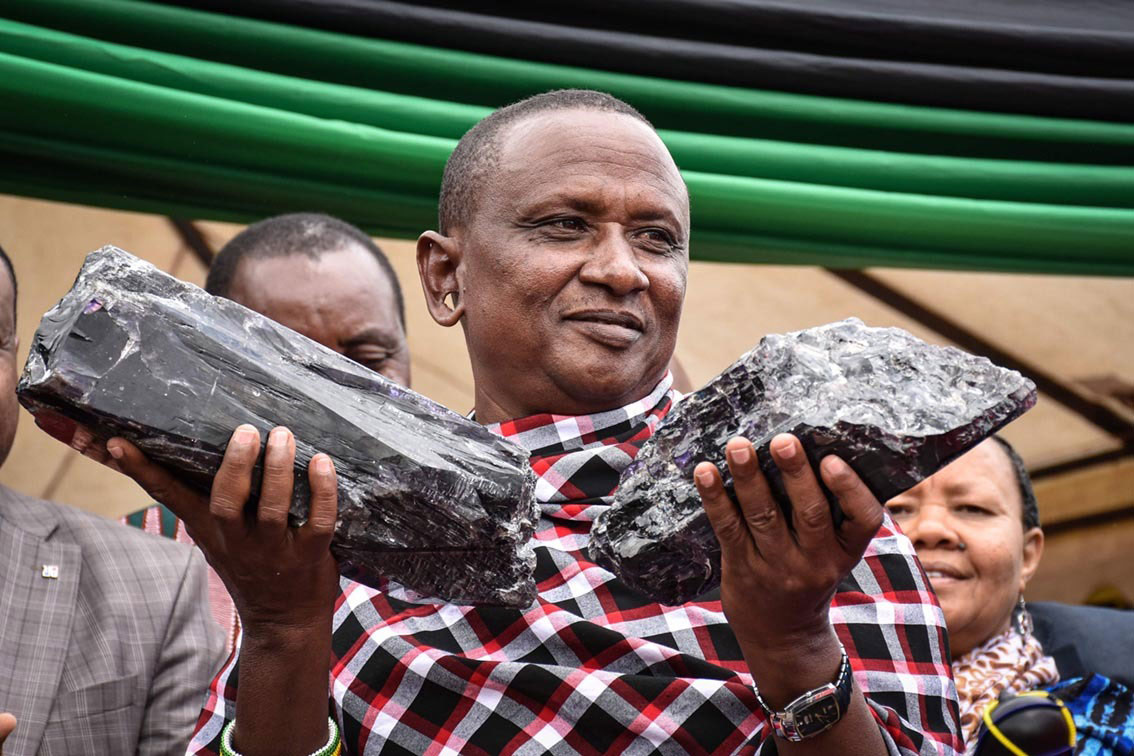
The £11m Gem of Tanzania hits rock bottom (Financial Times 01.10.09) – Gem exposed as a £100 fake,’ (The Independent 02.10.09)
‘It was once thought to be the most valuable jewel of its kind in the world,’ writes Chris Green (The Independent), ‘an enormous uncut ruby worth £11m with a history so murky that one of its former owners declared it to be cursed’ [TA No. 94]. Extract continues: ‘[T]he so-called “Gem of Tanzania”,’ according to Hatton Garden jewel dealer Marcus McCallum, ‘has been revealed to be little more than an expensive paperweight. The 2.1kg (4.6lb) rock is now believed to be a large lump of anyolite, a low-grade form of ruby, with a value of just £100. . .’ The Independent’s editorial section sums up by saying: ‘What better emblem could we have for these turbulent times than an asset that can go from almost priceless to worthless overnight?’ – Thanks to Rev’d Canon David M. Main, a new reader of TA, and David Leishman for these items.

Gone are the days when EA was divided by a common language – The East African 14-20.09.09
The overall theme of Joachim Buwembo’s article, published in The East African’s Opinion section, is concerned with East African integration. The writer spoke of ‘gate crashing’ a retreat in Arusha, where ‘captains of Tanzania’s media industry discussed . . . the prospects of Kiswahili in the digital era……The media moguls . . . were all in agreement that the Swahili language must change with the times to continue to serve the region and continent. . . [They also] agreed that the Swahili options on the Internet search engines and key Microsoft programmes (sic) only exist in textbooks and are definitely not what the users, who are mostly young people, use. They further agreed that all versions of Swahili, from Kenya to Congo, are valid and should not be denigrated just because they are not the “pure” Tanzanian version. ‘They generally viewed as unfortunate and outdated the tendency to laugh at the Kiswahili spoken by other people from the East African region.’

Maasai evicted and imprisoned to make way for safari hunting concession
– Survival Online News & Media 20.11.09
Extract: ‘ Eight Maasai villages in the Loliondo region of Tanzania have been burnt to the ground, leaving 3,000 people without food, water or shelter.
On 4 July, heavily armed Tanzanian riot police set fire to Maasai homesteads and food stores to evict them from their ancestral land. Thousands of Maasai are now destitute with their cattle in acute drought conditions. They are forced from their villages to create a game hunting area for the Otterlo Business Corporation (OBC). One Maasai said, “Today our land is being taken for investment: luxury tourist hunting.”
‘. . . [OBC] is reportedly linked with the United Arab Emirates royal families and has held exclusive safari and hunting rights in Loliondo, northern Tanzania since 1992. . . In 2007, the Hadza [community] narrowly escaped eviction from part of their ancestral land following Tanzania UAE Safari Ltd’s withdrawal from its hunting concession in the Yaida Valley after pressure from Hadza, indigenous organisations and Survival.’ Also see ‘Ancestral land-grab’ in this issue – Editor.

Mandala hominid footprints puts Tanga on world map – The East African Magazine 07-13.09.09
‘[A] group of conservationist[s] and filmmakers stumbled upon the footprints [of] what is now known as the Mandala Hominid, believed to be more than 1.5 million years old in Tanga region. The discovery was made on April 8 [2009] by a team led by Prof Edward Gerry Mgema, an explorer with the National Historic Documentary Films Production unit.’
‘The footprints are pressed into an ash layer, presumably from the nearby Oldonyo Lengai (an active carbonite volcano).’ ‘Samples of the ash have been collected for date analysis and results will not be known until late October or November [2009].’

Multiparty politics, same old one-party dictatorship
– East African 10-16.08. 09
According to freelance journalist Karl Lyimo, ‘[T]he multiparty political system is more of a bane than a boon for Tanzania and its people. . . [M]ultipartyism has not worked for the country in bringing about broader bona fide democracy and socio-economic cohesion.’

The article continues by giving a brief history of the development of Tanzania’s party political process, and then says, ‘After more than a generation of single-party politics, president Ali Hassan Mwinyi (1985-95) established the Justice Nyalali Commission in February 1991. It found that only 20 per cent of Tanzanians polled wanted multipartyism. Nonetheless, the government legislated single-party politics out of existence in 1992.

‘. . . [M]ulti-partyism has not succeeded. It has resulted in continued and suffocating single-party dictatorship and unnecessary socio-economic strife, albeit low-key. In the event, the same old party has dominated and dictated political, social and economic matters since Independence.’ In 1995 CCM won 59% of the votes cast. In 2000 this rose to 66%, and in 2005 CCM won 70% of the votes cast.

Lyimo ends by saying, ‘If this is what multipartyism means on the ground, give me benevolent dictatorship anytime. We could then leave out the electoral tensions, extravagance and flagrant politiking and concentrate on socio-economic development and nation-building.’

‘Have you seen the president’s new suit?’ – East African (Aug 31-Sep 6, 2009)
According to the writer John Kariuki: ‘Classy dressing is seen as central to the persona of a president . . .’ In his article, Kariuki compares the dress style of Tanzania’s current president, Jakaya Kikwete, with that of the deceased former president, Julius Nyerere. ‘While the late Nyerere’s dress sense reflected the humility of the working class, Kikwete is clearly a symbol of the capitalism that Tanzania now embraces.’ The article continues to comment on the dress sense of Kenya’s President Mwai Kibaki, whose ‘wardrobe has not changed much since his days as a finance minister,’ and Uganda’s Yoweri Museveni, who ‘wears his hat like a Mexican bandit in cowboy movies.’ When it comes to style, Kikwete easily tops his East African counterparts, being described as the region’s ‘best dressed head of state.’

The Times Obituaries (18 Aug 09) included a reflection on the illustrious career of Rear- Admiral Sir David Haslam: ‘Naval officer who, after the war, specialised in survey work and rose to serve as a respected and effective Hydrographer of the Navy.’
While [in command of HMS] Owen off East Africa and the Seychelles, he participated in the International Indian Ocean Expedition, which provided evidence for the theory of continental drift and tectonic plates. In January 1964 Owen rescued 180 women and children from the bloody Zanzibar Revolt in which thousands of Arabs and Indians were killed. For this Haslam was appointed OBE.’ Thank you John Sankey for this item – Editor.

Dar finally fetes its World War heroes – East African (10-16 Aug 09)
‘Tanzania has finally recognised the heroes of the Second World War for their service, half a century after that great conflict ended. The move makes Tanzania the first East African Community state to register, recognise and honour the veteran soldiers who fought in the colonial forces in many parts of Africa, Asia and Europe. . ‘[T]he government has decided to take over the responsibility for the veterans and to find a way to make their lives better, but they did not say how much money has been set aside . . . for the exercise. . .’ Those whose names will appear on the register include ‘members of the King’s African Rifles and the 6th (Tanganyika Territory) Battalion. . .
Existing records relate to 1,132 veteran soldiers. . . Currently, the registered veterans receive a small allowance from Britain. . . The money is paid out by a charitable foundation, the London-based Royal Commonwealth Ex-Services League, which looks after 65,000 ex-servicemen registered in 47 Commonwealth countries, including Tanzania.’

Training Community Animal Health Workers – Bó Vine (Autumn 2009)
This item, published by the Irish charity Bóthar, is about assisting the building of a sustainable community animal health service in North East Tanzania. ‘The privatisation of parts of the Agricultural sector in Tanzania has led to the near collapse of veterinary practice in rural areas, especially where the poverty of the farmers means low pay for any prospective vet in the area . . . [which] has led to an overall increase in disease and decline in the productivity of the animals in rural areas. . . . The aim of this project is to reverse that trend and build an affordable and self sustaining basic animal health service managed by the rural communities themselves. Currently, 90 community members are being trained in basic animal health to serve 100 villages in Tanzania’s north east region. Thank you Ann Moriyama for this item. Ann would be interested to know if anyone else has heard of this initiative? – Editor.

Saving the lives of older women branded as witches
Help The Aged magazine (Autumn 2009) ran an appeal to ‘help save women branded as witches’. According to a featured article updating readers on the organisation’s current project: ‘When anything goes wrong in remote villages in Tanzania, the older women in the community are terrified. Local people often hold them responsible for outbreaks of sickness, deaths or just bad harvest. Even their red eyes – caused by a lifetime of cooking over smoky wood fires – can be enough to brand them as witches.’ Thank you Wendy Ellis for this item – Editor.

Comments

TANZANIA IN THE INTERNATIONAL MEDIA

Compiled by Donovan Mc Grath

After a Severe Birth Injury – New York Times 22.03.09

This article described the distressing pain and suffering experienced by Sarah Jonas and Mwanaidi Swalehe, two teenage girls hospitalised in Dodoma after developing ‘an internal wound called a fistula, which left them incontinent and soaked in urine.’ The young women are hoping surgeons can repair the damage caused by difficulties during childbirth.
Extract: ‘Pregnant at 16, both had given birth in 2007 after labor that lasted for days. Their babies had died, and the prolonged labor had inflicted a dreadful injury on the mothers.’
The article continues: ‘… Dr. Jeffrey P. Wilkinson, an expert on fistula repair from Duke University in North Carolina, noted that women with fistulas frequently become outcasts because of the odor… Fistulas are the scourge of the poor, affecting two million women and girls, mostly in sub-Saharan Africa and Asia – those who cannot get a Caesarean section or other medical help on time. …’ Thank you Liz Fennell for this article – Editor.

Bi Kidude book review – East African 13.07.09

A review of a book about Fatma Bint Baraka, popularly known as Bi Kidude, was published in The East African (13 July 09). The reviewer Mohamed Said says: ‘Bi Kidude needs no introduction to the people of the East African coast, from Lamu in Kenya to Lindi in Tanzania and beyond. This is the region where taarab music is a popular part of Swahili culture.’
Extract continues: ‘In this predominantly Muslim society, where elderly people are expected to live their last days in pious seclusion, the 80-year-old Bi Kidude wears make-up, enjoys a drink once in a while and still mounts the stage in packed concert halls in Zanzibar and abroad…. This book is an encyclopaedia of the life and culture of Zanzibar people… The book moves with ease from one epoch to the other, introducing readers to the “Zanzibar enlightenment” when young people were first exposed to Western dance, music, and cinema for entertainment.’

Borderless competition – African Report No 18 (Aug-Sep 09)
‘Borderless competition: The arrival of East Africa’s common market next year will be the first step to much more open trading in the larger Comesa [Common Market for Eastern and Southern Africa] region; winners and victims are already getting ready’, reads the headline to this business article
Extract: ‘Even when tariffs strike zero on 31 December, a host of non-tariff barriers will persist, entrenched by vested interests. Much of the trouble is coming from Tanzania, where the authorities do not recognise harmonised regulatory standards already written into law. On the whole, Tanzania has been far more resistant to integration than any other EAC member. As its socialist past and lack of English-language training has kept Tanzanian businesses from becoming as competitive as those next door; fear of being overrun runs deep. It is questionable whether Tanzania will go forward with the EAC – it has until the end of 2009 to opt out.’

‘Expenses culture has high cost for world’s poorest nations’ – Financial Times 30.07.09.
Extract: ‘In Tanzania, one African country with a relatively well established if slow public sector, the problem is not simply corruption. It is a form of institutionalised, legal time-wasting that is endemic in the region . . .
‘At its root is the culture of the “per diem”, the daily payment made to officials attending meetings and conferences that is nominally designed to cover the costs of travel, food and accommodation… All too often [per diems] are a rational way for individual, underpaid and neglected civil servants to make ends meet, while doing little to help achieve any objective.
…The whole system rewards people on outputs not outcomes.’ Thank you Leocardia Tesha for this item.

Indonesia & Tanzania Illegal Logging – Developments 12.01.09
Indonesia-based NGO PT Triton and UK-based Environmental Investigation Agency (EIA) worked together with the Moi people in West Papua, Indonesia to express outrage at the environmentally disastrous logging activities proposed for their district. The result was an 11 minute film, The Tears of Mother Moi, screened at the Bali climate change conference and an instant Internet hit. The idea is to give local people a voice to express their thoughts and concerns over their – and our – environment.
Extract: ‘EIA is now taking its unique brand of training and empowerment to … Tanzania … As in Papua, illegal logging is a serious problem. With 33 million hectares of forest land (about 40% of the country), Tanzania is one of the most heavily forested countries in east Africa – but up to 500,000 hectares of forest are disappearing every year, up to 90% of it illegally felled.
‘… EIA’s new project got off the ground [last] November with basic training for three Tanzanian partner NGOs. Eventually the training will cascade down to local communities which are being invited to participate.’

Malaria Resistance -Economist 11.04.09
This interesting article explained a new approach in evolutionary theory that may help fight malaria. Aside from insecticides, herb-based drugs and the possibility of a vaccine, ‘the traditional first line of attack on malaria, killing the mosquitoes themselves, has yet to have a serious makeover.’ This method has enabled resistant strains to evolve, consequently rendering chemical insecticides ineffective over time.
Extract: ‘The upshot is that discovering a way to retain the anti-malarial benefits of insecticides without provoking an evolutionary response would be a significant breakthrough. And that is what Andrew Read of Pennsylvania State University and his colleagues have done. They have rethought the logic of insecticides, putting evolutionary theory at the centre, instead of a simple desire to destroy the enemy…’ Dr Read started from the observation that it is old, rather than young, mosquitoes that are infectious. Only females can transmit malaria (males suck plant juices, not blood) but they are not born with the parasites inside their bodies. They have to acquire them from humans already carrying the disease, and that takes time… In theory, then, killing only the oldest female mosquitoes—those at significant risk of being infectious—could stop the transmission of the disease. Since these females would have plenty of time to reproduce before they died, the evolutionary pressure imposed by killing them would be much lower…
‘The model, which they have just published in the Public Library of Science, reveals that selectively killing elderly mosquitoes would reduce the number of infectious bites by 95% and that resistance to such a tactic would spread very slowly, if it spread at all, because mosquitoes vulnerable to a post-breeding insecticide would have a chance to pass on their vulnerable genes to future generations.
‘The problem, of course, is to find an insecticide that only kills the elderly… A trial involving spraying fungal spores on to bed nets and house walls in Tanzania, is being set up at the moment. If it works, it will be a good example of the value of thinking about biological problems from an evolutionary perspective. People will still get bitten, but the bites will be merely irritating, not life-threatening.’ Thank you Simon Hardwick for this item.

Michael Jackson Tribute – East African 6.12.07.
This tribute to Michael Jackson sought to vindicate the late ‘King of Pop’ for failing to perform in East Africa by emphasising his ‘special relationship’ with the people of the region. Reporter John Kariuki says, ‘His music and videos carry memorable clips of the region.’
Extract: ‘For instance, part of the footage on … “Earth Song” [Bad 1987] was shot at the Tarangire National Park in Tanzania…’ Moreover, the Kiswahili verse … “Nakupenda pia mpenziwe” … appears in “Liberian Girl” … Originally, “Earth Song” was to be filmed at the Amboseli National Park, but since it involved darting elephants, “The Kenya Wildlife Services would not allow it”…‘Tanzania was more flexible and the filming was done on its soil.’ MJ did visit Tanzania in 1992, but there were ‘negative claims that he constantly held his nose … because of the country’s foul smell,’ which was explained as just ‘a nervous gesture’ by Robert E. Johnson, writing for Ebony (May 1992). Apparently, this is why producer Quincy Jones nicknamed him “smelly”.

Portraits of Success – Sir Stuart Rose – Times Mag 23.05.09
Readers of this article would have discovered that Sir Stuart Rose, Executive Chairman of Marks and Spencer, has connections with Tanzania. In a report featuring portraits of today’s high-flyers posing in their work spaces, among numerous items in his office, Sir Stuart Rose has an African shield hanging over the window frame. In reference to the shield, he said: “I spent my childhood in Tanzania and have real affection for it. I helped build the Mvumi Secondary School there three years ago, and was made an honorary chief of the Wagogo tribe.” Thank you David Morgan for this item.

Register your sim card in Tanzania – East African 13.07.09
According to Joseph Mwamunyange ‘Tanzania has become the first country in East Africa to start registering cellular phone sim cards.’
Extract continues: ‘The move is aimed at curbing misuse and keeping track of the owners… The practice in Tanzania, as in other neighbouring countries, is for mobile phone subscribers to buy sim cards like any other commodity. This has led to abuse of the cards. But now, one will have to produce some form of identification before buying a sim card. Mobile phone users have until December 31 to register their sim cards, after which time all unregistered numbers will be deleted from the mobile phone system.’

Should it follow on the path of health or weather – BBC Focus On Africa (Apr-Jun 09)
This is the ethical dilemma facing Tanzania today. Reporter Anthea Rowan asks: ‘Should [Tanzania] turn away from tobacco production or continue to reap its economic benefits?’ An estimated 1.5 million Tanzanians depend on the cultivation of tobacco for their livelihood, so will the country’s health lobbies convince citizens that smoking is bad for health?
Extract: ‘True, since 2003 smokers can no longer light up in public places and the sale of cigarettes to those under 18 is banned. But the country is emerging as one of Africa’s primary tobacco producers and non-governmental organisations like the Tanzania Tobacco Control Forum (TTCF) want tobacco growing to be cut back in favour of alternative crops deemed more healthy…’ However, critics argue that alternative crops (i.e. export vegetables and paprika) suggested by TTCF are not ‘viable replacements since the tobacco-growing region of Tanzania lacks the necessary infrastructure to support the export of highly perishable crops like fresh vegetables which must have swift access to an international airport and cold storage facilities….
‘But what of the conflict between promoting a tobacco-growing industry and the responsibility to protect a population from smoking-related disease?’
The article ends by saying: ‘The reality is that tobacco remains a profitable crop. The shape of its market is changing – there are fewer smokers in the West but growing numbers across China and eastern Europe. Smoking – and its attendant health problems – is a choice. Poverty usually is not.’

Tanzania claims $58m war debt from Uganda – Uganda’s Daily Monitor May 09 (online)
Extract: ‘Thirty years since the Kagera war, Tanzania, which played a major role in liberating Uganda wants the paycheck for its contribution to the 1979 war that freed Uganda from Idi Amin’s leadership. According to the paper’s online edition, the bill sent to the Uganda government stands at $58m…’

Tanzania to solve murder by ‘ballot’- West Australian 07.03.09
Tanzanian police are continuing their efforts to stop the witchcraft-related murders of albinos. After issuing possible victims in Dar es Salaam with mobile phones and access to a ‘hotline’ using text messages (TA No. 93), the latest tactic is to ask ‘residents to write down murder suspects’ names and deposit them in ballot-type boxes.’ Thank you Douglas Gledhill for this article.

Tanzania rookie Thabeet now a Grizzlie in the NBA -East African 06.07.09

President Kikwete and Thabeet

President Kikwete and Thabeet


Extract: ‘Tanzania now boasts of the first ever international basketballer from the region to grace the world famous NBA, the US top basketball league. Hasheem Thabeet from Dar was on June 25 selected by the Memphis Grizzlies as the second overall pick in the 2009 NBA Draft in New York and will earn $11.5 million in the next three years…. Born on February 16, 1987 in Dar, Thabeet at 7ft 3in and weighing 119 kilogrammes is the tallest player ever to play for the Huskies. ‘He did not begin to play basketball until the age of 15, when he began to watch pickup games in Tanzania…’ Thabeet began playing basketball when he was in Makongo Secondary School in Dar es Salaam.’

‘The Gem of Tanzania. The strange journey of the “jinxed” jewel’ – Financial Times 28.03.09
Jonathan Guthrie and Samantha Pearson analyse the complex chain of ownership of the 2.1kg ruby known as the ‘Gem of Tanzania’. Trevor Michael Hart-Jones, a South African-born businessman living in Winchelsea, East Sussex, is said to be the most significant former owner of the gem. Extract: ‘Mr Hart-Jones, 66, bought the Gem in 2002. It had been discovered by Ideal Standards, a company mining near Arusha … in which he had invested. The company sold him the gem for R200,000, or about £13,000… ‘Mr Hart-Jones exported the ruby to the UK in 2002 … It then came into the possession of Cheshire-based businessman Tony Howarth .. David Unwin bought the ruby from Mr Howarth in 2006, through a land deal, valuing the gem at £300,000 … The gem was recorded at the same value on the balance sheet of Tamar Group [owned by Unwin] that year. It received a gob-smacking revaluation to £11m in 2007 after the takeover of Wrekin [Construction]…’
According to the FT, ‘Wrekin enters administration’ 10 March 2009, and the ‘Administrators take possession of the ruby’ ten days later. Apparently, were it not for the recession, no one outside of the chain might ever have heard of the ‘Gem of Tanzania.’

The push to get all children into school – Guardian 10.03.09
‘The push to get all children into school has seen spectacular successes for Tanzania,’ reports Jessica Shepherd. ‘But’, she adds: ‘with up to 70 pupils to a class, and global aid faltering in the recession, can progress be sustained?’
Extract: ‘… [According to the Tanzanian government], the country is well on its way to achieving universal primary education by 2015 … The ministry of education … states in its statistics book published in June that by this year “all children aged seven to 13 can be enrolled”… But look deeper than the official statistics and education in Tanzania is an altogether different story.’ In her report, Shepherd goes on to explain in detail the overcrowded, dank classrooms and the lack of adequate teaching resources seen in one of the country’s schools. There are also ‘hidden’ costs for parents – the article continues: ‘While primary school tuition fees have been scrapped, Tanzanian parents are expected to contribute to other costs, such as uniform, a cooker for lunch, the cost of the school guards and, in some schools, a donation to the Aids bereavement fund for pupils who have lost one or more parents.’
Towards the end of the article the reader is informed that: ‘In the 1980s, Tanzania almost achieved universal primary education, but it had accumulated a crippling debt burden and by 2000 the proportion of pupils enrolled for primary school had dropped to 57%.’ Thanks to Liz Fennell and Sister Lusia for this article – Editor.

Waiting for a great leap forward – Economist 09.05.09
Extract: ‘The country already gets 40% of its government budget in aid, but now it wants even more foreign cash to help it through the economic downturn…’ President Kikwete, who has been accused of ‘spending too much time burnishing Tanzania’s image abroad and not enough fixing problems at home’ … hopes that aid will keep Tanzania afloat long enough for its economy eventually to make a great leap forward.’ Thank you David Leishman for this item – Editor.

Our apologies to Alex Renton who was wrongly described in TA 93 as an Oxfam reporter. He is a freelance journalist and the piece we quoted from was commissioned by the Observer – Editor.

Comments

TANZANIA IN THE INTERNATIONAL MEDIA

Compiled by Donovan Mc Grath

2009 marks the third year of Jakaya Kikwete’s presidency in Tanzania. Elections are scheduled for October 2010 and Kikwete, whose popularity is not as high as it was a year ago, is widely expected to achieve a second and final five-year term of office. However, such optimism is not without its challenges. There is an impending Bill that approves the amalgamation of several rival parties, strengthening the opposition. Old allies, like former-prime minister Edward Lowassa and businessman Rostam Aziz, may also challenge the president. Lowassa, who was forced to resign after being implicated in a corruption case of which he claims innocence, is currently thought to be considering presidential ambitions. It is Kikwete’s ‘moves against high-level graft in government and the ruling CCM’ that has earned him rivals among former allies – Extract from THE AFRICA REPORT (No 14. Dec – 08 Jan 09): ‘The CCM will want to maintain the tradition of allowing the sitting president to serve a second term, but powerful cliques are fighting Kikwete’s determination to reinstate a leadership code of conduct that will forbid business people from holding office and running their private companies concurrently. If this pressure were to threaten his hold on power, the president could yet go after more high-profile politicians and bureaucrats accused of corruption.
‘Another area of pressure on Kikwete comes from Zanzibar’s main opposition party, the [Civic United Front], which hopes to force Zanzibar’s President Amani Abeid Karume and conservative ruling party members into a power-sharing government before the 2010 elections.
Karume reneged on an earlier deal to do so but now says a coalition could follow the next elections, after he steps down.’

Under the headline: ‘Africa’s hungry tribe’ (OBSERVER MONTHLY Dec 08), freelance journalist Alex Renton expresses the plight of the Maasai of northern Tanzania who are experiencing increasing hunger due to high-prices of staple food. Focusing on a Maasai family living close to Oldonyo Lengai, ‘God’s Mountain’, near Engaresero village, Arusha, the reporter explains how they have resorted to selling family heirlooms in order to survive.
Extracts: ‘…[B]eaded bracelets, anklets, necklaces and chokers in the white, blue and yellow of the Kisongo clan. Some were studded with discs of tin or silver. One Maasai woman was selling her inheritance: wedding gifts, pieces from her mother. All were for sale to the tourists…
She had to sell something, or the family wouldn’t eat that night… There were no animals healthy enough to sell, so to put food in their children’s bellies they had to sell jewellery or beg or borrow money.
‘The principal problem is the global price of food staples – driven up over the past couple of years by the international oil price and the demand for biofuels.’
…A 25kg container of maize grains, enough to feed a family of five for a week, costs up to Shs 10,000 (£5). That may not sound much – but it is nearly double what it was in January.
‘…The biggest problems, though, lie with the volcano, Oldonyo Lengai… When it exploded at the beginning of the year the displacement of people fleeing it also disrupted the food supply.’ – Thanks to Roy Galbraith for sending this – Editor.

Over 80% of the Tanzanian population is employed in the agricultural sector. Tanzania has approximately 44m hectares of fertile land, of which only 10.2m hectares at present is being cultivated. Therefore, it comes as no surprise that President Kikwete promises to invest heavily in agriculture. However, there is a major drawback as THE AFRICA REPORT (Dec 08-Jan 09) reported. Under the headline: ‘Roadblocks to Tanzania’s green revolution’, the reporters highlighted the difficulties faced by foreign companies who wish to invest in the country.
Extract: ‘Tanzania’s sugar industry […] has tripled following the privatisation of four government-owned producers in 1998, but in the last ten years there has been no new foreign investment in the sector. “I imagine that [the lack of investment] is because they [foreign investors] have not been able to find the land to set up a new project,” says Ashwin Rana, general manager of Kagera Sugar and chairman of the Tanzanian Sugar Producers’ Board. One producer, Kilombero Sugar Company, owned by South Africa’s Illovo Sugar, has been waiting to expand its production on a plot of 2,000 hectares to which it has been legally entitled since it bought its plantation in Morogoro ten years ago. There are villagers on the land and [the] government has been slow to relocate them or find a replacement plot. Illovo lost interest and in 2007 took the $200m it had earmarked for Tanzania and invested it in sugar plantations in Mali and Zambia.’

The lives of Albinos in East Africa, reports the ECONOMIST (17 Jan) are at risk from a ‘horrendous trade’. Tanzania’s Head of Police, in Dar es Salaam, distributed ‘free mobile phones to several hundred locals with albinism.’ Extract: ‘Each phone comes with a “hot line” to the police. Albinos text in their location if they suspect they are being tracked by gangsters determined to kill them and harvest their body parts. ‘According to the Tanzanian Albino Society, at least 35 albinos were murdered in Tanzania last year to supply witch doctors with limbs, organs and hair for their potions.’ This is not solely a Tanzanian problem as the killing of albinos has spread to Kenya, Uganda and Burundi. Thank you Simon Hardwick for this item – Editor

The WEST AUSTRALIAN (2 Dec 08), under the headline: ‘100 years ago: Antediluvian Monsters’, published a short article about an important archaeological discovery made in Tanganyika during the early period of German colonial rule: ‘The German Government is sending an expedition to investigate the remains of gigantic antediluvian animals discovered by Professor Fraas in the southern portion of German East Africa. The bones of the hind leg of one animal are 11½ feet long, while the spine is a third longer than that of any animal yet discovered.’ Thank you Douglas Gledhill for sending this item – Editor

‘Game hunting in Tanzania has over the years become a well-established industry and an important source of income for the government,’ writes Mike Mande for the EAST AFRICAN (19-25 January). There are 54 licensed hunting companies operating in the 158 hunting blocks located in the game reserves across 42 districts. This is an increase of the 1988 accounts that stated there were only 21 hunting firms and 128 hunting blocks during that period.
Between 2004 and 2007, Tanzania earned $48m from game hunting. The country’s game fees for each animal hunted are charged according to species. ‘For example, [the] fees for shooting an elephant can be as high as $20,000 while baboons are only charged $110; birds range around $30 each…
‘Minister for Natural Resources and Tourism Shamsa Mwangunga said that 25 per cent of the earnings from hunting fees and licences go to the villages of the area where hunting takes place through the respective district councils. This money, according to Mrs Mwangunga, “is used to provide social services…‘The government sees the policy of 25 per cent contribution to district councils as part of its poverty alleviation effort.’

A recent letter to the Editor of TANTRAVEL brought readers’ attention to the poor state of the materials documenting slavery that are held in the Roman Catholic Museum at Bagamoyo.
On a recent visit, the historian Jeffrey A. Homburg noticed that much of the material (documents, photos, and artefacts) ‘is fast being destroyed by light, and heat … The labelling is also very poor and includes errors.’ The historian calls for outside intervention: ‘This is a World Heritage collection, and some action should be taken immediately to save it from oblivion.’ Thank you Liz Fennell for sending this item – Editor

Abdulaziz Y. Lodhi, the distinguished professor at Uppsala University, Sweden, wrote an interesting article in HABARI (Journal of the Sweden-Tanzania Society. Issue No 1, 2009) on the impact of Arabic on the Swahili language. His main argument: ‘Arabic in East Africa has minimal formal and academic recognition in spite of its historical predominance on the East African littoral and the rim of the Indian Ocean in general.’ Lodhi begins with a brief historical background on the status of Arabic, Swahili and English in Zanzibar and Tanganyika during the colonial era.
Extract: ‘…In 1890 when the Sultanate of Zanzibar became a British protectorate, Arabic had been the sole language of administration commerce, diplomacy, education, and liturgy in Muslim East Africa. Swahili gradually replaced Arabic in many fields during the 30 years of German occupation of Tanganyika, but after the First World War and the British takeover of Tanganyika, English was formally encouraged and spread there at the expense of both Arabic and Swahili.’
The article then briefly discusses the historical context of Arabic as a medium of instruction in Zanzibar where its use fluctuated according to colonial and post-colonial government policies, and then noted that Arabic, the spiritual language of the Muslims, which ‘is also the “Latin” of Swahili … is included in neither the programs of the Institute of Kiswahili Research (IKR), nor the Department of Kiswahili and African Languages at the University of Dar es Salaam. Only an extramural course is occasionally offered at the Institute of Adult Education in Dar es Salaam, but at the university, no graduate course in Arabic is offered. This is despite the fact that approximately 42 percent of Swahili vocabulary is of Arabic origin.
Towards the end of the article Lodhi restates his argument by saying: ‘there is an abundance of Arabic grammatical or structural loans in Swahili, which the other languages of East Africa borrow freely from Swahili…Arabic continues to make important contributions to the development of the modern Swahili lexicon, and indirectly the lexicon of other East African languages…However, it is English which is the largest language contributor to East Africa today, but its contribution is limited to nominals belonging primarily to the fields of modern technology and science.’

Disney returns to the genre of wildlife films on the big screen after an absence of almost fifty years – THE OBSERVER (11 Jan) wrote about The Crimson Wing, scheduled for UK release in the autumn, which highlights the plight of 1.5m flamingos that feed and breed on the shores of Lake Natron, a shallow soda lake at the foot of Ol Doinyo Lengai (Mountain of God). It is believed that a new soda ash mine, proposed by the Indian conglomerate Tata Chemicals, would be disastrous for the wildlife around the lake. Thank you Liz Fennell for sending this item – Editor

‘A new sweetened malaria drug for children will be introduced in Tanzania early [2009] after official approval from the Tanzania Food and Drugs Authority (TFDA)’, writes the EAST AFRICAN (Nov ’08) Special Correspondent Mohamed Issa.
Extract: The tablet has a pleasant taste and speedy solubility, which eases administration for malaria’s youngest victims…
‘Malaria kills almost one million people each year, mostly children. The World Health Organization (WHO) says that of all malaria-related reported deaths, nearly 85 per cent are in children 5 years old and younger.’ The introduction of this latest ant-malarial drug is due to the fact that ‘many young children cannot swallow whole tablets and crushing them is an inefficient procedure.’ This latest drug in the fight against malaria is described as: ‘The new sweetened, fruit-flavoured Coartem dispersible anti-malarial tablet …’

January’s edition of NEW AFRICAN published an interesting article that connects Tanzania, USA and Russia through the life of Lily Golden. Golden, who is described as a Russian African-American professor of history, has an extraordinary family background, which includes African, Native American, Jewish and Russian ancestry. Born in Tashkent, capital of Uzbekistan, in 1934, Golden is the widow of Kassim Hanga, the Zanzibari nationalist who became one of the masterminds of the 1964 Zanzibar Revolution. The couple met in Moscow in 1957 and married three years later when he returned to the Russian capital to study economics. Hanga was a parliamentarian in the pre-independent Zanzibar Sultanate, then a British protectorate. During the coup he was appointed vice-president of the “revolutionary” government. He later became minister for union affairs in the interim union government of Tanganyika and Zanzibar following the merger between the Republic of Tanganyika and the People’s Republic of Zanzibar on 26 April 1964. 10 years ago, their daughter Yelena, a Russian TV-star, went on a trip to Zanzibar to discover her family roots and met her paternal grandmother among scores of relatives.

Lymphatic filariasis (LF) is a disease that affects poor people in Africa, India, South America, South Asia and the Pacific. Mandy Turner, writing for the GUARDIAN (24.11.08), reports on its sufferers in Tanzania. Its painful and debilitating symptoms include fevers and grotesquely swollen limbs.
Extract: ‘While malaria can be contracted from a single bite, LF needs hundreds of bites from mosquitoes infected with male and female worms, which must enter the victim’s body, find each other and mate. An estimated 120 million people [worldwide] have the disease – around 40 million have been severely incapacitated and disfigured by it. Disturbingly, a further 1.3 billion are at risk of infection.’
‘One-third of people infected … live in Africa … There is no cure for LF; the damage done to the lymphatic system is permanent …. The pathogenesis of the drug is still not fully understood. But there are drugs that can break the cycle of transmission …’
Ten years ago the World Health Organisation (WHO) launched the Global Programme to Eliminate Lymphatic Filariasis based on a two-drug, once a year of at-risk communities. The WHO recommends a minimum of five rounds, before mass drug administration can be stopped.’
The Guardian reporter interviewed LF sufferers from various parts of Tanzania, an LF endemic country, where there is a concerted effort to eliminate the disease. President Kikwete has ‘launched a campaign to raise a further Shs 500billion (£250,000).’ Thank you Roy Galbraith for sending this item – Editor.

‘More refugees leave as UN, Tanzania closes camps’ reads the headline in THE EAST AFRICAN (January 5-11). Tanzania’s Burundian refugees (TA No 92) are continuing to return to their homeland as the peace process between major rebel forces and the Burundi government enters its final phase.
Extracts: ‘The long wait to return home by Burundians who fled to Tanzania to escape ethnic conflict is finally coming to an end, with the last camps closing down. As of January 2009, only a single camp hosting less than 50,000 refugees will be left …’ Approximately 165,000 Burundians have expressed their wish to stay on in Tanzania by submitting their applications for citizenship.

Comments

COMIC RELIEF & THE APPRENTICE

Comic Relief Team

The Comic Relief Team

The Comic Relief team of pop-stars, DJs and television presenters including Chris Moyles, Ronan Keating, Gary Barlow, Wearne Cotton, Denise Van Orton, and Cheryl Cole who recently climbed Mount Kilimanjaro, raised some £1.6 million for the charity, which supports many causes including some in Tanzania. But, according to the Independent (March 13th) they needed an army of helpers to get them to the top. There were some 33 climbers, two doctors, 100 porters, and two runners plus a detachment of security guards. Half a ton of broadcasting equipment, several open-air latrines and an awful lot of soup also had to be carted up the mountain. Weather conditions, which saw temperatures reach 30°C by day and minus 15°C by night, meant that as they neared the summit, each of the climbers was swathed in four pairs of trousers, six fleece tops and a balaclava. They had to cope with 75 miles per hour winds and extreme cold. Thank you Elsbeth Court for sending this – Editor.

Mona Lewis

Mona Lewis, contestant in ‘The Apprentice’

The latest series of the very popular BBC TV programme ‘The Apprentice’ had a Tanzanian angle. Joseph Kilasara sent us this in mid-April when the contest was in full swing:
Mona Lewis, a former Tanzanian beauty queen is flying the Tanzanian flag sky-high in the award winning TV show now in its fifth run – “The Apprentice”. For three weeks running she has proven by a long mile to be a strong candidate for our next best Ambassador at large. One can only bet that her next date in Tanzania will be at Magogoni Street in Dar es Salaam for the country to say thank you for doing us proud.
Hailing from Arusha, Mona was born in Karachi, Pakistan and is now living in Sittingbourne, Kent. She was a runner up in the 1996 Miss Tanzania beauty Pageant. The ex-Natwest Customer Advisor is reportedly to be honest, self driven and with a positive attitude summed up in her own words; “Having the ability to drive a dead horse to the winning line”.

Sadly, in this show Tanzanians and friends in UK cannot vote to influence the one man as hard to play as Stradivarius – Sir Alan Sugar, but in Ms Lewis we have reason to be confident confident that she will stay long enough to hear the famous phrase: “You are hired”.

Comments

TANZANIA IN THE INTERNATIONAL MEDIA

An editorial in the Kenyan newspaper THE NATION (October 21) quoting from the Tanzanian paper The Citizen wrote: ‘Hardly a day after President Kikwete called for a crackdown to stem the killing of albinos another horrendous case was reported. An albino girl was on Sunday night slain in Kahama, Shinyanga. It’s not surprising that the story has gone all over the world. The international community is rightly puzzled about the madness that has befallen our country. That the killers stormed the Standard Three pupil’s home, killed her and chopped off her body parts before the very eyes of her terrified parents, speaks volumes about how cruel and inhuman these criminals can be. Serious measures must be taken now to stem the killings. Police cannot be everywhere, but the wananchi can. We should unite to fight the primitive acts by criminals driven by senseless superstition’ – Thank you Keith Lye for sending this – Editor.

Tanzania has a large population of refugees from neighbouring countries and London’s GUARDIAN WEEKLY REVIEW (September 26) devoted a piece under the headline: ‘Last of the exiles return’. Extracts: ‘Peace has now returned to Burundi, and many who fled 30 years ago are returning home. 85-year-old Michael Bihonzi is among many who fled the ethnic massacres that started in 1972 and which consequently left up to 200,000 people dead, reports Xan Rice. Bihonzi, who found peace and safety in a Tanzanian refugee camp, climbed on board a truck with 23 of his children and grandchildren, and headed across the border with a cash grant of $40 from UNHCR, the UN refugee agency that is managing the repatriation effort. ‘More than 450,000 refugees have already returned. Now, with the last active rebel group in Burundi showing willingness to lay down its arms […] Tanzania has decided to close its remaining refugee camps near its western border.’

In an exclusive interview, AFRICA REPORT (October-November) asked Tanzania’s President Kikwete some pertinent questions regarding the country’s economy, the fight against corruption and, as he is currently chairman of the AU, his thoughts on democracy in Africa. The paper wanted to know why ‘statistics on malnutrition and sanitation remain appalling’ even though ‘Tanzania has a record of sustained growth and investment’? The President explained that ‘the huge investment’ Tanzania has made is just ‘beginning to translate itself.’ A sustained economic growth [7%] over a period of ten years will double the country’s GDP. ‘We are now seeing the result of that. It is close to $20bn from $15bn seven years ago.’ In a brief explanation of Tanzania’s economic history, the President said there was a time when there were empty shelves in the shops, which were then owned by the state. However, with the start of the economic reforms in 1986, under the leadership of President Ali Hassan Mwinyi, the economy began to turn around. Mwinyi allowed anyone who had the money to bring goods into the shops. “We came from very difficult beginnings, to the extent that if today somebody preached socialism, we would think he must be crazy.”

In a report published in THE EAST AFRICAN (October 13-19) Tanzania has opposed the consensus reached by Uganda, Rwanda, Burundi and Kenya that residents in one of the partner states can acquire land in another, saying that it is too early for the country to fully open its lands to other East Africans. One of the barriers to committing to the acquisition of land seems to be Tanzania’s land tenure system which declares that ‘all land is publicly owned by the head of state in trust for the whole nation with different legal regimes applying to rural and urban areas.’ “In Tanzania, you must have big investments to acquire land,” said Barack Ndegwa, a director in the Kenyan Ministry of EAC Affairs. It should be noted that Tanzanian negotiators declined to speak to the East African. Apparently, language sparked off another disagreement. According to Edith Kateme, Burundi wanted “access” to lands in the five-member states whereas Rwanda insisted on the word “acquire”. Kenya and Uganda opted for “may access”. There was hope that the issue could be resolved during the meeting in Zanzibar in November.

‘Now make way for us”. [Norway learns:] ‘A lesson in sustainability from Tanzania’, reports the economist Michael Fergus in HABARI, the journal of the Sweden-Tanzania Society. Fergus’s article debunks the ‘persistent, and very depressing myth that much of the infrastructure built in rural Africa in the 1970’s and 1980’s financed by the West, turned to dust, as soon as the donor left.’ A study (published in November 2007) of the water and sanitation schemes in Tanzania and Kenya, supported by Norwegian development aid, gives a complete lie to this myth. It shows that between 70% and 90% of the schemes built between 20 and 30 years ago are still working well. To the surprise of donor agencies, villages in the remote Tanzanian regions of Kigoma and Rukwa, in the spirit of kujitegemea, self-reliance, have managed to maintain a high percentage of water aid investments without assistance from the Tanzanian government.

The EAST AFRICAN (18th August) reported on a new export market being developed in the East Usambara mountains in Tanga region. Under the ‘Amani Butterfly Project’ insects are exported to the UK, USA, Switzerland, France and Germany. Depending on the species, butterfly pupae are sold for between $1 and $2.50 each. On arrival at their destinations they are cultivated in butterfly houses which charge fees to tourists wanting to see tropical butterflies flying under glass roofs. Since 2003 the project has paid more than $70,000 to butterfly farmers.

Columnist Melanie Reid informed readers of THE TIMES (May 26) of the disturbing plight faced by Tanzanian escorts (guides and porters) who accompany some 25,000 Western tourists on their quest to climb Africa’s tallest peak, Mt Kilimanjaro. In stark contrast to their Nepalese counterparts, working on Mt Everest, who are well-fed and well-clothed and who are now ‘recognised and recompensed for the unique skills they offer the developed world at play’, Tanzanian guides are extremely low-paid and ill equipped by the companies that organise the lucrative trips. According to Reid, ‘Up to 20 guides and porters die on Kilimanjaro every year[…] These young men exist in a ruthless free-market economy vying with each other for the jobs, and risking their own health with enforced lay-offs and lack of proper re-acclimatisation,’ says Reid. Porters (who carry 20kg packs containing water, food, firewood and the tourist’s possessions) earn $3 a day; guides up to £10. ‘Allegedly,’ says the columnist, ‘some companies do not pay their staff any salaries at all, but let them rely on tips.’ – Thank you John Sankey for sending this Editor

Several international media (including BBCSwahili, and MSNBC) reported the ceremonies held in Kenya and Tanzania in memory of the victims of the al-Qaeda bomb attacks on the U.S. embassies in Nairobi and Dar es Salaam. The attacks, which took place on August 7, 1998, killed over 200 people and wounded 5,000.

On Thursday 2nd October, FOXNEWS.com wrote under the headline: ‘Dance Turned Stampede Kills 20 Children in Tanzania’. Extracts: ‘At least 400 children aged 5 to 13 were inside the hall in the town of Tabora when the stampede occurred. [The children] were dancing to English and Kiswahili songs [while they celebrated] the Islamic Eid al-Fitr holiday.’ Police Commander Daudi Siasa said, “The children were trapped inside the hall, which has a capacity to accommodate maximum 200 people, but the number was more than double inside at the time.” President Kikwete sent condolences to the children’s families and dispatched a senior cabinet member to investigate.

In its ‘Country Profile on Tanzania’ by Walragala Wakabi in October the NEW INTERNATIONALIST awarded star ratings to various aspects of Tanzania today. In income distribution it awarded three stars, for life expectancy two, literacy three, freedom five (‘a thriving and powerful media and civil society’) and for its treatment of sexual minorities one star. On the latter it wrote: ‘Homosexuality is illegal; new laws have criminalised lesbianism and same sex marriage is punishable by imprisonment for seven years.’ On President Kikwete it wrote that he had maintained the neo-liberal and pro-privatisation policies of his predecessors….. but he had pussy-footed about the lingering issue of the relationship between mainland Tanzania and Zanzibar which feels marginalised and wants greater autonomy – the rising friction between the two has become a threat to what has hitherto been among the most politically stable countries on the continent’ – Thank you Sister Lucia for this – Editor

TZUK NEWS (September-October) published a story written by Gloria Mutahanamilwa about Boniface Hima (25) who is training to be in the British army where he hopes to be working as a Royal Engineer. Extracts: Hima is a born again Christian and I asked him how he mixed his strong Christian beliefs with a job in the armed forces. He replied: “If you read the Bible, there were wars and killings and God didn’t condemn Moses when he killed and buried someone with his own hands. He went on to say that if he were asked to go to the front line nothing would stop him as he had taken an oath of allegiance swearing to be faithful and bear true allegiance to Her Majesty Queen Elizabeth and her heirs and successors.
Boniface
Royal Engineer Boniface Hima (photo courtesy Mr & Mrs B.Hima)
He is enjoying every minute of his training and is encouraging other ethnics to join. The writer concluded: “I am left with one big question. If Tanzania and the United Kingdom should ….where would his allegiance lie?”

Who owns Obama? was the question posed in the EAST AFRICAN on November 10. Everyone knows that Kenya owns half of him but, according to the Tanzanian ‘Weekend African’ Obama is actually a quarter Tanzanian. The president-elect’s grandmother on his father’s side, the paper claims, hailed from Kowak village in Tarime District close to the border with Kenya.

Comments

OLYMPICS

 Tanzanian athletes at the Beijing opening ceremony

Tanzanian athletes at the Beijing opening ceremony

The Minister for Information, Culture and Sports, George Mkuchika led Tanzania’s Olympic squad to Beijing. The team comprised eight runners and two swimmers, including marathon runners Samson Ramadhani, Msenduki Mohamed and Getul Bayo. Samuel Kwaang, Fabian Joseph and Dickson Marwa were due to compete in the 10,000 metres, Samuel Mwera in the 800 metres, and the only lady athlete, Zakia Mrisho, in the 5,000 metres. The swimmers were Magdalena Mushi and Rushaka Khalid who featured in the 50 metres free style.

The national athletics team left for Beijing with some uncertainty hanging over the sponsorship of Chinese sportswear manufacturer Li Ning. AT had preferred the use of Li Ning equipment but the Olympic Committee ruled that the team should use those provided by German sportswear manufacturers Puma. This issue of TA goes to the press before the running events have taken place.

Tanzania has won only two Olympic silver medals since she started taking part in the Games. The medals were won by Filbert Bayi in 3,000 metres steeplechase and Nyambui in 5,000 metres at the 1980 Olympic Games in Moscow, Russia.

Comments

HYENA SQUARE

R&B superstar Kelly Rowland, formerly of Destiny’s Child, visited Dar-es-Salaam in June to present an MTV Staying Alive Foundation award to a former Tanzanian sex worker named “Eliza” who is now working to save the lives of her former peers. Ms. Rowland is MTV’s 2008 AIDS Awareness Ambassador for the Staying Alive Foundation.

The Staying Alive Foundation and the Tanzania Marketing and Communications for AIDS, Reproductive Health and Child Survival (TMARC) project both provide small grants to support local projects that reach people who are particularly at risk for HIV infection.

Eliza’s Sad Beginnings
Eliza was born in Iringa, and her father abandoned her mother and the family when Eliza was just a baby. When she was 12, her mother “sold” her to a family in Dar-es-Salaaam to work as a house girl. One day when Eliza was 14, the wife of the family went out, and Eliza was brutally raped and beaten by the husband. Bruised and battered, Eliza went to the police station to report what had happened to her, but the police refused to open the case without a bribe. As Eliza was leaving the police station, the wife and husband arrived and claimed that Eliza had been stealing from them, and Eliza was thrown in jail for six months.

After being released from jail, Eliza found her way to Uwanja wa Fisi (Hyena Square), a poor neighborhood in Manzese notorious for alcoholics, addicts and prostitutes. There Eliza met a young woman who invited her to stay in a guesthouse where she lived, and subsequently taught Eliza how to sell her body to men. Eliza managed to live and work under those circumstances for about four years, avoiding the drug use that felled many of her peers.

Despite the horrors of Hyena Square, Eliza had good moments. She cherishes a photo album chronicling a few happy times hanging out with friends. When Eliza shows that album now, she points out all of her friends who are gone – dead from AIDS, malaria, drug overdoses, or the many other diseases and afflictions that are associated with living and working in impoverished conditions. Along the way, Eliza tested positive for HIV. She was devastated at first, but eventually realized that she could live a healthy life by taking care of her health and taking the appropriate drugs.

The Light at the End of the Tunnel
One day, Eliza met some outreach workers from a local organization that had started a counselling booth for people in Hyena Square. She was inspired and started visiting them everyday, and eventually they invited her to join them in their rescue house. Eliza left her room in the guesthouse, started to think about her future, and before long was in the counseling booth, reaching out to her former colleagues with advice on how to escape the lifestyle and start over.

Now in her early 20s, Eliza serves as a role model for many young girls. The Staying Alive Foundation is funding her return to her home region of Iringa, where she will work with young women and their parents to help them understand the consequences of sending their daughters to be “house girls” in Dar es Salaam. She is also educating her community about the devastating consequences of sex work and the trials of HIV.

Kelly Rowland’s Journey to Hyena Square

Kelly Rowland (centre) and Eliza (right) at Uwanja wa Fisi (Hyena Square)

Kelly Rowland (centre) and Eliza (right) at Uwanja wa Fisi (Hyena Square)

During Kelly’s visit, she spent time with Eliza and T-MARC staff at their office in Dar es Salaam and then toured Hyena Square meeting and interviewing other sex workers. Kelly spoke with many young women and shared that she grew up in a household with no father like many of them and understands that loss. She also shared that she believes in the power of faith and the perseverance to create a better life, just as she did for herself.

For more see http://www.staying-alive.org and https://pshi.aed.org/projects_tmarc.htm

Comments

TANZANIA IN THE INTERNATIONAL MEDIA

(In order to make this section as interesting and representative as possible we welcome contributions from readers. If you see a mention of Tanzania in the journal, magazine or newspaper you read, especially if you live overseas or travel outside the UK/Tanzania, please send us the relevant item together with the name and date of the publication. We greatly value the many contributions we receive for this section of TA. – Editor)

Judith Melby writing in CHRISTIAN AID NEWS (Summer 2008) gave her view that Tanzania was not getting the financial returns it should be getting at the Geita Gold Mine: Extracts:
‘When Tanzania entered into contracts with mining companies in the 1990s, the World Bank was urging governments to develop private investments and provide incentives to attract foreign capital. Peter Kafumu, Commissioner for Minerals, says negotiating with the mining companies and their experienced lawyers was intimidating, and likened it to facing a traditional African weapon: “The companies are holding a panga by the handle and we are getting the sharp end.” Instead of reaping the rewards of a bonanza, Tanzania has lost hundreds of millions of pounds because the royalties levied on extracted gold are so low and mining companies have reportedly minimised their tax liability by inflating their losses.

AngloGold Ashanti’s (AGA) mine in Geita, one of Africa’s biggest open-cast mines, produced 308,000 ounces of gold in 2006 but AGA would only start paying corporation tax in 2011- 11 years after starting operations. Yet the company’s own annual reports showed that it made operating profits of US$93million from Geita between 2002 and mid-2007.

The residents of Geita had little to show for AGA’s gold boom. The town has few paved roads and intermittent electricity, and water is still drawn from wells. The town’s population has exploded from 20,000 to 120,000 as men flock there in search of work. Geita District Hospital was built in 1956 and probably has not seen much upgrading since. It is busy, with about 250 outpatients a day and 160 inpatients. Many wards have two patients to a bed…..’

‘Tanzania’s Environment Body Gets Tough on Developers.’ This is the heading of an article in the EAST AFRICAN (June 16) explaining that the National Environment Management Council (NEMC) has warned that development projects of almost all kinds must undertake environmental impact studies before launching projects. The Council stated its intention to take stern measures against any violations of the environmental law.

Vicky Ntetema writing in the July issue of the BBC’s FOCUS ON AFRICA explained how even Tanzania’s middle classes were now feeling the pinch as the prices of the main staple foods had gone up two fold in the past few months to 80 cents for a kilo of maize and $1 for a kilo of rice. The article quotes the case of 49-year-old pharmacist Joyce Mwasha who is fairly well paid, earning $700 a month at the city’s main hospital. Her husband is a forestry expert and together they can afford to send their son and daughter to boarding school. But they have noticed other price increases: meat is now $3 a kilo; it is $10 for a chicken and a kilo of cassava flour now costs 80 cents. She also has to spend between $60 and $100 on transport to work each month.

A highly-competitive student competition with £24,000 of prize money for the best ‘Big Idea’ (sponsored by the TIMES) attracted more than 1,000 entries from 68 universities around world. The paper reported that the winner was John Tilleman, the co-founder of ‘Solar Oven Systems’ which had developed a simple solar oven made from a piece of reflective plastic folded into a cone. Tilleman was reported to be in Tanzania to investigate the concept. He was hoping to use solar power to reduce deforestation – Thank you M. Anderson for sending this item – Editor.

According to EAST AFRICAN BUSINESS WEEK (February 25) data now being acquired in off-shore Tanzania has shown that it is possible that commercial production of petroleum oil and gas could be achieved as early as 2012. According to Dr. Philip Nelson, the Director of Petrodel Resources Ltd which has licences in Latham and Kimbiji there have been signs of “flat spots” and “bright spots” which are widespread in the seismic data from Nigeria’s oil-rich Niger Delta. These ‘spots’ are fundamental to the discovery, development, and production of oil and gas he said. Petrodel began its survey in February to collect seismic data. The company expected to begin similar surveys at the offshore sector in Tanga later – Thank you Keith Lye for sending this and other items -Editor.

AFRICA REPORT published in its April issue a list of the top 500 companies in Africa. Way out ahead at the top of the list is Sonatrach, an Algerian hydrocarbon company which is followed by South Africa’s Old Mutual insurance company. The only Tanzanian company on the list – at number 275 – is Vodafone Telecoms. 37 of the top 50 companies in the list are in South Africa.

The EAST AFRICAN (April 21) reported that the Olympic torch had arrived in Dar es Salaam from Argentina on the night of 12th April (see last issue of TA). The torch had a trouble free journey through the Tanzanian capital, the only African leg of the flame’s journey to Beijing. The 25 kilometre route had to be scaled down to five kilometres because of heavy rains that had pounded the city and flooded several sections of the rally route. The paper said that it was, to all intents and purposes, an all-Chinese affair as Chinese citizens working in East Africa turned up at the airport and lined the streets. Only a small crowd of Tanzanians were there at the periphery.

DEVELOPMENTS, published by the UK’s DIFID, highlighted in its Issue 4 of 2008 what it described as an unprecedented joint venture between the Japanese giant Sumitomo Chemical and A-Z Textiles in Arusha (see cover photo TA 0). Sumitomo are the creators of the ‘Olyset’ anti mosquito net – the first long-lasting, insecticide-treated nets which are guaranteed to last for at least five years. They never need re-treatment, are virtually tear-proof and can be washed up to 20 times while remaining effective. The non-toxic insecticide is contained within the fibre, not coated on the outside. The Arusha factory is now one of Tanzania’s largest employers with approximately 3,200 staff, mostly women – Thank you John Sankey for sending this – Editor.

‘Eco philanthropists are now buying up vast tracts of East Africa with little interest in commercial gain. Will this be the generation to rescue Africa’s wildlife and offer affluent consumers a true wilderness experience?’ This was the subject of an article in the FINANCIAL TIMES on 17th May by Lucia van der Post in which she described an ‘African miracle’ taking place in the north-west corner of the Serengeti. Extracts: ‘Just six years ago, this vital Western corridor of the reserve was a dismal hunting block with badly controlled hunting and poaching by the desperately poor population. It had now been transformed so that all its 346,000 acres were flourishing again under the beneficent eye of Wall Street fund manager Paul Tudor Jones. He has turned the area into ‘Singita Grumeti Reserves’ and made it one of the most sensationally luxurious safari destinations in Africa…. It has created jobs for some 600 people, offered educational scholarships and founded small businesses for neighbouring residents, to bring to this corner of Tanzania something of the prosperity that eco-tourism has brought to other places….. Nobody has any illusions that this eco-tourism can ever be made to pay its way. Keeping the costs down is the most that they are aiming for. Tudor Jones is rumoured to have poured some £45 million into the project and any future profit is to be directed to the ‘Grumeti Fund’ which helps villagers to set up small enterprises -Thank you Debbie Simmons for this – Editor.

A fun event reported in the WANTAGE HERALD (3rd July) comprised 20 specially created scarecrows scattered around the village of East Hagbourne and followed the heroes, heroines and villains theme of a church fete. It attracted a lot of attention. The objective was to raise funds to equip a hospital plus solar panels and equipment for schools in Liuli, Tanzania – Thank you Geoffrey Stokell for sending this – Editor.

The EAST AFRICAN (16th June) quoted the International Union for the Conservation of Nature’s Red List as describing a ‘grim’ roll-call of endangered species of birds around the world. Among the 1,226 species now threatened are the Sokoke Scops owls which feed mostly on insects such as beetles in the forests of coastal Kenya. But the birds are also found in the Usambara Mountains where a few hundred birds are still thought to reside. Global warming is affecting the bird population through long-term drought and sudden extreme weather which disrupts the natural environment of the birds.

Comments

IVUNA METEORITE

Ivuna Meteorite

Ivuna Meteorite

The Natural History Museum (NHM) in London have acquired the largest specimen of the Ivuna meteorite from a private collector in the United States of America.

The 0.7 kg meteorite landed near Ivuna, Tanzania, on December 16, 1938, and was subsequently split into a number of samples. Most of the other specimens are held by private collectors or by the Tanzanian government.

Ivuna is one of only nine known meteorites that are classified as carbonaceous chondrites. These meteorites contain “heavy elements” (i.e. elements other than hydrogen and helium) in nearly the same abundances as in the sun, which means that they are essentially unaltered since they were formed at about the same time as the solar system itself, some 4.6 billion years ago. In 2001, investigation by a team from the Scripps Institution of Oceanography, the Leiden Observatory in the Netherlands, and the NASA Ames Research Center showed the presence in Ivuna of two simple amino acids, glycine and beta-alanine, and linked Ivuna with a likely origin in the nucleus of a comet.

‘Ivuna is a real-life time capsule that means we can look at the very first steps of how our solar system formed,’ said Dr Caroline Smith, meteorite curator at the Museum. ‘We hold one of the most comprehensive meteorite collections in the world, yet Ivuna has been a missing piece in the jigsaw.’

Ivuna will be a star specimen in a new meteorites gallery, which the NHM is planning for the near future. Before being put on display, the NHM’s Ivuna fragment will be taken to NASA’s Johnson Space Center, where a 20g piece will be removed and subdivided into two 10g pieces. One of these pieces will be set aside, while the other will be further divided into 200mg allocations for various teams of researchers to study.

Comments