
by Martin Walsh
VISIONS FOR AN AFRICAN VALLEY: HISTORIES OF DEVELOPMENT IN KILOMBERO, TANZANIA SINCE 1877. Jonathan M. Jackson. James Currey, Woodbridge, Suffolk, and Rochester, NY, 2025. xvi + 253 pp. ISBN 9781847013941 (hardback) £95.00. ISBN 9781805435525 (eBook) £19.00.
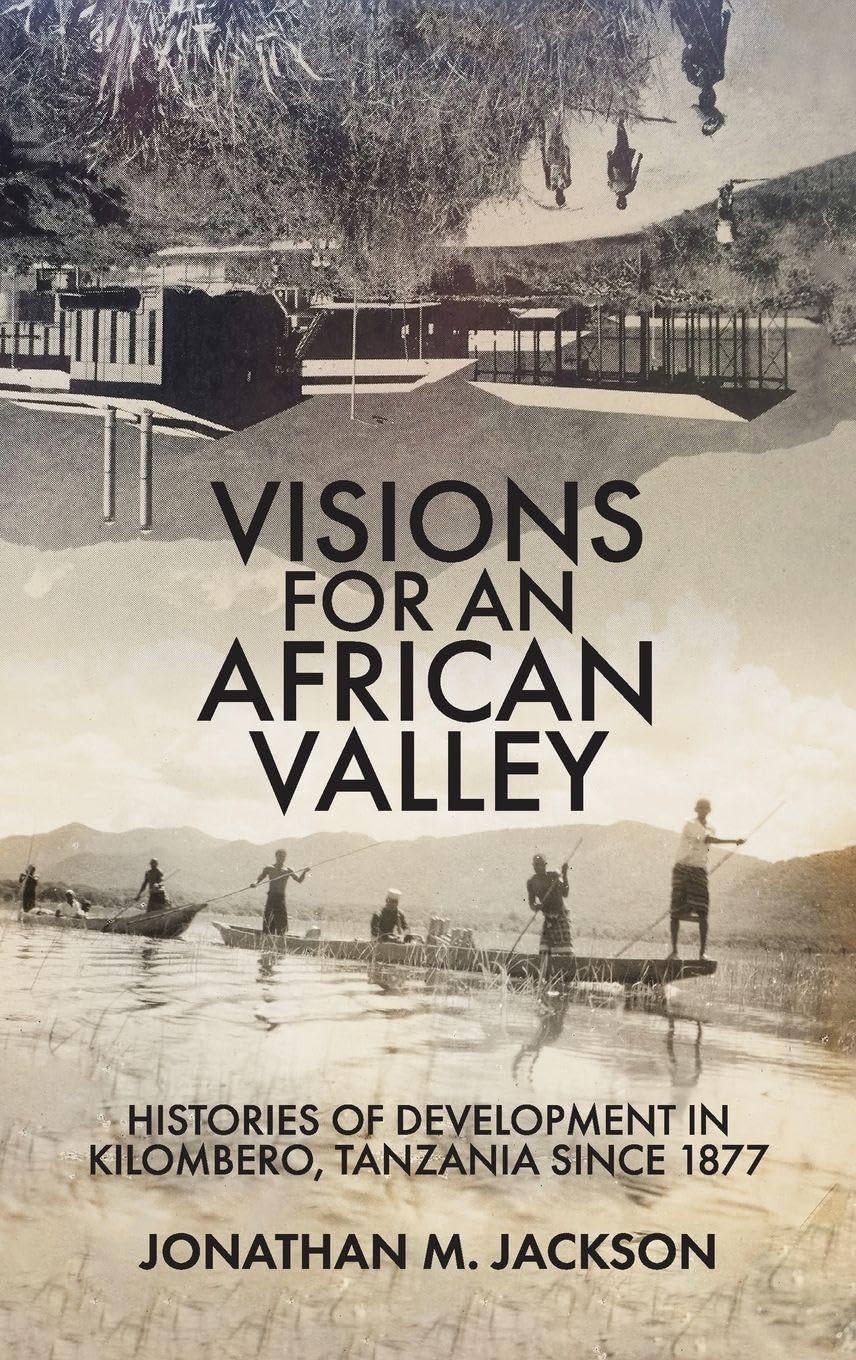
Visions for an African Valley cover
Research on the history of colonial development and future-making in Tanzania has focused on the racial and class politics that influenced development visions and practices. Studies of postcolonial development history have demonstrated how state leaders and their ideologies shaped nation-building trajectories. Notwithstanding the temporal dynamics, scholars have analysed how the flow of finance and technical assistance reveals intertwined global forces such as nationalism and the Cold War, and how foreign development assistance shaped development in Tanzania. Visions for an African Valley moves beyond this conventional analysis. Instead of employing ideological lenses in analysis, it specifically examines how colonial and postcolonial development actors perceived and planned for the Kilombero Valley as a specific geographical area. The choice of Kilombero as a window in exploring Tanzania’s development history is apt given that both colonial and postcolonial governments regarded the valley as a ‘critical development zone.’
Visions for an African Valley employs analytical concepts of ‘future making’ and ‘imagined futures’ to explain the negotiated and contested nature of development plans in the Kilombero Valley. Building on the broad range of archival sources and government reports from Tanzania and the United Kingdom, it contends that colonial and postcolonial development plans in the valley were a ‘future-making’ process dominated by Western development discourses and practices. The author posits that the Kilombero Valley was a tantalising ‘potential’ site for socio-economic development for both colonial and post-independent governments. The multifaceted visions of colonial and post-independent actors regarding the valley led to convoluted development plans. Kilombero’s ecology proved cumbersome to Western experts who had limited knowledge of African tropical ecologies. Consequently, many development ideas and plans failed to materialise. One of the significant points the book makes is that of the colonial and post-independence continuities in dependence on Western finance and expatriates in the planning and implementation of the ‘imagined futures.’ As a consequence, the plans for socio-economic development in the valley assumed a top-down character as they were planned by Western experts without incorporating local populations.
As in Joseph M. Hodges’ Triumph of the Expert (2007), Western-based development consultants and agencies used Western donors’ funds, technologies and expertise to plan for Kilombero Valley development without involving Africans who resided in it. Jonathan Jackson expounds further that many plans and ideas to develop Kilombero ended on paper as great “technical knowledge, gained through reconnaissance and from surveys” (p. 58), but failed to resolve its problems. This observation corroborates recent studies on ‘delayed or failed futures’, which have highlighted how river basin development projects, especially Stiegler’s Gorge (now Julius Nyerere Hydropower Scheme), became ‘delayed futures’ despite both colonial and post-independent development planners envisioning it as indispensable for socio-economic development.
In chapters 1 to 7, the book interweaves the history of development with the history of waterways and transport infrastructure in the valley. It carefully analyses the way colonial imagining of the valley connected development with the plans to build reliable transport infrastructure, a subject which existing development studies have overlooked. To be precise, in chapters 1 to 5, Jackson accounts for how the German and British colonial governments unsuccessfully addressed the transport challenge. He points out that “[i]n many respects, the history of the development in Kilombero is the history of the development of a transport infrastructure, or ultimately its underdevelopment” (p. 57). As in Daniel R. Headrick’s The Tools of Empire (1981), colonial planners viewed railways, roads, and bridges in the colonies, not just in Kilombero Valley, as technical systems for exploiting natural resources for the benefit of colonial empires. Colonial governments planned to bridge the coast and the interior through a railway line, but their visions failed to materialise. The failure of colonial visions to provide reliable transport infrastructure is one of the areas where colonial theory failed to meet practice. Jackson offers valuable insights into transport infrastructure history, thus, extending analysis beyond electricity and irrigation infrastructures, which currently dominate analyses of the valley.
In the last two empirical chapters, 6 and 7, Jackson examines how confidence in using Kilombero to drive development continued in the post-independence era. In building the nation, government perceived the valley “as a spearhead for industrial and economic development” (p. 166). It planned to establish timber and sugar industries and to develop the valley as the country’s agricultural modernisation training centre. Consequently, it received greater financial and technical assistance from international agencies in the 1960s and 1970s, including the construction of TAZARA and a resettlement scheme under socialist Ujamaa policy. Jackson argues that, although these schemes glorified progress, statecraft and patriotic spirit in building the new nation, they were, in reality, a materialisation of past colonial visions, particularly the need for reliable transport infrastructure and stable population in the valley. Although TAZARA “was a railway through and not for Kilombero,” says Jackson, “in any case, it was the fulfilment of one of the earliest development visions for the region” (p. 171).
On villagisation, he writes that, though “[f]or many Tanzanians today, historical memory insists that villagisation began with the implementation of Ujamaa after the Arusha Declaration” (p. 208), Kilombero resettlement schemes of the 1960s and 1970s were a fulfilment of colonial visions to populate the Valley in efforts to address the labour challenge. For him, Ujamaa formalised and implemented earlier visions. TAZARA, villagisation and many other post-independent development projects in the Kilombero Valley were not new post-independence development visions but the realisation of colonial ‘past futures.’
However, this well-researched and impressive piece has some pitfalls. Reading the book’s subtitle, Histories of Development in Kilombero, Tanzania since 1877, one expects to encounter a detailed analysis of Tanzania development issues from 1877 to the present. However, the book’s focus is mainly on the colonial period. Five chapters (1-5) cover the colonial period, while only two chapters (6-7) focus on the post-independence era. Moreover, in chapters 6 and 7, one can only find Tanzanian socialist development visions and practices up to 1976. Despite the subtitle’s promise, Tanzania’s post-socialist development is missing in the analysis, except for a few recent developments, which Jackson mentions in passing in the concluding remarks.
As a matter of fact, the Kilombero Valley has continued to be viewed as a potential area for socio-economic development in Tanzania even today. In addition, the liberal era, which began in the mid-1980s, was ground-breaking in the history of Tanzanian post-independence development. The adoption of liberal policies might have saved the country from the economic crisis of the 1980s, and the Kilombero Valley in particular evidenced a rejuvenated development vision, including an increase in foreign investors. Therefore, to exclude detailed analysis of this period in a book on ‘past futures’ makes Tanzania’s development trajectory incomplete and not helpful to the book’s cause. Readers could have benefited more from the analysis of changes and continuities in development visions in the valley, especially as Tanzania entered its era of economic liberalisation.
Additionally, the analysis could have been extended to integrate development plans in Kilombero Valley with broader development discourses in the country and globally at large. Although Kilombero received special attention from colonial and post-independence planners, it was not the only place that attracted actors’ attention in Tanzania. How did plans and visions on Kilombero Valley uncover broader ideas of exploiting river basins for socio-economic development in colonial and post-independence Tanzania? This is an important question that the book did not address. This makes analysis of the visions on the valley appear as isolated case from other development practices in Tanzania and the world. Lastly, there are minor linguistic mistakes, particularly on the use of Swahili phrases. For instance, one Swahili phrase is written Maendeleo wa Jamhuri instead of the Maendeleo ya Jamhuri (Development of the Republic). Nonetheless, Visions for an African Valley is an essential publication for students and researchers in colonial and postcolonial development studies in Africa. Moreover, historians of technology and infrastructures can also benefit from the book especially on how and why development actors strove for the construction of much-desired transport infrastructure in the Kilombero Valley.
(This is an edited version of a review that first appeared in Zamani: A Journal of African Historical Studies (Vol. 2 (1), pp. 185-188) and was published online on 17 October 2025: https://www.scienceopen.com/hosted-document?doi=10.56279/ZJAHS.2.1.185 )
Emanuel Lukio Mchome
Emanuel Lukio Mchome is a lecturer in history of technology, environment and urbanisation at University of Dar es Salaam. He received his PhD in 2022 from Technische Universität Darmstadt in Germany for a thesis entitled ‘Blackout Blues’: A Socio-cultural History of Vulnerable Electricity Networks and Resilient Users in Dar es Salaam, 1920–2020.
Also noticed:
WEALTH, POWER, AND AUTHORITARIAN INSTITUTIONS: COMPARING DOMINANT PARTIES AND PARLIAMENTS IN TANZANIA AND UGANDA. Michaela Collord. Oxford University Press, Oxford, 2024. xiv + 292 pp. ISBN 9780192855183 (hardback) £102.99. ISBN 9780191945335 (Kindle) £90.00.
Wealth, Power and Authoritarian Institutions cover
The author of this comparative study is a Lecturer in Politics and Development at the Global Development Institute, University of Manchester. It’s based on her Oxford DPhil and published in the series Oxford Studies in African Politics and International Relations. The publisher’s abstract follows.
“Through an analysis of the recent political history of Tanzania and Uganda, Wealth, Power, and Authoritarian Institutions offers a novel explanation of why authoritarian parties and legislatures vary in strength, and why this variation matters. Authoritarian political institutions reflect—and to some extent, magnify—elite power dynamics. They are a ‘terrain of contest’, an arena where power is tested, negotiated, and re-ordered. While there are many sources of elite power, the book centres on wealth, exploring how the socio-economic foundations of a regime affect its institutional landscape. This analysis first considers how diverse trajectories of state-led capitalist development shape divergent patterns of wealth accumulation across regimes. Where accumulation is more closely controlled by state and party leaders, as was true in Tanzania until economic liberalization in the 1980s, rival factions remain subdued. Ruling parties can then build up relatively strong institutional structures and parliament remains marginal. Conversely, where a class of private wealth accumulators expands, as occurred in Tanzania after the 1980s and in Uganda after the National Resistance Movement took power in 1986, rival patron-client factions can more easily form. Factional rivalries then channel through the ruling party and into the legislature, simultaneously eroding party institutions and encouraging greater legislative strength. Finally, the book reflects on the significance of a stronger legislature, particularly for distributive politics. It details mechanisms through which legislatures, as ‘terrains of contest’, contribute to both regressive and progressive redistributive outcomes. To support its analysis, the book draws on extensive fieldwork in Tanzania and Uganda.”
Martin Walsh
Martin Walsh is the Book Reviews Editor of Tanzanian Affairs.
PRIMARY HEALTH CARE IN TANZANIA THROUGH A HEALTH SYSTEMS LENS: A HISTORY OF THE STRUGGLE FOR UNIVERAL HEALTH COVERAGE. Ntuli A. Kapologwe, James Tumaini Kengia, Eric van Praag, Japhet Killewo, Albino Kalolo. CABI, Wallingford, Oxfordshire, and Boston, MA, 2023. xv + 257 pp. ISBN 9781800623316 (hardback) £120.75. ISBN 9781800623323 (eBook) £120.75.
This edited collection, written primarily by Tanzanian health professionals, is described by the publisher as follows:“Robust health care systems are paramount for the health, security, and prosperity of people and countries as a whole. This book provides for the first time a chronicle of the struggle for, and eventual success of, universal health coverage (UHC) in Tanzania. Beginning with an introduction to primary health care in the country, from its historical foundations to the major milestones of implementation, this book then considers stewardship of this important aspect of health systems over time. Written in a way to allow the application of lessons learned to other countries’ contexts, this book covers:
—Policy and governance issues such as leadership, human resources, and financing of health systems;
—Practical aspects of health system delivery, including supply chains, community care, new technologies, and the integration of services for particular population groups;
—The impact and mitigation of global events on health systems, such as resilience and preparedness in the light of disease outbreaks or climate change, and social, commercial, and political influences.
Concluding with a look to the future, forecasting the changes and new solutions needed to adapt to a changing world, this book is a valuable reference for policy makers, global health practitioners, health system managers, researchers, students, and all those with an interest in primary health care and reforms – both in Tanzania and beyond.”
The book comprises chapters with the following headings: “Introduction to Primary Health Care”, “Leadership and Governance for Primary Health Care in Tanzania”, “Human Resources for Health”, “Primary Health-Care Financing and Resource Mobilization”, “Health Commodities Supply Chain”, “Health Management Information and Evidence in Primary Health Care in Tanzania”, “Health-Service Delivery”, “Community Health Within Primary Health Care”, “Achieving Health-Systems Resilience in Tanzania”, “Beyond Health-System Building Blocks: Context and Determinants of Health”, and “Looking to the Future of Primary Health Care in Tanzania”.
Martin Walsh
PROSPERITY GOSPEL REDEFINED: THE IMPACT OF CHARISMATISATION ON THE MAINLINE CHURCHES IN TANZANIA. Leita Ngoy. Brill Schöningh, Paderborn, Germany, 2025. xxi + 293 pp. ISBN 9783506796288 (hardback) EUR €92.52. ISBN 9783657796281 (eBook) free to download from https://brill.com/display/title/69943
This open access book, written by a Lutheran Pastor, is based on her doctoral dissertation at Ruhr University Bochum. It’s published by Brill Schöningh in their Global Religion series, and here is their summary:
“This book provides an in-depth discussion of the cultural and missional implications of the explosion of charismatic Christianity on mainline denominations in Africa. The book proposes that the charismatization of mainline churches is a contextual, missional, and transcultural phenomenon that enriches and invigorates African Christian communities. Focused on the experience of the Evangelical Lutheran Church in Tanzania and using Prosperity Gospel as an example, the book explores how some mainline churches are being enriched by adopting practices of charismatic Christianity. It proposes a holistic and contextual understanding of the Prosperity Gospel, understood as the mafanikio gospel in Tanzania, as a relevant theological resource for Lutherans in Dar-es-Salaam. In doing so, it intends to contribute to the needed paradigm shift in theological discourses around Prosperity Gospel to challenge stereotypical criticisms that label it false and misleading.”
Martin Walsh