
THREE DECADES AT THE UNIVERSITY

Thirty years have now passed since the birth of one of Africa’s most renowned centres of learning – the University of Dar es Salaam. Very few universities in Africa have been able to attract the kind of international interest and financial support that Tanzania’s first institution of higher learning has managed to drum up. Even fewer have intellectually flourished independently of government directives while at the same time training their quota of skilled managers and technicians for Africa’s know-how-starved economies. But the economic stagnation of the 1980’s chilled much of the intellectual fervour that had marked the 1960’s and 1970’s.

THE FACULTY OF LAW AND THE UNIVERSITY COLLEGE
In October 1961 the Faculty of Law of the University of East Africa was opened in its temporary quarters in the TANU party building in Dar es Salaam. Meanwhile Western donor funds were invested in a new dream campus atop the lush hills on the outskirts of the city. President Nyerere officially opened proceedings on ‘the Hill’, as the new campus of the University College came to be known, in August 1964. The euphoria of independence was still very much in the air; students enjoyed quite privileged circumstances, and as time went by, some began to acquire the reputation of being elitist. One thing is clear: they dubbed their main dining hall ‘Harvard’ and, as campus legend has it, wore shirt and tie to meals and ordered from proper menus!

The Canadian professor Cranford Pratt, one of the foremost scholars on Tanzanian political economy, was appointed the first Principal of the University College. He would soon be joined by a host of other foreigners – among them Terence Ranger, Goren Hyden, Helge Kjekshus, Lionel Cliffe, John Saul, Andrew Coulson and Michel von Freyhold – who came to typify the kind of Western intellectual of liberal to radical bent who would arrive on campus over the next twenty years, drawn to Tanzania by the progressive rhetoric of President Nyerere and the promising spirit of ‘Ujamaa’. The University was to attract prominent Third World intellectuals as well including the famed Marxist historian from Guyana, Walter Rodney.

PROTEST BEGINS
The quiet days at the Hill came to an abrupt end in 1965 when the government sent police to break up a student-organised attack on the British High Commissioner in protest at Britain’s non-committal stance on Rhodesian UDI. The following year the National Association of Tanzanian Students organised a march to State House in protest at the governments’ plans to mandate two years of national service for secondary and university school leavers. Particularly arrogant phrases in the student declaration (‘This is an ultimatum’) and the unfortunate presence of some offensive poster board slogans (‘Colonialism was better’) no doubt sparked President Nyerere’s ire. Nyerere’s response was to become legendary and certainly left its mark on Tanzania. In response to student complaints about high salaries of leaders and civil servants he slashed his own salary by 20% and agreed to revise the salaries of others permanently. Some 400 students were sent home and before they were allowed to return, Nyerere had released the Arusha Declaration which included strict guidelines on the accumulation of wealth by party and government leaders.

After the students were allowed to return and during the following years the ideas of Black Power and workers’ revolution were powerfully advocated by visiting lecturers like Stokely Carmichael, C.L.R. James and A. M Babu. For some time the increasingly radicalised university community welcomed Nyerere’s socialistic rhetoric and supported the policies of TANU.

THE NEW UNIVERSITY OF DAR ES SALAAM AND POLITICAL DEBATE
In July 1970 the University of East Africa broke up and the Dar campus became a fully fledged national university. Some students began to dissent. The law student Issa Shivji came out against the ‘sham socialism of the Arusha Declaration and the ‘bureaucratic bourgeoisie’ of the party and government machinery. An intense debate followed on the nature of Tanzanian socialism accompanied by such incidents as the detention of the student organisation president, a student boycott of classes and a period of a year during which students refused to cooperate with any University institutions – including the campus bar.

As events during the 1970’s threw a hard light on both the socialist experiment of Nyerere’s government and the debates in the university, the left became split into warring factions. There was still a large group supporting Nyerere’s policies but another group continued to argue that the bureaucratic bourgeoisie had ‘hijacked’ Tanzanian socialism. Then, in 1978, the government announced salary increases of up to 40% for leaders. This was seen by students as a clear contradiction of the Arusha Declaration and, on March 5, 1,500 students marched on the city centre. They were brutally attacked by the police. 400 were taken away to their homes without due process of law and the government media engaged in a concerted campaign against them.

THE EFFECTS OF THE ECONOMIC CRISIS
By 1980 the country had entered the most profound economic crisis of its 20-year history and by 1986 the University had ebbed to its lowest point ever. The once beautiful facility on the Hill had collapsed. The water system had broken down and lack of spare parts delayed its repair until 1990. Campus restrooms became unserviceable and the odour of backed up excrement pervaded the campus for years a pungent metaphorical reminder of the rot that was spreading through the land. Shelves in the bookstore remained empty save for the dust-covered stacks of Lenin and Mao. Staff salaries could not support the most modest of families. The once-vindicated supporters of Nyerere quietly sought sabbaticals. Expatriates trickled home. Corruption soared; twice – in 1986 and 1988 the students struck against corruption and deteriorating conditions, but to no avail. The University fell into the hands of those who would not rock the boat.

A NEW CONSERVATIVE GENERATION
By the middle of 1988 the university was bankrupt and unable to open for class as scheduled in July. When classes were finally resumed in October, one of the last foreign radicals, the Jamaican political scientist, Horace Campbell , a disciple of the late Rodney, was no longer on the University payroll. His release was symbolic of the new Mwinyi government’s attempt to forget about Nyerere’s socialist dream while still attempting to maintain a monopoly on political power.

A new conservative generation dominated the University staff. Regardless of ideology, however, they were just as susceptible to the temptations of political corruption as their illustrious predecessors and just as capable of feeling the pinch of economic want. Despite numerous ‘campaigns’ against corruption and despite the new signs of life slowly emerging in the country’ s economy as a result of the Mwinyi economic recovery programme, the plight of the University teachers and students continued to deteriorate.

THE FALL OF THE BERLIN WALL
The fall of the Berlin Wall in the autumn of 1989 again stirred the students to action. Now it appeared that they had the weight of world events on their side. Not only could they present their former demands for an end to corruption and a consequent rehabilitation of the campus, but also a new call for a multi-party democracy.

Readers of recent issues of the Bulletin will be familiar with happenings on the Hill since then. The boycott of classes in May 1990, the ‘wall literature’ which so offended President Mwinyi, the subsequent closure of the University, the Mroso Commission (which vindicated the behaviour of the students), the rapid rehabilitation of the physical plant of the University (running water was now reaching all parts of the campus), the transfer of the popular Vice-Chancellor, Professor R. G. V. Mmari to head the new Open University and the launching, in June 1991, of a ‘Dar es Salaam Declaration of Academic Freedom’. Back in the days when President Nyerere – then himself a writer and intellectual of growing repute – used to casually stride around the corridors in his capacity as University’ Visitor’, and used to candidly discuss matters of national significance with students, such a declaration would have sounded odd.

THE FUTURE
Now, in October 1991, as the third decade of the University winds to a close in the wake of the dramatic collapse of socialism in the Soviet Union, it remains to be seen what will become of the University.

The University community – once again acting as the conscience of Tanzania – may again find itself on uncomfortable ground. Even if it wins the current battle for free intellectual expression, and even should CCM party hegemony eventually come to an end, to which ideological corner will this new ‘conscience’ turn when it becomes clear that the much vaunted’ multi-party, free-market democracy’ has failed to deliver the promised goods?
Paul A Isbell Munch

THE WILD BIRD TRADE

Tanzania has earned an international reputation as a leader in the field of wildlife conservation and is world famous for its national parks and wildlife. Nearly a quarter of the country is under some sort of wildlife protection order. Despite this Tanzania is the second largest exporter (after Senegal) of wild caught birds in Africa.

The bulk, if not all of Tanzania’s wild bird exports, are of its own native species, unlike some Far Eastern exporters/markets. There are over 200 registered bird and animal exporters. The main trade is in Estrilid finches (waxbills, cordon bleus etc), weavers, bishops, whydahs and, to a lesser extent, native parrots especially the endemic Fisher’s Lovebird. Large bird exports are dominated by flamingoes, storks (especially marabou), ibises and crowned crane. Trapping appears to be centred in Dodoma, Shinyanga and Kilimanjaro regions with holding grounds in Arusha and Dar es Salaam.

CONCERN ABOUT WELFARE AND CONSERVATION
Increasing concern is being expressed in Tanzania and internationally about the welfare and conservation aspects of the trade. It should be stressed however that the bulk of the Tanzanian trade is legal, according to Tanzanian and international law. But there is evidence of some illegal acts being committed.

Studies of the wild bird trade elsewhere have shown that there are huge losses suffered at capture, in the holding grounds and whilst being transported and there is no reason to suppose conditions in Tanzania are any different. In a well publicised case recently at least 1,200 birds died miserably on a flight from Tanzania to Heathrow. In 1982 a report by Kim Howell of the University of Dar es Salaam made a number of recommendations which helped to stop the trade in the yellow-collared lovebird (only found in a wild state in Tanzania). In 1948 Moreau (the doyen of African ornithology) commented on the huge numbers of lovebirds being exported (40-50,000 per annum) and in 1987 and 1988 a total of 183,607 live imports of lovebirds were reported, Tanzania being the source of the majority. 43% of birds imported into Britain from Tanzania in 1988 and 1989 were of unidentified species. Whilst there may be some excuse for not identifying non-breeding plumage whydahs or weavers there should be no excuse for not identifying families such as bar bets, starlings, coots, mousebirds, turacos, hornbills, flamingoes, lovebirds, rollers, waders and orioles.

REGULATION
The Wildlife Conservation Society of Tanzania was partly formed in 1987 because of the growing concern about unregulated exploitation of wild birds. As a signatory to the Convention on International Trade in Endangered Species (CITES) Tanzania has agreed to regulate its trade in CITES Appendix species. No CITES Appendix 1 species (the highest level of protection eg: elephants) are regularly exported but a number of Appendix 2 species IMPORT BANS
Earlier this year a joint campaign was launched by the Royal Society for the Protection of Birds, the Royal Society for the Prevention of Cruelty to Animals and the Environmental Investigation Agency to ban the import of wild caught birds into the EEC. The USA has already decided to phase out all imports of wild caught birds. As a result of concerns about the current population status of Fischer’s Lovebirds, the CITES EEC Committee imposed a temporary ban on the import into EEC countries of these birds on January 16th 1991. Many airlines (including KLM and BA but not Egypt Air and Air Tanzania) have banned the carrying of wild caught birds. There is also currently a MAFF imposed ban on all bird imports into Britain from Tanzania. A consignment of Tanzanian birds in 1990 was found to contain Newcastle Disease and this ban will continue until the Tanzanian veterinary authorities satisfy the British that their procedures are adequate.
Zul Bhatia

THE BIGGEST TEA FACTORY IN THE WORLD

Brooke Bond Tanzania Limited plans to build at Ngwazi, Mufindi, the biggest tea factory in the world according to a 1991-2011 Development Plan prepared by the company and presented to President Mwinyi during his visit to Iringaa at the end of July. The new factory will be built with the latest tea processing technology. It will have a capacity of 8,000,000 kgs of made tea and will bring total production capacity of the firm’s four factories to 18,483 tonnes compared with a present annual capacity of 6,764 tonnes. The number of people employed will increase from 6,000 at present to 8,200 – Business Times.

MY FIRST AND SECOND IMPRESSIONS OF TANZANIA

I have been to Tanzania twice.

In the middle of 1989 I found myself standing inside an air- conditioned bank in Mombasa, queuing to change a travellers cheque… I turned away from the counter and locked past the security guard, through the frosted glass doors and onto the street. As I stood and as I watched, an old man pulled himself along the dusty pavement with his hands, dragging his spastic legs along beneath him. It was a recurring theme throughout our six weeks in East Africa. I, the foreigner, waiting to change my western currency which would probably be worth more in Kenya shillings than he would ever own. Herein lies the gulf that separates Us from Them. And yet poverty, on this scale, is not really that different from the begging which we see in most European cities these days. What is different is the overall poverty of the nation.

KENYA AND TANZANIA

This poverty was much more apparent in Tanzania, where we moved next, than in neighbouring Kenya. Since the early sixties, when Kenyatta and Nyerere took their respective nations down very different paths from independence, these two republics have grown further apart. Kenya has, quite successfully, trodden the path towards capitalism. While Tanzania remains the limping socialist state – an economic slave to its massive international debt. Yet by concentrating on the profiles of the countries I think it is possible to overlook what is actually happening to the people who live there. I met a Christian in Nairobi waiting for a bus, who had grown cynical of President Moi and his false front – as he saw it. He had been forced, through lack of money, to leave school at sixteen and was now working as a labourer for about £l per day. To complete his last two years of education would have cost him £350. This, he knows, is too much for him. He knows too, that, if he could complete those vital years he could escape from the mire in which he is stuck. “It all depends on who you know”, he told me. It was very sad to see such an obviously intelligent person so frustrated and helpless.

In sharp contrast, In spite of the multitudinous problems which face Tanzania, the people whom we met and worked alongside in Iringa ware so contented and radiant. As the Pastor of the Anglican church said to us after dinner at his house one night, in his slow and deliberate English “….though we are poor, we are rich in spirit”.
It would be simplistic and stupid to conclude from this that, although Tanzania’s economy is in a pretty bad way, its people are far happier than their neighbours in Kenya. I was, though, left with the overall impression that, bearing in mind their respective situations, the Tanzanians were more cheerful than their counterparts in Kenya.

STANDING PROUD AND STRONG
It was especially clear, from our limited insight, that the churches in Tanzania are not allowing their circumstances to stunt either their faith or their vision for the future. The work which our Tear Fund Task Force Teem was doing involved clearing the foundations for a new cathedral in Iringa. This reflects the growth of the Church in Iringa, and the vision of Bishop Mtetemela for the Outreach Zone – now the Diocese of Ruaha. From the moment we arrived it was clear that we were welcomed as the world-wide family of God. Surprisingly quickly we had made some very close friends – not least the children, to whom we often gave wheelbarrow rides on the building site ! Wherever we went we were treated as guests of honour and looked after extremely well. When, after only three and a half weeks in Iringa, the time came for us to return to Britain, I realised how deeply we had become involved in the community. And even though, by this stage, many of us had been ill, some seriously, we were all very sad to leave Iringa and some very dear friends.

It was a marvellous way to spend the summer and to give something back after being spoiled for so long in our opulent and lazy society. I have many memories still clear in my mind (not least that of being woken up at five o’clock in the morning in a hotel in Mombasa by a woman screaming as her husband beat her). The lasting memory though, will be that of the Church of Iringa, standing proud and strong despite all the difficulties it faces.

AN EXPLOSION AND A CELEBRATION
My second visit was in 1990 when I was employed for the summer in the CMB Packaging (formerly Metal Box) factory in Pugu Road, Dar es Salaam. Sitting on board the M.V. Zaitun I watched as she struggled to tow a similar , if slightly more capricious, beast onward to Zanzibar. The trailing dhow had left Dar es Salaam twenty six hours earlier but, after an explosion caused by a battery wired up incorrectly, had been drifting for a full day with five of the crew lying dead on board.

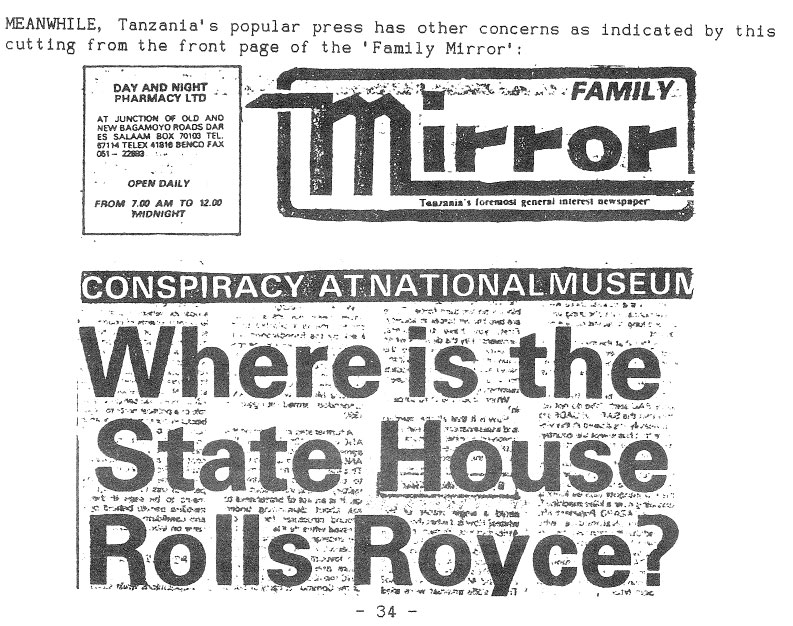
Meanwhile, back in the Haven of Peace, His Holiness the Pope was being driven from the airport in the state Rolls Royce along roads resurfaced for the first time in years. And so, while thousands of ecstatic Tanzanians in festive, papal tee-shirts lined the dusty streets of the town in the hope of a brief glimpse of Papa Yohana Paulo, five of their compatriots lay cold aboard a dhow in the Indian Ocean.

These two extremes highlight well what for me is a real dichotomy of life in Tanzania. Whilst I was bluntly reminded from the one horrific accident of the endemic low regard for safety and of the implicit cheapness of life it was equally obvious from the other that this country, given the occasion, is as capable as many others.

Again and again, in my work at the factory, mistakes were made which left me struggling to uncover the crux of the problem. Did I not explain, slowly and clearly? Did I not check and double check? Was the job too difficult? The situation was further complicated by the fact that every so often I would be taken aback by a particularly exact piece of work. Now and then I glimpsed the spark of pride which must be fanned into flame if this factory, and others like it, are to survive the difficult years ahead. It must be said though, that, at the end of the day, deadlines were met, and there were times of immense satisfaction and teamwork during my six weeks at the factory.

SHOULD WE PULL OUT?
I cannot help asking myself, however, whether the West is not asking for something that Africa is not ready to give when it tries to force its own high technology world upon her. In a travel book by the late Shiva Naipaul I read the views of a Dutch charity worker living in Tanzania who sums up my thoughts succinctly:
‘I do not want (the Africans) to repeat the mistakes we have made in Europe. Why must they too have factories and pollution and political p arties ? If that is what you mean by development, then, no I do not wish to see them ‘develop’. Why make them try for the impossible? It will only lead to unhappiness’.

So does Tanzania need ‘aid’ ? Is there a place for the army of twentieth-century Vikings who have set up camp in their own village – Valhalla – just outside Dar? Should we pull out and leave Tanzania to muddle along as best she can? Are there any answers, or is Africa, with her colonial past and deep-rooted tribalism, a mesh of problems too complex to untangle?

DEVASTATINGLY HUMBLING
In 1990 I went back again to Iringa to see the other side of the country’s make-up. I was invited to lunch by the church carpenter and his wife in the two bare rooms which are their home. Typically they had prepared food for me, a Mzungu, which they could ill afford (he earns the equivalent of £65.40 per year) but their generosity and warmth towards me was something that brought tears to my eyes and I shall not quickly forget. Yet, mixed with their joy, they were mourning the recent death of their five-year old son from diarrhoea which had failed to be treated quickly and correctly. It was devastatingly humbling for me to be able to encourage them, and when the time came for me to leave, it was 1 who Pelt the poorer. It is this spirit and this love which so many of the Tanzanians whom I have met are so quick to give that makes the call to action so much louder.

Surely though, the answer is not merely to throw money at Tanzania from our financial high-ground, After changing a fifty-pound travellers cheque in a bank in Arusha I gave the loose change from my small fortune to a leprous old woman who was begging on the pavement outside. She held out her fingerless bands and looked up at me with two blood-red eyes. As I walked away I asked myself what it was exactly that I had given that woman. I fear that ail that I gave her was money. For it is so much ‘cleaner’ and easier to give her of my pocket than it is to dig deeper in my heart and to give her the love and respect which she deserves as a fellow human being.

Perhaps it is wrong to scale up the conclusions from this incident to a macroscopic scale but I think there is a lesson to be learnt here. Whatever we tell ourselves, it is actually very costless for us to part with some small quantity of money which can be sent to some small corner of our little world. It is very much harder to reach deep within ourselves and to give of what we are rather than of what we have. I knew that when I got back to the Oxford world I would be faced with the same issues which had confronted me in Tanzania. I knew that, as I walked through the Radcliffe Camera after dark, the same people would be silently crying out from their doorways. I only prayed that I would be strong enough to answer their cry and not just to do the easy thing and pay off any conscience. I fear that the day that I cease to hear them will be the day that I am the beggar for ‘many who are first shall be last, and many who are last shall be first’ What good is it to a man if he gains the whole world but loses his soul?
John Drew

800,000 HIV INFECTED

HIV infection, AIDS and other sexually transmitted diseases would become a major disaster with far reaching repercussions in Tanzania and many other countries if not controlled soon. So said Prof Fred Mhalu of the Muhimbili Medical Centre at a recent seminar organised by the Tanzania Commission for Science and Technology (COSTECH), He said that the HIV infection rate was between 5 and 15% in urban areas and from l to 15% in rural areas but that in Bukoba town the rate was about 30% among adults. Country-wide some 800,000 people had HIV infection. “During the 1990’s AIDS is expected to triple the adult mortality rate and reduce expected population growth by up to 30%” he said. However, there had been significant falls in new cases of other sexually transmitted diseases in some parts of the country – Daily News.

WE HAVE REACHED NUMBER 40 – AFTER 16 YEARS

It was December 1975 and the big news in Bulletin of Tanzanian Affairs No 1 (12 pages A4 size) was that on October 22nd of that year the first passenger train had left Kapiri Mposhi station in Zambia for Tanzania with representatives of China, Zambia and Tanzania aboard. It had drawn into Dar es Salaam station on Friday October 24th 1975. The great TAN-ZAM Railway had been born. The Chinese construction camps, once a familiar sight along the route, had gone. So had the doctors who had dispensed free medical treatment and the engineers who had provided new water supplies and roads to remote rural areas.

The other big news? In August 1975 the TANU Party had published a booklet which claimed that 9,140,229 people had been resettled in villages. Not everyone was happy however, according to the Bulletin, and there had been widespread reports, including many in the Tanzanian press, of resistance to villagisation. President Nyerere had insisted at the Party Congress that the policy of pressing ahead had succeeded; people were settling into their new homes and services were being provided.

The then editor (Dr T. O. Ranger) stated the aims of the new Bulletin, which was to appear twice a year. He wrote that it was difficult for even the most industrious and persistent to obtain information about Tanzania from the British press. Things haven’t changed? Dr Ranger hoped to bring to the attention of readers material of real interest which they might otherwise not see. He assured readers that the Bulletin would not consist entirely of ‘official handouts’ and that material critical of aspects of Tanzanian policy would be included on occasion. Subsequent editors have endeavoured to follow these first guidelines.

The first Bulletin and many of those which followed contained extensive extracts from the highly readable speeches of Mwalimu Julius Nyerere. One, quoted in Bulletin No 1, had been given in the Guild hall in London: “…some very flattering things have been said about me since I arrived in Britain as the guest of Her Majesty the Queen….other things have not been said; in polite company it is not necessary to dwell on a guest’s errors or faults or the failures of the country he represents. I can assure you that I appreciate this convention – and propose observing it in reverse !”. But later in Oxford the President had himself dwelt on Tanzania’s weaknesses: “We call ourselves a democratic and socialist state. In reality we are neither democratic nor socialist…. democracy and socialism require a mature and popular awareness of the dignity and equality of men and women; a dynamic and popular intolerance of tyranny; a degree of maturity and integrity in those entrusted with responsibility for the institutions of the State and Society; and a level of national and personal affluence which Tanzania and Tanzanians do not possess….”

Bulletin No 4 (January 1977) announced the formation of the ‘Chama Cha Mapinduzi’ (Society of the Revolution) combining the two ruling parties – the Tanganyika African National Union (TANU) and the Zanzibar Afro-Shirazi Party and this Bulletin also contained news of the collapse of the East African Community.

Bulletin No 6 referred to the release from detention of Mr Abdulrahman Mohamed Babu and three others who had been condemned to death in Zanzibar, in absentia, for their alleged part in the assassination of the first President of Zanzibar, Sheikh Karume, in 1972.

Issue No 7 contained even more dramatic news, The Idi Amin regime in Uganda had invaded Tanzania in October 1978 and Tanzania was mobilising for war. And the Bulletin had a new editor – Mr John Arnold – and it had grown to 18 pages. The state of the economy has always figured prominently and Bulletin No 11 in December 1980 was a special issue devoted to the subject. Tanzania’s long period of negotiation with the IMF was under way.

No 15 recorded in some detail the story of the hijacking of a Tanzanian aircraft and the subsequent arrest of the hijackers in Britain. A tragic sequel to this event is described on page 4 of this Bulletin.

No 19, now under the present editor, recorded the untimely death of Tanzania” popular Prime Minister, Mr Edward Sokoine.

For the design of the cover of Bulletin No 22 we were fortunate in obtaining the services of an experienced artist (Richard Moon) and we have used his design ever since. This issue came down in size to A5 and was very special indeed. It included a 44-page booklet entitled ‘The Nyerere Years’ and featured appreciations by President Kenneth Kaunda of Zambia, Commonwealth Secretary General, Sir Shridath Ramphal, UN Representative George Ivan Smith, first Principal of the University College of Tanganyika, Professor Cranford Pratt and many others.

Subsequent issues have contained articles under such headings as ‘Tanzania After Nyerere’ , ‘The Maasai by a Maasai’, ‘Entire Cabinet Told to Resign’ ‘Witchcraft and Psychotherapy’, ‘The New Investment Code” ‘A Queen’s Scarf’, ‘The Makonde Carving – Its Essence’, ‘A Franco-Tanzanian Occasion’, ‘From Nyerere to Neo-Classicism’ ,’Why no TV?’, ‘KAR to TPDF’, ‘Tanzania and China’, ‘The Greatest Spectacle on Earth’, ‘Nine Holes in Mufindi’, ‘Digging Up Zanzibar’…..

Who are the readers? First and foremost, all those 600 odd Tanzanophiles who belong to the Britain-Tanzania Society. Plus some 110 individual subscribers and 44 university and other libraries in 18 countries around t he world.

And now we have reached No 40. We would very much like to hear from you readers about how you think we are getting on and what we should do in future to change or improve the Bulletin. Maybe it will eventually reach No 100. Who knows?
David Brewin

MISCELLANY

BCCI
The recent collapse of the Bank of Credit and Commerce International (BCCI) does not bother bankers in Tanzania according to banking sources. Officials of the Bank of Tanzania and the National Bank of Commerce stated that BCCI had no dealings in Tanzania – Business Times

DAR ES SALAAM AND DODOMA
Prime Minister John Malecela has stated that Dar es Salaam will continue to maintain its status as the commercial city of Tanzania even when the transfer of the capital to Dodoma is completed. The transfer in no way reduced the status of Dar es Salaam. It would always be the business capital he said – Sunday News.

GREATER AUTONOMY

The Government has given Tanzania’s banks greater autonomy in controlling credit and other business decisions to assist them to operate more economically and competitively. The banks will no longer be fully directed by the state and will have to act independently in assessing risks and returns associated with banking transactions – Daily News

10% OF CONSULTANCIES
At its recent Annual General Meeting in Dar es Salaam, the Tanzania Association of Consultants (TACO) approved its 1991/93 budget. It also announced a marketing strategy aimed at securing at least 10% of foreign funded national projects during the next two years and identifying the export potential of consultancy skills available in Tanzania. The Minister for Science, Technology and Higher Education, Mr William F. Shija, advised the members at the AGM that, in order to achieve professionalism, there should be interaction between various professional disciplines; there must be cooperation and there must be mutual understanding and respect. TACG Chairman Aloyse Mushi assured the Minister that the consultant members of TACO were a finished product which was ready for use, “They have spent many years in institutions of higher education and they are as good as any expert from America and Europe” he said – Daily News.

SIX MORE UNIVERSITY COLLEGES
The National Open University will be launched in the 1992/93 financial year and the newly established Muhimbili University College of Medicine and Health Sciences will become a full university by 1995. Feasibility studies to elevate the Mkwawa (Iringa), Chang’ombe (Dar es Salaam) and Marangu (Moshi) Teachers Colleges to university college status have been completed and plans are underway to make the Nkrumah Teachers College, Karume Technical College and the Centre for Kiswahili and Foreign Languages in Zanzibar into constituent colleges of the University of Dar es Salaam – Daily News.

MY FATHER AND THE ‘USEFUL’ PLANTS OF ZANZIBAR

My father, Robert Orchard Wi11iams, known as ‘RO’, who lived from 1891 until 1968, was the son of a Dorset fisherman. His grandfather’s main living had come from crabs, lobsters, mackerel, whiting and other fish. During fifteen years of his life RO was involved with agriculture in Zanzibar, first, until 1948, as Director of Agriculture and then, until 1959, as General Manager of the Clove Growers Association.

The clove has for long been Zanzibar’s main cash crop. The tree was named Eugenia aromatica after Prince Eugene de Savoire-Carignan, an Austrian General who lived from 1663 to 1736 and was famed for the help he gave the Duke of Marlborough during the war of the Spanish succession . The clove originated in the Moluccca spice islands of the South China Sea where it was used to purify the breath of dancing girls, amongst other things. When brought to the West by the Portuguese navigator Vasco da Gama it was found to mull well into wine, cure toothache and preserve meat. When the Dutch eventually took over control of the clove trade they went to the extent of felling clove trees on islands other than Amboina so as to corner the market a monopoly which continued until about 1870. They did not know that a Frenchman had captured some seeds and established a few trees in Mauritius.

In 1818 a Zanzibar Arab, Harameli bin Saleh, is reputed to have obtained some seeds from these trees and there by received a pardon from the Sultan of Zanzibar for some murder he had committed. By the middle of the twentieth century 80% of the world’s clove supply was coming from Zanzibar and Pemba – mostly Pemba.

Mature Zanzibar clove trees were 30 to 40 feet high with shiny, dark-green foliage; a full stand was about 80 trees to the acre. A plantation usually looked more like on area of wild forest for it was neglected except at harvest time when the weedy undergrowth was slashed. The trees were unshapely and ragged, the result of breaking off branches to pick the cloves. Gangs of pickers who arrived from the mainland did not care what happened to the tree and the owners regarded the damage done as inevitable. The tree would need one or two seasons to recover. After planting, trees took about five years to yield a first crop. The owner then had little more to do than sit back, engage a contractor for harvesting and collect the proceeds. The clove is the unopened flower-bud at the tip of a branch. Harvesting has to be done quickly and then the crop is sundried for four or five days. Stems and low quality buds are distilled for clove oil.

RO made a shrewd analysis of what his appointment as Director of Agriculture involved on arrival in Zanzibar. He found the clove industry largely managed its own affairs through a growers Association and that he had a member of staff, G. E Tidbury, who had made the crop his speciality and was writing what became the authoritative book on the subject. There was a worrying disease ‘sudden death’ which clearly required specialised research and the preparation of an application for funds and a team to undertake it. This was done.

RO’s offices were near the sea front on the ground floor of the main government office building which also accommodated the Legislative Council chamber. This square fantasy of some architect had been designed in the 1880’s. There were railed verandahs around each story, the whole surmounted by a clock tower. The antiquated lift, the only one on the island, was incredibly slow, but it worked and transported His Highness the aged Sultan when he attended meetings of the Council. It was the Sultan who later awarded RO the Brilliant Star Medal, the highest honour for a non- Muslim.

Office hours started early and finished for the day early in the afternoon. RO took advantage of the spare time this gave him to record, collect and make a catalogue of the plants on the islands. His well known book Useful and Ornamental Plants in Zanzibar and Pemba was published in 1949 by the Crown Agents, an impressively produced volume containing many illustrations, several of them by F. B Wilson. Wilson’s photographs of a coconut flowering spathe and a bunch of young coconuts are particularly striking.

The growing of coconuts was, to some extent, of greater importance than clove growing. The crop occupied a larger area than the clove on Zanzibar island though not on Pemba. The trees in Zanzibar were practically all of the tall type and could tower to 90ft when between 80 and 100 years old. The coconut industry was fully established and required little day-to-day attention from the Department as the marketing end tied in with the Clove Growers Association.

The coconut really seemed at home in Zanzibar particularly in its southern half where palms jutted over the beach as gracefully as anywhere on tropical shores worldwide. Scientists continue to argue as to the original home of the coconut, whether it be the Melanesian area of the Pacific or Central America. The Kon Tiki voyage did not solve the problem as ripe nuts have always floated on the sea and germinate when washed up on any suitable shore. After cloves and coconuts came the lesser crops. Rice was the most important cereal; others maize and sorghum, the former grown on low-lying land, the latter on the shallow soils of the coral-rag ‘wanda’ country. Sweet potatoes and cassava were the most important starchy food crops. Chilli peppers were a small export commodity. Oranges, mangoes and pineapples were the main fruits. The durian was a rarity but immensely popular but RO never had the courage to taste it! It smells more sickly than it tastes. A worthy description is written by Alfred Russel Wallace the famous explorer and navigator who expounded the theory of evolution at the same time as Darwin … ‘ its consistence and flavour are indescribable. A rich butter-like custard flavoured with almonds but intermingled with it come wafts of flavour that call to mind cream cheese, onion, brown sher y and other incongruities’. ‘Best eaten by a novice while holding the nose’ another writer said.

Pulses were rarely cultivated; vegetables uncommon. Breadfruit trees were found around villages. Livestock rearing was insignificant.

None of these were particularly time absorbing or significant enough to warrant more attention than they received at the Department’s experiment station at Kizimbani. RO’s answer to his quandary on what to focus his attention was to find and develop a cash crop that might play a supporting role to the clove or substitute for it if and in areas where ‘sudden death’ became serious.

He thought he had found it in cacao, a crop with which he was very familiar. But there was a degree of apathy about anything new. It was only the discovery of small numbers of old cocoa trees in both islands that prompted the idea of developing the crop. The best of the fields was at a remote place called Dunga. In spite of their age the trees seemed remark ably disease free . After weeding and pruning the field it was established that the quality was of the best and plans were made for the establishment of trial areas. A station for the rooting of cuttings was constructed and areas selected for planting and shade trees put in. Unfortunately that was about as far as the project got because RO moved to the Clove Growers Association and there was no one of his enthusiasm to follow it up.

RO became a businessman and trader in cloves, clove oil, copra and coconut oil. But that is another story!
R.O Williams Jnr

Mr R. O. WILLIAMS JNR. spent his career in the Colonial Agricultural Service in Kenya, British Guiana and Sarawak where he was the Director of Agriculture. He now lives near Corfe castle in Dorset.

MISCELLANY

CALL TO AMEND COPYRIGHT LAW
Although there has been a copyright law in Tanzania for literary and artistic works since 1966, its existence as well as its significance is unknown to most authors and artists. This was stated at a recent National Symposium on ‘Copyright’ organised by the Publishers Association of Tanzania in Dar es Salaam. Participants heard that there was rampant piracy of other people’s works especially in the video recording business. The participants also learnt that there were pirate publishers and printers who, through a ‘tender system’ used books of other publishers. The books were then sold at reduced prices.

The symposium suggested that the 1966 law should be strengthened and that Tanzania should join the international copyright conventions – SHIHATA

GOOD PERFORMANCE
A report covering the years 1979 to 1989 from the Tanzania Audit Corporation stated that the trend of performance of parastatal accounting was very good. Between 1985 and 1989 the number of clean accounts improved from 41.4% to 73.7% – a clear sign of improvement and a trend which should be maintained. Of 461 accounts audited during the year ending on 30th June 1990, 245 companies were given a clean certificate. This represented a percentage of 53.2%. – the highest percentage ever attained in anyone year.

BUT ….
The report went on to say that parastatal organisations made a loss of 5hs 4,198.9 million from 1979 to 1989. Many were becoming eaters and not creators of the national cake. During the decade 239 of the audited 461 accounts showed losses totalling 5hs 39,110.2 million as against 191 accounts which showed a total profit of 5hs 34,911.2 million. Large losses were by Industries and Trade, Communications and Works, Agriculture and Livestock, Water, Energy and Minerals, Local Government, Community Development, Cooperative and Marketing institutions Business Times.

LES AMITIES FRANCO- TANZANIENNES

The French equivalent of the Britain-Tanzania Society, ‘Les Amities Franco-Tanzaniennes’ has recently reported, in its journal ‘URAFIKI TANZANIA’, on its last Annual General Meeting. The Society has some 70 members and the last time we had direct contact (Bulletin No 29) it appeared to be thriving. Lately, however, it seems to have been passing through difficult times. The President and Secretary had apparently agreed to occupy these positions only for one year and they, together with the Treasurer, now wished to resign. Continuation of the society’s activities therefore depended on a new team taking over. The debate illustrated how attached the members were to a continuation of the society even if in reduced form.

On the other hand, the latest edition of ‘Urafiki Tanzania’ (January-March 1991) is one of the most informative that we have seen. It features a lengthy interview with the Tanzanian Ambassador in Paris, an analysis of Julius Nyerere’s career (‘La Voix de L’ Afrique’ …. ‘Maigr e Heritage Mais Pas De Regrets’), an article under the heading ‘The Struggle For Democracy’ and a rather sad piece on the equivalent in Dar es Salaam of what has become known as the ‘Cardboard City’ in London – DRB.

BRITISH BUSINESSMEN IN TANZANIA
Fourteen British businessmen visited Tanzania in March 1991 on a trade mission to search for local markets for British goods. They included representatives of coffee processing machine manufacturers, pallet racking and shelving systems, diesel engine suppliers and others. One member of the group, Mr Conor Robinson, an export executive of a London-based steel company, said that Tanzania had tremendous investment potential but the negative response by public organisations was hampering the investment business. He refused to name the parastatals and government institutions concerned – Business Times.

A BUSINESS NEWSLETER
The Tenzania/UK Business Group which was formed in London three years ago has recently produced its Inaugural Newsletter. This 20-pege issue, in the same format as this Bulletin, contained articles on the Tanzanian Trade Centre in London, a report on a visit by a group of members to Tanzenia last year, the new Investment Code (Bulletin No 37) and the results of the elections to the Group’s Executive Committee.

The principal officers of the Group ere Dr Fidehussein Remtulleh (Chairman), Mr Aziz Nasser (Vice Chairmen), Mr Simon Mlay (Secretary) and Mr Kassim Manji (Treasurer). Mr Manji defined the primary aim of the group as being ‘to get Tanzanian business people together and also those outsiders who are interested in Tanzania’s affairs, in order to ultimately play a part in the social and economic uplift of Tanzania’.

UNIVERSITY CHANGES
It has been announced in Der es Salaam that Professor G. R. V. Mmari has been appointed to head up the proposed new Open University, under the Ministry of Science, Technology end Higher Education in Tanzania. His place as Vice-Chancellor of the University of Dar es Salaam hes been taken by Prof Mathew Luhanga who is an engineer by profession and was previously the University’s Chief Academic Officer.

But members of the University of Dar es Salaam’s Academic Staff Assembly (UDASA) described the removal of the popular Prof Mmari as an ‘act of injustice’ and requested President Mwinyi to re-instate him. The unprecedented request was contained in a two-page statement issued after an extraordinary meeting on April 8th 1991 – Daily News.