
by James L.Laizer
GEF unveils $3.9bn climate package, creating new opportunities for Tanzania
The Global Environment Facility (GEF) has approved a US$3.9 billion replenishment package for the 2026-2030 funding cycle, unlocking new opportunities for environmental and climate investment in developing countries, including Tanzania. The decision was endorsed by representatives of GEF member countries during the 71st GEF Council meeting held in Samarkand, Uzbekistan, from 31 May to 3 June 2026, ahead of the Eighth GEF Assembly. The package will support global priorities including climate change mitigation and adaptation, biodiversity conservation, ecosystem restoration, sustainable land management, and pollution control.
A central feature of the new cycle is its expanded use of blended finance, which combines grant resources with private-sector capital to scale up impact. This approach is particularly important for developing countries like Tanzania, where development needs are significant and public financing alone is not sufficient. By crowding in private investment, the model is expected to unlock larger and more sustainable flows into climate and nature-based solutions.
For Tanzania, the timing of this funding cycle is highly strategic. The country is advancing climate resilience programmes, expanding renewable energy access, strengthening forest conservation, and safeguarding critical wildlife corridors that underpin both biodiversity and tourism. These priorities build on previous GEF support, which has already contributed to land restoration, biodiversity protection, and community-based natural resource management, providing a strong foundation for deeper engagement under the new cycle.
The new framework emphasizes national ownership, project readiness, and measurable results, encouraging countries to prepare strong, bankable proposals that can attract both grants and co-financing from development partners and private investors. It also prioritizes nature-based solutions and community-led conservation, recognising the role of Indigenous Peoples and local communities in protecting ecosystems. For Tanzania, this aligns with efforts to link conservation with rural development, landscape restoration, and sustainable land use. Overall, the cycle offers a strategic platform to accelerate sustainable development and strengthen institutional capacity, with focus now shifting to turning commitments into long-term, measurable impact on the ground.
Kilimanjaro ice recovery sparks hope, but scientists urge caution
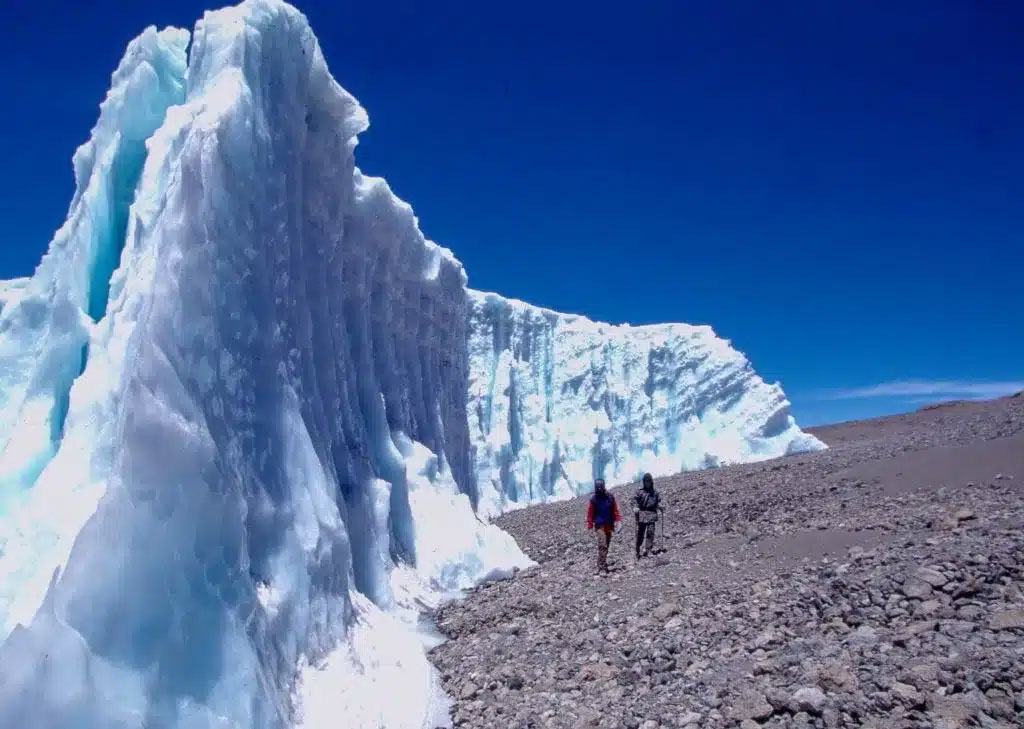
Edge of ice field on Mount Kilimanjaro – photo www.tranquilkilimanjaro.com
Mount Kilimanjaro remains one of Africa’s most iconic landscapes, symbolising both natural heritage and the visible impacts of climate change. For decades, its retreating glaciers were widely seen as evidence that the mountain’s famous ice cap could eventually disappear. Recent observations, however, have introduced cautious optimism alongside renewed scientific scrutiny. According to figures from the Kilimanjaro National Park Authority (KINAPA), glacier coverage has increased from about 2.24 square kilometres in 2010 to 5.92 square kilometres in 2025. If confirmed through independent scientific review, this would represent a rare reversal for a tropical glacier system and an important conservation milestone for Tanzania. The change is linked to more than two decades of conservation efforts led by the Tanzania National Parks Authority (TANAPA), local communities, and environmental partners, including large-scale tree planting, forest restoration, and watershed protection programmes.
KINAPA officials suggest that recovery of the surrounding forest belt may be contributing to improved ecological conditions. These forests play a key role in capturing cloud moisture, regulating local climate, and sustaining water systems that support both ecosystems and surrounding communities. The benefits extend to agriculture, biodiversity, and livelihoods across the mountain’s slopes.
However, scientists continue to urge caution. NASA-linked research shows that more than 80 percent of Kilimanjaro’s ice cover was lost between 1912 and 2011. Experts also stress that glacier surface area alone does not reflect total ice volume, as seasonal snow and measurement differences can affect results. Peer-reviewed verification is therefore essential before drawing firm conclusions.
Even so, the findings highlight the value of sustained conservation. Forest restoration has improved soil stability, water retention, and ecosystem resilience, showing how community action can shape long-term environmental outcomes. Tourism is also reinforcing this momentum, with rising visitor numbers and revenues supporting conservation and park management. This reflects broader gains in Tanzania’s tourism sector, including Zanzibar’s continued growth.
Zanzibar tourism approaches one million visitors in 2025
Zanzibar’s tourism sector recorded strong growth in 2025, welcoming more than 917,000 international visitors and edging closer to the symbolic one-million-arrival milestone. The performance reflects a steady post-pandemic recovery and the islands’ rising profile as one of Africa’s leading beach and cultural destinations. According to the Zanzibar Office of the Chief Government Statistician (OCGS) in collaboration with the Zanzibar Commission for Tourism (ZCT), the 917,167 arrivals are part of the official 2025 Annual Tourism Statistical Release. The figures are compiled under Zanzibar’s national statistical system covering Unguja and Pemba, based on immigration data from airports and seaports, and are typically published early in the following year.
Arrivals increased from 736,755 in 2024 to 917,167 in 2025, representing nearly 25 percent growth. December 2025 alone recorded over 100,000 visitors, marking one of the strongest monthly performances in recent years. The recovery has been supported by improved air connectivity from Europe, the Middle East, and regional African markets, alongside upgrades at Abeid Amani Karume International Airport, roads, and hospitality services. Europe remains the leading source market, with Italy, France, Germany, and Poland among the top contributors. Visitors stay an average of seven to eight nights, supporting jobs across tourism, transport, and local businesses.
Beyond beach tourism, Zanzibar continues to diversify into Stone Town heritage, spice tours, marine experiences, diving, and community-based tourism. As growth continues into 2026, expectations are rising that Zanzibar will soon surpass the one-million mark, with sustainability and service quality seen as key to maintaining momentum.