by Ben Taylor
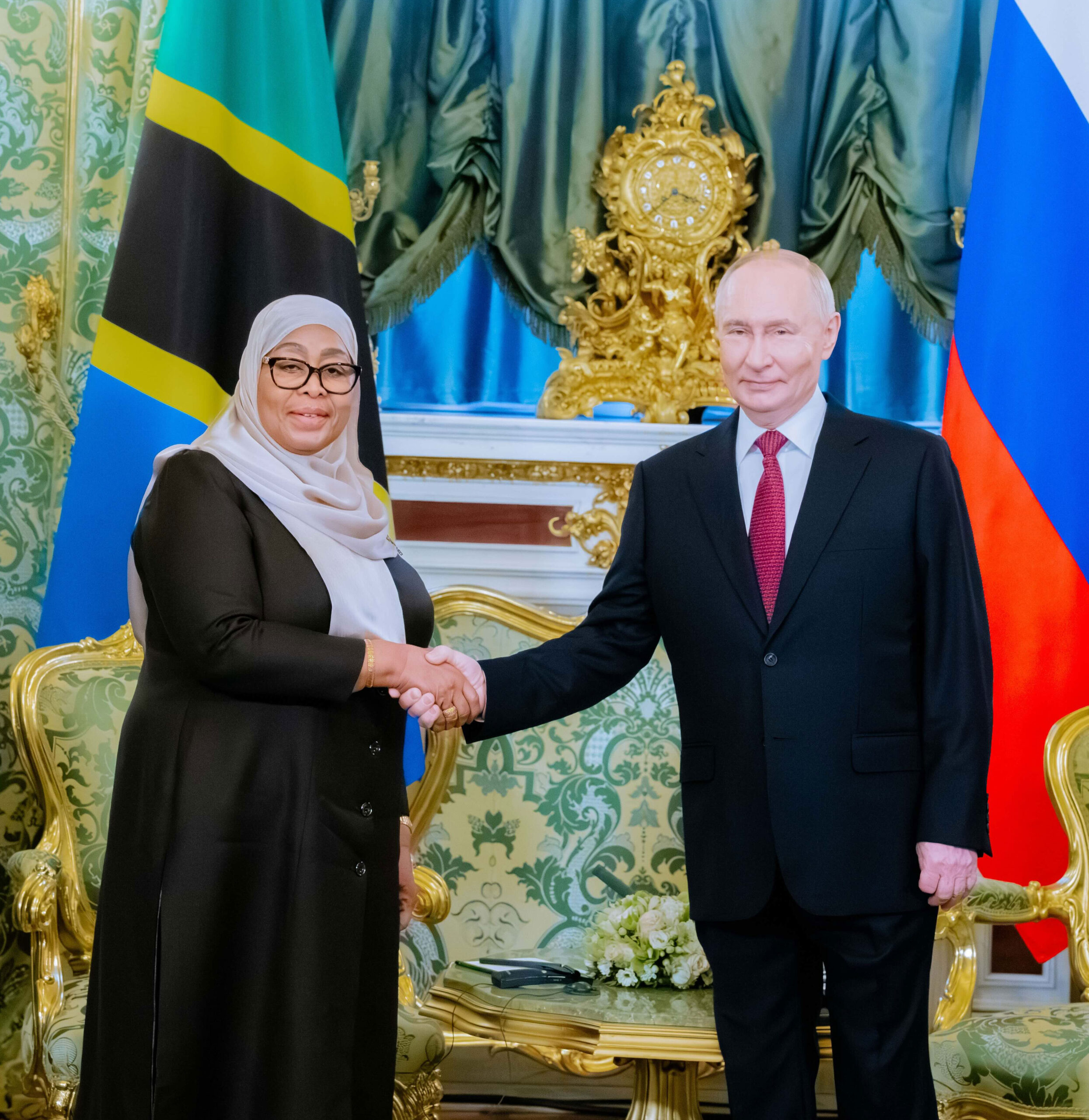
President Samia is welcomed by Russian President Vladimir Putin during her visit in June
Presidential Commission report and reactions
The aftermath of Tanzania’s highly controversial October 2025 general election took a significant turn on April 23, 2026, when the Presidential Commission of Inquiry belatedly handed its findings to President Samia Suluhu Hassan. Chaired by former Chief Justice Mohamed Chande Othman, the commission conducted a 153-day investigation across 11 regions, collecting testimony from more than 1,300 witnesses and hearing from 63,603 people.
The commission’s report confirmed a devastating human toll, documenting at least 518 deaths, over 2,390 injuries, and property destruction valued at more than TSh 125 billion. Nevertheless, opposition figures said these counts vastly understated the actual numbers of injuries and deaths, as they seemingly only counted deaths that occurred at protests, not later in homes and communities. The commission acknowledged that some deaths went unreported, meaning the statistics are necessarily incomplete.
“Evidence and information have shown that some politicians and activists used citizens’ challenges resulting from various identified sources as an opportunity to persuade citizens to participate in violence during and after the General Election using various slogans and declarations,” said Justice Chande.
“The Commission has obtained evidence beyond doubt that the events of violence in October 2025 were planned, coordinated, funded, and implemented by people who received training,” he said. Justice Chande added that he had evidence that confirmed there were people persuading and recruiting others, such as young people in difficult environments, bodaboda riders and small entrepreneurs, to participate in violence during and after the General Election. He said they were given TSh 10,000 – 50,000 and were promised jobs and a better life. He claimed further that from October 12-28, 2025, “they were kept together, given training, prepared, and encouraged to be part of starting and participating in violence on election day.”
Among the commission’s recommendations was a call for a new national Constitution be available by the year 2028, so it is used in local government elections of 2029 and the general election of 2030. “We listened to cries of those who lost their loved ones, who were injured, and who lost property,” said Justice Chande. “We saw eyes of youth who were arrested asking with anxiety their future. We met with families which until today have not understood who killed their loved ones and why.”
“But also on other side, we see Tanzanians with great courage, patriotism and wisdom. We listened to religious leaders praying for peace with real power. We saw Elders with respect providing words of wisdom. We got cooperation of citizens who came to provide evidence because they love their Nation.”
Presidential response
In response, President Samia acknowledged the profound impact of the crisis but notably chose to keep the full text of the report classified. “This is the President’s report,” she said. “Therefore, let no other people come and claim ownership of this report; it is the President’s report.”
She called for national unity in the face of challenging circumstances: “I urge you very much to continue to strengthen our unity and cohesion so that we do not give an opportunity to be disturbed by enemies of our nation.”
“We would be deceiving ourselves if we did not speak the truth that what happened at that time shook our nation. Indeed, it shook us. … The Commission has explained to us that the investigation has established that the violence that occurred was planned, coordinated, financed, and executed by trained people with criminal tendencies and destructive activities. Similarly, it has been established that the goals of those involved were to disrupt the election and create a leadership vacuum so the country would not be governed, and that is why the violence began on election day… Without a doubt, the efforts of the security and safety organs to control that violence and disorder are what have made Tanzania what it is today.”
“The Commission has examined what affected us and has provided both treatment and guidance. Our task now is to apply that treatment effectively… I will carry this responsibility with courage, confidence, and caution. But we must do this together. Do not leave this burden to me alone.”
Her senior adviser, Lazaro Nyalandu, later amplified this stance in a television interview with CNBC Africa, stressing that President Samia was “absolutely abhorred” by the massive loss of life, but defensively maintained that the violence was a “well-planned” and “orchestrated” event by political actors rather than a spontaneous democratic protest.
Wider reactions
Opposition leaders and international human rights organisations dismissed both the commission report and the President’s remarks as an attempt to whitewash state-sponsored brutality and shield security forces and government officials from accountability. They argued that blaming “outside orchestrators” completely ignored the indiscriminate violence deployed by the state.
Human Rights Watch criticised Justice Othman for failing to evaluate the lawfulness of the police force’s conduct, while Amnesty International openly condemned the decision to withhold the document from citizens. Flavia Mwangovya, Amnesty International’s Deputy Regional Director for East and Southern Africa, declared: “To withhold the Commission of Inquiry report from the public is a blow to transparency, which is key in the process of achieving accountability.”
“Using police data to investigate police conduct is methodologically unsound and undermines the reliability of findings,” argued a coalition of 14 civil society organisations, including the Legal and Human Rights Centre (LHRC), Tanganyika Law Society (TLS), Centre for Strategic Litigation (CSL) and Twaweza East Africa. “The commission collected sworn testimony from witnesses, [and] yet it failed to use this testimony to identify those responsible. This raises serious questions about whether the full report contains information deliberately omitted from the public presentation, and whether political considerations influenced what was included.”
Former Prime Minister Joseph Sinde Warioba expressed confusion over the government’s decision to keep the full Chande report confidential, saying it broke with national precedent. He noted that previous significant inquiries, such as the Nyalali Commission and his own corruption commission, had their reports made fully public. He emphasised that citizens need to know what the commission discovered to facilitate genuine national healing.
A new commission
President Samia Suluhu Hassan has officially formed a special criminal investigation commission to identify and prosecute those responsible for the deadly violence that followed the October 29, 2025, general election. This was among the initial commission’s recommendations.
The new commission will be chaired by Justice Shabani Ally Lila of the Court of Appeal, joined by three retired High Court judges, Justice Gad John Mjemmas, Justice Aishieli Nelson Sumari, and Justice Awadh Mohamed Bawazir, serving as commissioners. This directly implements a key recommendation from the initial presidential inquiry led by retired Chief Justice Mohamed Chande Othman.
This new commission’s mandate is to investigate specific matters, including identifying the main perpetrators of the violence. It is also tasked with clarifying the confusing circumstances surrounding deaths and injuries, locating missing corpses, and recommending concrete accountability steps.
However, the decision to form yet another commission has drawn sharp criticism from civil society and eminent national figures. The civil society coalition statement suggested this approach appeared designed to avoid rather than achieve accountability.
Diplomatic reactions
The fallout from the post-election violence and the commission’s findings have triggered an unravelling diplomatic crisis between Tanzania and its traditional Western partners. The administration’s decision to keep the full report classified while framing the 518 deaths as an “orchestrated plot” by unnamed opposition groups has left many in Washington, Brussels, and London dissatisfied. International responses have shifted from polite diplomatic concern to direct, punitive measures.
The United States has arguably delivered the most aggressive response. In May, the U.S. Department of State formally imposed targeted visa restrictions and financial sanctions. The primary target of the ban is Inspector General of Police (IGP) Camillus Wambura, alongside several other senior commanders within the Tanzania Police Force (TPF) and the state intelligence apparatus. The U.S. explicitly cited Wambura’s direct responsibility for command-level complicity in “gross violations of human rights,” including the deployment of live ammunition against peaceful protesters and unconstitutional arbitrary detentions.
Since the commission reported, the European Parliament and the European External Action Service (EEAS) escalated debates regarding a total freeze on aid flows to Tanzania. Brussels informed the Tanzanian Ministry of Foreign Affairs that further disbursement of governance and infrastructure aid is strictly conditional on the public release of the full, unredacted inquiry report and the establishment of an independent, internationally monitored judicial prosecution framework.
Since the report was handed over in April, the UK government has shifted its public-facing focus back toward trade and investment. For example, during the Tanzania Impact Investment Forum in early June 2026, High Commissioner Marianne Young focused her public remarks on pitching opportunities in Tanzania for British investors. While British diplomats are undoubtedly raising governance and human rights concerns behind closed doors in meetings with Tanzanian state officials, they have chosen to keep those specific grievances away from the public eye.
In response to this mounting pressure, President Samia has publicly warned citizens of a “difficult financing context ahead.” She has also begun aggressively pivoting its capital hunt elsewhere, reportedly prioritising new $1.4 billion infrastructure projects with China and a $1.2 billion uranium project backed by Russia (see below, and Energy and Minerals section, in this issue).
Tundu Lissu latest
Tundu Lissu, chair of Tanzania’s main opposition party, Chadema, remains in a highly precarious situation following his arrest on April 9, 2025. Detained after leading a political rally calling for constitutional and electoral law reforms, Lissu has spent over fourteen months behind bars. International monitoring groups, including the International Democracy Union (IDU), have repeatedly labelled his detention as politically motivated persecution aimed entirely at crushing democratic opposition in the buildup to and aftermath of the highly controversial October 2025 general election, from which Chadema was ultimately barred.
On the legal front, Lissu is currently facing accusations of treason, which carry the risk of capital punishment. Legal proceedings have been plagued by long delays and procedural standoffs before a three-judge bench at the High Court of Tanzania in Dar es Salaam. Acting as his own defence counsel due to what he describes as a systemic denial of private, meaningful access to his legal team, Lissu scored a notable procedural victory in February 2026. Presiding Judge Dunstan Ndunguru sustained Lissu’s objection against the prosecution’s attempt to use hidden, anonymous witnesses testifying from enclosed cells, ruling that the tactic unlawfully obscured witnesses from the court’s view.
Lissu’s imprisonment has drawn severe condemnation from international human rights bodies and foreign lawmakers. European Parliament members representing major political blocs issued a joint briefing confirming that Lissu has been held in prolonged solitary confinement without the option for bail. According to reports from Chadema’s deputy leader, John Heche, Tanzanian authorities have quietly attempted to negotiate a deal offering to drop the treason charges and release Lissu from prison on the strict, non-negotiable condition that he immediately accepts permanent exile and leaves the country, a compromise the opposition leader has consistently refused.
Regarding his health, deep concerns persist among international observers due to the punishing nature of his current isolation and his extensive medical history. There are also disputed reports that he suffered an attempted poisoning in mid-May. Lissu is a survivor of a brutal 2017 assassination attempt in which he was shot sixteen times, requiring years of intense, highly complex orthopaedic and reconstructive surgeries abroad. Human rights monitoring groups warn that keeping a politically targeted individual with significant lingering physical vulnerabilities in strict solitary confinement, while restricting regular access to his family, external doctors, and international observers, presents an active, ongoing threat to his long-term physical well-being.
In a surely related incident, on the night of May 20, 2026, Lissu’s personal aide David “Djumbe” Mghanja was violently abducted from his vehicle in the Bunju area of Dar es Salaam by armed individuals who handcuffed him and identified themselves as police officers. Djumbe managed to throw himself out of the kidnappers’ moving vehicle as gunfire erupted, evading his captors by hiding in a thick forest for over an hour. He was discovered at his home the following morning severely beaten and still wearing the tight metal handcuffs used by his abductors.
On May 23, three days after the attack, Prime Minister Mwigulu Nchemba publicly addressed the situation. He characterised the recent string of assaults and abductions targeting government critics as a coordinated “scheme” designed to divide Tanzanians. He strongly suggested the presence of an external conspiracy or foreign-backed elements trying to destabilise the country’s domestic peace, firmly denying that the state or ruling party had any hand in the violence against Djumbe.
On May 25, the Dar es Salaam Special Zone Police Commander, Jumanne Muliro, confirmed that the police are actively investigating the “kidnapping of the assistant to the Chadema chairman, Mr. David Djumbe,” alongside other recent serious crimes in the city. Muliro stated that investigations are ongoing and promised that the public would be officially updated as soon as any specific suspects are apprehended.
Ministry of Youth
The government’s other main response to the election situation is the establishment of a standalone Ministry of State in the President’s Office responsible for Youth Development. This began soon after the election, in late November 2025. Led by Minister Joel Arthur Nanauka, the ministry manages the needs of Tanzania’s 20 million young citizens (aged 15–35), who represent over a third of the national population but face high unemployment and a widespread sense of political disenchantment.
The stated rationale is to pull youth affairs out of diverse, fragmented bureaucratic portfolios and consolidate them under a single national focal point. In doing so, the government hopes to defuse tension by listening to young people and responding to their concerns.
The newly formed ministry has established an official guiding philosophy “Vijana Tuyajenge, Tanzania ni Yetu” (Youth let’s build it, Tanzania is ours). Its immediate strategy centres on three operational pillars: fast-tracking access to youth services, conducting regional listening tours, and investing heavily in technology through the new Vijana App portal to streamline employment and financing pathways.
The ministry’s flagship initiative is a TSh 200bn (£57m) Youth Enterprise Support Facility, launched by the government on February 5, 2026. In an acknowledgement of how past youth funding schemes dissolved into local government corruption and “ghost groups,” the ministry has adopted a new approach. For the first time, capital is not routed through local government but instead through commercial institutions like the CRDB Bank Foundation. The facility targets high-growth, productive fields including advanced agriculture, mining, manufacturing, and tech startups.
The first open application window, which ran from mid-March to late April 2026, generated over 30,000 applications from young entrepreneurs. On April 30, 2026, the ministry published its first round of preliminary data, approving an initial cohort of 1,961 youth business beneficiaries for concessional loans. To ensure the financial sustainability of the projects, Minister Nanauka has mandated that all successful applicants undergo an intense, zonal-level business and financial literacy training program before the commercial banks disburse the funds.
President Samia conducts state visit to Russia
President Samia Suluhu Hassan conducted a three-day state visit to Russia from June 3–5, 2026, marking a significant geopolitical pivot for Tanzania. This is the first time a Tanzanian head of state has made an official visit to Russia since founding father Julius Nyerere’s historic trip in 1969. She was escorted by a prominent business and ministerial delegation.
The timing of this diplomatic realignment is highly calculated; facing escalating aid cuts, direct visa sanctions, and a severe loss of reputation among Western democratic partners over the lethal post-election crackdowns of late 2025, President Samia is looking to Russia to diversify Tanzania’s foreign dependency and secure fresh capital.
The centrepiece of the visit was a high-stakes, televised bilateral meeting at the Kremlin, where Russian President Vladimir Putin welcomed the Tanzanian leader. Highlighting that 2026 marks the 65th anniversary of diplomatic ties between the two nations, President Putin noted that bilateral trade between the two countries increased by 25% over the previous year. For Russia, a deepened partnership with Tanzania serves a dual strategic purpose: it secures a geopolitical foothold along the Indian Ocean maritime logistics corridor, while simultaneously building an alliance with an emerging African nation that has expressed interest in partnering with the BRICS economic bloc.
The economic diplomacy culminated at the 29th St. Petersburg International Economic Forum (SPIEF 2026), where President Samia took centre stage as a key speaker alongside Putin and Chinese Vice President Han Zheng. Addressing the Russia-Tanzania Business and Investment Forum, she challenged executives from both countries to move past standard diplomatic rhetoric and locked in 12 major intergovernmental cooperation agreements. The delegation confirmed that Air Tanzania will officially launch its first direct flights connecting Dar es Salaam and Zanzibar to Moscow on July 2, 2026, aiming to tap into Russia’s outbound traveller market.
On the industrial front, the conversations shifted toward critical mineral extraction and advanced energy technologies. Russian Economic Development Minister Maxim Reshetnikov confirmed that energy giant Gazprom is actively drafting plans to enter Tanzania’s massive offshore gas sector, eyeing projects spanning from extraction to regional distribution networks. President Samia also utilised the St. Petersburg platform to court Russian state tech, inviting partnership in geological surveys, localised vaccine manufacturing, and active technical consultations to introduce small modular nuclear reactor (SMR) technology into Tanzania’s long-term domestic energy matrix.
Another high-profile visit
Former Manchester United captain and England footballer Rio Ferdinand visited Tanzania for three days in May. Welcomed by a vibrant reception of football fans at the Julius Nyerere International Airport, Ferdinand’s itinerary was heavily backed by the state. He travelled on the new railway to Dodoma to attend a parliamentary session, inspected sports infrastructure projects in Arusha being prepared for the 2027 Africa Cup of Nations (AFCON), and toured Serengeti National Park. By the end of his tour, Ferdinand accepted an official appointment as Tanzania’s Tourism Ambassador, pledging to use his global platform to promote the country’s cultural and social wealth.
The visit sparked significant political undertones and domestic controversy due to the identity of his primary government host. Ferdinand’s invitation and tour were personally managed by Paul Makonda, the Minister for Information, Culture, Arts and Sports. Makonda is a controversial figure in Tanzanian politics, having been placed under direct U.S. State Department sanctions in 2020 for his involvement in “gross violations of human rights,” including the targeted suppression of political opposition, critics, and marginalised groups during his previous tenure as Dar es Salaam Regional Commissioner.
The alignment of an internationally renowned sports icon and anti-racism advocate with Makonda drew frustration from domestic human rights defenders and opposition figures. Critics noted that the Tanzanian government heavily leveraged Ferdinand’s celebrity status to soften its international image and project a sense of stability and progressive development. By embedding Ferdinand directly into state-sponsored infrastructure tours and parliamentary events, the administration effectively utilised a global football legend to run a public relations campaign at a time when the state is facing severe international pressure over its domestic human rights record.