
THE NEW PRESIDENT

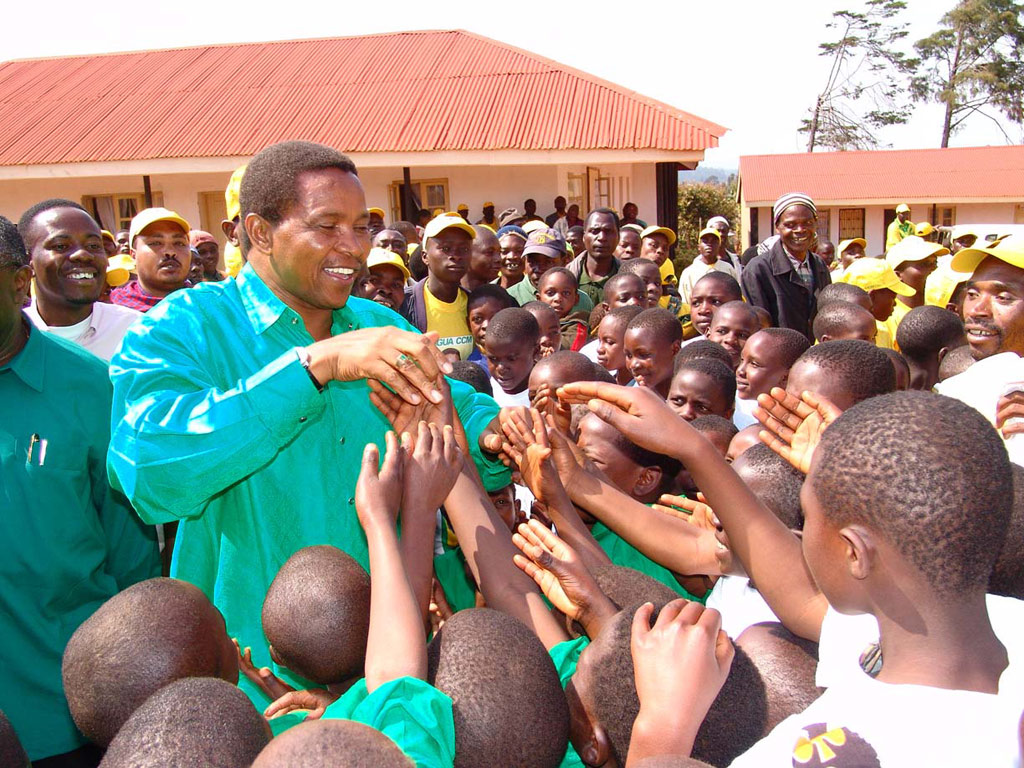
KikweteJakaya Kikwete greets children in Morogoro during the electrion campaign – photo Michuzi Jr

IRIN (a UN humanitarian news and information service, which may not necessarily reflect the views of the United Nations or its agencies) has issued a profile of the new president. Extracts: Jakaya Kikwete, is widely regarded as a career politician and staunch socialist. Yet he has repeatedly expressed his commitment to continuing his predecessor’s free-market reforms. Despite opposition complaints, these have left the majority of the people as poor as they were under the country’s socialist system. Kikwete’s affiliation with Tanzania’s founding President, Julius Nyerere; his immediate successors Ali Hassan Mwinyi and Mkapa; as well as Kikwete’s long-time membership in the ruling Chama Cha Mapinduzi (CCM), are well known. Continue reading
THE UNION ELECTION RESULTS

Union Presidential Elections
As held on December 14th 2005 having been postponed from October 30th because of the death of Mr Jumbe Rajab Jumbe, the Vice-Presidential candidate of the CHADEMA party.

Candidate (Party)

Number of Votes

% of Votes

Jakaya Kikwete (CCM)

9,123,952

80.28%

Ibrahim Lipumba (CUF)

1,327,125

11.68%

Freeman Mbowe (CHADEMA)

668,756

5.88%

Augustine Mrema (TLP)

84,901

0.75%

Sengondo Mvungi (NCCR-Mageuzi)*

55,819

0.49%

Christopher Mtikila (DP)

31,083

0.27%

Emmanuel Makaidi (NLD)

21,574

0.19%

Anna Senkoro (PPT-Maendeleo)

18,783

0.17%

Leonard Shayo (MAKINI)

17,070

0.15%

Paul Kyara (SAU)

16,414

0.14%

Continue reading

AN ELECTION DIARY

This daily diary was originally intended to cover the whole of the election in Tanzania but, three days before it was due to be held, the death of one of the Union Vice-presidential candidates caused the election on the mainland to be postponed until December 14th in accordance with the constitution. It was possible therefore for me to spend more time witnessing the election in Zanzibar but no time for the final stages of the elections for the Union presidency and for the National Assembly in Dodoma – Editor.

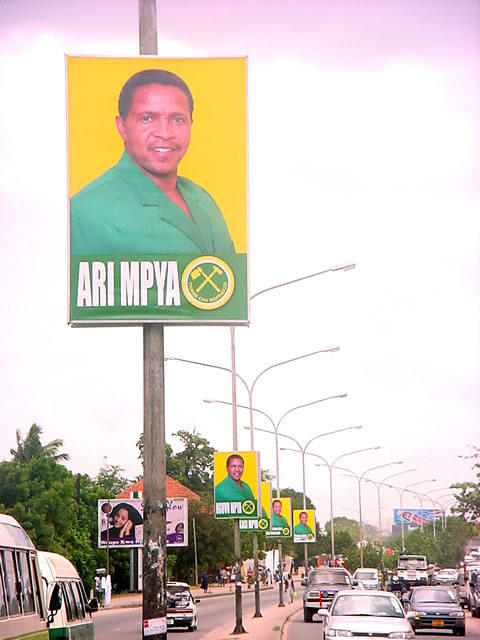
posterPosters in Nkrumah St, Dar. Kikwete’s slogan “Ari Mpya, Nguvu Mpya, Kasi Mpya” roughly translates as “renewed enthusiasm, vigour and a faster pace”
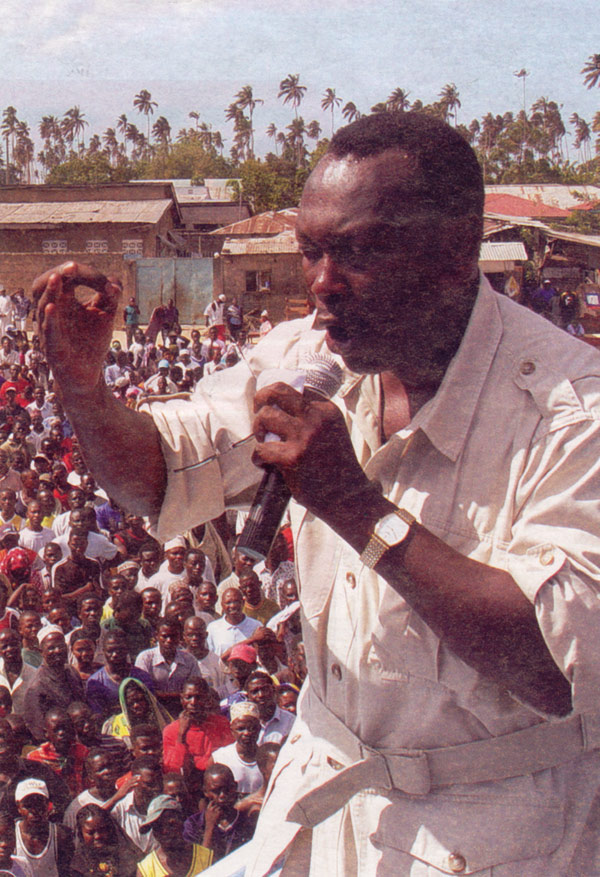
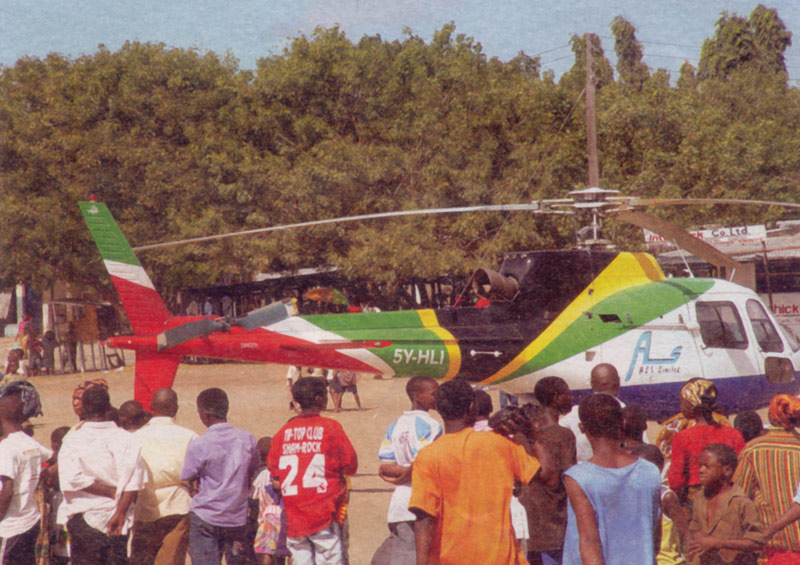
23rd October. It is obvious that there is an election going on. All the way from the airport smiling photographs of Mr Jakaya Kikwete, the candidate of the ruling Chama cha Mapinduzi (CCM) party look down upon you. There are thousands of them. Small ones on lamp-posts and massive ones on billboards. There are also other posters, simpler in design and less colourful, from the more affluent of the 17 opposition political parties involved in the elections. 24th October. Morning. To the headquarters of the opposition CHADEMA party which presently has four MP’s in the National Assembly. This time it hopes for at least 20, according to Acting Secretary General Shaid Ally Akwilombe who explains to me how the party’s dynamic young presidential candidate Freeman Mbowe (44) has vastly raised the party’s image, by campaigning in a helicopter.

Mbowe mbowe helicopter Freeman Mbowe (photo Peter Mgongo)

He has been holding up to ten meetings a day, often in remote places where a presidential candidate has never been seen before. Continue reading

ZANZIBAR – THE AFTERMATH

November 2nd. Immediately after the results were declared, residents of Pujini village in North Pemba fled their homes after a KMKM soldier disappeared. Other soldiers retaliated later by raiding the village and beating and robbing people….(later, on 16th November): ‘Police recovered the body of a soldier who was allegedly murdered by opposition party supporters. According to eyewitnesses, the deceased was abducted while riding a motorcycle with a colleague, who escaped, and was beaten to death by unidentified people. The police said that two suspects had appeared in the regional court in connection with the death – Guardian. Continue reading

TANZANIA IN THE INTERNATIONAL MEDIA

Uganda’s THE MONITOR published an article in June under the heading ‘The Grave of Kiswahili’. Extracts: ‘One of the jokes that Tanzanian army officers told after they overran Uganda and threw out dictator Idi Amin in 1979 was that they had also discovered the ‘grave of Kiswahili’…..After the beautiful language was born in Zanzibar and grew up in Tanzania, it had been killed in Kenya and buried in Uganda…. But the Kenyans are not the only guilty ones in practicing ‘lingocide’, and nor are Ugandans the only lingual undertakers in the region. The Tanzanians themselves are guilty of a similar offence. What Uganda and Kenya did to Kiswahili, the Tanzanians did to English. Suppose you met this smart young lady dressed in a business suit on Parliament Avenue in Kampala and, on asking her for directions, she smiles apologetically and says in her language that she does not know English! It would be odd, wouldn’t it? In Dar es Salaam it would not be. They killed English decades ago. It was the language of colonialists, exploiters and all those things. They reasoned that English is not the same as knowledge and went ahead to promote Kiswahili as the official language in which everything is transacted. Coupled with massive primary education, they soon achieved 100% literacy, probably the highest in the world ever. All citizens could read and write Kiswahili and everybody was happy, for a while. Continue reading

MIGRATING BIRDS AND BIRD FLU

Tanzanians have cause to worry about ‘bird flu’. The country is at risk because of migrating birds which have a major stopover in Tanzania. Jasson John, a Birdlife Officer with the Wildlife Conservation Society of Tanzania was quoted in The Express as saying that migrating birds from the North usually make a brief stopover in Nnorth Africa before coming to the East African coast between September and December, on their way to South Africa. The big threat was that the disease might be borne by water birds particularly those in the duck family as Tanzania has good habitats for such birds…The other threat is the presence of house crows that scramble for food and may easily interact with these migrant birds in coastal areas. He said the virus was found in the mucous of the birds. In rural areas people shared rooms with domesticated birds and depended greatly on birds as a source of food.

TANZANIAN ECONOMIC ACHIEVEMENTS

By Joseph Kilasara

Tanzania has come of age with the onset of the fourth phase government as we like to call it. The third phase government of Mr Mkapa has made tremendous achievements in addressing the macroeconomics fundamentals of the economy with the exception of unemployment which remains astronomically high.

At the start of Mkapa’s government in 1995, the economy was in a dire state with inflation hovering around 29% and growing; the currency was depreciating daily; foreign donors had deserted the country; tax evasion and corruption, both high level and petty, was seen as a norm; and, as the government was not collecting revenue, salaries were extremely meagre and frequently delayed. For some time the economic and business environment was all but chaotic and the government had lost its credibility and was becoming more of a joke. Continue reading

BUSINESS & THE ECONOMY

In an effort to boost the capacity of local microfinance institutions the Governor of the Central Bank of Tanzania, David Balali, has launched the ‘The Financial Sector Deepening Trust (FSDT)’. The objectives of the fund are to support any organization that contributes to realizing the objectives of the government’s ‘Poverty Reduction Strategy Plan (PRSP).’ The Trust’s investments will include research and development of financial markets, products and services, training, capacity building, strengthening smaller financial institutions as well as developing regulatory and supervisory frameworks – The Guardian.

The Guardian has also reported some good news for coffee farmers in Kilimanjaro thanks to the introduction of the Tanzania Kilimanjaro brand initiated by a company called Peet’s Coffee & Tea. The coffee is being marketed as a single origin coffee in the US as the result of a project funded by USAID, the Swiss State Secretariat for Economic Affairs, Farm Africa and other private donors.

Creditors have been closing in on the once high-flying flag of the road transport sector – The Scandinavian Express Services Limited – which operates throughout East Africa with its luxury buses. The liquidation bid has been filed in the High Court by Shell Tanzania seeking to recover about Tzs 1.5bn in unpaid oil supplies. This petition was immediately followed by those of several major local banks leaving the future of the company in a gloomy state. Nevertheless, this could in a way be a blessing in disguise to the credit market in general as it will instill a much needed debt-repayment culture.

MUHIMBILI DOCTORS STRIKE

Doctors at Muhimbili Hospital went on strike over pay in November demanding that their starting salary should be raised substantially. On November 20th the government complied by raising junior doctors’ salaries by over 60% from Tsh. 226, 000 to Tsh. 420,000 and to Tsh. 1,141,000 from Tsh. 1,030,000 for specialists and consultant doctors. On November 25th the doctors rejected the award. The government then sacked 176 doctors, nurses and pharmacists and quickly moved to replace them with doctors from the Tanzania People’s Defence Forces (TPDF) and Ministry of Health. Heavily armed police stormed the hostels to evict the sacked junior doctors and the interns who were still at the hospital. Some retired doctors reported at the hospital for duty. When the striking doctors changed their minds and accepted the pay award, the government said it would consider only individual requests to return to duty. In an interview with The Express, MNH Managing Director Dr. David Treggoning said the hospital administration was forced to take the decision to sack the doctors but they had not wanted t do so.