
by Sheila Farrell
Tanzania’s alternative education pathways: a second chance for teenage mothers
In spite of growing demand for skilled labour, almost two thirds of Tanzanian children do not complete their secondary school education up to Form IV level (equivalent to the UK’s GCSEs). The high dropout rate is caused by many different things: poverty, sickness, long distances from home to school, and the multiple barriers that prevent girls from continuing their secondary education. One of these is teenage pregnancy.
Official figures for drop-outs due to pregnancy are around 8,000 girls per year, but the stigma attached to pregnancy means that estimates by NGOs working in this area are much higher, commonly reaching 15,000 girls, if pregnancies among primary school children are included. This is equivalent to around 1 in 200 girls at lower secondary schools.
Pregnancy is not the only, or even the largest, reason why young girls drop out of school, but behind the statistics are personal tragedies that undermine the lives of many young mothers and their babies, and perpetuate an on-going cycle of poverty.
Until November 2021 young girls who became pregnant were permanently excluded from the State education system. This has been changed by President Samia Suluhu Hassan through expansion of the Elimu Haina Mwisho (Education has no end) and Alternative Education Pathways (AEP) Programmes.
As well as adolescent mothers the AEP programme is intended to target students who drop out before completing secondary school, vulnerable and marginalized youth, and young people whose life circumstances make regular schooling difficult. As well as academic education, it provides:
• Flexible instruction that fits students’ family or work responsibilities;
• Life skills education (decision-making, communication, citizenship);
• Vocational and entrepreneurship training;
• Mentorship and counselling;
• Psychological support to help students re-engage with society.
AEPs have existed for many years outside of the formal education system in Tanzania, with the Institute of Adult Education (IAE) registering and overseeing Open Schools run by non-government bodies while offering secondary education at its own centres.
Unregistered tuition centres were also popular in the early 2000s, while some students have prepared themselves independently or used private teachers to sit for national examinations as private candidates. However, this is expensive – well beyond the means of most families in rural Tanzania.
During the 1990s and early 2000s, AEP evening classes were very common, including within state schools. After the government discontinued the use of state schools for evening classes, education opportunities for teenage mothers were expanded under two separate programmes.
The first was the Elimu Haina Mwisho Programme, a second-chance education initiative for young girls who have dropped out of school due to pregnancy, poverty, or other social challenges which began in 2018. It was funded by Mastercard, implemented by Karibu Tanzania Organisation, an NGO, and centred on 55 Folk Development Colleges, themselves derived from a Swedish model for adult education. In its first three years it educated 1,200 girls. Since then, it has become a permanent institution, with a hybrid financing model, recruiting hundreds of new students through regular local recruitment drives. The Tanzanian Government covers the standard monthly base salaries of the permanently-employed government teachers stationed at these colleges, with top-up funding for teacher training, specialist vocational instructors and various allowances paid for by grants from external donors.
In parallel with this has been the expansion of the AEP school network as part of the World Bank-sponsored Secondary Education Quality Improvement Project (SEQUIP), which is being implemented by the Institute of Adult Education. This started in 2022, with just over 3,300 students spread between 131 AEP learning centres, and now has over 12,000 students in 200+ learning centres. The majority of these centres are owned and operated by the State and teach mainly young mothers.
However, there is still a role for the non-profit sector in pioneering new education methods in this type of school, and Tanzania Development Trust has been playing its part through its partnership with Tumaini Open School in Tabora. This was started in 2020 by Ezekiel Kassanga, one of TDT’s local reps, using volunteer teachers to teach teenage mothers in the offices of another NGO. After a successful fund-raising operation by TDT, to which many BTS members contributed, the school opened at its present site in July 2023 with just 12 pupils. Within three years this has increased to 82 pupils, with its Phase 1 target of 100 pupils expected to be met later this year.
What has contributed to this success? First, it is a residential school with the teachers living on-site, which gives them time to get to know their pupils. At present there is not enough accommodation to allow the girls to bring their babies with them, but this is the ultimate aim. Once money becomes available, staff will be employed to look after the babies during classroom hours before returning them to their mums, avoiding the severance of mothers from children which unfortunately occurs now.
Grandparents are also important, and a social worker has been employed to liaise with the girl’s families, persuading them of the benefits of continued education and working hard to remove the stigma associated with extra-marital pregnancy in conservative rural societies.
One of the main selling points of the school has been the high quality of education it offers. So far, with six teachers, it has benefitted from small class sizes and a willingness to let the girls learn at their own pace. It makes extensive use of computers and distance learning materials, providing girls with the skills they need to secure well-paid jobs after leaving school. And it encourages them to think as widely as possible, aiming to produce independent, self-confident young women of whom their families can be proud.
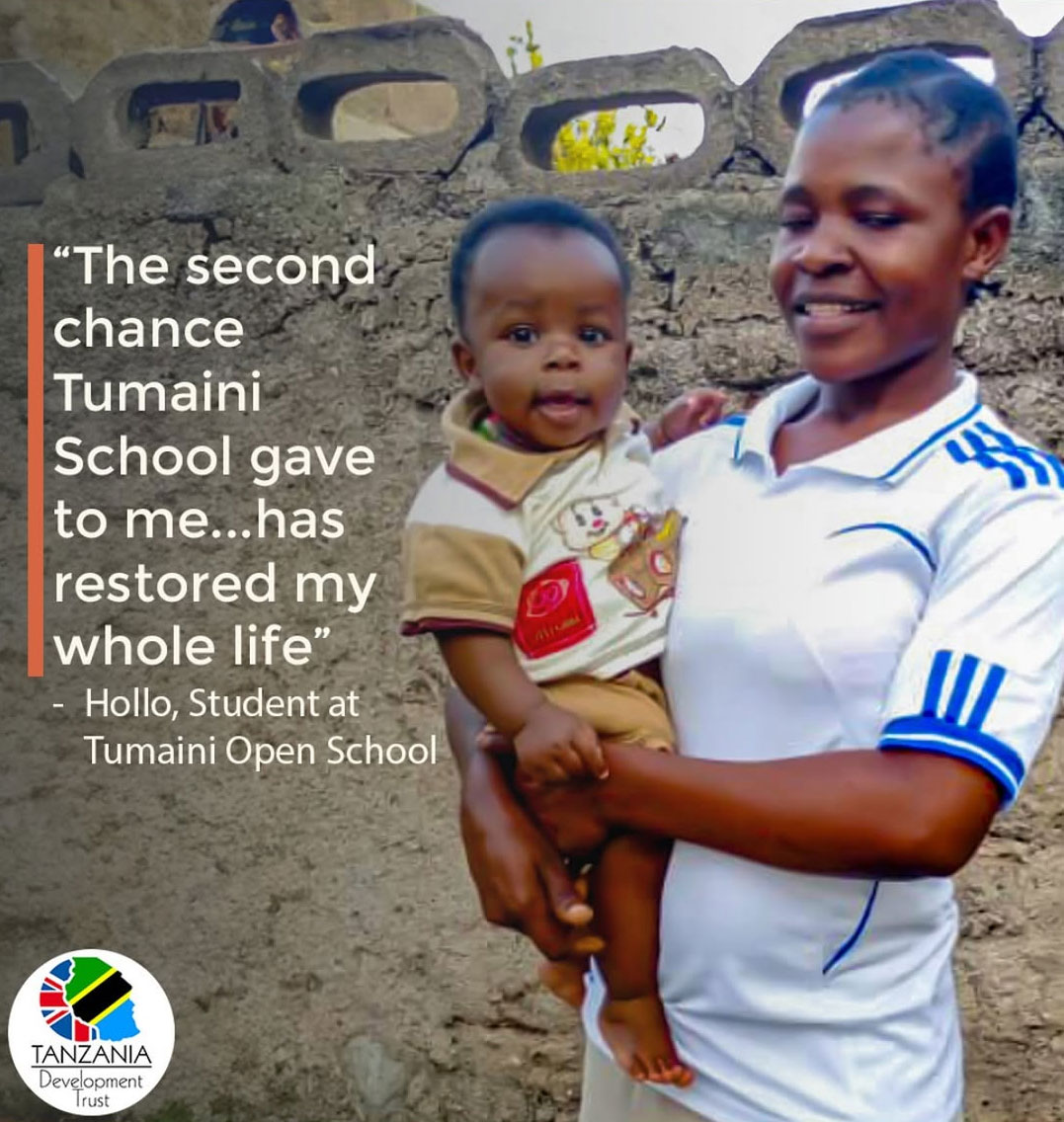
Tumaini is a girls-only school. Almost all of its teenage mothers come from poor families and are educated free of charge. But its reputation is beginning to spread, and it is now taking in fee-paying girl students who do not have babies of their own. In its business model, the aim is to grow the school to around 300 pupils of whom roughly one-third will be fee-paying. This is still some way off, but the school is moving in the right direction.
In spite of low income levels, education is highly prized in Tanzania and some poor families take on additional work in order to pay private school fees. Tumaini is trying to avoid high fee levels in order to become the local community’s private school of choice, but still needs to find ways of funding its £45,000 p.a. operating budget.
Like any organisation operating on a shoe-string budget, Tumaini is constantly innovating and trying to find better ways of doing things. The school’s director Ezekiel Kassanga is being helped in this by two TDT’s volunteers with extensive teaching experience in Tanzania: Nanette Archer and Steve Scorer. If you think you could help Tumaini in any way, even if you are not a teacher yourself, please get in touch with them at nanettearcher@tanzdevtrust.org or stevescorer
Alternatively you can find out more about the school and follow its progress on tumainiopenschool.org.
Tanzania Development Trust faces threats and opportunities
In its annual report on the state of the charity sector in the UK, published in March 2026, the Charity Commission pointed out that while the total income of registered charities was increasing faster than inflation, reaching over £100bn in 2024-25, the vast majority of the funding (90%) went to charities benefitting communities in the UK.
This is because many UK-oriented charities receive payments for their charitable activities or run trading activities such as charity shops. Only one third of the UK charity sector’s income comes from donations and legacies, with small charities like TDT being the most dependent on these more discretionary sources of income.
TDT is also heavily dependent on funding from grant-making charities – those that spend their income from investments or endowments supporting other charities working in the field. They awarded a total of £12bn to other charities in 2024-25 and accounted for just over one third of TDT’s income in 2024-25 compared with around 10% of income for all charities eligible to apply for this type of funding.
This is an area in which there has been a marked increase in competition for funds during the last 12 months, following the ending of most USAID and the cut-back in UK overseas aid from 0.5% of Gross National Income in 2025 to 0.3% by 2027 to help fund defence spending.
Within UK overseas aid there has also been a significant shift away from poverty relief, health and education towards expenditures aimed at fostering trade and investment. Now the UK charity sector, which spent £11bn overseas in 2024-25, is almost as large as the UK Government’s overseas aid programme whose target for 2024-25 was £13.3bn.
Whilst TDT will continue to apply to other organisations for grants in future, the external chances of success are likely to decline, so it will have to be continuously on the lookout for new opportunities and make full use of new technology to strengthen the way it presents the projects it wishes to support. It has already made substantial improvements to its website (https://tanzdevtrust.org) and its social media posts are now reaching a far larger number of people than 12 months ago.
But there is still a lot more to do to keep the money rolling in. We realise that people read Tanzanian Affairs for many different reasons, and may not wish to donate to TDT, so we will try not to annoy you with too many pleas for help. However, conversations with BTS members during its 50th Anniversary year highlighted a strong desire to continue to expand TDT’s work in Tanzania, even though the external financial environment is becoming more challenging.
So, if you have any suggestions about how TDT could increase its income, or would like to help in any other way, please contact sheilafarrell