NEGOTIATIONS WITH THE I.M.F.

NEGOTIATIONS with the I.M.F. and the RESIGNATION of the FINANCE MINISTER, EDWIN MTEI

The report in the Guardian of 9 November claimed that negotiations for an I.M.F. loan to Tanzania had broken down because the I.M.F. conditions were unacceptable to the Tanzanian Government. The Finance Minister, Edwin Mtei, had resigned apparently because he felt unable to take responsibility for the economy without the I.M.F. loan and the financial support requested from et number of western countries. This breakdown would probably mean that the other western countries from whom assistance had been requested would now be even more reluctant to help. Mtei had been replaced by a former Finance Minister, Amir Jamal.

Although there has been no official statement, this report seems to be substantially correct.

The following notes on the background to the negotiations are based on a briefing provided by Professor Reg Green.

Tanzania faces a very severe short term crisis. It needs over 1979-81 to obtain £200 million in soft loans. The Tanzanian economy survived the 1973/74 crisis (produced by two years of drought, the need to import grain and increased oil costs) by very firm controls on imports and incomes. Real output grew at between 4.5% and 6% between 1975 and 1978; food production increased over the same period by an average 4% p.a.; by 1977 external payments and receipts (including normal aid) were in balance.

The causes of the current crisis are complex. There is the continuing poor export performance and the excessive relaxation of import controls during 1977-78 (a policy introduced under pressure from the I.M.F. and I.B.R.D.). On top of these basic weaknesses have come:

a. the Ugandan invasion and its aftermath of support for Ugandan liberation (cost likely to be of the order of £250 million.)

b. major floods (losses due to flood damage – mainly crop losses, roads and bridges, calculated at approx. £40 m.)

c. oil price increases (amounting to £25m. per year)

d. Zambia’s inability to remit Tazara, port and goods payments (amounting to £30m.)

The short-term need is for foreign exchange. The uses would be general loosening of limits on key imports for keeping the economy going, (e.g. fertilizer, industrial raw materials, machinery and transport spares, drugs) and on materials for investment (e.g. structural steel, machinery). Project tied lending would be far too slow to meet the need. There is at present £25-£30 m. of aid reimbursement claims outstanding because Tanzania’s administrative machinery has difficulty in dealing with the procedure required by donor countries. Tanzania’s balance of payments deficit for the two years 1979/80 and 1980/81 is estimated at £620 m.

It is proposed to meet this amount by:
Import cuts of £300 m
Export increases of 20 m
Existing economic assistance 100 m
TOTAL £420 m
Special emergency loan £200 m
GRAND TOTAL £620 m

Without this emergency loan the import cuts required would reduce the economy to stagnation, since non-food consumer imports are already so low, further cuts would be concentrated an goods and materials which are essential to the basic working of the economy. There is nothing else left to cut. Such cuts would prevent production (exports or import substitutes) to reduce the gap. They would certainly greatly reduce Tanzania’s potential as an export market for at least a decade and halt domestic growth for several years. They could destroy the development dynamic built up over 1961-1973 and sustained over 1975-78. That result is in nobody’s interests.

The major western industrial countries and smaller countries with a record of supporting Tanzania have been approached; of these only Sweden has so far responded. The others appear to have been waiting for the result of negotiations with the I.M.F.

The I.M.F. team which visited Tanzania proposed a package of economic measures which, in effect, required an abandonment of the socialist policies followed since 1967. The measures included a substantial devalulation, removal of import restrictions, dismantling price controls, a general wage freeze but selective salary increases and a reduction of expenditure on services such as health and education. In the view of the Tanzanian Government, these proposals were unlikely to have the results hoped for by the I.M.F. and were, in any case, politically unacceptable.

The argument was not about how severe the measures needed to be. The restrictions proposed by Tanzania are stricter than the I.M.F. require. The real argument is about how imports can be contained at levels that Tanzania can afford, steep inflation avoided, and the priority which should be given to personal consumption as against social services and investment.

Throughout the negotiations, it seemed to Tanzanian officials that the I.M.F. experts had no real understanding of how the Tanzanian economy is operated and controlled.

REVIEW OF THE NATIONAL ECONOMY 1978-79

ANALYSIS of REVIEW of the NATIONAL ECONOMY 1978-79 (Hali ya Uchumi wa Taifa Katika Mwaka 1978-79)
Government Printer, Dar es Salaam 1979. Shillings 20.50. 118 pp.

The latest review of the Tanzanian economy gives, as might be expected, a somewhat confused and bleak picture of the unhappy East African scene, drafted as it presumably was whilst the war in Uganda was still being waged. Indeed, with hindsight, it is clear that the price of military victory has been high not only in precious lives, but also in the inevitable delay to vital development plans. The authors write in the opening paragraph that … “In the period 1978-79, the state of the national economy showed a decline compared with the previous year. The national income increased by 5.6% but this increase is less than the annual increase allowed for by the third Five Year Development Plan (6% per annum) and also less than the increase attained in 1977 (5.9%), although more than that achieved in 1976 (5.2%)”. At the same time all trade between the East African countries virtually came to a standstill as a result of the continued closure of the Kenya/Tanzania border, allied to the effects of the crusade against Idi Amin. Imports rose, but exports fell owing to the lower prices of the main cash crops, with the exception of cashew nuts and tobacco, leading to a worsening trade deficit of £249 millions as against £83 millions in 1977.

More serious, Government recurrent expenditure showed a massive 36% increase over the previous period to reach a record £732 millions and to turn a small budget surplus of just over £1 million into a deficit of £49 million; the Uganda war is the third of four reasons for this expenditure increase, the others being described, somewhat vaguely, as to revise and strengthen services provided by Township Authorities, to provide salaries for various grades of Government and Party leaders in the villages, and to finish off, foster and strengthen various projects started in previous years.

The cost of living continued to rise, with the retail price index for towns in Mainland Tanzania rising by 17% for the last quarter of 1978 as compared to 12% for the last quarter of the previous year, although the index for lower paid workers in Dar es Salaam remained unchanged. In a still mainly subsistence economy, it was fortunate that the output of maize, rice, wheat and other foodcrops continued to increase although, with the happy exceptions of tea and sugar, that of cash crops as a whole declined.

Industrial output continues to lag behind Development Plan targets, factories in many cases falling far below their estimated capacity for the now familiar reasons of power cuts and water shortages, scarcity of experts and inefficiency, plus increased operating costs and higher prices of raw materials. The minerals and building sectors also declined severely, the latter owing to the difficulty in obtaining building materials.

The number of workers in paid employment on the mainland. increased by 2.8% to 511,310 thanks largely to the commercial, agricultural, communications and public transport sectors. The 1978 wage bill also rose by 17.7% albeit not quite achieving the same rate of progress as in 1977.

The tourist trade, which tends to reflect the political and economic climate of a given country, showed signs of a slight improvement, in that the number of visitors rose by 5.1% from the previous year’s low of 118,000 to 148,400 although, strangely, the average length of a visitor’s stay dropped to its lowest ever period of 2-4 days! Again, although there was a sharp drop in the number of visitors to Game Parks from 275,000 in 1976 to only 111,000 in 1978, it was comforting to know that 280 poachers had been arrested and sentenced to terms of imprisonment and fines totalling 21 years and 21,000/- respectively.

This report which, incidentally, has itself gone up in price more than 25% from 15/- to 20/50, must surely describe the nadir of Tanzanian economic fortunes as she is buffeted by the successive blows of Kenyan quarrels and Ugandan war, not to speak of the perennial problems of petrol prices and world inflation. She will find, like others before her, that although the euphoria bred of military and political success transcends purely economic considerations in the short term, only great efforts by her own people supported by the practical sympathy of the outside world, will enable her to regain valuable lost ground. In this endeavour she has the priceless advantage of a broadly based political stability which should be strengthened still further by current hopes for peace in Zimbabwe-Rhodesia.

Randal Sadleir

THE DEVELOPMENT OF INDUSTRIES & MINING

(Reproduced from a Report of an International Study Team on the Faculty of Engineering at the University of Dar es Salaam, May, 1979)

The industrial development of Tanzania falls into two broad and overlapping stages, the development of consumer-related production with a large element of import substitution and the establishment of extractive and capital goods industries based largely on domestic reserves of raw materials. The first of these types of development was characteristic of the early years after Independence and particularly the years following the Arusha Declaration of January 1 1967, with its emphasis on self-reliance.

Development for the consumer market will continue in response to population growth and rising expectations, but according to present plans will gradually yield in emphasis to the building up of basic and capital goods industries relying on the local mining and extraction of raw materials, particularly iron and steel. Industries of this kind have already been established on the basis of imported materials, notably the steel rolling mill at Tanga, the fertiliser factory also at Tanga and the oil refinery at Dar es Salaam.

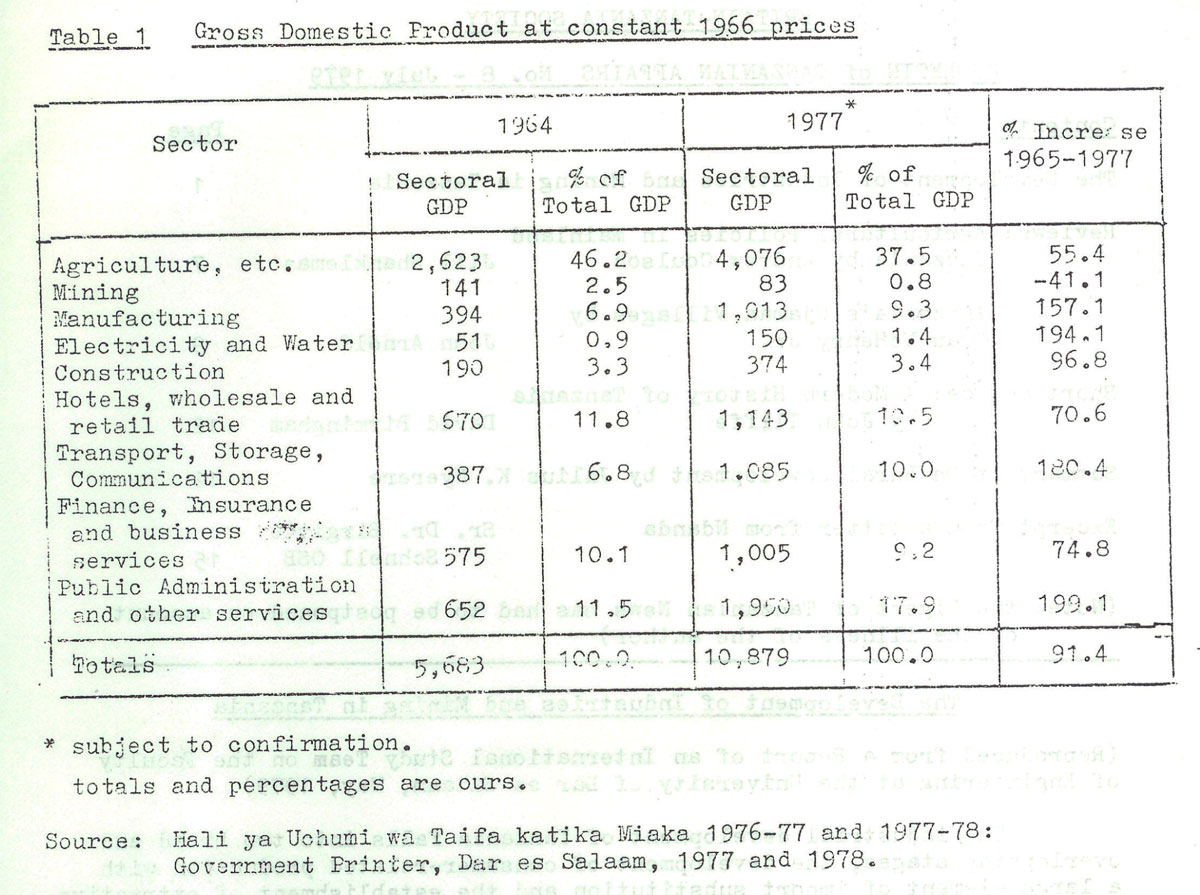
The growth of industrial activity during the years from 1964, the beginning of the First Five Year Plan, to 1977 can clearly be seen from the published figures of the Gross Domestic Product as set out in Table 1. The pattern of the monetary economy is there seen to have shifted markedly away from agriculture towards industry, water and electricity, building, transport and communications; in other words, towards the industrial sector of the economy.

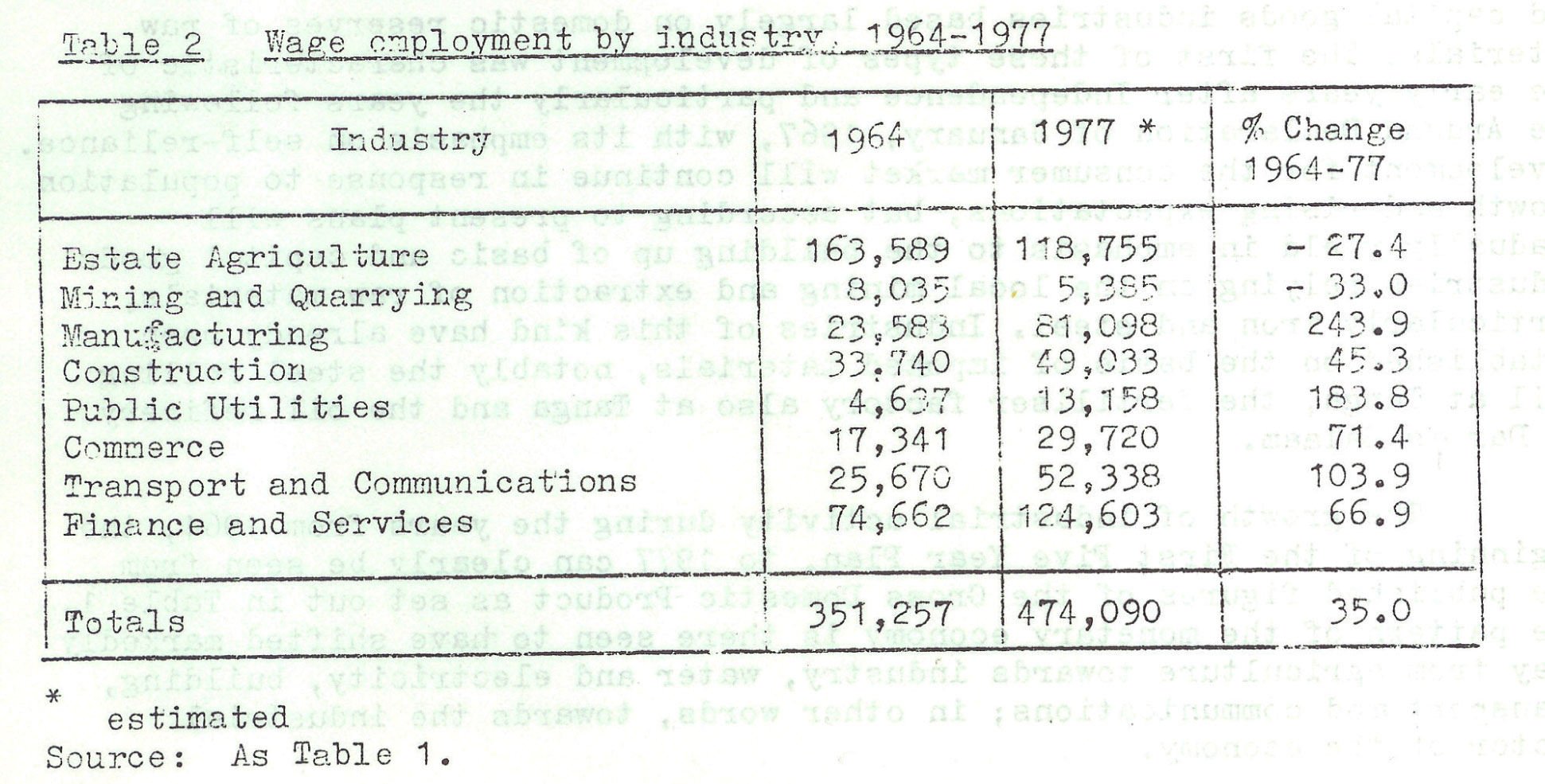
While the contribution of agriculture has risen by 55%, its relative contribution has fallen from 46% to 38%. Meantime, manufacturing industry has registered a growth of 157% and an advance in relative importance from 7% (3-4% at Independence in 1961) to over 9%. Still greater progress has been made by water and electricity (194%) and by transport and communications (180%), that is, by economic infrastructure. The recession in mining is referred to later in this chapter. Another indicator of the shift towards industry, public utilities, communications, etc., is provided by the employment figures given in Table 2.
Table 1 - Gross Domestic Product at constant 1966 prices

Source: Hali ya Uchumi wa Tajfa katika Miaka 1976-77 and 1977-78: Government Printer, Dar es Salaam, 1977 and 1978.
Table 2 Wage employment by industry 1964-1977

By 1976, the metal fabrication industries already accounted in money terms for nearly 10% of industrial production, while consumer goods occupied 65% of the total. Between 1965 and 1976 the consumption of electricity by industry rose from 36.0 million kilowatt hours to 185.3 million, a more than five-fold increase, while employment rose two and a half times, from 28,100 to 74,200. Meantime, the production of portland cement, begun near Dar es Salaam in 1966, rose from 50,000 tonnes in that year to 296,000 tonnes in 1974, though it fell slightly on account of labour problems to 244,000 tonnes in 1976. Urban water supplies increased from 12,800 million litres in 1963-64 to 61,000 million litres in 1976-77. At Independence in 1961 there were some 500 km. of macadamised trunk roads; by 1977 there were 2,625 km. (1)

More than most other African countries, Tanzania has from the first been notable for the thoroughness of its economic planning . At present such planning is carried cut within three time perspectives, namely, a 20 year plan setting out broad objectives and desired trends for the main features of the economy; a five year plan detailing the strategy for the ensuing five years; and an annual plan, which incorporates any necessary modifications to the five year strategy enforced by world circumstances, the accident of weather, planning delays and other influences….

Long-term planning of the economy for the period 1975-95 is based on consideration of the following main objectives:

(1) modification of the structure of the industrial economy in recognition of the need –
(a) to establish export industries in order to attract foreign exchange and to assist agriculture in increasing foreign exchange reserves;
(b) to establish industries producing for domestic consumption and development;
(c) to establish industries for the production of spares, fittings and machine parts to enlarge the national basis of self-reliance and to extend the domestic market for manufactured iron and steel with a view to facilitating the establishment of a metallurgical industry;
(d) to establish basic industries relying on domestic sources of raw materials, including iron and steel, coal, chemicals and building materials;
(e) to set up small scale industries based on simple technology and located in villages, where the greater part of the population live, with the object of promoting rural development;

(2) increasing industrial production and productivity;

(3) increasing employment and extending opportunities for education, training and the increase of skills;

(4) ensuring a fair distribution of industries by Region ; and

(5) providing and extending facilities for research, advisory services and technological information for the benefit of industry.

The intention of the long-term plan is to increase the contribution of manufacturing industry to the gross domestic product from nearly 10% in 1977 to around 20% by 1995; to increase the contribution of metal fabrication to industrial output from 10% to 30% and to reduce the contribution of consumer goods to the total from 65% to 40%. The general burden of the plan is, therefore, to change the balance of the economy decisively in favour of the extractive and capital goods industries, not at the expense of consumer goods, but in terms of relative growth. The establishment of industries for the manufacture of iron and steel is to have top priority in order to supply the needs of the metal fabrication and construction industries. At the same time the cement, glass products and wood products industries – all using local raw materials – will be increased to give added support to the construction industry, while factories producing chemicals, fertilisers, paper and printing machinery are to be developed.

… Between 1980 and 1985 top priority will be given to the development of the following basic industries, viz., iron and ferrous products, cotton, leather and sisal, chemicals, various foodstuffs, paper and wood, and non-ferrous products (e.g., cement and building materials). Meanwhile, the domestic market will, it is hoped, have been developed sufficiently to justify these activities. A start with the iron and steel, chemicals and paper industries already appears in the Third Five Year Plan (1976-81).

… Some 194 million shillings are set aside in the 1978-79 capital budget for roads, bridges, airports and other related works; 184 million shillings for various water development schemes; 446 million shillings for various electricity generating and distribution projects, notably, Phase 2 of the Kidatu hydroelectric scheme (229 million shillings); 140 million shillings for developments in the telephone and telex services; 586 million shillings for the improvement of the railway system in Central and Northern Tanzania; and a variety of Regional projects. (2)

Crucial to the development of industry in Tanzania is the expansion of the electric power supply. In 1975 the total capacity of the power supply system was 150 megawatts, of which 86% was sold in the coastal area and around Arusha and Moshi. In 1976 the first Phese of the Kidatu hydroelectric power scheme on the Great Ruaha River came into operation with a further 100 megawatts, a system that has now been connected by land line to Dar es Salaam. Phase 2 of the Kidatu scheme will shortly be completed, with a further 100 megawatts.

Meantime, considerable preparatory work has been carried out in Conjunction with NORAD (Norway) on the Stieglers Gorge project on the Rufiji River. (3) Reports have been submitted, not only on the construct1nn of the dam, but also on the use of power from Stieglers Gorge for the manufacture of iron and steel from the Liganga deposits of iron ore and the establishment of power-using industries based an local raw materials. Tha Stieglers Gorge project is therefore more than a hydroelectric power scheme, it is a plan for an industrial complex of considerable potential size and importance. The dimensions of this undertaking may be judged from the expectation of a power output of 600 megawatts, four times the total output in the whole of Tanzania in 1975. Further potential capacity lies in the Kiwira River scheme in Mbeya Region, with a maximum possibility of 233 megawatts, of which 14 megawatts are expected to be produced during the Third Five Year Plan; and in the Rusumo scheme, now under investigation, with a potential of 90 megawatts. A start will also be made during the Third Plan with a coal-fired thermal station based on local mines in view of the rising cost of oil.

As already indicated, long-term planning relies on the development of local resources of raw materials, particularly iron and coal. It remains, therefore, to describe those resources and the prospects of their gainful exploitation.

At Independence diamond mining was much the most extensive and lucrative form of exploitation of Tanzania’s natural resources, with gold following second in importance, yet for many years before that other minerals were known to exist in commercially significant quantities. Since virtually the entire mineral output was exported, it formed a valuable source of foreign exchange, but did virtually nothing to promote mineral-based industries within Tanzania. During the First Five Year Plan (1964-69), small quantities of coal, tin, mica, magnesite, tungsten, lime, salt, gemstones, glass-sand, kaolin and gypsum were produced; gypsum and lime were mined largely for internal consumption and salt was exported after meeting the domestic demand. Diamonds and gold, however, accounted for about 90% of production.

In 1966, the Geita and Kiabakari gold mines closed and in 1970 the Buhemba mine. Thereafter production remained small, but plans are afoot to open further mines during the Third Five Year Plan period at Lupo in Chunya District, in Geita District and elsewhere, which are expected to achieve an appreciable output.

Diamonds have for long been the most valuable mineral in Tanzania. In 1968, diamonds to the value of 164 million shillings were mined and exported. But the mines were becoming exhausted and in 1968 the remaining life expectancy was only ten years. In the event, however, it has proved worthwhile to continue mining, despite falling output, in view of rising world prices. While, however, the continuing diamond output was a useful asset in world markets, attention has increasingly turned to the exploitation of the country’s iron and coal resources and the importance of these minerals as a foundation for local industry.

Although coal has long been mined at Ilima colliery on a very small scale for a local market, there are known to be extensive reserves of bituminous coal at Songwe/Kiwira, in which Ilima is situated at Mchuchuma/Yateweka. Chinese experts are studying the possibility of using coal from the Songwe/Kiwira reserves for the smelting of iron from Chunya; in addition its use for coal-burning thermal generators, the production of tar for road making and the production of a simple ammonia fertiliser have been considered. The use of the Mchuchuma/Kateweka reserves for smelting the Liganga titaniferous ores has presented difficulties and is still under investigation.

Exploration has shown that iron ore deposits in Chunya District are extensive and capable of producing 250,000 tonnes of iron per annum. Reports have also revealed the presence of extensive ore deposits at Liganga in Njombe District with an annual potential of 500,000 tonnes. The Liganga ores, which have a 49% ferrous content, contain 13% of titanium dioxide and some associated vanadium. A West German team of experts is making a technical and economic study of the possibility of separating the vanadium and titanium. Meanwhile, a feasibility study by NORAD (Norwegian Government) of the use of power from the proposed Stieglers Gorge hydroelectric scheme for the manufacture of iron and steel from the Liganga deposits has been completed.

The prospect for mining operations both of coal and of iron ore depend not only on the completion of the technical and economic studies now proceeding, but also on the construction of the necessary infrastructure, notably road and railway links, the necessary outlets for the products in local industries and abroad. This is a complex operation and the ramifications of it suggest that it may yet be some years before large scale mining operations can begin. Owing to the technical problems still to be surmounted and the work on associated industries and services still to be put in hand, it is too soon to put a firm date on the onset of extensive mining operations. Nevertheless; the studies already made and the information gained suggest that the exploitation of Tanzania’s iron ore reserves most probably will begin within the coming decade.

Although the mining of Tanzania’s iron ore reserves is dimensionally and economically much the most significant development to be expected with reasonable certainty in the near future, considerable effort has also been expended on the investigation and development of other mineral resources. A search for exploitable oil reserves in the coastal sedimentary belt, started during the Second Five Year Plan, is continuing in the Southern Mainland, the Ruvu valley, south-east of Zanzibar and offshore. In the course of this search, natural gas was found at Songo Songo in Kilwa District and studies are now proceeding on the feasibility of its use in the manufacture of chemicals, especially ammonia.
Meantime, the steep rise in price of phosphates imported from the Middle East for the fertiliser factory at Tanga has precipitated research into the possibility of using phosphates mined at Minjingu, of which there is said to be a 10-20 year supply. Studies are also being made of the direct use of this mineral as a fertiliser. This project has, however, encountered financial problems.

Salt is a universal requirement for domestic use and the State Mining Corporation (STAMICC) has been preparing for the mining of salt to help to meet this demand and for export. Meantime, studies of the mining of gypsum are proceeding at Mandawa in Kilwa District to supplement the gypsum mined at Mkomazi in North-East Tanzania as a source of supply for the cement factory at Wazo Hill, near Dar es Salaam. At Lake Natron there are considerable deposits of soda ash and studies have been made of the refining and extraction of potassium and sodium chloride and of the technical, economic and transport problems involved.

The Third Five Year Plan includes plans for mining operations at Lake Natron on a small scale. Reserves of magnesite at Chambogo in the Pangani Valley are being investigated with the help of West German support. Other minerals under investigation are tin and tungsten in te Karagwe area, including the possibility of reopening the Kyerwa mine closed in 1971; asbestos, hitherto recovered in small quantities at Ikorongo in Serengeti District and elsewhere; copper, cobalt and nickel in the Piti River south of Tabora; and a number of rare earths and natural abrasives. Kaolin is produced in the Pugu Hills near Dar es Salaam and used for ceramics and potentially for paper making, with glass sand as a by-product. Finally, there has for some years been a successful industry in gemstones including the attractive green ‘Tanzanite’ which in 1976 contributed a useful 3 million shillings to the country’s foreign exchange reserves.

Mining operations in Tanzania have reached a transitional stage. Hitherto, diamond mining has stood out as much the most extensive and lucrative operation, but the ascendancy of the diamond is drawing to an end. Most other mining operations are at present limited, though prospecting and economic assessment is proceeding on a considerable scale. Among the known resources, those of iron and coal are extensive and a substantial home-based metallurgical industry is in prospect in the near future. If this branch of industry is successfully established, it will have a profound influence on the location and character of industry, on movements of population and on the pattern of Regional growth. Although these results are now fairly well assured, it is still not possible to attach a time scale to the industrial revolution that iron and steel making will induce in Tanzania. (4)

This account of the prospects for the economy would be incomplete without passing reference to the growth of small industries under the general superintendence of the Small Industries Development Organisation (SIDO). The long-term aim of this body is to promote small industries in the form of production cooperatives, particular]y in the villages, thereby not only advancing rural prosperity, but also decentralising the production of such consumer goods, components, etc., as can be produced economically on this basis. Small industries will be labour intensive and capital extensive and will therefore in many cases call for adaptation of methods of production and a resort to simple productive procedures. Such adaptations will offer a considerable challenge to engineers, involving not simply a reversion to historic semi-manual methods of production, but a modification of modern technology with the greatest economy in capital investment and a maximum use of human and other local resources. The importance attached to this development by the Government can be seen from the allocation of T shs. 117,241,000 to SIDO projects in the single year 1978-79.

References
(1) Sources of statistics: Bali ya Uchumi wa Taifa katika Mwaka 1977-78 ; Bank of Tanzania Economic Bulletin, Vol.IX No.3, Dec. 1977 ; Taarifa ya Hali ya Uchukuzi na Mawasiliano Nchini; Government Printer, Dar es Salaam. Mpango wa Tatu wa Maendeleo ya Miaka Mitano ya Kiuchumi na Jamii, 1 Julai 1976-30 Juni 1981 : Sehemu ya Kwanza- Shabaha na Maelekezo: Government Printer, Dar es Salaam.

(2) Mpango wa Maendeleo wa Mwaka 1978-79: Government Printer, Dares es Salaam. It is, unhappily, more than probable that substantial parts of this programme have fallen victim to the Uganda War and will have to be postponed.

(3) Details are taken from Norges Samarbeid med Utviklingslandene, 1977: NORAD, Oslo, 1978.

(4) The facts in this section on mining operations are taken from the following sources: Tanzania Second Five Year Plan for Economic and Social Development, Vol.1: General Analysis, Chap. 5; Mpango wa Tatu wa Maendeleo ya Kiuchumi na Jamii, Kitabu cha Kwanza, Shabaha na Maelekezo, na Kitabu cha Pili, Miradi: both Government Printer, Dar es Salaam. Mpango wa Maendeleo wa Mwaka 1976-77, 1977-78 and 1978-79; Government Printer, Dar es Salaam, 1976, 1977 and 1978 respectively. Hali ya Uchumi ya Taifa katika Mwaka 1974-75, 1975-76, 1976-77 and 1977-78: Government Printer, Dar es Salaam, 1975, 1976, 1977 and 1978 respectively.

REVIEW OF THE NATIONAL ECONOMY 1977-78

Analysis of Review of the National Economy 1977-78
Hali ya Uchumi wa Taifa Katika Mwaka 1977-78 Government Printer Dar-es-Salaam 1978 shillings 15/-

Randal Sadleir

One short brutally honest paragraph in the opening chapter provides the key to the year under review; it reads

“In the period 1977/78 the East African Community which had begun to falter in 1976/77, died. During this time all the Community Corporations were broken up and the frontier between Tanzania and Kenya closed. Trade between the partner nations also greatly Declined.”

How greatly is shown by the fact that there was an 88.5% fall in exports
to Kenya and Uganda and a 73.5% fall in imports from those countries. The tourist trade was particularly hard hit with a decline in the overall number of visitors, and a 39.6% reduction in hotel bed occupancy rates – the Northern areas being most affected with only 11% of tourist hotel beds occupied. The cholera epidemic did not help. The communications and transport systems suffered most from the collapse of the Community which has left Lake Victoria with no ship, the Indian Ocean ports especially Dar-es-Salaam with a critical shortage of dock facilities unloading equipment and storage space, and the infant Tanzania Airways Corporation short of vital aircraft and spare parts.

However, the authors remain optimistic, pointing out that the state of the economy as a whole showed some improvement in that the National Income had increased by 5.9% as against 5.2% the previous year, whilst the food position had also improved although it had again been necessary to import over £11 million worth of grain (mainly rice, maize and wheat) and this accounted for 5.3% of the imports bill. High world prices of cotton, coffee and cashew nuts helped to swell the agricultural sector by 5.6%, (the rise had been 4.7% in the previous year) whilst other sectors of the economy to show increases included water and power, wholesale and retail trade and minerals. Low industrial output again caused concern and was as usual attributed to shortage of experts and raw materials, increased costs of building materials, power cuts, water shortages, and difficulties in identifying suitable overseas markets. The communications, transport storage and building sectors also proved disappointing. The 1976/77 improvement in the balance of payments was not maintained, a 10% increase in exports being offset by a 14.3% increase in imports, to leave the trade deficit widening again from £65 million to £83 million.

Inevitably inflation was still a problem with rising prices largely caused by increases in the cost of food, cigarettes, paraffin oil, transport and accommodation (the rent of a room increased from 30/- to 50/- per month in May 1977). The retail price index for middle income workers in Dar-es-Salaam increased by 20.6% in 1977, compared with 8.4% increase in 1976; the same index for lower paid workers in Dar-es-Salaam went up by 16.9% in 1977 as against 14% in 1976, whilst the index in Dodoma only went up by 7.3% in the year under review. The number of paid workers rose by 3.8% from 456,787 in 1976 to 474,090 in 1977, virtually restoring the position to the 1975 level of employment. At the same time the total wage bill rose by 20.4% compared to the 2.2% drop the previous year; this was largely caused by increased employment in the agricultural sector.

As usual the report is well furnished with 70 tables of statistics conveniently placed in relation to the subject material, from which a vast amount of information can be gleaned by the reader, ranging from the customary fiscal figures to interesting items such as the electricity consumption in Mafia, the 122 tons of mail carried by air in 1977 and the million passengers who travelled on the UHURU Railway during the same year. Its pages well illustrate the tremendous struggle facing a new nation swimming against the economic tides, but buoyed up with a fierce determination to stick to her political principles at all costs.

THIRD DEVELOPMENT PLAN 1976-81

Tanzania’s Third Development Plan, 1976-81 (1)

The Third Tanzanian Five Year Plan, which was recently published, contains much interesting information about the state of the economy and its prospects. It consists of four parts, viz. Part I: Targets and General Analysis; Part II: Regional Plans; Part III: Projects; and Part IV: Manpower Development. Though chronologically the third five-year plan for the development of Tanzania, it is in fact the first of its kind, having been produced entirely by Tanzanians and after protracted discussion at various levels. It therefore represents – so far as complex economic documents of this kind can represent – a sort of national consensus about the developmental effort and the allocation of resources in the next few years.

Strictly speaking, the Second Five Year Plan finished on 30th June, 1974, but in view of the economic situation following the oil crisis and the number of uncompleted projects, the period was officially extended for a further year – to 30th June, 1975. A further year was allowed to pass before the introduction of the Third Five Year Plan on account of the national preoccupation with the villagisation of the rural population and the programme for universal primary education (UPE). Another reason for delay not mentioned in the plan was doubtless the time occupied in activating the novel and complex machinery for formulating the plan on the basis of consultation at all levels.

The formulation of the Third Plan was entrusted in 1972 to a Planning Commission consisting of the members of parliament as representatives of the people, with the Prime Minister in the chair. The Commission was assisted by 18 sectoral committees each specialising in a different aspect of the economy, to which experts were attached. The secretariat for the Planning Commission and its committees was provided by the Treasury. A committee consisting of the chairmen of the sectoral committees sifted and reconciled the recommendations of the various committees before forwarding them for debate and approval by the Commission.

Experts were also sent to the Regions to advise on the formulation of Regional and District Plans on the basis of the widest possible consultation with the people. The various regional and district officials of Government and Party were consulted about the choice of projects to be implemented during the plan period and agreed lists of projects were forwarded to the Office of the Prime Minister and the Treasury for further processing and selection and for scrutiny by the Treasury in relation to the available resources and the capacity of the economy. In this way, in comparison with its predecessors, the Third Five Year Plan rested on a wide basis of consultation with the people of Tanzania.

The Plan aims at the fulfilment of four general objectives, viz. the creation of wealth, the building up of the economic infrastructure, the extension of the social infrastructure and the establishment of respect for hard work and self-discipline.

The economic targets of the Plan may be summarised by a declared intention to increase the Gross National Product (GNP) by an average of 6% per annum. This target compares with a planned annual increase of 6.7% in the First Plan and 6.5% in the Second Plan, but during the period of the First Plan the actual average annual increase was 5% and of the Second Plan 4.8%. The target figure for the Third Plan must therefore be seen as an ambitions, though not wholly impossible, figure. Its attainment depends on the standard of the administration of the Plan in all its aspects, the terms and conditions of international trade and the availability of external aid of the form and in the extent desired. The first and second of these conditions of success affect among other matters the timely availability of resources for development purposes, since the increasing complexity of the economy and tte interdependence of its parts calls for a nice synchronisation of production where the output of one sector (e.g. cement or fertiliser) is a crucial input for another (e.g. water development or agriculture); while the import of capital goods for development will depend both on the volume of exports and the prices that they are able to attract.

The actual growth rate so far during the period of the Third Plan, though commendable, has fallen somewhat short of the target figure of 6%; in the calendar year 1976 the rate of growth was 5.2% and according to the Bank of Tanzania there was ‘some moderation in economic activity’ in the middle of 1977. This means that it will be a hard struggle to keep up an average of 6% over the whole plan period from July 1976 to June 1981 and some shortfall in the full accomplishment of the planned targets seems not unlikely.

In the light of the policy of self-reliance, the Plan lays great weight on the importance of increasing the production of export crops and other materials to sustain the import of the materials and equipment needed for development. Income from traditional export products must be increased over the Plan period by almost 100%, while a still greater increase is required out of the earnings of miscellaneous exports, such as timber, tyres, batteries and clothing. Judging from recent performance, this must represent a considerably enhanced production and export effort.(2) The Plan recognises that any balance of development requirements will have to be financed out of foreign loans and aid, but emphasises nevertheless that the main effort must go into trade and not aid. However, the Plan calls for continuing international cooperation with the aim of increasing the volume of loan money on easy terms for developing countries, seeking grants wherever possible and aiming at a general reform of the world economy.

An interesting passage relates to incomes policy, which is integral to the plan. The policy implicit in the Arusha Declaration of narrowing income differences between town and country and between different occupations is to continue, as greater equality of income is considered fundamental to a country based on ‘ujamaa’ principles. But under the Third Plan, while increases in real incomes will have to be coordinated with increases of GNP, consideration will also be given to extra payments based on labour productivity. It is also recognised that the stabilisation of commodity prices is closely bound up with the implementation of an incomes policy. Consequently, emphasis will be placed on the regulation and stabilisation of prices in order to enable industry to produce wealth under conditions of greater productivity.

The Plan envisages the fixing and explaining of baseline labour costs against which the performance of labour can be measured. The agreement of the Union of Tanzania Workers is to be sought in the fixing of grades and to be registered with the Permanent Labour Tribunal. Incentive payments out of the profits of production are to be considered. Finally, there is to be a change in the labour laws so as to emphasise duties and not, as hitherto, only the rights of labour.

Part IV of the Plan gives details of a manpower survey. Manpower planning, though inevitably approximate and prone to error, is an important tool in economic and social planning at the present stage of development, as it helps to ensure both that the essential skills are forthcoming in approximately the right numbers at the right time and that scarce resources are not dissipated by excessive or premature production in any category. Although manpower demand estimates are increasingly uncertain as the economy becomes more complex and transfers of function more numerous, they can still serve a useful purpose by indicating the order of magnitude of demand.

The shortcomings and limitations of manpower planning are well illustrated by comparing the projections in the Second Plan (1969-1974) with the number actually employed in 1975 as ascertained for the purposes of the Third Plan. The divergencies between Second Plan projections and the results of the Third Plan manpower survey are considerable and disclose a growth in employment(3) considerably greater than anticipated. Thus the Third Plan survey reveals a category A employment 32% higher than the Second Plan Projections. Of this excess, 9% is accounted for by the employment of 538 more non-citizens than anticipated in the Second Plan, an interesting indication of the growing diversity of the economy. Ascertained category B employment is 12% higher than the Second Plan Projections and category C employment no less than 148% greater. In particular occupations the differences are also considerable. Only 58% of the projected veterinarians (other than university teachers) were in fact employed. On the other hand, 53% more professional accountants were in post in 1975 than envisaged by the Second Plan.

These figures illustrate the great difficulty of producing manpower projections with any pretensions for reliability, even in a comparatively simple economic structure, partly due to the known fallibility of economic forecasting, of foreseeing changes in employment patterns and of making estimates of productivity changes. In particular, they show how infirm is the basis they provide for educational planning unless checked and revised by trend studies and supplemented by information from other sources.

The Third Plan as a whole contains a large amount of interesting detail on the various sectors of the economy which cannot be appraised without much more information, or summarised in a short article. The total investment envisaged by the Plan over the five-year period is shs. 30,218 million (c. £2,158 million), of which shs. 26,604 million (c. £2,054 million) is for ‘national’ projects, that is, projects developed from the funds of the central government, or national parastatal bodies, and shs. 3,615 million (e. £258 million) is to be devoted to projects financed by the Regions. Of this total capital expenditure, some shs. 21,268 million are to come from the Treasury (including funds from external aid sources) and shs. 8,951 million from specialised domestic banking institutions and other non-governmental sources. So far as the Regional projects are concerned, these extraneous sources will in the main consist of the free labour and other contributions of the villagers themselves. Of the investment in Regional projects, 29% will go into productive enterprises such as village industries, 47% will be used to improve the social infrastructure and 24% to build up the economic infrastructure. The large preponderance of investment in the social infrastructure is mainly due to the national effort to provide primary education for every child reaching school age (7 years old).

This development plan is a remarkably thorough inventory of intentions. the fulfilment of which to a marked degree depends on world factors beyond the central of the Tanzanians. Nevertheless, it is not an unrealistic plan and it provides a framework for orderly progress based on a clear perception of priorities. It may appear that the list of projects in Part III of the Plan is bound to become increasingly unrealistic during the years of the plan due to implementation delays, changes of policy, new needs and opportunities and other influences. But in fact the government also publishes an annual plan in which such changes are recorded and the parameters of the Five Year Plan are updated. Thus, development planning in Tanzania is a continuing process based on a general stocktaking at five year intervals and annual adjustments to take account of changing circumstances. It is a sobering thought that even the complete implementation of this plan will not markedly close the wealth gap between rich and poor countries.

With such solemn considerations in mind, it is incumbent on the rich countries to do everything in their power by way of aid, and still more by way of trade on a rational basis, to help countries like Tanzania to reach their self-imposed targets.

J. Roger Carter

(1) Mpango wa Tatu wa Maendeleo ya Miaka Mitano ya Kiuchumi na Jamii 1 Julai 1976 – 30 Juni 1981. Kitabu cha Kwanza – Shabana na Maelekezo (Sehemu ya Kwanza), Mipango ya Mikoa (Sehemu ya Pili): Kitabu cha Pili – Miradi-: Kitabu cha Tatu – Mpango wa Maendeleo ya Watumishi (1975-1980) (Mpigachapa wa Serikali, Dar es Salaam, 1978).

(2) Unfortunately, the state of the world economy and poor prospects for market penetration do not encourage hope of implementation on such a scale.

(3) In this calculation, ’employment’ is assumed to be the number of people in post and ignores vacancies. It is true that vacancies represent not only transfers, but also advertised posts unfilled because there is no suitable person available. In the Third Plan, 31% of the Category A posts are shown as vacant, but this figure must include aspirations in addition to true vacancies, as it is hardly conceivable that the money could be made available to pay additional salaries on this scale.

DIGEST OF TANZANIAN NEWS

January to June, 1978. Compiled by Graham Mytton.

The University
Students in Dar es Salaam held a demonstration in March in protest at the pay increases and fringe benefits awarded to M.P.s and Ministers. The pay increases which came into effect on January 1st were not officially announced for two months. M.Ps’ salaries went up to She 3,000/- per month. In addition, M.Ps who retire or are defeated after a five-year term are now entitled to a Sh. 45,000/- tax tree gratuity. Those who serve for two or more terms will receive a government pension. Ministers are now exempt from water and electricity bills, and get a house servant paid for by the state. The students objected to all this and marched carrying banners. The demonstration was reported to be peaceful, but the police used batons and tear gas to break it up. Students were arrested for organising an illegal demonstration. They said they had been refused a permit. President Nyerere had offered to meet the students but they decided to go ahead with their march. 367 of them were arrested and sent home. They included Emmy Nyerere , an engineering student and son of the President. In May, 327 of the students were allowed to return to their studies; 19 of the others will be allowed back next year. The remaining 21 “ringleaders” will be barred from further education for five years.

Release of Detainees.
On 26th April President Nyerere ordered the release of 13 detainees to mark the 14th Anniversary of the Union. They included Mohammed Babu and three others who, like him, had been condemned to death in absentia for their alleged part in the killing of Sheikh Karume in 1972. The other three were Capt. Hemed Hilali Mohammed, Col. Ali Mahfoudh and Mrs. Tahir Ali Salum. Their release was widely welcomed in Tanzania. After his release, Babu denied vehemently that he had anything to do with Karume’s death. He said there was no plot. The killing was the sole responsibility and action of the man who fired the shot, who wanted to avenge the death of his father.

Over the next two weeks 30 other detainees were released, including some members of Southern African liberation movements. 10 prisoners on Zanzibar sentenced during •the treason trial for their alleged part in Karume’s death were released. 14 others had. their sentences cut. Earlier, three men under sentence of death on Zanzibar had their sentences commuted.

Major Appointments.
The names of the secretaries-general of the newly restructured national organisations were announced in February:
Alfred Tandau – Union of Tanzanian Workers.
Rajabu Heri – Youth Organisation.
Maimu Hassan – Union of Tanzanian Women
Athumani Juma Mhina – Tanzania Parents Association
Daniel Makemba – Union of Cooperative Societies.

All the above are automatically members of the National Executive Committee
of the Party (Chama cha Mapinduzi, CCM).

Following these appointments there was a minor Cabinet Reshuffle:
Alfred Tandau – Minister without Portfolio
Daniel Makemba – Minister without Portfolio
Samuel Sitta – Minister of Works.

Other junior appointments were also made on 27th February.

Transport.
Continued port congestion in Dar es Salaam has been a major headache and has contributed to certain strains in Tanzania’s relations with Zambia. In March 35,000 tonnes of Zambian imports were said to be blocked. No-one seemed to agree who was responsible. Zambian sources said that the fault lay with Tanzanian dock workers. Tanzanian sources blamed poor documentation and even a deliberate usage of port facilities for cheap storage. Zambia has been getting special concessionary rates for the use of Dar es Salaam and the Transport Minister, Mr Jamal, announced that these concessions would be withdrawn, an announcement that caused anger in Lusaka. Meetings at a high level seem to have been going ‘on almost continuously since February. It seems that much of the cause of the delays is Tazara’s limited capacity. More rolling stock is needed.

Meanwhile, improvements to the rest of the railway system go ahead. Britain has made a grant of a further £4 million (£2 million last year) to help improve railway facilities. The Tanzania Railway Corporation has ordered 400 wagons, 13 coaches and 14 locomotives. The Corporation has also ordered new ships for Lake Victoria.

The Budget.
For many wage earners, the main interest in this year’s budget was the reintroduction of tax relief for families with children. The Tanzanian Government plans to spend She 12,300 million in the year 1978-9. She 6,700 of this is on recurrent expenditure and She 5,600 is for development. 37% of the development budget will go on economic infrastructure, 29% on productive capacity and 29% on social infrastructure.

Commercial and Industrial News.
At the beginning of June, the Government announced the expulsion of Lonrho because of the company’s activities in Rhodesia and South Africa. Lonrho’s activities in Tanzania have been cut down over the past eleven years due to nationalisation, but its involvement in tea, cotton and beer production and vehicle distribution contributed £1 million of the company’s £90 million profits last year. Announcing the expulsion of Lonrho, the Tanzanian Government made an outspoken attack on “Tiny” Rowland, Lonrho’s chief executive, who pretended to be a friend of Africa while he meddled in Southern African affairs. Lonrho is to receive £1 million in compensation for the assets of the Central Line Sisal Estates, nationalised in 1967.

Reports from the Tanzanian news agency say that the country’s sisal industry is threatened with collapse because of excessive administrative costs. Reports say that the Tanzanian Sisal Authority was paying some salaries up to one month late and had large outstanding debts to some suppliers.

The newly constructed Kibo paper mill has started production. Radio Tanzania announced in May that the mill would use as much as 90% recycled waste paper and 10% imported pulp. It would save the country an estimated She 7 million foreign exchange per annum.

There has been growing concern about low industrial productivity in many sectors. Prime Minister Edward Sokoine announced that disciplinary committees would be set up in all places of work to try to improve output. New laws would be introduced to underline responsibility and discipline at work.

Education.
Parliament has called for Swahili to become the medium of instruction at post-primary levels of education. A committee has been formed to look into the possibilities of carrying out this policy. It met first in June. Swahili will be the medium of instruction in geography, history, arithmetic and domestic studies in Form 1 classes from next year. The plan is that the use of Swahili will gradually spread upwards to cover all subjects up to University level.

President Nyerere has called on school teachers not to overdo education for self-reliance. He expressed concern that in some schools the pupils’ work in the fields had caused classroom work to suffer.

Agriculture.
Zanzibar and Pemba are to expand clove production by 50% over the next three years. She 40 million is to be invested.

The current plague of locusts afflicting the Horn and parts of Kenya has also been reported in parts of Northern Tanzania.

There was a severe fall in tobacco production in Iringa due to heavy rain and labour shortages caused by the cholera outbreak. A one million kilogram shortfall led to a loss of She 25 million in foreign exchange earnings.

Corruption.
President Nyerere has made a number of important speeches on this subject. Speaking to police officers in January he said that 1978 would be a year to fight corruption in the country, especially in the administration of justice. The police and the courts had lost their good name by becoming involved in corrupt practices. He announced he was taking personal charge of an anti-corruption squad which would seek to root out corruption at all levels. In February he told a party rally that drastic measures were necessary because Tanzania had lost its reputation as a nation free from corruption.

Health.
Tanzania has been affected by a major epidemic of cholera which broke out last November. It is believed to have come from a pilgrim returning from last year’s Haj. In March all primary and secondary schools in Dar es Salaam were temporarily closed, as were all open-air markets. The brewing and selling of local beer was banned and severe restrictions were placed on movement outside the city. No-one knows for .certain how many have died to date, but the official figure of over 400 is thought to be an under-estimate. The latest area to be affected is Kigoma and the disease has spread across Lake Tanganyika into Zaire and also into Burundi. Mercifully, the Minister of Health has recently reported that the outbreak is now virtually over and that only a few cases remain.

Archaeology.
There was considerable excitement at the discovery by Dr Mary Leakey of a set of four million year old footprints preserved in some volcanic ash at Laetolil. They are thought to have been made by an ape-like creature about “four feet high with a small brain area and big jaws and big teeth”. In June, the Tanzania National Scientific Research Council announced the discovery by Dr Peter Schmidt of one of Africa’s earliest Iron Age industrial sites near Kemondo Bay in West Lake Region.

Geology.
Tanzanian geologist J.J. Mwabene announced that he had found a third deposit of natural gas in Tukuyu. The deposits he had discovered were commercially exploitable and were 98% pure.

Telephones.
Since the closure of the Kenya-Tanzania border and the break-up of the East African Posts and Telecommunications Corporation, most international telephone calls have still been routed via Nairobi. But now Tanzania is to buy a satellite communication station which will end the country’s dependence on Kenya for its external telecommunication services. The Government has signed a $3 million contract with a Japanese firm to build the station as well as a new telex exchange. Both will be operational next year.

Graham Mytton.

REVIEW OF THE NATIONAL ECONOMY, 1976-77

ANALYSIS OF REVIEW OF THE NATIONAL ECONOMY, 1976-77
Hali ya Uchumi wa Taifa Katika Mwaka 1976-1977, Government Printers, Dar es Salaam, 1977, Shillings 14.70

Amazingly the price of the report is now nearly halved – a refreshing start to a much more cheerful document since the state of the economy showed considerable improvement over the previous years. The National Income increased by 5.2% compared with 4.6% in 1975 and only 2.5% in 1974, whilst the food situation eased considerably although it was still necessary to import shs. 177.6 million worth of grain to bridge the gap between production and consumption. The food sector increased by 4.7% and other key sectors such as industry (6.2%), Transport and Communications (6.1%) and Electricity and Water (5%) also increased significantly. Only the wholesale-retail trade showed a decrease, mainly because of greatly reduced orders of overseas goods especially foodstuffs. The balance of payments showed a welcome turn-round, exports increasing from £130 million in 1975 to £205 million in 1976, an increase of 49.6%, while imports declined by 4.8% from £284 million in 1975 to £271 million in 1976. As a result the trade deficit narrowed to £65 million compared to £146 million the previous year. Coffee sales played a big part, accounting for 31% of all exports; cotton, tobacco and tea also fetched good prices. Foreign currency reserves increased accordingly from £55 million to £74 million.

Although prices continued to rise in 1976 the inflation rate began to slow down from 15.2% in 1975 to 12.1% in 1976, helped by a considerable fall in the retail price index for lower paid workers in Dar es Salaam from 33.9% to 14% during the same period. The difference between a ‘developed’ and a ‘developing’ country strikes one forcibly when one notices that instead of an endless preoccupation with unemployment this report refers to a 3% reduction in employment from 470,799 paid workers in 1975 to 456,787 in 1976, with a concomitant 2.2% drop in the total wages bill. A very different ‘ball-game’ as the Americans have it!

There was a 16% increase in all buildings completed and a 34% increase in buildings other than housing, mainly schools and factories, but also including the beautiful Mount Meru Hotel at Arusha whose foundation stone ceremony I attended in 1973. The completion of the great KIDATU hydro-electric scheme added 100 megawatts to the national grid and also reduced the incidence of power cuts listed by the authors as one of 8 reasons for disappointing industrial output in a number of plants – similar to last year’s frank list of shortcomings. However some comfort can be gleaned from the 104% increase in flour production and the 18% increase in the output of beer and chibuku resulting from the improved wheat crop.

On a sadder note a short but poignant paragraph states baldly that ‘in the period 1976/77 the East African Community was in a state of confusion. This period witnessed the break-up of the East African Harbours, Railways and Airways’. It is good to see in a recent news-report that reconciliation is now hoped for early in 1978, since only a truly unified East African Community makes economic sense for young nations struggling for higher living standards in a harshly competitive world.

Randal Sadleir

THE COST OF LIVING IN TANZANIA IN THE 1970s

As elsewhere in the world, the cost of living in Tanzania has risen considerably in recent years, though the impact has been unequally divided between town and country. In peasant farming areas the increase has been substantially cushioned by the absence of a wage-cost element in domestic agriculture. The increased burden on peasant families has, therefore, been largely confined to the items bought for money, such as clothing and utensils, but as their money income is small the volume of such purchases is likewise limited. Other increased money costs are fuel and transport. But these increases have been largely offset by the growth in money incomes arising from the sale of crop surpluses. Thus, between 1970-71 and 1976-77 the price paid to the peasant producer of marketed maize rose from 23 cents per kilo to 80 cents per kilo, an increase of 220%. Similar increases in rice and wheat prices are recorded. These rises in price were deliberate acts of government policy to compensate peasant growers for the effects of inflation and to encourage increased food production in the face of the serious food shortages in 1974 and 1975.

While the peasant farmer in many areas probably enjoys an improved standard of living as the result of higher market prices for his product, the main brunt of increased prices has fallen on the towns, where normally there is little chance to eke out food requirements by home production. The impact of price rises can be seen from the national consumer price index, which rose by some 132% between 1970 and March 1977. This rise contained an increase in food prices of 169.6%, in fuel, light and water of 207.8%, in transport of 172.6%, in furniture and utensils of 151.3% and in clothing and footwear of 125.4%. Only rents show a fall of 61.7% following the nationalisation of buildings in April 1971. As food occupies 47% of the consumer basket, the price of food exercises a strong influence on the general index.

Food prices increased dramatically between December 1973 and December 1974, by no less than 77.5% causing the general index during that period to rise by 40.5%. An important cause of this drastic increase was the serious drought, which severely curtailed home production of food and enforced on the government a large import programme of food grains at high world prices. The subsequent recovery of domestic food production under the stimulus of better weather, higher buying prices for peasant farm surpluses and the national campaign caned Kilimo cha Kufa na Kupona (Cultivation for Life or Death) enabled the government to reduce and ultimately to terminate food grain imports. The ending of food imports and the recovery of home production arrested the growth of food costs and even caused a small diminution of the food index by almost 10 points between December 1974 and December 1975.

Food prices then remained stable until the end of 1976, when the upward trend was resumed in the first quarter of 1977 with repercussions on the general index. The food price index rose during this period by 17.9% and the general index by 13.3%. Meanwhile the index for fuel, light and water showed an increase of 69.7%. On the other hand, clothing and footwear prices remained unchanged, while furniture and utensils actually fell by 20 points. The higher cost of food is said to have been due to higher prices for vegetables and fruit, while the rise in fuel costs was laid down to a steep increase in the price of charcoal and firewood.

While the national consumer price index gives a picture of the urban areas of Tanzania in general, the Dar es Salaam price indices paint a picture of life In the former capital. There are two such indices, both based on a household budget survey carried out in 1969, one relating to wage earners with an income at that time of shs. 2,OOO to shs. 4,000 per annum, the other to middle grade civil servants earning shs. 3,OOO to shs. 20,OOO per annum. The indices constructed on the basis of this information are published against a base line of 100 in 1969, but in the following paragraphs they have been converted to a base line of 100 for 1970 for comparison with the national index.

The fact which springs immediately to mind in comparing the national indices with those for Dar es Salaam is the steeper rise in Dar es Salaam prices, amounting to 248% between 1970 and March 1977 for wage earners. In the same period food prices rose by 274%, a very serious increase for wage earners most of whom depend on the shops for their supplies. During the same seven year period the rise in prices for middle grade civil servants was nothing like as steep, being 141% or only marginally greater than the rise in the national index, while the rise in food prices for this income group was 186%.

Still, the rise in consumer prices has undoubtedly reduced the standard of living of the salaried class. With effect from 1st May 1974 civil service salaries were increased by 15% for the first time since 1961, except for a few upward adjustments in starting salaries. No further change has been introduced since that date. However, in view of the exceptional hardships imposed on the urban civil servants in the lowest ranks – messengers and the like – by the prices explosion, the basic starting salary was increased for wage earners from sh. l80 per month (shs.2,160 p.a.) in 1970 to shs. 270 per month (shs. 3,240 p.a.) in 1972 and shs. 340 per month (shs.4,080 p.a) in May 1974. This represents an increase of 88.9%. In the same period the index for wage earners rose by 55% and so also did the group index for food. Thus, in the middle of 1974 wage earners were more than compensated for price rises since 1970. The salaried grades, on the other hand, received an increase of only 15%, while the index for middle grade civil servants rose by 43% and the group index for food by 39%.

This adjustment was in line with the general policy of the government to reduce salary differentials; it also had the effect of reducing differentials in real income by making the upper grade civil servants in real terms poorer and the lowest grades richer. Unfortunately this did not last. The subsequent steadily upward trend in prices, especially the sharp upturn in the index in the first three months of 1977, must have caused serious difficulties for families in the middle grades, but its effects on the lowest grades must have been particularly severe. Since 1974 the basic starting rate in the civil service rose to shs. 380 per month (shs 4,560 p.a.), an increase of ll.8% while the price index for wage earners rose by l24.5%, the food index rising by almost exactly the same amount. It is clear, therefore, that the March 1977 level of food prices, 243% above the 1970 figures, must have produced serious hardship among the lowest paid in Dar es Salaam, whose incomes had risen only 111% in the same period.

Food prices in Dar es Salaam may recover from the sharp upturn in the first quarter of 1977 which may have been caused by some temporary problem with supplies. It is likely, however, that any permanent upward shift in price levels will not be continued for long without a corresponding upward adjustment of salaries in the lower ranges.

Roger Carter

REVIEW OF THE NATIONAL ECONOMY 1975-76

Analysis of REVIEW OF THE NATIONAL ECONOMY, 1975-1976 (Hali ya Uchumi wa Taifa katika Mwaka 1975-76) published by the Government Printer, Dar es Salaam, 117 pages, price 25sh.

The first thing which I noticed about the latest Review of the National Economy was that its price had increased by 25%, eloquent testimony to the still prevalent rate of inflation, which at 14.9% increase showed a decline from the 17.4% of the previous year. The opening sentence reminds us poignantly of stark African realities when it states that ‘the fear of famine lessened as a result of the fruits of the Do or Die Cultivation Campaign.’ Nonetheless, the National Income for 1975 increased by 4.6% – more them double the rate for 1974 largely owing to the greatly increased output of food crops. Output from other key sectors remained either at the 1974 level or slightly less.

Industrial output, for example, again decreased, with only pyrethrum dust insecticide showing and improvement because of increased acreage under cultivation. Reasons listed for the decline include shortage of raw materials, spares and essential equipment partly owing to higher prices, partly due to shortage of foreign exchange; lack of adequate capital investment; occasional shortages of water and electricity in Dar es Salaam, Tanga, Arusha and Mwanza, affecting breweries, cigarette and textile factories amongst others; scarcity of technical expertise in dealing with production schedules, and inability to follow up problems and put then right. Also, two somewhat bizarre reasons – ‘Lack of success in certain factories for various reasons,’ and ‘other technical and leadership problems in Fibre Board E.A factories in Arusha and in the Uvinza Salt Mines’: prob1eLls too peculiar to contemplate!

The output of minerals continued to decline by 14.3% as against a drop of 4.79% in 1974 largely due to a decrease in the mining of diamonds and gem stones. However one rejoices to read that gold is confidently expected to be produced again this year on the Lupa.

The building programme now concentrating on the new capital at Dodoma and improvements to Dar es Salaam harbour following the completion of the Uhuru railway, delayed by a serious cement shortage caused by the failure of the local cement industry, with an output of only 310,000 tons to match the current demand of 700,000 tons per annum. Present extensions to the Portland Cement factory at Wazo Hill near Dar es Salaam should help to improve the position.

The balance of payments continues to pose problems. In 1975 exports decreased by 3.4% from £143 million in 1974 to £138 million in 1975, while imports increased by 8.3% from £269 million to £284 million mainly composed of machinery and equipment, a largo proportion of which comprised the rolling stock for the new railway. Thus the trade gap widened from a deficit of £126 million in 1974 to £146 million in 1975, while foreign currency reserves dwindled by over another £1 million, insignificant compared to the catastrophic drop of £30 million the previous year.

Parastatals again increased their combined surpluses, this time by 20%. Unfortunately figures for the number of tourists visiting Tanzania in 1975 were not available for the first time for many years, although somewhat mysteriously tourist bed-units in hotels, which are given, increased by almost 20% from 493,000 to 592,000, so it looks as if all records were again broken in this vitally important invisible export industry. It would be interesting to know how many visitors came from Britain but the breakdown in the excellent statistical tables only extends to Europe.

Britain again led the foreign trade tables with imports from Britain up by over 30% from £30 millions to £39 millions; although exports to Britain decreased by 16% from £21 million to £17 million she was still able to maintain her lead over any single country. Imports from China were down 7% following the completion of the railway. At home prices continued to go up but nothing like to the same extent as in 1974 – an overall rise of 7.2% compared to 40.5% But to the low income group of workers in Dar es Salaam this hit harder than to any other section of the community.

An encouraging advance in the Social Services showed medical priorities being given to village health services and preventive medicine, whilst the new Bagamoyo hospital was opened in July 1976. 50% of 106 new dispensaries were finished during the year, the KEKO pharmaceutical plant completed and drug trials started.

The educational effort is trying to meet the exciting target of getting every child of the right age a Primary school place by November 1977 and succeeded in increasing the number of pupils in Primary school by 232,411 children, a 50% increase, as a result of unspecified ‘urgent and revolutionary methods’ [see also later article].

The same methods doubtless contributed to the fact that by May 1976 some 12 million people, some 85% of the population, lived in 8,000 planned villages an increase of some 30% over the previous year.

While the authors may make the modest disclaimer that ‘the progress of our economy during 1975 was on the whole disappointing’, this fascinating document vividly reveals how Tanzania has brilliantly succeeded in turning economic factors to her own social and political ends.

Randal Sadleir

ECONOMIC REVIEW FOR THE YEAR 1974-5

Economic Review for the Year 1974-5 (Hali Ya Uchumi wa Taifa katika mwaka 1974-5) Government Printer, Dar es Salaam, price 20/-, 109 pp.

Internally the past year has been one of crucial importance to Tanzania. We print here a review by Mr. T.R. Sadleir of the annual government report on the economy:

‘This concise, clearly presented and well documented report, vividly illustrates the struggles of a developing country caught up in the current economic typhoon. Nor do its editors make any attempt to gloss over the harsh realities of a difficult situation, made worse by widespread failure of the rains (in 1974) leading to serious food shortages.

An admirable short summary in Part I enables the layman to appreciate both the extent of the problems posed by the twin blows of world inflation abroad and crop failure at home, and the countermeasures introduced so swiftly by the government to meet them. Thus we read that the poor harvests brought in their train the added difficulties of using up precious foreign exchange reserves for food imports, while the foreign exchange earnings themselves were depleted by reduced exports of cash crops, with the resultant foreign currency drain precluding the purchase of adequate new materials and machinery for industry and thus increasing production costs.

World wide inflation high-lighted by the doubling of the price of petrol together with the instability of major international currencies, reduced the amount of goods purchased overseas. Indeed the local rate of inflation reached 17.9% with the result that the national income only increased by 2.2%, the lowest growth rate so far in any year of the second Five Year Development Plan. Since population growth is estimated at 2.7% per annum, average output per head has also declined.

Although most of the main food crops, especially maize, rice and wheat were hard hit, (as were coffee, sisal and pyrethrum) cotton, tea, tobacco and cashew nuts actually yielded increased crops. The serious food shortages led to the launching at the beginning of 1975 of a national “Do or die cultivation campaign” (Kilimo chakufa na kupona) which required every able-bodied citizen, as well as government departments, parastatals and commercial companies to cultivate food. Initial results of this drive are said to be encouraging. (See below). The report points out that great strides were made in village development and that ‘more than half the population now live in planned villages’.

The balance of payments position also worsened during 1974. Although exports rose in value by 10.8% to a total of £143 million, imports rose by 54.3% to reach a total value of nearly £269 million – a deficit of £126 million compared to £45 million in 1973, largely because of the sudden increase in expensive food imports, the increased price of petrol and world wide inflation. Members of the Society will be interested to hear that imports from Britain were up by 20.8% to a record £30 million and that Britain still takes a larger share of Tanzania’s exports, £21 million, than any other single country, heading both import and export tables as Tanzania’s principal trading partner for the past 12 years. During the same period wages rose by 15.4%, being wisely perhaps kept 2.5% below the rate of inflation. Capital growth not surprisingly remained static.

Amidst the array of statistics human facts emerge. ‘Many health schemes unfinished because of a shortage of both builders and building materials; industry faced with shortages of raw materials; water, electricity, transport services, low standards of efficiency and high cost of spare parts; building projects delayed by shortage of experts and rising prices; electricity and water schemes behind schedule’ and so on.

More hopefully, educational expansion continued to make rapid progress. Parastatals increased their combined surpluses by 58% from £29 million to £47 million, whilst in 1974 the number of tourists rose by 32,000 to a new record of 177,000 and the first stage of the KIDATU higher-electric scheme was completed. Above all the great TAZARA FREEDOM RAILWAY from Dar es Salaam to Zambia was completed and was scheduled to start commercial services from the beginning of July 1975 (see below). Other items of good news were the discovery of natural gas on the island of Songo Songo, the start of an oil search in the Indian Ocean, and remarkable 287% increase in the output of tinned meat as a result of improved cattle marketing.

The report mirrors the entire Tanzanian scene and its 68 tables of statistics graphically convey a fascinating variety of information , ranging from retail price indices of food for low income groups in the capital, Dar es Salaam, and the future capital, Dodoma, through the sales of precious stones and the numbers of students in various faculties in the University, to the 87,750,000 dispensary out-patients treated in 1974! More important it succeeds in portraying the excitement and heartaches of the battle against poverty, ignorance and disease, whose initial impulse is being maintained ‘against all disaster’, and the sense of urgency gripping the dedicated few charged with implementing the Development Plan.