FERRY TRAGEDY

by Ben Taylor
Over 200 dead in latest Lake Victoria ferry tragedy

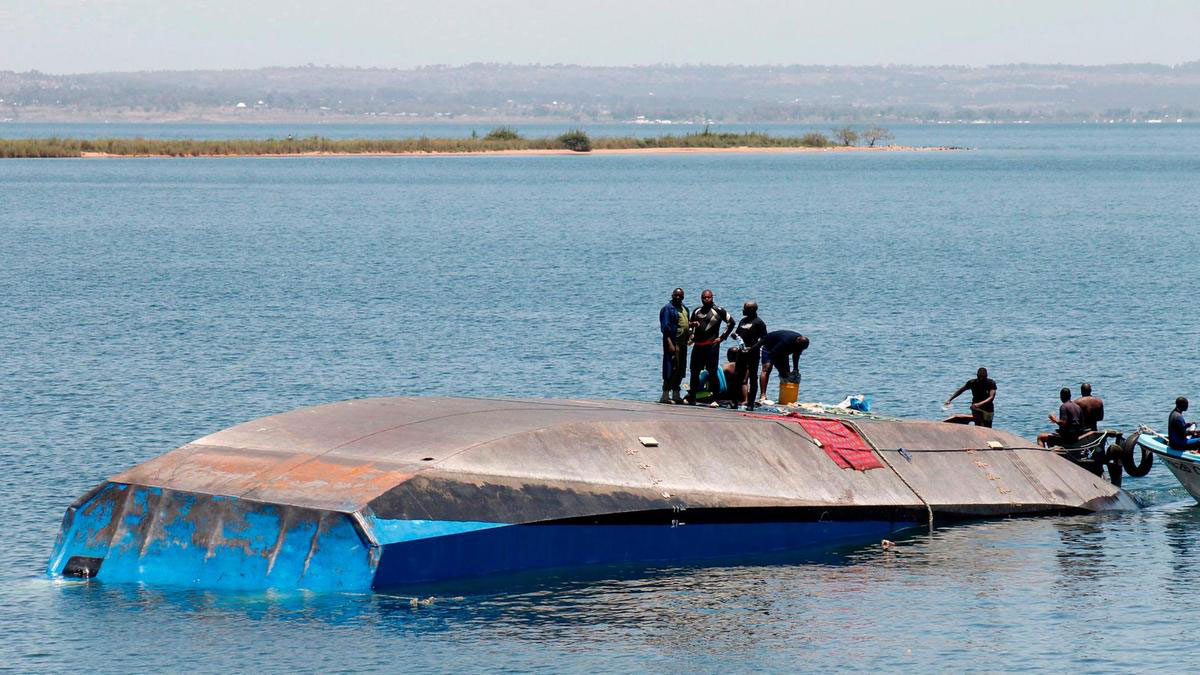
Rescuers on the upturned hull of the MW Nyerere


The MV Nyerere, a ferry operating on Lake Victoria, capsized on September 20th. The Tanzanian government have declared that 228 people died as a result while 41 were rescued.

The ferry was running its route from Bugolora on Ukerewe Island to Bwisya on Ukara Island with passengers and a cargo of maize, bananas, and cement as well as a tractor. It went down in the afternoon, 50 metres from the dock of its intended destination.

Survivors said the man steering the vessel made a sharp turn after realising he was preparing to dock on the wrong side of the ship. With the ship close to docking, many passengers had congregated on one side of the boat, with the result that it was unbalanced and unable to cope with the sudden change of course. It keeled over wildly, righted itself, and capsized on the other side, throwing dozens of passengers – none of whom were wearing life jackets – into the lake. Most of those who drowned were trapped inside the upturned hull.

Originally, officials believed that the ferry may have been carrying more than 400 passengers, approximately four times the reported maximum capacity of the vessel. The precise number of passengers is unknown as the official responsible for dispensing tickets drowned and the machine that recorded the number of passengers was lost in the wreckage. A week after the incident, the government stated that “close to 270” passengers had been on board.

President John Magufuli declared four days of national mourning and ordered the arrest of “all those involved in the management of the ferry”.

The government formed an investigative team led by a former army general to establish the cause of the disaster. Subsequently, President Magufuli dissolved the board of directors of the Tanzania Electrical, Mechanical and Electronics Services Agency (TEMESA), which runs ferry services on Tanzania’s mainland, as well as the board of the transport regulator, the Surface and Marine Transport Regulatory Authority (SUMATRA).

Just one week earlier, on September 14th, the local MP, Joseph Mkundi (Chadema), had complained in parliament that he had repeatedly warned the government that the MV Nyerere was “malfunctioning” and in urgent need of repair. A government spokesperson responded that new engines had been fitted recently.

The day after the disaster, the Minister of Home Affairs, Kangi Lugola, warned people against spreading false information that might cause turmoil. President Magufuli later cautioned politicians not to take advantage of the situation to gain political popularity.

The tragedy has led to renewed calls to address overloading on passenger and cargo boats. Overloading is seen as being largely responsible both for this latest incident as well as previous Tanzanian ferry disasters, notably the sinking of the MV Bukoba on Lake Victoria in 1996 and the MV Spice Islander in the Indian Ocean in 2011, causing the loss of 892 and 1,573 lives respectively.

One commentator argued that “most commentaries miss the point when attributing blame for such disasters. Rather than focus on the culpability of those endangering lives by overloading vessels, they lament the lack of life boats or life jackets, untrained navigators, inadequate maintenance and so on. … The elementary starting point— that government agencies perform all the roles that affect the safety of passengers, and therefore share full responsibility for disasters when they happen—is carefully avoided.”

Pope Francis, the United Nations secretary-general, Russian President Vladimir Putin and a number of African leaders expressed shock and sorrow. “His Holiness Pope Francis expresses his heartfelt solidarity with those who mourn the loss of their loved ones and who fear for the lives of those still missing,” the condolence telegram said, according to the Vatican.

“Our deepest condolences to the families and loved ones of the victims of the Lake Victoria ferry accident. Our thoughts are with you. We cannot thank the rescuers enough,” said President Paul Kagame of Rwanda in a tweet.

The ferry did not sink and was righted a week after the disaster.

TRANSPORT

by Ben Taylor

New ship purchased for Lake Victoria
President John Magufuli attended the signing of a contract to build a new ship, which will ply Lake Victoria between Mwanza and Bukoba, Musoma and ports in Kenya and Uganda. The signing took place two weeks before the tragic sinking of the MV Nyerere (see earlier article in this section.)

The new ship, which will be built at the cost of TSh 88.76 bn, will be 90 metres long, 17 metres wide and 10 metres high, and will have a capacity of carrying 1,200 passengers and 400 tonnes of cargo including 20 cars.

The project is to be implemented by two South Korean companies in collaboration with the National Service-economic wing, Suma JKT.

The construction of a new ship comes four and seven years after MV Victoria and MV Butiama respectively suspended operations because of technical issues, which greatly increased transport costs and times around the Lake Zone. It also comes 22 years since the MV Bukoba sank causing close to 1,000 deaths.

Speaking after witnessing the signing of the contract, President Magufuli said the projects were funded domestically. “There is not a single shilling from South Korea. Their ambassador is here to ensure that we get the value of money from the projects,” the President said. He added that citizens’ participation in the projects – through Suma-JKT – “would ensure that part of the money remains in the country.”

The project is scheduled to be completed within a year.

Welcoming the Head of State, the minister for Works, Transport and Communications, Mr Isack Kamwelwe, said they now have a challenge of increasing cargo to neighbouring countries.

“Together with the minister for Finance and Planning Dr Phillip Mpango and Industries, Trade and Investment minister Charles Mwijage, we will meet Kariakoo traders to understand their challenges in realising this endeavour,” he said.

FastJet and ATCL
The revived national airline, Air Tanzania Company Limited (ATCL), has been reinstated in the International Air Transport Association (IATA) Clearing House (ICH) after meeting its obligations. This allows ATCL to resume use of the IATA ticket platform and opens the possibility of flights to Mumbai, India.

The national carrier lost its IATA membership in 2008 due to non­payment of debts, a development that saw the ATCL banned from all international aviation transactions.

Further, in mid-December, ATCL took delivery of another new aircraft, the first of two Airbus A220 aircraft. A sister aircraft is expected in January 2019.

With a range just over 5,000km, the A220 will bring many points in Central and West Africa within range of Dar es Salaam, while giving the carrier a low-risk option to venture into the Middle East or grow frequency on existing domestic and international routes.

This will bring Tanzania’s active fleet to seven aircraft, comprising four propeller-driven Bombardier Q400s, a Boeing 787 Dreamliner and now the two A220s. A further Bombardier Q400 is also expected in 2019.

Meanwhile, the continued re-emergence of ATCL has taken place alongside growing difficulties faced by low-cost rival airline, FastJet.

FastJet Tanzania, which as recently as August had been planning to lease several new aircraft for routes within Tanzania, has since met with regulatory and financial difficulties. In September, Fastjet PLC – then the majority shareholder of FastJet Tanzania – disclosed in filings with the London Stock Exchange (LSE) that it was considering closing down its operations in Tanzania, on account of the “continued losses generated in the country.” The statement showed a $14.6 million net loss on $30.1 million in revenues for the six-month period to June 30, 2018.

Laurence Masha, a former Minister of Home Affairs who was on November 6, 2018 appointed as the first executive chairman of the FastJet Tanzania, told The Citizen newspaper in early December that had he bought 47% of the company shares owned by locals and other 17 owned by FastJet PLC, making him the new majority shareholder.

However, the new owners immediately ran into difficulties with the Tanzania Civil Aviation Authority (TCAA), which seized one of the airline’s two aircraft, citing unpaid debts. As the other aircraft was undergoing repairs, the company was forced to cancel all scheduled flights in December and January while it sought a new aircraft. At the time of writing, there are conflicting reports as to whether TCAA will allow this newly leased aircraft to enter the country and to operate flights.

“Fastjet Tanzania has paid some debts and others were paid by Fastjet PLC. We spent the remaining money to lease the plane and pay regulatory charges. They should now allow me to resume operations to get money for paying the remaining debts,” said Mr Masha.

“We really need the wisdom of the regulators and supportive cooperation from the government because we cannot manage to pay the debts while we are not doing business. I have talked to TCAA and the minister and I’m looking forward to getting their support after the festive season,” he added.

“Fastjet PLC thought the company would get cooperation from the government when it had a local investor but I don’t see it happening. There was a time I did not sleep for five days when I was busy looking for strategic investors to put their money into the company. They always ask if we have this supportive cooperation with the government,” he said.

However, TCAA Director General Hamza Johari told reporters that it was not true that they denied the airline the permit but that the applications were submitted late and were yet to be processed because of Christmas holidays.

He said that the authority received three letters from Fastjet Tanzania on December 24th, including one in which the company requested to bring in the Boeing 737-500 plane from South Africa and another on its business and financial plans.

“We will respond to all the letters in accordance with the law,” he said, adding that “if they really want to invest in the aviation sector, they must be more serious.”

The TCAA boss also denied allegations that it was favouring Air Tanzania Limited Company (ATCL) in order to give the state-owned airline a monopoly over the local market. He said such claims were unfounded as the sector was already competitive.

TRANSPORT

by Ben Taylor

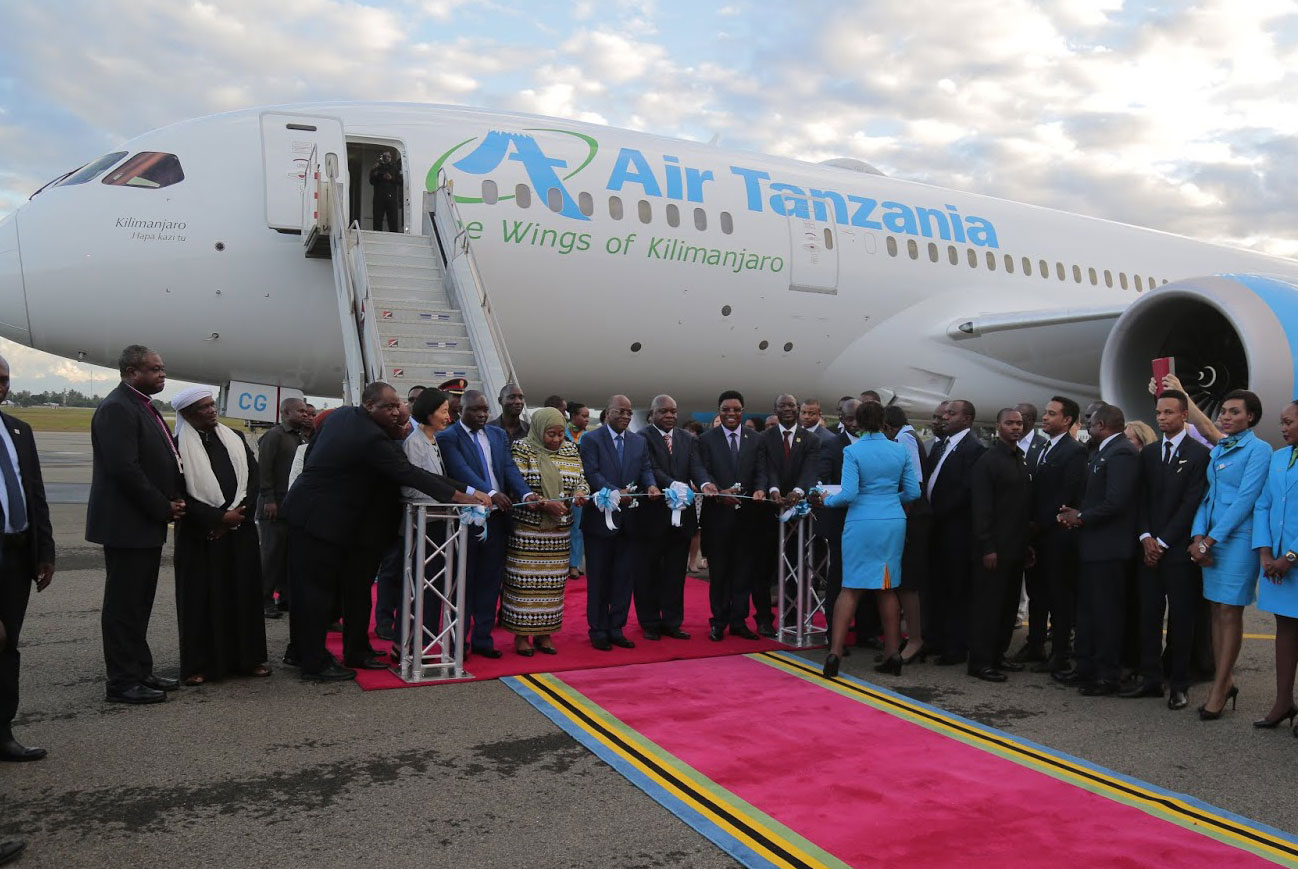
President Magufuli with Vice President Samia Suluhu Hassan, Prime Minister Kassim Majaliwa and other dignataries – photo State House

“Dreamliner” lands with Air Tanzania
A much-anticipated Boeing 787-800 Dreamliner aircraft arrived in Tanzania in July, and moved swiftly into operation on domestic routes for Air Tanzania. It is expected to begin international routes – to Mumbai in India, Bangkok in Thailand and Ghuanzhou in China – from September, once pilots and cabin crew have gained experience with the new aircraft.
The Dreamliner is the fourth and largest plane to be bought by the government since the 2015 election of President Magufuli. Plans are underway to purchase three others to make the total of seven planes aimed at reviving Air Tanzania Company Limited (ATCL) that had only one plane previously with a capacity of carrying 51 passengers. Three further aircraft are to be delivered, including two mid-sized planes later this year and a second Dreamliner in 2020.

At list prices, the new plane is valued at US$225 million. It has a seating capacity of 262 passengers. Three previous planes purchased for use by Air Tanzania were 76-seater Bombardier Q400 planes worth US$32 million each.

The plane is branded with the “Hapa Kazi Tu” slogan that President Magufuli adopted as his main campaign slogan in 2015. Speaking at Julius Nyerere International Airport (JNIA) prior to the arrival of the plane, the President explained why his government had decided to revive the national airline.

“It’s shameful for a country rich in natural resources like Tanzania not to have commercial aircraft of its own. We wanted to do away with this shame,” he said. “Before bringing the Bombardier-Q400,” he noted, “it was very expensive to fly to destinations like Bukoba. One needed at least TSh 1 million as return fare (from Dar) to Bukoba. But, with ATCL’s Bombardier, it now costs a maximum TSh 400,000.”

The President added that a third reason for reviving ATCL is to boost Tanzanian tourism. “We did an analysis and established that countries owning airliners also receive the highest numbers of tourists,” the president stated, citing as examples Morocco, South Africa and Egypt, each with over 10 million tourist arrivals annually. “We’re hopeful that the Boeing 787-8 Dreamliner will boost the number of tourist arrivals in Tanzania,” he stated.

Etihad suspends flights to Tanzania

Etihad Airways – the national airline of the United Arab Emirates – has confirmed suspension of flights between Dar es Salaam in Tanzania and Abu Dhabi. This move, which is part of an ongoing strategic review that involves scrapping unprofitable routes, will come into effect on October 1, 2018. After this date, travellers from Tanzania will be re-routed through Kenya Airways to Nairobi and then connected through Etihad to Abu Dhabi.

The Airline launched its first flights to Tanzania in December 2015, the airline’s third destination in East Africa after Nairobi in Kenya, and Entebbe in Uganda.

TRANSPORT

by Ben Taylor

New Air Tanzania plane arrives, finally!
A new Bombardier Q400 aircraft has arrived in Tanzania, after extensive legal delays in Canada, from where the 76-seater aircraft was purchased for USD $32 million. The aircraft is the third such plane to arrive in Tanzania under the efforts of President Magufuli to revive the national flag-carrier airline, Air Tanzania. Three further deliveries are scheduled for later this year, including two Bombardier CS300 planes and one Boeing 787-8 Dreamliner.

The new aircraft was initially scheduled to arrive in the country last year, but was seized by a court order requested by the construction firm Stirling Civil Engineering Ltd. Stirling’s claim stems from a 2010 com­pensation ruling by the International Court of Arbitration over a road construction contract that was terminated a number of years back, and which had not been paid by the Tanzanian government.

In August 2017, when the seizure of the plane was first reported by opposition politician Tundu Lissu, this was initially denied by the gov­ernment. A spokesperson later told reporters that the delays resulted from a conflict masterminded by a few unpatriotic Tanzanians, arguing that lawyers who filed a case before seizing the government property had no legal locus standi to do so, but were pushed by a few local politi­cians who wished the country ill.

The government has made no statement on why the situation has now changed and the plane has been released, or whether the money demanded by Stirling Civil Engineering has been paid.

On its arrival, President John Magufuli called for unity and patriotism among Tanzanians. “Elsewhere, people are always united when advanc­ing their countries’ development agenda. We need to put national inter­ests first. We should not get divided because this plane which arrived today is for our own benefit,” he said.

Air Tanzania currently operates between Dar es Salaam and Kilimanjaro, Mwanza, Kigoma, Kagera, Dodoma, Mbeya, Ruvuma, Mtwara, Zanzibar and the Comoros. (The Citizen, Daily News)

President Magufuli urges rapid delivery of rail project
President Magufuli has called on the contractor to ensure timely com­pletion of the Standard Gauge Railway (SGR) project, saying it will benefit the country and its people a lot, as well as help increase govern­ment revenues. He urged the Turkish firm responsible for this section of the project, Yapi Merkezi Insaat VE Sanayi, to do all it can to complete work ahead of schedule, stating that upon completion it will create at least 30,000 direct and about 60,000 indirect employment opportunities.

The President was speaking in Ihumwa, Dodoma Region, at the launch of the second phase of the project to upgrade the Central Railway – build over 100 years ago – to standard gauge, and to electrify the line. This phase will connect Morogoro to Makutupora in Dodoma Region, covering 426 kilometres, part of the overall 1,219km route from Dar es Salaam to Mwanza. The total project is expected to cost TSh 15 trillion.

Further connections are anticipated to Kigali, in neighbouring Rwanda, through a project partly financed by the government of Tanzania from its own sources. This will connect to the Dar-Mwanza line in the town of Isaka, to the south of Mwanza. Attracting Rwandan business to the SGR is thought to be key to the project’s viability, against competition from road freight and the rail route through Kenya and Uganda. Speed – and thus electrification – is seen as a key factor in this regard: Rwanda and Tanzania are targeting passenger speeds of 160kmph and cargo train speeds of 120kmph, compared to 80-110kmph on the diesel-powered Kenya route.
Minister of Works, Transport and Communication, Makame Mbarawa, said the Ministry will cooperate with the contractors in trying to complete the project on time.

The Turkish ambassador to Tanzania, Mr Ali Davutoglu, assured President Magufuli of the Turkish government’s commitment to continued cooperation with Tanzania in implementing this and other development projects. He said the SGR project would act as a catalyst to Tanzania’s efforts to transform itself into a middle-income economy by 2025.

Uber establishes firm foothold in Dar es Salaam
The disruptive taxi firm, Uber, has established a firm presence in Dar es Salaam since its launch in the city in 2016. According to a statement released by the company, there are 53,000 active Uber users in Dar es Salaam, and 1,000 active drivers.

The figures show Tanzania well behind continental leaders, South Africa (around 1 million users), and indeed behind neighbouring Kenya (360,000 users). Nevertheless, the number of users in Dar has rapidly achieved the critical mass that means users can generally rely on the service to find a vehicle for them when needed, and that drivers can depend on a steady stream of income from passengers.

Uber has now innovated further in Tanzania, introducing a new part­nership with the mobile phone company, Tigo. Under the new arrange­ments, Tigo users will be able to use the Uber app on their phones with­out incurring any data charges, and to make payments to Uber drivers using the Tigo Pesa mobile money service. (Daily News)

TRANSPORT

by Ben Taylor

Arguments flare over Air Tanzania plane seized in Canada A new commercial aircraft, purchased by the government as part of President Magufuli’s efforts to boost the previously-ailing Air Tanzania (ATCL), has been seized in Canada by a construction firm in dispute with the Tanzanian government over a long-standing debt. The aircraft – a Bombardier Q400 – had been expected to arrive in Tanzania in July 2017, but remains in Canada at the time of writing. The Canadian firm, Stirling Civil Engineering Ltd, seized the plane in Canada over a $38 million lawsuit before it could be delivered by Bombardier Inc to the Tanzanian government. The claim stems from a 2010 compensation ruling by the International Court of Arbitration over a terminated contract to construct a road between Bagamoyo and Wazo Hill / Kunduchi.

The government plans to revive ATCL involve the purchase of at least six new aircraft, including one Boeing 787 Dreamliner. The new planes are reported to have been placed under the ownership of the Tanzania Government Flight Agency – a state-owned firm – to avoid possible confiscation of the planes from lawsuits related to Air Tanzania’s multi million-dollar debts from previous suppliers.

The seizure of the aircraft came to light after two opposition MPs, Zitto Kabwe (ACT Wazalendo) and Tundu Lissu (Chadema), asked questions about the late arrival of the new plane. Kabwe raised the matter on social media and then Lissu held a press conference. In response, the then acting director of Information Department

Services, Ms Zamaradi Kawawa, described the “Bombardier fiasco” as “dirty games” by some members of the opposition. “The government is aware that some of the opposition leaders are behind this. They hold malicious intentions towards efforts done by President Magufuli on bringing development in the country, but their days are numbered, their betrayal is intolerable,” she said, accusing them of being unpatriotic.

Lissu asked “who is patriotic between me and the government that didn’t want to tell its people about the court case and subsequent seizure of the plane? Who is sullying the image of the country internationally between me and the government which is failing to adhere to international standards and clear the debt since 2010?”

A few days later, Lissu was arrested and his residence in Dar es Salaam was searched by the police. Two weeks later, in early September, he was shot multiple times by unknown assailants outside his home in Dodoma. He narrowly survived the attack. (See politics section, this issue).

The government of Tanzania has appealed through diplomatic channels to the government of Canada to intervene to ensure the plane’s release and delivery to Tanzania. Further, the government has promised to challenge Stirling Civil Engineering’s claims in court. (The Citizen, Reuters)

Former ATCL chiefs found guilty
Two former senior officials of the same national airline (ATCL) have been found guilty of conspiracy, abuse of office and occasioning loss. Former Managing Director David Mattaka and his Chief Finance Officer Elisaph Ikombe were each sentenced to 21 years imprisonment or fines of TShs 35m each. They are expected to pay the fines. The trial magistrate, Victoria Nongwa, also gave the two convicts a one-month ultimatum to compensate ATCL with 143,442 US dollars (over TShs 320m), representing the loss they had caused.

The court found that while discharging their duties in 2007, the two intentionally abused their positions by inviting tenders to supply ATCL with 26 motor vehicles without approval of tender board, by procuring the motor vehicles from a Dubai-based firm without conducting competitive tendering, and by authorising payments for purchase of the motor vehicles without a formal procurement contract.

Tanzania purchases new radar equipment
The Tanzania Civil Aviation Authority (TCAA), has signed a TShs 61 billion contract with the French firm Thales Air Systems to install a new surveillance radar system. The system will involve installation of new equipment at four airports: Julius Nyerere International Airport (Dar es Salaam), Kilimanjaro International Airport, Songwe Airport in Mbeya and Mwanza Airport.

The Minister of Works, Transport and Communication, Prof Makame Mbarawa, spoke at the signing ceremony, explaining that a shortage of the relevant equipment in Tanzania has meant the eastern triangle portion of the country’s airspace is currently being monitored by Kenya. He noted that this has been denying TCAA up to $1m in fees annually from airlines using that portion of the airspace.

TCAA director general Hamza Johari said the project was part of wider efforts to secure the country’s air space. He added that TCAA would purchase the radars with internally sourced funds, of which 45% would be from the authority’s various sources and the government will provide the remaining 55%. He explained that the French firm won the tender through competitive bidding which involved five bidders.

New railway law
The Tanzanian Parliament has passed a new law – the Railways Act, 2017 – which will, among other things, enable the establishment of a new railway company, the Tanzania Railway Cooperation (TRC). The new company will be responsible for handling all rail matters including transportation services, developing, promoting and managing infrastructure assets in the country. The new law also facilitates the disbandment of Tanzania Railways Limited (TRL) and the Rail Assets Holding Company (RAHCO). “All the contracts and agreements entered by TRL and RAHCO will be accommodated into the new company that means even the debts that the two entities had,” said Minister of Works, Transport and Communication, Prof Mbarawa. He added that the new law will replace the 2002 Railways Act.

Bulldozer goes to work around Ubungo

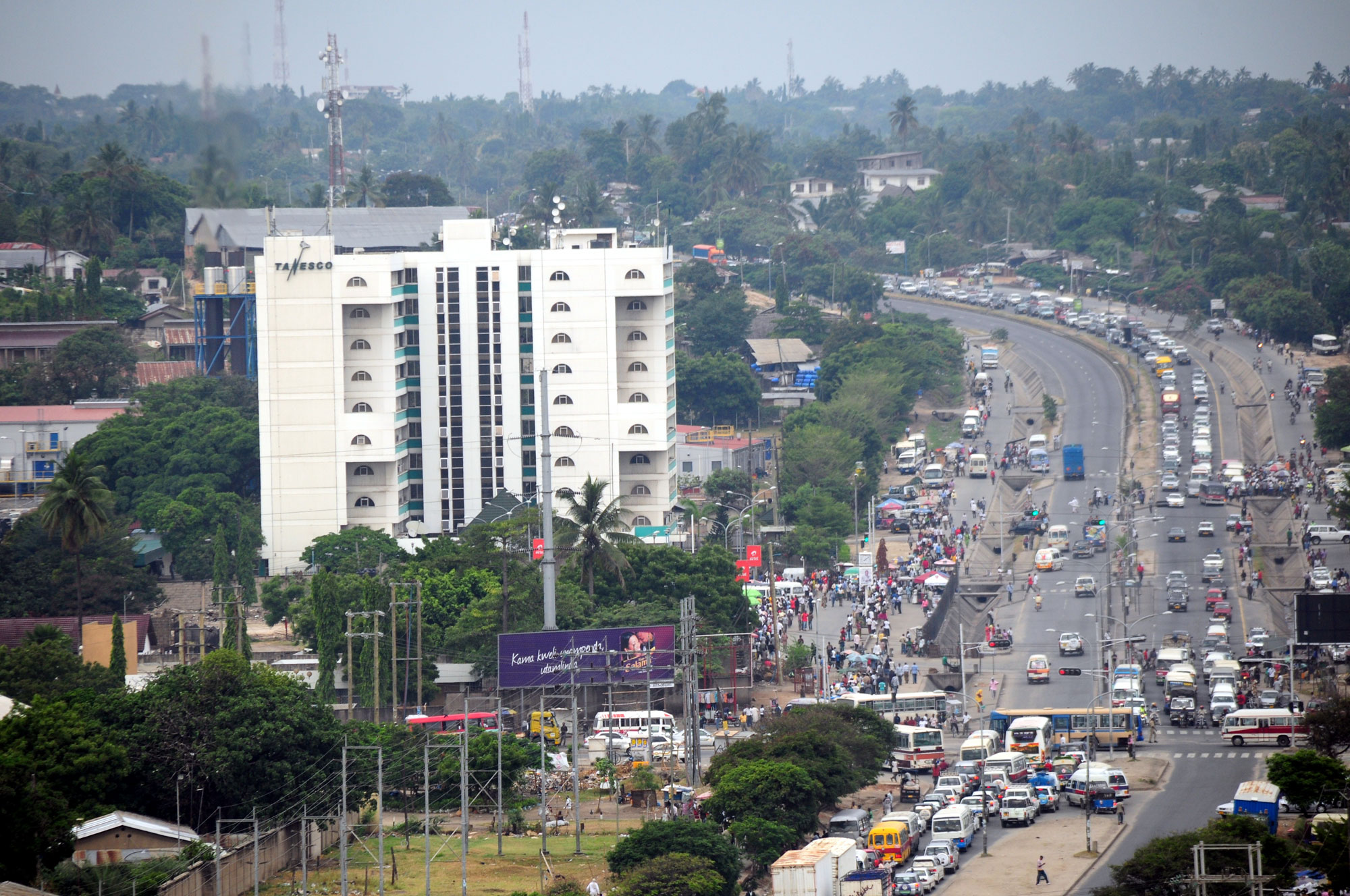
Tanesco building and Morogoro Road, Ubungo (Paul Scott. wikipedia)

President Magufuli has directed that the Tanesco headquarters building on Morogoro Road in Ubungo, Dar es Salaam must be demolished as it encroaches on the road reserve. The 10-story building is located within 90m of the centre of the road, in contravention of the Road Reserve Act. On the other side of the road, a boundary wall for the offices of the Ministry of Water also encroaches, and has already been demolished following the President’s instruction.

Potential demolition of the Tanesco building was raised in 2011 while President Magufuli was Ministry of Works. He had then instructed the National Roads Agency (Tanroads) and Tanesco to demolish the building, only to find himself overruled by the then Prime Minister, Mizengo Pinda.

Demolition of the building has become more urgent as the space is required for construction of a new $88m flyover interchange at Ubungo, similar to the interchange already under construction at TAZARA. Around 1,300 houses, public buildings and houses of prayers have been demolished this year by Tanroads to pave the way for the expansion of the Kimara-Kiluvya section of Morogoro Road.

TRANSPORT

by Ben Taylor

Dar port expansion underway

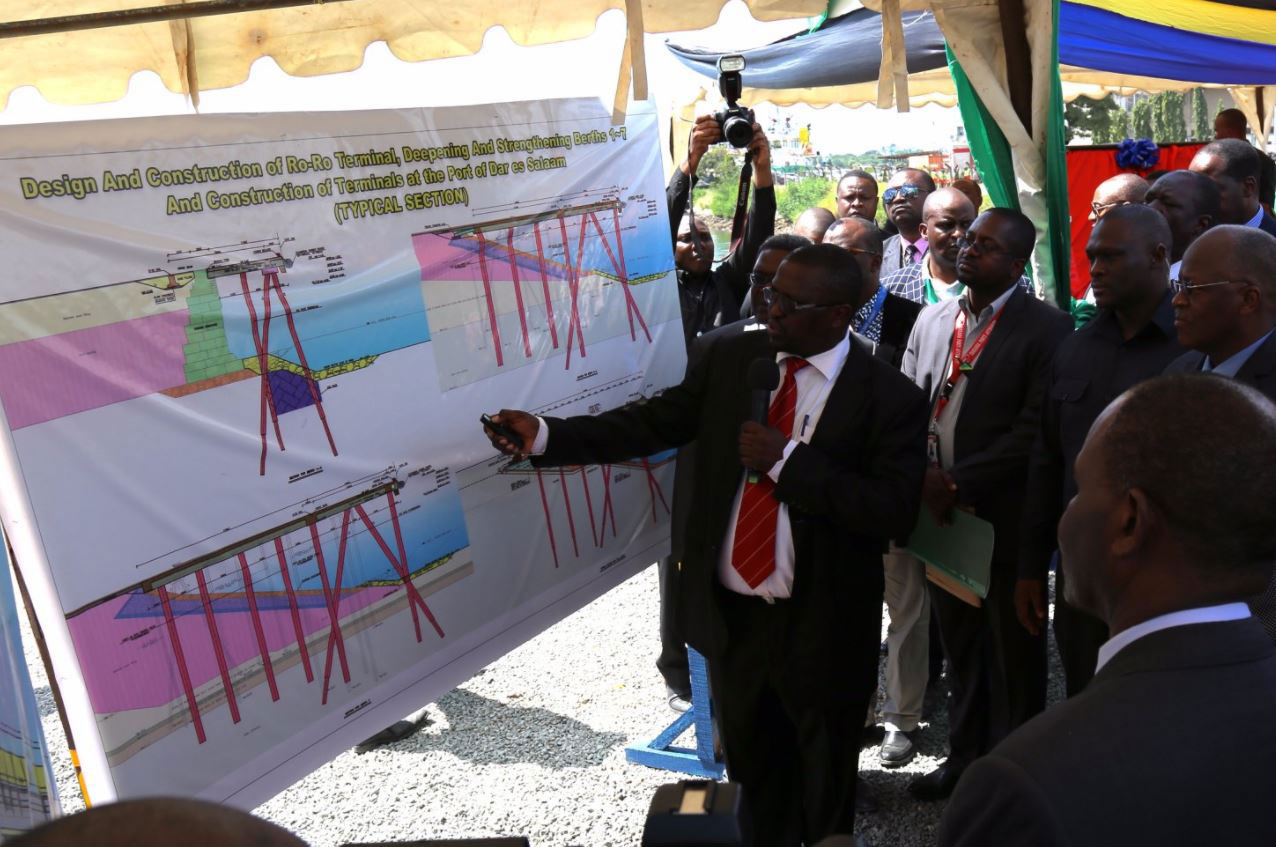
Launch of Dar es Salaam Maritime Gateway Project (DSMGP) (World Bank)

In July, President John Magufuli laid the foundation stone to launch construction works at Dar es Salaam port to deepen and upgrade seven of the port’s berths.

Dr Magufuli was informed that at present, only ships up to 243m in length and with carrying capacity of between 2,500 and 4,000 twenty-foot equivalent units (TEUs) can dock, but that following the upgrading works, the port will accommodate Post Panamax ships with 320-metre lengths and carrying capacity of up to 8,000 TEUs.

The Dar es Salaam Maritime Gateway Project (DMGP) is supported by the World Bank, which has offered a USD $345m loan, and the United Kingdom through the Department for International Development (DfID) through a USD $12.4m grant. The Tanzanian government, through own sources, will provide USD $63.4m.

The upgrading of the country’s major port is expected to enable more ships to dock, offload and load shipments at the harbour at the same time, reducing dwell time and enhancing efficiency. Dwell time at the port is expected to drop from 80 to 30 hours.

President Magufuli was impressed by the project and instructed the contractor, China Harbour Engineering Company (CHEC), to fast-track the project from 36 to between 28 and 30 months.

“This project will benefit not only Tanzania but her landlocked neighbours like Rwanda, Zambia, Burundi, Uganda, Malawi and Democratic Republic of Congo (DRC). The envisaged Standard Gauge Railway (SGR) will highly depend on the effectiveness of the port that handles 90 per cent of imported goods,” he said.

The entrance channel will have its depth deepened from 10.2m to 15.5m for a distance of 8km and its width widened from 140m to 170m, explained the Director General of Tanzania Ports Authority (TPA), Eng Deusdedit Kakoko. (Daily News)

Dar es Salaam wins Sustainable Transport Award
Dar es Salaam was announced the winner of the Sustainable Transport Award by the Institute for Transport Development and Policy (ITDP) in New York. This makes Dar the first African city to win the prestigious award.

ITDP notes that Dar had “launched a series of transformative improvements to transit, cycling and walking” in the past year, the most important of which is the Dar es Salaam Bus Rapid Transit (BRT) system, or DART. “DART is a high-quality, high-capacity BRT system incorporating best practice design and features, is the first true BRT system in East Africa. It spans 21 km of trunk route, and serves 160,000 passengers per day on average with the current fleet of 140 buses. By mid-2018, when the first phase becomes fully operational with over 300 buses, the system is projected to carry an estimated 400,000 passengers per day. DART has reduced commute times by more than half for residents.”

“Serving the key axis of Morogoro Road and running through the city centre, DART is more than a public transit system, it has brought improvements for pedestrians and cyclists as well. The project includes cycle paths, sidewalks, and improved pedestrian safety with well-designed, at-grade pedestrian crossings also complying with universal accessibility principles.” (The Guardian)

Eleven locomotives abandoned
The government has ordered Tanzania Railway Limited (TRL) and Tanzania Ports Authority (TPA) to explain the circumstances that led to the abandoning of eleven locomotives at the Dar es Salaam port.

The deputy minister of Works, Transport and Communications, Edwin Ngonyani ordered a report in July, a day after President John Magufuli had hinted at “dirty games” in the procurement process of the locomotives that arrived at the port a week earlier.

TPA director general Mr Deusdedit Kakoko told reporters that the locomotives belonged to TRL. It seems, however, that TRL had a dispute with the suppliers of the locomotives that TPA was not aware of at the time of clearing the consignment, according to Mr Kakoko.

The Citizen newspaper reported that the locomotives were dispatched in fulfilment of the contract signed in 2013 between TRL and a US based firm, Electro-Motive Diesel (EMD). A statement issued by the then TRL director general, Mr Kipallo Kisamfu said TSh70.9 billion had been paid to the contractor on 13 locomotives which would be dispatched in three phases. (The Citizen)

St Lucky Vincent school bus tragedy
Thirty-five people died when a bus carrying pupils from St Lucky Vincent School in Arusha crashed into a gorge in Karatu District in May. Among the dead were two teachers and a driver, and thirty-two pupils. They were travelling to Karatu to take part in mock examinations.

Vice President Samia Suluhu led mourners at a communal mass. Three survivors were taken to the US for treatment, and have made good progress. They are expected to return to Tanzanian sometime in August. (Daily News, The Citizen, The Guardian)

TRANSPORT

by Ben Taylor

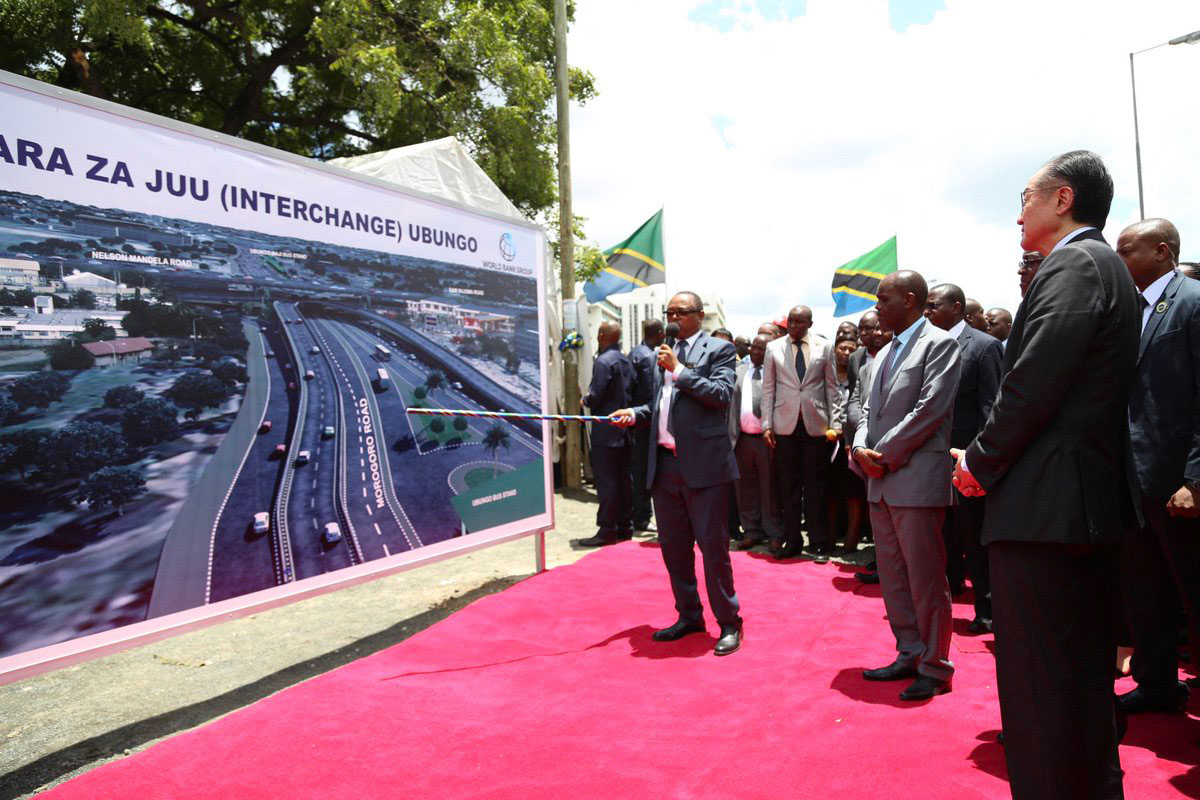
Foundation stone laid for new Ubungo interchange

Dr Jim Yong Kim at ceremony to mark start of new Ubungo interchange,

In the presence of World Bank President, Dr Jim Yong Kim, President Magufuli laid the foundation stone for a new flyover interchange at Ubungo junction on the outskirts of Dar es Salaam. The three-level flyover is to be built by China Civil Engineering Construction Corporation (CCECC) and is expected to ease the city’s traffic congestion problems.

Ubungo, where Morogoro Road meets Sam Nujoma Road and the Nelson Mandela Expressway, is a major bottleneck. As one of the busiest road junctions in the country, more than 65,000 vehicles pass through each day. At peak times, motorists trying to enter or leave the city can often find themselves spending three hours or more at the junction. The intersection also serves an average of 500 to 600 upcountry and international passenger buses coming in and out of the nearby Ubungo bus terminal every day.

The project will cost TSh 188bn, financed by a World Bank loan. The government is understood to have completed all the preliminary preparations including paying compensation amounting to TSh 2.1bn to people with property that is to be demolished.

CCECC is expected to begin construction works immediately, with a stated completion date of September 2020. Construction works are expected to aggravate traffic problems during this time.
A similar overpass costing around TSh 100bn is under construction at the TAZARA junction in Dar es Salaam.

Air Tanzania revenues up
Managing Director of Air Tanzania Company Limited (ATCL), Lasislaus Matindi, said the company had collected TSh 9bn in the first four months after it began operating flights with two new aircraft in October 2016. Mr Matindi said about 80% of the revenue was spent on operational costs and on settling some outstanding debts. He was speaking to reporters after talking with the Parliamentary Public Investment Committee (PIC).

Last year, the government of Tanzania bought two 76-seater Q400 aircraft from Canadian manufacturer Bombardier, at $62 million.

However, though the committee was happy with the information provided by from the management and board of ATCL, it called for a more detailed investment policy and business plan, a recruitment plan and details of the challenges the company faces, according to PIC chairman Albert Obama.

Dar-Bagamoyo ferry remains grounded
A ferry that was intended to provide a means of commuting direct to Dar es Salaam city centre from Bagamoyo remains grounded, with no immediate prospect of providing services. The boat, with a capacity of 300 passengers, was delivered in 2014 but grounded for ‘intense maintenance’ soon after its trial test. Rather than 90 minutes each way, as expected, the ferry was found to be only able to cover the distance in 3 hours, making commuting an unattractive prospect.

“The issue is already in the mandate of legal experts to ensure that all the prerequisites are met as per agreement before handing over the vessel after mechanical systems are approved. Once it is over the public will be informed on further steps forward,” said Deputy Minister for Works, Transport and Communication, Engineer Edwin Ngonyani.

He explained that up to now the boat was back with the manufacturers as it was not possible to accept something that failed to meet such a significant part of the specifications.
A report from the Controller and Auditor General in 2016 discovered signs of a flawed procurement process in the Dar es Salaam ferry boat’s $5m purchase from Danish-based company, JGH.

TRANSPORT

by Ben Taylor

Ongoing revival of Air Tanzania
President Magufuli rapidly carried through on his promise, made in early 2016, to purchase two new aircraft for the troubled national airline, Air Tanzania. The airline took delivery of two 76-seater Bombardier Q400 planes in September, at a cost of $62m to the taxpayer. The aircraft immediately entered service, expanding the fleet from one to three planes, and providing routes between Dar es Salaam and Mwanza, Bukoba, Kigoma, Mbeya, Dodoma, Kilimanjaro, Arusha, Zanzibar and the Comoros.

In December, the president placed orders for three new aircraft for national and regional routes, including a third Q400 and two 150-seat Bombardier CS300 craft, at a total cost of $203m. But the shopping spree did not stop there, with one further plane ordered: a Boeing 787 Dreamliner for use on long-haul routes with space for around 250 passengers. With an estimated price tag of $225-265m, this brings the total taxpayer spend on the airline to around $500m in a single year.

The new planes purchased by the government are owned by the state-run Tanzania Government Flight Agency (TGFA), but will be operated by ATCL. The choice of planes was said to have been influenced by President Kagame of Rwanda.

ATCL’s local competitors, Precision Air and the budget airline FastJet, have both faced difficulties in recent months. FastJet, having grown rapidly since its entry into Tanzania around four years ago, recently sold one aircraft and returned three leased craft in an effort to cut costs. Precision Air has been posting losses, and is said to be seeking funds to recapitalise. Both airlines have struggled to fill planes to full capacity.

According to a statement from the president’s office, the government plans for ATCL to add non-stop direct flights between Tanzania and Asian and European tourism markets in a bid to boost annual foreign visitor arrivals beyond current levels of around 1 million.

“Tourists have to use several connecting flights to come to Tanzania… this is because we don’t have our own (strong) airlines,” Magufuli was quoted as saying in the statement. “We haven’t even reached 2 million tourist arrivals a year, while a country like Morocco gets more than 12 million tourists each year,” the president remarked. (The Guardian, Daily News)

Progress on Dar es Salaam airport Terminal III, regional airports

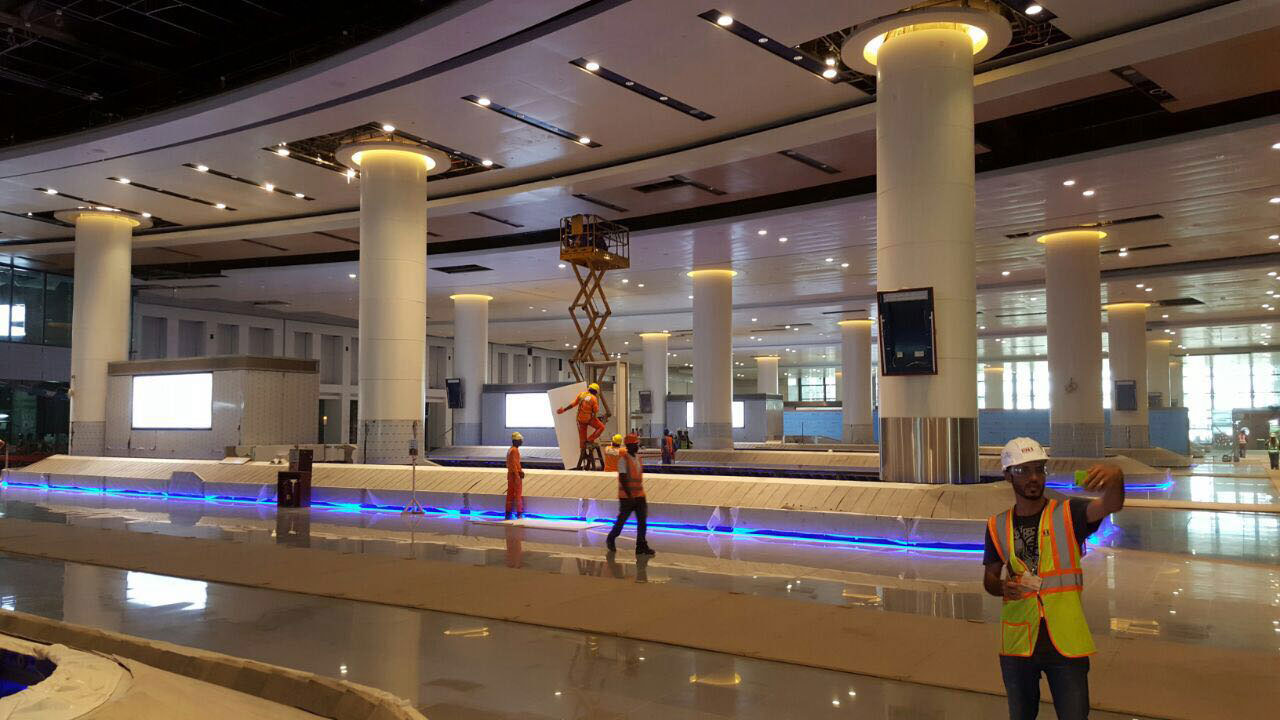
Construction at Terminal 3 in Sept 2016 www.williammalecela.com)

While on an inspection visit to Julius Nyerere International Airport, Minister for Works, Transport and Communication, Prof Makame Mbarawa, outlined the potential of the new, modern terminal building. It is set to accommodate over six million passengers each year, more than triple the airport’s current capacity, and will include shopping malls and several other business outlets offering an estimated 5,000 job opportunities.

The opening of the new terminal building, which was originally scheduled for mid-2016, has been pushed back to December 2017. The construction cost is now estimated at TSh 650bn, up from the original estimate of TSh 570bn.
Further afield, Songwe airport in Mbeya is currently under construction, expansion is underway at Mwanza airport and work is planned in Kigoma. The runway at Dodoma has recently been extended, allowing larger aircraft to serve the nation’s capital city.

Meanwhile, minister Mbarawa directed the Immigration Department, Tanzania Revenue Authority (TRA) and National Microfinance Bank (NMB) to facilitate a smoother issuance of visas to foreign passengers arriving at JNIA’s Terminal II. He gave the instruction after observing what to many will be a familiar sight of long queues of passengers waiting for visas at the terminal. (The Guardian)

Funds secured from China for rail expansion work
Export Import Bank China will lend Tanzania $7.6 billion for a railway connecting Burundi, Rwanda and Uganda to Dar es Salaam, a government official said. The work will upgrade the existing central line railway to standard gauge and extend the line to the neighbouring counties. Two additional lines will connect Dar es Salaam to the coal, iron ore and soda ash mining areas in the south and northern parts of the country.

The Minister for Works, Transport and Communications, Professor Makame Mbarawa, said completion of the project is expected to take three years. (Bloomberg, The Guardian)

TRANSPORT

by Ben Taylor

Rwanda rail route in development
The government has set aside US$ 460m for the construction of the Dar es Salaam-Isaka-Kigali/Keza-Musongati (DIKKM) project. The standard gauge railway project is planned to be completed by March 2018 and is estimated to cost US$ 5.2 billion.

President Magufuli also announced that the government was to allocate space for an inland container depot (ICD) specifically for Rwandan cargo, to reduce bureaucracy. He explained that 70% of Rwanda’s goods pass through Dar es Salaam port, and assured his Rwandan counterpart that corruption problems at the port had been addressed. The plan involves opening a Tanzania Ports Authority (TPA) office in Rwanda, so that cargo clearance can be done in Kigali.

The president also explained that Tanzania was committed to collabo­rating with the Burundian government, adding that Burundi had also expressed its willingness to send experts to Tanzania for sharing experi­ences with a view to strengthening mutual relations. (The Guardian)

New aircraft for Air Tanzania
President Magufuli has announced that his government will purchase new aircraft for the struggling national airline, Air Tanzania. Two Bombardier D8 Q400 planes are to be purchased to operate both domestic and regional routes, said the President.

Deputy Minister of Transport, Dr Charles Tizeba, told parliament in Dodoma that the government would put down US$ 3.34m as initial payment for purchase of the two airplanes, and that the market price of each of the aircraft was US$35m. He added that the balance of the sale price would be obtained from the planes’ operations and would be fully paid in a period of 10 years. (The Guardian)

BRT mass transit buses begin operations
The long awaited Dar es Salaam Bus Rapid Transit (BRT) buses began operations in the city in May 2016, with 105 buses operating along dedicated lanes along Morogoro Road and various connecting routes. Prices are set at TSh 200 for students and between Tsh 400 and TSh 800 for regular-price passengers.

The World Bank-financed project is designed to provide relief to 300,000 daily commuters, at a cost of $290m. Official estimates showed that traffic congestion has been costing the nation over TSh 400bn annually in lost working hours and extra fuel consumption.

The service’s first days of operation saw huge demand, resulting in long queues for ticket purchases and to board buses. However, as operators and passengers alike have become familiar with how the system works, the severity of these challenges has reduced. In particular, adoption of an electronic-ticketing system – several weeks after the launch of the buses – has reportedly reduced both confusion and waiting times considerably.

A second set of challenges emerged when drivers threatened strike action due to pay and conditions. Many claimed that they had not been issued contracts, or that the contract terms were not consistent with those previously announced. Much of the confusion appeared to relate to a series of performance-based bonus payments, depending on drivers’ punctuality and fuel efficiency, among other factors.

Finally, the buses were beset by an unfortunate series of accidents, with 34 of the buses reportedly involved in accidents within the first two weeks of operations. A spokesperson of UDART, the bus company, Deusdedith Bugwaya blamed the accidents on civilian drivers of cars and motorbikes crossing the dedicated bus lanes. The cost of the bus repairs was estimated at TSh 100m (£35,000).

Nevertheless, anecdotal reports suggest that the buses have already overcome these teething troubles and have made a positive impact on traffic congestion in the city. (The Citizen; The Guardian; Daily News).

Drivers’ doubts on Nyerere Bridge

Initial excitement at the official opening of Nyerere Bridge, linking Dar es Salaam city centre with Kigamboni, has been tempered by disappointment at higher-than-expected toll rates for bridge users. While it had previously been reported that the toll would be set at the same rate as the Kigamboni ferry crossing, this proved incorrect.

According to the newly announced toll rates, motor cycles are charged TSh 600, Bajajis and saloon cars TSh 1,500, pick-up vehicles below two tonnes and station wagons TSh 2,000, passenger vehicles TSh 3,000 (maximum 15 seats), TSh 5,000 (maximum 29 seats) and TSh 7,000 (above 29 seats). Cyclists and pedestrians are allowed to cross the bridge free of charge.

Daladala commuter buses’ operators are most upset by the prices, and baulked at having to pay up to TSh 70,000 per day (£25) for multiple crossings. Some such buses are reported to have started dropping passengers on one side of the bridge, forcing them to walk the 680m length of the bridge and find another bus on the other side. An average of 8,000-10,000 vehicles per day are using the bridge, according to Project Manager, Gerald Sondo, and the National Social Security Fund (NSSF) reported takings reached TSh 1bn (£350,000) in the first month of operations.

The bridge, which opened on May 14, 2016, was jointed financed by NSSF and the government, at a total cost of $143m. (The Guardian)

Uber launches in Dar es Salaam
Uber, the taxi service that uses mobile phone technology and which has revolutionised urban travel around the world, launched in Dar es Salaam in June 2016. As is the case in many other countries, Uber charges customers a fare that is a fraction of the price charged by tradi­tional taxi operators.

In Dar es Salaam, Uber advertises a fare of TSh 13,000 (approximately £4.50) for a journey between the airport and the city centre, less than a third of the equivalent price (TSh 40-50,000) for a traditional taxi. Furthermore, Uber allows customers to pay either using mobile money (such as m-pesa) or credit card, in addition to payment by cash.

These fares are low even by regional standards. Equivalent prices for similar journeys using the Uber service in Nairobi and Mombasa, where the firm has faced strong resistance from taxi drivers, are around double the cost of Uber fares in Dar es Salaam.

Early days of the service’s operations in Tanzania were marked by uncertainty among Uber drivers, unfamiliar with new operating methods and doubts at the low prices, and fear among other taxi drivers that their prices would be undercut. Reports of Uber drivers requesting top-ups to the official price were widespread, and many customers cited problems with requested drivers not arriving for pick up as agreed.

Nevertheless, Uber has not increased its fares in Dar es Salaam in the two months since its launch. (The Citizen; The Guardian)

TRANSPORT

by Ben Taylor

Map from www.openstreetmap.org - a not-for-profit community of mappers

Map from www.openstreetmap.org – a not-for-profit community of mappers

Julius Nyerere Bridge opened
President Magufuli has officially opened Julius Nyerere bridge in Dar es Salaam. The bridge, previously known as Kigamboni bridge, provides a second link between Kigamboni and Dar es Salaam city centre, relieving pressure on the Kivukoni ferry crossing.

The bridge is 680 metres in length, making it the longest cable-stayed bridge in East Africa. It is six lanes wide, plus pedestrian / cycle lanes on each side – a total of 32 metres. The road connects to the Mandela expressway, close to the national stadium, and to the Kigamboni-Kibada Road on the Kigamboni side.

It took nearly five years to construct, at a cost of US$143m. The work was carried out by the China Railway Construction Engineering Group in a joint venture with the China Railway Major Bridge Engineering Group and Arab Consultant from Egypt.

Officially opening the bridge, President Magufuli commended the contractors and local bodies that had been involved, including Tanzania Roads Agency, the Ministry of Works and the National Social Security Fund, which put up 60% of the cost.

“They had proposed that this bridge should be named after me since there are other bridges named after former presidents Benjamin Mkapa and Jakaya Kikwete, but I said no,” the president said. “I have just been fulfilling my responsibility as a public servant. I should not be merited. Calling it Nyerere Bridge will be an important gift to me. This bridge will be a good reminder and honour to our founding father’s efforts to unite Tanzanians despite their differences in tribe, religion and political party affiliation, such that we all speak one language.”

In his previous role as Minister of Works, President Magufuli had played a key role from early stages of the bridge’s construction.

At the launch event, President Magufuli suspended the Dar es Salaam City Director, Wilson Kabwe, after the Regional Commissioner, Paul Makonda, told the gathering that the director had cost the city council TSh 3bn by using outdated by-laws governing Ubungo bus station. The President asked the gathered crowd what action he should take, and was encouraged to “tumbua jipu” (lance the boil).

The bridge will be operated as a toll bridge, enabling NSSF to recover its contribution to the construction costs. The price will be the same as the Kigamboni Ferry crossing.

“It’s a dream come true, I never expected this to happen in my life time,” said Mzee Iddi Amri Saadi, a 72 year old resident of Kigamboni who for over five decades has been crossing the entrance of Dar es Salaam port on wooden boats or ferries. “It was about 27km drive this morning from home to office, (which took about 1 hour thanks to Nyerere Bridge). It used to take about 3 hours (to reach the office) via ferry by car,” said Irenei Kiria, a resident of Kigamboni.

TAZARA flyover project
A ground-breaking ceremony for the long-awaited TAZARA flyover project in Dar es Salaam was held in April. The junction, where Nelson Mandela Road and Julius K Nyerere Road meet, halfway between the airport and the city centre, has long been the focus on discussions on reducing traffic congestion in the city.

Speaking at the ceremony, Patrick Mfugale, Chief Executive Officer for the Tanzania National Roads Agency, said the project would cost $50m, of which the government of Japan was contributing $46.5m.

Makame Mbarawa, the Minister for Works, Transport and Communications, said that on completion, traffic congestion in the city will be reduced by 80%.

President Magufuli used the opportunity to speak about other planned transport projects. This included a six-lane 128km highway from Nyerere Bridge (Kigamboni) to Chalinze, with five flyovers, plans to upgrade the central railway line to standard gauge and to construct a 7km road bridge from Coco Beach to the city centre.