
TANZANIA IN THE MEDIA

WHO IS RESPONSIBLE FOR CORRUPTION IN AID?
Under this title, in the June issue of Transparency International’s Newsletter, Brim Cooksey blamed foreign aid for much of the corruption found in developing countries. He wrote that one of the main reasons for the disappointing performance of structural adjustment programmes was systematic corruption. An extreme example had been Tanzania’s import substitution programme which had allowed local manufacturers to import raw materials and finished goods. Some companies stopped paying counterpart funds. Import duty and sales taxes were not paid on some imports. Neither the Treasury nor the commercial banks had the administrative capacity or the integrity to handle large volumes of free foreign exchange and the donors ignored the problem.. . . ‘in December 1996 the IMF started disbursing a US$240 million structural adjustment loan but to date not one private or parastatal company has been put in receivership for the hundreds of millions of donor dollars which went astray ….pressure to spend (donor money) has led to unbelievable over funding.. . .well known examples are NGO’s, many of which are created with the sole objective of embezzling donor money’.

The writer went on to say that the picture emerging from the recent Warioba Report on corruption was that of an oppressed people largely at the mercy of an incompetent and corrupt state apparatus. Unfortunately, the report had not mentioned corruption in aid and this matter should be explored (Thank you Ron Fennel1 for this item – Editor).

ELEPHANTS
AFRICA (July-August) reported that singing of Ishe Konzberera (God Bless Africa) greeted the 74-21 vote at the Convention on International Trade in Endangered Species in Harare to relax the protection of the African elephant in Botswana, Namibia and Zimbabwe and allow regulated sales of ivory in 1999.

SPARTAN SPLENDOUR
Dr. Adbayo Williams, wrote in AFRICA TODAY (July/August) about what he described as the ‘new generation of visionary African leaders’ now emerging on the continent. It contrasted former President Mobuto of Zaire who ‘will spend his last days in lonely exile’ on the one hand with Nelson Mandela ‘who will be granted his last wish to die with a smiling face’, Leopold Senghor of Senegal who was spending his last days in ‘refined retirement’ and Julius Nyerere who, ‘in spartan splendour, still continues to function as the father of his nation’.

HELL ON EARTH
Tanzanians figured prominently in a two-page article in the July/August issue of NEW AFRICAN under the heading ‘Turkey: Hell on Earth for African Immigrants’. Istanbul was said to have less than 1,000 African immigrants but half of them were currently in detention, rotting away on trumped up charges. The trouble had started, the article said, when a Tanzanian was caught with heroin stuffed in his back-pack in June 1996. ‘This gave the Turkish police the excuse to raid the apartments of other Africans in the city…. Later, 43 Africans (mostly Tanzanians) were caught crossing illegally into Turkey from Greece. The immigration police promptly put them in detention. A week later the narcotics police arrested a Tanzanian with 500 grammes of heroin. The police then went straight to the African hostel, took out 13 other Africans, and planted heroin on them. A year later they are still in detention….another group was found in the apartment of a Tanzanian who had a postcard photo of a famous Turkish model singer, Hulya Avsar. The police mistook the postcard for a real photograph and thought the Tanzanian (“a monkey from the African jungle”) had had the cheek to take the beautiful model as a girl friend. The police gave the Tanzanian a good beating before realising that it was merely a postcard….’

‘JENGA’
This is the name of the second-best-selling game (after Monopoly) in the world and is, of course, the Swahili word ‘to build’. The object of Jenga, is to take wooden bricks from the bottom of a tower and put them on top without making it fall over. Last year 3 million people bought it. The SUNDAY TIMES (July 6) explained how the inventor of the game, Leslie Scott, who now lives in Denmark, spent the first years of her life in Africa and her first language was Swahili (Thank you Randal Sadleir for this item – Editor).

THE CURATE’S EGG
‘Tourism. The definitive curate’s egg, the pre-eminent mixed blessing’ – so began a recent article in THE SCOTSMAN by Julie Davidson. She went on to say ‘This week I thought of Nasser K. Awadh … whose gene pool is Zanzibar’s history, who draws his pedigree from the Yemen, from Indonesia and also from sub-Saharan Africa … and who recently slapped an Italian visitor. Crowning tourists, rather than hotels, is not one of the traditions of Zanzibar hospitality, but Nasser was defending his island’s dignity. “I asked him several times to stop throwing sweets at the children and then photographing the ensuing scrum of human monkeys but he went on doing it. So I smacked him’. Later we were standing outside the Persian Baths at Kidichi, a relic of the Omani Sultanate, when we saw the same disagreeable device practised by two German men. This time Nasser controlled his itchy palm. He scolded the children instead while I scowled and muttered at the Germans…. The curate’s egg. Nasser knows the merits of its good parts. He is much in demand for his guide’s eloquence and authority, the valued employee of Abercrombie and Kent, the only British tour operator which maintains an office in Zanzibar. But A & K’s exclusive foothold will soon be challenged by Britain’s largest tour operator, Thomson, who will be the first mass market holiday company to go into Zanzibar…..’ (Thank you Fiona Scott for this item – Editor).

INDUSTRIES REVIEW
The INTERNATIONAL HERALD TRIBUNE (June 11) contained a ‘sponsored page’ written by Richard Synge, who is based in Cambridge, Extracts: ‘Practically every sector of the economy is being transformed. The new Government policies are attracting investor interest from all over the world……analysts say that the first results of foreign direct investments made in the past five years will show over the coming months in the form of a rapid rise in gold exports and a sharp revival in the production of goods and services for the domestic market….evidence of the benefits of reform can be seen clearly in Dar es Salaam where a construction boom is under way. Mwanza is also developing rapidly with banks and other services moving in…. over the next three to five years Tanzania will begin to score some successes that will be noticed internationally…..if Uganda has done it, then Tanzania can do it……’ (Many thanks Ronald Neath for sending this item – Editor).

‘WHAT THE WITCHDOCTOR ORDERED’
This was the heading of a serious article in the DAILY TLEGRAPH (July 2) about how rich Tanzania is in medicinal plants and in people who say they can use them in medicine. With panic in the West that the African repository of potential future drugs will disappear as agriculture spreads across the continent, Tanzania is launching a pioneer project (through the Missouri Botanical Garden) which will try to document this plant world before it is too late and through training of local people, attempt to quell the fears of local scientists about the drug company scientists who, they say, fly in, whip some exciting looking plants from the bush, and then jet home again without benefiting the host country. The author of the article had visited the corner of the market in Dar es Salaam where the healers sell their exotic wares and went on to describe the work of the Tanzanian Institute of Traditional Medicine and of botanists at the university. Mention was made of a pile of gnarled ebony roots in the market used to relieve pain; elephant dung – ‘its smoke treats children’s fits’; and, lion oil ‘which relieves an inflamed leg’ (Thank you Liz Fennel1 for this item – Editor).

CORPORATE AMERICA

‘Kiswahili has found its way into the highest level of corporate America, sort of’. So began a note in the Spring 1997 issue of Mbegu za Urafiki (the Newsletter of (American) Friends of Tanzania) which is based in Maryland and has many former Peace Corps volunteers among its membership. The note continued: ‘The Miami-based Burger King Corporation has appointed Tanga born Dennis Malamatinas (41), the son of Greek sisal farmers as its Chief Executive…. although he left Tanzania at the age of six he still speaks a few words of Kiswahili and is believed to be the highest ranking American business executive who is from Tanzania (thank you Trevor Jaggar for this item – Editor).

BEAUTY CONTESTS
The September issue of NEW AFRICAN contained an article under the heading ‘Tanzania Bans Beauty Contests’ in which it wrote about what it described as the ever growing controversy over beauty contests. Organisers of a MSS Eastern Africa contest in April were warned that they were not to allow competitors to compete in swimsuits. Arguing that all beauty contests in the world allowed swimsuits, the non-Tanzanian entrants threatened to boycott the contest and the organisers backed down. But the government was said to have been furious. Arts and Languages Director Elinkunda Matteru said “We cannot allow our culture to be spoilt. We cannot allow the aping of shameful things with Africans walking in halls”. But former culture minister Philemon Sarungi was said to have defended the wearing of swimsuits as they are worn universally. The debate seems likely to continue.

TANZANIA IN THE INTERNATIONAL MEDIA

‘FROM SOCIALIST SHEEP TO CAPITALIST LION’?
In a 7-page cover story in its February issue AFRICAN BUSINESS Maja Wallengren wrote that ‘decades of socialism have so enervated the enterprise spirit in Tanzania that it acquired the unwelcome reputation of being a sheep in a region of predators. All this is about to change and the country is clearing its throat to roar like a lion’. The Director General of the UN Industrial Development Organisation (UNIDO) was quoted as saying that it was his hope that in the 21st century not only Asian tigers but also some African lions will be roaring in the international economic arena and Tanzania could be one of them.

QUALITY YES; QUANTITY NO.
AFRICAN BUSINESS (March) described the state of Tanzania’s struggling coffee industry as ‘quality not quantity’ following reports that the production in the year 1996/67 would be only 42,000 tonnes, a drop of 20% from the previous year. Traders were quoted as saying that massive replanting schemes were needed to replace the many trees which are 50 to 100 years old and thus increase the average yields from the 250kg per hectare in Tanzania to the Kenya figure of 500 kgs. However, quality was said to be improving and the country was now again earning a world class reputation for its mild Arabica. Production of Robusta coffee in Bukoba remained steady at 12-14,000 tonnes but here the problem was price. Vietnam’s coffee production had increased from 20,000 tonnes in the mid-1980’s to almost 250,000 tonnes for 1996/97 which was depressing world prices (A massive new replanting programme is about to start under a $14 million EC aid grant – Editor).

“SOOO POOR”
Zoe Heller, the columnist in the SUNDAY TIMES MAGAZINE explained (on March 9) how she had thrown over her boyfriend and, in order to distance herself from him, moved from Los Angeles to New York. But she doesn’t seem very happy with her new friends: ‘I have been out to a dinner party at a fancy house on the Upper East Side’ she wrote. ‘There was a revolting deb type there banging on about her recent jaunt up Kilimanjaro. “God, Africa, I mean, it’s sooo poor”! she kept on bellowing. “But so real, you know”. She told me about how fetchingly hard her thighs got during her ascent. ” ….. my porter was sooo sweet – when it got really cold and my nose was running, he’d take a handkerchief and wipe my nose for me”. “Ah, yes” I murmured “those marvellous Tanzanians, they do make remarkably good bearers, don’t they ……. ”

THE ‘MAGIC WAND’
NEW AFRICA (February) recounted how Mwalimu Julius Nyerere recently sold his famous cane or ‘magic wand’ as he calls it to raise funds for his sponsorship of the education of bright but poor children. Dozens of wealthy Tanzanians wanted to buy it. Former UN Adviser Gertrude Mongella was said to have offered Shs 3 million but it was local business tycoon and soccer financier Ahmed Bora who eventually got it for Shs 4.5 million. Nyerere was said to have been shocked by this revelation of the wealth of Tanzania’s new capitalist class. One of his relatives said that Mwalimu had lots of sticks and he had probably sold one of the powerless ones, not the magic one. Midst much public criticism Mr Bora decided to give the stick back to Mwalimu. No one knew whether he got his money back. Some were said to believe that the wand just refused to stay in Bora’s hands.

‘WHERE TO BE MUGGED’
Under this heading the INDEPENDENT published a guide to mugging (based on information from the British Foreign Office Travel Advice Unit) in its issue of March 1. Countries featured in this particular issue included Indonesia, Iran, Sierra Leone and Swaziland. On Tanzania it wrote: ‘Incidents of mugging and theft are common especially on public transport and beaches. Food should not be accepted from strangers as it may be drugged. Armed car thefts, particularly of four-wheel drive vehicles occur fairly frequently and may be accompanied by personal violence (Thank you Jane Carroll for this item- Editor).

BUREAUCRATIC HURDLES
The JOHANNESBURG STAR’s BUSINESS REPORT in its issue dated January 23 was highly critical of Tanzania’s six-year old investment act and wrote that the country was now rewriting its investment code. ‘The Investor Road Map of Tanzania’ sponsored by USAID had ranked it among countries with the worst investment hurdles. The article went on: ‘The report said that it took between 545 and 1,095 days to lodge an application for business …. there were delays in finding land, high taxes, poor infrastructure and far too many forms to fill in. In all, a firm in Dar es Salaam could expect to submit at least 89 separate filings per year ….. and financial institutions had to submit up to 235 returns every year. …. While it takes only one or two days to clear imports into Mauritius, Namibia or South Africa, in Tanzania it takes up to three months’. The article went on to describe the changes likely under the new code with its one-stop centre and a ‘facilitation office’ which was expected to make a considerable improvement in the investment climate.

ONE MAN COMPENDIUM
In an article on a recent African music festival at the Barbican in London NEW AFRICAN (February) reported as follows: ‘Tanzania’s much travelled master musician Hukwe Zawose, who is almost a one-man compendium of his nation’s cultural heritage, performed a spellbinding demonstration of song and dance with myriad traditional instruments’. It reminded readers that Hukwe’ s current album Chibeto had been chosen as African Life’s ‘Album of the Year’. The VSO publication ORBIT (fourth quarter 1996) listing the same album in its ‘Top 10 Sounds of 1966’ described Zawose as ‘one of Tanzania’s national treasures and a magical character of mythical proportions’ .

‘MALARIA FEAR FOR AFRICA TRIP MAYOR’
Under this heading the DAILY TELEGRAPH (21/3/97) wrote that a Labour mayor who spent £1,500 of council money on a week-long ‘fact finding’ trip to Musoma, Tanzania has returned with suspected malaria. Dawn Neal’s visit had been criticised at a time of financial cuts on Calderdale Council, West Yorkshire. She was accompanied by her boyfriend Danny McIntire, a fellow councillor and Margaret Berry, the council’s senior environmental health officer. They left Halifax to see the Serengeti Game reserve and advise the locals on tourism and also handed over a piece of medical equipment that can help to clear swallowed fishbones from throats. “This was not a holiday” she said. “It was a fact-finding mission to Calderdale’s twin town and we intend to begin fund-raising to pay for medical supplies for the people of Musoma” but a former mayor, Liberal Democrat Stephen Pearson, said “I don’t believe glad-handing people is going to make a fundamental difference to their quality of life”.

SCHOOL FEES
“When our children do well in primary school we get really worried” said a farmer in the western Usambara mountains. He was peaking to Charles Worth who wrote in CHRISTIAN AID NEWS (February/March) that since the government had imposed fees, secondary education had become a luxury which this family could scarcely afford. Only one family out of 300 in the village were able to send their children to secondary school. … many Tanzanians felt enslaved today because of Tanzania’s massive debt burden – the World Bank and IMF had imposed a structural adjustment programme which had drastically cut government spending on health and education …. ‘ Mr Worth went on: ‘Victorian campaigners had the vision and persistence to help bring an end to the evil of slavery. Can the British churches today catch their spirit, change the rules and end the slavery of debt in Tanzania?’ (Thank you Betty Wells for this item – Ed).

ONE HUNDRED CONSULTANTS
‘That is the staffing level of a London hospital with 300-400 beds and a district population of 200,000 – the same as Muheza district in Tanga Region. In London there are many more junior doctors and a network of GP’s. Muheza has three doctors. If each saw only inpatients for 10 hours a day, seven days a week, that would be 3xlOx7 = 210 hours, half an hour for each inpatient. Yet many are very sick and need more intensive treatment or operations done by the same three doctors. Then there are long hours to be spent seeking outpatients, supervising the laboratory and X-ray, and administration, teaching and trips to the ministry in Dar es Salaam to be fitted in …… ‘ extracts from a recent issue of the NEWSLETTER of ‘MEDICINES FOR MUHEZA’ (Thank you Trevor Jaggar for this item- Editor).

LAUNDERING
The New York WALL STREET JOURNAL has published an article by Robert Greenberger under the heading’ Some Hotels May Do More Laundering of Cash Than Towels’ which has attracted a lot of attention. It stated that there were indications that Zanzibar banking and hotel businesses were being used by foreign investors to launder international drug money. It was alleged that huge sums were being deposited in banks by hotels which had few guests. The IMF has been quoted as saying that shady financial flows were flourishing in Zanzibar but the Government of Zanzibar and the Bank of Tanzania have denied the allegations.

‘ALMOST LIKE HOME’
‘Tanzania may not resemble the famous gold producing regions of Western Australia on the surface, but Australian explorers active in the east African nation reckon that underground it is almost like home. ‘Tanganyika Gold’ has 28 exploration tenements in two main areas – the Lake Victoria Goldfield and the Lupa Goldfield. “it is exciting to be in an area that is very unexplored by Western standards and clearly has a lot of gold” says Managing Director Ian Middlemas. “It has similar geology to W Australia”….. Two tenements have been drilled so far – at Buhemba in the north of the Lake region and Busolwa to the South. The latter included intersects of 32m at 2.48 grams per tonne – a lot of the holes end in mineralisation Mr Middlemas said – THE WEST AUSTRALIAN (December 23) – (Thank you Mr D Gledhill for this item and for the mention of your gold prospecting uncles who were on the Lupa in the 1930 ‘s – Ed).

‘BARRED FROM ANIMAL KINGDOM’

Under this heading, at the end of a speaking tour of Britain by three Maasai spokespeople complaining about the action of the Tanzanian government in driving them from their lands in the interests of game and tourism, the London OBSERVER (April 6) published a half page article. It concentrated on the situation at the Mkomazi Game Reserve in the Same district and contrasted what it described as ‘the glass-fronted house with a satellite dish, verandah and spectacular views’ of manager Tony Fitzjohn (said to be nicknamed ‘boy Tarzan’ by the Maasai) and ‘the fly-infested, stinking animal carcasses, children with distended bodies standing in glum groups … near the boundaries of the 1,400-square mile reserve’. Mkomazi is run by a non-profit trust-making trust set up by the late George Adamson – husband of ‘Born Free’ author Joy Adamson – and Mr Fitzjohn and supported by the wealthy, including Prince and Princess Michael of Kent, and the film stars Sylvester Stallone, Clint Eastwood and Ali MacGraw; the Duke of Kent is a patron. When the trust arrived in 1989 the Maasai thought they would be able to negotiate but they claim that his has not happened and that they were driven out of the land at gunpoint. Sixty three of them are challenging the government in court. The trust, on the other hand, claims that it has succeeded in its conservation task and that the elephant count has gone up from two in ] 968 to 1,000 in 1993; the East African black rhino population had previously been hunted from 65,000 to near extinction; the area was badly overgrazed and there had been serious erosion when the Maasai were there.

SUDECO
AFRICAN BUSINESS (January) had a cover story and seven pages of text on Tanzania’s impressive political and economic progress. One of the articles was about the sad state of the sugar industry due to a severing of government subsidies to the Sugar Development Corporation (SUDECO) and the associated lack of capital for rehabilitation of factories now running at an average of only 50% capacity. It was assumed that SUDECO would be privatised some time this year.

THE MAASAI AND THE MINERS
The BBC WORLD SERVICE in its FARMING TODA Y programme on February 26 reported on the effect of mining for minerals on Maasai cattle keeping around the settlement of Simajiro. Cattle fall into the pits left after the miners of Rhodolite (a pale violet or red garnet) move on to other sites and as the miners encroach upon the surrounds of the village itself. A Maasai spokesman in a taped interview complained also of the water supply problem and a woman reporter spoke of the careful control of overgrazing of the poor land by the Maasai. (Thank you Mr P H C Clarke for this item – Editor).

ARROGANT ANIMALS
“At one time attacks by wild animals constituted 25% of all evacuations” said Juliette Heza, the longest serving flight nurse in the Flying Doctor Service quoted in AMREF NEWS (Spring 1997). “Nowadays”, she said, “most of the patients are from traffic accidents, malaria, cardiac emergencies and exhaustion amongst tourists”. She went on “I’ve treated dozens of hyena bites and snake bites. We still get buffalo attacks – they’re very arrogant animals. They can be very frightening”. The Flying Doctor Service teams aim to leave their base within five minutes of receiving a call for help.

THE BIGGEST RATS
‘They nibble at sleeping people. They gnaw at parcels in the post office. They take free rides in cars and trains …. .rats are on the rampage in Tanzania’ according to NEW AFRICAN (April). Minister of Transport and Communications William Kusila was quoted as claiming that the biggest rats of all were found on Tanzanian trains. “They grow fat on the food brought on board by travellers” he said. The article concluded ‘Foreign funded projects to eliminate crop destroying rodents ceased when donors cut their aid three years ago. Now the whole nation is being overwhelmed by a plague of rats and very little is being done about it’ .

REFUGEE STUDIES
A new Centre for Refugee Studies has been established at the University of Dar es Salaam reports the BRITISH COUNCIL’S AFRICA NEWSLETTER (January 1997). A British Council managed link has been arranged between the Centre and the Refugee Studies Programme at Queen Elizabeth House, Oxford University (Thank you Trevor Jaggar for this item – Editor).

FROM TOTTENHAM TO TANZANIA
‘A friend of mine, a surgeon, volunteered to work overseas and was swiftly transferred from Tottenham to Tanzania and a post in a city hospital… the wards were adequately equipped and the work was most satisfying … But she found that there was little she could do to affect a series of curious occurrences in one intensive care bed … patients had been passing away with far greater frequency in bed No 13 than occupants of other beds. Some staff thought that the bed was jinxed …. And then our surgeon discovered that the victims of bed 13 all died on the same day – a Wednesday, early in the morning. She decided to stake out the ward. All was quiet until the appearance of the cleaner, mechanically cleaning the floors as usual. Then suddenly, above the grinding din, she could just hear the high-pitched life-support machine alarm bleeping desperately. Springing to the rescue, the surgeon rushed over to see that the intensive care apparatus appeared to be switched off. To her horror she then noticed that the cleaner had been plugging his floor-polisher into the most convenient socket.. … ‘ from ‘Urban Myths’ in THE GUARDIAN (November 11).

(In our last issue there was a story about the difficulties ‘Mission Aviation Overseas’ was facing in obtaining licenses for airstrips in Maasai country. Christine Lawrence tells us that eighteen licences have now been granted – Editor).

TANZANIA IN THE INTERNATIONAL MEDIA

(In order to make this part of the Bulletin as interesting and representative as possible we welcome contributions from readers. If you see a mention of Tanzania in the journal, magazine or newspaper you read, especially if you live or travel outside the UK, please cut out the relevant bit, indicate the name and date of the journal, and send it to the address on the back page. If you do not wish your name to be mentioned please say so. We cannot guarantee to publish everything we receive but if your item gives a new or original view about Tanzania we certainly will – Editor)

MWALIMU AT HOME
The NEW YORK TIMES INTERNATIONAL devoted a full page in its September 1 issue to ’74-year old African elder statesman Julius Nyerere’ who was visited at his house in Butiama (Musoma); several of his 24 grandchildren were around. Nowadays he spends many of his mornings working in his maize fields and returns to the house at 2pm to have lunch with his wife of 43 years. Most afternoons he spends time in his library reading history, writing essays and later he often plays ‘bao’ with the best players in the village. He always wins! Every evening he attends Mass at the Roman Catholic church. (Thank you Elsbeth Court for this item – Editor).

THE BACK SEAT
A report by the organisation for Economic Cooperation and Development (OECD) has noted that Swedish aid to Tanzania since independence had totalled $3 billion but that the aid had ‘deterred rather than enhanced development and had led to aid dependency’. It should be reduced and then ended. Head of the Swedish International Development Co-operation Agency (SIDA) Bo Goransson said he was extremely surprised by the report. “We do not think it is OECD’s task to make suggestions as to what an individual donor does with its aid. He said that the Tanzanian leadership must share the blame for the ‘failed vision’ of self-reliance but he admitted that in dealing with Tanzania “we did take more responsibility than was necessary. The effect was that Tanzanians were moved from the driver’s seat to the back seat in development planning …… We have now started a new process of co-sharing in decision making to ensure that projects are owned by recipient countries” he said – EAST AFRICAN, October 21.

TANZANIA’S IMAGE NOT DAMAGED
During a recent long interview in the French magazine ‘PARIS MATCH’ Prime Minister Frederick Sumaye was asked whether he thought that Tanzania’s image might have been affected in French-speaking countries (where Tanzania was described as having been previously I qui te unknown’) due to the travails of Burundi and Rwanda. He replied “I don’t think it has damaged our image …. Tanzania has been praised by the international community for what it has done for refugees …. when you have a district like Ngara with 200,000 inhabitants and then, within one month, you get 500,000 people coming in you can imagine the pressures …. schools had to be used to accommodate the refugees, forests were destroyed …. if refugees passed though your farm they would cut your bananas or take your maize …. many had terrible wounds and our dispensaries were greatly affected …… ”

UNRELENTING MEDIATION EFFORTS

To coincide with its East African seminar in London the FINANCIAL TIMES (November 5) published a six-page supplement. It said that if East African co-operation reached fruition no one would be able to claim more credit than President Benjamin Mkapa. The recent rapprochement between the Kenya and Uganda presidents, who had been barely on speaking terms, had been largely due to his unrelenting mediation efforts. However, such commitment verged on the chivalrous because, while landlocked Uganda’s interest in sweeping away the barricades blocking its access to international trade seemed clear, Tanzania’s was far less obvious. Its lumbering bureaucracy remained a brake on development and the country was running trade deficits with both Uganda and Kenya.

However, the article went on: ‘Yet Mr Mkapa’s behaviour is not so foolhardy as it may seem. While the short term might be risky, the long-term benefits could be enormous’. Tanzania had huge tracts of unsurveyed and unexploited land; there was gold and minerals and the country was just beginning to recognise its failure to market its extraordinary tourist attractions; it would soon be exporting power to Kenya.

‘A SHARED SOFTNESS’
Two Ugandans and four Tanzanians put on an art exhibition in Kampala in August: Elaine Eliah writing in the EAST AFRICAN (August 26) contrasted their art. The Ugandan prints were ‘explosions of colour’ but there was a ‘softness about the Tanzanians’ styles’ probably due to their greater maturity: the Tanzanians were all significantly older. George Lilanga, from Newala ranked as one of Tanzania’s ‘master artists’ and was proficient in sculpting, pen and ink and batik painting as well as being an expert printmaker. Robino Ntila from Mdanda in Mtwara Region was described as pre-eminent in etching techniques and Francis Inmanjama’s work (he comes from Zanzibar) was said to show detailed realism in its depictions of wildlife and humans; his soft pastels ‘resembled illustrations in old books’.

BAD NEWS ON MALARIA
In what its editorial described as ‘bad news’ the LANCET (September 14) said that the very promising malaria vaccine known as SP166 which was tested in Tanzania last year had been found to offer no protection following a three year study in Thailand. ‘Any notion of actually eliminating the disease I , the Lancet wrote, has long since been abandoned; the operative term is still ‘control’.

A SYSTEM WITHOUT PARALLEL
Under the heading ‘Tanzania: a second garden of Eden’ PEOPLE AND THE PLANET (Vol. 5 No. 1) featured the ‘tree gardens’ of the Chagga people of Mount Kilimanjaro. It described them as an inspiring model of how tropical rainforest could be sustainably managed. Chagga farmers cultivated up to 60 different species of trees on areas of land typically the size of a soccer field. Known locally as vihamba the farms comprised multi-story tree gardens. They originated on patches of forest land where useful species remained standing while other parts were gradually replaced by what was now the main cash crop – coffee. Coffee had arrived at the Kilema mission from the island of Reunion in 1885. Long before the colonial period the Chagga tapped water in steep, remote gorges, digging canals and hollowing out tree trunks to conduct it as irrigation water to settlements on mountain ridges.

‘A DIFFICULT MARKET FOR OUR ADVERTISERS’
An article in the EAST AFRICAN (September 30) compared attitudes to TV advertising in Kenya and Tanzania. In Kenya advertising was throwing off its previously staid image and now testing viewer’s tolerance in hitherto taboo areas such as sex and politics. A very successful Barclays Bank advert had featured a robot dancing to a Zairean-style kwasa kwasa beat; the dancing cash machine was a great hit but some people hated it because the robot danced in a physically suggestive manner. Despite protests, this and other similar advertisements had remained on the air in Kenya.

But in Tanzania things could have been different. A range of factors including a long period of socialism was said to have rooted in the people a deep multi-cultural sensitivity. with its rural and conservative nature, Tanzania was difficult to handle for a globally inclined industry like advertising. A Mr. Sam Madoka was quoted as saying that Tanzania’s resistance to some commercials from Kenya was a commendable insistence on the country’s own identity and protection against the dumping of western concepts. Another advertiser said that “lack of a tangible knowledge of our cultures by expatriates results in the misrepresentation one sees on commercial TV in Kenya”. Others disagreed. Africa could not live in isolation from the rest of the world they said.

MILES AHEAD IN POLITICAL CULTURE
Kenyan journalist John Githongo has been writing in the EAST AFRICAN (October 21) about his long love affair with Tanzania. Extracts: ‘Nyerereism has made Tanzania an extremely refreshing place to visit ….. it is miles ahead of Kenya in political culture; notably absent from the recent by-election was the fierce abuse and threats that are typical of Kenya … then there is the refreshing way the media covered the Dar poll; the ITV went out and interviewed supporters of all parties …… both of Tanzania’s presidential transitions had been carried out peacefully and President Mkapa’s predecessors have not been aggressively marginalised in any way …… but there are two sides to the coin; Kenyans complain that everything takes too long in Dar especially financial transactions … the hunt for profit just isn’t taken seriously …. there is a subsistence mentality …. but I’m an optimist about Tanzania’s future and we in Kenya have a lot to learn from the country’.

REAL MEN
The London TIMES ran a series of articles on feminism and masculinism in mid-October and Lotte Hughes, who said that she had had a long romance with one of them, wrote about the ‘real men’ the Maasai. ‘Warriors dance, sing, cry (I’ve seen warriors weep and shake when their mothers shave off their locks at the Eunoto ceremony), show tenderness, laugh, fight a little, talk a lot to their sweethearts, take care of their families ….. they may look tough but they are true gentlemen with perfect manners ….. sex is guilt-free for both men and women and though Maasai society is patriarchal and polygamous I found that women have a fair amount of power …. these men are attractive because they are “centred”, self-assured without arrogance …. unlike British men who hang back when the going gets tough, these warriors defend their territory and their girlfriends …. to my surprise I rather liked it!’

UMOJA
The first issue of a quarterly newsletter entitled UMOJA has been published by the Tanzania Association in London. The members of the association, which elected a new Executive committee in 1995 (the chairman is Dr. G Mutahaba) are Tanzanians resident in Britain and Ireland. The newsletter contained an article on the increasing numbers of Tanzanians applying for political asylum in Britain. It said that in 1955 about 1,500 people from Zanzibar, including 43 unaccompanied children, had claimed that they were political refugees. Some 800 Tanzanians had been turned away by the immigration authorities. It was this influx that had prompted the British government to impose tighter visa restrictions. The article quoted Foreign Minister Jakaya Kikwete as telling the Britain Tanzania Society earlier that there was no political crisis in Tanzania to justify people fleeing the country.

‘A SYMBOLIC FORUM’
In an article critical of the arrangements being made for the trial of Rwandans on charges of genocide, Michela Wrong wrote in the FINANCIAL TIMES (September 25) that the choice of Arusha as a venue had proved a bone of contention. ‘A sleepy base for tourists climbing Mount Kilimanjaro, the town is a five-hour drive from the nearest capital Nairobi and communications range from patchy to nonexistent’. Cells and bullet proof partition walls reinforced to withstand terrorist attack had to be built from scratch ….. only 21 people had been indicted and Judge Richard Goldstone, chief prosecutor for both the Yugoslav and Rwandan tribunals, had admitted that the total might never exceed 40. That would turn Arusha into a symbolic forum rather than a realistic attempt to mete out justice to the thousands who had tried to eliminate a troublesome minority. But for those trying to rebuild Rwanda, such symbolism still had its value.’

The TIMES reported on November 19 that documents left behind by the fleeing Hutu extremists in Zaire had revealed plans to attack the Arusha centre to free three of the accused; they were said to be staying in conditions which resembled a four-star hotel. Tanzanian soldiers guarding the centre were said to have shown an ability to be corrupted and a Maasai spiritualist, who had access to the prisoners, might have been prepared to help (Thank you Andrew Gaisford for the first item – Editor).

LIONS AND AIRSTRIPS FOR FLYING DOCTORS
BBC WILDLIFE (December 1996) reported that mass vaccination of some 10,000 dogs living on the western borders of the Serengeti National park (around Musoma and Mwanza) would commence shortly. It would prevent a repeat of the 1994 distemper epidemic that had wiped out a third of the 3,000 lions.

A story about three human lives saved in Tanzania’s north Masailand recently was related in the November’96-January ’97 issue of MISSION AVIATION NEWS which described the apparently very difficult problem of obtaining a licence for an airstrip in Tanzania. It was said that it could take years. Forms have to be filled in by villagers who have cleared the strips and these then have to be approved by the village authorities, the District Commissioner – up to 50 miles away, the Regional Commissioner in Arusha and then, finally they have to go to Oar es Salaam. In January 1995 an airstrip at Buga had been opened which had been first identified four years earlier; 50 women had initiated the action which had led to the opening of the airstrip. Instead of a journey of six hours by road, serious medical conditions could now be reached within minutes.

Pilot John Clifford had identified 135 Tanzanian airstrips which could have a claim to exemption from the long licensing process as they were not used for tourism but only for medical and charitable work. Three new airstrips were recently licensed but seven were closed at the same time because licenses are for only two years. (Thank you Christine Lawrence for these two items – Ed.)

‘HIGH FLYING, DAPPER, GREGARIOUS BUSINESS TYCOON’
Under the heading ‘The rise and rise of Reginald Mengi’ NEW AFRICAN recently featured Reginald Abraham Mengi, the Tanzanian ‘media mogul’ who had risen from an impoverished childhood and who now owned a chain of other businesses in manufacturing (soap, chinaware, cold drinks and paper). ‘Two years ago he launched new radio and TV stations to add to his two national daily papers and three weeklies …. though his cri tics say he is expanding too fast and spending too much, his media is booming …. his success has made him many enemies and he has received hate letters …. though he says he has no political ambition ….. few doubt that deep down he has presidential ambitions’.

LEARNING FROM EXPERIENCE
Under this heading OASIS, the journal of water Aid, recounted in its Autumn/Winter 1996 issue the story of Chololo village in Dodoma region. water Aid’s programme in Dodoma was said to have enabled 622,000 people to improve the quality of their lives through the provision of improved water supply coupled with sanitation and hygiene education. In Chololo the people began work on their new water supply with great enthusiasm; they established a water fund, formed committees and took part in the initial survey but later, concerns over aspects of management of the supply caused them to lose confidence in the project. It took a visit to Ng’omai village, which had successfully completed its project 18 months earlier, for the villagers of Chololo to be convinced through discussions with their peers on the issues about which they were concerned. (Thank you Roy Galbraith for this item Editor).

‘ONE OF NATURE’S SILENT WORKERS‘
This is how the INDEPENDENT on a recent obituary page described Brother Adam (Dom Adam Kehrle): monk, bee breeder and beekeeper; born Germany 1898; died Buckfast Abbey, Devon September 1 1996. The obituary, by Lesley Bill, said that he was known in all beekeeping circles from the small market trader selling his honey on a stall in a French provincial town to the big commercial apiary owners in America and he was also well-known in academic circles in every continent. His aim had always been to create a cross-breed of bees with resistance to disease; bees that were gentle to handle, that swarmed rarely and were abundant honey producers. He had travelled 82,000 miles by road and 7,800 miles by sea plus many further miles by air in his search for appropriate bee characteristics. His travels culminated in a trip to Mount Kilimanjaro in search of the black honey bee (Apis Mellifera Monticola) when he was 89. The result of all this work had been the distinctive tan-coloured ‘Buckfast Bee’ which was still produced commercially on both sides of the Atlantic.

DANGEROUS PASSAGE
The story of a group of British tourists trying to snorkel off the coast of Zanzibar was given prominence in THE TIMES in its October 14 issue. Mrs Joan Garratt from Derbyshire described how she, three other Britons and two Africans, came into heavy weather; as they turned for shore the skipper got a line snagged round the outrigger and the small boat capsized. “The skipper gathered up the floating snorkel masks and started swimming for a distant sail and we assumed he was going for help” Mrs Garratt said. “But after he had reached it and climbed in, it set sail for the shore and we never saw him again. I think he was scared he was in trouble …. It was getting colder and colder in the water … and we expected to die. It was only when a fellow tourist began waving his brightly coloured shirt that we were spotted from the coast by a fisherman …. he had a dinghy and came out to rescue us. It seemed as though his boat would capsize too. I have never been so grateful to be on dry land”. After they returned they saw a map of the area with the words ‘white sharks’ written across it!

TANZANIA’S TRAIL OF TEARS – THE SLAVE ROUTES
The October-December 1996 issue of the Tanzania Tourist Board’s publication TANTRAVEL is so filled (in its 72 pages) with interest that it is impossible to do it justice in the limited space available in this section of TA. It is a very fine production filled with beautiful illustrations, enticing advertisements and engrossing short articles. The main subject in this issue is slavery. The early history of slavery is recorded followed by Livingtone’s eyewitness account of a slave massacre, an article on Tippu Tip (the King of the slavers), on Zanzibar, the hub of the whole trade and on Bagamoyo, the slave port. Other articles feature a family’s journey from Abu Dhabi to the top of Mount Kilimanjaro and the ‘best fishing in the world’ at Mafia Island.

THE ANGLICAN CONSULTATIVE COUNCIL
The CHURCH TIMES of October 17 stated that the Rt. Revd Simon Chiwanga, Bishop of Mpwapwa has been elected Chairman of the Anglican Consultative Council (ACC) one of the Anglican Church’s instruments of unity, which meets every three years. At its most recent meeting in Panama in October 1996 it discussed the next Lambeth Conference scheduled for 1998 and the future role of the Archbishop of Canterbury (Thank you Mr E G Pike for this item).

TANZANIA IN THE INTERNATIONAL MEDIA

WHAT A FANTASTIC PLACE!
In its regular feature ‘My Hols’ in the SUNDAY TIMES (July 7) the well-known Channel 4 newscaster Jon Snow wrote as follows: ‘… when I was with VS0 in Uganda I hitch-hiked on a wonderful holiday all round East Africa. Round Uganda, down Lake Victoria, round Tanzania, down to the coast and on to Zanzibar. What a fantastic place! Empty beaches, white Arab houses, graceful dhows, the smell of nutmeg …’

LAND LAW LEGISLATION AND RECORDS MANAGEMENT
The British Council’s ACTION IN AFRICA newsletter (June 1996) reported that two eminent land lawyers, Charles Harpum, a member of the Law Commission of England and Wales and Malcolm Grant, Professor of Land Economy at Cambridge University, were in Tanzania recently. They contributed to a workshop organised by the Ministry of Lands for lawyers scrutinising the draft land law legislation for consistency with the published National Land Policy before its presentation to Parliament later this year.

The same newsletter reported that the Council had hosted a presentation of the film ‘Towards Good Government: Records Management and Public Sector Reform in Tanzania’ to an invited audience of Principal Secretaries in the Civil Service and members of the Cabinet Secretariat. The film was made by the International Records Management Trust as one of the outputs of a workshop to restore order to the Tanzania National Archives which took place last year. The Ministry of Education has invited archives personnel to appraise records and reorganise its congested registry.

‘A VIBRANT REBIRTH’
This is how Mark Besire in the EAST AFRICAN (May 6-12) described a cultural renaissance now happening amongst the Sukuma. The centre of this rebirth was the Sukuma Museum, a ‘living museum’, at Kisesa 24 kms north of Mwanza which was being assisted by several donors including the Dartington Trust in Britain. New chiefs were being installed and others reinstalled. Many were collecting and researching shitogeljo – objects that played a significant role in traditional ceremonies. Some chiefdoms were returning to matrilineal succession as practised before the colonial period. The institution of chiefs was abolished at independence. But many chiefs were now taking active roles in their communities, more people were turning to traditional healers and there was great zest for traditional dance competitions.

THREAT OF EXTINCTION
A note of alarm was signalled in an article about a well-known Tanzanian tree in BBC MUSIC MAGAZINE in August 1996. It stated that, unless action is taken, harvestable stocks of the African Blackwood or ‘Mpingo’ tree which is used to make clarinets and oboes, the chinrests of violins and the wooden part of bagpipes – plus Makonde wood carvings, could run out within 30 years. An expedition from Cambridge University has gone to Tanzania this summer to get data to help the Flora preservation Society draw up a conservation plan for Mpingo. (Thank you Jane Carroll for finding this item. More on this subject in Readers Letters below – Editor).

PEMBA LIBRARY
The Bellagio Network Newsletter No 16 (Spring 1996) contained an article about the Pemba Public Library by Margaret Ling, Director of the Zimbabwe International Book Fair, Although the need for a library had been established 40 years earlier this one finally opened in 1994. Its initial stocking was helped by the British ODA and Council and there are now some 1,500 regular users of the 13,000 titles. Of these only 2% are from African publishers and Pemba, like 85 of the 104 districts in Tanzania, does not yet have a bookshop. (Thank you Pru Watts-Russel for this item – Editor).

TANZANIAN CD-ROM
GUARDIAN EDUCATION (March 12) revealed that the Leeds Development Education Centre (Tel: 0113 278 4030) has designed an interactive CD-Rom and accompanying teacher’s pack and video about a Tanzanian woman and her family for key stages 1 to 3 in schools. The cost is £49.

BIG ZOOLOGICAL FIND
According to the March/April issue of AFRICA – ENVIRONMENT AND WILDLIFE, a small chameleon spotted in the Mkomazi Game Reserve late in 1994 by entomologist Tony Russell-Smith has turned out to be a big zoological find. This was the first African pygmy chameleon seen by Dr. Malcolm Coe, leader of the Mkomazi Ecological Research Programme, in 40 years of studying savanna ecology. But Rhampholian kerstenti is a familiar sight in the coastal forests and in the Usambara and Pare mountains. The hills of Mkomazi are relatively undisturbed, offering what may in the future be a critical refuge for these eight centimetre-long reptiles.

PERHAPS THE GREATEST MUSICIAN TANZANIA HAS EVER PRODUCED
This is how the EAST AFRICAN described Mbaraka Mwinshehe Mwaruka on what would have been his 52nd birthday. He died in 1979 aged 35. ‘He was a singer, guitarist, performer and composer – East Africa’s most prolific all-round pop musician’, the article said. ‘Although he said that he only wanted to sing and dance he was an amalgamation of different things to different people – a poet to some; to his family a cutting satirist; to the country’s politicians a lavish praise singer; to the nation, a musical ambassador (he was with the famous Morogoro Jazz Band at the Expo ’70 Exhibition in Japan and later formed his own band, Orchestra Super Volcano); he was a witty social commentator in the East African oral tradition’. A commemoration was held at the newly opened FM Club in Kinondoni on January 12 this year.

ENGLISH VERSUS SWAHILI
Herald Tagama of Gemini News writing in the Uganda MONITOR (May 6-7) featured the revived debate in Tanzania about the language to be used in schools. The Chairman of the National Swahili Council, Prof. Herman Mwansoko, was quoted as having started the debate by leading a delegation to President Mkapa to press for a ban on English in all subjects in schools from primary level to university. President Mkapa deflected the proposal but said it was worth debating. And a debate began. Particularly vociferous were those parents who send their children to Kenya and Malawi to avoid declining standards in Tanzanian schools. Tony Ngaiza, the editor of Majira attacked this ‘fanciful’ proposal and accused the Kiswahili Council of frivolity when the quality of education was nose-diving. Mwansoko returned to the fray, calling the objectors ‘colonial minded’. Others noted that European countries had no difficulty in continuing to use their local languages in schools and also learning English. Eventually Mwalimu Nyerere, who had made Swahili the medium of instruction in primary schools so that he could put his message across to ALL the people, said that “What we have done for Swahili is enough. Now we have to give English its vim. It is the ‘Kiswahili’ of the world”.

“YOU SHOULD HAVE BEEN HERE LAST WEEK”
This, according to British TV personality Jeremy Paxman is what you always hear when you go on a fishing holiday. But, according to the WEEKEND GUARDIAN (January 27) when he went fishing at the Pemba Channel Fishing Club on the Kenya/Tanzania border he was greeted with the unprecedented words “You are going to catch fish. We’re having the best season for years”. Marlin fishing, Paxman wrote, is the macho end of angling – it is to fly fishing what arm wrestling is to chess. ‘The longer the search went on the more I began to dread what would happen if and when we found one. Then suddenly complete commotion… when the fight began it was every bit as exhausting as I’d feared. The fish tore off 400 yards of line and then leapt from the water… within five minutes I was soaked in perspiration and had lost most of the skin from my index finger. In 10 minutes my left arm was aching as if it couldn’t move any more. It took about 15 minutes. “Do you want to kill him?” the boatman asked. I couldn’t see the point and so we tagged him in the hope that the next time his aggression led him to attack a bait, the boatman might think it worth $5 to send back the tag and we’d learn a bit about how these beautiful fish migrate around the world’.

SUSPENSION OF REGISTRATION OF NGO’s
The EAST AFRICAN (June 17-23) reported that the government had suspended the registration of new NGO’s (non-government organisations) until September pending amendment of the 1953 Association Ordinance that governs the operations of such bodies. Each of the 850 NGO’s registered in Tanzania since 1953 would be examined amid rising suspicions that many were not following the law.

CLEANING UP LAKE VICTORIA
WORLD BANK NEWS (August 1) announced that $77.6 million $35 million from IDA is being invested in a project designed to conserve the lake’s biodiverity and genetic resources, control the water hyacinth, generate food and provide jobs and safe water in a disease-free environment.

NO SOCIAL SECURITY BENEFITS
VSO’s quarterly magazine ORBIT (No. 61) reported what it described as an unwelcome jolt. Volunteer Jennifer Semahimbo, who had married a Tanzanian while in the country, was refused social security benefits on her return to pending ‘reestablishment of her habitual residence’ even though she had kept her home in Birmingham and VS0 had paid her national insurance contributions. The Department of Social Security claimed that a Tanzanian tax clearance certificate in her passport indicated residence there.

TEA RESEARCH INSTITUTE OF TANZANIA
The EAST AFRICAN (August 19-25) reported that Tanzania has inaugurated its own Tea Research Institute in an effort to reverse the decline in the country’s tea production. Malawi was said to have the same acreage under tea as Tanzania but produced twice as much tea.

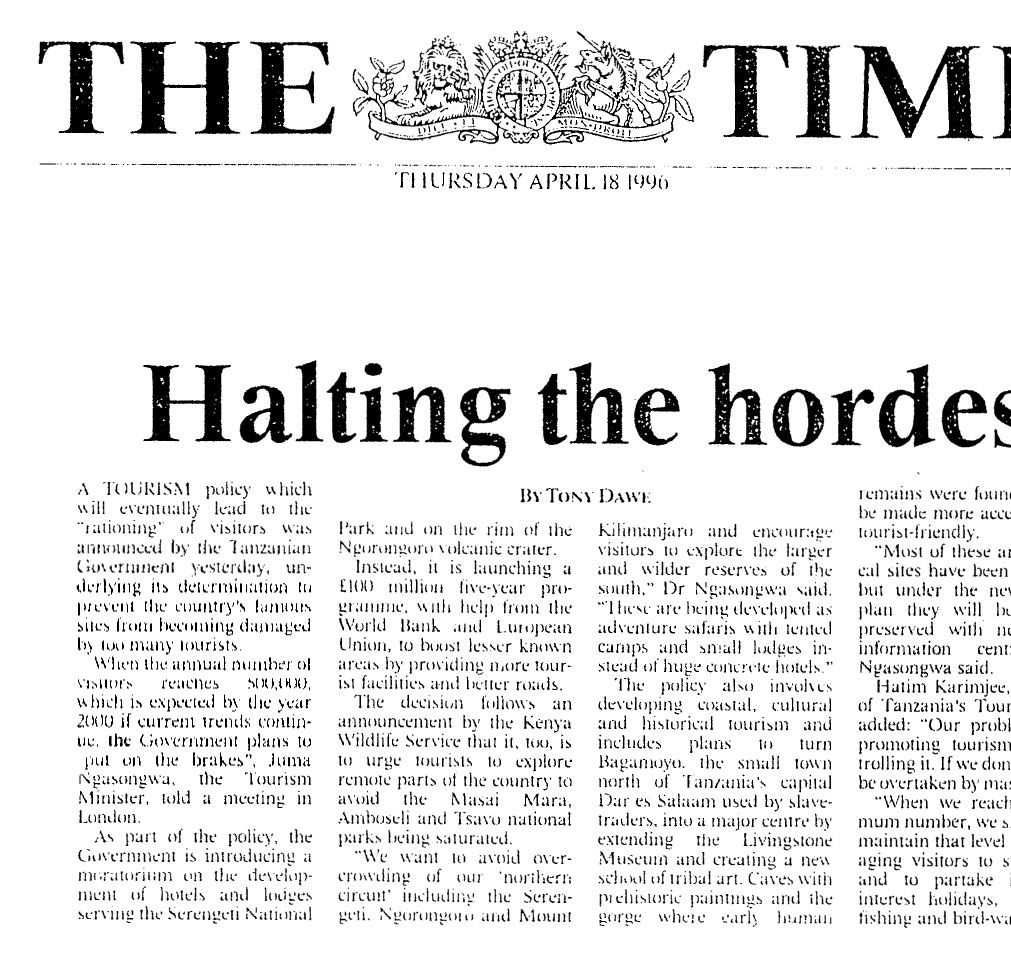
BOLD NEW TOURISM POLICY

Geographical Magazine excerpt

Geographical Magazine excerpt

The Times article on Tanzanian Tourism

The Times article on Tanzanian Tourism

A bold new five-year tourism programme involving investment of over $150 million was launched in Britain, at the Royal Geographic Society, on April 17 by Tanzania’s Minister for Natural Resources and Tourism, Dr. Juma Ngasongwa. The meeting coincided with the publication in the Geographic Magazine (May 1996) of an attractively illustrated 16-page Supplement (Cover photograph by Gary J Strand of ‘Wildlife Explorer’) about Tanzania’s tourist attractions. The next day the London Times publicised the event in an article under the heading ‘Halting the Hordes’ – see above.

RATIONING THE NUMBER OF VISITORS
Tourist numbers, which, ten years ago, totalled only 50,000 and have now reached almost 300,000 are to be increased further up to half a million by the year 2000. However, after the year 2,000, a break will be put on further increase in numbers in a bid to create a ‘quality product’ and avoid overcrowding of parks and reserves and hence damage to the fragile ecosystem.

SCOPE AND FUNDING
Funds for the programme are to come from international donors (following completion of a recent ‘World Bank Tourism Infrastructure Plan’ and a ‘European Union Tourism Master Plant plus private sector investments and Government funds. Features of the plan include new roads, upgrading of seven airstrips, the development of a new ‘Southern Circuit’ (Selous – the largest wildlife reserve in the world – Mikumi, Ruaha, Udzungwa, Katavi and Gombe Stream) by construction of tented camps and small lodges rather than big hotels, special interest holidays such as game fishing in the Pemba Channel and Mafia Island, bird watching in the Usambaras, historical tourism (including extension of the Livingstone Museum in Bagamoyo, a new School of Tribal Art there and greater accessibility to the caves with prehistoric paintings and the gorge where early human remains were found.

But critics at the meeting questioned whether it would be possible to control the numbers, One speaker pointed out that Ngorongoro was already catering for 50 vehicles a day and yet a new Sopa Lodge and new Serena Hotel were being built. In Zanzibar hotel construction had “gone berserk”. At a Britain- Tanzania Society tourism seminar held on March 23 one speaker attacked the whole idea of Third World tourism – it led to neo-colonialism, local people did not benefit enough, it destroyed the natural environment, led to prostitution etc. Dr. Ngasongwa, at the Royal Geographic Society, admitted that, as a result of inviting the private sector to develop tourism, there had been overdevelopment but stated that the government was now introducing a moratorium on the development of hotels and lodges serving the Serengeti National Park and the Ngorongoro crater and that all future developments would be subject to environmental impact surveys. Tanzania had learnt by its mistakes. Tanzania Tourist Board Chairman Natim Karimjee added that the main problem he faced was ‘control’. The article went on to say that autonomy would enhance positive management and eliminate the need to depend on governments for subventions.

TANZANIA IN THE INTERNATIONAL MEDIA

THE OBSERVERS IN TANZANIA
Joanna Lewis writing in AFRICA ANALYSIS (January 29) about the UN observers in Tanzania’s recent elections analysed what she described as ‘this under-funded and poorly-managed UN operation …. Could 200 observers seriously be expected to break the historical links between the ruling party and the state?’. There could be no greater symbol of the contradictions and confusions surrounding the continuous donor policy of democratisation of Africa, she wrote, than the international community’s involvement in the Tanzanian elections. They had left in their wake a ‘trail of tension and cynicism1. The UN monitoring had been a ‘charade8. The writer felt that donors might now be about to cool their passion for multi-partyism and quoted a joke made by Mwalimu Nyerere to a British Conservative MP who was an observer on election day – that there was more than one way to maintain a one-party state. The writer said that Mwalimu now had another – to make sure that you had UN observers at your multi-party elections!

NOT ON THE SYLLABUS
‘This sort of activity is not exactly on the syllabus at the Sokoine University of Agriculture’s Veterinary Faculty’ wrote Margaret Cooper in the September 1995 issue of VETERINARY PRACTICE but, she reported, not long ago four intrepid Tanzanian veterinary students and an English medical student risked all to rescue some tortoises and terrapins from a very hungry crocodile and then helped to translocate the crocodile to the Mikumi National Park. The rescue arose from a request by the Ministry of Natural Resources to deal with a collection of reptiles at an ~frican National Congress (ANC) camp which was to close imminently. Several visits were made to the camp to assess the collection which comprised a dozen tortoises, two leopard tortoises (Testudo pardalis) and ten Bell’s hingeback tortoises (Kinixys belliana) plus about ten terrapins and a Nile crocodile. …. some tortoises had been mutilated by the crocodile and the shells were repaired with car body filler or with putty …..

PRAISE FOR PRESIDENT MKAPA
‘Mkapa is on the right track’ according to a recent editorial in Ugandars NEW VISION at the time when the President was bringing together the quarrelling leaders of Kenya and Uganda at the beginning of the year. The editorial went on: ‘Everyone in East Africa has very high hopes of President Mkapa because of his idealistic and untarnished image. He is right to lay such emphasis on regional cooperation because it is undoubtedly the key to the survival and growth of the African continent. We wish President Mkapa every success in his endeavours’ (Thank you Margaret Snyder for sending this news item from Uganda – Editor).

HALVING HIV TRANSMISSION
HIV transmission could be almost halved if other sexually transmitted diseases (STD’s) were treated effectively according to research conducted by British and Tanzanian researchers in Mwanza and reported in the December 1995 issue of NEW AFRICAN. More than 12,000 people were recruited for the study which used high doses of cheaper drugs like Septin to treat the STD’s, two-day courses of which cost only $0.79 each. Professor David Mabey of the London School of Hygiene and Tropical Medicine said that they calculated the total cost of treating every STD patient could be brought down to as little as $2 million using these new methods

MANDRAX TABLETS
The TIMES OF SWAZILAND (December 19) reported that a Tanzanian national had been arrested at the Swaziland – Mozambique border post at Lomahasha carrying 169 Mandrax tablets worth hundreds of thousands of Emalangeni (Swazi currency). This was the only border post where there were sniffer dogs trained to detect drugs.

DIVERSIFICATION
Forty-five years ago The Tanganyika Wattle Company (TANWAT) established a sustainable forestry business near Njombe for the extraction of tannin from the bark of the wattle tree (Acacia mearnsis) which is used for tanning leather. But, as the December 1995 issue of CDC MAGAZINE reported, the demand for tannin has gradually dropped. Activities were therefore diversified first into arable cropping, then into irrigated tea and in 1995 into a new 2,500 kW power station to use up half of TANWAT’s waste wood. By May 1995 TANWAT was able to begin exporting electricity to Njombe and its environs.

CONTRASTS
Some striking contrasts between Britain and Tanzania are revealed in the 1996 WORLD BANK ATLAS:

  Tanzania Britain
Population growth rate %pa 3.1 0.3
Life expectancy at birth (years) 52 76
Births per woman 5.8 1.8
Infant mortaility (per 1000 live births) 84 7
Primary school enrolment (% net) 50 97
GNP per capita US$ (1993) 90 18,050
Average inflatation rate 1985-95 23.4 5.4
Agriculture’s share of GDP 56 2
Energy use per capita kWh 35 3,718
Water use per capita 1970-94 (cubic m) 35 205

STREET CHILDREN IN MWANZA
‘There are two groups of street children; the ones on the street who usually keep family ties and the children of the street who often get involved in anti-social activities’ – so wrote Sister Teresa, a Malawian Missionary Sister of our Lady of Africa in the April-May 1996 issue of WHITE FATHERS – WHITE SISTERS. She went on to explain how she got to know them. ‘When I found them playing cards outside Mwanza Hotel or in the market I joined them; I sat down with the bigger boys while they were smoking ‘bhang’ (marijuana) or drinking ‘gongo’ (alcohol); I have been in bars at night and found some of the young girls getting drunk.. . . .some of the boys come to our house for knotting, card making, watching videos….some of them go to sleep, because for once they can lie down without being harassed by the police or the ‘Sungusungu’ (traditional defence groups). Building relationships with the street girls is not that easy …. they want a quick way of getting money.. . .The streets of Mwanza are for me like pages of Scripture from the living context of life. It is like a sacred ground where I meet Christ in different forms. He calls me to live more closely with him and with his favourite ones, the poor, the street children and to know him more intimately through real live relationships with them’.

SNIFFER DOGS
The JOHANNESBURG STAR (January 6) reported that proposals have been made for a group of Tanzanian and other police officers to be trained in South Africa and then return home with Labrador and German sniffer dogs to assist in the fight against drug smuggling.

ANOTHER AWARD FOR NYERERE
The TIMES OF SWAZILAND (December 29, 1995) was one of many papers to publish the news that Mwalimu Nyerere had been awarded the first International à and hi Peace Prize for ‘bringing about social, economic and political transformation through non-violence1. The award, which carries a citation and a $300,000 prize, was created in 1994 to mark the 125th anniversary of the birth of the Indian independence hero
Mahatma Gandhi.

NEW VISA RESTRICTIONS
THE AFRICAN (Edition 3, March 1996) which describes itself
as ‘Europe’s Most Informed Black Magazine’ and addresses itself particularly to the refugee and exile African community, has reported that, in order to stem the increasing number of bogus Tanzanian asylum seekers arriving in Britain, the British Home Office now requires all Tanzanian nationals travelling to Britain to have a visa. The number of asylum seekers, excluding dependants, from Tanzania has risen from 107 in 1994 to 1,250 in 1995. (British people travelling to Tanzania also need a visa. The high cost (f 38) corresponds to the very high cost of the visa needed by Tanzanians coming to the UK- Editor).

WEEVILS ON THE ATTACK
The governments of Tanzania, Uganda and Kenya have agreed plans to launch large numbers of weevils later this year to attack the Water Hyacinth (Eichhornia crassipes) which is clogging up Lake Victoria. The weevils eat the leaves while the larvae chew into stems and crowns. But, according to the NEW SCIENTIST (April 6), experience with the weevils in Papua- New Guinea, indicates that they can take up to ten years to make a significant impact.
TA has also been informed by Mr John Mole of TANNOL HOLDINGS, which is running an international research project on the relationship between Bilharzia-carrying snails and the water hyacinth, of a proposal being made for the hyacinth to be used as cattle fodder at a site 30 minutes from Mwanza.

FIRST IMPRESSIONS
BRITISH OVERSEAS DEVELOPMENT has been reporting on the views of a group of Tanzanian students who visited Britain under the link arrangement between Shambalai School in Lushoto and St. Bedes School in Redhill, Surrey: – ‘Families are very different. In Tanzania the women and the girls do the cooking. Here, even the fathers cook for their children. But people here are so busy they don’t even have time to talk to each other8 – Daniel Herman. – ‘Pluses include the beautiful houses and the food (chips, chicken and beef)’ – Sylvia Denis. – ‘The visit to the car factory was best. Other likes included the air conditioning, the food, TV and British family life. But some of the skirts are too short’ – Hyasinta Lucas.

FIRST MARINE PARK
Recalling the setting up by parliament in April 1995 of Tanzania’s first Marine Park in Mafia island, an article in AFRICA – ENVIRONMENT AND WILDLIFE (November -December 1995) explained that Mafia was one of the most biodiverse spots on the East African coast. With its spectacular coral reefs, seagrass beds, intertidal flats and nearby islets, the park included major breeding and nursery grounds for many marine species. Islanders would continue to live in the park but most of the area would be a ‘regulated use zone’. The coming year would see the design of World Wildlife community development initiatives and an ecological monitoring system.

THE NEW ARUSHA
From a dusty outpost for early white hunters, Arusha has developed into an international centre demanding appropriate facilities for a population growing in sophistication. It already hosts the Eastern and Southern African Management Centre (ESAMI), the Centre for Integrated Rural Development in Africa (CIRDAFRICA), the Pan-African Postal Union (PAPU) and the Commonwealth Health Secretariat for East Africa. Now it is acquiring the United Nations International Rwanda Tribunal with hundreds of new spenders in the form of lawyers, journalists and investigators and the revived East African Cooperation Secretariat.

Already also the town has three modern casinos, three new entertainment and night spots, more than ten tourist class hotels. New developments expected or just recently opened include the 500-capacity ‘Hotel 77 Maua Nyama Garden’, the multi-million shilling “Mike’s Jointr which straddles the Themi River, the ‘Soweto Garden’, ‘Johnson’s Corner’ which is under construction along Nairobi Road, and the futuristic ‘African Cultural and Heritage Centre’ along Dodoma Road. Arusha has also launched its own FM radio station and a tabloid newspaper – the EAST AFRICAN.

THE LONGEST SURVIVING COOP
This is how the Tabora Beekeepers Cooperative was described in the Spring 1996 issue of QUARTERLY RETURN, the Newsletter of Shared Interest Society Limited, The coop was said to have been started by a Roman Catholic priest in the 19609 and now has 2,500 members. In the rainy season the beekeepers hoist their hives up in the trees. Harvesting can be hazardous but it has been made easier by plastic buckets provided by Traidcraft which buys the honey. The coop has helped in establishing a number of primary schools, a clinic, a bus service and even a social centre where honey wine is sold to make more money.

LITTLE DID THEY KNOW?
AFRICA TODAY (March/April 1966) reported that immigration officers barred 27-year-old Tanzanian Abdul-kader Shareef from Britain, apparently because they found a letter on him asking a friend in London to help him get a job. Twenty nine years later, Dr. Shareef was given VIP treatment on his return to take up his appointment to the Court of St. James as his country’s new High Commissioner in the UK.

SHOWING THE THIGH
A GEMINI feature published in an number of newspapers including the Barbados SUNDAY ADVOCATE described the controversy which had arisen following the recent Miss Tanzania contest. The winner who had worn a swimsuit at the contest had subsequently been expelled from her secondary school following protests from traditionalists to the effect that it was immoral for a father to see the thighs of his daughter, that White people were bringing an obscene culture into Tanzania, that the body was ‘God’s house’ and that it was sinful to turn it into a commodity. Others countered by saying that many traditional dances were performed with bare breasts, that no one complained about the wearing of swimming costumes for swimming, that boys exposed their thighs in boxing and why shouldn’t girls be treated the same. The Headmaster of the girl’s school said that the girl had been expelled because she had played truant in order to take part in the contest. Taking up the story NEW AFRICAN (February) reported that the lady in question, 19-year old Emily Adolf Kailio, went on to take part in the Miss World Competition in Sun City (some call it Sin City) in South Africa but did not get into the finals.

MITIGATING THE EFFECTS OF MERCURY IN GOLD MINING
About 40% of the gold mined in Tanzania is recovered through a process using highly poisonous mercury. Small scale miners have been evaporating into air tons of mercury. The Tanzanian environmental magazine AGENDA in a recent issue reported that Dr. G Njau of the National Industrial Research Development Organisation (TIRDO) assisted by Mr A Itika, Mr L Rweyemamu and Prof. C Migiro of the Institute of Production Innovation (IPI) have designed, fabricated and tested a retort to recover mercury. It has air-cooled condensers, weighs only 2.4 kgs and is capable of recovering 99.6% of the mercury used during amalgamation with gold. These scientists, who were joint recipients of the 1995 ‘Tanzania Award for Scientific and Technical Achievement’ (TASTA), are looking for an entrepreneur to produce the retorts on a commercial basis.

USING LOCAL MATERIALS
‘I got through about 800 trees, 50kg of nails and a crate of beer a week.. .We used local materials – bamboo andeucalyptus trees and I salvaged cast-iron pipes from a disused tin mine as culverts … with these very simple materials we built food distribution and registration centres and emergency shelter’. This was the way in which Ms Jo da Silva of RedR (Registered Engineers for Disaster Relief) vividly described in the December 23/24 1995 issue of THE STRUCTURAL ENGINEER how she had arrived in Tanzania at ten days notice to help tens of thousands of refugees from Rwanda who had themselves arrived suddenly in Tanzania in April 1994. Warehouses had been imported from Norway – they required ‘creative thinking’ when some parts were found to be missing.. . (Thank you Roy Galbraith for sending this item – Editor).

SOAP OPERAS
Although the first Tanzanian soap opera began only in April last year Tanzanians are lapping up the increasing numbers of soap operas with the same enthusiasm as everywhere else according to NEW AFRICAN (February). The man who is doing everything from editing the scripts to shooting the film is Sayed Mehboob or MEB as he is better known – the editing supervisor of Dar es Salaam TV. And one of the main reasons for the success of the programmes is that they are in Swahili. Most people have difficulty in following imported soaps. Kipigo cha Mke (Wife beating) is about an old Casanova who picks up beautiful young girls; Mtoto wa kufika (The stepchild) is about an overworked and frequently reprimanded stepchild called Siyawezi; Husada Mbaya (Jealousy is bad) features a student about to leave for Europe.

‘THE GREENEST AND COOLEST SPOT IN DAR ES SALAAM’
This is how TANTRAVEL – Tanzania’s Travel and Leisure Magazine – described recently the Dar es Salaam Botanical Gardens and National Museum. The gardens were established as experimental gardens by the German colonial administration in 1893 and originally stretched from the present built-over plots around the fifth hole of the Gymkhana Club Golf Course through the Ocean Road Hospital grounds and the area surrounding the present State House. In July 1914 a mammoth Trade Fair and Agricultural Show was held in the gardens but during the First World War some 140 species of plants and shrubs were destroyed to facilitate the digging of trenches. In 1941 a museum was opened as a memorial to King George V who had died in 1936.

RAILWAYS IN TROUBLE
In an article headed ‘Southern African Railways in Trouble’ NEW AFRICAN (February) paints a sombre picture of inefficiency and increasing losses of business to road hauliers. ‘At the beginning of 1995’ the report says ‘TAZARA announced far reaching measures aimed at commercialising operations in order to compete in the changed market. But, because it is owned by three countries – Tanzania, Zambia and China – it is refusing attempts to sell it as an independent railway company to foreign investors. (Continued on page 24)

THE CHANGED REMMY ONGALA

The popular Zairean singer Dr. Remmy or Sauti ya Mnyonga (Voice of the poor) who has made his home in Tanzania, has changed, according to the January issue of NEW AFRICAN. He used to sing about government corruption and inefficiency and praised opposition leader Augustine Mrema. Then, after a spell in Britain, where he performed with a bare torso wrapped in nothing but an animal skin, he returned to Tanzania and started playing his music at CCM election rallies wearing three-piece suits. He backed Benjamin Mkapa in the presidential race. ‘The hippy turned square; the maverick became respectable’. Some people were said to believe that the change was linked to his fear of being deported as he had overstayed his residence permit in Tanzania.

TANZANIA IN THE INTERNATIONAL MEDIA

THE ELECTIONS

Tanzania’s elections did not have a good press internationally. ‘Tanzania Polls in Chaos’ trumpeted the London TIMES (October 31). ‘An organised botch’, ‘a complete farce’ were amongst the words used by AFRICA ANALYSIS (November 3) which stated that the UN observers suffered from an impossible mandate. They had been told by the UN in New York that ‘no statements should be made by any staff in the name of the United Nations’.

The German newspaper ZEIT (November 3) described the Zanzibar election as a bizarre prelude to the mainland elections …. Mrema did not have a chance against criminal manipulations …’ Africa had looked with high expectations towards Tanzania …. everyone hoped for a victory for democracy (but) those in power knew how to prevent this. Once again’. Under the heading ‘Chaos Spreads in Tanzania’s First Election’ the FINANCIAL TIMES (October 31) wrote ‘Tanzania’s first attempt at multi-party democracy teetered on the verge of collapse yesterday undermined by administrative incompetence and the logistics of organising a poll in East Africa’s largest country ….. the latest confusion has added to a growing mood of cynicism in Dar es Salaam’. The DAILY TELEGRAPH headline read ‘Tanzania Poll Ends in Chaos Amid Rigging Claims’.

The WASHINGTON POST (November 4) wrote that ‘Disorganisation and confusion appeared to taint Sunday’s election early on as polling stations around the country opened several hours late. Professor Ibrahim Lipumba was quoted as saying that the elections were a a national shame. WEST AFRICA (November 3-19) under the heading ‘Democratic Stalemate’ quoted observers as wondering whether Tanzania would go the same way as other states in Africa and be a case of endless political instability.

In a more detailed analysis The FINANCIAL TIMES quoted Professor Mukandala, head of a local monitoring group as saying that “in a close contest the CCM will not relinquish power. … I don’t think there is anybody out there who believes these elections were free and fairw. The article went on ‘If CCM was ready to bend the rules, international observers … did little to thwart it. They prematurely ruled the Zanzibar stage free and fair and failed adequately to monitor the count….most observers overran their budget and had to leave, work unfinished. And as what many diplomats privately called a debacle emerged, the UN first kept silent and then issued a bland statement recommending the authorities to correct anomalies’.

AN IRONY OF HISTORY
On a related matter AFRICAN BUSINESS (October) pointed out an extraordinary irony of history. The veteran politician and writer Abdulrahman Babu was originally chosen by Augustine Mrema as his Vice-Presidential running mate in the recent elections but resigned when his candidature was questioned by the National Electoral Commission (NEC). His replacement was Sultan Ahmed Sultan whose grandfather, Sultan Ahmed al Mugheiry, was stabbed to death in the 1950’s for collaborating with the British colonial administration. His assassin, Mohammed Humud, was sentenced to life imprisonment but was released immediately after the Zanzibar revolution on January 12 1964. But later that year he was detained without trial and executed by the then Zanzibar President Karume. On April 7, 1972 Karume was assassinated by Lt. Humud Mohammed Humud, a son of Mohammed Humud. Although it was obviously a case of revenge, the authorities said that it was part of a plot, led by Babu, to oust Karume’s government. Babu was subsequently detained on the mainland in solitary confinement for six years and was also tried in Zanzibar, in absentia, for treason. It was this that led the NEC to say that he was not qualified to run for high office! (Thank you Oliver Stegen, Andrew Gaisford, Paul Marchant, Jim Read and others for the above items – Editor).

IN DEFENCE OF THE WATER HYACINTH
Anne Outwater defended the much-maligned Water Hyacinth (Eichhornia crassipes) which is spreading alarmingly in Lake Victoria in an article in the EAST AFRICAN (November 13). ‘Who is cleaning the outflow from Lake cities such as Mwanza and Bukoba she asked. Who removed the stench after all those bodies floated down from the Kagera River last year after the Rwanda genocide? Water hyacinths are very good at sucking up nutrients from water. They are strongest when the water has been dirtied with organic waste. After the hyacinths have done their work water runs clear and clean. It would be difficult to find a cheaper way of cleaning up the sewage going into the Lake……

0 J SIMPSON
NEW AFRICAN (December) asked people around the world for their comments on the 0 J Simpson murder trial verdict. From Tanzania, Finnegan Sibeye was quoted as saying that it was a ‘white planned legal trap’. Faranji Dumila said that White Americans are resentful about the rise of blacks.. .it is all about economic disparities ….Gregory Macha said ‘There is a growing tendency to criminalise the blacks especially those who excel in arts, sports or music ….’

BEIJING
Tanzania’s former High Commissioner in India, Gertrude Mongella, who was the Secretary-General of the 12-day UN Fourth World Conference on Women in Beijing, has received praise for her efficient management of the conference in many organs of the press. The TIMES (September 5) quoted her as declaring, amidst wild applause and ululation that women were no longer “guests on this planet. This planet belongs to them too. A revolution has begun – there is no going back’.

FLYING FOR LIFE
Under this heading the November issue of MAF (MISSION AVIATION FELLOWSHIP NEWS) described how 735 kgs of bibles, enough to fill three Landrovers, were flown recently by the only aircraft available to take the load (after removal of seats) – their Cessna 402 from Dodoma to Tabora for refuelling and then to Mpanda. From there the bibles were taken to be distributed by bible society workers to Burundi and Rwanda refugees in camps in the area. The bibles are expected to make life more tolerable for many refugees who had fled and lost their bibles in the dash for freedom. (Thank you Christine Lawrence for these two items of news – Editor).

GARDEN OF EDEN
Describing Tanzania as a Garden of Eden Father Peter Smith in the August-September issue of WHITE FATHERS – WHITE SISTERS wrote about Julius Nyerere as follows: ‘For inspiration he drew on the fellowship of the Acts of the Apostles, the brotherhood of the Qur’anic umma as well as the kibbutz of Israel and the communes of China. He provided a vision for Tanzanians and Africans rooted in their culture (so that they could) hold their heads as high as anyone in the family of mankind’.

He recalled that The Holy Ghost fathers came to the coast in 1868 and the White Fathers came ten years later. 99% of the White Fathers have passed through the 130-year old Atinan House (named after a Malian Doctor-Catechist), one of the first six permanent buildings in Dar es Salaam and, in the beginning, the mainland ‘seraglio’ of the Sultan of Zanzibar. One of a number of tables accompanying the article gives the religious adherence of Tanzanians:
Catholics 3,959,000
Total Christians 7,943,000
Muslims 5,866,900
Other faiths 4,178,000

ZANZIBAR BOOM
Michela Wrong writing in the FINANCIAL TIMES (October 20) said that after decades of grinding poverty, prosperity once again beckons for the legendary spice islands … that prospect, as much as the resentment generated by years of suppressed national identity, threatens to sabotage the 31-year Union. Undermining the debate is the islands’ extraordinary transformation since Tanzania turned its back on Julius Nyerere’s disastrous economic policies. … Encouraged by tax incentives, Italian, South African and other investors have poured into the tourism sector, which has now replaced the clove industry as the main source of foreign exchange. Decaying Arab palaces are being turned into five-star lodgings to steal trade from the dreary Soviet-style government hotels. Chic galleries selling designer wear now compete with T-shirt shops for backpackers. Tourist numbers, hardly 30,000 five years ago should touch 100,000 this year. In 1990 economic growth was minus 3%. now it is 4.5%…..

MIGRATION FROM TANZANIA
The corncrake, Britain’s only globally-endangered bird species, is being rescued by a Scottish bird preservation society. A spokesman for the society told the BBC’s RADIO 4 that the corncrake was once fairly common throughout Britain but in recent decades has existed only in declining numbers in Scotland. The bird migrates annually from Tanzania. The society is spending £300,000 annually to persuade Scottish farmers to adapt their methods of silage production so as to encourage the corncrake’s breeding habits (Thank you David Somers for this item – Editor)

83-YEAR OLD CLIMBS KILIMANJARO

“Something happened to me on Kilimanjaro. Something great, something sublime. Something different to anything I had experienced on other high mountains. I stopped 1,000m before the peak, 5,500m above sea level. Should I have tried to press on? The hardships can be overcome. But there are many: altitude sickness, fatigue, nausea, severe headache, diarrhoea, breathlessness, palpitations, vomiting, loss of appetite, severe cold, frostbite and even hallucinations …… (On the mountain) I was quite exhilarated; it seemed as though there were no problems for the old man.. .many others in the group had given up and descended.. .and then, near the top I began to feel uncomfortable; it was far too hot…and then it dawned on me what was wrong. I had too little water. The person who had kindly offered to carry the rest of my supply had gone far ahead. I dared not proceed. I was not going to be carried off the mountain. Never. But still I was overpowered. I experienced that wonderful rare feeling of joy.. “ -Schalk Theron writing in the JOHANNESBURG STAR INTERNATIONAL (August 24-30).

CROWD CONTROL

Tanzania is to limit the number of visitors to its national parks for the first time to reduce pressure on the animals and their ecosystems. According to the SUNDAY TELEGRAPH (October 21) officials are worried that the country’s 12 parks and other conservation areas could become as crowded as those in Kenya.

So far three parks have declared new limits on the number of tourist beds and vehicles allowed. Serengeti will not exceed the 1,200 beds it has now and will allow in only two vehicles for each pride of lions in the park. The smaller Tarangire National Park has a maximum of 287 ‘fixed’’ beds and one vehicle per two kilometres of road. In the Ngorongoro Conservation area the limit has been set at five lodges offering 422 beds.

Prices are rising too. Foreigners are now charged £12.50 to enter any of the national parks and £12.50 per 24 hours thereafter. Vehicles are charged £6.25 a day. Campers pay £12- £25 a night and rooms in lodges cost £30-£90 (Thank you Donald Wright for this item – Editor).

THE CHARGE
‘We had met the beast before. An old bull elephant, the rims of his ears ragged and torn; his left tusk broken off. He trotted towards us, stopped and glared and then charged. It was a massive piece of body language. But, still some distance away, he came to a halt and trumpeted defiantly. He decided that he had made his point. So began an article by Sean Hignett in the WEEKEND TELEGRAPH (August 19) describing a visit to the Serengeti National Park.

TANZANIA IN THE INTERNATIONAL MEDIA

LEANER AND MEANER
Faced with increasing competition from railways running to South African and, shortly, Angolan ports the Tanzania-Zambia (TAZARA) railway plans to become leaner and meaner, wrote Adam Lusekelo in the BBC’S FOCUS ON AFRICA (July-Sept.). Freight volume has gone down from more than a million metric tonnes in 1992/93 to 642,270 metric tonnes last year. Some 2,500 out of 6,600 jobs will be axed; entire directorates have been merged or scrapped outright. Regional General Manager Hamisi Tegissa was quoted as saying that, from now on, TAZARA will have to do business or it will sink.

COUNTRY FILE TANZANIA
The May issue of BRITISH OVERSEAS DEVELOPMENT contained a four-page ‘Country File’ on Tanzania suitable for the British National Curriculum Geography key stages three and four. There were short articles on roads, railways, cashew nuts, cloves, family life, health and the elections. Tanzania was said to be four times the size of Britain but with half the population.

SAVING THE MARRIAGE
The SUN in huge front page headlines has been following the fortunes of Tanzanian-born Mukhtar Mohidin with intense interest since he won £18 million on the British National Lottery and thus changed his life for ever. In the issue dated May 13 his wife was said to be insisting on a written agreement from her husband spelling out her share of the massive win. In another issue (May 12) the SUN reported that at a reunion for relatives there was such an angry squabble about who was entitled to a share of the money that the Thames Valley Police had to be brought in and detained two men until they had calmed down.

WILL THE FRAGILE UNION SURVIVE?
This was the question posed by the glossy Kenya publication THE OPTION – THE MAGAZINE FOR PRINCIPLED LEADERSHIP (April 1995). The article traced the history of the Union and gave reasons why it was ‘under question as politicians square up to multi-party elections’. Calls for Zanzibari autonomy could be a popular electoral card for mainland and island po1iticians …. ‘the decision to move the administrative capital from Dar es Salaam to Dodoma had only alienated the island … ‘

A DAZZLING PICTURE SHOW
‘At the soon-to-be-gazetted Mafia Island Marine Park I went diving on the most incredible reefs I have ever seen, an adventure, a dazzling picture show and a science lesson all rolled into one’. So wrote Anne Outwater in the EAST AFRICAN (May 15-21) who went on to say that she had also never seen bommies before. They are big pieces of Proties coral that long ago fastened themselves on to something like a clam shell in the sand and then grew, sometimes to a height of 12 feet and a width of 8 feet. ‘Other corals are then able to fasten themselves and grow. Thus an entire community is formed …. ‘

FIRST AFRICAN PILOT
The first African South African Air Force jet pilot to go solo, Captain Tsoku Khuma10, celebrated his historic feat in time-honoured style by being dunked by his colleagues in a mud bath. Khuma10 spent nine years out of South Africa with Umkhonto we Sizwe after training in Angola. He completed the first part of his education in Tanzania – JOHANNESBURG STAR

LAKE VICTORIA: A SICK GIANT
Under this heading PEOPLE AND THE PLANET (Vol. 2 No 4) recalled that Lake victoria was ‘discovered’ in 1858 by John Speke, after months of braving dense forests and tropical diseases in his search for the source of the Nile. But now, the illustrated article by Nancy Chege goes on, ‘The once clear life-filled lake is now murky, smelly and choking with algae … for decades, ecologists have travelled to Lake Victoria to study cichlids, small indigenous bony fish which made up 80% of the biomass composition of the Lake. Some 400 species had evolved from five species of ancestors, making Lake victoria one of the most species-diverse lakes in the world. But now there are only 200 species thanks to the depredations of the Nile Perch which has jumped in 15 years to 80% of fish weight in the Lake … one specialist has described this as the greatest vertebrate mass extinction in recorded history. But the Nile Perch has become a money spinner and is being exported all over the world.

“WE HAVEN’T LOST IT, WE JUST DON’T KNOW WHERE IT IS”
So said a spokesman for London Zoo quoted in the DAILY TELEGRAPH (August 8) describing the dash for freedom of a rare African female bush baby – the first to have been kept in captivity in Britain – which had been brought to London in February from a Tanzanian forest. The three-inch tall creature leapt out of its metal cage and slipped through a crack in its open door. Keepers armed with nets and torches had spent 11 days crawling behind the pen in an effort to find it.

“WE ARE IN BURUNDIAN WATERS NOW”

JOHANNESBURG STAR writer Duncan Guy, out in a canoe with Tanzanian fishermen on Lake Tanganyika in the middle of the night, gulped when he heard the news. “We all (Tanzanian and Burundian fishermen) fish where the catches are best …. ” he was told … “sometimes we go so far that we have to stay in Burundi during the day. And the Burundians come down to our village if that’s where the fish are”. The writer described how the boats and their attachments creek in the gentle swell and just below the surface the fish shine like silver as they enter the light from hurricane lamps in the canoes …..

A MAJOR SUCCESS STORY
In an article on tuberculosis in a recent issue of NEW AFRICA it was stated that, besides China and New York, Tanzania’s anti-tuberculosis campaign was the major success story on WHO’s books. It was estimated that 80% of all TB cases in Tanzania had been found, 90% had been treated and 80% of the infectious cases had been cured. But TB was still the second most important killer in Dar es Salaam.

LEGACY OF THE GREATEST WHITE HUNTER

Frederick Courtney Selous (born 1851) was the subject of an illustrated article in the JOHANNESBURG STAR INTERNATIONAL (July 20). Why was the Selous Game Reserve so special it asked; it was expensive, inaccessible and only modestly promoted. The answer was probably the legend surrounding the area and the mystique of the man whose name it bore …. the greatest white hunter of them all. As a boy he idolised his hero David Livingstone. For 20 years he was hunter (he shot 31 lions), safari guide, skin exporter, gold prospector, ostrich farmer, naturalist, ornithologist. He fought in the war against the Germans in Tanganyika and was killed by a bullet to the head on January 4, 1917 and was buried by his men in a modest grave in what was later to become the Selous Game Reserve.

PUBLISHING PROBLEMS
The AFRICAN PUBLISHING REVIEW discussed in its May/June 1995 issue problems of book publishing in several countries including Tanzania. The biggest constraint on marketing and distribution of books was the absence of sales outlets; of the 104 districts in Tanzania 85 do not have bookshops as a result of the government’s old policy of the confinement of sale of educational books to Tanzania Elimu supplies and the free education policy so that parents feel cheated if they have to buy books. (Thank you Pru Watts-Russell for this item – Ed.).

BEWARE!
Peter Fairy writing in the WEEKEND TELEGRAPH (July 22) suggested that Britons visiting Tanzania should beware of two swindles they might encounter if they fly into Kilimanjaro airport. ‘You might be asked to produce a certificate of vaccination against yellow fever although this is only mandatory if you are coming from a country (including Kenya) where the disease is endemic’ he wrote. A woman passenger had been told that she would have to be injected on the spot “although there is another solution”!

The second dodge occurred on departure. ‘When I was bodysearched the security officer found TShs 6,000 (£6.85) in my shirt pocket’ he wrote. “You are not allowed to take Tanzanian money out of the country. You must change it at a bank”. The nearest one was 30 miles away and it was 8 pm. I demanded to see his superior – at which point I was waved through …..

IN THE TOP 75
FIFA published recently its rankings of 175 world football teams. Tanzania has improved its position from 80th in 1993 to 74th in 1994. Brazil was number one with England 18th, Scotland 32nd, Wales 42nd, and Northern Ireland 45th.

But, sadly, as the EAST AFRICAN explained, apart from a late comeback by the national soccer team which grabbed the Challenge Cup Tournament in Nairobi (and the cricketers victory in the East and Central African competition at home) most Tanzanian teams were a flop on the international scene in 1994. Mbwana Matumla was praised for giving Tanzania its only medal (bronze) at the Commonwealth Games in Canada.

EXCITEMENT AND JOY
The London TIMES published a letter from Mr Jack Storer who had been in Dar es Salaam reviewing the work of the Tanzania Institute of Bankers at the time when a consignment of 1,100 textbooks funded by ODA arrived. ‘I shall long remember’ he wrote, ‘the excitement and joy of the librarian and her colleagues …. before I left two weeks later more than 100 members of the Institute had been in to borrow books’. Mr Storer praised the superb job being done by the British Council in Dar es Salaam and its ‘always busy’ library. (Thank you Christine Lawrence for this item – Ed.)

TANZANIA IN THE INTERNATIONAL MEDIA

THE MOST IMPORTANT INDIGENOUS INITIATIVE SINCE INDEPENDENCE
This is how AFRICAN BUSINESS (March 1995) grandiosely described the setting up of the first truly indigenous bank in Tanzania. The promotion committee of the new bank – the Akiba (‘savings in Swahili) Commercial Bank – has announced that the mobilisation of share capital was proceeding well particularly in Mwanza and Arusha, with some Shs 200 million ($370,000) subscribed so far. Several donor agencies have said that they are willing to provide training, computer equipment and experts during the bank’s initial stages. But the article quotes some observers as questioning the launching of such a major project in the present tough economic climate. To be viable businesses needed to operate at an average 50% profit because of the high inflation rate. Most local banks had not started full-scale lending and were making their money mostly from commissions, opening of letters of credit, financing foreign trade and operating forex businesses.

THE ANSWER TO THE 20TH CENTURY’S BIGGEST ENVIRONMENTAL PROBLEM
‘Next time you are in a public institution or business in Tanzania take a look in the car park or around the back of the building’ advised ‘Green Bullet’ writing in the November 1994/January 1995 issue of the Dar es Salaam environmental magazine AGENDA. ‘You will probably see some of the dying or dead population of some 10,000 Landrovers. Usually, the impact of a head-on collision is evident, with a concertina-style bonnet … but the LRMT has now been in operation for over eight years and people still come in with broken down Landrovers, receive a quote for reconditioning, and if they then agree to have the work done, achieve what, two years ago (before the operation ran down it now employs only 25 workers) I hoped would be the answer to the 20th century’s biggest environmental problem a totally recycled motor vehicle’. The writer went on to outline the environmental spin-offs of the process – the idea that a car had to be replaced by a new one would be eroded and the monthly influx of reconditioned Far Eastern saloons that have no chance of survival could be reduced.

CHOCOLATE ELEPHANTS A BOOST FOR TANZANIA’S REAL-LIFE ATTRACTIONS
Under this masterpiece of the headline writer’s art BRITISH OVERSEAS DEVELOPMENT (January) described a partnership between the Cote d’Or Chocolate Company (the ones with the elephant on the wrapper) and Britain’s ODA , to support the Ruaha National Park. Britain has allocated £1 million to the reserve, which is a home to leopards – rarely seen elsewhere – and more elephants than any other park in Tanzania. Numbers of elephants are now increasing and over 300 species of birds have been identified.

AND IN THE SELOUS NATIONAL PARK
‘I woke with a start to a tremendous crashing and ripping sound … Lifting the tent flap I could dimly make out a huge shape bearing down on me. The intruder edged nearer and stopped inches away from my face, breathing heavily. Immobilised, I waited for the beast to charge, trample all over me, or, at the very least, trip over a guy rope and bring the tent down. But the elephant was much more interested in the palm trees outside as he tried to pull down massive fronds laden with fruit …. Next morning it was explained to us that the new Mbuyuni site in the Selous Game Reserve had been pitched among the palms to get maximum shade. The manager explained – “Elephants have been coming here for years to feed. They are not going to be put off by a few tents” – Jill Sherman, The TIMES WEEKEND of January 25.

GAME HUNTING CONTINUES
About 200 Britons a year visit Africa to hunt game said the TIMES WEEKEND (January 21) and Tanzania is one of the hottest destinations because four of the big five animals can be hunted. But Tanzanian costs are the highest because of government levies. Prices range from around £700 to £1,300 per day. Some hunters spend £70,000 a head for a 28-day safari.

Issue No 9 of the publication MSITU (Press Cuttings on Environmental Issues In Tanzania, P 0 Box 840, Dodoma) featured on its front page attacks on the hunting policy of Minister for Tourism, Natural Resources and Environment Juma Omar. The MP for Monduli was quoted as saying that he had personally seen game that had been killed being loaded into two military aircraft from the United Arab Emirates and asked the Minister to explain what the 60-strong UAE party were doing in the country. MP for Mbulu Philip Marmo, who has since become Minister of Information and Broadcasting, wanted to know why too many hunting licenses were being issued. Parliament set up select Parliamentary Probe Committee.

Other press cuttings in this very informative publication featured the Mafia Marine Park, tree felling, charcoal burning, the Mkomazi Game Reserve, the Pangani Darn Project and the melting snow of Kilimanjaro.

A QUESTION OF NATIONALITY
Another angle to hunting was the report in the KENYA WEEKLY NEWS (December 23) which explained how so-called white hunters had allowed the killing of three of Kenya’s best known, almost 50-year-old bull elephants, which had crossed the border into Tanzania from the Amboseli National Park. There then followed a dispute as to the nationality of the elephants Tanzania insisting that they were not Kenyan. Dr. Cynthia Moss who has been studying pachyderms for many years was categorical that they were Kenyan and gave them names – M10, Sleepy and RBG.

The London TIMES took up the story and protests flowed in. The Times identified three alleged German, Zimbabwean and American hunters as being guilty. The head of Tanzania’s Wildlife Department Mr Mohidin Ndolanga subsequently reassured his Kenya opposite number that such hunting would be banned in future. (Thank you Christine Lawrence, Ian Leggett, John Sankeyand J de Graaf for the above wildlife items – Editor).

THE CHALLENGE TO TRADITIONAL LIFE
OVERSEAS, the journal of the Overseas League in London I featured Tanzania prominently in its March-May issue. writing on the challenge to traditional life I Danford Mpumwila, who grew up among the Benas in Southern Tanzania, described how confusion now reigned as new values and new social norms emerged among the tribe. ‘Traditional dances which used to be part and parcel of funerals f births, marriages and harvests have been repackaged and are now performed in modern halls for a fee; newspaper adverts for medicine men and healers are placed side by side with those for church services; entertainment halls alternate amplified western music with tribal dances; portable telephones are sold across the road from spears and shields; goats and cattle occupy the same streets as the latest Mercedes Benzes and BMW’s …

An article on the history of the TAZARA Railway by E J Kisanga reminded us how it was on a Sunday morning in March 1970 when the first 1,000 Chinese railway workers disembarked in Dar es Salaam, dressed identically in Mao suits and all carrying the same standard suitcases. ‘The workers left a lasting impression; in contrast to other expatriates they lived frugally and self-reliantly, planting vegetables and raising chickens and pigs for food and building their beds from the boxes which had contained the construction materials. At one time they even voted to reduce their salaries by one third to help the Tanzanian economy …. ‘

“WE ARE RELIANT ON THEM” – RWANDAN PRIME MINISTER
The problems of Rwanda (and hence, often the problems of Tanzania also) continue to receive considerable coverage in the media.

In an attack on French policy towards his country Rwandan Prime Minister Faustin Twagiramungu, quoted in THE TIMES (December 26) stated that Rwanda tended towards trade links with East African countries. “We are reliant on Kenya, Uganda and Tanzania … for these countries English is the most useful language”. The article added that many of the Ugandan Tutsis now coming home after 30 years of exile spoke only English and Swahili.

On December 26 THE GUARDIAN had reported that ‘Medecins Sans Frontieres’ had decided to pull out of refugee camps in Tanzania saying that it could no longer support mass murderers and those preparing to fight again.

TANZANIA’S EXASPERATION
As this issue of TA goes to press the DAILY TELEGRAPH (April 12) reported from Ngara that Tanzania was firmly resisting international pressure to accept yet another massive wave of some 50,000 refugees – Hutus from Burundi. ‘They are being greeted with unexpected violence from the neighbour they hoped would take them in’ wrote the paper. Tanzania shut its border with Burundi at the beginning of April, exasperated by the world’s assumption that – with 700,000 refugees already camped there it would continue to welcome the flow of victims. About 1,500 Burundian refugees who succeeded in crossing the border swamps and banana groves were confronted by Tanzanian troops at Mugoma. 300 were said to have been marched back into Burundi and the rest scattered into the bush.

Tanzanian Minister of State for Defence Col. Abdulrahman Kinana had been quoted earlier in the Uganda NEW VISION (April 5) as stating that Tanzania would stick to its rejection of an appeal for it to reopen the border. “We are not going to bow to pressure from anyone” he said. The world was not doing enough to force Rwanda to take back its refugees. As this issue of TA went to press it was reported that thousands of Burundi refugees stranded on the road to Ngara had agreed to return to their refugee camps in Burundi.

CHANGING THE COURSE OF COMMERCIAL AVIATION IN EAST AFRICA
The recent launching by Tanzania, Uganda and South Africa of the new joint airline ‘The Alliance’ has sent shock waves through Kenya Airways according to AFRICAN BUSINESS (March 1995). The move would force Kenya Airways to change both its operations and its policies in order to withstand the competition. Alliance is using the prestigious Boeing 747-SP initially on Johannesburg/London/Dubai/Bombay routes with stopovers in Dar es Salaam and Kampala. South African Airways holds 40% of the shares, Air Tanzania and Uganda Airlines 10% each and most of the remainder are to be subscribed by private investors in Uganda and Tanzania. The HQ is in Kampala. The airline also poses a threat to the Air Tanzania corporation (ATC) according to the article, something underlined by the reluctance of Tanzanian Government aviation officials to comment on the new project. Success would depend very much on the degree of trust between the new partners.

TANZANIA SIXTH LARGEST RECIPIENT
Statistics in the British ODA’s ANNUAL REVIEW FOR 1994 indicate that Tanzania received £23.57 million worth of aid in various forms from Britain in 1994 which made it the sixth largest recipient in sub-Saharan Africa after Uganda (£38.06 million), Zambia (£37.91 million), Mozambique (£29.93 million), Kenya (£28.82 million) and Zimbabwe (£24.56 Million)

‘IT WAS HIM – WORLD PICTURE EXCLUSIVE’
with this massive headline and a wedding photograph covering the entire front page, the NEWS OF THE WORLD (December 18 1994) announced that, after a search lasting several days, it had located the winner of £18 million in Britain’s National Lottery. The winner had tried hard to avoid publicity. He is 42-year-old Mukhtar Mohidin, a factory worker in the North of England, the son of Indian immigrants to Tanzania. He left the country for Britain in 1970 and he and his wife worked very hard for many years to save up to buy a run-down corner shop. ‘Now he can buy a supermarket’ the paper wrote ‘and pay flunkies to run it for him’. The same paper caught up with Mr Mohidin (who had gone into hiding) and filled most of its front page on April 16 with the news that he was going to be sued by his best friend who was claiming half the money; they had apparently agreed to split any winnings.

The SUNDAY TIMES (February 12) reported that Mr Mohidin’s family had been torn apart by bitter infighting.

VACCINATION A CAUSE OF LION DISEASE?
A disease outbreak has culled 250 lions in the South Eastern corner of the Serengeti National Park, about a third of the study population of the Serengeti Lion Project, according to a recent issue of the TROPICAL AGRICULTURE ASSOCIATION NEWSLETTER. The study population is a 25% sample of the estimated 3,000 lions in the park the largest population of big cats in the world. Tests indicate that the lions are dying from canine distemper virus (CDV) or something like it. CDV has infected hyenas in the Serengeti since the 1960’s so why has it now become a problem for lions? One explanation is that, until recently I lions may have gained immunity to CDV by eating wildebeest or cattle which have rinderpest. The eradification of rinderpest amongst cattle through vaccination may have left the lions more vulnerable to CDV. But prospects are fairly good. The Serengeti population is probably large enough to recover even if the epidemic should spread from the south-east corner of the park.

BIGGEST TO DATE
The 1994 World Travel Market in London saw Tanzania’s largest attendance to date according to the January issue of AFRICAN BUSINESS. There were representatives from 15 Tanzanian companies. The Tanzania Tourist Board (TTB) has stated that it is aiming for a high income, low volume tourist approach and is opposed to mass tourism development. More than 75% of Tanzania’s visitors come to see the wildlife. During 1994 there were 200,000 visitors to the country but its ‘carrying capacity’ has been estimated at half a million.

MOVING UP
In a summary of very recent research by the World Bank on adjustment in Africa, FINDINGS (February 1995) states that Tanzania (with Mozambique) has moved up from the category ‘Very Poor Macroeconomic Policy Stance’ to ‘Poor Economic Policy Stance’. The paper states that in almost all African countries real exchange rates remain overvalued, fiscal deficits high and inflation still a problem. Only one country is classified as having an adequate macroeconomic policy stance – The Gambia.

“LET DEMOCRACY EVOLVE. DON’T IMPOSE IT”
In a recent issue of the American publication AFRICA REPORT there were interviews with Robert Mugabe, Sam Nujoma and Julius Nyerere. Nyerere was asked about democracy. He said “The North says we must have a multiplicity of political parties to be democratic ….. this is going to cause a lot of chaos on the African continent … let Africa be given time to develop its own systems of democracy. The people will want democracy. No people will accept oppression. The mechanisms of developing democracy will change as history changes, as the country, the standard of living, the level of education changes. Let democracy evolve. Don’t impose it”.

PETER MANDELSON

The GUARDIAN WEEKEND (February 11) revealed that Mr Peter Mandelson MP, former British Labour Party Leader Neil Kinnock’s media magician and presently a close collaborator of the new leader Tony Blair, (Mandelson is referred to in the article as a ‘Mephistopheles’, a ‘Rasputin’, a ‘Master of Mendacity’, a ‘brilliant strategist’, a ‘rigorous campaigner’) spent one of his younger years in Ngara – sponsored by Bishop Trevor Huddleston, whom he had badgered for help. He worked as a teacher, and, according to the paper, also as an anaesthetist ‘pumping an ether balloon with one hand, while thumbing through Love’s Book of Surgery with the other.

TANZANIA IN THE INTERNATIONAL MEDIA

INVESTMENT
In an 8-page ‘Special Focus on Tanzania’ AFRICAN BUSINESS (September 1984) an optimistic picture was painted of the investment scene in the country. Quoting the Investment Promotion Centre’s chief technical advisor Harish Pant, the article stated that projects approved by the IPC had created over 70,000 jobs. There had been some 229 projects in manufacturing, 93 in tourism, 51 in agriculture and 43 in natural resources. Mining was beginning to boom and the IPC had approved 21 projects for investors from the US, Canada, Australia, South Africa, Japan and Britain.

ASIANS IN TANZANIA
‘Asians are proving to be awkward bedfellows for indigenous Tanzanians. Energetic and utterly business-oriented, with a huge network of contacts, the Tanzanian Asians behave rather like the elite courtesans of 19th -century Britain. They enjoy power without responsibility – much to the chagrin of the wazawa or indigenous Tanzanians who resent what they see as the Asianisation of the local economy’. These were the introductory words of a full-page article in AFRICA ANALYSIS (September 30) which pointed out that the 80,000 Asians represent only 0.3% of Tanzania’s population but control 75% of the business. The article listed the prominent Asian personalities who hold franchises for international brand names – Pepsi-Cola (Girish Chande), Toyota (Hatim Karimjee), Peugeot (Shabir Abji), Freight Forwarders (Hassan Dhalla) but pointed out that, as insurance, most Asians have taken on politically influential indigenous Tanzanian directors. All this was said to be causing some hostility at street level between Africans and Asians and this was often encouraged by the popular Rev. Christopher Mtikila, leader of the unregistered Democratic Party.

The article went on to say that politicians had been blocking Asians from acquiring the many parastatals earmarked for privatisation. A World Bank report was said to have noted that the government prefers to wait for international companies to bid for them. But, the article concluded, while Asians take the flak from all sides they do give the drive to the business engine in Tanzania. Asians claim that their business acumen lifted Tanzania out of the depths into which former President Nyerere had led it and a select core, respected by international agencies, give invaluable advice to government ministries on financial and social matters.

BIRDS AND WILDLIFE
The Royal Society for the Protection of Birds (RSPB) is collaborating with the Wildlife Conservation Society of Tanzania (WCST) to save Tanzania’s coastal forests which have several birds found nowhere else in the world and which are severely threatened. The RSPB’s AUTUMN NEWSLETTER also states that the Society is collaborating on another project in the Uluguru mountains and is helping in the production of the magazine ‘Miombo’.

‘I TALKED TO THE RUSSIANS’
The GUARDIAN’S literary editor Richard Gott, who describes himself as an incorrigible leftist, resigned on December 8th after admitting that he had been in contact with Soviet KGB officers for many years (but he claimed he was not a spy) and had accepted free trips to Vienna, Athens and Nicosia. He was foreign editor of the Tanganyika Standard in the 1970’s and, in a letter to the editor of the Guardian said ‘I had many contacts with both Soviet and eastern bloc diplomats, and, of course, with the leaders of the revolutionary movements of the time, all based in Dar es Salaam’.

TROPHY HUNTING IN THE MKOMAZI GAME RESERVE
A recent decision reported in BBC WILDLIFE (December) that the government is to allow trophy hunting by professional hunters in the 3,234 sq.km Mkomazi Game Reserve (which is a natural extension of Kenya’s Tsavo National Park) has caused consternation amongst ecologists. They complain that a project led by Tony Fitzjohn (who formerly worked with George Adamson in Kenya) for the rehabilitation of the park, which has resulted in a miraculous improvement in conditions there and a gradual build up of animal numbers, will be nullified if hunting is allowed (Thank you Christine Lawrence for this item).

TOO MANY PROJECTS?
In a review of the UNCTAD publication ‘The Least Developed Countries (LDC’s) 1993-1994 Report’ the New York-based AFRICA RECOVERY (April-September 1994) stated that donors could play a crucial role in reconciling adjustment with long-term growth. It urged donor cooperation in making aid more effective by focusing on building LDC capacities in planning and economic management. ‘However’, it went on, ‘donor preference for project over programme aid nearly overwhelms the weak administrative capacity of LDC’s forced to navigate between different donor procedures for numerous projects. Uganda and Tanzania, for example, had some 600 and 1,200 donor-financed projects, respectively, in 1993.

‘GARBAGE GAS’ PLANT
In a pilot project described as unique in Africa, AFRICAN BUSINESS (December) stated that Biogas is to be produced from Dar es Salaam’s garbage and will be used in making fertilisers, fuel for cars and electricity. The plant, to be built at Vingunguti on the southern outskirts of Dar es Salaam will treat waste from households, hotels, markets, breweries and abattoirs at up to 200 tons per day which should produce some 9.9 MW of electricity for sale each day. The project will be partly funded – to the tune of US$4 million – by the Danish Trust Fund of the UNDP.

AMBASSADOR NYAKYI
The GUARDIAN (November 25) reported that former High Commissioner in London Anthony Nyakyi is to be appointed by UN Secretary General Boutros Boutros-Ghali as UN Special Representative in Liberia.

GERMAN AID QUESTIONED
The French publication INDIAN OCEAN NEWSLETTER (September 24) quoted a pessimistic in-depth study by the German Development Institute (GDI) about Germany’s programme of technical cooperation with several countries. The study revealed the ‘absence of a viable and explicitly formulated development strategy’ in Tanzania and stated that the government and donors had been ‘unable to generate any major development impulses’. Development was said to be ‘very largely blocked and aimless’. The study recommended two priorities for reform – training, leading to the setting up of management systems and the promotion of appropriate technology.

MILITARY TRAINING IN NGARA
More than 2,000 Rwandan youths, equipped with 100 guns, and believed to be Hutu extremists are receiving military training at night at the Kasulu refugee camp in Ngara according to a report in the BANGKOK POST (November 19). Ngara District Commissioner Brig. Sylvester Hemed was quoted as saying that there was little that Tanzanian authorities could do about it. The only solution would be to cut back the population at the camps but this would be far too expensive.

BALLOON SAFARIS
Tanzania Serengeti Balloon Safaris Limited, a joint Tanzanian British company, has started business flying two balloons (with a total capacity of 20 people) according to the September issue of AFRICAN BUSINESS. The advantage of flying by balloon, Managing Director Jimmy Mkwawa explained, was that tourists were able to see many animals in a short period of time. It took two days to visit the whole Serengeti Park by car but it took only one hour by balloon.

ANGRY CATHOLIC BISHOPS
Tanzania’s Roman Catholic bishops had stopped, with immediate effect, all cooperation with the Ministry of Health on the issue of provision of condoms to schoolchildren reported NEW AFRICAN in its November issue. The furore had broken out over a National Aids Control Programme Calendar which contained pictures urging people to use condoms. A man is shown in the calendar distributing books on AIDS education to teenagers in school uniforms and a woman is shown dishing out packets of condoms to young men.

A GOLD LINED FUTURE
This was the heading of an article in the November issue of AFRICAN BUSINESS which described how Tanzania’s young Water, Energy and Minerals Minister Lt Col Jakaya Kikwete (since promoted to Minister of Finance) was about to revive Tanzania’s moribund minerals sector. Mining once accounted for 10% of Tanzania’s GDP before plummeting during the socialist years to 0.4% It is currently around 1.5% of GDP. He said that some 20 companies had already begun exploring for nickel gold and diamonds and some 260 prospecting licences have been issued. With the support of the World Bank the government has set up a US$12 million scheme to make some of the country’s 100,000 artisanal miners more efficient. Currently artisanal miners produce around eight tons of gold and US$ 4 million worth of gemstones.

REACTIONS TO LIFE IN BRITAIN
A paper entitled KARIBU TANZANIA, KARIBU SANA, the final report of a visit to Tanzania in September/October 1994 by Julian Marcus of ‘Education Partners Overseas’ contained the reactions of a group of students from the Moshi Technical High School when they visited their link institution in Huddersfield, England. The students were impressed by the technology, surprised by the rudeness of MP’s at Westminster, found the English at work and on public transport very reserved but hospitable at home, did not experience any racism but felt that there was tension between whites and Asians, were disturbed by a visit to Toxteth and didn’t feel comfortable about the attitude of black English people to them. They were initially embarrassed by the perceived equal roles of the sexes and critical of indiscipline witnessed in schools (not acceptable in Tanzania they said.) A teacher from another school also commented on lack of discipline but, nevertheless, when he returned to Tanzania, he tried to abolish caning in his school. He reversed this policy change after very adverse reaction from parents and teachers.

SEEING THE BUSH ON FOOT
In an article in the FINANCIAL TIMES (September 24), Michael J Woods referred to a sound he had heard sitting on a high river bank above the River Ruaha – ‘the deep rumble made by one elephant talking to another, a sound which, once heard, is impossible to forget1. Describing new possibilities for walking safaris in various African countries, he mentioned that Richard Bonham (booked through Worldwide Journeys and Expeditions) guides walks in the Selous Game Reserve in Southern Tanzania and that it is possible that this opportunity will be extended to other parks in the country now that a regular air charter service has been established.

HISTORIC FOOTPRINTS AT RISK
Under this heading the SWAZILAND OBSERVER (September 21) quoting Gemini News Service reported that human footprints which have lain undisturbed for 3.5 million years in Tanzania’s Olduvai Gorge and Laetoli are being endangered by tourists. Dr. Fidelis Masao, senior lecturer in archaeology at the University of Dar es Salaam said that the establishment of a camp on the edge of the gorge might induce erosion and any shortcomings in security could result in the smuggling out of fossils. Although the two sites are on the United Nations Heritage List they are said to be covered by soil and vegetation because of lack of maintenance by the government.

SOCIETY AND TOURISM IN ZANZIBAR
Under this heading Steve Shelley writing in the September issue of KUMEKUCHA (of the Denmark-Tanzania Society DANTAN) wrote that Zanzibar was and is an enigma. Italians and Germans were vying for beach plots and charter-flight concessions with a government unconvinced it wants either. The history of Zanzibar was nothing without colonialism – Persian, Portuguese, Omani, British, American, German, French – ….years of neglect had destroyed much of what must have been beautiful …. an almost satirical reflection of a clearly less than glittering past was the most endearing trait of Zanzibar today. You almost expected to see tourist brochures describing where Livingstone had his Range Rover serviced, Speke bought batteries for his cellular phone and Burton chartered his helicopter …
Dan Suther described it as one of the safest places he had been to … top government officials were really on the ball, knowledgeable and helpful, trying to make their country work..

TEN TONNES OF CANNABIS
Customs Officers at Felixstowe found 10 tonnes of Cannabis resin worth £35 million on November 25th – 20% of all the Cannabis intercepted in 1993-94 in Britain – hidden in a container loaded with Christmas candles (The GUARDIAN November 26). The find was made during a routine search of a ship from Rotterdam. The candles had originated in Zambia and had been shipped from Dar es Salaam.

RECOLONISATION
In an interview in the TIMES (October 22) the well-known Kenyan writer Professor Ali Mazrui, discussing the collapse of Liberia, Somalia and Rwanda and impending disasters in Sudan, Zaire and Angola, recommended the setting up of a Pan-African Security Council of elder statesmen backed by the major powers on the continent and that Rwanda and Burundi should become part of a federation with Tanzania. The Tanzanian army should disarm all Hutus and Tutsis. In the same article Mauritanian diplomat Ahmedu Ould Abdallah, angered by the abuse of foreign aid workers the previous month by Hutu refugees in Tanzania, suggested a form of recolonisation. Many former colonial regimes he said should be sued by their former colonies for forcing independence on them without first having a referendum. The colonial powers ran away, he said, before they had left any of the benefits of their influence (Thank you John Sankey for this item – Editor).

SUCCESS STORY
Prominent Tanzanian businessman Reginald Mengi, whose Industrial Productivity Promotions (IPP) now comprises 25 companies manufacturing products from household plastics to bricks and furniture, began in a very small way according to AFRICAN BUSINESS (September). He and his wife started by making ball point pens but IPP is now the biggest producer of such pens in the country. Next they went into plastics and then into soap. Their toilet soap ‘Rivola’ now sells better than any other make in Tanzania.

TAPES AND VIDEOS
TEAR TIMES, the magazine of the Anglican aid agency the Tear Fund, announced in its Autumn issue that it had for sale a 40 minute music tape of 10 Swahili tracks from the Nuru Choir in the Ruaha Diocese (£5), a video entitled ‘Ikengeza: A Year in the Life of an African Village’ (£6.95) and a 13- minute cartoon for children called ‘Trouble Brewing in Tanzania’ (f6.50) all obtainable from The Tear Fund, 100 Church Road, Teddington TWll 8QE (Thank you Ann Burgess for this item – Ed)

MUSIC IN ZANZIBAR
In a travel article in the July-September issue of SAFARA Stephen Williams wrote that ‘only a stroll from the Zanzibar Hotel is the Zanzibar Culture Musical Club. Nearby, every night, after evening prayers at the mosque, musicians come together to play informally and celebrate their Taarab music, a haunting, melodic mix of Arabic and African sounds. Visitors are always made extremely welcome and there is no charge.

MARCUS GARVEY FOUNDATION
GLOBAL AFRICA POCKET NEWS (Vol. 1 No 7) announced that the Pan-American organisation the Marcus Garvey Foundation (MGF) had launched a Rwanda Rescue Appeal Fund to help alleviate the pain and despair of the hundreds of thousands of African children in the refugee camps in neighbouring countries. The Foundation has opened an office in London and is in the process of setting up a permanent office in Dar es Salaam. The article stated that unlike Oxfam and Save the Children, MGF was not funded by government money, multinational companies nor was it supported by royal family endorsements or the self-indulgent racist European media. It believed in self-help and its appeal was directed to the African community.

UNTAPPED POTENTIAL
Under this heading OPPORTUNITY AFRICA (October) which began by praising the untapped potential of Tanzanian tourism went on to quote the words of a number of businessmen:
‘Dar es Salaam changes physically every time you go there. The big change is the Japanese resurfacing of all the principal roads. There is now a dual carriageway north out of the city through the prime residential areas…. Dar is an expensive city; a good house in a good location costs $20,000 a year; good quality offices cost $18 per sq.metre a month. Beer costs $1 a glass in a bar. But there are compensations though; staff are not expensive and Tanzanians are very nice people – an architect.

‘It’s tough to do business here but it can be done. You just have to keep at it.. . Dar es Salaam is like a village; within two days of your arrival everyone knows you are there’ – a consultant.
‘I like being there. While the town is run down, I never feel threatened and I walk about undisturbed’ – an export manager.
‘I know it is an ill-used word in Africa but Tanzania has a lot of potential. There is a lot going on and, as Africa develops, Tanzania could be up there with the best of them’ – an export promoter (Thank you John Sankey for this item – Ed.)

ANOTHER BTS
No, not the Britain-Tanzania Society but ‘Bretagne Tanzanie Solidarite’ an ‘association humanitaire’ created by the Bretagne Regional Trade Union (CFDT) in Rennes, France. According to OUEST-FRANCE (August 29) this BTS is helping Tanzania to deal with the influx of Rwandan refugees by sending medical supplies. The article was appealing for more assistance from readers (Thank you Gerald Marchant for sending this item from Normandy – Editor).

QUIET TEACHING METHODS
Teaching methods have to be much quieter at the Kidongo Chekundu School in Zanzibar than in British schools according to Vyners School (Ickenham) English exchange teacher Nicky Stone. Quoted in the September 14 issue of the UXBRIDGE GAZETTE she said that group discussions could not be held as none of the classrooms had doors or glass windows and other classes would be disturbed. Nicky Stone had been appalled by the lack of resources – some children were without desks and books were scarce. Vyners school is engaged in fund raising to help the Zanzibar schooi.

‘THE GARDEN OF EDEN IS A GEOGRAPHICAL LOCATION NOT MYTHOLOGY’ So wrote Simon Barnes (THE TIMES, November 26) describing the Ngorongoro Crater – ‘the last soft touch left on earth for the earthls most prodigious megafauna … nowhere on earth has so high a density of large mammals …. I felt one of those sensations, when you know the place reminds you of somewhere else … eventually I had it. Venice. Yes. Unique. The Crater has the same spooky, utterly Venetian feeling of having somehow slipped trough the fingers of time…. …

TANZANIA VICTORIOUS
In a thrilling finish Tanzania beat Zambia by six wickets on October 31 (THE EAST AFRICAN) and thus won the 26th quadrangular East and Central African cricket tournament. In reply to Zambia’s 146 for nine Tanzania made 150 for three with four overs to spare. Hassan Matumla who won a bronze medal at the Commonwealth Games in Canada returned home to learn that he would be awarded TShs 500,000 to mark his achievement. (Thank you John Sankey for this item and the previous one – Editor).