
by Ben Taylor
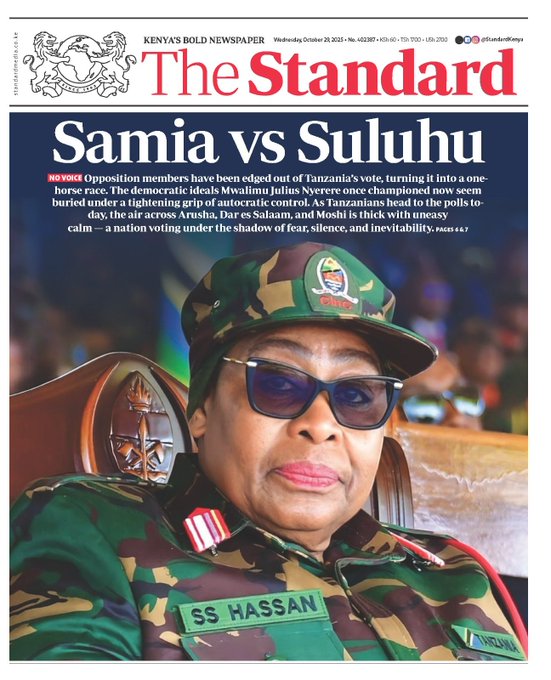
Standard newspaper cover – October 29th (election day)
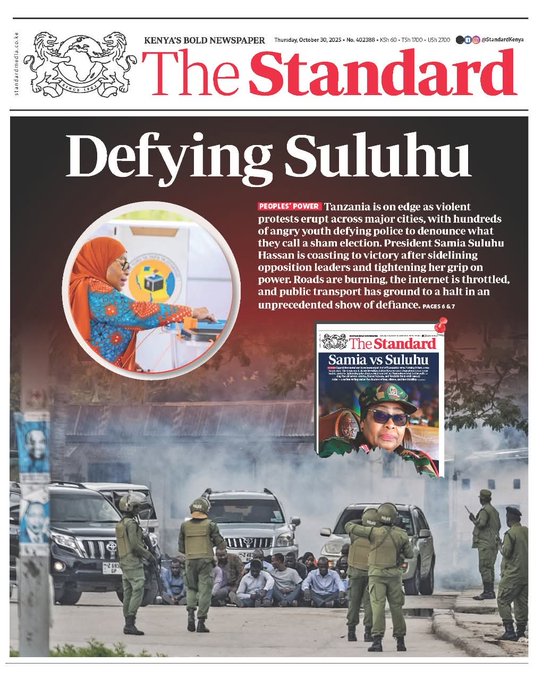
Standard cover – October 30th
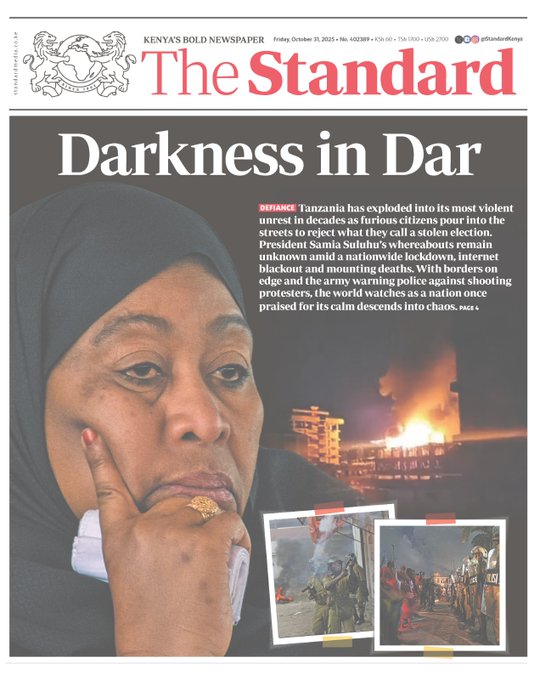
Standard cover October 31st
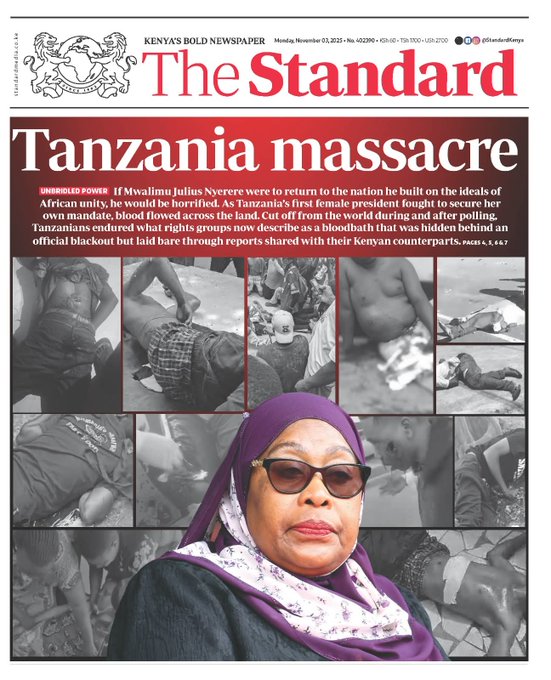
Standard cover 3rd November
Tumultuous 2025 “elections” and their aftermath
It was already clear well before election day that Tanzania’s general “election” of October 29, 2025, would be far from a perfect exercise of democracy. But few predicted the horror that befell the country on polling day and its aftermath.
The country’s first mass protests in decades rose up soon after polls opened, targeting a combination of election infrastructure and the property of prominent ruling party figures and supporters. This was met with a swift and uncompromising response by security forces – one that has reportedly cost the lives of hundreds, or very possibly thousands of citizens.
The “election” itself
President Samia Suluhu Hassan of CCM was contesting re-election as President essentially unopposed after her two meaningful opponents, Tundu Lissu of Chadema and Luhaga Mpina of ACT Wazalendo, were both blocked from standing. Lissu languished in a prison cell awaiting trial on charges of treason – charges that independent observers have described as baseless and politically motivated. Mpina was barred from standing by the “Independent” National Electoral Commission on the grounds on a supposed irregularity in his party’s nomination process.
There were wider signs of democracy in trouble as well, with new restrictions on the media and opposition political parties. UN human rights experts had earlier in 2025 expressed concern over a “pattern of enforced disappearance and torture” against political opponents, with over 200 cases documented.
Citing these and other concerns, Chadema declined to participate in the election at all. As a result, most CCM candidates for parliamentary seats were effectively unopposed as well.
Nevertheless, despite the lack of meaningful opposition, the “election” went ahead on October 29. Officially, President Samia was re-elected with 98% of the vote on an unprecedently high 87% turnout, figures that The Economist described as “ridiculous”. CCM candidates also “won” 270 out of 272 directly elected seats in parliament (ACT won the other two). A discreet, swearing-in ceremony for the President took place on military grounds on November 3, 2025.
The protests
In the lead up to polling day, various social media activists, including Mange Kimambi and Maria Sarungi, had been calling for citizens to take to the streets on election day to make their opposition to the “sham” elections clear. The widespread anger among citizens – particularly among young (so-called “Gen Z”) urban residents – appeared to stem from a combination of political and economic factors. Supporters of Chadema and Tundu Lissu were upset with the country’s political direction and increasing repression, with abductions featuring heavy on complaints on social media, while others focussed more on the lack of economic opportunities, especially for young people.
Nevertheless, previous attempts to mobilise similar protest movements in Tanzania (such as around constitutional and electoral reform in 2018) had largely fallen flat. There was therefore scepticism among observers that calls to protest on election day would deliver anything much.
In fact, the election day protests proved to be substantial. Thousands of protesters took to the streets of Dar es Salaam, Mwanza, Arusha and other urban centres across the country, marching and chanting and occasionally attacking polling stations and other election infrastructure or the property of prominent CCM leaders and supporters. Images on social media showed buses and petrol stations on fire, makeshift barricades with burning tyres erected, police stations and government offices torched or damaged, campaign billboards set on fire and ballot boxes and papers strewn across streets.
Protesters made concerted efforts to persuade security forces (particularly the army) to join them and/or to claim on social media that the army were on their side.
The reaction
On election day itself, the security forces had a highly visible presence on the streets of cities and towns nationwide. In some cases, this led to clashes with protestors, with stones and bullets flying in opposite directions.
Around the same time, as soon as substantial protests became apparent, the internet was taken offline across Tanzania, followed soon after by a nighttime curfew. The internet blackout made it harder for protesters to organise their efforts and to share what was happening with the wider world. It also made it harder for international observers and media organisations to understand what was taking place. For the next few days, only small amounts of information leaked out of the country. There was much misinformation too, on both sides.
And yet, the information blackout was not complete. Especially after the internet shutdown ended (five days later), thousands of stories and images and videos were shared with the wider world. Some of these have been scrutinised closely by the international media or human rights organisations, and found to be genuine. It is not possible to verify every image and every video, but nor is it credible that they were nothing more than a misinformation campaign by protesters and their supporters aiming to discredit the government.
The story told by these images and videos, as well as the testimony of participants and witnesses is horrific. Two days after polling day, a spokesperson from Chadema told the AFP news agency that “around 700” people had been killed in clashes with security forces, and a diplomatic source in Tanzania told the BBC there was credible evidence that at least 500 people had died. The violence did not stop there.
CNN, the BBC, Amnesty and the Centre for Information Resilience (among others) each separately reviewed a wide range of images and videos from social media and other sources and found them to be credible. What they show include uniformed officers appearing to fire at crowds and at people fleeing for their lives, and hundreds of images of bodies lying on the streets or piled up outside hospitals. There have been reports of mass graves on the outskirts of cities including Dar es Salaam and Arusha.
Stories have circulated widely of security forces picking up suspected protestors and supporters from their homes, many of whom have not been heard from since, and eyewitness accounts describe how live ammunition, tear gas, and brutal beatings became disturbingly common.
Amnesty’s Evidence Lab verified one video showing at least 70 bodies piled up on the floors and on stretchers in the morgue at Mwananyamala Hospital in Dar es Salaam. “I had never seen so many people shot like this, and so many dead bodies piled up and crows eating their flesh,” said one Dar es Salaam-based healthcare professional.
Other health workers spoke of how they told those with injuries that they were better off away from the hospital, as armed officers were visiting health facilities to “finish the job”.
The Centre for Information Resilience conducted a detailed data collection and verification exercise, finding “a clear, repeated pattern of security forces using live ammunition against protesters,” and “multiple instances where uniformed police and plain-clothed armed individuals were seen shooting.”
The overall death toll from the violence will likely never be known, but UN experts in December estimated at least 700 extrajudicial killings (while noting that other estimates point to thousands.) Chadema leaders have suggested various much higher figures. Online compilations of those whose were killed or whereabouts are unknown have several hundred names and videos or images.
Amnesty concluded that Tanzanian security forces “used unnecessary or disproportionate force, including lethal force, to suppress election protests, … showing a shocking disregard for the right to life and for freedom of peaceful assembly as hundreds of people were reported killed or injured across the country.” They found that security forces fired live ammunition and teargas directly at protesters and other individuals who posed no imminent threat of death or serious injury, and that security forces used firearms recklessly, injuring and killing bystanders, and abusively deployed tear gas in residential areas and into people’s homes.
A text message was reported as being sent to all mobile phone users nationwide around the time of internet restoration (around November 3–4, 2025), when people began sharing unverified images of bodies and violence. The message read: “Avoid sharing pictures or videos that cause panic or degrade a person’s dignity. Doing so is a criminal offense, and if identified, strict legal action will be taken.”
In the immediate aftermath of the election, a senior minister described the violence as limited to “very few small pockets of incidents” caused by “criminal elements”. He denied excessive force and called opposition death toll claims “hugely exaggerated.”
Later, officials labelled critical media reports (e.g., CNN’s investigation on shootings and mass graves) as “biased” or “information warfare” intended to “mislead and incite.” The President herself in December said that “these were not protests, it was violence with malicious intentions. … What happened was a manufactured event and those who planned it intended to bring down our government. In that situation, the government has a responsibility, and we swear to defend this country and its borders, to protect the safety of citizens and their property. And in that case, the force used is proportional to the event.”
Commission of Inquiry
President Samia Suluhu Hassan has established a Commission of Inquiry into incidents of unrest during and after the October 2025 General Election, which she announced on November 14, 2025 at the opening of Tanzania’s 13th Parliament in Dodoma. She also offered condolences for the loss of life.
She formally launched and inaugurated the commission on November 20, at State House Chamwino in Dodoma. In her launch speech, she emphasised its role under the Commissions of Inquiry Act of 2023 and directed it to examine claims that some protesters (particularly youth) were “paid” to participate and to investigate the role of local and international NGOs in the events.
The commission is an eight-member panel (described as “independent” by the government but criticised by others as lacking true independence), chaired by retired Chief Justice Mohamed Chande Othman. Other members include former state officials and retired civil servants, such as a former Inspector General of Police and the immediate former Minister of Defence (who held office during the period of violence).
The commission was initially asked to report within 90 days. Around the 90-day mark, it was reported that the commission had been granted an additional 42 days, effective from February 20. With the extension, the commission is now required to finalise its work and submit its report on or before April 3, 2026. The commission cited several reasons for the extension, stating that “the additional time will provide an opportunity for any individual, whether inside or outside the country, who has information, evidence or views to present, to come forward.”
Youth ministry
In the same speech to Parliament, the President also established the Ministry for Youth Affairs, which she said was specifically designed to address the socio-economic frustrations that fuelled much of the 2025 post-election unrest. It is also a strategic response to the demographic reality that youth (under age 35) make up more than 60% of Tanzania’s population.
The ministry is led by Dr Joel Arthur Nanauka, a well-known youth activist and author who previously focused on leadership and economic empowerment.
The ministry has already launched several high-profile initiatives. This includes a “Vijana App” national digital platform designed to coordinate youth issues and provide a feedback loop between the government and young people; a Youth Investment Fund aiming to establish over 100,000 youth-led companies by 2030; and a “Vijana Tuyajenge” campaign to shift the narrative from youth as “political protesters” to “nation builders” through entrepreneurship and civic participation.
The ministry is widely viewed as a “de-escalation tool.” By providing a dedicated seat at the cabinet table for youth issues, the government is attempting to address the high unemployment and lack of political inclusion that became flashpoints during the October 2025 protests.
Arrests, and forgiveness?
Large numbers of Tanzanians, mainly young people, have been arrested in connection with the protests. Precise numbers are not available, but it has been reported that over 2,000 were arrested, with as many as 250 charged with treason.
Many of those charged were released starting in late November 2025, following a presidential directive from President Hassan urging leniency. In her address to Parliament, she acknowledged arrests of many young people, stated they “did not fully understand what they were getting involved in,” and asked prosecutors to “show leniency” toward those arrested in connection with the violence. Again, precise numbers are not available, but some reports have claimed that as many as 1,700 have been released.
Diplomatic reactions
The African Union (AU) election observation mission declared that the elections “did not comply with AU principles, normative frameworks, and other international obligations and standards for democratic elections,” citing issues like ballot stuffing, internet blackouts, and excessive force, while urging restraint and thorough investigations into violence against protesters.
The Southern African Development Community (SADC) issued a rare sharp rebuke in its preliminary statement, describing the electoral commission as “compromised from inception” and concluding that “in most areas, voters could not express their democratic will.”
The European Union (EU) expressed deep concern over credible reports of killings, serious injuries, violence, and irregularities, including internet shutdowns, with the High Representative urging maximum restraint to preserve human lives and later supporting debates on freezing development aid amid the crackdown. In a joint statement, the EU Delegation, multiple EU member states (including France, Germany, and others), the UK (via the British High Commission), Canada, Norway, Switzerland, and additional partners on December 5, 2025, expressed regret over tragic losses of life and injuries, called for the release of bodies to families, the freeing of political prisoners, and addressing shortcomings identified in AU and SADC election reports.
The United States announced a comprehensive review of its bilateral relationship with Tanzania on December 4, 2025, citing “disturbing violence against civilians” before and after the elections, alongside ongoing repression of religious freedom and free speech, which it said threatened mutual prosperity and security.
Regional leaders from neighbouring countries (such as Kenya, Uganda, Rwanda, and South Africa) notably skipped President Hassan’s inauguration, signalling either disapproval or unwillingness to risk stirring domestic anger by showing support for her. Former South African President Thabo Mbeki went further, stating through his foundation that Tanzania “currently lacks a legitimate government.”
China has taken a supportive stance toward the Tanzanian government, emphasising non-interference and stability. On January 11, the Chinese government conveyed congratulations to Tanzania for the “successful conduct of the General Elections held in October 2025” and expressed “strong support for the Government of Tanzania to safeguard constitutional order, protect lives, property, and national stability in accordance with law.”
The Commonwealth Secretariat attempted to initiate mediation, announcing Malawi’s former president Lazarus Chakwera as special envoy. However, his appointment was quietly rejected by the Tanzanian government and openly criticised by civil society groups.
Despite the internet restrictions and the absence of journalists from international media outlets in Tanzania at the time, global news coverage of the post-election situation was considerable. Coverage has been highly critical of the President and the security forces’ actions.
Chadema officially called for an investigation by the International Criminal Court (ICC) in November 2025. Later that same month, a coalition of Tanzanian civil society organisations and victims filed a formal petition at The Hague. This petition specifically named President Samia Suluhu Hassan and senior security officials, accusing them of authorising a “premeditated crackdown” on civilians. The court has not yet opened a formal investigation, but the Office of the Prosecutor is in the “Initial Review” phase. Under the court’s rules, the Prosecutor must first determine if the alleged crimes fall under the court’s jurisdiction and if the Tanzanian national justice system is “unwilling or unable” to prosecute the crimes itself. The Tanzanian government has pointed to the Commission of Inquiry as proof that this does not apply.
A way forward?
The trauma of October and November 2025 will cast a long shadow. As of February 2026, the immediate violence has subsided, but underlying tensions and deep divisions persist. Nor is it entirely over: reports of further abductions continue almost daily.
The commission of inquiry is ongoing, expected to guide the creation of a permanent Truth, Reconciliation, and Healing Commission, a long-term initiative aimed at addressing historical grievances and fostering national unity. President Samia has also committed to re-starting a constitutional review process, a key demand of the opposition. If genuinely inclusive and far-reaching, this has the potential to address fundamental issues of governance, electoral integrity, and human rights protection.
Nevertheless, the outcomes of these initiatives are highly dependent on the government’s political will to implement meaningful reforms and ensure accountability for past abuses.
The 2025 elections and their violent aftermath represent a major setback for Tanzania’s democratic journey, and perhaps the end of the country’s reputation as an “island of peace” in a troubled region. The country descended into a maelstrom of contention, violence, and apparently widespread human rights abuses, leaving an indelible scar on the political landscape.
Perhaps there is a chance for President Samia and the nation as a whole to learn from this painful chapter, to collectively say “never again”, to genuinely address the grievances that fuelled the unrest, and to rebuild independent democratic institutions – the electoral commission, security forces, the media and more.
The path to true reconciliation and a stable, democratic future will be long and arduous, requiring courage, transparency, and a profound commitment to justice for all Tanzanians. At the time of writing, there’s a danger that President Samia will go down in history as the person who tipped Tanzania over the edge into tyranny, division, anger and brutality. But it’s not too late to find another path – she could instead become the person who brought the country back from the brink and established lasting stability and prosperity.