UNIVERSITY LINKS – THE LARGEST BUDGET IN AFRICA

The British Government’s Overseas Development Administration (ODA) makes an annual grant to the British Council specifically aimed at assisting the development of higher education in the Third World. One of the most important means currently used to achieve this aim is support for academic links with British institutions. In 1987/88 Tanzania benefitted from the largest ODA link budget in Africa.

Academic visits represent the core of the activity. This year it is planned that 47 Tanzanian staff members will be attached to departments in British universities or polytechnics for an average duration of 13 weeks. The purpose of these visits varies according to the needs of the Tanzanian department but are typically designed to exploit the facilities of the host university to advance the visitor’s research, but sometimes will also include attendance at short courses. This year it is also planned that 36 British academics will visit their link departments in Tanzania for an average duration of four weeks.

Typically they will help to advance joint research with Tanzanian colleagues, advise on curriculum development or, sometimes, teach.

The British Council provides an annual grant for most linked departments to acquire equipment in Britain. This year it averaged £3,180 per link. Books have been provided – to the value of £8,900 for the University of Dar es Salaam and £3,600 for the Sokoine University.

Links with the University of Dar es Salaam include :
University Administration – University of Bath;
Geography – University of Glasgow;
Sociology – University of Hull;
Foreign Languages and Linguistics – University of Lancaster;
Epidemiology and Biostatistics – University of Manchester;
Chemistry – University of Salford;
Commerce and Management – University of Sheffield,
Education – University of Southampton;
Statistics – University of Southampton.

There are also three academic links with Sokoine University of Agriculture:
Development Studies – University of East Anglia;
Veterinary Medicine – University of Glasgow;
Rural Economy – University of London, Wye College.

ONE OF THE NICEST AND HAPPIEST COUNTRIES

Britain’s Minister for Overseas Development, Mr, Chris Patten, has visited forty countries but considers Tanzania to be one of the ‘nicest and happiest’. He said this at a ceremony at the Ranfurly Library Service in London on December 7th 1988 to mark the 200,000th book to be sent under the ‘Textbooks for Africa Project’. This project is supported also by Rotary International, the British Council and ODA. To mark the occasion Mr, Patten handed over a copy of ‘Abbotts Physics’ to Mr, Ulli Mwambulukutu, the Minister Counsellor for Tanzania in the High Commission in London. The ceremony was held in a spacious 8,000 square-foot warehouse stacked with tea chests containing thousands more books destined for Tanzania, Malawi, Gambia, Botswana and other countries.

Mr, David Membrey, Assistant Director of the Ranfurly Library Service, explained to the Bulletin that Tanzania had been receiving books from Ranfurly ever since 1960. Some 725,000 had been sent altogether, including almost half a million within the last three years. He said that the Ranfurly Library Service was now supplying some three quarters of the books obtained by the Tanzania Library Service and large numbers were also going to schools and other institutions throughout the country.

CHINA AND TANZANIA

Some personal experiences:

On my first day in China – before the arrival of colleagues – I was free. The rest of our time in China was very thoroughly programmed.

I glanced at the telephone directory. Tanzania was mentioned only once (apart from the Embassy). The entry read ‘China – Tanzania Joint Shipping Company’. It was to be found, apparently, at Juanjiehu Beili, Building No. 7 in Chaoyangpu. I asked the hotel receptionist to write this for me in Chinese and he produced without hesitation this:

I went outside for a taxi. The driver was friendly but we had no way of communicating and soon got lost. We were in the right area of the city but, as in much of Beijing, were dwarfed by row upon row of massive apartment blocks (obtaining accommodation in such blocks, I learnt later, is the dream of most of the inhabitants of the city). All these complexes had their No 7 building. About a dozen conversations and 30 minutes later we found a much smaller building which was also No 7. But this one, to my relief and delight, had a notice on the gate in English – ‘The China – Tanzania Joint Shipping Company.’

I climbed up one flight of stairs – having made sure that the taxi driver understood that he should wait – and wondered what my reception would be. Parastatal bureaucrats are never at their most welcoming when they come face to face with a journalist wanting to ask questions, regardless of whether the journalist is an amateur or a professional. And Chinese bureaucrats do have an ‘image’ problem.

Most of the offices were empty – it was Saturday morning – but I found two gentlemen at their desks. To my surprise they were friendly. Their contacts with Tanzania must have had a good effect. “How interesting” they more or less said “can we see a copy of the Bulletin of Tanzanian Affairs?” and what would I like to know?

Mr. Lei Zhen Ya, the Manager, explained that the company started in June 1967. It is run jointly by the two governments, each with a 50% share and was designed to serve trade between the two countries. The company began with four second-hand vessels but these have all since been replaced by new ones – the Ruvu, the Ruaha, the Pingku and the Shuniji with a total tonnage of some 60,000.

Originally the ships served the needs of the Tanzania-Zambia (TANZAM) railway and transported workers to Tanzania from China (I can remember the arrival one Sunday morning in Dar es Salaam of 1,000 of these workers all dressed identically in Mao suits and all issued with the same standard suitcase – how things have changed in China in recent years!) The ships also carried railway construction material.

It was at this stage in the conversation that I decided to make sure to interview, before leaving China, one or two of the early workers on the railway (there had been some 20,000 Chinese involved altogether) and hear how they looked back on their Tanzanian experience.

With the completion of the railway and a fall in the export from Tanzania of groundnuts and sisal, trade with Tanzania had gone down considerably. Nowadays cargo was sought wherever it could be found. Out of a total volume of 190,000 tons of goods transported by the company from China last year only about 7,000 tons went to Tanzania and no imports from Tanzania to China were carried. Furthermore, 1986 was the first year since the founding of the company that it had not made a profit. But relations with Tanzania remained warm and friendly. During the Cultural Revolution (a bitter memory to almost everyone to whom we spoke later) staff of the China-Tanzania Shipping Company had been left strictly alone and not persecuted in any way. Because of the link with a foreign friendly nation.

The 33 crew members of the two Chinese ships were all Chinese I learnt. The two Tanzanian ships had some 25 Tanzanian crew members and 7 Chinese including the captain.

Mr Lei said that the company was facing many problems but that the biggest by far was in obtaining sufficient cargo in a highly competitive market. But he was optimistic about the future: “With the recovery in Tanzania’s economy, trade will increase” he said.

My own job in China was in the Ministry of Agriculture. “Do you know of anyone who used to work on the TANZAM railway” I asked. Yes, said one of our counterparts, his own father was still working in the Ministry of Railways and had many friends who had worked in Tanzania.

Mrs Tang, who works as a Swahili interpreter in the Ministry of Agriculture told me how she had spent five years in Tanzania from 1973 on a State Farm growing rice at Mbarali in Mbeya region. “I was the one woman amongst 100 men” she said “and they could only communicate with Tanzanians through me”. It was hard work but she had enjoyed it very much. The Tanzanian people were very honest, (something which cannot be said for speakers at Chinese banquets whatever their nationality), very patient and easy to work with. And Swahili was so much easier to learn than English. She had been working only ten miles away from the railway and she knew many of those who had worked on it. She would get in touch with the Ministry of Railways and arrange for me to meet some of them.

I asked whether it had been easy to get people to volunteer to work in Tanzania in view of the harsh conditions at that time. “Yes indeed” Mrs . Tang said. “Only those with the best work records were allowed to go. Everyone wanted the chance. It wasn’t only the pay (50% higher than in China); it was a unique opportunity to see another part of the world.” But Mrs. Tang had had some second thoughts herself on her sixteenth day of sea-sickness on the way to Dar es Salaam.

Mr. Said Salim from Tanzania has been working in China longer than any other Tanzanian. 21 years. “They call me the Mayor of Beijing” he said. Originally he went there under the auspices of the organisation set up after the Bandung Conference as a journalist. Nowadays he works on the Swahili edition of a Chinese monthly magazine. He and his Zanzibari wife have four children, all taking university studies in Beijing. “They are more Chinese than the Chinese” he said. I asked him if he happened to know anyone who had worked on building the railway all those years ago. No, he said, but he dug into his archives and produced an article he had written in the ‘Afro-Asian Journalist’ (No. 1, Volume 9) in March 1972:

“Two events different from, though closely related to each other and antagonistic in character yet very commonly known in Tanzania and Zambia, came to pass in Africa on November 11th. It was on this day in 1965 when the Rhodesian white settlers unilaterally declared their independence …… and it was on this same day, in 1971, that the track laying on the 502 kilometre Dar es Salaam-Murimba section of the now world-shaking Tanzania-Zambia Railway (the biggest donor aided project in Africa) was completed … the two events seem like a ‘historical accident’; …. because of the existence of profound mutual trust among the three committed countries and the exigency China understands for both Tanzania and Zambia to have the railway built as soon as possible, preparation had commenced in March 1970 before the Protocol was even signed …. following immediately the tortuous surveys conducted from 1966 to 1970”.

One of our young interpreters said one day that he had found somebody who had worked on the railway. It seemed that nearly everyone we met knew somebody who knew somebody who knew something about Tanzania. But unfortunately this person lived at the other side of Beijing (a massive city) and he did not think it would be possible for us to meet.

As I learnt each day more about the history, the politics, the economy, the agriculture (most people are remarkably outspoken and the English language ‘Daily News’ explores every issue with astonishing freedom of expression) the similarity of experiences and, in particular, the ‘political language’ in China and Tanzania became more and more apparent.

China had its ‘Great Leap Forward’, its nationalisation of private businesses, collectivisation of agriculture; Tanzania had its ‘Arusha Declaration’ and its villagisation.

And now, many years later, Tanzania has its ‘Economic Recovery Programme’ and its ‘Structural Adjustment’. China has its ‘Economic Reconstruction and Structural Reform’.

The decisive 13th Party Congress attended by 1,926 Chinese delegates in October 1987 found some echo in the ‘Third National Party Conference’ attended by 1,931 delegates in Dodoma in the same month of the same year. The Chinese Party Congress made what was described as ‘a refined and systematic exposition on the theory of the primary stage (ie. the present stage) of socialism in China.’ It reaffirmed ‘the Party’s pledge to build socialism with Chinese characteristics’. But it noted that a small number of Party members were engaging in tax evasion, smuggling, bribery, moral turpitude, breach of discipline …. ‘ And in Dodoma. Mwalimu Nyerere had spoken of ‘some dishonest public servants and unscrupulous individuals who were taking advantage of the severe economic difficulties to enrich themselves.’ (Bulletin No. 29)

The 13th Congress clearly stated that the private economic sector in China should be allowed to develop to a certain extent. ‘With the objective of common prosperity in mind, we should encourage some people to become well-off first through honest work and lawful business operations’. A sentiment surely widely understood in today’s Tanzania.

And in both countries the reforms are showing results. Chinese officials speak of a new vitality in the country’s economy – a 103% increase in GNP, a 118% increase in industrial and agricultural output, 130% improvement in per capita income and, most spectacular of all (it is necessary to queue to climb the Great Wall or see the Terracotta Warriors) a 480% increase in income from tourism since the reforms began. And in Tanzania too, important gains can be seen, Growth up significantly for two successive years, substantially increased production of crops and so on.

But China has been making changes much more rapidly than Tanzania. The new ‘Responsibility System’ has decentralised decision making and the foreign investment code has brought about massive foreign investment all over the country. Factories are springing up everywhere.

And, just as the rate of inflation, especially in urban areas, dominates conversation in Tanzania, in China I learnt that, whereas reform in the rural areas brought almost immediate benefits for farmers, urban residents felt that the most noticeable feature of reform was inflation.

Tanzania has just devalued its currency. And, according to the December 3 issue of the Economist, China seems likely soon to do the same.

As Mr. I.B. Chialo, Acting Ambassador for Tanzania when I was in China, explained to me, the ideologies of the two countries have for long had their similarities and historically Tanzania has followed China in many ways. He felt that there was much to be learnt from China even today and pointed out that, at the time we were speaking, President Mwinyi was welcoming to Tanzania a delegation (later I learnt that it was the first visit to Africa of delegates of the organisation of such a high level of representation) from the China International Trust and Investment Corporation (CITIC) which can claim credit for the remarkable development of foreign joint enterprise and other investment now to be seen in China. The Daily News in Tanzania later quoted President Mwinyi as having asked the delegation to share with Tanzania some of China’s experience in dealing with foreign investors in a socialist state. And just as in Tanzania there are those in China who are saying that the changes must be halted as they are endangering the national policy of socialism and its objective of achieving equality amongst people. Mr Chialo also told me that, although. because of the warmth of the relations between the two countries, Tanzania still received favours, the ‘era of mutual admiration is over’. “We are learning to be tough in negotiation from them” he said. He quoted several potential joint projects in Tanzania being held up because of the severe conditions on which the Chinese were now insisting.

After a busy month my visit came to an end. The Ministry of Railways let it be known that it would not be possible for me to talk to any of the persons who had contributed to the great railway project. The Chinese bureaucracy is still there.
David Brewin

JUSTICE IN TANZANIA – LESSONS FOR ENGLAND

Tanzanian law owes much to the colonial legacy of English law, which overlaid the traditional customary laws of Tanzania’s African communities, but some current developments and proposed reforms in English law reflect basic concepts familiar in Tanzanian legal experience. Some reforms already adopted in Tanzania are now under contemplation in England. These points emerged at a London meeting of the Britain Tanzania Society to welcome a party of senior members of the Tanzanian Judiciary.

Five Tanzanian judges made a study tour of Britain from 5th to 16th September 1988 following a request by the Chief Justice to the Commonwealth Magistrates’ Association; the main purpose of the visit was to allow the judges to acquaint themselves with recent developments in the English legal and judicial system as part of a current comprehensive programme of judicial development and training being undertaken by the Tanzanian Judiciary. The visitors took part in a seminar for British judges and then visited courts, judges and other relevant officials.

The three guests who addressed a keenly interested audience on “Justice in Tanzania” were Mr. Justice Mfalila (a High Court judge since 1972), Mr. January Ksoffe (Senior Deputy Registrar of the Court of Appeal), and Mr Exuper Mtui (Senior Resident Magistrate). They had all graduated from the University of Dar es Salaam and Mr. Justice Mfalila was greeted at the meeting by three of his former British teachers and one of his examiners, in the form of three University of London Law professors and a senior solicitor from a big City firm. The visitors themselves personified the ways in which the development of legal education in Tanzania, although it started only on the eve of independence in 1961, has enabled the country to help sister African states: Mr. Justice Mfalila has served with distinction as a judge of the High Court of Zimbabwe from 1984 to 1987 and Mr. Msoffe has been a resident magistrate in the Seychelles.

The judges outlined the legal history of Tanzania. Colonial policies of indirect rule had protected indigenous local laws by maintaining a dual judicial system. After independence Government policies had sought to promote unification, introducing a unified system of magistrates’ courts (1963) and systematic, statutory “Declarations of Local Customary Laws” relating to the family and succession. A notable and mainly successful and pioneering experiment in unification had given Tanzania a unique lead as the only Commonwealth African state to have introduced a unified system of family law in the Law of Marriage Act 1971: this applies a single set of procedures and standards for the contracting of marriages and the settlement of matrimonial disputes including divorce, while recognising the validity of all the existing diverse types of marriage (customary, Christian, Muslim, Hindu, civil etc.).

In some ways Tanzanian law has always differed from English law. Thus, trial by jury was never adopted and serious criminal charges are tried by a judge “with the aid of assessors”, whose individual opinions are advisory only; however, Mr . Justice Mfalila said that it was very rare far a judge to disagree with the Assessors and he had to state and record his reasons for doing so. By contrast, in the Primary (Magistrates’) Courts, where the majority of cases are dealt with, the magistrate sits with local assessors and decisions are made by majority vote. It is interesting to note that a recent official enquiry in England recommended a trial with assessors instead of a jury for certain difficult trials such as serious fraud offences.

Within a few days of the meeting a highly significant development in Tanzanian law took effect: from 1st October 1988 the Bill of Rights added to the Constitution by amendment in 1985 became “Justiciable” – enforceable by the courts, an interval having been allowed for the adjustment of any existing provisions which might have been inconsistent with the Bill of Rights. This development greatly enhances the power of he judiciary to protect individual rights. Needless to say, the United Kingdom has no Bill of Rights except insofar as the European Convention on Human Rights allows the European Court of Human Rights to adjudicate on the validity of British laws and practices: that international Court has given a number of adverse decisions an British law, most recently (November 1988) an the impropriety of special powers against terrorism in Northern Ireland. In Tanzania the much criticised Economic Crime Control Act 1984 might have been challenged if the Bill of Rights had been in force then, especially insofar as it originally denied legal representation to persons accused, a provision which was modified at an early stage. The Act has been further amended to restore jurisdiction to try “economic crimes” to the ordinary courts, applying the Penal Code.

Here is another example of Tanzanian law being ahead of the law of England. Early in 1989 English lawyers will be studying the revised version of the Draft Criminal Code prepared for the official Law Commission. This will be more than a century after an authoritative project to enact a criminal code for England was abandoned in the face of opposition. The Penal Code of Tanzania, continuously in force since its enactment in 1930, had its original source in the draft code rejected in England in 1880, via the model adopted as the Queensland Criminal Code 1899 which was introduced into Nigeria in 1904. There is at least the possibility that, before the end of the twentieth century, English law will have caught up with Tanzanian law by adopting a code of criminal law – which should be a valuable element in making a most important area of the law clearer and more accessible to the people.

The Tanzanian judges were questioned at the meeting about various aspects of Tanzanian law, and they were also asked what they had learnt from British legal institutions. They commented on the training value of judicial seminars and on techniques adopted in English courts to reduce delays in civil cases. They noted that in England it is proposed to simplify certain technical rules of evidence, e.g. those which impose unduly restrictive requirements on evidence given by children as witnesses; such changes have already been adopted in Tanzania (1985)!

Finally, attention turned to an issue of over-riding significance in the common problems of controlling crime and treating offenders. For at the time of the meeting a Government “Green Paper” was imminent in England which emphasised the importance of compensation of the victim of an offence by the offender: English courts may be required to order compensation in future, unless they can record reasons against doing so in particular cases. Yet this is to recognise a truth which was accepted as fundamental in African societies of Tanzania (and other states) long before the advent of colonial rule. Indeed it was the focal point of a conference on Penal Problems in East Africa held at the University College , Dar es Salaam more than two decades ago, when a distinguished criminologist with a lifetime of practical service in Africa declared: “The great Tsonga proverb is: ‘The repair of the damage done is restitution’ .. . . the true corrective of crime has little value if the one who suffered is not compensated.” [H.P. Junod]

Jim Read


THE JUDICIARY AND THE PARTY

The Daily News in its issue of November 3, 1988 reported on a seminar being held in Dar es Salaam on ‘The Role of the Judiciary in the Implementation of the 15-Year Party Programme.’

Party Secretary General Rashidi Kawawa, had told the participating judges that laws played a vital role in social and economic transformation especially in a society where the interests of the toiling masses were being trampled upon by the exploiting class. “The courts must at all times protect and champion the interests of the workers and peasants as a way of implementing the Party programme” he said.

Judge Goodwill Korosso, like many participants, observed that not all colonial laws were irrelevant to the aspirations of a socialist state under formation. British laws inherited at independence had been based on the principles of ‘natural justice’ which were the same for a socialist or capitalist society.

Judge Robert Kisnaga expressed concern over an allusion in the paper presented by party cadre Professor Daimon Mwaga to the effect that the courts of law could not afford to remain neutral in the overall struggle to build a state based on class interests. “I have in all my years in this job believed that the courts are an independent arm of the state” he said. He requested to be informed if the situation had changed.

TANZANIA IN THE MEDIA

CHAPTER AND CLAUSE
Under this heading, Africa Events commented on the statement made by Mrs. Sophia Kawawa (Bulletin No. 31) concerning the rights of women which is alleged to have been the cause of the recent riot in Zanzibar in which a number of people were killed. Mrs Kawawa, the article said, had been the top lady of Tanzania’s UWT, the Association of Tanzanian Women, for many years. As such, the article went on, the UWT wields no power. ‘But in back stage politics some UWT leaders are known to be accomplished bridge builders, freelance power brokers and generally provide charm and glamour to the ruling Party the CCM. However, every Tanzanian woman knows that none of their number stands a chance of climbing to the Party’s summit to engineer real change for the rest of her lot. The path is blocked. All key positions have been taken – for keeps. Pro-woman sloganeering apart, CCM is male, chauvinistic and macho. In a predominantly Muslim nation, which Tanzania is, Mrs. Kawawa urged the abrogation of an Islamic law, in a speech which was candid in the extreme. Zanzibar burst into the streets to protest’.

HANDS ACROSS THE EQUATOR
Under this heading the British Medical Journal in its issue dated September 3 1988 wrote an article by John B. Wood and Elizabeth A. Hills, two physicians, one at Hereford County Hospital and one at Hospitali Teule, Muheza, Tanga Region, who have been trying to learn something about each other’s way of life and arrange for some practical help to be given by the richer community to the poorer. Each year four health workers from each community visit the other for six to eight weeks. The article contains accounts of their experiences by a consultant obstetrician and gynaecologist, a hospital engineer, a laboratory scientist (who returned home with hepatitis B infection), and a non-travelling histopthologist from Hereford.

For the Tanzanian visitors, the main rows of wards at Hereford seemed familiar because they consist of corrugated huts like those at Muheza, only older. Most were surprised that methods of treatment, delivery of babies and the giving of anaesthetics were much the same as they were used to.

‘What changes had been made at Muheza as a result of the visits? There had been small changes in the operating theatre (a different routine for skin cleansing) but the biggest change was as a result of the visit of a medical assistant to the casualty department. She went home with a list of requirements concerning resuscitation, and changes have been made. A dressing room has been converted, a hole knocked through the department wall and a covered way is nearing completion.

AN INTEGRATED ROADS PROGRAMME
The African Economic Digest, in its October 28 issue, stated that donor agencies are expressing enthusiasm about the prospects for an integrated 3,000 kilometre roads programme for Tanzania. Consultants from the UK, West Germany, Canada, France, the Netherlands, and in particular, a US$ 1.0 million study on the administration of an integrated programme being financed by Denmark are under way. The report on the latter is expected to recommend that financial responsibility for the programme should be centralised in the Communications and Works Ministry rather than, as at present, spread across several government departments according to the classification of road involved. The studies need to be ready for a donor meeting planned for February 1989 in Dar es Salaam. After the meeting the World Bank seems likely to begin preparation of a detailed integrated road project to which US$ 100 million has been provisionally assigned.

WHY ARE ITALIANS NOT COMING TO MAFIA?
Under this heading the November/December issue of Tantravel explained how a prominent Italian businessman, Mr. Gian Paulo Benini, a few years ago, shocked his fellow Italians by advertising in newspapers inviting them to ‘join the Mafia Fishing Club’, What MAFIA club was this? he was asked. To the readers, the Mafia was an ‘omerta’ meaning not to be mentioned. He had to carefully explain that he was talking about a fishing paradise in the waters of the Indian Ocean. In 1973 Mr. Benini had founded the club. It ‘became very popular with international tourists interested in deep sea diving, snorkelling and goggling.

Nowadays however, according to Tantravel, tourism has declined in Mafia because of the lack of efficient transport to the island. Extension of the airport to carry bigger aircraft like the Fokker Friendship has been underway since 1980 but is still only 60% completed. Passengers often have to wait two weeks to get a place on a plane to the island.

Tantravel, in the same issue, also stated that Tanzania hopes to host over 270,000 tourists in 1989. This would represent an increase of 102,802 over the 1988 figure. Tanzania had earned Shs 400 million from the hotel levy in 1987/88.

SYMPATHY
Thailand’s English language newspaper The Nation gave Thai readers an account of the long negotiations going on between Tanzania and the IMF in its issue of August 19th 1988. It reported that Western donors were pleased with the results so far from three years of Tanzania’s economic reform programme and were in sympathy with the government IS dilemma over devaluation (as described in the first article in this issue of the Bulletin – Editor). “They are doing very well and for an economy which was in such bad shape you cannot change things overnight” one ambassador had said.

SIR GEOFFREY FINDS THE SPICE HAS GONE FROM ZANZIBAR’S ISLAND PARADISE
The Guardian in its September 16th issue wrote that “one of the better routes to paradise, short of dying, used to be to take the short boat journey across the Indian Ocean from Dar es Salaam to its island neighbour …. Zanzibar is bathed in the aromas of cinnamon, lemon grass and cloves. It was the favourite posting of every 19th century Western diplomat in Africa. The modern diplomat-explorer, Sir Geoffrey Howe, crossed the water wedged into a tiny Cessna aeroplane to find that paradise is not what it used to be, ‘Terminal Island’ reads graffiti behind the Sultan’s Palace, now the local headquarters of Tanzania’s ruling Party. It is one of the milder expressions of disgruntlement by Zanzibaris. They regard the mainland government in Dar es Salaam and its representatives in the palace, as pernicious a potentate as their former Arab rulers and are pressing for more autonomy.

The island’s new Chief Minister, Mr. Omari Ali Juma, an economic reformer, used a lunch for Sir Geoffrey Howe to discuss the island’s problems. “It is a grim situation” he said. “There is a general deterioration in the quality of life. And I have to confess, some government policies have led to this present crisis.” But Dr. Juma went out of his way to emphasise that the Union with Tanzania was safe.

Paradise, the article concluded, is not close to separatism. Meanwhile, the Daily Telegraph, in reviewing what it described as a basically affectionate biography of Sir Geoffrey Howe published recently, revealed that, while on national service, Sir Geoffrey had climbed Kilimanjaro, Africa’s highest mountain. He had gazed into the volcanic crater, looked out across the plains of Tanganyika – and fallen fast asleep!

KENYA, UGANDA AND TANZANIA
African Events has been giving its views on the recent visit by Kenya’s President Moi to Dar es Salaam and what it describes as the terminal stages of a slow-healing process that is about to close the rift that has kept the two ex-members of the East African Community apart for over a decade. ‘The first reason for the visit was bound up with Kenya’s rapidly changing fortunes in manufacturing and the problems she is having in developing exports. With the new economic liberation policies gaining ground in Tanzania … the Tanzanian market is beginning to look like an exporter’s paradise … Kenya is bent on getting a piece of the action and on restoring the old-time special trading relationship with its neighbour.’ A second reason for the visit, the article indicated, was to ensure that Tanzania should not be coaxed into allowing the various dissident groups which are making the Kenya government distinctly uneasy, to use Tanzania as a base for cross-border raids.

The article went on: ‘If Kenya is keen an getting into Tanzania’s good books, Uganda must be anxious that Kenya does not replace it as Tanzania’s most favoured East and Central African state. It was perhaps the need to allay Ugandan anxieties that Chairman Nyerere of Tanzania was in Kampala when President Moi was in Dar es Salaam. Chairman Nyerere heaped praise on Uganda President Museveni with a trowel. He told Ugandans that Tanzania had cut its ties with ex-President Obate and would never lend him a hand to hop back to power. ‘The Ugandans feel enormously grateful to Tanzania for evicting the tyrannical Idi Amin. They have shown some of this gratitude by putting a fair amount of trade on Tanzania’s plate. Uganda would now buy consumer goods from Tanzania rather than from Kenya if they were available and the price was right. Tanga is gradually replacing Mombasa as landlocked Uganda’s main port for its goods …. in Kenya’s eyes therefore, Tanzania is the key to its peace of mind on regional trade. Kenya wants to stalk into the sanctum of the evolving Tanzania/Uganda axis before it properly gels. Otherwise it might find itself out in the cold.’

In its October 21-27 issue African Concord reported that, during his subsequent return visit to Kenya, President Mwinyi, speaking to Tanzanians living in Kenya, called for the revival of the defunct East African Community. He said that the original community had broken up because of mi nor difficulties between member states.

AIDS AND TRADITIONAL MEDICINE
According to the November 3rd issue of African Concord, Tanzania’s Traditional Medicine Research Institute has encouraged traditional herbalists to continue treating victims of AIDS but has advised them not to do so by guesswork. The Institute’s Director, said that herbalists should only provide treatment after the AIDS victim had been scientifically proven to have the virus. He said that since a cure for the disease had yet to be discovered, herbalists were free to treat patients who came to them.

THE GHASTLIEST PLACE ON EARTH
Such was the description of the blotchy pink waters of Lake Natron on Tanzania’s border with Kenya given by Clare Hargreaves in the November 5 issue of the Daily Telegraph. She explained that the lake took its unearthly colour from the algae that thrive in its corrosive soda waters and provide food for its only inhabitants – millions of pink flamingoes. She went on; “these desolate, but hauntingly beautiful landscapes and the rough, dusty roads that go with them are not for travellers who need their home comforts abroad; here, ice-cold gin and tonics are as rare as Daimlers and baths are more often than not poured from a jerry can ….

But as Kenya becomes the Benidorm of safaris, visitors who really want to feel the pulse of Africa without competing with scores of other white mini-buses, will find Tanzania superb. Back at the camp, our Tanzanian driver had just killed a 4ft long red cobra, which still writhed in the dust beside our camp fire. The cook was busy hacking a freshly slaughtered goat which he threw into a huge cauldron of stew, watched by 17 pairs of hungry eyes ….. a day and a half away at Ngorongoro, waking in the night to a cacophony of roaring lions and ‘whooping’ hyenas …. this was the ultimate African adventure.”

JAPAN AND TANZANIA
The Japan Times featured Tanzania in three successive issues during September 1988.

The first reported that the Matsushita Electric Company, the only Japanese company running factories in Tanzania, was facing ‘production stagnation’. It cannot import raw materials for its products which include radios and batteries because Tanzania is short of foreign currency. Some of the 561 employees were said to be cleaning the floors, some repairing machines and some were doing nothing but chatting. The factory utilisation rate had dropped to 30%. But despite this, the factory manager was reported to have said that ‘some’ profits were still being made although he refused to be specific. The factory had not fired any of its employees. “If we do that, employees who are exempted from dismissal will not be able to concentrate themselves on their work thinking that they may be fired next” the manager had said.

The second article described how Tanganyika Tea Blenders Ltd. a government corporation selling tea and coffee wants to increase exports to Japan. However, Japanese trading companies were reluctant to import because of unstable supply and because they felt that the packaging was unattractive. Japanese importers “who are very punctual” do not tolerate delays said the head of liaison of a company specialising in trade with Africa.

In the third article the Japan Times gave the story of two Japanese agricultural specialists working on the strengthening of irrigation banks for rice in Bagamoyo. A photograph was published showing the Japanese agriculturalists helping Tanzanian farmers to operate a homemade cement mixer which can also act as a roller to consolidate the compressed soil on the banks.

NEW ARMY COMMANDER
The appointment by Tanzania of a new Army Commander, General Ernest Mwita Kiaro and a new Chief of Staff, General Tumainiel Kiwelu, has brought comment from two African journals. The African Economic Digest quotes observers in Dar es Salaam as stating that the changes will strengthen President Mwinyi’s control of the army, a ‘traditional Nyerere power base’. But New African went further in stating that many officers were asking why President Mwinyi should appoint such a man to head the army. The article was critical of General Kiaro but noted that he originated from Mara, the region from which both Mwalimu Nyerere and Prime Minister Warioba came. The article further claimed that Tanzanian soldiers would have preferred other candidates for the post of Army Commander and that their favourite would have been Major-General J. Walden.

TUSK AUCTION
The Independent on September 6, 1988 reported that some 2,600lbs of elephant tusks were on sale in Dar es Salaam. The auction was open only to trophy dealers who were not black-listed by Cites, the Swiss-based convention on international trade in endangered species. The ivory had to be paid for in foreign exchange and exported.


BOOK REVIEWS

THE SNAKEMAN by Margaret Lane. Hamish Hamilton. 1988. £ 6.95 This is a paperback edition of a book which was originally published in 1963 under the title ‘Life With Ionides’.

C.J.P. Ionides was undoubtedly one of the great characters of East Africa; one of those singularly original people who escaped from the restrictions of a more ordinary life to find fulfilment in his own way. After a rebellious childhood, Rugby, Sandhurst, the army in India, he landed in Dar es Salaam in 1925 in pursuit of the love of his life, wild animals. He did two years with the Kings African Rifles before taking up ‘professional’ ivory poaching and finally managed to join the Tanganyika Game Department in 1933 where he made a name for himself as a disciplinarian and a great naturalist. His autobiography was published under the title “A Hunter’s Story” by W.H. Allen in 1965.

The author of this book is Margaret Lane whose most well-known book is an outstanding biography, “The Tale of Beatrix Potter” (F. Warne 1946 and 1985 ) – not at all the same subject as Ionides, one would think, but I am not so sure.

Miss Lane was intrigued by the character of Ionides when she first met him in London after he had retired and went there for medical treatment. He was ‘shocked’ by London and persuaded her to visit him in idyllic Newala where he lived in ‘a tin-roofed bungalow plastered like a swallow’s nest on the edge of an escarpment, looking towards Mozambique.’ Here there was an abundance of snakes and he was able to carry on his retirement trade with the zoos of the world without a lot of trouble.

It is not necessary to be a snake lover to read this book and possibly one can learn to appreciate snakes from reading it. Miss Lane even learned to handle them. Incidents with other animals and insects are also described attractively.

The book is primarily a character study of Ionides during the few months that Miss Lane spent with him in 1962. She found him something of an ascetic but not averse to enjoying himself in the right company. One was able to ‘sit with him in his uninhabited-looking room and at a glance to see nearly everything that he would call his own’. He had, as he said, escaped from ‘the tyranny of possessions’. He spent much time apparently meditating in a cloud of tobacco smoke with his feet on the tablecloth while he waited for news of snakes to be relayed to him through an elaborate system of messengers.

He employed eight servants ‘for the comfortable running of his household’ which of course included the snake-catching business. The servants, however, were certainly not overworked: all they had to do was to obey orders when summoned in a fearsome voice. (“Excuse me I am going to ring my bell!”). His diet was frugal and identical every day – a sausage for breakfast, rubber-like goat for lunch, melted cheese on bread for supper – and the minimum of housework was done. Miss Lane had to introduce her own diet in order to survive and to suggest a few household jobs for the sake of hygiene. Once this was done, the two of them appear to have got along together very well.

Ionides had charm, was always courteous to Miss Lane, and ready for any amount of deep, original conversation. He was widely read, though somewhat behind the times. His heroes all had ‘a streak of violence in their nature’ as he had himself. Chaka, King of the Zulus; Tippu Tib; Hannibal; Genghis Khan. “Jezebel now, I always liked her; a great woman who died so bravely, with much dignity”. “It is the same feeling that he has for all wild animals” says Miss lane. In Shakespeare, which he read often, he would always quote the references to animals.

The book contains interesting descriptions of life in and around Newala at the time together with Ionides’ comments on it. Since he had ‘an instinctive disapproval of anything called progress’ there was much he did not like. Nevertheless he was very tolerant of people because he saw them as part of the animal kingdom and accepted them as they were.

Finally there is an enjoyable visit to Mafia, followed by a few days in Dar es Salaam where Ionides was greeted ‘on every hand as a rare and auspicious migrant’ his nickname being revealed as ‘Iodine’!

I am glad that this charming classic has brought the Snake Man to our notice once more.
Christine Lawrence

LETTERS

In the September Bulletin there was a lively discussion of the Teaching of English in Tanzania. But unfortunately there was a good deal of over-simplification and even downright confusion about aims and objects.

Firstly, there is no doubt whatever that when a nation first becomes independent it needs to stress its own language for both social and cultural reasons. Anything less does not satisfy the aspirations of nationhood and the important sense of belonging to a country. But Tanzania has gone through that period many years ago. Secondly, a sound knowledge of English is much more important in the world today than it was even twenty years ago. There are many commercial and cultural avenues which are blocked if the nationals of a country – any country – do not have a fair knowledge of English. Thirdly it is not necessary to have Shakespeare ‘rammed down the throats of pupils’ in order to encourage them to appreciate him, not as an English dramatist, but as quite simply, the greatest dramatist the world has ever known – a title acknowledged everywhere as true.

In a word, Tanzanian educators and University personnel need to forget about English as the language of their former colonial bosses, and face the fact of English as an increasingly valuable asset – the most important of all the world languages.

I was recently speaking with some Tanzanian students in Birmingham, and they wished very much that before coming to England to further their studies, they had learnt a great deal more English as a means to a finer education and a better future. But they were all intensely proud of their own language. That surely is the point.
Noel K. Thomas

TA ISSUE 31

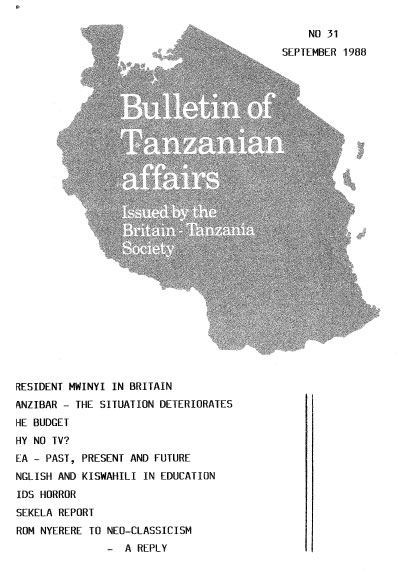
TA 31 cover

President Mwinyi in Britain
Zanzibar – The Situation Deteriorates
The Budget
Why No TV ?
Tea – Past, Present and Future
English and Kiswahili in Education
AIDS Horror
Nsekela Report
From Nyerere to Neo-Classicism – A Reply

PRESIDENT MWINYI IN BRITAIN

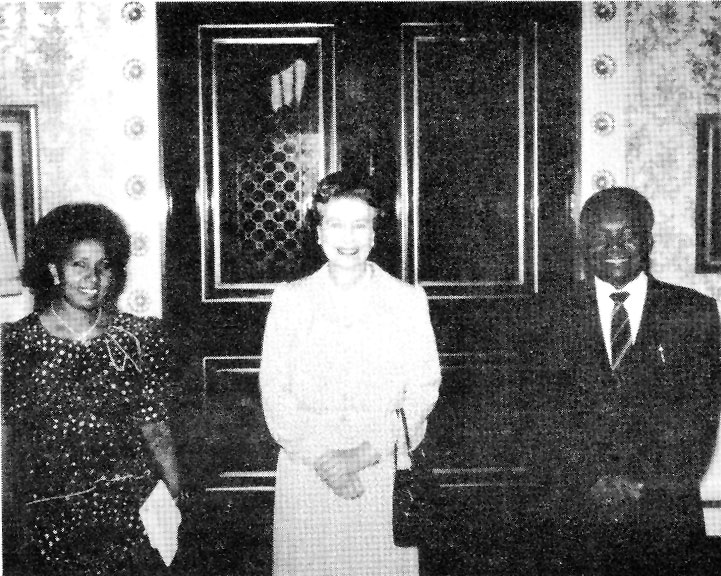
President Mwinyi and his wife with HM Queen Elizabeth

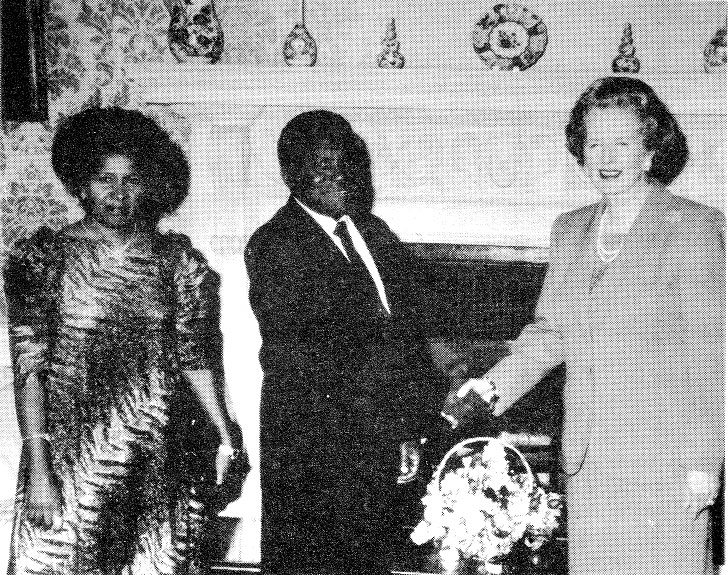
President Mwinyi and his wife with Prime Minister Margaret Thatcher

It wasn’t a State Visit. No red carpets and Royal Family at Victoria Station. No carriage procession along the Mall.

But it was the very next best thing. An official visit (from June 6th to 10th, 1988) at the invitation of the British Government. And, from all accounts, President Mwinyi received a ‘right royal’ welcome. The visit was on similar lines to the farewell visit which Mwalimu Julius Nyerere made in March 1985.

PROFILE OF PRESIDENT MWINYI
Tanzania’s President Ali Hassan Mwinyi remains largely unknown outside his own country. Unlike his charismatic predecessor, Mwalimu Julius Nyerere, Mwinyi has done little travelling abroad; and even when he attended his first Commonwealth Conference last year he remained silent throughout the meeting. ‘I am a new boy and I would like to learn and listen’ he told me when I remarked on his silence.

Mwinyi has been characterised as playing two opposite roles; some say he is merely a placeman for Nyerere; others claim that he is determined to unscramble the socialist institutions created by Nyerere. Placeman or Antagonist? The answer is that Mwinyi is neither of these. He is devoted to Nyerere and an ardent believer in the kind of egalitarian socialism which his predecessor has sought to make the national ethic of Tanzania; but he is also independent-minded and, after consultation with his colleagues, he makes his own decisions.

Because he is so short, (just over five feet), modest, and rather reticent in conversation with those he doesn’t know well, it is easy to overlook the true stature of Nyerere’s successor.

Mwinyi has described himself as ‘a government official duty-bound to the public’. Although not a vanguard leader, this self-denigration as a super-civil servant does not do justice to his achievements in the first 30 months of his presidency.

He acted decisively in the way he completed the long drawn-out negotiations with the IMF in 1986 and has toughly defended his agreement against critics in the ruling party.

He has brought a new smack of authority to the running of the bureacracy and in fighting the incipient corruption that has been building up in the country. Discipline in the civil service became much tougher; obstructive senior officials were firmly dealt with; and the entire administration was made more efficient.

Like Nyerere he has been frank in admitting failures in the system and in publicly criticising the weaknesses that have become so manifest.
Mwinyi’s main political problem at present derives from the continuing troubles in Zanzibar from where he originates. Dissidents on the Isles – some of whom are determined to secure their secession from the mainland and to break up the Union – have proven hard to control despite the recent tough action in expelling seven senior government officials from the ruling party.
Colin Legum

THE VISIT
Britain’s High Commissioner in Tanzania, who accompanied the President throughout his visit, has kindly described, succinctly, for the Bulletin, all that happened during the official part of the visit.

‘Although President Mwinyi had made official visits to neighbouring countries in Africa, and to a few Asian countries, this was his first one to Europe. As such, it is being generally interpreted as a mark of a special relationship between Britain and Tanzania. The way had been prepared by Deputy Prime Minister Salim Salim, who came to London last November and by Finance Minister Cleopa Msuya who was here in March. The Daily News commented that President Mwinyi “spent five good days in Britain”, which “will go a long way in cementing relations between Tanzania and Britain.”

President Mwinyi was given lunch by the Her Majesty the Queen at Buckingham Palace and inspected a Guard of honour of the welsh Guards before calling on the Prime Minister, and dining at 10 Downing Street. He was entertained at a Government dinner at Lancaster House, at the Mansion House by the Lord Mayor and at the Royal Commonwealth Society at a joint meeting of the RCS, Britain-Tanzania Society and the Royal African Society. He also met members of the East African Association, and visited Brooke Bond, Booker Agriculture International, British Aerospace and the Overseas Natural Resources Development Institute (ONDRI). The Chairman of the Britain-Tanzania Society and senior officers called on him at his hotel. The formal part of the visit finished with a very happy reception at the Residence of the High Commissioner for Tanzania in Highgate. Mama Sitti carried out a separate programme which included the hospital for Sick Children in Great Ormond St., where a number of Tanzanian children have been treated, and where she made a donation to the wishing well appeal.

In his speeches to the East African Association, the Royal Commonwealth Society and at the Lord Mayor’s luncheon, President Mwinyj gave a frank account of the economic problems facing Tanzania, thanked donors for their help and warmly invited new investment particularly in sectors that would earn foreign exchange such as agricultural exports, natural resources and tourism. He said that there was ample room for both public and private enterprise; and particularly for joint ventures between the two. He explained that because of the present shortage of foreign exchange it was not possible at the moment to externalise some of the earnings; but the Government would honour their obligation to do so as resources allowed.

In her after dinner speech, Mrs Thatcher told President Mwinyi that Britain sympathised with the difficult economic problems which Tanzania is facing and admired the way in which he is now tackling them. She expressed the hope that Tanzania would remain in agreement with the IMF;
and pledged a further £10 million aid, to add to the £70 million Britain had already pledged over the past two years in support of the Economic Reform Programme.

The highlight of the visits outside London was a lively presentation at ONDRI on the larger grain borer (a major pest in Tanzania) and on other subjects relevant to Tanzanian agriculture. These included a practical cooking demonstration of recipes for sorghum. Booker Agriculture’s Brown Candover farm impressed the_ party; and they were Interested to see Tanzanian tea at Brooke Bond’s factory. President Mwinyi stayed on in London for two weeks after the end of his official visit for medical consultations’.

During this extended period Tanzanians from all over Britain were able to meet their President at a packed meeting organised by the Tanzania Association at the Royal Commonwealth Society (on June 12, 1988).

The language was Kiswahili and President Mwinyi was on top form. The meeting consisted of questions and answers and was scheduled to last two hours but went on much longer.

The President began by saying that he was sure that what people wanted to know was how things were back home in Tanzania. His answer was short and to the point. There had been good rains in the North and the South (not so good on the coast) “but there is enough to eat” Loud applause.

He then spoke for 25 minutes about the situation in Zanzibar. He explained the historical background to the recent tragic killings (see below) and how, for many years, Zanzibar had had a tough post- revolutionary government which had had to restrict citizen’s freedom. Now, suddenly, Zanzibar was free. It had got too much freedom too soon. And some people were abusing that freedom.

Questions ranged far and wide – tax, devaluation, commerce, tourism, housing, the idea of a freeport, cattle being allowed to wander uncontrolled in the streets, nationalisation, education…. The atmosphere was very good humoured. The President gave long and detailed replies to all questions and would not allow the Chairman of the meeting to rule out any question asked. He seemed to speak with complete assurance, only rarely calling on his colleagues on points of detail, and his answers were always totally pragmatic. Some of his oratorical gestures were almost reminiscent of Mwalimu himself.

But there was also drama. One Zanzibari said that he did not agree that the islanders were gorged with freedom. “They are free only as far as the ruling party lets them be” he insisted. For example, should the islanders wish to form a second party would the President let them? The revolution of 1964 and the bullying by the first post-revolutionary government had opened many bad wounds the President replied. More time was needed for them to heal. When the time was right, the ruling party and the government would not stand in the way of another party on the islands. But the questioner was not at all satisfied. He was eventually only prepared to resume his seat under pressure from the audience and on the understanding that he could see the President afterwards.

And Tanzania’s High Commissioner in London had a very tough time indeed on the question of delay in the issuing of passports. Africa Events summarised this final meeting well. It wrote: “The President charmed them off their legs with the dazzle of an instant smile and the homespun wit of a Kiswahili proverb” – Editor

TEA – THE PAST, PRESENT AND LIKELY FUTURE

TEA – THE PAST, PRESENT AND LIKELY FUTURE OF TANZANIA’S THIRD LARGEST AGRICULTURAL FOREIGN EXCHANGE EARNER

The Past
The first experimental tea was planted in 1904 by German settlers at the Agricultural Research Station at Amani, near Tanga and at the Kyimbila Mission near Tukuyu. The first estate was developed by a Mr. C. Gee in the Usambaras in 1926. A land development survey in 1929 recommended that tea should replace coffee in the Southern Highlands and a Tea Officer was appointed. Free seed was distributed to interested settlers between 1930 and 1934 and a small tea factory was opened in Mufindi in 1930. By 1934 1,000 hectares had been planted which produced 20 tonnes of processed tea. 9.3 tonnes were exported earning a revenue of £1,150. The tea industry had begun.

By 1938 tea production had reached 200 tonnes. During the Second World War many of the German tea planters had been interned and their estates taken over by the British Custodian of Enemy Property. The Custodian subsequently leased them to the Tanganyika Tea Company, a subsidiary of Brooke Bond Ltd. By 1956 production had increased to about 1,700 tons in Mufindi, 450 tonnes in Tukuyu and 740 tonnes in the Usambaras.

Until independence in 1961 tea production was wholly in the hands of foreign companies, or private estates. Then began a rapid development of production by smallholders.

Smallholder Tea
By 1934 there were an estimated 28,700 farmers producing 4,000 tonnes of processed tea from about 9,000 ha. Most smallholder grown tea is individually managed and is planted either in isolated patches or within a larger block comprising all the tea from one village. The average holding is about 0.3 hectares, the largest being about 5 hectares. Much of the tea is clonal.

Fertiliser and herbicides are supplied by Kereku, the Cooperative Union and these inputs are paid for by a flat rate levy on all green leaf sold to the Tanzania Tea Authority (which was established in 1968 and manages the planting and processing).

The current annual average yield achieved by smallholders is 400 to 500kg ha of processed tea, These yields could higher be if some of the social and infrastructural constraints to production were removed. These include late delivery and application of fertiliser, unreliable transport and delayed payment for green leaf.

The Present

Today, Tanzania produces 15-18,000 tonnes of processed tea annually from a planted area of around 19,000 ha. Only Kenya and Malawi in Africa produce more. About 75% of the production is exported and tea has become the third largest foreign exchange generator in the Tanzanian agricultural sector.

Tea Estates
The three main foreign companies producing tea in Tanzania are Brooke Bond Tanzania Ltd, George Williamson Tanzania Ltd., and the Mufindi Tea Company Ltd. which together manage some 4,500 ha in the Southern Highlands. They produce about 10,000 tonnes of tea each year. Other estates are privately owned, while some of those taken over by the Government in the 1970’s are now reverting to private ownership. Others are being run as joint venture companies between Government and an outside management/investment agency such as the Commonwealth Development Corporation.

A large proportion of estate tea was originally propagated from seed and is therefore genetically diverse. Since about 1970 however most new plantings and all in-fillings have been with clonal plants either selected locally or imported from Kenya or Malawi. The productivity of certain tea estates has risen considerably over the last thirty years. For example, from 1955 to 1970 average yields increased at the Kilima estate in Mufindi from 600 to just under 1,000 kg of made tea per ha. This was partly due to increased fertiliser applications, a change in the type of fertiliser used, and replacement of hand weeding by herbicides.

During the late 1960’s and early 1970’s shade trees were removed and in 1971 irrigation was introduced on a commercial scale. By the 1980’s yields (averaged over a four year pruning cycle) had reached 2,000 kg, per ha. Since 1980 yield increases have been less dramatic although in 1986 Brooke Bond Tanzania produced, on some 2,000 ha, an average yield of 2,412 kg per ha. Contributing to these increased yields have been changes in harvesting policy; for example three leaves and a bud being plucked instead of two leaves and a bud, and the introduction of ‘scheme plucking’ in which individuals are given responsibility for harvesting their own small area of tea (compared with traditional plucking by gangs of labourers).

It is fashionable to criticise plantations. They are chastised for occupying land which might otherwise be growing food crops and for using scarce foreign exchange to pay for imports such as fuel and spare parts. Although in some situations there may be some justification for this view, it is one-sided and there are many examples of situations where plantation crops make important contributions to the economy of a country and the welfare of its people. Nevertheless, fluctuations in the world price of commodities can have a big effect; for example, in Tanzania the demise of the sisal industry in the 1960’s and 70’s followed a fall in the world price of sisal. The profitability of the tea industry is similarly sensitive to such price changes.

Constraints to production
The major factors constraining production of tea, as in other agricultural industries in Tanzania, are foreign exchange restrictions and, until recently, artificially high exchange rates. There are shortages of fuel, equipment, spare parts, fertilisers, and electricity for drying and for irrigation pumps, which cause estates to keep high levels of stock in order to maintain production throughout the year. Shortage of people prepared to pluck tea has been another problem especially when there were no consumer goods to be bought in the shops.

Tea Research
Until 1978 research support for the industry was provided by the Tea Research Institute of East Africa with its sub-station in Amani, Tanzania but this was subsequently broken up. Although cultural trials at Amani have been recorded since then little new research has been undertaken. However, in 1986 the Federal Republic of Germany provided money to buy a farm in Mufindi which is to become the headquarters of a new Tanzanian Tea Research Institute which is being funded by the Tanzania Agricultural Research Organisation (TARO) through a cess on all tea sales. A study of the factors which have contributed to the increase in yields of tea in the Mufindi district in the last 15 years is being undertaken by Silsoe College in Britain by the authors of this article.

Marketing
About 70% of tea production is exported in bulk either through the London tea auction (30%) or by direct contract sales (40%). Internal sales represent about 25% of production; the popular varieties being Green Label, Simba Chaia and Siftings. Consumption within Tanzania is increasing slowly and now averages 0.2 kg per head of the population compared with 3.1 kg in Britain.

Labelled brands for export are Safari, Kilimanjaro and African Pride sold in attractive 100, 250 or 500 g packs.
Tanzania stopped importing tea in 1979. Of the tea exported about 60% goes to the UK. The Sudan comes second and other important markets include Ireland, Canada, Pakistan, the USA, Somalia, W. Germany, the Netherlands and Ethiopia.

The Future

The tea industry has been going through a difficult period. In the estate sector there are soon going to be problems of continuity with many expatriate senior managers approaching retirement age. Recruiting qualified Tanzanian staff is difficult because the estates cannot reward them adequately for the responsibility they are charged with or for the necessity of living away from the main towns. There is also a lack of adequate training at all levels of the industry and an urgent need to establish a viable and relevant research and extension programme staffed by well qualified people.

However, during the last year confidence has increased despite recent reductions in the world price of tea. This is partly due to changes in government economic policies and to devaluation which has led to new investments and expansion plans. Given that this new-found confidence is supported by real improvements in the well-being and living standards of all those associated with the industry, then the tea industry seems set to develop again in a positive way.
M.K.V. Carr
William Stephens
T.C.E. Congdon

Dr. M.K.V. CARR is Head of Agricultural Water Management at Silsoe College. He was in charge of the Ngwazi Irrigation Unit of the Mufindi Station of the Tea Research Institute of East Africa from 1966 to 1971.

Mr. T.C.E. CONGDON is the Estates Director of Brooke Bond, Tanzania Ltd. and has worked in Mufindi for over 30 years.

Mr. WILLIAM STEPHENS is a Tea Research Officer with the joint Tanzania Tea Authority, Brooke Bond, ODA Tea Project.