
BUSINESS NEWS

Exchange Rates (December 1):
US Dollar = T Shs 605-615
£ Sterling = T Shs 850-1000

Although there was some opposition and there had been delays in presenting the matter to parliament the Bill ending the 29- year old state MONOPOLY OF INSURANCE was finally passed on November 5. The National Insurance Company (NIC) and the Zanzibar Insurance Company are to remain wholly owned by the two governments but they have been given two years ‘to clean their slates’ – Daily News.

The Tanzania Revenue Authority has begun publishing lists of registered TAX CONSULTANTS, the only persons authorised to offer advice on taxation matters. Persons who have been refused registration have been instructed to stop practising immediately – Business Times.

The LOANS AND ADVANCES REALISATION TRUST of Tanzania which was formed in 1991 to recover the bad debts of 93 firms (with a total debt to banks of $45 million) has brought in $9.0 million from sale of the assets of 59 of the firms – the East African.

The National Agricultural and Food Corporation (NAFCO) which has a new board of directors is now producing 50% of Tanzania’s requirements of WHEAT. with 38,000 tonnes in stock, the Chairman requested the government to stop importation of foreign wheat which was destroying NAFCO’s market Daily News.

The government has repaid £13.6 million to the Commonwealth Development Corporation (CDC) out of a £20.0 million LOAN RESCHEDULED in 1990. CDC disbursed £8.0 million in 1995 for investments in power generation, agro-processing, tourism and financial institutions – Business Times

FUEL PRICES were increased by about 6% on September 1 due to the dwindling value of the shilling and increased prices of crude oil. Regular gasoline went up from Shs 335 to Shs 350 per litre – Daily News.

Five NEW COMMERCIAL BANKS were due to open before the end of 1996 to add to the fifteen already operating. The new banks are the Exim Bank, the Wall Street Banking Corporation, savings and Finance Bank, The Akiba Commercial Bank and the Mercantile Bank of Pakistan – East African.

From January 1, 1997 the MONOPOLY ON THE IMPORTATION OF REFINED PETROLEUM PRODUCTS held by the Tanzania Petroleum Development Corporation (TPDC) is to be removed. Tanzania has long opposed this move which the World Bank had been pressing for (the refinery was considered outdated and inefficient) because it considered the refinery as of strategic economic importance. It was hoped that this change in policy would reinforce international confidence in President Mkapa’s commitment to free market economic policies – Africa Analysis Tanzania is to benefit from THREE NEW CREDITS from the World Bank/International Development Association (IDA): $26.3 mi 11 ion to improve the management of water resources; $ 31.1 million for the second phase of a national agricultural extension project and $35 million for Lake victoria to help conserve its biodiversity and genetic resources; this project includes assistance to buy equipment for 25 to 30 new irrigation networks and moves to streamline the operations of organisations managing the Pangani and Rufiji river basins – World Bank News.

Tanzania Breweries Ltd. (TBL) whose production went up 56% in 1995 following its entry into a JOINT VENTURE AGREEMENT with South Africa/s Indol International, was hoping that by Christmas 1996 its best selling brand ‘Safari Lager’ would be on sale in Kenya. It has also started selling on the local market a new brand with an alcohol content of 4.45% per half litre bottle – ‘Kilimanjaro Premium Lager/. Tanzania consumes some 20 million crates per year of which half comes from TBL, a quarter from Kenya and the rest from smaller producers – the East African.

Zanzibar could become an OFF-SHORE BANKING CENTRE – the first such tax haven in Africa. A locally registered mining company, Tanzalite International, is said to be in discussion with the Zanzibar Investment Promotion Agency on the possibilities – Business Times.

Dar es Salaam held its first MOTOR SHOW from October 13 organised by the 21-member Tanzania Motor Traders Association (TMTA). Chairman Pravin Mevada said that it had been a success and business enquiries had been received. Asked about possible future car assembly in Tanzania Mr Mevada said that with current sales volumes it was unlikely to be economic. The Vice-Chairman of the TMTA has criticised what he described as the ‘dumping’ of second hand cars; Tanzania imported only 4,600 new cars in 1995 compared with 41,400 second hand cars. – Daily News and the Express.

There was a drop in COFFEE PRODUCTION in Tanzania in the 1996/97 season about 42,000 tonnes compared with 53,000 tonnes in the previous season. Regional figures: Mbeya, Mbozi, Mbinga and Songea 12,000 tonnes; Kilimanjaro about 15,500; Bukoba some 13,000 tonnes. Planting of new seedlings was necessary if production was to be revived – the East African (November 11).
THE 1996/97 BUDGET

Tanzania’s Finance Minister, Professor Simon Mbilinyi, said in his budget speech on June 20 that government would spend Shs 758,896 million in 1996/97 compared with estimates of Shs 631,906 million in the previous year – an increase of 20.8%. Government would collect Shs 550,192 million domestic revenue; the balance of Shs 208,704 million would be raised through a series of sources which included foreign loans and grants (Shs 187,537 million – an optimistic figure, non-bank borrowing (Shs 24,256 million), additional revenue from taxes and nontax revenue (Shs 13,563 million). There are no plans for ‘bank borrowing’ which is really equivalent to printing money. He said that he had two main aims in his 1996/97 budget – to broaden the tax base and to protect local industries. Shs 40 out of every Shs 100 of expenditure was to service foreign debt amounting to seven billion dollars. This would mean shedding 200 out of 1,500 development projects.

Earlier, Planning Minister of State Daniel Yona had stated that he was optimistic about restoring macro-economic stability by lowering the rate of inflation from 23.5% to below 10% within two years; exports had gone up from $519 million to $683 million last year but the government had had to borrow Shs 86.4 billion compared with Shs 56.8 billion the previous year to finance the budget deficit.

HIGHLIGHTS OF THE BUDGET

– increase in the minimum wage for the civil service from Shs 17,000 to Shs 30,000 but present allowances are consolidated in the new rates and income tax will be charged;

– higher taxes on imported beer; local beer tax remains at Shs 280; beer from the Common Market for Eastern and Southern Africa (COMESA) countries Shs 345 per litre; from other countries Shs 745; Konyagi up from Shs 300 to Shs 400 per litre; imported spirits from Shs 300 to Shs 500; soft drinks from Shs 32/80 to Shs 34; cigarettes up by 20%;

– to protect the domestic textile industry higher taxes on imported woven fabrics and garments;

– increase of 20% on registration and transfer of motor vehicles;

– to help education substantial reduction in duty on packaging materials; abolition of duty and sales tax on newsprint used for printing newspapers, books and exercise books used for educational purposes – increases in duty on completely built buses, lorries and bicycles; sales tax on local tyres and on computers reduced from 25% and 30% respectively to 10%;

– reintroduction of tax on traditional exports including minerals:

– 15% income tax on landlords charging more than Shs 500,000 per month

– new taxes on security services, car rentals, air charters, quantity surveying, private valuers, driving schools, reworked jewellery;

– tax abolished on goods imported by religious institutions for educational, health and water supply projects;

REACTIONS

The budget was criticised by many in the business community which had itself prepared detailed budget proposals for the Minister’s consideration. They had proposed doing away with a myriad of taxes which cost more to administer than the benefit they brought; to introduce punitive measures for those breaking the law; give an amnesty for earlier defaulters because their cases could clog up the courts for years and cause yet more corruption; and encourage by tax incentive new investment in priority areas. The Business Times expressed the disappointment of the business community – ‘the difference between this budget and past budgets is that the business community was interested in what the Minister of Finance was going to say. This was the first time that there was a government which actually meant it when it said that it wanted to fight corruption, encourage the free market and the private sector. In the past Ministers of Finance had pretended that they were administering a budget and businessmen had pretended to pay their dues. But this budget was too conservative, designed primarily to appease the IMF and World Bank and lacked incentive for investors.

THE DONOR CONFERENCE IN PARIS

At the Consultative Group meeting in Paris in late July donor nations pledged about $1.2 billion in aid ($200 million more than originally planned) of which about $560 million could be made available during 19976/77. Delegates welcomed the progress that had been made during the second half of the 1996 financial year with structural reforms and the start made in restoring fiscal stability. But there was some ambiguity in the statement made at the end of the meeting. Specific conditions were laid down before the aid could start being disbursed. These included sustaining macro-economic and fiscal stability, further progress in reform and measurable improvements in governance (presumably in Zanzibar). A particularly contentious issue was the liberalisation and privatisation of the utility companies.

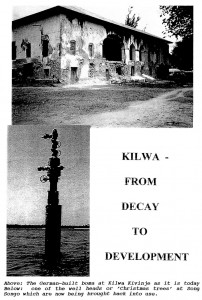
KILWA – FROM DECAY TO DEVELOPMENT

Kilwa 1996

Kilwa 1996

Above: The German-built boma at Kilwa Kivinje as it is today Below: one of the well heads or ‘Christmas trees’ at Songo Sonqo which are now being brought back into use.

Historic Kilwa Kisiwani, decaying Kilwa Kivinje, small town Kilwa Masoko with its unusual little market and the nearby Songo Songo island may never be the same again in the light of all that is now going on in this long neglected part of Tanzania:

– President Mkapa has made a promise that the main road from Dar es Salaam to Kilwa, which must be one of the worst in the world, will be fixed during his term in office;

– If it is, the present occasional visitor to the ancient ruins on the island could become more like a flood because the excavations of the ruins at Kilwa Kisiwani remain in good condition and full of interest;

– a rehabilitated and expanding fish freezing and packing plant at Kilwa Masoko could, if the local fishermen respond and if the government can gain control of the illegal fishing now taking place, benefit thousands of local fisherman all along the coast;

– a long planned fertiliser manufacturing plant – the Kilwa Ammonia Company (KILAMCO) appears to be back on the drawing board; Minister of Energy and Minerals William F Shija announced in August that discussions were continuing with M W Kellog of the USA and IFFCO of India on possible financing because the biggest development of all – the Songo Songo ‘Gas to Electricity project’ is now fully financed and being developed apace.

– new efforts are being made by an Irish company which has taken over exploration following the numerous efforts over the years of such companies as BP, AGIP, AMOCO Shell, Shell Company to find viable quantities of petroleum through two wells being drilled at Mandawa, 30 kms inland from Kilwa; drilling equipment has been flown in by helicopter.

But visitors to Kilwa Kivinje must be saddened by the sight of a town seemingly forgotten by the world. The main street comprises dirty and derelict buildings on both sides of the road but the saddest sight of all is the old German Boma. Heavy rain earlier this year caused further damage to the building which now looks forlorn indeed. The old mango tree just outside town where the Germans hanged leaders of the Maji Maji rebellion was burnt down last year but the government has replaced it with a small monument.

Following the collapse of a parastatal fishing company and the failure of the enterprise which succeeded it, a third attempt to establish a viable cleaning, processing and freezing plant is now under way at Kilwa Masoko and is showing considerable promise. Seithmar Ocean Products Ltd., the most important local industry, is employing 100 people and is shipping significant quantities of prawns, lobsters, crabs and sea fish to Spain and Portugal. It supplies local fishermen with outboard engines, nets, and ice and then collects the fish they are able to catch. The products then have to travel with difficulty in massive 20-ton refrigerated trucks at -20 degrees C along the appalling road to Dar es Salaam. The operation needs lots more fish; it is also greatly handicapped by the widespread dynamiting of fish stocks by people from outside the area and the government’s inability to stop it.

THE GAS TO ELECTRICITY PROJECT

If all goes well a bright orange smokeless flame at the top of a 100ft. flare stack will pierce the night skies of Songo Songo island later this year and signal the beginning of what must be one of the biggest, if not the biggest, development projects under way in East Africa at the present time. The gas field was discovered in 1974 and later relinquished by AGIP. It was further developed from 1986 to 1985 by the Tanzania Petroleum Development Corporation (TPDC) and 9 wells were dug of which 5 are producers.

The company now formed to develop the field is SONGAS. Its Assistant General Manager Gary Boucher told TA that all the funds needed ($300 million from the World Bank, TransCanada Pipelines, Ocelot Energy Inc., the government and several other donor agencies) were now available, subject to final contracts. Although there had been a six month delay caused by the need to complete a number of supplementary agreements, everything was now ready to start and the whole thing should be completed by the end of 1998.

This complex project will finally bring into use three offshore and two onshore wells. The well heads constructed at the time and known in the trade as ‘Christmas trees’ are likely to have become heavily corroded over the years and the first job, (being undertaken by the Canadian companies Ocelot Tanzania Ltd and TCPL Tanzania Inc. on behalf of TPDC will be to test, repair and increase the tubing size on two wells to increase the gas flow. Then the new company which has been formed to implement the project – SONGAS – will be able to start work on building two 35 million cubic ft. processing units on Songo Songo island; it will construct water and power supplies, roads, an airstrip and wharves on the island; build a 25 km 12″ diameter underwater pipeline to Somanga Funga (bypassing Kilwa to the north – see below); lay a 207 km underground pipeline from there to the Ubungo Power Plant and the Wazo Hill Cement Plant in Dar es Salaam; then will follow the purchase of an additional gas turbine generator to add to the four already owned by TANESCO at Ubungo and thus produce 150 megawatts of electricity to fuel Dar es Salaam’s growing industries. The gas supply is expected to last for at least 50 years.

‘SERIKALI YAONYWA’

‘The Government is Warned’. This was the front-page headline in ‘Taifa Letul on August 11 as indignation about the fact that the gas was to be sent to Dar es Salaam and not used directly for the benefit of the southern Region of Tanzania. Wananchi wa Kusini wasema kunyang’anywa gesi hiyo ni kufyekwa miguu na mikono….Wadai gesi hiyo ni zawadi toka kwa Mungu (Southern people say that to be deprived of this gas is like sweeping away their arms and their legs ….. they claim that this gas is a gift from God) the article went on. TA understands that the reason why the gas has to be piped first to Dar es Salaam and then converted into electricity is the availability in the capital of numerous industries able to use the gas directly – something which does not apply to Kilwa or other parts of the Southern region. But a Rural Village Electrification scheme is envisaged for some time in the future.

David Brewin

BUSINESS NEWS

Exchange rates (August 18): $1 = TShs 612 £1 = TShs 920

World Bank Resident Representative in Tanzania Ronald Brigish told a press conference in May that while the GDP GROWTH in Sub-Saharan Africa averaged 3%, Tanzania was now growing at a rate of 4% p.a. Tanzania had bright prospects and could register economic growth of even 10% like Uganda. The country’s POVERTY was exaggerated, he said. He thought that Tanzanians were probably consuming more than twice the official GDP per capita of $120 p.a. and that the difference was caused because figures for the informal sector, small scale mining and trade were not included in official statistics – Daily News.

Exchange controls by the Central Bank of Tanzania have been removed on the strong recommendation of the IMF. Restrictions on payments and transfers of money whether they be for imports, education, transport, travel or repatriation of investment income were officially removed on July 15 but many observers reacted with caution to the move wondering whether it was in the best interests of the country – East African. The National Assembly ratified on April 24 a 1994 agreement between Tanzania and Britain which gives FAVOURED STATUS to investors from the two countries. The agreement enables the aggrieved party in the case of nationalisation to refer the dispute to the International Centre for Settlement of Investment Disputes or to a special joint arbitration tribunal in the case of other disputes – Daily News.

A USAID STUDY has singled out antiquated socialist-era laws still on the statute book as major impediments to investment. Reference was made to the legal monopoly in grain marketing of the National Milling Corporation even though the government had liberalised marketing through executive directives; these could be contested in court. The stagnation in coffee production was partly due to the Nationalisation Act of 1973 which gave the government powers to seize commercial farms of over 50 acres. Such old laws should be repealed to encourage investors – Business Times.

The new TANZANIA REVENUE AUTHORITY started work on July first. Its Commissioner General is Mr Melickzedec Senare. It is the only body authorised to recommend tax exemptions to the Treasury and is empowered to attach property for auctioning without reference to the courts. It has received a grant of $2.5 million from the USA, $0.49 million from the World Bank and 2.7 million Kroners from Denmark to help with start up costs. The UK firm Coopers and Lybrand assisted it in drawing up its staff scheme of service and remuneration package. World Bank funds are being used for communication equipment to enable it to communicate with all customs posts in the country. At the inaugural ceremony President Mkapa instructed the authority to raise tax collection to an internationally comparable percentage of the GDP. He said that in Tanzania it was only 14.6% compared with 23% in Kenya, 32% in Zimbabwe and 45% in the European Union – Daily and Sunday News.

A 10,000-line computerised DIGITAL TELEPHONE SYSTEM which identifies both fake and genuine subscribers has been installed in Dar es Salaam – Business Times.

The leasing of the SA0 HILLS SAWMILL to a Norwegian company at $198,000 p.a. on May 15 is expected to boost the country’s dwindling wood industry. Nortan AS will pump in $3.4 million for rehabilitation. The parastatal Tanzania Wood Industries Corporation’s (TAWICO) output declined from 21,419 cu.m. in 1991 to 8,515 cu.m. in 1994 and profits turned into losses. The company’s nine other subsidiary companies are to be privatised – East African.

Tanzania has jumped from 16th to 7th position among 20 African countries with the highest income from TOURISM – from 1.3% in 1993 to 2.3% of African tourism revenue in 1994. South Africa, Tunisia and Morocco lead the list – Business Times.
Locally made WINE has virtually disappeared from the market because of the collapse of the Dodoma Wine Company (DOWICO)> The company, which produced a million litres in 1983, has stopped purchasing grapes because of liquidity problems – Business Times.

A Tanzanian company, Superdoll Trailer Manufacturers (STM), has won the International Africa Award which is awarded each year by ‘Editorial’ an international publishing company to companies which produce high quality products and provide good service. Almost 50 companies were represented at the award ceremony in Senegal – Business Times.

CASHEWNUT PRODUCTION has increased dramatically from 17,059 tons in 1990 to 81,000 tons in the 1995/96 season. Farmers are now using sulphur pesticide and improved seeds under the Cashewnut Improvement Programme (CIP) – Daily News.

At a meeting convened on June 18 for the 1,000 strong ‘Tanzania Shop Owners Association1 addressed by the Commissioner of Income Tax, which was designed to allay their FEARS OF THE NEW REVENUE AUTHORITY, less than 50 people turned up; none were from the large Tanzanian Asian membership – Business Times.

At a meeting of the ‘Tanzania-UK Business Group’ in London on July 22 Director General of the Investment Promotion Centre Samuel Sitta revealed that an INVESTORS FORUM was being planned for November 5 to 8 at the Sheraton Hotel, Dar es Salaam; he admitted that the ‘One Stop Investment Centre’ had not yet become a reality but hoped that improved and accelerated procedures for investors would be announced at the conference (Thank you Ron Fennel1 for this item – Ed).

The start of work on prospecting for what is expected to be one of the biggest GOLD MINES in the world in Shinyanga Region is being held up by the need to evict 7,000 illegal miners. They will be relocated to other areas. The company has already spent $3.8 million in initial work in the area – East African.

The Kuwait Fund has agreed to finance a $13.8 million TELECOMMUNICATIONS NETWORK in Zanzibar to be installed by the Tanzania Telecommunications Company and Ericsson AB (Sweden) within 16 months.

The COOPERATIVE AND RURAL DEVELOPMENT BANK (CRDB) was privatised in July. It is now owned by 10,000 individuals, cooperative unions and private companies, each limited to not more than 5% of the shares plus the Danish International Agency (DANIDA) which has 30%. They jointly raised $3.4 million to buy the bank – East African.

BUSINESS NEWS

Exchange rates (April 1): $1 = Shs 548 – 570
£1 = Shs 1510 – 1,600

BANK INTEREST RATES have fallen substantially to an average of 15% and lending rates to 30-35%, following a fall in inflation in January to 26.6% – The East African

Minister of Finance Simon Mbilinyi has announced that the DAR ES SALAAM STOCK EXCHANGE will be launched on September 30,1996

THE BRITISH DEPARTMENT OF TRADE AND INDUSTRY has announced that a high profile British Trade Mission is being organised to go to Tanzania (at the time of the Dar es Salaam International Trade Fair) from June 29 to July 4 and that delegates will be entitled to a grant of £600 towards travel expenses.

Differences within the management of Sutton Resources in Vancouver about the strategy for financing the RICH GOLD AND NICKEL-COBALT HOLDINGS it has at Bulyanhulu and Kabanga-Kagera respectively were reported in January by ‘Africa Analysis1. Sutton President Mike Kenyon was reported as having said that he had been approached by companies in the US, Britain, Australia and Africa about development at Bulyanhulu where gold resources were estimated at 1.5-3.5 million ounces and that a sum of about $130 million, which could be raised, would be needed to develop the mine. Kabanga and Kagera would need a far bigger investment of up to $435 million; this project would be be too big for a small company to take all the way to production. Serious talks had begun with at least two major potential partners.

The PARASTATAL DIVESTITURE PROGRAMME is being accelerated. Starting originally with some 440 parastatals Tanzania had already divested 95 by the end of 1994 and now plans to complete the programme by dealing with 82 in 1996, eight in 1997 and the final four including TANESCO in 1998. One of the biggest deals in 1995 was the joint venture agreement between R J Reynolds Tobacco International which purchased 51% of the shares in the Tanzania Cigarette Company for $55 million. China has presented the Tanzania-Zambia Railway Authority with 30 new passenger coaches valued at Shs 5.40 billion on soft loan terms. This has enabled TAZARA to introduce two new express trains on the Dar es Salaam-Kapiri Moshi route – Daily News.

When new Finance Minister Simon Mbilinyi took over the very difficult task of BALANCING TANZANIA’S BOOKS he inherited from his predecessor the following financial projections for the 1995/96 fiscal year:

Revenue 707 US$ million (16.5% of GDP which represented an increase of 37% compared with the previous year).

Expenditure 901 US$ million (20.6% of GDP and including $221 million for development)

Difference: 194 US$ million

Thus, something had to be done. So, on December 31 a MINIBUDGET was announced which included increases in taxation on business licenses, petrol and diesel, alcohol and tobacco which were aimed at removing the remaining budget deficit. Progress so far? In the first quarter – revenue performance slightly better than estimated; recurrent expenditure $7.8 million more than projections because of the election costs and the introduction of a ‘cash budget system’. Release of substantial donor funds is still held up.

In April 1996 the Government published its BUDGET ESTIMATES FOR 1996/97 which make grim reading and indicate that recurrent expenditure can be increase by only 8.6% (in US$ terms) to $960 million compared with inflation at some 27%. Thus no improvements can be expected in the hard pressed social services sector. Education expenditure as a percentage of total recurrent expenditure will be only 2.1% – an increase of only 0.1% over 1995/96. 2.8% of the budget has been allocated for health. These figures compare with the largest single item – 36% of recurrent expenditure for servicing public debt! Defence claims the next highest amount (Shs 45.8 billion) followed by the Police (Shs20.2 billion) health (Shs 16 billion) and education (Shs 12 billion). No money has been allocated to any parastatal company. Qn the revenue side the Government hopes to collect $976 million. The budget is being planned under the assumptions recently agreed between the Government and the IMF ie. GDP growth 5%; reduction of inflation to 15% – Business Times. The passenger TRAIN SERVICE between Moshi and Voi in Kenya which was suspended 18 years ago after the collapse of the East African Community and the Lake Victoria Boat service from Mwanza to Kisumu were restored in January – Daily News.
The troubled NATIONAL BANK OF COMMERCE’s percentage of nonperforming
loans has increased to 62% over the past year compared with 57% previously but vigorous efforts are being made to recover $240 million owed to the bank. As part of its restructuring programme the bank has sold more than a dozen buildings and is in the process of retrenching some 2,500 staff – East African.

UGANDA’S GREENLAND BANK opened a branch in Tanzania on February 12.

WILLIAMSON DIAMONDS is producing in one month almost the same amount of diamonds as it produced in a year before the new plant was commissioned. 15,226 carats were produced in the whole of 1994 but 44,742 carats were produced between August and December 1995 – Business Times.

TANZANIA AND THE DONORS

In ‘Habari’ the journal of our Society’s sister organisation in Sweden (No.3 of 1995) there is an article entitled “Nordens adoptivland gar kraftgang” (Scandinavia’s adopted country goes backwards). The article notes that Tanzania has received 16 milliard dollars of aid during the past thirty years, but that nevertheless it appears to be as far away as ever from becoming economically self-supporting. The special relationship with the countries of Scandinavia began when Julius Nyerere and Olof Palme together hammered out a programme of growth towards a goal of self-reliance. All the Scandinavian countries contributed generously to this end and there are many evidences of their open-handed treatment of the needs of Tanzania, one of the poorest countries in Africa. In the sixties and seventies, in spite of setbacks, the donor community continued its support, having in mind not only the external nature of many of the adverse influences that had dogged the Tanzanian economy- the two oil price rises, the break-up of the East African Community and the war with Idi Amin – but also the severe drought of the middle seventies and the adverse terms of trade in some of Tanzania’s traditional exports.

During the first twenty years of independence there were certain aspects of the economic situation that at the time ere not clearly understood. First, in spite of strenuous efforts to extend the educational system, a shortage of manpower trained and experienced in certain fields persisted and became more acute as development projects multiplied. Secondly, the critical importance of the maintenance of equipment and infrastructure went largely unrecognised. Thirdly, economic planning often failed to take account of the recurrent cost consequences of investment. The result in many cases was a rapid deterioration of plant and communications, poor economic performance and, in an economy characterised by state enterprise, growing burdens on the budget. The notion that the pace of development depended on the rate at which human and financial resources could be made available did not appear to enter into the calculations of the Government, or, for that matter, of the donors, who tended at that time to compete with one another for scare resources.

The consequences of planning failure can be seen in the educational system itself. In the Five Year Plan for 1969-74 it was envisaged that primary education would be expanded year by year, reaching the goal of Universal Primary Education (UPE) in 1989. The target date was set in accordance with estimates of the rate of growth of the economy, in other words, what could be afforded. In 1975, however, it was decided, in response to the policy of villagisation, apparently without the benefit of cost calculations, to bring forward the date of UPE from 1989 to 1977. The result was an attempted leap forward for which neither adequate funds, nor the necessary trained teachers, could be made available. External shocks, the growing rigidity of the economy and rising inflation put economic growth into reverse i the late seventies. Donors took the view that widespread structural adjustment was needed and sought compliance with a programme of reform mapped out by the International Monetary Fund. The rigid conditionality associated with IMF funding, however, proved unrealistic in a number of countries, sometimes provoking riots, and for a while the proposals of the IMF were resisted. In 1985 amid conditions of continuing economic decline and some softening of the IMF8 s requirements, the Tanzanian Government agreed to follow the prescriptions of the Fund. There followed a resurgence of donor support and growing coordination between donors.

The Government’s structural adjustment programme has brought a number of benefits, notably a resumption of economic growth. But in 1994 it became evident that revenues were flagging and that a growing budget deficit financed by borrowing from the Bank was causing inflation to rise. Serious concern about this trend among the donor community was compounded by the announcement by President Mwinyi on 9th. November 1994 that Shs 70 billion of revenues from import taxes has been lost on account of tax evasion and corruption. Tanzania had earlier been widely regarded hitherto as a country mercifully free from corruption and in President Nyerere’s day strenuous measures were taken against corrupt practices. It was therefore with alarm and shock that the donor countries learned of the extent of corrupt dealings. The consequence has been a suspension of significant parts of the donor programme.

Donor import support was allowed to expire without renewal, creating a critical shortage of foreign exchange. But the most serious consequence lay in shortfall in counterpart funds offered by traders in payment for foreign exchange. For this shortfall has led to a widening of the budget deficit, increased resort to Bank lending and in consequence a rise in inflation. Sweden, once the most generous of the aid donors, was also coming to realise that much project aid had been misdirected, for example for example, in the case of the Mufindi Paper Mill and the imaginative but unsuccessful sister industry programme. Something was going wrong and the Swedish government to put in hand a detailed review of the aid programme. Similar studies were instituted by the Netherlands and Finland.

The Scandinavian reaction reflected not only concern about corruption, but also a recognition that the conditions making for successful aid were most complex. What one writer has called the ‘aid bombardment’ could have negative effects by weakening local effort and encouraging the growth of a dependency culture. It can be argued that Tanzania’s sovereignty has already been impaired by aid amounting to almost half of the GNP and financing and financing a substantial part of the budget deficit and the import bill. Nobody was suggesting that aid should be abolished overnight, but greater care was needed to ensure that the effect was to promote self reliance and, in the long run to publish the necessity for aid. It is unlikely that the donors will resume exactly where they left off.

The approach of elections in October, inevitably led to a pause in new economic initiatives, but it was greatly hoped in donor circles that a strong government, armed with a renewed mandate would reactivate the reform programme. Recent events had set back progress towards a more self-sustaining and balanced economy, which only last February had seemed possible. Inflation, one of the most potent causes of poverty, remained at unacceptably high levels and must be brought under control as a matter of urgency.

With the reform programme again on track, donor aid, including that of the UK, is likely to follow, though not perhaps on the scale reached in recent years. For the donors, a commitment to the reform programme and to resolute measures to contain and wherever possible eradicate corruption will decisively influence their support. The donors for their part will need to understand the severe practical difficulties faced by the Tanzanian authorities – the shortage of trained personnel, the effects of population growth, the complexity of necessary changes, such as those in the banking system, and the political repercussions of civil service reform, not to mention the extreme sensitivity of a small economy to external influences and the vagaries of climate. It is also necessary to remember that corruption feeds on inflation and that the control of corruption is likely to be frustrated unless inflation is brought under control.

Above all the situation calls for a renewal of mutual confidence, which has been damaged by recent events. At the time of writing the signs were encouraging. The Netherlands renewed its contribution to import support in November and it is likely that other donors will do likewise following the election of the new President and evidence of a stern and consistent stand against corruption. Import tax evasion has been investigated by the Controller and Auditor General on the instructions of the former President Mwinyi. Prosecutions and dismissals have followed, many of the bonded warehoused have been closed and substantial unpaid taxes have been recovered. In February it was calculated that aid in the sum of $1.13 million would be needed for the remainder of 1994-95 and the financial year 1995-96. It no remains to be seen whether the new administration in Dar es Salaam can justify a renewal o support of this order.
Roger Carter

BUSINESS NEWS

Exchange rates (November 24): $1 = Shs 610 – 635
£1 = Shs 920 – 1,020

The National Bank of Commerce increased its INTEREST on lending from 32% to 40% on August 1. The discount rate at which it borrows from the Central Bank is 50.3% – Business Times.

In a major step towards the RE-INTEGRATION OF EAST AFRICA the governors of the central banks of Kenya, Tanzania and Uganda have agreed to make their currencies freely convertible from December 31 1995 – The East African.

The British Council has launched a SERVICE CENTRE in Dar es Salaam containing rooms fitted with business software and communication facilities to assist development project specialists and consultants – Daily News.

The Shs 2.7 billion NATIONAL SHIPPING AGENCIES CCMPANY (NASACO) building, which was opened in February 1993 and which also accommodated the offices of a department of the Commission of Customs and Sales Tax, was gutted by fire on August 17 – Daily News.

The European Union has committed Shs 93 billion under LOME IV for Tanzanian projects in AIDS control, water supplies in Mwanza and Iringa, environmental protection, road rehabilitation and coffee research in the Ruvuma and Mbeya regions, plus general import support – Business Times. Tanzania should have a STOCK EXCHANGE by June 1996 the Director of the new Capital Markets and Securities Authority (CMSA) Dr. Fratern Mboya said recently. It would be able to enhance the liquidity of state-owned firms now being privatised, and would be established with the help of the government but be placed in private hands within three years – Daily News.

A new MINERAL INFORMATION CENTRE has been set up in Dar es Salaam which has computerised most of the geological data collected in the country in the last 100 years, for the benefit of potential investors. It was launched through a World Bank loan and has already been used by over 100 foreign companies – Guardian.

Administrative costs have been slashed at AIR TANZANIA CORPORATION by cutting board members from 10 to 5 – Business Times.

The newly established TANZANIA REVENUE AUTHORITY began work on September 2. It has been designed to stem what was described by an official as the ‘pathetic’ tax administration of the country. The Chairman is Prof. Benno Nduliu who was a director of the Nairobi-based Africa Research Consortium.

A NEW BANK – the Eurafrica Bank – began operations in September, the seventh bank to be established in Tanzania since 1991. Under the chairmanship of Professor Simon Mbilinyi the bank is 30% owned by Banque Belgolaise of Brussels, 20% by the World Bank affiliate the International Finance Corporation and 9% by the Tanzania Development Finance Corporation. It has a staff of 53 Tanzanians and 3 expatriates – The East African.

Another bank – THE AKIBA COMMERCIAL BANK – is in the process of formation. It aims to finance Small and Medium Scale Enterprises (SME’s) and has so far raised capital as follows: Shs 400 million from individual Tanzanians, Shs 275 million from Tanzanian public institutions and Shs 330 from overseas financial institutions. A large Netherlands bank – Rabobank – which has a triple ‘AAA’ rating will manage the Akiba bank in its early stages – Business Times.

Tanzania’s NATIONAL BANK OF COMMERCE is undergoing major restructuring by closing 34 of its 179 branches and trimming its 6,000-man workforce by 46%. The bank hopes to start operating profitably within 18 months after. – Daily News.

Sales from Zanzibar’s highly successful SEAWEED INDUSTRY totalled Shs 492 million last year which compares with only Shs 289 million from tourism. But the employment needs of the seaweed industry are beginning to affect school attendance in the areas where the crop is harvested – Business Times.

BUSINESS NEWS

Exchange Rates (April 1995):
US$ = Shs 605
£ Sterling = Shs 966

The STANDARD BANK INVESTMENT CORPORATION OF SOUTH AFRICA (STANBIC) took over the collapsed Meridien BIAO Bank on June 2 and customers were assured that all their deposits would be safe and due interest would be paid. STANBIC said it would retain most of the 150 members of staff at the three branches in Dar es Salaam and Arusha but not open additional branches. The total losses incurred – $34 million – are being covered by Ministry of Finance Bonds ($18m), the Central Bank ($10m) and STANBIC ($6m) – The Dar es Salaam Guardian (May 3) and Daily News (July 17).

PARASTATAL REFORM was going well the Reform Commission’s Chairman Mr George Mbowe said recently. 95 firms had been divested in the last two years and by the end of this year 145 firms would have been either partly or wholly sold, liquidated or subjected to a performance contract. In some cases production had picked up from zero to 75% of capacity. Very positive results were being seen in the leather, beer, hotel and pharmaceutical industries – Daily News.

The WORLD BANK’S IDA has granted an additional credit of $10.9 million for financial sector reforms and for the restructuring, privatisation and downsizing of three banks including the Bank of Tanzania and for the development of capital markets – World Bank News.

The recent BUSINESS FORUM in Zanzibar attracted 190 participants and was a great success. Of the 90 projects presented 62 have materialised, involving an investment of $81.5 million. “What Singapore is for Asian countries Zanzibar could do for East African countries and activate an Afrodollar market” said Finance Minister Amina Ali. The government has put together an attractive investment package including 100% foreign ownership, exemption from import or sales tax on many importations, a IQ-year tax holiday on dividends and a quota- free environment as far as the export of garments to the US and Europe is concerned – Business Times (July/August),

The World Bank Group’s INTERNATIONAL FINANCE CORPORATION will invest $24.4 million in Tanzania Breweries to help the company to increase output and meet international health, safety and environmental standards – World Bank News (June 1).

A newly formed NGO, the ECONOMIC AND SOCIAL RESEARCH FOUNDATION (ESRF) will conduct at least six studies by the end of next year on the effects of the stabilisation and structural adjustment programmes on Tanzania’s policy reform process – East African (April 17).

The 27-year old NATIONAL INSURANCE CORPORATION (NIC) increased its gross premium income by 30% in 1994 and made Shs 567 million profit before tax compared with Shs 180 million the year before – Daily News (April 19).

TOURIST ARRIVALS last year were 261,395 and earnings totalled $192 million equivalent to 18% of the country’s exports Daily News.

The Government collected Shs 9.1 billion in May as IMPORT DUTY, SALES TAX, AND EXCISE DUTY – the highest ever.

The World Bank has asked Tanzania to de-regulate its OIL INDUSTRY and to close its oil refinery because it is small and inefficient. The government opposes this and has set up a task force to study the matter – East African (April 24).

FINANCIAL STOP PRESS

The Tanzanian Finance Minister arrived in Paris at the end of July to assure the Paris (donors) Club that tax loopholes had been closed and that the country was committed to the reform process. At stake was $1.2 million that Tanzania urgently needs. The government, whose coffers are empty according to the Daily News, has been forced to increase bank borrowing fourfold in 1994. Mr Kikwete said on his return that several donors might soon release funds but other Treasury sources (quoted in the East African) felt that his mission had not been a success and most donors were still withholding aid.

HOUSING BANK CLOSED
It was announced on August 4 that the Government had terminated operations of the Tanzania Housing Bank for what was described as ‘critical deterioration of the financial condition’ of the bank. Depositors accounts were being transferred to the National Bank of Commerce (NBC) and the cooperative and Rural Development Bank. The Government would spend Shs 9 billion to pay depositors, creditors and employees of the defunct bank.

NEW CAPITAL FOR NBC
Earlier, following a crisis statement from the National Bank of Commerce, the Government announced that it was immediately injecting Shs 11 billion of equity capital, seeking joint venture partnerships with foreign commercial banks for NBC’s international banking services and reducing the bank’s urban branch network. The Bank’s management had stated that it had incurred a loss in 1993/94 and that it had a Substantial portfolio of non-performing loans.

THE BUDGET

Tanzania’s 1995/96 budget was unexciting but did clearly aim to win some popularity for the government prior to the elections. The minimum wage was raised and duties on imported foodstuffs and clothing were reduced. The transport sector was hit hard.

The budget proposed a 14.2% increase in expenditure on last year to Shs 627,688 million – Shs 184.7 million foreign component; Shs 27 million in bank loans. Minister for Finance Jakaya Kikwete said he was assuming that the February pledges of $1 million from donors would be fulfilled. Tax exemption on most capital goods and services enjoyed by foreign investors would be abolished but other tax rates would be adjusted to compensate. Planning Minister Horace Kolimba said that the government would no longer accept foreign aid involving foreign experts; projects would be implemented by Tanzanian experts.

Targets for next year, which many observers considered unrealistic, included a GDP growth of 5%, reduction of inflation to 15%, repayment of Shs 26.8 billion to banks and a self-financing budget by 1997/98. More realistic targets included increasing export levels from $505 million to $606 million.

BUDGET HIGHLIGHTS
* Minimum wage for civil servants raised from Shs 10,000 to Shs 17,500 per month and not taxed; minimum pension to retirees to be raised to Shs 2,000 per month;
* Tax exemption for imports abolished to curb tax evasion; as compensation capital goods and industrial raw materials would be charged only a flat 5% duty instead of 30%; tax holidays intact;
* Sugar, rice, cooking oil and wheat products – 20% import duty (compared with about 50%) and 5% sales tax compared with 30% before; duty on imported clothes reduced from 50% to 30%;
* road toll levy on petrol and diesel up from Shs 40 per litre to Shs 50;
* Vehicle registration fee up from Shs 50,000 to Shs 75,000;
* Foreign companies to pay 20% of profits after tax as ‘branch withholding tax’; corporation tax to be 35% for all (down from 40% for foreign firms);