TANZANIA IN THE MEDIA

EAST AFRICA BEAUTIFULLY PRESENTED
The very attractively produced and richly illustrated Winter ’89/90 issue of the German publication ‘GEO’ was devoted entirely to East Africa. A well-known group of contributors included Ngugi wa Thiong’o looking back sadly on his earlier dream of a unified East Africa, Richard Hall, Editor of ‘Africa Analysis’ on tribalism, Ahmed Rajabu, Zanzibar-born Co-editor of the same journal on the failure of Tanzania’s experiment with African Socialism, Brian Jackson of the ‘Sunday Times’ on the depredations of elephant and rhino poachers and Roger Lewin of ‘New Scientist’ on ‘bones of contention’ about the origins of mankind at Olduvai and other places. There were also a 24-page photographic essay on people, places and political events, and articles on the booming tourist industry of Zanzibar, the Aga Khan’s aid programme, and photographs of the early days of colonialism.

One extract: ‘Zanzibar resembles nothing so much as an animated salad’ .. .. ‘hot spice-filled air would fill the taxi and suddenly Zanzibar smelled like a baked ham and I would feel hungry’ .. .. . ‘ A year or two from now the Aga Khan will open a 200 room Serena Hotel, the first of many such developments. Alas, Zanzibar will not only have tourist attractions, it will also have tourists’.

And another: ‘For East Africa’s ultimate test of courage you need a narrow bridge, just wide enough for one vehicle to pass at a time and a couple of the small buses (matatus) approaching it from opposite sides at speed. If the road approaches the bridge down a steep slope .. this adds immeasurably to the drama …. ‘

And another: ‘The entrepreneurial gifts of the Tanzanians surfaced in the mid-seventies during the austere days of Ujamaa but they now displays themselves with a cockiness that would embarrass even the greediest of Wall Street insider traders . … Tanzanians have to survive’.

7,000 KILOMETRES A YEAR
According to a recent issue of ‘DIALOGUE’ (No 10) a rural woman in Tanzania walks 7,000 kilometres annually for various activities including fetching water and firewood, the two major energy consuming tasks of women.

The article then went on to describe Tanzania’s progress in providing water in the villages.

In 1971 Tanzania launched a twenty-year water supply plan which aimed to provide water for everyone by 1991. However, by 1988 only 48~ of the people had been so provided and it has now been found necessary to extend the final target date to the year 2000. Furthermore, out of a total of 2,211 piped water projects which existed by 1985, 749 needed rehabilitation while 111 were obsolete.

To cope with rehabilitation and development of new supplies each region has now drawn up a Water Master Plan with the help of donor agencies. It is intended that the people, and especially the women, will in future play a leading role in planning, implementation and maintenance of their water projects.

THE BARABAIG AND THE WHEAT PROJECT
The 20-year dispute between Barabaig people in Central Tanzania and a Tanzania/Canada wheat project (covered in Bulletin Nos. 24 of May 1986 and 35 of January 1990) was highlighted in a paper published on March 12th 1990 by ‘AFRICA WATCH’, an organisation which is part of ‘Human Rights Watch’ that also comprises ‘Americas Watch’, ‘Asia Watch’ and ‘Helsinki Watch’.

The paper stated that Prime Minister Joseph Warioba had issued a statutory instrument which attempted to extinguish the traditional rights of pastoralists who are trying to recover part of the land alienated for the wheat scheme. The paper appealed to people to write politely worded letters to the Tanzanian Government asking, amongst other things, for certain charges of criminal trespass to be dropped and for the Government Notice on customary rights to be repealed.

TAZARA RAILWAY ON HOLD
The United Nations publication ‘DEVELOPMENT FORUM’ in its March/ April issue reported that nine traditional Western donor supporters of the Tanzania-Zambia Railway (TAZARA) were withholding further pledges of aid to improve the railway because they think it has ‘a bleak future’. At a conference in Dar es Salaam they gave political reforms emerging in South Africa as the main reason for their reluctance to offer further aid at present.

ADAMSON’S LAST AMBITION ABOUT TO BE REALISED
Tony Fitzjohn is a one-time ‘Boy Tarzan’ who became the protege of the great naturalist George Adamson reported the DAILY TELEGRAPH on February 10th. ‘At the invitation of the Tanzanian Government Fitzjohn is about to supervise a project that was Adamson’s dream at the time of his murder in Kenya last year – the rehabilitation of the Mkomazi Game Reserve. At the recent memorial service for Adamson at St James Church, Piccadilly. a fund was launched in his name. Half the money raised will go to the Mkomazi project, not to rehabilitate lions but to build an airstrip, bush roads and a camp. pay game rangers and workers a living wage and reintroduce two of Tanzania’s most hard pressed animals, the wild dog and the cheetah. Donations can be sent to The George Adamson Memorial Fund, 215E Elgin Avenue, London W9 INH.

CHLOROQUINE FOR ABORTION
DEVELOPMENT FORUM (March-April) published an article by Charles Mbaga in which it was stated that Tanzania’s Ministry of Health had reported that 50 people died last year in Dar es Salaam from overdoses of chloroquine, the anti-malaria drug. 30 of these cases were of women attempting abortion. One doctor was quoted as saying that young women often die in their rooms and their friends or families prefer to hide the cause of death when it is connected to abortion. Many people felt that the time had come to legalise abortion. Others were strongly against such a move.

CONTOUR MAPS
BRITISH OVERSEAS DEVELOPMENT in its April 1990 issue stated that a ten-year project to provide 114 1:50,000 scale contour maps of North East Tanzania, including Dar es Salaam, Moshi, Arusha, Tanga and Mount Kilimanjaro is nearing completion.

£50,000 RAISED FOR ELEPHANTS PRESERVATION
The MAIL ON SUNDAY reported recently on the success of the fund raising campaign it launched in July 1989 to help the Game Rangers in the Mikumi National park to stop the poaching of elephants. The £51,000. raised has provided two Landcruisers, 67 uniforms, a fridge and a microscope for the laboratory. The newly appointed Warden at Mikumi, Mr John Balosi, who has a Masters degree in Elephant Population Dynamics, believes that the war against the poachers is now being won. “I have not seen a single carcass since I’ve been here” he said .. This was because of the governments ‘Operation Uhai’, a massive six-month sweep against the poachers, backed by the army and air force, and because of the new international ban on the sale of ivory.

THE MANDELA OF ZANZIBAR
According to ‘AFRICA ANALYSIS’ MWINYI COMES SIXTH
‘NEW AFRICAN’ has been carrying out a survey amongst its readership to determine the most popular Head of State in Africa. President Mwinyi has been placed high up on the list. Above him came only Robert Mugabe first followed by Kenneth Kaunda, Hosni Mubarak, Muammar Gadaffi and Daniel Arap Moi. There were thirty other Heads of State in the poll. Also significant was the fact that in only three countries did the inhabitants place their own country’s President first – Botswana, Kenya and Tanzania. Readers were also asked if they believed in a single or multi-party system of government. 78% preferred a multi-party system but in Tanzania there was a slight majority for the one party state. Asked what they thought about their own government three quarters of the Tanzanians were satisfied. Three quarters of Ethiopians were not happy. Mr De Klerk of South Africa received a surprisingly high poll rating – he came 20th out of 35.

TANZANIA MOVES INTO IRRADIATION AGE
Tanzania will soon start using irradiation to preserve horticultural and fishery products for export reported’ NEW AFRICAN’ in its February issue. Cobalt 60 rays will be used to emit gamma rays to bombard the products in special chambers in plants to be built at Mwanza and Bagamoyo.

NEW PLANS FOR DENTAL TRAINING
Tanzania has 104 Dental officers and 172 Assistants but, according to AFRICA HEALTH in its January issue, a recent government report has stated that this ratio is all wrong. A better ratio would be six assistants for every officer. Accordingly, in future, no more than 15 dental officers will be trained in anyone year. At present one dentist or assistant serves 151,724 people compared with a global average of 1: 80-90,000.

A SHOP AT PASU MARKET
In an article describing the activities of a Community Training institute at the foot of Mount Kilimanjaro THE BANK’S WORLD, a publication of the World Bank (February 1990) there was a story about a group of 300 women who were never able to register their shop. The shop, which was started by the Women’s organisation UWT In 1983, sells basic commodities (soap, cooking oil, cigarettes etc). The main problem now faced is lack of goods. They cannot get goods because they are not registered as a cooperative. The Cooperative Officer has been asked to come many times but has never come. How about closing the shop? Impossible without calling a meeting of members. But the meeting cannot be called unless the books have been audited. The last meeting was in 1986. In the same market there are now three other shops selling similar goods, and, right next door, another UWT shop opened in 1986.

60 YEARS OF MISSIONARY WORK
Father Robin Lambourn celebrated 60 years of missionary work in Tanzania on February 14th 1990. The Rufiji Leprosy Trust Quarterly Newsletter No 2 reports that World Leprosy Day was celebrated at the Kindwiti Leprosy Village in January by the opening of newly renovated wards, providing conditions more conducive to patient recovery. In a six month trial of ‘Multi-Drug Therapy’, first introduced into Rufiji in May 1987 there has been a spectacular 90% cure rate in the case of the common type of leprosy, Paucibaccillary. The two-year treatment programme for the more severe Multi-bacillary leprosy has yet to be evaluated but the results are not likely to be so good because many patients think they are cured when the symptoms clear up and do not continue the treatment for the full period.

Father Lambourn, in a speech on Leprosy Day reminded villagers of how different Kindwiti is today from when it was first set up by the Germans 100 years ago. In those days patients were forbidden by law to leave the leper colony. Today they were free to come and go and also free from the life sentence which the disease used to represent. But there are other problems. It is reported that lions tend to walk round or through the village about three times a week roaring ‘to let us know they are still there’!

REVIEWS

FILOSOFA’S REPUBLIC. Thursday Msigwa. Pickwick Books. PO Box 925. London W2 IFA. Hardback £11.95. Paperback £5.95.

The flyleaf of this book begins: ‘Every African country needs its founding genius. The Republic of Ngombia is fortunate to have Cicero B Nyayaya, President For As Long As He Likes and originator of the brilliant doctrine of Human Mutualism. Known to million disciples throughout Africa and Scandinavian universities as ‘Fi1isofa’, his world famous Harisha Declaration set forth the principles of Human Mutualism in plain, straightforward language that a child could understand and inspired generations of aid-workers and Dutch volunteers. In this book, Thursday Msigwa, writing through the eyes of a white visitor to Ngombia, shows us the enormous difference that Human Mutualism has made to life in an Ngombian village ….’ Each chapter is headed by a quotation from the writings of the Filosofa. Paul Marchant has written the following review – Editor.

Any worthwhile book prompts the question’ whom is this Intended for? I say ‘book’ advisedly, because it leaves open the further question ‘what sort of book is it?, A novel, I suppose. Or, at least a novella: just 120 pages divided into some dozen un-numbered chapters.

It is essentially a polemic. It paints an exaggerated picture of good intentions at the top and hard and corrupt reality at the bottom. Written in the first person, it is an entertaining account of the experiences of a European expatriate in a recently independent African country. There are no prizes for guessing which country. The style is smooth and attractive and the pseudonymous author has an occasional quite original turn of phrase.

However, it has a number of defects and that raises the question of who the likely readers are, because the value and enjoyment of the book are directly proportionate to the knowledge the reader has of the country in question. This is especially so because of the way in which the author subtly – and not so subtly – is set throughout on demeaning ‘Filosofa’. The tone is set as early as page 4- ‘Filisofa was not against modern inventions like the wheelbarrow’ and quoting as one of his favourite sayings ‘anyone who possessed more than the average man must have stolen it’ not to mention his use of the provocative word ‘masses’ in the Marxist sense.

Comparisons inevitably come to mind: Evelyn Waugh, Chinua Achebe, Joyce Carey, not to mention Candide and the ‘Notes from Overground’ published a few years ago by ‘Tiresias’.

But in comparison with eg ‘Candide’ Msigwa lacks the light touch and is too relentlessly downbeat, sour and sarcastic. He is lacking in both understanding and sympathy. For the former one need only consider his attitude to Father Ordonez, a Spanish missionary with a rather dictatorial approach (‘he had been born in the wrong century; he should have been one of those priests who went to America with the conquistadors to supervise forced conversions’) and remember while doing so the long-term, slowly-slowly-catchee-monkey approach which Cardinal Tan set for the White Fathers a century ago – one should live one’s life by one’s own lights and there is no need to thump the desk and judge success only by the number of people converted to the faith. Expressions of sympathy are rare and grudging in this book as on page 62 where the author ‘revised somewhat’ his opinion of the villagers’ laziness. Self-reliance, a major element in Filosofa’s philosophy, gets its first, (and almost only) mention, over two thirds of the way through the book.

The author occasionally seems to show some slight reservations about what he all too often asserts as incontrovertible, as on page 95 when, stating that the villagers resented being charged by the Mission, he has the grace to add in parenthesis ‘so I am told’. Any of us who have lived any length of time in such a country know only too well how Mission dispensaries were preferred to the government variety precisely because they made a charge.

Msigwa covers his traces well but very occasionally his position (and origins ?) show all too blatantly: ‘rage inwardly as we might’ he writes about some further ‘unjust’ imposition on the poor plantation of which he was an employee, they gave in because they ‘knew it was a condition of permission to trade in Ngombia at all’. So why not go elsewhere to trade? Equally revealing is his use of ‘loyal’ as meaning apparently, ‘useful’ or ‘reliable’. And having said that ‘there was no justice in Ngombia to subvert’, nevertheless, only a page later he has a momentary twinge for the wretched Henry Muhema who, although an upright and Christian long-serving foreman in the company, had been found guilty after a conspiracy by his deputy.

I suppose my reservations about ‘Filosofa’s Republic’ are due to its author’s apparent lack of interest in probing beneath the surface, except when events hit him so squarely between the eyes that even he (like the anti-hero in Stoppard’s ‘Professional Foul’) is forced to question his self righteous assumptions.

A HISTORY OF LEPROSY IN TANZANIA. African Medical and Research Foundation. P. O. Box 30125. Nairobi. 1989.

Leprosy is a chronic inflammatory disease caused by microbacteria and it is a major cause of disability throughout the tropics and subtropics with an estimated 15 million people affected. Despite its feared reputation it is one of the least contagious of the communicable diseases. It has a long incubation period and the disease has an extremely prolonged course.

Knud Balsev in this booklet provides a fascinating insight into the disease in Tanzania and the approach to its treatment and management. In the 1860’s Livingstone and Stanley both reported leprosy as a common disease. Fear of infection led to epilepsy being sufficient grounds for divorce for both husband and wife in the Bahaya tribe of West Lake Region and in Zanzibar. The attitude towards leprosy by the general population in the late nineteenth century was similar to that described in the bible and characterised by fear. Often it was ascribed to sorcery or to the breaking of certain taboos and, although in some places, leprosy was considered as a disgrace, in others there was no stigmatisation. Early missions in Tanzania found that they were caring for many leprosy patients and leprosy camps developed around these missions. The French Holy Ghost Mission in Bagamoyo was founded in 1863 as an orphanage for freed slave children. From 1888 the mission took responsibility for young women with leprosy and the merchant Sewa Haji supported the project financially. With the period of German rule treatment of leprosy became the responsibility of the German colonial government and was carried out in collaboration with missions. The Bethal mission established itself in the Usambaras in 1891. In 1904 the construction of a hospital in Dar es Salaam provided palm thatched wards for the treatment of leprosy patients until 1961.

After the First World War when the British took over the German administered leprosy camps and settlements policy on management changed. Whereas the German administration introduced compulsory segregation the British preferred voluntary segregation. In 1923 an estimated 3,299 patients were in segregated camps. Just before the Second World War the Medical Secretariat of the British Empire Leprosy Relief Organisation visited the country and at that time there were 31 leprosy settlements with a total of 3,400 patients. The war years led to a deterioration in services for leprosy sufferers due to shortage of staff and funds.
However, after the war, an Inter-Territorial Leprosy Specialist was appointed and Dr James Ross-Innes laid the foundation for all later leprosy work on a national scale in Tanganyika. His successor, Dr Harold Wheate, built on this firm foundation and it was during the mid-fifties that ‘Dapsone’ became generally available and the number of patients treated increased dramatically.

When Tanganyika became independent in 1961 the government policy for leprosy control and treatment was pursued with increased activity in a number of areas, including the regional scheme of domiciliary treatment in Kagera Region with the assistance of the Swedish/Norwegian Save the Children organisation and in Geita with input from German and Dutch Leprosy Relief associations. Collaboration between Government and Voluntary agencies proved extremely successful. The Tanzania Leprosy Association was formed in 1978 and came to work closely with the Central Unit of the National Tuberculosis and Leprosy Programme in the Ministry of Health.

Knud Balsev worked in Tanzania between 1970 and 1986 treating patients with leprosy and during that time he collected a wealth of information on the subject and this booklet is the result. It is published one hundred years after the establishment of the first leprosy programme at the Holy Ghost Mission in Bagamoyo. It contains useful statistics and epidemiological data and a very helpful list of references. I recommend it as a fascinating historical document which provides an excellent insight into the development of services to treat this ancient and devastating disease.
Peter Christie

POPULAR INITIATIVES AND LOCAL GOVERNMENT IN TANZANIA. Joel Samoff. The Journal of Developing Areas. October 1989.

In this article Joel Samoff seeks to describe the resurgence of some form of autonomy in local affairs in Tanzania some years after the abolition of District Councils in the mid-1970’s.

It would have been helpful to have been given the background to events leading to the abolition of District Councils in the 1970′ s. These, open to all races, had been in operation for a number of years, even before independence in 1961, and some senior officials were being trained to quite high professional standards, but the overall concept of local government was a British one. This perhaps, combined with the fact that real power at local level was increasingly concentrated in the ruling party committee, undermined the credibility of local councils and their ability to collect their local rate, and so led to bankruptcy. But Mr Samoff thinks that the local party organisation was reinvigorated following the elimination of councils.

A main theme of the article is to discuss whether the abolition of local government and cooperatives was a • mistake’ as Julius Nyerere 1s often reported to have said and to examine what has begun to develop in the meantime. The ‘popular initiatives’ referred to in the title describe movements in the Kilimanjaro District, or region perhaps, to start privately funded secondary schools. This was because government policy for new secondary schools was to favour the less prosperous areas, of which Kilimanjaro is not one. Mr Samoff claims that ‘this effort to expand secondary education – a powerful local initiative – led to the recreation of local government’ .. His article does not however refer in any detail to any other district than Kilimanjaro. Perhaps the strongest claim of this initiative to local legitimacy is that local school committees are reported to level taxes and cesses in their areas to build and run these schools and to have been ‘recognised as legitimate taxing authorities. . . . . by central government and parastatals’.

The article concludes that, in the perspective of the need for the central bureaucratic governing class to consolidate its power, the abolition of local government and cooperatives , and their more recent resurrection, was not a ‘mistake’. The idea that local government could be a strong middle tier of government does not seem to be contemplated. Perhaps that only operates efficiently in a multi-party stat e. Perhaps also the development of effective local institutions at district level was ‘seen as inimical to the functioning of village socialism (Ujamaa). In the 1980’s, we are told, central government began to resurrect local government and cooperatives but no description is given of the form they are now taking. One would have had greater confidence had the article’s information been ostensibly based on more widely drawn information. There are only references to one district and that hardly representative of a highly varied country. Perhaps other writers can widen the perspective, and even report on what forms the supposed revival of local government is taking.
Simon Hardwick

ECONOMIC EVALUATION OF IMPROVED MANAGEMENT FOR ZEBU CATTLE IN NORTHERN TANZANIA. Peter K. Ngategize. Agricultural Systems No 31. 1989.

Peter Ngategize has undertaken to evaluate the potential, in economic terms, of improving the indigenous cattle population in smallholder units, instead of the more popular research target of imported cattle species or cross-bred animals.

He assesses their worth in terms of tried and trusted production parameters, with results establishing frequently reported traits for Zebu cattle such as long calving interval, lengthy returns to oestrus and high age at first calving.
This information acts as the baseline for a hypothetical herd consisting of a collection of smallholder units. The herd model undergoes a simulated growth over 15 years under two systems; the first, with no input improvements and utilising an estimated offtake rate (defined as the number of animals sold as a proportion of the average herd size) of 5%; the second, with minimal input improvements achieved through a farmer training programme and improved effectiveness of dipping and vaccination programmes.

Not surprisingly, Ngategize’s results suggest that the offtake rate could be increased to 7.5% and still allow a stable herd size (with no improvements) and up to 9.3% under the improved system. He also carries out a partial budget analysis of the improved system, revealing a positive net present value and a high internal rate of return; in essence a financial justification for the improvement policy.

Whilst I would strongly support Ngategize for his advocacy of gradual improvement of indigenous livestock with a farming systems approach and minimal injection of capital, his use of simulations and models could be criticised as lacking any foundation in reality.
Offtake rates are commonly used as a measure of efficacy within cattle production systems. The use of this parameter in the analysis should be seen as a guideline only and, as such, it would have been useful to include more comparative values. To put them into perspective, the offtake rate for the world as a whole is 19%, for developed countries 33%, for developing countries 10% and for Africa 12%.

The author himself doubts the validity of aggregating a collection of smallholder units into one herd and realises that the dependancy upon farmer recall for data must introduce significant error.

The utilisation of cost-benefit analysis and economic evaluation is central to project appraisal, but, whilst the results appear encouraging, the limitations of this method are well known and the use of sensitivity analysis at this stage would probably be justified.

The paper is economic in title and content and the author well versed in the manipulation of data. However, the conclusions are very general, and I would welcome a further paper that outlines the specific strategies to increase calving percentage and reduce calf mortality,
which Ngategize says are economically feasible.
Nick Clinch

THE SECOND ECONOMY IN TANZANIA. T. L. Maliyamkono and M. S. D. Bagachwa. ESAURP – Heinemann Kenya. James Currey Ltd. 1990. £ 9.95.

It is estimated that the second economy in Tanzania probably accounts for 30-40% of the GDP. This book sets out to provide reasons for its existence and to analyse its various components. It can be said that it is successful in both these tasks. In fact, the authors are to be congratulated for the comprehensive nature of the evidence they have amassed, and this work can be regarded as an authoritative description, or as near authoritative as one is likely to get, of the overall economic situation in Tanzania in 1988.

The book first outlines Tanzania’s economic history since independence. For the first fifteen years or so after independence in 1961 the economy seemed to be progressing. Growth in per capita GDP was positive. In the period 1970-76 the average net growth was 1.5% per annum. In the latter half of the seventies and the early eighties, the situation turned sour with a vengeance, and per capita income fell by 15% over the period 1976-86. A number of reasons for this are adduced by the authors.

They explain in some detail about the exogenous factors involved including the sharp rise in the oil price, a general deterioration in the terms of trade for agricultural commodities, poor harvests find Tanzania’s successful effort to depose Idi Amin of Uganda. However, the decline in Tanzania’s economic situation was considerably exacerbated by the internal consequences of social and economic management policies pursued since independence; for instance the Ujamaa village collectivisation policy which became compulsory in 1973 and led to a large initial decline in agricultural production. This was compounded by the abolition of private trade for food crops and replacement by trading through cooperatives which proved unable to cope due to lack of suitable management. This system was subsequently revised, but the creation of a regional buying and crop processing parastatal, the National Milling Corporation, ensured, at least in theory, t hat the grain market remained under centralised control . The middle seventies also proved to be a dividing line in the effectiveness and scope of government price control policies. Price controls on cert ain important consumer products instituted in 1967 remained effective until the 1973 oil price shock and the 1973-74 drought resulting in a large rise in the cost of imports which caused the government to form the National Price Commission. By 1978 some 3000 different items were subject to price control. Of course, the administrative resources to tackle this mammoth task were totally inadequate.

This is the background against which the second economy in Tanzania has grown. At the time of writing it accounted for a major part of food crop trading in certain parts of the country and also the trade in small scale export agricultural products such as cardamoms and animal hides and skins. (Trading in food crops has since been thrown open to the private sector). Moreover, the expansion of the administrative apparatus required to run a centralised economy, together with the adverse economic circumstances, has led to a drastic decline in the real value of public sector salaries and the formal wage sector as a whole. An I LO study showed Tanzania experienced a drop of 65% in real wages between 1979 and 1984. Another study shows that in 1985 top level public employees only received salaries in real terms equivalent to one third the 1980 level. The situation has not improved significantly since and means that officials and others remain under compulsive pressure to have other sources of income in order to maintain themselves and their families.

To some extent the authors approach the second economy with mixed sentiments. They are influenced by the pejorative official concept of ‘Ulanguzi’ implying illegality of all unauthorised economic activities outside official control. Of course, the distinction is made between economic gains from anti-social activities such as poaching and corruption and genuine, but unrecorded, economic activities such as small scale market gardening or part-time hairdressing. Unofficial trading, a major economic activity, tends to be regarded as a borderline case. Overall however, the authors accept a positive view of the second economy as a necessary adjunct of the centrally controlled economy. As the private sector increases and the trend towards the relaxation of central economic control continues the definition of the second economy will be increasingly one of the difference between those a activities recorded in official statistics and those which are not. On this basis the World Bank’s latest figure of $180 per capita GNP (i n 1987) should probably be adjusted to a real figure of $240-60 and even higher if the monetary value of the substantial subsistence economy were taken into account.

‘The Second Economy in Tanzania’ must be regarded as essential reading for all those interested in the state of the Tanzanian economy. The wealth of information including 62 statistical tables and graphs represent a commendable effort of compilation. This, together with the accompanying detailed analysis, guided by a high standard of objectivity, represents a considerable achievement in economic exposition.
R. Allen

GRASSROOTS STRATEGIES AND DIRECTED DEVELOPMEMNT IN TANZANIA: THE CASE OF THE FISHING SECTOR. Morja-Liisa Swantz. World Institute for Development and Economics Research. UN University. Helsinki.

This paper, which was presented at a meeting of the African Studies Association in Chicago is concerned with a critical examination of the general direction of development policies and strategies adopted by Tanzania during the 1970’s and the way in which such policies affected the poorest sections of the community. The paper strongly criticises the centralised planning methods used by the government which often ignored the detailed needs, aspirations and capabilities of the artisanal population. The author terms this process’ directed development’ based on ‘planning-from-the-top’ rather than starting the planning process at grasssroots level using background socio-economic surveys and gradually working upwards through district and regional government organisations. Although the fisheries sector is used as an example to describe development trends, In fact, only about 50% of the report deals specifically with fisheries.

The author suggests that the centralised planning process resulted in a major emphasis being placed on modernisation and industrial development which had a detrimental effect on the productivity and standard of living of rural communities.

Within the fisheries sector the discussion is largely restricted to the role of the Mbegani Fisheries Development Centre (MFDC) which was established at a reported cost of US$ 22 million using support from Norway, and the effects of the centre on adjacent fishing communities between Bagamoyo and Dar es Salaam. The main objectives were to increase fish production using new techniques, improve the catch and earning capacity of fishermen, supply trained manpower to the fisheries sector and earn foreign exchange by the sale of surplus fish and luxury marine foods. In reality the over-riding function of the centre was to earn foreign currency by encouraging the development of industrial trawling for prawns for export. This meant that almost all training in fishing techniques was focussed on commercial trawling using a large stern trawler as a training vessel. Clearly the method was totally inappropriate to meet the needs of artisanal fishermen who.se main problems stemmed from the lack of basic fishing gears. Consequently, the centre had little or no positive impact on small-scale fisheries; indeed the author provides evidence of a negative impact on those fishing communities situated close to the centre through loss of access to certain fishing grounds.

A further valid criticism raised by the author concerned the inappropriate training of fisheries extension workers by the centre, again resulting from the bias towards high-technology methods with little regard for the real needs of artisanal fishermen who catch over 90% of the total marine fish production of Tanzania.

The paper goes on to describe the effects of the recent ‘liberalisation’ programme which resulted in an easing of restrictions on imports and encouragement of exports. The main impact on the fisheries sector was an increase in availability of certain gears and out board engines. However, the latter were expensive and unaffordable for the vast majority of fishermen.

From about 1986 important policy changes were made by the government and MFDC resulting in a change in direction of training programmes by increasing their relevance to small-scale fishermen and women and, perhaps more importantly, by the introduction of sales of fishing gears and engines.

The sale of gears proved very successful and had a major positive impact on local fishing communities by increasing the numbers of fishermen and their catches and by the stimulation of greater trade, much of which was undertaken by women. However, the author fails to point out that gears were sold at very low subsidised prices which undoubtedly had an adverse effect on the sale of locally made nets at the factory in Dar es Salaam.

The author concludes that had investment gone into t artisanal sector in the first place rather than into modern high technology fishing and training programmes, then the nation would have been provided not only with sufficient fish to meet its own food requirements but also with surplus for export. This statement is optimistic to say the least, and shows a lack of detailed understanding of the marine fish resource potential of Tanzania. However, a fisheries development project supported by Britain (ODA) in the Southern coast al regions clearly demonstrated that between 1983 and 1987 supply of gears for sale to local fishermen resulted in increased effort and catches.

Important issues not raised in this paper concern the lack of support given to the government fisheries department which has been unable to effectively carry out its recognised duties in collection of statistics, extension, development and research. In the absence of basic fisheries statistics it is not possible to formulate rational development and management programmes. The ODA has attempted to improve the situation in the South by carrying out various resource evaluation studies which form the basis of extension and development programmes. Unfortunately, in the North such programmes are s till lacking.

The author made brief mention of another major problem facing the marine fisheries sector: the widespread illegal use of dynamite to catch fish. The very damaging effects of this method on the coral reef structure which forms the foundation of many fish resources is not disputed. Past attempts to control this irresponsible activity have failed and until firm measures are introduced development will be greatly hindered.

Finally, the author stressed the need for future planning and development processes to start at the grassroots level. Undoubtedly. this would result in improvements in identification of the most appropriate technologies to meet the needs and be within the capability of artisanal fishing communities. James Scullion

POPULATION PRESSURE. THE ENVIRONMENT AND AGRICULTURAL INTENSIFICATION: VARIATIONS ON THE BOSERUP HYPOTHESIS. Urna Lele and Steven W Stone.

ISSUES IN FERTILISER POLICY IN AFRICA. LESSONS FROM DEVELOPMENT PROGRAMMES AND ADJUSTMENT LENDING. 1970-87. Urna Lele, R. E. Christiansen and K Kadiresan.

These two documents cover part of a major World Bank research project conducted under the heading ‘MANAGING AGRICULTURAL DEVELOPMENT IN AFRICA’ (MADIA) which has involved detailed analysis of six East and West African countries including Tanzania. USAID, UKODA, DANIDA, SIDA, the French and German governments and the EC participated. The following review draws out key implications of these studies as they refer to Tanzania – Editor.

This series of studies makes compelling reading for those concerned with agricultural development in Southern Africa.

The overall findings cover such areas as crop yield, biological and chemical inputs, farmers incomes, population density, incentives, land and labour productivity and the increasing scarcity of forest resources. The experience in Tanzania illustrates the benefits foregone of a set of policies that did not stimulate growth in areas of high potential whilst emphasising consumption and welfare oriented efforts in areas of lower productive potential.

In Tanzania about 60% of the population lives on 20% of the land and to remedy this regional imbalance the government has opened up new areas of high potential in the Southern Highlands (Iringa, Mbeya, Ruvuma and Rukwa). Population is concentrated around the Lake Victoria Basin and coffee producing Northeastern Highlands (Arusha, Mara, Mwanza, Shinyanga and Kigoma, both areas of traditionally higher value and higher yielding crops. The attempt to open up the Southern Highlands makes sense in the longer term. In the shod run it has had high opportunity costs. Tanzania has differed from Kenya in not encouraging regional economic growth in line with comparative advantage. Pricing policies did not provide incentives for further intensification, a shift to higher value crops and use of modern inputs in the North. Smallholders, for instance, receive only one third to one half of the world price for dark-fired and sun/air cured tobacco.

Data on fertiliser consumption, regional expenditure pattern and marketed surpluses of maize, tobacco, tea and coffee suggest a clear shift away from the Northeastern and Lake Victoria areas towards the South. Use of inputs follows regional planning more closely than it does population density. Fertiliser consumption in the land abundant South rose from 35,000 tons in 1975 to 91,500 tons in 1987 – representing not less than 70-75% of total fertiliser use even though only 18% of the population lives in these four regions. In the North, where the majority of food and export crops were traditionally grown there was a decline in fertiliser consumption from 22% in 1975 to less than 10% in 1986-87 even though one third of the population resides there.

Production increased in the South but at the cost of declining marketed production in the North. The Southern Highlands doubled its share of total coffee production to 25% in 1981-85 and increased its share of tobacco production from 18% in 1970-74 to 60% in 1982-86. But this was not associated with substantial growth in overall output due to a decline in traditional areas. For instance, coffee production in Arusha/Kilimanjaro regions fell from 26 million tons in 1975 to 20 million tons in 1985.
The fiscal resource constraints encountered by Tanzania illustrate the dilemma of giving regional equity a higher national priority than growth in overall production. Continued growth in the Northeastern Highlands could have financed development in other regions. Recently the macro economic environment has improved. Cooperative and private institutions have begun to make a come back, Production is gradually picking up in the Northeastern Highlands.

Lele et al indicate in their fertiliser paper that use of fertiliser, priced at full cost, is not economic for farmers in Tanzania. Benefit-cost ratios calculated for fertiliser use in 1988 comparing input and output price data
SARUFI MPYA (New Grammar). Mohamed A Mohamed. Press and Publicity Centre. Dar es Salaam. 1990.

This new book is an advanced study of the intricacies of Swahili grammar. Different chapters deal with such subjects as tense patterns, tense affixes, clauses and sentence construction. A reviewer in the ‘Daily News’ writes: ‘Most educated people in Tanzania easily recognise grammatical terms in English eg noun, subject, predicate, pronoun, subject etc. But they will be baffled by such terms as nomina, kitenzi, kiwakilishi, kiima, kishazi etc’ .. The reviewer indicates that that is the reason why this book should be read! – DRB.

DOTTIE. Abdul-Razak Gurnah. Jonathan Cape. £13.95.

The author of this book was born in Zanzibar and educated in Tanzania and the UK. He now works in the University of Kent. The novel is set in England in the 50’s and 60’s and involves Dottie’s efforts to find a confident path through her difficulties. She is isolated from her own culture but not yet part of a new one. She is in some ways a paradigm for most immigrant people. What history can they recall? What history should they recall? She suffers as a member of a subject race coming from a colony to the motherland. What carries her through is her individual fortitude from the BBC programme ‘Bookshelf’ reported by P.J.C. Marchant.

MOUNTAINS OF THE MOON. A new film directed by Bob Rafelson.

Tanzanophiles will hardly be able to resist going to see this film which describes the story of the epic 1854 journeys of Sir Richard Burton, the 19th century explorer and John Hanning Speke to the shores of Lake Tanganyika – the first white men to see the Lake – and the subsequent Journey of Speke to Lake Victoria which he correctly identified as the source of the River Nile. The film has received mixed reviews in the British press. The Bulletin decided to ask for an African point of view. Mr Badou Diop has written as follows – Editor

The history of Western exploration and discoveries, whatever one might think, is inextricable linked with the phenomenon of imperialism and hence colonialism. Therefore the ‘Mountains of the Moon’ will have to be seen in this light.

Whether intentionally or deliberately, the Director Bob Rafelson touches on several familiar problems. Burton and Speke have completely diverse conceptions on what exploration is all about. Burton, we are told to believe, thinks that exploration is not only about teaching the main goal, in this case the Nile, but also having an intense interest in the local people concerned. Speke has the typical view of the majority in Britain at the time that one should not become emotionally involved with the natives.

Back in England after the visit the two explorers were involved in rivalry mainly created by the Royal Geographic Societys to who of the two had the most accurate scientific explanation about the source of the Nile. John Speke is the epitome of the kind of modern British tourist whose aims on holiday include sun and sex.

The film, which is shot in Kenya, is a visual delight even though not in the same league as the other famous Kenyan film ‘Out of Africa’. However, one comes out of ‘Mountains of the Moon’ feeling that a film blessed with such exciting subject matter should have been better. Rafelson seems to lack the authority and erudition to undertake such a heavy enterprise. But Tanzanians should go and see it because it shows an important and historic period in African history.

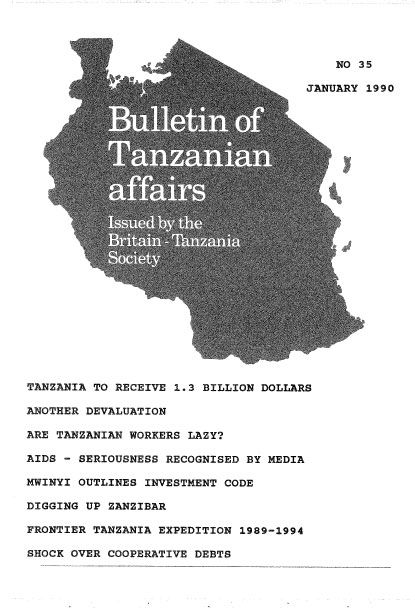
TA ISSUE 35

TA 35 cover

TANZANIA TO RECEIVE 1.3 BILLION DOLLARS
ANOTHER DEVALUATION
ARE TANZANIAN WORKERS LAZY?
AIDS – SERIOUSNESS RECOGNISED BY MEDIA
MWINYI OUTLINES INVESTMENT CODE
DIGGING UP ZANZIBAR
FRONTIER TANZANIA EXPEDITION 1989-1994
SHOCK OVER COOPERATIVE DEBTS

TANZANIA TO RECEIVE US$ 1.3 BILLION

A group representing 14 donor nations and 11 international organisations have indicated that they will provide US$1.3 billion to Tanzania to support the country’s economic adjustment and development programme in 1990.

The Consultative Group for Tanzania meeting at the World Bank’s Paris Office from December 18th to 20th 1989 said a large portion of the aid would be targeted at balance-of-payments support and the country’s social sectors.

The Group praised Tanzania’s progress in implementing its Economic Recovery Programme launched in 1986, noting that policy changes had helped raise agricultural productivity and increased the economic growth rate to about 4% per year.

At the meeting, the Government announced its plans to move ahead with the second phase of its Economic Recovery Programme. Endorsing the plan, the Group said it was pleased that the Government had incorporated a ‘priority social-action programme’ into the overall recovery programme.

The Group emphasised that further action is still needed in improving public-sector management and reforming parastatals. Attention should also be given to additional reforms in the agricultural marketing and cooperative systems and in the financial sector. The Group also supported a stronger role for the private sector in the economy.

The World Bank has published detailed tables indicating how different groups of countries have performed during the decade 1977 to 1988. Tanzania’s Gross National Income Per Capita was (in 1980 US dollars) $300 in 1977 but had fallen to $240 in 1988. Figures for Kenya were $440 in 1977 and $390 in 1988. Tanzania shares with Burkino Faso, Burundi Malawi, Mali, Ethiopia, and Somalia the lowest income amongst 40 Sub-Saharan countries whose estimated incomes are published in the latest World bank tables. Tanzania comes fifth from the bottom. By comparison the 1988 figure for the United States is $14,080 and for the countries of the European Community $11,640 – World Bank News.

DIGGING UP ZANZIBAR

Inscriptions from a prayer niche in the mosque on Tumbatu island.

Of all the things that Zanzibar is famous for, its archaeology is probably not one. Yet for 1989, African archaeology was essentially Zanzibar’s with no less than three major international projects in the Isles. The results of last summers ‘ diggings promise to change much of what we thought we knew about the history of the East African coast. During the British period there was a very ambivalent attitude towards the past. On the one hand careful records were made of the standing antiquities accompanied by some sober and, more often, wild speculation. A museum was built but many of the objects there were poorly catalogued and many coins were lost. Colonial officials did their best to demolish the most important ruins – parts of the Marahubi Palace were taken down in the fifties as unsafe, while only the Revolution in Zanzibar saved the Chake Chake Fort whose fate had been almost sealed by 0 proposed hospital expansion in late 1963. A little archaeology took place at Ras Mkumbu, which Sir J. Gray thought was the ancient city of Kanbalu. Dr James Kirkman showed that he was wrong. After 1963 all research stopped, and responsibility shifted from one Ministry to another. Many of the monuments fell down; a few more were destroyed for their stones.

In 1984 we were invited by the Ministry of Information, Culture and Tourism to undertake a survey of Zanzibar’s archaeological sites and monuments. In collaboration with Abdulrahman M Juma, the Anti qui ties Officer of the Ministry, we found over 60 sites during the next two years. At many of these we dug ‘test pits’ (small holes a metre square) which produce a sequence of pottery and stratigraphy that provide a clear indication of the date range and wealth of the community.

One find was especially spectacular. At Mtambwe Mkuu, a large town of the 11th century in Pemba, which is even mentioned by Arab geographers by the name of Tamby, we found intact a large hoard of gold and silver coins, buried in a cloth pouch. The gold coins were all Fatimid dinars from Egypt, the latest dating to 1066 AD. But the silver coins, which numbered over 2,000, were of greater historical interest. They were locally minted – probably at Mtambwe itself – and give the names of nine local rulers living in the 11th century.

The next stage was detailed mapping and area excavation work. In 1989 three different groups were each allocated a major site. The Ministry itself worked at Unguja Ukuu, with help from SAREC and the Urban Origins Project; the University of Dar es Salaam worked at Pujini in Pemba; we worked with the British Institute in Eastern Africa on Tumbatu island.

Unguja Mkuu may well turn out to be the earliest site on the whole African coast. It covers a massive area of at least 30 hectares, with middens, buried walls, and what appears to be part of a fortification.

A burial site was also excavated with clear evidence of a spear wound in the skull. Abdulrahman Juma was able to identify a wide range of pottery and glass finds, including Chinese Tang Stonewares and very early Islamic moulded wares, possibly as early as the 7th century. Languja is mentioned by Al Jahiz in the 9th century, as one of the most important ports on the coast. Abdulrahman Juma seems to have found it at Unguja Ukuu.

The work at Pujini identified a rather different site, probably dating to the 15th century. Traditions link Pujini with a tyrannical ruler of Pemba, Mdame Mkume, who, among other things, forced the workers who built Pujini to carry the stones on their heads while shuffling on their buttocks. The work here, led by Dr. Adria LaViolette, found no direct archaeological evidence for such practices but a large and quite unique fortress was uncovered. Surrounded by large ramparts and a ditch, a square enclosure contained a number of stone houses, as well as two subterranean chamber s . Such fortifications are very rare before the arrival of firearms on the coast and the only explanation is that Pujini was the product of fantasy.

The third project on Tumbatu attempted to uncover parts of the best preserved medieval town on the islands. Tumbatu is, almost certainly, the Tumbat, mentioned by Yakut as the place where the ruler of the Zanj lived in the 13th century. It is a large town covering 20 hectares with over 40 ruined houses and mounds. There are at least four mosques of which three were discovered last year. In one of the mosques, the mihrab or prayer niche was excavated and found to contain an almost complete inscription collapsed on the floor. This was carved in local coral, using floriate Kufic script. Only one other example of such a script is known from East Africa and that is at Kizimkazi, where it is dated to 500/1107 AD. We are sure that the Tumbatu inscription was by the same craftsman. The style used is very close to recently discovered tombstones from the Persian Gulf port of Siraf, which was the seaport for Shiraz. Here, for the first time, we have some archaeological proof behind the many Shirazi traditions in Zanzibar, which were echoed in modern times, for example, in the name of the Afro-Shirazi Party.

We are sure that 1990 will yield more from, the buried soils of Zanzibar and Pemba where further work is planned at all three sites. Meanwhile, some of the more spectacular finds have already been put on display in the Zanzibar Museum. (Further information is available from the British Institute in Eastern Africa, Pitt Rivers Museum, Oxford OXl 3PP – Editor).
Mark Horton

TANZANIAN WORKERS LAZY?

Tanzanian workers are lazy and unproductive says Tanzania’s National Productivity Council (NPC) quoted in ‘Business News’ on September 29th 1989. The NPC Executive Secretary, Mr Nikubuka Shimwela attributes the trend to a lack of a productive culture in the nation. “People are not serious with work” he said.

According to the Council the nation’s productivity has been falling since 1980 with adverse effects on the national economy. In financial institutions productivity has been declining at an average rate of 3.3% In the manufacturing sector at 6.2%, in the mining sector at 4% and in public administration at 5.5% In cross section interviews on productivity many interviewees have charged that the most unproductive sector is the public administration sector. Civil servants report late for work, one person charged. Some leave their work well before closing time while most spend a considerable amount of time in dubious private ventures during working hours.

NO SAYS MR. KASWAGA
Responding in the Mailbag column of ‘Business News’ a Mr Ben Kaswaga wondered what had happened to workers in recent years. Had the generation of early post-independence workers disappeared? The answer was no he wrote. Many of those Tanzanians were still alive and well. But something or other had happened in their minds.

‘How much productivity can be expected of a Tanzanian who gets up at 5.30 in the morning without even a crumb of boiled cassava for breakfast to make two bus connections at 30 shillings each so as to be in time for work? Can this hungry worker produce much when all he has for lunch is a couple of roasted sweet potatoes to be washed down the throat with, perhaps, one soda because he can’t afford anything better? Can this worker be productive when, at 2.30 pm – tired, underfed and undernourished – he has to make another two bus connections to get back home and arrive there, maybe two hours later ….

The Tanzanian is lazy? True, probably, but that is mainly because he does not eat enough. He does not eat enough because he is not paid enough (or sometimes not at all) because there is low productivity. But there cannot be higher productivity from a demoralised, tired and hungry producer …..

Need we wonder why even that old glorious self-help spirit is now only a thing of the past?’

TANZANIA EXPEDITION 1989-1994 (FRONTIER)

Operating from a small office on the top floor of London’s Fruit and Wool Exchange in the East End and managed by only two persons is the Frontier Tanzania/Society for Environmental Exploration Project which is sending hundreds of British young people to work on environmentally related work in Tanzania.

The project began in July 1989 and already more than a hundred young Britons have been to Tanzania under the project. They claim to have put in 10,000 man days of work so far – equivalent to one person’s effort over a per! od of fort y years. It is hoped to send some 200 young British people to Tanzania each year for the next four years.

Guiding and supporting the young volunteers (average age 22) have been some twenty Tanzanian specialists (including post-graduate students) and twenty five experts from overseas institutions including the world famous author of the book ‘Mammmals of East Africa’ , Jonathan Kingdon.

‘Frontier’ is a collaborative project between the University of Dar es Salaam and the UK based Society for Environmental Exploration(SEE). A Memorandum of Understanding was signed between the two parties on July 12th 1989.

The objectives are defined as to promote and advance field research into environmental issues, implement practical projects designed to maintain or improve the environment and promote the sustainable exploit at ion of natural resources. SEE is a charitable organisation funded only by the contributions of the participating research scientists and the young people themselves who are research assistants.

Work accomplished between July and the end of last year has been in four areas – coastal forest studies, marine research on Mafia island, research on mangroves in the Rufiji Delta and various studies in the Mikumi National Park.

In the Park, work has been organised by the University of Dar es Salaam’s Botany Department and has included vegetation mapping and the establishment of forest plots – a wide diversity of forest types were found where only one was thought to exist. At the invitation of the National Park authorities, Frontier has conducted studies on the construction of roads in the southern part of the Park; the routes for 58 kms of new roads were defined.

Among the more important aspects of the work has been the assessment of the damage being suffered in the coastal forests at Kiono, Kisiju, Pugu Hills, the Vikindu Forest Reserve and in the Matumbi H:llls, The areas of remaining forest have been documented along with the destruction being brought about by logging, charcoal burning and slash-and-burn subsistence farming and hence the projected life spans of each forest. Preliminary results indicate that known evergreen coastal forests probably now occupy less than 200 sq kms and that a mere 50 sq kms remains completely undamaged. Frontier insists however that it is not a campaigning organisation. It leaves to others the dissemination of the information it helps to collect and the implementation of appropriate remedial action.

Frontier has provided transport, accommodation in tented camps and field equipment in the forests to help Tanzanian scientists in such work as mist netting of bird species, assembling quantitative data on the floristic composition of the forests, the collection of over 3,000 herbarium specimens (one new species of flowering plant was discovered), studies related to a new theory on shell polymorphism of selected snail species and the discovery of a species of toad new to science.

The Rufiji Delta contains the largest area of estuarine mangrove forest in East Africa <1,022 sq kms) and Dar es Salaam University's Botany Department selected the site for Frontier's research work on a small island in the Delta Simba Uranga. Studies there include recording patterns of mangrove sedimentation and shoreline retreat, vegetation mapping, determining patterns of water and sediment flux within the main channels, measurements of salinity intrusion, prawn fishing activities and the distribution of wintering bird populations. Asked in her London office to which she had just returned from Tanzania what had been the main problems so far, Eibleis Fanning, one of the organisers, mentioned three things. Firstly, some medical problems in the field in Tanzania - one case of malaria and lots of cuts and bruises amongst the volunteers. Secondly, a shortage of funds to employ additional staff in London, And, thirdly, the urgent need for a photocopier and a computer or word processor. Any reader of the Bulletin upgrading his Amstrad for something better and not knowing what to do with the old model is requested to phone Frontier at 01 375 2390! David Brewin

AIDS SERIOUSNESS RECOGNISED BY THE MEDIA

It is hardly possible to pick up a copy of Tanzania’s two main English language newspapers these days without seeing some reference to the AIDS scourge which is causing such serious concern. During the last three months of 1989 there were more than thirty different articles or news items on the subject in the press.

The saddest of all the stories was in the Daily News of October 7th and was written by Joseph Kitharoa from Bukoba in Kagera region, It concerned thousands of children who have become orphans and elderly dependents with no family members left to support them because of AIDS. A recent survey found 6,000 orphans who were being helped by the Tanzanian and Danish Red Cross organisations with donations of clothes and blankets.

The CCM Party in Kagera Region has instructed rural districts to immediately introduce bye-laws prohibiting people from attending night drinking parties and to close pombe (beer) shops and disco halls by 6 pm each evening. In Mara Region the party has called upon those performing circumcision ceremonies to suspend them until all have received instruction in hygiene.

Minister of Health Dr Aaron Chidu8 told an inaugural meeting of the newly established National Aids Control Committee that many more people will perish if control measures are not taken by 20 to 40 year olds following the daily increases in AIDS cases.

The Bagamoyo College of Arts cultural troupe has taken a play called ‘Ukimwi’ round many of the worst affected regions. Actor Nkwabi Ng’hangasamala, playing the part of AIDS in the play, and wearing a mask and vividly decorated shirt cries out “Watch out …. I am AIDS and I will shortly demonstrate how I torture end eventually kill those who cross my path”.

During a five-day media seminar on AIDS in Morogoro the participating journalists carried out a survey among Morogoro’s prostitutes. Some said that they refused to have sex with their clients unless condoms were used, They said that they were particularly wary of young people, especially those in a hurry. Those who were fat and old however were allowed sex without condoms. Specialists at the seminar estimated that there were now some 4,000 cases of AIDS in Tanzania and 500,000 people infected with the HIV virus.

In Zanzibar a Member of the House of Assembly suggested total isolation of AIDS victims but the Deputy Health Minister explained that this would be counter-productive and that the identities of Victims would not be revealed to the public.

Liheta Festo, a reader of the Daily News, put it very simply in a two-paragraph letter. ‘If you marry a virgin of the opposite sex and remain faithful, your chances of getting AIDS are about the same as getting struck by a meteor in the swimming pool’! – Editor

BUSINESS & THE ECONOMY

SHOCK OVER COOPERATIVE DEBTS
Members of the National Executive Committee of the CCM Party have expressed shock over the huge debts cooperative unions owe the banks, the Committee’s Department of Mass Mobilisation and Political Propaganda said in a statement on October 12th 1989.

The Committee directed that the following cooperatives should, by January 1989 pay their debts or explain why they should not be deleted:
Nyanza Shs 5,250,000,000
Shinyanga Shs 3,440,000,000
Ruvuma Shs 1,570,000,000
Mara Shs 1,450,000,000
Mbeya Shs 1,340,000,000
Kagera Shs 1,270,000,000
Tabora Shs 1,200,000,000

The next day, during a short meeting of the National Assembly in Dodoma, the Member for Shinyanga Urban twisted a debate on a new Written Laws Bill by rejecting the amendment on the Cooperative Law and suggesting instead the suspension of its application and a change towards free marketing of crops. He said that the Cooperative Law, which provided for a monopoly to be given to cooperative unions, was a barrier to people seeking their own markets.

The member for Bariadi said that high interest charges on the unions were among the reasons for their poor performance. Shinyanga cooperative union was paying Shs two million in interest charges. A Nominated Member said that the marketing boards were a burden to cooperative unions and that they should be scrapped as they were useless – Daily News.

MWINYI OUTLINES INVESTMENT CODE
During a state visit to Japan in late December 1989 President Mwinyi gave the first indications of the shortly to be announced Investment Code for Tanzania. The President listed, at a meeting with Japanese economists, the eight areas of priority for investment. They were agriculture and livestock development, tourism, natural resources (forestry, fisheries, fish farming, game cropping and wildlife ranching), mining and petroleum development, (particularly oil and gas, gold, diamonds, gemstones), manufacturing industries (including agro-based industries, steel and metal engineering, printing and publishing, pharmaceuticals and electrical engineering ) construct ion (hotels, houses, warehouses), transport and transit trade.

On investment protect ion the President said that Tanzania will undertake to maintain a legal framework that will give guarantees of protection to foreign and domestic investors. Tanzania would join the International Centre for Settlement of Investment Disputes (ICSID) and the Multilateral Investment Guarantee Agency (MIGA).

On incentives he said that initial investments would be granted a tax holding on profits for the first five years of production. Constraints on foreign exchange remittance would be minimised. The President spoke at length about the importance of the private sector and appealed to the Japanese business community to invest in Tanzania – Daily News.

TANZANIA DEVALUES AGAIN
Tanzania devalued its Shilling again on December 4th 1989. This time the devaluation was by 17.1% to a new value of Shs 190 to the US dollar. The Bank of Tanzania said that the devaluation was meant to sustain recent gains in the agricultural and industrial sectors.

SWEDEN GETS TOUGH ON TAZARA
The Swedish Aid Agency (SIDA) has lashed out at ‘bad management and indiscipline’ in the Tanzania Zambia Railway (TAZARA) and threatened to pull out its multi-million dollar support unless the two states tackle the problems. In identical scathing letters to the Ministers of Communications in Tanzania and Zambia the Director General of SIDA said that it was not in the interests of Sweden nor the TAZARA owner countries to finance investments in the railway as this would merely replace resources being wasted due to bad management and indiscipline.

He noted that when the line was handed over to Tanzania and Zambia in 1976 there were 128 locomotives. Of these, only 39 were in operation in October 1989, another 39 were awaiting repair and 50 had been scrapped. Between July 1986 and August 1989 12 locomotives, 140 wagons and 26,500 sleepers had been damaged in 145 accidents costing roughly US$12 million. This excluded losses on salvage operations, opportunity losses and permanent loss of market share. The procurement of 350 new wagons by TAZARA with Swedish support would merely cover about seven years of wreckage of wagons at the present rate he said.

Sweden is in a US$ 4O million agreement to aid TAZARA. The total amount of aid being provided by all donors is US$ 150 million. Sweden had offered to help finance a thorough review of the TAZARA management system by an experienced consultant.

An official of the Finnish Development Authority said that though they had not yet evaluated a Finnish supported project involving the supply of rescue cranes and rerailing equipment, casual observation would show that there was a state of indiscipline and slackness within the authority’s management.

An official with the Norwegian Development Agency who spoke on condition of anonymity said there was a state of turbulence in TAZARA.

A USAID representative however stated that he did not see the problems that other donors had ‘capitlised on’ but that his agency would be ready to offer short course training in management. USAID is providing 17 locomotives and manpower training to TAZARA.

Speaking a month earlier TAZARA General Manager Standwell Mapara said that the railway, after several loss-making years, now seemed to be on the right lines. It would shortly be one of the most profitable lines in Africa. It had recorded losses of US$37 million in its first seven years but since 1984 it had begun to make meaningful profits. In 1986/87 it had earned a surplus of US$413,000.

The line was now carrying one million tons of freight – double the carrying capacity of 1986 and this would shortly increase to 1.6 million tons thanks to the modernisation programme being supported by eleven Western countries and international agencies – Business Times/Daily News.

CABINET RESHUFFLE
President Mwinyi reshuffled his cabinet in September 1989. He took over the Defence portfolio himself and moved five Ministers. This followed the departure of Mr Salim Ahmed Salim for his new post as Secretary General of the Organisation of African Unity. A full Ministry of Information was set up and the International and Regional Cooperation portfolio which was under the ministry of Foreign Affairs was shifted to the Ministry of Finance.

Shs 2 BILLION IN BRITISH AID
The British Government has agreed to give Tanzania £10.4 million (Shs 2.47 billion) in support of its Economic Recovery Programme. Some £4.5 million will also support English teaching. The programme will be expanded to cover 324 government and private secondary schools and will concentrate on a reading programme and in-service training for Tanzanian English language teachers.

Britain’s support for the University of Dar es Salaam will continue with the provision of 3508,920 to institute a MS Education programme in Applied Science at the Department of Zoology and marine Biology.

Tanzania’s Police force will receive £358,250 to assist in training programmes for criminal investigation and prevention.

The Songea-Makambako road built by Britain, will receive £1.57 million for extension of the existing maintenance project and the rehabilitation of the Lilondo quarry.

PARASTATALS RECEIVE ‘CLEAN’ REPORTS
More than half of the 396 parastatal accounts audited for the year ending June 30, 1989 received clean reports, The total of 51.5% is the highest proportion yet achieved. Another 35% of the account s were given qualified audit reports. 176 accounts disclosed profits and 189 recorded losses – Daily News.

SHERATON TO MANAGE KILIMANJARO HOTEL
According to the November 10th issue of Tanzania’s ‘Business Times’ Sheraton International will assume the management of the Kilimanjaro Hotel in 1990 under a partnership agreement with the Tanzania Tourist Corporation. Seven other hotels, including the Lake Manyara Lodge, Ngorongoro Lodge, Kunduchi Beach Hotel and the Mafia Lodge will also enter into joint management agreements with Accor, a French fir~ which Is already managing the Mount Meru Hotel. All the hotels are to undergo extensive repair and expansion at a cost of some US$35.0 million to be provided by a consortium including Swiss, German and Yugoslav firms plus the European Investment and African Development Banks.

MISCELLANY

ELEPHANTS – TANZANIA WINS ITS CASE BUT NOT EVERYONE AGREES
Tanzania’s initiative in trying to achieve a world-wide ban on the trade in ivory (Bulletin No 34) caused a heated debate at the biennial conference of the UN sponsored Convention of International Trade in Endangered Species (CITES) in Switzerland in October 1989. Eventually 76 countries voted for a total ban on ivory but eleven voted against. Botswana, Zimbabwe, Malawi, Mozambique and Burundi declared that they might file a reservation which would enable them to sell and export ivory. Furthermore, trophy hunting and the local use of meat, skin and ivory of the elephant is still not banned.

The immediate effects were good however. Reports from South Africa in early November spoke of the bottom falling out of the ivory trade. Shopkeepers selling ivory reported losing 60% of their normal turnover. American tourists were said to have reacted with horror on seeing ivory objects still on sale on the shops.

OSTRICH FARM IN ARUSHA
The Government has authorised the establishment of an ostrich farm in Arusha in spite of opposition from members of the Regional Development Committee who feared that this could lead to disturbance of the ostriches in their natural habitat. Parent stocks of the birds wi11 be captured from the wildlife areas and eventually produce up to 20,000 ostriches mainly for export . The farm is at Gomba Estate and already has some 200 ostriches. The birds are bred mainly for their valuable tail feathers, skin and meat – Daily News.

RICHEST RUBY DEPOSITS
Tanzania has the richest and biggest ruby deposits in the world a Swiss geologist/gemologist said in Arusha recently. The Longido mine was the biggest ruby mine in the world. The mine was nationalised in 1972 and operated by Tanzania Gemstone Industries (TGI) but closed shortly afterwards. However, it is now operating under a joint venture between TGI and a Swiss Company, Tofco SA. The new company has imported all necessary mining equipment and lorries – Daily News.

42,316 PUPILS LEFT SCHOOL IN 1988
According to the Ministry of Education’s 1987/88 Annual Report 42,316 pupils left school in 1988 because of pregnancy, early marriage, entering petty trading and following the emigration of parents in search of pasture.

Arusha Region had the highest incidence of pupils leaving school followed by Kilimanjaro, Tanga, Mbeya and Kagera Regions.

However, some 3,169,202 pupils were enrolled in primary schools and the number entering Standard One in January 1988 was 548,055 – an increase of 8,698 children compared with 1987. The enrolment represents 89.6% of the school age population. This means that some 800,000 children were not sent to school – Daily News.

A REGIONAL DERMATOLOGY TRAINING CENTRE
A Regional Dermatology Training Centre is being set up at the Kilimanjaro Christian Medical Centre (KCMC) in Mosh!. It will cover the needs of English speaking countries in East , Central and Southern Africa. The training will be aimed at the Medical Assistant level and will cover the diagnosis and treatment of the skin diseases prevalent in rural areas, including leprosy and sexually transmitted diseases, (including AIDS) in a two-year course leading to the award of a Diploma in Dermatology from the University of Dar es Salaam. The International Foundation of Dermatology will construct the training centre and hostel on the grounds of the KCMC. In addition to these capital costs considerable finance will be required to fund the training courses. Fund raising amongst potential donors was one of the purposes of a meeting about the project held on September 13th 1989 at the Bolivar Hall attached to the Venezuelan Embassy in London and hosted by H.E. the Venezuelan Ambassador who is himself a dermatologist.
Harold Wheate

MUSICAL SUCCESS IN EUROPE
‘Dr’ Remmy Ongala and his Super Matimila orchestra are, according to the Daily News, taking Europe by storm. The 10 man Tanzanian orchestra has so far performed in Yugoslavia, Norway, Finland, Holland, Belgium, France, Denmark, West Germany, Spain, Canada, the USA and Britain.

‘Throughout our tour’ said Ongala, ‘so many people have got interested in our music that we now have the double task of explaining where Tanzania is …. we play all our numbers in Kiswahili to show them that we come from that peace-loving, beautiful country in East Africa’

FOREIGN CONSULTANCIES CRITICISED
Foreign consultants have been criticised from two directions recently.
Discussing a paper on ‘Energy and Biotechnology’ at a three-day Party seminar in October a participant said that Tanzania was spending about US$270 million a year on foreign consultancy. He said that there were many Tanzanians who could do such assignments but many institutions preferred foreigners who are given 97% of all consulting work in the country.

Two weeks later Mwalimu Nyerere, told the closing session of a seminar on science and technology at Karimjee Hall in Dar es Salaam, that Tanzania should start refusing external aid which increased the country’s dependence on foreign experts. Reiterating the call for collective self-reliance among the developing countries, Mwalimu, who is also Chairman of the South Commission, said countries in the South should meet each others demand for human and material resources before going to the North. His remarks were cheered by the audience. At the same time Mwalimu donated Shs one million from the monetary part of the Lenin Peace Prize he got in 1987 to a proposed International Village for Science and Technology to be built in Tanzania.

Meanwhile, a Tanzania Association of Consultants (TACO) has been inaugurated at the Hellenic Club in Dar es Salaam. It was originally registered by Government in May 1988. The association is a multidisciplinary body comprising consultants in engineering, agricultural and rural development, financial management systems and administrative management. The Chairman is Mr Aloyce Peter Mushi of Co-Architecture, Dar es Salaam. The priority is to help the Government to cut down on expenditure on foreign consultancy companies – Daily News.

DAR UNIVERSITY PRAISED
The University of Dar es Salaam is one of the few examples in Africa in which faculty and research economists are contributing significantly to national economic policy analysis, according to the World Bank Annual Report for 1989. The economists had been seconded to Government and parastatals where they participated in the drawing up of the first Economic Recovery Programme and in techniques of external negotiation. The Bank praised the way in which the authorities had opened debate on difficult policy issues.

NEW TELEVISION STUDIES
The Minister for Information and Broadcasting, Mr Ahmed H Diria, has appointed an eleven-member technical committee to undertake feasibility studies on the establishment of television in mainland Tanzania. This follows the Part y and Government decision to introduce television by the year 2,000 Daily News.

FIFTY ENGINEERS QUIT CIVIL AVIATION
More than 50 Civil Aviation engineers have left their jobs and sought employment elsewhere because their scheme of service, approved by the Ministry of Manpower in 1983 has not yet been implemented.

AN OLD LADY WHO IS STILL AN EXTREME BEAUTY
It was with these words that the Danish Ambassador to Tanzania described the recently renovated (with Danish help) MV Victoria. The ship had broken down three years ago and the rehabilitation has included the changing of all engines, three generators, rewiring, and installation of A/C instead of D/C current. Its carrying capacity has been increased by 450 seats so that it can now carry 38 first class, 66 second and 1,096 third class passengers in addition to 200 tons of cargo. The vessel’s speed has been increased from 12.5 to 14.0 knots so that it will be the fastest of the 12 ships the Tanzania Railways Corporation (TRC) operates on Lake Victoria.

MV Victoria dates back to 1958 when it was first built in Britain. It was brought to Kisumu in Kenya where it was re-assembled in 1960. When the East African Community collapsed in 1977 the vessel was held up in Kisumu and stayed there until the completion of lengthy negotiations between the Community partners and it was allowed to come to Tanzania. SHIHATA