NEGOTIATIONS WITH THE I.M.F.

NEGOTIATIONS with the I.M.F. and the RESIGNATION of the FINANCE MINISTER, EDWIN MTEI

The report in the Guardian of 9 November claimed that negotiations for an I.M.F. loan to Tanzania had broken down because the I.M.F. conditions were unacceptable to the Tanzanian Government. The Finance Minister, Edwin Mtei, had resigned apparently because he felt unable to take responsibility for the economy without the I.M.F. loan and the financial support requested from et number of western countries. This breakdown would probably mean that the other western countries from whom assistance had been requested would now be even more reluctant to help. Mtei had been replaced by a former Finance Minister, Amir Jamal.

Although there has been no official statement, this report seems to be substantially correct.

The following notes on the background to the negotiations are based on a briefing provided by Professor Reg Green.

Tanzania faces a very severe short term crisis. It needs over 1979-81 to obtain £200 million in soft loans. The Tanzanian economy survived the 1973/74 crisis (produced by two years of drought, the need to import grain and increased oil costs) by very firm controls on imports and incomes. Real output grew at between 4.5% and 6% between 1975 and 1978; food production increased over the same period by an average 4% p.a.; by 1977 external payments and receipts (including normal aid) were in balance.

The causes of the current crisis are complex. There is the continuing poor export performance and the excessive relaxation of import controls during 1977-78 (a policy introduced under pressure from the I.M.F. and I.B.R.D.). On top of these basic weaknesses have come:

a. the Ugandan invasion and its aftermath of support for Ugandan liberation (cost likely to be of the order of £250 million.)

b. major floods (losses due to flood damage – mainly crop losses, roads and bridges, calculated at approx. £40 m.)

c. oil price increases (amounting to £25m. per year)

d. Zambia’s inability to remit Tazara, port and goods payments (amounting to £30m.)

The short-term need is for foreign exchange. The uses would be general loosening of limits on key imports for keeping the economy going, (e.g. fertilizer, industrial raw materials, machinery and transport spares, drugs) and on materials for investment (e.g. structural steel, machinery). Project tied lending would be far too slow to meet the need. There is at present £25-£30 m. of aid reimbursement claims outstanding because Tanzania’s administrative machinery has difficulty in dealing with the procedure required by donor countries. Tanzania’s balance of payments deficit for the two years 1979/80 and 1980/81 is estimated at £620 m.

It is proposed to meet this amount by:
Import cuts of £300 m
Export increases of 20 m
Existing economic assistance 100 m
TOTAL £420 m
Special emergency loan £200 m
GRAND TOTAL £620 m

Without this emergency loan the import cuts required would reduce the economy to stagnation, since non-food consumer imports are already so low, further cuts would be concentrated an goods and materials which are essential to the basic working of the economy. There is nothing else left to cut. Such cuts would prevent production (exports or import substitutes) to reduce the gap. They would certainly greatly reduce Tanzania’s potential as an export market for at least a decade and halt domestic growth for several years. They could destroy the development dynamic built up over 1961-1973 and sustained over 1975-78. That result is in nobody’s interests.

The major western industrial countries and smaller countries with a record of supporting Tanzania have been approached; of these only Sweden has so far responded. The others appear to have been waiting for the result of negotiations with the I.M.F.

The I.M.F. team which visited Tanzania proposed a package of economic measures which, in effect, required an abandonment of the socialist policies followed since 1967. The measures included a substantial devalulation, removal of import restrictions, dismantling price controls, a general wage freeze but selective salary increases and a reduction of expenditure on services such as health and education. In the view of the Tanzanian Government, these proposals were unlikely to have the results hoped for by the I.M.F. and were, in any case, politically unacceptable.

The argument was not about how severe the measures needed to be. The restrictions proposed by Tanzania are stricter than the I.M.F. require. The real argument is about how imports can be contained at levels that Tanzania can afford, steep inflation avoided, and the priority which should be given to personal consumption as against social services and investment.

Throughout the negotiations, it seemed to Tanzanian officials that the I.M.F. experts had no real understanding of how the Tanzanian economy is operated and controlled.

REVIEW OF THE NATIONAL ECONOMY 1978-79

ANALYSIS of REVIEW of the NATIONAL ECONOMY 1978-79 (Hali ya Uchumi wa Taifa Katika Mwaka 1978-79)
Government Printer, Dar es Salaam 1979. Shillings 20.50. 118 pp.

The latest review of the Tanzanian economy gives, as might be expected, a somewhat confused and bleak picture of the unhappy East African scene, drafted as it presumably was whilst the war in Uganda was still being waged. Indeed, with hindsight, it is clear that the price of military victory has been high not only in precious lives, but also in the inevitable delay to vital development plans. The authors write in the opening paragraph that … “In the period 1978-79, the state of the national economy showed a decline compared with the previous year. The national income increased by 5.6% but this increase is less than the annual increase allowed for by the third Five Year Development Plan (6% per annum) and also less than the increase attained in 1977 (5.9%), although more than that achieved in 1976 (5.2%)”. At the same time all trade between the East African countries virtually came to a standstill as a result of the continued closure of the Kenya/Tanzania border, allied to the effects of the crusade against Idi Amin. Imports rose, but exports fell owing to the lower prices of the main cash crops, with the exception of cashew nuts and tobacco, leading to a worsening trade deficit of £249 millions as against £83 millions in 1977.

More serious, Government recurrent expenditure showed a massive 36% increase over the previous period to reach a record £732 millions and to turn a small budget surplus of just over £1 million into a deficit of £49 million; the Uganda war is the third of four reasons for this expenditure increase, the others being described, somewhat vaguely, as to revise and strengthen services provided by Township Authorities, to provide salaries for various grades of Government and Party leaders in the villages, and to finish off, foster and strengthen various projects started in previous years.

The cost of living continued to rise, with the retail price index for towns in Mainland Tanzania rising by 17% for the last quarter of 1978 as compared to 12% for the last quarter of the previous year, although the index for lower paid workers in Dar es Salaam remained unchanged. In a still mainly subsistence economy, it was fortunate that the output of maize, rice, wheat and other foodcrops continued to increase although, with the happy exceptions of tea and sugar, that of cash crops as a whole declined.

Industrial output continues to lag behind Development Plan targets, factories in many cases falling far below their estimated capacity for the now familiar reasons of power cuts and water shortages, scarcity of experts and inefficiency, plus increased operating costs and higher prices of raw materials. The minerals and building sectors also declined severely, the latter owing to the difficulty in obtaining building materials.

The number of workers in paid employment on the mainland. increased by 2.8% to 511,310 thanks largely to the commercial, agricultural, communications and public transport sectors. The 1978 wage bill also rose by 17.7% albeit not quite achieving the same rate of progress as in 1977.

The tourist trade, which tends to reflect the political and economic climate of a given country, showed signs of a slight improvement, in that the number of visitors rose by 5.1% from the previous year’s low of 118,000 to 148,400 although, strangely, the average length of a visitor’s stay dropped to its lowest ever period of 2-4 days! Again, although there was a sharp drop in the number of visitors to Game Parks from 275,000 in 1976 to only 111,000 in 1978, it was comforting to know that 280 poachers had been arrested and sentenced to terms of imprisonment and fines totalling 21 years and 21,000/- respectively.

This report which, incidentally, has itself gone up in price more than 25% from 15/- to 20/50, must surely describe the nadir of Tanzanian economic fortunes as she is buffeted by the successive blows of Kenyan quarrels and Ugandan war, not to speak of the perennial problems of petrol prices and world inflation. She will find, like others before her, that although the euphoria bred of military and political success transcends purely economic considerations in the short term, only great efforts by her own people supported by the practical sympathy of the outside world, will enable her to regain valuable lost ground. In this endeavour she has the priceless advantage of a broadly based political stability which should be strengthened still further by current hopes for peace in Zimbabwe-Rhodesia.

Randal Sadleir

NOTES ON CURRENT ISSUES

Changes in Zanzibar
Friends of Tanzania have ever since the union of Zanzibar and Tanganyika been disturbed by the continuation of arbitrary rule on Zanzibar and Pemba islands and the apparent inability of the central Tanzanian government to persuade Zanzibar to accept free elections and adopt the normal processes of law. There seems to be no doubt that some of the activities of the rulers of Zanzibar have been highly embarrassing to the Tanzanian Government. When questioned about the failure of Zanzibar to live up to the Tanzanian standards of personal freedom, Julius Nyerere has always said that full union of the two countries would take time to achieve.

The problem within Zanzibar has largely been caused by the group who controlled the party and owed their position to the part they had played in the 1964 revolution. This group strongly opposed the idea that they should submit themselves to an election. The creation of a single political party, C.C.M., to replace TANU and ASP was an important step towards the creation of a single state.

In October a new Constitution was adopted for the islands which provides for an elected President and Council of Representatives. Zanzibar’s representation in the National Assembly consists of two elements; the members of the Revolutionary Council are ex officio members and there are also members representing constituencies. Vice-President Jumbe obtained agreement that the constituency members should also be elected and not appointed. Zanzibar retains a disproportionate share of the seats in the Tanzanian National Assembly and in the Central Committee of C.C.M. This seems to be the price which must he paid to persuade her to bring her internal policies closer to those of mainland Tanzania.

Negotiations with Lonrho
The multi-national company, Lonrho was ordered out of Tanzania because of evidence that it was attempting to exert political influence in Zimbabwe. Lonrho has publicly criticised the Government of Tanzania over what it claims is delay in settling the compensation for its assets in Tanzania.

Tanzania does not deny liability but believes that Lonrho has put an inflated price on the assets, in view of the record of losses by some of the firms concerned (e.g. Riddoch Motors). There were previously protracted negotiations with Lonrho when its sisal, newspaper and printing companies were nationalised. This is in contrast with negotiations with other firms on compensation for nationalisation of assets and suggests at least that Lonrho is not acting responsibly.

The British Minister responsible for overseas aid, Neil Martin, M.P., answering a recent Parliamentary question, gave an assurance that Lonrho’s complaint would not affect the level of British Aid to Tanzania.

Food Situation in Tanzania.
The July Newsletter included a note of the effect on one area of the exceptionally heavy rains of 1979 and, in another section of this letter, there is an estimate of the total cost of damage to crops, roads and bridges. The rice crop was particularly hard hit and very little was harvested. However, the President made it clear in a speech on 1 September that, although little foreign exchange could be spared to import rice or wheat, there would be enough of other foods for everyone, and there was no danger of hunger.

Tanzania’s growth in food production, averaging 3.5% to 4% p.a. between 1967 and 1978 (and probably in the range 6% to 10% between 1975 and 1978) has been one of its successes, even when compared with population growth. The continuing problem is how to maintain the increase in good crops and combine it with a similar increase in export crops. So far price changes have only produced an increase in one at the expense of the other.

APPROPRIATE TECHNOLOGY FOR GRAIN STORAGE

Report of a pilot project by the Community Development Trust Fund of Tanzania in collaboration with the Institute of Adult Education and Economic Development Bureau, and funded by the Government of the Netherlands.

The January ’79 Newsletter included an account of the contribution made by the I.A.E. to Ruvuma Region. This Report on a project carried out at the village of Bwakira Chini in Morogoro Region also demonstrates the vital contribution which can be made to effective development by the proper use of the techniques of adult education.

This project was initiated in May 1975 when it became clear that, after two disastrous years of ’73 and ’74, the Kilimo cha Kufa na Kupona campaign together with reasonable rain, would produce a reasonable harvest, so attention moved from production to storage. It was known that losses of food before, during and after harvesting could amount to between 25% and 40% of the crop. Peasant farmers were well aware of the extent of their losses and recognised improved storage as being among their most pressing needs. Clearly there was the potential for substantially increasing the amount of food available for human consumption by improving storage methods, but equally clearly, the resources were not available to provide sophisticated systems at village level. C.D.T.F. took the view that the problem should be approached by villagers using their own knowledge and skills.

Morogoro Region was selected for the project because it produces all the important grain crops grown in Tanzania. Bwakiri Chini village consisted of 270 families: it was registered and had a village council which organised the purchase and sale of crops, a workshop, a dairy herd and a retail shop. The village had no collective agriculture and there was considerable variation in the wealth of its families.

The mass adult education campaigns, using radio, had demonstrated that it was possible to use discussion groups to involve people in development activity. The project team used this experience when it met the village council to explain their objectives. The council appointed a special committee on storage which continued the dialogue with the project team. At first the villagers were reluctant to talk because they were waiting for the team to produce their solution but, as it was realised that the team had come to learn, the villagers began to explain the methods they used and their advantages and weaknesses.

After each meeting, instead of writing minutes, an artist from the I.A.E. produced a large drawing to illustrate the points which had been made; this drawing would be used to begin the discussion at the next meeting. The team soon realised that the problem was even more complex than they had imagined. Grain had to be harvested while it was still moist because, if left in the fields until dry, it would be eaten by animals, especially wild pig. But stored damp grain was very vulnerable to attack by mould, fungus and insects. Hence, if it is to he stored, grain must he dried; if this is done outside, the store must be roofed against occasional rain, but there is also the danger of theft by monkeys and humans. It is possible to dry grain by spreading it in the roof space over the cooking fire, but this can only he none with relatively small quantities and it is liable to be eaten by rats.

Some of the richer peasants had already begun experiments with improved methods of drying their grain and, through a process of discussion and demonstration, the project team, with the village storage committee, were able to suggest adaptations and improvements which everyone could adopt. The villagers were themselves involved in the exercise of trying new combinations of old ideas to improve their design. Every suggestion had to take account, not only of cost of materials and labour time, but the changes required in traditional procedures.

Less than eight weeks after the arrival of the project team in the village, the discussions had stimulated some of the villagers to implement the ideas proposed. Individuals experimented with rat-proofed sun-drying structures, fifteen raised rat-proofed storehouses (‘dungu’) were erected and malathion dust (a non-persistent insecticide) was being used extensively for the first time. Materials which could not be obtained locally, such as paraffin tins (dehes ) for rat guards, malathion dust and nails were purchased by the village committee and sold through the co-operative shop.

When the time came for the project team to withdraw from the village, the committee realised that they had only begun to deal with preservation and storage of crops. They decided that they must continue to meet and work by keeping records of the effectiveness of the improvements adopted and help more people to make use of them.

The members of the committee were taken to Morogoro to take part in a seminar with fifty third-year undergraduates at the Faculty of Agriculture. The committee members found that they were able to answer all of the students’ questions because they had all been raised in some form in the discussions in the village. Suddenly the village committee realised that they knew more about the subject than those who had more formal education; by pooling their experience they had made themselves the experts.

The immediate results of the scheme were that the village saved some 12 tons of grain (valued at Sh.10,000/-) which it would otherwise have lost. More important was the understanding which the villagers achieved of their own systems and how they could be improved.

The project demonstrated once again the complexity of development problems – that there are no instant solutions, and the necessity for those involved in development to have a real understanding of the techniques of communication and a respect for the knowledge and experience of the people they wish to help.

John Arnold

DIGEST OF TANZANIAN NEWS

It was not possible to supply a news digest in the last Bulletin, so the following covers the whole of 1979. For this reason, some interesting and important news items have been excluded.

UGANDA
Tanzanian and UNLF forces took Kampala on 11 April, and on 29 May the end of the war was signified by the capture of Arua, capital of West Nile Province. This was the last big town to be taken.

Tanzania had 40,000 troops in the country and the war is estimated to have cost more than a quarter of a million pounds a day. In July it was agreed that the soldiers would be brought home but about 25,000 remained, or were replaced. The Ugandan Foreign Minister, Mr. Halimadi, said in November that the Tanzanian soldiers were needed to train the new Ugandan army and maintain law and order. Also in November, President Nyerere reaffirmed that he would not withdraw the troops. He said it would mean an extra burden on Tanzania. But he denied that the war was the main cause of Tanzania’s economic problems (see below).

Libyan soldiers captured by the Tanzanian army were all released between July and November.

The war increased the size of the army from 30,000 to 75,000 men.

More than 400 Tanzanian and UNLF soldiers were killed in the war, but most died in road accidents. Tanzanian soldiers had a good reputation for their behaviour towards Ugandan civilians until the end of the war, then there began to be severe problems of discipline.

GOVERNMENT and C.C.M.
The Minister for Manpower Development, Abel Mwanga, said in November that 90% of the Civil Service was now manned by nationals in comparison to 26% at independence.

The chief executive secretary of the C.C.M., Pius Msekwa, was on a 10-day official visit to Britain in March and April as a guest of the Labour Government.

In November it was announced that seventeen officials of
C.C.M. in Kigoma had been dismissed for “lack of discipline”. After a two-day NEC meeting in Zanzibar, the officials from Kigoma town were ordered not to contest any elections for five years. According to Pius Msekwa they had refused to co-operate with the Government’s measures to combat the cholera outbreak in 1978.

THE BUDGET
The Budget in June laid great emphasis on food and cash crop development. The Government expects to spend Sh.14,659,000,000 on both development and recurrent expenditure in the financial year beginning 1 July.

With effect from 22 June, everyone travelling outside Tanzania has to pay a 20% surcharge on his ticket. All foreign vehicles entering the country have to pay 50% more for licences and local licences went up by 25%. Duties on certain imported non-essentials were increased, as were the prices of beer and sugar.

Prices of many imported goods increased earlier in the year as the result of the small devaluation of the shilling.

In September, President Nyerere said that economic conditions would make life very rough for the next eighteen months. Half the country’s income from exports would now have to go to buying oil.

To make up for the damage done hy the floods, Tanzania is importing 80,000 tons of food from Japan, Thailand and elsewhere. Earlier, shortages had caused black market prices to rise to four times the official level.

AID and FOREIGN INVESTMENT
The period has been dominated by the economic difficulties and the resultant disagreement with the IMF/World Bank. Following Mr. Mtei’s resignation, President Nyerere made a forceful speech at the Ubungo farm implement factory. He said that Tanzania will not abandon socialism and self-reliance. He said that Tanzania would accept assistance, but not at the expense of its policies. Some “quarters” were trying to pressurise Tanzania to change policy because of its economic situation. But Tanzania, he said, will overcome hardships without compromising its policy. Tanzania’s economic crisis was a result of the world’s economic system which continued to give the wealthy the power to control the distribution of wealth.

Britain is writing off Shs.57,000,OOO of debts owed by Tanzania. Shs.330,000,000 has been pledged for the year 1979/80. Britain is making a £8,000,000 grant to improve health services in Southern Tanzania, and the ODM is financing a feasibility study into a proposed irrigated rice scheme in Madibira in Southern Tanzania. Britain is also providing Sh.655,000,OOO for the Songea-Makambaku road.

Holland is making a grant of Shs.380,000,000 during the current Five-Year Plan.

The U.S. Peace Corns programme is starting again in Tanzania. The United States has also granted Shs.48,000,OOO for an agricultural training project.

AGRICULTURE
Professor Rene Dumont, in his latest study of Tanzanian agriculture, says that the country is “the best hope for African Socialism” but only if there are some fundamental reforms. He was again invited hy President Nyerere to go and make a study of the situation. His main points:

1. Bureaucrats must hold dialogue with the peasants.
2. Natural resources must be looked after better, to avoid erosion, over-grazing and deforestation.
3. Alternative energy-saving technology must he adopted, including
ox and donkey carts, bicycles, etc.

Professor Dumont said that, out of the country’s 8,000 or so Ujamaa villages, only about a dozen were operating efficiently on a cooperative basis. He also said the C.C.M. was too dominated by town people – it was time the peasants got organised to push their interests.

TRADE and INDUSTRY
The Bank of Tanzania warned in February that legal action would be taken against those who imported goods in contravention of exchange controls. People had been abusing the system and had been using travel and other allowances for the purpose of importing non-essential goods.

The Tanzania State Motor Corporation has placed an order for some 300 truck and bus chassis with British Leyland. The deal is worth £5,000,000. The vehicles will he assembled by Leyland- Albion Tanzania.

A boiler at the Bukoba coffee processing factory blew up in August, killing 14 people. The factory has been out of action.

TRANSPORT.
The Tazara Line has been disrupted on a number of occasions by floods and by attacks from the Rhodesians. But Chinese railway engineers expected to re-open the line in December. In November Dar es Salaam was congested with 70,000 tons of Zambian freight – double the amount for which there is storage.

Tanga Port is being expanded to handle half a million tons of cargo a year to relieve congestion in Dar es Salaam. The Chairman of Tanzania Harbours Authority, Mr. Peter Kisumo, said the cost of the scheme would he about Sh.20,000,000. Tanga would become the main port for Tanzania, while Dar es Salaam would mainly serve neighbouring countries.

ENERGY
The increasing cost of oil has given an additional spur to prospecting. Drilling is to begin around the Songo Songo Islands to find if there is enough oil for commercial exploitation. Natural gas has already been found there.

Two sets of measures were announced in August to conserve Petrol. The price of ton-grade petrol went up to Sh.33 per gallon. Then it was announced that petrol rationing would de introduced. Petrol stations would be closed at 9 p.m. and no petrol would he sold to private vehicles between Thursday night and Monday morning.

The National Development Corporation said in September that a study was being made to see if Tanzania could make motor fuel from sugar as in Brazil.

Chinese mining experts have discovered huge coal reserves at Ilema in Mbeya Region – more than 50 million tons.

RELATIONS with KENYA
The border with Kenya was specially re-opened in March or April to allow 100,000 tons of emergency maize supplies through to Zambia.

In May President Nyerere and President Daniel arap Moi met in Arusha to discuss relations. They agreed to allow the use of each other’s air space. Discussion on other outstanding issues continues.

The Foreign Minister, Benjamin Mkapa, told Parliament in July that the border would be reopened as soon as a solution to the question of the assets and liabilities of the East African Community was found.

RELATIONS with the U.K.
The Queen went to Tanzania on a state visit in July – her first ever visit. Among the places visited were Arusha, Moshi, the nearby game parks, Dar es Salaam and Zanzibar.

Tanzania has ended the double taxation agreement with the U.K.

RELATIONS with ZAIRE
On 1 June, President Mohutu arrived in Arusha with 80 officials for talks with President Nyerere and members of his government. They agreed to set up a permanent commission to improve cooperation.

WILDLIFE
Poaching, for long a scourge of Kenyan wildlife, has become a major problem in Tanzania, especially along the Kenya border. The Mara Regional Game officer, Msindai Izumhe, said in November that 5,000 wild animals – mainly elephants and wildebeeste, died on the edge of Serengeti after their food supply had been destroyed in bush fires deliberately started by poachers.

Rhinoceros in Ngorongoro have been reduced to less than 50 by poachers. Tanzania now spends a larger percentage of its budget on conservation areas than any other country in the world.

OTHER NEWS
You can now dial Tanzania direct from some major exchanges in the U.K.

A ten-day forest fire on the slopes of Mt. Kilimanjaro destroyed more than 25,000 acres of heathland and cedar forest in September.

60 people drowned in July when a bus plunged into Lake Victoria near Nansio. The bus was illegally overloaded.

In April, the Director of Broadcasting, Paul Sozigwa, returned to his former post as the President’s Press Secretary. His place at RTD was taken by David Wakati. Sam Mdee moved from State House to head the mass media department at the Institute of Adult Education.

Ferdinand Ruhinda, editor of the Daily News, and Costa Kumaliza, editor of Uhuru, moved to C.C.M. headquarters. Their places were taken by Uli Mwambulukutu and Wilson Munubi Bhukoli.

The BBC TV “Blue Peter’s” sale of coins and stamps raised £21,558 in May – enough to buy 1,000 bicycles for Tanzania medical workers.

The University is to spend about Sh.160,000,000 on new buildings including new geology and dental departments.

The celebration marking the 18th anniversary of independence from Britain was attended by President Pereira of the Cape Verde Islands, and the Prime Minister of Papua-New Guinea, Mr. Somare.

BOOK REVIEWS

Towards Socialism in Tanzania. edited by Bismarck U. Mwansasu and Cranford Pratt, Tanzania Publishing House, Dar es Salaam, 1979, pp. x and 243, available from Third World Publications £5.95.

This book consists of the papers of a conference held in Toronto in April 1976 with some revisions and additions. Three papers discuss the role of the Tanzanian Government and its agencies; three discuss Socialism and rural development. Around these six studies comes a joint introduction by the editors and a concluding paper from each of them. The papers are generally lucidly and effectively written, free of jargon or pretension. For someone like myself who has been out of Tanzania now for ten years, they provide an admirable opportunity for catching up. There is no doubt that this is a book that most members of the Britain-Tanzania Society will want to buy and read.

I have three reservations, however, to my generally good opinion of the book. It is a pity that it has taken three years to appear. This is not, unhappily, an unusually long time after the event given the lassitude of academic publishing, but a book of this sort suffers more than most from such a delay. The writers were able to take cognisance of universal villagisation but they were not able to go far in assessing its consequences.

Then there is the problem of the book’s character as a debate. The publishers tell us that it is ‘written from a wide range of perspectives’; that ‘the viability of Nyerere’s approach is a matter of continuing debate’ among Marxist and non-Marxist scholars and that the book ‘includes vigorous statements from both interpretative schools.’ But this is a little misleading. In his concluding chanter Cranford Pratt lists a number of prominent ‘Marxist Socialist’ commentators on Tanzanian affairs and a number of ‘democratic Socialist’ commentators. Only one of the first list appears in this hook; three of the second. Many of the papers refer to the work of Shivji but he does not contribute; John Saul, who is identified as the most sophisticated of Marxist commentators and who is based in Toronto, does not appear either. In his final chanter Pratt debates with ‘ultra-left’ scholars. I am not certain whether any of the chapters in the hook fall into this category, but it seems doubtful. The result is that in order for the debate to take place ‘ultra-left’ positions have to be summarised by Pratt himself. It is hardly surprising that the book has not concluded the debate, which has been carried on with some vehemence in the pages of the Canadian Journal of African Studies.

Finally, I could not help feeling a little unhappy about the argumentative focus of the book – the focus on whether or not Tanzania is becoming Socialist. I do not dispute that this is an important question – or at least that many important questions are contained within it. But there seems at the moment a prior question about Tanzanian rural development. Certainly it will be important to discover how rural production surpluses are being distributed and amongst whom. What worries me, however, is whether villagisation is going to lead to a surplus at all. This massive feat of social engineering is also a massive gamble: concentrated settlement and block agriculture has never succeeded before in most parts of Tanzania and one would like to know what chance it has of succeeding now. Adolpho Mascarenas’ paper tells us something about the agricultural mistakes made in the process of villagisation. Mascarenas remains optimistic and I, too, since so much depends on the success of the villagisation, hope very much that it succeeds. But I would wish to see some informed discussion of the question of production.

All this meant that I finished the book wanting to know more and to hear more argument and to know what had happened recently. But then that is in its way a compliment to an open-minded, and honest hook.

Terence Ranger

‘African Socialism in Practice : The Tanzanian Experience‘ edited ‘by Andrew Coulson. Published by Spokesmen and obtainable from: The Review of African Political Economy, Bertrand Russell House, Gable Street, Nottingham. Price: £2.95

The debate on the nature of Tanzanian society and the validity of its claim to be developing on socialist lines is largely conducted through the pages of learned journals which are neither easy nor cheap to obtain. As Professor Cranford Pratt explained in his address to the annual meeting of the B.T.S. the Marxist critics and the social-democratic defenders of Julius Nyerere rarely actually engage in face to face debate. Indeed, it seems doubtful if they even read their opponents’ books. The audience reads or hears the criticism or the defence demolished on the basis of evidence to which most of them have no access. The British audience depends on secondhand information or sparse personal experience.

So we should be grateful to Andrew Coulson and Spokesman for producing, at a very reasonable price, this source book for the Marxist criticism of Tanzania’s development and policies.

The first section contains four policy documents, three by Nyerere – ‘The Rational Choice’, ‘Freedom and Development’ and” ‘The Arusha Declaration Ten Years After’ – and the Mwongozo-TANU Guidelines which was originally published in Swahili and has not been readily available in English.

The remainder of the hook consists of fourteen case studies of development projects which describe in detail how plans were implemented and the difficulties encountered. The examples include the creation of an ujamaa village, the Dar es Salaam automated bakery and the management of the Tanzanian Publishing House.

The contributions provide valuable information and they not only make fascinating reading but are a considerable help towards understanding what has actually been happening on the ground in Tanzania over the past ten years, even for those who will not accept the authors’ interpretations of and reasons for events.

The political debate on Tanzania is not simply of academic interest; ideas which gain acceptance eventually shape policy. ‘Tanzania’ has become an idea, an inspiration and an option for other Third World countries. If that idea is destroyed, whether by Marxist philosophy or the dogma of the I.M.F., there will be profound consequences for the future of the Third World.

Friends of Tanzania need the information which this book contains in order to be able to understand and take part in the debate.


‘Tanzania’s Ujamaa Villages’
by Dean McHenry Jr. reviewed in the July, 1979 Newsletter, is obtainable from:
Institute of International Studies
University of California, Berkley, CA 94720, USA. Price: $5.95

TA ISSUE 8

Issue 8 cover


BRITAIN-TANZANIA SOCIETY
BULLETIN of TANZANIAN AFFAIRS No. 8 – July 1979

Contents
The Development of Industries and Mining in Tanzania
Reviews: Agricultural Policies in Mainland Tanzania by Andrew Coulson -Jill Shankleman
Tanzania’s Ujamaa Villages by Dean McHenry Jr. – John Arnold
Short notice: A Modern History of Tanzania by John Iliffe – David Birmingham

Julius K. Nyerere – On Rural Development

Excerpt from a letter from Ndanda – Sr. Dr. Birgitt Schnell OSB

(Note: the Digest of Tanzanian News has had to be postponed on account of the illness of the author)

THE DEVELOPMENT OF INDUSTRIES & MINING

(Reproduced from a Report of an International Study Team on the Faculty of Engineering at the University of Dar es Salaam, May, 1979)

The industrial development of Tanzania falls into two broad and overlapping stages, the development of consumer-related production with a large element of import substitution and the establishment of extractive and capital goods industries based largely on domestic reserves of raw materials. The first of these types of development was characteristic of the early years after Independence and particularly the years following the Arusha Declaration of January 1 1967, with its emphasis on self-reliance.

Development for the consumer market will continue in response to population growth and rising expectations, but according to present plans will gradually yield in emphasis to the building up of basic and capital goods industries relying on the local mining and extraction of raw materials, particularly iron and steel. Industries of this kind have already been established on the basis of imported materials, notably the steel rolling mill at Tanga, the fertiliser factory also at Tanga and the oil refinery at Dar es Salaam.

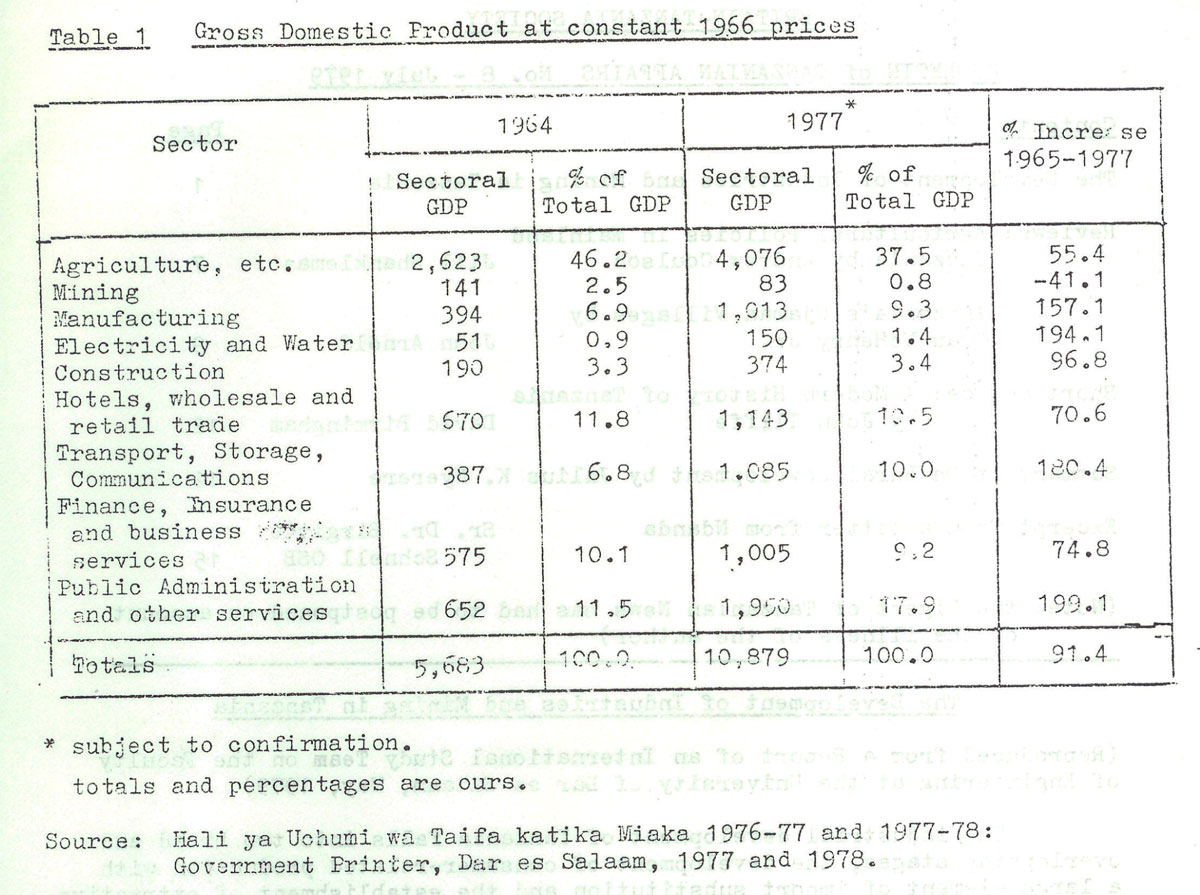
The growth of industrial activity during the years from 1964, the beginning of the First Five Year Plan, to 1977 can clearly be seen from the published figures of the Gross Domestic Product as set out in Table 1. The pattern of the monetary economy is there seen to have shifted markedly away from agriculture towards industry, water and electricity, building, transport and communications; in other words, towards the industrial sector of the economy.

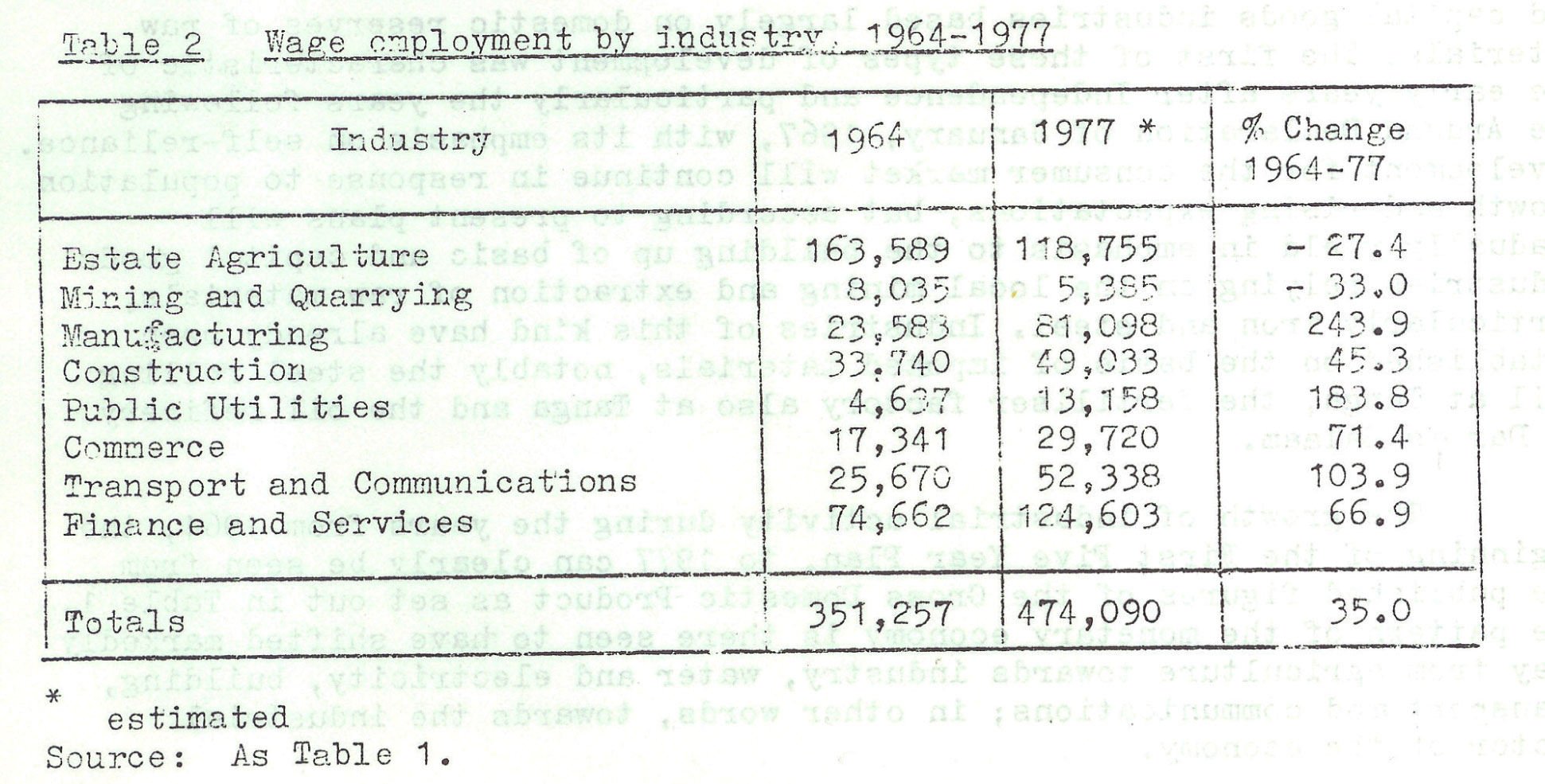
While the contribution of agriculture has risen by 55%, its relative contribution has fallen from 46% to 38%. Meantime, manufacturing industry has registered a growth of 157% and an advance in relative importance from 7% (3-4% at Independence in 1961) to over 9%. Still greater progress has been made by water and electricity (194%) and by transport and communications (180%), that is, by economic infrastructure. The recession in mining is referred to later in this chapter. Another indicator of the shift towards industry, public utilities, communications, etc., is provided by the employment figures given in Table 2.
Table 1 - Gross Domestic Product at constant 1966 prices

Source: Hali ya Uchumi wa Tajfa katika Miaka 1976-77 and 1977-78: Government Printer, Dar es Salaam, 1977 and 1978.
Table 2 Wage employment by industry 1964-1977

By 1976, the metal fabrication industries already accounted in money terms for nearly 10% of industrial production, while consumer goods occupied 65% of the total. Between 1965 and 1976 the consumption of electricity by industry rose from 36.0 million kilowatt hours to 185.3 million, a more than five-fold increase, while employment rose two and a half times, from 28,100 to 74,200. Meantime, the production of portland cement, begun near Dar es Salaam in 1966, rose from 50,000 tonnes in that year to 296,000 tonnes in 1974, though it fell slightly on account of labour problems to 244,000 tonnes in 1976. Urban water supplies increased from 12,800 million litres in 1963-64 to 61,000 million litres in 1976-77. At Independence in 1961 there were some 500 km. of macadamised trunk roads; by 1977 there were 2,625 km. (1)

More than most other African countries, Tanzania has from the first been notable for the thoroughness of its economic planning . At present such planning is carried cut within three time perspectives, namely, a 20 year plan setting out broad objectives and desired trends for the main features of the economy; a five year plan detailing the strategy for the ensuing five years; and an annual plan, which incorporates any necessary modifications to the five year strategy enforced by world circumstances, the accident of weather, planning delays and other influences….

Long-term planning of the economy for the period 1975-95 is based on consideration of the following main objectives:

(1) modification of the structure of the industrial economy in recognition of the need –
(a) to establish export industries in order to attract foreign exchange and to assist agriculture in increasing foreign exchange reserves;
(b) to establish industries producing for domestic consumption and development;
(c) to establish industries for the production of spares, fittings and machine parts to enlarge the national basis of self-reliance and to extend the domestic market for manufactured iron and steel with a view to facilitating the establishment of a metallurgical industry;
(d) to establish basic industries relying on domestic sources of raw materials, including iron and steel, coal, chemicals and building materials;
(e) to set up small scale industries based on simple technology and located in villages, where the greater part of the population live, with the object of promoting rural development;

(2) increasing industrial production and productivity;

(3) increasing employment and extending opportunities for education, training and the increase of skills;

(4) ensuring a fair distribution of industries by Region ; and

(5) providing and extending facilities for research, advisory services and technological information for the benefit of industry.

The intention of the long-term plan is to increase the contribution of manufacturing industry to the gross domestic product from nearly 10% in 1977 to around 20% by 1995; to increase the contribution of metal fabrication to industrial output from 10% to 30% and to reduce the contribution of consumer goods to the total from 65% to 40%. The general burden of the plan is, therefore, to change the balance of the economy decisively in favour of the extractive and capital goods industries, not at the expense of consumer goods, but in terms of relative growth. The establishment of industries for the manufacture of iron and steel is to have top priority in order to supply the needs of the metal fabrication and construction industries. At the same time the cement, glass products and wood products industries – all using local raw materials – will be increased to give added support to the construction industry, while factories producing chemicals, fertilisers, paper and printing machinery are to be developed.

… Between 1980 and 1985 top priority will be given to the development of the following basic industries, viz., iron and ferrous products, cotton, leather and sisal, chemicals, various foodstuffs, paper and wood, and non-ferrous products (e.g., cement and building materials). Meanwhile, the domestic market will, it is hoped, have been developed sufficiently to justify these activities. A start with the iron and steel, chemicals and paper industries already appears in the Third Five Year Plan (1976-81).

… Some 194 million shillings are set aside in the 1978-79 capital budget for roads, bridges, airports and other related works; 184 million shillings for various water development schemes; 446 million shillings for various electricity generating and distribution projects, notably, Phase 2 of the Kidatu hydroelectric scheme (229 million shillings); 140 million shillings for developments in the telephone and telex services; 586 million shillings for the improvement of the railway system in Central and Northern Tanzania; and a variety of Regional projects. (2)

Crucial to the development of industry in Tanzania is the expansion of the electric power supply. In 1975 the total capacity of the power supply system was 150 megawatts, of which 86% was sold in the coastal area and around Arusha and Moshi. In 1976 the first Phese of the Kidatu hydroelectric power scheme on the Great Ruaha River came into operation with a further 100 megawatts, a system that has now been connected by land line to Dar es Salaam. Phase 2 of the Kidatu scheme will shortly be completed, with a further 100 megawatts.

Meantime, considerable preparatory work has been carried out in Conjunction with NORAD (Norway) on the Stieglers Gorge project on the Rufiji River. (3) Reports have been submitted, not only on the construct1nn of the dam, but also on the use of power from Stieglers Gorge for the manufacture of iron and steel from the Liganga deposits of iron ore and the establishment of power-using industries based an local raw materials. Tha Stieglers Gorge project is therefore more than a hydroelectric power scheme, it is a plan for an industrial complex of considerable potential size and importance. The dimensions of this undertaking may be judged from the expectation of a power output of 600 megawatts, four times the total output in the whole of Tanzania in 1975. Further potential capacity lies in the Kiwira River scheme in Mbeya Region, with a maximum possibility of 233 megawatts, of which 14 megawatts are expected to be produced during the Third Five Year Plan; and in the Rusumo scheme, now under investigation, with a potential of 90 megawatts. A start will also be made during the Third Plan with a coal-fired thermal station based on local mines in view of the rising cost of oil.

As already indicated, long-term planning relies on the development of local resources of raw materials, particularly iron and coal. It remains, therefore, to describe those resources and the prospects of their gainful exploitation.

At Independence diamond mining was much the most extensive and lucrative form of exploitation of Tanzania’s natural resources, with gold following second in importance, yet for many years before that other minerals were known to exist in commercially significant quantities. Since virtually the entire mineral output was exported, it formed a valuable source of foreign exchange, but did virtually nothing to promote mineral-based industries within Tanzania. During the First Five Year Plan (1964-69), small quantities of coal, tin, mica, magnesite, tungsten, lime, salt, gemstones, glass-sand, kaolin and gypsum were produced; gypsum and lime were mined largely for internal consumption and salt was exported after meeting the domestic demand. Diamonds and gold, however, accounted for about 90% of production.

In 1966, the Geita and Kiabakari gold mines closed and in 1970 the Buhemba mine. Thereafter production remained small, but plans are afoot to open further mines during the Third Five Year Plan period at Lupo in Chunya District, in Geita District and elsewhere, which are expected to achieve an appreciable output.

Diamonds have for long been the most valuable mineral in Tanzania. In 1968, diamonds to the value of 164 million shillings were mined and exported. But the mines were becoming exhausted and in 1968 the remaining life expectancy was only ten years. In the event, however, it has proved worthwhile to continue mining, despite falling output, in view of rising world prices. While, however, the continuing diamond output was a useful asset in world markets, attention has increasingly turned to the exploitation of the country’s iron and coal resources and the importance of these minerals as a foundation for local industry.

Although coal has long been mined at Ilima colliery on a very small scale for a local market, there are known to be extensive reserves of bituminous coal at Songwe/Kiwira, in which Ilima is situated at Mchuchuma/Yateweka. Chinese experts are studying the possibility of using coal from the Songwe/Kiwira reserves for the smelting of iron from Chunya; in addition its use for coal-burning thermal generators, the production of tar for road making and the production of a simple ammonia fertiliser have been considered. The use of the Mchuchuma/Kateweka reserves for smelting the Liganga titaniferous ores has presented difficulties and is still under investigation.

Exploration has shown that iron ore deposits in Chunya District are extensive and capable of producing 250,000 tonnes of iron per annum. Reports have also revealed the presence of extensive ore deposits at Liganga in Njombe District with an annual potential of 500,000 tonnes. The Liganga ores, which have a 49% ferrous content, contain 13% of titanium dioxide and some associated vanadium. A West German team of experts is making a technical and economic study of the possibility of separating the vanadium and titanium. Meanwhile, a feasibility study by NORAD (Norwegian Government) of the use of power from the proposed Stieglers Gorge hydroelectric scheme for the manufacture of iron and steel from the Liganga deposits has been completed.

The prospect for mining operations both of coal and of iron ore depend not only on the completion of the technical and economic studies now proceeding, but also on the construction of the necessary infrastructure, notably road and railway links, the necessary outlets for the products in local industries and abroad. This is a complex operation and the ramifications of it suggest that it may yet be some years before large scale mining operations can begin. Owing to the technical problems still to be surmounted and the work on associated industries and services still to be put in hand, it is too soon to put a firm date on the onset of extensive mining operations. Nevertheless; the studies already made and the information gained suggest that the exploitation of Tanzania’s iron ore reserves most probably will begin within the coming decade.

Although the mining of Tanzania’s iron ore reserves is dimensionally and economically much the most significant development to be expected with reasonable certainty in the near future, considerable effort has also been expended on the investigation and development of other mineral resources. A search for exploitable oil reserves in the coastal sedimentary belt, started during the Second Five Year Plan, is continuing in the Southern Mainland, the Ruvu valley, south-east of Zanzibar and offshore. In the course of this search, natural gas was found at Songo Songo in Kilwa District and studies are now proceeding on the feasibility of its use in the manufacture of chemicals, especially ammonia.
Meantime, the steep rise in price of phosphates imported from the Middle East for the fertiliser factory at Tanga has precipitated research into the possibility of using phosphates mined at Minjingu, of which there is said to be a 10-20 year supply. Studies are also being made of the direct use of this mineral as a fertiliser. This project has, however, encountered financial problems.

Salt is a universal requirement for domestic use and the State Mining Corporation (STAMICC) has been preparing for the mining of salt to help to meet this demand and for export. Meantime, studies of the mining of gypsum are proceeding at Mandawa in Kilwa District to supplement the gypsum mined at Mkomazi in North-East Tanzania as a source of supply for the cement factory at Wazo Hill, near Dar es Salaam. At Lake Natron there are considerable deposits of soda ash and studies have been made of the refining and extraction of potassium and sodium chloride and of the technical, economic and transport problems involved.

The Third Five Year Plan includes plans for mining operations at Lake Natron on a small scale. Reserves of magnesite at Chambogo in the Pangani Valley are being investigated with the help of West German support. Other minerals under investigation are tin and tungsten in te Karagwe area, including the possibility of reopening the Kyerwa mine closed in 1971; asbestos, hitherto recovered in small quantities at Ikorongo in Serengeti District and elsewhere; copper, cobalt and nickel in the Piti River south of Tabora; and a number of rare earths and natural abrasives. Kaolin is produced in the Pugu Hills near Dar es Salaam and used for ceramics and potentially for paper making, with glass sand as a by-product. Finally, there has for some years been a successful industry in gemstones including the attractive green ‘Tanzanite’ which in 1976 contributed a useful 3 million shillings to the country’s foreign exchange reserves.

Mining operations in Tanzania have reached a transitional stage. Hitherto, diamond mining has stood out as much the most extensive and lucrative operation, but the ascendancy of the diamond is drawing to an end. Most other mining operations are at present limited, though prospecting and economic assessment is proceeding on a considerable scale. Among the known resources, those of iron and coal are extensive and a substantial home-based metallurgical industry is in prospect in the near future. If this branch of industry is successfully established, it will have a profound influence on the location and character of industry, on movements of population and on the pattern of Regional growth. Although these results are now fairly well assured, it is still not possible to attach a time scale to the industrial revolution that iron and steel making will induce in Tanzania. (4)

This account of the prospects for the economy would be incomplete without passing reference to the growth of small industries under the general superintendence of the Small Industries Development Organisation (SIDO). The long-term aim of this body is to promote small industries in the form of production cooperatives, particular]y in the villages, thereby not only advancing rural prosperity, but also decentralising the production of such consumer goods, components, etc., as can be produced economically on this basis. Small industries will be labour intensive and capital extensive and will therefore in many cases call for adaptation of methods of production and a resort to simple productive procedures. Such adaptations will offer a considerable challenge to engineers, involving not simply a reversion to historic semi-manual methods of production, but a modification of modern technology with the greatest economy in capital investment and a maximum use of human and other local resources. The importance attached to this development by the Government can be seen from the allocation of T shs. 117,241,000 to SIDO projects in the single year 1978-79.

References
(1) Sources of statistics: Bali ya Uchumi wa Taifa katika Mwaka 1977-78 ; Bank of Tanzania Economic Bulletin, Vol.IX No.3, Dec. 1977 ; Taarifa ya Hali ya Uchukuzi na Mawasiliano Nchini; Government Printer, Dar es Salaam. Mpango wa Tatu wa Maendeleo ya Miaka Mitano ya Kiuchumi na Jamii, 1 Julai 1976-30 Juni 1981 : Sehemu ya Kwanza- Shabaha na Maelekezo: Government Printer, Dar es Salaam.

(2) Mpango wa Maendeleo wa Mwaka 1978-79: Government Printer, Dares es Salaam. It is, unhappily, more than probable that substantial parts of this programme have fallen victim to the Uganda War and will have to be postponed.

(3) Details are taken from Norges Samarbeid med Utviklingslandene, 1977: NORAD, Oslo, 1978.

(4) The facts in this section on mining operations are taken from the following sources: Tanzania Second Five Year Plan for Economic and Social Development, Vol.1: General Analysis, Chap. 5; Mpango wa Tatu wa Maendeleo ya Kiuchumi na Jamii, Kitabu cha Kwanza, Shabaha na Maelekezo, na Kitabu cha Pili, Miradi: both Government Printer, Dar es Salaam. Mpango wa Maendeleo wa Mwaka 1976-77, 1977-78 and 1978-79; Government Printer, Dar es Salaam, 1976, 1977 and 1978 respectively. Hali ya Uchumi ya Taifa katika Mwaka 1974-75, 1975-76, 1976-77 and 1977-78: Government Printer, Dar es Salaam, 1975, 1976, 1977 and 1978 respectively.

NYERERE ON RURAL DEVELOPMENT

Summary (Shortened version, verbatim)

On Rural Development by Julius K. Nyerere: address to the Food and Agricultural Organisation World Conference on Agrarian Reform and Rural Development, Rome, 13th. July, 1979

Under the economic, political and social systems at present operating, the world’s people are divided into two groups – those with access to its resources and those without access. Those with access to existing resources – the rich – can afford to invest heavily in the production of greater wealth, so they get richer. The poor have very little to invest; their productivity consequently remains low and they remain poor. Worse still, the market laws of supply and demand mean that the wealth of the few diverts the world’s resources – including the labour of others – from meeting the real but ineffective demand of the poor into satisfying the luxury desires of the rich. Land and labour are used to cultivate grapes instead of grain; palaces are built instead of houses for the workers and peasants.

The automatic market tendency to favour the rich is aggravated by the fact that political power also flows naturally to the ‘haves’ of the world – the educated and those persons or societies which have inherited public or private capital. The result is that publicly produced wealth also benefits the wealthy more than the poor, accrues to the towns rather than to the rural areas and serves the educated rather than those without academic opportunity or ability.

Until now we have in general been trying to tackle the problem of poverty – including rural poverty – by directing resources into the existing system and hoping that it will ‘trickle down’ to the poor. Some of it does. But the major benefit of the new investment stays where it began – with the man who already has and in proportion to the wealth which he already has. The poor benefit – or sometimes suffer- from the side effects; or they receive the crumbs left over.

The lesson to be drawn is surely that fighting poverty is not just a question of production techniques and capital investment. It is a highly political topic. It involves matters relating to the existing wealth distribution and the present location of power within nations and between nations. For the root of world poverty, as well as the mass of it, lies in the rural areas. Urban poverty is more obvious – the slums and degradation of some towns in the developing countries force themselves upon the notice of the richest citizen and upon the most casual visitor from other states. But the bulk of the slum inhabitants and the beggars on our streets have migrated to towns because they are pushed out of the rural areas by landlessness, joblessness and hopelessness . It is therefore in the rural areas that we can most effectively tackle the long-term problems of urban poverty, as well as dealing with the mass misery which now exists unseen – hut not unfelt by its sufferers. Trying to deal with mass poverty by improving conditions and providing work in the towns simply attracts more and more people from the depressed rural areas.

An effective attack on world poverty can only be made by going direct to the rural areas and dealing with the problems there. The objective is and must be the provision of food, clothing, shelter, education, and health services, for everyone, under conditions which provide for universal human dignity. That objective can only be achieved if certain basic facts are recognised and acted on.

First among these is that those who own land will use it for their own benefit. If the land in a state is owned by a small number of people, these can be relied upon to maximise their own private income from that land by using for whatever crop will bring most profit to themselves. If the land is owned by the peasants, either individually or collectively, it will be used to meet their needs. Actions which transfer land to the people are an essential first step in the fight against poverty.

Even if effective land reform is carried out, that is not enough. The poor who have gained land under it – again whether privately or cooperatively – have to have access to credit, to improved seeds and tools, and to new knowledge, if the transfer of power over the land’s resources is to be permanent and to lay the basis for future development. But ‘Land to the Peop1e’ is not a solution on its own.

If poverty is to be abolished in the rural areas, farming activities must be efficient. Rural industries must be established to process the farmers’ crops and provide many of their domestic and agricultural goods. Forestry and animal husbandry must use land not suitable for arable farming. Water control and land conservation measures must be built to increase the productivity of the land at the same time as they provide clean water and possibly power. Schools, dispensaries, sports facilities, and so on, need to be established. This kind of diversification of the rural economy is an essential part of the struggle f0r human development and human dignity. At least in the initin1 phases of our development our agriculture and our rural service industries need to be labour intensive rather than capital intensive.

But to say that the rural areas must produce a surplus to finance diversification is to beg the question. Rural areas do produce a surplus now. The trouble is that it is extracted and used to finance luxurious consumption pattern of the rich and the kind of development in urban areas which will support the present economic structures. The surpluses are extracted by the comparative pricing of primary products and manufactured goods. It is done also by the combination of regressive taxation and the allocation of Government expenditure to services needed by town dwellers rather than those needed by the people in the villages. Rural development and the diversification of the rural economy which it involves will not take place without fundamental changes in the present approach to development and to government activities.

This implies giving priority to universal primary and technical education in preference to advanced studies in the humanities, or indeed to much in the way of post-graduate professional studies. It also implies that rural dispensaries and health centres will have to be given preference over sophisticated hospital services for the few.

Although internationally we are still at the stage of regarding a transfer of resources from the rich to the poor as being a matter for the voluntary decision of the rich, there is no excuse for such an attitude within nations. Giving land to the people and acting to ensure that rural surpluses are retained in the rural areas is essential; but it is only the first step. It has to be combined with deliberate policies which transfer resources from these wealth producing sectors to the financing of social and productive capital in the rural areas. This can be done either by government control and pricing policies, or by the taxation structure, or by a judicious mixture of the two.

It is surely quite obvious that as rural development has all these implications it will not occur unless governments are absolutely committed to attacking poverty at its roots in the rural areas. But that is not the whole answer, Governments by themselves cannot achieve rural development. They can only facilitate it and make it possible. For rural development is people’s development of themselves, their lives end environment.

If the people are to be able to develop they must have power. They must be able to control their own activities within the framework of their village communities. The people must participate not just in the physical labour involved in economic development, but also in the planning of it and in the determination of priorities. At present, the best intentioned governments – my own included – too easily move from a conviction of the need for rural development into acting as if people had no ideas of their own. This is quite wrong. Both political and economic power has to be held by the people within the village, in the Region and in the nation, if development is to be in the people’s interests. It is through cooperation that each of us develops his own potential and receives personal identity.

Within our developing countries there is a tendency to think that if you have made a budgetary allocation for something called ‘rural development’, then the rest or government policies and expenditure patterns can go on as before. Such attitudes defeat any hope of rural development, or of implementing a ‘basic needs approach’. Rural development, for example, requires greater use of fertilisers, with the consequential need for a fertiliser plant, or a phosphate mine, or both. It needs a factory to produce animal-drawn ploughs, harrows, seeders and another producing tractors and bulldozers. It needs electrical power, both for decent living in the rural areas and for village industries. A rural development strategy thus requires a whole industrial and communications development policy, which is geared to the needs of the rural areas and the masses who live in them. Every aspect of government and public activity, in other words, has to be angled towards promoting mass welfare in the rural areas, while yet enabling the urban areas to service effectively the rural areas from which their sustenance comes and which are their justification for existing.

Everything which I have said in relation to the implications of a strategy of rural development within nations can also be applied to international economic and political relationships. Under the present world economic order the rich and industrialised areas – regardless of whether these are capitalist or socialist – automatically, as well as by the exercise of naked power, extract from the poor and rural areas even that little which they have. It is done through the pricing mechanisms of primary products relative to manufactured goods, by the virtual monopoly of international transportation facilities, by the control of world currency and credit which is exercised by the rich nations – and by a hundred other so-called market forces.

The fundamental imbalance between the world’s rural and urban nations – between the industrial and the primary producer areas – is not yet universally recognised as the root causes of world economic problems and world poverty. It is clear that a strategy for rural development has two aspects. One is internal within the nations of the Third World. The other, equally important, is external to any single nation; it involves the whole world. The problem of poverty cannot be effectively tackled unless there is action on both fronts simultaneously.

REVIEWS

Agricultural Policies in Mainland Tanzania by Andrew Coulson:
Review of African Political Economy, No. 10, Sept. to Dec. 1977

Coulson’s article gives a thorough survey of the vicissitudes in agricultural production policies in the thirty year period 1946-1976. The article also contains some discussion, although with less comprehensive coverage, of agricultural marketing structures over the same period.

In choosing this period for study – a period which covers the last fifteen years of colonial rule and the first fifteen of independent government – Coulson is arguing a basic continuity in the assumptions underlying agricultural policies. Three such assumptions, which seem to me the most important emerging from Coulson’s article, are:

(i) a belief in the necessity for government intervention in agriculture. Coulson argues that this was stimulated by the command economies of World War II and by the acceptance of keynesian economic theories;

(ii) a goal of increasing the agricultural surplus. This has taken either or both the forms of seeking to raise output of export crops, or increasing the production of food crops to supply the non-agricultural population;

(iii) the assumption that in agriculture the initiation and implementation of policy had to be carried out by government officers, because the African population was ignorant and backward.

Coulson describes various forms which agricultural policies assumed against the background of these assumptions. His description is particularly clear for the colonial period, rather less so for the fifteen years after Independence. It is useful to list the main features of successive policies.

Up to the mid 1950’s three different approaches are identified:

(i) encouragement of white settlers who were expected to introduce large-scale ‘modern’ capitalist agriculture;

(ii) the groundnut scheme- intended to produce supplies of oils for Britain by establishing modern, large scale, but state owned estates.

(iii) the ‘Land Development and Soil Conservation Scheme’. This was intended to introduce ‘modern’ methods to African peasant farmers by dint of by-laws and legal sanctions enforcing specific, and very detailed, farming methods.

None of these schemes were long-lived and all failed. The settlement of white farmers met successful resistance by African farmers to the appropriation of land; the groundnut scheme was technically ill-founded; whilst African farmers met the strict control of their farming practices with passive resistance. As Coulson points out, the failures of the latter two policies were not only organisational and political, but also technical. Grounded in a faith in western methods, the techniques invoked were generally wholly inappropriate to Tanzanian, or peasant farmer, conditions.

From the mid 1950’s up to the late 1960’s there was a shift in attention towards those African farmers who individually or collectively appeared likely to develop modern, westernised agriculture. In the last years of colonial government and early years of independence the ‘focal point’ approach channelled advice, equipment and credit towards the more successful and wealthier individual African farmers. The nebulous belief behind this approach was that others would copy the methods of the successful. In fact this approach exacerbated the inequalities in land holding and access to other resources, and appeared likely to lead to a polarisation of the rural population into capitalist farmers and landless wage labourers. Opposition to policies which thus encouraged inequality caused a shift within the same ‘focal point’ approach towards groups of farmers rather than individuals in the post-Independence ‘settlement schemes’. These aimed to re-settle groups of farmers on new land, make available the tools of modern farming and await a transformation in agriculture, which would again trigger imitation by other groups.

Coulson argues that during this period agricultural production did increase. He ascribes this to the emergence of some large scale African farmers and to the expansion of the area of individual peasant farms. He notes the agricultural failure of the settlement schemes; and also argues that the intervention of agricultural ‘experts’ had little to do with the growth of production. As in the previous period, many of the approaches canvassed by the extension service were inappropriate or incorrect, whilst in addition the size of the service meant that few farmers had much direct contact with extension advice in any case.

Since 1967 agricultural policy has again taken a mass, rather than a selective approach, first with the encouragement of ujamaa villages then with the villagisation programme. In both the voluntary formation of ujamaa villages and the wider and compulsory villagisation scheme, emphasis has been placed on the resettlement of population into villages rather than the scattered settlements of individual households and farms, which had been common in many areas.

In discussing this latter phase of ujamaa and villagisation, Coulson deals more with the political and administrative aspects of the policies than with the agricultural. Had he looked in more detail at the production policies which villages are encouraged to follow, he would have seen an extension of several aspects of plans developed, and abandoned earlier. The Ministry of Agriculture, together with aid bodies – notably the World Bank – have sought to expand cash crop production by peasant farmers by encouraging the cultivation of at least one cash crop in each area of the country. This encouragement has ranged from the minimum acreage by-laws mentioned by Coulson to credit and input packages which seek to schedule and direct production of crops which have been chosen for the area by planners and administrators.

Coulson states in a resume of the article that “a general conclusion is that those who controlled the State consistently misunderstood fundamental aspects of peasant agriculture and over-estimated what the use 0f State power could achieve in rural development”. This he certainly shows in the case of policies up to the latest phase. However, he has not been able to show conclusively that in the case of villagisation the State has over-estimated what it ~an achieve, since he has come to no clear conclusion about the State’s goals in villagisation; nor, as he makes clear, are the results of villagisation fully evident in any respect yet, be it political, agricultural, or social.

More generally, Coulson appears to hold doubts on the viability of any government intervention in agriculture. This is suggested by brief references to the success, in ecological terms, of pre-colonial agricultural systems and the repeated reference to the localised successes of the ‘focal point’ approach, where individuals were motivated by ‘the possibility of getting rich’. Since this individualistic approach cannot be compatible with any socialist system, it would be interesting to know whether Coulson perceives any forms of government intervention in agriculture compatible with both socialist aims and success. A quick answer to this might take the form of the need for involvement of farmers in formulating plans and policies. Whilst this broad statement is unexceptionable, there are enormous problems in conceiving, let alone implementing, structures that would involve the mass of farmers in a real, not a nominal, way; and in reconciling the contradiction between an economy in which commerce and industry are dominated by the State and agricultural production by small-scale peasant producers. In the post-Arusha Declaration period, this is maybe the central problem of agricultural policy in Tanzania.

Jill Shankleman
(The reviewer has recently returned from Tanzania, where she was working as an FAO adviser. Ed.)

Tanzania’s Ujamaa Villages: the implementation of a rural development strategy by Dean E. McHenry Jr.: Institute of International Studies, University of California, Berkeley.

Discussion of Tanzania’s rural development policies is an ideological battle ground where the contenders whether seeking to defend Nyerere’s policies or attack them from the left or the right are too often content to collect and present only the evidence that supports their case. The size and diversity of the country make genuine research difficult and expensive and there is a tendency for articles to quote the same references, comments and conclusions. It is not surprising that views on ujamaa villages and villagisation have become polarised and stereotyped. There has been a deplorable absence of hard facts and unbiased analysis.

In marked contrast to most published work, Dean McHenry has provided an invaluable dispassionate study of the context within which the ujamaa village policy was formulated, the methods by which its implementation was attempted, the extent to which the efforts have been successful and the lessons for Tanzania and countries with similar problems.

McHenry undertook most of his research while teaching at Dar es Salaam University and he clearly has a profound basic sympathy for Tanzania and Nyerere’s policies and a wide understanding of the issues. He makes extensive use of published information and speeches, but he has also done his own researches at village level.

The study begins with the necessary reminder that neither the problems identified in the Arusha Declaration, nor the solutions proposed, were new. In ‘Ujamaa – the Basis of African Socialism’ Nyerere linked the cooperative aspects of traditional African society with his ideas for reviving rural communities. To emphasise the new approach represented by Arusha, no reference was made to the efforts made during the colonial period to resettle and concentrate peasants first as anti-sleeping sickness measures and later to open up new ground and crops. Emphasising new approaches made political sense, but colonial settlement schemes are part of Tanzania’s history remembered by the peasants, even if the lessons had to be relearnt (largely at the peasants’ expense) by a new generation of politicians and administrators. Colonial officials had also to face the practical and moral problems of implementing policies which were not understood, or resisted by those who were supposed to benefit. If the politicians and administrators of independent Tanzania had had the time and inclination to study the recent history of their country, they would have been better prepared to face the problems posed by the vastly more ambitious policies for the creation of ujamaa villages and then total villagisation.

There had been little change in the social and economic conditions nor in the administrative resources available. The new factors were the enhanced powers of the Government and the existence of a national political party and great reliance was placed on the ability of the Party to inspire and mobilise popular support for the new policies. In a detailed examination of the structure of the Party, its membership and operation, McHenry identifies some of weaknesses as an instrument for mass political education. Similarly, he demonstrates that the Government machine was no more effective than its colonial predecessor in establishing genuine popular involvement in decision making.

The ujamaa villages were expected to make possible the provision of basic services to the rural population, increase agricultural production by the introduction of improved farming methods and move society decisively in a socialist direction. The political initiative for this new approa.ch to development in the post-Arusha period was born of frustration at the failure of officials, experts and extension workers to produce any perceptible progress towards rural transformation, stimulate stagnant agricultural production, or deal with the disarray of the cooperatives.

The objective of moving peasants into villages was achieved, but it was not done by political inspiration, nor the complex of material and status incentives, which the Government machine could offer. The mass movement of the reluctant was eventually achieved by force or the threat of force and McHenry plots the shift in policy, resulting from the conflict between ideology and the practical problems of its implementation, by which first the objective of communal work was abandoned and then the way opened for force to be employed. Although the Government never specifically authorised force and denounced cases where it was used in excess, there is no doubt that local politicians and administrators were under pressure to produce results and no guidance was given on the alternative methods which were permissible. McHenry rejects the official defence that force was never policy and that its use was rare; the stories of the occasions when it was used spread rapidly and provided a powerful incentive to those who were resisting other arguments.

The variety of methods used to induce people to move into villages inevitably resulted in a wide range of motivations and confusion of ideas as to what ujamaa entailed. McHenry’s personal research involved collecting information from ujamaa villages in four Regions on how much and what kind of work was being done communally and who participated. The conclusions indicate that a small proportion of food was being produced communally possibly because there was too much risk in leaving such a necessity to a new and untried method. In non-agricultural activities communal work was much more common possibly because it was practical and permissible to enforce participation.

The unresolved question remains why did Tanzania’s leadership expend so much effort on achieving villagisation? They must have known that the provision of the promised basic services could not possibly keep pace with the creation of new villages, thus inevitably producing disillusionment. Implementing the policy strained the Party’s principles, but produced meagre material gains; indeed agricultural output may well have fallen. Was it simply a method of ensuring greater Party and Government control over the peasants, or are there long term gains still to come?

As well as presenting a coherent and carefully documented account of Tanzania’s rural development policies, McHenry’s book is an invaluable work of reference containing more than 60 tables of informaticn. Anyone engaged in teaching the politics or economics of Tanzania should ensure that their students do not see this book first unless they are already certain that they are quite clear on the composition of the National Conference, National Executive Committee and Central Committee, or are quite familiar with ‘number of inhabitants per agricultural officer by Regions and years’.

One word of warning. Skip the first chapter, which contains a valiant attempt to define ‘development’, ‘policy’ and ‘implementation’, but becomes hopelessly bogged down in statements such as: ‘Other ends which are sometimes used to define this non-choice orientated conceptualisation of development include …’. Presumably this is for the benefit of his sponsors, because once McHenry actually begins writing about Tanzania he presents the complexity of facts and opinions with splendid clarity.
John Arnold

Short Notice

A Modern History of Tanganyika by John Iliffe: Cambridge University Press, African Studies Series No. 25, 1979, Paperback f7-95. 616 pp.

All friends of Tanzania will welcome the appearance of John Iliffe’s great work: ‘A Modern History of Tanganyika’. This book was researched during the 1960’s when John Iliffe taught at the University of Dar es Salaam and was written in the 1970’s while he was teaching at the University of Cambridge. It is a fundamental contribution not only to the history of Tanganyika but also to the overall understanding of the history of Africa. It will undoubtedly go down as one of the great publications of this decade. The first quarter of the book deals with the nineteenth century and with the crisis of the colonial advent and the coincidental ecological catastrophe of the early twentieth century. The remaining 450 pages are concerned with the twentieth century up till 1961. The Bulletin hopes to carry a full review in its next number. Meanwhile at under £8 for the paper back this must surely be one of the best buys on any member’s shopping list.

David Birmingham