HEALTH

by Ben Taylor

HIV sector faces funding crisis
The Executive Chairperson of the Tanzania Commission for HIV/AIDS (TACAIDS), Dr Fatma Mrisho, warned that donor funding for the fight against HIV and AIDS was at risk. She said that the Canadian and Danish governments had informed her that from 2015, they would no longer provide financial support to the National Multi-Sectoral Strategic Framework. In addition, the US President’s Emergency Plan for AIDS Relief (PEPFAR) is also reducing funding. “We, as a nation, need to get prompt replacement for the funding, failure of which all the achievements made in the fight against HIV and Aids for more than 20 years will experience a heavy blow,” said Dr Mrisho. (Daily News)

Drop in new HIV infections among children
Tanzania recorded a decline in new HIV infections among children between 2009 and 2012, according to a new report by the UN on “The Global Plan towards elimination of new HIV infections among chil­dren”. Nevertheless, the Global Plan indicated that since only 53% of eligible pregnant women and 26% of eligible children are currently receiving antiretroviral therapy, the country should continue to focus on providing treatment. (East African)

Dengue fever outbreak
The Minister for Health and Social Welfare, Hussein Mwinyi, announced that several deaths from dengue fever had been reported at Muhimbili National Hospital in Dar es Salaam. Preventive measures, including sensitising the public about the deadly disease, are being taken. (East African)

Bacteria to be deployed against mosquito larvae
A $22 million biolarvicide plant is under construction in Kibaha, with the potential to provide a valuable new weapon in the battle against malaria, one of the country’s biggest killers. The project, a joint venture between the Tanzanian government and a Cuban state-owned firm, will produce a more eco-friendly alternative to synthetic larvacides. The biolarvicides contain toxins that specifically target mosquito larvae. Tanzania is spending about $240 million (a staggering 3.4 per cent of GDP) annually to treat malaria. This suggests that of the $11.37 being spent per person per year on health, $2.14 is spent on treating malaria and its complications. (East African)

EDUCATION

by Anne Samson
[All extracts from The Citizen except where noted]

Fallout from Form IV examinations
The re-marking of the Form IV examinations, conducted in May, resulted in a small improvement in the pass rate. The proportion of candidates classified in Divisions 1-4 rose from 35% to 44% (from 126,847 students to 159,747). The enquiry organised by Prime Minister Pinda into the poor examination performance is still to report its findings publicly.

The Tanzanian NGO Twaweza conducted a survey of 2,000 people after the Form IV results were released. The research revealed that 32% of respondents had not heard of the Form IV results, and that the absence of textbooks and teachers not attending classes was the cause of the poor results. Even if teachers did attend class, they handed out an assignment and left without teaching. It concluded that ‘the government and teach­ers were to blame’.

The Legal and Human Rights Centre 2012 report found that the quality of education was deteriorating and that there was ‘an acute shortage of teachers’.

The deputy minister for education has called for the re-introduction of corporal punishment. This has been criticised by Save the Children and the Commission for Human Rights and Good Governance.

There is concern that some of the four hundred Division IV students who have places in overseas colleges may not be going to bona fide uni­versities. Those who failed the recent exams should have access to edu­cation to improve so as not to be caught out by institutions only inter­ested if they can pay. Ten thousand Form V places have not been filled as a consequence of the poor results. Only students achieving Division I to III can progress, with those getting Division IV being allowed a resit, and some schools have reportedly had to close.

Form VI Results
On 3 June it was announced that of the 51,611 candidates who sat the examination, 87.85% passed. Of these, 35,743 achieved between Division I and III to qualify for university entrance. The success was attributed to the ‘sheer determination, self-motivation and focus’ of the students to overcome the inadequacies of the facilities available to them.

Higher Education
The Higher Education Student Loans Board (HESLB) has blacklisted more than 68,000 graduates for defaulting on their loan repayments and forwarded their names to the Credit Reference Bureau. (24Tanzania.com)

The Vice Chancellor of Teofilo Ksanji University, Mbeya, was locked in his office during July as students demanded the ‘release of money meant for their practical training’ which was due to start after the completion of their examinations. The delay in the release of funds was apparently due to the late payment of the fees by the Higher Education Students’ Loan Board.

Education budget
The government announced in June that it had spent TSh76.4 billion on textbooks for primary and secondary schools as part of efforts to improve education. Capitation grants of more than TSh82 billion had also been disbursed, TSh60 billion for primary schools and TSh22 bil­lion for secondary schools.

In December 2012 there were 171,986 primary and 51,469 secondary school teachers of whom 27,693 (13,633 primary and 14,060 secondary) teachers were newly employed. Teachers were being sent to “far-flung areas” through various initiatives, but a shortage of science teachers remains. TSh20 billion has been set aside for teachers’ houses across 40 district councils.

Despite the issues surrounding education and expectations that there would be an increase in the education budget, a decrease of 4.8% was announced, with TSh690 billion being allocated compared to TSh724 billion last year.

Teacher education
To address the shortage of teachers, agreements will be entered into with other countries in the East African Community. Tanzania needs at least 26,000 science teachers but the universities only produce 2,200 teachers with degrees and diplomas each year.

The government will introduce training for head teachers and introduce a professional board for teachers.

A 3R (reading, writing and arithmetic) assessment will be introduced in grade 2 and teacher training to ensure students master basic skills in early grades. This is part of the Big Results Now initiative. (Daily News)

The Public Service Recruitment Secretariat discovered, after receiving a tip-off, that almost 700 applicants for public service jobs had sent in forged certificates during 2012/13.

Curriculum
MP James Mbatia (NCCR-Mageuzi) accused the government of not hav­ing a national curriculum in place for primary education. This has led to a heated debate amongst interested parties. A small survey in Kigoma Region by The Citizen revealed “a number of setbacks to primary school education foundation in the country”. The consensus appears to be that education has been affected by politics with the result that educators are not consulted about changes. The quality of textbooks was identified as a further issue.

Education materials
The Education Materials Approval Committee (EMAC) was disbanded in early June because of corrupt practices. It will be replaced with “another strong organ”. All textbooks approved by EMAC will be reviewed “to ensure any mistakes were corrected”. Mbatia is calling for “those responsible for the mess” to be prosecuted.

School inspectorate
A parliamentary committee has suggested that government introduce an independent education inspection agency charged with ensur­ing quality education in both primary and secondary schools, as the Education Inspection Department had “failed to effectively perform its duties” due to the lack of adequate financial resources. The committee suggested that TSh10 billion be set aside for inspection purposes in the next financial year. In 2011/12, 3,061 out of 7,200 targeted primary school were inspected (42.5%) and 935 out of 2,100 secondary schools (43.3%). The failure of the inspectorate was part of the cause of the 70% failure rate in education over the last ten years.

The ministry of education has suggested that schools be ranked using the Leaving School Examination results from primary and secondary and that a school incentive schemes be introduced to improve educa­tion.

MINING & ENERGY

by Roger Nellist

Tanzania in the wider African context
Recent Tanzanian mining developments were included at the Africa Mining Summit convened by the Commonwealth Business Council in London on 25-26 June 2013, although the country was not represented at Ministerial level. Ministers from other leading African mining countries – notably Cameroon, Ghana, Kenya, Rwanda, South Sudan and Zambia – shared their experiences and highlighted recent policy approaches to mineral development in their countries.

Recurring themes at the summit were (a) increased acceptance of greater transparency in mining sector operations, driven in part by the Extractives Industry Transparency Initiative (of which Tanzania is a member); and (b) the emergence across the continent of various forms of “resource nationalism” – of which the most common are the need to maximise national value-add from the minerals produced and also to ensure that local communities where the mining operations take place derive specific, identifiable benefits. These themes for mining also ring true for oil and gas operations (see TA 105 on Tanzania’s offshore gas developments).

In a presentation at the summit by IntierraRMG, Tanzania was bench-marked against other African mineral-producing countries, confirming that the country is a significant minerals player, especially in gold. In recent years Tanzania has ranked 3rd in the African annual gold production league, producing significantly less than South Africa and Ghana but a little more than Mali, Burkina Faso, Guinea, Zimbabwe and others. Tanzania also ranked 3rd in 2011 and 2012 in the number of new gold prospects drilled across the continent – which will help sustain the country’s gold production levels in future years. Tanzania’s Geita mine ranks 4th in the list of Africa’s top 10 gold mines.

Tanzania produces useful quantities of other minerals too; but in terms of the total value of all minerals produced, the country ranks only 11th out of the 28 African countries listed by IntierraRMG. South Africa dominates Africa’s minerals value list, with some US$60 billion of annual mineral production revenue, which dwarfs Tanzania’s US$2 billion, as well as Zambia’s US$7 billion (in second place in the African league table). Mozambique lies in third place (with about US$5.5 bil­lion) and Ghana is fourth with US$5 billion.

Gold (20%), coal (19%) and copper (9%) together accounted for almost half of total African mineral production revenue in 2012. Importantly, mineral prospecting and appraisal work last year enabled Tanzania to identify additional resources of each of these three key minerals, as well as other major metal and mineral resources, ensuring that the mineral sector has good potential to continue to contribute to the Tanzanian economy in the years ahead. (www.intierrarmg.com)

The Africa Mining Summit also demonstrated that the contribution of mining to economic and social development in Sub-Saharan Africa is under increased scrutiny and criticism. Minerals and petroleum are non-renewable resources, and unless the production gains are effi­ciently captured and invested by governments, the host countries could experience a net reduction in their national wealth.

Mineral taxation
In April 2013 the International Centre for Tax and Development (ICTD) published a paper entitled Low Government Revenue from the Mining Sector in Zambia and Tanzania: Fiscal Design, Technical Capacity or Political Will? Written by Olav Lundstøl, Gaël Raballand and Fuvya Nyirongo, it examines the impact of Tanzania’s mineral taxation regime on govern­ment (GOT) revenues over the last decade. This suggests that the GOT could have earned substantially more had it levied on an internationally competitive set of fiscal terms.

The authors illustrate the big turn-around in Tanzanian mining over the last 15 years, citing export statistics for gold, the country’s domi­nant mineral. The annual value of Tanzanian gold exports increased from just US$ 22 million in 1998 to US$ 2,200 million in 2011, reflecting a tenfold increase in the quantity produced and the large global price hike. However, government revenues from the mining sector have not risen correspondingly. The country’s mining tax regime during this period was basically an outcome of efforts to make the sector more attractive in the late 1990s, following decades of public ownership and stagnating levels of investment. In an attempt to address the perceived revenue imbalance, mining terms were tightened in 2004 and again in 2010 – though efforts to enhance revenue flows from existing mining operations were reportedly frustrated by fiscal stabilisation terms previ­ously agreed with the mining companies.

The ICTD paper compared mineral revenue-sharing between invest­ing companies and host governments in seven major mining countries worldwide, including Tanzania and Zambia, and then estimated the amount of mining revenue forgone by the government during the period 1998 – 2011 due to ‘ineffective mining revenue-sharing terms’. Noting that effective sharing of mineral benefits between companies and governments has been notoriously difficult to achieve, especially in Sub-Saharan Africa and certainly when compared with petroleum operations, the authors found that if Tanzania had performed as well as the best mining countries in the comparative benchmarking sample, the government might have collected an extra US$ 1 billion of tax rev­enue from large mining operations over the period 1998 – 2011. Total revenues might then have been US$ 1,831 million instead of the US$ 776 million it is understood the GOT earned. This would have been an increase of 136%, or very roughly US$ 75 million extra per year. (Zambia performed much worse, with a discrepancy of almost 300%).

The ICTD paper also examined the composition of the GOT’s mining revenues. Company data from the most recent Tanzanian Extractive Industries Transparency Initiative (TEITI) reports for 2008/9 and 2009/10 showed that six mines dominated the large-scale mining sector, all pre­dominantly in gold. These accounted for 85-90% of the audited export of gold from Tanzania as well as the majority of the direct investment, pro­curement and employment in the large-scale mining sector . However, ICTD’s analysis of these TEITI reports found that profit-based corporate tax made a very modest contribution to mining revenue, despite 5-10 years of operations under the current mine owners and a global mineral super cycle since 2005/6. Gross value-based corporate taxes, together with employee-based taxes, dominate the tax revenue collected from the mining sector. As is common in other mineral producing countries, certain fiscal exemptions are part of the mining regime, though the government is now trying to minimise their use. (For full text, see http:// www.ictd.ac/sites/default/files/ICTD%20WP9.pdf)

Electricity: The US “Power Africa” Initiative
On 2 July 2013, in the presence of President Kikwete, President Obama delivered a speech at the Ubungo Symbion Power Plant in Dar es Salaam. Drawing attention to the fact that nearly 70% of Africans lack access to electricity, a major obstacle to economic and social develop­ment, Obama profiled a major new initiative – “Power Africa” – that he had announced in Cape Town a few days earlier. Power Africa prom­ises to double access to electricity in Africa, as a first step bringing elec­tricity to 20 million homes and businesses. It will do this by matching public and private resources with projects led by six African countries that are committed to energy reforms, including Tanzania. The US is committing $7 billion in support of this new initiative and private sector companies have already committed more than $9 billion.

Obama cited the Ubungo plant as a model for replication across the continent: ”This facility was idle. But the Tanzanian government, under President Kikwete’s leadership, committed to making reforms in the energy sector. With support from the Millennium Challenge grant, General Electric, and Symbion, they got it up and running again. More Tanzanians got electricity”.

Obama appealed for a sense of urgency in African energy reform effort. One of the things he had learned from the business roundtable during his visit was that “if we are going to electrify Africa, we’ve got to do it with more speed…. It’s hard to attract private-sector business if they feel as if their money is going to be tied up forever in uncertainty. So we want to focus on speed, but we also want to do it right. And the United States intends to be a strong partner in this process”.

TRANSPORT

by David Brewin

Dar-Chalinze expressway planned
Plans to upgrade the road between Dar es Salaam and Chalinze to a six-lane highway are well advanced, according to the Deputy Minister for Works Gerson Lwenge. The road will be operated as a toll-road. “The 110km Dar es Salaam – Chalinze road has been a headache to transport­ers and has been a cause of unnecessary delays and accidents. But with the implementation of the project, the cost of doing business will be cut down,” he said.

According to Tanroads, the project is expected to take three years and entails construction of six lanes to expressway toll road standards with service roads on both sides and grade separated interchangeability. Access will be controlled and embankments will be high enough to accommodate frequent underpasses and interchanges while maintain­ing good vertical profile. (Daily News)

Tanzania set to become port hub for East Africa
Dar-es-Salaam port has been ranked the top port in East Africa by the the 2012 East African Logistics Performance Survey by the Shipper Council of East Africa (SCEA). This significant improvement in logistics performance is due to drastic changes implemented by the Tanzanian Port Authority in processing cargo in Dar-es-Salaam. However, ship­ping a container from East Africa can still cost more than double than if it were shipped from the Far East.

In addition, new ports are expected in Bagamoyo (which will have the capacity to handle 20 million containers per year, compared with Dar es Salaam’s installed capacity of 500,000) and Tanga. Furthermore, exten­sive infrastructure improvements are planned at Mtwara, Tanga and Bagamoyo. (tanzaniaInvest)

TANZANIA IN THE INTERNATIONAL MEDIA

by Donovan McGrath

I eat halal meat, and I just know these recent religious tensions aren’t kosher. Elsie Eyakuze shares her thoughts on recent religious tension in Tanzania.
Extract: “Let’s admit: We’re not coping well with our diversity anymore. There are some who will say that we never have been the haven of peace and tolerance that we purport to be, that we are rather fragile. There might be some truth to that. It is unlikely that Tanzania in its 50-odd years of Independence has managed to magically resolve one of the most intractable social divides… Since we no longer have the unifying elements of a socialist regime marching us through poverty to rely on anymore, it looks like we’re starting to take care of some of the business we never got around to in the tender period of our early nationhood.
Now identities are cropping up, and they’re always so obvious aren’t they? If not tribe, then religion. I respect the benefits that a strong iden­tity, a set of beliefs can confer on people. Just not at the cost of the col­lective good. That is what is frightening about the recent accumulation of stories about religious strife – it is not in keeping with our reverence for the quiet life. The secular life. The separation of church and state, and all that entails.
…We have stepped all over Zanzibar’s frail sovereignty to avoid even the hint of encroaching theocracy… I don’t know many Tanzanians who can look at their clans and not stumble across at least two major religions, an aunt who is a charismatic pastor, a couple of closet atheists and a handful of mixed marriages…. Which makes me wonder who is looking to benefit from the destabilisation that religious strife offers? … I can’t bring myself to imagine that we would be so stupid as to fall into the trap of religious strife … People of true and deep faith tend to be rather difficult to annoy to the point of violence. Which makes religious conflict one of the biggest contradictions I have ever encountered…”
(East African 6-12 April)

Radical preacher wanted over Zanzibar acid attack shot in police raid
“A radical Muslim preacher wanted for questioning over the acid attack on two British tourists in Zanzibar was shot … as he fled police trying to arrest him [in Morogoro].’ Extract continues: ‘Sheikh Issa Ponda is understood to have survived the raid and was on the run but injured police sources told The Daily Telegraph. He had visited Zanzibar in the weeks running up to the attack on Katie Gee and Kirstie Trup … Ponda earlier this month met with the imprisoned leaders of a Muslim separa­tist group, Uamsho, who police believe may have inspired the attack on the two women. (Telegraph online 10 August). (Editor’s note: there has been considerable concern in Tanzania regarding the portrayal of this acid attack in the UK press, including this article from the Telegraph. In particular, several British papers insinuated, as this article did, that the arrest of Sheikh Ponda was connected to the acid attack. The Tanzanian police have strenuously denied this connection.)

Why Dar is hot, and the rest of us are not
According to the East African, as far as African diplomacy goes Tanzania right now is that girl on the dance floor that every boy wants to dance with. If it is a Chinese leader coming to Africa, he must stop in Dar es Salaam. If it is a Western leader visiting, tea with the President at State House on Ocean Road will inevitably be on the cards. And now in the first week of July not only has US President Barack Obama decided to cherry pick only Tanzania to visit in the region, but former American president George Bush and his wife Laura will also be in town for a First Ladies conference.
An earlier article entitled ‘Why Obama chose Tanzania for his Africa tour’ explored three possible reasons why Dar is hot. First, it has vast oil, gas and mineral reserves that have been discovered in recent years, so the Americans don’t want the Chinese to feast on the goodies alone. They want a piece of the action. Second, its leaders are not involved in any major domestic or international controversy… Third, it is the most stable country in the region … the only country in the region whose political reserves have not yet been tapped out. Rwanda has to keep 24 hours DRC watch as well as peacekeeping in Darfur and the two Sudans’ border; Uganda, Burundi, and Kenya are still wading through Somalia’s murky political waters. And Tanzania has the largest unspent store of energies that can be unleashed through political reforms.” (East African 8-14 June).

Violent Episodes Grow in Tanzania, an African Haven
“As one of the leaders of an acrimonious doctors’ strike in Tanzania, Dr. Stephen Ulimboka was not entirely surprised when a group of armed men appeared, unannounced, at a meeting and arrested him. But when he saw that the car they were forcing him into had no license plates, fear truly hit him. … Tanzania has a reputation abroad as an island of stability in the often-chaotic region of East Africa. … President Obama arrives here on Monday to a country where human rights groups and the largest opposition party say episodes of intimidation and suppres­sion of political opponents are growing.
“The international community believes there is peace in Tanzania,” said Willibrod Slaa, the secretary general of the opposition party Chadema. “There is fear, not peace.”… Journalists have been attacked and in at least one instance killed while working. Last July, the government banned an independent weekly newspaper, Mwanahalisi, which had been reporting aggressively on Dr. Ulimboka’s kidnapping, linking the crime to the government. President Jakaya Kikwete denied any con­nection. … Analysts say the very real prospect that voters will choose another party in the next election, in 2015, has rattled some members of the government, particularly those who are afraid that a new party in power could mean aggressive investigations and prosecutions.” (New York Times 30 June)

Tanzania settles human trafficking case of former diplomat
President Obama can go to Africa next week with a clean conscience. The government of Tanzania, which had been in a years-long dispute with the State Department over a human trafficking judgment against one of its diplomats, has settled the case on the eve of the presidential trip. Diplomat Alan Mzengi in 2008 was ordered by a U.S. court to pay a $1 million judgment to a domestic servant he and his wife held against her will at their Bethesda home for four years while he was posted in Washington. The woman was maltreated and eventually escaped, but Mzengi didn’t pay the default judgment and instead returned to Tanzania, where he was reportedly working as an advisor to the presi­dent.
The victim was willing to accept only the $170,000 in back wages she was owed, but, despite years of efforts by the State Department, no serious offer emerged. Finally, Tanzania this week paid the $170,000; according to people familiar with the agreement, Mzengi himself paid a small amount of the total and his government provided the rest. The victim’s pro bono lawyer, Martina Vandenberg, said it was the first such payment for a case of diplomatic human trafficking in the United States.” (Washington Post 21 June)

Obama hopes to tap into Tanzania’s boom
“Discovery of large energy deposits and secession fears in East African country form backdrop for US president’s visit. … Obama is visiting Tanzania months after China’s new president, Xi Jinping, had finished a tour of the resource-rich country. As China continues to expand its foot­print on the African continent, the United States is moving to strengthen ties with countries it has had good relations with over the years. … The US government understands that there are political schisms and corrup­tion in Tanzania, but the country’s stability is important for US business interests and foreign policy, given the risk of terrorism on the coast of East Africa and the ongoing efforts to find peace in the Great Lakes region, as Tanzania shares borders with eight other countries.
… Despite the corruption and likely instability in the future, President Obama’s decision to visit Tanzania will be viewed by many as good judgment. The fact that Tanzania has held five successive democratic elections in a region plagued by political instability and tribal disputes does not only make it a good investment destination, but also gives it legitimacy and moral authority to broker peace in Somalia, where the United States is battling groups affiliated with al-Qaeda.” (Al Jazeera 30 June)

An Electric Moment for Tanzania Lingers
“The curving stretch of road along the Indian Ocean behind the State House was once simply called Ocean Road. Now, a black-and-white­striped post holds a sign bearing its new name: Barack Obama Drive. … After Mr. Obama headed back to the United States on Tuesday – ending a trip to sub-Saharan Africa that also took him to Senegal and South Africa – the American flag still waved alongside the green, yellow, black and blue of the Tanzanian flag, under the ubiquitous signs with Mr. Obama’s face and the Swahili word for welcome, “karibu.” … Mr. Obama retains the kind of celebrity status here in East Africa that he once enjoyed in Europe and other parts of the world, making his visit a public event as much as an act of diplomacy. The cheering throngs welcoming him to Tanzania were much larger and louder than those he saw on the first two stops of his trip.” (New York Times 2 July)

Funded at last! Zanzibar Cathedral
Extract: “In 2007 CED [Christian Engineers in Development] was asked to look at whether we could assist in efforts to conserve and repair Zanzibar Cathedral. The costs are considerable and CED had been sup­porting the Cathedral and Friends of Zanzibar Cathedral to find funding with the expectation that the EU would make a call for heritage projects and fund a large portion of the work. The Cathedral organised a spon­sored climb of Mount Kilimanjaro which raised around $20,000 … the World Monument Fund (WMF) … has taken a broader interest in the project and its significance on the World stage…
The works principally involve the tying of the barrel vault arch roof of the Cathedral, which is formed of approx 600mm thick coral and lime concrete, with high tensile steel bars (to be imported). Plan one is to provide steel thrust palates at either end of the tie rods, but if the wall construction proves to be very poor, then plan two may have to swing into operation – the casting of large reinforced concrete beams to spread the load. We hope and pray the project does not necessitate this!” (CED Newsletter No 97, May 2013)

The Bully of Zanzibar
“House crows compete for resources with other birds, prey on their eggs and chicks, and regularly raid poultry.” Extract continues: “When David Livingstone arrived on the island of Zanzibar in 1866, he was so appalled at the filth and the stench that he called it “Stinkibar” … In an attempt to clean up the island, the colonial governor of the time [who had seen crows eating rubbish in India] .. introduced the Indian house crow [in 1891] to clean up the filth, little knowing the havoc it would wreak in Zanzibar and beyond… “By 1917, the house crows were offi­cially declared a pest in Zanzibar …” [and] has been called the world’s most destructive crow. This aggressive monster is unafraid of humans … They are known to gouge out the eyes of infant cows, sheep and goats … it is difficult to bait the house crow because it can recognise human faces… Thriving on human waste … [t]he only thing known to repulse house crows is the avicide Starlicide, manufactured in America to get rid of the European starling… It worked well until the infamous 9/11 terror attacks, when the poison was banned for export by Americans for fear it could be used for other purposes… Kenyan authorities have taken no initiative to fight the menace. But [Tanzania] is killing one million birds a month…” (East African 20-26 April)

Not all Tanzanians have the ‘r’ problem – Ebby Exaud shares his experience with Swahili during a stay in Kenya.
Extract: “I went to Kenya to study for a bachelor’s degree six years ago, and, at first, I was surprised at the way everyone changed their intona­tion on learning that I was Tanzanian. “Naomba nikusarimie.” “Umerara poa ndugu yangu?” “Naomba nikuombe uniretee kazi yangu.” (May I greet you? Did you sleep well, my brother? Can I please ask you to bring back my work?) I don’t know who told these people that all Tanzanians speak like that. And I am not referring to the courtesy in speech but replacing “l” with “r.” It took me a long time to explain to them that not all Tanzanians have the “r” problem. It mostly comes from Sukuma who do. But it never stopped. The good thing with being a Tanzanian in Kenya is that you are considered the Kiswahili guru. I was always happy to teach my Kenyan friends proper grammar. I could not get over how they always said “mandizi” as the plural for “ndizi.” In Kiswahili mufti, the plural for ndizi is ndizi.
I had three roommates at the university, all Kikuyu… They said if I wanted to have a comfortable stay at the university, and in Kenya, I had to learn the language… My Kikuyu lessons didn’t last too long … just two days… I asked them to teach me how to say “Good night” in Kikuyu. Happily, they told me it was “Koma ngui ino.” So I sent Wahura [a Kikuyu girl] a “good night” text message in Kikuyu and she did not reply that night. In the morning, I learnt what I thought was a good night message actually meant, “Sleep, you dog”! She had a good laugh when she realised I had not meant to insult her. But it marked the end of my Kikuyu lessons. To this day, I do not know how to say “good night” in Kikuyu.” (East African 25-31 May).

Tanzanian artist draws out the life in women
Extract: “…In Tanzania, the Tingatinga style of art, named after its founder, Edward Said Tingatinga, was developed in the second half of the 20th century. And now, there is a new generation of artists who have created their own style. Among them is Beata Munita, a self-trained painter who has been working on canvas since 2009. Munita has a unique style in her use of colours, brush stroke, and mosaic back­grounds. The artist says she paints the stories of African women and their role in society. The purpose of her work is to express all aspects of women as mothers, workers, home makers and wives… Munita show­cased her art at the Alliance Francaise in Dar es Salaam. It was her first exhibition The 360 Degrees Woman.” (East African 29 March)

Young African Millionaires to watch in 2013
This online edition of Forbes featured ‘a handful of young African entrepre­neurs who’ve legitimately built multi-million dollar companies while in their 20s and 30s. Tanzanian Mohammed Dewji is among them.
Extract: “Dewji, 38, a Tanzanian businessman and politician, is the CEO and leading shareholder of Mohammed Enterprise Limited (METL), one of the largest industrial conglomerates in East Africa. His father, Gulam Dewji, founded the conglomerate decades ago as a trading com­pany but “Mo” as he is popularly called, now calls the shots… METL, which records an annual turnover of close to $2 billion, owns 21st Century Textiles, one of the largest textile mills in sub-Saharan Africa by volume… The group employs over 24,000 full-time employees… Mo Dewji [is also] a Member of Parliament for Tanzania’s Singida Urban constituency…” (Forbes magazine – online 15 July)

The Mtwara boom
Thousands of tonnes of drill pipes are neatly stacked in a yard at Mtwara port in southern Tanzania, waiting to be loaded onto vessels supplying gas rigs 100km (60 miles) offshore. There drill bits, guided with centi­metre-level accuracy, will bite into the seabed 2km underwater and then penetrate the reservoirs of gas that locals hope will fuel a long-awaited leap forward. When the British colonial authorities opened the deepwa­ter port at Mtwara in 1954, partly to replace a naval port at Simonstown in South Africa, it was billed as a turning-point for East African trade. But the port decayed and Mtwara and its cashew-growing hinterland were neglected by Tanzania’s rulers after the country became independ­ent, initially as Tanganyika, in 1961.
Work on a road linking Mtwara to Dar es Salaam, the commercial capital, began half a century ago and is still unfinished. Most tellingly, Tanzania’s education system has failed to equip the local Makonde peo­ple with skills. But the scale of the coming gas bonanza bears no com­parison with anything in the past. Tanzania’s gasfields abut even richer ones in the waters of neighbouring Mozambique. Britain’s BG and Norway’s Statoil have won licences to exploit the bulk of the gas found so far. Tanzania’s government wants the companies to put some of the gas to use in Tanzania and to invest in local infrastructure. Exporting the rest will mean constructing a liquefied-natural-gas plant that will be the biggest project in Tanzanian history.
The government has also signed up a Nigerian company (Dangote) to build a cement factory near Mtwara. A new railway will have to be laid to carry material from the port to the factory. Within a few years coal, ores, timber and food should be shipped out of Mtwara in greater quantities than before.” (The Economist 20 April) -Thank you John Walton, Simon Hardwick and David Leishman for this item – Editor

Africans moved aside for land
This issue looks at the forced movement of people from their land. In Ethiopia cattle-herders are being resettled into “main villages” to free up vast tracts of land to foreign corporations, while in Tanzania Masai herders are being evicted to allow a big-game hunting firm exclusive access to Masai village land (see TA 95,96 and 105)
“Masai herders may be victims of deal with Dubai hunting firm”. Extract continues: “Tanzania plans a new “wildlife corridor” on 600 square miles of Masai village land in the Loliondo Region … will evict 30,000 Masai – and allow exclusive access to the Ortello Business Corporation (OBC), a big-game hunting firm owned by the royal family of Dubai, United Arab Emirates.
Tanzania’s tourism minister, Khamis Kagasheki … announced the creation and sale of the wildlife corridor as a kind of fait accompli…. Tanzanian officials claim the Masai are squatters on government land and that their cattle overgraze and threaten the health and migration of herds of wildebeest. Many biologists argue that the Masai, who do not hunt, pose little threat to the ecology and lived alongside wildlife, including the wildebeest, for centuries. Nomadic cattle rearing is a highly productive use of arid lands, well adapted to the inconsistent local weather patterns, they argue.
‘The way the Masai manage the range actually encourages wildlife,’ says University of Washington expert Benjamin Gardner. In recent years, the government of Tanzania has earned far more cash from tourism than from cattle, and the Masai argue that officials are taking their land under the rubric of environmentalism to line their pockets. The OBC has operated in Liliondo since 1992 and pays so well that Tanzanian President Jakaya Kikwete sent in national police during a 2009 drought to keep cattle and locals away from water resources near the hunting camp.
… The government might rethink its decision after an online petition received two million signatures and as Masai threatened to leave the ruling party, Chama Cha Mapinduzi … Tanzania’s mission in the United Nations issued a statement upholding Minister Kagasheki’s decision that evicting the Masai was an ecological necessity… Ced Hesse, principal researcher on dry lands and pastures for the Britain-based International Institute for Environment and Development, says Tanzania’s position is ‘not founded in any scientific evidence’.” (The Christian Science Monitor Weekly 10 June) -Thank you R J Searle for this item – Editor

The Karagosis are back
Up to the 1960s in Zanzibar, the Karagosi [Puppets: from Turkish Karagöz] show was the main Eid attraction, both for kids and grown-ups at Mnazi Mmoja grounds, followed by a ride on the wooden merry­go-round and a picnic on the grass with family and friends. Extract continues: ‘The Karagosi show is a revival of the old customs. The performance combines live actors and puppets on stage together in a funny, enchanting performance. The organizers are Creative Solutions and dramatist Issak Esmail Issak collaborating in their second summer production, “Ruya na Rabia”. The action takes place in the 30s and 40s in Makunduchi village on southern Unguja. The play is based on one of several published short stories by Issak Esmail Issak. The language is Swahili.
Ruya and Rabia are twins. One of them influences the other in habit and action so strongly that no one is able to tell them apart. Soon Rabia is lost at sea during Mwaka Koga (finalizing the year after Ramadhan and Eid). Ruya grieves and becomes ill. When she recovers she discov­ers she has inherited Rabia’s magic, whereby she is able to make those near her imitate all her actions… Ruya and Rabia is a comedy for young and old, played by trained young Zanzibari actors, exquisite puppets created by Aida Ayers at Creative Solutions and with original freshly composed music. The show was performed at Creative Solutions Centre at Mangapwani”. (Habari 2/2013)

SPORT

by Philip Richards

Football
Despite high hopes reported in TA 105, and valiant efforts recognized across the spectrum of Tanzanian society and media, Taifa Stars have sadly failed to qualify for next year’s FIFA World Cup in Brazil. A 2-1 defeat away to Morocco at the beginning of June always made the game a week later against Ivory Coast (top of the FIFA rankings in Africa) a difficult mountain to climb.

Kim Poulsen’s team bowed out of their campaign with a 4-2 defeat in front of a home crowd in Dar, leaving the remaining away game in September against Gambia merely a matter of maintaining pride. Disappointingly, Tanzania have also failed to qualify for the 2014 African Nations Championship, after a 4-1 aggregate defeat against Uganda. As a result of this and the World Cup exit, the national side have dropped 7 places to 128 in the FIFA rankings. (Daily News)

Athletics
Tanzania sent two athletes to the 2013 World Athletics Championships in Moscow in August. The country’s hopes lay with Faustine Mussa and Mohamed Msenduki, who both competed in the men’s marathon. Alas neither Mussa nor Msenduki were able to bring home a medal, finishing 34th and 39th respectively.
On the domestic front, exciting news that a 2500 seat indoor stadium in Dar is expected to be ready for use by November this year. The Filbert Bayi Indoor Stadium, named after the legendary Tanzanian middle distance runner, will cater for various sports including the construction of an athletics track.
On a less positive note, it has been reported that the national athletics body (Athletics Tanzania) may struggle to run the national champion­ships in Morogoro due to lack of funds. (The Citizen)

Swimming
Three swimmers represented Tanzania at the FINA World Swimming Championships in Barcelona but did not advance beyond the heat stages.

Cycling
While Chris Froome’s victory in this year’s Tour de France captured the public imagination in the UK (and to a lesser extent, Kenya, where Froome was borne and began his cycling career), much work is being done to rebuild the reputation and organisation of cycling as a sport in Tanzania.
An example of this is an identification camp recently held in Babati District, Manyara Region. Attended by prominent overseas cyclists, the camp produced four local cyclists who went on to represent Tanzania in the 900km Tour Cycliste du Congo. Maybe we will see a Tanzanian at the start line in Yorkshire next year for the Grand Depart of the 2014 Tour de France ! (The Citizen)

OBITUARIES

by Ben Taylor

BI KIDUDE was Zanzibar’s leading cultural ambassador, the most celebrated singer of the taarab style. Born Fatuma binti Baraka around 1910, she was universally (and affectionately) known by her adopted name, Bi Kidude, or “little thing”. From the 1920s she was singing for a living, following the example of her idol, Siti binti Saad, whose style Bi Kidude had picked up as a young girl. Her uncle played in Saad’s band, so she hung around with the musicians, pretending to sleep while she took it all in. She continued to sing throughout her life. In 1994, seven decades after she began performing, she recorded her first solo album, Zanzibar; in 2005 she was awarded the Womex (World Music Expo) Lifetime Achievement Award.

She is revered by Tanzanian Bongo Flava hip-hop artists, alongside many of whom she performed or recorded in her final years. But Bi Kidude was not just about the music. She was a rebellious figure, chal­lenging Islamic traditions: refusing to accept the role that was expected of her as a woman, performing together with men without wearing a veil as well as drinking and smoking heavily. “I don’t think that Bi Kidude would have called herself a feminist,” wrote Elsie Eyakuze, “but she did the cause untold amounts of good. This slightly sodden, plenty frisky little old lady of Taarab … was good magic. She was a carrier of joyfulness and eccentricity. Stories abound about her exploits, the risks she took, her cheerful embrace of an unconventional lifestyle.” She died on 17 April 2013.

ALLY SYKES and his brother Abdulwahid were key figures with Julius Nyerere in the nascent Tanganyikan independence movement in the 1950s. When the Tanzanian African National Union (Tanu) was formed in 1954, Ally Sykes paid for the first 1,000 membership cards to be printed. Tanu card no. 1 went to Nyerere, while no. 2 went to Ally Sykes. Earlier, he had joined the King’s African Rifles aged 15, serving in Burma during World War 2. On his return to East Africa he headed for Nairobi, where he worked as a musician and as a highly success­ful sales promoter, marketing a wide range of products from music to Coca Cola to real estate. In 1958 Peter Colmore, a British impresario and entrepreneur based in Kenya, appointed him to be his agent in Tanganyika. Ally later operated on his own, while also taking a post in the colonial civil service. Before independence, his political activities made him unpopular with the authorities. After independence, his wealth created a problem; the 1967 Arusha declaration made it impos­sible for him to maintain his business interests and he lost a great deal of property under the 1971 Acquisition of Buildings Act. He died in Nairobi on 19 May, aged 86. President Kikwete, and former presidents Mwinyi and Mkapa, attended his funeral in Dar es Salaam.

JOHN BAPTIST DA SILVA was an artist and historian of Zanzibari culture. He moved to Zanzibar as a young boy, from Portuguese Goa, where he was born in 1937. His father was dressmaker to the Sultan of Zanzibar. His paintings, drawings and photographs of the unique architecture of Stone Town helped raise awareness of the plight of the buildings, many of which were deteriorating rapidly, and were influ­ential in the UN decision to make Stone Town a World Heritage Site in 2000. He died on 20 March, aged 76.

Sir NICHOLAS MONCK, a notable contributor to Tanzanian devel­opment in the era of Julius Nyerere died in August 2013, aged 78. As a senior economist for Derek Bryceson, the Agriculture Minister, from 1966-69 Nick helped construct a much more effective agricultural pol­icy. Also a sportsman, he played for a local Dar football team and sailed the coast. Back in the UK he had a distinguished civil service career. He became private secretary to Denis Healey as Chancellor of the Exchequer, then 2nd Permanent Secretary of the Treasury and finally Permanent Secretary of the Department of Employment. The Times (3 Sept) declared that he “was an unconventional civil servant…. one of the most civilised and approachable”. A man of strong egalitarian views, Nick had great sparkle and charm, and a wide circle of friends, who will miss him greatly (by Alastair Balls).

BARBARA ROLLINSON, former assistant secretary, Government of Nigeria, who came to Tanzania with her husband John and taught English at the DA Girls’ School and Geography at the HH Aga Khan Boys’ Secondary School, Dar es Salaam, from 1963 to 1966. She died peacefully on 15 May.

Updated 18th October 2013 to remove erroneous obituary for Richard Beatty OBE, with many apologies

REVIEWS

Edited by John Cooper-Poole

SERENGETI STORY: LIFE AND SCIENCE IN THE WORLD’S GREATEST WILDLIFE REGION. Anthony R.E. Sinclair. Oxford University Press, 270 pp. ISBN 978-0-19-964552-7. £18.99/$34.99
Most people interested in African savannah ecosystems, and the Serengeti in particular, will be familiar with the scientific work of Anthony (Tony) Sinclair. As the author of hundreds of influential research papers and seven major scien­tific books, his life-long research has left a permanent imprint on the discipline of ecosystem ecology, and possibly more importantly, on the face of the planet. In Serengeti Story, Tony Sinclair traces the history of this 30,000 km² World Heritage Site from his arrival in 1965 to the present, laced with personal experi­ences of great joy and disaster, scientific perspectives on the past health of the ecosystem, and the challenges faced by this vast expanse of wildlife-friendly terrain under constant threat from resource exploitation, agricultural conver­sion, herders and poachers.

Sinclair provides an accessible, fascinating and illustrated history of the people and animal populations of this region. Few of the processes controlling its biodiversity and ecological systems were understood until the second half of the 20th century, and much of this understanding is due to Sinclair, his students and his collaborators. Included are chapters on the early wildlife ecologists -the likes of George Schaller of the Wildlife Conservation Society, who first described the social lives of lions; and Han Kruuk who did the first study of wild hyenas. He includes a number of portraits of his successful research stu­dents (now collaborators) and his record of supporting Tanzanian researchers is admirable.

He recounts the various disasters, shortages and blocks to East African field research that were regularly encountered due to political upheavals such as those in Uganda, border closures in the East African Community, banditry and routine breakdowns of aircraft and cars. Some of these stories are very funny, others are tragic, but all are told with Sinclair’s honest and elegant prose. And each human story is matched with information about the bird and mammal species of the Serengeti, uniquely known to Sinclair.

Serengeti’s story does not yet have a happy ending. While dedicated ecologists such as Sinclair have made a life’s work out of unravelling the complex dynam­ics and interactions sustaining this vital ecosystem, what they all have shown is how vulnerable it is to human activities. Predator die-offs due to distemper from local dogs, retaliatory hunting and poisoning, threats from ivory and meat poaching, fires and the increasing frequency of droughts, and most recently the proposal for a highway to enable mining and settlements that will cut the renowned wildebeest migration in half.

In June 2013, the funding for this road was approved by the Tanzanian Parliament and thus it will probably go ahead. It appears that no part of the globe is immune from the interests of development, even World Heritage Sites like Serengeti that provide considerable revenues through their intact ecosystem functioning. The voice of campaigners, scientists, local conservationists and the long-term studies of Sinclair and colleagues may ultimately be for naught.
P.C. Lee

Phyllis Lee has studied wildlife biology in East Africa since 1975, and is currently the Director of Science for the Amboseli Trust for Elephants, as well as Professor at the University of Stirling, U.K.

TRANSLATING GROWTH INTO POVERTY REDUCTION BEYOND THE NUMBERS Edited by Flora Kessy, Oswald Mashindano, Andrew Shepherd and Lucy Scott 2013. Mkuki na Nyota: Dar es Salaam. 226 pages. ISBN 978-9987-08-226-1. Available from African Books Collective Ltd., P.O. Box 721, Oxford OX1 9EN (paperback).

A book with four respected academic editors and thirteen contributors devoted to poverty reduction in a third world country is bound to appeal to a wide readership. The work of the Chronic Poverty Research Centre might not at first appear of interest to the casual reader, but the many interviews of the rural poor are fascinating to anyone who has experienced travel in the non-urban parts of Tanzania. This well referenced book can be recommended as a valuable source of information about Tanzania, where economic growth has averaged seven per cent between 2000 and 2008 but poverty has stubbornly failed to make any such dramatic improvement. This is at a time of stable government and exploitation of many forms of natural resources.

Small farms (shambas) often do not thrive and secondary education is one of the best ways for children to escape rural poverty; but it often only leads, at best, to employment in the service industry in towns. However, those employed in urban areas, such as security guards, will remit money to support families in rural communities.

Chapter 4 on the Rise of Womens’ Responsibility also gives hope as it is suggested that a quarter of households are woman-led. Yet divorce and (male) alcoholism are cited as causes of women falling into poverty. Inheritance laws (including customary law) do not always favour the retention of viable shambas and polygamy is another problem. Education at primary level is available for all, but the route for women to escape poverty is not easy. A recent research paper, Boys v Girls Maths performance in Africa, analysed secondary school results and found that Tanzania has the worst record of the 19 countries monitored for girls doing worse than boys at government examinations.

Increasing cross border trade is suggested as one possible means by which agricultural products could be more profitable. However, the friendship bridge Mtambashwala, between Mtwara region and Mozambique, opened in the last year, has not brought immediate benefits. Farming remains the largest work sector and the sale of plant products averaged 26 per cent of GDP. The livestock industry, unlike that of neighbouring Zambia, has never developed a significant export trade and will not do so until road and rail links are more reliable.
Dick Lane

Dick Lane worked as a veterinary surgeon in Africa in the early 50’s and since 2002 has been a frequent visitor to rural Tanzania. Having been awarded a Fellowship of the Royal Agricultural Societies, he has an interest in all farming matters, economics and is studying for an MSc involving animal welfare. He is a trustee of the registered charity African Sisters (CMM) Support Group, which helps the Anglican Sisters in Tanzania and Zambia.

ASPECTS OF COLONIAL TANZANIA HISTORY. Lawrence E. Y. Mbogoni and Mkuki na Nyota, Dar es Salaam. 2013. Pp. 211. US$24.95, paper (ISBN 9789987083008). Available from African Books Collective.

The Tanzania-born and America-based historian Lawrence Mbogoni has pro­duced a delightful and eclectic collection of essays on colonial life in Tanzania. His starting point is the central distinction between coloniser and colonised, and how this conceit plays out in diverse forums, from the airy realms of ‘civilisation’ discourse to grubby conflicts over land and money. Divided into four sections – ‘Economy and Politics in Tanganyika’; ‘Film Production and Radio Broadcasting’; ‘Affairs of the Heart in Colonial Zanzibar’; and ‘Slavery and Politics in Colonial Zanzibar’ – this collection is not framed around current academic debates on the meanings of colonialism, but rather offers a study of institutions and emotions.

Loneliness, avarice, fear, depravity, and jealousy animate the actions of eccen­tric European adventurers who come to colonial Tanganyika to strike it rich in diverse locales such as the Lupa goldfields or the game-hunting savannahs. Mbogoni has a particularly sharp eye for European debauchery, be it in the spreading of venereal diseases through interracial liaisons, or in the excessive drinking that leads to territory-wide alcohol restrictions. As a result, each of the book’s eleven chapters rarely fails to entertain.

The first section’s overriding topic is the hypocritical unaccountability of colonial legal structures, which the author shows can take many forms. In the experience of the colourful poacher-turned-gamekeeper George Gilman Rushby, conservation laws and institutions pliably bend to meet European convenience. In the case of Chief Makongoro of Ikizu, the institution of indirect rule allows an ambitious chief to build up enormous wealth and patronage, until administrators decide that patronage is in fact corruption, deposing Makongoro and sending him off to an exile which he does not long survive.

Mbogoni also explores a famous 1955 murder case of the Arusha-based settler Harold Stuchbery at the hands of a local Maasai man. The subsequent criminal trial ended in acquittal, but for the Maasai the real legal process is offering ‘blood money’ to compensate Stuchbery’s survivors, in which the animating principle is not guilt or innocence but balance.

Throughout the book, the main sources are classically colonial—and British colonial at that, as German-era materials are not consulted. European memoirs loom large, as do the reports and legislation of the British colonial government. The bibliography is a bit sparse but the footnoting is generous, revealing the paradoxical nature of the book’s sources—mostly drawn from ‘metropolitan’ archives and libraries, with almost none having a physical home in Tanzania.

Narrative regularly trumps academic-style structuring in each chapter, with introductions and conclusions employed primarily to set up stories rather than elaborate analyses. Yet Mbogoni does bring in relevant secondary literature on Tanzanian and African history to illustrate wider contexts. The defining role of colonial racism and the (failed) attempts to impose cultural hegemony are phrased briefly, flatly, and without any jargon-strewn prose.

In the second section, Mbogoni offers an overview of Tanganyika’s colonial cinema and reveals the logistical nightmares that Hollywood productions navi­gated in late colonial East Africa. The most original chapter in historiographical terms concerns radio, with a much-needed survey of colonial-era broadcast­ing. Colonial radio was dominated by the government’s Public Relations Department and one key manager seconded from the BBC, Tom Chalmers, yet Mbogoni does not offer much interpretively about the legacy of Radio Dar es Salaam and the Tanganyika Broadcasting Corporation for Tanzania.

The most surprising chapter concerns the illicit relationship between a British colonial doctor, Henry Watkins-Pitchford, and a young teenage Parsi girl in Zanzibar, a tale preserved in voyeuristic detail in the U.K. National Archives. More familiar is the case of the Zanzibari ‘Princess’ Seyyida Salme and Heinrich Ruete—a story which Mbogoni ably synthesizes, while adding his own somewhat wooden speculations on the lasting religious impact of Islamic education on the exiled Zanzibari widow.

The concluding chapters on the legacy of slavery in Zanzibari politics covers well-trodden ground, and unfortunately takes at face value the islands’ racial categories and the orientalist fantasies of European travel writers. The book’s general lack of source criticism and specific historiographical intervention is most sorely felt in this final section, which will satisfy few readers interested in Zanzibari history. Yet this does not detract from the larger portrait, painted in a novel combination of brushstrokes that highlight the relationship between the institutions and psychologies of colonial-era life.
James R. Brennan
Dr James Brennan is currently at University of Illinois at Urbana-Champaign U.S.A. He is author of the book Taifa; Making Nation and Race in Urban Tanzania (Reviewed in Tanzanian Affairs No 104)

WORLD WAR I IN AFRICA: THE FORGOTTEN CONFLICT AMONG THE EUROPEAN POWERS; Anne Samson, : I. B. Tauris, London 2013 306 pages, ISBN 978 1 78076 119 0. £59.50.

Anne Samson’s World War I in Africa: The Forgotten Conflict among the European Powers is a welcome addition to the literature on the 1914-18 War. Each decade tends to bring at least one new title on the conflict, and following the earlier works of Byron Farwell and Melvin Page, and the memorable 1978 special issue of the Journal of African History, we have recently had books by Ross Anderson, Giles Foden, Edward Paice and, Huw Strachan and John Morrow with his The Great War: An Imperial History.
Despite these important works, the European aspect of the conflict is so programmed in to the Western DNA that non-European theatres need all the publicity they can get. What is pleasing about this addition is that it looks up and down the scale, from high politics and strategy to operations on the ground, rather than a particular region (East Africa being the usual candidate) or epi­sode (such as the dispatch of gunboats to the inland lakes). Though heavily focused on eastern and southern Africa, it provides a continent-wide narrative of the campaigns, linking their conduct to local and imperial level politics and examining the interrelatedness of policy and strategy with what was happening on the ground.

The book also offers a blended perspective that brings the Belgians and the Portuguese alongside the British and the Germans. Whilst not a military history, the volume covers the war on land, sea and in the air, with a whole chapter devoted to the war in the air, at sea and on the inland lakes, where gunboats fought and across which troops were ferried.
The book reflects Dr Samson’s expertise as a South African historian; the war in West Africa is entirely subsidiary here, as is the war north of the Sahara.

The author’s review of the situation on the eve of the war does not do a great deal for the book’s war focus, the outbreak of war not occurring until page sixty-eight. There are useful tables of key events and personalities, as well as seventeen rather dreary black and white photos. There is an attempt throughout to examine the impact of key personalities, such as Jan Smuts and Paul Von Lettow-Vorbeck, adding a rather traditional ‘great man’ sheen to the account.

The view from Whitehall is fully explored, as is the question of what the European belligerents with African holdings actually sought to achieve. All told, this is an original and important contribution to the literature on the war in Africa. But it is not definitive; it touches lightly on issues that warrant signifi­cant further research,such as logistics, and it is avowedly not an African history of the war, but of the conflict Europe brought to Africa.
Ashley Jackson
Ashley Jackson is Professor of Imperial and Military History at King’s College, London

THE WICKED WALK. By W.E. Mkufya. Mkuti na Nyota Publishers, Tanzania. 2012. ISBN 9789987082032. p/b 118 pages. £15.95. Available from African Books Collective.

Maria detests her life as a prostitute but sees no other way of earning the money she needs to support herself and her daughter Nancy, a form 4 secondary school student. She desperately desires a better life for her daughter, but feels powerless in seeing Nancy swept along in an ‘evil’ current and pursued by the unsavoury Magege, manager at the local rubber factory. Magege is unscrupu­lous, corrupt and greedy with a taste for young school girls, Nancy included. Nancy very soon realises her power as a woman who can make “easy” money from selling sex and decides to quit school where she has a promising academic future ahead of her.

Deo is dating Nancy and is told by a colleague at the factory that she is “seeing” Magege behind his back, but he doesn’t want to believe it. Eventually he is forced to face the truth and breaks off his engagement to her. Much of the nar­rative focuses on the state of society – inequality, injustice and especially how “sugar daddies” like Magege seem to get away with their immoral behaviour. Hence the title, drawn from the Book of Psalms: ‘the wicked walk on every side when the vilest men are exalted’.

The book is well worth a read. In particular, for anyone who knows Dar es Salaam this novel will instantly transport you back there.
Helen Carey
Helen Carey was born and brought up in Kenya. She works in Environmental Food and Farming Education and is currently with the Soil Association. She spent 3.5 years with VSO in Zanzibar and is always on the lookout for projects to take her back out there

DEVELOPMENT RESEARCH

by Hugh Wenban-Smith

This compilation of articles on Tanzania, culled from journals in the LSE library, covers January to June 2013. The abstracts are based on those pub­lished by the author(s).

“How does additional education affect willingness to work in rural remote areas in a low income context? An application to health workers in Tanzania” Kolstad, JR – Journal of Development Studies Vol 49(2).
A data set capturing stated preferences among freshly educated Tanzanian health workers with basic and more advanced education is applied to investi­gate how additional education affects willingness to work in rural areas. It turns out that those health workers with advanced education would have been more likely to prefer a job in a remote rural area had they not received this education. The finding is significant and substantial with several different specifications and robust with regard to omitted variables.

“Common counsel, common policy: Healthcare, missions and the rise of the ‘voluntary sector’ in colonial Tanzania” Jennings, M – Development and Change Vol 44(4).
Analysis of the voluntary sector in sub-Saharan Africa has tended to focus on the role of the NGO, and the types of relationships this institution establishes and maintains with donors, national governments and the communities with which they work. The voluntary sector in Africa is therefore usually defined through, and often treated as, synonymous with, the institution of the NGO. This article suggests that this view is too narrow in its gaze. The voluntary sector was not a creation of a post-colonial (and especially post-1970s) devel­opment crisis. It emerged from an evolving relationship between colonial era non-state (voluntary) actors and governments determined to demonstrate that they were meeting their commitments to the welfare of the Africans under their charge.

“Delivery care in Tanzania: A comparative analysis of use and prefer­ences” van Rijsbergen, B & d’Exelle, B – World Development Vol 43. Maternal mortality remains high because of low use of skilled delivery care. While governments try to lower access barriers, little is known about women’s preferences. This study combines data from a survey and a choice experiment in Tanzania to compare women’s preferences with real choices of delivery care. We find that less empowered women and women who delivered their latest pregnancy outside a health facility find the technical quality of care less important, which indicates that their lower use of delivery care is partly induced by these preferences.

“Prostitution or Partnership? Wifestyles in Tanzanian artisanal gold-mining settlements” Bryceson, D F, Jonsson, J B & Verbrugge, H – Journal of Modern African Studies Vol 51(1).
Tanzania, along with several African countries, is experiencing a national mining boom, which has prompted hundreds of thousands of men and women to migrate to mineral-rich locations. At these sites, relationships between the sexes defy the sexual norms of the surrounding countryside to embrace new relational amalgams of polygamy, monogamy and promiscuity. This article challenges the assumption that female prostitution is widespread and using interview data with women migrants delineate six ‘wifestyles, sexual-cum-con­jugal relationships between men and women that vary in the degree of sexual and material commitment. In contrast to bridewealth payments, which involved elders formalizing marriages through negotiations over reproductive access to women, sexual negotiations and relations in mining settlements involve men and women making liaisons and co-habitation arrangements directly between each other without third party intervention. Economic interdependence may evolve thereafter with the possibility of women, as well as men, offering mate­rial support to their sex partners.

“Remembering Nyerere: Political rhetoric and dissent in contemporary Tanzania” Becker, F – African Affairs Vol 112 (447). This article examines the changing uses of political rhetoric around the burial of Julius Nyerere in 1999. It argues that the ruling party uses rhetoric as a means of ‘soft power’ but also documents how this rhetoric, though geared towards legitimizing Nyerere’s successors, employed tropes that were rejected by some people and were used by others to critique leaders who were perceived to lack the selfless integrity attributed to Nyerere. The article compares funeral songs by a government-sponsored band, popular at the time of Nyerere’s death, with memories of Nyerere in rural areas in the early-to-mid-2000s. While the image of Nyerere in the funeral songs as a benign family patriarch writ large still persists, it co-exists with strongly divergent constructions of Nyerere as an authoritarian ruler or a self-seeking profiteer. Moreover, the ‘official’ benign Nyerere has been employed not only by government and party faithful, but also by striking workers, opposition politicians and critical newspapers as a measure of the shortcomings of his successors. The invocation of Nyerere as a paradigm of an endangered ideal of virtue in public office indicates widespread anxieties towards a state that often disappoints but occasionally delivers, in unpredictable turns, and the limits of the government’s ability to shut down dissent.

“Non-state actors and universal services in Tanzania and Lesotho: State building by alliance” D’Arcy, M – Journal of Modern African Studies Vol 51(2).
In recent years over half of all African states have re-introduced some form of universal basic service provision, though many more have done so in education when compared with health. This paper argues that while democratization has been important in generating pressure for reform, alliances with actors outside the state, such as donors and non-state service providers, have been the critical enabling factor allowing weak states to overcome their capacity constraints and respond. An inter-sector comparison of health and education policy in Tanzania shows how a difference in donor policy preferences between sectors – donors having converged behind the principle of universal primary education but not universal healthcare – has led to variation in alliance opportunities and hence policy outcomes.

“‘Let us swim in the pool of love’: Love letters and discourses of commu­nity composition in twentieth century Tanzania” Prichard, A C – Journal of African History Vol 54(1).
A series of love-letters exchanged between an African Anglican priest and a teacher in training before their marriage is used to investigate the relationship between the fashioning of the individual self, marriage and community at the dawn of Tanganyika’s independence. When seen through marriage’s histori­cal position as an institution central to community composition, these letters illustrate how the family – and the intimate process of building families – could become an alternate site of national imagination. These two young lovers understood their marriage as an explicitly political act of community composi­tion, and cast themselves as characters in the drama of national imagination. In negotiating their 20th century marriage, Rose and Gideon became political innovators, selecting, producing and testing the content and boundaries of the nation.

“Industrial policy and the political settlement in Tanzania: Aspects of continuity and change since independence” Gray, H – Review of African Political Economy Vol 40(136).
Tanzania’s experience of industrial policy since independence is explored through the concept of the political settlement. Higher growth in manufacturing since 1996 has been seen as a vindication of neoliberal policies of market liberalization. Yet, the neoliberal approach fails to take account of the important legacy of state-led industrialization under socialism and aspects of the political economy of the state in Tanzania that explain some of the longer-term con­straints on industrialization. Critical aspects of Tanzania’s political settlement relate to state capital relations and the distribution of power between contend­ing factions of intermediate classes within the state.

TA ISSUE 105

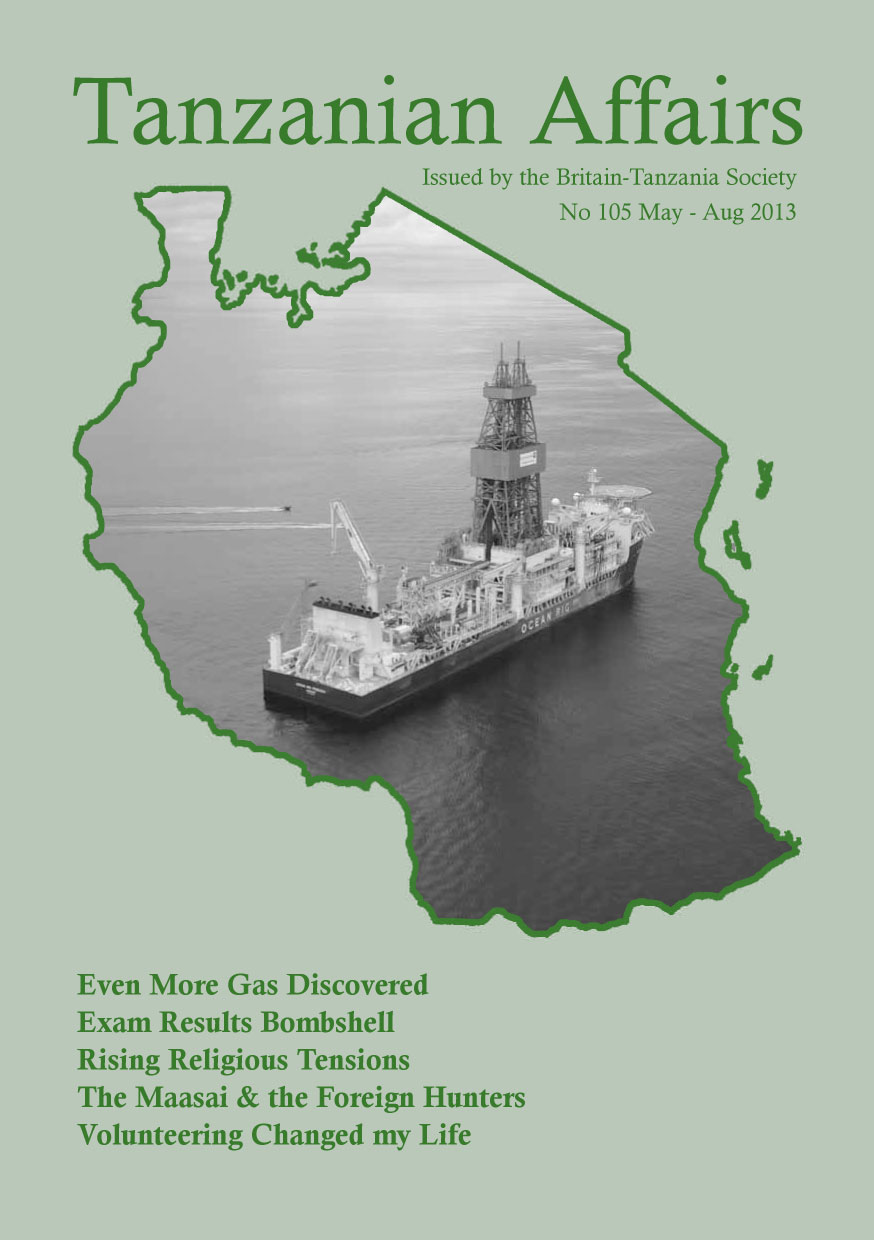
Issue 105 cover featured the Ocean Rig Poseidon used for gas exploration off the Tanzanian coast

Issue 105 cover featured the Ocean Rig Poseidon used for gas exploration off the Tanzanian
coast

Even More Gas Discovered
Exam Results Bombshell
Rising Religious Tensions
The Maasai & the Foreign Hunters
Volunteering Changed my Life

A pdf of the issue can be downloaded here