SOME OF OUR CONTRIBUTORS

Many hundreds of people have contributed to the columns of Tanzanian Affairs over the years. Sadly, many of them are no longer with us.

We would like to have presented, in this special issue, extracts from all of them but constraints of space and time make this impossible. We have also had to restrict the period covered for the same reasons. We decided that the earlier contributions, because of their historical significance, would be of the greatest interest, and the contributions mentioned below are all from the first fifty editions of TA. For those not seeing their contributions mentioned, we are sorry; but hope this will not discourage you from contributing again.

We can hardly thank enough all the people who have contributed, none of whom asked to be paid. Without them we must wonder whether TA would ever have existed.

I also feel privileged to have met so many of them and to have benefited from the wealth of knowledge and experience they have shared with us.
So, thank you again.
David Brewin (Editor).

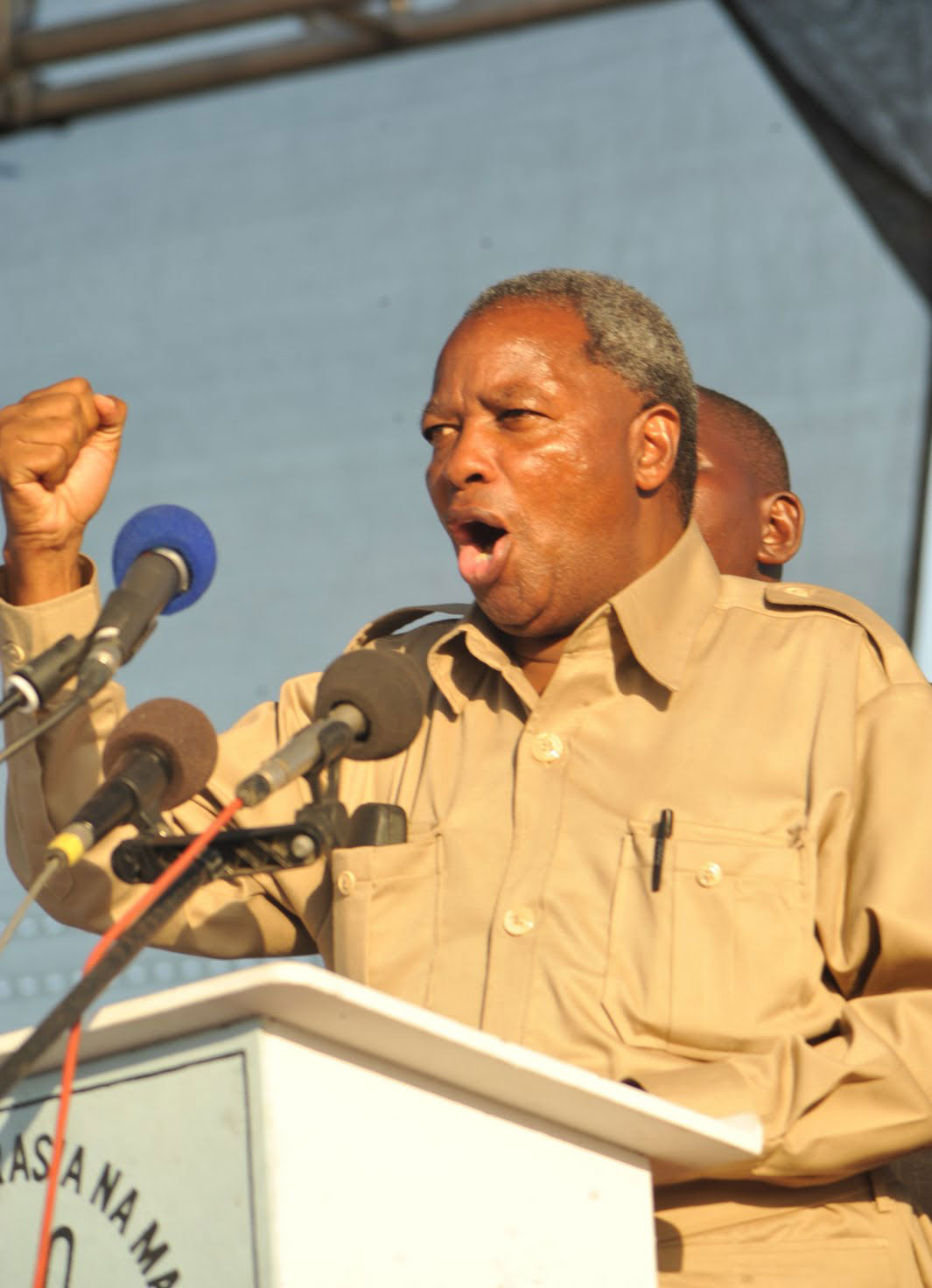
Mwalimu Julius K. Nyerere, whose name must have appeared in almost every edition of Tanzanian Affairs since the beginning (in 1975), paid tribute to TA in our 50th edition.

Graham Mytten contributed a regular digest of Tanzanian News in the 1970s.

John Arnold wrote on many subjects when he was the second editor of Tanzanian Affairs, in particular, on the ‘ideological war’ over villagisation in the eighties.

Roger Carter, co-founder of the Britain-Tanzania Society, wrote a regular column on the economy for many years.

David Leishman. The first of his many contributions was in 1978.

Jill Shankleman, FAO Advisor, reviewed Andrew Coulson’s article on agricultural policies in Tanzania in 1979 (followed by many other articles over the years).

Professor Reginald Green wrote several robust articles on Tanzania’s economy in the 1980s.

Ann Brumfit reviewed an article on language development in 1981.

Martha Honey reviewed a BBC broadcast on the controversial Preventive Detention Act in 1982.

Peter White of the Polytechnic of Central London wrote on the bus and coach industry.

The Right Rev George Biggs, who was a missionary priest (mostly in Masasi) from 1937 to 1973, gave his impressions on returning to Tanzania after many years as Bishop of the Seychelles.

In July 1982 Ruth Carr reviewed a book comparing Tanzanian and Mozambican policies on rural development and came down heavily in favour of the latter.

N M Mulokozi of the Institute of Kiswahili Research in Dar University was full of praise for the two-volume novel by Aniceti Kitereza on peasant life in Ukerewe in pre-colonial times.

Professor C K Omari of Dar University wrote on the interaction of religion and society in 1983.

Philip Raikes contributed a comprehensive piece on the history of coffee in Tanzania in 1984.
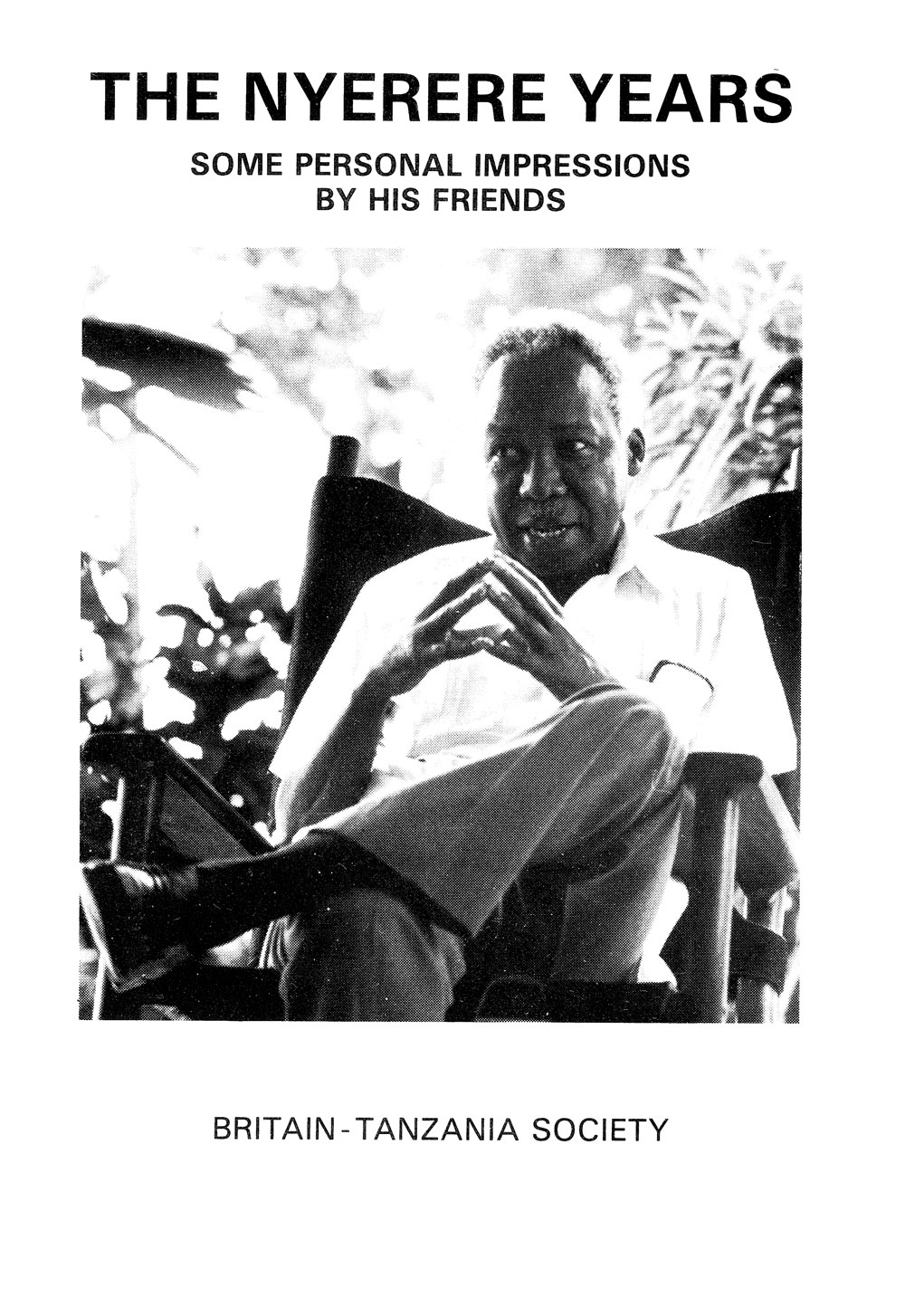
The Nyerere Years pamphlet


President Kenneth Kaunda of Zambia, Bishop Trevor Huddleston and Sir Shridath Ramphal, former Commonwealth Secretary General, paid tribute to Mwalimu Nyerere on his retirement in edition no. 22.

Peter Yeo contributed several articles on the co-operative movement in Tanzania over the years.

Professor G R V Omari, Vice- Chancellor, Sokoine University of Agriculture, was a constructive critic of Tanzanian Affairs in the 1980s.

Peter Chonja reviewed the report of the Presidential Commission on Education in 1986.

Christine Lawrence, a pillar of support over many years, together with a friend, Shirin Spencer, reviewed a performance in London by actors, singers and dancers from the Bagamoyo College of Art. Described as a fusion of Tanzanian and British traditional music with jazz, rock and pure drumming (plus the ‘Tanzanian Tango’), the production was titled ‘Nutcracker – A Village Party’.

Professor Juma Ngassongwa, who was later to become a Cabinet Minister for many years, contributed an analysis of ‘Peasant Farming in the time of President Nyerere’ to a 16-page supplement on agriculture in edition no. 24.

Sisal plant

Sir Roger Swynnerton, President of the Tropical Agricultural Association, wrote an obituary in 1987 on George Lock, who from 1930 to 1959 had devoted his agricultural service in Tanganyika to sisal research, the development of sisal crop husbandry and the improvement of sisal fibre processing at a time when the country was the biggest producer of sisal in the world.

In 1987 S A V Bowman wrote a letter to the editor in which he said that “Tanzanian politics, evidently the main preoccupation of the Bulletin (as it was then known) are, to me, the least interesting aspects of the country….”.

In 1989, James S Read, Professor of Comparative Law in London University (and later Senior Lecturer in Law at Dar es Salaam University College), a frequent contributor, wrote an article on ‘Justice in Tanzania – Lessons for England’.

Reviewing in 1989 a highly critical article on a World Bank Urban Shelter Project, Dr Carole Rakodi, at that time a Lecturer in Town Planning at the University of Wales, pointed out that the author was wrong to treat the Bank as a scapegoat and had ignored mismanagement in Tanzania (for example, the abolition of local government) and class tensions within the local population.

Mrs Keiko Collins, a book translator, and Mrs Midori Uno of NHK Radio Japan, contributed two articles (‘Tanzania and Japan’ and ‘Tanzania and I’) in edition no. 33 which explained how wrong Mrs Uno had found Japanese preconceptions about Tanzania to be when she went there as a volunteer and how there had been, since 1978, a Japan -Tanzania Association whose membership included three former Japanese ambassadors in Dar es Salaam.

Basil Hoare, a consultant in agricultural extension and training and a former staff member of the FAO in Rome, contributed frequently to TA.

T C E Congdon, Estates Director of Brooke Bond Tanzania Ltd wrote in 1989 an unusual and amusing analysis of the flora and fauna of a golf course, under the title ‘Nine holes in Mufindi’.

Mrs Eirlys Park, at one time a local correspondent to ‘The East African’ and the ‘Tanzania Standard’, wrote in no. 34 about the large collection of Makonde sculpture, built up by the Maides family, then living in Arusha.

Dr Mark Horton, the well known TV archaeologist who has done a great deal of work in Tanzania, first contributed to TA in 1990.

Dr Noel Thomas, Principal of the Teacher Training College in Swaziland, who has contributed many times to TA, reviewed an article on ‘Education and Culture of Tanzanian Teachers’ in no. 35.

In 1990 ‘A History of Leprosy in Tanzania’ was reviewed by Dr Peter Christie, a consultant paediatrician who advised on family planning in Tanzania.

Dr James Scullion wrote about ‘Grassroots Strategies in the Fisheries Industry’ in no. 36.

Dr Per Eklund, a Swedish researcher/consultant on rural development, wrote about population pressure and fertilizer policy in no. 36.

Dr Deborah Bryceson wrote on famine in East Africa in no. 37.

Geoffrey Wilkinson served in the Agricultural Department in Zanzibar from 1948 to 1954. In TA no. 41 he reviewed ‘Just Your Cup of Tea’ a collection of stories about the early years of tea development at Mufindi.

Sir James Farquharson, the former head of the East African Railways, wrote in no. 42 (a special issue called Mageuzi at the start of multi-party politics in Tanzania) on the discussions with the World Bank on the proposed Tanzania/Zambia Railway before the Chinese offered to construct it.

Judith Holland organised, very effectively, many seminars and other gatherings for the Britain Tanzania Society for several years.

In no. 43 in 1992 John Leonhardt, a biologist, wrote a review of a BBC programme, ‘Mpingo: The Tree that Makes Music’, whose wood was described as the only material from which you could make clarinets.

In no. 44 Cheridah Coppard, who described herself as ‘an amateur bird watcher’ reviewed an article by the International Council for Bird Preservation.

Those interested in the traditional musical instruments of Tanzania enjoyed the review of a book on the subject in 1993 by John Brearly, then an ethnomusicology student.

‘Suddenly, with a speed I did not believe possible for a beast of such vast, barrel-like proportions, a hippopotamus rose beneath us’. So began an exciting article in No. 46 by Ben Freeth, who described himself as a sky jumper.

In 1993 Professor Gelase Mutahaba, then Director of the Administration Division of the Commonwealth Secretariat, wrote a review of a comparative study of Public Sector Personnel Management in three African countries, including Tanzania.

Bevan Waide, then Advisor to the Parastatal Reform Commission, wrote in no. 49 a critical review of a study of state enterprises in Tanzania following nationalisation. There had been many problems but also many constructive initiatives He concluded that policy towards the parastatal system had changed as dramatically and almost as rapidly in Tanzania as similar policies in Hungary or Poland, but without a change in the ruling party.

Well- known Law Professor Issa Shivji made available to us in no. 50 an interview he had given to Haramata on the report of the Presidential Commission of Inquiry into Land Matters.

Chief Justice Francis Nyalali gave a wide-ranging and revealing speech at SOAS in 1994 which described how the functions and power of the judiciary had changed substantially during the early years of independence. It was published in TA.

Dr Margaret Snyder, founding director of the UN Development Fund for Women (UNIFEM), whose first book (written with Mary Tadesse) was ‘African Women and Development’, reviewed a controversial book about Ukimwi (AIDS) in 1993.
TZAFFAIRS ONLINE

The first experiment to put Tanzanian Affairs online was in May 2007 (Issue 87), using free blogging software called WordPress having obtained site www.tzaffairs.org. As well as adding each new issue since then, I have slowly worked through the back issues scanning, tidying up and uploading the text to the website, so now there is a complete record from Issue 21 (July 1985) onwards. Visitors can search for a keyword, or view a particular issue by selecting it from the “Category” drop down box, or choose by date using the “Archives by Date” box.

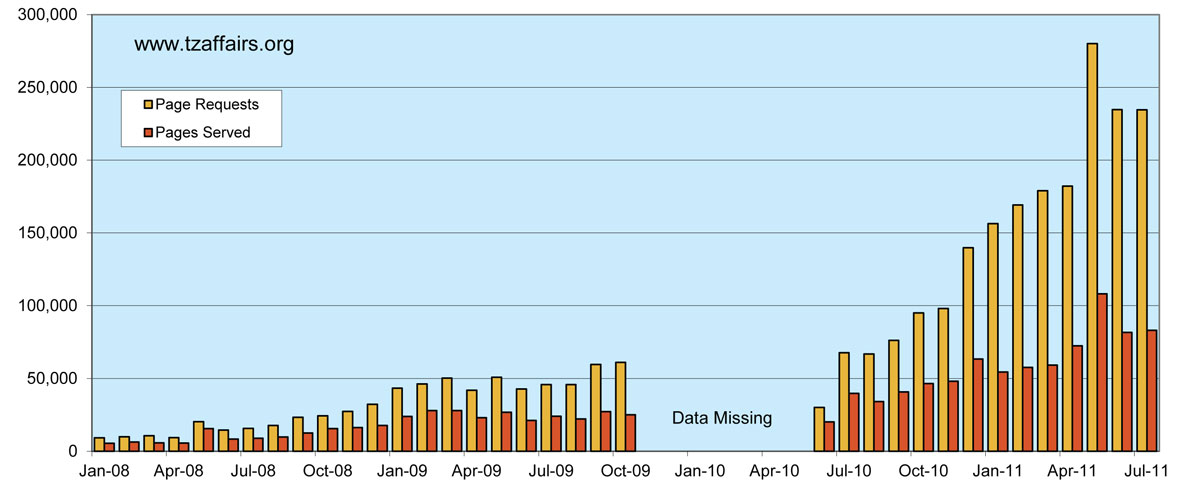
A graph of pages served by the website shows a steady growth in visits as more and more content has been added to the site. Many of these “visits” are by automated web-bots such as Google, so the numbers should be taken with a large pinch of salt.

Page statistics for website www.tzaffairs.org


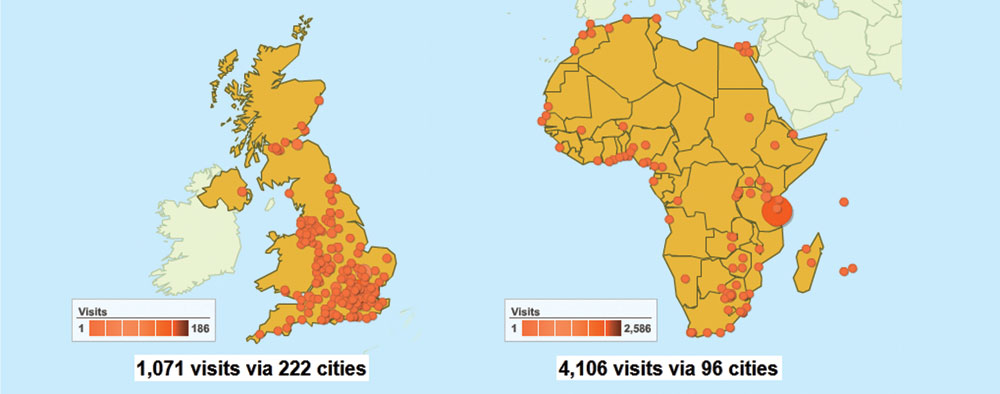
Recently, however, new software from Google has allowed us to monitor visitors more accurately, and it was a pleasant surprise to see that in the three months since Issue 99 was issued, 9,768 people have visited the site from some 158 countries. Even more encouraging is the number of visitors from Tanzania – making up 32% of visitors, with USA (16%) and UK (11%) making up the top three countries. It would be wrong to think that all these visits were from people keen to read in-depth articles, and indeed some of them may have visited by accident or just to see a photo, but it is nevertheless evidence that Tanzanian Affairs is reaching a wider audience.

Visitors to tzaffairs website

The task remains to get issues 1 to 20 online – for this we need a volunteer able to take the issues from David Brewin in London, scan them at high resolution (600dpi) and then transfer the files to me here in Botswana using ftp (or CD). Please contact me at jacob{AT}kwangu{DOT}com if able to assist.
Jacob Knight

THE SUCCESSION?

Dr Wilbrod Slaa (Secretary General of Chadema)

A Synovate opinion poll taken in May and reported in the Citizen on August 4 provided some revealing insights into what Tanzanians were then thinking about the leadership of their country. According to the poll (based on only 1,994 respondents), if an election were held in 2011, with President Kikwete not allowed to stand (because he would have completed his second term), Dr Wilbrod Slaa of the opposition Chadema party would be the clear winner with 42% of the vote. Professor Ibrahim Lipumba, Chairman of the opposition CUF party would get 14%. If the ruling CCM party should select Prime Minister Mizengo Pinda as its candidate, the figure for him would be 12%. This must have been bad news for the CCM.

Other questions revealed however that 51% of the respondents said that they supported CCM, 35% backed Chadema and 10% CUF.

In the 2010 general elections, CCM’s Jakaya Kikwete won the presidency with 61% of the vote, followed by Dr Slaa with 26% and Prof Lipumba with 8%.

IF BRITAIN IS BURNING, HOW SAFE IS TANZANIA?

Citizen Chief Reporter Lucas Liganga has been reflecting on what has been happening in Britain. Extracts:
‘The youth-engineered riots rocking some of the UK’s major cities have been described as a lesson for Tanzania to wake up, think and act. Political and social analysts have said that the riots in the UK are an indication that all is not well in our societies, adding that the line between peace and chaos is very thin indeed.’

Rakesh Rajani, the head of ‘Twaweza East Africa’, an initiative that promotes transparency and accountability in the region, said that Tanzania’s leadership and its professional classes should get their act together and focus on the frustrations facing the youth. “I was in London only one week ago,” he said, “and everything looked sunny and peaceful. A few days later some of these same places are in flames, and many people are hurt, angry, confused. For Tanzania, it should be the time to wake up, think and act about, for instance, the condition of the schools, the treatment of street hawkers and the dearth of opportunity for the young in the rural areas.”

Chadema Chairman Freedman Mbowe said the government’s policies should take into account the interests of the youth who comprise Tanzania’s majority. “The lesson we get from what is happening in the UK is that if there are no deliberate policies to address critical issues concerning the youth, we should expect such riots,” he said.

Executive Secretary of the Media Council of Tanzania, Kajubi Mukajanga, said that leaders should understand the reality that the young generation, who had a lot of expectations, was now starting to lose hope. He said the youth get frustrated when they see the country’s abundant natural resources benefiting only a handful of people, leaving the majority of them in poverty.

Zanzibar House of Representatives MP Ismail Jussa Ladhu (CUF), said most of the youth in the country were frustrated and a small event could trigger… riots across the country. He said: “We have natural resources but these are not used to uplift the youth. Only the few are enjoying these resources. They feel excluded and frustrated.”

BRITAIN MORE CORRUPT THAN IT THINKS?

For the last few years Tanzanian Affairs has been explaining the extent of corruption in Tanzania while, at the same time, noting the actions of the government and especially the very free Tanzanian media, in exposing it. TA has also described the many corruption cases brought before the courts. It has recalled how the whole cabinet was removed at one stage and how many government ministers and senior officials (about 20) have been charged in court and/or lost their jobs.

This corruption has resulted in some donor agencies threatening to limit aid to the country. There has been no lack of preaching by non-Tanzanians on how Tanzanians should do better.

In the last few weeks however, the situation has changed as explained in a report by ‘Transparency International’ under the heading ‘Is Britain more corrupt than it thinks?’. The report has been reproduced in the Citizen. Extracts:

Lecturing the world
‘Britons love to lecture the world about integrity and the rule of law, but the ‘News of the World’ phone hacking scandal has laid bare a web of collusion between money, power, the media and the police. Far from the innocent, upright democracy of its self-image, Britain is showing a seamy side that anti-corruption campaigners say is getting worse, and may be politically explosive, as society becomes more unequal due to the financial and economic crises.

‘Behind a facade of probity, London offers a haven for oligarchs and despots, a place where foreign media magnates have bought access to and influence over the government. The scandal engulfing Rupert Murdoch’s media empire has already destroyed a newspaper, cost two top police officers their jobs, seen the arrest of powerful media figures and embarrassed the Prime Minister and political elite.

‘But it points to a bigger problem in British society – overly cozy relationships among elites that are ethically dangerous, even when they do not involve outright criminality. Britain says it has been bolstering its legal and regulatory system. Just this month a new law on bribery, tightening rules for UK firms operating abroad, entered into force…..’

CURRENT CASES IN TANZANIA

They just will not go!
Citizen reporter Florence Mugarula raised the issue on many peoples’ lips in an article on July 29. She wrote: ‘In developed nations, leaders leave voluntarily when their governments run into trouble. In Tanzania, those responsible just will not go, even in the face of a crisis under their watch.

One exception to this rule has been former President Ali Hassan Mwinyi who in 1976, as a Minister, stepped down following the deaths in Shinyanga of people on remand, who were being investigated over the killing of witchcraft suspects.

The reporter went on to wonder why this President’s son, Dr Hussein Mwinyi continued to hold on to his position as Defence Minister despite the recent bomb explosions at army bases in Dar es Salaam. Why had Energy Minister William Ngeleja remained in office in view of the serious power rationing ?

By contrast, back in 1996, the then Finance Minister, Prof Simon Mbilinyi resigned over corruption allegations and, five years later, Minister of Industry and Commerce Iddi Simba resigned over an issue of sugar imports licensing.

The BAE Saga
No scandal in Tanzania has received as much attention as the BAE Radar case, both in Tanzania and in Britain. As this issue of TA is going to press Tanzania has still not received the £29.5 million which the British Senior Fraud Office had decided BAE should pay to Tanzania for the supply of an air traffic control system in 1999. The background has been explained in numerous earlier issues of Tanzanian Affairs. The sale provoked outrage at the time and BAE agreed finally, in February 2011, to pay back the £29.5 million to Tanzania.

In November 2010 the UK’s Department for International Development and the Tanzanian government drew up plans on how to spend the money. They agreed that it should be invested in education – £4.4m for school textbooks plus 192,000 desks, 1,196 teachers’ houses and 2,900 pit latrines. However, BAE then attached conditions before it would pay.

Both parliaments become involved. In Tanzania, MPs were angered by this and sent a delegation to UK in July 2011 to find out what was happening. One of the MPs said: “Every hour the money is sitting in the BAE bank account, is an hour preventing the children of Tanzania, from enjoying what is theirs. The kids are sitting on the floor; the teachers are sharing houses, the desks, the books, seven people using one photocopied book …..”

Meanwhile BAE indicated that it wanted to be involved in deciding how the money should be spent, and that it had appointed Lord Cairns to head an Advisory Board that would ‘guide the company as to the optimum means of applying the £29.5m for the benefit of the people of Tanzania in accordance with all applicable company policies.’ There were proposals that British NGOs might supervise the use of the money.

The Tanzanian response was swift. Foreign Affairs and International Cooperation Minister Bernard Mwembe said that Tanzania would not allow British NGOs, commissioned by BAE Systems, to operate in the country.

In the British House of Commons the Overseas Development Committee strongly criticised BAE for dragging its feet. It urged the company to pay the amount in full and raised the possibility of taking the matter back to court if the payment wasn’t made.

It questioned the right of the company to set up its own advisory board to decide on how the money should be spent – rather than give the money directly to the government of Tanzania, as Tanzanian MPs had requested.

Committee Chairman Malcolm Bruce MP asked whether it was not “offensive” for the company to suggest it knew better how to spend the money than the government of Tanzania. He advised BAE to hand over the money “as soon as possible”.

EPA Scandal – the latest
According to the Citizen on Sunday, in July, foreign donors started pressing the government to fully disclose the outcome of investigations into the TShs 133 billion External Payment Arrears (EPA) account scandal and prosecute all culprits. (Details in earlier editions of TA).

The donors included the African Development Bank, Canada, Denmark, the EU, Finland, Germany, Ireland, Japan, Norway, Sweden, UK and the World Bank, which are together providing some $450 million (TShs 678 billion) in budget support to Tanzania this financial year.

The lost sum was apparently siphoned out of the EPA account, which was under the watch of the Bank of Tanzania (BoT). It was fraudulently paid to 22 companies during the 2005/6 financial year. Fifteen people had been charged in court so far…….

The government has also been hard-pressed to explain why all those involved in the scam had not been prosecuted and to provide proof of the TShs 60 billion it said had been surrendered by suspects.

The Richmond case
The Citizen has reported the latest news on this case. In a surprising decision, the only person arraigned over the Richmond power scandal, which led to the resignation of the then Prime Minister, has been acquitted of forgery. It was alleged that in June 2006 a Mr Naem Gire forged documents that misled TANESCO’s Tender Board into believing that Richmond had the capability to produce 100MW of electricity.

This court decision has embarrassed the prosecution which had failed to prove that Mr Gire had a case to answer. The magistrate said she had evaluated each piece of evidence by the prosecution but found that everything regarding the documents was done by a Mr Mohamed Gire, a brother of the accused.

The Meremeta Company
Another issue worrying some MPs is the Meremeta Company. They have asked the government to tell the truth on the alleged billions of money lost. Chadema Shadow Minister for Defence and Security, Joseph Selasini, said a Select Committee should be formed to find out the truth, commenting “The opposition camp has been trying for the last five years to find out about the ownership of the Meremeta Company and we have received no satisfactory answers”. The Premier had once told the nation that this was a military company so no more details would be revealed – Nipashe.

The Opposition camp in the National Assembly also queried the decision by the Tanzania People’s Defence Force (TPDF) to sign a contract with Jeetu Patel, one of the key accused in the Bank of Tanzania EPA scandal. The contract was for importing power tillers from India for agricultural improvement in the country.

PARLIAMENT – BEHAVIOUR OF MPs

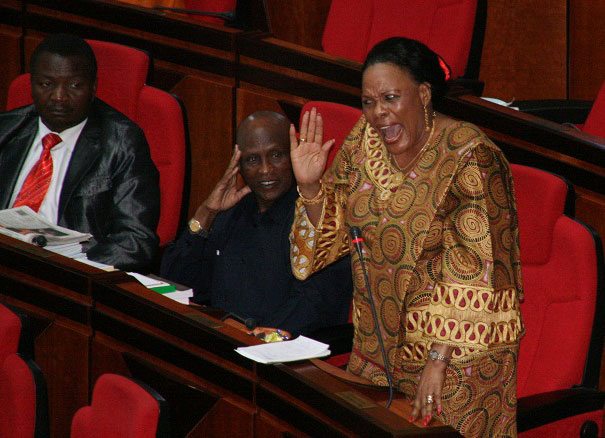
MP for Same South, Anne Kilango Malecela (CCM) asks a question in Parliament to January Makamba (Chairman of the Parliamentary Committee on Energy and Minerals) about the fuel problems.

Some observers see the latest developments in the National Assembly, where some opposition MPs are creating something like mayhem at times, as a healthy sign that Tanzanian democracy is now working as it should be, and that an active and lively opposition is an important element of any such democracy. Parliament was no longer a mere rubber stamp. The current vibrancy of the House was similar to that of parliaments in established democracies the world over.

Other observers, quoted in the Citizen, accustomed to the more genteel behaviour of MPs during the period of one-party government, accused some of the new MPs of ‘gross misconduct.’ Chrisant Mzindakaya, who was an MP for 40 years before stepping down in 2010, said booing, heckling and engaging the Speaker in shouting matches were ‘unpatriotic and cheap politics’. Similar concerns were raised by former Prime Ministers Salim Ahmed Salim and Joseph Warioba, who said blatant violation of the rules in Parliament should not be tolerated. Others said that lawmakers might soon be exchanging blows if the situation was not checked. Deputy Speaker Job Ndugai said the chaotic scenes were a sign of declining morals among leaders, who would stop at nothing to make political capital.

Budget estimates
Several ministers had a rough time in defending their budget estimates this year. Those for the Ministry of Energy and Minerals had to be withdrawn after Prime Minister Pinda intervened following what the Daily News described as a heated, emotion-charged debate to ask parliamentarians for another chance to work on them. The MPs agreed unanimously that they would be tabled again after three weeks. For further details see ‘Business & the Economy’ section below.

MPs accuse Energy Minister of laxity

Minister of Energy & Minerals, William Ngeleja.

Speaking at a seminar for MPs organised by Energy Minister Ngeleja, several MPs accused him of what they termed ‘empty promises and lame excuses’ for the longstanding power problems hitting the country. Attacking TANESCO representatives, one MP said: “We’re not interested in your PowerPoint presentations or grand-sounding plans. What we want is electricity and we want it now! Your expertise or your education is useless to us if you cannot find ways to solve the power problems once and for all.” David Kafulila (Kigoma South-NCCR-Mageuzi) advised the government to revise power purchase agreements. Augustine Mrema (Vunjo-TLP) wanted to know why the government had agreed to buy electricity generated by the Dowans plant which had been bought by Symbion, while the same government refused to allow TANESCO to buy the generators – Mwananchi.

The Minister said that electricity rationing would soon cease when Independent Power Tanzania Limited (IPTL) started supplying an additional 90MW into the national grid. Mr Ngeleja appealed to MPs to forget the Dowans issue, saying it was “mired in politics….”

Permanent Secretary in trouble
A letter addressed to unnamed ministry officials by the Ministry of Energy’s Permanent Secretary, David Jairo, was released in which he had apparently asked for donations of TShs 50,000 each to ‘make the presentation of his budget estimates a success.’ The Prime Minister quickly reacted and said that this was punishable, unbecoming conduct and he was as angry about it as MPs were. The PM was quoted in the Daily News as saying that he felt like sacking the offending Permanent Secretary immediately but could not do so because he had no mandate. It was President Kikwete who could discipline him. A CCM MP said that he would not support the Minister in his budget proposals. “We virtually live in the dark. The officials who cast us into this predicament are well known. Their heads should roll,” he said.

Health budget
Kigoma-South MP (NCCR-Mageuzi) David Kafulila provoked heated exchanges during the debate on the budget estimates for the Ministry of Health & Social Welfare. The legislator caused confrontations between opposition and ruling party MPs after alleging that the government had spent millions of money for treatments abroad of minister’s family members and that it was sluggish in collection of taxes. This made ruling party (CCM) MPs very annoyed and Kafulila was asked by the Acting Speaker to withdraw his statement. But Kafulila substantiated his claims with a quotation from the late Mwalimu Nyerere, and the atmosphere in the House became so hot that the chairperson had to adjourn the session seven minutes before the official closing time – Mwananchi.

Four MPs ordered out

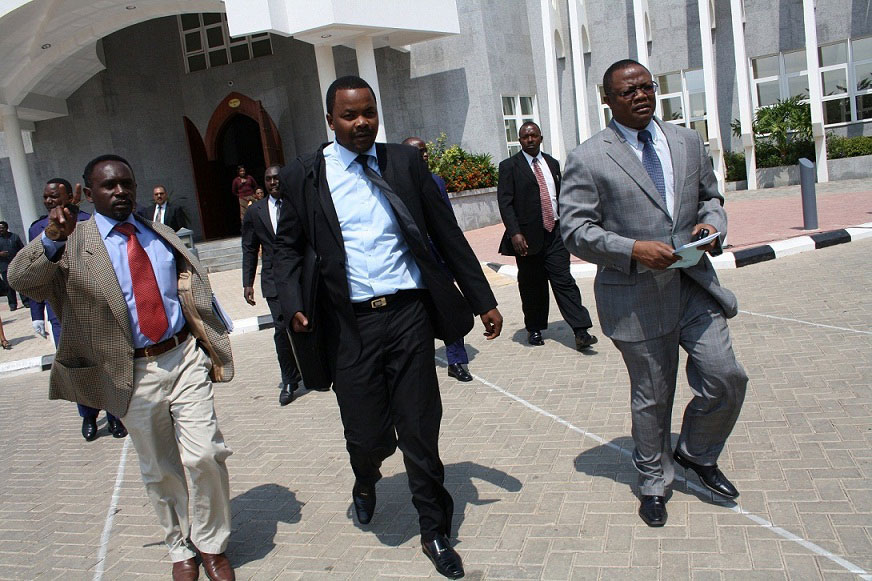
Chadema MPs Tundu Lissu (right), Pastor Peter Msigwa (left) and Godbless Lema being escorted out of the parliament

The atmosphere in the House was not improved when the Speaker ordered four Chadema MPs to leave the chamber for what was described as ‘violating parliamentary standing orders.’ One was charged with failing to sit down when told to do so and the others had apparently switched on their microphones to speak without permission.

“Jeopardising stability”
Government Chief Whip William Lukuvi said that a speech by Mr Lema, the Chadema Shadow Minister for Home Affairs, aimed at inciting people against their government and was jeopardising the country’s stability. Mr Lukuvi identified the offending words as: “It is better we fight, rather than live peacefully while we are denied our rights. Peace is not the absence of war but the presence of justice”.

Rostam Aziz resigns
Parliament was shaken again when the prominent and influential CCM MP for Igunga, a member of the Party’s Central Committee and head of President Kikwete’s presidential election campaign in 2010, Rostam Aziz, suddenly resigned from his parliamentary seat. In his resignation speech he referred to what he called “gutter politics” as the reason behind his departure. He also indicated that he might not give any support to his party to retain the constituency.

In accepting the resignation, the CCM Ideology and Publicity Secretary, who is bringing considerable energy into his job of ‘cleansing’ the party, said that Aziz had responded to the Party’s plea that some of its members should take such action. “We are grateful that he (Rostam) has responded to the call” – Daily News.

Chadema lost no time in launching a special operation, christened “Operation Chukua Igunga” designed to take the seat from CCM.

MP’s expenses
This very hot issue in the UK has now arrived in Tanzania’s parliament. Chadema’s Zitto Kabwe has proposed the scrapping of the TShs 70,000 subsistence allowances and TShs 80,000 sitting allowances paid to each MP daily and to use the money saved for the development of MP’s constituencies.

Prime Minister Pinda said that this was a misinterpretation of the law. It was a constitutional matter. “There is no way the government can act without following due procedures … It can take a long time,” he said. In a popular move Kabwe then forfeited his entire allowances for the period of the lengthy budget debate – Mwananchi.

HUNTING

The Guardian on Sunday has published a detailed analysis of the lucrative hunting industry following moves to implement the Wildlife Conservation Act of 2009 which, amongst other things, limits the number of hunters and forces foreign firms to give 25% of their shareholdings to Tanzanians. Foreign-owned companies allocated hunting blocs should not exceed 15% of the total hunting companies at any particular time. Thus only nine foreign hunting firms out of 27 will be allocated hunting blocs for the period 2013 to 2018, out of the 65 which applied.

Some observers fear that if 18 major firms are forced to leave Tanzania, over 5,000 Tanzanians might lose their jobs, with the Treasury likely to suffer a loss of nearly $15 million in tourism-related taxes annually.

A Tumaini University lecturer in Wildlife, Corporate, and Land Laws, Nyaga Mawalla, said the WC Act was contravening the investment guarantees offered to investors under the Tanzania Investment Act of 1997 and the Constitution of the United Republic. “The Constitution’s Bill of Rights provides that all persons are equal before the law and are entitled, without any discrimination, to protection and equality before the law,” Mawalla stated and added, “The Wildlife Conservation Act No. 5 of 2009, favouring hunting firms owned by a majority of Tanzanians, was discriminating against those Tanzanians who had purchased 25% of the shares from the foreign firms”.

Government’s position
The spokesperson of the Natural Resources and Tourism Ministry Matiko Mwita, said that arguments with regard to a bad law were supposed to be raised during the enactment of that law and not now. “Why [are] these people criticising the Wildlife Conservation Act this time around when we are in the process of allocating hunting blocks?” he asked. His ministry was not responsible for making laws. A ministry spokesman said that he was only implementing the laws, regardless of whether they were good or bad.

Under new tourist hunting rules, Tanzania is increasing the cost of licence fees for prime hunting blocks from $27,000 to $60,000 a year. The revised guidelines also categorize the hunting blocks into five depending on the type and number of animals to be hunted.

BUSINESS & THE ECONOMY

Compiled by Valerie Leach
Economic management in Tanzania continues to be challenging. Large food surpluses in the West are stockpiled as transportation bottlenecks prevail, consumer prices rise, especially for food and fuel, and districts in the North of the country and neighbouring countries to the North face acute food shortages.

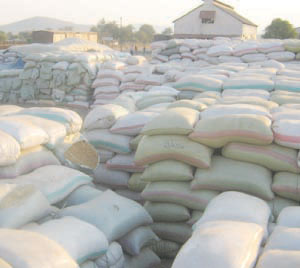
Bags of maize stuck at the railway station in Mpanda District, Rukwa Region, due to lack of transport. Photo: Musa Mwangoka - The Citizen

While a ban against private food crop exports officially remains in place, Tanzania has opened its doors to drought-affected countries to negotiate directly with it in the drive to procure food. “Neighbouring countries confronted with a food crisis are welcome to deal directly with the government instead of farmers, traders or agents in border regions for food purchases,” Prof Jumanne Maghembe, the Minister for Agriculture, Food Security and Cooperatives said. He said Tanzania has a surplus of 1.7 million tonnes of food. Tanzania’s move comes against a backdrop of rampant food smuggling to neighbouring countries. The Tanzanian police estimates that more than 400MT of maize is trucked daily out of the country through Mara, Arusha and Kilimanjaro to Kenya, South Sudan, Somalia and Ethiopia – East African News Agency.

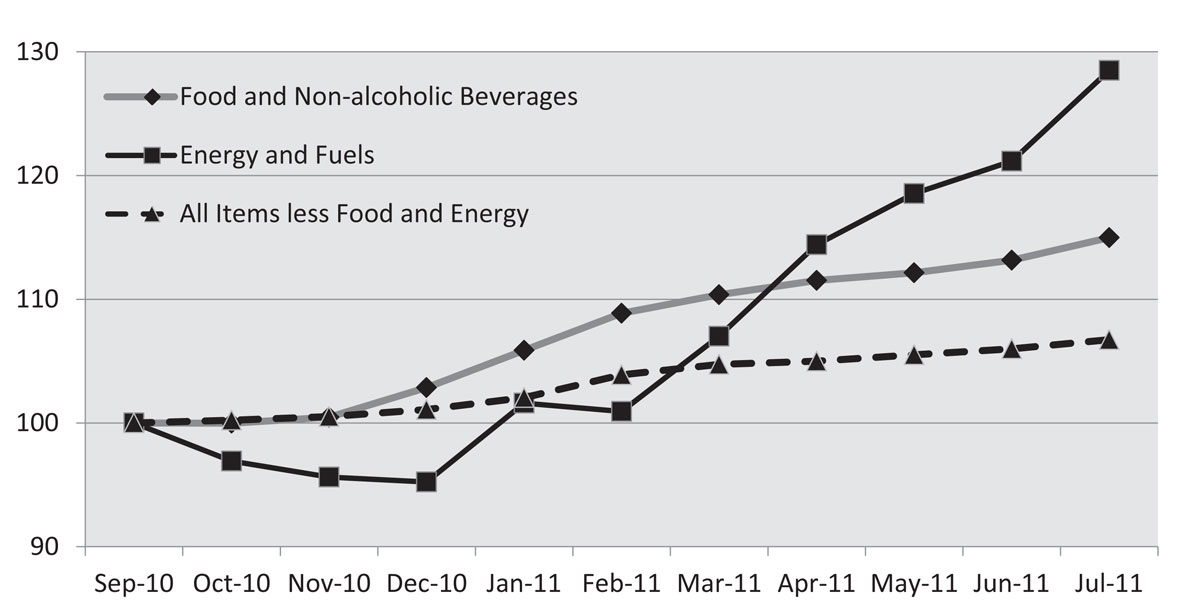
Food prices in Tanzania have risen sharply. The National Bureau of Statistics (NBS) reported that the headline inflation rose to 13% in July from 10.9% in June. Prices of food and non-alcoholic beverages rose by 15.9% for the year ending July 2011. Food and non-alcoholic beverages account for 47.8% of Tanzanians’ ‘shopping basket’ – The Citizen.

Fuel prices have also risen sharply. The NBS reported that energy prices rose by 34.2% in the year to July 2011, compared with a rise of 29.0% in the year to June 2011. The increasing prices of food and energy contrast with stable prices of other items in the consumer price index.

Price movements of different components of the Consumer Price Index - Source: National Bureau of Statistics, www.nbs.go.tz

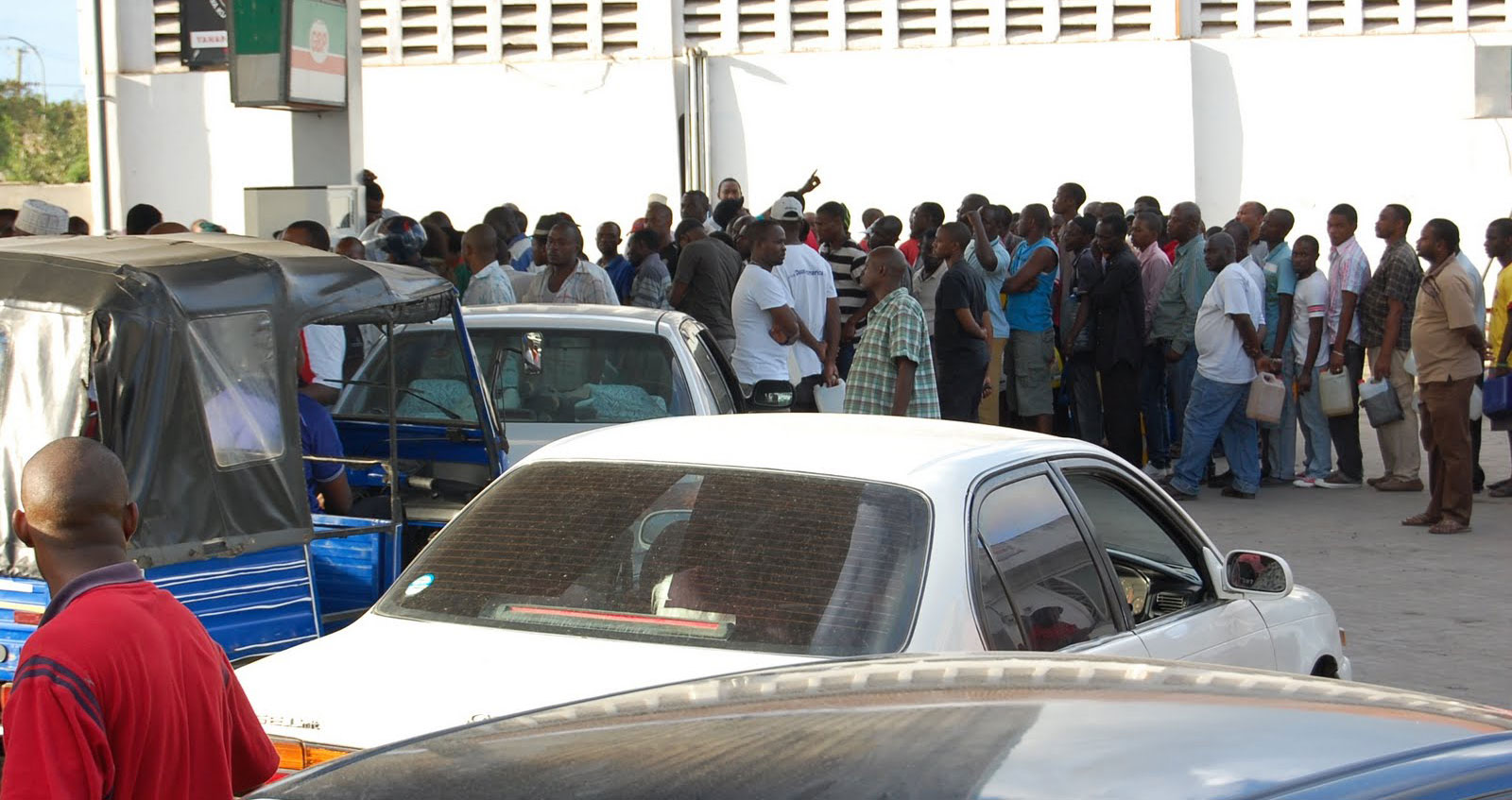
The Energy and Water Utilities Regulatory Authority (EWURA) announces new fuel prices fortnightly. Early in August EWURA published indicative prices which sparked a boycott by major oil importing firms. Following the boycott, EWURA slapped a three-month no-sale ban on BP Tanzania, a firm in which the government has a 50% stake, and strongly warned a couple of others. Two top executives of BP (Tanzania) Limited were arrested in Dar es Salaam. They were granted bail and are due to appear in court to answer charges related to economic sabotage. EWURA is also monitoring conduct of oil dealers Total and Oryx following reports that some of their filling stations resisted selling fuel at the new prices. New prices announced mid-August effectively restore the pre-boycott oil price levels. Minister Ngeleja justified the increase, saying it was prompted by two major factors: an increase in oil prices on the world market and a fall in the value of the local currency relative to the American dollar – The Guardian.

Huge queues at Sinza petrol station in August - Photo Jackson Odoyo

Tanzania’s economy to grow by 7.3% in 2012
Tanzania’s economy is expected to grow by 6.9% this year and 7.3% in 2012, according to a new report of the African Development Bank, African Economic Outlook. The report also says that the country’s economic growth faces great risks, including increasing fiscal deficit, and inflationary pressure from fuel and food prices. “The infrastructure deficit such as lack of reliable energy may pose a threat to the struggling economic growth not only in Tanzania but also in other countries,” said Prof Mthuli Ncube, the African Development Bank (AfDB) chief economist. Last May, the International Monetary Fund (IMF) cut its 2011 growth forecast for Tanzania to 6% from 7.2% in March, saying frequent power outages would hurt output while food and fuel prices could push inflation to higher levels – Daily News.

Imports and Exports
During the year ending May 2011, the current account deficit widened by 3.6 per cent to USD 2,607.4 million compared with the year ending May 2010. This was the result of a larger increase in imports than the increase in export earnings. The increased cost of imports was mainly on account of persistent increases in global oil prices. Moreover, there was a significant rise in imports of fertilizer that could be associated with the implementation of Kilimo Kwanza. In the year ending May 2011, a total of 313,400 tons of fertilizer were imported compared with 235,000 tons imported in the similar period a year earlier. In the year ending May 2011, the value of exports of goods and services amounted to USD 6,447.1 million, an increase of USD 1,399.3 million when compared with amount realized in the year ending May 2010. This development was largely driven by good performance in gold, manufactured goods, coffee, tobacco, cashew nut as well as receipts from travel and transportation services. Exported manufactured goods include cement, textile apparels, edible oil, wheat flour, plastic products, soap, paper products; and glass and glassware products. (Bank of Tanzania, Monthly Economic Review, June 2011).

Highlights of the Budget Session of the National Assembly, June-August 2011
This year’s budget session has been a lively one with MPs from all parties questioning budget proposals. In three ministerial budgets the Premier had to intervene. The first time, he withdrew the Energy and Minerals Budget and asked Parliament for three weeks to prepare emergency plans to deal with power rationing. MPs had rejected budget proposals for the Ministry of Energy and Minerals, forcing the Prime Minister, who is head of government business in Parliament, to postpone it to August 13, when the government pumped in TSh1.2 trillion for short, medium and long term power generation aimed at easing the power crisis.

In addition, the MPs rejected budget proposals for the Ministry of Transport, prompting the cabinet to convene an emergency meeting that authorised an additional budget of TSh95 billion.

In the debate on the budget for the Ministry of Lands, Housing and Human Settlement Development, the Prime Minister moved quickly to allay MPs’ fears over land grabbing by assuring them that the government’s lease system guarantees that no one person can wholly own land in the country. “This is one thing that the government should be praised for,” the Prime Minister said. “No one can own land in this country and we have said that, come what may, we will not budge on this.” He added, however, that while there were areas where land is a critical issue, there was ample land in other areas that people were free to move into. “We should not fear to welcome investors in land if such investment will be beneficial for the country,” pleaded Mr Pinda – The Citizen.

Experts have warned that new tax waivers announced by the Treasury will further increase revenue losses incurred by the government through excessive exemptions and other generous fiscal incentives, which are currently put at nearly TSh2 trillion. The experts also argue that contrary to the government’s position, the fiscal incentives – which mostly comprise tax holidays, investment allowances and tax credits, timing differences, and general tax reductions – will not necessarily attract investments. Research undertaken by local and international institutions has established that the concessions play only a marginal role in influencing investors’ decisions. “Experience shows that a high occurrence of tax exemptions reduces the tax base, creates room for bribery and corruption, and increases the appearance of loopholes for tax evasion.” researchers at the Christian Michelsen Institute of Norway noted in their June 15, 2011 report on tax opportunities and challenges in Tanzania, Zambia and Mozambique – The Citizen.

Energy
Members of Parliament cautiously welcomed the government’s emergency power generation plan and called for prudent use of the billions of shillings that will be invested. But some opposition MPs accused the government of ignoring proposals to cut its unnecessary expenditure to fund the emergency plan instead of borrowing from the commercial banks – The Citizen.

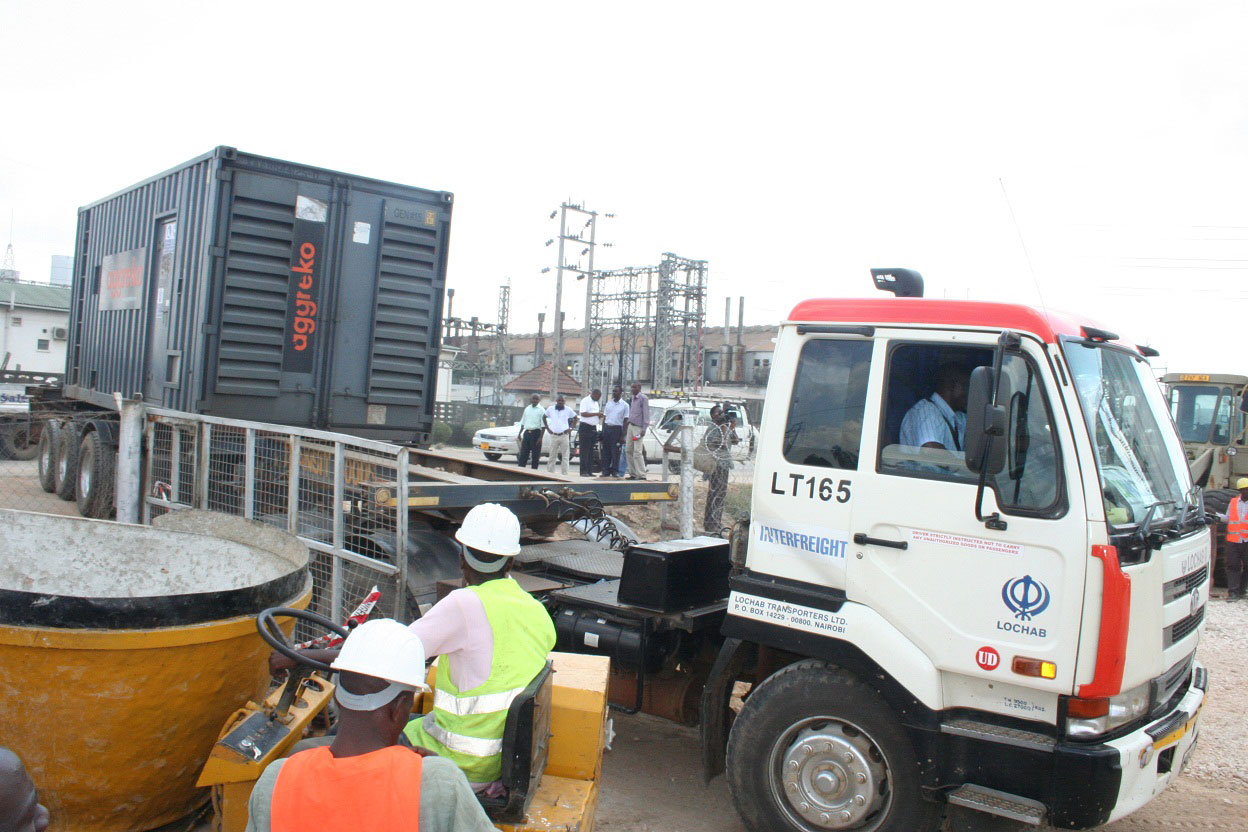
The government’s emergency power production plan indicates that 572 megawatts (MW) will be produced between August and December, with the National Social and Security Fund (NSSF) coming in as a new player who will produce 150 MW. Other players who will contribute to the power pool are Symbion which will inject 112 MW, IPTL who will produce 100 MW and Aggreko who will supply 100 MW. The emergency plan will cost TShs 523bn. Tanesco will manage TShs 115bn from sales of power and the government will obtain a TShs 408bn loan from a bank – Daily News.

Aggreko generating equipment is offloaded in Ubungo, Dar-es-Salaam - photo Victor Makinda

Land
The government will establish the land bank to facilitate protection of land and make it easily available for investment purposes in a move which seeks to avoid conflicts among investors and villagers. It will also enable people in the area to benefit from land resource at the same time enhance sustainability of extensive land-based investments, Minister Tibaijuka told the National Assembly. She said under the new arrangement, villagers would have shares in the invested land but under invested value method of land valuation. Shares and profit will be shared among the investors, relevant district council and the central government. She said a bill for the establishment of the bank would be tabled in the House after completion of necessary preparations. The Minister also said that the government would establish Land Compensation Fund to be used for compensating parties moved from their land for national development projects – Daily News.

Agriculture
The government will implement two ambitious agricultural programmes during the 2011/12 financial year, namely the Southern Agricultural Growth Corridor of Tanzania (SAGCOT) and the Marketing Infrastructure, Value Addition and Rural Finance Support Programme (MIVARF), to boost agricultural production. Presenting his office’s TShs 3.4trl budget estimates, the Prime Minister, Mr Mizengo Pinda, said that the government has set aside TShs 1.5bn while donors have pledged TShs 26.3bn for the 20-year SAGGOT programme. He said the government in collaboration with International Agriculture Development Fund, African Development Bank and Alliance for a Green Revolution in Africa would start implementing MIVARF next month. MIVARF to be implemented in 7 years, will cover all regions in the country plus Zanzibar – Daily News.

Crop Marketing
The Ministry of Agriculture, Food Security and Cooperatives is preparing a new procedure dubbed ‘commodity exchange markets,’ in order to improve the crop marketing system for major cash crops. Tabling his 2011/2012 budget estimates, Agricultural Minister Prof Jumanne Maghembe said his ministry, in collaboration with other sectoral ministries and stakeholders, were preparing the system which would be a special marketing system for farmers. “This system will start being implemented for crops which are already in the process of being sold through the warehouse receipt system,” he said. The Minister said further that the budget allocated for the Grain and Mixed Crops Board for implementation of the commodity exchange markets was TShs 8.19bn – Daily News.

NILE WATERS DISPUTE

Egypt’s control over the Nile waters came to an end late in May when, at a ceremony in Kampala, six countries (Tanzania, Kenya, Ethiopia, Rwanda, Burundi and Uganda) ratified a ‘Cooperation Framework Agreement’ (CFA) that repeals the colonial treaty of 1929. The World Bank Trust which manages the resources of the Nile Basin, had been blocking development projects along the river outside Egypt and Sudan because the existing ‘Nile Basin Initiative’ lacked a legal basis which the new CFA now provides – East African.

Without waiting for the new agreement Tanzania has already tapped the waters of the Nile by pumping water to Shinyanga and Kahama. It is now planning a new project to take water to a population of 420,000 people in Tabora Region.