OBITUARIES

Veteran politician and national leader RASHIDI MFAUME KAWAWA – Simba wa Vita (83) died on December 31 at the Muhimbili National Hospital.
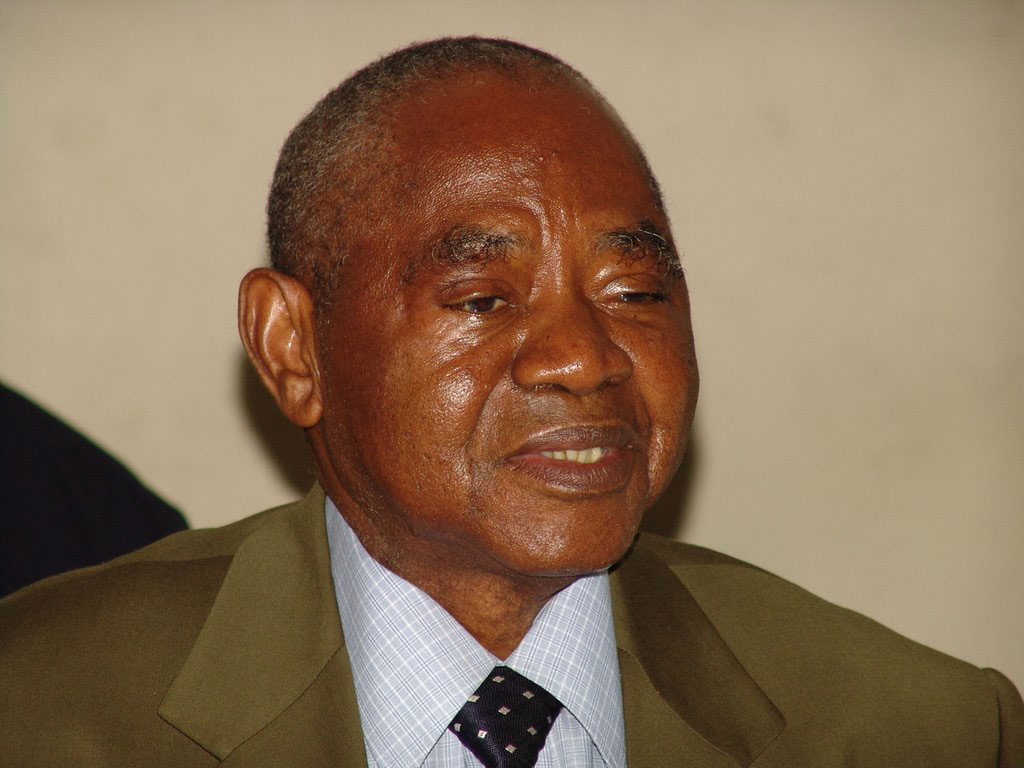
Rashidi Mfaume Kawawa (photo Issah Michuzi)


Announcing the news President Kikwete said the nation had lost a great son who sacrificed a lot for the liberation and development of his country. He declared seven days of mourning in honour of the man who had served as Minister of Defence, Prime Minister, Second Vice-President, and Secretary General of the CCM.

Mzee Kawawa, who was preparing to travel abroad, had reported to hospital for a malaria test. The results indicated that he did not have malaria but, on his way home he suddenly felt ill. At the hospital doctors found that his blood sugar was approaching zero and his two kidneys had completely failed. Then came cardiac arrest.

Mzee Kawawa was born near Songea as the son of an elephant hunter and his first job was as a Public Works Department accounts clerk. In 1951 he realised a long-standing dream by becoming a social worker and he joined a mobile film unit engaged in government literacy programmes. When it was decided to use the unit for educational filming, he was chosen as the only Tanzanian leading actor. Then he became a star in two more films, which added greatly to his popularity.

Then, in 1953, he was given a much more stressful job. He later described his time in central Tanganyika, working among Kikuyu detainees held during the Kenyan Mau Mau movement, as “the greatest challenge of my life.”

The Tanganyika independence movement was then underway. When his civil service employment prevented him from full participation in the struggle his decision to use the unions to further independence led to his resignation in February 1956 to devote his time to the organisation of the labour movement. Kawawa became President of the Tanganyika African Government Services Association and, after that, helped found the Tanganyika Federation of Labour (TFL) and was elected its first General Secretary in 1955.

In September 1960, following his first appointment to cabinet rank, he resigned from the TFL to concentrate on politics. When Mwalimu Nyerere resigned from the post of Prime Minister of the independent Tanganyika for a brief period in 1962, Kawawa replaced him until his return to office.

After 1964 Kawawa held the office of Second Vice President of Tanzania, serving as Nyerere’s principal assistant for mainland affairs, and as leader of the National Assembly.

He played a very important role during the villagisation programme of the 1970s which became one of the most difficult undertakings the government had undertaken. As the principal assistant to Mwalimu Nyerere, he ensured that the task was accomplished although it is much criticised today.
He was strict and did not tolerate civil servants who did not do their job.

Many Tanzanians believed that Kawawa would succeed Nyerere after the latter relinquished the Tanzanian presidency in 1985 but, his unwavering commitment to a state-controlled economy caused him to lose popular support to the more pragmatic Ali Hassan Mwinyi, who eventually became President.

In recent years Mzee Kawawa continued to play a significant role in Tanzanian politics and was unwavering in his support of Mwalimu Nyerere. One example was seen in 1995 when he strongly supported Nyerere’s wish that his protégé, Benjamin Mkapa, should be nominated as the CCM presidential candidate in spite of strong opposition within the party.

Thank you Bobby MacIvor, former wife of Derek Bryceson, who was Minister of Agriculture under Nyerere in the 1970’s, for sending us this personal tribute – Editor:

‘It needs only a short search in my mind to bring back a picture of Rashidi, memories come again to me, clearly and vividly. I can see a short, fairly stout and broadly smiling man, often laughing out loud. This was at the time of the lead up to Independence for Tanganyika. I knew then that I had met a man with an enormous amount of energy and enterprise and enthusiasm.

My random memories of Rashidi then, are not to quote histories written of all that had happened on special dates, but to try to show my own picture of him and the many sides to him. There was the ebullient Rashidi, the inspired, inventive Rashidi and the ambitiously determined Rashidi. He planned and implemented many of his ideas. Ideas to help his country make progress.

With Julius Nyerere as President, Rashidi must have found someone who had, I believe, chosen him to make a good balance in the leadership. Leadership for the Christian and Moslem peoples of a large country.
When I lived in a house at Msasani Bay, next door to Julius and Maria and their family, my husband, Derek Bryceson and our son and daughter would often meet them on the beach. The wide expanse of the wonderful Indian Ocean, made for us all, a tranquil and beautiful place to be. Julius sometimes called us to come and sit with him on his verandah if he was alone. He would tell us about his thoughts and ambitions and how Rashidi particularly was an extremely valuable and important person to him. A person who could help share the great and heavy responsibilities they had to carry with others in government and outside it.

I left Tanzania with great sadness after a divorce from Derek in 1974. I left behind so much, but took with me not only some personal possessions, but many treasured memories. One of the sharpest of those was of Rashidi.
After more than forty years and in a very different life in England, I sometimes think to myself of Rashidi. Rashidi in another form. As a Tanzanite, sparkling, strong, firm as a rock with a value which has no doubt.’


MICHAELA VON FREYHOLD
, who died in January in Bremen, was a sociologist and anthropologist who came to Tanzania in 1968 and taught in the Sociology Department at the University of Dar es Salaam and later at the Institute for Finance Management. Her book Ujamaa Villages in Tanzania: Analysis of a Social Experiment (Heinemann, 1979) is by far the best study of the early years of ujamaa, based as it is on thorough fieldwork and observation in four villages in Tanga Region, but also placing what happened in the historical and political economy framework which she developed in her lectures, and showing how young government staff sent to do the government’s bidding, which they were not particularly comfortable with, in villages which they little knew or understood, were placed in an impossible position. The case studies show that there were many villagers who were prepared to give ujamaa farming a trial, but that they were repeatedly frustrated by unsympathetic action from government officials or forms of aid that they had not asked for and which for them were not priorities.

Michaela also wrote, less successfully, about the new breed of managers that took over factories and parastatals from 1967 onwards (her sympathies almost entirely with the workers), and on women with young children in rural areas. On leaving Tanzania she became Professor for the Analysis of Third World Development at the University of Bremen – . Thank you Andrew Coulson for this – Editor
REVIEWS

Edited by John Cooper-Poole (UK) and Marion Doro (USA)

THE KARIMJEE JIVANJEE FAMILY : MERCHANT PRINCES OF EAST AFRICA 1800-2000. Gijsbert Oonk, Pallas Publications, Amsterdam University Press 2009. ISBN 978 90 8555 0273. Distributed in the UK by Africa Book Centre Ltd, Brighton [e-mail orders : orders@africabookcentre.com] £45

In many ways the modern economy of Tanzania was built by the Asian immigrants who arrived from the west coast of India over a period of four hundred years, albeit with a huge influx from the late 19th century. There are only a very limited number of accounts of this story, and even fewer which focus on the history of one successful extended family. Dr GijsbertGristant Oonk of Erasmus the University, of Rotterdam has told the story of the Karimjee Jivanjee family of Zanzibar and Tanzania , in an intriguing book (which a fascinating array of photographs from the mid nineteenth century onwards) published by Amsterdamhis University Press. .Oonk is a broader historian of Indian migration to Africa and so is able to place this remarkable saga in context.

Buddhaboy Noormuhamed of Mandvi, GujaratGujaratManvi, Gujurat sent his son Jivanjee to Zanzibar where he opened his first shop in 1818, initiating a series of businesses in Zanzibar and the mainland based on the export of commodities and the import of key industrial and consumer goods. These were extremely productive and profitable and are unique in having survived in various forms to this day. Critical forward looking decisions included the acquisition in the early twentieth century of agencies from all over the then industrialised world, an early investment in the sisal industry, followed by tea and coffee and then tea, the establishment of a motor car distribution business by 1927, and in a new tourist camp in the Serengeti in the late 1990s. The leading members of the family played business, political and charitable roles throughput the twentieth century and continue to do so.

There are some important special characteristics of this saga. First, the Karimjees emanate from the close knit GuajaratiGujurati speaking Bhora community, a Shiashia group with intense community supporting bonds – a critical factor when the founder’s younger brother lost a whole cargo en route from India in the 1860s. Second, by the early twentieth century, the leading family members were unusually internationalist in their perspective, travelling regularly to Europe and in the case of Sir Yusufali Karimjee to Japan where in the 1930s he married Katsuko Enomoto. Thirdly, whilst the majority of new initiatives have been successful, they have been entered more on the basis of intuition than detailed planning. For instance, the move into sisal was triggered by a walk shared by Sir Yusufali Karimjee and a Greek plantation owner in Dar es Salaam in 1921. Fourthly, neither the Zanzibar Revolution of 1964, nor the property nationalisations on the mainland in 1971 persuaded the family to abandon Tanzania. Although many members left at that time, three remained to husband the motor business and the agricultural estates. This placed the family in a strong position when the Tanzanian economy was liberalised in the late 1980s.

Alongside this commercial success several family members have contributed both to political progress and to major charitable projects. In the colonial politics of Zanzibar, Tayabali Karimjee and Yusufali Karimjee fought very effectively against commercial decisions which negatively affected the Indian community, particularly in relation to the cloves business. Later they werehe was the main donorsdonor to the Tanzania National Library and to the Faculty of Arts at the new University of Dar es salaam. In the 1950s, AbdulkarimAbdul Karim Karimjee played a significant part in early nationalist politics and organised the huge donation by the family of the Karimjee Hall [where Tanzania’s National Assembly met recurrently until the early 21st century], and a major donation to the University of Dar es Salaam in its earliest years. Tayabali Karimjee funded Zanzibar’s main hospital [ironically renamed the V.I. Lenin hospital for more than thirty years] which continues to be the main medical facility on the island.

In a conversation with this reviewer President Nyerere opined that the Karimjees would never leave Tanzania. This book explains just why that may be true, and at the same time will be a valuable resource to any student of Tanzanian economic and social history.
Laurence Cockroft

THE CRITICAL PHASE IN TANZANIA 1945-1968, by Cranford Pratt, Cambridge University Press, digitally printed version 2009 (originally published 1976), Cambridge ISBN 978-0-521-11072-3. £24.99.

When Tanzania is rife with accounts of corruption in high places, it is not surprising that there has been a revival of interest in the incorruptible first President, Julius Nyerere, especially amongst young political activists in Tanzania. One such described Nyerere’s legacy as “generating passionate public debate aimed at bringing positive social and economic change” (Chambi Chachage in Pambazuka 452, 2009). A newly founded Chair – the Mwalimu Nyerere Professorship of Pan-African Studies has been awarded to Issa Shivji, author of the critical account, Class Struggles in Tanzania in the 1970s. The Mwalimu Nyerere Foundation’s tenth anniversary of Nyerere’s death, held in Dar es Salaam last year, was an enormous success in attracting a large and lively audience and many young people.

Hence the publication of what seemed like a new study of crucial years in Nyerere’s life as President – those immediately preceding and following independence, seemed promising. Sadly Pratt’s book is a reprint from 1976 which seems to have been reproduced by Cambridge University Press as a “digitally printed version” (complete with American spellings and occasional errors) simply because it could be done. It is disconcerting to find the present tense being used to reflect on the potential of a leader dead for a decade. Whilst it is instructive to look at Pratt’s views of this period, this book demanded an introduction, framing the debate about the events of the time and their aftermath and explaining why it is pertinent to re-issue it now.

In view of the above it is unfair to point out that Pratt has not responded to later work, such as that of Susan Geiger on the emergence of TANU as a political party, or critical or more measured accounts such as those of Yeager or Coulson, and the vast output of reflection on Nyerere’s leadership, which continues. What is amazing is the sheer ferment of analysis and critique that did go on in the decade following Tanzania’s independence which is covered here. Pratt refers to work by Cliffe, Saul, Arrighi, Ngombale-Mwiru, Shivji, Rweyemamu and many others published in the early seventies, though he distances himself from what he calls ‘Marxian scholarship’.

Pratt is clearly a fan of Nyerere’s and sometimes eulogises his contribution. He also describes him throughout as a ‘socialist’ and sees Tanzania as heading in a socialist direction, though frequently having to qualify that label. At the heart of Nyerere’s conception of socialism was a deep commitment to equality and to a form of African communitarianism; he was no Marxist. What is exceptional about this book and makes it well-worth reading even now, is the spotlight it puts on the struggle between vision and reality in the struggle to establish a nation state. We talk glibly of independence, and yet Tanzania came to this momentous moment with hardly any personnel capable of running a country or delivering public services, still reliant on colonial civil servants, with minimal industrial development and the mass of the population dependent on subsistence agriculture. As Pratt shows, in the first few years the government’s hold on power was precarious, with very little capacity to enact change. At one point Nyerere had to be rescued by the British from a coup attempt by army discontents.

Expectations were also impossibly high, though Nyerere always had a groundswell of popular support from which he was able to pull off quite audacious political acts. One of these was his welcome to African liberation movements (especially the ANC) to locate themselves in Tanzania and his active advocacy of pan-Africanism. Another was his willingness to forgo foreign aid on matters of principle, despite Tanzania’s dependence, and to accept aid from China and East European socialist countries. He intervened in the revolutionary turmoil of the newly independent Zanzibar and manoeuvred a union of the two countries which has continued to cause difficulties. But he also took a constitutional stand on ensuring that racial minorities in Tanzania enjoyed equality with African citizens – a position that was understandably unpopular, given the privileged socioeconomic position which these minorities had enjoyed in the past. Conversely he inveighed from the beginning against class privilege, ‘parasitism’ and the danger of entrenched income and wealth differentials; as well as for self-reliance and open debate. He brought the party (the Tanganyikan African National Union, TANU) very centrally into the decision making and policy formulation process and shifted within a few years to espousing a one-party state, whilst establishing democratic safeguards and a functioning National Assembly. Pratt’s account of the process whereby democratic freedoms were defined as incorporating one-party rule but the exclusion of other organised political elements (the unions and the cooperative movement were soon incorporated into the state) is an instructive one. Pratt shows how this culminated in the promulgation of the Arusha Declaration of 1967 (only six tumultuous years after independence) in which a socialism of self-reliance and planned transformation of rural production was combined with a nationalisation of the commanding heights of Tanzania’s economy (a few foreign-owned banks and processing industries).

The focus of this book is on Nyerere, but Pratt is aware that, to adapt Marx, leaders ‘make history, but not under conditions of their own choosing’. Nyerere was a remarkable, even a unique leader, a man of vision and restless intelligence, an exceptional communicator with ordinary people, fired by an optimism of the will, constantly seeking to solve problems. This is well-illustrated here. But he was faced by a universe of enormous challenges and difficulties which could not be moved by one man alone or simply through exhortation. Nyerere could not have achieved what he did without popular and party support, or expedient alliances abroad, though there is no denying the effort and intelligence he put into manoeuvring and sustaining these relationships. Pratt’s focus on the leader leads him to be fairly vague about rural transformation or the problems entailing in transforming a dependent economy at the mercy of the world’s markets. And the book comes to an end just as the scene is set for the contradictions and dilemmas to test Nyerere’s vision of Tanzanian socialism to its limit.

Janet Bujra


“BIOFUELS, LAND ACCESS, AND RURAL LIVELIHOODS IN TANZANIA”
, Emmanuele Sulle and Fred Nelson
International Institute for Environment & Development. ISBN 978 1 843 69 749 7.
In Africa, many non-food crops are grown on agricultural land, but rarely has there been the opposition that we see for biofuels. If you want to understand why biofuels in Africa is such a difficult area, why opinions run strong on both sides of the debate, this book offers a well-balanced perspective and is a good place to start. As the book makes clear, biofuels in Tanzania are complicated because land is complicated. Customary laws and state centralized land administration overlap, secondary rights of pastoralists and women often disappear as property rights are formalized or transferred. When the pace of change is slow institutions may adapt, but in Tanzania 4 million hectares of land have already been requested for biofuel investment (though in reality little has been granted yet), with individual requests as large as 400,000 hectares. This book covers much ground in just 64 pages of text, and so must by definition cover some areas in less detail than the reader might want. But into this small book the authors have packed rigorous research and useful and detailed information on the current state of investments in biofuels in Tanzania, the different modalities of biofuel production, and very detailed and nuanced chapters on land access and acquisition. As is the case for many agro-processing industries, the choice is often between large plantations which allow companies more control over quantity, quality, and price of inputs; and outgrower and contract farming which offer less control but more opportunities for rural communities. In Tanzania, added complications of possible permanent loss of village customary land rights, loss of access to forest resources and grazing lands, and loss of miombo woodlands, make the authors, with good reason, wary of large-scale transfers of land for biofuels. Although I prefer not to read private sector investments described as “projects”, or of villagers “giving” land to biofuel companies, such linguistic differences do not detract from an important book in a fast-moving and still under-documented area.
Elizabeth J. Z. Robinson

LETTERS

I have noted the astonishing news that Tanzania was the third largest recipient of international aid (official development assistance?) in 2007. I, for one, would like to think that what is driving the resurrection of the EAC to new heights, is precisely that kind of embarrassing and, I’m sorry to say, shameful news. Bar a hiccup involving the Royal Navy in 1964, and, while the OAU stood by, Nyerere’s honourable war to rid Uganda of Idi Amin in 1978, Tanzania has been at peace since internal self-government, half a century ago. Why should it still be needing so much demeaning outside support?
Tanzania is blessed with a coastline, is on a major shipping route, enjoys a large land mass with a variety of climatic zones and eco-systems, it harbours great existing and potential mineral resources, and its population is large, if ill-distributed, but not so large that the advantages of a sizeable market are outweighed overall by land-stress and pressure on resources. Yet it languishes in the arms of the aid gravy-train, for whom it is a veritable paradise – experts, official and NGO, on fabulous salaries crawling all over the place, aid funds sloshing about, too often diverted and secreted out of the public domain by the scurrilous and venal. The gap between rich and poor is, I suspect, greater today than at Tanganyika’s independence, and the purchasing power of the poorest, in real terms, lower than in 1961, certainly since the end of the 1960s.

Is Tanzania’s population still growing at a speed which means a GDP growth rate of 6-8% a year needs to be achieved? I think everyone is agreed on that, but it begs the question as to why the country can not achieve and, more important, sustain such growth rates. Is it still too small in global terms to be able to withstand outside economic shocks?
Aside from all the other well-documented, internal causes of under-development since the Independence era, the scandal of world terms of trade continue to dog the efforts of smaller states to consistently achieve higher growth rates; but to think that, even with a Doha Round resolution, those in economically-dominant positions globally are going to cede their dominance voluntarily to an extent acceptable to poorer nations, is wishful thinking.

With an internal common market the EAC is at last beginning to reach a stage where it can, like the EU, start building influence, and affect global decisions, in its own right, as a trading bloc, just as South Africa does now – remember, a century ago South Africa was four separate countries about to be amalgamated – having the size and economic muscle, if not yet to be quite a ‘ BRIC ‘ country. Following Nyerere’s vision of an East African state, Tanzania needs to hasten EAC integration towards eventual political federation or union, as its charter details. Is it a fond hope to think that an impetus towards irreversable political integration could bring to the fore a new generation of more altruistic, public-spirited politicians, sensible to a wider and more diverse population, and, through size, a more responsible standing in the world? President Kikwete is one of this younger breed of politicians, an ideal East African president?

A.D.H. Leishman

ZANZIBAR –RECONCILIATION AT LAST?

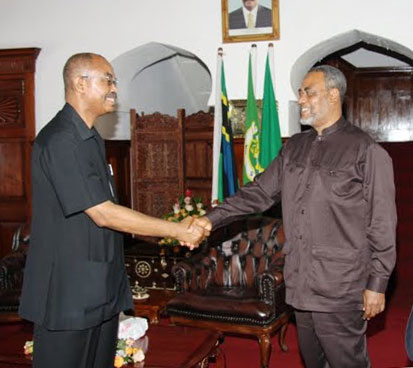
President Karume (left) and Seif Shariff Hamad. Photo Ramadhan Othman Ikulu

There was considerable excitement in Zanzibar on November 5 2009 when it was revealed that the Secretary General of the leading opposition party (the Civic United Front – CUF) Seif Shariff Hamad, whose party won all the elected posts in Pemba in the 2005 elections, had met for two hours President Amani Karume of the ruling Chama cha Mapinduzi (CCM) party, behind closed doors. It was the first visit Hamad had paid to Karume since he had refused to recognise him as the islands’ President after the controversial elections in 2005.

A State House press release said that the two leaders had discussed various matters including the need to ‘maintain peace, tranquility, tolerance and cooperation among all people in the islands’. They also agreed on the need for ‘sustainable negotiations’ between them and their parties.

Hostility at Unguja meeting
Shortly afterwards, on November 7, Hamad had to face an angry crowd of his supporters at a rally in Unguja (the main island) when he revealed that his party now recognised the President. As thousands of people started shouting and milling around the podium, CUF Party (national) Chairman Professor Ibrahim Lipumba took to the podium and tried in vain to calm the crowd. Some of them were heard shouting: “You have betrayed us”.

Lipumba said that the matter would next be discussed in party sittings so as to get members’ views. “If they think we betrayed them, we are prepared to be accountable. Maalim Seif (the name by which Hamad is best known in Zanzibar) has been committed to CUF ever since he left the CCM” Lipumba said. According to the Swahili press, which gave substantial coverage to the event, Lipumba pleaded with the crowd but eventually the rally had to be called off and the leaders were driven off through a narrow alley under tight security.

Addressing a rally later in Tanga, Lipumba urged members all over the country to calm down. He said he was aware that members, especially in Zanzibar, were annoyed by the meeting but he assured them that Hamad would never betray them. “I hear some people accuse him of being bribed. This is rubbish for a person like Hamad who has devoted his life to the CUF party and even spent three years in detention. How can such a man be a sell-out?”

Warmer reception in Pemba
Addressing rallies in Pemba, a few days alter, Hamad received a warmer reception. “We took time to ponder with Karume where we were heading” he said “and we came to the conclusion that we had fought one another for far too long.”

Subsequently, CCM leaders, especially those from the Mainland, were asked to keep out of the reconciliation process which had been initiated by Zanzibaris. CUF Director of Foreign Affairs Ismail Jussa told The Citizen that CCM leaders should remain on the sidelines “because they don’t know what is going on.”

Meanwhile, speculation continued as to whether the two leaders had agreed on anything else, particularly on the possibility of power sharing in government.

It wasn’t until November 15 that President Karume finally commented, although the press wanted to know more than he gave them. He said that no eligible voter would be left out in the registration of voters for the 2010 elections. He made the remarks at a time when hundreds of CUF supporters in Pemba were claiming that they had been denied registration for the next elections because they did not hold residency identity cards.

The President, who will not be seeking election again after two terms, added that “We want both the winners and losers to accept the results. This is possible only if the elections are free and fair.” In another development, the President said he would now appoint two CUF members to the House of Representatives in accordance with previous agreements.

“We weren’t supervised by whites”
CUF Deputy Secretary General Juma Duni Haji told reporters that the talks between Seif Shariff Hamad and President Karume were held in secret so as to avoid ‘interference’ by people with ulterior motives. He said the previous ‘Muafaka’ (agreements) had failed, partly because they were sponsored by the donor community. Hamad said everything was now forgotten and forgiven. “Countries like Kenya and Zimbabwe resolved their differences with the help of outsiders but in Zanzibar that was not the case. It is better for locals themselves to resolve their problems with home-grown solutions. That is why, in our case, no white man supervised us.” – Nipashe.

Some uncertainty remains
Although the two parties were showered with praise by all parties in Tanzania and from many in the international community, some doubts were still being expressed as to whether the agreement would stick and, in particular, whether it might lead on to power sharing. Professor Lipumba said they were not sure as everything had been done orally. “It is a political risk we took, so I can’t guarantee that everything will turn out the way we expected.”

Then two Zanzibar government ministers spoke against the idea of a coalition government and power sharing. Deputy Chief Minister Ali Juma Shamhuna and Minister of State in the Prime Minister’s Office (Union Affairs) Mohammed Seif Khatib, differed with President Karume who had said that the issue of power sharing would have to be decided by the people. Minister Shamhuna said that Zanzibar did not need power sharing or a government of national unity. What was needed was for the parties to accept the election results. Minister Khatib told a rally in Pemba that national unity did not necessarily mean co-opting another party into the government. “CCM alone is capable of bringing about unity as that is its policy,” he declared – Mwananchi.

RIFT IN CCM NOW IN THE OPEN

After almost fifty successful years of leadership of Tanzania by the always united ruling Chama cha Mapinduzi (CCM) party, and with the next general election less than a year away, the party is no longer able to conceal the extent of its internal divisions which are being publicised in the media almost daily. Some observers recalled the late Mwalimu Nyerere’s view that CCM would never be removed from power by small opposition parties. A major change would only happen if the party were to split.

The freedom with which the press and the people are now able to express themselves in Tanzania, particularly on the issue of corruption, has provided ammunition for those keen to see the end of what some consider to be a continuation of ‘one party’ government. The opposition parties never cease to attack the government on the corruption issue and, judging by recent by-election results, they are increasing in popularity in certain parts of the country. The seriousness of the situation for CCM was illustrated at acrimonious meetings of the party’s Central and Executive Committees in August last year when there were accusations that the leadership was trying to ‘gag’ its own MPs. Several of the more outspoken CCM MP’s warned the party on the dangers if vigorous action was not taken against the many leading figures in the country now being charged in court on corruption charges.

Former Prime Ministers join in

Critical remarks by two former prime ministers, Joseph Warioba and Dr Salim Ahmed Salim, supported by Nyerere Foundation Director Joseph Butiku, seem to have exacerbated the situation. Opposition CHADEMA Secretary General, Wilbroad Slaa lauded the ex-premiers for having the ‘courage’ to speak out. CUF Chairman Lipumba said they had donned the mantle of Mwalimu Nyerere who was being sorely missed by the country – Mwananchi.

Anti-sleaze MPs on war footing
At a rally in which some of the CCM MP’s, known as ‘crusaders against corruption’ said they had decided to hold joint rallies in their constituencies so as to educate the masses on the plot by ‘corrupt politicians’ to unseat them by pouring in ‘dirty money.’ They included Dr Harrison Mwakyembe (MP for Kyela) author of the highly critical report on the Richmond scandal – see below. They claimed their rivals in CCM were spending Shs 400 million in each constituency in efforts to defeat them at the next elections in 2010 – Tanzania Daima.

A Committee of three ‘wise men’ set up
In reaction, the party quickly took the decision to set up a committee of three ‘wise men’ to oversea the restoration of party unity and to fix the party’s growing image problem.
According to the investigative newspaper This Day, the committee, comprising ex-President Ali Hassan Mwinyi, ex-Parliamentary Speaker Pius Msekwa, and former Speaker of the East African Legislative Assembly Abdulrahman Kinana had, as its primary task, to seek ways of healing what was described as the deep rift between a growing number of CCM MP’s and the central party establishment. The party was said to have ‘become beholden to a few rich individuals’ and the CCM secretariat had ‘even failed to meet regularly with the MPs to listen to their views.’

Political analysts were quoted in the paper as saying that many incumbent CCM MPs were choosing to become vocal about corruption for fear of being regarded by their constituencies as being part of the problem. The paper went on: ‘The National Executive Committee meeting had been virtually dominated by a brazenly overt…. campaign from within, to unseat the incumbent Speaker of the National Assembly, Samwel Sitta, who had made clear his own strong aversion to the ‘grand corruption vice.’ Political observers were quoted as saying that if allowed to escalate, the fall-out from the meeting might eventually lead to a complete disintegration of CCM as the country’s most powerful political party.

By November, the meetings of the three wise men were being described in the Swahili press as having become ‘fiery’ with divisions between the reformist and conservative camps becoming obvious. While the latter defended former Prime Minister Edward Lowassa who had had to resign following revelations about the Richmond corruption case (see below), and his supporters, the former called for their expulsion from the party. One meeting was said to have started at 8 pm and ended at 1.30 am. Some were calling for the resignation of CCM Secretary General Yusuf Makamba who was said to have left one meeting when the exchanges ‘became too hot for his hypertension.’

The media indicated that the tug-of-war seemed to be led by Speaker Samuel Sitta and prominent businessman Reginald Mengi from the reformist camp while Edward Lowassa and CCM Secretary General Yusuf Makamba lead the conservative side. Former President Mwinyi told TA that his three-man committee had encouraged the different groups to express their views freely to each other so that issues could be brought into the open. He intended to complete his report during the month of December.

Main opposition party also divided
All is not well in the main opposition party on the mainland, CHADEMA. During a Central Committee meeting attended by some 600 delegates, prominent MP Zitto Kabwe, Deputy Secretary General, (who has much support among younger party members) and is clearly ambitious, was apparently dissuaded from trying to unseat Freeman Mbowe as Party Chairman, only by the intervention of party elders including the founder of the party, one time Finance Minister Edwin Mtei.
According to numerous reports in the Swahili press, the elders knew that a tug-of-war for chairmanship between Kabwe and Mbowe would not be good for the party. Apparently, they suggested that Kabwe should instead be offered the post of Secretary General but he was said to have rejected the proposal outright, and proposed instead that both he and Mbowe should pull out and that present Secretary General Dr. Wilbroad Slaa should become chairman instead. Kabwe denied that the struggle was ideological, with him on the left and Mbowe on the right.

In elections in September for CHADEMA young peoples’ and women’s groups differences continued between young and older members of the party and the elections had to be postponed until later. Slaa complained that these party elections had already cost Shs 50 million which was enough to build a dispensary. “Our party just can’t afford this kind of expenditure” he said.

At the meeting, mother of Kabwe, Shida Salum, was quoted in virtually all the Swahili press, as standing up to defend her son, accusing some leaders of being corrupt. “I know Zitto. He is not on sale and can’t be bought,” she said.
Veteran former leader Edwin Mtei was said to have pointed out that Zitto Kabwe was still young and so would be in a good position to vie for the party chairmanship in 2015 or 2020. When asked if he intended to run for the presidency in 2015 Kabwe said that by then he would still be below the statutory age of 40 required by the constitution.
Another row erupted later when Dr Slaa terminated two party officials said to be close to Kabwe. Both then resigned from the party and one joined the small NCCR party.

When contacted about all this, Party Chairman Mbowe admitted that the party had problems but said that other parties were ‘down with cancer’ while for CHADEMA it was just a normal hiccup – Rai.

CORRUPTION CASES – THE LATEST

Tanzanian Affairs has been giving prominence in recent issues to reports on the various corruption cases which have been widely and frequently debated in Parliament, the media and elsewhere.

Kikwete – “578 Cases in court”
In a historic first ‘question and answer session’ broadcast live on all major television and radio networks on September 9, President Kikwete answered many questions, from around the country, on corruption. “We have taken steps and, as we speak, there are 578 corruption cases in the courts” he said. He added that the number was only 58 in 2005 when he had assumed power. He brushed off claims that his government was harbouring people suspected of grand corruption within the government and the ruling CCM party.

He also dismissed claims that the ruling party of which he was Chairman, was silencing MP’s who spoke out about corruption in the National Assembly. He also cited cases currently going on in various courts as well as senior public officials who were facing charges of abuse of office and embezzlement. He said that the respective anti-corruption agencies were finalising two or three cases involving high-profile personalities. “Our party would like MPs to speak out and assess their government” he said, “but that should be done in a way that protects the party’s interests too.”

Tanzania drops 24 places
A few days later, the international Berlin-based anti-corruption watchdog ‘Transparency International (TI)’ released a report showing that Tanzania had dropped 24 places in the ‘Global Corruption Perception Index (CPI)’ from the 102nd position in 2008 to the 126th spot in 2009.

The CUF Leader in Parliament, Hamad Rashid Mohammed, said the Judiciary did not act fast to clear pending corruption cases, while the Prevention and Combating of Corruption Bureau (PCCB) was dragging its feet in investigating allegations of grand corruption. Hamad told The Citizen that, although Parliament had been at the forefront in the fight against graft, many corruption scandals had been exposed but the Executive and Judiciary had so far done nothing.
Another government critic said that many corruption suspects were being acquitted because of the PCCB’s ‘shoddy investigations’ and its failure to effectively prosecute those charged with corruption.

The PCCB Public Relations Officer said she had not seen the TI report, but added that reports that Tanzania had fared better than other East African countries were ‘encouraging’. Rwanda had won accolades for wide-ranging steps to improve governance and gone up 14 positions to break into the top 100. Burundi, the worst performer in the region, was ranked 168th. Tanzania’s best ranking was 94 in 2007, when Parliament finally set up the PCCB.

The long-running Richmond saga (see earlier issues of TA)
The investigative newspaper ‘This Day’ revealed in October that, in addition to all the other irregularities, the controversial Richmond Development Company (which had later become Dowans Holdings), had tried to obtain more than $115 million from the government in 2006 for capacity and energy charges, under the later badly discredited emergency power supply contract it had signed. But, according to the paper, this represented a hefty profit as it had only spent $30m to install the planned 100-megawatt power plant in Dar es Salaam.

According to government sources quoted by the paper, Richmond/Dowans was subsequently paid more than $42m. The government had also paid $4,865 (approx. Shs 6bn/-) for airlifting some of the power generators, consumables, and other accessories from the United States. But, apparently, what the company brought in was only 20MW of power generating sets – one fifth of what was needed under the contract. This however, still represented a hefty profit for Richmond, considering that the company spent just $30 million to install the plant in Dar es Salaam.

Dowans Holdings apparently bought the remaining power generators from South Africa. But a government technical team sent to Cape Town in December 2006 to assess the trailer-mounted turbines, was said to have discovered that some of the equipment was rusty.

The formal termination of the contract between Richmond/Dowans and the government in 2009 paved the way for certain persons to set in motion yet another plan to obtain $69 million by selling the power generators to the government. It was only the fierce opposition to the proposal mounted by the parliamentary Energy and Minerals Committee and others, that blocked this from going ahead.

Towards the end of last year, while some MP’s were becoming increasingly restive as they waited to hear the government’s reactions to the numerous recommendations in the parliamentary report dated February 2007, the government announced that it intended to resurrect the company, as electricity supplies were again proving inadequate – The Guardian.

In October 2009, according to the Guardian, there was some surprise, amid escalating power rationing, that the government’s call for tenders for new emergency power generating plants failed to attract any competent bidders.

Government takes over and starts producing electricity
Eventually President Kikwete directed the appropriate ministers to take over the plant, which had been idle for several years, from its liquidators, to ease the crippling shortage of electricity.

Standard Chartered Bank (Hong Kong) then told the High Court that this decision was contrary to a court order that had placed the company under receivership and asked the court to halt the move as it would be unfair. The case was adjourned – Mwananchi.

During November the plant finally began producing electricity.

The Bank of Tanzania’s ‘Two Towers’ scandal

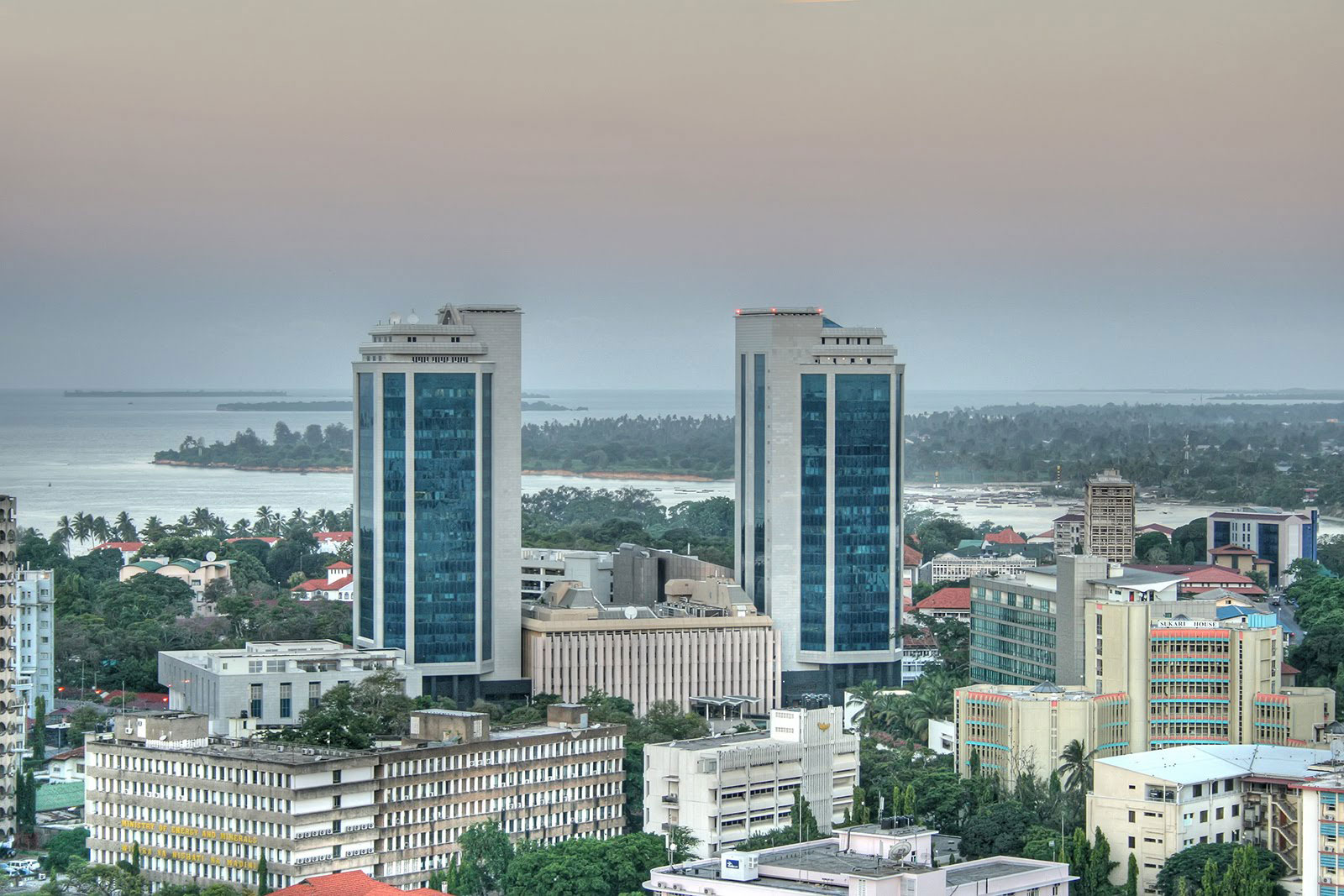
The Bank of Tanzania's two towers in Dar-es-Salaam

There are four cases of alleged corruption involving the Bank of Tanzania.
Prosecution in the first has been proceeding slowly. Former Bank Director of Personnel and Administration Amatus Liyumba, on trial for causing over Shs 221 billion loss to the government, told the court that the decision to revise the cost of building the bank’s headquarters was made by the Board of Directors and the Bank’s Governor, not him. Nothing could have been done without the approval of the Board. The prosecution charges that Mr Liyumba
and Mr Balali changed the scope and added extra works not covered in the contract, making the original tender cost
shoot up from $73 million to $357 million. The project involved building a 14 storey north tower at a cost of US$ 26 million and a south tower at US$ 29 miliion.

The ‘whistleblower’
In mid-November the Guardian on Sunday published a tribute to the person it described as the ‘whistleblower’ in the case who had, in April 2006, made the bold decision to go public. ‘Knowing that his decision, apart from costing him his job could also cost him his life, the man acted in the interest of his fellow countrymen.’

As expected, he lost his job and faced attacks from the Bank through a press release questioning his integrity as an engineer. The person concerned was reported now to consider himself lucky, because if he had approved the project, he would be spending his days and nights at the Keko Maximum Prison with his former boss Amatus Liyumba.’ He was transferred to Mwanza, where he spent two years more or less aimlessly. “They wanted to keep me away from HQ” he was quoted saying. “I feel so bad for being paid for doing nothing” he added. He was reported to be living happily in the outskirts of Dar es Salaam where he was running a construction firm to get by. “I would have made millions” he said.

Banknotes scandal
The Citizen reported in September that four senior employees of the Bank had been charged over the loss of Shs 104 billion, in yet another scandal involving the inflation of the cost of printing new bank notes.
The fourth scandal concerns the siphoning off, by some 22 companies, of Shs 133 billion through the Bank’s EPA account which has been described in detail in earlier issues of TA.

Gold auditing case
In this case, former senior cabinet ministers Basil Mramba and Daniel Yona (plus two other senior officials) have been charged with abuse of office that caused the Government a loss of over Shs 221 billion after granting tax waivers to a gold auditing firm, Alex Stewart (Assayers). The controversial assignment saw the company take $50 million in fees which sparked off a public outcry. Seventeen witnesses were being called to testify against the former ministers but the defence refused to reveal the names of their witnesses. The magistrates accepted this before the case was adjourned – Guardian.
The prosecution said, during the preliminary hearing, that Mramba signed government notices exempting the corporation from taxes in disregard of advice given by the Tanzania Revenue Authority (TRA) and had prepared an agreement between the company and the BoT which was amended without Attorney General and cabinet approval.

The Radar saga back in the limelight
Attention in the Radar case has switched to the UK where the Senior Fraud Office (SFO) has completed its enquiries and is asking the Attorney General to proceed with the prosecution of BAE which supplied the equipment. The Times of London wrote that if BAE would agree to pay up to £500 million (Tanzania is not the only country in which the company is accused of paying bribes) in a ‘plea bargain’ the problem could be resolved. But BAE felt that any admission of guilt would be unacceptable as it would undermine its huge markets in the USA and other countries. The paper said, that faced with the SFO’s ultimatum, it had decided to call the SFO’s bluff. It indicated that if the figure (for the Tanzania case) was in the range of £10-20 billion and that BAE would not be tainted with corruption and instead face lesser charges, negotiations might be renewed. However, the article went on to say that in dealing with Prime Minister Gordon Brown (and not Tony Blair) BAE would be likely to be rebuffed.

Progress in the investigations in Tanzania has been going slowly – the Director General of the PCCB was said to be waiting for the final report from the SFO in the UK. The key individuals being investigated by the PCCB include former Attorney General Andrew Chenge, former Bank of Tanzania Governor Idris Rashid, and prominent businessmen Tanil Somaia and Shailesh Vithlani. The local and foreign investigations forced Chenge to resign from the cabinet last year – Guardian.

MP’s allowances
As in Britain, allowances provided for MP’s, have become a cause of discord in Tanzania. Some MP’s are being accused of taking double payments from meetings they attend – Nipashe.
The opposition has said that the whole system is rotten and the PCCB has set in motion a number of investigations. It has been alleged that some corporations and government institutions have been paying Shs 200,000 daily to MP’s who also get parliamentary day allowances. House Speaker Samuel Sitta and others have been quoted in the Swahili press as justifying the allowances as ‘traditional Tanzanian hospitality’ and that the PCCB should not be investigating MP’s without consulting him.

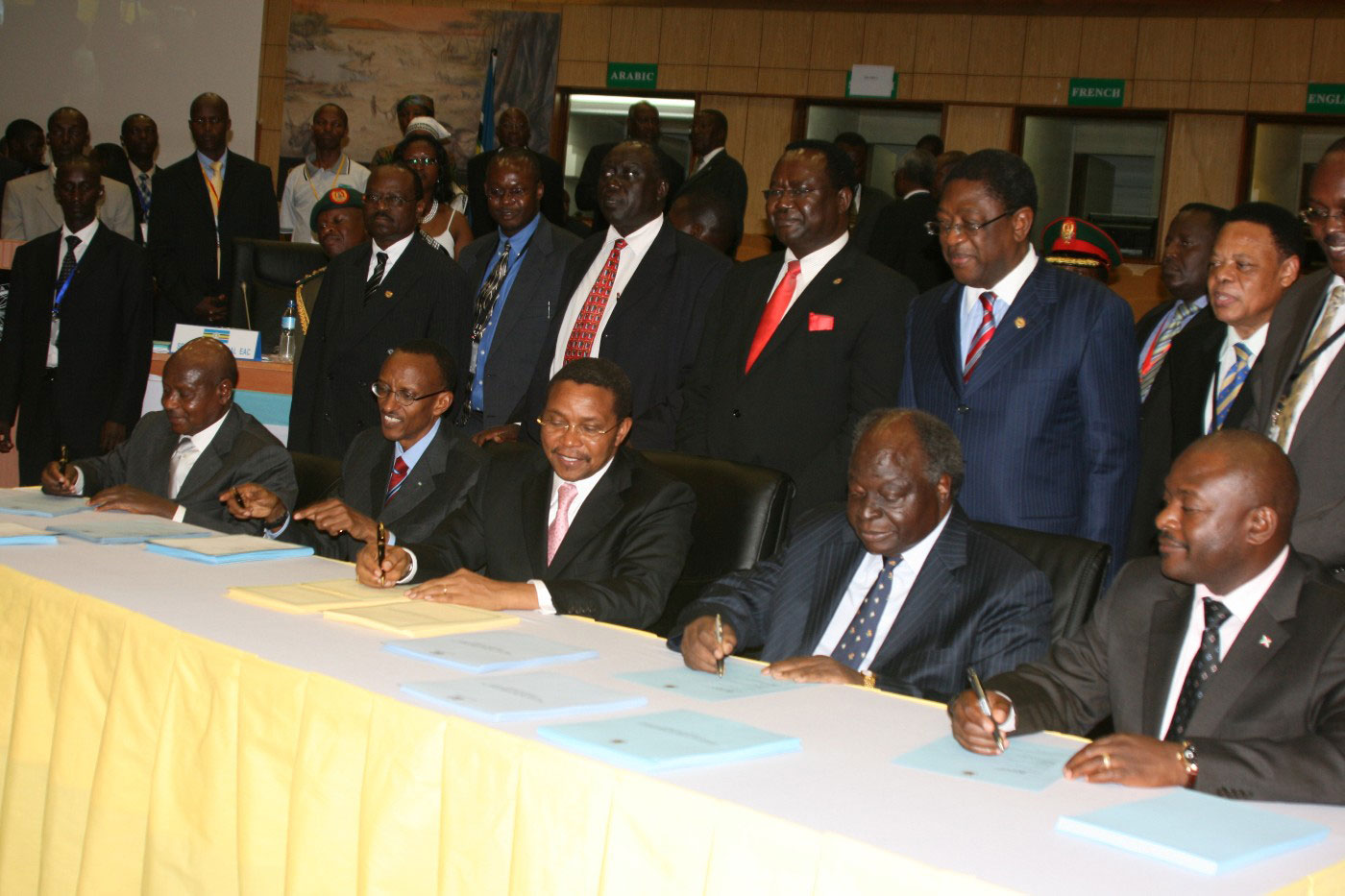
COMMON MARKET PROTOCOL SIGNED

Presidents Yoweri Museveni (Uganda), Paul Kagame (Rwanda), Jakaya Kikwete (Tanzania), Mwai Kibaki (Kenya) and Pierre Nkurunziza (Burundi) at the signing of the EAC Common Market Protocol. Picture Paul Sarwatt

East African Community (EAC) leaders formally agreed on November 20 to allow free trade, movement of people and right of residence in the region, with the signing of the protocol establishing a common market. This followed protracted negotiations between the five member states. All promised to arrange for ratification without delay. President Museveni of Uganda underlined the new found spirit of integration by inviting the other EAC members to become partners with Uganda in drilling for the oil that had been discovered there recently.

FAITH NEWS

In recent months, an avalanche of circulars released by various faith-based organisations, ahead of the 2010 general elections, has descended on Tanzanians. The process was set in motion by the Roman Catholic Church whose circular counsels individuals to vote wisely and bravely and to reject ‘corrupt power mongers’. The circular ignited a heated debate, with some ruling party leaders strongly attacking the move, alleging that it was endangering the nation’s unity and that the Church was ‘diverting from its core mission of preaching the word of God and instead playing politics.’ The leader of the Catholic Church told critics not to teach church leaders how to perform their duties, and pointed out that the document was a civic education initiative to guide voters on exercising their electoral rights responsibly.

The Government advised Muslim leaders against issuing a document similar to the controversial Catholic booklet so as to create disharmony in the country. But they went ahead and launched their 45-page document called ‘Mwongozo’ at a rally attended by thousands at the Mnazi Mmoja grounds in Dar es Salaam. They that it was ‘intended to guide followers on important social and political issues ahead of the elections’ It traces the role played by Muslims in the struggle against British colonialism and describes what it perceives as discrimination against Muslims in the post-Independence period. Muslims are now asked to vote for leaders who are going to ‘defend their rights’ (from Habari Leo and many other papers).
President Kikwete said his entire government was unhappy with the religious manifestos. “We would not like to go into the elections next year with people voting by following instructions from their clerics,” he said.

Muslims tear down billboards
Muslims in Morogoro took to the streets in Morogoro uprooting billboards and posters promoting disco and musical programmes for the Idd festival. They told reporters that they objected to Muslim festivals being used to promote ‘forbidden practices’. One said “For us Idd entails prayers and not debauchery” – Majira.

OTHER POLITICAL DEVELOPMENTS

Half of MP’s to lose their seats?
On September 11 an opinion poll carried out on behalf of Mwananchi Communications showed that, if a snap election were held then, some 132 out of the 232 elected MPs would be found ‘not acceptable to the public’. Altogether there are 319 MPs in Parliament – Mwananchi.

Government not opposed to solo candidates
Responding to growing public pressure for the Government to clear the way for individuals interested in running for office in forthcoming elections as independents, Justice and Constitutional Affairs Minister Mathias Chikawe was quoted in The Citizen as saying that the Government was not opposed to the idea. It had appealed against a High Court ruling in favour of the recognition of the right of independent candidates. ”We have only gone to High Court to protect the Constitution……..If the court is allowed to force amendments in parts of the Constitution, who will stop it from calling for a repeal of the whole Constitution?” he asked. The Minister said the matter should be left to the Court of Appeal to rule.

CCM wins again in civic polls

Tanzania conducted nationwide elections for local councils in October but it has proved difficult for TA to obtain the detailed results. CCM claimed that it had won 98% of the seats.

There were minor incidents of violence. In Dar es Salaam, some contenders were seen distributing money. at polling stations. In Manyara region some polls had to be suspended after squabbles broke out among party supporters. In Bunda some 200 party members complained that they were stopped from voting on allegations that they were ‘illegal’ immigrants from Kenya.’ In Mbeya a CCM branch chairman was arrested on charges of assaulting a CUF candidate. In Ruvuma police had to intervene following a skirmish between CCM and CUF members fighting over a rally ground. In Tanga a CUF motorcade was pelted with stones – Nipashe,

Turnout was generally poor. In Dar es Salaam region only 26% of the eligible voters registered. CCM took 402 seats out of 446 in Dar, and in Morogoro 259 out of 274. But in the CHADEMA stronghold of Kigoma the opposition got 35 out of 68.

Zanzibar – Discord over voter registration in Pemba

Establishment of a new electoral register in the CUF stronghold of Pemba resulted in serious trouble after it was decided by the government that only those holding Zanzibar identity documents could register.

Among the incidents reported:
CUF complained that thousands of people had been refused ID’s. The ID Directors office was raided by a huge crowd of protesting people but the Director insisted that his office had exceeded its target for registering people and that more people than expected had been given ID cards.
Several people set on fire several houses in Wete district, mainly the property of CUF supporters. Scores of residents could be heard chanting pro-democracy slogans. Police arrested a number of people and took them away for questioning.
Seven people were arrested in different locations in Unguja, when they refused to obey police orders requiring them to disperse after being denied registration because they had no residents’ IDs.
In Pemba North, after CUF had called for registration to be stopped, some people resorted to witchcraft. They placed slaughtered chicken, rotten eggs and beehives at some centres. . Aome electric cables were cut. Several shehas (local officers) were assaulted with acid while their houses had been dynamited. ZEC offices were raided. Some 300 complaints came from several villages in Unguja North where people said that they had been denied Zanzibar ID’s on the grounds that they spent too much time at sea and in fishing camps.’

On September 18 CUF called for an investigation but this was turned down by the government which maintained that such action would slow down preparations for the elections. The Minister of State in the Chief Minister’s Office was quoted as saying that the government was not prepared to bow to CUF demands, taking into consideration that the majority of people did have IDs.

Following continued scuffles between people and the Police registration was suspended in mid-September.
The Chairman of the Zanzibar Electoral Commission (ZEC) said the trouble was costing the ZEC millions. The Director of the Zanzibar ID Department said those who claimed to have been denied the ID were liars. He said: “CUF is telling its members to hide their IDs and then complain.” CUF head of publicity, Salum Bimani said this was a plot by CCM and government to deny CUF members their voting rights – Habari Leo and most other papers. On September 28 CUF urged the ZEC to suspend the registration. The letter, copied to the UNDP, said CUF was withdrawing and “would not be responsible for any outcome.” The spokesperson for the ZEC said that, while registration was stalling in Pemba, ZEC had fulfilled its target in Unguja by 90 percent. He said the poor turnout in Pemba was due to the CUF boycott’ – Mwananchi.