
A FRANCO-TANZANIAN OCCASION

The members of the ‘Association des Amities Franco-Tanzaniennes’ are too modest. On October 23rd and 24th 1987 they held a seminar (or ‘colloque’ as they rather charmingly term it) in Paris (jointly with the Centre de recherche et d’etudes sur les pays d’Afrique Orientale – CREPAO) which was something of a model of its kind.

It was held in two locations and squeezed a very great deal into two long days. No tea breaks in France ! There were speeches, as one would expect, and much animated debate, but there were also films, video and slide shows and, at the conclusion, naturally, as we were in France, a convivial ‘diner Tanzanien’. Yet throughout, members were saying to me that they hoped I would not be too disappointed as everything must be so much bigger and better when organised by the Britain-Tanzania Society.

Several different nationalities participated, including some fifteen Tanzanians and virtually everyone spoke at some stage (although I was somewhat disoriented when the interpreter suggested that perhaps we would get on rather better if I made my own contributions in my mother tongue!) The interpretation was of a remarkably high standard – especially in one session handled by Father Justo Laconza – now studying at S.O.A.S.in Britain – so that I could not complain.

As regards the formal sessions, much had indeed been covered in the wealth of seminars which have been held in Britain during recent months including a presentation not dissimilar to the excellent paper ‘President Nyerere and the State’ by Jeanette Hartmann which was published in Bulletin No. 26.

The first address, by Professor Francois Constantin (University of Pau), dealt with Tanzania’s image in France. It was not a very strong image. There was the absence of any colonial connection and many in France had only become aware of Tanzania when a certain French Foreign Minister had become involved, many years ago, in a public altercation with his Tanzanian counterpart at Dar es Salaam airport! But the real reason for the low profile of Tanzania in France had been the lack of eccentricity in Tanzania’s leadership. Reference was made to Bokassa, Idi Amin and others. Perhaps another reason is that the French have not been exposed, as have so many Britons, to the skill with which Mwalimu Nyerere handles the English language.

But those French people who were aware of Tanzania had been deeply impressed, according to Professor Constantin, by Mwalimu’s integrity, humanism, life style, moral stature and charisma. Latterly however, things had changed. There had been the economic problems, the corruption and a lot of faulty insinuation. The French Association needed to communicate better and re-establish the truth.

Mr. Gerard Fuchs, Socialist member of the French Parliament explained that, for each country, the Parliament had established interest groups. There were some thirty Deputies in the Tanzanian group which made it, numerically, one of the largest. Unfortunately, however, it was not as active as it should be.

Father B. Joinet, author of the book ‘Manger d’abord’, gave a colourful address under the title ‘Nyerere – Has He Achieved His Objectives?’. Like a recently graduated student in management technique Professor Joinet first clearly spelt out what he felt the objectives had been. For example, Ujamaa had not been an objective to be achieved. It was an image of a utopia which had not been achieved anywhere on earth. It was an idea aimed to give inspiration.

Father Joinet hypothesised that Nyerere had had four objectives:
– liberty at all costs and of all kinds; cultural, political and economic;
– unity of the nation;
– elimination of gross inequality and,
– adequate food, water, clothing and housing for everybody in Tanzania

These objectives Nyerere had achieved. He should be awarded (in the French system of academic assessment) 18 out of 20 (or was it 19? various different grades were bandied about for different elements of the programme!)

The implication was that development, as such, had not been high in Nyerere’s list of objectives. All employment was an exploitation. There had been, therefore, no proper division of labour as understood in other countries . Father Joinet felt, and he believed that Nyerere agreed with him, that Nyerere had envisaged a nation of modest but self-supporting crofters.

On the subject of stability (a matter of particular relevance as the nomination of Mwalimu as the sole candidate in the election for the chairmanship of the C.C.M. had been published in that day’s edition of ‘Le Monde’) Father Joinet referred to Tanzania’s regional administrations. You often found conflicting forces. The Party Chairman might push hard for development; the Party Secretary might want to go forward more slowly. Result ‘stability’. Rapid development could lead to instability. But stability could also mean stagnation.

Nyerere had been very far sighted on several occasions. For example, during the war with Uganda, he had instructed journalists not to emphasise the presence of Libyan troops on Uganda’s side. It might prove necessary to work with Gadaffi again at a later date and there was no point in permanently antagonising him.

Nyerere’s attachment to his own culture would long be remembered. There was no Government supported ‘Academie Anglaise’ in Dar es Salaam. Clear differences of opinion emerged on some issues. Dr Jeanette Hartmann spoke about two groups that had been jockeying for power in Tanzania. The first group were Nyerere’s men; together a long time; much ideological rhetoric; not wanting too much change so that they could continue to control the political process. Another group were supporters of President Mwinyi. Many of them were in Government trying to find pragmatic solutions to day to day problems. Both groups however were agreed on the need for political stability.

Professor Bavu, also from Dar es Salaam University, said that there were not really different groups. Mwinyi had been created by Nyerere. There were however certain ideological differences.

Tanzania’s Deputy Minister of Education, who was in Paris for a Unesco conference, said that Tanzania was proud of its twenty-five years of unity and stability. Tanzania had, in spite of all the difficulties, remained as a fundamentally democratic society.

Marjorie Mbilinyi, also from Dar es Salaam University, spoke about the sexual division of labour. Cultivating by hand with a baby on your back was very hard. Young women were leaving the land and trying to get any other work. A powerful film on the income – generating activities of women (work carried out without any help from the menfolk) was shown later in the seminar and followed by a discussion. It is called ‘Kumekucha’ (From sunrise) and has been highly and rightly praised in a Daily News review by Martin Mhando. He wrote that the six women interviewed in the film have one thing in common – a clear understanding of their role in society vis-a-vis the man; and that, if a man leaves the theatre after the 20 minutes of being stripped naked of his humanity without feeling guilty then he is no human being. The subsequent discussion on the film in Paris was less successful however than it might have been due to the extreme pugnacity of the film’s producer.

Professor Robert Mabele, also from Dar es Salaam University, took part in a brief discussion on the import of ‘useless goods’ (whisky was mentioned). He explained that the Trade Liberisation rules were often breached.

Ms Anna Cassam, former Assistant to President Nyerere, spoke with considerable force and passion. France was guilty of cultural arrogance. It was part of the northern world in which there was a lack of comprehension; there were different dimensions of time and space, She spoke of a visiting Parliamentary delegation in the 1970’s from an unnamed European country. The leader had been impressed during his upcountry tour. “You are trying to build democracy and equality” he had said to Mwalimu Nyerere. “But is this going to bring happiness?” There had followed a moment of silence. “No” said Mwalimu, “we are not engaged in metaphysical research. We are involved in a struggle against exploitation and uuderdevelopment. This has nothing to do to do with happiness”.

Everything about Tanzania had to be understood as part of a struggle. The struggle with the IMF had not been just a struggle against the organisation in H Street, Washington DC. It had been a struggle against the modern equivalent of slavery. The objective had been to maintain Africa on the margins of the world economic system, France had been the beneficiary; Africans had been the victims.

Zanzibar was squeezed in to a short period near the end the seminar. “We are accustomed to that” said a lady from Zanzibar. We were treated to a rather skillfully devised potted history of Zanzibar which, as is customary on these occasions, stimulated some controversy as to what actually has been happening in Zanzibar during the last twenty years. We also heard some strong words about the new mass tourist complex being constructed in Zanzibar and the unfavourable effect it was likely to have on the environment and the social structure.

Our French counterparts are deserving of considerable praise for arranging such a stimulating two day programme.

One criticism, At the ‘diner Tanzanien’ there was no Dodoma wine. We had to make do with Bordeaux!
David Brewin
THE FOOD STORAGE CRISIS

THE PROBLEM
GOVERNMENT AND DONOR ACTION
WINNING THE BATTLE AGAINST AN ADDITIONAL THREAT
ACTION IN THE VILLAGES
BRINGING NEW TECHNOLOGY TO BEAR

Tanzania is facing a crisis as a result of the bumper crops harvested during the last two years and the inadequacy of storage capacity. The Government has indicated the importance it attaches to a resolution of the problem by putting the Office of the Prime Minister in charge of coordinating the campaign to improve storage facilities. A National Coordinating Committee has been set up and there were two well attended donor meetings in September and November 1987.

The Problem
In every decade there are approximately five years of good harvests and five years of drought. There was adverse weather, for example, from 1980 to 1984/85 but from 1985/86 Tanzania enjoyed two good seasons. Similarly, in the 70’s, the early years were dry; in the later years Tanzania had good rains.

As a result of the good rains in 1985/86, primary cooperative societies had to handle over 500,000 tons of various cash and food crops. In 1986/87 the quantity rose by 28% to over 640,000 tons. The 1987/88 season seems likely to produce crops totalling 760,000 tons. Needless to say, therefore, Tanzania’s existing storage capacity cannot cope and large quantities of crops have had to be left with the farmer to store.

Existing storage capacity at primary society level is estimated to be just less than 500,000 tons. There is a shortfall therefore of some 260,000 tons.

Government and Donor Action
At the household level: A US$ 3.2 million project has been negotiated with the UNDP to undertake research on improved household stores in ten regions.

At the Primary Society level: Government, EEC, West German and FAO assistance is being used to construct 75 godowns, each with a capacity of 300 tons in villages all over the country. This will only partially resolve the problem however as there are only 3,689 godowns available at present and an estimated need for 5,267. The 75 new godowns should provide 22,500 tons of additional storage capacity and it is intended that this will be a continuing programme. The EEC is also assisting in the provision of concrete slabs with tarpaulins at some 83 sites.

At the Cooperative Unions; these 24 Unions have, at present, capacity to store 138,000 tons compared with a need for 270,000 tons; the Unions plan, if they can raise the funds, to build 48 godowns with a capacity of 41,000 tons in the first year of their development programme.

At the National Level: Existing National Milling Corporation godowns are in need of rehabilitation. A World Bank project is underway but will not have adequate funds to support construction of the new silos needed in Tabora, Songea, Makambako, Mbeya, Sumbawanga and Dar es Salaam.

(Extracts from a Speech by Mr. Charles Kileo, Minister of State, Prime Minister’s Office).

Winning the Battle Against an Additional Threat “We are winning the battle” declared Dr. Peter Golob, the Director of the campaign against the Larger Grain Borer Beetle in Western Tanzania run by the Overseas Development Natural Resources Institute (ONDRI) under an FAO project.

The beetle, which is believed to have been introduced from Central America in a load of grain for refugees, is spreading into neighbouring Kenya, It has been decimating stored food crops, mainly maize and cassava since about 1977.

The Swahili name for the beetle is ‘Dumuzi’ but the Tanzanians, with their cockney-style humour, call it the ‘Scania beetle’ because of its facial resemblance to the front of a Scania lorry!

Dr. Golob told ‘Friends of Urambo and Mwanhala’, the Devonshire based aid group, at Tavistock, Devon, that the campaign against the beetle had at last ‘taken off’ and that although the pest could never be completely eliminated from Africa, its ravages were now being reduced to a manageable level.

He said they were hampered by the poor communications, both transport wise and educationally, by farmers’ reluctance to abandon traditional storage methods, by the tremendous distances and by the increased cost of pesticides caused by the devaluation of the currency forced on Tanzania by the IMF, The insecticide is now being produced in the country.

Dr. Golob praised the work of two VSO volunteers. Their number had now been increased to nine.

Among those present at the meeting was Mr. Malcolm Flory of the Bicton College of Agriculture in Devon which is currently negotiating with the Tanzanian Government about the setting up of a link between the college and villages in the Tabora area.
John Budge

Action in the Villages
It is now four years since Tanzanian extension workers, together with British and American volunteers, began tackling the problem of ‘Dumuzi’ at village level. The recommended method of control has remained consistent throughout this period whilst the extension techniques have been developed enormously. The result is that more and more families are now receiving the basic information they need to control ‘Dumuzi’ in a more appropriate and understandable form.

When the insecticide dust first became available in Tanzania in 1984 it was obviously an unknown commodity and the extension worker’s first task was to advise on its safe and effective use. A wide range of issues were raised at village meetings. “Was it really necessary to shell one’s maize?”; “Yes, the insecticide cannot kill insects already inside the cob if it is only sprinkled on the outside”. “How much insecticide do I use?” Initially, the chemical was in large sacks and dosages were recommended in terms of matchboxes full of insecticide. However, several tons of insecticide were repacked in Tabora into packets suitable for protecting six ‘debbes’ of maize, the equivalent of one large sack. This proved to be much more reliable. Currently, insecticide is imported in accurately weighed sachets with printed instructions in Swahili.

During the campaign much emphasis was placed on the need for building traditional woven stores which could be protected to some degree against rats and rain. It was usually possible to find an ‘Mgogo’ expert to demonstrate his skill in basket weaving to a predominently ‘Sukuma’ or ‘Nyamwezi’ village, or for the smaller baskets traditionally used for low volume crops to be adapted for storing shelled maize. In practice, it was not until some of the ‘entrepreneurs’ in a given Village had successfully stored maize for eight to ten months that any of the new ideas began to appeal to the majority of families.

One volunteer has experimented with drama as a medium of spreading the recommendations and in helping to allay the fears of villagers regarding the use of insecticides. This has proved to be most successful and, because of local participation in the acting groups, these events have drawn wider audiences than would be expected at village meetings.

For the hard pressed extension worker, who may be responsible for several villages and also for coordinating all the inputs for cash crop production, there can never be enough hours in the day to patiently explain the changes in storage practice which the ‘Dumuzi’ beetle has made inevitable in Tanzania. Caroline Hanks

Bringing New Technology to Bear
Prompted by the damage caused by the Larger Grain Borer and other storage pests, in early 1977 a British company, Rural Investment Overseas (RIO), set out to find a way to encourage timely and effective insecticide dusting of maize.

A large proportion of the country’s maize crop has to remain in store for several months in village stores holding 2-500 tons and operated by primary cooperative societies. Without insecticide treatment anything up to 30% of this maize is destroyed by insects

The normal treatment for insect damage is fumigation but this can only be done effectively under closely supervised conditions, in central stores.

In a project funded by the ONDRI, two manually operated machines were designed at Silsoe College and tested at the Tanzanian Centre for Agricultural Mechanisation and Rural Technology (CAMARTEC) near Arusha. One is a pedal operated combined sheller/duster and the other is a bagged maize duster called the ‘Swinger’.

Field testing of prototypes in Songea district have been positive.

The ‘Swinger’ consists’ of a cage into which an open bag is strapped with the dose of insecticide dust sprinkled on top. The cage pivots on an A frame and has a drum above it into which the maize empties when the cage/drum assembly is swung vertically through 180 degrees. There is a mixing cone inside the drum, and it is necessary to swing each bag through two complete revolutions to effect adequate mixing. A team of four operators can comfortably mix 100 bags a day. This ties in well with the sequence of delivery of grain by the farmer – weighing, dusting and putting the bag into the store. The alternative dusting method is much more labour intensive and time consuming as it involves emptying the grain onto the ground and hand mixing the insecticide before refilling the bag.

It is intended that the ‘Swinger’ should be manufactured in Tanzania.

Robert Whitcombe

MISCELLANY

23 MILLION PEOPLE
The Minister for Finance, Economic Affairs and Planning, Mr. Cleopa Msuya estimates that Tanzania’s population now totals 23 million, almost double that of 1967. The estimate is based on an annual population growth rate of 3.3% which the Minister described as ‘very high’. He noted that the economic growth rate was only 2.5%. “If the actual population coincides with the estimated figure” he said “it means that we have been getting poorer, year in, year out”.

The Minister announced that the next census would be conducted in August 1988 and that it would cost some 80 million shillings. In Zanzibar the Statistics Department estimates a population growth rate of 2.7% p.a. during the period between the last two censuses – 1967 and 1978. Zanzibar’s population should therefore be well in excess of half a million today. – Daily News.

STOWAWAYS
Stowaways from Tanzania are turning up in various parts of the world and the Government is beginning to express some concern about the problem. In the most recent cases, three are understood to have died in a ship near Dar es Salaam; another group were thrown into the water off Mtwara; they were provided by the Greek captain of the ship with lifebuoys and survived to face prison sentences when they returned to land; and seven have been reported as being rounded up in the Atlantic Ocean islands of Sao Tome and Principe. Another group did not get so far. They were arrested in Maputo.

Mwalimu Nyerere, during a recent tour of Kilimanjaro Region, bitterly criticised parents, according to the Daily News, who encouraged their children to stowaway in the belief that the youths would thus easily acquire wealth and be able to buy luxury goods from foreign countries. The Party Chairman called for a joint drive incorporating parents, the Party and the Government to deal with the problem.

DAR BUILDINGS DESCRIBED AS DANGEROUS
A probe team investigating the collapse of a building in Msimbazi Street, Dar es Salaam in August last year, which resulted in the death of two persons, has concluded that the Consultant, the Dar es Salaam City Council and its officials were directly responsible for the accident through negligence and technical incompetence.

The team said that it had also found irregularities in other projects it had studied. Architectural drawings were inadequate, land use requirements were not followed, the sizes of rooms were below requirements and in public buildings, such as cinema halls, toilets were not provided.

Since January 1985 some 3,000 building permits have been issued by the Dar es Salaam City Council but the probe team considered that “probably up to 95% of these … are incorrectly issued”.

The team suggested two ways to deal with the problem, There should be a quick re-appraisal by 15 registered architects and 15 registered engineers of some 3,500 projects; this should take six months. The second approach would be for another team of architects and engineers to do a detailed re-appraisal of some 700 selected projects over a period of nine months. In the meantime, all permits should be revoked except in cases where proof could be furnished that registered architects and engineers had been involved – Dai1y News.

VIJANA CRITICISED
A strongly worded letter from a reader (Mr. Satiel Mgalla) to the Daily News has taken the C.C.M. Party youth wing, VIJANA, to task. “Tanzanian youths are today a scandal to the old generation because of their participation in racketeering, murders, bhang smoking, stowawaying and, you name it, any criminal activities reported …. it puzzles me to read however in the newspapers the Party youth wing concentrating in condemning apartheid South Africa, MNR Mozambique, UNITA Angola bandits while Tanzania’s youths roam in urban streets creating terror to law abiding senior citizens. My advice to VIJANA is that building socialism is not dancing to the tune of ‘Mdundiko’ (Zaramo dance music) and that let it clean its own house before indulging in condemnations of other evils outside our border … ”

….AND PRAISED
The day following publication of this letter however, Party Secretary General Rashidi Kawawa was reported to have praised VIJANA for its timely completion of the main platform, designed to seat 276 delegates, at Dodoma, in preparation for the Third Party Conference which was due to open four days later.

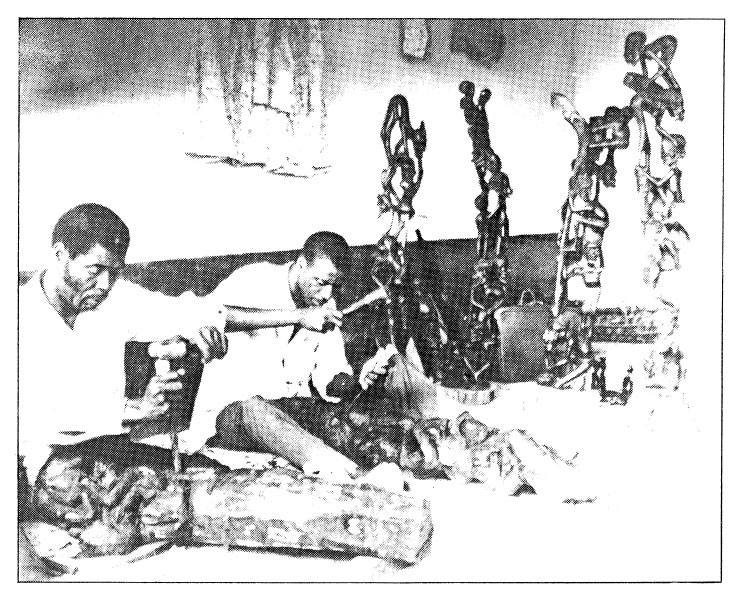
THE MAKONDE CARVING: ITS ESSENCE

Makonde carvers

A good many pieces of wood tourists buy as Makonde carvings are far from the carvings of the Makonde. This may be true of what most tourists buy in many parts of the world.

The tourist has proved to be a source of income to nations as well as individuals. He has the money and urge to take away something that will remind him of the people and their culture; so the people give it to him, but, in the process, and because they want to get as much money out of him as possible, what is given becomes less and less authentic.

In the sixties the majority of Makonde carvers found in Dar es Salaam today lived in a small Makonde settlement called Boko some thirty two kilometres along the Bagamoyo road. The seventies saw a move by the Makonde to get closer to the buyer until by the late seventies Boko village was left as a farming area. This was also the beginning of the disintegration of the Makonde Society there.

Like other African ethnic groups, the Makonde have their own cobweb of a heritage of ritual, taboos and superstition. They have their own way of seeing and relating to ‘godness’ and their own systems of keeping at peace with this godness.

During one weekend in 1967 I was witness at Boko village to a ritual that started on a Friday afternoon and ran through to Sunday evening. It was a ‘coming of age’ rite for a girl. After greetings, salutations and ululation, drums started to get tuned. It was the beginning of a fifty hours long ritual, There were high toned drums accompanied by something of a talking drum; males with heavily tattoed faces and torsoes; females with tatooed faces and lip plugs; high resonant female voices combined to make an intricate base for the “Sindimba’ dance. At one stage the circle of dancers was joined by two masked dancers. The dance and rhythm flowed and stopped in a manner rather distracting to a learner but meaningful to the Makonde.

The staccato movements of the masked dancers which are otherwise very comic made the core of the function. While there is very close communication between the musicians and dancers, there is also some communication with the audience far and beyond that which exists with strangers watching. Hence the success or failure of the function.

The girl whose day this was, was locked up in the house and brought out only briefly for a glimpse by future suitors. The combination of drum music, masked dancers, heavily tattoed males and the unusually exotic hip movements of the women, merged to give a taste of something of the mystique understandable only to them.

The mystical air, indeed, this esoteric web of rites is the source of and inspiration behind the Makonde carver. On the other hand the carving is part and parcel of this web. It is, as it were, a symbolisation of the mystique referred to earlier.

This carving was never made for sale. The carver kept it as one would keep the shirt of a deceased father. It was a link between him and, say, the supernatural. It was like a charm on the one hand and an effigy on the other.

The name “shetani” which has come to be used to describe the abstract carvings does not mean “satan” as it is generally understood. The name should not be tinted with any “evil” connotations either. It is the best the Makonde have done and can do to explain “the mystique”. Outside this aura of ritual, the Makonde, as an artist, and like any artist from any other culture, has nature and his own socio-economic surroundings to provide inspiration and reaction to his art.

One Vitorino Antony Madonga, a reputed carver, directed my attention to the clouds when I was trying to find his source of inspiration. Clouds, he said, are always full of pictures. One can actually see a total picture there and all one has to do is to copy it and transform it into a carving. At times the cloud pictures tend to compliment something or some event that is taking place down on earth. The carver tries to incorporate this cloud-earth relationship into his carving.

Carvings derived from this inspiration are called “mawingu” (clouds). But the carver says there are so many aspects of our lives, our spirits and our true nature and identity as animals which are very cloudy. What the artist does is try to represent the frightening and rather ugly nature of that which is not understandable and dark about man.

To Mr. Madonga, the tattoo designs on their faces and bodies have a particular meaning. Some of the body tattoos stand for clan totems. These are at times reproduced in yet more abstract form in the carvings. The true Makonde carving is therefore an embodiment of the austerity of life not represented in many of the so-called Makonde carvings bought today.
Godwin Z Kaduma

A FRENCH TOURIST IN TANZANIA

The Bulletin’s French counterpart ‘Urafiki Tanzania’ contains in a recent issue an article by a Mr. Larry Barouch in which he describes his experiences as a tourist in Tanzania.
The following are extracts from his article: (Translation by A. and P. Dio
p)

I was rather favoured as a tourist in Tanzania because I could communicate with the people much better than the majority of French tourists. I can speak English and I can get by in Arabic ……

I had never been in Africa before this trip, which arose out of a combination of circumstance. I like animals very much and I always dreamt of a safari in Africa. In Paris I had befriended a Tanzanian student who talked to me about the marvels of the Serengeti and of the Ngorongoro National Park. (The Serengeti game park is bigger than Belgium and the Netherlands put together.) These game parks are situated at the Kenyan and Tanzanian borders and the body which arranged the trip designed an itinerary which meant that the Kenyan game parks were to be visited first, before those of Tanzania. Tourist facilities in the Kenyan game parks are marvellous and everything works perfectly well. On the contrary, nothing seemed to work properly in the Tanzanian parks, for the Tanzanian government policy has always been hostile to tourism, this means that the infrastructure is old and rusty. I think that my arrival coincided with a new government political orientation more favourable to tourism, but nothing had yet been done to renew outdated hotels and motels. Furthermore, it was the time when tourists had been bombarded with excessively expensive game park fees.

Of course when on safari one does not have any contact with the locals, driving mile after mile through the savannah taking picture after picture like Japanese tourists in the Champs-Elysees. My first contact with people was in the little Village of Mto Wa Mbu (which means river of mosquitoes, but I never saw one during my whole journey). We had a disagreement with the hotel manager, who had to go and fetch the only person in the village speaking English to serve as an interpreter. Once we reached an understanding I had a chat with the interpreter, who happened to be a prosperous farmer. I asked him whether he belonged to the Ujamaa; he answered me laughing that he didn’t, and didn’t need to. “You understand,” he said to me, “here it is not like Kenya, everybody is free here, everybody does what he wants. There in Kenya the poor are obliged to remain poor but here the poor can unite within the Ujamaa cooperative. I, thanks to God, am rich, and don’t need it, but if I were poor, of course, I would be a member.” ……..

Later, by good chance, when I was in the process of moving into a hotel in Arusha I found that the hotel manager was the half brother of my Tanzanian friend in Paris …… He invited me to have a drink (he was a Muslim – not very devout.) In his nearby house I met his wife who was a ravishing beauty and was busy sewing. She kept on glancing in our direction with disapproval as she noticed the bottle of whisky whose level was rapidly going lower. The manager explained that he didn’t get a very good salary and that his wife therefore helped them to reach the end of the month by making clothes for sale. Whisky must be expensive in Tanzania.

Once arrived in Dar es Salaam after several delays in the departure time (Air Tanzania possesses only two Boeings, and when one of them is in repair the timetable collapses) I quickly found myself short of money. The poor hotels, said to be ‘deluxe’, full of cockroaches in the rooms, and where the lift doesn’t work three times out of four, are beyond the means of French tourists. My Tanzanian friend from Paris, who had not been back to his country for several years, advised me to take as little money as possible with me and to pay everything with my Carte Bleu. Unfortunately, when I was there, there was a dispute between the Bank of Tanzania and Visa International, which made my Carte Bleu useless. I explained my problems to the room steward. (In this hotel, women chambermaids are not allowed. Islamic morals?) He agreed with my complaints, saying that life was very very hard for white people in Tanzania, but thanks to God, it was agreeable for Tanzanians ……

Next I took a plane to the capitalist paradise of Kenya …. Kenya and Tanzania are almost like twin countries – same climate, same topography, same language but strangely I found the Kenyans not very pleasant and the Tanzanians friendly and happy ……. perhaps it is because a left wing person like me prefers it when restaurant waiters tap you on the shoulder and address you as ‘rafiki’ or comrade rather than, as in Kenya as ‘Bwana’ or Sir.

Unfortunately I was not able to see a lot in Zanzibar. All the members of the family I was staying with came to admire the noble foreigner I was, and insisted that they should show me the city, which I could not refuse. This meant that I visited the same monuments four times in three days, marvelling each time at the Sultans Palace, the House of Karve1s and the two cathedrals, one Catholic and the other Anglican, which in actual fact are the only points of touristic interest of this town. I never saw a clove tree. I managed at least to escape one afternoon in order to scuba dive with the young man at the house in the warm and clear waters of the Indian Ocean.

AIDS

Tanzania has reported over 800 cases of HIV-AIDS; half have resulted in death since 1983, and local medical experts believe that the disease was introduced to East Africa by foreign servicemen. Prostitutes in East African ports contracted the disease from the troops and then trailer drivers transporting land-looked Burundi’s imports introduced it to Tanzania. The disease was first reported at Lukuyu village in Kagera region close to Uganda which is a major stop on the trailer route. The first victims were women wearing T-shirts labelled ‘Juliana’, obtained from trailer drivers. When the disease was first detected local people referred to it as ‘Juliana’ because its victims were wearers of Juliana T-shirts – Daily News.

– AND THE GOVERNMENT TAKES ACTION
The Government has launched an aggressive five year campaign to halt what the Minister for Health and Social Welfare, Dr. Aaron Chidua has described as the ‘alarming spread’ of the disease. AIDS is now threatening all twenty regions of the country.

At a recent two day AIDS donor meeting in Dar es Salaam, 14 donor agencies undertook to support the Government’s efforts by contributing Shs 270 million out of the first year’s estimated costs of Shs 800 million. The Aid Control Programme (ACP) will include research, training, clinical improvements, systematic screening of blood exchange and a Campaign to educate the people. The ACP has been acclaimed by the World Health Organisation.

A count by the Ministry of Health and Social Welfare ending June 28 this year showed that 1,256 Tanzanians have developed cases of AIDS since 1983 of whom 426 have died in hospitals. Tanzania’s rate of infection among pregnant women in Dar es Salaam is 3.6% in Arusha 0.7% in Mbeya 6% and in Kagera region 16%. – Shihata.

MISCELLANY

NDUGU AND WAHESHIMIWA
The National Assembly has decided that Members of Parliament should be addressed as Waheshimiwa. But Mwalimu Nyerere has made it clear that CCM Party leaders will continue to be addressed as Ndugu. “Never will they be addressed as Your Excellencies” Mwalimu Nyerere said. “If an MP insisted on being called Mheshimiwa then it would not be bad if he was addressed as Ndugu Mheshimiwa Mbunge”.

The whole issue has sparked off a lively debate. A reader in the Daily News complained that Waheshimiwa sounds colonial and bourgeois and brings in people’s minds the idea of a class opposed to other classes. It should be remembered that the President introduced the word Ndugu to show that Tanzania is a classless society.

DEVELOPMENT LEVY
Effective July 1, 1987 Villages have become the official agents of the District Councils in the collection of Development Levy. Under the new arrangements the villages will be able to retain 17% of the collection to help run their own village governments. Village governments will use the ten cell leaders to collect the levy and these leaders will receive 3% of the collections as an incentive. District Councils will cooperate with the village governments in drawing up registers of Development Levy payers – Daily News.

HISTORIC BUILDIIGS: AN ENDANGERED SPECIES
The Architectural Association of Tanzania at a recent meeting with a UNESCO expert, Dr. J. Jokilehto from the International Centre for the Preservation and Restoration of Cultural Property has complained about the increasing and widespread demolition and rebuilding of historical buildings under the pretext that they are dangerous or unsuitable for human habitation. They cited the new structures being added to the German built headquarters of the Tanzania Railways Corporation in Dar es Salaam which they considered to be not only ugly and disfiguring to the remainder of the building but also as lacking in imagination. It would have been better if the corporation had looked for office space somewhere else.

The most famous Dar es Salaam landmark to suffer from the craze for Demolition is generally considered to have been the New Africa Hotel. This was followed by the Splendid Hotel and a host of others – Shihata

ISLES RE-INTRODUCE HISTORY TEACHING
Zanzibar will, this year re-introduce the teaching of history in its education system. The subject was struck off the syllabus soon after the Zanzibar Revolution in 1964. It was replaced at that time by lessons on political education which centred mostly on the protracted liberation struggle in Zanzibar which culminated in the overthrow of the Arab dominated regime – Daily News

GOLD EXPORTERS TO RETAIN 70%
The Minister for Energy and Minerals, Mr. Al Noor Kassum, has announced that the Government intends to allow gold and gemstone exporters to retain 70% of their foreign exchange earnings as an incentive and to enable them to import the necessary inputs for mining.

YOUTH JUMPS TO DEATH
The son of Butiama village chairman and former head of Tanzania’s youth organisation, Mr. Joseph Nyerere, died in April after allegedly jumping from the first floor of a building in Upanga, Dar es Salaam. Mr. Kwame Joseph Nyerere was twenty six. His body was flown to Butiama for burial – Daily News

RAILYAYS SECURES 1 BILLION SHILLINGS FOR WAGONS
The Tanzania Railways Corporation (TRC) has secured 1,576.2 million shillings from the Government and eight foreign donors for the purchase of 32 locomotive engines, 1,000 freight wagons and seventy five container wagons. The locomotives are to be bought during 1988/89. Some of the funds will also be used for laying sleepers along the Ruvu-Mnyusi and Kilosa-Dodoma lines.

BUT THE MANYONI-SINGIDA LINE MOVES SLOWLY AHEAD
In October 1985 the TRC took up the task of relaying the line between Manyoni and Singida which was removed by the colonialists in 1947 after it had been found to be running at a loss. The 115 mile line was expected to take about two years to complete.

However, the project has been facing a lot of problems including lack of equipment, building materials and labour. The line is now scheduled to be completed in thirty months but cost will have gone up because of the devaluation of the Shilling – Shihata.

SECONDARY EDUCATION
There are now 103 Government secondary schools in Tanzania compared with 95 last year. The student population in these schools has increased from 43,911 to 46,120. 136 private secondary schools and seminaries had 56,293 pupils – Daily News.

CHIMPANZEES AND AIDS

The well known ethologist, Dr. Jane Goodall, widow of the late Mr. Derek Bryceson, the former Minister for Agriculture, who has become an international authority on chimpanzees and works mainly at Gombe, near Kigoma, spoke to the Bulletin recently in Dar es Salaam about her fears for the future of chimpanzees. For, as D. J Eichberg, head of a major AIDS research programme in Texas was quoted as saying recently, ‘Chimpanzees are the only model available to do human AIDS virus vaccine work. They are 100% affectable with the disease. Once you get to the nitty gritty, essential questions like the efficacy and efficiency of vaccines have to be tested in chimpanzees” The centre in Texas has 172 of the.. Now, in Britain too, the Porton Down research centre is looking for 30 chimpanzees for similar work.

It was in 1960 that the famous palaeontologist/archaeologist Dr. Leakey persuaded Jane Goodall to undertake a long term study of chimpanzees at Gombe. During the intervening twenty seven years she has written numerous scientific papers, and received many international awards. She has also published the definitive work ‘The Chimpanzees of Gombe: Patterns of Behaviour’ which is now in its 4th printing. And this is what she told us.

She lives in a house on the lake shore in the midst of a high canopy forest. In the forest is the spectacular Kakombe falls. The water hurls itself over a rock ledge and drops forty feet on its way to a stream and ultimately, the lake below. And there, up in the giant fig trees chimpanzees can sometimes be seen at play.

The Gombe park is only 30 square miles in area. It is situated 30 miles north of Kigoma. The research work, which can be expected to continue for many years yet, involves many visiting scientists and some 30 Tanzanians work there. . Tourists find it difficult to get there although they can arrange to be brought to the beach by boatmen from Kigoma. When they do arrive, they stay in an old student hostel. “We share with chimpanzees 98% of our genetic make-up” she said. “Chimpanzees are much more like us than are baboons. There are only 150 chimpanzees at Gombe. They live in three social groups of about fifty. I know one group quite well.”

Apparently, they can be capricious and brutal as well as charming and friendly. Jane Goodall has always responded to them as individuals. She writes in her book about Gigi, considered very sexy by males despite her unusual (for a female) size and aggressiveness. Fagan was ousted as dominant male in the group by his former protege, Goblin. He regained his position when he and four other males ganged up on Goblin. There was Passion, a psychotic primate who, with her daughter Pall stole infants from other chimp mothers and ate them. There was Honey Bee, who stayed with her mortally wounded mother for five days, grooming her and shooing away flies, after the two were attacked by a group of males.

To the usual human ear the sound made by chimpanzees is a sort of hoot. “But”, says Jane Goodall, “I have managed to record 25 different chimpanzee sounds. But they find it difficult to make a sound on purpose.”

Normally chimpanzees used in research have been bred in captivity. But young chimpanzees captured from the wild – an extremely difficult operation – rarely breed satisfactorily in captivity. Jane Goodall fears that, with the greatly increased demand for them now because of the needs of AIDS research, there will be increasing pressure on wild colonies to provide extra chimpanzees for testing purposes.

Jane Goodall realises that such is the enormous concern about AIDS that there is no way anyone can prevent chimpanzees being taken from the wild. But she is angered by the way in which many of them are being kept in captivity. She spoke of conditions being like in Nazi concentration camps. “Sometimes they are shut up in little cells only 6 ft. square”.

SUNDAY DRIVING BAN LIFTED

The Government has lifted the ban on Sunday driving imposed in 1974 to control the usage of fuel following rocketing oil prices. The Government indicated that it believed that recovery efforts would be expedited if citizens, including those with motor vehicles, were able to travel to and participate in agricultural activities on Sundays ..

Oil consumes more than half of Tanzania’s foreign exchange earnings and the driving ban had contributed to savings. Sunday News writer Adam Lusekelo indicated however that, for some people things would not really change.
“Our strategy was classified material” he wrote “but now that the ban has been lifted, we might as well narrate some of our ban beating manoeuvres.

“We approached the road block in our rickety pick-up. As was expected, the car cop stopped us with great authority. He stood in the middle of the road. I thought that was foolhardy because half the Dar es Salaam cars don’t have brakes.
License?
We showed it to him.
Registration card?
He got that too.
Sunday driving permit?
That is when all of us concentrated on our supporting roles to the star – the young lady we were with. She ‘inexplicably’, burst into tears. The rest of us wore long and sorrowful faces.
What’s wrong? asked the now flabbergasted cop.
Its just that (..sniff..), it’s just that … one of us renowned for his acting skills moaned, we have been to a funeral …
The magic word funeral worked. You know how we rally to each other when it comes to funerals.
He let us through.
True enough there was drink and fresh air at the beach hotel. And lots of official cars too – their owners on duty quaffing beer.
Or you can try something else.
The best method of all was to buy a football. No, not to play with. You tie it round the girl’s midriff and make sure that she is wearing a maternity dress …… “