POLITICS

by David Brewin

Tendwa retires after 13 years
Former Registrar of Political Parties, John Tendwa (pictured overleaf), has retired and been replaced by Judge Francis Mutungi. News of the Registrar’s retirement was received with glee by major opposition par­ties that roundly accused him of strangling democracy in the country.
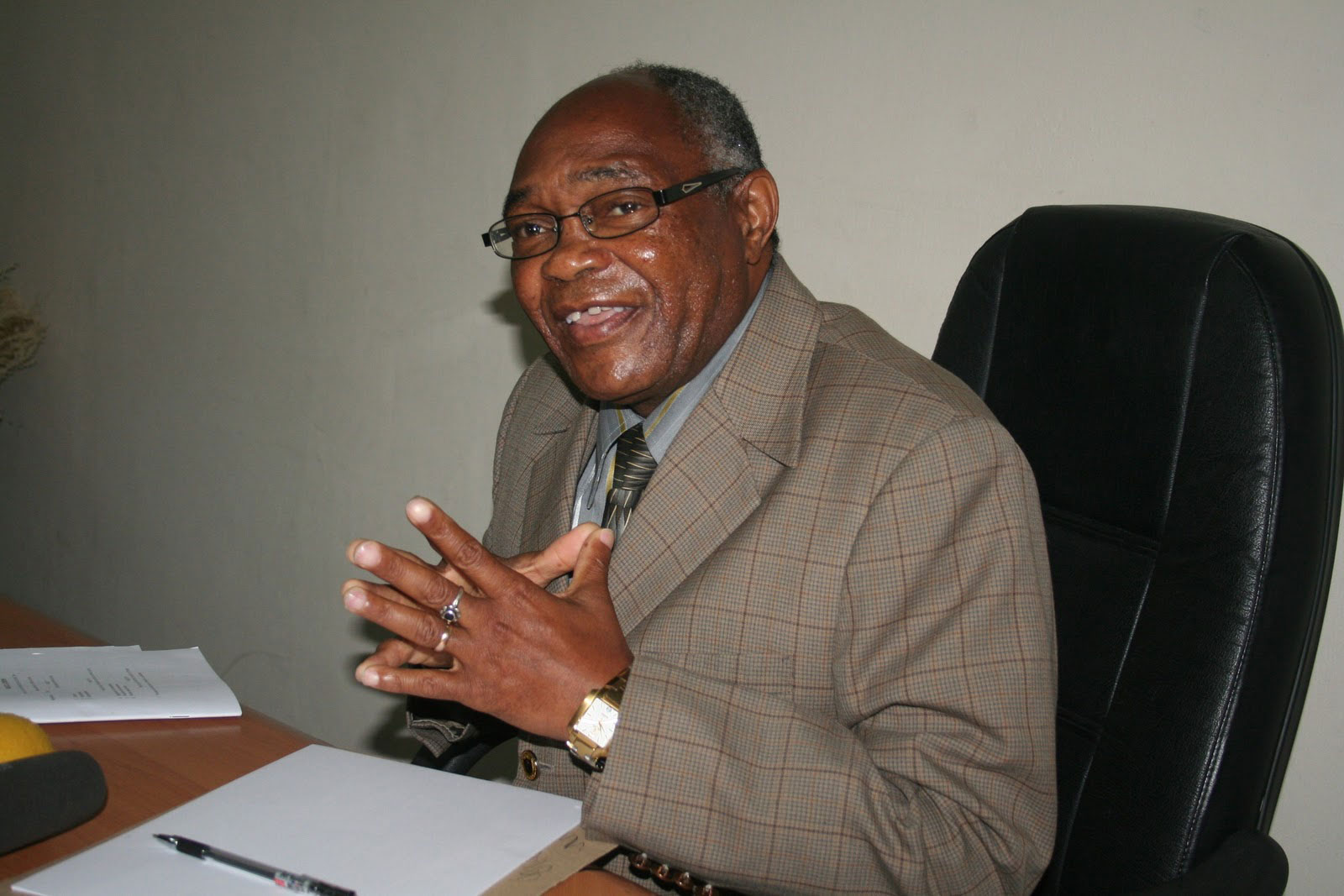
John Tendwa

John Tendwa

Tendwa said that he left office satisfied with what he described in The Citizen as “the great achievements he attained for the country’s multi­party democracy, criticism from opposition parties notwithstanding.” He had built the registrar’s office virtually from scratch, and facilitated the enactment of key laws that had enabled multiparty politics to flour­ish. “My critics often don’t know how the registrar’s office operates and aren’t aware of the challenges … it’s never an easy thing to deal with politicians,” he added.

Tendwa said that when he was appointed registrar, he was not even provided with terms of reference. Key statutes to guide the operations of the office and the conduct of political parties were either not yet enacted or inadequate. “When I was appointed, I just didn’t know how I could fulfil my responsibilities. The office needed employees with qualifications in law, but there I was … the only lawyer in the entire office! I thank God that I managed to build a credible institution.”

During his tenure, he sent to Parliament several key Bills such as the Political Parties Act 2009 and the Political Parties Code of Conduct. He also facilitated the enactment of the Election Expenses Act 2010. He pointed out that the Election Expenses Act was a challenging law not liked by politicians all over the world because it limited what they could spend during elections.

On allegations that he favoured the CCM, Tendwa said that at some point the ruling party was also charging that he was favouring the opposition. “To me, being accused from both sides means I was doing my job well,” he said.

Kabwe writes to Cameron
Shadow Minister for Finance Zitto Kabwe (Chadema) has written to British Prime Minister David Cameron asking for a review of his coun­try’s laws and those of other rich nations which make it impossible for African countries to fully investigate people who have stashed huge amounts of money in offshore accounts. His letter followed Cameron’s appointment of a committee to investigate this whole area of concern.

In his letter Kabwe wrote: “I call on you to demonstrate your leadership at the (G8) Summit, [which was held in Northern Ireland in June] by putting in place aggressive sanctions against British Overseas Territories and Crown Dependencies which continue to provide cover for the siphon­ing of billions of dollars of our tax revenue,” Kabwe added that money held by individuals in foreign banks was sometimes siphoned off from development aid from the UK.

Kabwe was among the first legislators in Tanzania to alert the govern­ment that there were numerous Tanzanians who had stashed dubiously acquired billions in foreign banks.
Independent candidates may be allowed to stand
The serial litigant and leader of the Democratic Party (which has no MPs) the Rev Christopher Mtikila, has been partially successful in his campaign for independent, candidates to be allowed to stand as President or as MPs. Constitution Commission leader Judge Warioba said that the first draft of the new constitution included provision for the change. The Rev Mtikila, said that while the announcement was a major step forward, he wouldn’t hold his breath.

Yet another Party
Another political party, the ‘Alliance for Democratic Change’ has been provisionally registered, making a total of 19 parties. At Independence in 1961, Tanganyika had four parties, the Tanganyika African National Union (TANU), the United Tanganyika Party, the African National Congress, and the All Muslim National Union of Tanganyika. (The Citizen)

Six Chadema MPs suspended
In April House Speaker Anne Makinda suspended six Chadema MPs for five successive sessions on the grounds of “gross misconduct”. Those suspended were Opposition Chief Whip Tundu Lissu (Singida East), Godbless Lema (Arusha Urban), Joseph Mbilinyi (Mbeya Urban), Rev Peter Msigwa (Iringa Urban), Ezekiel Wenje (Nyamagana) and Highness Kiwia (Ilemela).

Chadema National Chairman and Leader of the official Opposition in Parliament, Freeman Mbowe, accused Ms Makinda and her deputy, Job Ndugai, of “following directives to favour the ruling CCM and its gov­ernment.” Flanked by Chadema Secretary General, Dr Willibrod Slaa, Mbowe told party members that Chadema would campaign outside parliament against the move. “Speaker Makinda has lied to the entire world by endorsing the decision made by her deputy to suspend our MPs. We can’t accept this and we will continue to fight for the interests of our nation and its people.” According to the House rules, a five-day suspension can only be imposed after the issue has been referred to the Parliamentary Powers and Privileges Committee.

On the envisaged new Constitution, Mbowe stressed that the party would withdraw from the process if the government failed to table in Parliament amendments to the new Constitutional Review Act. “If they force us, we will go to the elections under the old Constitution and by God’s wish we shall win,” he said.

Foul Language
MPs who use foul language in Parliament risk expulsion from the debating chamber Speaker Makinda warned in April. She would now use her powers to discipline errant lawmakers. Standing Orders would be applied to the letter to restore discipline in the House. “I will make sure that abusive MPs are immediately kicked out of the House.” She reminded MPs that being on different sides of the political fence was not a licence for them to hurl abuse. Ms Makinda’s rebuke followed fierce verbal exchanges on the budgets of various ministries between MPs from CCM and CUF, on one side, and Chadema on the other. (The Citizen)
EXAM RESULTS BOMBSHELL

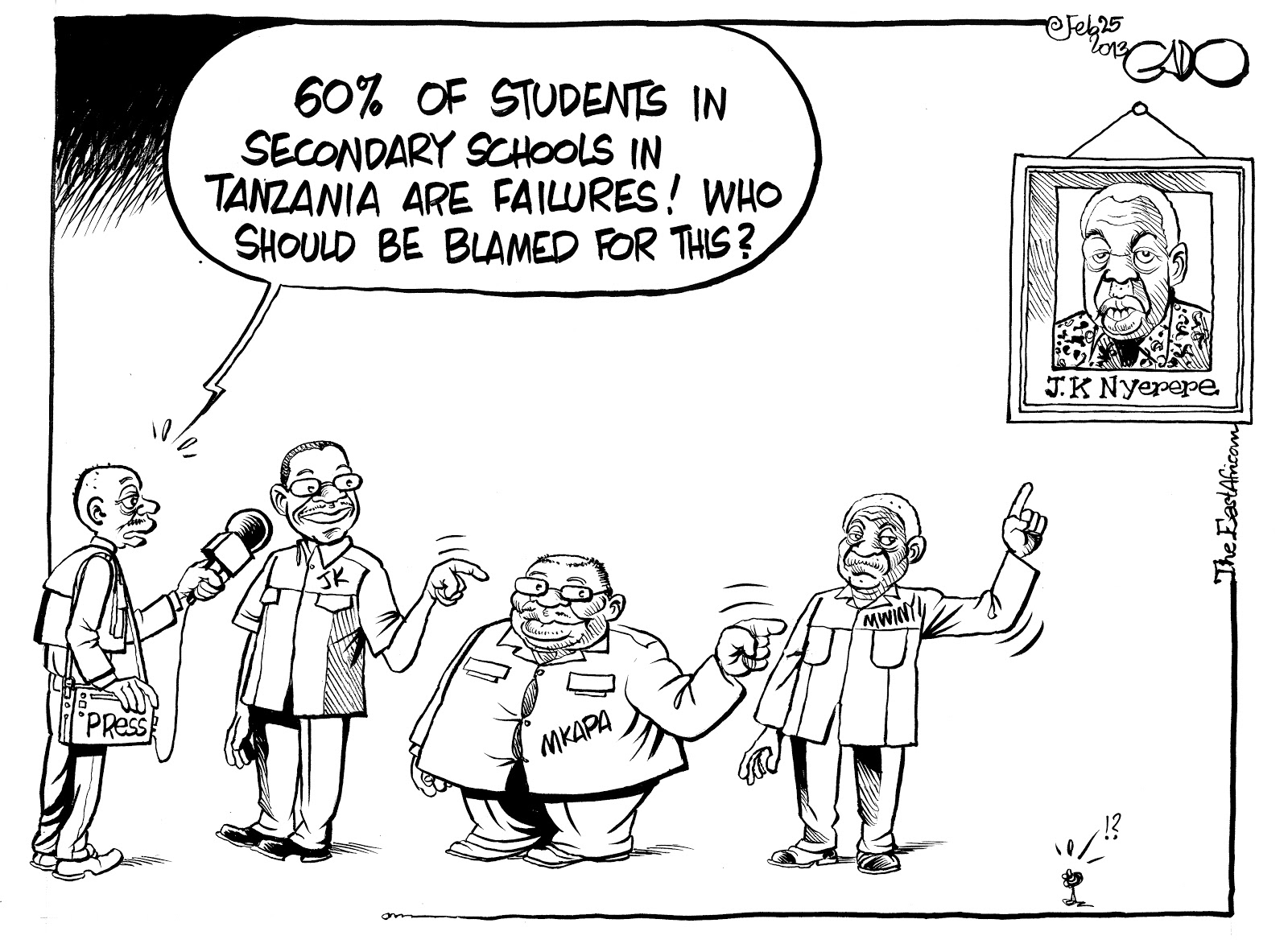
After publication on February 18 of results showing that almost two thirds of students had failed in the Form IV (O’level) secondary school examinations, President Kikwete felt the need to assure the public on radio that education remained at the top of his administration’s list of priorities. He said that his government was touched by the massive number of failures. “It is a shock that, even schools with a well-known history of good performance such as seminaries, privately owned as well as old government schools, performed so dismally…we have to find out why,” He said that various analysts had pointed to reasons for the failure, but that his government would not rely on hearsay. He had therefore asked the Prime Minister to set up a Commission of Enquiry. He noted that the Commission would help the government and other stakeholders to take decisive measures early so as to avert further prob­lems in the future.

Mr Kikwete allayed fears that there was a lack of political will to improve the quality of education in the country, saying: “That is why we allocated about TShs 3.6 trillion in our budget specifically towards the education sector.”

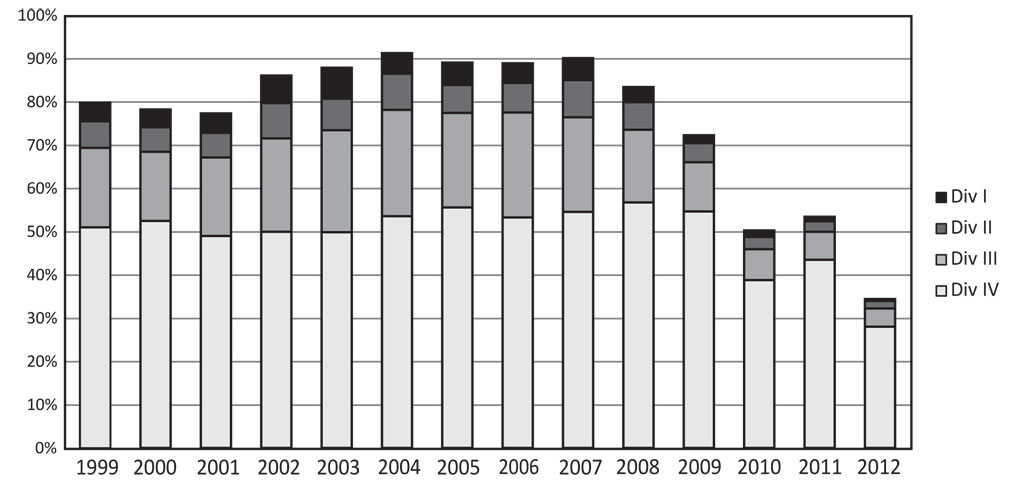
Form IV results from 1999 to 2012 (source wavuti.com & necta.go.tz)  (These figures exclude pupils who registered but did not attend examinations)

Form IV results from 1999 to 2012 (source wavuti.com & necta.go.tz) (These figures exclude pupils who registered but did not attend examinations)

‘Worst in Tanzania’s history’
The results were the worst in Tanzania’s history with only 35% of the 367,750 candidates who sat the Form IV exams in October 2012 achieving a pass – a substantial drop from the previous year’s 54% pass rate, itself well down on previous years.

There have been similar downward trends in Standard VII results and the Primary School Leaving Exam, where the pass rate dropped from 57% in 2011 to 30% in 2012. Uwezo surveys of literacy and numeracy since 2010 have painted a bleak picture.

But it was these Form IV results which saw the greatest outcry, and within days there was a buzz of activity with numerous committees investigating what needs to be done.

Summary of results
The National Examination Council of Tanzania (NECTA) records four levels of student performance – Divisions I, II, III and IV. Detailed results were as follows:
Division I: 1,641 students (0.4%)
Division II: 6,453 students (1.8%)
Division III: 15,426 students (4.2%)
Division IV: 103,327 students (28.1%)
Failed: 240,903 students (65.5%)
(these figures exclude students who registered but did not attend the examination)

Education Minister under fire
Mwesiga Baregu, a civics professor at Saint Augustine University of Tanzania, was quoted in the Somali newspaper Sabahi as saying that Minister of Education Shukuru Kawambwa should resign. “If the min­ister is a leader with integrity and responsibility regarding education in this country, he should resign without waiting for pressure from outside. If the minister refuses, President Kikwete should fire him.” Freeman Mbowe, Chairman of the Leading opposition party CHADEMA, said he had organised several public rallies since the examination results were announced to pressure Kawambwa to step down.

Retired secondary school teacher Yusuf Halimoja, 79, was quoted in the media as saying that the education system had declined because well-educated people no longer wanted to be teachers. “I started teaching in 1953. At that time, you could not become a teacher without a first or second class [ranking]. Because of this, teachers were respected and knowledgeable…But nowadays, the first, second and third class [rank­ings] pursue other professions and those with fourth class are sent to teach. That is wrong.”

Cartoon by Gado - reproduced with permission www.gadocartoons.com

Cartoon by Gado – reproduced with permission www.gadocartoons.com

The Commission
Prime Minister Mizengo Pinda’s 15-man Commission of Enquiry is led by the Executive Secretary of the Tanzania Commission for Universities (TCU), Professor Sifuni Mchome. Its remit is to understand why the Form IV results were so poor and to make recommendations to prevent this happening again.

The NCCR-Mageuzi MP, James Mbatia, refused to join the group feeling it “might create a conflict of interest as he is still pursuing the private motion on the education sector he submitted in parliament” in February. He highlighted the errors in various Government-approved English textbooks as evidence of “deficiencies in the country’s educa­tion system and the alleged corruption encroaching it”. Other areas which needed addressing were the policy framework, curriculum (there were questions over its legality) and the “dire lack of teachers”.

The Prime Minister said the Commission would work for six weeks starting on March 4 to review past performance, consider a rescheduled examination for failing students and to determine whether the transfer of educational operations from the federal to local governments contrib­uted to the poor results.

At Tanzanian Education Network (TEN/MET)’s Quality Education Conference in early March to discuss the “standard of education in the country”, the Children’s Book Project reiterated Mbatia’s concern about the quality and management of textbooks and called for authors to be trained in writing appropriate texts for teachers and pupils. Cathleen Sekwao of TEN/MET expressed concern about the overloaded primary school syllabus. “It puts too much of a burden on the pupils to learn so much in such a short time defeating the very purpose of the books as the pupils learn less under such pressure.” As an example, Sekwao said that “Standard One pupils formerly were studying only three subjects, reading, writing, arithmetic compared to eight subjects taught today.”

The concern about education has led to the release of some significant statistics which give the background to the exam crisis.
– 1,640,969 the target for Standard 1 enrolment in 2004
– 1,368,315 the number of children who were actually enrolled
– 272,654 the enrolment shortfall, which was attributed to “massive enrolments in the first year of PEDP of 11 to 13-year-olds in grade I”
– 3 number of known suicides linked to the Form IV results
– 15,283 new teachers targeted by local authorities (no year given)
– 10,788 Grade IIIA teacher trainees enrolled in teachers’ colleges
– 10,037 number of these in government teachers’ colleges
– 751 number of these in private teachers’ colleges.
– 4:1 Pupil:book ratio in standard I-IV
– 6:1 Pupil:book ratio in standards V to VII
– 8,000 number of pregnant girls who drop out of school each year, leading to a call for sex education to be introduced into schools

Efforts to improve education
Tanzania is already making considerable efforts or planning to do so in different parts of the country to improve education:

In Mid-February, the Parliamentary Committee responsible for educa­tion invited Village Education Project Kilimanjaro to share its findings and recommendations on improving English in Tanzania.

The New Original English Course (NOEC), recently updated with all explanations and instructions in the teachers’ books now in Kiswahili, was featured on various breakfast talk-shows and in the press. The course covering Standards III to VII ensured that pupils were suffi­ciently fluent in English to continue their later studies in English and is seen as an immediate practical solution to rescue the education system from the ‘intensive care unit’.

115 students across 48 schools in Temeke District have benefited from funding by the Parastatal Pension Funds (PPF) through the ‘Education Benefit’ programme which is granted to children of any PPF member who passes away during their service period”.

On 11 October 2012, Salma Maoulidi contributed a piece to the Daily News on how education today compared with that of the 1977 constitu­tion which set out to remove the class divide amongst Tanzanians. She concluded: “There is no Minister, Principal Secretary, MP, RC or DC who sends his or her child to a ward school. If national leaders, who make and implement policy, don’t want to subscribe indeed to poli­cies they pass or swear to uphold why should the common person be expected to stomach the same?’

In launching the new Annual Teachers Awards ceremony, Chairman of the Education and Expedition Agency Association, Emmanuel Mjema ‘challenged the government to provide direct financial incen­tives to teachers in public and private schools countrywide so as to help improve the education standard.’ The first ceremony was on 25 November (Guardian 23/11).

Mauritius is to introduce student exchange programmes with Tanzania and other African countries as a way to enable them to obtain interna­tional experience.

St John’s University has managed to curb cheating by assuming that any cheating starts with leaked papers by the person who sets the paper. The Vice Chancellor noted that there should be no negotiation as cheat­ing was a serious crime which was harmful to academic pursuit and detrimental to the country.

THE MAASAI & THE FOREIGN HUNTERS

The long-running land dispute which began some 20 years ago over the use of the grazing areas in the 4,000 sq km Game Controlled Area at Loliondo may be moving towards a resolution, following the announce­ment of a compromise plan by the government.

During the last few weeks there have been several new developments in the saga: The government first announced that Maasai herders were to be expelled so that the agreement between the government and promi­nent hunters in the United Arab Emirates, notably the Othello Business Corporation (OBC), would continue. The Maasai protested vigorously about this loss of their ancestral lands and gained strong support from campaigners and others in Tanzania and around the world.

Then in April the government announced a compromise solution, involving a division of the disputed area into two parts. Announcing the new policy to international media representatives, Minister for Natural Resources and Tourism Ambassador Khamis Kagasheki was quoted in the Daily News as saying that the government had decided to allocate 2,500 sq kms of the Game Controlled Area to village communi­ties in Loliondo. The remaining 1,500 sq kms would be retained as the Game Controlled Area for a number of reasons, including protection of wildlife breeding areas and to allow a corridor for the iconic great migration of wildebeest. He said that the government made the deci­sion to parcel out the land to Maasai communities to support landless families in the area.

The Minister stressed that there would be no human activities which might destroy the environment in the 1,500 sq km piece of land. It was a malicious misrepresentation of facts for a section of people both in and outside the Loliondo Game Controlled Area to claim that the government was grabbing land from the local communities. This was not correct, the Minister said, since the people had been living in the area illegally because the 4,000 sq kms had been a national resource throughout history and the land had never been allocated to the Maasai communities under any government arrangement. The Minister noted further that the OBC had the rights to certain hunting blocks in the area, which they could use to generate income if they pleased. It is under­stood that OBC pays very heavy fees for its hunting licenses. Although OBC had a contract ending in 2018, the government could still revoke it if need be.

STOP PRESS: As this issue goes to the press there are reports that, fol­lowing a meeting in Arusha, thirteen civil and land rights organisations have strongly opposed the government plan, arguing that the entire Game Controlled Area is within legal village boundaries and that the plan therefore still represents a significant reduction in the villagers’ land. There are also concerns that the water catchments and good pas­ture are largely within the proposed Game Controlled Area and much of the land allocated to the communities is dry plains unsuitable for grazing.

RISING RELIGIOUS TENSIONS

Father Evarist Mushi, a 55 year old Roman Catholic Priest, was shot dead on February 17th, in Mtoni near Stone Town, Zanzibar. Just two days later, a church was burnt down, also on Zanzibar. This brings the total of attacks on religious institutions in Tanzania in recent years to
26. (The Guardian)

President Kikwete spoke about the rising religious tensions in his monthly address to the nation at the end of February. He expressed his shock at the situation, asking “Tanzanians have never been this way… what has happened?

“The government will not hesitate to take action against people who are promoting religious hate, defiling holy books and those who ridicule others’ beliefs… I have reminded the police and other authorities not to take these issues lightly.”

Some have drawn a link between these attacks and terrorism, includ­ing the East African newspaper. This claim has been lent credibility by reports that US agencies are supporting the investigation into Father Mushi’s murder. Others link the attacks to a growing separatist move­ment on Zanzibar, which seeks independence from mainland Tanzania.

Attacks have not been limited to the Isles, however. Also in February, the small town of Buseresere, Geita region, witnessed the beheading of Rev Mathayo Kachila, a pastor with the Tanzanian Assemblies of God church amid religious clashes. This incident and the rioting in Tunduma (see below) related to disputes over whether Christians should have the right to slaughter animals for public consumption. Earlier violence in Dar es Salaam has targeted both Muslims and Christians.

At the beginning of April riots in Tunduma on the Tanzania/Zambia border caused the Tanzanian authorities to temporarily close the bor­der. According to the Citizen, the clashes were over ‘religious misunder­standings’ on slaughtering rituals in the border town. The rioting erupted after a crowd gathered to oppose the idea that it was Muslims alone who were permitted to slaughter animals. All social and economic activities were forced to stop for several hours. According to the police, a group of hooligans demanded that Christians should also be allowed to slaughter animals and then proceeded to the Mwaka area in Tunduma, where they destroyed a mosque that was under con­struction. Two people, including a police officer, were seriously injured and forty others were arrested. Police in Mbeya Region ordered the Tunduma Ward Councillor Frank Mwakajoka and a pastor of the Evangelical Lutheran Church of Tanzania (ELCT), Gidion Mwamafupa, to surren­der themselves to the police for allegedly fuelling the violence.

The head of the Catholic Church in Tanzania, Polycarp Cardinal Pengo, used his Easter greetings to accuse the police of failing in their duty to maintain order. “I cannot say that I am satisfied with investigations into the killing of the priest,” he said, in reference to Father Mushi. He went on to call for open dialogue between the Muslim and Christian communities. (The Citizen)

This call has been echoed by politicians of all stripes. James Mbatia MP, NCCR-Mageuzi chairperson, said in his capacity as chair of the multi­party Tanzania Centre for Democracy (TCD) “We have collectively agreed with religious leaders to discuss the tense situation and find a solution.” CUF national chairman Ibrahim Lipumba said national leaders should be brought together for discussions to be chaired by President Jakaya Kikwete. CCM Secretary for Ideology and Publicity Nape Nnauye also said religious leaders should to meet for talks and find a permanent solution to the situation. (The Citizen)

SWISS BANK ACCOUNTS

Swiss Ambassador Olivier Chave has revealed that the Swiss National Bank have found certain ‘shadowy individuals’ who have spirited TShs303.7 billion ($178 million) out of Tanzania to what were described as ‘Alpine offshore havens with a reputation for secrecy.’ During a courtesy call on CHADEMA Deputy leader, Zitto Kabwe, in January this year, he said that if Tanzanian officials provided evidence that the money had been fraudulently obtained, the Swiss national authorities would wire it straight back to Tanzania. “We have done that several times – we once returned cash stashed in our banks by former Nigerian president Sani Abacha,” he said, and added that Tanzania could also recover back taxes on the money.

Needless to say this soon created a storm in Parliament. Mr Kabwe said he thought that the Tanzanian authorities did not really want to get the money back. The Kigoma North MP then tabled a private motion proposing the formation of a select committee to probe the matter, but the motion was rejected. According to the Citizen, MPs began to sling accusations and there was apparently a threat that Mr Kabwe would name and shame the thirteen individuals allegedly involved.

The Speaker of the National Assembly Anne Makinda brought the debate to an abrupt end with the assertion: “Government will use its organs to establish the truth, with assistance from international inves­tigators.”

Prime Minister Mizengo Pinda was adamant that the issue be handled carefully because it was “sensitive.” He assured the public that govern­ment would do all it could to expose the faces behind the Swiss billions. Anti-corruption chief Edward Hosea said his office would do whatever it could to figure out whose cash was hidden in Swiss bank accounts.

TANZANIA & MALAWI – LATEST

‘Biased and false’
As the long standing dispute on the ownership of Lake Nyasa between Tanzania and Malawi continued, Tanzania dismissed as “biased and false” a CNN programme which claimed that Tanzania’s border with Malawi lies on the shores of Lake Nyasa. Tanzanian officials said that the broadcast had supported Malawi’s position on the dispute and did not augur well for efforts to settle the matter amicably. The government sent a protest note to the US-based television network on the reports, which it considered to be prejudiced, according to Director of the Tanzania Information Services, Assah Mwambene.

Asked whether the government had consulted US ambassador to Tanzania, Alfonso Lenhardt, he said that Tanzania believed CNN to be an independent media house guided by an editorial policy which the US government had no mandate to influence.

The border row between the two countries follows claims by Malawi that it owns all of the northern part of Lake Nyasa, in accordance with the Heligoland Treaty of 1890 between the colonial powers Germany and Britain. Tanzania argues that, in accordance with international customary law, the border between the two countries is in the middle of the lake.

“Everything is compromised” – President Banda
After failing to reach agreement in 2012 (see TA 103 & TA 104) the two countries agreed that they would submit a letter to former Mozambican President Joaquim Chissano, who chairs the African Forum of former Heads of State within the Southern African Development Community, asking him to arbitrate the matter.

In the latest development, Malawi President Joyce Banda said that Malawi was giving up on mediation efforts and would take to the courts to settle the dispute. “We should not waste time on this (media­tion),” she said in Lilongwe after returning from visits to the US and Britain. She said that the mediation bid by ex-President Chisano was “compromised because information submitted by Malawi was leaked to Tanzania”.

She accused the executive secretary of the forum, John Tesha, a Tanzanian national, of passing some vital information to his home coun­try. “After surrendering our documents, we were told that they were leaked to Tanzania before the Tanzanians surrendered theirs,” Banda said. “We feel everything is compromised,” President Banda had earlier said the dispute had dragged on for too long and she was considering taking it to the International Court of Justice for arbitration.

THE DEATH OF A JOURNALIST

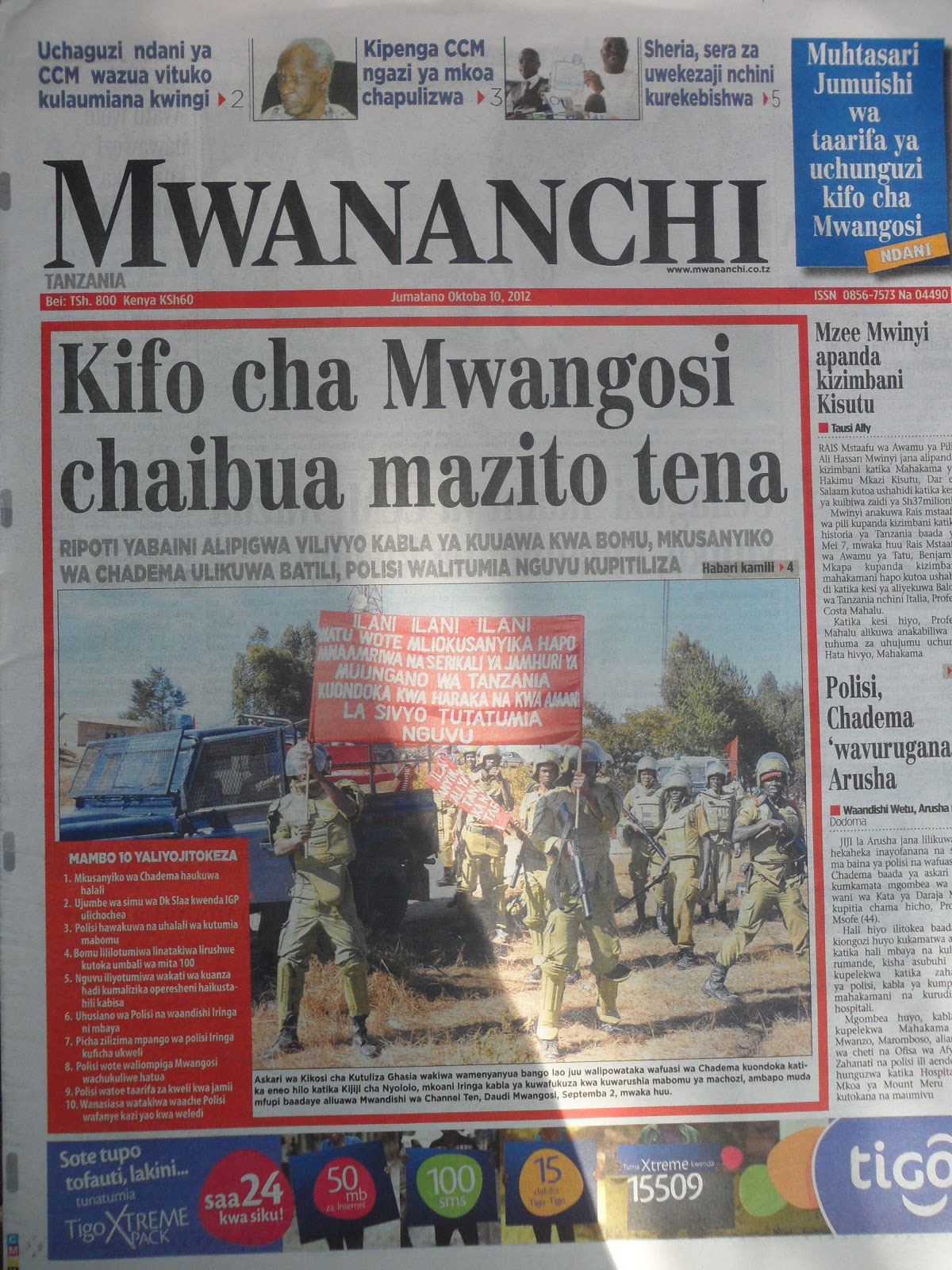
Coverage in Mwananchi

Coverage in Mwananchi

Prominent Channel Ten TV reporter Daudi Mwangosi (40) was killed on 2nd September while a demonstration he was covering in Nyololo Village in Iringa region was being dispersed by police, attracting widespread concern and international condemnation.

A joint committee formed by the Media Council of Tanzania (MCT) and Tanzania Editors Forum (TEF) to probe the circumstances that led to his death released its findings on October 8. At the press conference, MCT Secretary General Kajubi Mukajanga said evidence proved beyond reasonable doubt that the police had deliberately and consciously intimidated Iringa-based journalists covering Chadema activities at Nyololo Village.

“The investigation was independent and was not meant as a police inquiry or judicial inquest, but as an honest documentation of the state of affairs surrounding the first ever killing of a Tanzanian journalist on duty,” Mr Mukajanga said, “Generally, this committee – based on the evidence collected in the region – concludes that there was a tense and suspicious relationship between the two sides. Mwangosi was killed in cold blood in the hands of the police”. The committee made field visits and conducted interviews with journalists based in Iringa, Chadema officials and eye witnesses. Evidence collected included video clips, still pictures and publications, and broadcast materials from media organisations.

To support the allegations of the “tense and suspicious” relationship Mukajanga noted that, in November 2011, Iringa-based ITV reporter Laurean Mkumbata was brutally beaten and his working equipment destroyed in front of the Iringa Officer Commanding the District. “In similar incidents, the committee has learnt that towards the end of February 2011, Iringa-based journalists were mistreated during the official visit of Vice President Mohamed Gharib Bilal.” Mukajanga said that, Iringa journalists were denied accommodation in hotels, a situa­tion that forced them to sleep in a bus they were travelling in.

Meanwhile, a Special Committee was set up by Minister for Home Affairs Dr Emmanuel Nchimbi, under Judge Stephen Ihema, which also reported in early October. The committee established that there was excessive use of force by police, but ruled this out as the cause of the death of Daudi Mwangosi. The committee was, however, unable to reveal what caused the death of the journalist as the case was already pending in a court of law.

A ‘Daudi Mwangosi Fund’, aimed at taking care of journalists in trouble due to their working environment, is being set up.

TANZANIA & MALAWI

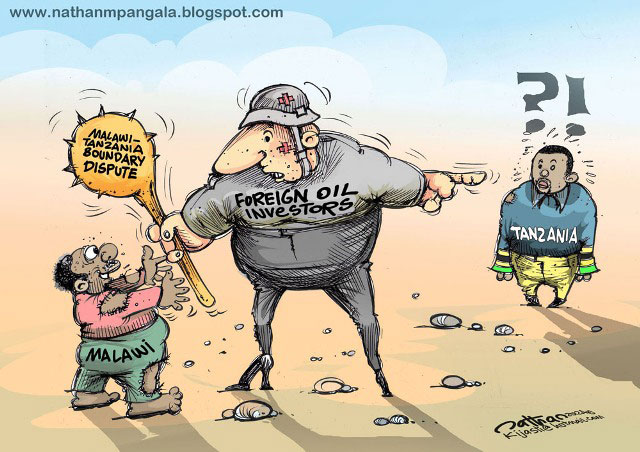
Cartoon by Nathan Mpangala - www.nathanmpangala.blogspot.com

Cartoon by Nathan Mpangala – www.nathanmpangala.blogspot.com

The border dispute between Tanzania and Malawi (see TA 103) has taken a new twist, prompting the contending parties to seek mediation before retired eminent persons of the Southern African Development Community (SADC).
Foreign Affairs and International Cooperation Minister, Bernard Membe, told journalists that this latest move was reached to avert a looming stalemate over the exact ownership of Lake Nyasa. Membe said the two sides had now officially agreed that there were two fundamental issues – Malawi maintains that the Lake north of Mozambique belongs to Malawi in keeping with the 1890 treaty signed between the German Government for Tanganyika and the British Government for Nyasaland, while Tanzania maintains that her border passes straight through the middle of the Lake – splitting the northern part of the water body roughly into two equal parts – as an international border.

Given such fundamental differences, both sides had seen the need to find a mediator to lead the next processes of the negotiations, with a view to finding a lasting solution to the dispute. It was therefore proposed that they should send a letter to the SADC mediation committee, chaired by former Mozambican President Joachim Chissano, early in December. The letter will request the former Mozambican leader to form a team of professional lawyers and other experts from across the African continent that would help sort out the legal aspects. The committee would have three months to tender its recommendations i.e. by late March 2013.

The minister added that should a decision mutually acceptable to the contending parties elude this committee, the matter would then be taken before “the highest levels of international arbitration”, such as the International Court of Justice, for further mediation. Membe said an appeal to the International Court of Justice (ICJ) would be made in accordance with the Vienna Convention on the Law of Treaties (1969), which could provide the framework for a speedy solution. He explained that the meeting had been called specifically to discuss the various options available for resolving the boundary issue which had been rec­ommended by the joint committee of officials from both countries who had met on November 18.

Malawian Foreign Affairs Minister Ephraim Chiume expressed opti­mism and thanked President Jakaya Kikwete and President Joyce Banda for the steps they had taken to ensure the matter would be resolved amicably.

RUCTIONS IN ZANZIBAR COALITION

Just as in Britain’s coalition government, tensions between the two rival camps within Zanzibar’s government of national unity (GNU) can boil over from time to time. In Zanzibar it happened when First Vice President Seif Shariff Hamad publicly accused Zanzibar President Ali Mohammed Shein of not curbing alleged excesses of the security apparatus.

Addressing a public rally at Kibanda Mait, Mr Hamad, who doubles as Secretary General of the main opposition Civic United Front (CUF), charged that, under cover of cracking down on perpetrators of chaos linked to Uamsho, the Police Force, intelligence service and what he characterized as ‘rogue elements’, were harassing innocent civilians. While declaring that the GNU would not be wrecked, he nonetheless accused the rival camp within the government of clandestinely carrying out moves aimed at sabotaging the partnership.

SWISS MILLIONS – ZITTO SHOT DOWN

Parliament on November 10 rejected a proposal by CHADEMA’s Kigoma MP Zitto Kabwe to form a select committee to probe some $196 million allegedly lodged in Swiss banks by 13 public officials. Instead it resolved that the matter be handled by government organs in collaboration with international investigators. Speaker Anne Makinda said the report on the outcome of the investigations should be tabled in Parliament in April 2013. Dismissing Zitto’s proposal, she said it should have been tabled separately as a private motion. This provoked a heated two-day debate in the House in November on what should be done to recover the money, with most MPs supporting Kabwe. Prime Minister Mizengo Pinda said the matter was sensitive and needed handling with care, but he assured the public that no stone would be left unturned in attempting to expose the culprits. This was a matter of national interest and nobody would be spared or protected.

Kabwe said he had no qualms with the decision, since the motion was after all adopted by the House and he would raise the matter again at the next sitting in April if no progress had been made.