COUP D'ETAT

COUPS IN MAURITANIA, GUINEA BISSAU AND MADAGASCAR
As parts of Africa seemed to be returning to the era of government change by coup d’etat, President Kikwete reiterated his strong objections, upholding the stand he has been taking during his one year as Chairman of the AU. He said he differed emphatically from the newly elected AU Chairman, Col. Muammar Gaddafi and the Senegalese President Abdoulaye Wade, who had presented a request that membership of Mauritania and Guinea Bissau be restored to the AU.

Kikwete spoke even more strongly against the coup in Madagascar. With the support of many heads of state and to widespread applause of other members at the UN Conference Centre Economic Committee for Africa (UNCC-ECA) in Addis Ababa, he requested his fellow leaders in Africa to be honest when discussing important issues about African development. President Wade had defended his call to allow military governments in AU, saying that the Guinea coup was being supported by the people. President Kikwete said: “It is very simple for the army to organise people into the streets and make them sing praises. You can do anything when you have a gun, and I know that because I was once in the army….If you want to become a President, first resign from the army, as I did” he said. – Guardian.

AND THE SUDAN
President Kikwete, together with other African heads of state has condemned the action of the International Criminal Court in indicting Sudanese President Omar Al-Bashir for war crimes. Their fear is that arresting Al-Bashir could worsen the situation in Darfur.

However, former Tanzanian Foreign Minister Dr Asha Rose Migira, who is now the Deputy Secretary General of the UN in New York, does not agree. According to the East African she told the media in Dar es Salaam that the UN recognised and respected the decisions of the Court as a legally instituted authority. “President Al-Bashir must cooperate with the court” she said.
AN EXEMPLARY RELATIONSHIP

President Kikwete and President Hu Jintao

President Kikwete and President Hu Jintao


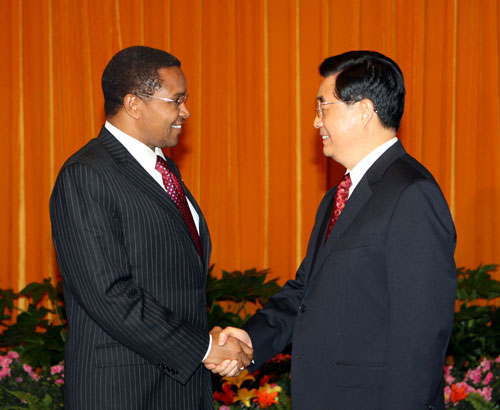
President Kikwete and President Hu Jintao on the occasion of the Chinese leader’s visit to Dar-es-Salaam in February 2009

Needless to say, considering the good relations that have existed between Tanzania and China for over 45 years, when President Hu Jintao planned his second visit to Africa, Tanzania, was on the itinerary – together with Senegal, Mali and Mauritius.

“Our relationship with Tanzania can be viewed as an exemplary relationship of sincerity, solidarity and cooperation” said President Hu. President Kikwete said Tanzania and China enjoyed a special relationship, which was initiated by the previous leaderships of both nations. The visitor was accorded a 21-gun salute before inspecting a guard of honour at the welcoming ceremony at the Karimjee Hall. A large number of Tanzanians greeted the Chinese leader by playing drums and trumpets, clapping their hands and waving flags.
Major streets of Dar es Salaam were also festooned with the national flags of both countries and banners that read ‘Welcome President Hu’ and ‘Long Live China-Tanzania Friendship.’ Some local people wore costumes and shirts featuring Hu’s picture.

In his speech President Hu said he appreciated Tanzania’s efforts to ensure the smooth relay of the Olympic torch when it was in Dar es Salaam last year (see TA 90) as well as its adherence to the ‘One-China’ policy. The Chinese President brought a $21.95million aid gift with him and said his government would invite young Tanzanians to visit China and would offer more scholarships. On the global financial crisis, he said China would keep its promise not to reduce aid to Africa – Guardian.

FLOGGING CONDEMNED

President Kikwete has terminated the appointment of the DC for Bukoba Rural, Albert Mnali, after he had ordered the flogging of 31 primary teachers. A statement issued by State House said that the DC had violated public service regulations and tarnished the image of the government.

Mnali instructed that the teachers be flogged after schools in his district got the worst results in the territorial primary examinations. He told reporters that many people had sent him messages of support but Deputy Minister for Education and Vocational Training Mwantumu Mahiza said Mnali should be sent for a ‘psychiatric check’.

Some local residents were quoted as saying that the DC had been right in flogging the teachers because the standard of teaching had deteriorated. They told reporters that, after the teachers had obtained bank loans, they virtually abandoned their classrooms. Some of the supporters even suggested that the DC should stand for election next year and they would campaign for him – Majira.

OTHER CORRUPTION CASES

The Richmond Saga

The Richmond saga continues. On June 23, 2006 Richmond Development Company signed a contract with TANESCO to generate 100 megawatts of electricity when the country was experiencing acute power shortages. Several months later, some legislators said that Richmond lacked experience, expertise and was financially incapacitated (For details see several previous issues of TA) but there had been little progress in bringing to justice the many people involved. The House of Assembly’s Select Committee had produced an impressive report containing 23 recommendations which had resulted in the resignation of the then Prime Minister and Energy Minister. MP’s waited to see what other actions the government would take.

Finally in early August, Prime Minister Pinda announced each of the recommendations in parliament. He said that the Director General of the Prevention of corruption bureau (PCCB), the Permanent Secretaries of the Ministries of Finance and Energy and Minerals and several technical advisers in government and TANESCO plus the members of the government negotiating team had been served with letters to show cause why disciplinary action should not be taken against them for their role in the controversial contract. Continue reading

CCM’S INTERNAL PROBLEMS

Several Swahili newspapers reported in October that during elections for leadership positions in CCM’s mass organisations there had been further dissension. The party’s Central Committee and National Executive Committee (NEC) rejected certain prominent candidates. Party members wanted to know why they had disqualified Musoma Rural (MP) Nimrod Mkono for the party’s Parents’ Wing (Wazazi) and a final decision was postponed. For the CCM Women’s Wing a controversial candidate had stated that she wanted to withdraw from the race because of ‘corruption and dirty campaigning’ but was eventually allowed to stand. For the Youth Wing (UVCCM), it was decided that the chairman should come from Zanzibar and that a controversial candidate named Nape Nnauye, who had been expelled earlier as a member allegedly for uttering unproved statements against the party’s senior leaders, should not be allowed to stand. But he remains a National Executive Committee (NEC) member.

CCM’s Secretary General Yusuf Makamba was criticised following the by-election defeat (see below) but no action was taken – Majira.

Government reacts forcefully

Mwana Halisi published a story to the effect that several top CCM officials were plotting to make it difficult for President Kikwete to win the next election in 2010. The Government then asked Mwana Halisi to show reason why steps should not be taken against it over this conspiracy story. In the past the paper had been warned several times about its radical stories according to Majira.

One day after this the State House Director of Communications, Salva Rweyemamu, told the press that the story was a pack of lies aimed at tarnishing the image of Kikwete and his family (his son was mentioned in the story), while instigating hatred among the leadership. He said allegations were a figment of imagination of the newspaper aimed at boosting its sales. Meanwhile, one of the politicians named in the story filed a lawsuit against the editor of the paper, Saed Kubenea, as well as its publishers and printers.

Kubenea said he stood by his story and was prepared to meet the bigwigs in court – Mwananchi.

Mwana Halisi was then banned for three months by the government.

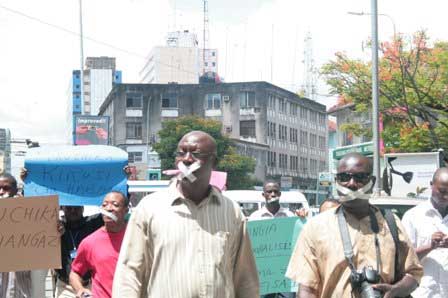
protest
Demonstrators at the protest

Continue reading

BY-ELECTION SHOCK FOR CCM

It is virtually unknown for Tanzania’s formidable ruling CCM party to lose a parliamentary by-election but, on October 13 it happened – in Tarime, Mara region. The by-election was caused by the death of the controversial CHADEMA MP Chacha Wangwe who died in a car crash (TA 91). The new MP Charles Mwera (CHADEMA) got 34,545 out of 64,795 votes cast at 406 balloting centers. 2,938 votes were spoilt. At least 149,919 voters had registered for the by-election and were expected to vote. CCM’s candidate got 28,996 and two minor parties got 949 votes and 305 votes respectively.

In a parallel council election CHADEMA also triumphed by 4,820 votes to 3,239.

Voting was peaceful but the campaign was one of the hottest on record. The CCM sent some of its top people to campaign and spent a vast sum of money in trying to regain the seat from the opposition even though CHADEMA has only ten seats in the National Assembly and CCM has most of the remaining 222. There was sporadic violence. The leader of a small party was stoned and injured as he was addressing an election rally, a group of CHADEMA supporters were beaten up.

mbowe
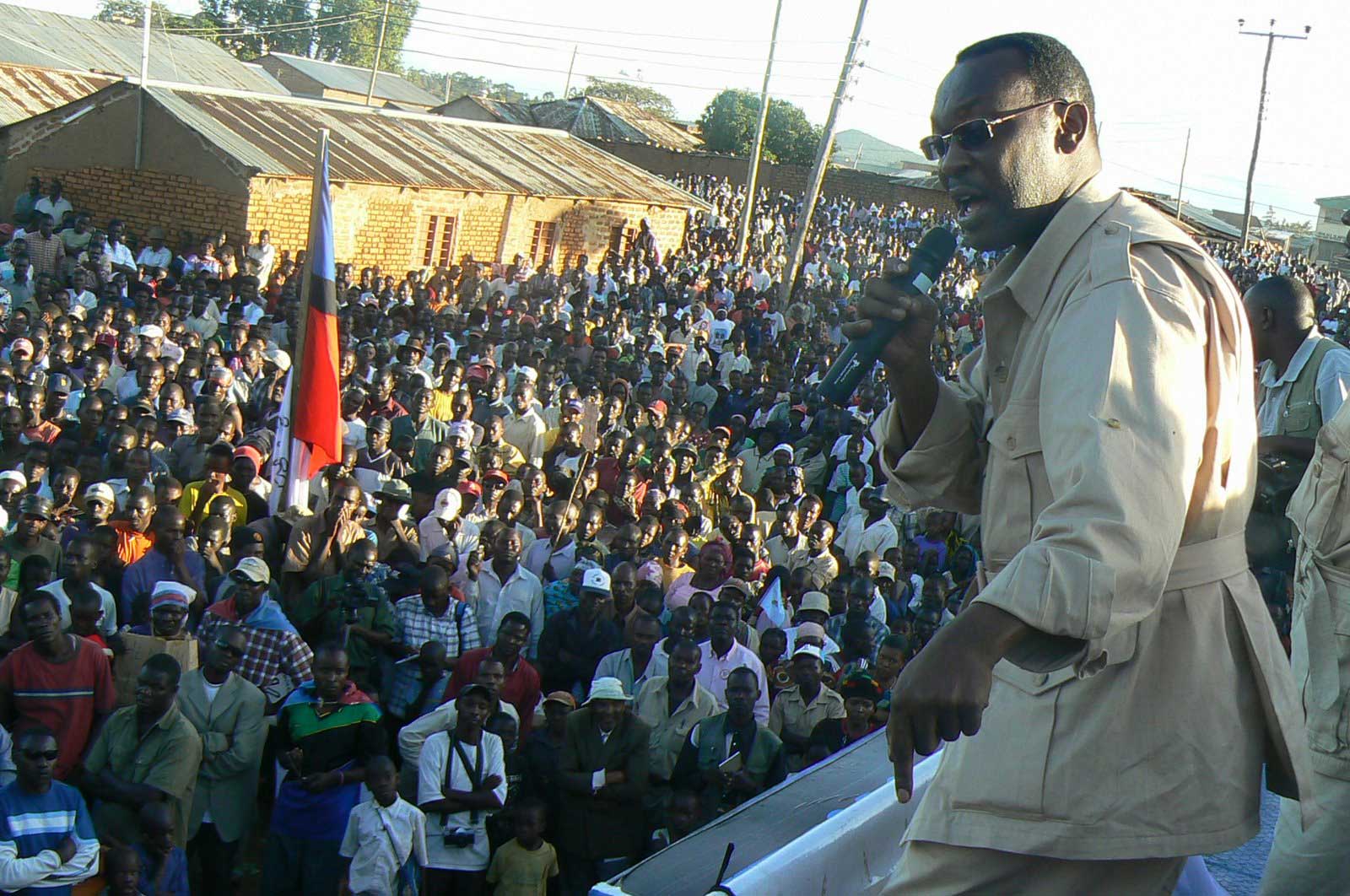
Freedom Mbowe (leader of CHADEMA) speaking at the Tarime by-elections (photo courtesy Mussa Juma http://haki-hakingowi.blogspot.com)

When CHADEMA leader Freeman Mbowe arrived in Tarime to campaign he was greeted by thousands of party members and accompanied by a procession of some 200 motorbikes and cars. Three kilometres from the town he left his car and started marching with the crowd, entering the town in style as people chanted: “commander, commander”. Mbowe was in his signature khaki safari suit. Police said that CHADEMA had ‘declared war’ on them and that the party’s supporters stoned police and smashed their vehicles, as they were dispersing an unlawful assembly – Mwananchi and all other Swahili newspapers.

ambassadors
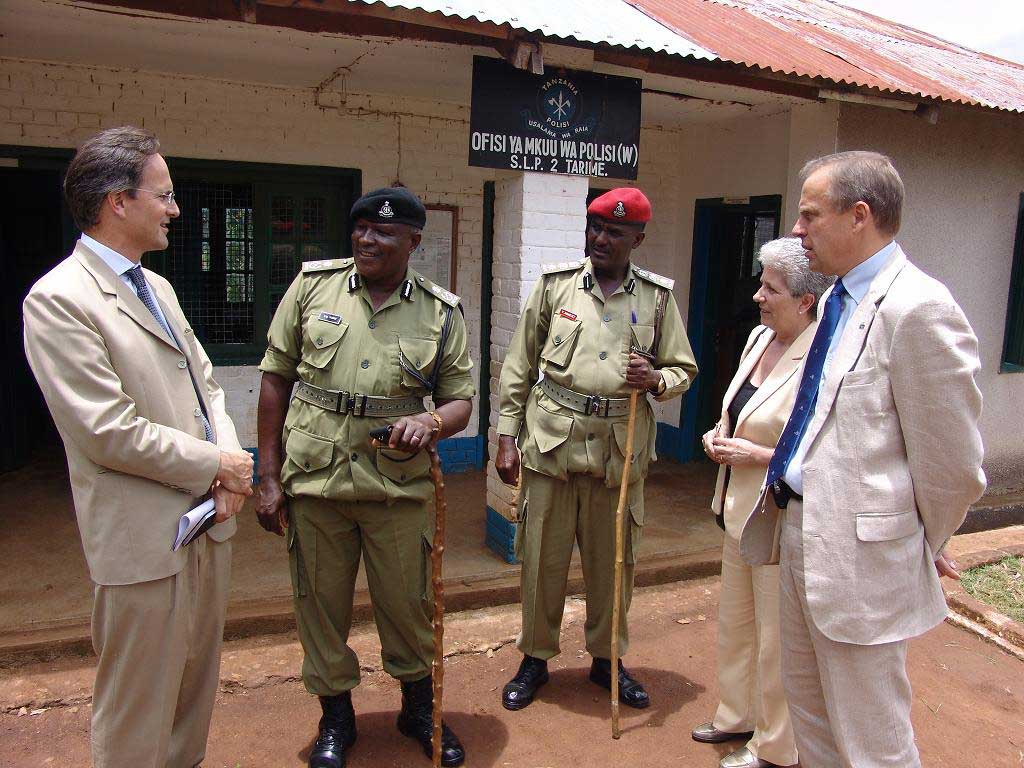
British High Commissioner Philip Parham and ambassadors Staffan Herrstrom (Sweden) and Janeth Siddall (Canada) with the Head of the Police Special Unit, Commander Venance Tossi. The ambassadors visited Tarime during the run up to the by-election and met with the police and the consituency returning officer (photo Mussa Juma)

Continue reading

TANZANIA AND OBAMA

obama_kanga
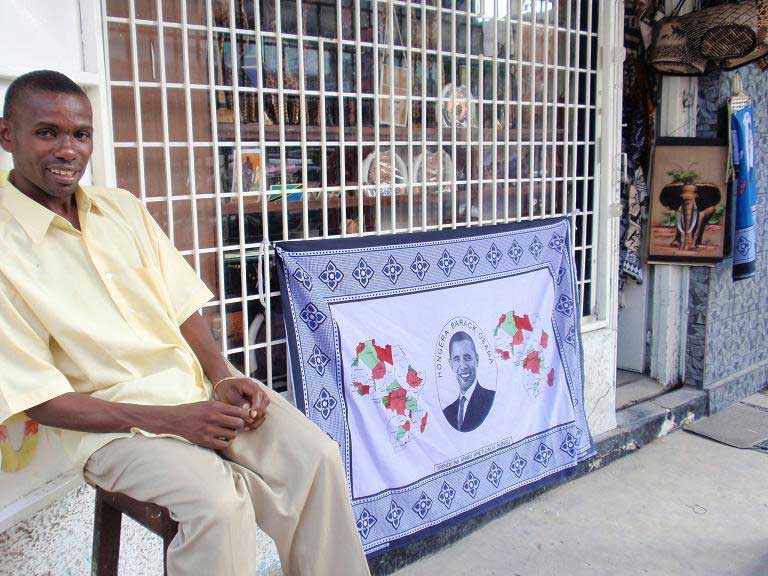
Kanga on sale in Dar-es-Salaam

‘We share America’s excitement in Obama’ wrote the Tanzanian Guardian’s editor, the morning after the historic American election results came out. The paper went on: ‘Americans have spoken – and spoken well. The world is genuinely excited for the United States, whose election has made history by producing a black president, and for the world as a whole….Indeed President-elect Barack Obama’s victory is not only an inspiration to millions of people all over the world but also has special resonance with the people of Africa, where his Kenyan father originated.

Another significant fact is that Americans have taken us through a major lesson in democracy – and this is that, despite the intensity of the contest and the stakes for the contestants, they have come out of it gracefully and truly tested.

One lesson that African politicians must take note of comes from the telephone call made to President-elect Obama by his main rival, Republican Party candidate John McCain. In that call, McCain acknowledged defeat with dignity and went on to concede the historic significance of Obama’s victory to the American people and their country`s politics. “I urge all Americans who supported me to join me in not just congratulating him (Obama) but offering our next president our goodwill, `” McCain stated.

That is how politicians in Africa should conduct themselves if our democracy is to grow to maturity and stabilise the continent……We wish the new US president and the American people well.

WHO CONCEIVED/LED THE WAY TO UJAMAA?

A contribution by Lawrence Cockcroft with the assistance of Gerald Belkin, and Ralph Ibbott.

In responding to a call from the late Julius Nyerere in 1960 to people to work hard and work together on farming in the interest of the country’s development, a small group of the TANU Party Youth League (TYL) led by Ntimbanjayo John Millinga (see obituary below) established, in the Litowa valley in Songea District, what became known later as the Ruvuma Development Association (RDA). Millinga had a vision of developing a village where its families, by working together, would improve their lives and provide a better future for their children.

From this small start in 1961 other groups came for advice and as a result the RDA was formed. All members had agreed that a large part of the work would be carried out communally. In 1966 Griff Cunningham, the Principal of Kivukoni College wrote, “An unique set of circumstances prevailed in the RDA, for the founder and chief sustaining drive behind the settlements is undoubtedly Ntimbanjayo Millinga…(who) has provided a genuinely charismatic leadership from the beginning and has, by his messianic zeal, created a small group of disciples.”

The RDA type villages came to be known as ujamaa villages which soon attracted considerable attention. President Nyerere became very interested. He began to see it as a pattern for the rural development of Tanzania. In the villages and the association there was always much practical discussion, which often led to new enterprises. From past experience, the people knew that if their children went far enough in the school system, they generally went off to work in the big city. This led to them setting up a school at Litowa for the children from all the RDA villages. Millinga’s position had enabled him to select a fine person to be head of this school and to get the authority from Nyerere for them to develop their own curriculum suitable for the needs of the villages.

Discussions also led to the questioning of the law which only allowed the sale of people’s excess maize to the local inefficient co-operative which sold maize flour at more than three times the price at which it purchased the grain. A better price for them would mean earning more development capital. This led to them buying out the Songea grain mill. President Nyerere helped with this purchase by donating Tsh 90,000/- Later the association also purchased the timber mill. Continue reading

“WILDEBEESTS WILL VOTE FOR YOU”

There was a sharp debate in parliament when MP’s and others were invited to comment on the new ‘Wildlife Act 2008.’

“This Bill favours wildlife protection more than human beings” according to one participant.” “If you MP’s let it pass and become law, you must recruit wildebeests to vote for you come 2010” a village chairman said. The Bill would undermine indigenous Maasai people residing adjacent to the controlled areas in the vast districts of Simanjiro, Monduli, Longido and Ngorongoro. Mbakule Laizer from Longido was concerned by a certain section on the Bill that directed investors within the Wildlife Management Areas to pay fees direct to the Wildlife Division contrary to the previous system where they used to pay the respective village authorities. “We have spent a considerable time in our life to conserve the wildlife believing that one day we will reap the benefits of our efforts, but now when the government wants to rob us of the fees, I fear the move will spark off a dispute” one participant said amid applause from the floor.

The Chairman of the House Committee on Land, Natural Resources and Environment said it was unfair for villagers to threaten to deny MP’s their votes in the forthcoming general elections. “We have brought the Bill before you so that you can suggest what is to be removed or added, and we are ready to take you views in order to come up with a fair Wildlife Act at the end of the day,” he said – Guardian.

CORRUPTION – CRUSADE CONTINUES

New developments in Tanzania’s remarkable exposure of corruption and the battle against it have continued to stand head and shoulders above other news from Tanzania during the last few months.

The government has promised to continue investigating allegations of fraud and other forms of crime involving huge contracts. Prime Minister Mizengo Pinda said the focus would be on such contracts because they were the ones where poor performance and foul play usually resulted in mismanagement or misappropriation of massive amounts of public funds.

754 allegations Continue reading