STUDENTS STRIKE

In November some 16,000 Government-sponsored University of Dar es Salaam students and most other university undergraduate students were suspended indefinitely following their boycotting of classes in protest against loan fund allocations. They demanded that the government, through the ‘Higher Education Students Loans Board’ give them 100% loans instead of basing the loans they get on the financial status of their families, parents or guardians. The government decided to be tough and the affected universities were then closed. This seemed to exacerbate the situation with opposition parties condemning the government’s actions.

student
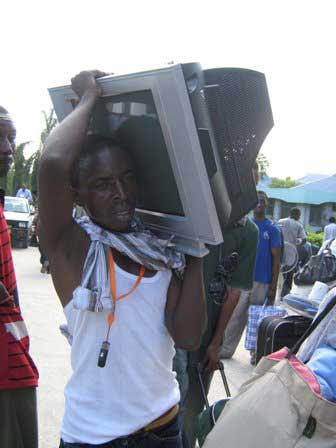
Tony Zakaria, a columnist writing in the government-owned Daily News was not impressed by the behaviour of the students. Extracts: ‘The pictures of students and teachers (also threatening to strike) on TV screens and on newspaper pages in the past few weeks have been colourful to say the least. Students dragging others from buses or classrooms to force them to join the strikes amounts to violence. So does the action of striking teachers throwing chairs at their leaders in a meeting hall…. teachers have been going to school but doing zero teaching in class….. Are they being paid salaries at the end of each month to silently ‘teach’ from their offices? We have seen hordes of pseudo-intellectuals on TV… struggling to juggle TVs, DVD players, impressive music systems and their suitcases large and small, as they scrambled to leave campus after they were booted out…The defiant, fire-breathing future intellectuals have vowed to fight on and strike again upon being reinstated at some unknown future date. You want to know how they spend their money, loaned or otherwise? Visit Mabibo hostel or any other dormitories of these potential future servants of the public. TV antennae growing like a forest of potted plants on windows for all to see. A cacophony of sound that passes for music …. will assail your ears, unless you are deaf to the obvious…. When do they seriously study, these music and vision lovers?’

TANZANIA & THE WORLD CUP

Tanzania did not do well in the preliminary rounds of the World Cup to be held in South Africa in 2010. The results of the qualifying matches were as follows:
01-02/06/08: Tanzania 1-1 Mauritius
06-08/06/08: Cape Verde 1-0 Tanzania
13-15/06/08: Tanzania 0-0 Cameroon
20-22/06/08: Cameroon 2-1 Tanzania
05-07/09/08: Mauritius 1-4 Tanzania
This placed Tanzania in third place in its group and hence not eligible to continue in the competition. Teams have to be in one of the top two places to qualify. The group results were as follows:

Played W D L GF GA Pts
Cameroon 5 4 1 0 9 2 13
Cape Verde 5 3 0 2 6 5 9
Tanzania 5 1 2 2 6 5 5
Mauritius 5 0 1 4 3 1 2

THE VICKERS VIMY & THE TABORA ANTHILL

An almost forgotten episode in Tanganyikan (and aviation) history was recalled by an auction in Shropshire on June 25 last year. Lot 42 was described as ‘the original Album of Captain F C Broome DFC covering the epic African Exploration Flight of January 1920 ……. including Broome’s original typed notes for his log of the flight.’ It sold for £700.
In 1919 there had been record-breaking flights across the Atlantic and to Australia by Vicars Vim aircraft and the South African government was keen to see a similar flight from London to Cape Town. Lord Northcliffe, owner of the Times newspaper, saw the chance of a scoop. On 4th February 1920 the Times announced in bold headlines that it was sponsoring a flight to Cape Town. This would not be a race, but a serious attempt to show ‘whether Africa can be traversed easily and safely from end-to-end by proper aircraft in ordinary conditions’.

The twin engined Vimy byplane, with two experienced RAF pilots (Captains Broome and Cockerel) and two mechanics on board, left England on 24th January and Broome’s logbook records their rather chequered progress. After leaving Brooklands aerodrome, he ‘nearly took the towers off Crystal Palace’; and having landed at Lyons to refuel, almost caused a strike by ‘asking for 600 gallons of juice’ on a Sunday night.

The plane also stopped at Naples, Malta, Tripoli and Benghazi and finally arrived at Cairo on 3rd February. There it was joined by Dr Charles Mitchell, Director of the London Zoo. who had been appointed Times Special Correspondent. Describing the hazards to be faced in Africa, the Times noted that the aircraft would fly along the east shore of Lake Victoria to avoid the ‘active volcanoes’ on the western shore which were ‘likely to cause atmospheric disturbances, which in their turn might bring about a forced landing among tribes addicted to cannibalism.’

On 5th February the Times revealed that another Vickers Vimy had set out from Brooklands aerodrome the previous day, piloted by two South Africans, Lieutenant Colonel van Ryneveld and Flight Lieutenant Brand. Their aircraft was imaginatively named ‘Silver Queen’.

The Times insisted that there was no race, noting that ‘it was of course never intended that the flight of the Times aero plane should be undertaken in a competitive spirit, but wholly for the purpose of scientific exploration and to test the route through Africa’. Nevertheless, Northcliffe wanted his plane to get to the Cape first.

The Times aircraft left Cairo on 6th February encouraged by a message from Queen Alexandra, and arrived at Khartoum on February 8th after two forced landings. It left Khartoum on February 10th but did not reach Jinja in Uganda until 22nd February. Repeated engine troubles caused more forced landings; adulterated fuel was probably to blame. Several nights were spent camping in the bush with ‘repose often disturbed by lions.’ Meanwhile Van Ryneveld was having his own problems. The Silver Queen crashed between Cairo and Khartoum and was damaged beyond repair. Undaunted, Van Ryneveld returned to Cairo and was lent a Vimey by the RAF. It was christened ‘Silver Queen II’. He left Cairo in the replacement plane on February 22nd After a refuelling stop at Mwanza the Times aircraft landed at Tabora on 26th February. They were greeted by a large crowd led by the Administrator of Tanganyika territory. Broome wrote: ‘Arrived Tabora cheerful. Thought worst part was over.’ But during take-off the next day the Vimy’s starboard engine cut out and the aircraft crash-landed in the scrub. It hit a large anthill and the impact forced the undercarriage into the lower wing. Fortunately none of those in board was injured but the plane was damaged beyond repair. Broome recorded: ‘All disgusted with rotten luck.’

Thus the Great African Exploration flight ended ignominiously on an ant hill.

Meanwhile ‘Silver Queen II’ reached Bulawayo, Southern Rhodesia where it to crashed on take-off. The South African Government promptly sent a two seater single engined de Havilland DH9 christened ‘Voortrekker’ as a replacement. Whether or not it was within the spirit of the competition for a different plane to complete the final leg of the journey the two pilots were greeted as heroes when they arrived at Cape Town on 20th March 1920. They were awarded a prize of £5,000 each by the South Africans and were knighted by King George V. In the best traditions of British sportsmanship, the Times commented that ‘while extending our deepest sympathy to Dr Chalmers Mitchell and his gallant companions for the great disappointment which befell them….. we feel that no one will join in our congratulations to Colonel van Ryneveld and Major brand more heartily than they’.

Postscript – The fuselage of the wrecked Vickers Vimy was taken over by the Tabora Sporting Club for use as a pavilion. Do any of our older readers remember it?
John Sankey

TANZANIA IN THE INTERNATIONAL MEDIA

An editorial in the Kenyan newspaper THE NATION (October 21) quoting from the Tanzanian paper The Citizen wrote: ‘Hardly a day after President Kikwete called for a crackdown to stem the killing of albinos another horrendous case was reported. An albino girl was on Sunday night slain in Kahama, Shinyanga. It’s not surprising that the story has gone all over the world. The international community is rightly puzzled about the madness that has befallen our country. That the killers stormed the Standard Three pupil’s home, killed her and chopped off her body parts before the very eyes of her terrified parents, speaks volumes about how cruel and inhuman these criminals can be. Serious measures must be taken now to stem the killings. Police cannot be everywhere, but the wananchi can. We should unite to fight the primitive acts by criminals driven by senseless superstition’ – Thank you Keith Lye for sending this – Editor.

Tanzania has a large population of refugees from neighbouring countries and London’s GUARDIAN WEEKLY REVIEW (September 26) devoted a piece under the headline: ‘Last of the exiles return’. Extracts: ‘Peace has now returned to Burundi, and many who fled 30 years ago are returning home. 85-year-old Michael Bihonzi is among many who fled the ethnic massacres that started in 1972 and which consequently left up to 200,000 people dead, reports Xan Rice. Bihonzi, who found peace and safety in a Tanzanian refugee camp, climbed on board a truck with 23 of his children and grandchildren, and headed across the border with a cash grant of $40 from UNHCR, the UN refugee agency that is managing the repatriation effort. ‘More than 450,000 refugees have already returned. Now, with the last active rebel group in Burundi showing willingness to lay down its arms […] Tanzania has decided to close its remaining refugee camps near its western border.’

In an exclusive interview, AFRICA REPORT (October-November) asked Tanzania’s President Kikwete some pertinent questions regarding the country’s economy, the fight against corruption and, as he is currently chairman of the AU, his thoughts on democracy in Africa. The paper wanted to know why ‘statistics on malnutrition and sanitation remain appalling’ even though ‘Tanzania has a record of sustained growth and investment’? The President explained that ‘the huge investment’ Tanzania has made is just ‘beginning to translate itself.’ A sustained economic growth [7%] over a period of ten years will double the country’s GDP. ‘We are now seeing the result of that. It is close to $20bn from $15bn seven years ago.’ In a brief explanation of Tanzania’s economic history, the President said there was a time when there were empty shelves in the shops, which were then owned by the state. However, with the start of the economic reforms in 1986, under the leadership of President Ali Hassan Mwinyi, the economy began to turn around. Mwinyi allowed anyone who had the money to bring goods into the shops. “We came from very difficult beginnings, to the extent that if today somebody preached socialism, we would think he must be crazy.”

In a report published in THE EAST AFRICAN (October 13-19) Tanzania has opposed the consensus reached by Uganda, Rwanda, Burundi and Kenya that residents in one of the partner states can acquire land in another, saying that it is too early for the country to fully open its lands to other East Africans. One of the barriers to committing to the acquisition of land seems to be Tanzania’s land tenure system which declares that ‘all land is publicly owned by the head of state in trust for the whole nation with different legal regimes applying to rural and urban areas.’ “In Tanzania, you must have big investments to acquire land,” said Barack Ndegwa, a director in the Kenyan Ministry of EAC Affairs. It should be noted that Tanzanian negotiators declined to speak to the East African. Apparently, language sparked off another disagreement. According to Edith Kateme, Burundi wanted “access” to lands in the five-member states whereas Rwanda insisted on the word “acquire”. Kenya and Uganda opted for “may access”. There was hope that the issue could be resolved during the meeting in Zanzibar in November.

‘Now make way for us”. [Norway learns:] ‘A lesson in sustainability from Tanzania’, reports the economist Michael Fergus in HABARI, the journal of the Sweden-Tanzania Society. Fergus’s article debunks the ‘persistent, and very depressing myth that much of the infrastructure built in rural Africa in the 1970’s and 1980’s financed by the West, turned to dust, as soon as the donor left.’ A study (published in November 2007) of the water and sanitation schemes in Tanzania and Kenya, supported by Norwegian development aid, gives a complete lie to this myth. It shows that between 70% and 90% of the schemes built between 20 and 30 years ago are still working well. To the surprise of donor agencies, villages in the remote Tanzanian regions of Kigoma and Rukwa, in the spirit of kujitegemea, self-reliance, have managed to maintain a high percentage of water aid investments without assistance from the Tanzanian government.

The EAST AFRICAN (18th August) reported on a new export market being developed in the East Usambara mountains in Tanga region. Under the ‘Amani Butterfly Project’ insects are exported to the UK, USA, Switzerland, France and Germany. Depending on the species, butterfly pupae are sold for between $1 and $2.50 each. On arrival at their destinations they are cultivated in butterfly houses which charge fees to tourists wanting to see tropical butterflies flying under glass roofs. Since 2003 the project has paid more than $70,000 to butterfly farmers.

Columnist Melanie Reid informed readers of THE TIMES (May 26) of the disturbing plight faced by Tanzanian escorts (guides and porters) who accompany some 25,000 Western tourists on their quest to climb Africa’s tallest peak, Mt Kilimanjaro. In stark contrast to their Nepalese counterparts, working on Mt Everest, who are well-fed and well-clothed and who are now ‘recognised and recompensed for the unique skills they offer the developed world at play’, Tanzanian guides are extremely low-paid and ill equipped by the companies that organise the lucrative trips. According to Reid, ‘Up to 20 guides and porters die on Kilimanjaro every year[…] These young men exist in a ruthless free-market economy vying with each other for the jobs, and risking their own health with enforced lay-offs and lack of proper re-acclimatisation,’ says Reid. Porters (who carry 20kg packs containing water, food, firewood and the tourist’s possessions) earn $3 a day; guides up to £10. ‘Allegedly,’ says the columnist, ‘some companies do not pay their staff any salaries at all, but let them rely on tips.’ – Thank you John Sankey for sending this Editor

Several international media (including BBCSwahili, and MSNBC) reported the ceremonies held in Kenya and Tanzania in memory of the victims of the al-Qaeda bomb attacks on the U.S. embassies in Nairobi and Dar es Salaam. The attacks, which took place on August 7, 1998, killed over 200 people and wounded 5,000.

On Thursday 2nd October, FOXNEWS.com wrote under the headline: ‘Dance Turned Stampede Kills 20 Children in Tanzania’. Extracts: ‘At least 400 children aged 5 to 13 were inside the hall in the town of Tabora when the stampede occurred. [The children] were dancing to English and Kiswahili songs [while they celebrated] the Islamic Eid al-Fitr holiday.’ Police Commander Daudi Siasa said, “The children were trapped inside the hall, which has a capacity to accommodate maximum 200 people, but the number was more than double inside at the time.” President Kikwete sent condolences to the children’s families and dispatched a senior cabinet member to investigate.

In its ‘Country Profile on Tanzania’ by Walragala Wakabi in October the NEW INTERNATIONALIST awarded star ratings to various aspects of Tanzania today. In income distribution it awarded three stars, for life expectancy two, literacy three, freedom five (‘a thriving and powerful media and civil society’) and for its treatment of sexual minorities one star. On the latter it wrote: ‘Homosexuality is illegal; new laws have criminalised lesbianism and same sex marriage is punishable by imprisonment for seven years.’ On President Kikwete it wrote that he had maintained the neo-liberal and pro-privatisation policies of his predecessors….. but he had pussy-footed about the lingering issue of the relationship between mainland Tanzania and Zanzibar which feels marginalised and wants greater autonomy – the rising friction between the two has become a threat to what has hitherto been among the most politically stable countries on the continent’ – Thank you Sister Lucia for this – Editor

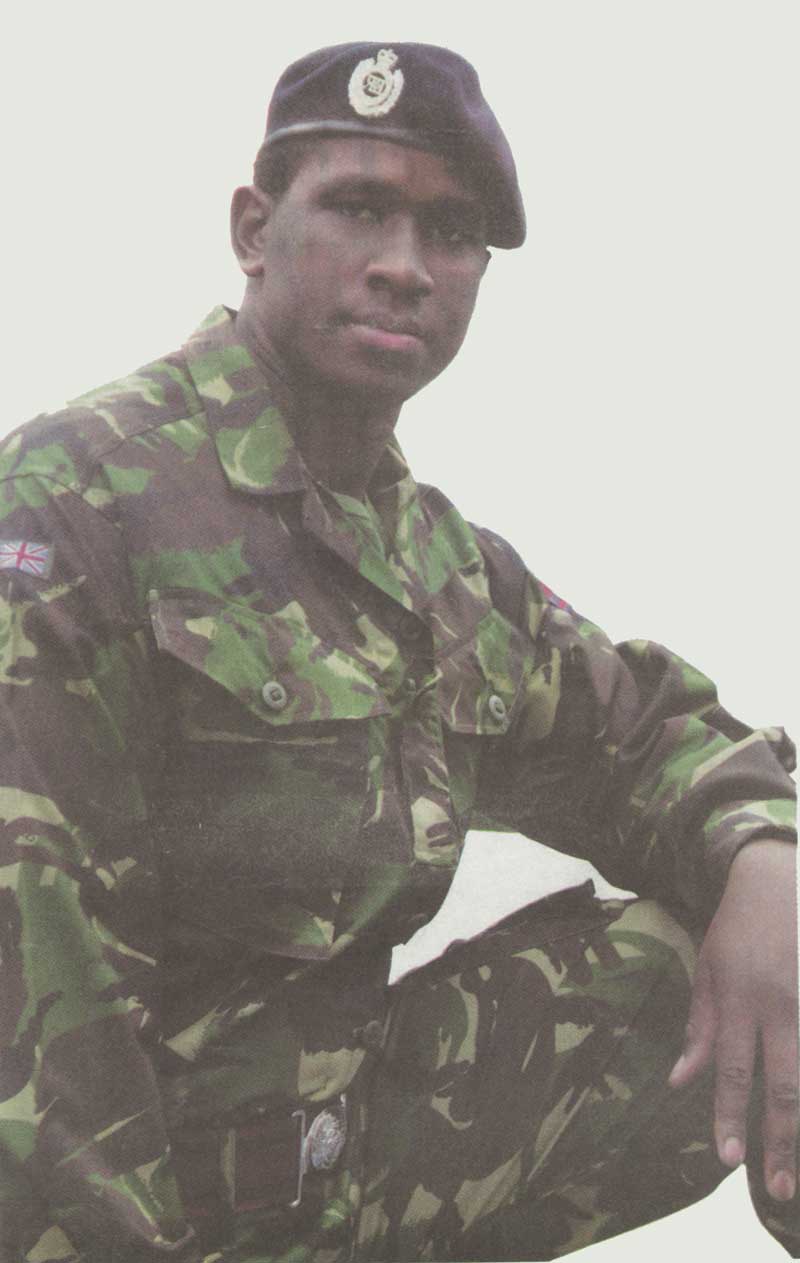
TZUK NEWS (September-October) published a story written by Gloria Mutahanamilwa about Boniface Hima (25) who is training to be in the British army where he hopes to be working as a Royal Engineer. Extracts: Hima is a born again Christian and I asked him how he mixed his strong Christian beliefs with a job in the armed forces. He replied: “If you read the Bible, there were wars and killings and God didn’t condemn Moses when he killed and buried someone with his own hands. He went on to say that if he were asked to go to the front line nothing would stop him as he had taken an oath of allegiance swearing to be faithful and bear true allegiance to Her Majesty Queen Elizabeth and her heirs and successors.
Boniface
Royal Engineer Boniface Hima (photo courtesy Mr & Mrs B.Hima)
He is enjoying every minute of his training and is encouraging other ethnics to join. The writer concluded: “I am left with one big question. If Tanzania and the United Kingdom should ….where would his allegiance lie?”

Who owns Obama? was the question posed in the EAST AFRICAN on November 10. Everyone knows that Kenya owns half of him but, according to the Tanzanian ‘Weekend African’ Obama is actually a quarter Tanzanian. The president-elect’s grandmother on his father’s side, the paper claims, hailed from Kowak village in Tarime District close to the border with Kenya.

KILIMANJARO SNOW WILL NOT GO

Tanzanian researcher Prof. Ernest Njau has said that snow on Mt. Kilimanjaro will not disappear around 2017, as suggested by foreign scientists. He said that the Intergovernmental Panel on Climate Change (IPCC) report contained prediction errors due to imperfections in the climate models used. Recent scientific reports had taken the sunspot-climate relationship into account and had come up with a prediction that a 430-year-long global cooling trend was due to start in about the year 2060, and the Ice on Kilimanjaro would return to its original state. He said it was true that the average global temperature had not increased since 1998, despite the increase in atmospheric carbon dioxide by 4% over the same period.

Last year, another study on the dwindling ice on the mountain’s cap suggested that global warming had nothing to do with the alarming loss of its snow. US-based scientists Philip Mote and Georg Kaser linked the problem to a process known as sublimation that occurs at below-freezing temperatures and converts ice directly to water vapour with the liquid phase skipped. They said that the Kibo icecap (19,340 feet above sea level) occupied about 12.5 square miles when first measured but this had dwindled to about 7.5 square miles by 1912, to about 4.3 square miles by 1953, and just over 1.5 square miles by 2003 – Guardian.

NEW VISA RULES

The British High Commission in Dar has changed its procedures for the issuance of visas. Applications will have to be lodged on-line at least six weeks before the date of travel. Political and Press Officer at the diplomatic mission John Bradshaw told a press conference that visa applications would in future be processed at a central office in Nairobi as part of a plan to reduce the number of British offices handling visa applications – Majira.

Habari Leo commented: This is a shame, to say the least, for such a rich country because in this age and time of technological advancement, when speed and efficiency is the watchword, Britain has decided to impose stringent conditions thus delaying the visa application process…. What happens when, while the passport is being processed in Nairobi, one has to travel elsewhere? Obviously they looked at their own interest without considering the interest of travelers. A cartoon in Mwanchi included the words: ‘You might as well shut down the embassy.’

Mtanzania stated that students from Tanzania applying to study in Britain as from March 2009 would have to get approval from officially accredited universities and colleges.

MISCELLANY

UK water company Biwater failed in its bid to claim up to US$20 million in damages from the Tanzanian government following the collapse of the controversial water privatisation contract in 2005 (see TA previous issues). The case was heard at the International Centre for the Settlement of Investment Disputes (ICSID). In 2003, a subsidiary of Biwater, ‘City Water Services’, took on a water privatisation contract in Dar es Salaam. The Tanzanian government cancelled the contract after less than two years, citing City Water Services’ failure to meet the targets set in the contract. The Tribunal has found that while technical breaches of Biwater’s investor rights did occur, Biwater was not entitled to compensation because the breaches were worth zero in monetary value and that the termination of the contract was inevitable. The policy of water privatisation was imposed on Tanzania via a series of conditions set by the World Bank in return for aid, debt relief and cheap loans. The UK government supplied millions in aid to support the wider Tanzanian privatisation programme.

Two British tourists were robbed of £ 2,700 plus other belongings while staying at Breezes Hotel in the South Region of Zanzibar. It is believed that some hotel employees entered their room and broke open a safe deposit box while the guests were out having dinner – Tanzania Daima.

The French Ambassador to Tanzania has announced that the French government had committed $2 million to promote the French language in Tanzania in a three-year programme. He was addressing a meeting of French teachers who now number over 300 – Guardian.

Tanzania received an award for effective use of donor aid in the health sector. The award was made in Accra, Ghana during a review of progress in the implementation of the 2005 Paris Declaration on Aid Effectiveness. Participating countries were given the chance to showcase best practice examples in aid management and effectiveness.

OBITUARIES

NTIMBANJAYO JOHN MILLINGA (69), who died of cancer on July 12 last year, was born in one of the far corners of Tanzania by Lake Nyasa. He was educated to standard 8, had two years of nursing training and attended a nine months Political Science course at Kivukoni College in Dar es Salaam. He became well known for his work in setting up the Ruvuma Development Association (RDA) in the 1960’s which is described in an article above. He became Chairman of the Songea District Council in 1963 and in 1965 MP for the Songea South constituency. He worked in a number of areas in the country as District Secretary, Regional Secretary and Area Commissioner of the CCM party. A drawn out fight with prostrate cancer dogged his later years. However for the last decade of his life he re-engaged with the issues of production and enterprise at Litowa, successfully promoting a tile production factory and strengthening educational development. In all his working life he was greatly assisted by his wife Conrada and three surviving children.

Mbeya Rural CCM MP RICHARD SAID NYAULAWA (57) died in mid November last year having been suffering from colon cancer. President Kikwete said: “We shall remember him for his contribution in Parliament and society as well. He was in the forefront in defending the interests of his people and all the citizens”. He was a member of the party’s National Executive Committee.

BISHOP CECIL RICHARD NORGATE (1921-2008), always known as Richard, was ordained priest in England in 1950, and died in Tanzania in October 2008. After joining the then Universities’ Mission to Central Africa (later merged with USPG, but now celebrating 150 years since its inauguration) went directly to the diocese of Masasi in Mtwara Region, where he stayed for the rest of his life. In 1958 he was appointed parish priest of Mkomaindo. The hospital there was an important medical centre, and under Bishop Trevor Huddleston, a nursing school and training for rural medical aides brought new opportunities and responsibilities for the priest. In 1977 he was appointed by Bishop Hilary Chisonga as Vicar-General (in effect deputy to him) and then in 1984 he was elected by the clergy and laity of the diocese as their bishop. More than 25 years after Independence, it was unusual, to say the least, for local people to elect an Mzungu bishop, but Richard had the qualities and had earned the respect to enable him to undertake the task most capably. In 1992 he retired to live at St Cyprian’s College Rondo. The present Bishop of Masasi, Patrick Mwachiko, writes that Bishop Richard contributed a lot to the building of the present new church at Mkomaindo, and “they decided to bury him inside the church where he had worked as parish priest for so many years, but also out of respect for him and his contribution to the diocese of Masasi.” – Thank you Revd. Graeme Watson, USPG Mission Companion (1967 -77 ) for this – Editor.

PROFESSOR A. B. WESTON, who died in London on 23rd June, 2008, laid the foundation of legal education in East Africa in 1961. Colonial neglect of legal education left Tanganyika, at independence in 1961, with only two African lawyers, both newly qualified abroad. Born in Australia in 1924 ‘AB’, after combat experience as a pilot, was teaching in Toronto when Cran Pratt, the (Canadian) first Principal of the hurriedly established University College recruited him as Dean of the new Law Faculty opened in October 1961. It was a formative appointment for Tanzania and a life-changing step for AB, who (at the cost of his own research and teaching) plunged into the demands of organising the first, for long the premier, law school in the region, building a first class library, securing foreign scholarships for graduates and helping negotiate creation of the University of East Africa (1963). He learnt Swahili and left an enduring legacy to Tanzanian law in helping to compile the Swahili Law Dictionary. AB married three times – twice in Tanzania to Sandawe ladies – and had seven children. Many former students are still active as judges, professors or senior lawyers in Tanzania and elsewhere. In the Seventies he was particularly pleased to be formally admitted to practise as an advocate of the Tanzanian bar.
Jim Read

REVIEWS

Edited by John Cooper-Poole (UK) and Marion Doro (USA)
Suggestions from readers about items for future review are always welcome.

ENDING AID DEPENDENCE. Yash Tandon, Fahamu Books, 2008
133 pages, ISBN978-1-906387-29-7. £7.99. paperback.

The global financial crisis and predictions of imminent capitalist collapse possibly brought a smile to the face of Yash Tandon, director of leftist think-tank, South Centre, and author of this book.

In ‘Ending Aid Dependence’ Dr. Tandon develops his well-rehearsed arguments from earlier works and continues his tirade against the West, IMF, World Bank and various UN agencies perceiving them as neo-colonialist and neo-imperialist bent on perpetuating economic dependence and perverting the political independence of the developing nations of ‘the South’.

In wishing to provoke a global dialogue whose laudable purpose would be to work towards an end to the unsatisfactory reliance on aid of so many impoverished nations of the South, it is a pity that for half the length of his book Dr. Tandon bites the (only) hand that feeds them.

He does make reasonable points – for example it is unconscionable that after nearly half a century of independence and despite billions of dollars of investment by the West and the institutions reviled by Dr. Tandon, many nations remain underdeveloped and penurious; true too that promises made by donors at high-profile international conferences are often diluted or put aside. He observes that much aid seems primarily to serve the ‘charity industry’ for its own benefit and continuing survival.

Unfortunately, he glosses over the endemic corruption and disreputable governance affecting nearly two-thirds of the South countries today, and unrealistically suggests as alternatives the immediate post-independence policies of Nkrumah’s Ghana or Nyerere’s Tanzania whose failed socio-economic experiments inflicted so much misery. Such naivety is apparent too in that despite past chronic misuse, Dr. Tandon feels that aid, unlike most lender/borrower relationships, should be donated without terms and conditions.

In this ultimately unsatisfactory book, Dr. Tandon offers few if any practical solutions, only discussion and the development of (yet more) strategy. The South nations can only become free of aid if and when they offer their peoples conditions for economic, social and financial progress backed by incorrupt institutions and the rule of law. Until then, with unconditional assistance unlikely to emanate from any other source, the West and its institutions, however imperfect or self-serving, remain the South’s only source of succour without which the situation would be even worse. The end to aid reliance unfortunately remains a distant dream and any smile can be only fleeting.

Roger Payne 2008.

The two following abstracts of papers likely to be of interest to readers were kindly sent by Professor Pat Caplan:

‘BETWEEN SOCIALISM AND NEO-LIBERALISM: MAFIA ISLAND, TANZANIA, 1965-2004’. Review of African Political Economy, special issue on ‘Class, Resistance and Social Transformation’, no. 114, 2007, pp. 679-694 By Pat Caplan, Goldsmiths College, London

This paper considers issues of equality and inequality in Tanzania with particular reference to Mafia Island over a period of forty years. It begins by examining an apparently paradoxical situation: in the recent period of neo-liberal economics, during which Tanzania has won plaudits from multilateral agencies for its economic policies, many ordinary people on Mafia consider that their well-being has actually decreased and that
social differentials have vastly increased: wengine wanapata, wengine hawapati (some get, others don’t).

The paper seeks to consider some reasons for this situation by considering the relation between state (and local state), political party(ies) and citizens, and the changes and continuities in these relations over four
decades. This also involves an examination of the role of donors (wafadhili) and NGOs, on the one hand, and developers (wawekezaji) on the other. It is shown that the discourse in which issues of development are
discussed contains both continuities with earlier periods, as well as changes.

The paper also examines people’s perceptions of equality, inequality and poverty, with particular emphasis on the comparisons made between their own lot and that of others, as well as their views of their entitlements.
It concludes with case studies of two villages on Mafia: Kanga in the north, which has remained relatively isolated and poor, and Chole in the south, where tourist development has taken place.

‘BUT THE COAST, OF COURSE, IS QUITE DIFFERENT’: ACADEMIC AND LOCAL: IDEAS ABOUT THE EAST AFRICA LITTORAL. Journal of Eastern African Studies vol.1 no. 2. 305-320. July. 2007 by Pat Caplan, Goldsmiths College London

This paper examines identity and history on the coast of East Africa, an area long thought to be different from its hinterland in many respects, including the absence of ‘tribes’. It discusses the apparent paradox of
recent calls by intellectuals of East Africa coastal origin for the Waswahili to be termed a ‘tribe’. In the first section, I consider the arguments of those who have maintained that the Waswahili are not a single people, and in the second discuss those who have argued the opposite. The third section considers some of the reasons for the differences, including historiography, identity politics, and the positionality of both authors and informants.

THE ECONOMIC IMPACT OF HIV/AIDS IN AFRICA: A COUNTRY STUDY. Mandy Siebold, Saarbrücken, VDM Verlag Dr Müller, 2008. pp.101. ISBN 978-3-8364-6308-9. Received as a pdf document.

This book explores the current and potential impact of HIV and AIDS on the economy in Tanzania. Based on a review of existing literature, it argues that the disease represents an economic crisis because it targets the economically-productive groups in society. The first section of the book provides a general survey of HIV and AIDS, and Tanzania. The second part takes a more detailed look at the impact on key areas of the economy: the workforce; the macro-economy; particular sectors such as the formal, education, agricultural and public sectors; and how the disease affects households, women and children.

Whilst the book does provide a wide-ranging survey, its main weakness is reliance on data that is already out of date. This reduces the usefulness of the book, as the data cannot be relied upon to reflect the current situation. For example, on page 19, the book asserts that there are 42 million people globally living with HIV and AIDS. However, the latest estimate from UNAIDS is that there are 32.5 million people living with HIV and AIDS. Similarly, estimates of the number of children orphaned are out of date (and the assertion that a large proportion live without family support of any kind is not supported by current research). Numbers currently receiving anti-retroviral treatment have expanded dramatically over the past two-three years with the implementation of programmes by the Global Fund, the Gates and Clinton Foundations and US funding. Ultimately, these weaknesses undermine the usefulness of the book as a key text in understanding how HIV and AIDS is affecting Tanzania’s economy, society and politics.

Michael Jennings

MIOMBO, Newsletters of the Wildlife Conservation Society of Tanzania, Numbers 31 and 32. The Society, Dar es Salaam, 2008. 20 pages each issue. Free to members of WCST.

Quite apart from the knowledge that one’s subscription is helping the WCST’s admirable cause, one splendid advantage of membership of the body is to receive two issues of the Society’s Newsletter each year. The issues for 2008 were, as usual, excellent.

Number 31, datelined April, contained, as major features, a summary of WCST’s conservation projects under implementation; a survey of the rare warbler, Karamoja Apalis, in the Serengeti ecosystem; an article querying whether the water flow from the Eastern Arc Mountains is declining; an excellent piece on Tanzania’s endangered marine turtles; the discovery of a new Shrew species in the south centre of the country; and pictures of a Parliamentary Committee visit to Lake Natron. Natron is the lake, north-west of Arusha that is the subject of heated debate: bird conservation vs soda ash extraction on an industrial scale.

Number 32, datelined November, continues the Lake Natron theme with a detailed update on that ongoing saga as well as offering a well-researched article on Peafowls in Dar; a fascinating piece on the threat to Tanzania’s biodiversity from invasive alien trees and plants; and features on the distribution of the wild dog, climate change and environmental education.

The WCST is a wonderful organisation and always needs new members. They can be contacted at wcst@africaonline.co.tz. The newsletters on a whole range of flora and fauna topics are worth the annual cost of membership alone!

David Kelly

WORLD LEAGUE GUIDE, covering the ICC World Cricket League Division 4 tournament, held in Tanzania 4-11 October, 2008. 4-page leaflet, published by ICC (International Cricket Council).

A small, but unusual, literary offering, essentially a souvenir programme for the matches held in Dar es Salaam, a significant landmark in the history of Tanzanian cricket. The tournament involved teams from Afghanistan (the eventual winners), Fiji, Hong Kong, Italy, Jersey and Tanzania. There are welcome messages from the President of the ICC and from Zully Rehemtulla, the Chairman of the Tanzania Cricket Association; some useful facts about all the contesting countries; the tournament programme itself; a summary of the global structure of the ICC World League (for countries outside the Test arena); and a picture of the Tanzania squad.

David Kelly

KEEPING SOMETHING ALIVE
. Glyn Roberts and Mark Smith. ISBN 978-1-906274-07-8. Brill Books 2008. paperback. 128 pages. £7.50 inc. p & p. Available from Tools for Self reliance, Netley Marsh, Southampton SO40 7GY. Tel: 023 8086 9697. Email: info@tfsr.org.

This is the story, written by two of its founding members, of Tools for Self Reliance from its start in 1978 up to 1995. The idea of collecting unwanted tools and refurbishing them for the use of craftsmen in Tanzania, was one which quickly caught on, with over sixty support groups in Britain, and tools being sent to a number of countries. As well as providing much needed tools, the organisation seems to have served as a conduit for the enthusiasm of many supporters of Mwalimu’s policy of African Socialism and radical movements generally.

In its early days the organisation worked as a cooperative, everything being decided democratically, but it soon became apparent that a more structured arrangement was needed to meet the needs of a rapidly growing organisation. Clearer lines of authority, formal links between support groups, headquarters, and distributors had to be devised, not without much soul searching. There is surely the basis here for several worthwhile business school dissertations on organisational development.

There is useful information about the number of tools supplied, but more about finance and personnel numbers would enable the reader better to compare inputs with outputs, which on the basis of the information given appear to have been rather poorly related.

The shortcomings of the organisation are fairly discussed, particularly the difficulty, shared by many (most?) donors, of assessing their effectiveness.

Small though it is, this book is thought provoking and likely to interest anyone who is, or has been, involved in aid projects of whatever size. Given the ethos of the organisation it is no surprise that profits from the book will go to the organisation, rather than the authors. Very good value, and much to interest, at the price, particularly as a DVD is included.

J. C-P.


RAISE YOUR VOICES AND KILL YOUR ANIMALS
. Islamic Discourses on the Idd el-Haj and sacrifices in Tanga, Tanzania. Authoritative Texts, Ritual Practices and Social Identities. Gerard Cornelius van de Bruinhorst, 2007. Doctoral thesis, Utrecht University.
The book text can be downloaded at http://igitur-archive.library.uu.nl/dissertations/2007-0907-200459/index.htm

The Islamic Sacrificial Feast, one of the two major Muslim annual festivals and coinciding with the pilgrimage to Mecca, has long been neglected as a static, canonical ritual determined by centuries old, Arabic texts. This study based on extensive fieldwork and many written documents illustrates how the ‘orthodox’ Idd el-Hajj (as the feast is called in Tanzania) shows many different faces. The basic elements of the ritual shared by all Muslims and corroborated by authoritative texts are a communal prayer, a sermon and an animal sacrifice. The ritual reflects the influence of these authoritative texts but the interpretations of these scriptures are continuously reworked in order to reconceptualise Muslim identity in a changing social and political context. Although all Muslim groups in Tanzania accept the idea that Islam is embodied in a set of basic texts, the legitimacy of these texts and their applicability to particular situations is continually challenged and contested.

The discussions on the correct ritual practice are influenced by new developments like the vernacularisation of Islamic key texts and an exceptionally high literacy in Swahili which enables a large part of urban Muslim population to participate in these discourses on Islam and Islamic ritual. This study especially illustrates the ideas on time and place of the Idd el-Hajj. Differences in the date of the festival are connected to the problems of moonsighting: the lunar month only starts with the first sighting of the crescent but the validity of a sighting is not accepted by all Tanzanian Muslims. The personal authority of a religious leader, the loyalty to a local madrasa (Qur’an school) or the desire to synchronise the Idd with the ritual performance of the whole nation or with the activities of the pilgrims at Mecca results in different holidays.

Secondly, the notion of place in the Idd el-Hajj performance is very important because of the link with the hajj: the annual pilgrimage to the sacred heart of Islam. Different conceptions of the religious and social importance of the hajj are reflected in the way Tanzanian Muslims perceive the role of Islam in their society. This is furthermore reflected in the place where each community performs its Idd prayers: inside the mosque or on public prayerfields. Also the significance of animal sacrifice changes according to the place where it is performed: in the private sphere of the house, on the public field in the centre of the town or in the state controlled abattoir.

The major point of this study is that in the particular forms of the Idd el-Hajj Muslim groups redefine their position within a field of different loyalties and identities and in this process continually reconstruct a Muslim moral community. These different identities are not necessarily contradictory or mutually exclusive. Sometimes the social significance of the ritual is primarily that of a family happening, sometimes the ritual is important to express the identity of a particular madrasa or mosque. But the two most important moral communities visible in the discourses and practices of the Idd el-Hajj are the Tanzanian nation state and the global Muslim community. Tensions between the daily reality of a Muslim minority living in a secular state and the ideal image of a unified Muslim community exemplified by the hajj are at the heart of these discourses.

CO-EDITORS

I am very happy to announce that Tanzanian Affairs now has two coeditors. Seven BTS members responded to the advertisement I placed in the BTS Newsletter some months ago asking for a volunteer deputy editor. I would like to apologise to the other BTS members who offered to help in various ways and have not yet heard from me. It has taken several months to decide what to do in view of the wealth of experience which you all offered. I am very grateful and would like to keep your names on file so that we can perhaps call on you again at some future date. Both of the new co-editors speak Swahili fluently and visit the country frequently.

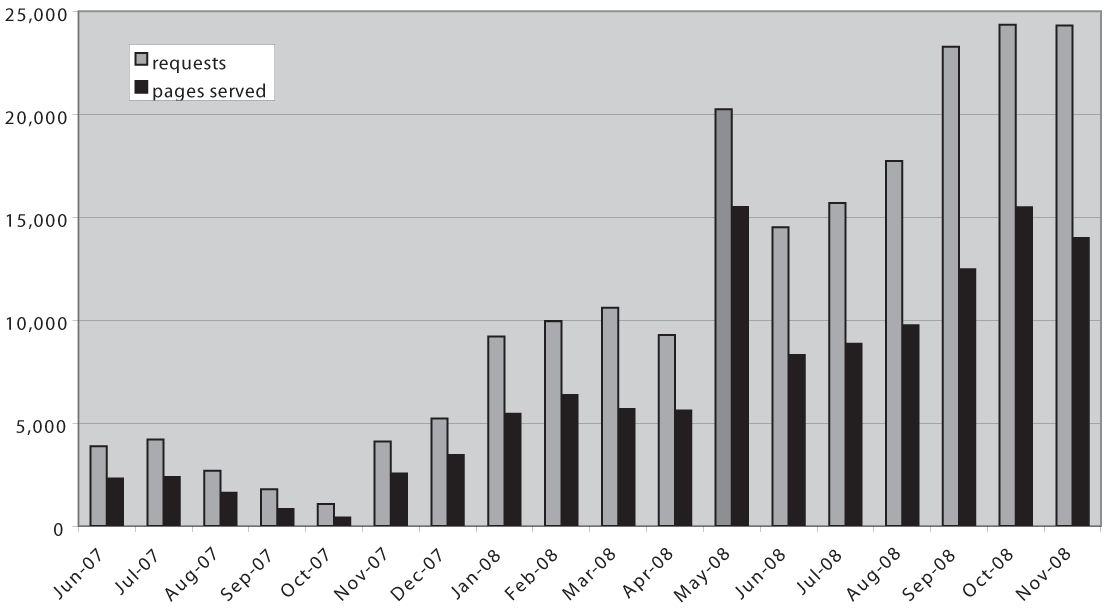
Donovan Mc Grath is a full-time lecturer in Media and Communications and a part-time lecturer in Swahili. He is an Alumnus of the University of London’s School of Oriental and African Studies (SOAS) where he gained a BA Honours degree in African Language and Culture. He also studied Swahili Poetry, the Swahili Novel and Advanced Swahili Usage at the University of Dar es Salaam. Later on, at Middlesex University, he achieved a Master of Arts degree in Film and Visual Cultures. He is co-author of Colloquial Swahili, published by Routledge in 2003. He has also written extensively on the subject of film and theatre for Live magazine here in the UK and book reviews (in Swahili) for Femina magazine in Tanzania. As his first contribution Donovan has written the largest part of our feature ‘Tanzania in the International Media’ in this issue. The other co-editor is Jacob Knight, an engineer stationed in Botswana who keeps in close touch with what is happening in Tanzania. He has been playing a vital role in the production of TA for some time as typesetter and graphic designer and also now produces Tanzanian Affairs on line at www.tzaffairs.org which is attracting a growing readership.
traffic2
Number of hits each month on the www.tzaffairs.org website

Jacob is hoping to upload more back issues of Tanzanian Affairs onto the website to make a searchable archive dating back to the first issue in 1975. While much of the process is automated, human input is required in tidying up the text files and correcting the mistakes made by the computer when “reading” the printed copies – any volunteers to assist with this would be appreciated (email jacob@kwangu.com).
David Brewin, Editor.