REVIEWS

edited by Martin Walsh

BARABAIG: LIFE, LOVE AND DEATH ON TANZANIA’S HANANG PLAINS. Charles Lane. River Books, Bangkok, 2017. 264 pp., 156 illustra­tions (hardback). ISBN 978-6-1673-3985-6. £40.00.

BARABAIG: LIFE, LOVE AND DEATH ON TANZANIA’S HANANG PLAINS

Land grabbing, the large-scale acquisition of land for agricultural and other forms of investment, is, quite literally, big business in Africa. Dubbed ‘the new scramble for Africa’, this is most often associated nowadays with Chinese commercial interventions on the continent, though it also takes many other forms, some driven by transnational corporations. At national level, it typically involves collusion between powerful government actors and private sector interests, especially when one has captured or is manipulating the other. Tanzania, alas, is no exception, and has its own sorry history of land and conservation grabs, including ongoing examples that have featured in this bulletin. Following land distribution in Zanzibar and forced ‘villagisation’ on the main­land, the single most significant land alienation to make international news was the eviction of Barabaig livestock herders from their pastures in Hanang District to make way for a Canadian aid-funded wheat growing scheme. The negative impacts of this were documented and brought to the world’s attention by Charles Lane, an Australian researcher who first came to Tanzania in the mid-1970s to work as a volunteer and aid worker. Lane had a long association with the country before he chose the Barabaig as the subject of his University of Sussex PhD, a choice inspired in part by an article by Oxfam Press Officer Derek Warren (‘Aid grows a crop of problems’, The Guardian, 2 December 1983).

As its schmaltzy subtitle suggests, Barabaig is very different in style from Lane’s earlier writing about the people of the Hanang Plains and the campaign to redress the wrongs done to them [See TA 24, 35, 47, 51 and 57]. “This is the story of my time with the Barabaig. Not the outcome of my academic research, but a personal account of warmth and wonder, humour and humility, gallantry and gore. I tell it for the Barabaig, for they deserve to have it told. […] They need to be better understood by those who have condemned them as killers and aimless wanderers unworthy of attention. Indeed, the whole world needs to know about the Barabaig, their ancient culture and way of life before it is lost forever. In telling this tale, I hope I have done them justice.”

Barabaig opens with a double foreword by the Director of Survival International, Stephen Corry, and Guardian journalist George Monbiot. Following Lane’s introduction, the text is divided into three main parts. The first two, ‘Early Days’ and ‘Becoming Barabaig’, are lavishly illustrated by photographs from Lane’s fieldwork, and describe his introduction to Barabaig life and some of the most striking elements of their social life in the late 1980s. Lane doesn’t gloss over his cultural naiveté, and there are plenty of self-deprecating anecdotes of the kind that fill anthropologists’ conversations and memoirs, including perhaps too much information about toilet habits.

The third part, ‘Fight for Rights’, about the struggle on behalf of the Barabaig, was the one I enjoyed the most, and I wish that it had come sooner and occupied more of the text. Lane is refreshingly honest about the successes and failures of the campaign and legal proceedings, while a postscript summarises recent developments and his feelings on a return visit with his family. Barabaig isn’t the first coffee-table-plus-campaign book that has been written about a belea­guered indigenous group in Tanzania, and presumably won’t be the last. I’m not a fan of the hybrid format and its uncomfortable relationship with exoticising and ‘white saviour’ narratives, but hope that it does lead more readers to engage with this and other campaigns against the land grabbing that is blighting so many lives. I certainly finished reading this handsome volume wanting to know more, not to mention wishing that I had Charles Lane’s campaigning instincts and flair.

Martin Walsh
Martin Walsh is the Book Reviews Editor of Tanzanian Affairs.

INCREASING PRODUCTION FROM THE LAND: A SOURCEBOOK ON AGRICULTURE FOR TEACHERS AND STUDENTS IN EAST AFRICA. Andrew Coulson, Antony Ellman and Emmanuel Reuben Mbiha. Mkuki na Nyota, Dar es salaam, 2018. 294 pp. (paperback). ISBN 978-9987­08-156-356-5. £30.00 (Available from A.C. Coulson, 8 Innage Rd, Northfield, Birmingham B31 2DX, for £20.00).

This is a very important contribution to any discussion of agriculture, food and rural policy in Tanzania. The quest for a sound agricultural strategy has been a key theme in Tanzania since independence, but a really effective and sustained strategy has proved elusive. As this book shows, the enthusiasm of the post-independence government for mechanised settlement schemes quickly ran into the ground in the late 1960s, and by the mid-1970s had been replaced by very large-scale ‘villagisation’ in which at least five million people moved into ‘ujamaa’ villages. In turn this strategy was more or less abandoned in the late 1980s as the World Bank and other donors’ insistence on total privatisation became the dominant theme. The net result in 2018 is an unsatisfactory mix dominated by large- to medium-scale companies and small, mainly independ­ent farmers.

It is the latter who are the subject of this book, which does a remarkable job in identifying and explaining the constraints and opportunities which small farmers face. This analysis goes on to discuss ways forward from the farm­ers’ perspective, a very rare approach seldom achieved in the many books and pamphlets on African agriculture published over the last fifty years. It is in the tradition of William Allen’s pathbreaking The African Husbandman (1965).

The target audience is students and young practitioners in agriculture in Tanzania and so there are several chapters devoted to the factors of production and basic explanations of the limits to output. However, they are interpolated with fascinating case studies of fifteen individual projects – from the Dakawa Rice Farm, to the Upper Kitete Co-operative, and the Tanga Fresh (dairy) project. These really tell the story of what has worked and what has failed, not neglecting to explain that some success stories – such as potatoes in Njombe

– have been driven by farmers largely on a ‘farmer to farmer’ basis. These cases should make the book of interest to a wider audience of policy makers in government and the donor community.

The impact of new research and technology is a recurring theme. Irrigation is considered in its various forms from low key stream diversion to trickle (or drip) irrigation. Whilst several of these are rated as one of the keys to the future, their limits, set by the physical context, are also recognised. There is a chal­lenging chapter on agricultural research and the role of local and international (e.g. IITA) research centres and their limited impact, mainly ascribed to a lack of mechanisms for dissemination (a debatable point). Scepticism is applied to the role of genetically modified crops which are perceived as being a largely corporate product, a position which downplays the role of CGIAR centres in developing GM crops and the fact that this work is funded by a large range of donors including philanthropic foundations quite divorced from companies.

The book recognises very effectively the external constraints on farmers and points out that the majority of small-scale farmers have at least one family member working in the local economy on either an informal or formal basis. Even with this supplementary income, small farms need to access marketing, credit and ‘extension’ advice – and seldom obtain all three, a major failure of government policy.

It suggests that female-headed households do not necessarily earn lower incomes, in food or cash, than male-headed households and indicates that this distinction, widely considered to be valid in the past, is now breaking down.

The message of this book is that farmers should adopt a blend of proven tradi­tional agricultural technologies (such as intercropping) and modern strategies which conserve the soil (notably conservation agriculture) and new variations of cropping systems which build in trap crops and intercrops to deter pests. Systems which integrate livestock and crops are rightly considered to be essen­tial. At a political level, strategy should be geared to integrating public health and nutrition into food and agricultural policy – as is increasingly accepted worldwide. These issues should make the book of interest to a wider audience of policy makers in government and the donor community.

The analysis and recommendations are clearly applicable across a range of countries, although readers outside Tanzania may be reluctant to engage with the specific case studies. But the authors, all with deep experience, have cre­ated a highly readable book which deserves to have a real impact at the ‘farmer level’ – always their objective.
Laurence Cockcroft

Laurence Cockcroft is a development economist who has worked particularly on African agricultural issues since 1966, including work for DevPan and TRDB in Dar es salaam in the early 1970s. From 1985 to 2012 he was respon­sible for the programme of the Gatsby Charitable Foundation in Africa. He is also a co-founder of Transparency International and was Chairman of its UK Chapter from 2000-08 and has written two books on international corruption.

LEADERSHIP AND CONFLICT IN AFRICAN CHURCHES: THE ANGLICAN EXPERIENCE. Mkunga H.P. Mtingele. Peter Lang, New York, Bern, 2017. xxii + 266 pp. (hardback). ISBN 978-1-4331-3294-0. £69.95.

If abuse occurs within a community, should it be covered up to preserve the reputation of the community, or be exposed to deter recurrence? A highly topi­cal question, and Dr Mkunga Mtingele opts for the latter course in this book: ‘African leaders have to change their way of thinking and their style of leader­ship. Change will not come if the truth is not told.’

His study tells the truth about six conflicts relating to leadership within the Anglican Church of Tanzania (ACT), with occasional comparisons with other countries. His main case-study concerns the marginalisation of the Sukuma, the biggest tribe in Tanzania, in the diocese based in Mwanza. He is well qualified to speak on this topic, with his legal training, and twelve years as Executive Secretary of the ACT, followed by international experience with the United Bible Societies. He surveys sociological analyses of leadership and conflict in the first three chapters and uses them to interpret his field research.

He identifies numerous roots of such conflicts, beginning with the superior attitude to Africans taken by many colonial rulers and Western missionaries and often inherited by their indigenous successors in leadership. When chiefs were abolished in 1963, it was easy for local bishops to step seamlessly into their shoes, at least in the minds of their fellow tribespeople – and people were demanding a bishop of their own tribe which led to conflict in regions of mixed ethnicity. Tribalism seems worse in the church than in the nation.

Imported church traditions also led to conflict, though to a lesser degree, between evangelicals in the hinterland and Anglo-catholics at the coast, though there were also examples of warm partnership. Mtingele describes what he calls ‘the Episcopal-Syndrome’ as ‘ambition for status, wealth, authority and power (SWAP)’. It creates authoritarian bishops and fearful, sycophantic underlings, leading to loss of trust and to conflict. Many ACT clergy live in abject poverty – no wonder they aspire to be elected bishop and may go to any lengths to achieve it – the polar opposite of the model of Jesus Christ. The author resisted many attempts to make him a bishop – no doubt disillusioned by the episcopal models he met. This reviewer believes Mtingele’s research is relevant to Anglicans everywhere. Conflict was aggravated by accusations of witchcraft; by the silence of lay people when clergy were fighting one another; by the inadequacy of diocesan constitutions; and by the use of adversarial methods rather than the African tradition of decision by consensus.

The conflicts he describes, often involving excessive violence, were a public disgrace, emptied the churches, reduced domestic income and international aid and diverted the church from its mission – yet paradoxically sometimes cre­ated new, smaller Christian groups more in touch with their immediate locality, leading to growth.

After pages of gloomy stories, Mtingele concludes with some gems of radical recommendations: better working conditions for clergy; centralised payment of their stipends; limiting tenure of episcopal office; detribalising episcopal appointments; more mergers of the evangelical/catholic traditions. Wisdom indeed, but can a body as conservative as the Anglican Church accept such challenges to the ‘path-dependence’ model which he has shown dominates its practice? The author is working on a basic Swahili version so that his findings may be accessible to Tanzanians. The foreword written by Archbishop Idowu-Fearon of Nigeria calls the book ‘disturbing’ but ‘important … for Africa as a whole and perhaps elsewhere as well.’

This is not, and nor does it claim to be, a balanced picture of the Anglican church. If it were, it would have to mention key figures like Roland Allen, Bishop Tucker of Uganda, Bishop Lucas of Masasi who campaigned vigor­ously, often fruitlessly, against missionary dominance. It would have to identify the East African Revival (1936 onwards) which, utterly indigenous and inde­pendent of, yet influencing, the whole Anglican establishment, brought life and growth to a flawed and sinful church – and knew how to handle conflict. It would also ask if and how the Bible, supposed to be ACT’s guide to life, is used to bring peace.

The many typographical errors are a distraction for the reader and unacceptable in a book at this price.
Roger Bowen

Roger Bowen taught theology in Tanzania from 1965 to 1978 and then at St John’s College, Nottingham. He was editor of the Swahili Theological Textbooks programme and has written Mwongozo wa Waraka kwa Warumi. In retirement he is chairman of the Cambridge Centre for Christianity Worldwide.
OBITUARIES

by Ben Taylor

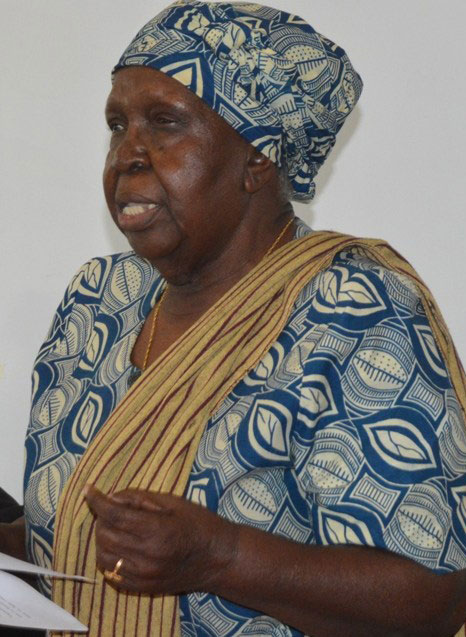
Mama Zippora Shekilango

Mama Zippora Shekilango, an education and gender activist, died in September at the age of 80.

Her late husband, Hussein Ramadhani Shekilango, is perhaps more famous, and even has a prominent road named after him (Shekilango Road in Dar es Salaam). But it would be a mistake to see Mama Shekilango as merely her husband’s wife.

For many years, she was a doughty campaigner on gender and education issues. First, she had been a teacher and headmistress at highly successful schools including Zanaki, Msalato, Kisutu, Jangwani and Forodhani.

It was her love of education, for the girl child to have equal chances of education as the boychild, that led her to become one of the country’s leading gender rights activists. Despite coming from a generation where both men and women celebrated patriarchy, she became instrumental in advocating for gender equality. Twenty-five years ago, out of con­viction that gender equality was the way to inclusive development, with others she founded the Tanzania Gender Networking Programme (TGNP). The organisation has been at the forefront of the struggle for gender equality in Tanzania ever since.

Zitto Kabwe, the leader of the opposition party ACT Wazalendo reflected on her passing by quoting her: “Without quality education the nation will find itself stagnant and this is why it’s always important to meet and discuss the way forward.”

Saumu Jumanne, of the University of Dar es Salaam, paid tribute: “The knowledge that a teacher passes on to the students, more often than not outlives the teacher. Her values will live on. Hopefully as a nation we can learn from her dedication to teaching, gender activism and all in the spirit of patriotism. To the likes of Mama Zippora, Tanzania always came first in their doings. This is a great lesson to all of us in public services today.”

CHANGES AT THE TOP OF GOVERNMENT AND PARTY

by Ben Taylor

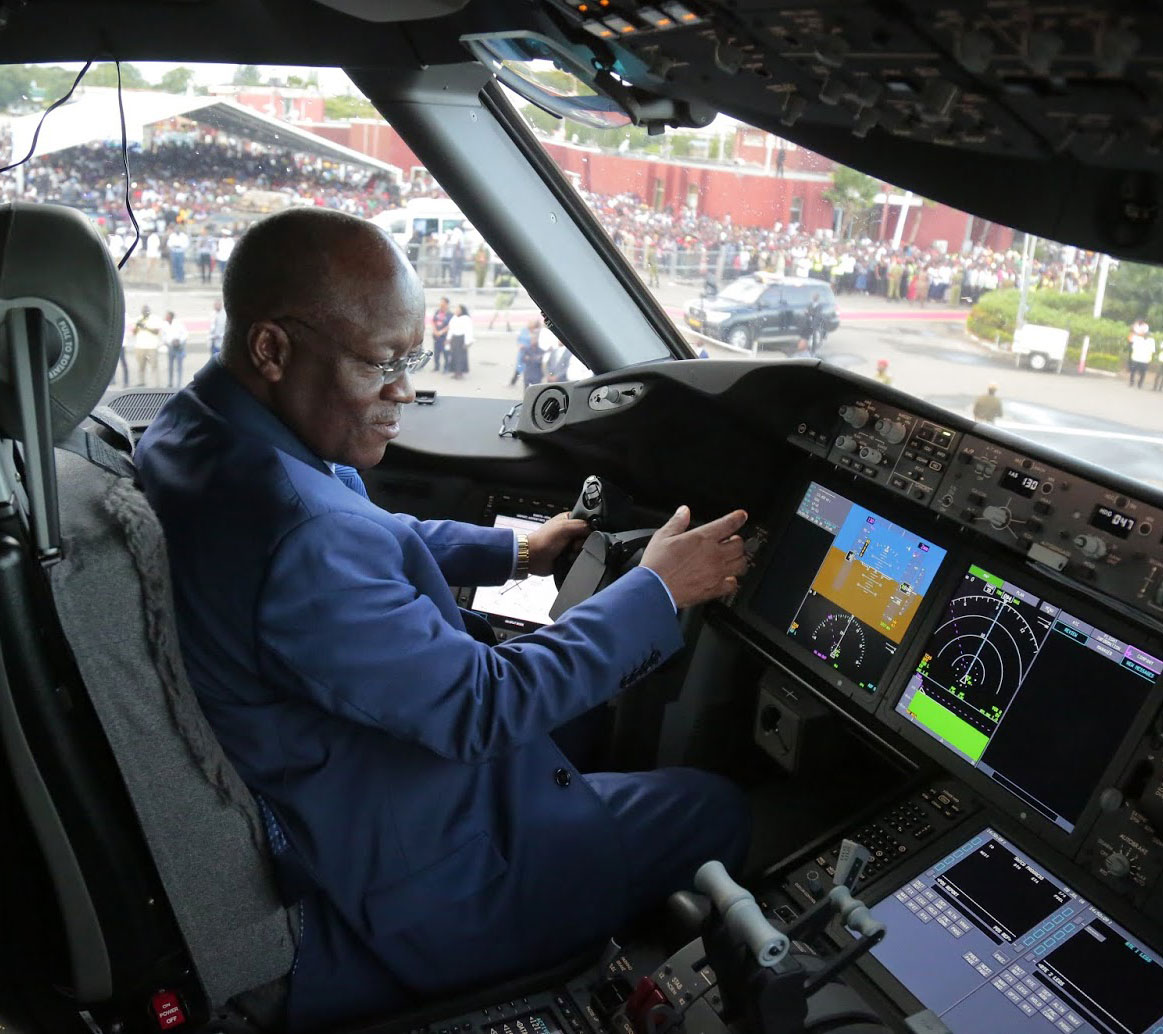
President Magufuli at the controls of the new Air Tanzania Boeing 787-800 Dreamliner (See “Transport”) – photo State House

President Magufuli carried out a minor cabinet reshuffle in July, the most prominent act of which was the sacking of the ambitious Home Affairs Minister, Mwigulu Nchemba. In his place, the President promoted Kangi Lugola from his position as Deputy Minister of State in the Vice President’s Office for Union Affairs and the Environment.

The reshuffle also saw Isack Kamwelwe and Prof Makame Mbarawa swap places as Minister of Water and Irrigation and Minister of Works, Transport and Communication, with Prof Mbarawa moving to the water docket. While not a cabinet post, the President also appointed a new chairman of the National Electoral Commission, Justice Semistocles Kaijage.

This followed a few weeks after the long-standing CCM Secretary General, Abdul-Rahman Kinana, resigned from his post. President Magufuli, as party chairman, moved swiftly to appoint Dr Bashiru Ally as his replacement. The appointment was confirmed by the party’s National Executive Committee (NEC).

President Magufuli, while not mentioning former Minister Nchemba by name, appeared to explain the reasons for his sacking in a speech two days later. He listed a long series of problems at the Home Affairs Ministry, including a controversial TSh 37bn contract where the Controller and Auditor General (CAG) said in his report that the work was not done, despite the payment of billions of shillings. The contract involved a deal between a private company, Lugumi Enterprises, and the police force for the installation of 108 forensic machines in some police stations in the country.

The President also mentioned a multimillion shilling contract for the purchasing of police uniforms that were never delivered, failure to resolve a shortage of fire engines, recurrent road accidents, and the purchase of 777 police cars through a shoddy contract. According to the President, some of the cars were declared to be new while in reality, they had covered over 400 kilometres each.

The list continued with mention of what the President described as an influx of illegal immigrants, as well as haphazard issuance of work permits, misuse of funds by the National Identification Authority (NIDA), and a “lack of scrutiny” in the registration of non-governmental organisations (NGOs). The President said some NGOs were operating against the country’s ethics and traditions.

Dr Magufuli went on to challenge the new Minster, Kangi Lugola, to ensure that prisoners were involved in productive activities instead of staying idle. “In other countries, prisoners are involved in productive activities. The law should also be reviewed, so that prisoners on death row can be deployed productively.”

The appointment of Dr Bashiru – a long-standing supporter of constitutional reform – to the influential post of CCM Secretary General was seen by some as surprise choice. Dr Bashiru, a university academic had previously held only weak ties to the ruling party, to the extent that he felt compelled in his first days in office to publicly clarify that he was, in fact, a CCM member.

Dr Bashiru’s one clear previous link to the party had been that President Magufuli had appointed him as chair of a committee charged with investigating CCM’s assets. The party owns various properties across the country, and should earn a steady revenue as a result, but accountability has been weak and many assets have been effectively privatised. The committee’s investigation was a first step towards regaining control over the party’s wealth, which could then strengthen its financial autonomy and bureaucratic organisation. Having led the investigation, Bashiru will now be in charge of overseeing implementation of the committee’s recommendations.

OPINION POLL SURPRISE, AND REACTION

by Ben Taylor

A new public opinion survey by Twaweza released in July found that the popularity of President Magufuli has declined sharply. Just over half the population (55%) say they now approve of the President’s performance, down from 71% in 2017 and a massive 96% in 2016. This means President Magufuli has registered both the highest and lowest presidential approvals ratings on record in Tanzania.

The poll also found that a majority of citizens (55%) would vote for President Magufuli if an election were held now, followed by the Chadema candidate, who would secure 15% of the vote. As such, President Magufuli would secure a comfortable majority. It is notable, however, that nearly one in three voters (29%) said they were unsure who they would vote for, considerably higher than similar polls in previous years.

The decline in President Magufuli’s approval rating was sharpest among residents of rural areas, such that the President is now more popular in urban areas than rural.

The CCM secretary of Ideology and Publicity, Humphrey Polepole said President Magufuli’s popularity ratings would increase significantly by end of the year. “I call on Twaweza to conduct a similar study at the end of the year after the government has made significant progress in the implementation of priority projects,” he said.

Within a week of the poll findings being released, Twaweza found itself embroiled in difficulties with the Commission for Science and Technology (COSTECH). The COSTECH acting Director General, Dr Amos Nungu, wrote to Twaweza, questioning whether the organisation had the proper permits to conduct the poll and giving Twaweza seven days to explain why legal action should not be taken against them.

At a press conference, however, COSTECH leaders found themselves under pressure from reporters, unable to explain what law or regulation Twaweza was alleged to have broken or even whether a COSTECH research permit was required for an opinion poll.

Several activists and analysts spoke out in support of Twaweza. Maria Sarungi-Tsehai, the Change Tanzania director, argued that the saga is politically-motivated. “Twaweza has issued a number of opinion polls on different topics. In fact last year, a very similar poll on people’s views of politics and approval ratings of leaders including the President was published, yet we saw no query from COSTECH,” she said. She described the commission’s move as part of a “clear pattern of reprimand” by government agencies aimed at putting pressure on private actors when there is an impression they are not acting as desired by the authorities.

Fatma Karume, the recently-elected president of the Tanganyika Law Society (TLS), said Twaweza had breached no rules or standards in its recent or previous opinion polling. “I think it’s very important for those chosen to head various government agencies to be well-versed in the laws establishing them, otherwise they would be abusing their power,” she stated.

Semkae Kilonzo, coordinator at Policy Forum, an NGO, said that any attempt at stifling opinion polls is an infringement on the rights of people. “Opinion polls are crucial for a vibrant democracy as they give people the opportunity to air their views and express an opinion about how they are governed,” he said.

A few weeks later, the Executive Director of Twaweza, Aidan Eyakuze, announced that immigration authorities had confiscated his passport and barred him from travelling outside the country. Mr Eyakuze said he could not associate this move with the opinion poll findings or the COSTECH response. “They didn’t tell me the reason behind confiscating my passport or why they didn’t want me to travel outside the country,” he said. However, the seizure of his passport took place a few days after a TV programme to discuss the poll findings aired allegations by one guest that Mr Eyakuze was not a Tanzanian citizen.

[Full disclosure: the author of this piece and editor of Tanzanian Affairs works as a consultant for Twaweza.]

CASHEWNUTS

by Ben Taylor
A proposal to amend the Cashewnut Industry Act as part of the 2018/19 budget met with a furious response from a section of MPs in parliament. The amendment, part of the Finance Bill 2018, was designed to collect all export levies from cashewnuts in the consolidated fund, rather than providing 65% to farmers through the Cashewnut Board of Tanzania as had previously been the case.

Cashew exports accounted for US$341 million in the year to March 2017, the latest date for which official trade statistics have been published. This is more than the combined earnings over the same period from coffee, cotton, tea, cloves and sisal.

MPs from cashewnut-growing regions – primarily Mtwara and Lindi – spoke vociferously against the change. Nape Nnauye (CCM, Mtama) and Hawa Ghasia (CCM, Mtwara Rural) – both former ministers – spoke strongly. The Parliamentary Budget Committee, chaired by Ms Ghasia, published data showing that the government had failed to remit a total of TSh 200 billion for financial years 20115/16 and 2016/17 to the Cashewnut Development Fund as per the Cashewnut Industry Act requirement that 65% of export levies be channelled back to farmers.

The argument proved to be the trickiest sticking point in the debate over the 2018/19 budget. At one point, the house was adjourned to give time for discussions between the Budget Committee and the Minister of Finance and Planning, Dr Philip Mpango. An opposition MP, Mr Ahmad Katani (CUF, Tandahimba) warned the Minister against visiting Mtwara and Lindi regions. The controversial amendment was eventually enacted.
A few weeks later, however, Ms Ghasia and the Budget Committee Vice-Chair, Jitoson Patel, both resigned from their positions on the committee, for reasons that were not explained.

DEFECTIONS TO CCM

by Ben Taylor

A series of high-profile defections of opposition figures to CCM has raised questions about the state of politics in Tanzania.

Around 70 opposition members including councillors and MPs have left other parties to join – or rejoin – CCM in recent months. This includes MPs Julius Kalanga (Monduli constituency), Mwita Waitara (Ukonga), Godwin Mollel (Siha), Maulid Mtulia (Kinondoni) and Zubery Kachauka (Liwale). Prominent CUF leader, Julius Mtatiro also left the party to join CCM, and a few months earlier, former Chadema presidential candidate, Dr Wilbroad Slaa joined CCM.

Various reasons are given for the defections. Some, including Mtulia and Mollel, have claimed great satisfaction with President John Magufuli’s performance. Others, including Waitara, say they had lost faith in their former parties after finding themselves criticised for collaborating with the government in development activities in their constituencies.

Accusations have been made that defectors to CCM have been “bought,” though there is no clear-cut evidence to support this claim.

Nevertheless, several public figures have argued that such a high rate of defections is not good for national politics, as it is likely to lead to disillusionment with politics among citizens. Several recent by-elections, including those to replace or re-elect defecting MPs, saw voter turnouts below 50%.

Dr Richard Mbunda of the University of Dar es Salaam argued that “self-disenfranchisement is disastrous both for the electorate and the government. The latter loses legitimacy while the former find themselves governed by policies they haven’t consented to.” He argued that legitimacy, once lost, is hard to regain, and civil disobedience is the likely result of being governed by an illegitimate government.

CCM Ideology and Publicity secretary Humphrey Polepole has said the opposition will continue to lose prominent leaders and members in the ongoing wave of defections. He claimed that many members of Parliament and councillors have requested to join CCM, noting that the decision was primarily caused by Chadema national chairman Freeman Mbowe’s poor leadership. “They complain of lacking coordination from top leaders. I predict that Chadema’s downfall will continue,” he said.

However, Mr Mbowe assured Chadema supporters that the defections would strengthen, not destroy, the party. “Chadema is strengthened by these defections because we are left with true leaders and members who are ready to build a strong opposition in the country,” he said.

CUF deputy secretary general for the Mainland, Ms Magdalena Sakaya, said she was shocked with developments that she said were “bad for democracy”. “Looking at the bigger picture you realise it’s a project to kill the opposition,” she said.

ENERGY & MINERALS

by Roger Nellist

Ministry split, new Ministers appointed
In October 2017 following the mineral sands export saga, enactment of the controversial new mining and petroleum legislation and the dismissal of the former Minister for Energy and Minerals, President Magufuli divided the Ministry of Energy and Minerals into two portfo­lios and appointed new top teams.

Tanzania’s new Minister for Energy is Dr Medard Kalemani, supported by Ms Subira Mgalu as Deputy Minister and by Mr Khamis Mwinyi Mvua as Permanent Secretary. Tanzania’s new Minister for Mining is Ms Angellah Kairuki, supported by Deputy Minister Stanislaus Nyongo and by Mr Simon Samuel Msanjika as Permanent Secretary.

Statoil renamed as Equinor
Meanwhile in May the large Norwegian State oil and gas company Statoil – which has discovered large gas reserves offshore Tanzania and is a key partner in the potential liquefied natural gas (LNG) project – announced it had formally changed its name to Equinor. The new name reflects the company’s values (of equality and equity) as well as its continuing Norwegian presence. The move comes at a time when it is increasing its efforts to develop new and renewable forms of energy.

LNG project in the doldrums
In recent years, large gas discoveries (estimated at about 57 tcf) have been made offshore southern Tanzania and during the last two or three years the government and the Tanzania Petroleum Development Corporation (TPDC) have been in discussions with the principal discov­erers – Shell, Exxon Mobil, Ophir Energy and Equinor (Statoil) – with a view to building a large LNG export terminal onshore at Lindi. It will be a huge investment, costing an estimated US$30 billion. However, progress on realising the project has slowed recently and various factors are being cited for this.

The investors are blaming government for the bureaucratic procedures they face in acquiring land to build the plant on as well as the uncer­tainty introduced into the overall energy regulatory environment by the tough new legislative provisions. (See articles in earlier TA bulle­tins). Crucially, the Host Government Agreement terms have yet to be agreed, without which the LNG project cannot proceed. Further uncer­tainty arose this summer when Exxon Mobil indicated it was seeking a buyer for its 35% interest in the big gas reserves in Tanzania’s offshore deep water Block 2 (where Equinor, the operator, holds 65%). There have also been worries about the substantial fall (by about one third) in world gas prices since 2015.

Observers suggest that relations between the gas developers and the government are strained and that a final investment decision on the Tanzanian LNG project seems unlikely before the early 2020s. To help move matters along, in April TPDC announced it was recruiting inter­national advisers to assist it to formulate an appropriate commercial framework for the project.

Three critical parliamentary committee reports
In Dodoma in May the Parliamentary Energy and Minerals Committee criticised the Ministry of Energy for its slow progress in implementing the LNG project, and called on the government to fast-track its negotia­tions with the investors – so as not to lose crucial overseas gas markets to competition from other major gas producers. They pointed to neigh­bouring Mozambique, which has gas reserves three times larger than those so far discovered in Tanzania and is also more advanced with its gas commercialisation plans.

In response, Minister Kalemani told Parliament that government was still in discussions with the multinational investors and that conceptual design work and initial project evaluation had been completed. He said government had already budgeted TSh 6 billion to fund pre-front end engineering design of the LNG plant as well as to compensate people affected by the project.

Then on 25 June Dr Kalemani told Parliament that “everything is pro­gressing well” and that actual construction of the LNG plant would start in 2022. He said the multinational investors were currently com­peting among themselves to determine which of them will lead the project execution.

On a related gas matter the same Committee also criticised his Ministry for the slow speed at which it was connecting homes in Dar to the gas supply. Minister Kalemani responded saying that 70 homes were already connected, another 1,000 would be served in the near future and that TPDC would be spending about TSh 21 billion next year putting in place the necessary infrastructure to supply a further 2,000 homes.

Also in June the Parliamentary Budget Committee asked government for an analysis of the reasons for the fall in exploration activity in Tanzania in the last year. No new wells have been drilled and con­cerns were heightened by the unsettling reports in June that Exxon Mobil was seeking to leave Tanzania in favour of a bigger LNG project in Mozambique. Minister Kalemani told Parliament: “It is true that Mozambique is doing well but Tanzanians should also understand that we are not very far from that stage”. TPDC sought to reassure stake­holders and the public about the Exxon Mobil sell-out too, commenting that such a move was normal business practise for the big multination­als, adding: “when it comes to energy investment never be in a hurry. This might just be a change of strategy or change of management”. An Equinor (Statoil) spokesman confirmed that they were proceeding with business as usual, having already invested a very large sum of money in Tanzania drilling 15 wells (and making nine discoveries).

In June too a special Parliamentary Committee that was established at the end of last year to investigate the 11 Production Sharing Agreements so far signed with government reported that gas is being produced under only three of them. Naming the five former Energy Ministers who signed all the agreements with TPDC and various international oil companies, the Committee asserted that what it viewed as shortcomings and loopholes in the terms were resulting in financial losses to govern­ment amounting to hundreds of billions of shillings. In particular, the Committee pointed to the supposed lopsided nature of the provisions in the various agreements with Songas and advised government not to renew the power production and gas drilling contracts with Songas when they expire in 2024. It highlighted the various assets of TANESCO and TPDC that were effectively given free to Songas in return for which the Committee believes those two parastatals were not awarded adequate shareholdings in the project.

The Attorney General responded, telling Parliament that government was now reviewing all the contracts with Songas. But Pan Africa Energy Tanzania – the developer and operator of the producing Songo Songo gas field and Songas – expressed concern at the “inaccurate findings and allegations” made by the special Committee, stating it had com­plied with the terms of its agreements with government and pointed to its impeccable operational record and the significant economic benefit its operations had already brought to Tanzania.

Other petroleum and mining sector problems
In April, Swala Oil and Gas declared ‘force majeure’ under the terms of its Kilosa-Kilombero Production Sharing Agreement with government and TPDC, saying it was “disappointed and frustrated” by the demand for it to undertake a special environmental impact assessment (EIA) of the likely implications for the proposed Stiegler’s Gorge hydropower dam of the company’s use of water during the drilling of its first explo­ration well (Kito-1) next year. The government has already approved an EIA that Swala undertook in 2017 and the amount of water to be con­sumed in the drilling of the well will be a tiny fraction of that pertaining to the dam. Swala has so far spent more than $20 million exploring for oil and gas in Tanzania.

Given the continuing ban on the export of gold and copper concentrates, Acacia Mining Tanzania announced in April that during 2018 it will be producing 40% less gold than it did in 2016 and, with no end then in sight to the ongoing discussions between its parent – Barrick Gold – and the government, the company was being forced to cut costs and unfor­tunately would have to lay off an unspecified number of workers at its Tanzanian mines. Acacia employs about 2,800 workers in the country, 96% of whom are Tanzanian.

In June the Minister for Constitution and Legal Affairs, Prof Palamagamba Kabudi, told Parliament during the debate on the Ministry of Minerals’ budget that the ongoing discussions between government and Barrick “are in the final stages and things are in good order”; however, the US$300 million good faith payment to Tanzania promised earlier by Barrick/Acacia will only be paid once the discussions are concluded.

In a Canadian (Fraser Institute) global mining survey of 2,700 mining companies operating around the world, Tanzania’s perceived ‘mining investment attractiveness’ dropped 19 places on the world listing, fall­ing from 59th position in 2016 to 78th position last year. The substantial deterioration is blamed on the adverse legislative changes in 2017 (especially their retrospective application) and on what some inves­tors in Tanzania see as excessive and random taxation of their mineral operations. Of the 91 countries surveyed 15 were African and Tanzania ranked only 12th out of the 15 – behind Ghana, Mali, Botswana, South Africa, DRC, Namibia, Zambia, Morocco, Zimbabwe, Burkina Faso and Ivory Coast, and only a little ahead of Ethiopia, Mozambique and Kenya (the worst).

Some good news: Miombo Hewani Wind Farm
In June, Windlab Limited announced that its Tanzanian subsidiary will be constructing a large wind turbine farm with associated electri­cal infrastructure at a location in Southern Central Tanzania close to Makambako (where it will connect with the national grid). The Miombo Hewani wind project will be built in phases and now has approval for a total generating capacity of 300 MW. The first phase (costing US$300 million) will involve the construction of 34 wind turbines that will deliver about 100 MW of electricity, also creating jobs and extra income in Njombe Region. This wind project will therefore add significantly to Tanzania’s current power generation capacity of just over 1,300 MW (comprising 560 MW of hydropower and 750 MW of thermal gas and diesel), importantly also diversifying the generating source.

In making the announcement the CEO of Windlab Limited, said: “We are very pleased to receive the first Environmental and Social Impact Assessment certificate for a wind farm in Tanzania. In developing Miombo Hewani, Windlab has applied the industry best practices and experience it has gained from developing more than 50 wind energy projects across North America, Australia and Southern Africa”. He added that Miombo Hewani enjoys an excellent wind resource, one of the best in the world. Moreover, the wind pattern there is biased towards night time generation and generation during Tanzania’s dry season, making it an ideal addition to Tanzania’s current and planned electricity generation mix. Windlab Tanzania said that the wind farm is expected to operate for at least 25 years and should generate enough power to supply nearly 1 million average Tanzanian homes.

TRANSPORT

by Ben Taylor

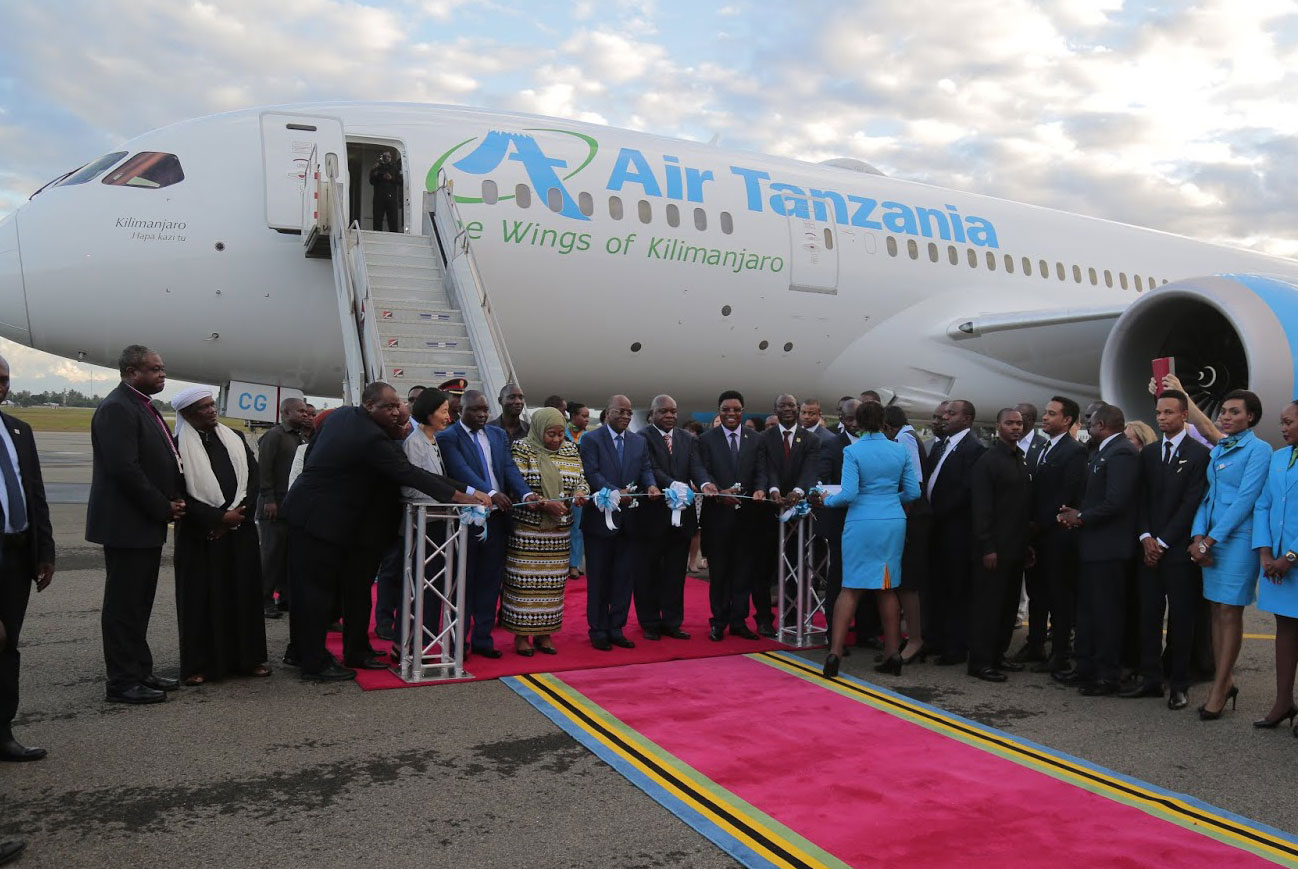
President Magufuli with Vice President Samia Suluhu Hassan, Prime Minister Kassim Majaliwa and other dignataries – photo State House

“Dreamliner” lands with Air Tanzania
A much-anticipated Boeing 787-800 Dreamliner aircraft arrived in Tanzania in July, and moved swiftly into operation on domestic routes for Air Tanzania. It is expected to begin international routes – to Mumbai in India, Bangkok in Thailand and Ghuanzhou in China – from September, once pilots and cabin crew have gained experience with the new aircraft.
The Dreamliner is the fourth and largest plane to be bought by the government since the 2015 election of President Magufuli. Plans are underway to purchase three others to make the total of seven planes aimed at reviving Air Tanzania Company Limited (ATCL) that had only one plane previously with a capacity of carrying 51 passengers. Three further aircraft are to be delivered, including two mid-sized planes later this year and a second Dreamliner in 2020.

At list prices, the new plane is valued at US$225 million. It has a seating capacity of 262 passengers. Three previous planes purchased for use by Air Tanzania were 76-seater Bombardier Q400 planes worth US$32 million each.

The plane is branded with the “Hapa Kazi Tu” slogan that President Magufuli adopted as his main campaign slogan in 2015. Speaking at Julius Nyerere International Airport (JNIA) prior to the arrival of the plane, the President explained why his government had decided to revive the national airline.

“It’s shameful for a country rich in natural resources like Tanzania not to have commercial aircraft of its own. We wanted to do away with this shame,” he said. “Before bringing the Bombardier-Q400,” he noted, “it was very expensive to fly to destinations like Bukoba. One needed at least TSh 1 million as return fare (from Dar) to Bukoba. But, with ATCL’s Bombardier, it now costs a maximum TSh 400,000.”

The President added that a third reason for reviving ATCL is to boost Tanzanian tourism. “We did an analysis and established that countries owning airliners also receive the highest numbers of tourists,” the president stated, citing as examples Morocco, South Africa and Egypt, each with over 10 million tourist arrivals annually. “We’re hopeful that the Boeing 787-8 Dreamliner will boost the number of tourist arrivals in Tanzania,” he stated.

Etihad suspends flights to Tanzania

Etihad Airways – the national airline of the United Arab Emirates – has confirmed suspension of flights between Dar es Salaam in Tanzania and Abu Dhabi. This move, which is part of an ongoing strategic review that involves scrapping unprofitable routes, will come into effect on October 1, 2018. After this date, travellers from Tanzania will be re-routed through Kenya Airways to Nairobi and then connected through Etihad to Abu Dhabi.

The Airline launched its first flights to Tanzania in December 2015, the airline’s third destination in East Africa after Nairobi in Kenya, and Entebbe in Uganda.

BUSINESS & THE ECONOMY

by Ben Taylor

Budget estimates presented and disputed

Minister of Finance and Planning, Dr Philip Mpango, presented the government budget for 2018/19 to parliament in June. He told parlia­ment that the TSh 32.5 trillion budget would focus on protecting local industries against competition from imports, and on improving agricul­ture, industries, social services and logistics.

Dr Abel Kinyondo from REPOA, a think-tank, said protecting local industries is good but should not be done in a way that would affect the productivity and competitiveness of local producers. “Protectionism should be temporary. A non-protectionist mechanism should be put forward to encourage local industries to be competitive, otherwise it will encourage smuggling of foreign goods of higher quality,” he noted.

Dr Semboja Haji from Zanzibar University cautioned against the viola­tion of World Trade Organisation (WTO) rules. “Increasing taxes on imports to protect local industries is all right, but the taxes imposed should not exceed limits put by the WTO,” he noted.

Other highlights of the budget include a removal of VAT on various products including sanitary towels, medicine packing materials and animal food supplements, a tax amnesty proposal (see below), and a marked increase in debt service (see below).

On the expenditure side, the main highlight of the budget is the continued large allocations to large-scale and high-profile mega-projects. This includes TSh 700 billion allocated to the Stiegler’s Gorge hydro-power project, and TSh 4.2 trillion for road and rail infrastructure projects.

In a note of caution, the government said that Tanzania’s economic growth plans could be affected by eight major factors over the coming years, calling upon stakeholders to work with them to come up with mitigation measures. These factors, according to Dr Mpango, include inadequate funds, land ownership conflicts, inadequate participation of the private sector, high rate of population growth, environmental degradation and climate change, regional and global economic and political shocks, natural calamities, and spatial politics that can breed wars and conflicts.

Opposition MP, Zitto Kabwe (ACT Wazalendo, Kigoma Urban), took issue with budget estimates, pointing to repeated failure to meet rev­enue collection targets and related under-release of funds for develop­ment. He asked whether it made sense to keep increasing the size of the budget each year when previous years budgets were never met.

Speaking in an interview with Azam TV, Kabwe said the trend over the past five years was that the government had not met any of their budget estimates. He claimed that for every planned TSh 100, the government had released an average of TSh 65. He added that in the first full financial year of the administration of President Magufuli, the budget increased by 30%, but less than half the funds for development expenditure were ever released.
“The government needs to stop putting up budgets with large numbers when it well knows it has no funds,” he argued.

Another opposition leader, Freeman Mbowe of Chadema, argued that implementation of the budget will be difficult because of the tendency by the government to redirect approved funds to new areas in contra­vention of the law. With most expenditure decisions being made out­side Parliament, said Mr Mbowe, the country finds itself in a situation where very little development funds reach some of the critical sectors while certain ministries receive much more than what was approved by Parliament.

“In 2016/17, for instance, Parliament approved TSh 100.5 billion as development budget for the Ministry of Agriculture, but only TSh 2.5 billion was disbursed,” he said. During the same financial year, the Ministry of Livestock and Fisheries and the Ministry of Water and Irrigation received only 3.25% and 25% of the approved funds, respec­tively, he said.

He added that some other ministries have received more funds con­trary to what was endorsed by Parliament for 2017/18, including the Ministry of Information, Culture, Sports and Arts, the Ministry of Home Affairs, the President’s Office for Regional Administration and Local Government, and the National Electoral Commission. Mr Mbowe claimed that all these Ministries and agencies had spent more than double their budget allocation for the year.

Tax amnesty wins support
The Minister of Finance and Planning, Dr Philip Mpango, announced in his 2018/2019 budget speech that he would be introducing a tax amnesty, allowing firms to settle underpaid taxes from previous years without financial penalties or interest charges. The move is designed to encourage companies to comply voluntarily with resolving backlogs of unpaid or underpaid taxes from previous years.

According to the Minister, the 100% amnesty on interest and penalties will last for six months starting from 1st July 2018 up to 31st December 2018. The move is expected to improve tax compliance by 10% and to increase government revenue by TSh 500 billion.

The Tanzania Revenue Authority (TRA) provided further details in July, explaining that the amnesty will cover only taxes administered by TRA on behalf of the central government, including VAT, income tax, with­holding tax, PAYE, excise duty and stamp duty. It is only available to companies that are willing to commit in writing to paying the principal tax amount within the financial year 2018/19 (without penalties or inter­est charges), and that are willing to drop any objections or appeals that are pending either with TRA or with the tax courts.

The move has been praised by both economists and the business com­munity, though with some reservations. Prof Honest Ngowi of the University of Mzumbe, said that if the tax burden on companies is eased, the measure will help promote private investment. “The resulting conducive investment climate will translate into increased invest­ments, production, employment and business transactions that will lead to new sources of revenue to the treasury,” he argued.

However, Shabu Maurus of Auditax International, writing in The Citizen warned that there are several risks or disadvantages to com­panies that decide to tax advantage of the amnesty. For example, the requirement that companies must “conclude their tax liabilities without further grievance or dispute” may prevent some firms from engaging, particularly where the difference between tax liabilities claimed by TRA and those accepted by the firms is substantial.

Debt service reaches 30% of budget
For the first time in recent years, the government will spend over 30% of its annual budget for 2018/19 on debt service. This is up from 18% just five years earlier. The amount budgeted for debt service has increased from TSh 3.3 trillion in 2013/14 to TSh 10 trillion in 2018/19.
According to the Minister, Dr Mpango, by April 2018 the public debt stock had reached TSh 49.7 trillion, up from 43.8 trillion in April 2017. This has therefore now reached over 40% of Tanzania’s Gross Domestic Product (GDP).

“Grants and concessional loans which were coming with lower interest rates and long-term yields have declined, forcing the government to rely on external or internal non-concessional loans with high interest rates and short-term yields” said Economics Society of Tanzania chief executive officer Blandina Kilama. “If you are in need and you no longer obtain concessional loan, you must shift to other type of loans which are more expensive. What we are seeing now is that concessional loans have declined and countries are forced to go for non-concessional loans with short terms.”

She said having loans was not a problem but the problem was the rate of growth of loans and where the borrowed was used. “The focus must be on proportionate behaviour between the maturity of loans and maturity of the projects,” Dr Kilama said.

Dr Mpango has in the past defended the growing debt, saying it was within an acceptable limit.

Mpango – Makonda tax dispute
An unusual tax dispute has arisen pitting the Minister of Finance and Planning, Dr Philip Mpango, against the influential Dar es Salaam Regional Commissioner (RC), Paul Makonda.

Dr Mpango took issue with the efforts of Makonda, long seen as one of President John Magufuli’s closest allies in government, to import 20 containers of tables, chairs and blackboards through Dar es Salaam port without paying import duties. The Finance Minister insisted that the taxes – reportedly around Tshs 1.2 billion – must be paid, or the goods seized and sold at public auction.

Mr Makonda explained that the consignment had been imported at his own initiative to improve schools in Dar es Salaam, and that the furni­ture had been donated by Tanzanians living in the US. The furniture is valued at an estimated TSh 2 billion.

Dr Mpango insisted that the law was categorical that all furniture items imported into Tanzania must be taxed. “I took an oath to enforce tax laws and I will not waver,” declared Dr Mpango in August after inspect­ing the shipping containers being held by customs officials. “The rule of law must prevail. We will not victimise anyone nor will we fear anyone when it comes to enforcement of tax laws … We must uphold our laws – we can’t play around with taxes.”

The containers arrived at the Dar es Salaam port in January this year with Mr Makonda personally listed as owner of the goods in the ship­ping documents. The RC is understood to have written to the Tanzania Revenue Authority (TRA) to ask for a waiver, but his request was rejected. On May 12, this year, TRA gave 90 days for owners of 800 containers, including 20 belonging to Mr Makonda, to pay taxes or otherwise they would be auctioned.

President John Magufuli eventually weighed in on the dispute in August, expressing his disappointment over the saga and coming down in support of the Finance Minister. He said the recent decision by Dr Mpango to order the auctioning of the containers was the right move. “According to the laws of the land…no one has the mandate to borrow, bail out or receive donations on behalf of the government without being authorised by the Finance Minister,” said the President.

Before the public auction began at the end of August, Mr Makonda said he will make sure that all containers are not sold, and that he has asked God to block anyone attempting to buy them as the facilities were meant to be distributed to Dar es Salaam schools. “I will hold special prayers to ensure that those containers will never be sold to anyone because I imported them for poor teachers in our region,” he said. He then threatened buyers of the containers, saying their families will be cursed.

“Allow me to ask my fellow leaders in government to carefully select their words when speaking,” responded Dr Mpango. “How would one dare say that whoever buys these products would be cursed? How do we involve God in issues such as these ones?”

The first two attempts to auction the goods were unsuccessful as no bids met the minimum prices set by TRA.

Members of parliament have previously demanded disciplinary action against the Dar es Salaam RC for some of his remarks against MPs, while some opposition leaders have questioned the origin of his alleged oversized influence in government. (The Guardian, The Citizen)

Diaspora remittances
Remittances from the Tanzanian diaspora around the world averaged over TSh 1 trillion each year between 2013 and 2017 (US$2.3 billion over five years), according to the Deputy Minister of Education, Science and Technology, Mr William Ole Nasha. The Minister was speaking in parliament in April on behalf of the Minister of Foreign Affairs and East African Cooperation, in response to a question from Saada Mkuya (CCM, Welezo), herself a former Finance Minister.

The figure remains substantially lower than remittances to other East African countries. The Ugandan diaspora has transmitted over US$ 1 billion each year since 2015, and remittances from the Kenyan diaspora reached US$ 2 billion in 2017, according to figures compiled by The Citizen.

Figures released by the UN Conference on Trade and Development (UNCTAD) in June showed that the cost of sending funds to Tanzania is higher than the cost of sending funds to Kenya, Uganda or Rwanda. Sending £120 from the UK to Tanzania costs 14% of the amount, com­pared to 13% when sending the same amount to Rwanda, 9% to Uganda and 7% to Kenya.

“It is time the government of Tanzania found ways to encourage more Tanzanians in the diaspora to use formal channels,” said Junior Davis, Chief of the Africa Section at UNCTAD. He suggested the government should do everything in its power to cut the costs for money transfers. (The Citizen)

Foreign Exchange Rate
Helped no doubt by the uncertainty over Brexit, the Tanzanian Shilling has strengthened against the pound and euro in recent months from a low of 3,230 TSh to the pound in April to around 2,950 TSh to the pound in September, which is similar to the rate in September 2017.