SEAWORTHINESS OF DHOWS

The Zanzibar Ministry of Communications and Works each year checks on the seaworthiness of private dhows prior to issuing them with new licences to carry passengers and cargo but does not demand from the operators the fixing of radio equipment on the dhows as the sets are not available in Tanzania.

The Deputy Minister of Communications and Works, Ndugu Mohamed Abdallah Khamis said the Ministry’s engineers also check on the condition of life jackets and life buoys.
Ndugu Khamis was answering the Representative from Mwembe Makumbi, Ndugu Hamadi Ali Fadau who had demanded in his question that the installation of radio equipment on dhows be made mandatory so that their skippers could call for help in case of problems. ~ Ndugu Fadau cited a string of cases in which lives were lost because dhows facing problems could not call for help from either nearby ships or the Zanzibar port – Daily News

PRAISE FOR VOLUNTEERS

The Minister for Education, Ndugu Jackson Makweta, has praised the presence of British volunteers in different sectors of Tanzania’s development as an indicator of co-operation between the two countries. The Minister said this on June 30th 1986 when opening a conference of the British Volunteer Service Overseas (VSO), which coincided with the commemoration of 25 years of British Volunteer Service in Tanzania. Ndugu Makweta noted that, with the decision to put extra effort into the teaching of English, more language teaching experts, including the British volunteers would be needed to improve the teaching of language in secondary schools and colleges. He thanked the organisation foi- its decision to bring more volunteers next year on top of the more than 80 now working in the agricultural, livestock, forestry, health, community development and education sectors – Daily News,

TANZANIA AFTER NYERERE

A Conference Held at the School of Oriental and African Studies (SOAS) 26th and 27th June 1986.

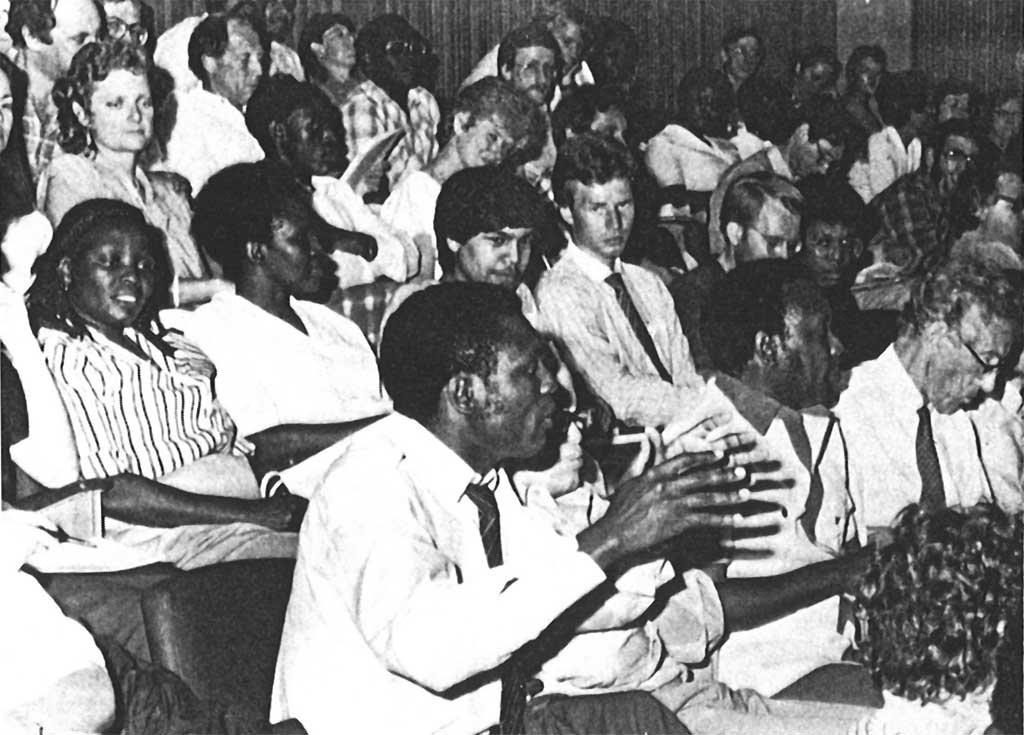
This was an impressive occasion. The photograph above by Paul Fo (SOAS) shows part of the packed audience. Michael Hodd to whom much credit is due for organising this ambitious affair (and who also received brickbats when things did not proceed as he had intended!) was himself surprised by the size and scale of the participation Furthermore, the conference could hardly have been better timed as Tanzania adjusts itself to the dramatic changes now underway.

There were participants from almost all the major centres of learning in Britain which are interested in Tanzania; there were also representatives of FAO, the World Bank, ODA, the British Council, the Britain-Tanzania Society, the Scandinavian Institute of Africa Studies, the College for Developing Countries, Antwerp, the Centre for Development Research, Copenhagen, the Institut fur Afrikanistik de Univer:sitat, Vienna, the Institute of Social Studies, the Hague and a contingent from the United States who took a prominent role.

Above all there were the large group of participants from Tanzania, one for each major subject area in the programme and many more besides, whose contributions were not only, in general, the most clearly delivered but also, naturally, the most up to date and often the best informed. They were characterised, as Gus Liebenau (Indiana) put it by a combination of pragmatism and intellectual vigour. The frankness of their contributions also compared well with the directness of the criticisms coming from many of the non-Tanzanians. As Tamin Amijee (Queen Mary College) put it “Nyerere is to Blame” might have been a better title for the conference. A much appreciated remark by Philip Raikes (Copenhagen) about the beneficial effects of changing one’s mind from time to time was also appropriate to the occasion.

It is quite impossible to do justice in this Bulletin to the 27 papers presented – one paper alone would fill the whole of this issue! Comparisons, as Shakespeare said, are “odorous” but there were some good papers and some not so good, Those on industry in Tanzania were of high quality. Those on Education and Manpower covered only part of the field and one in particular was stronger on political rhetoric than on the realities of the Tanzanian educational scene. On agriculture, the most intractable problem facing Tanzania, the solutions still seem to evade us. On Urbanisation and on some other subjects the World Bank came in for some heavy but rather unconstructive criticism. There was some straightforward talking in the section on Trade and Aid from Denis Osborne (ODA) – “the British Government’s attitude has been that there should be no new financial aid to Tanzania pending economic reform; the argument behind this had been not simply that we liked people to agree with the IMF but because we thought that some changes were needed if aid were to be effective.”

The final section of the conference on political issues was extremely interesting. Jeanette Hartman (University of Dar es Salaam) in a thoughtful paper spoke of a “government without governance and a state without a system.” Part of a paper on Zanzibar by David Throup (Cambridge) was challenged by another speaker and Haroub Othman queried the appropriateness of the conferences s theme because as he said, “Nyerere will continue to be a great influence on the country for a long time to come,” Many were disappointed that Mr Othman’s verbal contribution to the debate had to be cut short due to time constraints.

A clear division seemed to arise between two groups of participants – those accustomed to regular sparring matches at other conferences and those enjoying the novelty of the occasion. But John Arnold (Southampton) told me that he found at this conference a new willingness to debate with rather than abuse or ignore those with differing views. I believe, however that I was not the only one present to be astonished by the aggressiveness of some of the remarks made by certain of the academics about their fellows.

There was too strong a tendency to want to discuss socio-economic hypotheses about what happened in the past but As Henry Bernstein (Wye) pointed out however “the great villagisation debate….ground to a halt in the late 70s” yet this and other debates continued to rumble along at this conference.

Members of both groups of participants expressed some frustration with the conference. To the first group it was “superficial” ; to the others it was “too academic”. In my view it was good’ for the two sides to meet. It might have been better if they had been able to do so in a more structured way, through, as Mick Silver (Bath) suggested, small working groups running in tandem.

It was Mohamed Halfani (Dar es Salaam) who finally admitted something that many speakers were reluctant to say. “What is to be done? Like everybody else in the conference I am shunning this problem and saying it would be presumptuous of me to suggest alternatives”!
Among the more interesting and surprising remarks we heard at the
conference were the following:

A BACKLASH
“There is a right-wing backlash in Tanzania. This my lead you to reach hasty conclusions… the right wing people may not be able to go very far ….. the army is influential.. A. F. Lwaitama, University of Aston

EDUCATION FOR SELF RELIANCE

“‘Education for Self-Reliance (ESR) is inspirational rather than a policy document. Are Tanzanian schools working in its spirit?” A very difficult question. It’s like the debate in Britain about religious education in schools. Nyerere had problems in the curricula implications. ESR was a perfect vehicle for communicating with aid agencies. It was like Booker T. Washington’s speech in the American South when he told blacks not to leave the South but to cast down their buckets where they were. The speech encouraged Northern aid agencies like the Rockerfeller Foundation to come to the aid of the South. Similarly, Nyerere’s call for ESR was swallowed hook, line and sinker by the writers of aid literature in the Northern Hemisphere. People were led to believe that it (ESR) was what was happening.”
Kenneth King, University of Edinburgh

THE SPOT MARKET

(In response to talk at the conference about black marketing and attacks on people going abroad and then returning home with toothpaste and selling it at exorbitant prices) “a debate on black marketing at this level caricatures the entire economic debate. There are a lot of petty commodity producers who are labelled black marketers. Before one labels people negatively in this way. one has to realise that if a peasant takes a bunch of bananas across the Kenya border to sell at a price higher than the official price in order to obtain basic commodities that are not available locally for personal consumption, that person is not a black marketeer. Oil producers sell oil outside the OPEC market. We don’t call them “black marketeers.” We speak of the “spot market”. …. Don’t accuse our mothers. ….”
E. J. Kisanga, London School of Economics

STATISTICS

(In answer to criticism of the statistics in a paper entitled “A Food Strategy for Tanzania,”)” Don’t forget that we are working within the context of a developing country. The US Department of Agriculture told me that it took them 100 years to develop a good system of agricultural statistics. What is the alternative? Are we saying that because we have bad statistics – by the way they are not too bad – that we don’t have to help Governments to plan for the future?” A.N.Cortas. Food and Agriculture Organisation
of the United Nations, Rome

REGIONAL CO-OPERATION
(Reference had been made to the effect that) “maybe there is a future for some Tanzanian industries through the Southern Africa Development Co-ordination Conference, SADCC. I wish that I could share that opinion….. in the case of the East African Community the problem was that everything benefitted one country more than another. The Kampala agreement allocated particular industries to countries. But this proved impossible. Countries should recognise that it is better to get something rather than nothing out of regional co-operation.”
Dr. Walter Elkan, Brunel University

TANZANIA AND SOUTH AFRICA

“Some of us are worried about how new economic conditions may affect (Tanzania’s) attitude to the S.Africa struggle. The ANC is worried about…the effect of IMF conditionalities…. how it might affect our capacity.”
Haroub Othman, University of Dar es Salaam.

COMPARISONS

“Comparing the United States with Tanzania (this had been done by another speaker on the subject of education) is like comparing apples and oranges.”
Leslie Block, Northeastern Illinois University

HOUSING

“The most amazing thing in Dar es Ealaam is the amount of building going on now…. There is great development from Bahari Beach at one side, to the airport at the other. The Housing Act of last year… allowed this.”
S.Rugumisa. The Prime Ministers Office, Dar es Salaam

REVOLUTION

“We need a little ferment from below to spur the top level people. Don’t be afraid of revolution.”
Manuel Gottlieb, University of Wisconsin

NYERERE AND THE FUTURE

“The painful thing for Nyerere (as compared with similar leaders) would be for him to sit in Butiama and see all his progressive achievements eroded away. Nkrumah was far away from home in Guinea when the changes were made, Nasser was in his grave before Sadat made the changes.
Haroub Othman, University of Dar es Salaam,

I hope that we shall be able to quote more fully from some of the
papers in future issues. We do have room for part of one paper however. It was quite different from all the others. Through its originality and perception of what the Tanzanian man (in this case, woman) in the street thinks about the Nyerere years (as evidenced by Mwalimu’s speeches) we may gain a clue as to what Tanzania after Nyerere could be like, The paper is entitled “The Nyerere Heritage” and consists of an imaginary dialogue between a thirty year old female primary school teacher and a 35 year old male linguistic student.
David Brewin

THE NYERERE HERITAGE

Question from the linguistic student: When Nyerere finally leaves, do you think something of his style of public speaking will remain with us?
Answer from the primary school teacher: I don’t know what you people call “style”. As far as I am concerned something decidedly Nyererean will continue to influence political oratory in Tanzania in the area of Lexis. In translating Shakespeare’s “The Merchant of Venice” to “Mabepari wa Venisi” and “Julius Caeser” into “Juliasi Kaizari”, Nyerere created a political lexicon which is unique in East Africa. Words like Ubepari, Umwinyi, Makupe, Ujamaa, Ndugu, have acquired a whole range of meanings which it will take some time superseding (in case some right-wing politicians wish to do this in the future!)
Q: Apart from lexical influences, is there anything else about the way Nyerere spoke which Tanzanian politicians will have to inherit or may inherit?
A: I suppose his way of saying “Ndiyo” with a high-rising intonation to mean “Yes, you must believe me!” and with a low-level intonation to mean “Yes, and who dares not believe me” will continue to be imitated by some politicians.
Q: What message would you give to researchers like myself who are interested in linguistic differences between lectures, sermons, harangues and such like?
A: I would like people like you to come up with theories which discourage upstart politicians who would wish to reduce Nyerere’s oratorical style to mere techniques used to elicit laughter or agreement. Just because a lot of us always laughed whenever Nyerere started to laugh in his peculiar ironic way, and we used to clap in agreement whenever he said his many “ndiyos”. Some of these careeri5t politicians think people like me would do the same if they mimicked Nyerere!
Q: What sort of theories would satisfy you?
A: Well, theories which looked into things like what kinds of speeches Nyerere gave to party conferences and what kinds did he give to Parliament, What sort of speeches Nyerere gave to open air mass rallies at Mnazi Moja and Jangwani in Dar es Salaam and what sort he gave to a selection of Dar es Salaam Party and Government leaders at Rarimjee Ball or Anatoglu Hall. There were times when he seemed to lecture in a most soliloquising way and there were times when he seemed to use his Dar e s Salaam audience to indirectly give a sermon on humanism to world leaders outside Tanzania. Very rarely did be engage in demagogic political stunts to win some political favour from his audience like most politicians in the so-called older political democracies.
Q: What impression do you form of Nyerere as a politician from his political speeches?
A: I think he carried conviction and honesty in his discourses on the evil of one people ruling over another, and how this corrupted both the coloniser and the colonised. He stirred in one a sense of pride in one’s own African ancestry. His speeches during the war with Idi Amin in 1978/79 were most powerful in arousing in most Tanzanians a sense of outrage against a11 forms of oppression irrespective of the person committing “dhuluma”. The anti-Amin war songs and speeches evoked the “spirits” of Mkwawa and Songea and the anti-colonialism Maji-Maji Resistance War of earlier times. This part of the Nyerere heritage will stay in the hearts of Tanzanians like myself for a long, long time. Who knows, this part of the heritage will come in handy should South Africa do to Tanzania what the United States did to Libya!
Q: Wouldn’t you say that in practice he would only be remembered for instituting the one-party state and watering down the role of parliamentary democracy?
A: Well, I don’t know what you people in universities will remember him for – but I know this: even many years after he has gone his anti-umwinyi, anti-dhuluma sentiments as they reflected themselves in the 1971 Party Guidelines (Mwongozo) – proclaimed after the Idi Amin Coup in Uganda and the attempted coup in Sekou Toure’s Guinea the year before – as well as in the speeches delivered during the anti-Amin war will have a long term impact on Tanzanian society.
Q: But what came out of his speeches as his attitude towards institutions like parliament and elections and a free press ?
A : I don’t know what you people would say was his attitude to democracy. All I know is that he seemed to be saying that countries like Great Britain did not necessarily Rave democratic institutions mere1y because there were opposition parties and that newspapers were owned by rich capitalists who competed amongst themselves for readership and control over the news. I do not believe that at village level there will be any advantage in having one party which believes the village should grow coffee and another which commits itself to uprooting the coffee as soon as they win control of the village council! I don’t know what democracy means in any other terms than those set in Nyerere’s speeches. I don’t know whether the colonial governors left any manuals on how best to run governments democratically ! My main complaint with CCM (and TANU before it) is that they tend to allow too many capitalist crooks who engage in Ulanguzi to infiltrate them.
Q: What about his attitude to African liberation ?
A: At first I did not understand when he said recently that it was sad he had participated in the foundation of a Tanzanian nationalism instead of an East African nationalism or an African nationalism. Listening again to his speeches during the anti-Amin war and his comments on the famine in Ethiopia I can see he is a man who is more proud of having the ARC school at Morogoro than he has so far admitted. His naming of a stadium in Sumbawanga as Nelson Mandela last year is very symbolic. This was the last thing he named before retiring from the presidency!
Q: What would you remember Nyerere for in the field of agriculture and industry?
A: In the late 1960’s things were good. My brother secured a job with the Cotton industry in Mwanza although we come from Mbinga which grows coffee. He used to come home during his holidays with lots of stories about life in other parts of Tanzania. He would tell us about the steamships on Lake Victoria and locomotive train rides between a very big city with lots of cars and a town known as Dodoma which was going to replace Dar es Salaam as the big city! My mother was unhappy at first because she did not like losing someone who might have helped on our coffee farm. But then, my brother used to send money and clothes to my mother, and most of us young people did not share my mother’s enthusiasm for farm work in the same village one was born in and was to die in.
Q: Do you think he favoured small peasants like your mother enough?
A: I don’t know. I think my mother has always been happy with Nyerere. She only complains when the price of coffee goes down or the prices of corrugated iron sheets or clothes go up. But I suppose Nyerere had children like myself who learned about life in other parts of the world and wanted the good things of the city. People in factories and offices have holidays – paid leave they call it. They have pensions. They have greater independence from control by their parents and relatives. I hear that in Europe people are paid for quite long periods of time for doing nothing! Who would not like a life like that ? I suppose Nyerere favours peasants like my mother but he too has children like myself who want Tanzania to develop and be like those European countries. The Europeans who come over here are always found enjoying themselves in our hotels in our own country! Who would not like life like they lead? I am sure Nyerere’s love is torn between that for his old mother and that far his young children.
Q: What will remain in the minds of most Tanzanians as the thing they inherited from the Nyerere e rain the sphere of education?
A: The institution of National Service (Civil and military) for all higher secondary and tertiary level graduates, the use of Kiswahili as the medium of education in primary schools, the 1974 Musoma Resolution on Adult Education and universal primary education have had an impact on Tanzanian social life which has yet to be assessed. The philosophy of Education for Self- Reliance (although it has not been very successful in many practical terms) has had a very great impact on the practice of education in Tanzania. A young chipukizi (pioneer) in Tanzania is likely to know more about what is going on in South Africa, Nicaragua, and Palestine than most children of her age in Britain for instance. All these things are not visible but they will be, should Uncle Sam do a Grenada on Tanzania! These Nyerere inheritance s will certainly make Tanzania very difficult to rule in a completely right-wing way.
Q: Did Nyerere strike you as someone who wished to urbanise Tanzania?
A: I have been to Dodoma. If he had had his way he would have wished Dodoma to grow up into a village-like capital city – a compromise between his love for the social harmony of his mother’s peasant life and his sympathy for his children’s aspiration for economic growth and material development in the European sense. Q: If your children asked you what Nyerere’s attitude to employment was, what would you say?
A: I will tell them to listen to his speeches! I think his idea of employment was again influenced by his retaining close contact with peasants like his mother in his home village. To me, employment means being employed by the state. To Nyerere you got the impression that it could mean both employing oneself on a peasant farm and being employed on a village communal farm on a wage and “paid leave” basis! I think t his problem is too complex for me t o explain, but maybe ecologists, and humanists, and people like that, can explain it better. Was it to be “kufanya kazi” or “kuajiriwa” ?

Conclusion
The dialogue between the imaginary school teacher and the imaginary linguistics student is as realistic a depiction of the perceptions of quite a number of Tanzanian lay people of what Tanzania after Nyerere will be, as could be presented to a conference of economists, political scientists and sociologists. The apparent naivety of some of the contributions should not belie the seriousness given to the issues examined.
A.F.Lwaitama

TZ IN INTERNATIONAL MEDIA

22 PAGES ON 22 YEARS OF THE UNION
The May issue of “Africa” celebrated the 22nd Anniversary of the Union between Zanzibar and Tanganyika with a 22-page “Tanzania Spotlight.”

Interviewed by the magazine, President Mwinyi said “I cannot for a moment pretend that our Union, over its quarter century history has not gone through its stresses and strains. In fact the quest for unity and against all forms of balkanization, like human progress itself is never anything like plain sailing or a bed of roses. That is why in more mature and highly developed societies than our own, like Europe, for instance, divisive tendencies; have not been altogether eliminated, even after centuries of great efforts. Consequently, both our Party and Government are more than acutely aware that however hard we try, we cannot attain perfection free of all forms of shortcomings. Hence our constant and ceaseless search within the Party and Government for better socio-political institutions, which truly reflect the aspirations of our people as well as our ever-changing reality and environment. Thus the recent constitutional changes, for example, of both the Union and Zanzibar Governments, were yet another attempt by the Party and Government to redress any apparent and possible shortcomings. Indeed our Party and Government stand ready and willing to make whatever institutional adjustments necessary, in order to meet our peoples’ legitimate wishes. That is not, however, the same as saying we shall bend over backwards to accommodate the desires of those anarchist elements that are bent on creating discord and despondency among our people. Any society can only ignore such selfish manifestations at its own peril.”

UGANDA AND TANZANIA
In an edition headed “De Profundis”, “Africa Events” in its March 1986 issue strongly criticises the silence of Black Africa’s leaders over the years during which the “carnage that was Uganda” took place. It had been left (save for Nyerere’s ‘De Profundis’ in the seventies) to non-African Governments and organisations to speak out. After discussing how the new Uganda Government must be regarding its neighbours – the Sudan, Zaire and Kenya – it says this on Tanzania: “For a crucial two years after the overthrow of Amin, Uganda was virtually ruled from Tanzania. Very little of any importance was ever decided in Kampala without reference to Dar es Salaam. For that period Julius Nyerere was in reality President of Tanzania and Uganda. What Nyerere supported in Uganda worked, what he didn’t support did not work. It is widely and passionately believed (in Uganda) that Obote would never have dared to rig the results of the 1980 elections without the acquiescence of Dar es Salaam. The tragic events of the last five years stem from that election, and it is for this reason that many Ugandans blame Nyerere in the same breath they blame Obote for the near destruction of their country…… President Ali Hassan Mwinyi has no track record on Uganda; so he will be that much better placed to persuade angry Ugandans to let bygones be bygones, however tragic and bloody they may have been.”

WINE
The German journal “Afrika” in its February/March l986 issue tells the story, from a woman’s point of view, of the development of wine growing in Tanzania. It relates how wine cultivation began in 1957 when Italian missionaries from the Bihawana mission near Dodoma planted grape, vines. Initially, the pastoral people of Dodoma showed little interest but, according to the article, “After the Dodoma campaign in 1971, during which 30% of the population was resettled in villages a new start was made with the establishment of wine growing. At the grape harvest of March/April 1980, a total of 94 acres were under cultivation in the villages of the Dodoma rural districts. In some villages, there are vineyard cc-operatives but as a rule wine growing is carried out individually by the local farmers in a position to invest money for that purpose. This means that they sell cattle, or other market produce, to get the necessary funds. The local women cannot invest any money, because what they earn from the sale of market produce goes as the housekeeping money for the family. The strenuous digging of the ditches for the vines is done by the men and women together. The man clears a piece of his land, women burn the brush wood. Through a consultancy service, the farmer learns how to prune the vines, and to carry out effective plant protection and pest control. His wife and his childrens care off the birds before the grape harvest.

During the grape harvest all the family work together again to get the highly perishable crop to the cellars as quickly as possible. Since the land belongs to the man, who was the one to invest capital in wine growing, he also has the sole right to the proceeds. Wine growing is thus regarded as a man’s domain. The advisory service also approaches the owners of the vineyards; the women who also work in these projects are not consulted. The extra work done by the women is taken for granted.”

MTWARA LINDI PROJECT
In an article headed “Lowering Expectations”, “Spur” of April 1986 reviews the history of the British rural aid programme in Mtwara Lindi. It reads, in part as follows, “The local population must be bemused by the activities of the British over the past decade. First the flourish of the initial rand project – indeed it is interesting that it was the Tanzanians who -persuaded the British to restrict themselves to two rather than three regions, lest they bite off more than they could chew. Then the extensive questioning, and the raising of expectations of what help might be provided; uncertainty as London dithered about the future of the project; and the eventual recalling of vehicles, renaming of the project, and the final retraction from some of the earlier implied commitment. This has all happened over less than a decade, during a time of worsening economic conditions in Tanzania; as usual, Mtwara and Lindi regions, at the end of the line both literally and metaphorically, have experienced more than their fair share of these difficulties.

The initial project was a genuine attempt to offer help to the poorest area of a poor country. The idea of Integrated Development, so popular in the 1970’5, has lost favour because of the – difficulties such projects have experienced, including lack of involvement and commitment of local people arid worries about long term feasibility when donors withdraw. But the concept seems an excellent one. What is less appropriate is the length of time over which it has been envisaged. Rather than building up the project so quickly and providing so much capital in the form of housing and vehicles so soon, and then fizzling out in a short time, it would surely be better to start more gradually, giving the local people time to assimilate the help, and donors more time to listen to the local needs and appreciate their problems and traditions. The encouraging aspect of the Mtwara Lindi “fiasco” is that the projects that remain offer a good hope of genuine dialogue on a small scale with the Tanzanians.”

The article goes on to say that these new small projects, many staffed by volunteers, include goat and rabbit breeding programmes and a freshwater fish project.

THE BUDGET
Commenting on the budget in its August 1986 issue, “African Business Management” writes, “Since the early1980’s which culminated in the prevailing dreadful economic situation, Tanzanians inside and outside the Karimjee parliamentary building have been waiting to hear only one thing in the annual budgets unveiled by the Minister for Finance, Planning and Economic Affairs, Cleopa David Msuya – the devaluation of the shilling.

This time, however, things were different, Msuya came up with what is now billed as a generally fair budget which has considered the plight of tax-burdened workers, the incentiveless peasants and already privileged executives.

In an unusual move a powerful delegation of the Union of Tanzanian Workers (Juwata) visited President Ali Hassan Mwinyi at the State House the following day, 20th June, to thank him for a fair and considerate budget which is seen as a positive starting point for increased efficiency in the economy.”

THE CORAL REEF
Fishermen using dynamite are destroying much of the coral reef off the coast of Tanzania with the result that erosion is threatening beach hotels and private properties according to an article by Frank Nowikowski in the May issue of “Commonwealth”. The article goes on: “A number of homes and some hotel buildings have fallen into the sea . Destroying the coral has accelerated the coastal erosion near the beach hotels. Many have invested in groynes to break the power of the waves and prevent further property being claimed by the sea. Although effective, these measures disfigure beautiful beaches, an example being in front of the Airicana Hotel where sand filled giant black sausages dominate the beach.

A further problem is that now the reefs have been breached, sharks can freely enter the area. This makes previously safe waters dangerous for swimmers, and there have been several sightings of sharks recently. Fishing with dynamite is illegal in Tanzania, but the authorities have said that they do not have the resources to enforce he law.”

AIDS
The Paris based “Marches Tropicaux” in its issue dated Bay 9th l980 compares the way the spread of AIDS Is being dealt with in Tanzania and such countries as Kenya, Rwanda and Ethiopia. In the latter countries there is reported to be something of a blanket of silence. Tanzania on the other hand has taken the initiative and lifted the curtain. Tanzania’s Minister for Health announced in April 1986 that AIDS (for which there is now a Swahili word – “Ukimwi”, an abbreviation of Ukosefu wa Kinga ya Mwili – Editor) is present in some 17 of the 25 regions of the country, particularly in the Kagera region near the frontiers of Rwanda and Uganda. Some 125 cases had been reported by September last year in Tanzania of whom 60 had died. Research workers estimate that 1 in 10,000 of the inhabitants of the Kagera region are now potential carriers.

PAYMENTS TO RETIRED LEADERS
“The Parliamentarian” in its April 1986 issue stated that the Minister for Finance, Planning and Economic Affairs had tabled a Bill in the National Assembly earlier in the year seeking to provide retirement benefits for specified leaders. The Bill provided that the retiring President would be paid, among other things, annually TShs. 124,000 taxfree and would also receive TShs.3,105,000 tax free as his pension. The retiring Vice-President would be payed annually TShs. 84,666.60 tax free, a pension of TShs.2,105,000 tax free and a total sum of TShs.250,000 as a resettlement allowance.
Participating in the debate Ndugu Lumuli Kasyupa (Kyela) criticised the Bill because it did not include other leaders such as Ministers and Members of Parliament. He therefore urged members not to approve the measures proposed until the Government had made the necessary amendments that would cater for all leaders.
The Member for Arumeru, Ndugu Paniel Ole Saitabau, cautioned against a trend that was emerging in the House that was likely to lead to MP’s being misunderstood by those who elected them. “If we start discussing our interests now in this new House we will be very unpopular with the people.” he said.
Speaking on the same Bill, Ndugu Ernest Nyanda (Magu) urged MP’s to concentrate on the Bil1 instead of calling for Bills catering for MP’s and Ministers.
The Bill was passed in its original form.

OIL EXPLORATION
The Nigerian “African Concorde” in its August 1986 issue reports that Tanzania will maintain its oil exploration efforts despite the unsatisfactory progress made since the exercise started in 1050. Replying to a question in Parliament, the Deputy Minister for Energy and Minerals, Ndugu Maokola-Majogo was reported to have said that despite the problems which have hampered oil exploration in the past, some companies were still negotiating with the Government for oil exploration permits. Ndugu Majogo informed the House that oil exploration had been going on in various parts of the country since 1950. However, none of the wells sunk so far had shown any sign of oil. natural gas though was discovered at Songo Songo in 1975. The natural gas is now awaiting exploitation.

IVORY POACHING
“Jeune Afrique” had a short article in a recent issue which spoke of “inquietude en Tanzanie.” Poaching in national parks, particularly the Serengeti was said to be reaching alarming proportions. In the first 3 months of this year 35 elephants had been killed despite efforts of game wardens unable to fight against poachers shooting from jeeps and helicopters. The average price of ivory was said to be 68 dollars per kilo (earlier this year) and an elephant tusk was said to weigh between 45 and 65 kilos. “Calculez…” the magazine advised.

THE CANADIAN WHEAT DEVELOPMENT PROGRAMME
This development programme in the Hanang Wheat complex in the Arusha region which was featured in ‘Bulletin’ number 24 continues to attract controversy. It figured prominently and was much criticized in one of Ali Mazrui’s T.V. programmes on Africa. A recent court case between the National Agricultural and Food Corporation (NAFCO) and the Mulbadaw village council is also the subject of some lengthy correspondence in the May/June issue of “Africa Events. ” The case was concerned with some 22,793 acres of disputed land on which NAFCO had paid TShs.38,802 for unexhausted improvements.

IMPROVED PIT LATRINES
In a special “Water Survey” in its August issue “African Business” states that sewerage is a subject that most people would rather not talk about let alone allocate funds to. Improved pit latrines are described as the only possible way of extending the numbers covered by adequate sanitation and points out that all Tanzanian householders have been obliged by law since 1974 to install pit latrines. The big problem has been to persuade villagers to make minor improvements to existing designs which can help reduce the diseases associated with latrines.
The “Improved Pit Latrine” being promoted by the UN was said to have evolved out of practice in Tanzania and Zimbabwe. One of the improvements in the design is the inclusion of a chimney or ventilation shaft (covered by gauze or wire netting) which keeps the pit relatively odourless; flies and mosquitoes are attracted up the shaft by the light but are not able to escape.

FOUR DONKEYS
The “Sunday Telegraph” has published four news stories in recent months on the subject of four donkeys. A team of British explorers led by Mr. George Tardios a reengaged in a two year attempt to I retrace the steps of the Victorian explorer Stanley. The donkeys were bought by the explorers from traders who had ill-treated them. The donkeys had subsequently performed well on the 1500 mile trek on the route followed by Stanley and the explorers did not want to abandon them at the end of the expedition. They cannot be imported into Britain because of strict rules designed to keep out African horse- sickness. Mr. Tardios therefore appealed for help to Prince Philip, Mrs Thatcher and Mr Joplin, the Minister of Agriculture.
Later articles in the series indicated that animal welfare supporters had rallied to save the donkeys. Buckingham Palace had referred the problem to the RSPCA. and the Brooke Hospital for Animals (which was set up in 1934 to look after war horses which had served in African campaigns) had offered the donkeys a home provided that their transport costs could be met. Miss Celia Marker of Ringwood Hampshire, a Brooke Hospital supporter said, “It is rather wonderful that these should have the chance-of going to Brooke. The hospital does wonderful work encouraging the owners of horses and donkeys in Egypt to look after their animals. ”
Funds were not apparently forthcoming for transporting the donkeys to Cairo, but in its June 22nd issue, the “Sunday Telegraph” reported that the Tanzanian Air Force had come to the rescue by agreeing to fly the donkeys from the shores of Lake Tanganyika to Kenya where they will be given a retirement home near Nairobi. Generous donations had been received towards the cost.

TANZANIA AFTER NYERERE
“Africa Events” May/June lengthy cover story on “Tanzania after Nyerere” contained a number of perceptive articles. Michael Hodd of SOAS in his, which was headed “Marketeers versus Planners”, compared Tanzania’s recent performance unfavourably with that of Kenya, Manfred Bienefeld from the Institute of Development Studies at Sussex University seemed to argue to the contrary, that in many respects Tanzania “ranks among the top 10 or 20 percent of sub-Saharan Africa.”
Professor Ali Mazrui wrote that “Nyerere’s Tanzania emerges as a case. of heroic failure. The heroism is definitely still there but the wilderness of failure is spreading and threatens to stifle the last plant of heroic resistance.” Tom Young, also of SOAS, on the subject of Tanzania’s international relations expressed the belief that “when Nyerere finally retires from active politics. . . the country will be forced to concentrate on its internal problems.”

In an article headed “How to climb Mt Everest without Sherpas”, Athumani Hamza wrote that, for the first time, discussion about the relevance of socialism “has been brought into the open fields of national debate. What was once sacred is now publicly questioned and critically analysed; not so much in the media which is state owned and poodly but in market place:^, homes, bus stops, seminars, committees, everywhere,… beneath the staid matter- of- fact day-to-day flurry of official activity and the ever bubbly froth of socialist rhetoric, there has always been an undercurrent of clandestine resistance on the part of an influential section of the leadership. It is widespread.. . So the most interesting thing about Tanzania’s attempted transition into socialism, is that Nyerere has all along, since 1967, been a loner. In the last 20 years no back-up politicians have emerged… or have demonstrated at public meetings or in written discourses, their intellectual grasp of Ujamaa theory or their mastery in interpreting it to the masses, their flair in delivery, or their enthusiasm in advocacy… President Mwinyi has a mighty rough climb ahead of him. To make it to the top of millenial Mt Everest, he needs good, intelligent, conscientious, dedicated Sherpas. Nyerere did not have them. Well he had their bodies but not their hearts. That’s why he never made it beyond the foothills, Mwinyi therefore must make a choice. Either to change Sherpas or to change tack.”

TANZANIA AND THE EUROPEAN COMMUNITY

Years ago when I was an English teacher in Madagascar, I asked a class to write about their home town. Most of the class began with a sentence like “Tulear is 600 kilometers from Tananarive, the capital and 6000 kilometers from Paris”. For them, Paris was the focal point of the world; Africa might as well not have existed. Similar attitudes prevail throughout Africa wherever different languages and customs adopted during the colonial era have led to a lack of awareness about neighbouring countries.

One of the many products of the agonisingly slow and belated progress towards increased co-operation in Europe has been a desire to lessen these barriers between Africans created by colonial rule, and to encourage development and regional co-operation. Bilateral assistance, conditioned as it often is by language and traditional trade ties, usually tends to reinforce these divisions. By bringing together several former colonial powers and other important bilateral donors, the European Community is uniquely well placed to encourage pan-African initiatives such as the preferential trade area, as well as supporting joint action amongst countries affected by problems such as the spread of pests and diseases, or desertification.

Readers of the Bulletin will be aware of the importance of such concepts as Pan-African co-operation in Tanzanian policy over the years since independence. From the beginnings of the Organisation of African Unity through to present day initiatives like the PTA and the Southern African Development Co-ordination Conference (SADCC) Tanzania has been prepared to lend its weight, even though its own experience of closer co-operation in the East African Community highlighted the difficulties which can arise. If such problems can arise between countries with strong historical ties how much more hazardous must wider co-operation be ! Yet it is not only natural – the early explorers would surely be dismayed at the cultural gulf and plain lack of contact between some of the areas in the region – but even a geographical necessity that a common approach to problems should be sought. Tanzania’s importance stems not just from its political will in approaching these issues but from its strategic position as a transit country for much of central Africa and from the importance of its own natural resources in the potential development of the region* The EEC through the European Development Fund is supporting Tanzania’s efforts to improve transport facilities which are important for the development of neighbours such as Rwanda and Burundi, by improving the port facilities at Kigoma, assisting Tanzanian Railway Corporation and helping to construct new facilities at Isaka and a road linking them with Rwanda. Emphasis has also been placed on the working out at national level of policies for food production; such a strategy has now been produced for Tanzania. The idea is to bring together all the various factors affecting the provision of an adequate diet for all the population. Regional food security is best achieved by starting at village level or even the individual shamba.

Tanzania has the potential not just to feed itself, but to produce exportable surpluses. However, before that potential can be realised, many constraints must be overcome. Tanzania is almost the poorest of African countries, with all the problems that they share: acute shortage of foreign exchange, weak planning capacity, poor institutional performance. Moreover Tanzania faces particular difficulties in ensuring that all its people have sufficient food, not only because of its size and the poor state of its infrastructure, but also the remoteness of the food producing areas from the deficit regions. Any responsible programme of assistance towards the provision of food for all in Tanzania must face these problems within a realistic time scale.

The Tanzanian Government acknowledges that the sector has suffered from inadequate investment, inadequate incentives to producers, poor performance of the relevant institutions, a lack of foreign exchange and a transport service in a state of disrepair. In its 1982 policy statement on agriculture, on the basis of which the national food strategy was prepared, the Government outlined measures covering institutional reform, prices and input supply and marketing in order to move towards the objective of self sufficiency in food.

It was within the framework of this approach that talks were held in Dar es Salaam in July 1985 between the Tanzanian Government and the European Commission delegation headed by Dieter Frisch, the Director- General for Development. The aim was to agree on the way in which funds available to Tanzania for its national development programme, from the EEC would be allocated. Put simply, the question was, what was the best way for Tanzania to spend about Shs.2,130 million in foreign exchange?

Most farmers in Tanzania grow crops for cash as well as for their own food. In some areas the two crops are grown on the same piece of ground, as is often the case with coffee and bananas grown in the North and North-West. How much each family decides to grow of each depends partly on the price which they will receive for each crop as well as on the suitability of the soil and their own requirements. But Tanzania needs to earn foreign exchange from export crops like coffee and cotton to buy both the inputs needed to grow more food, and the spare parts and fuel to move food around the country. A balanced programme requiring food and cash crops was therefore required. As the EEC has been the main donor for the development of coffee production in Tanzania over the past few years, through a fairly successful programme of support to the Coffee Authority of Tanzania (now the Coffee Marketing Board) which has ensured that coffee production levels were maintained, it was decided to focus the allocation of the finance available on agriculture in the coffee-growing areas. The programme to be supported will cover all the problems affecting coffee and food production in the se areas, including the need to ensure that the newly formed co-operatives can do their job properly. Transport is a particular problem in some of these areas, and the BBC agreed to consider proposals for the repair of lorries along the lines of a successful project carried out a few years ago, and for the maintenance of minor roads giving access to agricultural areas.

The funds available to this programme result from the signature in 1984 of the third Lome convention, a contractual agreement between the EEC and over sixty countries in Africa, the Caribbean and the Pacific (known as the ‘ACP’ countries). This is a unique agreement covering not only finance for national and regional development, but also a scheme for the stabilisation of export earnings (‘STABEX’ for short) and a wide variety of other forms of support. The EEC’s food aid and its scheme for co-financing projects with voluntary agencies like Christian Aid and Oxfam are funded separately from the Convention (they come from the EEC annual budget) but every attempt is now being made to ensure that all these different forms of co-operation fit together within a coherent framework. The EEC is fast becoming one of Tanzania’s major aid donors, and in fact the share of Tanzania’s aid coming from the Community (including Member States ‘bilateral programmes) is now over 40%. Coupled with the fact that about 50% of the country’s trade is with the European Community, this means that the ties between the two are stronger than at any time since independence.
Martyn Pennington

MILITARY MEN IN THE GOVERNMENT

The Tanzanian Government has appointed a total of 19 soldiers to senior position sin the Government and its institutions and several others have been placed in Party positions while about 10% of the 240 members of the National Assembly are men in uniform. The Deputy Minister for Defence and National Service, Lt. Col. Abdulrahaman O. Kinana told the National Assembly recently that the army had patriotic and skilled men who were ready to take up duties in the Government. Lt. Col. Kinana was responding to Ndugu Meshack Maganga (National) who wanted to know the number of soldiers in various positions. The Deputy Minister said there was one Minister, one Deputy Minister, three Regional Commissioners, nine District Commissioners, three heads of Government departments, and two heads of parastatal organisations, who were armymen. – Daily News

TANZANIA AS A DEMOCRATIC ONE-PARTY STATE

In the elections to the Legislative Council of 1960, the first held on a common roll franchise, the Tanganyikan African National Union won all but one seat, Tanganyika therefore entered upon independence as a defacto one-party state. This remarkable result was due as much to the outstanding leadership of Julius Nyerere as to the unifying influence of a common cause. Soon after independence the opinion gained ground t hat the monopoly of power should be retained by TANU and should be confirmed in law by the independence constitution.

The origins of this opinion were diverse. The role of TANU as the undisputed leader in the campaign leading up to independence and its spectacular recognition in the polls encouraged the opinion that TANU alone possessed the ability to govern. A desire to create a system of Government appropriate to African conditions and experience was no doubt stimulated by recollections of the tribal baraza and the habits of mind that went with it. And at a more self-interested level it was known that certain leaders having borne the heat of the day during the independence campaign, saw the one party state as a ready means of perpetuating their own authority – wrongly, as later experience showed.

Beneath these immediate concerns lay an instinctive fear of organised dissension. Et is easy for us in our island kingdom to overlook the mature sense of nationhood that has emerged from centuries of our history and the wide areas of consensus which have furnished us with the conditions essential for two-party government. “It is evident” wrote A.J.Balfour, “that our whole political machinery presupposes a people so fundamentally at one that they can safely afford to bicker; and so sure of their own moderation that they are not dangerously disturbed by the din of political conflict.”

Tanzania can make no such assumptions. As the history of Nigeria, Uganda and even Kenya has shown, centrifugal tendencies can be strong and dangerous. Tanganyika was the creation, not of historical evolution but of the ambitions of the European powers in the nineteenth century. For many years the only cohesion was that imposed by an alien administration. Even as the colonial period drew to a close, local and tribal loyalties often exerted a more dominant influence than the national interest. If Tanzania was to become something more than a geographical creation, positive steps were required to arouse a sense of common destiny. It was the judgement of Tanzania’s leaders that a political system based on the interaction of party rivalries could undermine these efforts and endanger the unity of the infant state.
The decision to turn Tanganyika into a one-party state was made by the National Executive Committee of the Party and on the 14th January 1963 this decision was announced by President Nyerere. The President made known at the same time that he had been empowered by the National Executive Committee to appoint a Presidential Commission to consider the changes of the constitutions of the Republic and of the Party that might be necessary to give effect to this decision. The Commission was appointed on 28th January 1964 and reported on 22nd March 1965. There were 13 members, two of whom were prominent Europeans and one Asian. The Commission invited written evidence and also took verbal evidence throughout the country. Its deliberations were guided by the terms of two important memoranda drawn up by President Nyerere and as a result the final report was deeply influenced by President Nyerere’s approach to the whole subject, an approach which, as it turned out, received widespread support during the course of the verbal evidence.

The Commission, following the President’s view, laid finally at rest the view that the party should be a small, elite leadership group and insisted that it should be a mass organisation open to every citizen of Tanzania. This decision finally established the character of TANU as constituting a national movement; indeed the word ‘party’, with its sectional implications, was no longer an appropriate description and the resulting pattern of Government, as Professor Pratt has suggested, “was in many ways closer to a no party system than to a one party system.” It is clear from the evidence that this concept fully reflected the mood of the people, who showed no interest at all in entrenching an ideologically exclusive elite, but saw the necessity for a single national movement to emphasize and safeguard the unity of the nation.

In his guidelines to the Commission the President laid down a number of ethical principles, which later were incorporated in the constitution of TANU and survive in substantial measure in the present constitution of the Party (CCM). They are also reflected in the Union Constitution as amended in 1985, where Part 3 endows certain important rights and duties with the force of law. The principles listed by the President relate to the fundamental equality of all human beings and their right to dignity and respect; the right to take part in government at all levels; the right of freedom of expression and movement, of religious belief and of association within the law, subject only to safeguarding the freedom of others to enjoy these benefits; the right of protection of person and property under the law and of freedom from arbitrary arrest, subject to a duty to uphold the law; the right to receive a just return for work by hand or brain; common ownership of natural resources; the responsibility of the state to intervene actively in the economic life of the nation in order to secure the wellbeing of all citizens, prevent exploitation and such personal accumulation of wealth as is inconsistent with a classless society; and to fight against colonialism and work for African unity and international co-operation.

In proposing these guiding principles the President foresaw some of the abuses that might pass unchallenged in a single party system. The Commission considered these dangers with the utmost seriousness and as one result of their deliberations a permanent Commission of Enquiry was established to perform the functions of an ombudsman and enquire into allegations of the abuse of power. The reports of the Commission show that- this function has been performed with considerable effect. The basic rights safeguarded in Part 2 of the constitution of TANU as amended also reflected the President’s proposals and acquired a certain legal status when the Party constitution was incorporated as a schedule to the Interim Constitution of the United Republic of 1965. In the Interim Constitution it was stated that ‘all political activity in Tanzania, other than that of the organs of state of the United Republic…shall be conducted by or under the auspices of the Party’. This position was reaffirmed in slightly different terms in the Constitution of 1985, in which the leadership role of the Party was also extended to the conduct of parastatal organisations. In practice, this has meant party responsibility for general policy and for monitoring the implementation of policy. The Party is not itself an executive organ of government, but in the course of formulating policy it has access to the personnel and the documentary resources of the Government departments involved.

Subject to such guidance, the executive arm of Government was free to govern as best it could and the National Assembly to legislate, to vote money and to monitor the performance of Government. In practice the National Assembly has been slow to exercise its powers of criticism, though there have in recent years been signs of greater liveliness and self-confidence. There have been a number of instances where Government proposals have been modified or rejected and one which led to the dismissal of a Minister and senior officials. The important consideration here is that protest is not organised on a Party basis and it is this aspect that makes the proceedings of the National Assembly so unfamiliar and puzzling. It is like Parliament without the whips.

The Tanzanian system is called a ‘one-party democracy’ and some may see this title as a contradiction in terms. In fact, however, the efforts made under the system to represent popular will are not negligible. Despite the limitation of candidature to two persons approved by the Party in each constituency, successive elections to the National Assembly have brought about widespread changes in membership, including the unseating of Ministers, and no leader can lay permanent claim to a position of leadership. The choice of President allows only for a ‘yes’ or ‘no’ vote for a single candidate chosen by the Executive Committee of the Party and confirmed at a Party National Conference. But at least the right to vote ‘no’ has been freely exercised. In each national election hundreds of thousands of Tanzanians have voted against Nyerere (and in 1985 Mwinyi), whilst in 1985 no less than 41% of Zanzibari voters voted against the choice of Abdul Wakil as their President. While the tendency towards the formation of a ruling class is undeniable, it is not inviolable and there is constitutional provision which, it is hoped, will continue to be effective in safeguarding peaceful change.

Criticism of the one party system has recently come from no less a person than the Chairman of CCM himself, Julius Nyerere. In the course of his peregrinations around Tanzania he has found in party circles much slackness and indifference. With characteristic frankness he has admitted that in a multi- party system competition between p arties keeps them on their toes. This was not a suggestion that Tanzania should abandon its one-party system, but that alternative methods must be found to stimulate and sustain political awareness and activity. Nyerere has long been conscious of this problem and said so in a speech in 1974: now he is face to face with it in practice. Since the Party is predominant in matters of general policy, in the election of a President and in the choice of candidates for the National Assembly, the comment is important.

The criticism has also been expressed that the one party system as operated in Tanzania may have had the effect of muting legitimate dissent. There is danger here of passing judgement on the basis of British experience, overlooking the absence of a tradition of informed discussion, the very recent achievement of widespread basic literacy and the extreme scarcity of newsprint. Yet it is reasonable to wonder how far justifiable proposals for reform can accumulate support without the help of some kind of party machinery. It is noticeable that the important reform culminating in the Preventive Detention (Amendment) Act of 1984 seems to have been triggered, or at least promoted, by a symposium at the Faculty of Law in 1982, that is, outside the Party system. This is not the same thing as the formation of an alternative party, but it does suggest that there may be limits to the ability of a one-party system to give hospitality to the serious advocacy of reform. If so, then changes will ultimately ensue. Under the one-party system the voice of the Party has great significance and therefore it is the modulation of that voice which is decisively important. The present highly indirect system of election to the National Executive Committee may turn out to be the point at which reform is most needed.

J. Roger Carter

THE GROUNDNUT SCHEME

The television programme on the Groundnut Scheme sought to put the blame on Mr. Strachey but in fact there were many to blame. Leaving the apportionment of guilt aside why did things turn out as they did ? One might as well ask why a baby who can’t even crawl can’t succeed in the 200m hurdles. No-one knew how to do the job, and those of us who knew how to find out did not have the time to do it. I went to Kongwa on the same train as the first bulldozers. Had there been less pressure, more time, and a proper sequence of investigation, pilot scale trials, training and practical planning, the job could probably have been done (though not in the agricultural pattern intended at the start) in the Southern Province, Kongwa was too dry: it is cattle country; Urambo was too wet for groundnuts but we did well enough with tobacco.

Large schemes can be successful – do not forget the Sudan Gezira. Large mechanised rain fed developments can succeed if the limits of management are of such a size that individual entrepreneurs and producers can handle them as in Zimbabwe, Kenya, the semi-mechanised sorghum in the Sudan, and the Punjab on both sides of the Indus. But in all these cases the sequence of investigation and pilot scale trial (and error!) leading up to training and planning have been more or less followed.

Perhaps the saddest outcome of the Groundnut Scheme is that many observers have run scared of broad development thinking and have taken to seeing development as a process which seeks to conserve what is and fears to consider new ways in a changing world. The population of Sub- Saharan Africa 100 years hence, will be five times what it is now. The old ways won’t do; we must have new ones on a large scale. However much small scale producers may be able to contribute, we already see larger scale ones entering the action using their own capital and management competence. The jot of increasing output at lower unit cost of product seems likely to come increasingly from them. It need not, but I think in many cases it will.
Prof, A. H. Bunting.
Reading University

390 TANZANIAN STUDENTS IN BRITAIN

The British Council in its annual booklet “Statistics of Students from Abroad in the United Kingdom” for the academic year 1984-85 reports that there were 225 (including 29 women) students from Tanzania in British universities. Of these, 192 were post-graduates and 33 under-graduates and 172 were in their first year of study. A further 62 (13 women) were studying in polytechnics (28 in the 1st year) and 103 (26 women) were in other institutions of higher and further education (79 in the 1st year). The grand total of all foreign students in Britain in 1964/85 was 55,608 including 28,232 from the Commonwealth and 6,128 from EEC countries.

BOOK REVIEWS

A ZOO WITHOUT BARS by T.A.M.Nash. published by Wayte Binding, 97 St James Park, Tunbridge Wells, Kent. £9.95 plus £l.50 p&p
On being given this book to review I wondered what made it worthy of a leatherbound edition of £55,00. Having read it I am reminded of a precious miniature portrait which is kept in a velvet lined box. It is in effect a microcosm of 5 years of one person’s life while he was Tsetse Fly Research Officer in Kondoa district of Tanganyika Territory from 1927-32. As such it is unique and a collectors item. The author says, “it is written for the reader who is interested in the living conditions, the wildlife, the peasant and the European characters who gave (him) so much to laugh at.” It is based on his 117 letters home and is generally non-technical and abounding in details of everyday life in the bush. In fact there are so many details and so many incidents that they are inclined to become overwhelming if the book is read for a long stretch. However as a lively record of bygone days it is very good indeed, and what emerges particularly is this young man’s tremendous vitality and ability to ‘get to grips’ with everything around him and enjoy most of it. I imagine that the author, writing over 50 years later, must have relived the whole experience with much the same enjoyment but far fewer physical trials!

Tam Nash was only 22 when he took up his appointment under a somewhat eccentric boss (C. F. M. Swynnerton) who “never slept for more than four hours a night and was always in too great a hurry to stop for food. He was a delightful person, a tremendous enthusiast but utterly exhausting. His native name was ‘Bwana Funga-Fungwa’ (Master packunpack)”. Tam does not say much about the tsetse fly experiments but what he does say indicates that they were along the same lines as those we recently saw on television in a Horizon programme about the very successful work now being done in Zimbabwe by Dr. Glyn Vale. Has progress been slow ?

Living in the African bush over 50years ago was no joke, and Tam underwent no particular training for it as recruits do today. For the first few months he had no proper house; he had no electricity, no refrigerator, no telephone; there was no airmail post until 1931; there were no insecticides as we know them and no antibiotics and only quinine for malaria. Somehow he adapted to the dreadful living conditions and delighted on the wildlife on his doorstep, his “Zoo Without Bars. ”

After 14 months a proper house was built for him out of sun-dried mud bricks by one of the interesting European characters around. This was a “stubby little man” named Tschope who had been chauffeur to Colonel von Lettow-Vorbeck and later a Company Commander with the German forces, gaining the Iron Cross. I like his artistic streak: “He cut a stencil from a petrol tin and made a frieze of grey rhinos on a whitewash background, trotting along the top of three walls of the verandah, finishing at a grey pool of water.” Tam says, “it made an excellent background to show off my best antelope heads.”

This sentiment might not have been echoed by today’s animal lovers, but it must be understood that Europeans living in the reality of the African bush, shot animals as a matter of course, either for food or for self-defence and they took some pride over the way it was done. It was indeed usual for expatriate officers to shoot game to provide enough meat for themselves and their African employees, especially where there were no cattle due to the tsetse fly problem.

Tam’s encounters with animals led to many interesting observations of their behaviour. Besides being an entomologist, he was obviously interested in all aspects of the natural scene around him. Trees mentioned in the book are almost always given their latin names as well as their common ones. Kondoa district was on the edge of the Masai Steppe and the Rift Valley, and there seem to have been countless lions, rhinos, zebras, gazelles, buffaloes and such like around In 1929 Tan married a “small wife,” Wendy was only 4’10” tall but I imagine must have made up for lack of inches with courage and devotion! Her only complaint as far as I recall was that when she arrived, the doors and windows of her new home had been painted blue and it clashed with the curtain material she had brought with her. They had to stay with neighbours for a week while this was rectified.

At this time also Tam acquired a car – a model T Ford for which he himself designed a wooden box body and had it built in Dar es Salaam. This enabled them to make some enjoyable excursions, even into Kenya. Once, on the way to Lake Basuto, they “met Wa-ufiome women wearing t heir ruffs of concentric circles of highly polished brass wire around their necks, and later the Wambulu women with their soft leather shawls beautifully decorated with beads, shells and coins; in some cases the shawls contracted at the back of the waist and then widened out near ground level, looking like the tails of birds.”

On 16th February, 1931, the first R.A.F. planes landed in Tanganyika at Kondoa. There was great excitement and Tam was taken on a flight. Among the crew was Wing-Commander Harris, Pater to become “Bomber Harris” and Marshall of the R.A,F. Also that year they received their first airmail post: a letter from England took 20 days to arrive! Social life varied. Sometimes they had interesting visitors such as Dr.L.S.B.Leakey, Sir Julian Huxley, the Duke of Gloucester, and Sir Walter Johnson.
In April 1932 a son was born to Wendy and Tam, in hospital at Dar es Salaam. However, this event led to them leaving Tanganyika as Tam felt the time had come for him to seek a pensionable post. He spent the next 26 happy years in Nigeria.
Christine Lawrence

BICYCLES UP KILIMANJARO by Richard and Nicholas Crane. Published by Oxford Illustrated Press and obtainable from Brigit Plowman, J. H Haynes and Co Itd. Sparkford, Yeoville, Somerset. £9.95.
“Bike across the Sahara?”
“No good. Murph, and Tim have already done that”
“Swim up the Nile?”
“Don’t like water”
“Right. What about running somewhere. Cairo to Capetown? Up
Kilimanjaro?”
“Did running last tine”
“Bike up Kilimanjaro then !”
“Mmmmm Could be a good idea. Could be BRILLIANT! Let’s do it”
Thus the genesis of the idea culminating in the ascent of Kilimanjaro by the Crane cousins, riding up and carrying bicycles, is described in their book “Bicycles up Kilimanjaro.”

The enthusiasm, energy, and zest of the pair catches the reader and leads him on to the final ascent of Uhuru Peak, the highest point in Africa. The main author, Nicholas, seems to have been born on a bicycle (he is editor and author of books on the subject), and his narrative of the ascent leaves the reader feeling somewhat bruised and battered from all the tumbles that the pair take.

The book is well written, providing an interesting narrative of what is really a fairly straightforward hike (on foot!) up Africa’s highest Mountain. The Crane cousins’ desire to do something different results i n their resolve to ride and carry their mountain bikes up Kilimanjaro and to be the first people to cycle round the summit marker on Uhuru Peak at 19,340 ft, The exhilaration of attaining Gillmans Point on Kilimanjaro’s crater rim, following a 3,000 ft near vertical climb up volcanic shale from the mountain hut at 15,000 ft is well captured, as is the extreme difficulty of trying to cycle, or even think clearly, in the rarefied air at such altitudes. One has to admire the pair’s determination in trying to ride along the rim from Gillman’s Point to Uhuru Peak, gasping desperately for breath and trying to co-ordinate their movements. The ultimate reward must have been to freewheel from 19,000 ft to 7,000ft in double quick time !

The ample narrative of the book is complemented by some excellent photographs, which alone make the reader want to attempt the journey (albeit on foot !). There is little descriptive text outside of the everyday events and surroundings affecting the travellers, though one section is devoted to a visit to Wajir in North Eastern Kenya to see the site of the windmill pump to be purchased from funds raised by this expedition.

The authors have used their adventure to publicise the good work being done for developing countries by the Intermediate Technology Group, for which £20,000 has already been raised.

The book is good value, and as the authors’ royalties are being paid over to this worthwhile cause, a most pleasant manner in which to donate to charity.
Martin Burton

LOW COST TRANSPORT FOR DEVELOPING COUNTRIES: POSSIBILITIES FOR THE BICYCLE IN TANZANIA by B.J. De Wilde, Centre for Appropriate Technology, Delft University of Technology. 1983
This study for a thesis shows its academic origins, but is written by what is rare these days – a grass roots observer of everyday life who can put things in perspective as seen by ordinary people. The lapse of time since its preparation in no way diminishes the value of his conclusion.

And how right and proper that this work comes from the Netherlands, proverbially the home of cycle users. Here is the “Old World’s” appropriate technology leaning towards the “Third World’s” appropriate technology.

The well known advantages of the bicycle are set out, and are applicable in Africa too:-
Low capital costs and no running costs;
Low maintenance costs and simple repairs;
Very little foreign exchange expenditure;
Useful in both town and country;
Relatively little cost for roads and tracks;
Plus convenience, durability, simplicity, and relative safety.

The study starts with an analysis of the “misfunctioning” of the
present personal transport system in Tanzania. This gives a misleading impression. It never has been motorised, The question is whether it should be, and the photograph of Mwalimu Nyerere on a bicycle with the caption “People must learn to use bicycles instead of relying on oil consuming vehicles” indicates that it isn’t national policy. Of course buses are necessary even in countries where cycles are plentiful, and the problems of UDA and KAMATA in providing a service for city and country (mainly due to maintenance difficulties) are not over-stated.

There is a discussion on design, drawing on the known success stories world-wide in countries where cycles are the means of transport for the mass of the people. Abortive efforts have been made in Tanzania to re-design yet again. The point is that the re is no need to redesign, rather import existing models from hither and thither, as described, and try them out. People will accept new products and foreign designs if they work well, and if they are reliable. For example , the best cycle trailers in Africa are said to be found in Cameroon. Their manufacture is a genuine local industry, and both design and manufacture could readily be repeated in Tanzania.

This is where the international Appropriate Technology organisations could and should help. It has all been researched and solved somewhere. The information exists. Successful designs should be circulated from country to country. Better still, actual examples should be sent and demonstrated to show their advantages.

There is an eye popping reference to the wooden bicycles of the Kigoma Region, “which are not fitted with a braking system, so downhill trips can be dangerous, Cow hides are sometimes used to make the tyres!”

The obstacles to greater use of bicycles in Tanzania are enumerated as : –
Price (now nearly equal to a years earnings);
Safety (suffering from intolerant car users);
Roads (especially road junctions in cities);
and Status.
The latter is an endemic problem in all developing countries, and applies to the whole concept of appropriate technology – not only to bicycles. The study says “Things could change as the concept of appropriate technology catches on.” But will it? Unfortunately psychology and pride are too often against it. The suggested answer is a pilot project. There would he few better uses for “bilateral aid” from a perceptive foreign donor. Tanzania could help all of East and Southern Africa too.
Mel Crofton