
MISCELLANEOUS

TEA and the “Daily News”
In a full length column entitled “Comment” on 16 January 1986 the “Daily News” turned its attention to Tanzania’s tea industry. There was a strong reaction a few days later in a letter to the Editor from reader H T Masinde. “While it might be true that ‘the crop has greatly helped to improve the people’s living conditions’, it is not true that in ‘practically every area where tea is grown there are glaring signs of affluence….’ Also your generalising statement that ‘production in small holder farms has always been increasing steadily…’ is misleading. Here I have in mind such areas as Bukoba where small tea farms have been abandoned to turn into bushes while labour in organised estates has constantly been difficult to secure. Adding salt into my tea you assert that ‘in almost every house, a cup of tea is a never miss item’. Perhaps, but I believe if this is not a deliberate distortion of truth then you are completely out of touch with the reality. It just defeats my mind to imagine of a person in present Tanzania who does not know, at least, that for the majority of citizens drinking tea is a luxury for the blessed few. Your joke that ‘even during these difficult days when most essential commodities are in short supply, tea has always faithfully remained on the shop shelf …‘ is just a mockery in the hearts of the majority. Man, I couldn’t take tea at Christmas not because there was no tea but because Mr Sudeco couldn’t supply me with sugar! In this sense, tea will always faithfully remain on shop shelves not because it is plenty but because of the missing sugar. It might be of great service to our economy if Mr Tea Authority increased the export and reduced the domestic quota:”

COFFEE – Problem in Transporting
The “Daily News” reported at the end of January on one of the many serious transport problems facing Tanzanian agriculture. “Tanzania Railways Corporation (TRC) has sent nine wagons to Kagera Region to be used for transporting coffee stranded at Kemondo Bay to the Tanga port. TRC General Manager Ndugu Tom Mmari said yesterday that other wagons would be sent to Bukoba at the end of the week for the same purpose. The corporation had charged the Kagera Region Cooperative Union more than Shs 180,000/- as damages for failing to unload 6 wagons containing fertilizer. The fertilizer has been lying unloaded for almost two weeks now, he said. A statement issued in Bukoba by the Kagers Regional Cooperative Union (KCU) said some 1,384 tonnes were at Kemondo Bay outside Bukoba town, 111 tonnes were at Bukoba Port and 170 tonnes at the Bukoba coffee processing plant (Bukop). The Kagera Regional Party Secretary, Ndugu Nicodemus Banduka, accompanied by KCU leaders has visited the Kemondo port where he urged the TRC to increase the nunt>er of wagons. He also directed the KCU management to hire lorries and transport the crop still in Bukoba to Kemondo ready for railing to Tanga. Similarly, wagons at the port should be unloaded ‘immediately to give room for the crop, he further directed. Ndugu Banduka was told by the KCU management that 13 wagons would be required to haul the coffee from the port. The union is allocated 11 wagons each week. The Kemondo port manager, Ndugu Benjamini Kibira, said TRC had already directed that wagons bringing in goods to Bukoba should not be loaded with other goods and that they should be used for transporting the crop.”

SUGAR
Following talks last year between Mwalimu Nyerere and President Fidel Castro ten Cuban sugar experts have arrived in Tanzania to advise on the rehabilitation of some of the sugar factories, which are running below capacity.

CASHEWNUTS – The Decline in Production
Writing in the February 1986 edition of “South” Brian Cooksey has analysed some of the causes of the recent decline in production of cashewnuts. He states that “The Cashewnut Authority of Tanzania bought little more than 32,000 tonnes of cashews from local producers last year. Such poor production figures were last recorded in 1958; only 12 years ago, farmers were selling 145,000 tonnes.

“The authorities have blamed declining production on the weather, insect and fungus attacks, bush fires, smuggling and poor farming methods. Others, though, say responsibility rests squarely with the Government and some of its outside advisers (the writer mentions the World Bank) -the very institutions planning to revive the industry by spending 250 million shillings under the 1984-92 National Cashewnut Programme.

“Throughout the 1970s, the Government’s critics say, official policy discouraged production of export crops by peasants, who were treated as a source of investment for other sectors. The growth of parastatal crop authorities with monopoly purchasing powers, the abolition of cooperatives and the communisation programme were all means to further state control of farm surpluses.

“By 1980, producers were receiving only 24 per cent of the export price of raw nuts, down from 72 per cent in 1970. Communisation was another big disincentive. And while both these policies have now been officially reversed, the latest increase in producer prices is only half the official inflation rate.”

LIVESTOCK POLICY
Among the main features of Tanzania’s new national policy paper on livestock (Sera Ya Mifugo, Tanzania) dated 1986 is a requirement that villages will not, under any circumstances, be allowed to maintain livestock over and above the numbers recommended so as to ensure the judicious use of land. The Ministry of Agriculture and Livestock Development, the policy says, will work out incentive schemes aimed at encouraging the involvement of the people in modern livestock development. The schemes would entail the scrupulous implementation of the sales and price policy with the objective of increasing real incomes of livestock keepers while simultaneously enhancing efficiency.

The Ministry will conduct research on the possibility of producing locally drugs for cattle dips, pumps for spraying insecticides and other inputs. The Tanzania Livestock Research Organisation (TALIRO) will concentrate on developing better use of well known livestock development methods by livestock keepers in the country instead of embarking on new methods. Large scale private livestock keepers will be encouraged and given expanses of land provided it is not owned by villagers or parastatal organisations – Daily News

RICE PROJECT IN MOSHI
The first phase of a Tanzanian-Japanese project which forms part of the Kilimanjaro Integrated Development Programme was completed in Moshi District recently according to Shihata, the Tanzanian News Agency. 955 hectares of the 2,300 hectare project (2,000 for paddy) has been provided with irrigation canals, drainage and flood protection control measures and 300 hectares of paddy was reported as being harvested. Phase 2 has already started and is due to be completed in 1987.

LIONS IN LINDI REGION

Man-eating lions killed five people and injured one in six villages in Liwale District in Lindi Region in January this year according to the Daily News. Farming activities were interrupted as a massive hunt was launched by the Game Division and the local people. The lions were eventually killed. A Game Officer with the Lindi Regional Game Division, Ndugu Asterius Ndunguru, said the situation became normal after the Game Division in Liwale District was provided with sufficient rounds of ammunition to counter the beasts.
THE USAMBARA MOUNTAINS

A CASE FOR CONSERVATION AND DEVELOPMENT

(This article is based partly on an International Union for the Conservation of Nature (IUCN )/Conservation for Development Centre report to the Government of Tanzania, “Agricultural Development and Environment Conservation in the East Usambara Mountains”, IUCN Regional Office, Nairobi, November 1985.)

As Norman Myers so succinctly puts it, “Tropical forests offer a wealth of environmental services”. (The Primary Source: Tropical Forests and our Future). Not least in those services is the regulation of floods and the mitigation of droughts; two climatic phenomena that afflict all Africa at one time or another. In close association come the additional services provided through the prevention of soil erosion, the control of sedimentation and the provision of a rich store of biomass suitable for multipurpose sustained economic development – that is, if only it were managed correctly.

Rarely are tropical forests accorded a realistic evaluation of their costs and benefits in development planning. Their conservation appears to be an expensive luxury to loggers and national exchequers alike. In reality, however, such short term exploitation hides the longer term cost of damage to the forest, its locale and the many services it provides. There is no reason why conservation and development should not be compatible. The East Usambara Mountains of Tanzania is a good case in point.

The East Usambaras are at the seaward end of a chain of forested, acid, igneous mountains stretching from near the Kenya-Tanzania border right down to southern Malawi. Although adjacent to the sea at Tanga, they are a highland massif of 400km above 600m altitude with the highest point at 1250 m. About 300 km are forested, of which 80 percent has forest reserve status. The mountains receive 1500 to 1200mm of rainfall annually, ensuring an ideal growing environment of this ecological ‘island’ for a dense hardwood tropical rainforest. The tall canopy trees include endemic varieties such as Cephalosphaera and other timbers of exceptional economic value.

The forest cover is of crucial importance to the Usambaras themselves, the surrounding region and potentially to the economy of Tanzania. These forest roles may be summarised as:

* water catchment protection: the forest is vital to the storage and slow release of water to the lowland surrounds. The town of Tanga is reliant on Usambaran water and its slow release through the dry season to the coastal plains. Similarly, the forest cover protects the lowlands from floods. On both counts – drought and floods – recent years have seen a worsening position.

* topsoil fertility: the soils are primarily Acrisols, the leached, highly weathered soils of Africa, with no reserves, only transient fertility and virtually all nutrients bound up in the biomass and not in the soil.

* Use for shade-demanding crops, primarily spices. Cardamom is a big cash earner for local farmers and it is grown in the understorey to the forest where it demands shade and the nutrients of the forest litter. Continuous cardamom, however, cuts out forest regeneration.

* Timber is an important product and is exploited by the state-owned sawmills and by private pit sawyers. Up to 20 varieties of the largest trees are in great demand for such high-value products as veneers and furniture. Low density and selective exploitation is probably sustainable but the devastation caused by the sawmills operations is irreversible on these soils.

* The gene pool of the Usambara is the richest and most diverse in Africa for such a small area. Many plants are of economic interest not only for timber but for fruit, medicines and other products. Many are absent or rare anywhere else .

The notion of ‘hands-off’ conservation is unrealistic in the Africa of today; all the above forest roles can be achieved by selective and careful exploitation, and the use of the forest not only as a stock of resources but also as an environmental protector. In short, conservation and development.

Threats to the forest come from three sources: the loggers are the most obvious but are relatively easily controlled if existing regulations were enforced; the spice cultivators are a medium-term but not intractable problem. It is the pressure for cultivable land, coffee and tea plantations (which already exist but in a degraded state) and annual cropping that is the major uncertainty for the future. What can be done to head off the threat?

Arguably the Usambaras present an opportunity to combine forest preservation with catchment protection and resource utilization. It is clear that no single strategy can provide the whole answer; it will have to be a mixture of several activities, among which the most obvious are :

total protection and enforcement of forest reserve status on the more rugged parts to prevent gross erosion, and certain core areas to act as gene pools;

village-centred and village-planned development activities; to promote rational utilisation of the forest and/or to provide alternative income sources from occupations such as dairying, fruit, village industry etc; rehabilitation of existing tea estates and their improved management; to provide remunerative job opportunities on land that is already alienated from the forest, and to encourage some of the spice cultivators back into forest clearings;

communication, training and education, especially in the vital role of forests; the interactions between vegetation, drought and floods; and the idea that conservation need not mean throwing a fence around the forest and shooting trespassers.

These are heady challenges. Nevertheless, in response to the catalogue of repeated failures in agricultural development, the EEC has agreed to fund a first phase of conservation and development activities in the East Usambaras. It remains to be seen whether they will succeed because the inter linkages in the natural environment are complicated enough, but when combined with land utilisation they become like the proverbial plate of spaghetti – tangled and apparently endless. However, a start will be made on a pilot project basis to test the various options, to learn-by doing on a small scale and to lay the basis for deciding how to exploit and preserve the forest while protecting the catchment and the surrounding plains from the vagaries of an unkind climate, droughts and floods.
Michael Stocking

Dr. MICHAEL STOCKLING is a soil scientist in the Overseas Development Group, University of East Anglia, working mainly on soil conservation, agricultural development for small farmers, and soil fertility and productivity

THE GROUNDNUT SCHEME – ’40 MINUTES AND 40 YEARS ON’

“NUTS”- BBC2 TELEVISION
(March 27th 1986)

To someone (like me) who served as a District Officer in the Western Province of Tanganyika from 1948-50, in the Nzega Kahama and Kasulu Districts, this evocative programme aroused a bitter-sweet nostalgia, as memories of a long forgotten dream came flooding back. A dream which began on the first Colonial Service Course at Oxford to be held after World War II when the austere post-war Labour Government inspired a battered Britain, freezing, short of coal, clothes and food to a bright vision of a great self-governing Commonwealth of free Nations, economically interdependent, basking in the reflected glory of the British Crown.

Our mentors at Oxford elaborated on the speeches at Westminster and the ‘leaders’ in the ‘Times’; benevolent Britain would invest the then enormous sum of £30 million (equivalent to £300 million at today’s prices) into clearing 3 million acres of tsetse infested bush in the Central, Western and Southern Provinces of Tanganyika, which would then be planted with enough groundnuts to provide vegetable fats like margarine for the people of the United Kingdom – if not Europe and the world – to the mutual benefit of all! Useful spin-offs would be the eradication of the tsetse fly and the mosquito with the consequent reduction in sleeping sickness, Trypanosomiasis and malaria, the employment and ultimate resettlement of thousands of Tanganyikans and the provision of schools, hospitals, plus the usual infrastructure of roads, railways, ports, telecommunications and so on.

Clement Attlee, Stafford Cripps, John Strachey and Arthur Creech Jones were the heroes of the hour, if not the villains of the piece! We were proud indeed to be sailing for Tanganyika where such a splendid scheme was being launched, supervised by an impressive array of agricultural experts and scientists.

In Tanganyika itself it was a different story. The long-suffering professional Colonial Service Officers, many of whom had spent the entire war without home leave, trying to run the whole Government machine on £4,000,000 a year were resentful and suspicious of the “whole crazy Whitehall scheme”, superimposed by a Government in London with little or no local consultation, bringing in its wake an army of “highly paid helpers” and many Senior Officers, most of whom had little or no knowledge of the country or its language and still less farming skills.

This TV programme, though inevitably made up of somewhat uneven and disjointed sequences of old film and survivors, nonetheless did succeed to a “large extent in recapturing the extraordinary atmosphere of hope and despair, rumour and confusion, cultural conflict, disappointment, political intrigue and lies which reigned supreme. A night stop at Urambo station remains in my memory where a noisy drunken rabble of workers, prostitutes and hangers-on swarmed along the platform in the moonlight like a scene from a 19th Century gold rush. “Panda Mali Kufa Kwaja!”

The ghastly Beehive brandy which we drank as a last resort stirred old memories as did the swimming pool in the bush with the old fashioned costumes which reminded me of pleasant swims in the dams of Nzega District with Peter and Rachel Bleackley. It was good to see Tom Unwin suitably dressed for the bush reminiscing in his inimitable style. But the dream faded and eventually became a joke.

We were given the basic facts. The second year (1949) target for land clearing – 450,000 acres; land cleared 227,000. Target for production of groundnuts 58,500 tons; actually produced 2,500 tons or 4%. One case quoted was of 3,000 acres planted in 3 days at the rate of 112 lbs of seed per acre; the harvest averaged 82 lbs per acre! And we were given the reasons for the failure – bad management, inexperience, unsuitable equipment, very abrasive soils and lack of rain.

Randal Sadleir
Dr. RANDAL SADLEIR was a District Commissioner in Tanzania and later founded the Swahili newspapers “Baragumu” and “Mwangaza”. He is now with the “Cancer Research Campaign”

AND A CANADIAN AIDED WHEAT SCHEME

If one were to judge by an extract from a recent article in “Links” magazine published by “Third World First” sent to us by a reader of the Bulletin, it would seem that Tanzania is facing something similar to the Groundnut Scheme but this time with wheat. The article is critical of a number of large-scale agri-business type food production projects underway in, for example, Mozambique, Mali and Senegal. About Tanzania, the author , Colin Hines, writes:

“In Tanzania a Canadian aided wheat scheme is causing even greater concern. Since it began in 1970, Canada has committed $44 million to the project with the hope that the Tanzanian Government will be able to run it independently in the foreseeable future. Yet the prospect of that is nil. In addition, $1.5 million was spent on equipment for each of the six farms in the Hanang district (totalling 60,000 acres).
“The land for the wheat schemes was taken from the Barabaig, a pastoral people who both occupied and grazed their cattle on the land. They have now been forced to overgraze on the surrounding land. The schemes themselves are far too intensive for the area, and a report on Agricultural and Livestock Production in Arusha Region noted with alarm that the technology being applied to these large scale fully mechanised operations is alarmingly similar to the technology used in western Canada which contributed to the catastrophic soil erosion (dust bowls) of the 1930s.

“The farms are laid out prairie style with no allowance for tropical downpours. Erosion is already severe as huge gullies cut through the fields – indeed £22,000 was spent on one farm trying to fill such a gully, without success. This catalogue of disasters might be excusable if the schemes were at least producing wheat on a comparable scale. In fact, Tanzania is now estimated to be producing less wheat than when the project began, and any prospects of even sustaining production without massive inputs are bleak.”

We asked the Canadian High Commission if they would like to comment. We received a telex in reply, extracts from which are as follows:

“ARTICLE BELITTLES OUTPUT OF WHEAT FARMS. CANADIAN-TANZANIAN WHEAT PROGRAM NOW AVERAGES APPROX 40,000 TONS OF WHEAT ANNUALLY, ENOUGH TO PRODUCE 180 MILLION LOAVES OF BREAD A YEAR. TOTAL ANNUAL PRODUCTION FROM THESE WHEAT FARMS HAS DOUBLED SINCE 1979. IN 1985 THEY PRODUCED 46,500 TONS Of WHEAT OR 75% OF TANZANIA’S DOMESTIC WHEAT PRODUCTION. ON AVERAGE TANZANIAN WHEAT FARMS HAVE PRODUCED AT LEVELS COMPARABLE TO WESTERN CANADA AND IN 1985 TANZANIAN WHEAT FARMS BETTERED PER ACRE YIELDS IN WESTERN CANADA DESPITE NOT USING FERTILIZER. WHILE TANZANIA AS A WHOLE IS PRODUCING LESS WHEAT THAN BEFORE, REASON IS LARGELY EMIGRATION Of EXPATRIATE WHEAT FARMERS. CANADIAN=TANZANIAN WHEAT PROGRAM HAS IN FACT COMPENSATED FOR DROPS IN PRODUCTION IN OTHER AREAS OF COUNTRY. MOREOVER, BEFORE, ONLY SUBSISTENCE FARMING CONTRIBUTING LITTLE TO TANZANIA’S AGGREGATE FOOD PRODUCTION EXISTED WHERE WHEAT FARMS ARE NOW. INCOMPARABLY MORE TANZANIANS ARE NOW BEING FED THROUGH THE WHEAT FARMS THAN WAS CASE WITH RELATIVELY FEW CATTLE THAT WERE PREVIOUSLY THERE AND WERE DISPLACED.

MISLEADING FOR ARTICLE TO SUBMIT THAT DISPLACEMENT Of BARABAIG HAS LED TO OVERGRAZING IN SURROUNDING AREAS. IRONIC THAT WHILE WESTERN FARMERS CRITICIZED FOR RAISING CATTLE WHERE GRAIN COULD BE GROWN, IN TANZANIA – WHERE NEED FOR FOOD MUCH MORE CRITICAL – TANZANIA/ CANADA CRITICIZED FOR GROWING GRAIN WHERE BARABAIG CATTLE ONCE GRAZED.

ARTICLE LAMBASTS MECHANIZED AGRIC AS INAPPROPRIATE TECHNOLOGY BUT ONLY PRACTICAL WAY TO PRODUCE WHEAT IN THIS REGION Of TANZANIA IS THROUGH MECHANIZATION. OX-POWER SIMPLY COULD NOT PLOUGH AND PLANT ENOUGH ACRES IN THE SHORT SEASON TO MAKE IT WORTHWHILE.

ARTICLE UNFAIRLY IMPLIES THAT CANADA SOMEHOW IMPOSED WHEAT AND WHEAT PROJECT ON TANZANIA. IN FACT WHEAT HAS INCREASINGLY BEEN STAPLE FOOD SINCE 1940s. FARMS FIRST CONCEIVED AND DESIGNED BY TANZANIAN GOVERNMENT WHICH THEN EXPLICITLY ASKED FOR ASSISTANCE FROM CANADIAN GOVERNMENT. TANZANIAN GOVERNMENT PLACES HIGH PRIORITY ON SELF-SUFFICIENCY IN FOOD PRODUCTION, WITH TANZANIA-CANADA WHEAT PROGRAM AS ITS CENTREPIECE.

ARTICLE MAINTAINS THAT PROSPECT OF TANZANIAN GOVT BEING ABLE TO RUN WHEAT FARMS INDEPENDENTLY IS NIL. WHILE AT PRESENT THERE IS DECIDED CANADIAN PRESENCE ON FARMS, AFTER ONLY DECADE AND HALF OF CANADIAN ASSISTANCE TO TANZANIA ALL MANAGEMENT DECISIONS NOW BEING MADE BY TANZANIANS. PART OF REASON IS THAT TRAINING PROGRAM HAS GENERATED SIGNIFICANT CONTINGENT OF WELL-TRAINED TANZANIANS.

ARTICLE POSITS THAI ANY PROSPECT OF EVEN SUSTAINING PRODUCTION WITHOUT MASSIVE INPUTS FROM ABROAD ARE BLEAK, BUT HANANG FARM COMPLEX NOW PROFITABLE AND IN FINANCIAL POSITION TO PAY FOR OWN EQUIPMENT AND SPARE PARTS IN TANZANIAN SHILLINGS. FOREIGN EXCHANGE SHORTAGE IS REFLECTION OF MACRO ECONOMIC SITUATION IN COUNTRY. ARTICLE DOES NOT MENTION HUGE IMPACT OF WORSENING ECONOMIC CONDITIONS IN TANZANIA AND THROUGHOUT AFRICA IND THIRD WORLD, AFFECTING IN PARTICULAR COSTS OF INPUTS SUCH AS FUEL AND SPARE PARTS.

RE: ARTICLE’S CLAIMS ABOUT EROSION PROBLEM ON WHEAT FARMS, INITIAL PROBLEMS ALMOST INVITABLE WHEN PIONEERING AN AGRICULTURAL EXPERIMENT. HAVE SINCE MADE ADJUSTMENTS. WHEAT PROGRAMS RESEARCH COMPONENT NOW HAS SOIL MANAGEMENT SECTION. RESULT IS PROPER GRASS STRIPS IN CONTOUR HAVE BEEN INSTALLED ON TWO MOST-RECENTLY DEVELOPED FARMS, AND SIMILAR EROSION CONTROL FEATURES BEING ELABORATED FOR OLDER FARMS AS WELL. HEAVY EMPHASIS HAS ALWAYS BEEN PLACED ON DEVELOPMENT OF MINIMUM TILLAGE METHODS IN SUPPORT OF SOIL PROTECTION AND WATER CONSERVATION. FURTHER THRUST TOWARDS BETTER SOIL CONSERVATION PRACTICES BEING PROMOTED BY CROP MANAGEMENT SECTION. DEVOTING MORE AND MORE ATTENTION TO FINDING ALTERNATIVE CROPS IN ORDER TO EXPLORE ALTERNATIVES TO MONO-CROPPING WHEAT.

IN LIGHT OF THESE ADJUSTMENTS OBJECT TO ARTICLE MAKING ANALOGY BETWEEN TANZANIAN WHEAT FARMS AND WESTERN CANADA DUST BOWL OF 1930s. SUBSEQUENT HALF CENTURY HAS REVOLUTONIZED FARM PRACTICES AND THESE IMPROVED TECHNIQUES ARE BEING ADAPTED TO TANZANIA.”

THE FUNDAMENTAL ISSUE

The fundamental issue of agricultural policy in Tanzania has always been to reconcile two potentially contradictory needs: (a) to generate sufficient surplus food to feed the towns and any plantation labour forces (eg sisal estates) ; (b) to produce sufficient export crops to earn essential foreign exchange. It is seldom that both objectives have been achieved simultaneously. When the emphasis has been put on self-sufficiency in food, then cash crops like cotton or cashewnuts have declined. But if the prices paid for food crops are too low, or the prices paid for cash crops too high, then food surpluses dry up.

The difficulty in feeding the towns is that farmers do not have to sell their food. They can also eat it, or store it, or let their friends have it in small quantities. It is for this reason that cooperatives or marketing boards have never succeeded in the food crops sector. They either offer prices that are too low (and the farmers find other ways of taking their crops to town), or they offer prices that are too high (and the coops get landed with large unsaleable surpluses).

Recent years have reinforced this lesson. Marketing Boards, Crop Authorities and food crop cooperatives are all expensive failures.

But there are things the Government can do. By far the most important is to maintain the road system and the railway network, and to make sure diesel is available up- country. Without transport the towns cannot be fed, especially Dar es Salaam and Dodoma (neither of which have reliable sources of food nearby).

The Government must also make available the basic consumer goods that Tanzanians want to buy – hoes, axes, pangas, ploughs; khangas and others textiles; bati and cement, shoes and cooking utensils, soap and oil, basic drugs for humans and animals. Many other items will be produced by craft industries (baskets, tables, chairs, beds, buckets, doors, ox-carts, boats). Factories exist to make most of the basic consumer goods, but they are running at very low capacity. It should be a priority to get these factories running to capacity, especially those that use little foreign exchange. It is better to have a few factories working at 80-100% capacity, rather than a large number working at 20%.

Even this will require some foreign exchange, and this is also needed for crude oil purchases, spare parts for engines and pumps, and repayments of loans. Tanzania has to export coffee, tea, cotton, sisal, tobacco and cashewnuts. But in recent years prices have made several of these barely profitable. Cashewnuts is the classic case: production has declined substantially. Some of the trees were cut down, some burnt, some are covered with vines or climbing plants. But most of the trees are still there. If the price was right, then in a good year production would probably be over 100,000 tonnes. But to get prices right probably means (a) devaluation (b) forgetting about most of the inefficient processing factories and (c) improving transport and roads.

In the case of coffee, the problem is to prevent the beans being smuggled abroad. Cotton is the crop most directly competitive with food crops. In the Eastern (coastal) zone there are many reasons why it is better to encourage food production. In the Lake area, cotton will be grown if the price is sufficiently high.

In summary the problem for the Government is to set export crop prices high enough to earn foreign exchange, while not so high as to cause a shortage of food. The Government will also have to decide its wages policy. If it devalues but at the same time raises wages, this could easily cause inflation, ie there could be more money in people’s pockets than there are goods for them to buy.

The solutions are therefore (a) to expand availability of consumer goods, but also (b) to raise wages only slightly and certainly not as much as the devaluation. Wage levels could be raised more if fewer were employed. The ideal would be for parastatals and Government to produce increased output of goods and services with fewer employed; while those released produced extra goods and services in the private sector or on their own account. This could be done with a vigorous removal of waste, concentration on essentials and closure of non-essentials, with priority for industries that use minimal foreign exchange. If Tanzania could achieve this, it would for the time being have solved the fundamental problem of economic management. Andrew Coulson

Dr. ANDREW COULSON is a Lecturer at the Institute of Local Government Studies at the University of Birmingham.

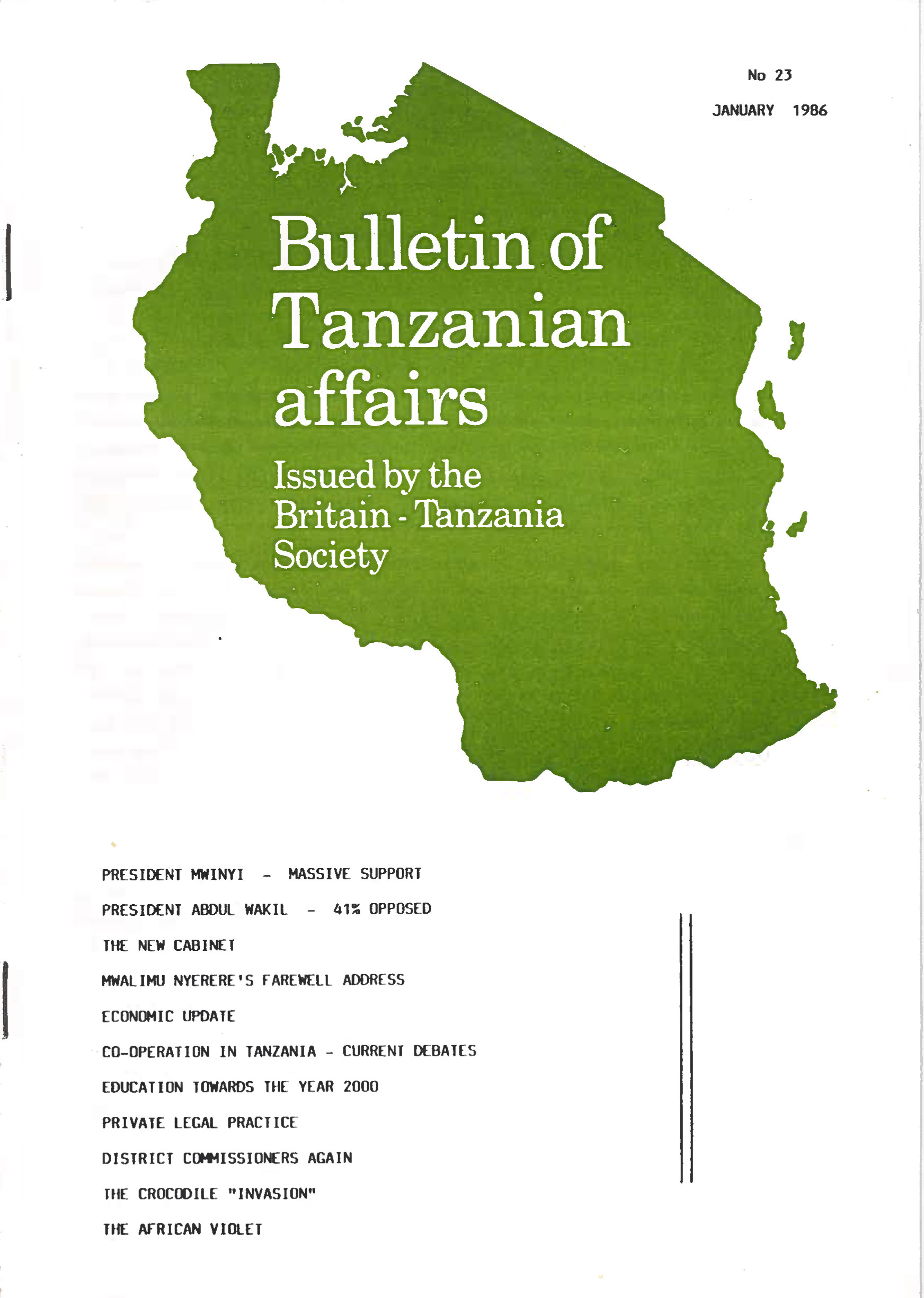
TA ISSUE 23

TA23 cover

PRESIDENT MWINYI – MASSIVE SUPPORT
PRESIDENT ABDUL WAKIL – 41% OPPOSED
THE NEW CABINET
MWALIMU NYERERE’S FAREWELL ADDRESS
ECONOMIC UPDATE
CO-OPERATION IN TANZANIA – CURRENT DEBATES
EDUCATION TOWARDS THE YEAR 2000
PRIVATE LEGAL PRACTICE
DISTRICT COMMISSIONERS AGAIN
THE CROCODILE “INVASION”
THE AFRICAN VIOLET

EDITORIAL

The last four months have been the most eventful in Tanzania for many years, firstly the farewells to President Nyerere on his retirement. We have a review of his last interview – as President – on British TV by Dr Noel Thomas, Principal Lecturer in English, Westhill College, an affiliated college of the University of Birmingham on page 7 and several extracts from the President’s farewell Speech at the Diamond Jubilee Hall on 4 November 1985. Then came the massive vote of support received by President Mwinyi (page 4) and the indications of “rumblings” in Zanzibar reflected by the much lower level of support for President Wakil (page 5). Tanzania also has a new Cabinet (page 24) and a very different National Assembly. Nearly half of the MP’s lost their seats. Twenty-two former members were not in the list of candidates approved by the National Executive Committee. Ndugu Rashidi Kawawa and Ndugu Amir Jamal opted out voluntarily. In the seat of the latter (Morogoro Urban) Ndugu Shamim P Khan became the new MP. Ndugu Paul Bomani polled 55,898 votes in the Mwanza constituency against his opponents’ 20,727.

We were not the only publication to mark President Nyerere’s retirement with a special issue (No 22). We were fortunate to receive responses from 12 contributors but “Africa Events” in its tribute to the President under the heading “Moses’ Staff, Pharoahs Sceptre” attracted a further eight including George Shepperson recalling student days at Edinburgh University, Michael Manley former Prime Minister of Jamaica, Lucille Howell, Willie Brandt and our own Vice-President, Roger Carter, who wrote of Nyerere’s “Christian Insights and Fabian Origins”. One of our most difficult tasks in putting our own brochure together, surprising though it may seem, was to obtain a good photograph for the cover. It was pure coincidence that “Africa Events” used the same photograph for its special issue.

Meanwhile Tanzania’s economic problems remain. An update on these by Roger Carter is given on page 9. This is followed by a very interesting up-date on Tanzania’s Co-operative Movement where fundamental changes are underway. Peter Yeo took part, during August 1985 in some vigorous discussions at a seminar for field workers at the Co-operative College in Moshi and also had informal meetings in several primary societies in Rombo District. His article, on page 12, arises from these discussions.

Our article in No 21 has brought an encouraging response from Professor Mmari, Vice Chancellor of Sokoine University of Agriculture who states that, as far as the Mazumbai Forest is concerned, over which the University has control, no parastatal organisation will be allowed to establish a sawmill. On a similar theme, crocodiles in Lake Rukwa, we have an article from Joseph Kithama of Shihata, the Tanzanian News Agency (page 18).

Among the many Tanzanian visitors to UK during recent months has been Mr M S Muze a former Commissioner of Education. He told me that the Government continues to place high priority on primary education and now that teachers are being produced in greater numbers it is becoming possible to pay more attention to quality. We have been meaning to publish a review of the Presidential Commission on Education “The Educational System in Tanzania Towards the Year 2000” for some time and managed to persuade Peter Chonjo to do this for us during the short time he had left in Britain after completing his PhD studies. His report starts on page 20.

We should be celebrating in this issue two tenth anniversaries – those of the “Britain-Tanzania Society” and the “Bulletin of Tanzanian Affairs”. Unfortunately we ran out of space so we will try again in 10 years time! I hope I may be forgiven for a personal celebration. “Ukulimu wa Kisasa” (Modern Farming) with which I was closely associated in its early years has just published a special issue (No 350) to mark its thirtieth year. One of its readers, Felix A L Makimbo, offered a poem which begins like this:

Ni Miaka thelathini, ukulima wa kisasa,
Gazeti letu nchini, umri limetimiza,
Liitoayo misingi, ya kulima kwa kisasa,
Umri twaliombea, gazeti letu lidumu.

Miaka hiyo ni mingi, ambayo limetimiza,
Tuliyofunzwa ni mengi, ya upandaji wa pamba,
Tumbaku nayo iliki, ukulima wa matuta,
Umri twaliombea, gazeti letu lidumu.

Na upandaji wa miti, mihogo na marejea,
kahawa pia katani, muda wote tumesoma,
Michungwa upachikaji, hayo yote laeleza,
Umri twaliombea, gazeti letu lidumu.

Lasomesha mambo mengi, ili nchi kuijenga,
Na mbolea jinsi gani, kwa hakika kutumia,
Wadudu uzuiaji, hayo yote laeleza,
Umri twaliombea, gazeti letu lidumu

David Brewin

PRESIDENTIAL ELECTIONS

PRESIDENT MWINYI – 92% SUPPORT
PRESIDENT ABDUL WAKIL – 41% OPPOSED

The results of the Presidential elections in Tanzania gave President Ali Hassan Mwinyi a massive win but the results of the elections held earlier in Zanzibar gave President (of Zanzibar) Idris Abdul Wakil only 58.6% of the vote.

The Daily News reporting on the day after the results were declared (1 November, 1985) stated that the results were not unexpected but they overwhelmed Ndugu Mwinyi, and he said so, as well as Mwalimu Nyerere, who shed tears of joy.

Mwalimu declined comment on Ndugu Mwinyi’s victory when he was invited to speak by the Chairman of the National Electoral Commission, Chief Adam Sapi Mkwawa. “I cannot say anything,” he pleaded.

He was probably overjoyed by the positive response to his repeated call on voters during the election campaign to give his successor a massive confidence-building “YES” vote.

Ndugu Mwinyi’s score is just a point short of Mwalimu Nyerere’s 93.01 per cent win in the 1980 election. The retiring President won 91.46 per cent of the 4.5 million votes cast in 1975.

Announcing the results at a colourful ceremony held at Diamond Jubilee Hall in Dar es Salaam, Chief Mkwawa said 5,181,999 or 74.98 per cent of the 6,901,555 registered voters cast their votes on Sunday.

He said 4,778,114 people voted “YES” while 215,626 or 4.16 per cent voted “NO”. Chief Mkwawa said 188,259 votes accounting for 3.64 per cent of the total were spoilt.

The Commission Chairman said it was clear from the results that more than half of the voters had accepted the sole Presidential candidate, a minimum score set by the 1984 Union Constitution.

“I, therefore, hereby declare that Ndugu Ali Hassan Mwinyi has been elected President of the United Republic of Tanzania under Section 41(3)(c) of the 1977 Union Constitution as amended by Act Number 15 of 1984,” the Commission Chairman said.

The announcement was greeted by prolonged applause from Party, Government leaders and foreign diplomats gathered in the hall to hear the results.

President Nyerere, vividly the happiest man in the hall, gave Ndugu Mwinyi a hug. Then came the turn of other dignitaries to shake hands with the President-elect. These included Mama Maria Nyerere and Mama Sofia Kawawa.

Emotions were charged by a ceremonial number Yuko Wapi Ndugu Mwinyi Tuhangaike Naye – literally translated to mean “where is Ndugu Mwinyi, we want to have a field day with him” – which was played by the National Service Taarab Group.

Amid the fanfare, Young Pioneers gave Ndugu Mwinyi a scarf and garlanded Mama Mwinyi.

In his brief but meaningful acceptance speech following the formal announcement of results, Ndugu Mwinyi said: “I publicly accept to carry the burden of state, to serve and not to rule as a servant of all Tanzanians”.

Ndugu Mwinyi promised, that he would endeavour to serve the people of Tanzania diligently and honestly without favour, regardless of their religion, colour, station in life or place of origin. Referring to his election, he said: “I must confess that I am immensely overwhelmed by the outcome. Even where I was sure of being elected, but I honestly did not expect such a massive mandate”.

“I am most grateful. I also want to thank all the people, especially those who were lucky enough to register and actually vote on October 27. I particularly thank those who voted “Yes” for demonstrating full confidence in me. “These people have gambled correctly and I sincerely thank them for this. I will strive to live up to their expectations”.

Ndugu Mwinyi went on to thank those voters who voted “NO”, for their political awareness and use of their conscience to vote in Tanzania’s democratic elections. “I do promise that I will serve all of them, even if I knew them, equally with any other Tanzanian citizen”.

He concluded: “I have already said I am overwhelmed, indeed I am, I have nothing to add”.

In Zanzibar, the Chairman of the Zanzibar Electoral Commission announced that 131,471 (58.6%) voted Yes to Ndugu Wakil (formerly the speaker of Zanzibar’s legislature) and 75,220 (41.3%) voted No. In its November issue “Africa Events” endeavours to explain what happened in Zanzibar on the basis of the existence of two power blocks vying with each other for ascendancy in Zanzibar’s politics. One group are said to regard themselves as the legitimate heirs of the late Sheikh Abeid Karume and his Afro-Shirazi Party (ASP) and the other more closely in sympathy with the liberalisation measures introduced by President Mwinyi when he became President of Zanzibar last year. Ndugu Wakil was said to have had the support of the former group.

Apparently there were other factors including traditional feelings between Zanzibar and Pemba; the people of Pemba voted Yes for Wakil in much smaller numbers than those in Zanzibar.

According to “New Africa” Ndugu Wakil had been initially selected as candidate for President by the National Executive Committee (including islanders) by only 85 votes to 78 for Zanzibar Chief Minister Seif Shariff Hamed who hails from Pemba. Ndugu Wakil subsequently re-appointed Ndugu Hamad as Zanzibar Chief Minister.

Former President Nyerere referred to the Zanzibar problem during one of his pre­election visits to the island. He said that the Chama Cha Mapinduzi will never entertain the idea of having conflicting groups within its ranks and that the main task of CCM leaders and members at the moment is to build a strong party.

He said it was healthy for CCM members to hold different views on certain issues, but this did not mean having groups engaging in “tug of war” within the Party.

He said prior to Tanganyika’s independence and the revolution in Zanzibar there existed several parties. On the Mainland there were TANU, Congress and other small ones. In the Isles there were the Afro Shirazi Party, UMMA and ZPP.

But after Tanganyika’s independence and the revolution in the Isles all the other parties dissolved themselves and their members joined the mainstream of TANU and ASP.

“Because we accepted them into our ranks, there was no reason whatsoever to continue to be suspicious of them since they became part of us”, he said.

The Party Chairman explained that the same people who did not belong to either TANU or ASP during the independence struggle were later absorbed by CCM in 1977.

What was important from these people was their allegiance to CCM and not to their former parties, including TANU and ASP, he stressed.

On Zanzibar’s political history, Mwalimu said at one time Pemba was the power base of the UMMA Party whilst the Afro Shirazi Party was dominant in Zanzibar.

Mwalimu dismissed as absurd claims by some CCM members and leaders in Zanzibar that there were good and bogus members within Chama Cha Mapinduzi.

He also said it was a great sin for CCM members to discriminate against fellow members on the basis of colour, or because their fathers and relatives belonged to Parties other than ASP.

“CCM is not a racist Party and with its formation we began a new chapter to build unity and forget the past” Mwalimu stressed.

On the nomination of Ndugu Ali Hassan Mwinyi for the Union Presidency, he said many people in Zanzibar were not happy because he had done commendably well during his short tenure of office in the Isles and would have wanted him to be their leader for a few more years.

On the other hand, a few disgruntled elements in Zanzibar were happy that Mwinyi would soon be moving to Dar es Salaam to head the Union Government which they considered better for them because as they saw it Ndugu Mwinyi was misleading Zanzibar.

Mwalimu stressed that whatever Ndugu Mwinyi had been able to do in the Isles was a result of his diligent application of Party policies and, therefore, whoever challenged him on this was challenging CCM and should be prepared to fight CCM, the Party Chairman warned.

He said after his retirement his main concern would be to build a strong and united CCM on the basis of the laid down objectives.
David Brewin

NYERERE – THE SUMMING UP

The very welcome appraisals of Julius Nyerere which appeared in the previous edition of “The Bulletin” have been matched by a special interview with the President, broadcast by Channel Four TV in which the interviewers were Tariq Ali and Darcus Howe.

It provided an altogether fascinating insight into the nature of both the politician and the man. It also gave him a chance to look back over his years in power, and to provide at least a few clues to the historians who will later be trying to assess the importance of Julius Nyerere, not only as President of his own country, but also as one of the principal architects of emergent Africa.

It was therefore a natural starting point to ask him first what he thought was the greatest achievement in Tanzania’s development during the last twenty years. Nyerere was absolutely clear in his reply. “The greatest achievement is that we are a united nation; a nation with a purpose.” He took his main illustration from the field of education, pointing out that when the British left there were only 300,000 children in primary education for four years. Today in Tanzania there are three and a half million children receiving primary education and each child is able to stay in school for seven years. Nyerere conceded that there were many things his Government had not been able to do, and many social advances were still to be made, but he obviously took enormous pride from the fact that between eighty five and ninety per cent of the people of Tanzania were now literate. “We have virtually wiped out illiteracy in our country”, he declared confidently, and there is little doubt that for him this single fact is more important than any other social development in the independent life of his nation.

The President was then asked to comment on part of the Arusha Declaration – that every government leader must be a peasant or a worker, and must in no way be associated with the practices of either capitalism or feudalism. He affirmed that despite all difficulties this had been achieved. The main problem, of course, had been to educate an entire nation to accept priorities quite different from those which many other newly independent countries had made. Normally the populace wanted quick wealth and a very rapid rise in the standard of living. It had been necessary in Tanzania to show that the proper development of the country could not be attained by the easy grabbing of riches and the smooth acceptance of easy capitalist criteria.

Throughout the whole interview Nyerere returned again and again to the terrible contrast between poverty and wealth which continually plague the world. He had obviously been very impressed by the huge response which many individuals in the Western world had made to the tragedy of the Ethiopian famine. And yet the governments of the Western world had on the whole failed to match this response. Instead their statesmen had tried to put the blame on their democratic systems, defending themselves by claiming that in a democracy ‘it is very difficult to transfer wealth from their systems to poorer nations.’ Here President Nyerere was at his most passionate and eloquent. “I accept that; I know that it is difficult. But why did those statesmen stop there? They are refusing to educate their own people. And yet those same people, as individuals, responded. It was the governments that failed.”

The President conceded, however, that African governments and statesmen were by no means free from blame. They should be truly responsible to their own people. “I don’t think we are educating our own people enough.” In countries where there were no political parties, and only armies held control, there were inevitably very big problems. “It is very difficult for armies to mobilize their people.” It was in the many comments of this sort, dotted about the interview, that Julius Nyerere showed quite plainly that little escapes him in African affairs, and the behaviour of certain countries make him unhappy.

In the last two minutes of the interview after lengthy discussion on relations with the IMF and South Africa, Julius Nyerere talked whimsically about his own future. Yes – he would stay on for a further two years as Chairman of his Party, but then he would leave public life. With a broad smile on his face he denied that it was a unique event. “It is not unique. Leopold Senghor did it before me. I am doing it because it is time to do it. My country has allowed me to lead it for thirty years. If you gave me another thirty I could not do more.”

And so the man who more than any other statesman has become the image of Tanzania for the world outside will, when his two years as Chairman have come to an end, “retire to my village, to keep my six cows, and help with the village farm”. And at the very end of the interview, having reviewed the problems of his own country and of the world, and nailed once more his colours uncompromisingly to the mast, he was still smiling.

Noel Kennedy Thomas

MWALIMU NYERERE’S FAREWELL ADDRESS

In the original publication these quotes appeared individually, spread out through the bulletin.

We have built a nation – together. The angel Gabriel could not have built Tanzania alone, still less a fallible human being like myself. Even if the Angel Gabriel had been assisted by Ministers and public servants made up of other Angels, he still could not have built Tanzania. You, the people of Tanzania, acting together and individually, have built Tanzania into what it is – a proud, united, and self-confident nation. I thank you all very much.
Julius Nyerere, Farewell Speech,
4 November, 1985

.

It is easier to respond to a simple challenge like an invasion than to withstand the constant difficulties and disappointments, as well as triumphs, of trying to develop a poor and backward country like ours. Yet for nearly 22 years – on the mainland for longer – we have worked and struggled together, and you have supported my leadership while we went through the very many difficulties and troubles of our short national life. And even now we are still contending with extremely difficult economic circumstances, with no sign that external conditions will move in our favour. I repeat; we have faced the sacrifices and fought the difficulties together. We are still doing it. And although I say we have done these things together, it is you, the people of Tanzania, who have borne the real burden – which is a very heavy one.

Over the last six or seven years our country has been hit by many events over which neither Government nor people had any control. Our standard of living has consequently gone down instead of going up. But you, the people of Tanzania, have not just become uselessly and destructively angry, nor suggested that we should sell our independence for very temporary relief from our economic problems. Instead, you have supported me and your Government, and fought against the effects of the break up of the East African Community, the drought, the drop in our export prices, and the international economic recession. And you have understood that the struggle is not over, – that it will go on for a long time.

Thank you very much.
Julius Nyerere, Farewell Speech

.

For we have an international reputation, and I have an international reputation also. You have created both. When a person is hard-pressed or in other economic trouble, he can either crawl on his knees and beg the rich for alms, or he can stand up for justice while he endures and struggles to become more self-reliant. The same thing is true of a nation. But the nation has to be politically strong and proud in order to make the latter choice. You, the people of Tanzania, have provided that strength by your unity, your self-respect and your pride in our independence.
Julius Nyerere. Farewell Speech

.
 
And the truth is that religious conflict could have been a bigger danger to us in Tanzania than tribalism. We inherited a situation where the two major religions had about the same number of adherents, but where as far as the Africans were concerned one had had almost a monopoly of access to secondary and higher education. When we began to Africanize posts which were previously held by the colonial servants, almost all of the few Africans who had the necessary educational qualifications were Christians. This fact could have been used to divide us along religious lines – and there were a few individuals who did try to do that. But the muslims of our country absolutely refused to be hoodwinked by this attempt to divide us; in doing so they made a contribution to our later peace and development which is of inestimable value. And they gave us a chance, through our educational policies, to correct the imbalance we had inherited – which we have done. I am now in the happy position of sometimes not knowing whether a new Member of Parliament, a Minister, or a new Principal Secretary in our Government Ministries, is a Muslim or a Christian or neither – unless their first name happens to give it away. And even that is not a sure guide in Tanzania, for we have Christians with Muslim names, and Muslims with Christian names. The religious tolerance and freedom in our country is your creation; what I have done is to speak up for these values on your behalf.
Julius Nyerere. Farewell Speech

.

What more can I say? We have worked together, rejoiced together, been sad together, and mourned together when we have lost a colleague or a friend of our country. We have laid the foundations of socialism and self-reliance together. I thank you for your comradeship in all these struggles. I thank you for making Tanzania what it is.
Julius Nyerere. Farewell Speech