CHANGES IN THE STANDARD OF LIVING

In January, 1978, in Bulletin of Tanzanian Affairs No.5 we reported on the trend in the cost of living in Tanzania down to the beginning of 1977. Since then, strong inflationary influences have pushed prices up and it therefore seems opportune to review once again the effect of this trend on the standard of living so far as this is apparent from the published figures.

The first general indication of the price trend is to be seen in the national consumer price index. Using a base line in 1969, this index rose by 687% in 1983. Within this period, food prices rose by 807%, clothing by 696%, fuel and water by 855% and furniture and utensils by 1,101%, only rents remaining but 8% above the 1969 level. After the nationalisation of buildings in April, 1971, rents fell by over 60%, but were subsequently increased in stages in 1978, 1980 and 1982. The trend of prices at the end of 1983 is clearly visible in the figures for the fourth quarter. Food prices were then 894% above the 1969 baseline, fuel and water 1,252% up.

The Dar es Salaam retail price index for the lowest paid workers showed a still more serious upward movement, while Dodoma was somewhat less seriously affected. The following table compares the trend in Dar es Salaam and Dodoma with the trend in the minimum wage for urban workers.

Percentage rise over 1969 of the retail price index for the lowest paid urban workers in Dar es Salaam and Dodoma

Dar es Salaam All items, Food
1972 18.6, 20.1
1974 69.0, 77.2
1975 148.5, 165.8
1980 412.2, 460.1
1981 569.5, 619.4
1983 907.9, 961.2

Dodoma All items, Food
1972 14.2, 13.4
1974 47.2, 70.2
1975 99.0, 144.4
1980 292.2, 324.4
1981 392.6, 424.0
1983 706.8, 784.4

Minimum wage % over 1969
1972 35%
1974 70%
1975 90%
1980 140%
1981 300%
1983 300%

Source: Hali ya Uchumi wa Taifa katika Mwaka 1983: Dar es Salaam 1984

The conclusion from the above table is inescapable that the standard of living of the lower paid town dwellers has fallen substantially. In July, 1984, there was a further rise in the minimum wage to 405% above the 1969 level, but the disappearance of the sembe subsidy in the 1984 budget must have given a simultaneous boost to the retail price index. The widespread cultivation of spare patches of land in Dar es Salaam, even to some extent in the middle class suburbs, is evidence of the straightened conditions in which many people now live.

There is no doubt that the pressure on urban populations shown by these figures is a cause not only of great anxiety on behalf of those affected, but also of concern for political stability. The figures well illustrate the caution shown by the Tanzanian government in accepting some of the more draconian proposals of the International Monetary Fund. Owing to the very great difficulty in bringing inflation quickly under control, the situation is unlikely to get better in the short term. The real solution to the problems of the urban poor is a turn round in the economy and every day that passes without an IMF agreement only exacerbates the problems of regeneration and increases the dangers of political disorder.

J. Roger Carter

SOCIALISM AND CAPITALISM

Professor Abdulrahman Mohamed Babu’s address at the University of Dar es Salaam received front page coverage in the ‘Daily News’. He is reported to have said that capitalism can be applied towards attaining Tanzania’s socialist objectives and added that it was wrong to condemn capitalism wholesale. It was a dynamic force. To ignore it would amount to unrealistic emotionalism, he pointed out, stressing that ‘we should make the best out of it and avoid the worst.’ To quote the article, Ndugu Babu said infusion of positive capitalist practices into Tanzania’s economic system was essential for reconciling the country’s backward agriculture and infant industrialisation. ‘Let the people be rich- socialism is about plenty, not poverty, ‘ he emphasised, pointing out that the more economically well-off people become, the stronger the home market becomes and the more conducive situation you create for a budding industry.

He argued that the burning question was not capitalism versus the masses, but by 90% the masses versus nature. He thus advocated increased encouragement of private investment in socially oriented enterprises as well as individual initiative to create capital for sustained growth.

He called for emulation of the recent decision by Chinese authorities to allow for three per cent vigorous private economic participation in the continuing search for a rational balance between consumption and accumulation, a goal, he said, which transcended ideological affiliations.

The Professor decried the tendency of heavy expenditure on grandiose projects at the expense of those that touched the people more closely and which would ultimately be economically more viable. Ndugu Babu, who underscored the need for constant self-criticism, called for a scientific approach in mapping and implementing Tanzania’s socialist programmes, noting that the country’s stable government was a major foundation upon which to build a successful future.

BOOKS

Andrew Coulson of the Institute of Local Government Studies in the University of Birmingham has reviewed: “Resources and Industry in Tanzania; Use, Misuse and Abuse” by J.V.D. Jones (Tanzania Publishing House, Dar es Salaam, 1983). He writes:

The most common starting point for discussions of industrialisation is markets: if a market for a product can be identified, then a project to manufacture it is proposed. The industrial process is usually based on imported raw materials and equipment and all too often the proposal itself is made by someone who has a vested interest in selling either industrial inputs, or – more likely – machinery. It is not surprising that so many projects created in this way turn out badly. They give a bad taste to the whole process of industrialisation in countries such as Tanzania.

The strength of this book is that it starts not from markets, but from the raw materials available, and describes how they could be used to develop a self-reliant industrialisation in Tanzania. Both large-scale and small-scale processes are discussed, without any vested interests.

The author was a lecturer in chemistry at the University of Dar es Salaam, who subsequently moved to Development Studies and worked with the university students and contacts in the parastatals to assemble the mass of information assembled in this book.

Obviously what can be developed in the future depends on what exists already. The book therefore describes the processes used in existing Tanzanian factories. But it also recognises that these are determined to a large extent by the historical origins and ownership of the companies who made the investments. A theme which occurs many times is the interrelationship between industries. If coal is to be mined, a variety of the industries are needed to use both the coal and its by-products. If a rural industry is to use hydroelectricity, then the planners need several years’ warning. If salt is to be electrolysed to make caustic soda for the soap and glass industries, then uses for chlorine must also be found, e.g., to make hydrochloric acid, PVC, or insecticides. A self-reliant industrialisation is too big and complex to happen spontaneously {n a country with markets as small as those in Tanzania. It therefore has to be planned around a small number of key industries, as the experience of socialist countries teaches us.

This is therefore a uniquely valuable book, not just one for specialists. It includes many positive suggestions and should be available for reference by anyone concerned with developing projects in Tanzania. I hope it gets the distribution it deserves both inside and outside the country. It would be tragic if shortage of a basic raw material (paper) and industrial capacity (printing) prevented widespread use of this handbook, which points to the only way in which in the long term Tanzania can avoid its present cruel dependence on imports.

Andrew Coulson

Professor Royston Jones has sent us the following review of a recent book: “Problems and Contradictions in the Development of Ox Cultivation in Tanzania” by Finn Kjaerby Research Report No.66, Centre for Development Research, Copenhagen and Scandinavian Institute of African Studies, Uppsala, 1983.

The message of Kjaerby’s report may be summarised as follows. The Government has given verbal encouragement to the use of oxen for cultivation, but financial aid has still gone to tractors, although the use of tractors has failed because of lack of expertise and servicing facilities. Agricultural development plans have paid insufficient regard for the peasant farmers’ customs and their intimate knowledge of their local conditions. Oxen and ox ploughs are in demand in some areas and efforts are needed to meet present demand. Demand in other areas is hampered by lack of funds and lack of knowledge about the advantages of ox-ploughing. There is still room for much field experiment in the development of the most appropriate agricultural tools for the different Regions, although much of the past experimental work away from the realities of true site conditions has not been of great value.

The report examines the development of animal traction for smallholder peasant farmers against a background of failures of more capital intensive technology in relation to the present energy and production crisis in under-developed countries. It is pointed out that the slow and uneven success of the ‘green revolution’ has resulted in an increasing acknowledgment of ‘the need for increasing the source of farm power in agricultural systems dependent on hoe cultivation and human energy … ‘ The report examines in detail the potential of animal traction, which is stressed in a growing body of literature. A review is made of the agricultural mechanisation policies of the Tanzanian Government during the 1960’s and 1970’s. Despite the failures of cooperative tractor mechanisation and emphasis on animal traction given in political statements, the lion’s share of funds and efforts continued to be concentrated on tractor mechanisation for the villages.

Ox ploughing by African farmers in Tanzania has had a history of only some 50 years and has depended almost entirely on the single furrow mouldboard steel plough, whereas in Ethiopia a locally made wooden scratch plough (the ‘ard’) with a horizontal fitted iron blade has been widely used for more than a thousand years. A rough estimate gives a number of some 70-80 thousand ox ploughs in Tanzania at the end of the colonial period.

Among the socio-economic factors in colonial times determining the spread of ox ploughs were the development of a profitable cash crop and the growth of wage labour, whether migrant labour in mines, employment on settler farms, or salaried employment. Savings from cash crop production and wage employment rather than credit constituted the main source of investment capital for the purchase of oxen and ploughs. Government extension and trial work played virtually no role in the spread of ox ploughing. The process arid pattern of adoption was one where the initial innovators had the opportunity to learn about profitability and skills from settlers and missionaries. They succeeded with ox ploughing in their villages, where others became interested and could learn the skills.

The distribution of ox ploughing until very recently has remained uneven and has depended upon a variety of factors, including infrastructure facilities for marketing, transport and repair services, soil conditions and the availability of grazing access for cattle, the possibility of growing suitable crops like cotton, rice, maize, wheat and coffee and the presence of settler farms and missionaries. It is probably safe to conclude that even in areas where ox ploughing has become fairly common, the ratio of those who acquired ploughs remains low in relation to the number of households. The main reason is the unequal ownership of cattle, which determines access to draught oxen.

It is rather difficult to assess the impact which the development of ox farming has had on the rural economy. It seems that the concern about lower yields has been somewhat exaggerated. In the long run the only way to overcome this problem is to intensify production through the development of ox powered comprehensive mechanisation spread more evenly over the farming population in relevant areas. Of even greater importance is the fact that comprehensive ox cultivation can relieve one of the most immediately pertinent constraints on agricultural productivity, namely, the excessive workload on the women in weeding and transport.

Recent plans for the increased production of ox equipment are criticised in terms of the choice of appropriate equipment. One of the most needed items in addition to the ox cart is an inter-row weeder, or cultivator for relieving the critical weeding bottleneck. Kjaerby suggests that the production of a tool bar should be planned, such as the proven light weight ‘houe sine’ made in Dakar, to which can be attached a single plough share, a ridger share, chisels, tines, a groundnut lifter and even an eco-seeder. Other alternatives are also considered.

The author reviews in detail the problems of research, design and production of a comprehensive range of appropriate equipment. There is criticism of the value of tests made in rather favourable experimental environments. If peasant agriculture is to benefit from the Tanzanian research institutes, it must be based on the actual conditions of peasant farming, viz., sloping fields, stone and weed problems, undersized oxen, problems of seed quality, etc.. Given the present shortage of mouldboard ploughs and the crying demand, the time would seem ripe to introduce the Ethiopian ‘ard’, which pushes its way through the soil without inverting or overturning the topsoil, especially in semi-arid areas. It is cheap, easily made and easily operated.

The author discusses the changes in land use brought about by villagisation and population growth and suggests various possible developments and modifications of ox drawn implements appropriate to the new situation based on applied research. The most serious constraints on production, he believes, are weeding and transport, pointing to the importance of ox carts and inter-row weeding equipment. As many implements as possible, including ox carts, should be capable of manufacture and repair in small village workshops.

Mr. Kjaerby concludes his book with suggestions about the use of agricultural credit and with speculations about the changes in social relationships that may be brought about by a growing use of ox technology, particularly with respect to the role and influence of women. He comments on the past tendency in design work to draw uncritically on European concepts and to go for solutions which cannot be realised under peasant farming conditions. He recommends two levels of research, which must be closely coordinated:

(1) Farming systems research to identify major constraints and adaptive testing of implements on individual peasant farms.

(2) Adaptive design and testing work at research stations simulating peasant farming conditions.

There is a great variety of peasant farming systems and agro-economic zones in Tanzania, which necessitate local specific solutions to technological problems and constraints. Mr. Kjaerby repeatedly emphasises the need for the closest possible attention to realistic feasibility studies in the field in order to avoid a continuation of past failures and the application of inappropriate technology.

Royston Jones

TANZANIA’S WATER SUPPLIES

In 1971 Tanzania declared its intention to supply the entire population with clean piped water within a walking distance of 400 metres by 1991. During the first decade of the programme it is estimated that 7.7 million people received piped water for the first time and that some 45% of the population of 19.4 million now enjoys access to clean water. But only 38% of rural dwellers are served, compared with 80% of those in urban areas. Thus Tanzania still has a long way to go.

Dr. Allen Armstrong of the University of Dar es Salaam Department of Geography has been writing in the Daily News about some interesting recent developments as follows:

“The completion of regional water master plans during 1983, covering 17 of its 20 Regions over a 12 year period, represents a major advance towards its target. The plans now provide authorities with basic information previously lacking – a comprehensive water resources inventory, an appraisal of demand and socio-economic issues surrounding water issues and concrete proposals for water supply schemes in a regional, and frequently in a village, context.

The plans, representing a major investment in obtaining water-related knowledge, have been undertaken by eight international consulting firms financed by nine different overseas donors.

Two major lessons have been learned in the process of producing the regional master plans. The first is the need for designing the simplest technologically appropriate solution, stressing ease of construction and operation, low costs and which obviate the need for imported skills and equipment. Early water schemes and development projects in many other fields have failed because they failed to respect these basic criteria.

As a result of experience, recent master plans have suggested an appropriate technological mix, obviously dependent on local conditions, would be 15% gravity water supplies, 20%, surface water pumped, 15% boreholes, 50% shallow wells.

Recent plans have also carried socio-economic studies as an integral component, recognising that community participation is a vital element in installing and, even more so, in operating and maintaining them …. Indeed, the very nature of water supplies implies that it is almost impossible for a centralised official body to construct and run schemes throughout the country and is, therefore, most effectively handled at local level …

Despite clearly defined targets, generous foreign aid and competent technical documents, (Tanzania) is experiencing many problems, which typically and increasingly beset basic needs strategies. In line with the country’s other faltering development programmes, it is beginning to realise that a wide gap remains to be bridged between successful planning and effective implementation.

Allen Armstrong

TANZANIA’S CONSTITUTIONAL AMENDMENTS

Introduction
The latest constitutional reforms in Tanzania, which were adopted by the National Assembly in Dodoma in October, 1984, have been seen as a step towards the consolidation of democracy and the building of socialism in Tanzania.

In order to appreciate the various major changes which have been introduced, it is proper to look at the political and legal background of this constitutional process, which marks a big historical milestone in the history of Tanzania. Post-independence constitutional structures have largely responded to the political evolution which the nation has gone through since 1961. These are best illustrated by the 1962 Republic of Tanzania Constitution and the 1965 Interim Constitution, which formalised the United Republic of Tanzania following the 1964 Act of Union with Zanzibar. In the aftermath of the merger of the political parties in Tanzania mainland and Zanzibar, which led eventually to the formation of Chama cha Mapinduzi in 1977, the political structure was again reflected in the 1977 Constitution of the United Republic. This Constitution was further amended in 1980 to take account of a significant evolutionary process in Zanzaibar, where the government had introduced a more representative government structure by the adoption of the 1979 Zanzibar Constitution, whose positive contribution was the introduction of a House of Representatives. This House took over the legislative powers hitherto exercised by the Zanzibar Revolutionary Council, which had ruled by decree since the 1964 revolution. The Council has, however, remained until now the executive organ of the Zanzibar government.

1984 Fourth Amendment
The amendments which were adopted by the National Assembly were known as the Fourth Constitutional Amendment Act, 1984. This constitutional measure replaces the 1977 Constitution subject to the retention of some of its provisions and others carried forward from previous Constitutions. The present amendments were based on the 1983 proposals drawn up by the Executive Committee of Chama cha Mapinduzi in order to correct certain anomalies, and shortcomings highlighted in the Party’s 1981 guidelines.

The National Executive Committee looked at the political situation in Tanzania and the need to provide for democratic safeguards within the context of a one-party democracy and also to guarantee the socialist goals to which Tanzania is committed. There were three main areas which were pointed out for analysis and possible reform, namely:

– The powers of the Presidency
– The supremacy of Parliament
– A participatory democracy

When these proposals were eventually released to the public, the National Executive Committee had also considered it appropriate to find ways of consolidating the Union in view of certain areas which needed greater clarity, such as the unique structure of government, which was neither federal, nor completely united. Also, Significantly, the question of sharing and dividing national resources and responsibilities needed also to be clarified, so that future governments would have clear guidelines in running Union affairs.

Following the release of the Party’s proposals there ensued widespread public debate and it was a result of this debate that two major political and constitutional achievements have become well established and reflect the political maturity of Tanzania.

First, the free and widespread public debate, which preceded and influenced these constitutional changes did much to arouse constitutional and political awareness in many spheres of life in Tanzania. The second major achievement in the new Constitution was the inclusion of a chapter on human rights. A major criticism of Tanzania had formerly been the lack of a legal basis for its respect of human rights. The Fourth Amendment brings these out in full in Chapter 3, which defines the rights and duties of individuals, provides safeguards against the abuse of state power and outlines the limitations on individual rights when they infringe the rights of others. It may rightly be said that the public debates convinced the Party and Government that the constitutional exercise would be incomplete without a Bill of Rights in the Constitution.

The Constitution
As any other constitution, the 1984 Act has provided for the division of power within the state and has defined the powers of the Party, the Presidency, the Executive, the Parliament and the Judiciary. The Constitution also clearly defines the areas which apply to the Union Government and those which apply to the Zanzibar Government. It underscores the political fact of having two governments in Tanzania, in which the Union Government covers concurrently the union and mainland jurisdictions. Article 4 of the Constitution establishes a structure consisting of two governments and forms the basis of the 1st. Schedule, which enumerates the matters subject to Union jurisdiction. There are 21 items which now appear on the list of Union matters. There were 17 items in the 1977 Constitution and therefore it is worth noting that the following have been added as new Union subjects:

1. Communications and Civil Aviation
2. Research
3. Meteorology
4. Central Statistical Data Collection
5. the Court of Appeal

One provision, relating to East African Community affairs, was of course dropped. All non-Union matters relating to the mainland fall under the Union Government, while non-Union matters relating to the islands of Zanzibar and Pemba come under the Zanzibar Government.

The Constitution provides for the office of President, who is to be elected for a maximum period of two terms. This is a new provision, but it does not preclude a person who has served as President of Zanzibar being elected as President of the United Republic (Article 40(2) and (3)). For the Vice-Presidency, the Constitution has introduced a system of two Vice-Presidents, whereby at any time one shall be the President of Zanzibar and the other the Prime Minister of the Union. Their order of seniority is determined by Article 47 so as to ensure that the President and the First Vice-President come from the Islands and the Mainland respectively, or vice versa.

The office of Prime Minister again appears in the Constitution and while, as indicated above, he will be one of the Vice-Presidents, he will first and foremost be the leader of government business in the National Assembly (Article 52) and also be responsible for the day to day government business of the United Republic. Therefore the office of the Prime Minister is also a Union office.

As for Parliament, this has been endowed with powers under Article 63 whereby its primary responsibility is to ensure the accountability of the Government for its activities. Parliament has also the responsibility for legislation in Union matters and for Tanzania mainland, while the primary legislative function for all Zanzibar affairs is vested in the Zanzibar House of Representatives.

Article 63(e) gives as one of the functions of Parliament the duty to prepare, or direct the preparation, of reports on any of its functions for submission to the Party. This is a fundamental provision, for it recognises the concept of the supremacy of the Party, which has also been enshrined in Article 10 of the Constitution. The Constitution provides in Article 97 for the privileges and freedoms of Parliament.

Zanzibar
As regards Zanzibar, the House of Representatives has met and adopted amendments to the 1979 Zanzibar Constitution. These amendments have also had a far-reaching impact in view of the constitutional process which has taken root there. It is imperative to note that for the first time Zanzibar will have an elected House of Representatives. The House will also have the supervisory and legislative role over the Zanzibar Government, which has already been described in the case of the Union Government. There are other significant changes which the House adopted, such as the introduction of a legal system, which finds its source both in legislation and in the adversary legal system common also to the mainland.

Conclusion
This brief summary does not exhaust the changes brought about in the new Constitutions of the Union and of Zanzibar. There is, for example, a severe restriction on the number of nominated members of Parliament as compared with the 1977 Constitution, ensuring that a substantial majority are elected constituency members. It is hoped in a future issue of The Bulletin to give some further details of the Bill of Rights enshrined in the Union Constitution. Both of these new Constitutions are due to come into force in January, 1985.

B.T.M. Nyanduga

Note: The views expressed in the above article are those of the author and do not in any way represent the official views of the Tanzania High Commission, or of the Government of the United Republic of Tanzania.

WHO’S WHO AT THE TANZANIA HIGH COMMISSION

His Excellency Anthony B. Nyakyi – Head of Mission
Ndugu A. V. Magere – First Counsellor and Head of Chancery
Ndugu C.N.B. Mwakang’ata – Counsellor (Political) and Information
Ndugu J. Lugandu – Counsellor (Protocol)
Col. Ndugu B.N. Msuya – Defence Adviser
Ndugu G. Mkocha – Counsellor (Trade)
Ndugu B.T.M. Nyanduga – First Secretary (Economic and Legal)
Ndugu J. Ameir – First Secretary (Consular)
Mrs. S. Nyanduga – Third Secretary (Political) and Information
Ndugu B. Rweyendera – Administrative Attache
Ndugu F. Lweshabura – Financial Attache

Ndugu M.K. Nathani – Tourist Representative
Ndugu E.E. Khilamile – Assistant Tourist Representative

RESUMPTION OF RAIL TRAFFIC

The November 1984 issue of ‘Railway Gazette International’ reports that at a meeting in Nairobi in October the chief executives of the Kenya Railways and Tanzania Railways Corporation signed an agreement covering the resumption of rail traffic between them. Both form part of the metre gauge system, which formerly comprised, with Uganda, East African Railways. The Tanzania Railways Corporation general manager, Tom Mmari, announced that repairs of the 32km. section across the frontier between Kahe and Taveta stations had already been completed and through freight traffic was expected to begin almost immediately. A passenger service would be resumed when sufficient coaching stock became available.

On Lake Victoria, the train ferries ‘Victoria’ and ‘Umoja’ would start to ply between Mwanza in Tanzania and Kisumu in Kenya as soon as repairs had been completed. It is ten years since the break-up of the East African Railways system. In due course, the railways may be able to benefit from an exchange of staff for training and other purposes. The Railway Gazette also reports that, following a visit by Transport Minister John Malecela to Bruxelles, the Tanzania Railways Corporation is to receive shs.15 million worth of wagons from Belgian manufacturers. Following the recent completion of a study by Pakistan Railways into the proposed Musoma – Arusha line, the Government is to investigate sources of funding for the scheme.

P.H. White

THE MACHINE AGE
Construction of phase 1 of the Kilimanjaro Machine Tools Manufacturing Company has been completed and production has started. It will manufacture machinery and machinery spares that will be used for both metal and wood working activities in agriculture and industry. – Shihata

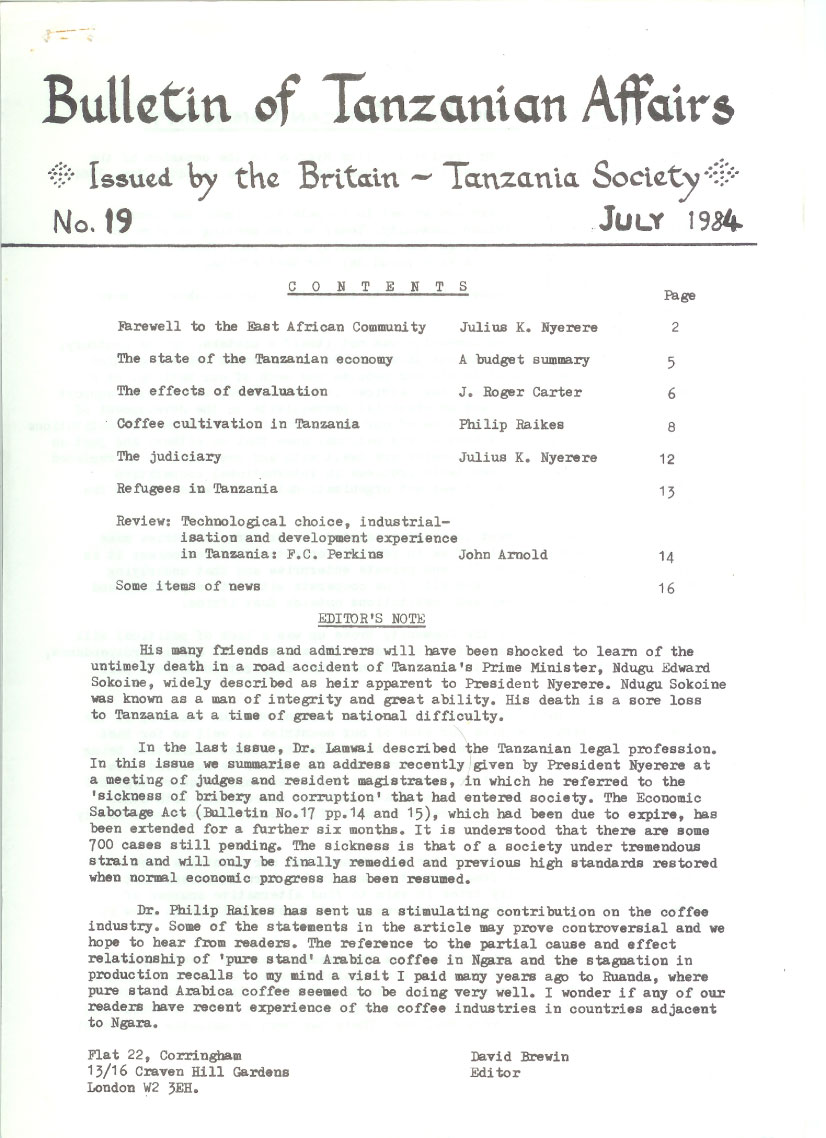
TA ISSUE 19

Issue 19 cover

Bulletin of Tanzanian Affairs
No. 19 JULY 1984

CONTENTS
Farewell to the East African Community – Julius K. Nyerere
The state of the Tanzanian economy – A budget summary
The effects of devaluation – J. Roger Carter
Coffee cultivation in Tanzania – Philip Raikes
The judiciary – Julius K. Nyerere
Refugees in Tanzania
Review: Technological choice, industrialisation and development experience in Tanzania: F.C. Perkins – John Arnold
Some items of news

EDITOR’S NOTE
His many friends and admirers will have been shocked to learn of the untimely death in a road accident of Tanzania’s Prime Minister, Ndugu Edward Sokoine, widely described as heir apparent to President Nyerere. Ndugu Sokoine was known as a man of integrity and great ability. His death is a sore loss to Tanzania at a time of great national difficulty.

In the last issue, Dr. Lamwai described the Tanzanian legal profession. In this issue we summarise an address recently given by President Nyerere at a meeting of judges and resident magistrates, in which he referred to the ‘sickness of bribery and corruption’ that had entered society. The Economic Sabotage Act (Bulletin No.17 pp.14 and 15), which had been due to expire, has been extended for a further six months. It is understood that there are some 700 cases still pending. The sickness is that of a society under tremendous strain and will only be finally remedied and previous high standards restored when normal economic progress has been resumed.

Dr. Philip Raikes has sent us a stimulating contribution on the coffee industry. Some of the statements in the article may prove controversial and we hope to hear from readers. The reference to the partial cause and effect relationship of ‘pure stand’ Arabica coffee in Ngara and the stagnation in production recalls to my mind a visit I paid many years ago to Ruanda, where pure stand Arabica coffee seemed to be doing very well. I wonder if any of our readers have recent experience of the coffee industries in countries adjacent to Ngara.

David Brewin
Editor
Flat 22, Corringham, 13/16 Craven Hill Gardens, London W2 3EH.

FAREWELL TO THE EAST AFRICAN COMMUNITY

(From a speech delivered by President Julius Nyerere on the occasion of the formal dissolution of the East African Community in Arusha on 14th. May, 1984)

Nearly seventeen years ago we met in Kampala and signed the Treaty establishing the East African Community. Today we are meeting to sign an Agreement, which formally brings that Community to an end. Therefore I cannot pretend that this is a very proud day for East Africa! But the past has passed. We have to learn from its mistakes and move forward again.

The existence of the Community was not itself a mistake. On the contrary, in the East African Community our three countries possessed something which was good, which was useful to all our peoples and each of our nations. As a result of it we had a coherent East African infrastructure, which could support a common market and which was an essential prerequisite to the development of large-scale industrial units. None of our East African corporations or institutions worked perfectly. I do not know of any national ones that do either. And just as faults within our domestic economies are dealt with and overcome, to be replaced by new problems, so the inevitable problems in international cooperation structures can be tackled. It was not organisational faults which led to the break-up of the Community.

Nor did the different ideologies adopted in our three countries make cooperation impossible. All of us in practice operate mixed economies; it is only the proportions of public and private enterprise and that underlying philosophies which differ. And all of us cooperate with both capitalist and publicly owned enterprises and institutions outside East Africa. The only reason why the Community broke up was a lack of political will to deal with it in a spirit of unity and in the awareness of our interdependence, with the inevitable difficulties of international cooperation between poor countries.

I think we have now learned this basic lesson. For the break-up of the Community was very expensive for each of our countries as well as for East Africa as a whole. It led to some essential infrastructural facilities being unnecessarily duplicated. Trade patterns were disrupted. We Buffered from trying to provide in isolation those public utilities which require regional action. And we found that in our separate economic discussions with other countries of the world the interests of East Africa could be even more easily disregarded.

Thus, we now know from bitter experience that our countries need each other. Isolation follows from separation and in its turn increases that separation as each country tries in vain to find alternative sources of strength. The result is greater weakness, or at least a failure to grow in strength.

Some of the problems arising from the break-up of the Community were recognised very quickly. A Mediator was appointed early in 1978 and charged with the function of distributing the assets and liabilities of the East African Community. The Agreement we are Signing today is his achievement and our achievement. It is a very real one. There has been an amicable settlement of very difficult and contentious issues and during the negotiations our awareness of being basically East African has been reinforced.

Today’s Agreement puts into legal form the decision of our three Governments about the proportion of the Community assets and liabilities which will be taken over by our respective countries. It marks the acceptance by all our creditors of this arrangement. Bilateral agreements have been made between each of our three East African countries and the creditors concerned. In addition, Kenya and Tanzania have agreed with Uganda on the compensation payments to be made for Uganda’s shortfall in assets. And last but not least, all East African Community pensioners and stockholders have been assured of their due money. Today we are transferring the East African Community to the history books.

As we do so, however, I want to record my sincere thanks to all those who have made our fresh start possible. I cannot mention everyone who contributed. ~t I must repeat my thanks to Dr. Victor Umbricht for his patient perseverance and the way he put his great intellectual and diplomatic abilities to our service. The World Bank and the UNDP financed the work done under his leadership and the British Government provided invaluable technical assistance to hill and therefore to us. The Ministers and Officials of our three Governments have also done an incredible amount of detailed work as well as giving the necessary advice to their respective Presidents. To all these people and institutions I offer my thanks. At the same time I would like to thank our creditors for their cooperation. Some of them have taken that even further by deciding to cancel East African Community debts so as to facilitate the renewal of cooperation in this region. We greatly appreciate this action.

So we in East Africa can now plan our future together. As we do so, we have to recognise the changes which have taken place since 1977 and which prevent the revival of the East African Community in its old form. Some of these changes have taken place within our separate countries, some relate to the different world environment in which we now have to operate. But while none preclude new forms of cooperation, some make it even more imperative than it was in the 1960’s and 1970’s.

In particular, the states of East Africa are now being forced to recognise and revalue their common interests in relation to the industrial world. All of us have been hit by deteriorating terms of trade, by the international economic recession and the monetarist policies which have been adopted to deal with it and by the resurgence in powerful countries of the doctrine that might is right. We have all experienced our individual weakness in negotiation, with its danger of giving away more than we need to do- or should do- because of the desperation of our need. We have therefore come to realise that while standing together will not, for the present, make us strong, it can make us stronger. And in our present weakness every accession of economic or political strength is important.

Trilateral and bilateral discussions about the form of new East African cooperation are getting under way; it is not for me to prophesy their results. There are a few institutions, most notably the East African Development Bank, which we have already decided to carry over from the Community. Some essential tasks so clearly need to be operated on a regional basis that the technical problems of organising cooperation are not likely to create political controversy; the meteorological services and most if not all kinds of research are obviously in this category. But apart from this I can only throw my own ideas into the common pool.

The advantages of East African cooperation, coordination, or joint ownership, in respect of really large scale economic enterprises or public utilities does not need any elaboration. Some energy projects, for example, have technically to be created on a large scale, or not at all, yet our domestic economies, while needing to be supplied, may not be sufficient to justify their size. International transportation enterprises, whether by air or sea, are ruinously expensive for small nations like ours however advantageous it may be to have such a thing under your own control. In the new climate of deliberate and conscious East African cooperation the complex problems of creating these things for our common benefit can be looked at anew.

But why should we stop there? Kenya, Uganda and Tanzania have all supported resolutions at the OAU and the Non-Aligned Conference calling for greater South-South economic cooperation. And we are all poor countries. Our national income is low because our output per head of our population is very low. What all of us need is, first, increased production of the goods which can be traded and, secondly, arrangements encouraging regional trade. Is there no way in which through East African cooperation we can improve our level of production?

For example, all three countries have acknowledged that agriculture is the basis of its economy and the starting point for any self-reliant development. And agricultural output in our peasant societies as much as in other forms of agricultural organisation depends on better seeds, on the availability of fertiliser, insecticides and pesticides and on the provision of agricultural implements and machinery. Surely we should investigate the potential benefits to our nations and to East Africa of cooperation in such areas.

Or again, some consumer goods and services can with advantage be produced on a small scale, even at village or district level. The economic viability of other manufacturing processes demands what is for each of us at present a national market. However, some essential manufactured goods can only be produced economically on a scale which none of our economies can at present support. Why cannot we designate, or establish, ‘East African Industries’ for this purpose? These would have to be organised in such a way that we all have a genuine and continuing interest in them and their efficiency and, politics being what they are, their geographic distribution will have to be in rough balance. They could be, but do not have to be, joint enterprises; shares in them could be publicly or privately owned according to the preferences of the host or participating country. Certainly I am convinced that Kenya, Uganda and Tanzania could all gain from such cooperation in large scale production and that we have among our citizens the ability to work out modes of operation and ownership appropriate to our common needs and differing economic structures and organisations.

Colleagues and friends, our purpose here is formally to wind up the East African Community so that we can move to the new task of organising and implementing East African cooperation for the 1980’s and beyond. Our Ministers have already been instructed to begin the new work. Now that they are relieved of the burden of the past I am confident that they will bring to their new duties the same commitment and energy which they have recently devoted to the Agreement we are signing today. I look forward to the summit meeting at which we shall approve the implementation of new cooperation arrangements. For decisions relating to our economies are being made every day. If we do not make them in the context of East African cooperation our countries will be constantly moving further and further away from each other and along different routes to the same destination of economic stagnation.

Julius K. Nyerere

A BUDGET SUMMARY

(The budget speech was delivered to the National Assembly on 8th. June, 1984, by the Minister for Finance, Ndugu Cleopa Msuya)

The news from Tanzania continues to give cause for considerable concern and anxiety. The last year has seen a further decline in the standard of living. Income per head at 1966 prices fell from shs.665 in 1980 to an estimated shs.589 in 1983. The gross domestic product at constant 1966 prices likewise fell from shs.12,035 in 1980 to shs.11,671 in 1983. Tb balance the recurrent budget it was necessary in 1983-84 to borrow from the bank a record sum of shs.3,120 million, with all its inflationary implications, an amount equal to about 7% of GDP at current prices. The production of export crops has continued to be sluggish and to remain well below the levels of the last decade. By April, 1984, the crop authorities had accumulated debts to the National Bank of Commerce of shs.5,OOO million. Adverse weather conditions and a rapidly growing population have imposed on Tanzania the need to import food in the last three years and the prospects for the 1984 crop remain serious. An acute shortage of food is reported in Shinyanga and Mwanza Regions, while in Tanga, Kilimanjaro, Arusha and Mara Regions the long rains were four weeks late following the failure of the previous short rains. There is thus a danger that Regions which normally have a food surplus will become net importers of food.

In the face of this very grave situation the Government has adopted further drastic measures in an attempt to arrest the decline. First, the currency has been devalued by 26% in an attempt to bring it more into line with market realities. The dollar is now equivalent to shs.11 in place of the previous rate of shs.12.6 and the pound sterling exchanged at the end of June for about shs.22.5. Tb mitigate the effect on urban wage earners the minimum wage has been increased by 35% to shs.810 and the tax threshold has been raised accordingly. There have been corresponding increases on a diminishing scale in Government salaries falling to 15% for those receiving more than shs.4,OOO per month. Parastatal salaries are to be adjusted accordingly.

Secondly, various steps have been taken in an attempt to increase the output both of food and of export crops and also to expand certain industries, tourism and the exploitation of natural resources. Producer prices for farmers are to be increased by 46-55% according to crop. This will serve both to offset increased costs of production, including the effects of devaluation, and also to increase incentives. The accumulated debts of the crop authorities will be taken over and funded by the Government over a period of 6-8 years, leaving the new Cooperative Unions to take over crop marketing and movement on a fully commercial basis without the constraint of inherited debts. New facilities are being developed by the National Bank of Commerce, the Tanzania Investment Bank and the Tanzania Rural Development Bank in support of small scale projects in agriculture and industry, the development of local raw material supplies and the promotion of projects in the agricultural and irrigation sectors respectively.

Thirdly, a concerted attack is being made on cost reduction and inefficiency both in Government and in the parastatals, following the reports of two special enquiries, to be supervised by Ndugu Amir H. Jamal, Minister in the Office of the President. A streamlining of Government, involving the reduction of 22 Ministries to 15, is expected to yield savings of shs.40 million. A resolute attack on transport costs will be accompanied by measures to reduce the misuse of official transport facilities for private purposes. New procedures will be introduced to ensure that payment vouchers and local purchase orders are only effective with the approval of vote holders and when funds are available.

Except in key categories – teachers, medical personnel and agricultural Experts – new Government recruitment will be restricted or arrested, as in the previous year.

Fourthly, various steps are being taken to increase revenues. Notable among them is the imposition of a boarding charge in secondary schools of shs. 1,500 per pupil and a charge for lunches in secondary day schools of shs.350 per pupil. The trend in secondary education is towards the expansion of day schools. In addition, the abolition of the sembe subsidy and the subsidies on fertilisers and insecticides will yield substantial economies. The airport service charge is to be increased from shs.40 to shs.125 and foreigners will be expected to pay the equivalent of 10 dollars in foreign currency for trips abroad. Sales taxes on a number of items, including petrol, will be increased.

The measures now taken seem to provide somewhat greater freedom for market influences and a recognition of the contribution of local initiative and of the private sector. At the same time, in line with basic Government policy, the burdens imposed are widely distributed and care is taken to safeguard the poorest sections of the community. A central theme is the reduction of wasteful and unproductive expenditure. Nevertheless, some further fall in the general standard of living seems inescapable.

The Government has not given up hope of reaching an accord with the IMF. It is, however, good to learn that Denmark has decided to maintain its support in 1984 to the tune of £15.2 million, though with a shift of emphasis towards productive activities at the expense of infrastructure; and that Sweden has approved a programme for 1983-84 and 1984-85 totalling £64.4 million for the two years, including a valuable allocation of £11.9 million for import support in 1984-85.

Inevitably there is grumbling and the alternative market remains unquenchably active. But the general state of morale appears to remain remarkably buoyant. There is an assumption in this country- even in high quarters- that the Tanzanians have brought their troubles upon themselves. Such an unqualified judgment would be grossly unfair. Certainly there have been serious mistakes- the manner of implementation of the villagisation programme is an example- and certainly the remarkable speed of progress in the social sector has outdistanced the diminished resources required to sustain it. But by far the most important cause of the nation’s difficulties is the hostile world economic climate. Tanzania alone cannot change these external influences and is compelled to adjust to them. In the middle seventies it successfully came to terms with the first oil price rise. But the second round of increased oil prices combined with high world interest rates and the effects of the recession have created conditions too adverse for an easy escape for Tanzania’s frail and diminutive economy. The Government is making strenuous efforts, but there has never been a time when external help of the right kind was more needed.