THE EFFECTS OF DEVALUATION

In 1983 the IMF were understood to be pressing the Tanzanian Government to devalue the shilling from Shs. 12.6 to the American dollar to between shs. 25 and shs.35. In free market conditions, where the money earned by exports and services falls short of the money spent on imports and other external obligations, the value of the local currency will tend to fall in relation to foreign currencies. The effect of such currency depreciation will be to make imports more expensive in local currency terms and exports cheaper in foreign currency. As a result, imports will fall and exports will be encouraged to expand until a new equilibrium is reached. That is the simple theory.

But this simple theory has little meaning in a very poor primary commodity exporting country already restricting imports to a few basic necessities. In such circumstances the consequences of devaluation are complex and are most unlikely to follow the predictions of the simple model. While serious disequilibrium is easily recognised, an ideal or equilibrium rate of exchange is hard to establish. This has been seen recently in the discussions surrounding the sterling rate of exchange, where the interests of exporters, of importers and of the government have seemed to conflict.

First, there may be no scope left for choking off demand for imports, so that the import bill is not reduced. Secondly, the external prices of export crops are determined in world markets and the effect of devaluation here is limited to the indirect one of yielding higher domestic currency returns for given world prices. Thirdly, the stimulus to exports is not an instant reaction to higher prices. While there is ample evidence in Tanzania that farmers respond sensitively to changes in profitability, any marked increase in output will require new planting which, in the case of most export crops, will come into production only after a gap of several years. Further, the government has to consider the impact of export stimulation on food crops. Devaluation does nothing to enhance the profitability of food crops and may even reduce it by increasing the cost of transport and of imported fertiliser and insecticides. Any increased return to food crop producers, therefore, has to come from the consumer, or from government subsidies, or from savings on the handling and marketing of crops. It would, however, make no sense if food crop production were to suffer from a transfer of attention to export crops, resulting in the need for higher food imports. On the contrary, greater food production is one important way of correcting the imbalance in the foreign exchanges.

It seems likely the IMF’s advocacy of drastic devaluation has rested in part on the assumption that a substantial proportion of export crop production is disposed of in the more lucrative black market and is therefore lost to the nation’s foreign exchange account. A rise in official producer prices would therefore, it is assumed, restore the black marketed output to official trading channels, where it would substantially add to official foreign exchange earnings. The IMF may well over-estimate black market losses, for which there seems to be little evidence in the figures for the amounts officially marketed. It is possible, therefore, that the IMF in their calculations have set the corrective action too high and it remains to be seen whether the devaluation recently announced will be sufficient to eliminate such black market wastage in the form of unofficial cross-border sales to neighbouring countries.

Devaluation has the advantage of increasing producer incomes at no expense to the government by increasing the local currency income from sales. Some of the increase will be absorbed by greater production costs, which rely heavily on imports, notably transport, but a margin for increased profits should remain. The IMF clearly places reliance on the profit motive to induce farmers to produce more for export, but the reaction of farmers to monetary incentives is likely to be coloured by the availability on the shops of desired items of common consumption. Since the shops are largely bare of such items, the impact of devaluation will depend in part on the rehabilitation of consumer goods industries. Unfortunately, devaluation increases industrial costs and does nothing to encourage industrial growth for the home market.

The rise in the cost of imports in local currency terms will inevitably raise the cost of living. The extent of the rise will depend both on the import content of common consumer goods and also on the increased production costs of local commodities, notably food. The higher cost of fuel, machinery and vehicles for cultivation and transport will be an element in higher food costs. There has been disagreement between the government and the IMF about the inflationary consequences of their proposals for devaluation, but that there will be a substantially increased burden on the consumer, particularly in the urban areas, there can be no doubt. In view of the already intense pressures on the urban poor, the government has to take this effect carefully into account in their calculations as to the extent of devaluation that can be accepted.

This summary of some of the effects of devaluation, though incomplete, is sufficient to show that the timing and extent of devaluation are not matters for nice monetary calculation, but involve political judgments and the offsetting of benefits against costs, which in the last resort only the government can do. Any devaluation policy entails real losses in consumption and investment. The problem for government is to minimise these losses and to distribute their impact in such a way as to safeguard the urban poor, while securing the maximum adjustment in the balance of payments. It is worth keeping in mind that for Tanzania export rehabilitation is the only permanent and sound means of restoring balance to the foreign exchanges. Consequently, the government has to keep an eye fixed on the impact that any package of measures may have on the exporters. This is not Simply a matter of producer incentives, but involves action on a wide front to produce and distribute the inputs necessary for export production to create, in effect, an environment conducive to export growth.

The recent package of measures described elsewhere in this issue involving a devaluation of 26% is the outcome of the government’s detailed scrutiny of the problem in all its aspects. It is to be hoped that it will be sufficient to attract the sympathetic cooperation of the IMF.

J. Roger Carter

COFFEE CULTIVATI0N IN TANZANIA

Coffee is currently Tanzania’s most important export crop and has been one of the three most important since the early colonial period. While sisal was grown entirely on plantations and cotton solely by smallholders, coffee has been produced by both, though there are very few large estates left. When one comes to look at the effect which coffee production has had on the areas in which it is grown, it becomes clear that this is rather different from the effects of other peasant-produced export crops, like cotton, or cashewnuts.

In part this is because the physical environment in which coffee can be grown is different from that for cotton or cashew, in part because of factors specific to the crop. One thing which tells one a lot about the difference between them is the use of compulsion in their introduction. During and since the colonial period the use of state coercion to introduce or expand the cultivation of required crops has been a recurrent phenomenon. Apart from a very short period the early 1920’s, compulsion has almost never been used to make peasants produce coffee. On that occasion it rapidly became clear to the peasants that the crop was profitable and voluntary planting went ahead so rapidly that, under pressure from the white settlers, the authorities turned around to trying to discourage production. Cotton, by contrast, has been the object of compulsory campaigns from the first years of the present century, when they were among the factors which led to the Maji Maji rebellion, to the present. Throughout the colonial period, whenever a particular group of people was felt to be ‘lazy’, or ‘backward’, compulsory production of cotton was among the favourite means to ‘teach them a lesson’- and one which almost invariably failed. Since the early 1970’s, with declining cotton production and export proceeds, ‘compulsory minimum acreages’ of cotton and many other crops have again been used- and with similar lack of success.

This, of course, is closely related to the fact that coffee was also grown on estates and plantations, while cotton generally was not. Coffee normally gives a good enough return on land, labour and capital to attract this sort of producer, whereas early attempts to produce cotton on large farms showed clearly that it did not. In particular, its low return on labour made it unprofitable to large farms and relatively unattractive to peasants, at least where there were alternative crops. B.Y contrast, coffee not only gives higher returns on labour, but being a perennial crop it can be kept going with a minimum of labour once it has been planted and nurtured to maturity.

Coffee is a tree crop which, once planted, can be maintained for decades, though periodic pruning is required if production is to be maintained. It requires rainfall of 40″ (1,OOOmm.) and upwards if irrigation is not to be used and a climate sufficiently cool such as is usually found in East Africa only above about 1,50Om .. In short, it is best suited to cool, well-watered areas, mostly mountainous. The main coffee growing areas in Tanzania are the northern Kilimanjaro/Meru area, Bukoba/Karagwe (where for Bukoba a situation west of Lake Victoria provides a cool, rainy climate without mountains) and Rungwe/Mbozi in the southern highlands. In addition, smaller amounts of coffee are grown in the Uluguru and Usambara mountains and the highlands of Ngara, Kigoma and Ruvuma.

Even prior to the introduction of coffee, these areas had agricultural systems considerably different from those of the lowlands and drier areas. Population density tended to be much higher, in some cases because population groups had been compressed into mountain areas because of military attack from larger, better organised and more warlike groups in the plains. This in turn generated a more stable and intensive pattern of agricultural practices than the shifting cultivation, which was suited to the low population densities in the plains. The Chagga of Kilimanjaro were using irrigation before the colonial period; the Iraqw of the Mbulu highlands had systems of erosion control and even possibly fodder conservation and there are similar examples from most of the other highland areas. Perhaps most importantly of all, in many if not most cases the standard staple grains of the plains (sorghum and millets) had been replaced by bananas and plantains, which give higher yields per hectare and which are permanent. This further stabilised the pattern of landholding into something much more like private ownership than was found anywhere else in the country.

Settlers and Missionaries
But it was not only to the local inhabitants that such areas were attractive. With the coming of colonialism, cool, well watered mountain areas were especially attractive to two different categories of foreigners- the settlers and the missionaries. For a number of reasons, missionaries had a relatively greater influence in Tanganyika during the colonial period than in neighbouring Kenya. In Kenya, where the settlers were overwhelmingly dominant, a large proportion of the best coffee land was alienated to become the ‘White Highlands’, while in order to ensure a supply of cheap labour and to block off alternatives to wage labour coffee growing by Africans was largely forbidden. The growth of African coffee production in Kenya thus dates from the 1950’s, when it was grown illegally in contravention of the rules and the 1960’s, when it was finally allowed.

In Tanganyika the Germans had been less successful than expected in growing coffee on estates up to 1914 and their estates were in any case taken from them during the war of 1914-1918. After the war, Kenya and other colonies were more attractive areas for British colonisation, while the League of Nations mandate and a Governor strongly influenced by indirect rule thinking placed further limits on the alienation of land. Settler production of coffee was encouraged, did grow and did lead to pressures to limit African production, but the interim had given a chance to local producers and the restrictions were less effective, only amounting to outright prohibition in one or two cases (Mbozi District in Mbeya for example).

While missionaries have often shown themselves willing to work with the colonial authorities, their interests differ from those of the settlers. The latter were interested in limiting the possibilities for African advancement in the interests of cheap labour, thus leading them to oppose both conversion to Christianity (‘Christian boys’ were ‘cheeky’ and ‘did not know their place’ a widely-voiced opinion when I lived in Tanganyika as a child in 1948-51) and education. The missionaries for their part were interested in converting as many as possible to Christianity and in the development of a sober, hard working peasant community with at least some educated members as a basis for its further spread. Moreover, whatever the personal inclinations of the missionaries, the institution of churches, schools, parish committees and other organised groups inevitably had some impact on the development of other organisations and institutions like cooperatives and tribal associations and exerted an enormous influence on formal education.

Clearly the development of peasant coffee production fitted well into this design, while the cool and pleasant climate of potential coffee areas together with the more settled pattern of cultivation and domicile made these areas particularly attractive to the missions.

Coffee and Education
If one compares the major coffee growing areas of Tanzania with areas in which other export or cash crops dominate, the impact of the missions becomes very clear. The three main coffee areas mentioned above contain no more than about ten per cent of the country’s population, but their peoples dominate the civil service, the professions, the churches and large-scale business (to the extent that this is controlled by Tanzanians at all). Moreover, they are particularly dominant at the higher levels. Levels of literacy and formal training are very considerably above those in the remainder of the country, in spite of an educational policy which, since 1969, has been specifically intended to reverse this bias.

Nor is it coincidental that most of the first marketing cooperatives in colonial Tanganyika were coffee cooperatives. Education is certainly not the only reason here. The crop lends itself to the development of cooperatives in some ways, notably that almost all is exported and that the price/weight ratio is high enough to allow good returns to both producer and cooperative.

It is also significant that the coffee-growing areas were much less affected by compulsory villagisation up to 1976 than others. In part, of course, this relates to settled cultivation and domicile, high population density and the unavailability of suitable sites for new settlement. But influence with and contacts in the higher levels of the bureaucracy have also been important. I worked in Bukoba in 1974/5 and during the planning of the villagisation drive there was a steady stream of senior civil servants and politicians from the area returning to visit their own villages and the administrative offices to check that no movement was intended and to show “their people” that they had solved the problem. Once again, the contrast with cotton areas where a very large proportion of the rural population was moved, in some cases more than once, is striking.

Coffee Improvement
The above should not lead one to believe that coffee-growers have been free from all of the irritating and normally ineffective interventions which the government has showered upon other rural producers from the beginning of the colonial period until the present, though compulsion has been less common and when used has been aimed at changing how coffee is produced. An early example is from Ngara District, where, in contrast to the rest of the west Lake area, peasants were forced to produce arabica coffee in “pure-stand”, rather than robusta coffee interplanted with bananas. One result of this has been that coffee production in that area has never grown to a level above that of the 1930’s, when compulsion was imposed with more than usual energy.

The inter-planting versus pure-stand controversy has a long and sad history. In all of the main coffee-growing areas, most peasants grow coffee inter-planted with bananas, which considerably reduces the yield of coffee. But the reason for this is that in most cases, and especially for small peasants, there is little room to grow coffee elsewhere. Bananas as the basic staple food are by far the most important crop and, even when translated into money terms, the value of bananas from a given interplanted area invariably exceeds that of coffee. For many peasants, the issue is not whether to grow coffee pure-stand or interplanted but whether to plant coffee among the bananas or not (most do).

But the extension service, noting the negative effect of interplanting on coffee yields, and being until quite recently largely unconcerned about food crops, has made pure-stand cultivation the basis of much of its advice, notably in Bukoba District. One side-effect of this has been that most of its other advice is thereby made irrelevant to the 85% or so of all coffee producers, who lack the land and/or labour to plant pure-stand coffee. Bananas are voracious users of water and soil nutrients, while their shade and evapo-transpiration produce a micro-climate different from that elsewhere. It does not require an advanced degree in agronomy to figure out that the fertilizer, spacing, pruning and insecticide requirements of coffee which is interplanted with bananas will be different from that of pure-stand coffee.

Another series of issues relate to the type of coffee produced and the way in which it is processed. In Kilimanjaro and most of the mountain producing areas of Tanzania, the type of coffee is arabica, a plant which produces high quality mild coffee. It is usually ‘wet-processed’, a fermentation process which requires running water and produces the best coffee, normally used for blending with others. In Kilimanjaro and most other mountain areas, water is no great problem as it is available from streams originating further up the mountain.

By contrast, the coffee of Bukoba, the second largest producing area, is, and has been since before the colonial period, mainly robusta, a plant which, as the name implies, requires rather less attention and which produces a more bitter coffee. It is, however, better suited to the production of powder coffee. Almost all the coffee of this area, including a small amount of arabica, is ‘hard-processed’, left in the sun to dry, after which the outer shell is removed by crushing and scraping.

Before the development of powder coffee, the price difference between the two types of coffee was considerable, while for arabica, there is a significant price-difference between ‘wet’ and ‘bard’ processing (roughly that between Colombian and Brazilian coffee). But the development of powder coffee has tended to reduce these differentials and it is thus surprising to find that for about fifteen years from 1950, the colonial and independent governments, or rather their extension services, spent considerable time, energy and money on trying to get the hard robusta producers of Bukoba to change to mild arabica.

Apart from the fact that robusta seems to do better on the rather poor soils of Bukoba, ‘wet-processing’ presents problems in that area. Surface water tends to be available only in valley-bottom swamps and ponds at some distance and downhill from where the coffee is grown. This entirely alters the labour implications of wet-processing. In spite of almost all coffee seedlings available from official sources being for arabica over a period of upwards of a decade and in spite of numerous other forms of pressure, the vast bulk of all coffee in Bukoba and Karagwe continues to be ‘hard-processed’ robusta.

In view of the above, it is not surprising that the extension service tends to consider the coffee producers of Bukoba District more ‘backward’ and ‘resistant to change’ than those of Kilimanjaro where, in addition, far more fertiliser and insecticide are used. In the past few years, however, some doubt has been thrown even on this. Largely because of the differences in input use, the import content of Kilimanjaro coffee exported is about 30% as opposed to only 10% for robusta. It is possible that if all of the indirect costs associated with input use in Kilimanjaro were added up, the disparity would be even greater. This is certainly not to propose that no fertiliser or insecticide should be used. But it may well be that heavy subsidies have led the producers of Kilimanjaro to use too much, while a better-oriented programme for Bukoba and the remainder of the Kagera Region could increase total coffee production at lower cost.

In the long run, one would expect landlessness to be a major problem in areas with high population densities even before the colonial period. But even here the disparity in educational levels has hitherto made it easier for people from these areas to find jobs than for most Tanzanians. It is true that for the past fifteen years political power has largely been directed away from the coffee areas, at least formally, through a series of revenue and price subsidies in different sectors. Even so, they have been shielded from the most serious effects of policies like villagisation and agricultural compulsion. Currently pressures from various sources for a more single-minded concern with economic as opposed to socio-economic development seem likely to favour the coffee producing areas.

Philip Raikes

THE JUDICIARY

(Extracts from a speech to Judges and Resident Magistrates given at Arusha on 15th. March, 1984, by President Julius Nyerere)

President Nyerere began by admitting that there was a wider gap between Tanzania’s principles and practices than there should be. He referred to the ‘sickness of bribery and corruption’ which had entered society and he explained that it could not yet be said that people were absolutely equal before the law. It was still an advantage to have friends or relations in high places. Some of the shortcomings were for the time being inevitable in the sense that they could not be remedied immediately. They reflected the poverty, technological and educational backwardness and the lack of administrative and managerial experience, complicated by the international economic situation.

He went on by saying that’ first class administration of the laws does not by itself create a just society, especially if the laws themselves are unjust. An obvious and clear case of this is South Africa. But how does this subject relate to Tanzania? Successive Governments in this country have sometimes felt forced to pass laws which in practice can be very dangerous for justice. Perhaps the clearest case is the Preventive Detention Act, which was first passed in 1962, but the Economic Sabotage Acts, together with the setting up of Tribunals, could also be cited. And there may be others.

The reason for these laws is known. People can differ about whether or not they are necessary, but it is obvious that those who proposed them, or agreed to them, thought that they were necessary- and I am among those who saw their importance. It is, however, true that in their implementation there can be dangers. I myself believed that the power to use preventive detention for the security of the country – which was the intention of the Preventive Detention Act – is necessary and that when used for this purpose it has on the whole been used well. But on too many occasions we have used this law to arrest criminals, or people believed to be criminals, whose acts do not relate to the security of the state. This is bad use of a necessary law and can introduce the practice of evading the use of normal legal procedures for ordinary crimes. It is essential that we should correct ourselves in this respect and I am sure that the first person who has to correct himself is the President.

I am not sure that in its present form the law on Economic Sabotage is essential. What we want is a law which will effectively protect our national economy. But it is not sufficient that there be strict or harsh laws on this. Those concerned, including the courts, must be willing actually to use them to protect our economy. It is the use of law to protect criminals which destroys respect for the instruments of law and incites Government to pass laws like the present one. This is why I say it is necessary for you to understand the problems with which Government has to contend and if possible to send recommendations to us about how to deal with the problems in a manner which does not bring danger to the rule of law and the principles of justice.

…. I am quite sure that Tanzanians do not want a Judiciary which has no principles and which carries out the wishes of the Government or Party leaders instead of respecting the law. Tanzanian people want a Party with principles, a Government with principles and a Judiciary with principles.

…. The truth is that the protection of the principle of the independence of the Judiciary is in your hands and especially in the hands of the senior judges such as those at this meeting. You must enforce discipline strictly throughout the judiciary and do so without being swayed by personal sympathy for the wrong doer, or fear of unpopularity should he be related to persons known to you. There are jobs in our society which can be done by undisciplined people and people whose personal integrity can be called into question. Being a Judge or Magistrate is not among them.’

Julius K. Nyerere

REFUGEES IN TANZANIA

Tanzania, like many other African countries, is a place of asylum for refugees of diverse Origin who have fled from their homes on account of war, persecution, or famine. At the present time more than 200,000 refugees from Rwanda, Burundi, Zaire, Malawi and South Africa are making their homes in Tanzania, some on a permanent basis, while others retain hopes of returning one day to their countries of origin. Unlike some countries of the Far East and elsewhere, it is not the policy of the Tanzanian Government to herd the refugees into camps ‘, where they are maintained in idleness, or indeed to enforce their separation from the local population. Fortunately, Tanzania has land to spare on which the refugees are enabled to settle and maintain themselves, developing their own institutions and receiving initial help from external agencies.

One substantial group consists of Hutus, victims of a cruel civil war in Burundi in 1972. There are about 37,000 Hutus now settled in the Mishamo settlements in Mpanda District in an area the size of Zanzibar. Each family on arrival is given about 12 acres of land and rations are provided by the United Nations High Commissioner for Refugees (UNHCR) until the refugees are able to support themselves. The UNHCR and other international bodies have provided resources and expert help to enable the settlers to dig wells, to build schools and other communal facilities and to improve their agricultural programme.

The refugees at Mishamo are settled in 16 villages organised on self-help lines. Each village has a substantial communal farm from which the produce is sold to the Tanzanian crop authorities and the proceeds are devoted to village development. The settlements are served by some 250 Tanzanian agricultural and health workers and other specialists. In 1~80 some 36,000 refugees from Rwanda were granted Tanzanian citizenship.

This approach to the refugee problem based on 1ine creation of self-supporting communities and integration in the national community is almost unique. There are of course other parts of Africa where overpopulation, or unfavourable natural conditions would make a solution on these lines difficult. Nevertheless, Tanzania’s policy takes account of the enduring nature of much of Africa’s refugee problem and the need to provide refugees with the chance to form self-sustaining and self-respecting communities within the national family.

REVIEW

‘Technological Choice, Industrialisation and Development Experience in Tanzania.‘ by F.C. Perkins: Journal of Development Studies, Vol.19 No.2 January 1983

The Arusha Declaration identified the emphasis on industry inevitably dependent on foreign loans and expertise 2.S one of the mistakes of Tanzania’s early development plans. The new objectives of self-reliance and development based on agriculture were expected to be reinforced by a form of industrial development emphasising the use of labour rather than capital, providing a market for local raw materials and closely integrated with the rural economy. The Chinese-funded Friendship Textile Mill using technically outdated, but easily maintained, machinery and the establishment of SIDO (Small Industries Development Organisation) were regarded as demonstrations of the new strategy.

The place of industry in Tanzania’s development was set out in more detail in the 1977 Long-term Industrial Strategy, which defined prime objectives to be greater economic self-reliance and self-sustaining economic growth. This was to be achieved by creating links between sectors of the economy with a first priority for new public investment in basic consumer, intermediate and capita] goods industries and a stress on the importance of export-oriented industry and small-scale village enterprises.

Major investment decisions which did not conform with these policies, such as the Dar es Salaam Bakery and the Tanga Fertiliser Factory, both very expensive and embarrassing to the Government (see Coulson: ‘African Socialism in Practice’ and the Journal of Modern African Studies Vol.XX no.X 1977), were generally regarded as aberrations. This assumption is challenged by Perkins in his study of 300 industrial units in 10 industries, which suggests that Tanzania has had little success in maintaining its industrial investment policies against the pressures of foreign aid donors and international corporations.

Parkins compares the capital intensive techniques with the less technically advanced but more labour intensive methods (which he terms appropriate) actually in use in each of the ten industries. Using economists’ measures of efficiency, he calculates that appropriate techniques create more employment, produce more output for the capital invested, have either the same or higher labour productivity and use no more raw materials than the capital intensive methods. Yet despite firm political direction and economic justification, Tanzania’s industrial parastatals have avoided appropriate technology and shown a marked bias towards capital intensive and advanced methods. As a consequence, industry is still highly dependent on imported raw materials and there are few links within and between industries.

These characteristics are especially marked in the new parastatals, which choose to use more capital intensive methods than the organisations created by the nationalisation of existing private firms. Of all the parastatals studied, only 22% are calculated to be technically efficient; ‘all the rest used both more capital and more labour to produce a unit of output than did the other firms in their industries.’

Perkins concludes from the first part of his study that ‘…despite the rhetoric, Tanzania’s industrialisation programme has in general promoted the establishment of enterprises using large-scale, capital intensive, often technically and almost invariably economically inefficient techniques. Its technological choice policy in industry has in most instances failed to promote the achievement of major national development objectives …’.

Tanzania’s experience in this field is similar to that observed in other developing countries and Perkins examines the possible explanations. The orthodox economic criticism of developing countries is that their economies are distorted by regulations making labour artificially expensive and investment incentives making capital artificially cheap. These distortions exist in Tanzania, but this does not explain why high cost methods were chosen when lower cost systems were available. Nor do other possible constraints- the scarcity of skilled workers, the quality of product, or information on possible alternatives, explain the choice of methods which were not the most economically efficient.

The divorce of industrial investment decisions from clear national policy commented on by missions from both the World Bank and the ILO has probably been due to the nature of the decision-making process and the management of foreign aid. Studies in other developing countries have noted a tendency for the appraisal of investment schemes to be dominated by engineers, who are concerned to maximise output, often assuming unrealistic levels of utilisation, than by economists, who should select on the basis of cost efficiency. This factor may be present within the Tanzanian bureaucracy and a general absence of adequate staff to assess projects may have led Ministries to tend to approve projects on the oo.sis of having identified a source of funding, the usual funding agent being a foreign government, or a transnational corporation. Parastatal managers ha.ve tended to judge their success in terms of expanding output by starting new projects. Hence their preference has been for projects that can be started quickly. Their protected position means that parastatals have been little concerned with profitability and hence they have accepted the technology offered by the source of finance rather than search for the most economic or appropriate.

The existence of SIDO may even have acted as a justification for other parastatals to ignore small-scale industry ~s not being their responsibility. There are certainly examples of new large-scale investment being planned to meet total national needs even when SIDO has had plans and programmes to expand small-scale production of the product. Loom-weaving, hand-made paper. hand-tool making by blacksmiths, grain-milling, saw-milling, oil-milling. shoe-making and open pan sugar milling are in this category.

Perkins concludes that Tanzania’s rate of industrial growth and the growth of the national income would have been faster if the declared national policy had been followed. His research has given further insight into the power of the industrialised nations to influence to their own advantage the development of the economies of the Third World countries and the importance of examining with considerable care what aid, technical assistance and private investment are actually achieving for the economies of both donor and receiver.

John Arnold

SOME ITEMS OF NEWS

Death of Prime Minister Edward Moringe Sokoine
Ndugu Sokoine was killed as a result of a road accident on April 12th. on his way from Dodoma to Dar es Salaam. His car collided with a land cruiser driven by Dumisani Dube, a member of the African National Congress (ANC). The Prime Minister was fatally injured and died on the way to hospital in Morogoro.

Ndugu Sokoine was born at Kisongo near Monduli in 1938. He was educated at Monduli Primary School, Umbwe Secondary School and the Mzumbe Local Government Training College. He then went to Germany for further training in administration and finance.

In 1965 he was appointed to a post in the Masai District Council and in the same year became a Member of Parliament. In 1967 he became Parliamentary Secretary to the Ministry of Commerce, Transportation and Labour and in 1970 Minister of State in the Vice-President’s Office. In 1972 he was appointed Minister of Defence and National Service, a post that he held until 1977, when he was promoted to the post of Prime Minister. In 1980 he was obliged to relinquish this position for health reasons. After his recovery, he was again appointed Prime Minister in February, 1983, a post that he held until his untimely death.

Ndugu Sokoine was hard working and self-disciplined and a person of complete integrity. One of the very few Masai who have played a prominent part in national affairs, he maintained close contacts with his own people and was appointed Haigwanani, or leader, of the Masai in Kisongo, the place of his birth. In others he expected his own high standards and took a leading part in the campaign against economic saboteurs (see Bulletin No.17). He is understood to have been closely involved in the creation of National Service at the time of its inauguration in the early 1970’s.

The death of Ndugu Sokoine is a very serious loss to Tanzania at a time of great national difficulty and has deprived it of a distinguished leader.

Some national trends
Real national income per head in Tanzania has been falling since 1979. This is partly due to flagging production, but is also the consequence of a high rate of population growth. The World Bank records an average growth rate of 3.4% between 1972 and 1980 and forecasts a rate of 3.5% for the period from 1980 to 2000. The total population is now over 20 million and is expected to reach 26 million by 1990 and 36 million by the year 2000.

This very high rate of growth is due to the spread of health services, resulting in a considerable fall in mortality. Life expectancy at birth has risen from 40 in 1960 for males to 51 years in 1982 and for females from 43 in 1960 to 54 in 1982. In the meantime, infant mortality has fallen between the same dates from 144 per thousand to 98 and the child death rate (aged 1 to 4) from 31 to 18.

The Constitution
As noted in Bulletin No.17, considerable thought is being given to some necessary changes in Tanzania’s constitution and the constitution of Zanzibar. Some initial proposals were drawn up by the National Executive Committee of the Party and published for public discussion. The reactions of organisations and individuals have been collected at Party Headquarters and in June they received the consideration of the National Executive Committee. The outcome of this consideration of the amendment proposals by the NEC has now been published (June 7th.).

The NEC recommend that the Union Constitution should have entrenched within it a Bill of Rights, which would encompass human rights and obligations and the safeguarding of the public interest.

The NEC recommend a reversion to the previous practice of having two Vice-Presidents, one being the President of Zanzibar and the other the Prime Minister of the Union. The Union Presid0nt would be chairman of the cabinet and would appoint the Ministers on the advice of the Prime Minister.

Powers under the Preventive Detention Act would remain with the President, but the procedures used would be legally binding and detention would be subject to periodic review. The names of detainees should be published in the Gazette and provision should be made to enable those detained to dispute the grounds for their detention. A similar provision should be made in the Zanzibar Constitution.

The President’s power to declare war, or a state of emergency, should be subject to seeking a mandate from a joint session of the NEC and Parliament within 14 days.

The main powers to appoint and discipline public servants should be vested in the Public Service Commission, with the exception of the most senior officials in sensitive and important ministerial and parastatal positions.

The Constitution of Zanzibar should uphold the independence of the judiciary. While the Court of Appeal would be empowered by the Union, it would be necessary for Zanzibar to introduce a system of primary, district and high courts similar to those on the mainland.

The powers of parliament would be strengthened and it would be made clear that the Prime Minister (and the Chief Minister of Zanzibar) were in overall charge of government business and were responsible to the National Assembly (House of Representatives in the case of Zanzibar). The functions of the two parliaments would include the consideration and approval of development plans. Both houses would have permanent secretariats and would form permanent committees to supervise the implementation of policies.

The Musoma Resolution

It was decided by the National Executive Committee of the Party (TANU) in 1974 that students admitted to the University of Dar es Salaam should have worked for two years and should carry a positive recommendation from their TANU branch. It was found necessary at an early stage to relax this requirement in the case of women on account of the small number able to qualify on such terms, and also in the case of most of those entering the Faculties of Science, Engineering and Agriculture. At a meeting of the NEC on 31st. May, 1984, this condition of entry was relaxed and henceforth it will be possible for all students to enter the University after completing their sixth form studies and one year in the National Service. The NEC, however, emphasised the importance of retaining the existing provisions for mature entry.

Education
The NEC has been considering the recommendations of the Presidential Commission on Education, the contents of which are not yet public. One recommendation emerging from the report, which was endorsed by the NEC, was that the need for secondary education expansion should be met as far as possible by creating day schools within easy reach of communities. Apart from the reduction in cost, such a development would harness local effort to contribute towards the initial outlay.

The Faculty of Agriculture, Forestry and Veterinary Science of the University of Dar es Salaam at Morogoro became on July 1st. the independent Sokoine University of Agriculture.

Law reform
On 21st. May, 1980, an Act of Parliament received presidential assent
establishing a Law Reform Commission of Tanzania to review the existing law and propose measures for bringing it into line with current circumstances in Tanzania, for the elimination of anomalies and defects and for improved simplification of the law; to advise on the more effective administration of the law; to prepare programmes for the reform of laws and their consolidation and revision at the request of the Attorney General. The initial members of the Commission are:
Ndugu Augustine Saidi, former Chief Justice
Ndugu Pius Msekwa, Permanent Secretary to the Prime Minister and Chairman of the Judicial System Review Commission of 1974-77
Ndugu D.Z. Lubuva, former Attorney General of Zanzibar
Ndugu J. Kanywanyi, Professor of Law at the University of Dar es Salaam
Ndugu F.B. Mahatane, private advocate in Arusha
Ndugu M. Ismail, private advocate in Dar es Salaam

The Commission will draw upon the detailed and valuable recommendations of the Judicial System Review Commission. The Commission has been asked to consider the possibility of establishing ward and village tribunals; to review the Companies Ordinance in the light of the Arusha Declaration; to review the legal profession with particular reference to private practice and the role of the Tanzania Legal Corporation without jeopardising the rights of individuals to legal assistance; the causes of delay in civil suits; and the possibility of statutory compensation for persons injured while assisting the police.

Destruction of the Bank of Tanzania by fire
The main building in Dar es Salaam of the Bank of Tanzania was completely destroyed by fire in the early hours of May 17th. 1984. The cause of fire is not yet known. It is understood that the strong room in the basement, where vital records and currency are kept, has not been affected. But the loss of current documents and records will be serious. It is, however, thought that copies of certain records are kept at the National Bank of Commerce.

The Tanzania Railway Corporation needs £100 million to replace track on the 1,600 miles of the central line, which is now carrying goods in and out of Burundi, Uganda and Eastern Zaire.

The annual report of the Customs and Excise Department states that in the past 12 months illegal imports and exports worth Shs. 5 million were seized at border posts. The most commonly smuggled items were TV sets, which are very scarce since their import was banned five years ago.

The 1980-81 tourist season earned Tanzania shs.13 million from the export of wildlife and game trophies.

Social services
Members of the Presidential Commission on Education (see Bulletin no.13 of July, 1981) divided into 3 groups to make two week tours of Africa, Europe and the Far East.

The Tanzania Agricultural Machinery Testing Unit (TAMTU) is to be merged with the Arusha Appropriate. Technology Unit (AATP).

The Kilombero Sugar Training Centre, built with assistance from the Netherlands, was opened in August.

The Minister for Information and Culture, Ndugu Ben Mkapa, himself a former journalist, has officially opened the Tanzania School of Journalism at Mgulani in Dar es Salaam.

The Minister of Health, Dr. Aaron Kiduo, criticised the country’s doctors at the annual conference of the Medical Association of Tanzania, describing their performance as mediocre and a decline in ethical standards, which was producing public discontent. He claimed that too many doctors had entered the profession simply to obtain a comfortable living. The Minister has also announced that the law banning private hospitals passed in 1977 is to be enforced and that commercial hospitals are to be closed.

In an address to the nation in Swahili carried by Dar es Salaam radio on 5th August, President Nyerere said that since the start of adult education in 1970 many Tanzanians had learned to read and write and to do simple calculations. While it was not known exactly how many Tanzanians had acquired that ability, it was known that by 1977 over 6 million had registered for adult education courses; in 1975 over 3,800,000 had sat the exams and the number in 1977 was 2,346,154. Those who had passed the third and final fourth stage exams could be regarded as having overcome illiteracy to the extent that they were ready to begin further reading of books and newspapers. It was not known how well the nearly 3,500,000 people at present registered for adult education classes were progressing, for, by January of this year, many had stopped attending, some of them possibly because they had completed the course and were ready to sit the tests, which had not been set for the last four years. At present it was not known how many Tanzanians could read or write, or how well; nor was it known whether the learners and their teachers were being provided with the services they required.

Foreign relations
A military pact with Uganda provides for Tanzanian troops to train Ugandan troops in Uganda, but they will not become involved in security operations.

In a further attempt to end cattle rustling on the Kenya border, Tanzanian police have disarmed people who do not have firearms licences. This is part of a long-term strategy of improving relations with Kenya.

Tentative agreement has been reached with Malawi on the definition of a new border to replace the river Songwe, which in the past has caused confusion by changing its course.

The British High Commissioner in Tanzania, Sir Peter Moon, has said that within the past two year period more than 700 Tanzanian students have been trained by the British Government. He said, although it would be difficult for Britain to continue training large numbers of students because of rising costs, his country would continue to assist Tanzanian students going abroad for further studies.

General
As from 1st. October all residents of Tanzania will require the approval of the Bank of Tanzania for foreign travel even if fares are being paid for in foreign exchange by foreign sponsors.

Some passengers were stranded at Kilimanjaro International Airport in the middle of September because large aircraft were unable to land due to lack of fire fighting equipment. Services to Tabora and Songea were suspended for the same reason.

President Nyerere has been awarded the second Third World Prize by the Third World Foundation for Social and Economic Studies. This prize of one hundred thousand dollars and a medallion is conferred for outstanding contributions to Third W0rld Development in the economic, social, political, or scientific fields. The Foundation said that Mwalimu had played a key role in interpreting Africa to the world and the world to Africa. His ideas and values had been a source of inspiration and guidance to Africans across the continent and to people throughout the Third World in their pursuit of development, self-respect and genuine independence.

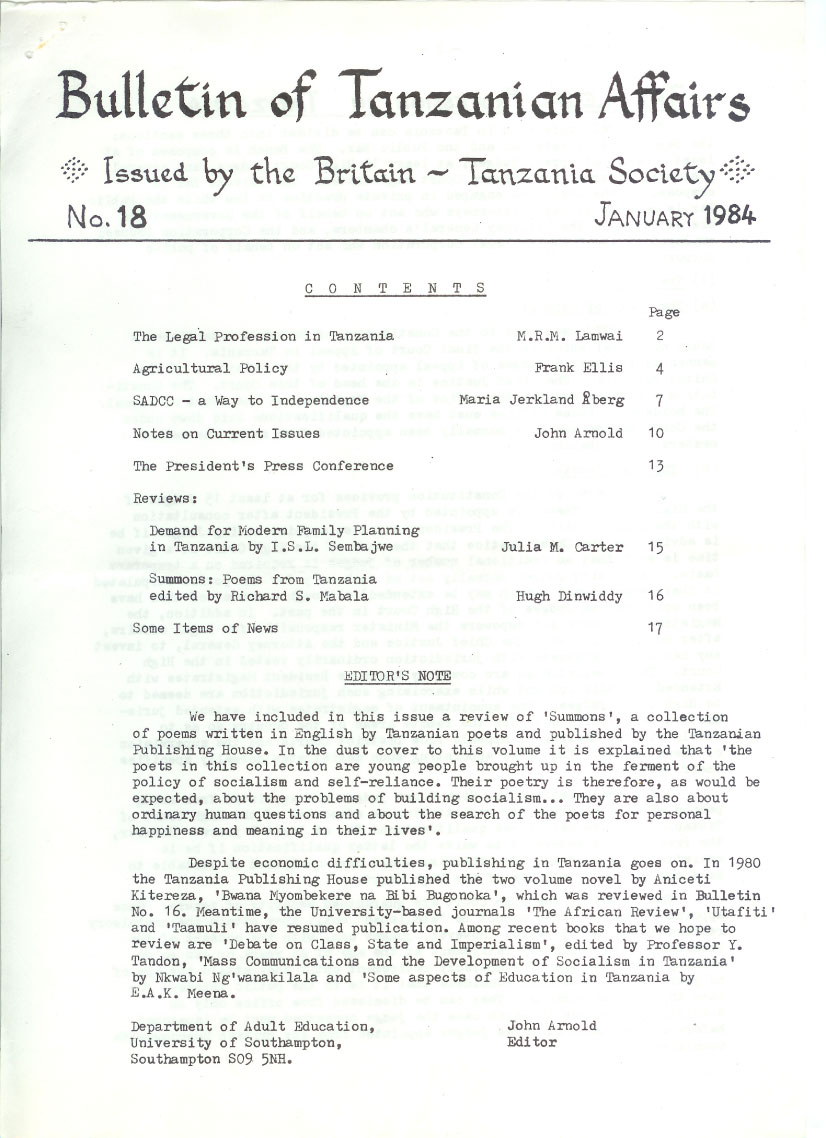
TA ISSUE 18

Issue 18 cover

Bulletin of Tanzanian Affairs
Issued by the Britain – Tanzania Society
No.18 JANUARY 1984

CONTENTS
The Legal Profession in Tanzania – M.R.M. Lamwai
Agricultural Policy – Frank Ellis
SADCC – a Way to Independence – Maria Jerkland Aberg
Notes on Current Issues – John Arnold
The President’s Press Conference

Reviews:
Demand for Modern Family Planning in Tanzania by I.S.L. Sembajwe – Julia M. Carter
Summons: Poems from Tanzania edited by Richard S. Mabala – Hugh Dinwiddy
Some Items of News

EDITOR’S NOTE
We have included in this issue a review of ‘Summons’, a collection of poems written in English by Tanzanian poets and published by the Tanzanian Publishing House. In the dust cover to this volume it is explained that ‘the poets in this collection are young people brought up in the ferment of the policy of socialism and self-reliance. Their poetry is therefore, as would be expected, about the problems of building socialism … They are also about ordinary human questions and about the search of the poets for personal happiness and meaning in their lives’.

Despite economic difficulties, publishing in Tanzania goes on. In 1980 the Tanzania Publishing House published the two volume novel by Aniceti Kitereza, ‘Bwana Myombekere na Bibi Bugonoka’, which was reviewed in Bulletin No. 16. Meantime, the University-based journals ‘The African Review’, ‘Utafiti’ and ‘Taamuli’ have resumed publication. Among recent books that we hope to review are ‘Debate on Class, State and Imperialism’, edited by Professor Y. Tandon, ‘Mass Communications and the Development of Socialism in Tanzania’ by Nkwabi Ng’wanakilala and ‘Some aspects of Education in Tanzania’ by E.A.K. Meena.

John Arnold
Editor
Department of Adult Education, University of Southampton, Southampton S09 5NH.

THE LEGAL PROFESSION IN TANZANIA

The legal profession in Tanzania can be divided into three sections: the Bench, the Private Bar and the Public Bar. The Bench is composed of at least 5 Court of Appeal judges, at least 15 High Court judges, and several Resident, District and Primary Court magistrates. The Private Bar is composed of the advocates engaged in private practice in law while the Public Bar is made up of State Attorneys who act on behalf of the Government and are employed in the Attorney General’s chambers, and the Corporation Counsel employed by the Tanzania Legal Corporation who act on behalf of public corporations.

(1) The Bench:
(a) The Court of Appeal:
The 1979 amendment to the Constitution of Tanzania establishes a Court of Appeal which is the final Court of Appeal in Tanzania. It is manned by at least 5 Judges of Appeal appointed by the President of the United Republic. The Chief Justice is the head of this Court. The Constitution also provides for the office of the Registrar of the Court of Appeal. The holders of these offices must have the qualifications laid down under the Constitution and have normally been appointed from among the senior members of the Bench.

(b) The High Court:
Section 60 of the Constitution provides for at least 15 Judges of the High Court. These are appointed by the President after consultation with the Chief Justice. The President may also appoint Acting Judges if he is advised by the Chief Justice that the work of the High Court at a given time is such that an additional number of judges is required on a temporary basis. The Acting Judges normally act as such only for the period stipulated in their appointment (which may be extended) although a number of them have been confirmed as Judges of the High Court in the past. In addition, the Magistrates’ Courts Act empowers the Minister responsible for legal affairs, after consultation with the Chief Justice and the Attorney General, to invest any Resident Magistrate with jurisdiction ordinarily vested in the High Court. These magistrates are commonly known as Resident Magistrates with Extended Jurisdiction and while exercising such jurisdiction are deemed to be High Court Judges. The appointment of magistrates with extended jurisdiction is normally made for the remote areas of the country so as to facilitate the hearing of appeals from District Courts and the Supervision of these courts. The Order appointing such magistrates normally specifies their tenure.

Under the Constitution, High Court judges are appointed from among people who are eligible for registration as advocates of the High Court of Tanzania and have held these qualifications for at least 5 years. However, the President is empowered to waive the latter qualification if he is satisfied that a person who otherwise would have qualified is sui table to hold the office of a judge of the High Court.

The judges of the High Court are guaranteed security of tenure. Once appointed, their office cannot be “abolished” until they attain the compulsory retirement age of 55 years. However, judges can, with the consent of the President, take voluntary retirement at the age of 45 years, or can go on working after the age of compulsory retirement until they attain the age of 62 years if the President considers that it is in the public interest for them to continue working. They can be dismissed from office only on disciplinary grounds in which case the judge concerned must be impeached before a Commission of three judges appointed from any British Commonwealth countries.

Although the Chief Justice (an appointee of the President) is the head of the judiciary in Tanzania, the running of the High Court is left in the hands of the Jaji Kiongozi (Principal Judge) who is appointed by the President after consultation with the Chief Justice.

The Constitution also provides for the office of the Registrar and Deputy Registrars of the High Court which are manned by officers appointed by the President and with similar qualifications as those held by judges.

(c) Magistrates:
There are two classes of magistrates: professional magistrates comprising the District Magistrates and Primary Court Magistrates. The District Magistrates are normally promoted Primary Court Magistrates and the Primary Court Magistrates are appointed after a short training mainly in procedure and criminal law at the Institute of Development Management at Mzumbe.

Like the judges of the Court of Appeal and the High Court, the Magistrates are appointed by the President. The Constitution establishes a Judicial Service Commission composed of the Chief Justice as its Chairman, one High Court judge nominated by the President after consultation with the Chief Justice and another member appointed by the President. Members of Parliament and people barred by law cannot be members of the Commission. This Commission is the disciplinary body for magistrates.

(2) The Bar:
(a) The Private Bar:
The Private Bar is composed of private legal practitioners known as advocates. The Advocates Ordinance requires the Registrar of the High Court to keep a Roll of Advocates. Any person who has the qualifications prescribed by the ordinance is entitled to be registered. These qualifications are: either a law degree of the University of Dar es Salaam (formerly the University of East Africa) or such other University or legal training institution as recognised by the Council for Legal Education; or the applicant must be a legal practitioner with a right of audience before any court of unlimited civil and criminal jurisdiction in any Commonwealth country or any other country designated by the Minister for Legal Affairs; or a Solicitor of the Supreme Court of England, Northern Ireland or the Republic of Ireland; a Writer to the Signet; a Solicitor of the Supreme Court of Scotland and holders of other legal offices in the United Kingdom. In addition, the applicant must satisfy the Chief Justice that he has adequate knowledge of the language of the court which is English and must also produce testimonials of character. A person wanting to be registered as an advocate in Tanzania must petition the Chief Justice.

The Private Bar in Tanzania is the one which is engaged in assisting and representing private individuals in both criminal and civil proceedings before the court. Its members perform the function which are performed by both barristers and solicitors in England. The division which exists in England between the two functions does not exist in Tanzania.

However, the number of advocates is far from adequate. The slow development of the Bar before independence, the exodus of many advocates of foreign origin in the 1970’s and the fact that most Tanzanian graduates in law are employed in the public sector have contributed to the small size of the Bar. Also there are fears that private practice in law will be abolished and so some lawyers are hesitant to start private practice.

The few advocates who exist are centred in urban areas – Dar es Salaam and Arusha taking the largest proportion. Most of them are engaged in individual practice. Partnerships in legal practice in Tanzania are exceptions rather than the rule. Criminal practice takes a large portion of the advocates’ time. It was observed by the Tanzania Judicial Systems Review Commission that very few people benefit from the services of the Private Bar, because the advocates are so few and very expensive. Most cases in Tanzania are conducted by the parties themselves. There is no comprehensive legal aid programme, so even in criminal cases there is no right to legal aid unless the case falls within the provisions of the Legal Aid (Criminal Proceedings) Act, normally one involving offences carrying the death penalty.

(b) The Public Bar
This comprises the lawyers who are employed as State Attorneys in the Attorney General’s Chambers. They are mainly engaged in advising the Government and in public prosecutions under the direction of the Director of Public Prosecutions. They appear on behalf of the state in appeals before the High Court and the Court of Appeal.

Another group of lawyers belonging to the Public Bar are the lawyers who are employed as Corporation Counsel by the Tanzania Legal Corporation. This corporation was established in 1971 under the Tanzania Legal Corporation (Establishment) Order with the purpose of providing legal services to public corporations. Although the Order has been amended to enable the Corporation to provide legal services to the public, the Corporation has so far played no significant role in cases in which private persons are involved because of the small number of lawyers employed by the Corporation.

The Tanzania Legal Corporation is headed by the Chief Corporation Counsel, who is appointed by the President, Senior Corporation Counsel, Assistant Corporation Counsel and Corporation Counsel. All these officers are people who are qualified to be registered as advocates, but in practice they are not registered as such. Their right of audience before the Courts accrues from their employment.

Although the Corporation has not played a significant role in private litigation, it has been providing lawyers to represent people who fall within the provisions of the Legal Aid (Criminal Proceedings) Act.

Conclusion
It may have been seen that the President of Tanzania has very wide powers of deciding the composition of the Bench at every level, except in the case of Zanzibar, which is not governed by the Constitution of the United Republic of Tanzania in this respect. In fact, the Constitution preserves the right of the High Court of Zanzibar to exercise jurisdiction concurrently with the High Court of Tanzania. The existence of such wide powers vested in the President has led some commentators to question the independence of the judiciary in actual practice.

M.R.M. Lamwai

SADCC- A WAY TO INDEPENDENCE

In May, 1979, the foreign ministers of the five Front Line States meeting in Gaborone decided to call a larger meeting in Arusha (SADCC 1) in July of that year to try to evolve a strategy for broadly-based cooperation in southern Africa. At the Arusha conference in addition to the Front Line States nine bilateral and a number of multilateral aid organisations (World Bank, Commonwealth Secretariat, European Community, African Development Bank and a number of UN organisations) took part as observers. The conference was united in forming the SOUTHERN AFRICAN DEVELOPMENT COORDINATION CONFERENCE (SADCC). The transport and communications sector in the region was considered to be particularly crucial and demanded immediate attention. Consequently, the decision was taken to establish the SOUTHERN AFRICAN TRANSPORT AND COMMUNICATIONS COMMISSION (SATCC) with headquarters in Maputo. Other important questions discussed at the conference dealt with energy, soil and water conservation, training and food production, with the special purpose of reducing dependence on imports from South Africa. As a contribution to the section on agriculture the INTERNATIONAL CROP RESEARCH INSTITUTE FDR SEMI-ARID TROPICS (ICRISAT) in Hyderabad, India, offered to start a branch in the region, or, to be more exact, in Botswana. In its research and development projects, the Institute is to investigate the special agricultural problems faced in the extensive dry areas of the region.

The discussions in Arusha were concluded with the endorsement of a proposed declaration containing four principal goals for cooperation within SADCC:

(1) to reduce economic dependence on South Africa in particular, but also on other countries;

(2) to institute a true and just integration of the states in the region;

(3) to mobilise resources for national, international and regional projects; and

(4) to act together towards securing financial and technical assistance within the framework of a strategy for economic liberation.

Action Programme and Financial Provision
The Arusha conference was followed in April by a summit meeting in Lusaka, the first meeting at which all nine member states took part, including Zimbabwe, which had just become independent. The summit endorsed unanimously the Lusaka Declaration, a formal presentation of the proposed main objectives of SADCC, which in turn emphasised the following spheres of activity :
(1) transport and communications;
(2) agriculture;
(3) training, especially within the transport and agriculture sectors;
(4) industrial development; and
(5) energy.

Within the framework of the action programme it was calculated that 1.5 milliard dollars would be needed during the eighties for the regional projects. It would be impossible to generate so much money within SADCC. Tb maintain the momentum of the development programme it would be necessary to be assured of considerable external financial support. Consequently, it was decided that at the next plenary meeting, which was to be held in Maputo in November, 1980 (SADCC 2), the problem of funding should be the main subject. Thirty governments and bilateral aid organisations together with twenty multi-lateral and international bodies were represented at Maputo. The result was that the donor organisations undertook to support the regional projects within SADCC to the extent of 650 million dollars spread over a five year period from 1980 to 1985.

The SADCC projects were set in motion and at the Blantyre conference in November, 1981, the time had come for the first evaluation. It transpired that the greatest progress had been made in the transport and communications sector and that many projects were in full swing. Even within the agriculture and food sectors as well as within the industry sector progress had been made. Less satisfactory was the position with energy and land conservation. The main question before the conference was finance. One year after the Maputo conference only 273 million dollars out of the promised 650 million had actually been committed in legally binding agreements. This factor had obviously reduced somewhat the tempo of development. Delays in obtaining the release of funds can in part be attributed to bureaucratic sluggishness, but it is unfortunately true that in some cases political problems were associated with the delays. In January, 1983, a new meeting with various donors was held in Maseru, where about 200 million dollars were promised.

Unanimous decisions at all levels
Sir Seretse Khama, at that time chairman of SADCC, stated in his opening address to the summit meeting in Lusaka in 1980 that cooperation within SADCC should be built on ‘concrete projects and specific programmes rather than on grandiose schemes and massive bureaucratic institutions’. This motto has since then characterised the manner in which SADCC has attacked regional cooperation. A decentralised model and a decision-making process requiring unanimity at all levels was decided upon. A limited number of institutions have in the meantime been developed and formalised in a Memorandum of Understanding of the SADCC, which was adopted at a summit meeting in Harare in July, 1981.

The Summit is the highest authority in SADCC with responsibility for general policy and for the control of activities. The summit consists of the chiefs of the member states and it meets at least once a year. All decisions must be unanimous.

The Council, which consists of one minister from each member state, is responsible for overall planning, general coordination, control of the organisation’s various institutions and supervising the implementation of programmes. The Council approves the work programme of SADCC and appoints the member state charged with the coordination of activities within a particular area of work. The Council meets at least once a year and all decisions must be unanimous.

Sectoral Commissions can be set up for programmes within particular areas of activity. The Southern African Transport and Communications Commission (SATCC) is such a commission. It is possible that similar commissions will be set up within the energy, agriculture and industry sectors. The Commissions report to the Council.

A Standing Committee of Officials responsible to the Council has been established. It also must meet at least once yearly and its decisions must be unanimous. Finally, a small Secretariat has been established in Gaborone, which is responsible for serving the various SADCC institutions. The Director of the secretariat is responsible for and rapporteur to the Council. The Council also occupies a key position in respect of planning within SADCC with sectoral commissions, a permanent committee of officials and a secretariat as executive organ. Outside this structure are the annual conferences (SADCC 1, SADCC 2, etc.) to which the various aid organisations are invited.

Distribution of responsibility
The ongoing work is in large measure decentralised. Each member state has been allocated its special sphere of responsibility. Angola is responsible for coordination in the energy sector. Botswana has been given development research and activities connected with cattle diseases. Lesotho shares with Zimbabwe responsibility for land conservation and land use. Malawi coordinates the conservation of fish and wild animals. Mozambique, on account of its central situation in the region, has been allocated the coordination of the important transport and communications sector. Swaziland is responsible for the coordination of manpower development and training. For the time being it is also responsible for the health sector. Tanzania has special responsibility for industrial development. Zambia is responsible for the Southern African Development Fund and for the mining sector. Zimbabwe, finally, has been given the foodstuffs sector, land conservation and development (jointly with Lesotho) and the printing of securities (currency, cheques, state bonds, etc.).

SADCC can be characterised by concepts such as pragmatism, decentralisation and unanimity in decision-making. It deals with limited, concrete projects within the region and works towards increased cooperation in line with its principal common goals. The decentralised mode of operation has both advantages and disadvantages. The advantages are that bureaucratisation is avoided and money is saved. The main drawback may be deficient coordination between sectors. A system requiring unanimity in decision-making at all levels (in contrast to majority decisions) assumes as a prerequisite that unanimity between such different states will generally speaking be attainable. The member countries are of course most dissimilar in respect of size, resources, stage of development and political aims. The disadvantage of this model may well be that progress is slower when all the time it is necessary to aim at the lowest common denominator. But with a ‘speedier’ model based on majority decisions and a supranational organisational structure, the organisation might all the time be threatened with collapse.

During the short time that the organisation has existed, it seems that SADCC has made relatively good progress. Development has got furthest in the transport sector. The South African regime clearly sees SADCC as a threat and conducts an aggressive destabilisation policy against its neighbours – a policy, however, which rebounds upon it and threatens its own commercial interests in the region.

Maria Jerkland Aberg

Note: The above article is translated from the Swedish and omits the first part, which describes the present economic geography of southern Africa. The article, in turn, constitutes a summary of ‘Dependence and collective self-reliance in southern Africa: the case of the Southern African Development Coordination Conference (SADCC)’, by Arne Tostensen (Scandinavian Institute of African Studies, Uppsala, 1982).

AGRICULTURAL POLICY

Between May and October, 1982, a Government task force undertook a major reappraisal of agricultural policy and its implementation in Tanzania with the object of defining alterations to existing policy and new priorities for the nineteen eighties. The results of that exercise are contained in two documents published by the Ministry of Agriculture – the report of the task force itself, “The Tanzania National Agricultural Policy (Final Report)”, dated October, 1982, and the official statement concerning future agricultural policies, “The Agricultural Policy of Tanzania”, dated 31st. March, 1983.

The intention of these notes is to summarise briefly the key changes in agricultural policy set out in the documents and also to provide some comment on the proposals within the context of agricultural development in Tanzania over the preceding decade.

The task force on national agricultural policy was chaired by Professor Simon Mbilinyi, formerly Personal Economic Assistant to the President and now Principal Secretary to the Minister of Agriculture. It was composed of roughly 15 members drawn from relevant Government agencies and from the University of Dar es Salaam. Its terms of reference were broad and its final report is extremely wide ranging, encompassing for example the organisation of agricultural production, land tenure, land use planning, agricultural research and extension, agricultural technology, agricultural marketing and prices, agricultural inputs and the problems and prospects of individual crops. With respect to each of these, as well as other topics, the report (which, incidentally runs into 240 pages) contains both a detailed interpretation of past performance and a set of policy recommendations for the future. It is clear that most of the task force recommendations were subsequently accepted by the Government as components of the new official agricultural policy, since the March, 1983, document is essentially a re-statement of the task force policy proposals with only minor amendments.

The task force report recognises various defects in previous agricultural policy, especially in the areas of motivation for production, agricultural marketing, agricultural input supply and extension. Within each of these areas heavy emphasis is placed on improving incentives, increasing efficiency and rationalising institutional arrangements. The outcome appears to take the form of a perceptible shift towards permitting more market criteria to enter the practical implementation of agricultural policy. However, considerable ambivalence surrounds this intention, since the report also contains a commitment to the existing apparatus of state controls and planning, such that it is difficult to envisage how some of the proposals will achieve their intention (on which more later). Some main policy shifts and the thinking which seem to lie behind them are summarised as follows:

1. The problems for agricultural production in some locations of village size (distance to fields) are recognised. The proposed solution is the concept of Central Service Villages, which would act as the focal point for satellite settlement located closer to production areas. The size of such satellite settlements is not specified in the task force recommendations.

2. Increased security of land tenure is strongly emphasised for all private forms of agricultural production, including the so-called ‘homestead shamba’, the family plot on the village ‘block farm’ and private commercial farms. A minimum leasehold of 33 years is proposed for all such farming in order to give tenants sufficient security to maintain and develop the long-term productivity of their land instead of carrying out short-term, soil-exhausting agronomic practices.

3. The formation of new, private commercial farms is to be encouraged, especially for the production of export crops, or crops needed as raw material for domestic industry. There seems to be a hint here of attempting to promote a new frontier spirit in Tanzania (including for outsiders) to take up the ‘challenge’ of private development under conditions of acute shortage of foreign exchange. (The whole of Canada and USA was opened up for grain production before the invention of the internal combustion engine.’)

4. The high costs and inefficiencies of the former parastatal crop marketing system are recognised. Proposals include:
(a) a reduction of the status of the export crop parastatals to marketing boards concerned principally with the sale, where possible by auction, of export crops;
(b) the concomitant reintroduction of Regional Cooperative Unions as the purchasing agents for all designated crops from Primary Cooperative Societies (villages, or groups of villages). This decision actually pre-dates the task force, but is integrated into its recommendations;
(c) for export crops a target proportion of 75% of the export price to be passed back to farmers. This compares with proportions which fell to as low as 30% for some export crops during the nineteen thirties;
(d) the encouragement of food crop transfers between Primary Cooperative Societies and between Regional Cooperative Unions to meet local variations in food self-sufficiency and to avoid the necessity of centralised procurement of all food crops by the National Milling Corporation;
(e) the associated limitation of National Milling Corporation functions to the delivery of urban food supplies, management of the Strategic Grain Reserve and food processing, especially for urban markets.

5. Some of the defects in the past implementation of producer prices policy, especially the relative neglect of export crops and the failure to adjust agricultural prices in line with inflation are recognised. It is proposed that producer prices should be biased towards export crops with a high net foreign exchange earning capacity and towards food crops, which minimise foreign exchange expenditures in their production, that is, minimise imported inputs. It is also proposed that the price fixing procedure should take account of changes in the cost of living index. In addition, it is recommended that annual farm management surveys are undertaken in order to obtain up-to-date and realistic estimates of production costs.

6. Both the supply of agricultural inputs and the organisation of agricultural extension are recentralised in the Ministry of Agriculture. This recognises the waste and duplication, as well as poor implementation, of the previous decentratisation of those functions to individual crop parastatals and other Government distribution agencies. The new agricultural policy thus represents an ambitious attempt to correct deficiencies in the past implementation of agricultural policies both by correcting perceived weaknesses in existing institutions and by once again modifying organisational arrangements. It also contains a strand of improved private incentives and greater market orientation. The new policy does not, however, challenge the most important implicit assumption of the Government approach to agriculture in Tanzania over the past two decades, which is that comprehensive state controls and planning in every sphere of agricultural activity is necessary in order to achieve centrally-determined targets and objectives. For example, one of the recommendations concerning agricultural production is that every single village in Tanzania should prepare two Master Plans, one on village residential areas and the other on economic activity, showing agricultural production targets, and so on. This may seem reasonable until it is pointed out that there are over 8,000 villages in Tanzania, making for 16,000 proposed Master Plans, and it becomes legitimate to conjecture how exactly the information generated by these plans is to be analysed and assimilated for policy purposes (perhaps each village should have a microcomputer?). Another example in the sphere of agricultural marketing is the reintroduction of cooperative societies and unions without actually abolishing the crop parastatals. It is difficult to see how unit marketing costs are to be dramatically reduced by this proliferation of marketing agencies. It has only to be recalled that one of the major reasons given for the previous abolition of the cooperative unions was their spiralling costs and losses.

7. The problem with extensive Government intervention in a country like Tanzania is that comprehensive controls down to the level of individual village or household require an immense diversion of resources in order to maintain the required administrative apparatus. The magnitude of this cost burden is usually out of all proportion to the gains, which are supposedly made in information and planning. The new agricultural policy unfortunately does not tackle or escape this dilemma. The policy contains numerous sensible suggestions for improving agricultural policy implementation, but there exists a considerable danger that good intentions will be lost in the maze of bureaucratic intricacies which surround them.

Frank Ellis