
BOOK REVIEWS

‘Tanzania- A Political Economy’: Andrew Coulson, Clarendon Press, 1982. £6-95 (paper).

Tanzania currently suffers from many shortages, but it has been studied and written about in abundance. Much has been published about aspects of Tanzania’s history, politics and economic development, but it is not easy to obtain, or always comprehensible. Andrew Coulson has drawn together the writings of the past decade to produce a comprehensive and highly readable account of the development of modern Tanzania. Its scope and clarity give it a strong claim to be the standard work on the country, which has long been needed and as such it will have considerable influence and its interpretations could become a generation’s judgment on Tanzania.

As Coulson makes clear in his first chapter, he is writing on two levels, an introductory outline of the country and an analysis of the ‘underlying, historically determined economic position.’ The story of the creation and development of Tanzania is interwoven with a rigorous comparison of official policy and actual performance, that some readers will feel to be so unrelentingly critical of both colonial and independent governments as to verge on the destructive.

The first third of the book is ‘the story of the incorporation of this land area and these people into the ‘World capitalist system’. The failure to resist or deal with the consequences of this are seen as the root cause ‘of Tanzania’s current problems. Prior to colonisation, the tribal societies were probably better fed than today’s population, crafts were developing and there was considerable internal trade. These achievements had been assisted by imported innovations, but were reversed by colonial conquest and the associated destruction and epidemics. The skills which had been evolved to survive in the harsh environment were lost as a new economic pattern was established, the production of crops for sale and labouring on plantations providing for European industry.

The subsequent efforts by successive governments to revive peasant agriculture have been characterised by assumptions of peasant idleness and ignorance, whereas they have proved themselves enterprising and efficient on the occasions when they have been given clear incentives. The colonial powers also prevented the establishment of industry, which might have been developed, based on the exploitable minerals and the processing of crops. Both the official attitude to the peasants and the belief that the country could not support viable industry were largely inherited by the nationalists after independence.

Colonisation also brought a fundamentally different concept of education. Coulson gives a brilliant, concise explanation of the devastating impact of western education on traditional society. His denunciation, in highly ideological terms, of mission and government education provision will offend those who were involved or have knowledge of the personal dedication of the teachers and administrators, who struggled in difficult conditions with pathetic resources, but he makes a powerful case.

There is an important reassessment of the achievements of Cameron, whose governorship between the wars has been regarded as crucial in setting the country on the road to eventual independence. Cameron is credited with resisting the aspirations of European settlers and encouraging limited African development, but he did not understand and ignored the damaging influence of Kenya’s more dynamic economy. His commitment to indirect rule could not make it a reality in Tanganyika, where tribes had never become fully formed and many legitimate chiefs had not survived the German conquest.

Despite his criticisms of colonial policies on education and industrialisation, Coulson sees the growth of nationalism as a consequence of education and the expansion of towns. He has a sympathetic note on Martin Kayamba, whose African Association established for the educated elite became the basis on which TANU was organised, although there is an implied criticism that TANU ought to have evolved from Eric Fiah’s African Welfare and Commercial Association, which had political aims and claimed to speak for all Africans.

In his assessment of Nyerere, Coulson rejects both the adulatory biographies and those who manage to write about Tanzania without mentioning his name. There is respect for his political skills, which have enabled him to survive, but Nyerere’s vision of agricultural development being achieved through living in villages is considered to be fatally flawed. The total commitment to modernisation theory, the dismissal of traditional forms of agriculture and the adoption of government as the main, perhaps only, provider are identified as the essentially false assumptions of Nyerere’s ideas and policies. This is a criticism of Nyerere’s basic philosophy, not of his failure to ensure the implementation of his policy by unsympathetic subordinates, but it is questionable as a summary of Nyerere’s thinking, which ignores his appeal to traditional values in ‘Ujamaa- the basis of African Socialism’, his repeated pleas for the use of ox ploughs and good thatch rather than tractors and corrugated iron sheets and the self-reliance objective of the Arusha Declaration.

It is certainly true that Nyerere did not transform TANU into the instrument of government. Independent trade unions were suppressed and there has been a huge expansion of an authoritarian state requiring the employment of a large bureaucracy divorced from the life and experience of most of the population. The combination of the idea of progress through villages and a bureaucracy distanced from the peasants produced the political and economic damage of the villagisation operation. Villages were required to enable government-supplied social services to continue to expand. Increased production was assumed, but it was never explained how it was to come about. Indeed, peasant production had been growing steadily in the years between independence and the Arusha Declaration. The chapter on ‘Ujamaa and Villagisation’, Coulson’s special interest, is exceptionally good and deserves careful reading and study.

The bureaucracy, the effective ruling class, is held responsible not only for the failures in agricultural and rural development, but also for Tanzania’s general economic stagnation. While drought, oil prices and the world economic recession are by implication difficulties that a developing country must expect to have to deal with, the root cause of Tanzania’s problems is its own ruling class, who ‘are not accumulators, have little experience of industry or large scale agriculture and little faith in small scale agriculture, thinking not in terms of investment, but social services, authoritarian with no tradition of self-criticism’, almost totally unsuited to bringing about economic transformation. Coulson sees parallels between the Tanzanian civil service and the British labour Party and his own argument is almost Thatcherite. High taxation has financed a bureaucracy to staff services such as agricultural extension, which have no appreciable effect, and the parastatals with their poor output and productivity records. The consequence has been no resources for productive investment.

This is a harsh indictment. Coulson does not produce a comprehensive alternative strategy, but he clearly believes that if villagisation had been left to happen voluntarily through small politicised groups and the peasants given reasonable price incentives they could have continued to produce enough food to feed the country and enough export crops to finance a basic industrial strategy. The cost would have been growing rural inequality as larger farmers expanded production by hiring labour and possibly a slower rate of growth of social services.

Inevitably in attempting to cover so much there has to be a great deal of compression, but this is offset by five appendices providing case studies of development. Of these, the one dealing with the Ruvuma Development Association is most welcome. Coulson, in common with many writers, including Rene Dumont, sees the decision to disband the RDA as a watershed, when the Party hierarchy decided that an independent organisation, however committed to socialist development, could not be tolerated. Writings on Tanzania frequently refer to RDA, but this is the first published account of its story.

Coulson will be accused of over-concentration on Tanzania’s failures, underrating its problems and ignoring its achievements and also of using valuable pages to explain his concepts of ‘class’ and ‘state’ in the only boring sections of the book, but his explanation of what is happening in Tanzania depends on understanding the nature of the class which controls the state rather than the number of adult literacy schemes organised, or village water schemes provided.

Professor Cranford Pratt once complained at a meeting of the Britain-Tanzania Society that the problem of trying to understand Tanzania was that the rival factions of commentators never read each other’s work and an author’s allegiance could immediately be identified by the references quoted. Coulson breaks out of this sterile constraint and also provides suggestions for further reading on the subjects of each chapter and a useful bibliography. Little about Tanzania is simple. The words ‘paradox’ and ‘ambiguity’ seem to occur in most chapters and it is possible to value and enjoy Coulson’s book without sharing his despondent conclusion that ‘despite elements in its favour, the contradictions and stagnation of the nineteen seventies are likely to continue’.

John Arnold

‘Development and Religion in Tanzania – Sociological Soundings on a Christian Participation in Rural Transformation’: Jan P. van Bergen, Dar es Salaam, 1981.

This book was written as a result of the Senate of the University of Dar es Salaam granting Mr. van Bergen the status of research associate, a post held until 1976; the subsequent write-up emerged in 1981. The book highlights the Church’s reaction to institutions and programmes which sprang up after independence. There was an initial fear of development being overtaken by communism. This was especially so after the Arusha Declaration. There is also current anxiety about a possible increase in Chinese influence. The involvement of Muslims in various political structures also causes great uneasiness. The government controlled newspapers, the Daily News, the Sunday News and Uhuru, appear to many Christians to be hostile to the original teachings of Christ and what they imply in relation to marriage customs and family life in Africa.

With regard to villagisation, the reaction of the Church has been very mixed. Pastoral considerations have always been in favour of people living together in clusters, because it makes for easier contact with people and parochial activities. The missions with their buildings, plant and plots of land became natural centres for the planning of new villages. However, when villagisation programmes got under way, new settlements were planned far from the traditional church-parish complex. When whole communities were moved, the Church leaders angrily condemned this, because they would be separated from their people and church buildings would become obsolete.

As van Bergen points out, ‘the community concept of Christians differs from that of ujamaa’. The latter is less exclusive. Its focus is different from the Church and does not contain reference to a special religion or faith. Julius Nyerere writes: ‘The Tanzanians themselves have religion, but the community has not. The Sheikh has his religion, the Christian has his faith, the traditionalist has his convictions. But there are also religions which cause unrest and trouble’. The President has held meetings with Party officials, members of the government and religious leaders so that there is a real dialogue and mutual feelings of misunderstanding, if not dispelled, are “freely communicated. The President has also discussed ways in which the clergy could involve themselves in the ujamaa experiment.

At the end of his book, Mr. van Bergen spells out what he thinks is valuable in the struggle for power-sharing, which could be established between the Church and the state and other ideologies, which do not completely complement each other:

The image and ideology of the Churches influence their credibility in proclaiming values and ideas in the field of nation building. This does not mean that the relationships between Church and state are bad or hostile. Neither is it true that the Churches do not try to contribute to the formation of good citizens. The delicate balance in ideology remains because both institutions realise that they need each other. The Party needs the Church because of its influence on the masses, its educated leadership and its financial potential. The Churches need the Party because. in a secular society in which several world views, faiths and religions are present, the political Party is the unifying identity.

Michael Butler

‘Mozambique and Tanzania – Asking the Big Questions: Frances Moore Lappe and Adele Beccar-Varela: IFDP, San Francisco, 1980.

The material for this book, which aims to compare the efforts made by the leaderships in Tanzania and Mozambique to achieve food security, was collected during a summer trip to both countries in 1978. The authors do not mention how long this trip lasted, but they do admit that they were not able to talk to many ordinary Tanzanians and Mozambicans due to shortage of time and language barriers. Their essay is essentially ‘an attempt to define how the leadership in each country defines the development process they are helping to shape’.

The central argument throughout the book is that, although Mozambique and Tanzania both claim to be on a socialist path and the leadership in both countries aims at equity, participation and cooperation, there are sharp contrasts in the methods adopted by each to achieve their socialist goals. The picture painted is of Tanzania’s elitist approach, in which decisions are made ‘top down’ and policies implemented coercively at the expense of aims to mobilise and involve the people. Mozambique, however, due to its experience of the armed struggle against Portuguese colonialism and the peasant and worker mobilisation in the liberated areas, has created more democratic and accountable leadership structures, that are more grass roots based, and its policies seek to gain the active participation of the people.

Whilst the authors admit several times the difficulty in drawing comparisons between a country like Tanzania with 18 years experience of independence and another like Mozambique with only 4 years and with such different histories and physical infrastructures, they say they are only attempting to compare the approaches and priorities of the leaderships in each and not their success records. The authors emphasise that Tanzanian socialism is not of the scientific marxist type, but is based on the moral bedrock of ‘goodwill’ in which the interests of the whole community are put before personal and private interests. Nyerere claims that these principles were embodies in traditional African communities. Mozambique’s socialism, on the other hand, whilst founded in the experience of intense exploitation of the Mozambican people and their life and death struggle to throw off that exploitation, is based on the theory of the class struggle. Hence, Mozambique aims to transform traditional tribal life not conducive to scientific socialism, such as superstition and passive obedience to village elders. The rationale for cooperation and collective solutions to development problems stems not from African tribal traditions, but from practical experience gained in the liberated zones during the armed struggle and scientific socialist ideology.

The book then looks at the practical approaches of the leadership in each country in relation to development, production, leadership style and structures, popular participation, villagisation and attitude to foreign aid. The authors find that Tanzanian leaders define development in organisational terms. The main task of leadership is to create effective organisational structures to implement central government decisions at local level. Mozambican leaders, on the other hand, see the task of transforming the people’s concept of themselves and mobilising the people to participate actively in the new society as the key to the country’s development.

Tanzania comes in for serious criticism when the authors examine leadership and the origin of its authority in each country. They find that in Tanzania the leadership has retained the patriarchal attitude towards the people, who they consider must be led by means of the carrot and the stick ‘for their own good’. Decisions made by the central government are to be implemented at village level by appointed village managers, who as outsiders to the communities they lead can ensure that decisions are implemented in an organised and impartial manner. The authors admit that:

‘because this view of leadership in Tanzania resembles closely what we receive from our own culture, it was hard even to perceive whilst we were there. Only after we had spent some time in Mozambique did we become aware of the possibility of alternative assumptions’.

In Mozambique they found that the leadership saw the people as a source of energy and direction and leaders saw themselves as accountable to the people and to the decisions taken at the 3rd. Congress, of FRELIMO in 1977, which defined the’ leadership structures and the direction of policy. The civil service is controlled by FRELIMO, which since it was restructured in 1978 has now become a broader-based vanguard party. However, the most important characteristic of Mozambiquan leadership is the inbuilt practice of criticism and self-criticism, which is encouraged and practised at all levels. Leaders who abuse their power, or fail to meet their responsibilities, are criticised and if they continue to behave incorrectly they are ousted. The Minister of Agriculture, who failed to give sufficient priority to rural agricultural development, was criticised and subsequently dismissed.

When the authors examine popular participation, they find that in Tanzania there appears to be a ‘top down’ approach, with the authorities at both national and local level identifying problems and local leaders supervising the people in their solution. Mozambique, however, has both upward and downward channels for participation and decision making and their structures rely on local initiative and experimentation, which if successful will be passed on to other communities or groups with similar problems. The selection of Party members and representatives for the local, provincial and national assemblies is done at meetings of people, who put forward suitable candidates, which the Party and local people present at the meeting evaluate politically and finally select. These procedures have resulted in far more peasants, workers and women being selected as leaders. In Tanzania, the author’s impressions are that the vast majority of Party officials work as civil servants and are drawn from the already privileged class of bureaucrats.

On villagisation, the difficulties encountered by the Tanzanian government over the last 14 years in persuading people to move into ujamaa villages are described. In the late 1960’s the government encouraged people to move voluntarily, but progress was so slow that by the 1970’s it had resorted to coercion and consequently many Tanzanian leaders lost faith in cooperative principles. The Mozambican leadership, on the other hand, appear to be prepared gradually to implement their plans for people to form communal villages. As popular participation in the planning and formation of such villages is crucial to their long-term success, the Mozambican government does not intend to take short cuts – an example where lessons bitterly learned in Tanzania are useful to the leadership in Mozambique.

Finally, the authors briefly look at the different attitude in each country to foreign assistance. The role of the ‘cooperante’ (expatriate) in Mozambique is one of assistance in implementing FRELIMO policies, not that of making policies, whereas in Tanzania foreign experts from for example the World Bank have been permitted to design policy, provide their own additional staff, select suitable Regions for their projects and even participate in appointing Tanzanian staff to work on their projects. The authors feel that this heavier reliance on foreign ‘experts’ has had the effect of dampening self-help initiatives and discouraging the willingness of Tanzanians to experiment.’

Whilst I feel that the authors have not been fair to Tanzania in their analysis, perhaps not giving sufficient weight to the different historical circumstances in which the leaders in each country have emerged and not really exploring how the policies work at grass roots level, I think that they have identified some of the most important ways in which the Mozambican leadership is trying to involve its people in building the new independent socialist society. What still stands out in my memory of Mozambique is the accountability of the leadership, the active participation of the people and the control of expatriates like myself. These are the aspects where the authors of this book have found the contrasts between Tanzania and Mozambique are sharpest. Only time will tell if the Mozambican leadership reverts to a more elitist conception of development and to a more bureaucratic and authoritarian mode. This in part will depend on the political quality of the cadres at present in the new socialist schools.

Ruth Carr
DIGEST OF TANZANIAN NEWS

Transport
The Swedish aid organisation SIDA is to assist ‘with the improvement of Air Tanzania’s ground handling equipment at Dar es Salaam and Kilimanjaro airports and the Irish airline Aer Lingus is to help with a manpower development plan. Air Tanzania’s troubles have included the grounding of aircraft through lack of spares. It is reported that several Western airlines are considering Suspending their services to Tanzania because the Bank of Tanzania has released no currency in payment of tickets for eight months.

Industry and Trade
The Tanga-based Tanzania Fertiliser ‘Company has started the production of ammonium hydroxide, which is used in paint production and wood treatment. *

A trade agreement with Mozambique provides for Tanzania to exchange aluminium sheets, cocoa beans and hoes for welding electrodes, tyres, tubes and sewing machines.

A second gold mine (buckreef) developed at a cost of £8 million and employing 300 people has started production and is expected to have an output of 2 kilos a day.

A power alcohol plant is planned to be in production at Moshi by 1985 using by-products as raw materials. The alcohol will be made from molasses, much of which at present goes to waste, and will be mixed with petrol. The project will be financed by a French Government loan.

The hydroelectric power project at Mtera, 100 miles north of Iringa, is to be financed by a consortium of five European countries, Sweden, Norway, the German Federal Republic, France and Italy, together with the World Bank and the Kuwait Development Fund.

Agriculture
The International Development Association (the World Bank affiliate for concessionary lending) has approved a credit of $12 million for the coffee, cotton and sisal authorities, technical assistance for the Ministry of Agriculture and staff for an advisory group to make recommendations to the Tanzanian Government on an economic recovery programme (see Bulletin No.13, page 2).

The Dairy Farm Company of Tanzania (DAFCO) aided by the World Bank is purchasing 1,000 dairy heifers and 10 bulls from Zimbabwe. The plan to establish 17 dairy farms each with 350 cows and a breeding centre and to provide 50 ujamaa villages with herds of 20 cows each was launched in 1974 and should have been completed by 1980, but has been extended to 1984.

A proposal for a rice irrigation project at Mkomazi, near Korogwe, first investigated in 1950, has been abandoned after a West German report found that it would not be profitable.

Education
The Ministry of National Education is to investigate the effects that the adult literacy campaigns have had on the behaviour, attitudes and thinking of new literates.

Graham Mytton

* The early history of the Tanzania Fertiliser Company is described in an article entitled ‘Tanzania’s Fertiliser Factory’, by Andrew Coulson in the Journal of Modern African Studies, 1977, Vol.XV No.1.

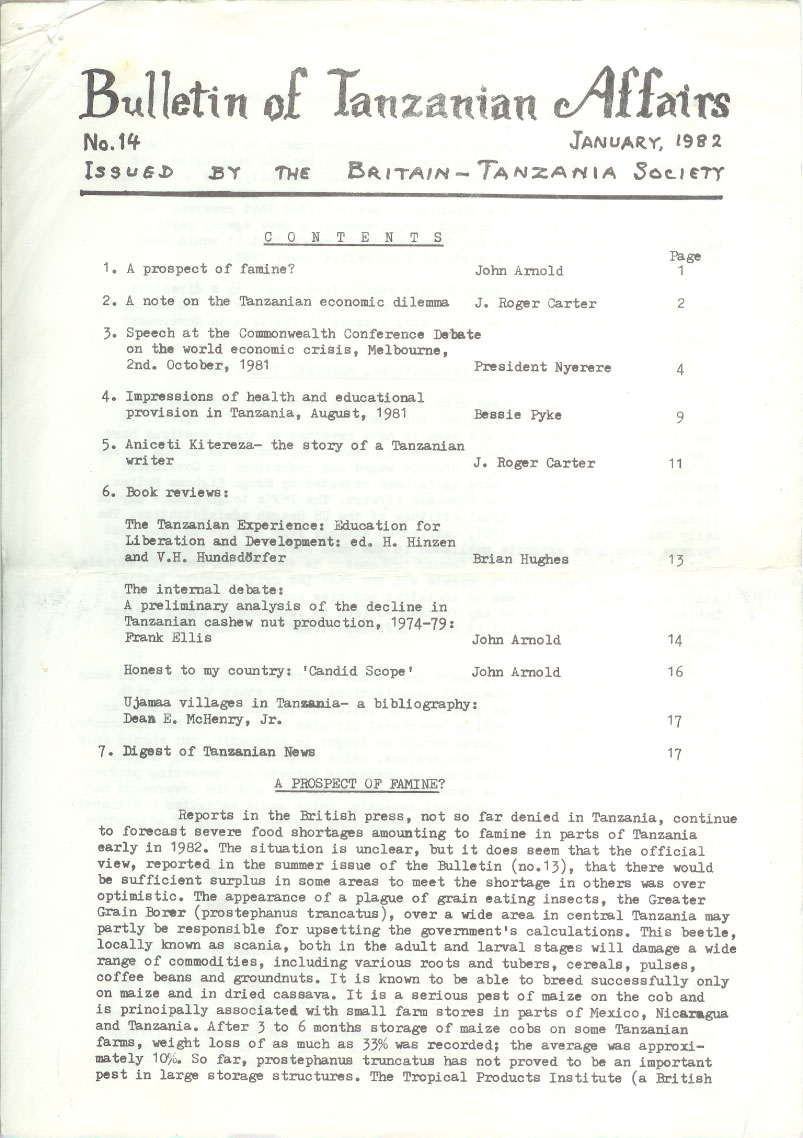
TA ISSUE 14

Issue 14 cover

Bulletin of Tanzanian Affairs
No. 14
JANUARY, 1982.
Issued by the BRITAIN- TANZANIA SOCIETY

CONTENTS
1. A prospect of famine? – John Arnold
2. A note on the Tanzanian economic dilemma – J. Roger Carter
3. Speech at the Commonwealth Conference Debate on the world economic crisis, Melbourne, 2nd. October, 1981 President Nyerere
4. Impressions of health and educational provision in Tanzania, August, 1981 – Bessie Pyke
5. Aniceti Kitereza- the story of a Tanzanian writer – J. Roger Carter
6. Book reviews:
The Tanzanian Experience: Education for Liberation and Develepment: edo H. Hinzen and V.H. Hundsdorfer – Brian Hughes
The internal debate: A preliminary analysis of the decline in
Tanzanian cashew nut production, 1974-79: Frank Ellis – John Arnold
Honest to my country: ‘Candid Scope’ – John Arnold
Ujamaa villages in Tanzania- a bibliography: Dean E. McHenry, Jr.
7. Digest of Tanzanian News

A PROSPECT OF FAMINE?

Reports in the British press, not so far denied in Tanzania, continue to forecast severe food shortages amounting to famine in parts of Tanzania early in 1982. The situation is unclear, but it does seem that the official view, reported in the summer issue of the Bulletin (no.13), that there would be sufficient surplus in some areas to meet the shortage in others was over optimistic. The appearance of a plague of grain eating insects, the Greater Grain Borer (prostephanus trancatus), over a wide area in central Tanzania may partly be responsible for upsetting the government’s calculations. This beetle, locally known as scania, both in the adult and larval stages will damage a wide range of commodities, including various roots and tubers, cereals, pulses, coffee beans and groundnuts. It is known to be able to breed successfully only on maize and in dried cassava. It is a serious pest of maize on the cob and is principally associated with small farm stores in parts of Mexico, Nicaragua and Tanzania. After 3 to 6 months storage of maize cobs on some Tanzanian farms, weight loss of as much as 33% was recorded; the average was approximately 10%. So far, prostephanus truncatus has not proved to be an important pest in large storage structures. The Tropical Products Institute (a British Government organisation) has made proposals to the Tanzanian Government on the control of this pest.

The measures taken by the Tanzanian Government to rectify the shortages are not well known, but are believed to include deliveries from Canada, Japan, the United States and the European Community. The Government may have experienced difficulties on account of the very grave shortage of foreign exchange – in July the Financial Times reported that reserves had fallen to £600,000, barely two days’ requirements. A news agency report early in October stated that the Government estimated that it would need to import 87 million dollars worth of food before June, 1982.

It is planned to protect next year’s food supply by a directive from the Party requiring all villages to establish a minimum of 100 hectares of food for cash crops, to be cultivated communally for sale to Government organisations.

APPROACH TO THE INTERNATIONAL MONETARY FUND (IMF)

In June, talks began with the IMF on a three year extended fund facility of more than £250 million, but there is no report of progress. On the contrary, the IMF officials seem to have reverted to their previous hard line and are requiring a devaluation of at least 50%, increases in the prices of basic foods, the freezing of minimum wages and reductions in Government spending. These conditions have again been rejected by Ndugu Kighoma Malima, the Minister for Planning and Economic Affairs. The IMF’s tough stance may be linked with the openly critical attitude of the US Reagan administration. The Daily Mail of 23rd. July, 1981, carried an article very hostile to President Nyerere drawing on extracts published in the Wall Street Journal of a report on Tanzania by Ken Adelman, US Deputy Ambassador to the UN. If the Mail Article is correct, Adelman’s report repeats all the familiar criticisms of Tanzania, attributing all its problems to socialist policies and clearly arguing that Tanzania should not receive any further US (and by implication other Western government) assistance until it has a different leader and adopts a free market economy.

Tanzanians are well aware that there are serious shortcomings in many of their commercial and industrial organisations and to start to deal with these problems the Party has produced its policy on productivity, incomes and prices. To implement this policy Government Circular No.1 of 1981 has instructed that salary increases and bonuses should no longer be automatic, but should only be paid to those working in organisations, which surpass production targets and achieve lower costs. Guidelines on preparing targets and measuring productivity have been issued by the Permanent Labour Tribunal and the Government has presented a Bill to the National Assembly, which would establish a National Productivity Council to supervise the policy and advise on forms of motivation for workers.

John Arnold

A NOTE ON THE TANZANIAN ECONOMIC DILEMMA

The shortage of foreign exchange resources that Tanzania is able to generate by the sale of exports lies at the centre of Tanzania’s acute economic problems . As a result of this shortage, the purchase of consumer goods abroad has been drastically curtailed and of luxury goods virtually eliminated by government action with a view to concentrating such overseas resources as it is still able to command on capital goods, industrial spares and industrial raw materials. So acute, however, is the shortage of foreign exchange that it is doubtful whether Tanzania is able to hold the economy to its present albeit much reduced level of activity. The impression is created of an economy that is slowly running down.

The causes of the foreign exchange crisis are complex. Among the most obvious is the formidable increase in the sums claimed by petroleum purchases since 1974, despite a reduction of the volume consumed. Another is the world economic depression, the consequent flagging of demand for many Third World products and the resulting fall in prices, alongside the rising cost of imported manufactures caused by inflation. But the most fundamental cause of the crisis is the decline in the volume of exports(1). Between 1910 and 1979 merchandise exports from Tanzania, of which 90% consisted in primary products, fell in volume by an average of 6.6% per annum, in contrast to an average annual increase of 3.4% in the previous decade. The dramatic fall in world demand for sisal after 1910, Tanzania’s largest agricultural export in 1965, accounted for much of the decline, but the production of cotton and cashew nuts also fell substantially. Coffee production just held its ground and only tea and tobacco showed an increase. However, by 1980 tobacco exports had also sagged on account of an increase in home consumption.

The reasons for this general decline in exports are somewhat complex. The suggestion made in some quarters that government backing for primary exports was half-hearted on account of their association with colonial economic relationships is difficult to substantiate in the face of the close attention to measures to improve the export position found in the various Five Year Plans and in the budget speeches of economic ministers. A much more likely explanation is the growing preoccupation of government, especially after the years of drought 1913-4, with the serious problem of food production for the rapidly growing population, the restoration of food self-sufficiency and the avoidance of costly imports of food. The census of 1918 has shown a very high current rate of population growth of 3.4% per annum, representing a doubling of the population in 21 years and a projected total of 35 million in the year 2,000. Providing for such a population without recourse to external supplies will confront any government with formidable problems.

There are, however, other causes of the setback in the production of export crops. The World Bank (2) lays much emphasis on the inadequate compensation paid to producers and attributes this largely to inflated rates of exchange, resulting in a low shilling equivalent to sales income, and to inefficient and costly crop collection and transport. The Bank and the IMF have urged devaluation as a means of paying incentive prices to producers without financial cost to the government.

This argument may well contain some truth. The President’s remark at the Commonwealth Conference in Melbourne that industrial import prices reflect the costs of production, while the prices of exports are determined by market decisions in far away capitals, suggests that the market value of exports converted into shillings at current exchange rates are not enough to meet production costs. Depreciation could solve this problem by increasing the shilling proceeds of sales. It was in fact the expedient resorted to by the Tanzania Government in October, 1915 and January, 1919, but the adjustment of 15% was not enough to remove the wide B8.P between Tanzanian costs and world prices and was not, therefore, effective in providing for adequate rises in producer prices.

The other burden on producer prices, the growing percentage of earnings absorbed by inefficient transport and marketing organisations, notably the National Milling Corporation, has greatly exercised government and has led to strong measures in an attempt to rectify the situation. The causes of inefficiency are not all managerial, however, and stem in part from the cost and difficulty of administering a transport system with insufficient and deteriorating vehicles and fitful supplies of fuel.

In the face of the foreign exchange crisis the Bank and the Fund lay great emphasis on depreciation as a remedy for declining exports. But such a policy overlooks the grave repercussions on imports and therefore on the replacement and maintenance of machinery and transport. Depreciation raises import costs and cannot fail gravely to exacerbate the already formidable struggle to maintain the country’s physical assets. The Bank’s solution to this problem is to impose still stricter controls on imports (3) and to direct them still more rigorously towards productive purposes; but Tanzania has long introduced a regime of the strictest priorities emphasising industrial and agricultural needs and the scope for a further curtailment of imports must now be insignificant. The Bank’s emphasis on measures to stimulate exports, moreover, can only significantly increase export earnings in the comparatively long run owing to the time taken for new planting to bear fruit, depending on the crop. Thus, the Bank’s prescription must mean still greater austerity during the period taken for export stimuli to take effect and such austerity must greatly accelerate the rundown of the economy and place further obstacles in the way of recovery of exports by inflicting further damage on transport vehicles and roads, the supply of fertilisers and protective chemicals and the smooth operation of processing factories.

So far as Tanzania is concerned, the remedies favoured by the Bank and the Fund would be more practicable if it could be assured of a ‘massive transfer of resources’ as advocated in the Brandt report. This would entail sums larger than are needed to compensate for the higher cost of imports over the next few years. For a radical rehabilitation of transport and maintenance systems and the restoration to full working order of industries serving agriculture are essential ingredients of the export recovery process. Without such assured support, it is difficult to see how Tanzania can accept devaluation as the answer to the export crisis.

J. Roger Carter

(1) This decline was common to many countries in Africa and in fact 19 African countries had negative export growth rates in the seventies, including Kenya, Uganda, Zambia, the Sudan, Ethiopia and Mozambique.

(2) in Accelerated Development in Sub Saharan Africa: an Agenda for Action: The World Bank, 1981.

(3) Tariff terriers are preferred to direct import controls, but this is a separate issue.

PRESIDENT NYERERE IN MELBOURNE

SPEECH BY PRESIDENT NYERERE AT THE COMMONWEALTH CONFERENCE IN MELBOURNE, 2nd. OCT. 1981

None of us here needs any convincing about the seriousness of World Poverty. We are all aware of the reality and seriousness of it. It is true that the statistics about 700 or 800 million people living in conditions of absolute poverty are both dry and imprecise. But in reality they are statistics about human beings. They mean babies dying of malaria because the dispensary has no drugs and the state no money to provide those drugs; they mean peasants and workers weakened by hunger and disease failing to produce with primitive tools enough food for their families next year; they mean an export crop failing to get to the port where it can be sold, because there is no foreign exchange to buy the spare parts for the wagon which should carry it; they mean primary schools and even universities lacking textbooks; they mean millions of unemployed or under-employed men and women without unemployment benefits or any form of social security; and quite often they mean millions of people dying every year because they have nothing to eat.

None of us here suffers personally from absolute poverty. But to those of us whom history has condemned to the management of poverty, poverty is an agony all the same. It is in the context of such realities of poverty that I try to speak.

Each of us here is responsible for dealing with the problems of our own people. Some of us are trying to do that by pursuing monetarist policies, some through Keynesian policies, and some by socialist policies of direct control over the physical movement of goods and money, and others through a hotch-potch of all those. We all make things marginally better or worse for our citizens – and in the process often make things worse for those in other parts of the world. But this endeavour to ‘put our own house in order’ is analogous to householders trying to defend their individual homes against an encroaching sea. It cannot be done. Their only hope is to combine to build a breakwater which would divert the water from that coast.

We live in One World, united as never before. The inability of Third World countries to buy manufactured goods means reduced effective demand in potential markets and therefore increased unemployment in the industrialised countries. Unemployment there means less demand for the primary commodities produced by developing nations, which can then buy still less from the developed countries. The endeavour to protect particular industries of the developed world through tariff or non-tariff measures (including so-called voluntary agreements) means that newly industrialised nations can earn less foreign exchange with which to buy other manufactured goods, and another turn is taken in the world’s downward economic spiral. These are over-simplified but still true examples of the links between developed and developing countries. But from our point of view there is another side to this story, which affects us first – and worst – but also spins back to affect the North because it further impoverishes the South.

The price at which cotton is bought and sold in the world is determined by the workings of the international free market; countries of the South learn what the prices will be by listening to reports from Britain, USA and Europe. The cost of producing that cotton is completely irrelevant; so is the cost of living of the worker or peasant in the cotton fields. On the other hand, the prices of lorries, tractors, railway wagons, fertilisers, etc., are all determined by the producers – the transnational corporations and other firms. And the prices they quote do take account of the increased oil costs, and of ‘cost of living increases’ for their workers. The result is that poor countries almost always buy dear and sell cheap. Mrs. Thatcher yesterday pointed out that relative prices affect income distribution. I agree! But I add that this is not a new thing, which began with OPEC. Nor is it confined to the relative prices of oil and other things. Through changes in relative prices the Third World countries have for many years been paying economic tribute to the industrialised states. Now we are doing so to the oil producers as well. In both cases there is a transfer of income from the poor to the rich – or at least the richer. For example, we have estimated that between 1912 and 1980 Tanzania’s terms of trade deteriorated by 21.5% when oil is left out of account. When oil is included they deteriorated by 35.7%. Putting this in real terms, a country like Tanzania had to sell 38 tons of Sisal, or 7 tons of cotton, to buy a 7 ton truck in 1912. In 1980 that truck required 134 tons of sisal or 28 tons of cotton.

Again I stress: this constant impoverishment of the poor affects everyone. The modern world economy is built upon trade, and a salesman needs prosperous customers. Moreover, the poor do have power to disrupt the world economy even now. When further intensification of poverty causes social, economic and political disorder in Third World countries, supplies of essential raw materials may be interrupted. And such disorders are not without their relevance: to world peace, for they provide fertile ground for foreign interference.

Considerations such as these have led the world to make an official commitment to an attack on world poverty. But there is little agreement about how to carry it out, and the existing international economic institutions seem to be incapable of conducting it. Leaving aside political questions, only a small number of Third World nations have in private hands the kind of wealth which could start modern productive activities, and most of us, especially if we have no valuable minerals, are not very attractive to foreign private investors. Tanzania’s position may be especially bad in this respect, but few developing countries can provide the economic infrastructure a modern enterprise requires for efficiency and profitability. In any case, many of the jobs which need most urgently to be done take decades and billions of dollars of investment before they begin to yield any financial return to the investor.

The Bretton Woods system of international financial institutions was established at the end of the last World War. Naturally it ignored the needs and interests of Third World countries, most of which did not then exist as separate political entities. Even within its intended framework, however, its effectiveness in promoting stability and growth had begun to crumble before the problem of oil surpluses surfaced in 1974. The modifications of practice, and the introduction of the International Development Association in 1960 and the Special Drawing Rights in 1969, have been grossly insufficient to meet changing needs. The IMF and the World Bank have not been able to prevent the present world recession, nor to deal with the problem of Third World poverty and its impact upon the world economy. Indeed, these institutions are, even now, not regarded by the nations which control them as being instruments of development. Yet we cling to the status quo.

The World Bank capital/loans ratio remains at 1:1, so its lending at normal rate remains severely limited; IDA virtually ran out of money last year, and still cannot consider additional projects ‘in the near future’. Allocations of SDR’s have been so modest as to make little impact upon world liquidity, and a link with development has been denied. Ordinary IMF credit is so tied up with conditions (most of them highly political), bearing little or no relations to the circumstances of poor countries, that Third world country drawings from it are usually only a small proportion of the credits agreed after months, sometimes years, of bargaining. In fact there are many years in which Third World countries make a net payment to the IMF!

In short, the International Financial Institutions as at present constituted do not reflect the realities of financial power or financial needs in the world. Further, there are indications that they will be allowed in the near future to do even less than they have been doing until now, – that IMF and World Bank conditionality may be tightened, and that no new S.D.R.s will be issued on any basis. For we cling to the Old Order.

There have, of course, been many discussions about the economic crisis, and particular crises within the total framework, and many helpful organisations exist on a functional or geographic basis. But unfortunately, to the extent that we try, in isolation, to deal on a regional or specific basis with problems of international indebtedness, inflation, energy, unemployment, or poverty generally, we are doomed to lurch from one problem to another, and the world economy to remain depressed or at least unstable. For each of these, and of our individual national problems, are but symptoms.

At the same time as we try individually and in groups to alleviate them, we need to tackle the basic causes of them all. That means re-examining, and where necessary, changing the international economic framework which shapes (and to some extent controls) our interaction with one another. This overall re-examination can only be done when all states work together through Global Negotiations under the auspices of the United Nations.

Global Negotiations are not in themselves a magic formula and they will get no-where unless they have an agreed purpose. That purpose must be to introduce greater stability and greater justice into the world economy. Those two things – stability and justice – are linked. In the long run neither is possible without the other, and both require ordered and orderly change in present practices and present institutions. But obviously these are difficult and complicated matters. Underneath the framework of those objectives, and in the light of them, we have to specify key and priority areas of attention – and give it to them. I think there is general agreement here at least about the areas of emphasis.

First, it seems obvious that the world’s existing financial institutions and arrangements are inadequate and – I would say – ill-designed to cope with the existing financial and economic problems. Certainly they are no longer able to cope with the huge oil surpluses on the one hand and terrifying and intractable deficits on the other hand. Nor do they help us, nationally or internationally, to deal with the problems of rapid inflation alongside widespread unemployment. We all have our own ideas about how the machinery needs to be altered; what is probably required is a new Bretton Woods Conference to examine the many proposals already made, and to design a new financial order on the ruins – and where possible with the building bricks – of that which was created to deal with the problems of the 1940s and 50s.

Secondly, we need to look again at the whole question of international trade, including problems related to access to markets, prices and pricing methods, and so on. It was originally proposed in 1945 that an International Trade Organisation should be created. Instead we have GATT, UNCTAD, and the endeavours to regulate trade in particular commodities in isolation. It is true that we also have STABEX and the I.M.F. Stabilisation Fund etc., but these are too limited in their scope. Also they deal with fluctuations in money prices and not with those changes in real values which affect international trade in the long run and the health of individual economies in the short run. Another look should be given at this whole question, and at the institutions which are necessary to ensure the kind of essential ‘stability and justice’ which is at the heart of a healthy world economy.

Thirdly, there is need to do something about the present levels of food production and food consumption. Increased production of food is essential; it is absurd that while millions go hungry the per capita production should be decreasing in many countries. But increased output of food in the Third World requires investment – in research, in the production and spread of improved tools, in education, in water conservation, and in power. Yet already we have experience of food rotting in one place while people starve in another country or even a hundred miles away. For unfortunately assured food consumption also involves investment. It requires storage capacity, and transport, – and workers who have the purchasing power to make their demand for food effective in the market place.

And finally, Energy. At present we leave its development, and access to it, to the chance of political events and of economic or military power – the location of which change from time to time. We need some kind of ordered plan and system for the development, exploitation, and distribution of both renewable and non-renewable energy resources . And we also need, very urgently, help to the oil importing Third World countries so that they can develop their own energy supplies. Both of these things can be worked out, once the whole world has recognised that all of us have a direct interest in doing so.

None of the problems under these headings can be dealt with except by the combined efforts of the developed and the developing nations working together – if not on terms of equality since we are so obviously unequal, at least on terms of mutual respect. All of the problems will demand the deliberate application of existing world resources of men and money, and the creation of new resources directed towards their solution. And all of them will take a long time, both in the preparation and in the implementation of the plans which are worked out.

However, the desperate economic situation of poor countries cannot wait while we work out and develop new international finance and trading patterns and new international economic relationships. These long term solutions will require a change from the present pattern of charity for poor nations, to a pattern in which the world’s resources automatically flow more evenly between the rich and the poor countries. Instead of the uncertainties of ‘Aid’ we need a large element of automaticity in the transfer of resources from the weal thy to the poor, whether this is done through a system of international taxation, through an S.D.R. link, through the exploitation of the Global Commons for the benefit of the disadvantaged, through a reduction of armaments expenditure and its use for development, or by a combination of all these things.

But in the meantime, an increase in international credit and in Aid is essential for both the poor and the rich countries. I am speaking quite deliberately when I say “for both the poor and the rich countries”, because such credits, and Aid itself, are mostly spent on goods and services from the developed countries, and thus reduce their present problems of unemployment and social unrest. For the kind of Aid and Credit we are talking about is not a redistribution of wealth in the social services sense. It is an application of resources to investment – and investment which will enable the poor nations to increase their own wealth-production.

I have heard the arguments about international credit fuelling inflation, and the necessity to reduce Government expenditures etc. But I confess that to countries like Tanzania these arguments seem to miss the point. For in poor countries like mine, with a chronic balance of payments deficit, inflation is primarily derived from increased costs – either of imports, or from the higher unit costs of our own production caused by lack of those essential imports for which we cannot pay.

There is also the fact that all members of the United Nations are committed to allocating 0.7% of their G.N.P. to Official Development Assistance. Yet we hear instead of plans for cuts in budgetary allocations for Aid, even by countries which were already very much below that target. There is also talk of Using Aid even more deliberately as a political weapon in the East/West conflict!

It is in this political environment that we meet today, and we prepare for the meeting of North and South leaders at Cancun in Mexico. Some people are very sceptical about that Meeting. They point out that when it was first proposed there was at least the prospect of an early Law of the Sea Treaty, that Interest Rates and Unemployment in the Developed World were lower, and so on. Yet despite the importance of the political set-back, the very intensity of the present problems makes clearer the need for all of us to face up to the present economic disorder and to begin to deal with it. To waste this unique opportunity would be to say that only after the catastrophe of a world war are the leaders of the Globe capable of an imaginative reorganisation of our affairs – and another war might not leave that possibility open to us. Of course, the Cancun Meeting is not structured for negotiations. But it can and it must create the opportunity for constructive Global Negotiations with clear and stated objectives, with priorities of action laid ,down, and with a stated time-frame which is oonsonant with the urgency of the problems.

Neither the depressing statements made recently on these subjects by representatives of the United States of America, nor the refusal of the U.S.S.R. even to attend Cancun, should be allowed to turn us from working to make Cancun a success. The Superpowers have great importance; but they are not the world, and they are not uninfluenced by other voices. Seven leaders from the Commonwealth will be present at Cancun. We shall have no authority to speak for anyone except ourselves, but I for one hope to learn from my colleagues at this Meeting. And I firmly believe that a clear and united call from this Commonwealth Conference, setting out what we expect Cancun to achieve, could even now help to make a success of that North-South gathering.

But the Commonwealth should not rest content with that. As a group of countries we can work together in ways which will alleviate immediate problems and make some contribution to the long-term advance. For example – and I stress that it is only one example – we could (and I believe we should) expand Commonwealth Technical Cooperation arrangements through which we can learn from each other’s experience; we should strengthen the Technical Assistance Group of the Secretariat. Tanzania at least, has found both of these to be of very great assistance, and they are very cost-effective. I hope that we shall give proper consideration to all positive suggestions for increased Commonwealth activity in these and other fields.

Mr. Chairman: my basic purpose has been to suggest that we in this Commonwealth meeting are not helpless in the face of world economic problems. By acting together, and speaking together, we can help ourselves to deal with urgent economic problems. Also, we have the ability to nudge the world some degrees towards the evolution of a stable and just economic order, to the ultimate – and indeed the immediate – benefit of us all.

HEALTH AND EDUCATIONAL PROVISION IN TANZANIA

IMPRESSIONS OF HEALTH AND EDUCATIONAL PROVISION IN TANZANIA – AUGUST 1981

During August 1981 I travelled with the University of Southampton Department of Adult Education Study Tour round southern, central and northern Tanzania. Our route took us from Dar es Salaam by way of Kilwa, Lindi, Masasi, Tunduru, Songea, Njombe, Iringa, Dodoma, Ngorongoro to Moshi. Covering 2600 miles in three weeks, our stops in each place were often tantalisingly brief but nevertheless I think that our impressions have some validity, particularly because of the wide area that the tour covered.

My own interests are in health and education. My observations of the people we saw in the countryside were that they appeared to be adequately fed and were not suffering from any major disease. I saw no young person with limbs deformed from leprosy. This all suggests that the basic prevention of and cures for the main diseases are now available. What is lacking is what could perhaps be called the secondary level of medical provision, namely spectacles, crutches, access to regular physiotherapy. We saw very few people, except in educational establishments, wearing glasses. In Britain about 50% of the people one meets seem to need glasses for distance or reading. In Tanzania nowhere near that number seem to have spectacles. I saw a number of people disabled, I assume from polio, getting about on all fours; one man in a community centre in Dar es Salaam with his legs doubled up behind him, moving on his knees. This sort of thing demonstrates the lack of appropriate calipers and physiotherapy at the right time to keep the muscles flexible.

There is not, however, a total lack of provision. We stayed at Mgulani Salvation Army Hostel, where there is a residential school for physically handicapped children and where the physiotherapist makes the calipers to help the children be mobile. She has not been there long, however, and is supported from Britain by the Salvation Army. When she arrived her first job was to make new aids immediately for all the pupils, as they were fast outgrowing their old ones.

While I feel that Tanzania can be proud of its progress in the health field, there is not surprisingly still some way to go.

In Masasi we visited the nursing school founded by Dr. Stirling at Lulindi attached to Masasi hospital, now including a training school for Rural Medical Aids (RMA’s). There we saw a class of about 20 of the nursing students in their smart pink uniforms receiving what appeared to be a very thorough training. We disagreed in our group as to whether the training apparently being given to these nurses might be too thorough and hospital-based for the actual conditions in the villages in which the nurses will be working. For myself, I feel that as at present the nurses and the rural medical aids are in the front line in terms of medical services in the community they need a thorough training. This was underlined for me in an ujamaa village near Dodoma, where the RMA told us that he had a visit from a doctor twice a year. This RMA was very pleased that next to his dispensary a new building was nearly complete, where the patients would be able stay overnight and not, like the mother who gave birth to a baby son during our visit, have to return home after an hour or two at the clinic.

The other major hospital-attached project we saw was the nutrition rehabilitation unit at the Kilimanjaro Christian Medical Centre, a mission hospital in Moshi. I was most impressed by the thorough social as well as medical history that the nurses took, the follow-up after discharge (helped by a landrover provided by OXFAM) and the practical approach to increasing the mother’s knowledge of available sources of protein, even to the extent of giving them two rabbits to take home, to be returned when the number had increased to eight!

Nutrition rehabilitation is aimed at the small group of mothers whose children’s growth is below what we might call the poverty line in an area which is normally quite prosperous. Is it a luxury in a country where some villages only see a doctor twice a year? Perhaps, but I think that it shows two things. First, it shows that the Moshi Region has achieved a level of prosperity where undernourishment is not the norm, where the norm is that people do have enough to eat and special Care has to be taken of the few that slip below this level. Secondly, the method used to deal with the problem is in accord with the national policy of education for self-reliance. It is no use treating a persistently malnourished child with sophisticated modern techniques. For anything approaching a permanent improvement it is necessary to involve the mother in taking responsibility herself for change, the same policy which is necessary nationally for the fruits of development to be spread fairly to all citizens. As Ndugu Mwingira, the MP for Songea and Chairman of the Britain-Tanzania Society’s Tanzania Chapter, said to us when we met him in Songea, ‘development is in the people’s own hands’. It was good to see this happening in Moshi and Dodoma.

Turning to education, we were in Tanzania on 12th. August, 1981, the day of the national literacy campaign examinations, and we were impressed by the organisation involved is setting up the tests in the villages all over the country on the same day. We liked to think that the pencils we had presented in Songea the day before might be being used in the tests we saw happening under the trees in the villages as we drove past.

My principal impression of education in Tanzania was the enthusiasm of the people involved in it. I don’t think it is possible to involve particularly adults in an educational programme such as the literacy campaign unless they feel that it is relevant to them. The students we met at Mkwawa Science Teachers Training College, who were the lucky ones who had got through to secondary education and beyond, could not have been more enthusiastic about their studies and their commitment to the service of the state. At this college the classrooms were used after hours for further education classes for people, as the Principal told us, who had missed the opportunity for education during their school days. We saw another example of further education in the village of Mpunguzi near Dodoma in an adult class of women, by no means all young, doing simple arithmetic, both teachers and several of the students with their babies tied round them! No problems with creche, facilities here!

Sometimes the enthusiasm gets ahead of itself, as at one point during our visit to Muhukuru Folk Development College near Songea, where the woodwork teacher, after describing all the different skills he was teaching his pupils, referred to his hopes for future development, including training on electric power tools. First obtain your electricity supply! Generally, however, it was good to see great efforts to make education relevant to the environment in which most people live – the village. The Headmaster of Nkowe Rural Trade School was pleased to inform us that all of the 19 students who qualified last year were still working in their own villages.

As with health care, it was striking that, despite the emphasis on the provision of basic services for the majority, minority needs were not overlooked. We visited a Government trade school for blind students in Masasi and Masalala School in Iringa, which has a residential class for blind children who sang to us most movingly. When the Regional Education Officer in Songea was telling us about educational provision in the Region, he was embarrassed to have to say that primary education reached only 97% of the population, because the Region had as yet no special provision for handicapped children. At least the need was recognised. For a Government to accept responsibility for its disadvantaged members is for me the sign of a caring community as any family should be. Does not ‘ujamaa’ mean familyhood?

Bessie Pyke

ANICETI KITEREZA- THE STORY OF A TANZANIAN WRITER

This year a remarkable Kiswahili novel has been published by the Tanzania Publishing House. It is called ‘Bwana Myombekere na Bibi Bugonoka na Ntulanalwo na Bulihwali’. The writer, who died last year, was Aniceti Kitereza, a Sese of the Silanga clan, grandson of Machunda, the omukama or chief of the Sese, who ruled between about 1835 and 1869. Kitereza himself was born in 1896 on Ukerewe Island in Lake Victoria a year or two after the first appearance on the island of the white man in the shape of the White Fathers as missionaries. At the time of his birth and for some years afterwards the White Fathers represented the sole European influence, but from 1906 the Fathers began’ to cooperate with the German colonial administration in establishing the cultivation’ of cotton as a cash crop, shortly followed by rice. But the predominant influence in Kitereza’s early life was that of the traditional Kerebe society virtually unadulterated by European values and practices.

Kitereza was first educated at Kagunguli primary school attached to the White Fathers’ mission, which he entered in 1905, but after five years he was sent by the Fathers to their seminary in Bukoba, where he remained until 1918. There he showed a gift for languages and mastered Kiswahili, German, French and Latin. After the war he taught himself English with the help of a German dictionary, but never became proficient in this language. Returning to Ukerewe in 1919, he served briefly as a teacher, but then took up employment as a clerk to an Italian trader, Bunoni, acting as buying agent for rice, and remained with him until Bunoni was repatriated on the outbreak of the Second World War. He then became clerk to Father Simard, a French Canadian priest at the White Fathers’ mission.

Father Simard shared with Kitereza a deep interest in the folk lore, customs and history of the Kerebe. He also discovered Kitereza’s gift as a writer and encouraged him to develop this talent. Father Sinard urged Kitereza to record his knowledge of the traditions of his people, which the latter was more than willing to do and entered upon the work with enthusiasm. After a false start in an academic form of writing, Kitereza turned to the novel as a vehicle for his ideas and by 1944 had produced in Kikerebe the two-volume novel that has just appeared in Dar es Salaam.

Kitereza became a faithful Christian and came to terms with the European way of life, but he nevertheless retained a deep affection and respect for the customs and values of his forefathers and a concern to ensure that these values should not be lost. His writing was not, therefore, motivated by nostalgia, or anthropological curiosity, or intended for a readership of his own generation, but was purposely written for the present and future generations of children in the primary schools of Ukerewe, to bring alive to them the traditions of a bygone age and instil pride in this inheritance. There is, it seems, a strong affinity between the social values that Kitereza was trying to preserve and the communal aims of modern Tanzania.

The book was typed in three copies covering some 300 pages in single spacing. Father Simard was greatly excited by the character and importance of the novel and promised to translate it into French with a view to publication. He took a copy with him on leave, but lack of time prevented him carrying out his intention. On his next leave, he again promised to work on the manuscript, but died in 1952 and never returned to Ukerewe. In 1950, Father Simard had also corresponded with the East African Literature Bureau in Nairobi with a view to publication in Kikerebe, but the readership was considered too small to justify the costs involved. So the matter rested for the next 16 years. One copy of the novel remained in the safe keeping of a Dutch priest at the mission, Father van der Wee, a friend of Simard and Kitereza.

In 1968, Professor Gerald W. Hartwig and his wife Charlotte M. Hartwig arrived from Duke University in North Carolina to carry out historical research on the island. Professor Hartwig soon got to know Kitereza and through him he not only learned much about the history of the Kerebe people, but also learned of the existence of the novel. Realising the importance of this document and the impossibility of publication in Kikerebe, he persuaded Kitereza to translate the work into Kiswahili. Kitereza began this task in December, 1968, and completed it sixteen months later in March, 1970, covering 850 pages of foolscap in longhand. In October, 1970, after the manuscript had been photocopied, Professor Hartwig approached Heinemann Educational Books Limited in London, who referred the matter to Heinemann Educational Books (East Africa) Limited in Nairobi.

The managing director of the Nairobi firm, R.C. Markham, consulted the late John Allen, sometime of Makerere University in Uganda and a well-known Kiswahili expert. Allen advised that in his view the novel was ‘something quite out of the ordinary’ and added that, whereas sales in Kiswahili would be slow, he had not the slightest doubt that in English it would be ‘a winner, equally readable for fun as fiction, or seriously as an anthropological study’. Publication in Kikerebe he dismissed as impracticable owing to the tiny potential readership; in fact the language is understood now to be used only by the older people on the island. Allen offered to translate the book into English on a cost basis without a fee, as he enjoyed the work and had a high regard for the author. He would put his translation on tape and Heinemanns would arrange for transcription. He undertook to try to reduce the length to about 450 pages.

Markham was enthusiastic about these proposals and referred them to London for advice. Writing to Hartwig, Markham said that Heinemanns were very enthusiastic about the book, adding that ‘the author has a very sincere style and his story, brilliantly translated from Swahili, is extremely interesting and gives in novel form the ways of the Ukerewe people before the coming of the white man’. Markham pointed out that a subsidy would be needed to cover the costs of transcription and appealed to Hartwig for help, who wrote to Dr. Francis X. Sutton of the Ford. Foundation. The Foundation agreed to help if publication was decided upon.

On completion of Part I of the English manuscript personally edited by Markham, copies were sent to London, where an experienced reader was found, who advised rejection. A former Nairobi professor then at Leeds University gave half-hearted approval on the basis of a gamble with publication. Two African readers were then invited to read Part I and tore it to shreds. In view of these adverse reactions, the Board of Heinemanns (East Africa) decided against publication.

In April, 1974, Walter Bgoya, Managing Director of the Tanzania Publishing House, was approached. After studying the manuscript, he enthusiastically agreed to publish in Kiswahili. The manuscript was carefully edited to eliminate some old-fashioned and ‘up-country’ expressions not thought to be generally intelligible and to shorten the text by omitting unnecessary and repetitious material. The book was sent for printing in China in two volumes and the cost of printing was defrayed by the Ford Foundation.

It was with much sorrow that Walter Bgoya learned of the death of the author shortly before the arrival of the advance copies of the printed book, following by a year or two the death of Kitereza’s wife, with whom he had lived in great poverty, severely handicapped by arthritis. Their four children had all died in early childhood. He was 84. Professor Hartwig has written of him:

“Unlike many of his contemporaries, his writing voices no protest, fights no battles, is not defensive of his heritage, nor is it aimed at a white or European audience. His writing is simple, unsophisticated, extolling the virtues of earlier values and traditions; his intended readership- the young people of his community”.

J. Roger Carter

BOOK REVIEWS

The Tanzanian Experience- Education for Liberation and Development: ed. H. Hinzen and V.H. Hundsdorfer: UNESCO Institute for Education, Hamburg, and Evans Brothers Limited, 1979: 266 pages.

This book is a collection of papers written by various educationists. They are mostly Tanzanian scholars and teachers, but the German editors and one or two other expatriate observers have also contributed. Their aim is to present a broad-based case-study of Tanzanian educational reforms in the perspective of lifelong education.

The structure of the book includes sections on the philosophy and purpose of education in Tanzania; the experience of schooling and teacher training; the post-independence non-formal and formal systems of adult education (a section of which includes post-secondary and university programmes); and a short chapter on Tanzanian research in education. Within this framework, the editors have assembled nearly thirty pages, several of which will already be familiar to many people interested in developments in Tanzania. In some senses, therefore, the book may be of limited value to anyone who is seeking up-to-date information and new thoughts about what is happening in the field of Tanzanian education today. The idea for the book was conceived in 1975 – it seems to have been assembled in 1977 and was published in 1979. Does it have contemporary relevance in 1981 – taking into account the speed with which new developments occur?

Well, yes, I think it does – particularly for someone who wants to get a general picture of the ideas and values that inform the various innovations in Tanzanian educational reform. For anybody not familiar with the role of President Nyerere as a writer and teacher, the five papers by him that are included here will surprise and delight. His lucid directness and the lightness and charm with which he develops the most important and profound ideas give this book a core content of high quality.

The rest is fairly uneven, but contains some useful critical assessments of well-known educational programmes, and one or two interesting descriptions of what is (or was) actually taking place at a grass-roots level. It is unfortunate from our contemporary viewpoint that there is hardly anything in this book about the Folk Development Colleges, presumably because their main development and expansion has taken place in the past five years. It would have been of great value to learn more about the way Tanzania is tackling some of its basic social problems – the post-primary school leaver; the world economic recession; the courageous attempt to reorganize social and productive life through rural development and villagization; and what comes after the functional literacy programme.

These are gaps caused by recent developments. What the book does convey, however unevenly and disjointedly, is the flavour, style and excitement of the Tanzanian socialist experiment. This book is clearly about a country that is redefining itself and attempting, as part of the process, to construct a new and relevant approach to education.

Brian Hughes


The Internal Debate:
Most of the published comment and debate on Tanzania is produced in Europe and North America and domestic criticism has been limited to that produced by the President himself, the writings of the University based Marxist left and complaints about lost postal orders and examination certificates in the letter pages of the daily press. The verbal criticism expressed in Party meetings, in public meetings with political leaders and at almost any social gathering has not been transferred into print. The publication, in Tanzania, of two very different booklets each critical of either Party policy or Government execution of policy is a welcome development, a sign of a maturing society which is able to distinguish criticism from subversion and accept that not all the causes of the country’s economic difficulties are outside its control.

‘A Preliminary Analysis of the Decline in Tanzanian Cashew Nut Production 1974-79‘: Frank Ellis. University of Dar es Salaam Economic Research Bureau Paper 79.1

Dr. Ellis is one of those all too rare academics who can present the results of their research clearly and briefly. His findings illustrate some of the basic problems facing Tanzania’s planners, the conflict between villagisation as a method of maximising the provision of services and its frequently adverse effects on agricultural production; the failure of crop marketing boards to provide producers with good service or a fair return; and the absence of detailed information on the production methods and problems of key crops.

Cashew nuts were one of the success stories of Tanzanian peasant farmers. With a minimum of Government assistance output increased from 5000 to 145,000 tons in just over 20 years. This expansion was achieved by the peasants of the coastal and southern regions who have been frequently condemned as being lazy and backward. The potential earnings from this export crop could be enhanced if the nuts were processed and packaged wi thin Tanzania. Hence since 1974 ten processing factories have been built with loans from the World Bank and the Bank of Sicily, an apparent example of self-reliant industrial development using local produce to earn foreign exchange. Why then by 1979 was the industry in crisis with production down to 40% of the 1973/4 peak and half the factory capacity unused?

Government officials in the cashew nut areas have made strenuous efforts to reverse the decline in production. The extent of grass cutting under cashew trees (to prevent fires and facilitate collection of the fallen nuts) became a measure of an Area Commissioner’s performance and urban civil servants have been sent out to assist with harvesting but the decline has continued. The official explanations include the familiar accusations of backward peasants refusing to follow advice on agricultural practice on pruning, spacing and thinning, or lazy peasants refusing to clear the ground under their trees and abandoning them to destruction by bush fires (or elephants!).

Dr. Ellis argues that the peasants are acting quite rationally in withdrawing from cashew production, since it has become an uneconomic use of their time as a result of a combination of villagisation, the price level and problems of grading and payment resulting from attempts by the marketing authorities to improve crop quality.

Tanzanian cashew nut production began in the early ’50’s and expanded rapidly, providing an export cash crop for areas which were unsuitable for coffee, cotton or tobacco. The trees could be grown along with traditional food crops and so involved a minimum of risk and the annual clearing could be carried out when annual crops were harvested. The largely Asian small traders provided an efficient marketing system and despite complaints of exploitation they offered prices which encouraged the harvesting and expansion of the crop. Starting in 1962 marketing was taken over increasingly by cooperative societies and a succession of marketing boards, which attempted to introduce quality grading systems. These were thought by the growers to be unfair and were much resented. From the mid-60’s the price of cashew nuts to the producer fell both in terms of general price levels and in relation to alternative crops. Particularly in recent years the national need to stimulate food production has increased the prices for beans and peas which produce a much more rapid return for labour than cashew nuts. This relative price fall was intensified by the increasing proportion of the export price being taken up by marketing costs.

On top of the declining price incentive came the villagisation programme which was conducted with great vigour in the cashew nut producing areas. Villagisation removed the producers from their trees, increasing the time needed for their cultivation and harvesting. This crucially affected the economics of combining cashew nuts with food production. It became an uneconomic use of peasants’ time to make the special journeys required to clear grass under cashew trees and collect the harvest. The attempts by Government officers to force peasants to look after their trees were counterproductive; it was in the peasants’ interest to allow their trees to be killed off by bush fires since they could not then be forced to look after them.

The life cycle of the cashew nut tree, seven years from planting to first fruiting and replacement after 30 or 35 years, suggests that replanting and new planting virtually stopped at the end of the 60’s in response to the falling real price of the crop and that this process was intensified by villagisation despite the efforts of officials to encourage the crop.

Dr. Ellis’ study has done a considerable service by explaining the contradictions in policy, which try to improve peasant living standards by providing village services and yet reduce their cash income, and the damage caused to the economy by the inflexible application of national policy. Villagisation need not have had such disastrous consequences for cashewnut production if the different needs of permanent and annual crops had been recognised and if the minimum of 250 families for a village had not been adhered to so rigorously. Smaller villages, or satellite villages grouped around a central unit, would have reduced travel time to tend cashew trees. Above all, the study demonstrates the futility of attempting to coerce the peasants to accept a policy, which brings them no economic advantage.

Dr. Ellis’ paper should be helpful to policy makers in identifying the problems of rural planning and devising remedies. Readers who have studied Rene Dumont’s book ‘L’Afrique Etranglee’, or the brief summary of it in our issue no.12 of March, 1981, will recognise in this paper much common ground.

John Arnold

‘Honest to my Country’: ‘Candid Scope’: TMP Book Department, Tabora.

This booklet consists of five essays written at the time of the tenth anniversary of the Arusha Declaration in 1977, but only now published together with four of Julius Nyerere’s writings – ‘Let us correct our mistakes’ (first published in Swahili in 1962), ‘Public ownership in Tanzania’, published in February, 1967, after the post-Arusha Declaration nationalisations, ‘Freedom and Development’, presented to the TANU National Executive Committee meeting at Tanga in October, 1961, and ‘The varied paths to socialism’, an address to the University of Cairo in April, 1967.

The production of ‘Honest to my Country’ is an event of some political significance. Written by a Tanzanian and published in Tanzania, it criticises Government and Party policies as being too radical. Nyerere has frequently been attacked for being insufficiently committed to a truly ideological socialism, but criticism from the political centre is something new. Some Tanzanians have welcomed the book, without accepting its arguments, as a demonstration of the reality of political freedom in the country, but for many it articulates their worries and disappointments. A press report claimed that a Dar es Salaam bookshop sold its stock of 700 copies in a few hours.

The author seems to be giving the impression that he is taking a brave stand and making fundamental criticisms, but most of his priorities for change have already been identified by the President; indeed, much of the book is taken up with quotations from Nyerere’s writings in support of the author’s arguments. Most of the other issues are commonly discussed within Tanzania, although it is true that they have rarely until now been written down.

The first essay borrows Nyerere’s title ‘Tujisahihishe’ (let us correct our mistakes) and consists largely of quotations from Nyerere’s writings and speeches, which identify the problems, which Tanzanians can correct for themselves. The author claims that these national self-criticisms show the need for a reappraisal of the methods being used to achieve objectives and the efficiency of national institutions. This section suggests that the author has read a book on management techniques.

The second essay is concerned with what is termed national character and freedom of expression and is probably the most important of the five. Significantly, it is the one which least depends on quotations from Nyerere or other sources. The author describes the fear of ordinary people to speak openly about political matters because of the risks to their personal position, or even of ‘keko’ (detention) and the inhibiting effect which this fear has on initiative. The case is argued for an end to the Prevent1ve Detention Act, a reduction in the powers of the President by dividing the posts of Head of Government and Head of Party and limiting the period of office. The author also calls for the removal of the requirement for the National Executive of the Party to approve candidates for the National Assembly, additional national newspapers which are not subject to Government or Party control and for the meetings of the National Executive Committee of the Party to be in public.

The third and fourth sections are concerned with Party attitudes to private industry and rural development. Neither contains any hard analysis of the causes of Tanzania’s economic problems. The main argument is that the near ritual abuse of private industry and commerce is not justified by Party policy and is harming development. The proposal that the peasants, having been moved into villages, should be allowed to cultivate individually hardly needs arguing, since this had become effective policy at least two years before the book was written.

The final section repeats without acknowledgment many of the criticisms of Tanzanian society, which Nyerere made in ‘The Arusha Declaration- Ten Years After’- the need for more democracy, franker discussion of problems, giving publicity to failures as well as successes and improving the efficiency of parastatal organisations.

The choice of Nyerere’s writings which are included as appendices has been done with considerable care. In particular, Tanzanians should be reminded of ‘Freedom and Development’, which was intended to stand with ‘Socialism and Rural Development’ and ‘Education for Self-Reliance’ as the foundations of the policies of the Arusha Declaration, but which have somehow never received the same attention.

The general impression is of a weak and unsatisfactory book. The criticisms which are made need to be more clearly stated. The author seems to want the status of leader of a responsible pro-Nyerere opposition without really offending anyone. The art of political opposition has to be learned and the author is taking the first tentative steps.

John Arnold


‘Ujamaa Villages in Tanzania- a Bibliography’
: Dean E. Mc Henry Jr.: Scandinavian Institute of African Studies, Uppsala, 1981 (ISBN 91-1106-181-8)

We hope that the Bulletin can speak on behalf of all friends and students of Tanzania in recording appreciation of Dean McHenry’s labour of love and of the Scandinavian Institute of African Studies for publishing it. No doubt somebody, somewhere, will find an omission, but for the rest of us its nearly 500 carefully documented entries will provide an invaluable source of guidance and information. We can only say ‘thank you very much’ to Dean McHenry.

John Arnold