
BOOK REVIEW

Bwana Myombekere na Bibi Bugonoka na Ntulanalwo na Bulihwali: by Aniceti Kitereza: (completed on 13th. February, 1945): pp.617: Tanzania Publishing House, Dar es Salaam, 1980: hard cover shs.115, paper back in two volumes, shs.35 each.

When Mzee Aniceti Kitereza died on 20th. April, 1981, at the age of 85, few people in Tanzania and fewer still outside Tanzania had ever heard of him. The local media did not even mention the incident. He had lived and died an ordinary man. On the surface his life had been no different from that of hundreds of other German educated contemporaries. He had been a teacher, catechist, petty trader, building clerk, cooperative officer and finally, in his old age, peasant.

Yet this apparent ‘ordinariness’ was deceptive. The practical matter-of-fact worker was also the passionate thinker, educator, philosopher and scholar. He was a walking encyclopaedia of the ways and customs of the Bakerebe and, above all, a lively, unique, confident and highly talented novelist.

Kitereza probably hardly realised what an inestimable ‘offspring’ he has bequeathed mankind in the form of his 618 page, two volume novel, Bwana Myombekere na Bibi Bugonoka na Ntulanalwo na Bulihwali (henceforth Bwana Myombekere na Bibi Bugonoka…).

In his long life, Kitereza had more than his rightful share of life’s tragedies. In many ways the tragic streak in his life is paralleled in the lives of his major characters, Bwana Myombekere and his wife Bibi Bugonoka. They, like Kitereza, are obsessed by a desire for offspring. It is true that they do get two children. But the first child is prematurely stillborn and the second child, also born prematurely, lives for only one day. Thereafter Bugonoka has no more pregnancies and as a result becomes increasingly despised and alienated from her husband’s relatives. Only Myombekere loves and tolerates her, all the while struggling to find a cure for her ‘barrenness’.

Matters reach a head when Bugonoka’s parents, Namwero and his wife Nkwanzi, hearing of their daughter’s maltreatment, decide to take her back, leaving Myombekere without a wife. Thus to the shame of barrenness (for a shame it is in this pre-colonial Kerebe society) is added that of bachelorhood and the accompanying loneliness and distress. Myombekere has to decide whether to marry another woman, or to bring back Bugonoka. His half-hearted attempts to woo another woman prove futile. He ends up prostrating again before the father-in-law, begging for forgiveness and the return of his wife.

Thus begins the story of the adventures of this unhappy Kerebe family that is supposed to have lived sometime in the seventeenth or eighteenth century. It revolves around the twin poles of production and reproduction, creation and procreation. Through production, within the framework of his clan, his village, his kingdom and the accompanying traditions, beliefs, customs and taboos, Kerebe man produces wealth in order to build his eka (or Kaya, or household) and hence realise his humanity and his manhood. This he can achieve by interacting and cooperating with fellow humans, obeying the common law, not daring to go beyond the limits sanctioned by society in whatever he does.

Society in turn protects and helps him to realise his possibilities, to build his eka. Man is not only a social animal, he is the working animal; he is not so much homo sapiens as he is homo faber.

Yet work, labour, is only one leg of the myombekere (the means and conditions of building and consolidating the eka). In order for the household to stand on its two feet, production ought to be accompanied by reproduction. For man is both the agency and the purpose of the myombekere. Man builds for man, the older generation builds for the younger generation, the old ones wither away so that the young ones may flower. By their death, they achieve immortality through the lives of their living offsprings for generations to come. Hence, Myombekere’s kinsmen tell him:

“Wewe ni ndugu yetu, sasa unakubali kweli kukaa na mke wako huyu akiwa mgumba hivi, uzuri wako huu wote uishie chini! Hivi wewe unadhani kufufuka kwa watu hapa duniani ni nini? Si kuzaana kuacha mbegu yako ikiwa hai ndiyo maendeleo ya ukoo wetu?”

(You are our kinsman. Are you really willing to live with this wife of yours, barren as she is, and let all your fine character be buried with you! What, indeed, do you take the resurrection of the dead in this world to mean? Isn’t bearing children and leaving behind your living seed the way to perpetuate our clan?)

The purpose of labour is to build the eka, the purpose of marriage is to consolidate that eka by supplying it with offsprings who will both protect and perpetuate the eka and, through the eka, the clan and ultimately the species. Hence the need for interaction and exchange, both human and material, between different eka, different clans.

And this is where lies the central problem of this story, for Myombekere and Bugonoka fail to get children. Without children, what basis is there for him and Bugonoka to remain united in marriage? Can love alone sustain marriage in a society where offsprings come before everything else, where barrenness is a social stigma? More seriously, can Myombekere and Bugonoka build their eka without offsprings? How, and what for? Can life have any meaning without children?

A modern reader, living in a highly competitive urbanised society, schooled in the best traditions of family planning, may see these issues differently. Indeed, he might consider barrenness a non-tragedy, if not a blessing in disguise. But not so the Kerebe peasant society in this novel, for whom abundance of manpower is the precondition for material abundance, security of life and, indeed, survival itself. Hence, Myombekere must get back his wife and, what’s more, get her to conceive and bear living children.

Detailed descriptions of his endeavours to this end take up the best part of Volume 1. They include successive trips to his in-laws to retrieve his wife, his efforts to get the fine (which includes six pots of banana beer) to pay for her return, his perennial search for a muganga who can cure his and his wife’s barrenness and finally, the treatment itself and how his struggles are eventually crowned with some success.

Volume 2 begins with the birth of Myombekere’s son, Ntulanalwo. He survives, but at great cost to his parents, for he is constantly in need of medicaments, protective charms, close care and attention. As one misfortune after another assails him, we are reminded that (Obunaku) bugonoka – misfortune comes unexpectedly, without warning. It has befallen the family through Bugonoka’s failure to have children. Now, misfortune’s twin brother, death, seems to be bent on wiping out the family. The reader cannot but feel, like Myombekere, that (Olufu) ntulanalwo (I always live with death). It is only after he is transferred to his maternal grandfather’s that Ntulanalwo begins to enjoy some health.

While wondering whether their sorrow and suffering will ever come to an end, Myombekere and Bugonoka are blessed with another child, this time a daughter. In sceptical optimism, they name her Bulihwali (when will sorrow end in this world?) hoping that their sorrow would now cease. Life for them now begins to have some meaning.

The rest of Volume 2 is really the story of Ntulanalwo and Bulihwali – how they grew up, married, had numerous offsprings and, after the death of their parents, became quite prosperous. The story ends with their death.

The story is of course much richer than the above skeleton may lead one to believe. It is not only confined to the lives of Myombekere and Bugonoka and their children, but deals rather with the life of the Kerebe society of the time, seen through the life, actions, problems and aspirations of the family of Myombekere. Myombekere represents Kerebe manhood just as Bugonoka represents Kerebe womanhood. Their quest is the perennial quest of their society; for they are expressing and enacting the dominant values of that society. As their lives unfold before us, we are gradually introduced to a tapestry of the Kerebe world – the culture, customs, beliefs, practices, human relations, productive activities; the geographical environment, the flora and fauna, the months and the seasons; the sciences, the oral literature, the arts and crafts.
The story takes place against a background of the rich flora and fauna that is the feature of the island of Ukerewe. This land, situated in Lake Victoria some few miles from Mwanza, is a beautiful, evergreen island, very fertile, heavily populated and potentially very wealthy. Its forests and grasslands had, until early this century, plenty of useful trees and wild animals, which were hunted for their meat and fur. The trees were felled for house building and boat construction (Ntulanalwo is in fact a great hunter and carver of canoes).

Along the extensive coastline fishing is a regular preoccupation of some men, so is the hunting of hippopotamuses. Indeed the life and culture of the Bakerebe as depicted in this book is to a large extent based on fishing and agriculture. The lake is the second shamba to the Bakerebe, its products supplement their agricultural diet. Its waters form a natural highway in addition to serving most domestic needs. No wonder the lake looms large in this novel, and numerous types of fish are mentioned and their properties minutely described.

Beyond the coastline agriculture is predominant. All typical tropical crops – cassava, millet, bananas, beans, sweet potatoes, etc. grow effortlessly. The wealthier families have in addition some cattle from which they get milk, meat and manure. Cultivating is sometimes done individually and sometimes collectively (obuyobe). There is enough land for everybody and apparently everybody except the omukama (king) and the aristocrats works, or is expected to work. This is precolonial Kerebe land and society as it was and is depicted in Bwana Myombekere na Bibi Bugonoka. It is an apparently healthy, peaceful, hard working society. True, it is superstitious and technologically not much developed, but it is far from being savage or primitive – as many anthropological works on pre-colonial Africa have led us to believe. While not defending its shortcomings, Kitereza, like Achebe (in Things Fall Apart) reasserts the values and achievements of his people.

This novel is, in short, a mine of ethnographical, historical and scientific information about precolonial Bukerebe and its people. Yet it is not history, nor is it strictly speaking a historical novel. All the characters are imaginary, all the incidents fictitious. There is no mention of the reigning kings, or appraisal of their historically known actions. There is very little about the political feuds and upheavals that characterised the Kerebe Kingdom in the 18th. and 19th. centuries. All this is beyond Kitereza’s intentions. His primary objective is to preserve the language, customs, practices and cultural traditions of the Bakerebe, seen from the point of view of the ordinary eighteenth century Kerebe, for the benefit of future generations. Bwana Myombekere na Bugonoka na Ntulanalwo na Bulihwali is primarily and deliberately a cultural novel.

It is not autobiographical, although anyone familiar with Kitereza’s own life cannot fail to see parallels between his personal problems and those of his protagonist, Myombekere. Like Myombekere, he lost all his children in childhood, yet, unlike Myombekere, he never tried to look for another wife and apparently never went to consult the traditional waganga. Kitereza, born at the crossroads between the past era and the present (colonial) era, is satisfied with merely serving as a bridge between the two eras, revealing the past to the youth of today, without much praise or censure, while personally remaining staunchly modern and progressive in outlook and in practice.

This novel is a great work indeed, not only because of its wealth of cultural information, but because Kitereza has put his whole personality, linguistic and artistic talent, knowledge, experience and meticulous care into its execution. This is much more obvious in the original unpublished Kerebe version. In the present Swahili translation something of the original is inevitably lost. One hopes that the Kerebe original will also one day find a publisher.

In the meantime, this work remains a classic of Swahili literature. It is the longest Swahili novel ever published, the most racy and the richest culturally. Without question it establishes Kitereza as a leading Swahili – nay, African novelist and the first and last one of his kind. For as there was only one Homer, one Shakespeare and one Tutuola, there can be only one Kitereza. Kitereza represents his age and generation and these two can never come back.

Bwana Myombekere na Bibi Bugonoka is not only Kitereza’s masterpiece, it is his eka. His eka is his book, in which he placed his whole talent and aspirations. It is his only child, his only wealth (at the time of his death he was living a very poor man in a single room hut built for him by the Kangunguli Ujamaa villagers). His greatest desire, as he admitted to the present author, was to see his book in print before his death. How tragic that even this small wish never materialised, for he died while the advance copies of his novel were awaiting collection at the post office in Dar es Salaam.

M.M. Nulokozi
Institute of Kiswahili Research
University of Dar es Salaam

References:
Kitereza, A., “How Men and Women came to Live Together” (Edited and introduced by Charlotte and Gerald Hartwig): Natural History LXXIX (1970) pp.9-20.
Hartwig, G.W. and Charlotte M., “Aniceti Kitereza: a Kerebe Novelist”: Research in African Literature, Vol.3, No.3, (1972) pp.162-170.
J. Roger Carter, “Aniceti Kitereza- the Story of a Tanzanian Writer”: Bulletin of Tanzanian Affairs, No.14, January 1982.
DIGEST OF TANZANIAN NEWS

National Conference of Chama cha Mapinduzi
At the quinquennial meeting of the National Conference of the Party held in October, 1982, President Julius Nyerere was reelected Chairman for a further five years by 1,726 votes to 9; Vice-President Aboud Jumbe was reelected Vice-Chairman by 1,716 votes to 19.

In the election by the members of the National Conference for the 130 elective seats on the National Executive Committee of the Party (the remaining 63 members are ex officio), Hon. Kighoma A. Malima, the Minister for Planning and Economic Affairs was defeated.

The new Secretary General of the Party, chosen by the National Executive Committee from among its own members, is Rashidi Kawawa, one time Second Vice-President of Tanzania and later Prime Minister and Second Vice-President and later still (from 1980) Minister without portfolio.

Food and Agriculture
There have been reports of drought and the consequent threat of food shortage in Mwanza and Arusha Regions and of new wells running dry in Masasi District. The United States of America is providing 26,000 tons of maize and rice as part of its food aid programme.

In 1980-81 the weight of coffee sold was at an all-time high at 67,340 tonnes, 21% higher than in the previous record year, 1975-76. As a result of the slide in coffee prices, however, earnings from coffee in 1980-81 were 26% less than in 1976 -77, the record year for earnings. The high yield in 1980-81 was officially attributed to good climatic conditions in most coffee growing areas, and increase of area under coffee and the effects of the Coffee Improvement Programme supported by the European Community. It is unlikely that climatic and other conditions will favour the coffee harvest this year and there have been reports of widespread infection by coffee berry disease, said to affect 80% of trees in the areas growing mild Arabica coffee, which accounted for nearly 80% of the 1980-81 crop. The area around Mount Kilimanjaro is said to be badly affected. The Government, however, have reserved 10% of coffee export earnings for the purchase of pesticides and other requirements for improving the crop.

Grants made in support of agriculture include shs.56 million from Japan for the purchase of Japanese fertiliser and other agricultural chemicals and shs.14 million from Norway for the University of Dar es Salaam Faculty of Agriculture.

An agreement has been signed to establish a railway linking Uganda, Rwanda and Burundi with the Tanzania Central Line at Uvinza. Contracts for the survey and design of the 2,000 km. network have been awarded by the Kagera River Basin Organisation (an intergovernmental body) to the Italian consultants Technictal in association with Austrian Railways Engineering. The existing railway system is being repaired and improved with assistance from Austria, Denmark (signalling equipment) and the Canadian International Development Agency (CIDA) (modern communications system for the Central Line). The building of a heavy engineering workshop in Morogoro for the repair of diesel engines was completed in October, 1981, and the building of workshops in Tabora and Moshi is proceeding.

The Tazara line to Zambia is running far below its planned capacity. A main cause of the problem has been the repeated breakdowns of locomotives. Measures to improve the performance of the line include the replacement of some of the existing Chinese locomotives with new ones from West Germany.

A new state-owned shipping line has been established – the Tanzania Ocean Shipping Company – with one ship, m.v.Jitegemee.

Industry and power
Canada is to provide a grant of shs.215 million for further oil exploration. Arrangements have been agreed with China to start production of coal from the Kiwira coalfield. The output will be used to power the Mbeya cement works and the Mufindi pulp and paper factory (financed by Kuwait).

Bulgaria is to make a credit available for the purchase of equipment for the Mbeya brick and tile factory.

Trucks and Waggons are being supplied by Finland to move phosphates from Minjingu near Arusha to the Tanga fertiliser factory.

The African Development Bank is making a 50 year loan for the electrification of the towns of Newala, Masasi and Nachingwea.

Denmark is providing spares for cement factories and for the Kilombero sugar factory.

Miscellaneous
Two members of the Kenyan airforce who fled to Tanzania during the recent troubles in Kenya in August, 1982, were not extradited, as requested by Kenya. They have been granted political asylum, but Tanzania has indicated that it wishes them to be accepted by a third country.

The hijackers of a Tanzanian aircraft, which eventually landed at Stansted airport (see Bulletin No.15 of July, 1982) were convicted. The leader was sentenced to eight years in prison and the others to terms of between three and six years.

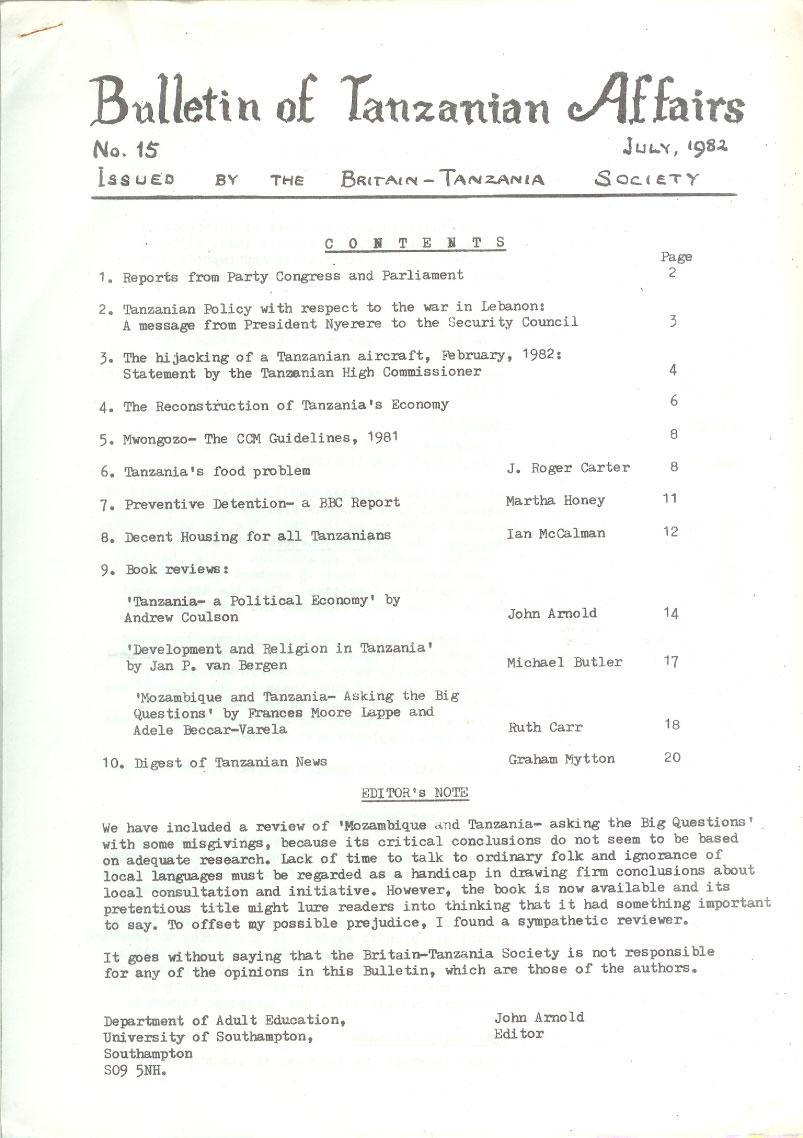
TA ISSUE 15

Issue 15 cover

Bulletin of Tanzanian Affairs
No 15
JULY 1982

CONTENTS
1. Reports from Party Congress and Parliament
2. Tanzanian Policy with respect to the war in Lebanon: A message from President Nyerere to the Security Council
3. The hijacking of a Tanzanian aircraft, February, 1982: Statement by the Tanzanian High Commissioner
4. The Reconstruction of Tanzania’s Economy
5. Mwongozo- The CCM Guidelines, 1981
6. Tanzania’s food problem – J. Roger Carter
7. Preventive Detention- a BBC Report – Martha Honey
8. Decent Housing for all Tanzanians – Ian McCalman
9. Book reviews:
‘Tanzania- a Political Economy’ by Andrew Coulson – John Arnold
‘Development and Religion in Tanzania’ by Jan P. van Bergen – Michael Butler
‘Mozambique and Tanzania- Asking the Big Questions’ by Frances Moore Lappe and Adele Beccar-Varela – Ruth Carr
10. Digest of Tanzanian News – Graham Mytton

EDITOR’S NOTE
We have included a review of ‘Mozambique and Tanzania – asking the Big Questions’ with some misgivings, because its critical conclusions do not seem to be based on adequate research. Lack of time to talk to ordinary folk and ignorance of local languages must be regarded as a handicap in drawing firm conclusions about local consultation and initiative. However, the book is now available and its pretentious title might lure readers into thinking that it had something important to say. To offset my possible prejudice, I found a sympathetic reviewer.

It goes without saying that the Britain-Tanzania Society is not responsible for any of the opinions in this Bulletin, which are those of the authors.

John Arnold
Editor
Department of Adult Education, University of Southampton, Southampton, S09 5NH.

REPORTS FROM PARTY CONGRESS AND PARLIAMENT

Food Situation.
We began the last issue of the Bulletin with a report of forecasts of severe food shortage in Tanzania early in 1982. It appears that, although there have been local shortages, surpluses in other areas and imports have so far been sufficient to prevent the disaster which was being predicted in the press.

The rain was very late in many areas, but heavy when it came, so this season’s crops are unlikely to be good. The government has provided for substantial increases in the prices to be paid to farmers for food crops with differential regional prices which will favour the production of sorghum, millet and cassava in drought prone areas.

Changes in the CCM (Party) Constitution
An extraordinary National Congress of CCM was held in January which endorsed important changes in the Party’s constitution.

Membership of the National Executive’ Committee (NEC) has been expanded to include 90 members from the Regions and from Zanzibar elected by the National Conference from a list of candidates drawn up by the NEC. The NEC will choose the members of the Central Committee, the Secretary-General of the Party and the Secretariat of the NEC. The Central Committee, in addition to the Chairman, Vice-Chairman and Secretary of the Party, will have 15 members chosen from among the members of the National Executive Committee. Thus the appointment of up to ten members by nomination by the Party Chairman has been abolished.

The National Conference will choose the Party Chairman and Vice-Chairman by secret ballot. Previously these posts were filled by acclamation at the Party Conference. It was also decided to separate Party and Government posts at Regional and District level, since the union of such posts in the hands of the Area and Regional Commissioners had tended to result in the Party function being subordinated. These changes will be implemented after elections for all levels of office in the Party have been completed next October.

The Congress also approved the National Economic Survival Programme (NESP) and the 1981 Party Guidelines.

Re-establishment of Local Government and Cooperatives.
Parliament has passed legislation to enable the re-establishment of local authorities and cooperative societies, which were both abolished in the early 70’s. There was strong opposition to the proposal to finance local government through a poll tax and the bill was passed with a majority of only 2 votes.

Dar es Salaam will increase its population from an estimated 1 million to over 1.6 million following a Government decision to expand its boundaries to increase its size from 542 to 1223 square kilometres, taking in 50 surrounding villages. The Kipawa area of the City is to be cleared to make room for the expansion and modernisation of the airport. The number of air passengers is growing at 10% a year and there is a need for longer runways and a new passenger terminal.

Parliamentary Enquiry into Sugar Price Increase
As a consequence of the sugar shortage the increase in its price and the management problems of the Sugar Development Corporation (SUDECO), (see Bulletin No.13, July 1981) Parliament set up a select committee to enquire into the price of sugar. The committee produced a highly critical report* at the January meeting of Parliament. The price increase from Shs.8/50 to Shs.10/- a kilo was held to be an unjustified attempt to shift the burden of SUDECO’s failures on to the consumer. Some sugar estates and factories were badly run, although others were commended for keeping their production up despite shortages of spares. The main faults were in distribution, where there were large unexplained losses, and in the incompetence of the marketing manager and his deputy who were not qualified for their posts, but had been employed on the insistence of the Minister of Agriculture, Ndudu Joseph Mungai. The Minister was severely criticised in the report for incompetence and nepotism. The Minister rejected these criticisms during the debate on the report, but early in February he was dismissed from his post.

Gas Deposits Confirmed
The Tanzanian Government confirmed on 5th July the existence of large deposits of natural gas at KIMBIJI in TEMEKA District, 40 kms. south-east of Dar es Salaam. The reserves have been estimated at three to four times more than those at Songo-Songo in Kilwa District. In a statement to the National Assembly the Minister for Water and Energy, Al-Noor Kassum, said that in order to continue the exploration with the possibility of further supplies of gas and perhaps oil, the OPEC Special Fund has agreed to provide an interest free loan to finance the drilling of two wells at Kimbiji.

* Ripoti ya Kamati Teule ya Bunge kuhusu Bei ya Sukari, Mwaka 1981-82.

TANZANIAN POLICY WITH RESPECT TO THE WAR IN LEBANON

The Text of a Message sent by President Nyerere to all Permanent Members of the United Nations Security Council on the Question of Lebanon

I am writing to you on the subject of Lebanon. Without any question the Israeli invasion is a flagrant violation of the sovereignty and territorial integrity of Lebanon. It constitutes an arrogant disregard of international law and of the basic principles of mankind’s common humanity; and it cannot possibly be justified on the grounds of a threat to Israel’s existence or security by Lebanon, or from Lebanon by the Palestine Liberation Organisation. No such threat did exist or could exist. The deaths of Israelis from guerilla activity or from terrorism in Israel, or elsewhere, can no more justify the massacre in Lebanon than the assassination of one Nazi official by one Jewish youth could justify the extermination at Lidice.

The State of Israel exists and has all the rights of a State. But it has no rights over other peoples or other nations, and it has no right to ignore the United Nations which created it. For the people of Palestine also exist; and they too have rights to a State within internationally recognised borders. The search for a solution to the problem of Palestinians and Israelis living together, each in their own homeland and on the basis of mutual respect, is an urgent one. The suffering, misery, and destruction caused by the Israeli invasion of Lebanon, and its air and sea attacks on the territory of that country, have had a devastating effect upon that search and therefore upon the future security of all the peoples of the Middle East including the Israelis themselves. It is certain that neither the cause of the Palestinian people, nor the authenticity of the P.L.O. as their representative, can be eliminated by death and destruction launched from Israel.

The number of children, as well as women and men, killed and wounded as a result of this invasion of Lebanon is at present – perhaps for ever – uncountable, for rescue teams and medical services have been overwhelmed. In addition, thousands upon thousands of people have been forced to flee from their homes and are wandering as refugees without food or shelter. Yet this tragedy has led to another: the world has been looking on as if it were helpless. Indeed one would almost think that we are all indifferent to the suffering, and ignorant of the danger of an even greater conflagration following upon this Israeli attack upon a United Nations member-country. And there is yet a third tragedy. It is that those who suffered from the holocaust, and whose state was established out of the world’s sympathy for the victims of that attempt at genocide should now themselves be engaged in what appears to be little less than an attempt to exterminate another people.

I am appealing to you to use the great influence, prestige and power of your country to do everything possible to bring Israel’s invasion of Lebanon to an end. In particular, and with the utmost urgency, I appeal to you to take such actions as will deter Israel from carrying out its threatened attack against West Beirut, and as will cause a speedy withdrawal of all Israeli forces from the territory of Lebanon.

I am sending a similar appeal to the Leaders of all other Permanent Members of the United Nations Security Council. My hope is that, either individually or collectively, you will act in accordance with the responsibility which this position gives to your nation for the maintenance or the re-establishment of peace and security in the world.

2nd July, 1982 Julius K. Nyerere

HIJACKING OF A TANZANIAN AIRCRAFT

THE HIJACKING OF A TANZANIAN AIRCRAFT, FEBRUARY, 1982:

STATEMENT BY HIS EXCELLENCY THE TANZANIAN HIGH COMMISSIONER

The Hijackers
Five Tanzanians have been charged in the United Kingdom with the act of hijacking the Air Tanzania aircraft. All five are related through birth and marriage: two pairs of brothers and a brother-in-law (whose sisters are married to the eldest brother in each pair).

Their Particulars
All five are young people in their early twenties. Their standard of education is Primary School Standard Seven up to Secondary School Standard Twelve (equivalent to Junior Secondary in the U.K.). One elder brother (the leader of the group) is a taxi driver. The other elder brother is an odd job man. The rest were all school leavers at the time of the hijacking and were thus not in any employment. Despite claims to the contrary the leader of the group had had no military training in Tanzania nor any connection with the Tanzania Peoples Defence Forces so far as could be ascertained. Only the leader of the group had been outside Tanzania before. He had worked as a seaman, in the course of which he had visited the United Kingdom and Greece among other countries where ships call.

Families
The two married men had their families on board the aircraft – one a wife and two children; the other a wife and one child. All the 5 relatives returned to Tanzania with the other hostages after failing to secure permission from the British authorities to remain in the U.K. The decision to refuse the request to stay was made by the British authorities.

Weapons
The weapons (real and imitation) used by the hijackers to secure control of the aircraft included: two wooden imitation pistols, an imitation hand grenade, two candles wrapped up to appear like gelignite explosive sticks and three knives. But in the course of the flight possession was obtained of a hand gun (0.38 revolver), a shot gun and a rifle. These weapons belonged to passengers who had surrendered them to the Captain of the ‘plane in accordance with the regulations on the transportation of arms on aircraft. The ammunition for the 0.58 revolver which wounded the First Officer was obtained by the leader of the group from the owner after threatening him with a knife.

Passengers and Crew
The aircraft was under the command of a Tanzania captain assisted by a First Officer and a crew of 3. The flight left Mwanza with 99 passengers on board all bound for Dar es Salaam. 5 disembarked in Nairobi and 2 in Athens, the rest continued with the flight to Stansted.

All hostages except two returned to Dar es Salaam in the hijacked aircraft. The two exceptions were the First Officer who was still in hospital recovering from his injuries and a subsequent operation to remove the bullet and a Roman catholic priest whose final destination when he boarded the ‘plane at Mwanza had been Rome. The priest had hoped to stay in Dar es Salaam for a few days making arrangements to travel to Rome for medical treatment. In the event he found himself at Stansted and it made no sense for him to return to Dar es Salaam only to arrange another trip to Europe. So he travelled direct to Rome. No other passengers remained behind despite wide-spread reports to the contrary.

Motive of the Hijackers
From the accounts of the many people who established contact with the hijackers and especially those who negotiated with them, there appear to be only two consistent themes in their demands. The first one is that of wanting President Nyerere to resign. The reasons they gave were incoherent, confused, even laughable e.g. the entire original charge of “fascism” advanced by the leader of the hijackers: The second one is derived from the way the hijackers acted. Why did they bring along their families? Did they expect that after carrying out the hijack the British authorities would allow them or their families to remain in the U.K.? Whatever they might have thought, the result did not warrant the methods and it is regrettable that some commentators should lay blame on anything else but wrong-doing.

Accomplices in Tanzania

The leader claimed a membership of some 3,000 young men and women of an alleged movement which he variously described as the “Tanzania Youth Democracy Movement” or the “Tanzania youth Revolutionary Movement”. Investigations carried out both during and after the incident have revealed no such movement. Instead they have led to the arrest of four accomplices in Tanzania. These have now been brought before a court to answer a charge of conspiracy.

Casualties
There was only one casualty throughout the ordeal, which lasted for 36 hours between Mwanza and Stansted – that of the First Officer who was shot by the leader of the hijackers in circumstances which suggest carelessness.

Release of Hostages
The whole strategy of handling the hijackers was to buy time without giving in to their demands. As part of this strategy the negotiations were intended to talk them into submission. By the end of the first round of negotiations involving the High Commissioner on Saturday night and Sunday morning the strategy was already paying off. The hijackers were already showing signs of fatigue and it was quite apparent that they could not hold out for much longer. That, at any rate, was the impression they gave the negotiators. For example, by about 2.00 a.m. on Sunday morning they were too tired to open the aircraft door to receive the food and water they had been clamouring for. Thus it was no surprise when they gave in and released the first seven hostages some moments before Kambona came on the scene. Soon after all the rest were released.

Trial
The five are facing trial in the U.K. in accordance with the law here. Despite press speculation, Tanzania is quite happy to see the law take its course and has made no attempt to seek the extradition of the five to Tanzania.

THE RECONSTRUCTION OF TANZANIA’S ECONOMY

The basic 1982/83 – 1984/85 Tanzanian economic policy objectives and guidelines were presented to the National Assembly on June 16th, 1982 in the budget speeches of the Minister of State for Planning, K.A.Malima and the Minister for Planning A.H.Jamal. The broad policy structure of reconstruction planning is set out in Structural Adjustment Programme for Tanzania. The initial time frame set is 1982/83 – 1984/85, but the accompanying Budget Speech which contains the first year’s resource allocations implies that the period may be as long as five years.

In terms of immediate action the Structural Adjustment Programme’s 1982/83 tranche shows no marked changes on 1980/81 policy. It is a set of retrenchment measures. These result in a sharper proposed cut in recurrent, as well as capital expenditure because the end of the security expenditure related to the Uganda war and the subsequent reduction in the size of the armed forces has allowed a one-third cut in budgeted expenditure for defence. The 7 to 8.5% rise in nominal recurrent spending by other Ministries and by Regions implies a fall in real recurrent services of 4 to 7%.

The very sharp increase in parastatal rehabilitation and subsidy expenditure estimates for 1982/83 (not necessarily an equally large increase over actual 1981/82 expenditure) is related to past agricultural and transport parastatal losses and to the unsustainably high prices set for several crops – notably cotton, tea and tobacco – in 1981. The absence of either a sharp increase in staple grain and flour prices, or a minimum wage increase to offset inflation, represent a change from the approaches to deficit and income management in 1980 and 1981 as does also the absence of any tax increases.

There are no tax changes, resulting in a very large and uncertain local borrowing requirement of Shs.4,376 million. The uncertainty arises because the logic of the Structural Adjustment programme includes substantial additional foreign resource inflows – including $210 million in IMF drawings and a World Bank Structural Adjustment credit – which are not as yet negotiated. If they are negotiated and received promptly a smaller deficit is likely, but if late or not at all a much larger one is certain.

The Structural Adjustment Programme is in part a consolidation of elements from three earlier Tanzanian forward planning exercises: the abortive 1980-83 Structural Adjustment Programme, which foundered on non-acceptance by the Bank and the 1981 coffee price collapse; the 1980 decadal development proposals to the UNCTAD sponsored “least developed” conference series (notable for lack of practical response) and the 1981 and 1982 National Economic Survival Programmes. Because the external economic context ‘has worsened substantially during the period 1980 to 1982, the present Structural Adjustment Programme is far more draconic in its implications – albeit remarkably non-specific on what actual cuts are seen as acceptable. The policy statements on exports, incentives and efficiency consolidate those of 1980/81 and 1962/82 in a somewhat more coherent way, but specific measures (at least in an applicable form) are less evident than in the earlier statements.

The stated commitment to maintaining achieved degrees of egalitarianism and levels of basic services reads somewhat oddly in the light of what the Budget does not include in votes and wage changes, though the sharper decreases in defence spending and •the capital budget have allowed some protection of health, education and water (the key basic service heads). Given the level of subsidies to agricultural products, probably over Shs.1 ,500 million or over 10% of recurrent estimates as a whole totalling Shs.14,144 million, increases in peasant real incomes are clearly dependent either on increases of output, reductions of transport and storage losses, or cuts in procurement, transport and marketing costs in both the private and public sector.

A substantial number of proposals for directions of change, new approaches and rehabilitation packages are made. These are less interrelated, detailed or costed than in previous Tanzanian planning exercises. This may be because of the short time that elapsed between receipt of the report of “Three Wise Men” chosen jointly by the World Bank and the Tanzanian Government (formally known as the Tanzania Assistance Group, with three experts and a supporting secretariat)* in April and the mid-June budget deadline for the presentation of a Tanzanian programme harmonising their proposals with existing Tanzanian strategy. It may also relate to the fact that the detailed elaboration of proposals and programmes dependent on foreign finance prior to having been able to negotiate agreement on that finance, at least in principle and in order of magnitude, is not necessarily very useful and runs a distinct risk of over optimism.

The section on parastatal performance notes the very uneven performance – from good to abysmal – and the negative effect of the weaker parastatals on the performance of others. It re-stresses the problems caused by inadequate accounting personnel and by the refusal of many parastatal managements to accept responsibility. It calls both for the enforcement of the existing legal rules on the preparation of parastatal annual capital and operating budgets and the approval of budgets by Planning and Finance, also for substantially greater worker power through strengthened Workers Councils and enhanced representation at board level.

The outcome of the 1982/83 – 1984/85 Structural Adjustment Programme (and any extension to 86/87) depends in the first instance on negotiations with the IMF and the World Bank as well as other sources of external finance. With exports covering less than half of essential (slightly over half of actual) imports, no workable medium-term economic strategy, including one aimed at raising the ratio of exports to import requirements, can be made to work without either a sharp increase for three to five years in concessional resource flows, or a sharp recovery in the terms of trade (now perhaps 50 on a 1972 base of 100 or 45 on a 1976/77 base). The latter appears quite out of the question as neither a 100% increase in the price of coffee, tea, cotton and cashew nuts, nor a 50% fall in those of manufactured goods and petroleum, are in the least likely. Whether the reiterated stress on exports, incentives and productivity – now apparently in large measure endorsed by the “Three Wise Men’s” report – will have more success in allowing access to Fund and Bank resources than in 1980 and 1981 remains to be seen.

* see Bulletin No.13, page 2.

MWONGOZO – THE CCM GUIDELINES OF 1981

Mwongozo was adopted by the National Executive Committee of the Party at a meeting held between 23rd November and 7th December 1981, ten years after Mwongozo of TANU, 1971. It is an important document for a number of reasons. First, it draws upon the experience and thinking of a decade and represents a considered reaction to the practical problems that have arisen as Tanzania has attempted to put into practice the principles and policies of the Arusha Declaration of 1967 in an increasingly unfavourable world economic climate. Secondly, it is wide-ranging in its impact on matters economic, social and constitutional. Though some of its conclusions are likely to be constrained by financial limitations, Mwongozo provides an agenda for discussion in many spheres in the months and years to come.

Finally, and perhaps most importantly, Mwongozo offers us an inspection window into the thinking of leading Tanzanians, including President Nyerere, the Chairman of the Party. Mwongozo is in Kiswahili and was intended as a handbook for Tanzanians, a pocketbook for Party members, not for the outside world. We may not always agree with that thinking, but that is not our business. The importance of Mwongozo is that it shows us how Tanzanians are reacting to their own situation in the light of certain social principles, which they believe to be supremely important and which many elsewhere would agree to De indeed important to the world in general. We may sometimes feel that the Tanzanians are only fumbling, but many of us in the West do not even fumble.

Mwongozo is too long to reproduce in the Bulletin, but a somewhat shortened version in English is being prepared for circulation shortly to all members of the Society.

TANZANIA’S FOOD PROBLEM
The recurrent failure of Tanzania to feed itself and the consequent necessity to supplement home-grown supplies with imports, which are costly in foreign exchange, have drawn attention to the need for a more systematic appraisal of the conditions needed to avoid future shortages and to provide for the needs of a rapidly growing population. Table I shows the extent to which cereals have been imported in the recent past and the wild fluctuation of imports; it also shows the growth of population.

Table I. Imports of cereals and growth of population, 1969-1982

Year Imports of cereals (tons) Estimated population
1969 31,000 13,140,000
1970 54,000 13,573,000
1971 52,000 14,021,000
1972 163,000 14,484,000
1973 37,000 14,962,000
1974 400,000 15,455,000
1975 415,000 15,966,000
1976 96,000 16,492,000
1977 126,000 17,037,000
1978 137,000 17,528,000
1979 33,000 18,180,000
1980 346,000 18,780,000

Cereals includes maize, rice and wheat.
Sources: Imports of cereals 1969-79, ‘Food production, trends, problems and possibilities – Tanzania’ by C.S.Lombard, Oct. 1981. Imports of cereals, 1980, ‘Hall ya Uchumi wa Taifa katika Mwaka 1980’, Government Printer, Dar es Salaam, 1981. Estimated population based on the censuses of 1967 and 1978.

It is widely maintained that Tanzania ought to be able to feed itself and to consign sufficient to reserves for the lean years. That it does not do so has complex causes, which include the present frailty of the economic infrastructure – storage, roads, transport vehicles and crop marketing management; agricultural errors of judgment and of timing; the planting of unsuitable crops in high risk areas; and problems of peasant motivation.

The extent and reliability of rainfall is the most important variable which affects crops. During the sixties rainfall was above normal and this tempted peasants to extend the growing of maize into high risk areas in place of more drought resistant crops, such as the millets and sorghum. Maize has a number of advantages over millet and sorghum. It is less susceptible to bird attack and diseases and maize flour is more palatable and therefore more popular and more saleable. But maize is also more vulnerable to rainfall variations and deficiencies and a crop may be spoiled by premature planting before the rains have properly set in. Reliable rainfall during the middle growing period is essential.

Valuable work has been done by the FAO/KILIMO Crop Monitoring and Early Warning Project as a guide for planting policy on the incidence and variations of rainfall in various parts of Tanzania and the effect on crops. Unlike soil variations, rainfall deficiencies or excesses cannot be corrected, except in those limited circumstances where irrigation is practicable, and can only be taken into account in crop planning. Moreover, the choice of crops must take into consideration not only the amount of rainfall, but also its reliability. Difficulty is liable to be created by a succession of years over which rainfall has been ample or deficient, as this tends to encourage planting practices, which are not justified over a longer period of reference.

The FAO studies have divided Tanzania into seven agroclimatic areas, using rainfall data accumulated over 30 years or more. The most favourably endowed area, type S, has reliable rains from November to June. These conditions are found in the Southern Highlands and are very suitable for maize, finger millet, bananas, wheat and beans. In these areas maize is subjected to water stress in less than one year in five during one month at the tasseling stage. In Central Tanzania, comprising Singida, Dodoma and parts of Tabora, and in the south-east, comprising Mtwara and Lindi Regions (type C), on the other hand, there is a high risk (70%) of dry spells in mid-season around February and the climate is therefore only suitable for drought-resistant cereals and root crops, except at the western end of these areas, where maize may successfully be grown in perhaps 60% of the years. There are also areas with two rainy seasons, the B type, as in Dar es Salaam, where maize can successfully be grown during only 20% of the years in the short rains, but may be successful in 60% of the years in the long rains, except in some areas, which are only suitable for grazing; the L type, as in Kagera Region, (West Lake), where the short rains are more reliable than with the B type and both maize and rice may successfully be grown; and the Tn type, as in Tanga Region, where the long rains from March to June are sufficient for maize and where at higher altitudes two crops can successfully be grown. There remains the T type, intermediate between B and C types, as in Kilosa, suitable for maize planted in mid-season and in some parts for wheat and vegetables; and finally the K type, as in Kilimanjaro, where two water-demanding crops may successfully be harvested each year, corresponding to the two rainy seasons. (1)

Statistical information about food crop production is hard to obtain and reliance is normally placed on the amounts purchased from the peasants and the state farms by the National Milling Corporation for sale in the towns and in deficit areas. But the figures of marketed crops ignore the amount retained by peasants for their own use. How this varies is a little obscure. It is no doubt a first charge on production, but in the lean years families may nevertheless deny themselves for the sake of at least a minimal money income. The figures of NMC purchases over recent years have fluctuated wildly and it is not easy to distinguish a trend, but by using three-year averages to minimise seasonal variations, it appears that between 1969-72 and 1977-80 purchases of staple grains rose by an average of 1.8% per annum. As the population is understood to have risen during that period at a rate of 3.3% per annum – even more rapidly in the towns – the volume of staple grains available for marketing fell by 1.5% per annum per head of population during that period.

According to the World Bank(2) most of the growth has been obtained by extending the area under cultivation rather than by the improvement of output per hektare. There appear to remain substantial areas of good land that can be taken into cultivation, but in the long run, with the prospect of 35 million mouths to feed by the end of the century (nearly 20 million today), the problem of increasing yields is becoming daily more acute. In some areas this has been successfully achieved by the use of fertilisers, but the problem of maintaining fertility is not necessarily solved by successive applications year after year. Professor Dumont, who is a great believer in stock breeding both for food and for haulage, suggests that the cotton soils of Sukumaland, in which injudicious applications of ammonium sulphate have increased the acidity of already excessively acid soils, can only be restored to fertility by the use of organic manure in conjunction with small quantities of fertiliser.(3)

On the evidence provided by the World lank, there seems little doubt that the raising of yields encounters serious problems in African Third World countries and calls for a consistent and prolonged effort in applied research. In particular, the Bank recommends an extended programme of testing and validating under local conditions the research findings of the FAO Centre for Maize and Wheat (CYMMET) in Mexico, which in turn is expected to expand its research into the problems revealed by validation studies in Africa. In general, the Bank seems to take the view that markedly increased yields can only result from protracted study and subsequent changes in production technology are not expected to be achieved in the short run. This means that early self-sufficiency can only result in the main from increased acreages under cultivation and it remains to be seen whether this effort will be successful, particularly in view of the priority given to a very large expansion of export crops. (4)

But this technological approach to increased production may well obscure the problem of peasant motivation, which clearly lies at the heart of the immediate problem of production. As the Bank points out, substantially increased producer prices are essential. They are important not only to raise the standard of living of the peasantry, but also to give substance to the official emphasis on rural development and to convince the peasants that the wealth they create is not being needlessly dissipated in the interests of a swollen and urbanised bureaucracy. These psychological factors, which seem to be well understood by the Party (5), are immensely important for overcoming the food problem. The cooperation of the peasantry has to be won and cannot be elicited merely by pressures and directives.

There is, in fact, statistical evidence of the sensitivity of the peasants to the level of producer prices. When the National Milling Corporation began to purchase drought crops (sorghum, cassava and the millets) in the early seventies, the unduly favourable prices offered caused a diversion from the preferred cereals and created for the Corporation a serious problem of storage and disposal. Peasants need cash for buying consumer goods and materials for house building (nyumba bora). The presence of goods in the village dukas (shops) is an important factor in peasant motivation. Communal farming (ya kijamaa), which is encouraged by the Party, is successful in areas in which it is seen to provide an adequate income for the provision of social facilities- schools, clinics, village roads, water supplies, maize mills, etc.. Here again, success depends in part on the visible returns.

Tanzania’s economic situation is not favourable for securing for the peasant the full benefits that a buoyant rural economy might be expected to yield. This no doubt accounts in part for its sluggish response. But despite immense difficulties in maintaining industrial production and the means of transport, there remains room for improvement by the choice of priorities and by maintaining the rural emphasis for which Tanzania has been justly famous.

J. Roger Carter

1. The information in this paragraph is from ‘Rainfall Variability, Types of Growing Seasons and Cereal Yields in Tanzania I by R.A. Gommes and M. Houssiau: FAO/KILIMO Crop Monitoring and Early Warning Project, Dar es Salaam, 1982.
2. World Bank: Tanzania Basic Economic Report, Washington, 1977.
3. ‘L’Afrique Etranglee’: Rene Dumont and Marie-France Mottin: Editions du Seuil, Paris, 1980.
4. Mpango wa Pili wa Taifa wa Kujihami Kiuchumi wa Mwaka 1982.
5. Mwongozo, 1981

PREVENTIVE DETENTION – A BBC REPORT

In 1962, less than a year after independence, Tanzania adopted a Preventive Detention Act giving the President power to detain indefinitely and without trial persons acting in a manner threatening the security of the state. In the fragile post-independence period of the early 60’s many African states, including Ghana, Kenya and Zambia, passed similar laws. But now, 20 years after independence, members of Tanzania’s judiciary have been calling for the repeal of the Preventive Detention Act.

At a Faculty of law symposium in January, Mr. Kalunga, Principal State Attorney in the Ministry of Justice, presented a paper calling for the repeal of the Preventive Detention Act. This is the latest such public appeal. Several months ago a small book entitled ‘Honest to my Country’ (see TA Issue 14, p.16), written anonymously by a Tanzanian lawyer, called for doing away with the detention law. Then in December a court of appeals judge, R.H. Kissanga, said that the time had come seriously to consider repealing the law. Over the past two years a number of judges have heard cases involving detainees and some have written opinions very critical of the way the law is implemented. In this latest critique Attorney Kalunga called the detention law ‘a menace to everyone in the country’. The Act, he wrote, was a horrific piece of legislation, difficult to defend, and its utility was certainly zero. To the ordinary citizen, whose heart is full of love for freedom in his motherland, the act is a nightmare. It creates fear, unhealthy and unnecessary submissiveness.

Kalunga’s controversial paper stimulated three hours of lively debate. The audience included Tanzania’s Attorney General, a number of judges, several MP’s, professors of law and several ex-detainees. Most speakers advocated repealing the Preventive Detention Act. A number, including the Attorney General, said it should be more carefully implemented and perhaps revised. Only one speaker defended the law as it is applied. Opponents of the detention law argued that nowadays Tanzania is politically stable and that therefore the original reason for the law no longer exists. Some legal experts said that the law itself is redundant, since there are other laws which adequately protect against any threat to national security. Further, a number of speakers said that the act puts far too much power in the hands of one man, the President, and that it does not give detainees their fundamental rights, such as the right to legal counsel, or to be charged and tried in court for their alleged offences. And according to some of the speakers the law, harsh as it is on paper, is being grossly misused. They said it has become a catch-all for locking up a variety of common criminals whom, for one reason or another, the executive branch and the police cannot, or do not want to, bring to court. Those being detained nowadays are very rarely political opponents of the Tanzanian government. Rather they include small and big time criminals, such as habitual drunkards, cattle rustlers, thieves, embezzlers, smugglers, foreign exchange violators, racketeers and economic saboteurs. As one speaker, High Court Judge and Member of Parliament Nassoro Mnavas, said, ‘the law itself was originally passed to deal with political malcontents after independence. But unfortunately it is now being misused to supersede ‘ criminal law’. Neither the names nor numbers of detainees are made public. And my attempts over the past several weeks to obtain this information have, so far proved futile. But according to knowledgeable people I’ve interviewed the number of presidential detainees may be as high as several thousand.

In his remarks at the symposium Tanzania’s Attorney General, Joseph Warioba, said he was disturbed by much of the discussion, which he considered ‘a bit one-sided’ and ’emotional’. He said ‘we must look to see if there are enough safeguards’ in the detention act, but concluded: ‘I do not think we can say that we can do without the law at this time’. Just what will happen next remains unclear. However, it does seem that at a minimum there will be efforts to crack down on the current widespread misuse of the detention law and that the courts may become more aggressive in hearing detention cases. And at some point parliament may be asked to debate whether or not it should revise or repeal the detention act.

Martha Honey
(Reproduced with the kind permission of the British Broadcasting Corporation)

DECENT HOUSING FOR ALL TANZANIANS

‘After food and clothing, shelter ranks third amongst the basic necessities of life’. The Minister of Lands, Housing and Urban Development repeated this message at the conference held in Arusha to work towards a national housing policy for Tanzania. He continued: ‘when Tanzania became independent on 9th. December, 1961, the government took immediate steps to provide decent housing to all Tanzanians irrespective of their income or race’. The conference was only too able to assess how this objective had fared as it listened to papers which spelt out the problems both in the past 20 years and in the way ahead.

Like many developing countries the Tanzanian population has been growing Rapidly – currently at a rate of 3.3% per year (doubling in 20 years) – since independence, with a present population of 19 million. Half of this 19 million is under 15. It is not difficult to imagine the demands for shelter generated by such growth. Compound this with the experience that the traditional house-type lasts about 7 years depending on mud, pole and branches for the main constructional items. The net outcome of this calculation is that about 600,000 houses were being built or rebuilt in 1978. It is not amiss to recall that the UK, with a population 3 times the size and a GNP per head 24 times greater, has managed 500,000 houses in a year only once.

This scale of the problem is, however, complicated by the movement of rural people towards the towns. While largely a rural country (85% live in villages) the main towns, and especially Dar es Salaam, are growing at over 8% per year. leading to substantial areas of squatters’ houses, of which there are 100,000 in Dar es Salaam alone. This movement to the towns aggravates the housing situation since such a move is towards a cash economy, needing to buy materials for proper shelter from a largely subsistence agricultural economy with materials near to hand. So there are major factors of populations growth, urban drift and material availability.

How have the formal public housing institutions tackled these very substantial tasks, as promised in 1961? The picture, it has to be said, is not good. The Minister stated that the National Housing Corporation since 1962 had built no more than 14,000 homes. The Registrar of Buildings had also constructed 400 houses. Site-and-Service projects had released a further 9,000 plots for individuals to build their own homes. These approaches are clearly not meeting the needs of the bulk of Tan2anians, concentrating, as it transpired, on high quality, high cost units in urban locations.

As a new approach, the Tanzania Housing Bank (THB) was established to provide mortgage finance for people to build their own new houses. Such finance would also be available to villages as a whole and as such the THB played a significant role in the implementation of national governmental policy for the creation of new and centralised village settlements, which were to form the basic organisational units of the country and the Party. By the end of 1979, 27 villages had borrowed to finance 2,000 houses, as well as individual loans. Yet it was still the urban areas with 15% of the population that were getting half of the available finance, due largely to rural inaccessibility of the urban-based THB and to its conservative approach to income requirements and repayment schedules (over three quarters of the THB borrowers earn more than twice the average income). These rules become a major constraint when Tanzania’s GNP per head is amongst the lowest 15 in the world.

So there is a huge gap between the houses that are reported as being constructed and the comparatively few houses that the formal institutions have been funding. The contribution from the informal sector is thus the bulk of all housing activity. It is not surprising that the Arusha conference resolved that the starting point for a national housing policy was that home ownership should be encouraged. The closing speeches that now ‘Tanzania has very limited resources to provide public housing. That is why the Government and Party encourage Tanzanians to build their own homes instead of waiting for the Government to provide housing for them.’ Self-reliance is now the watchword for housing provision; it is a long way to come in 20 years.

Self-reliance will apply to materials and to construction and financing. One reason of course why so few houses were funded publicly was the high standard required by a building code exported from Britain in the thirties and unamended since independence. It related well to urban aspirations of importance and mortgage security. Its critical failure, however, was its almost total dependence on cement blocks and on imported components, including the raw materials for corrugated iron or aluminium sheets. The money cost was itself high (over twice the cost of an indigenous brick house), but its major national disadvantage was the high import content. And that is a disadvantage worse today than ever, when the average import capacity of the country is only half what it was in 1972 or 1976. The terms of trade have moved radically against the country since then and the lack of resources has led to a drop in income of about 50% over the last 3 years.

There is now internal cement production, but it is fired by fuel oil, which has itself to be imported. The product when finished has to be distributed by diesel-fuelled vehicles. The planned output is to double, but the National Economic Survival Programme priorities may not allow such consumption of extremely valuable and expensive imported resources on housing projects, when they could be applied to utilising more of the economy’s productive capacity, which is only 3o% utilised at present. If national priorities determine the resource allocation of high cost construction materials, it becomes even more essential that locally available materials are used, to locally agreed standards and designs and by locally comprehended methods of construction. These now form the key planks in the ‘nyumba bora’ campaign to improve rural housing.

The Arusha Appropriate Technology Centre has developed particular soil cement mixtures compacted in a manually operated mould-machine to provide traditional house-types with a much longer life. Such a machine, with adequate training and repair backup, form~ a sensible approach for a village construction unit to provide rural housing at a 35% saving over sand-cement blocks. Again, in appropriate areas one can often see very small scale clay pits providing bricks to be fired locally. The importance of local production is highlighted by the fact that the westernmost Districts use 40 time less cement per head than those at the capital.

The other key local element is that of education being undertaken by the Party (CCM) and local officials both to advise on the long-term advantages of improved long-life housing and on the need for joint village working to build and finance them. At a practical level there should be technical support via the Rural Construction Units, which should be equipped to train and assist villagers in building, joinery, bricklaying and plumbing methods. If these key areas can be successfully tackled, the number of houses needed could drop from 600,000 to 200,000 per year, since each improved house would last of the order of 4 times as long. Even that would demand resources of an estimated shs.1.4 billion per year, which even reduced to an individual village scale must be doubtful in view of the low real income from cash crops.

This financing area is crucial, since villages have to raise loans from the THB to fund the works with little state financial support. The success of such a strategy depends on major relaxations and improved accessibility on THB’s side as well as substantial income and commitments by the villagers. Certainly evidence on the ground at the moment indicates a substantial number of houses still being built of traditional .materials of mud and laths on a pole framework.

In the towns, the authorities have accepted squatters as an unavoidable component of housing policy and have embarked on a programme to upgrade squatter areas. This is by way of loans from the THB to individuals. The state cannot provide new housing and amenities, but it aims to improve the surroundings if owners improve their own homes. The success of this in mobilising resources, coupled with the Site-and-Service Programme, is indicated by Dar es Salaam’s consumption of 40% of the national output of cement. The Squatter Improvement Programme is one area in which the World Bank has made material contributions to improve the homes of 315,000 people throughout the urban areas of Tanzania. Nevertheless, the issue of squatter areas will continue. There are 100,000 squatter houses in Dar es Salaam now and urban populations must be’ expected to rise from 3 million to 10 million in the next 20 years. It would be foolish to pretend that all the urban workers will be able to afford THB loans: but can Tanzanian society accept the South American, or even the Kenyan, scale of alienation?

Ian McCalman