THE HUMAN RESOURCES DEPLOYMENT ACT 1983

The Human Resources Deployment Act, 1983, was passed by the National Assembly in April and became law on 9th. May. It gives the Government wide new powers to mobilise the country’s labour force for productive work. It follows a direction of the National Conference of the Party (Chama cha Mapinduzi) held in October, 1982, that the Government ensure that everybody who is able to work does so more skilfully and productively. The Act is ‘aimed at making provisions to regulate and facilitate the deployment of available human resources towards the eradication of poverty’.

The preamble to the Act refers to the Constitution of the Republic, the Arusha Declaration and resolutions of the former Tanganyika African National Union and of CCM concerning the right and duty of citizens to engage in productive and lawful work. The Minister for Labour, after consulting other Departments and public and private bodies, is required to produce a National Human Resources Deployment Scheme involving public and private sectors and agriculture to ensure that all residents capable of working do so more skilfully and productively. The Act also sets up a National Human Resources Advisory Committee appointed by the Minister for Labour to advise on the implementation of policy, on research into better ways of using available manpower resources and on any necessary legislation.

The Act makes the new local authorities responsible for making arrangements which will ensure that every resident within its area ‘engages in productive or other lawful employment’. All local authorities are required to establish a local human resources deployment committee to carry out the provisions of the Act and will have the assistance of a local co-ordinator appointed by the Commissioner for Labour. In addition to formulating plans for employment- generating projects, local authorities will maintain two registers. There will be an Employers’ Register, which will give information on employment capable of being offered by employers. There will also be a register of all ‘residents’, that is, people who ordinarily reside in the area of the authority excluding those under the age of 15 and those incapable of work on account of old age, illness, or infirmity, with details among other things of their qualifications and present employment. The Commissioner for Labour in conjunction with employers in the public and private sectors will establish a national register of non-skilled, skilled and high-level manpower. The Minister may make regulations as to the manner in which the inclusion of a person’s name on the register may be proved, for example, by the issue of identification cards.

The Minister may arrange for the transfer and subsequent employment of unemployed people, having special regard for retired public servants, unemployed young persons, unemployed adults, housewives and non-citizens. Where training or rehabilitation is needed, the Minister in cooperation with other Departments may make provision for suitable courses. The Minister is especially required to provide for the rehabilitation and gainful employment of persons convicted as ‘idle and disorderly persons’ (prostitutes, beggars, gamblers, vagrants, etc.), or as ‘rogues and vagabonds’ (petty thieves, idle and disorderly persons on second conviction). The officers of the Commissioner are empowered to enter premises ‘reasonably suspected of harbouring idle persons’. It will be an offence to obstruct any scheme organised under this Act.

The Act appears to reflect the conviction long held and expressed in the Arusha Declaration and subsequent statements that the nation’s human resources are one its principal assets. The more effective use of manpower has become even more critical in recent years owing to the decline in the nation’s economy and restrictions in the flow of external resources. If in the present unfavourable international climate the nation cannot develop the economy as previously planned, at least it must make the best possible productive use of the two factors of production that are available in abundance – its human capital and its land. It is a recognition of this fact that is believed to have led to this legislation.

There are of course symptoms of maladjustment in the use made of human resources, which are mainly a consequence of the economic crisis. There are persons who have been devoting their energies to black market activities and other occupations that are parasitic on the economy in an effort to bypass shortages and to manipulate the situation for personal enrichment. There is also the pervasive and unsolved problem of the urban unemployed, rural folk who drift into the towns in the, belief that the streets are paved with gold. There are finally those retired civil servants – one hopes few in number – who use their knowledge of the ropes and a little greasing of palms to secure special favours. Some of these aberrations are punishable at law under the Economic Sabotage (Special Provisions) Act, but the Human Resources Deployment Act is a much more positive approach to such problems. It is interesting that special attention is given by the Act to employment schemes as a therapy for petty crime.

Whether the new local authorities will measure up to this formidable challenge remains to be seen. Even labour-intensive employment requires an investment both of capital and of initiative and expertise; only the future can show whether these essential ingredients are available in sufficient measure, though the comparative success of the Small Industries Development Organisation (SIDO) even under difficult economic conditions is a hopeful sign. One interesting aspect will be the use made of the services of the growing body of civil servants retiring at 55, or resigning at 50, as the law provides. The hope is that many will return to their villages and provide a focal point for new initiatives in rural society.

The first test will be in the Dar es Salaam Region, where the Prime Minister has directed that the Region identify farming land for the unemployed of the city. This is potentially a substantial task. It is calculated that of the city’s estimated population (1983) of 1.3 million only 166,000 (12%) are formally employed. On the assumption that on an average they have four dependents, this accounts for 830,000 people, leaving an estimated 470,000 engaged in the informal sector or unemployed. Clearly nothing like this number will need to be resettled. Studies both of Tanzanian and of other African urban areas (1) have demonstrated that the informal employment sector is complex and dynamic, making an important contribution to the economy. The Tanzanian Government would not want in practice to remove this source of initiative and enterprise. However, there is understandable worry at the demands that Dar es Salaam makes on the national food supply and both employed and unemployed residents are being urged to make efforts to grow at least part of their food requirements. The Government will offer farm implements and seed for sale, or on easy credit terms, and provide food for a short period for people who are prepared to settle in and farm the new land.

John Arnold

BOOK REVIEW

Contextual Perspectives on Geographical Thought: Gillman of Tanganyika (1882-1946) by Dr. B.C. Hoyle: Discussion Paper no.19, Department of Geography, University of Southampton, 1983: 25pp.: 75p.

This short paper is intended to be the forerunner of a major study of Clement Gillman’s life and work. Engineer, cosmopolitan, explorer and practical geographer par excellence, Gillman’s 40 years of scientific exploration and practical administration span the whole period of the modern development of Tanganyika to the end of World War Two. He was particularly associated with railway development, but his pervasive interests in hydrology and environmental issues placed him in the front rank of those who both contributed to and drew intellectual support from the newly developing field of academic geography.

Anyone with an interest in modern developmental problems in the Third World is bound to admire and value the considerable achievements of such a pioneer geographer. It is a tribute to Brian Hoyle’s enthusiasm and perception that he should have chosen to write so well and so carefully about such a figure. In his own writing he shows the same qualities which he attributes to Gillman, i.e., ‘meticulous observation’ and ‘accurate recording of facts’ as well as a capacity to enliven these facts with comment and intelligent interpretation. We should all look forward to the fuller and no doubt definitive work which will follow. It is perhaps appropriate to conclude this short note with Brian Hoyle’s own summary at the end of his paper on Gillman himself:

‘He was clearly a man of strongly-held and forcefully-expressed opinions, a man who was widely admired, but whom some must have found a constant source of irritation; a man whose agnosticism set him apart from many in his community; and whose internationalism received a cool reception during the rampant nationalism of the two World Wars. Yet in the last analysis he was a man of tremendous drive and enthusiasm, of vast experience and wise counsel, and a pioneer to whom all concerned with modern development planning in East Africa today owe a considerable debt.’

Paul Fordham

(1) see ‘The Informal Sector and Peripheral Capitalism’ by Manfred Bienefeld: Institute of Development Studies Bulletin 6.3

DIGEST OF TANZANIAN NEWS

Attempted coup and treason trial
In late January, Zambian and Kenyan newspapers carried reports of an attempted coup in Tanzania. It was alleged that there had been fighting in a northern garrison town and that 600 soldiers and 1,000 civilians were under arrest. These stories followed earlier reports of bandit activity on the shores of lake Victoria involving the ambushing of an army patrol. Such reports were described as greatly exaggerated by the Inspector-General of Police.

On 28th. January, 29 people appeared in court charged with conspiring to overthrow the Government by force and kill the President. The accused included Christopher Ngaiza, a personal assistant to the President responsible for the Kagera Basin Project; 14 army officers ranging in rank from lieutenant to lieutenant-colonel; a university lecturer; and several business men.

The prosecution seemed to have some difficulty is preparing its case, as there were repeated requests for adjournment. However, by the second week in June the prosecution was claiming that investigations had reached an advanced stage and that they would be ready to open the preliminary enquiry before a magistrate by the end of the month. The Government then took a decision to abandon the prosecution and it was reported that the accused people would be held in preventive detention.

On 17th. June two of those being held in maximum security, Pius Lugangila, a business man, and Hatty Naghee, a former pilot with Air Tanzania, escaped. As a consequence, the Minister for Home Affairs and the Director of Prisons resigned their posts.

Constitutional proposals and administrative changes
Amendments to the Constitution, which have been put forward for public discussion, include limiting the number of terms a President can serve, the creation of a Second Vice-President (one being for mainland Tanzania and the second for Zanzibar and the islands) and increasing the powers of the National Assembly. The system of appointments in public institutions is to be modified.
These posts will in future be advertised and the Board of the organisation together with the parent Ministry will make recommendations to the President, who will make the final decision.

The Department for the Civil Service and Manpower Development, which was previously part of the Prime Minister’s Office, has been made into a separate Ministry headed by Pius Mwandu.

Executive Directors have been appointed for the 80 new District Councils wh1ch are to be established later this year. Councils will be responsible for the provision and maintenance of economic infrastructure, social services and revenue collection. The separation of Government and Party means that the senior civil servant in a District again has the title of District Commiss1oner.

The future responsibilities of District Councils under the Human Resources Deployment Act 1983 have already been noted on page 12 (above).

Cooperative Societies
Cooperative Societies which were abolished in 1976 are to be re-established together with Cooperative Unions at Regional level. In addition to marketing crops, the Cooperatives will have responsibility for promoting agricultural production. They will do this through the supply of farm inputs and the provision of credit. In a recent speech, opening the Third Conference of Financial Institutions, President Nyerere pointed out that in the last year in which Cooperatives were acting as credit intermediaries roughly 90% of the advances made by the Tanzania Rural Development Bank were recovered on time, but after the present Crop Authorities took over this function collection had dropped to about 30% of the amount due. The President stressed the need for the Financial Institutions to support the new Cooperatives by providing simple accounting systems, which could be operated by village leaders.

The Economy
Expansion of Inter-African Trade: An agreement has been reached with Zimbabwe for the exchange of goods to the value of shs.5 million during 1983. Tanzania will send timber, sisal fibre and twine, aluminium, sea foods and salt and receive in exchange coke, animal-drawn farm implements, sanitary ware, bakers’ yeast, hurricane lanterns and blair pumps. A similar agreement with Mozambique has been extended to include food and manufactured goods.

Large Scale agricultural production: In 1983-84 the National Agricultural and Food Corporation (NAFCO) plans to extend the area under maize in Mbozi District from 600 to 1100 hektares and to establish a maize farm at Nantumbo in Ruvuma Region with an eventual area of 3,900 hektares, of which 200 hektares will be brought under cultivation in 1983-84. The total cost in 1983-84 will be shs.21 million, of which 3.4 million will be a grant from the Netherlands Government for the farm in Mbozi District and 10 million a grant from the USSR Government for Nantumbo.

Sugar is said to be selling informally at shs.30 to shs.40 a kilo, although the official price is shs.11 a kilo. Low production is attributed to lack of spare parts and bad weather. Two factories have closed and output is reduced at others. A major expansion of production is planned, which will triple output by the end of the decade. A new mill at Kagera, replacing the one destroyed by Amin’s troops, has been built and will be in production this year, though it cannot function to full capacity until the sugar estate is provided with irrigation.

A French financed factory for processing clove oil on Pemba was due to go into production in May with a capacity of 150 tonnes of oil a day.

Production of salt in 1982 was 29.2 tonnes and fell considerably short of national requirements. The principal source is the Uvinza salt works, where facilities are being extended with the help of a loan from Italy. Ten years ago half of the production from Uvinza was exported to Burundi, Zaire and elsewhere. Smaller amounts are produced in salt pans on the coast. New coastal salt pans are being built at Nwambao, Sadani and Changwahela, the last two being expected on completion to have a productive capacity of 45,000 tonnes per annum.

Tanzania’s coconut production is expected to continue to fall for the next 8 years because her stock of palm trees is over-aged, although new plantings are expected to bring an improvement after 1990. As a result, Tanzania, once a net exporter of copra and other oil seeds, is now a net importer of vegetable oils and there is little prospect of a resumption of copra and coconut oil export for the next 10 or 20 years.

Devaluation
The devaluation of the Tanzanian shilling by 20% against the US dollar took effect on 3rd. June. The new rate will be shs.12.2 to the dollar (the old one was 8hs.9.7 to the dollar). A previous devaluation of 10% took place in March, 1982. As discussed elsewhere in this Bulletin, the IMF is pressing for a more substantial devaluation. It may be that the Tanzanian Government is attempting to move to a compromise position by stages.

Mtera Hydroelectric Project
The International Development Association of the World Bank (IDA) has allocated shs.420 million towards the cost of an underground electric power plant at the Mtera dam in Iringa Region. The dam itself was completed in 1980 as part of the Kidatu Hydroelectric complex. The Tanzanian Government will contribute shs.1,372.8 million and negotiations are proceeding to raise the remaining foreign exchange from Sweden, Norway, the Federal Republic of Germany, Kuwait, Italy and France.

Agreement with Lonrho
Agreement has been announced between the Tanzanian Government and the multi-national firm Lonrho over the compensation to be paid for the Lonrho assets in Tanzania, which were nationalised in 1976. The nationalisations were a political move against Lonrho, which was accused of assisting the illegal UDI regime in what was then Rhodesia. The Chief Executive of Lonrho, Mr. ‘Tiny’ Rowland, stated in a radio interview that the company expected to resume operations in Tanzania, but President Nyerere has made it clear that Lonrho will not be allowed to come back unless it gives a satisfactory answer to the allegation that it is supporting Jonas Savimbi, the South African backed dissident group in Angola.

Education
During the budget debate the Minister for National Education, Mr. Jackson Makweta, accepted that there is an urgent need to expand secondary and university education. Such expansion would have to be on the basis that students could be non-resident and would have to use low-cost buildings.

Graham Mytton
Daniel Mbunda
and others

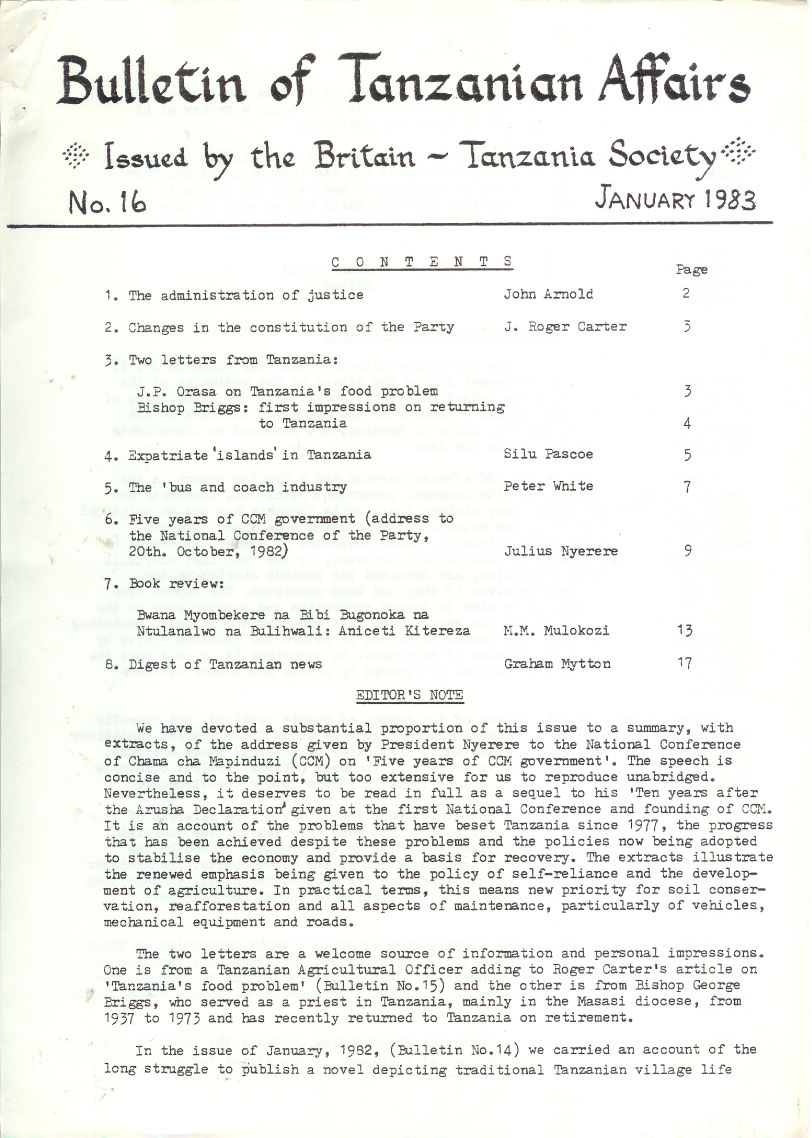
TA ISSUE 16

Issue 16 cover

Bulletin of Tanzanian Affairs
Issued by the Britain – Tanzania Society
No. 16 JANUARY 1983

CONTENTS
1. The administration of justice – John Arnold
2. Changes in the constitution of the Party – J. Roger Carter
3. Two letters from Tanzania:
J.P. Orasa on Tanzania’s food problem
Bishop Briggs: first impressions on returning to Tanzania

4. Expatriate ‘islands’ in Tanzania – Silu Pascoe
5. The ‘bus and coach industry – Peter White
6. Five years of CCM government (address to the National Conference of the Party, 20th. October, 1982) – Julius Nyerere

7. Book review:
Bwana Myombekere na Bibi Bugonoka na Ntulanalwo na Bulihwali: Aniceti Kitereza – N.M. Mulokozi
8. Digest of Tanzanian news – Graham Mytton

EDITOR’S NOTE
We have devoted a substantial proportion of this issue to a summary, with extracts, of the address given by President Nyerere to the National Conference of Chama cha Mapinduzi (CCM) on ‘Five years of CCM government’. The speech is concise and to the point, but too extensive for us to reproduce unabridged. Nevertheless, it deserves to be read in full as a sequel to his ‘Ten years after the Arusha Declaration’ given at the first National Conference and founding of CCM. It is an account of the problems that have beset Tanzania since 1977, the progress that has been achieved despite these problems and the policies now being adopted to stabilise the economy and provide a basis for recovery. The extracts illustrate the renewed emphasis being given to the policy of self-reliance and the development of agriculture. In practical terms, this means new priority for soil conservation, reafforestation and all aspects of maintenance, particularly of vehicles, mechanical equipment and roads.

The two letters are a welcome source of information and personal impressions. One is from a Tanzanian Agricultural Officer adding to Roger Carter’s article on ‘Tanzania’s food problem’ (Bulletin No.15) and the other is from Bishop George Briggs, who served as a priest in Tanzania, mainly in the Masasi diocese, from 1937 to 1973 and has recently returned to Tanzania on retirement.

In the issue of January, 1982, (Bulletin No.14) we carried an account of the long struggle to publish a novel depicting traditional Tanzanian village life written by Aniceti Kitereza. This book is now available from the Tanzanian Publishing House and we are very pleased to be able to print a review of it by Mr. Mulokozi of the Institute of Kiswahili Research.

At the time of writing there has been no report of a conclusion to the negotiations between the Tanzanian Government and the International Monetary Fund for financial support to enable Tanzania to deal with the crisis in its economy. It appears that negotiations are continuing and we hope to have a report for the July issue.

John Arnold
Editor
Department of Adult Education, University of Southampton, Southampton S09 5NH

THE ADMINISTRATION OF JUSTICE

The need for revision of the Preventive Detention Act (see Bulletin No.15) was raised by Members of Parliament during the debate on the estimates of the Ministry of Justice during the budget session in July, 1982. The questioning of the operation of this law follows a Faculty of Law Symposium reported in the Bulletin. The Minister, The Hon. Julie C. Manning, MP, promised to investigate the possibility of reconsidering the law.

A recent broadcast in the BBC African Service and a similar report in the Guardian based on interviews with lawyers, government officials, diplomats and former detainees by Martha Honey claimed that, while Tanzania has had no political prisoners since about 1978, the detention law is being widely used against economic saboteurs and other criminals. Those suspected of crimes who cannot be prosecuted, either because of insufficient evidence, or the fear that they will bribe their way out of conviction, are detained for periods similar to the sentences they would have received if they had been convicted. The report also claims that this system, which aims to bypass corruption and inefficiency in the legal system, has produced its own rackets and that government officials, including ministers, have sometimes been demanding bribes in return for granting visits by families and obtaining the release of detainees. On occasions it is said that the President’s orders have been delayed or ignored by prison and police officers seeking bribes.

There are no official figures of the number of people detained, but recently released detainees have estimated that the figure is about 1,500. Prison conditions are over-crowded, but ex-detainees admit that cases of physical abuse are rare. In addition, there are thought to be several thousand habitual violent criminals detained under comparatively mild conditions in remote farming settlements.

Members of Parliament were concerned about the levels of the salaries of magistrates and judges, which were so low that many were leaving the judicial service. The shortage of magistrates is adding to the problems caused by the inefficient and at times corrupt administration of the lower courts. The Minister is pledged to fight bribery and has asked for the cooperation of all in reporting cases, promising to continue her policy of dismissing anyone known to have accepted a bribe.

Tanzania has now signed the Organisation of African Unity Convention on Human and People’s Rights, which prohibits arbitrary arrest and detention. Tanzania is the twelfth state to sign the convention. When a majority of the 26 members have signed, the OAU will be empowered to establish a commission to protect human rights in Africa.

(Sources: BBC African Service; Tanzanian Broadcasting Service; The Guardian for 18th. November, 1982; article by Anaclet Rwegayura in New Africa for November, 1982)

CHANGES IN THE CONSTITUTION OF THE PARTY

At a meeting of the National Conference of Chama cha Mapinduzi, the governing body of the Party, in January, 1982, a number of changes in the Constitution of the Party were approved. Many were matters of detail, such as provision for a secretariat at District, Regional and National levels and a definition of their functions. There were, however, more significant changes, such as the following:

(1) Party Chairman and Vice-Chairman
As before, these officers are to be elected for a term of five years by the National Conference, but henceforth election is to be by secret ballot. The National Executive Committee is now empowered to suspend either officer if his conduct or activities contravene the requirements of good leadership, subject to reference to the National Conference for a final decision.

(2) Central Committee
This body, charged with day-to-day administration under the National Executive Committee, has been reduced to 15 members of the NEC in addition to the officers from 30 members appointed by the NEC plus up to 10 further members nominated by the Party Chairman. Thus, the Chairman’s right of nomination is abolished, as is also a special subcommittee of the Central Committee responsible for guiding and supervising the activities of the Government with respect to Zanzibar. The Committee is to increase the frequency of its ordinary meetings from two monthly to monthly.

(3) National Executive Committee
In contrast to the Central Committee, the size of the NEC is increased from a maximum of 142 to a maximum of 193, with an additional emphasis on Regional membership and the Party Secretary is now a member in his own right. The functions of the NEC are more clearly defined than before and now include the duty of proposing a candidate each for election as Chairman and Vice-Chairman of the Party and as President of the United Republic and of making the final choice of a candidate for election as Head of Government in Zanzibar.

(4) Frequency of meetings
The National Conference will continue to be called in ordinary session every five years, but the NEC will ordinarily meet every four months instead of six and the corresponding Regional and District organs are also to meet more frequently.

The changes in general seem to be aimed at strengthening the Party as a machine for guiding the objectives of government and for mobilising and educating popular support. There is, however, as before no direct link between members at the grass roots and either the National Conference, or the NEC. The National Conference has about a thousand members, of whom one third are members of the Bunge (parliament of the United Republic) and of these a third are constituency elected members. Thus only about a tenth of the membership of the National Conference are responsible to the electorate not limited to Party members. The influence of the grass roots member is felt mainly at branch, Regional and District level. All branch chairmen and a member elected by each branch have places at the Regional Conference of the Party, while the District Conference includes the chairman and three members of each branch.

J. Roger Carter

TWO LETTERS FROM TANZANIA

From J.P. Orasa, Agricultural Officer, United Republic of Tanzania:
I am writing to comment on Mr. Roger Carter’s article on ‘Tanzania’s food problem’, which appeared in the Bulletin of Tanzanian Affairs No.15 of July, 1982.

Throughout the twenty one years of Tanzania’s independence the question of food has consistently received top priority, but the results of various programmes and planning exercises have had no meaningful results, as the food situation has not been steadily improving. It is, however, fortunate that the situation has not gone out of Government control, although the import bill is scaring.

Mr. Carter has rightly pointed out that the causes of Tanzania’s failure to feed itself are complex. In addition to the problems enumerated by him, the demand for food is exaggerated by certain food-eating habits. As it may have been noted, the food problem in Tanzania is based on the supply and consumption of maize, rice and wheat. These are the most preferred cereals that form the main staple grains. Maize is the most consumed; the per capita maize consumption between 1975 and 1977 was 82.9kg, or 63.8% of all cereals consumed including sorghum and millet.

The majority of Tanzanians still cling to maize meal because it can easily be accommodated within the household financial limits. An indigenous coastal dweller does not willingly part with his rice meal, just as a Southern Highlander would not like to miss his maize meal. As a consequence of these dominant and sometimes inflexible food habits certain food crises or shortages are more apparent than real. These food habits indirectly control the tastes and palatability of food. It is probably because of these habits that the sorghum and millet preparations are not as popular as those of maize, rice and wheat. By using better shelling methods and if more research into possible preparations of delicious sorghum dishes is carried out, this dry-weather resistant crop will save the nation from frequent spells of food grain hardships. The move away from millet, sorghum and cassava over the years into maize, rice and wheat has increased the burden on the producers of these cereals, who have been unable to cope with consumer demand.

Up until now there are villagers in many of the rural areas who are not aware of the food problem facing the country. In their small plots scattered here and there they produce bananas, sweet potatoes, yams, majimbi (a kind of root spinach), round potatoes, cassava, etc. in addition to cereal crops. These people have sufficient food throughout the year. But as the same people move to urban areas they tend to shy away from these traditional food items, thereby increasing the demand for cereal crops. If these indigenous foodstuffs were preserved and distributed to areas facing food shortages, the growers would be encouraged to produce more and the demand for cereals would decrease.

Another problem that aggravates the food situation is the lack of adequate storage and transport facilities. As a result the food piling up in one Region cannot be moved to areas requiring it in time. For example, the surplus maize in Ruvuma and Rukwa Regions in 1980-81 could not be fully utilised before it got spoiled. This year about 55,300 tonnes of round or Irish potatoes in Iringa Region failed to get to market in time due to transport problems.

Thus, the food problem of Tanzania does not arise simply because the country cannot produce enough to feed her people. Much of the surplus food is spoiled for lack of proper storage and because of an unsatisfactory distribution system. A substantial amount of local produce, including fruits and vegetables, cannot find markets. If this problem could be solved, there might even be a surplus of some products for export.

J. P. Orasa

From the Right Reverend George Briggs, written from Mtwara:
One of the first impressions of someone who is returning to Tanzania after several years’ absence is the startling increase in the size of the population. When I first knew Mtwara during the war years it was a small fishing village and now it has a population (together with Mikindani) of 60,000. Its new start in life occurred shortly after the war as a result of one of the British Government’s less successful initiatives – the ill-fated Goundnut Scheme. Mtwara was the railhead where the nuts would arrive from up-country and the port from which they would be despatched to their destinations. Well, the project came to nothing, but Mtwara has since grown to become a Regional headquarters.

I learned only yesterday that four or five cashew nut processing factories have been built at great expense in this area, where cashew trees are abundant, but that they are all standing idle. Why? Because the market for these nuts is mostly in America, where they offer a small price for the processed nut and a much larger one than Tanzania can afford to ignore for the whole nut. The point is that this nut has several valuable properties apart from its kernel- properties which Tanzanians were hoping to exploit through their factories. But now …! Is it surprising that Nyerere is mad with the Western world? As if USA could not afford to forego its profits on the processing of cashew nuts and leave them to a developing country which needs them very badly.

If Sunday attendance at church is anything to go by, then the Christian religion is in good heart in Tanzania. Recently I have had opportunities to attend churches other than the one here, two in Dar es Salaam and two up-country, and the congregations were all impressive, as indeed they are here at Mtwara. Self-support in terms of cash is improving too. The factor which for some of us is a worry is the almost total absence of voluntary service, either for the church, or for anything else. This is an essential element, surely, in the Christian religion; without it a parish, a diocese, or other ecclesiastical unit is defective. This apparent absence of a spirit of self-giving comes out, I think, in the fact that very few of our ordinands have had more than a primary education. The minimal response to vocations- presuming they are there!- from people with a good academic record is very disturbing.

As in many poor societies, theft, bribery and corruption are rife in Tanzania. I mention this, as I have suffered from it twice during the short time I have been in this country. On the first occasion I was relieved of all my money as I was boarding a bus for Korogwe in Dar es Salaam. Fortunately, I discovered what had happened before the vehicle started and so was saved from what would have been an embarrassing situation. The second time was at 4 p.m. on a Saturday, when most of us on the compound were in church at evensong; the housebreakers had a rare field day when they got into my bedroom and found the contents of four suitcases lying about. I was in the middle of unpacking them. I regret most the loss of a cassock (alb) made for me by a Carmelite nun in Mauritius, which I had not worn. There is no benefit provided by the state here for unemployed school leavers and they, together with soldiers returned from Uganda, are said to make up a large proportion of the culprits.
+ George Briggs

REFLECTIONS ON EXPATRIATE ‘ISLANDS’

Tanzania’s political leadership believes that a system of private enterprise is incompatible with the country’s desire for genuine political independence and social equality. It wishes to avoid dependence on private foreign investors and multinational corporations, which would entail an increase in foreign political and economic influence. Although the total impact of post-Arusha nationalisation on the structure of commerce and industry is considerable, a large private sector remains in Tanzania. The very visible private or foreign financed enterprises which we saw in Tanzania during the Southampton University Study Tour of August, 1981, generated conflicting feelings within the tour group just as they must do within Tanzania itself. Were Peramiho Mission, Sao Hill Sawmill and the Brook Bond Tea Company to be viewed as laudable islands of excellence, or neo-colonial paternalistic enclaves?

Peramiho Mission was founded in 1898. Its present operations cover health education and industry in addition to religious work. The printing department is self-sufficient except in inks and certain other items, which are imported about every four months through Mtwara. The Government relies on it to print examination papers and official forms. The printing workers usually stay, while those in the garage and carpentry workshop tend to move away and establish their own businesses after training. The trade school also has tailoring and shoemaking sections. Despite the policy of africanisation at Peramiho, one felt that the German brothers saw it as their responsibility to maintain a presence. There were 25 European brothers with an average age of 60.

The mission hospital also had expatriate doctors and Tanzanian doctors generally speaking were reluctant to work there, partly because they preferred a normal urban community and partly because of a half-acknowledged feeling of distaste for the atmosphere of a mission and the relationships that prevailed there. Drugs for the hospital were obtained direct from 1urope and America, financed by charitable organisations. An African priest trained at Peramiho observed that although the mission had done good work it was too introverted. A Tanzanian official who had been born in the area pinpointed the ambivalent attitude towards Peramiho when he remarked that if the German priests left the ‘Peramiho system’ would change very quickly, as Tanzania would not be able to obtain the materials to maintain it. The Tanzanian Government had, indirectly, asked the Germans to leave, but they bad not yet done so.

Sao Hill Sawmill in Mufindi was the first example of moderately large scale industry which we visited during the tour. The sawmill was run by a company funded by the Norwegian Agency for International Development (NORAD) and production started in 1975. It is the biggest project of its kind in Tanzania. Originally there had been 11 expatriate workers, now there are 5, including, significantly, the project manager and a mechanic.

The area did not have a high population density. There were 360 workers, mostly living in local villages, but a growing number occupied houses built on the site. The sawmill helped local villages by buying food and providing employment. However, there were problems of marketing as opposed to producing ire timber and much was being stockpiled. Some of it was exported, but more could have been sold within the country if potential buyers could have provided their own transport to collect it. This marketing problem was threatening the firm’s profitability. The comments of the Norwegian project manager highlighted some of the difficulties of such a foreign-financed project. Originally, the Norwegians were to have been at the sawmill for five years, but this period was being extended. He felt that it would take 10 to 20 years for full africanisation. He was worried about the future of the project because of doubts about the maintenance of discipline and productivity, which Tanzanians fresh from training found hard to enforce. The economic organisation and structure of large-scale industry were still strange and new to his Tanzanian colleagues.

The Brook Bond Tea Company at Kilima, also in Mufindi District, had 9 expatriates, amongst them engineers, accountants, a doctor and two estate managers. Tanzania has not nationalised its tea estates, except those formerly owned by Lonrho, and the Brook Bond Company was accepted by the Tanzanian Government because it was earning foreign exchange, tea being one of the few export crops until recently growing in volume. The situation has now changed with tea being overproduced and costs, especially fuel, increasing, making tea production hardly profitable. However, the company still made money on its marketing side. Tea production is labour intensive, but seasonal and insecure. The development of villages over a wide area is inhibited by the removal of manpower during the growing season. The pace of africanisation of the management seemed slow. An African junior manager, who had moved to Brook Bond from a Government post because the salary was better commented on the difficulties involved in full africanisation. In his experience, expatriate managers had more success than Tanzanians in obtaining licences to import machinery and materials.

Such foreign companies can contribute to a form of economic growth, but whether it can become the basis for long term development is more debatable. Do such investments really lay the foundation for indigenous growth when the capital, technology and expertise must be matched ~ an equally expensive infrastructure of roads and vehicles? There may well be increasingly effective competition from peasant producers using family labour and the minimum of equipment. The debate helped to occupy the time on the long journeys over bumpy Tanzanian roads. We were divided over the theoretical advantages of foreign investment and management, but we were all intensely grateful for the warm welcome, the hospitality and the way in which busy and sometimes worried people were willing to show us round and answer our endless questions.

Silu F. Pascoe

FIVE YEARS OF CCM GOVERNMENT

Chairman’s address to the National Conference of Chama cha Mapinduzi given on 20th. October, 1982, in Dar es Salaam. As the full address occupies 66 pages, the following is a summary-of the main points contained in it.

The address begins with a brief survey of Tanzania’s foreign policy and reaffirms commitment m the liberation struggle in southern Africa, support for the Organisation of African Unity, active participation in the Non-Aligned Movement, the United Nations, the Commonwealth and special meetings such as that at Cancun, regional organisations such as the Southern Africa Development Coordination Conference and the Kagera Basin Organisation, and the building of friendship with all countries on a basis of mutual respect.

On 5th. February, 1977, he reported to the Party on the national economic and social situation ten years after the Arusha Declaration and warned that despite the progress that had been made the next three or four years would be very difficult. That has certainly been the case. World recession has created economic difficulties for developed and developing countries alike and this is the world environment in which Tanzania has to live and do business. Tanzania has been very seriously and very adversely affected. In addition, Tanzania has had to repel and destroy an aggressor. Tanzania now faces formidable economic problems and declining living standards and it is on this front that it now has to fight back, correcting past mistakes, overcoming weaknesses and keeping clearly in view its basic goals.

“The basic problem is that our earnings and our consumption are out of balance; we are consuming more than we are earning. We are not earning enough to pay for all the things we need to buy from abroad if we are to feed, clothe, educate and care for the health of all our people as well as provide all the tools, the spares and the raw materials for the factories we have already built” and “our young industries, or enough transport and fertiliser and insecticide for our agriculture … The shortage of imported goods is compounded by a shortage of Tanzanian goods.. ..The shortage of goods reduces Government revenue and … even the money the Government does get from taxes buys less and less goods and services … The drop in our earnings arose partly and seriously from the fall in the price of the goods we sell; but in many cases there has also been a fall in the quantity we put on to the world market. Imports, on the other hand, have gone up in cost year by year … It is the lack of imported goods which is causing many of our factories to close.”

The prices of imports have increased much faster than those of exports. Despite the growth of population, in 1981 oil imports were only 70% of the 1972 figure, but the oil bill in foreign exchange increased more than sevenfold. In contrast, the price of coffee fell over 5 years by 40%, tea by 29% and tobacco by 12%. The prices of cotton and sisal have risen, but this has been offset by falls in production. The breakup of the East African Community cost Tanzania the loss of many vital maintenance, training and communications facilities and required expensive investment to create an airline, civil aviation support services, railway repair workshops, central postal services and an earth satellite, nearly all of which had to be paid for in foreign exchange. The war in Uganda in which 684 soldiers were killed and 467 seriously injured cost over shs. 4,000 million, a large part in foreign exchange. Finally, there have been problems with the weather, a succession of bad harvests, droughts, floods, damage to roads, bridges and crops.
These external problems have been the main cause of our difficulties. But problems have also been caused by our own successes. First, as a result of rising expectations people now expect to be ace to drink tea with sugar, wash with soap, light their houses with paraffin lamps, buy new clothes sometimes, obtain cement and corrugated iron for their houses and secure medical help when they are ill. These are things that the people did not expect 20 years ago. Primary education has expanded from half a million children in school in 1961 to three and a half million in 1982. The establishment of industries and the expansion of road transport have created a need for imported fuels, spare parts and chemicals. Investment in social services has greatly reduced the infant mortality rate and as a result the population has doubled in 20 years.

But we have also suffered from our own mistakes and failures. My appeal in 1977 to improve industrial discipline, reduce costs and increase efficiency in both parastatals and Government has had little effect. Payrolls, particularly at senior level, have been maintained even when production is much reduced. Since 1977 employment in Government ministries has increased by 35%.

Policy making has been done with great seriousness, but decisions are not always carried out and financial regulations are often ignored with impunity. Our most fundamental failure is perhaps our neglect of the principles of self-reliance. Traditional skills in carpentry and metal working have not been used to make good shortages of imported tools and equipment and in this there has been little improvement in detail, and none in attitude, since 1977.

However, “things have changed for the better Virtually everywhere, so that village life is now very different from life in the isolated homesteads we knew a decade ago. Almost all villages now have a primary school; 90% of them have at least one cooperative shop; about 31% of the villages (and about 40% of the village people) now have easy access to a safe water supply; and well over 30% of the villages have either a dispensary, or a health centre, with others being served by regular clinics.

Elected village governments have now become active institutions, initiating and running their own development activities …. We have passed legislation which will allow District and Village Councils to raise money locally …. Urban Councils were reestablished in 1981; an Act to establish District Councils has been passed … An Act has also been passed to establish a new Cooperative structure.”

In the health services emphasis is being laid on preventive work, which does not require expensive training or drugs.

Already 10.6% of the recurrent budget is spent on education. Adult education is now making an important contribution despite shortages of materials and Universal Primary Education (UPE) has made great advances, though much remains to be done in improving its quality and integrating the school into village life. Unfortunately, the post-primary technical centres, so important for supplying the villages with skilled craftsmen, do not seem to have attracted much interest or support. The Government will continue to emphasise the importance of technical and vocational training so vital to our development. Although the proportion of primary school graduates who go on to a secondary school has now fallen to 2•6% as a result of UPE, we cannot at present afford more secondary school places and will concentrate for the time being on consolidating what already exists. At the University the proportion of women students has now increased to 23.8%. There are still not enough qualified students coming forward from our secondary schools to fill all the available places in science-based subjects and we are trying to rectify this by earmarking 60% of the science graduates for training as teachers in our secondary schools. But university education is enormously expensive- on an average about shs.70,000 per student- and the University authorities are now looking into the means for reducing this very heavy cost.

The Dar es Salaam bus service has less than half the buses it needs to provide a good service and less than half of these are actually in service. Low fares, which have not increased since 1974, contribute to the low level of service. The joint Tanzania Chinese Shipping Line is operating successfully despite unfavourable world conditions, but the Tanzania Coastal Shipping Line continues to have severe problems despite valuable support from Norway. The railways have also been operating under severe difficulties, but with the help of Canada and other countries steps are being taken to reverse the decline. The railway system is crucial for the movement of agricultural exports to the ports and food from surplus to deficit areas.

The two extensive natural gas fields at Songo Songo and Kimbiji will take 5 to 10 years and much capital to develop, but agreement has been reached for the manufacture of ammonia and urea out of the gas at Songo Songo and negotiations are proceeding on the financing of the large investment involved.

In internal trade, pan-territorial pricing is being revised to allow Regional Trading Companies to add the cost of transport to the price of heavy goods. The number of goods subject to price control is being reduced to the most essential as an aid to proper enforcement.

In terms of factories built, industry can offer a success story. Some 43 new big projects have been completed since 1977 and another 28 are in an advanced stage of building. But industry has been heavily import-dependent in terms of raw materials, machinery, fuel and, in some cases, management. Starved of foreign exchange for the past two years, industrial production has fallen from over shs. 1,000 million in 1979 to shs.648 million in 1981 and average factory utilisation is now between 30% and 50%, which means high production costs. Small scale industry expanding under the auspices of SIDO has a much better productivity record. It has also been more resistant to economic crisis. Some large factories will have to be closed as a short term measure to allow others to receive enough of their imported requirements to enable them to operate profitably and efficiently.

“It is upon the agricultural sector that Tanzania depends for the earning of all the foreign exchange needed by the transport sector, the social services, the defence forces, the administration, industry- and agriculture itself. Whatever we call success in Tanzania is largely a success created by the peasants …. Although it is agriculture which is basically responsible for all the successes on which we pride ourselves, we have not been developing agriculture itself. And now it cannot bear the load we have put on to it.”

The urban and the non-productive rural populations have been growing fast – faster than the development of agriculture. The output of cash crops has been especially affected. Except for coffee and tea, where production has remained about the same, the output of all major export crops has declined in the last five years. “These figures cannot be attributed solely to drought and although special explanations can be given for the decline of each particular crop the evidence suggests that some more general explanation has to be sought for the decline over so many crops.”

The increasing use of high productivity seeds for cotton, maize, millet, sunflower and many other crops is a ground for hope, but their reproduction in sufficient quantity takes time. Another good sign is the expansion of improved beef and dairy herds and the improvement in beef sales. But the fact remains that the explanations so far offered for our declining production do not appear to go to the heart of the problem. Some say that it is the result of our socialist agricultural policies, but the amount of socialist agriculture that exists so far is very small. For the most part agricultural production comes from individual peasant farms. There are indeed some communal village shambas and some are productive, but their total contribution to village output is slight. It is because those villages with large communal farms are so successful that a rapid extension of them has been urged in the 1981 Party Guidelines.

It is also not possible to pin the blame solely on the crop authorities and other agricultural parastatals, though they do have many serious faults. Administrative costs are much too high, there are delays in supplying fertilisers, insecticides and other inputs, crops are not always collected promptly and payment to farmers is often seriously delayed. Steps are in train to remedy these faults, but the problems of agriculture are more deep-seated.

One fundamental reason for our shortcomings is that, in spite of professions to the contrary in the Arusha Declaration, in ‘Siasa ni Kilimo’ and other statements, agriculture is not central to our planning and our thinking. Another lies in our neglect of the soil and the need to maintain soil fertility by the use of compost, manure, fertilisers and appropriate crop rotations. Further, we have failed to provide better implements, even enough hoes, and the ploughs and other implements suitable for use with ox traction are commonly not available. Very little use is made of our many rivers and lakes for small scale irrigation. In large areas of Tanzania land is being turned to desert by over-grazing and the careless removal of trees. It is gratifying to note that village fuel woodlots are now being grown in some villages and that 12,000 hectares of trees were planted last year. But a more widespread practice of contour ridging, as already practised by the peasants in Mbinga District, is essential if we are to protect our soil from total destruction. It is our land that is at stake.

Where do we go from here?

First, we must remedy those things that are within our power to remedy. Then, although we do not like their prevailing ideology, we must do all we can to reach agreement with the International Monetary Fund (IMF). But the IMF alone cannot solve our problems. Neither the IMF, nor the World Bank, nor anyone else will provide us with all we need for our rehabilitation. Only we ourselves can stop our economic decline on a basis of self-reliance. There is no other choice.

“In the light of our experience and further expert investigation, Government has now prepared the Structural Adjustment Programme. Its main objectives are: to increase production; to reduce the rate of inflation; to alleviate the foreign exchange shortage so that output and efficiency can be increased; to increase productivity in all fields and in particular to improve the management of the public sector; and last but not least to do these things while maintaining the advances we have made in income distribution and the social services.“

“The Structural Adjustment Programme (SAP) is a programme of consolidation, not of expansion. Hardly any new projects will be undertaken. That includes especially new projects in the social services, which in the short term are consumers of wealth and not producers of it. We know that new schools, new dispensaries, new social welfare arrangements, etc., are urgently needed. But we have been forced to recognise that what we do not produce we cannot consume. It is going to be extremely difficult, and require all our combined efforts, to maintain our present health and education services. We shall not be able to expand these services in the coming few years ….

Our task in the case of industries and agriculture is to rehabilitate the most important factories and large farms which now exist and to provide them with spare parts, fuel and other raw materials without which they cannot operate …. There will be no new cars imported …. We shall concentrate any foreign exchange we have for transportation on the purchase of spare parts, with priority given to lorries, bicycles and motor cycles- in that order. The cars which do get spare parts will be those used in the productive sectors and those used by the disabled and the elderly …. To continue to expand consumption in money terms without any increase in the production of goods … Simply leads to inflation … Recurrent expenditure … will go on being cut until it begins to compare.’ again with Government’s actual revenue.”

The political difficulties of such a programme for every minister and every member of parliament are acknowledged. But there is no alternative. Of great importance are better incentive systems and better economic management, planning and control. For the management of SAP a special implementation secretariat has been set up in the Ministry of Economic Affairs and Development Planning. But in the end the success of SAP depends on all Tanzania’s citizens. The maxim ‘kila mtu afanye kazi’ must be made a reality. Almost every country in the world is facing problems. But those that succeed in overcoming them will be those with good policies and good programmes and the determination to implement them whatever the difficulties in a spirit of self-reliance.

Abbreviated from the address by Julius K. Nyerere

THE BUS AND COACH INDUSTRY IN TANZANIA

The British bus operators the predominant problem today is lack of demand. In Tanzania, despite substantial economic problems, operators face no shortage of customers, but fuel, tyres and spares often constrain the level of service that can be offered.

With a population of about 19 million, Tanzania has an area much larger than that of Britain, giving an average density of only 20 persons per square kilometre, as compared with 230 in Britain. Apart from the main port, Dar es Salaam, with a population approaching a million, no town exceeds about 110,000 in population and the rural areas, especially in the centre, are of very low density indeed. Intense local demand is thus found in only a few areas, but long distance travel has grown rapidly as a result of migration and the growth of education.

Car ownership is very low – about one car per 300 people – and has a negligible effect on public transport in most areas. Walking and cycling probably account for most journeys, but cannot of course cater for longer distances. Internal air services offer a limited frequency, but in a country where the basic minimum wage is only about £45 per month are used by few. The rail network is limited and suffers from operational problems. The Chinese-built ‘Tazara’ line linking Dar es Salaam with Zambia carries only freight traffic at present*, despite a palatial passenger terminal at Dar es Salaam. The older metre-gauge network, inaugurated under German colonial rule, also concentrates on freight, with one passenger train per day on the route westward through Dodoma to Kigoma and on the line northward to Moshi and Arusha. Between Arusha, Moshi and Dar es Salaam about twenty bus journeys per day operate, vastly exceeding the rail passenger capacity.

High demand for bus and coach services is immediately evident from the high loads. One operator bases his budgeting on a minimum load factor of 70%. Pre-booking is desirable, or even necessary, to gain a seat on long distance, routes. Even on a Sunday afternoon, urban routes carry substantial standee loads.

In meeting this demand operators face many problems of supply. Fuel accounts for 20 to 25% of operating costs in contrast to 5 to 10% in Britain. Imports of fuel now cost over half the foreign exchange earnings of the nation and physical continuity of supply is also uncertain. Following a critical period in May-June, 1981, many long distance services from Dar es Salaam now carry sufficient fuel for the round trip rather than relying on inland supplies. Tanks to accommodate an extra 440 litres have been fitted to vehicles of the state owned National Bus Service (NBS), while independents carry additional oil drums. The price of fuel varies markedly with distance from coastal ports, reflecting transport costs. For example, at the southern port of Mtwara derv costs about shs.4 per litre (c. 25p.), but in Songea, 600 miles westward, about shs.6 (c. 40p.).

Supply problems also occur from time to time in tyres, although these are manufactured locally following the establishment of a joint operation some years ago with an American company. Poor roads aggravate tyre wear and also cause spring damage. Fairly large stocks of spares have to be held to ensure reliable operation.

In view of the limited investment that a country such as Tanzania can afford, it is not practicable to provide tarmac surfacing over a high proportion of the network. Within towns, major roads are surfaced together with some inter-urban links. Most of the inter-urban mileage, however, is unsurfaced. This becomes very dusty in the dry season and muddy in the wet season. Continuity of service on most routes relies heavily on the skill and efforts of driving and maintenance staff. For such conditions a robust type of vehicle is required. Most recent deliveries to both independents and the NBS have been of the Leyland CD23, still carrying the Albion Clydesdale badge. The high floor level and front engine are well suited to the road surfaces and temperatures encountered. Bodywork is by domestic builders, mostly based in Dar es Salaam, including Singh Bros. and the Quality Garage. A centre entrance layout is generally favoured with five across seating to give a seating capacity of about 65 and a well-used roof rack. For urban use a standee layout with rear entrance and front exit and a seated conductor is found. Except in mini- and midi-buses there is no one-man operation in view of the low labour costs and high loadings.

The CD23 appears to be well regarded by operators. Accompanied by widespread use of Land Rovers, especially in the South, the Tanzanian scene can present a remarkably high proportion of Leylands on the road, although Scania and Isuzu have caught much of the lorry market. There is one feature which may require some improvement, namely, the hanger bracket securing the front springs, which is liable to considerable punishment on rough roads. A small number of Scania 111’s may also be seen, mainly as works buses, and NBS also has on test a Mercedes 1617.

There are two main publicly owned operators, both of which derive from the nationalisation of Dar es Salaam Motor Transport (DMT) in 1970. The long distance services from Dar es Salaam were transferred to the National Bus Service, better known by its Swahili fleetname KAMATA. This company now runs a fleet of about 90 vehicles on both long distance and suburban services. In some cases older long distance vehicles are rebuilt to dual doorway layout for suburban work. An interesting innovation recently has been the introduction of an internal radio network linking head office in Dar es Salaam with inland offices, reducing reliance on the heavily used telephone system.

The urban services of DMT were transferred to Usafiri Dar es Salaam, known as UDA, which today operates about 250 vehicles. Leyland and Mercedes high floor single deckers form a substantial proportion of the fleet, but an increasing element comprises the Ikarus units. The first batches of rear engined 266 model have a low rear clearance and the very first a somewhat incongruous appearance, being built to the East-European rule of the road rather than the British, which Tanzania retains, passengers thus boarding on the offside! More successful have been the 280 model articulated single deckers, whose high capacity has proved very valuable in handling growing traffic. Reliability is good, despite the complexity of articulation. Another significant part of the UDA fleet is the Isuzu minibus, operated on selected routes at a premium fare.

No private competition is permitted in Dar es Salaam apart from the numerous unmetered taxis. Shared taxis, or other forms of ‘paratransit’ found in developing country cities, are generally absent. Elsewhere in Tanzania a very different picture is presented with independent operators carrying most of the traffic both on routes competing with NBS and on routes not otherwise served. There is no price competition, all prices being regulated to a common scale, but there is competition in service quality and availability. A particularly marked concentration is found on the Dar es Salaam-Moshi-Arusha road, with about 15 to 20 operators, most with just one or two buses on the route. The standard Dar es Salaam-Moshi fare (in 1981) is shs.90, but at least one operator offers a ‘luxury’ service at shs.130.

Another publicly owned operator is the Tanzania Railways Corporation (TRC), who in addition to railways as such run extensive road fleets originating as rail feeder services in the days when long distance road transport was less common than today. The former brown and cream colours of East African Railways, from which TRC split off in 1976, are retained. The principal operating base is Iringa, some distance south of the main east-west line.

In southern Tanzania considerable problems were caused by the collapse of “Teeteeco’, a publicly owned operator, which suffered severe maintenance problems providing freight and passenger services. Its operations have been taken over by three smaller companies under the control of the National Transport Corporation based at Lindi, Mtwara and Songea known as KAULI, KAUMU and KAURU, which is mainly running buses at present. New Leyland CD’s have been supplied with assistance from World Bank funds under a ‘rehabilitation and improvement’ project.

Overall it is clear that considerable scope for expansion exists in Tanzania provided that problems of fuel supply, maintenance and road surfacing can be successfully overcome.

Peter White
Polytechnic of Central London
September, 1981

* in 1981; now there are believed to be one passenger train in each direction per week.