IMPRESSIONS OF TANZANIA

Notes from a visit in October/November 1980 by Geoffrey Rockliffe-King, Development Economist.

I visited Tanzania for six weeks in October and November 1980 as part of a team engaged in a study for a U.N. agency. Prior to the field work I benefited from a desk study which revealed some of the most pressing issues for Tanzania. The field trip did much to dispel the gloomy prognosis of the desk study, although it is hard to see a possible way out of the investment/ foreign exchange trap. Morale was surprisingly high amongst lower rank civil servants. Their response to the rapid erosion of the buying power of their salaries has been to engage in home-based enterprises such as egg production. The rules preventing second jobs for civil servants have been circumvented by businesses operated through wives, a practice of many senior officials and politicians with large scale undertakings. The interest in the election in October, in which two ministers lost their seats, seemed to indicate some confidence in the government despite the economic setbacks. All over the country, people expressed hopes that life would return to ‘normal’, given a couple of decent harvests, now the involvements in Uganda and Zimbabwe were working themselves out.

Import difficulties and self-defeating Government measures to fix prices have combined to promote a thriving black market. One trivial example is film, virtually unobtainable outside Dar; there the asking price was TSh 210 in October. Prices have been bid up for many non-luxury items, and distribution complicated by patterns of influence: you need a friend at the factory. This unfortunate development disadvantages those many people without influence and deprives the Government of tax. At the margins of the cash economy, we came across several instances of a return to barter. Inflation has certainly set back the gradual process of drawing cattle-holding peoples into the money system. Overstocking in the north is already having dire effects on the grazing lands, but there will be no enthusiasm for reducing numbers without trustworthy alternative stores of value.

In the remote areas, there were signs that programmes to promote development were losing ground. The veterinary services, for example, were effectively immobilised by shortages of fuel and spares, were unable to pursue vaccination campaigns without vaccines, had run out of most medicines and lacked the essential chemicals to conduct post-mortems. It will not take long to lose the network of skilled veterinarians, which has been established at a great cost, if the vital inputs are missing. Similar problems were apparent with supplies such as fertilisers and insecticide; the absolute scarcity is compounded with daunting transport difficulties.

I found ‘Ujamaa’, the drive for socialism, to be very low key in the approach of officials to the worsening economic problems. Indeed, many had to be reminded of the political context and most held quite pragmatic views on the subject. It seems that it was felt necessary to attract support for the movement by the provision of social services, and that somewhere along the line the notion of central government provision took over from the idea of self-help. Whatever the cause, the policy appears to be stranded and, without considerable resources, looks set to dwindle away. The political slant which I had anticipated turned out to be altogether different: people were very aware of external changes, as those events influenced Tanzania. I was surprised on several occasions by questions from junior civil servants in district towns on foreign policy issues, such as the workings of Lome II and the likely African initiatives of the new US President.

Aesthetically, Tanzania exceeded all expectations, both in variety and appeal. In particular, I enjoyed the section of main road which follows the Great Ruaha for a distance between Iringa and Mikumi, an endless hill in spectacular scenery, although I may have been influenced by the smooth road after so much gravel! Our safari took us by Ngorogoro, a place which deserves the tour-operator’s superlatives if not his customers. We also passed through Serengeti and Mikumi National Parks. In the former, the game was so plentiful it appeared to be tethered. These Parks provide a welcome change of pace on the mission, and, a real bonus, a glimpse of four cheetah together, at dusk in the crater. It remains a mystery that Zanzibar can be so totally different from the Mainland when the 737 is airborne for only nine minutes from Dar; but the country is full of such contrasts and must surely build on its tourist potentials.

As always, the mission enjoyed some lighter moments. One was our arrival at the Dodoma Hotel to claim our confirmed reservations, only to be told that all but six of the rooms had been demolished, “as part of the new capital expansion plan”. It came as no surprise to find that the six rooms were occupied by the master-planners themselves. The most memorable statement of the trip came from a Catholic Missionary, who told us that, for him, the border was not closed! In contrast, the most sobering moment was finding a long diversion indicated, on the approach to Singida, by a barrier with the terse notice; Closed, Cholera. The prolonged drought had given rise to acute water shortages in the middle of the country, with consequent public health hazards.

One does not sum up Tanzania after one short visit. My initial reactions have been very positive, especially with regard to the feeling of freedom in the country. I hope I am able to go back and learn more, as the country certainly justified all the attention it was given in college.

J. Rockliffe – King.

NOTES ON CURRENT ISSUES

Investigations by Central Committee of C.C.M. into Mismanagement of Public Corporations.
Most of Tanzania’s economic problems are created by forces beyond her control but her situation has been made worse by mismanagement in some of the public corporations (the so called parastatals). The previous edition of the Bulletin (No. 11) referred to the difficulties of the National Milling Corporation and also to the efforts being made to improve levels of management.

In January a special meeting of the C.C.M. National Executive Committee was called to consider the problems caused by poor distribution of scarce essential goods and also the operations of parastatals which have been losing money. The meetings produced dramatic results:

The Chairman and General Manager of the Tanzanian Investment Bank were dismissed and two prominent businessmen detained as a result of the sale of a ship which had become the Bank’s property after the break up of the East African Shipping Line. The ship was sold for Tanzanian shillings although the Bank still has to pay some of the ship’s debts in foreign currency.

The Minister for Communications and Transport and the General Manager of Air Tanzania both lost their posts as a result of the Corporation’s attempt to establish an international service with a leased Boeing 720 which turned out to require repairs and spares which ATC could not afford. Leasing substitute aircraft to meet commitment lost the Airline more money. The international operation has now been ended.

At the beginning of February fifteen directors of the Pyrethrum Board were suspended when it was revealed that the Board had spent so much on its own administration that it had been unable to purchase pyrethrum flowers from growers since last November. In 1979/80 administrative costs were sh 16/60 a kilo against the market price of sh 15/44 a kilo for crude pyrethrum extract.

Speaking at the Celebrations for the fourth anniversary of C.C.M. Julius Nyerere announced that the hire of private cars to Government Departments was under investigation.

Is C.C.M. meeting its objectives?
In an address to mark the 1Oth anniversary of the University of Dar es Salaam Julius Nyerere spoke of his worry about the effectiveness of C.C.M. in maintaining democracy in Tanzania (29/8/80):

“We claim to be building a Democratic One-Party State. Our Constitution and that claim are based upon the theory that C.C.M. is a mass movement controlled by its members and responsive to their needs and aspirations. It is supreme because it is intended to be the people’s voice in directing government and in controlling the power of government as expressed through the organs of government – the Administration, the Courts, the Police, the Jails, and the Army. The Party is thus intended to be the people’s spokesman, the people’s method of organising themselves for voluntary co-operative activities, and the people’s protection against the arrogance and possible tyranny of government machinery and personnel.

How successful is C.C.M. in fulfilling those stated objectives? We have a government consisting of C.C.M. Members; is the Party really channelling the people’s views to that Government as well as speaking for the Government to the people? Do the people really feel that the Party is their own instrument, which can be moved by them and used for their purposes? How close is the Party to the general masses of the People of Tanzania?

At many levels we have given to one person two jobs at the same time: in the Party and in the Government. The President of the country is Chairman of C.C.M., the Regional Secretary of the Party is also Regional Commissioner; and since the establishment of urban and village governments we have made the town or village Party Chairman into the Chairman of the local council and hence into the head of the local government at that level. And every time these two jobs are combined, that of the Government tends to overshadow that of the Party. So that in practice all of these people have become government persons first, and only secondly the spokesmen of the people’s ideas, aspirations and complaints. They are so busy implementing government policy and defending government actions that they have little time to do purely Party work and to act upon – or even listen to – the proposals or complaints of the people. But the responsibilities of Government continue to be very attractive to Party leaders, and very often when they talk about Party supremacy a lot of Party leaders are in fact saying that all of them should have two jobs – and that the job in the Government should be the major one.

Giving functions of Government and of Party to one person is not a total explanation of the problem, and indeed some of the reasons for introducing this system remain valid. But we need to look at this whole question again, for the separation of the Party and people, and therefore a separation between our principle of One Party Democracy and the facts, will mean the death of the Party. without a live C. C.M., governed by the people themselves, we shall- under our existing constitution – be governed by bureaucrats, University Graduates, and a few demagogues, and not by the people themselves or their representatives”

Nyerere referred again indirectly to the position of the Party and his fear of its divorce from the people in a speech at Dodoma on the 4th. Anniversary of the C.C.M. (5/2/81):

“Our problem is mainly centred on the distribution of what we have. We do not distribute it equitably. You will remember recently we convened a meeting of the (Chama Cha Mapinduzi) national executive committee in Dar es Salaam to discuss this matter of equitable distribution. We discovered that there were people who had licences in their pockets but had no shops. They go to a certain place and take a large quantity of soap but then we do not know where they take the soap to. They have no shop nor do they take the soap to anyone else’s shop. So that soap disappears … So we decided not to give anyone a licence until we have ascertained that they own a shop or a place where they take the goods to sell. But what happened in the past was this: A person came in wearing a suit and we issued him with a licence. Where would he take the goods to? We discussed this problem. And I think we have begun (tackling) this issue by denying licences to those who have no shops…

Then there was another group that emerged. These were those who had no government licences. They are issued with documents known as permits. So-and-so would come to me and say: Mwalimu I want you to help me. Help you in what? I want you to give me a permit to buy soap. Why should I give you a permit to go and buy soap? And such people have approached me: I’m not joking and that is the precise reason why I’m explaining this (laughter) … So you give him a permit and he takes the soap home and sells it from there and so when you go to the shop, you find no soap, and the one with a licence , to sell soap has none to sell … So you go to him and ask for soap. He says: Which soap do you want? I say: Bath soap. Then he says: There is soap but not at the government price. So what are your prices? He says: Soap is available at party prices (laughter)…

We resolved to remove such malpractices which put the party in disrepute … we agreed to resolve the issue by refraining from such practices (of issuing permits) … and we agreed, secondly, that party and government officials must supervise the distribution of commodities …”

BOOK REVIEWS

Beyond Ujamaa in Tanzania: Underdevelopment and an uncaptured peasantry. Goran Hyden (1980), Heinemann, London, 270pp

This is a most stimulating and challenging book arguing basically that the resilience of the peasant mode of production has resulted in it successfully resisting attempts to ‘modernise’ it, either by capitalism or socialism. Although highly assertive and even repetitive at places Hyden, nonetheless, achieves his aim of analysing underdevelopment outside the commonly accepted notions of capitalist penetration and dependency, arguing that Marxist paradigms are inapplicable to Africa, and not least to Tanzania, for two reasons. Firstly, the peasant mode of production, because of its social logic, resisted capitalist penetration thus rendering this notion an unsatisfactory explanation of underdevelopment, and secondly, the vast majority of African peasants have not been alienated from their means of production (i.e. principally land), thus the development of antagonistic social classes has been lacking. Further, because o f its failure to break down pre-capitalist modes of peasant production, capitalism did not succeed in generating self-sustaining modernisation.

The peasant mode of production has retained its resilience because of its success in satisfying man’s needs within the ‘economy of affection’ which recognises the importance of social structure, ties and obligations within the wider peasant system. As long as the ‘economy of affection’ satisfies needs, and assuming that famine is not a problem, then there is in fact very little incentive for peasants to accept innovations. This therefore means that the peasant mode of production can operate quite independently of state power~ or indeed of any other social class. It is quite capable-a reproducing and subsisting within its own social logic, just as long as peasants retain access to the means by which they can continue to secure their own reproduction, that is the land primarily. The state, therefore, is irrelevant to the needs of the peasant mode as it stands. Conversely, Hyden argues, the state is dependent on the peasantry as food producers and so is obliged, for its own existence, to control and subordinate the peasant sector because “history has demonstrated that the development of modern society is inconceivable without the subordination of the peasantry” (p.16).

Hyden applies this theoretical stance to the evolution of agricultural policies in Tanzania. The resistance of many peasants to colonial attempts to develop agriculture is explained by the resilience of the peasant mode, and Hyden goes on to argue that the same resistance was applied to the attempts by the post-independence state, including the introduction of ujamaa and villagisation. More could have been made of the fact that the post-independence state attempts paid little attention to the results of the earlier colonial attempts. In many ways they followed the same path and consequently received a very similar response of resistance from the peasants. However, although Hyden suggests that in its attempts to control the peasantry the state becomes more authoritarian, he does not really explore fully the methods by which the state attempted to do this. Some are considered, but not deeply enough; for example, Operation Maduka (the establishment of communal village shops), and the conversion of political organisation from a mass party (TANU) to a more selective (and potentially elitist) party (CCM). Other features such as the use of minimum acreage bye-laws and the role of Kivukoni as an ideological college deserve far greater attention than they receive.

The discussion of events of the 1973 to 1976 period are sketchy and assertive. Although Hyden is very correct in pointing out that the introduction of villagisation is a recognition by the state that they had failed to subordinate the peasantry, nothing is gained from blandly asserting that villagisation moved only about five million people and not the ten million people that other observers have suggested. No evidence is offered, and the reader is left wondering whether Hyden’s methodology is simply ‘think of a number between ….’! Perhaps when the 1978 census results are available in some detail, we will have a clearer idea of the number of peasants moved. Until then, this type of uninformed speculation is of little value.

More seriously, Hyden consistently, and correctly, repeats the resource orientation of peasant production, but he ignores the effect of movement on peasants’ micro-environmental knowledge. Micro-environments and resource bases can alter significantly over relatively short distances, and so knowledge built up over many generations in one area may be of little value in an adjacent area of as little as two miles away. Clearly, this can have a significant deleterious effect on food production, an effect that can be considerably made worse by drought, as happened in 1974-75. In addition, on being moved to a new location, peasant priorities were to build houses for shelter etc. at the expense of planting food – after all, the state could be relied on to provide food to prevent famine, but could not be relied on to build shelters. As we know, Tanzania faced a major shortfall of food production at the time, and Hyden surprisingly accepts the view that the drought was the cause. Whilst few would share Lofchie’s extreme view that the drought was irrelevant, analysis would suggest that the effects of villagisation, the uncertainty this created among peasants, and the drought all contributed together to produce the crisis. Hyden’s argument at this point to support the drought school is very flimsy. He shows that National Milling Corporation grain purchases picked up in 1975/76 and 1976/77, a fact he attributes to more favourable weather conditions. Certainly this is part of the story, but so is the fact that peasants were now coming to terms with new micro-environmental conditions, they were now producing surpluses above requirements for the family’s needs after disruption, and they were now re-asserting their former self-confidence. In short, they were once more demonstrating peasant resilience to withstand external threats from the state, a point that Hyden apparently misses.

On a more general level, the reader is left wondering whether peasants have the ‘exit option’ open to them. This is difficult to see in areas where population pressure is great and/or the carrying capacity of the land has reached its upper limit, for example. As land becomes ever more fragmented or indeed lost altogether to particular individuals, then a real threat exists that the peasant will be alienated from his means of production, something that must weaken the resilience of the peasant mode of production. By generalising about peasant modes and not paying special attention to these areas where this may be a problem, Hyden weakens his case.

A major disappointment to the reviewer were the unoriginal proposals for the future development of rural Tanzania – the provision of a range of services supporting modern agriculture and the provision of consumer and capital goods to stimulate the consumer desires of the peasant. Having carefully read Hyden’s argument and found myself in broad sympathy with much of it, the profound disappointment at the end left me with a feeling of “yes, but we’ve seen this before”.

This may be harsh criticism, however, for what is a most stimulating and thought provoking book, and one that is not only worth being read carefully by people interested in Tanzania, but also by people interested in the issue of African development, not only because of Tanzania’s experience but also because of the wider implications of Goran Hyden’s approach.

John Briggs
Department of Geography, University of Glasgow.

Economic Shocks and National Policy Making Tanzania in the 1970’s.
R.H.Green; D.G.Rwegasira and B. Van Arkadie.
Institute of Social Studies. Research Report Series, No. 8. The Hague 1980. 136 pp plus Introduction and statistical Appendix.

Written by two ex-Advisors to the Tanzanian Ministries of Finance and Economic Planning and the current Director of Economic Research and Policy at the Bank of Tanzania, this report illustrates the options and constraints faced by economists advising policymakers in Tanzania. For non-economists the report provides a sourcebook on the technical problems of planning and evaluating development strategies and responding to external shocks such as crop failures, world recession and dramatic changes in the terms of trade. But such readers will not find the book easy to use. it concentrates on the technical story of economic policy in Tanzania with very little by way of general summaries. In addition, the writing is not always elegant, as the following sentence illustrates – “It was the result of an iterative estimation of minimum resource requirements, maximum domestically generatable resources and maximum mobilisable external resources, with estimation carried out sectorally (especially for external resources) as well as globally” (pp l28/l29)

The background against which this book is set is well-known. Tanzania is a poor country – its economy is characterised by subsistence agriculture, it relies on a handful of primary products for its export earnings, and it is dependent on imported manufactures. The hallmark of its development strategy is the intention to create a self-reliant socialism as evidenced by the Arusha Declaration, the leadership code, the creation of nationalised and parastatal institutions, and a commitment to the goals of greater equality, mass access to social services, popular participation in decision-making, and the achievement of national control over the economy.

The book describes the basic dilemma of Tanzanian development strategy as follows. In order to transform the structure of the economy, basic services and industry must be developed. But this demands high initial level of imports. Due to fluctuating harvests, unstable world demand and prices, and the difficulties of raising production, exports of coffee, sisal, cotton etc cannot be: ‘relied upon to pay for imports essential for the development programme. Furthermore, food and other basic consumer imports exhaust part of the precious exchange reserves. Thus, despite the self-reliant philosophy, external borrowing is inevitable because “full compression to import levels sustainable without bridging finance would be very costly economically and politically”. In other words it would hamper development’ and further impoverish the people.

As if this general position was not bad enough, 1973/74 saw the arrival of a series of ‘shocks’ – the effects of drought on Tanzanian food production allied with a rise in grain prices on the international market, and also a fourfold increase in oil prices with consequent secondary increases in shipping and fertilizer costs.

The response of the Tanzanian Government was to accept and adjust to the oil crisis by raising petrol prices. But in order to preserve the development programme and maintain the commitment to equality the government also raised food prices ~o protect rural incomes; raised the wages of the low paid; expanded credit to permit the finance of stocks and work in progress; increased taxes and public industry prices to maintain funds for development projects and also recurrent spending on mass adult education, health services and water supplies.

The inevitable balance of payments gap was to be financed by external borrowing. Because bilateral aid sources are generally not sympathetic to requests for import support, the option was – to take the upper credit tranche from the I.M.F. (together with the conditions attached to this facility) or resort to the international commercial credit market, both of which present a problem for a poor country, particularly one committed to a transition to socialism.

In addition to describing the 1973/74 crisis and Tanzania’s response to it, the report also attempts to evaluate economic policy. In addition to the usual difficulty that the consequences of the pursuit of an alternative policy cannot be known, this presents two major problems. Firstly the report points out that the “micro-efficiency” (technical efficiency) of market mechanisms would perhaps have been higher than the bureaucratic methods actually employed in response to the crisis (they may have involved lower administrative costs, fewer shortages, better distribution and the avoidance of a black market) but that the “macro-efficiency” of measures must also be considered, that is their consistency with the country’s chosen path to development and its commitment to maintain the development effort and to resist the growth of inequality.

Secondly, the success or failure of economic policy is difficult to judge because of the distorting effects of external factors. Thus the coffee boom of 1976/77 brought unplanned benefits, while the 1974 drought, the lag in disbursement of promised foreign aid and the recession in the developed world represented distorting negative factors.

But although a single measure of success or failure is not possible, the report does, with the admitted benefit of hindsight, suggest where mistakes have been made. Thus there is still scope for improving efficiency in agriculture, industry and the public service. Also, it is now realised that a crisis management (exchange control) approach to trade problems was misguided. What has to be admitted is that an export strategy is needed. Although the ‘primary product export’ path to growth had been rejected as outmoded and tainted with colonialism, failure to pay for necessary imports with export earnings will increase dependence on foreign borrowing.

One particular feature of Tanzanian policy which there is widespread interest in evaluating is the villagisation programme. Perhaps ten million people were involved between 1973 and 1976, a period coincident with the food shortages and balance of payments problems described by Green et al. In what might be a carefully worded sentence the report concludes that “villagisation had little negative effect on 1973/74 output, and its subsequent short-term positive impact is probably low and not yet statistically demonstrable”.

Brian Harvey
Sen. Lecturer in Economics, University of Nottingham, Dept.of Adult Education.

DIGEST OF TANZANIAN NEWS

Challenges to Election Results.
A total of 13 petitions have so far been filed in the High Court of Tanzania challenging this year’s 26th October election results. It is the longest list of petitions ever recorded in the country’s electoral history since independence in 1961. The deadline for filing petitions to the High Court was on the 22nd of this month. Justice Mustafa of the Court of Appeal of Tanzania said in an interview that the petitions were a healthy expression of the people’s awareness of their rights. The Attorney-General, Ndugu Joseph Warioba, said the petitions, on the other hand, reflected the successes of the country’s policies in creating politically-conscious people …

C.C.M. Appointments.
Following the Cabinet changes also changes there were also changes in the C.C.M. throughout the country. One of the surprises was Pius Msekwa’s move to Tabora.

Regional Party Secretaries:
Arusha – John Mhaville
Kigoma – Bruno Mpangala
Shinyanga – Gwasa Sebabili
Kilimanjaro – Edward Barongo
Coast – Lawi Sijaona
Mtwara – Moses Nnauye
Tabora – Pius Msekwa (the former C.C.M. executive secretary)
Tanga – Major-General Kiwelu

The new executive secretary of the C.C.M. is Daudi Mwakawago who has for the past five years or so been principal of Kivukoni College. He was previously a Cabinet Minister and nominated MP.

Another important administrative change is that the Head of the Civil Service is now Principal Secretary to the Prime Minister, instead of as before, to the President.

The Economy.
The National Executive has decided that the practice of some leaders of giving permits to private individuals to obtain essential commodities from industries or companies must stop at once. The Executive was holding a special session to examine problems of scarcity and high prices.

In December petrol and Kerosene pr ices were raised. Petrol went up to Sh9/35 per litre for premium and Sh7/25 for regular. Meanwhile Tanzania had another energy problem. The water level at Kidatu dropped so low that electricity output had to be cut. Low rainfall in many parts of the country meant that if factories maintained their usual output using normal electric power, the water behind the dam would be exhausted in a short time. TANESCO ordered Tanzania’s forty-eight largest enterprises to close down for a month last November in order to rectify the situation. The recent heavy rain is believed to have improved the situation.

Swiss Aid.
Tanzania signed an aid agreement for 42,000,000 shillings with the Swiss Government. The aid is equipment and technical assistance to improve rural road networks in Kilombero and Ulanga districts. The Tanzanian Government will contribute about 6,850,000 shillings to cover the cost of Tanzanian staff and local manpower on the project. The Swiss-Tanzanian Development corp plans to help Tanzania in various other projects in 1980-81, including the faculty of engineering in the University of Dar es Salaam.

Finnish Aid.
Finland has pledged to give Tanzania a grant of about 96,000,000 shillings during 1981 to cover four main Finnish-financed areas of forestry, water development, mining and construction industry.

Danish Development Aid.
Denmark has agreed to grant Tanzania 970,000,000 shillings to finance rural development projects during the next four years; the projects include rural water supply and rural electrification. According to an agreement signed in Dar es Salaam on 6th December the grant will also finance teacher training programmes, the construction of three girls’ secondary schools, a vocational training centre at Dodoma, and health programmes.

Rebuilding of Kagera.
Bukoba: Eighty per cent of Kagera has already been rebuilt. An officer of the rural district development committee said since the rebuilding started in August of last year the rebuilding has been carried out satisfactorily. He said this while briefing the Swedish Ambassador in Tanzania, who visited the area to see the progress of the rebuilding of the Kagera area. The officer thanked the Swedish Government for its assistance of 10,000,000 shillings for the rebuilding of the area. He said all schools, dispensaries and government buildings that were destroyed during the war have now been newly rebuilt. Ambassador Wirmark saw the Kagera sugar factory and the area destroyed when the troops of fascist Amin occupied the Kagera area between October and December 1978.

Tanzanian commission on reviving co-operative societies.
The International Co-operative Alliance, ICA, has welcomed the idea of restoring regional co-operative unions. It said the move would consolidate co-operative activities in the country. This was said by the ICA regional director for East and Central Africa. He was talking to newsmen in Dar es Salaam yesterday on the idea. A special commission looking into the possibility of reviving the co-operative societies in the country is expected to submit its report to the Prime Minister soon.

Policy on village shops.
A statement from the Ministry for trade stressed that the trade policy directed that by 31st December 1980, leaders in the villages should ensure that every village has a well-established village shop with the capacity and capital to replace private shops. The emphasis of the trade policy was to open, not to close shops. The statement said licences would re withheld from private shops only in those villages which had reached to goal of well-established village shops.

Wine Project.
A modern multi-purpose wine factory is to be built at Dodoma next year at a cost of about 80,000,000 shillings. The new factory would be built in two phases. It would be producing an annual 500,000 litres of wine upon completion. The Dodoma rural district office has set aside some 200 ha for growing grapes for use at the factory.

Cost of University Education.
President Nyerere has commented adversely on the very high cost to the country of University education. Speaking at the degree ceremony in August he noted that the university was taking no less than 31% of the Ministry of National Education’s entire annual budget. He wondered whether such an amount could be justified. He called for people to come up with ideas for making higher education Cheaper, especially in view of the C.C.M. policy of building more universities.

Foreign Affairs.
Mozambique. On 11 January President Nyerere welcomed home members of the Tanzanian People’s Defence Force from Mozambique. The President announced that there was a mutual defence agreement between Tanzania and Mozambique. Tanzanian forces helping to organise the regular Mozambique army had been in action repelling Rhodesian raids. Mozambique had in turn assisted Tanzania with men and weapons in the war against Uganda.

Tanzania-Mozambique unity bridge proposals. At a three-day meeting
in Dar es Salaam engineers from Mozambique and Tanzania had recommended that work on the construction of the 68,000,000 shilling unity bridge across the Ruvuma river should start in August 1981. The construction camp should be located near Masaguru on the Tanzanian side.

Kenya. The border remains closed. But progress has been made. There was a summit of the three East African states in Kampala which was also attended by President Kaunda. Last July, President Nyerere commented that it was “not good” that Tanzania was doing business with all its neighbours except Kenya. But he said, there were still some outstanding issues of difference that had to be resolved.

The Tanzanian Government confirmed that the 22 people killed on 22nd December by Kenyan police at Talek along the Tanzania-Kenya border were its nationals. The people, armed with arrows, bows and guns were killed after they had crossed into Kenya to steal cattle. A Government statement issued in Dar es Salaam today said that those who were involved in the incident were not members of the Tanzanian armed forces; they were Tanzanians living along the border in Mara region. The statement said the Government has strongly condemned the act of crossing the border into a neighbouring state to steal cattle as an act of lawlessness.

Zimbabwe. At the end of the year, President Nyerere, accompanied by the then Minister of Trade, Ibrahim Kaduma, and Foreign Minister Salim Salim went to Zimbabwe. Various bilateral agreement were signed.

Graham Mytton

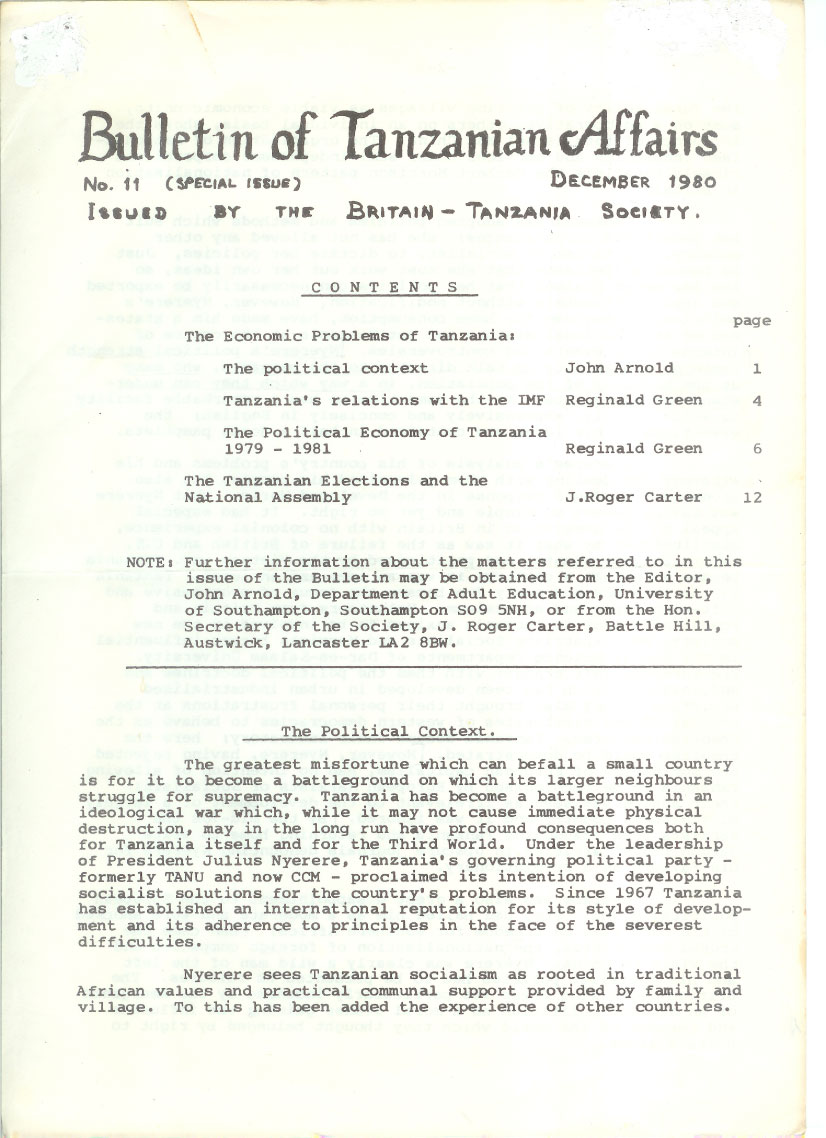
TA ISSUE 11

Issue 11 cover

Bulletin of Tanzanian Affairs
No. 11 (Special Issue) December 1980

Issued by the Britain-Tanzania Society

CONTENTS

The Economic Problems of Tanzania:
The political context – John Arnold
Tanzania’s relations with the IMF – Reginald Green
The Political Economy of Tanzania 1979 – 1981 – Reginald Green

The Tanzanian Elections and the National Assembly – J.Roger Carter

NOTE: Further information about the matters referred to in this issue of the Bulletin may be obtained from the Editor, John Arnold, Department of Adult Education, University of Southampton, Southampton S09 SNH, or from the Hon. Secretary of the society, J. Roger Carter, Battle Hill, Austwick, Lancaster LA2 8BW.

THE POLITICAL CONTEXT

The greatest misfortune which can befall a small country is for it to become a battleground on which its larger neighbours struggle for supremacy. Tanzania has become a battleground in an ideological war which, while it may not cause immediate physical destruction, may in the long run have profound consequences both for Tanzania itself and for the Third World. Under the leadership of President Julius Nyerere, Tanzania’s governing political party – formerly TANU and now CCM – proclaimed its intention of developing socialist solutions for the country’s problems. Since 1967 Tanzania has established an international reputation for its style of development and its adherence to principles in the face of the severest difficulties.

Nyerere sees Tanzanian socialism as rooted in traditional African values and practical communal support provided by family and village. To this has been added the experience of other countries. The rural policy of creating villages as viable economic units, some on a co-operative, others on an individual basis, shows the influence of both Israel and China. The organisation of nationalised industries and services under semi-independent corporations closely parallels the Herbert Morrison pattern of nationalisation in Britain.

Tanzania has adopted policies and methods which suit her people and circumstances; she has not allowed any other country, capitalist or socialist, to dictate her policies, Just as Tanzania believes that she must work out her own ideas, so she has never claimed that her policies can necessarily be exported and applied elsewhere without modification, However, Nyerere’s policies, home-grown for home consumption, have made him a statesman of international stature and put Tanzania at the centre of international events and controversies. Nyerere’s political strength rests on his ability to talk directly to peasants, who make up the majority of the population, in a way which they can understand and appreciate. At the same time he has a remarkable facility to write lucidly, expressively and concisely in English; the essentials of his ideas are contained in half a dozen pamphlets.

Nyereres’s analysis of his country’s problems and his strategy for dealing with them galvanised his people, but also produced a profound response in the Developed World. What Nyerere was saying seemed so simple and yet so right. It had especial appeal to the generation in Britain with no colonial experience, disillusioned by what it saw as the failure of British and U.S. reformist governments, and politicised by the Vietnam war. Tanzania became more than a country, it was an idea and an ideal. Tanzania in the late 60s and early 70s became the focus of progressive and left-wing hopes and enthusiasm. Volunteers from Britain and Scandinavia went to Tanzania anxious to be involved in the new society, and expatriate socialists and Marxists became influential in the Social Science Departments of Dar-es-Salaam University. The European left brought with them the political doctrines and and analysis which had been developed in urban industrialised societies. They also brought their personal frustrations at the refusal of the electorates of western democracies to behave as the theories required. Tanzania became their laboratory; here the theories would be demonstrated. However, Nyerere, having rejected the domination of European capitalism, had no intention of allowing Tanzania to be recolonised by European Marxists or Socialists; their advice was seen as irrelevant to the development of a largely agricultural country and it was ignored. By the mid-70s the Marxists were abandoning Tanzania and returning home to write jargon ridden articles in obscure journals denouncing Nyerere for his failure as a revolutionary.

Nyerere was also a great disappointment to the European political Right. They had hailed him as a moderate and were shocked by his hard line on freedom for southern Africa; then came the Arusha Declaration, the nationalisation of foreign companies and the visit to China. Nyerere was clearly a wild man of the left and his socialist policies had to be presented as failures. The British Right Wing Press was particularly incensed by the emergence of an African politician as a moral leader gaining the influence and respect of the world which they thought belonged by right to Britain alone.

Hence, when natural disaster and the rise in oil price s combined to throw the Tanzanian economy into crisis in the mid- 70s, she found herself with few friends except the Scandinavian countries and West Germany. When Tanzania actually found herself at war in ’79 with a savage dictator, she was not only left to fight alone , but was offered only the most grudging help after she had freed her neighbour from tyranny and was left with responsibility for a country in chaos. It is as if Britain had managed to defeat Hitler without the assistance of the USA or the USSR and had received no post-war Marshall Aid.

War, drought, floods (yes, Tanzania had both in successive years), oil price increases and decline in world trade, have inflicted immense damage on Tanzania’s economy and have produced intense social strains. Plans have been set back, people have been disappointed and the great ideals are further from achievement.

Most outside commentators have ignored the effects of natural disaster and world economics and what is happening in Tanzania has been discussed in Britain as the consequences of political mistakes, either the failure of Socialism or the failure to apply Socialism. Tanzania is being used to make points in the British or European or western political debate. Nyerere himself has become a target for the type of journalist who makes a living by trying to show that he has discovered that a hero has fallen. We believe that Tanzania can and should only be judged in its own terms. We do not underestimate Tanzania’s difficulties but they must be set in the context of what she has endured and achieved. The truth is that Tanzania has survived, her economy is reviving and, with proper help, it will continue to improve. A general election has been held at which nearly half the Members seeking re-election – including two Ministers – were defeated) their form of democracy is not the same as ours, but it works. Progress in many rural communities has been substantial and impressive. 85% of the children are entering the primary school. Half of the population has access to safe water. Life expectancy at birth now just exceeds the average for the thirty-eight poorest countries. Despite the narrowing of income differentials, corruption in high places is rare.

The following reports seek to give a factual account of Tanzania’s negotiations with the IMF, the present state of the economy and the composition and working of the National Assembly. These will, it is hoped, provide a context within which Tanzania’s problems and achievements may be more fairly judged.

John Arnold.

TANZANIA’S RELATIONS WITH THE I.M.F

This article is based on data and other material that has appeared in the press and in Ministerial statements and contains nothing that may have come to the author’s notice on a confidential basis during his recent service as consultant to the Tanzanian Treasury. It is, therefore, in no sense an official Treasury record or statement of the situation. Ed.

Until 1974 Tanzania had good relations with the IMF, perhaps because she had no need of its facilities. During the economic crisis of ’74 and ’75 Tanzania drew on IMF credits to meet costs of importing food. Since the problems were caused by events outside of Tanzania’s control (drought and the first round of oil price rises), these credits were offered with minimal conditions.

Over the next two years the boom in coffee prices enabled Tanzania to start to repay its borrowings, but imprudent relaxation of import controls in ’78 and the collapse of the coffee boom made another approach to the Fund necessary. This time there was disagreement over the conditions with the IMF pressing for a 25% devaluation. A small devaluation early in ’79 was matched by modest IMF credits. War with Amin und rising oil prices worsened Tanzania’s economic position but no agreement could be reached on further credit facilities and negotiations broke down dramatically in October.

In reply to Nyerere’s protests, the Managing Director of the IMF denied that the Fund had ideological biases or political motivation. New negotiations began this year with new teams of officials from both sides. There were strong pressures to reach an agreement. The IMF’s reputation had been damaged by the breakdown of talks with Tanzania and Jamaica while the Brandt Report had been highly critical of the Fund’s criteria, procedures and lack of sensitivity.

While Tanzania had demonstrated that it could hold out for a time without IMF support and several Governments had responded to its appeal for help, shortage of foreign exchange had drastically reduced manufacturing output, arrears on payments for commercial imports were rising to £100m and substantial repayments of earlier IMF loans would fall due in 1980/81.

The 1979 breakdown concerned eight points of principles

– Devaluations the IMF suggested 25%; Tanzania considered that any devaluation would only worsen matters. (1)
– Higher interest rates to be introduced in place of Tanzania’s system of credit control.
– Reduction in the real level of Government expenditure, especially on Health and Education.
– Wage freeze to be continued to reduce real value of wages.
– Price controls to be abolished.
– Relaxation of Import Controls to allow in more imports on a less selective basis.
– Economic efficiency to be improved. Obviously Tanzania favoured this, but there was a wide difference on what the words meant.

Whatever the Fund intended, the proposals would have meant dismantling planning and repudiating the strategy of transition to socialism. They would also have worsened the trade deficit by more than the Fund credit provided, accelerated inflation, increased inequality of income distribution and reduced marketed food production. hardly a recipe for economic recovery, even in orthodox capitalist terms.

The outcome of the 1980 negotiations can be deduced from Press statements and from Ministerial speeches in the National Assembly.
– There has been no devaluation.
– Credit control has remained and there have been no important changes in interest rates.
– The Budget, voted on before agreement was reached with the Fund, aims to reduce Government’s recurrent deficit, but not at the expense of Social Services.
– Price Controls have been retained and enforced more effectively.
– Import Controls remain central to planning, although additional foreign exchange has allowed larger allocations to reduce production and transport bottlenecks.
– Minimum wages have been increased by 26% for urban and 36% for rural workers. This increase was announced on the day the IMF team arrived. Salaries have not been increased.
– Economic efficiency: work began, on Tanzanian initiatives, in problem areas before the arrival of the IMF team, in particular in the re-organisation of the National Milling Corporation, which had been making massive losses, and the development of an export strategy.

The conditions which Tanzania has had to accept and which could cause difficulty are limits on Government borrowing, bank lending and arrears of external payments. As targets, these limits are probably close to those of the Tanzanian Government; problems can arise, because if the limits are exceeded, the IMF standby credit automatically stops. The limits are set for each quarter year, but Tanzania works on an annual budget and has big seasonal variations in government borrowing and foreign exchange income. However, it seems that the limits were not exceeded for the September quarter.

The total credits made available by the IMF come to about £100m. (2) Of this only 35 – 40% will actually be available to pay for additional imports, allowing an increase of 4%. The balance of the credits will be used to reduce the arrears of unpaid import bills and repayments of earlier IMF credits. It is not easy to forecast whether the agreement will provide sufficient help to see Tanzania out of its difficulties. Keeping within the quarterly limits will depend on world oil prices and inflation rates, the weather and food supplies. If the IMF limits cannot be kept, the question of the exchange rate is certain to be re-opened, with no prospect of either side changing their view.

Tanzania clearly regards the outcome of the 1980 negotiations as only an interim arrangement and not a real resolution of differences. The problems are not peculiar to Tanzania but originate in the structure of the IMF. It was therefore appropriate that Tanzania should be the host for the South-North Conference on the International Monetary System held on 30th. June to 3rd. July, 1980; this resulted in the ‘Arusha Initiative’, sharply critical of the Fund, proposing major interim changes and, in the longer term, total reconstruction. Minister of Finance Jamal was also able to use his position as Chairman of the 1980 Meeting of the IMF Governors to spell out the Third World’s criticism of the Fund and the changes which were required.

Reginald Herbold Green.

(1) It is well known that increased exports, particularly of primary products, depend on structural and technical changes within Tanzania and cannot be achieved in any marked degree by price manipulation in the short run. The effect of devaluation would therefore be to increase the cost of imports and hamper the changes and adjustments needed in the export industries without yielding any substantial benefits in increased export earnings. The IMF prescription of devaluation rests on the wholly erroneous assumption that export surpluses already exist that could readily be sold abroad if prices were lowered. Ed.

(2) The credit consist of a standby arrangement of SDR 179.6 million during the period to 30th. June, 1982, and a compensatory financing facility of SDR 15 million to help to meet outstanding import costs in the year ending 12th. March, 1980. The value of these credits is roughly £100 million and £8.5 million respectively. The outstanding obligation to the IMF amount to SDR 72.1 million, or roughly £40 million.

SELF RELIANCE, SOLIDARITY & SURVIVAL

The Political Economy of Tanzania, 1979-81: Self-Reliance, Solidarity and Survival.

Based on a paper delivered at the Annual General Meeting of the Britain Tanzania Society on 24th.October, 1980. The author was Economic Consultant to the Tanzanian Treasury during the period from April to September, 1980, but this article is issued entirely under his personal responsibility and is in no sense a statement of official Tanzanian policy.

The crisis and its limits.
It would be totally unrealistic to paint a rosy picture of the Tanzanian economy at the end of 1980 or to hold out prospects for an easy recovery in 1981. True, President Nyerere in late 1979 forecast eighteen bad months, but he then assumed a reasonable 1980-81 crop year, not both short and long rains failure in half the country, and did not foresee the 1980 oil price explosion. These two factors have cancelled out the gains from the reduction in defence costs, though that reduction has itself been slowed by the continuing instability and economic collapse of Uganda.

What is surprising is not the crisis, but that there is a functioning economy, a budget and a political and economic strategy. At the end of 1979 a quick review of the economic situation led the writer to remark that Tanzania was walking on water. A year later things are better – Tanzania is walking on thin ice. Unfortunately ice on salt water near the equator tends to be very thin.

However, it is also necessary to note the achievements of Tanzania in spite of the crisis:
1. There have been no deaths from starvation, nor will there be.
2. Universal Primary Education is steadily progressing.
3. Health facility visits are now up to 10 per person per year in contrast to 1.5 at independence and 3 to 4 in the late sixties.
4. By 1981 pure water will become available to over 50% of the rural population, compared with probably 10% at independence.
5. The urban minimum wage was raised by 28% in mid 1980, clawing real purchasing power back to 1978 levels.

Since 1977, Tanzania’s economy has been battered by events over which she has had no control, namely –
1. 1977 – Collapse of East African Community – at least $100 million replacement facilities required.
2. 1977/78 – Collapse of coffee boom. Losses up to $100 million per year on export earnings.
3. 1978/81 – Amin Invasion and support for new Uganda Government. $500 million war, over $100 million support to Uganda.
4. 1979/80 – Oil price doubling. $150 million a year by second half of 1980.
5. 1979 – Flood damage to transport and crops. Of the order of $100 million.
6. 1979/80 – Drought. Probable total crop loss $100 million, 1980/81 added food import bill $50 million.

The total cost of these events over the period 1977-81 comes to about $1,500 million; that is, 32% of the 1979 Gross Domestic Product, or 125% of the Annual Government Revenue, or 200% of the Annual Export Earnings.

These successive crises and the 1978/79 war diverted attention from the task of improving output. The policy of self-reliance had led to some neglect of export strategy and in consequence the terms of trade moved against Tanzania by an average of 5% a year since 1972, while the volume of exports also declined at a rate of 1 – 2% a year since the mid 1960s. The drive to expand domestic manufacturing stimulated a demand for imported raw materials and spares. These trends produced a recurrent balance of payments problem.

Food production kept ahead of population growth, but there were unuseable surpluses of some crops, while the production of others such as wheat, rice, sugar, milk and oilseed did not meet the demand.

The National Milling Corporation, responsible for the marketing of the main food crop, maize, was badly advised on storage systems and its operations have been generally poorly managed, creating losses which have contributed to inflation.

By October 1979:
1. the rate of inflation had risen from the mid 1975-mid 1979 rate of 8 to 10% a year to over 20%;
2. manufacturing output was collapsing (20-25% fall from the first quarter of 1979 to the first quarter of 1980, with a parallel fall in Sales Tax receipts);
3. for the first half of 1979/80 the recurrent budget deficit came to about shs.l,750 million;
4. goods shortages worsened to record levels (worse than 1975);
5. black marketing became common and built up a middle official or manager/private sub-wholesaler/retailer nexus of corruption;
6. real income fell 20 to 25% below 1973 for minimum wage earners, 5 to 10% for most peasants, over 50% for the majority of salary earners;
7. morale was badly shaken, with tiredness and near despair being dangerously common.

The trough came at the end of October 1979 when talks with the IMF by a weak and apparently ill prepared Tanzanian side collapsed in acrimonious disarray. President Nyerere’s “18 hard months” speech was as sombre as his 1975 New Year’s “grow food or starve” address and had no equally easy call to action to offer, although it did raise again the standard of holding on and striving to get back on a forward course.

The fight back.
Economic management again became central. A new (for his third term) Minister of Finance and a new top Treasury team were soon joined by new Ministers of Commerce and of Planning. The theme was to seek interim bilateral aid while putting Tanzania’s economic house in better order, to hold out for six months basically alone to demonstrate that Tanzanian policy was not up ‘ for auction and that Tanzanian strategy was still coherent and functional.

Action was far reaching and rapid, if by no means always fully successful:

1. the import budget was hacked back to near balance by the first half of 1980, but at a severe cost in reduced production and with no possible cure for the arrears albatross;

2. the recurrent budget deficit was held to shs.2,600 million for 1979/80 and a 1980/81 budget drawn up with measures to cut the deficit to shs.350 million without reducing basic public services;

3. the tax system was simplified, recurrent expenditure control potentially at least substantially improved, and tighter cash flow management instituted;

4. bank credit budgeting was improved for 1980/81 but at the expense of a sharp squeeze in the September-December period;

5. a plausible, detailed export strategy potentially capable of generating 6% export growth was worked out and while implementation is only beginning, for the first time there is broad acceptance of this as a priority area;

6. industrial output was pushed back to early 1979 levels by September 1980, some bottlenecks to plant completion and operation were removed, but the imported spares and inputs constraint was at best dented;

7. the rehabilitation of transport was begun, but from a very weak base as 1971-75 deferred maintenance had been only partly clawed back over 1976~78 before floods and foreign exchange crises imposed new setbacks;

8. food supplies for 1980/81 (including imports) had been organised and prices rationalised somewhat, but no new strategy had been worked out;

9. the reform of the National Milling Corporation had begun, but the process of decentralising and achieving minimal levels of storage, physical control and financial performance would still take at least eighteen months;

10. in commerce efforts to end foreign exchange leakage and the sub-wholesaler centered black market upsurge had begun, sometimes with more energy than detailed planning, and a well worked out programme to strengthen and expand the 5,000 odd village communal shops had also started.

External assistance.
Renewed external negotiations yielded shs.650 million in import support grants and loans in 1979/80 (up from shs.150 million in 1978/79) and the expectation of shs.1,000 million in 1980/81. Negotiations with the World Bank funded further Songo Songo natural gas probing and oil exploration and some agricultural storage and marketing improvement. As shown in the previous article. Renewed IMF negotiations produced funds at least for 1980/81 to cover some reduction of arrears to foreign suppliers, repayment of earlier IMF drawings and a marginal increase of imports without any surrender of political or planning principles.

An interim balance sheet.

What can be said at present about the results to date? Tanzania’s economy and society as well as its political economic philosophy have survived. Given the 1977-80 shocks, that is not a trivial achievement. But there is a continuing crisis.

The foreign exchange gap has been contained. Arrears (barring new shocks) have peaked and allocations are now more rationally planned. But overall the economy is still starved of needed imports which cannot be financed. Manufacturing output has been pushed up a third from March 1980 and should rise modestly in 1981. But shortages continue and 1981 will probably be little – if at all – above the previous 1978 peak.

Shortages of basic goods are contained at irritating and time wasting austerity levels. In six of its eight neighbours the Tanzanian shilling stands at a premium on the black market. But (except for food) the shortages are at least as bad as the previous 1975 trough. Inflation is less than in six of the eight neighbours but at about 20% is still painfully high. Basic public services – especially water, health and education – are steadily being extended. But operating supplies (spares, drugs, fuel, books, paper, chalk) are inadequate, raising serious quality and useability problems.

Violence and – less certainly – corruption have been reduced, but they are still at levels well above 1978 and a fortiori 1973. The minimum wage increases and the control over crop prices have reduced the fall in real income of the weakest social groups. But they have not reversed them (especially following the drought) and the vertiginous fall in the real incomes of salary earners is a cause for alarm as to its morale and morality implications.

Economic planning and management is much better than in 1978-79 and in some areas is at a new high. But serious gaps – e.g. in the National Milling Corporation – remain and overall there is still some deterioration especially at the middle level of management. The explosive rise of middle level technical ( post , secondary and non-university tertiary) institutions to over 200 and of their enrolment to over 25,000 gives hopes of breaking the middle level personpower bottleneck by 1985.

Morale: How Tanzanians see it.
Ultimately an analyst’s views are of less real significance than those of Tanzanians in offices and fields, on shop floors and in polling booths. Here, morale and perceptions seem to vary widely.

The weariness in the face of successive post-1974 crises remains. The sense of loss of part of what had been won and of any assurance of sustained progress is real. Shortages, corruption and problems with individuals (even if, or perhaps especially if those individuals are senior managers or officials) do lead to cynicism and fatalism. But that is not the whole picture. Even in late 1979 morale in the rural areas and in the Party was surprisingly high. Since June 1980 urban morale seems to have risen. The initial results of clawing back have not passed unnoticed. Further, tiredness – let alone cynicism – is not universal. There are many officials and managers who work late, who seek to improve performance, who become passionately angry at incompetence or corruption. The election results bear out this view. The President’s 93% is a vote of confidence. So is the return of all five major economic ministers standing by large majorities. The defeat of over 50% of back bench MPs is not truly unusual but does reflect the view that many middle level leaders were lazy or inept. The overall pattern is that of a selectively critical but hopeful electorate , not an embittered or despairing one.

The road ahead.
The prospects for Tanzania in 1981-83 depend largely on the progress of events beyond her control. How will the Gulf War affect petroleum supplies and aid from oil producing states? What will the weather be like? And export prices? Will the World Bank structural adjustment credit be approved (indeed will IDA survive President Reagan)? What will the climate be for the transfer of world resources? Will Uganda win through to stable government, thus ending its resource drain on Tanzania? Will Zambia be able to earn and make available sufficient foreign currency to reduce its massive arrears to Tanzania? It is hard to be highly optimistic about many of these questions.

Export prospects look better. Cashew nuts and sisal appear to be reorganised for recovery and manufactured exports for continued increase. The Buck Reef gold mine (a 20,000 ounce one) is due to come on stream. But to win through to 6% growth will be hard. After 1984 there are prospects of substantial mineral exports – fertilizer based on natural gas, perhaps uranium oxide, perhaps nickel and cobalt, vanadium and iron ore, possibly coal . But none is yet in hand, none can yield major net earnings until the late 1980s and major payoffs cannot be until the 199Os.

Agricultural advance is possible. It requires a coherent new strategy based on the five deficit foods, storage, a ‘new’ National Milling Corporation, selected export and industrial crop development, crop prices which are in coherent relationship with each other as well as reasonable in comparison with the prices of urban goods, better crop authority management and – especially – communication with growers. The need for action is seen, some initiatives have been taken and the advance (or failure to advance) to an overall strategy will be the most important economic event of 1981/82.

Finance and domestic credit will be on a sound basis if – and only if – the foreign exchange continues to be available at, or above, late 1980 levels. The same holds for industrial output, where the clearing of power and water bottlenecks, getting factories completed, finding export markets and correcting inefficiencies in management will payoff if – and only if – the import of raw materials and spares can be increased. Rural incomes will rise if weather in 1981 is average or better. Urban wages can be raised parallel to price increases if moderate production gains allow a cut in the inflation rate to 10 – 15%. A 10 to 15% salary increase is badly needed, but the chances of production and tax revenue to allow for it by mid 1981 are at best 50-50.

Foreign exchange is the key question. From 1990 on manufacturing and mining should allow a breakthrough. From 1985 on the export development strategy should payoff fairly well and over the period from 1982 to 1984 it should have some impact. 1981-82 requires good management, external support and more than ‘a little bit of luck’.

Can Tanzania win through?
In 1979-80 economic and social collapse and the end of Socialism and Self-Reliance as proclaimed in 1967 has been avoided. Has this created a basis for mounting a new advance or merely postponed descent into a more dependent, inegalitarian future? Frankness forces a clear warning that the odds against success are still high. But that has been true before- in 1974 when drought and oil prices hit; in 1978 when Amin invaded; in late 1979 when external bankruptcy and domestic disintegration only months away, the prospects and the odds looked worse than today.

The survival of Tanzania’s strategy and dynamics have been problematic ever since its present policies were launched in the Arusha Declaration. It remains problematic. But prophets of doom (right, left and centre; gleeful, sardonic and despairing) have to date been confounded. There have been hardships and setbacks, but Tanzania remains progressive, closer to its goals than in 1967, remarkably united behind the basic strategy and coherently seeking to move ahead. The most appropriate mood may be, at least for the friends of Tanzania, a degree of pessimism of the intellect, looking at the challenges and strains, but optimism of the will, looking at past challenges surmounted and a living national determination to win through.

Reginald Herbold Green.

BACKGROUND TO PARLIAMENTARY ELECTIONS IN TANZANIA

The elections for the presidency and the National Assembly in Tanzania held on 26th. October, 1980, raise once again the question of the efficacy of representative democracy as practised in that country. It is natural for us to judge the political institutions of another country by comparison with the arrangements familiar to us and to look upon the Mother of Parliaments as an example to be followed elsewhere. We do not readily appreciate how peculiar are the historic origins and the circumstances of national temperament on which our constitutional practices rely. As Lord Balfour has observed, “our whole political machinery presupposes a people so fundamentally at one that they can safely afford to bicker; and so sure of their own moderation that they are not dangerously disturbed by the never-ending din of political conflict.” (1) “Constitutions are easily copied”, he added, “temperaments are not; and if it should happen that the borrowed constitution and the native temperament fail to correspond, the misfit may have serious results.”

This danger was clearly perceived by the founding fathers of independent Tanganyika. There was little or nothing in the historical experience of the people to correspond with the political traditions of Britain. It was only three years before independence that the first elected members took their seats in the Legislative Council. On the day of independence, Tanganyika inherited a parliamentary structure, which indeed followed many of the formal practices of the House of Commons, but which lacked the psychological basis upon which its successful operation depended. As the Presidential Commission appointed to advise on a one-party constitution reported, “the process of government in the United Kingdom provides a striking example of the force of a national ethic in controlling the exercise of political power … In other words, there is a consensus between the people and their leaders about how the process of government should be carried on.”(2) In Tanganyika, on the other hand, the Commission recognised that “we do not have behind us a long tradition of constitutional government and positive steps are needed to entrench the national ethic in the moral imagination of the people.”

Tanganyika was not an island, but a vast territory carved by the colonisers out of the continent of Africa, with little natural geographical unity and until recent times only limited communication between the inhabitants of its separate parts. Nationhood, an idea familiar to the English since the war with Spain in the 16th. century, was an entirely novel sentiment to the peoples of Tanganyika. Nation building became, indeed, one of the first and most important preoccupations of the new leaders.

In the years before independence, the diverse peoples of this great country were united for the first time at the hands of TANU by a common longing for liberation from colonial rule, but after independence this unifying influence fell away and new means had to be found for sustaining and entrenching the unity produced during the liberation struggle.

The search for institutional means of generating a sense of national unity deeply influenced the constitutional arrangements expressed in the Interim Constitution of Tanzania of 1965.(3) The outstanding features of this constitution were the declaration in section 3(1) that “there shall be one political party in Tanzania” and the relationship that emerged between that single Party (4) on the one hand and the National Assembly on the other. The significance of these features of the Tanzanian constitution are not well understood and are commonly stigmatised as undemocratic. It is therefore important to look closely at the reasons for the decision to abandon the institutions of multi-party democracy.

It is first of all necessary to understand the fear of irresponsible factionalism in many of the post-colonial countries of Africa. That this fear was often justified has been shown by the dismal breakdown of many democratic constitutions and the imposition of an appearance of unity by military dictators. Even in Kenya, which has been spared the ordeal of a military coup d’etat, the strength of centrifugal forces eventually led to the assumption by the ruling party, KANU, of a monopoly in Parliament. President Nyerere believed that “the existence of really fundamental differences within any society pos5s a ‘civil war’ situation and has often led to bloody revolution.” (5) The reconciliation of fundamental divisions was believed to depend on the conscious creation of a national ethic and its vigorous propagation. Such was President Kaunda’s ‘humanism’ as enshrined in the preamble to Zambia’s one-party constitution of 1964, such also President Obote’s ‘common man’s charter’. The Presidential Commission, as we have seen, appealed to similar unifying influences in its call for a national ethic, “which should be included in the new constitution in the form of a preamble. Thereafter, everything possible should be done to win for these principles a strong commitment from the citizens of the United Republic.”(6) The efficacy of these various credal statements in creating a moral consensus will be judged variously in the light of experience. Tanzania had the advantage of a statement of national aims that was much more clearly focussed than those of its neighbours on the realities of the national life and that produced effects that soon became clearly visible, particularly in the rural areas. Over the propagation of these ideas and their progressive implementation in the life of Tanzania the party of liberation, TANU, was to stand guardian.

It was firmly believed, not only in Tanzania, that the aim of creating a body of common beliefs was incompatible with a multi-party system of government. A multi-party system, such as we take for granted as an essential ingredient of democracy, was seen to be not only a distraction from the efforts to create national unity, but as a direct cause for disunity by the encouragement of ‘adversary politics’ and the exaggeration of differences for political purposes.

The importance of constitutional measures aimed at strengthening a national sense of unity received strong support in Tanganyika from the political situation that existed just before and just after independence. In the elections of 1958-59, all the candidates elected to the Legislative Council were either TANU candidates, or supported by TANU. In the 1960 elections, only a single elected member was neither a member of TANU, nor supported by TANU. In the two years following independence, 350 out of 356 candidates elected to urban local authorities belonged to TANU. At the time of the Presidential Commission, therefore,(7) mainland Tanzania was already de facto virtually a one-party state. One unfortunate effect of the existing constitution based on a multi-party principle was that the vast majority of candidates were returned unopposed. As a result, the party system had hitherto failed to provide the electorate with electoral experience, or with the political alternatives that it was designed to offer.

In the one-party state that came into existence with the adoption of the Interim Constitution,(8) the choice before the electorate was no longer one of party, but one of person. In the United Kingdom, the requirement of a deposit is intended to limit the number of candidates to those having a chance of election, but such devices were considered inappropriate to a one-party system. Following the advice of the Presidential Commission, therefore, the Constitution provided for pre-selection by the Annual District Conference of the Party from among those nominated, a body which included three representatives of every village branch, ten of every urban branch and the chairman of every branch. The two candidates attracting the largest number of votes were then put forward, subject to endorsement by the National Executive Committee, as candidates for election to parliament.

Under the 1965 Constitution there were 107 constituency “members comprising 53% of the total membership. A further 15 were chosen by parliament from among candidates put forward by a variety of national organisations representing workers, co-operatives, women, youth and other interests; 20 members were the Regional Commissioners ex Officio; up to 32 were appointed by the President from among the members of the Zanzibar Revolutionary Council; up to 20 were appointed by the President from among persons ordinarily resident in Zanzibar; and up to a further 10 members were in the President’s power of appointment. The disproportionate representation of Zanzibar and Pemba was the price that had to be paid to persuade Zanzibar to enter the political union with the mainland. But the result has been the removal from Zanzibar of the dominating influence of China and East Germany, or of any other external power that might seek a footing there in the future.

A study made of the activities of parliament in 1967 showed that 82% of the speeches other than those of ministers and junior ministers were made by constituency members, who also asked 96.5% of the questions and 86.3% of the supplementaries. It appeared, therefore, that the non-constituency members took relatively little active part in the proceedings. Only 35 national, nominated and ex officio members, other than ministers, out of a total in these categories of 97, made speeches during the year and only 25 asked questions or supplementaries. The performance of even the constituency members varied widely and “a mere dozen were constantly in the front line of parliamentary work, making a strenuous effort to keep themselves and their colleagues fully informed of government activities. (9)

In 1977 the Interim Constitution gave place to a substantive constitution. (10) The constituency members fell from 107 to 106 and the total complement of members rose to a maximum of 229 with the addition of the Vice-President ex officio and 25 members chosen by parliament to represent the Regional Development Committees, of which constituency members of parliament are full members. The numerical proportion of constituency members thus fell to 47%.

Both constitutions provided for a number of committees of parliament, namely, a finance and economic committee, a political affairs committee, a public accounts committee, a committee on development and social services, a standing orders committee and a general purposes committee. The impact of these committees on the work of parliament has not been fully assessed.

Parliament, that is, the President and the National Assembly, is entrusted by the constitution with the legislative power. An important function is the annual review of departmental estimates and the passage of the finance bill, an episode in the life of parliament that constitutes a general investigation of the activities of government, in the course of which ministers are called upon to explain and defend their execution of national policies. The broad lines of such policies are, however, laid down by the National Conference of the Party (CCM) and cannot be challenged in the National Assembly. But as all members of parliament are also members of the National Conference ex officio, they are able to participate in the formulation of policy in that forum.

One of the aims and objects of the Party is “to ensure that, by using the lawfully established forums, every citizen has the right to participate effectively in the national decision making process.”(11) Tanzanians are justified in pointing to many examples of the successful implementation of this right. Nevertheless, President Nyerere with characteristic frankness has recognised many imperfections and has not allowed complacency to stand in the way of reform. “The Party … is intended to be the people’s spokesman, the people’s method of organising themselves for voluntary cooperative activities and the people’s protection against the arrogance and possible tyranny of government machinery and personnel. How successful is CCM in fulfilling those stated objectives? We have a government consisting of CCM members. Is the Party really channelling the people’s view to that government as well as speaking for the government to the people? Do people really feel that the Party is their own instrument, which can be moved by them and used for their purposes? How close is the Party to the general masses of Tanzania?”(12). President Nyerere recognised that, without a vital CCM in close touch with the people, the present constitution would be in danger of delivering Government into the hands of the bureaucrats and the demagogues. He saw the possibility that the present widespread practice of combining in the same person governmental and party office might be leading to a neglect of the prime function of the Party as the voice of the people. This matter will be critically examined in the coming months.

Tanzania claims no finality in one-party democracy and the improvement of its institutional forms continues to receive attention in the light of the aims set out in the preamble to the 1977 Constitution of the United Republic and the constitution of CCM. Many of the decisions before government are becoming so complex and so alien to the daily experience of the people that government by the people as an ideal is increasingly difficult to realise. But that is a problem that is faced by all democracies.

J. Roger Carter

(1) The Earl of Balfour, from the introduction to the English Constitution by WaIter Bagehot: OUP, The World’s Classics, 1928.

(2) Report of the Presidential Commission on the Establishment of a Democratic One-Party state: Government Printer, Dar-es-Salaam, 1965.

(3) Law no. 43 of 1965

(4) or, strictly, the TANU party in Tanganyika and the Afro-Shirazi party in Zanzibar until the union of these two parties as the Chama cha Mapinduzi (CCM) on 5th. February, 1977.

(5) Julius K. Nyerere, Democracy and the Party System: OUP, 1963.

(6) Presidential Commission, op.cit.

(7) op.cit. The Commission reported on 22nd. March, 1965

(8) Op.cit. The constitution of TANU, the one party, appeared as a schedule and thus the party acquired unique legal and national status.

(9) Helge KJekshus: Parliament in a One-Party State: from the Journal of Modern African Studies, vol.12, no. 1, March 1974: OUP

(10) Katiba ya Jamhuri ya Muungano wa Tanzania wa Mwaka 1977

(11) Constitution of Chama cha Mapinduzi (CCM), 1977, Article 1.

(12) Address to the university of Dar-es-Salaam during the 10th. anniversary celebrations, 29th. August, 1980.

TA ISSUE 10

Issue 10 cover


BRITAIN-TANZANIA SOCIETY
Bulletin of Tanzanian Affairs No.10 – July 1980

CONTENTS
The Economy
Negotiations with the International Monetary Fund and the World Bank
Energy
The National Milling Corporation
The Sisal Industry
The Debate on Ujamaa: Villagisation and food production
– Comments on three articles on Villagisation and Food Production published in recent editions of the Journal of Modern African Studies – John Arnold
– Review of ‘Ujamaa Villages in Tanzania – analysis of a social experiment’ by Michaela von Freyhold – J. Roger Carter
Digest of Tanzanian News – Graham Mytton
A comment on ‘Towards Socialism in Tanzania’ by Mwansasu & Pratt – Daniel Mbunda

Editor’s note

The arrangement of the contents of the Bulletin attempts to distinguish between contributions which simply report events and those which provide opinion and interpretation.

The information sections depend on what we believe to be reliable sources, but there will inevitably he some discrepancies, which we can only hope will be clarified in future reports. For example, I have seen at least three widely varying figures for the amount and terms of the World Bank loan to Tanzania.

Where opinions are expressed, they are, of course, those of the contributors and not of the Society and readers must form their own judgments where opinions differ.

John Arnold
Department of Adult Education,
University of Southampton,
Southampton
SO9 5NH.