
THIRD DEVELOPMENT PLAN 1976-81

Tanzania’s Third Development Plan, 1976-81 (1)

The Third Tanzanian Five Year Plan, which was recently published, contains much interesting information about the state of the economy and its prospects. It consists of four parts, viz. Part I: Targets and General Analysis; Part II: Regional Plans; Part III: Projects; and Part IV: Manpower Development. Though chronologically the third five-year plan for the development of Tanzania, it is in fact the first of its kind, having been produced entirely by Tanzanians and after protracted discussion at various levels. It therefore represents – so far as complex economic documents of this kind can represent – a sort of national consensus about the developmental effort and the allocation of resources in the next few years.

Strictly speaking, the Second Five Year Plan finished on 30th June, 1974, but in view of the economic situation following the oil crisis and the number of uncompleted projects, the period was officially extended for a further year – to 30th June, 1975. A further year was allowed to pass before the introduction of the Third Five Year Plan on account of the national preoccupation with the villagisation of the rural population and the programme for universal primary education (UPE). Another reason for delay not mentioned in the plan was doubtless the time occupied in activating the novel and complex machinery for formulating the plan on the basis of consultation at all levels.

The formulation of the Third Plan was entrusted in 1972 to a Planning Commission consisting of the members of parliament as representatives of the people, with the Prime Minister in the chair. The Commission was assisted by 18 sectoral committees each specialising in a different aspect of the economy, to which experts were attached. The secretariat for the Planning Commission and its committees was provided by the Treasury. A committee consisting of the chairmen of the sectoral committees sifted and reconciled the recommendations of the various committees before forwarding them for debate and approval by the Commission.

Experts were also sent to the Regions to advise on the formulation of Regional and District Plans on the basis of the widest possible consultation with the people. The various regional and district officials of Government and Party were consulted about the choice of projects to be implemented during the plan period and agreed lists of projects were forwarded to the Office of the Prime Minister and the Treasury for further processing and selection and for scrutiny by the Treasury in relation to the available resources and the capacity of the economy. In this way, in comparison with its predecessors, the Third Five Year Plan rested on a wide basis of consultation with the people of Tanzania.

The Plan aims at the fulfilment of four general objectives, viz. the creation of wealth, the building up of the economic infrastructure, the extension of the social infrastructure and the establishment of respect for hard work and self-discipline.

The economic targets of the Plan may be summarised by a declared intention to increase the Gross National Product (GNP) by an average of 6% per annum. This target compares with a planned annual increase of 6.7% in the First Plan and 6.5% in the Second Plan, but during the period of the First Plan the actual average annual increase was 5% and of the Second Plan 4.8%. The target figure for the Third Plan must therefore be seen as an ambitions, though not wholly impossible, figure. Its attainment depends on the standard of the administration of the Plan in all its aspects, the terms and conditions of international trade and the availability of external aid of the form and in the extent desired. The first and second of these conditions of success affect among other matters the timely availability of resources for development purposes, since the increasing complexity of the economy and tte interdependence of its parts calls for a nice synchronisation of production where the output of one sector (e.g. cement or fertiliser) is a crucial input for another (e.g. water development or agriculture); while the import of capital goods for development will depend both on the volume of exports and the prices that they are able to attract.

The actual growth rate so far during the period of the Third Plan, though commendable, has fallen somewhat short of the target figure of 6%; in the calendar year 1976 the rate of growth was 5.2% and according to the Bank of Tanzania there was ‘some moderation in economic activity’ in the middle of 1977. This means that it will be a hard struggle to keep up an average of 6% over the whole plan period from July 1976 to June 1981 and some shortfall in the full accomplishment of the planned targets seems not unlikely.

In the light of the policy of self-reliance, the Plan lays great weight on the importance of increasing the production of export crops and other materials to sustain the import of the materials and equipment needed for development. Income from traditional export products must be increased over the Plan period by almost 100%, while a still greater increase is required out of the earnings of miscellaneous exports, such as timber, tyres, batteries and clothing. Judging from recent performance, this must represent a considerably enhanced production and export effort.(2) The Plan recognises that any balance of development requirements will have to be financed out of foreign loans and aid, but emphasises nevertheless that the main effort must go into trade and not aid. However, the Plan calls for continuing international cooperation with the aim of increasing the volume of loan money on easy terms for developing countries, seeking grants wherever possible and aiming at a general reform of the world economy.

An interesting passage relates to incomes policy, which is integral to the plan. The policy implicit in the Arusha Declaration of narrowing income differences between town and country and between different occupations is to continue, as greater equality of income is considered fundamental to a country based on ‘ujamaa’ principles. But under the Third Plan, while increases in real incomes will have to be coordinated with increases of GNP, consideration will also be given to extra payments based on labour productivity. It is also recognised that the stabilisation of commodity prices is closely bound up with the implementation of an incomes policy. Consequently, emphasis will be placed on the regulation and stabilisation of prices in order to enable industry to produce wealth under conditions of greater productivity.

The Plan envisages the fixing and explaining of baseline labour costs against which the performance of labour can be measured. The agreement of the Union of Tanzania Workers is to be sought in the fixing of grades and to be registered with the Permanent Labour Tribunal. Incentive payments out of the profits of production are to be considered. Finally, there is to be a change in the labour laws so as to emphasise duties and not, as hitherto, only the rights of labour.

Part IV of the Plan gives details of a manpower survey. Manpower planning, though inevitably approximate and prone to error, is an important tool in economic and social planning at the present stage of development, as it helps to ensure both that the essential skills are forthcoming in approximately the right numbers at the right time and that scarce resources are not dissipated by excessive or premature production in any category. Although manpower demand estimates are increasingly uncertain as the economy becomes more complex and transfers of function more numerous, they can still serve a useful purpose by indicating the order of magnitude of demand.

The shortcomings and limitations of manpower planning are well illustrated by comparing the projections in the Second Plan (1969-1974) with the number actually employed in 1975 as ascertained for the purposes of the Third Plan. The divergencies between Second Plan projections and the results of the Third Plan manpower survey are considerable and disclose a growth in employment(3) considerably greater than anticipated. Thus the Third Plan survey reveals a category A employment 32% higher than the Second Plan Projections. Of this excess, 9% is accounted for by the employment of 538 more non-citizens than anticipated in the Second Plan, an interesting indication of the growing diversity of the economy. Ascertained category B employment is 12% higher than the Second Plan Projections and category C employment no less than 148% greater. In particular occupations the differences are also considerable. Only 58% of the projected veterinarians (other than university teachers) were in fact employed. On the other hand, 53% more professional accountants were in post in 1975 than envisaged by the Second Plan.

These figures illustrate the great difficulty of producing manpower projections with any pretensions for reliability, even in a comparatively simple economic structure, partly due to the known fallibility of economic forecasting, of foreseeing changes in employment patterns and of making estimates of productivity changes. In particular, they show how infirm is the basis they provide for educational planning unless checked and revised by trend studies and supplemented by information from other sources.

The Third Plan as a whole contains a large amount of interesting detail on the various sectors of the economy which cannot be appraised without much more information, or summarised in a short article. The total investment envisaged by the Plan over the five-year period is shs. 30,218 million (c. £2,158 million), of which shs. 26,604 million (c. £2,054 million) is for ‘national’ projects, that is, projects developed from the funds of the central government, or national parastatal bodies, and shs. 3,615 million (e. £258 million) is to be devoted to projects financed by the Regions. Of this total capital expenditure, some shs. 21,268 million are to come from the Treasury (including funds from external aid sources) and shs. 8,951 million from specialised domestic banking institutions and other non-governmental sources. So far as the Regional projects are concerned, these extraneous sources will in the main consist of the free labour and other contributions of the villagers themselves. Of the investment in Regional projects, 29% will go into productive enterprises such as village industries, 47% will be used to improve the social infrastructure and 24% to build up the economic infrastructure. The large preponderance of investment in the social infrastructure is mainly due to the national effort to provide primary education for every child reaching school age (7 years old).

This development plan is a remarkably thorough inventory of intentions. the fulfilment of which to a marked degree depends on world factors beyond the central of the Tanzanians. Nevertheless, it is not an unrealistic plan and it provides a framework for orderly progress based on a clear perception of priorities. It may appear that the list of projects in Part III of the Plan is bound to become increasingly unrealistic during the years of the plan due to implementation delays, changes of policy, new needs and opportunities and other influences. But in fact the government also publishes an annual plan in which such changes are recorded and the parameters of the Five Year Plan are updated. Thus, development planning in Tanzania is a continuing process based on a general stocktaking at five year intervals and annual adjustments to take account of changing circumstances. It is a sobering thought that even the complete implementation of this plan will not markedly close the wealth gap between rich and poor countries.

With such solemn considerations in mind, it is incumbent on the rich countries to do everything in their power by way of aid, and still more by way of trade on a rational basis, to help countries like Tanzania to reach their self-imposed targets.

J. Roger Carter

(1) Mpango wa Tatu wa Maendeleo ya Miaka Mitano ya Kiuchumi na Jamii 1 Julai 1976 – 30 Juni 1981. Kitabu cha Kwanza – Shabana na Maelekezo (Sehemu ya Kwanza), Mipango ya Mikoa (Sehemu ya Pili): Kitabu cha Pili – Miradi-: Kitabu cha Tatu – Mpango wa Maendeleo ya Watumishi (1975-1980) (Mpigachapa wa Serikali, Dar es Salaam, 1978).

(2) Unfortunately, the state of the world economy and poor prospects for market penetration do not encourage hope of implementation on such a scale.

(3) In this calculation, ’employment’ is assumed to be the number of people in post and ignores vacancies. It is true that vacancies represent not only transfers, but also advertised posts unfilled because there is no suitable person available. In the Third Plan, 31% of the Category A posts are shown as vacant, but this figure must include aspirations in addition to true vacancies, as it is hardly conceivable that the money could be made available to pay additional salaries on this scale.
FAMILY PLANNING IN TANZANIA

The concept of family planning in Tanzania is not new. What is new are the contraceptive methods which are given as part and parcel of the Maternal and Child Health services in a medical setting. Child spacing, as we call it in Tanzania, has been practised from time immemorial throughout the length and breadth of Tanzania. Thus, traditional child spacing was practised to enable mothers to breast feed their babies over a long period of time (say, two years and over). This practice of breastfeeding was underpinned by the belief that if a mother conceived before her previous baby was two years old, the baby’s growth would be deterred and the mother’s health would be endangered. Breastfeeding was advocated among all the tribes because it was religiously believed that if a child continued to breastfeed when its mother was expecting another baby before the baby had been weaned, the baby was likely to fall victim to some incurable disease. Such beliefs were responsible for the evolution of instructions in child spacing knowledge and personal hygiene among many of the tribes before and after young people got married.

Most of the child spacing practice was done through abstinence among couples. In polygamous marriages, the gap between children was very often even wider. The traditional child spacing practice still exists among some of the rural population. This, in a way, has greatly helped the acceptance of modern child spacing practice. Thus, the older generation looks at UMATI (Chama cha Uzazi na Malezi Bora cha Tanzania), the Family Planning Association, as a movement which has been established to revive Tanzania’s old but good traditional practices.

Initially, the Family Planning Association of Tanzania, which is now known as UMATI, was started by a few individuals interested in the wellbeing of mothers and children and the nation as a whole. Among them were doctors, housewives and nurses. It was started as an Association for Dar es Salaam. It was therefore known as the Family Planning Association of Dar es Salaam until 1967 when the association was registered as a national organization. The Association was charged with the responsibility of supplying contraceptive materials and of providing family planning clinical services in voluntary agency hospitals and clinics. Today child spacing services are available to all women who attend MCH clinics throughout the country.

UMATI is a member of the International Planned Parenthood Federation (I.P.P.F.). Apart from subscriptions from its members and fund-raising efforts, UMATI receives most of its assistance from IPPF. As a voluntary organization UMATI depends on donations and voluntary support for the success of its activities. Much of what has been achieved is due to the voluntary spirit of many individuals and organizations such as IPPF and OXFAM. The Ministry of Health directive, issued in 1969 to the Regional Medical Officers requesting them to render child spacing services as part of Maternal and Child Health services, accelerated the demand for both contraceptive services and training of personnel to provide services. Most of the clinical services became the responsibility of the hospitals and clinics directly receiving both supplies and advice. This expansion of work brought about a new demand for skilled workers to manage child spacing clinics. The Association, consequently, found itself responsible for starting a training programme for paramedical personnel from government and voluntary hospitals and for the association’s own needs. The training programme was set up in 1971. Initially, it was only possible to conduct a two weeks in-service training course for nurse/midwives and medical assistants. Now such training takes four weeks, and only a limited number of trainees (9-12) can be taken at a time because of the limited facilities for theory and practical training activities. To train their students in these skills the Medical school of the University of Dar es Salaam and the School of Nursing (in Dar es Salaam) make use of the Association’s training programme facilities. Once a year, the Association conducts a training course for tutors from nursing schools in the country. The Association also works closely with the Institute of Social Welfare in training matters.

The extension of family planning work has been possible through the involvement of government and voluntary agencies in clinical services. The Association too has found it necessary to extend its educational programme to the remotest areas possible. This has been one of the main objectives since 1972 when the Annual General Meeting of the Association stressed the importance of the element of responsible parenthood. At that meeting the role of the Association was expanded to include spacing of births and caring of children, thus advocating and stressing the responsible parenthood element as well. Since then the name of the Association, Chama cha Uzazi Bora, had to be changed to Chama cha Uzazi na Malezi Bora. In implementing and stressing responsible parenthood other aspects had to be included in the day-to-day activities of the Association’s staff as in the teaching/training material. Advice on nutrition, breast feeding, immunization, personal hygiene, family welfare, sanitation and environmental care became important parts of the teaching of child spacing work in Tanzania. An integrated approach to family planning is therefore in practice in Tanzania.

In order-to create awareness throughout the country, the Association, over the past six years, worked hard to form branches all over the country to enrol volunteers (since the Association cannot afford to recruit enough paid staff) and supporters at grassroot level. Until December, 1977, there were about 60 district centres and more than 300 village branches. The Association has 22 UMATI educators (Walimu wa UMATI) in all the regions. The formation of branches has also created an understanding and appreciation of UMATI’s activities among the local communities as well as leaders at regional and national levels. Leaders and members at UMATI district, regional and national levels act as good ambassadors of the Association. These volunteers are supported by full-time UMATI educators in the regions. The educators conduct educational programmes as well as coordinating UMATI activities with those of the government, the party and other voluntary agencies. Much of the Association’s work very much depends on the hard work and dedication of volunteers at all levels as well as the support and understanding and appreciation by both the government and the party.

In 1973, UMATI went through a critical but important phase of development when it was severely attacked by the local press through ignorance. The Association was eventually saved by the then party’s (TANU) pronouncement at its National Executive meeting in September, 1973, when the party issued a directive that the work that was being carried out by UMATI was very important for the development of the nation and that it should be encouraged. The Ministry of Health was called upon by the party to help the Association in its endeavours as much as possible. Thus, following this party pronouncement in 1973, more and more of the child spacing clinical services became the responsibility of the Ministry of Health activities. For this reason child spacing services now are seen as vital services for mothers at their daily comprehensive MCH clinics. As stated earlier, after the government inclusion of child spacing services in their MCH programme since 1974, UMATI expanded its activities and acquired a new role in one way or the other by putting emphasis on education and training. The following are the main activities of UMATI:

(i) Information and Education to the general public; through seminars, printed material (leaflets, posters, pamphlets)radio and films.
(ii) Training of medical and paramedical personnel.
(iii) Distribution of contraceptive supplies and equipment (until such time that the government is able to get its own supplies).

Through its educators in the regions, UMATI plays an active part in training Maternal and Child Health Aids in the 18 national training centres of the Ministry of Health established throughout the country. The training is given to primary school leavers and lasts 18 months. The training instructions include antenatal care, immunization, family planning, nutrition evaluation, general health education, simple deliveries, malaria chemo-suppression and simple treatment of disease. The main objective of this kind of training is to equip trainees with knowledge and skill that will enable them to provide basic health primary care in villages. In this way UMATI’s work is a necessary input in rural development which is Tanzania’s main development strategy in her war against poverty, disease and ignorance among her people. UMATI is therefore playing her part in our national development effort.

UMATI provides services that are not readily available and therefore supplements and catalyses the nation’s effort to eradicate these important enemies of the nation which militate against the improvement of the quality of life among our people. UMATI, therefore, is seen as an important agent for our national socio-economic development effort.

Christina M. Nsekela

DIGEST OF TANZANIAN NEWS

January to June, 1978. Compiled by Graham Mytton.

The University
Students in Dar es Salaam held a demonstration in March in protest at the pay increases and fringe benefits awarded to M.P.s and Ministers. The pay increases which came into effect on January 1st were not officially announced for two months. M.Ps’ salaries went up to She 3,000/- per month. In addition, M.Ps who retire or are defeated after a five-year term are now entitled to a Sh. 45,000/- tax tree gratuity. Those who serve for two or more terms will receive a government pension. Ministers are now exempt from water and electricity bills, and get a house servant paid for by the state. The students objected to all this and marched carrying banners. The demonstration was reported to be peaceful, but the police used batons and tear gas to break it up. Students were arrested for organising an illegal demonstration. They said they had been refused a permit. President Nyerere had offered to meet the students but they decided to go ahead with their march. 367 of them were arrested and sent home. They included Emmy Nyerere , an engineering student and son of the President. In May, 327 of the students were allowed to return to their studies; 19 of the others will be allowed back next year. The remaining 21 “ringleaders” will be barred from further education for five years.

Release of Detainees.
On 26th April President Nyerere ordered the release of 13 detainees to mark the 14th Anniversary of the Union. They included Mohammed Babu and three others who, like him, had been condemned to death in absentia for their alleged part in the killing of Sheikh Karume in 1972. The other three were Capt. Hemed Hilali Mohammed, Col. Ali Mahfoudh and Mrs. Tahir Ali Salum. Their release was widely welcomed in Tanzania. After his release, Babu denied vehemently that he had anything to do with Karume’s death. He said there was no plot. The killing was the sole responsibility and action of the man who fired the shot, who wanted to avenge the death of his father.

Over the next two weeks 30 other detainees were released, including some members of Southern African liberation movements. 10 prisoners on Zanzibar sentenced during •the treason trial for their alleged part in Karume’s death were released. 14 others had. their sentences cut. Earlier, three men under sentence of death on Zanzibar had their sentences commuted.

Major Appointments.
The names of the secretaries-general of the newly restructured national organisations were announced in February:
Alfred Tandau – Union of Tanzanian Workers.
Rajabu Heri – Youth Organisation.
Maimu Hassan – Union of Tanzanian Women
Athumani Juma Mhina – Tanzania Parents Association
Daniel Makemba – Union of Cooperative Societies.

All the above are automatically members of the National Executive Committee
of the Party (Chama cha Mapinduzi, CCM).

Following these appointments there was a minor Cabinet Reshuffle:
Alfred Tandau – Minister without Portfolio
Daniel Makemba – Minister without Portfolio
Samuel Sitta – Minister of Works.

Other junior appointments were also made on 27th February.

Transport.
Continued port congestion in Dar es Salaam has been a major headache and has contributed to certain strains in Tanzania’s relations with Zambia. In March 35,000 tonnes of Zambian imports were said to be blocked. No-one seemed to agree who was responsible. Zambian sources said that the fault lay with Tanzanian dock workers. Tanzanian sources blamed poor documentation and even a deliberate usage of port facilities for cheap storage. Zambia has been getting special concessionary rates for the use of Dar es Salaam and the Transport Minister, Mr Jamal, announced that these concessions would be withdrawn, an announcement that caused anger in Lusaka. Meetings at a high level seem to have been going ‘on almost continuously since February. It seems that much of the cause of the delays is Tazara’s limited capacity. More rolling stock is needed.

Meanwhile, improvements to the rest of the railway system go ahead. Britain has made a grant of a further £4 million (£2 million last year) to help improve railway facilities. The Tanzania Railway Corporation has ordered 400 wagons, 13 coaches and 14 locomotives. The Corporation has also ordered new ships for Lake Victoria.

The Budget.
For many wage earners, the main interest in this year’s budget was the reintroduction of tax relief for families with children. The Tanzanian Government plans to spend She 12,300 million in the year 1978-9. She 6,700 of this is on recurrent expenditure and She 5,600 is for development. 37% of the development budget will go on economic infrastructure, 29% on productive capacity and 29% on social infrastructure.

Commercial and Industrial News.
At the beginning of June, the Government announced the expulsion of Lonrho because of the company’s activities in Rhodesia and South Africa. Lonrho’s activities in Tanzania have been cut down over the past eleven years due to nationalisation, but its involvement in tea, cotton and beer production and vehicle distribution contributed £1 million of the company’s £90 million profits last year. Announcing the expulsion of Lonrho, the Tanzanian Government made an outspoken attack on “Tiny” Rowland, Lonrho’s chief executive, who pretended to be a friend of Africa while he meddled in Southern African affairs. Lonrho is to receive £1 million in compensation for the assets of the Central Line Sisal Estates, nationalised in 1967.

Reports from the Tanzanian news agency say that the country’s sisal industry is threatened with collapse because of excessive administrative costs. Reports say that the Tanzanian Sisal Authority was paying some salaries up to one month late and had large outstanding debts to some suppliers.

The newly constructed Kibo paper mill has started production. Radio Tanzania announced in May that the mill would use as much as 90% recycled waste paper and 10% imported pulp. It would save the country an estimated She 7 million foreign exchange per annum.

There has been growing concern about low industrial productivity in many sectors. Prime Minister Edward Sokoine announced that disciplinary committees would be set up in all places of work to try to improve output. New laws would be introduced to underline responsibility and discipline at work.

Education.
Parliament has called for Swahili to become the medium of instruction at post-primary levels of education. A committee has been formed to look into the possibilities of carrying out this policy. It met first in June. Swahili will be the medium of instruction in geography, history, arithmetic and domestic studies in Form 1 classes from next year. The plan is that the use of Swahili will gradually spread upwards to cover all subjects up to University level.

President Nyerere has called on school teachers not to overdo education for self-reliance. He expressed concern that in some schools the pupils’ work in the fields had caused classroom work to suffer.

Agriculture.
Zanzibar and Pemba are to expand clove production by 50% over the next three years. She 40 million is to be invested.

The current plague of locusts afflicting the Horn and parts of Kenya has also been reported in parts of Northern Tanzania.

There was a severe fall in tobacco production in Iringa due to heavy rain and labour shortages caused by the cholera outbreak. A one million kilogram shortfall led to a loss of She 25 million in foreign exchange earnings.

Corruption.
President Nyerere has made a number of important speeches on this subject. Speaking to police officers in January he said that 1978 would be a year to fight corruption in the country, especially in the administration of justice. The police and the courts had lost their good name by becoming involved in corrupt practices. He announced he was taking personal charge of an anti-corruption squad which would seek to root out corruption at all levels. In February he told a party rally that drastic measures were necessary because Tanzania had lost its reputation as a nation free from corruption.

Health.
Tanzania has been affected by a major epidemic of cholera which broke out last November. It is believed to have come from a pilgrim returning from last year’s Haj. In March all primary and secondary schools in Dar es Salaam were temporarily closed, as were all open-air markets. The brewing and selling of local beer was banned and severe restrictions were placed on movement outside the city. No-one knows for .certain how many have died to date, but the official figure of over 400 is thought to be an under-estimate. The latest area to be affected is Kigoma and the disease has spread across Lake Tanganyika into Zaire and also into Burundi. Mercifully, the Minister of Health has recently reported that the outbreak is now virtually over and that only a few cases remain.

Archaeology.
There was considerable excitement at the discovery by Dr Mary Leakey of a set of four million year old footprints preserved in some volcanic ash at Laetolil. They are thought to have been made by an ape-like creature about “four feet high with a small brain area and big jaws and big teeth”. In June, the Tanzania National Scientific Research Council announced the discovery by Dr Peter Schmidt of one of Africa’s earliest Iron Age industrial sites near Kemondo Bay in West Lake Region.

Geology.
Tanzanian geologist J.J. Mwabene announced that he had found a third deposit of natural gas in Tukuyu. The deposits he had discovered were commercially exploitable and were 98% pure.

Telephones.
Since the closure of the Kenya-Tanzania border and the break-up of the East African Posts and Telecommunications Corporation, most international telephone calls have still been routed via Nairobi. But now Tanzania is to buy a satellite communication station which will end the country’s dependence on Kenya for its external telecommunication services. The Government has signed a $3 million contract with a Japanese firm to build the station as well as a new telex exchange. Both will be operational next year.

Graham Mytton.

SCHOOL AND AGRICULTURE IN TANZANIA

(First published in Polestar)

Agriculture is an integral part of each school day in Tanzania. Through it the children learn self-reliance.

At a signal from the headmaster the class stands up. It is Monday and about twenty e1even-year-01d boys and girls wait quietly in front of wooden benches. To one side maize cobs are piled high and I notice a bundle of white cotton. The children have grown these on the school “shamba” or plot of land.

The cotton will be sold to buy materials for the school and the maize will be eaten. There are no school meals provided by someone else. If the school. or village do not produce food, then there is none.

The children learn the skills of farming and gain experience by helping to decide how to use the money for the good of the school as a whole; for new writing books, pencils or pens, a coat of paint for a classroom, another blackboard or repairs to the roof.

Ninety per cent of these children leave school at the age of fourteen but they will face no gigantic leap into the world of work. They have been working as they learn and are familiar with the kinds of decisions they will have to make as adults.

Only the scale of those decisions will have changed. Proceeds of cash crops, which in this particular village of Lukobe are cotton, sunflowers and castor oil, may be invested in a well, or inoculation of the livestock against tsetse fly, or in improvements to a local road.

Ten days later, we are in the fertile North. Two secondary schoolboys have left their lessons to conduct us round their school farm.

The maize stands tall and green, quite unlike the parched, yellow stalks in the arid plains below. Coffee bushes are dwarfed by the peppering of giant shade trees needed, even in this lush hill district, to keep the fruits cool.

In an adjacent field is a small nursery garden where seedlings are nurtured. Many of these have died, explains one of the boys ruefully, because during the summer holidays no one watered them. Across the track, is a small herd of cattle, about half a dozen, and a wooden enclosure built by the pupils.

Like all secondary schools, this is for boarders. It lies in Lyamungu in the northern hills of Tanzania approaching Mount Kilimanjaro. The academic standards are high. All instruction is in the medium of the pupils’ third language, English (Swahi1i being the second language and a tribal tongue the first).

From 8 a.m. to 1 p.m., apart from a break at 11 o’clock for porridge, a European style curriculum is followed. From 3 p.m. to 5 p.m. each day all pupils work in the farm.

They are fifteen per cent self-sufficient at present in terms of food production and cash income from the sale of coffee fruits, and are aiming at twenty-five per cent self-sufficiency in the near future.

School and work in Tanzania: a pile of maize and a bundle of cotton in a primary school classroom in the desperately dry interior; a fully-fledged coffee farm and small-holding at a secondary school in the fertile North. Both indicate a means of offering every child the dignity of work that makes an actual contribution to their country.

Sally Simpson.

BOOK REVIEW

Helge Kjekshus, ECOLOGY CONTROL AND ECONOMIC DEVELOPMENT IN EAST AFRICAN HISTORY – The Case of Tanganyika 1850-1950, Heinemann Educational, London, 1977, £2.80.

Rarely have I read a book on African history which has left me with such a feeling of new and refreshing awareness on matters of the rural environment. Have no doubts about it, Dr Kjekshus’s book is in every way a very important contribution to the debate on Tanzania’s pre-colonial past and the impact of colonial rule. Dr Kjekshus, a past Senior Lecturer in Political Science in the University of Dar es Salaam, has written a social history of Tanganyika from the middle of the 19th century, when European descriptive travel writing really got under way, to the post-World War IT period. ‘The study seeks to restore the people as agents of African initiatives. There will be no great men … focus is on man as a doer, husbandman, industrialist and trader. In these initiatives the individual takes on the anonymity of mere numbers … ‘ But it is not simply social history for its own sake, rather a treatise refuting with admirable style and startling evidence those hoary old sentiments about the parlous state of the African on his land and the sure benefits to be derived from contact with European enterprise and initiative, sentiments so beloved of early colonial administrators, settlers and missionaries alike, and still so prevalent as an attitude today.

Dr Kjekshus first considers population levels over the period from 1850 to 1890 and tones down the sensational reports of mass death resulting from internecine warfare and slave raiding. With a stable if not slightly increasing population over the period, he then shows how, by the 1880’s, if European accounts are to be accepted, the African had assumed virtual mastery over his environment through a very precise and profound knowledge of his surroundings. Strikingly, he had outwitted tsetse in a way no outside agency has yet achieved, tor all Europe’s scientific knowledge. The author states that ‘the pre-colonial economies developed within an ecological control situation – a relationship between man and his environment which had grown out of centuries of civilizing work of clearing the ground, introducing managed vegetations, and controlling the fauna. The relationship resulted in an “agro-horticultural prophylaxis”. (Ford 1971), where the dangers of tsetse fly and trypanosomiasis were neutralized and “Africa’s bane l1 (Nash 1969) was made a largely irrelevant consideration for economic prosperity. The contrast to the twentieth century, when the tsetse fly has been “one of the major obstacles to economic development” (Ormsby-Gore 1925), is clear’.

After examination of the ‘supports’ of the ecologically-controlled environment, both industrial (iron, salt and cotton manufacturing) and commercial (intra- and inter-tribe trade), Dr Kjekshus then most lucidly traces the break-down of this man-controlled system in the 1890s, from these causes: first, and in a devastating way, Rinderpest; then, in quick succession or concurrently, smallpox, a sandflea plague, red locusts, drought, and the advent of Deutsches Schutzgebiet, meaning food requisitions, constant warfare and the ‘scorched earth’ policy.

What did all this mean to the African husbandman? The loss of his ascendancy over the land and his submission, unwillingly-and with resistance, to colonial tampering with his way of 11fe on the land and on what and where he should provide his labour for the regime. The author only briefly deals with the effects of this tampering (which since Independence has expanded to become full-scale ‘social engineering’), but then the wealth of writing on this subject, from Ren6 Dumont to William Allan (1965) hardly necessitates detailed treatment in this book, though what has been done in case study form for Central and Southern Africa (ed. Palmer & Parsons 1977) should now be taken up for East Africa, with Dr Kjekshus’s treatise as a backdrop. From Richard Burton’s descriptions of ‘comfort and plenty’ in the l860s and l870s, we have come a century later to precariousness and uncertainty in man’s relationship with the land. In one decade, 1890-1900, ‘the conditions for economic life deteriorated and brought many tribes back to a frontier situation where the conquest of the ecosystem had to recommence’. In most parts of Tanganyika this reconquest has yet to begin, and, as Dr Kjekshus implies in passing, it may be that settlement in permanent villages, as it is now being furthered, will not achieve that reconquest.

Dr Kjekshus relies for most of his evidence concerning conditions in the last half of the 19th century on descriptive material from early European, especially German, travellers. As this material is central to his argument, it would be intriguing to know whether oral and archaeological research could help substantiate the evidence so that we have a more profound knowledge of the period with which to compare the later scene. Of equal interest would be to know how many of the causes of ecological collapse in East Africa in the l890s, and what other ones, were applicable to British Central Africa, Katanga and Portuguese East Africa, an area where European colonisation began in earnest at about the same time. An interesting comparison could be made between the extent of disruption caused on the one hand by Arab penetration from the northern east coast, Portuguese penetration from the southern east coast and Boer penetration from the south.

I commend Ecology Control to all concerned with rural development in black Africa – it should be required reading for anyone working in the rural field and especially those technical experts and their administrative counterparts in government who have tended to see ‘rural progress’ (and I do not absolve myself) as some inanimate scientific exercise, perhaps hedged about with doctrinaire ideological principles, and still too often larded with an intolerance of and arrogance at what is seen as the backwardness of rural peoples.

David Leishman.

References:
Ford, J. The Role of the Trypanosomiases in African Ecology, Clarendon Press, Oxford, 1971.

N’ash, TAM. Africa’s Bane: The Tsetse Fly, Collins, London, 1969. Report of the East African Commission, Cmd. 2387, chaired by W. Ormsby-Gore, HMSO, London, 1925.

Allan W. The African Husbandman, Oliver & Boyd, Edinburgh, 1965.

Dumont, R. has written numerous books and reports to Governments in Africa on the question of agricultural development, perhaps his most famous book being False start in Africa, Deutsch, London, 1966, and an important report on Tanzania’s agricultural development published by the Tanzanian Government in 1968.

Palmer, R. and Parsons, E.J. (eds.), The Roots of Rural Poverty in Central and Southern Africa, Heinemann Educational, London, 1977.

TA ISSUE 5

Issue 5 cover

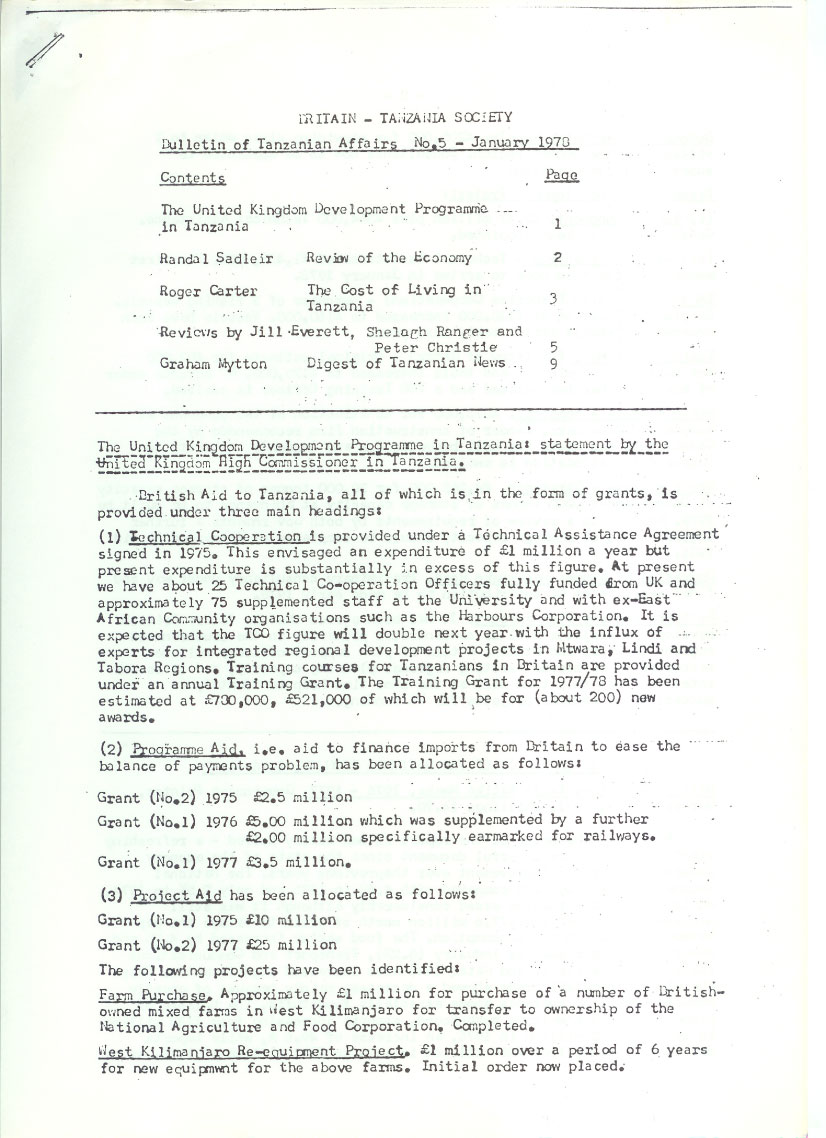
BRITAIN – TANZANIA SOCIETY
Bulletin of Tanzanian Affairs No.5 – January 1978

Contents
The United Kingdom Development Programme in Tanzania
Review of the Economy – Randal Sadleir
The Cost of Living in Tanzania – Roger Carter
Reviews by Jill Everett, Shelagh Ranger and Peter Christie
Digest of Tanzanian News – Graham Mytton

UK DEVELOPMENT PROGRAMME IN TANZANIA

The United Kingdom Development Programme in Tanzania: statement by the United Kingdom High Commissioner in Tanzania.

British Aid to Tanzania, all of which is in the form of grants, is provided under three main headings:

(1) Technical Cooperation is provided under a Technical Assistance Agreement signed in 1975. This envisaged an expenditure of £1 million a year but present expenditure is substantially in excess of this figure. At present we have about 25 Technical Co-operation Officers fully funded from UK and approximately 75 supplemented staff at the University and with ex-East African Community organisations such as the Harbours Corporation. It is expected that the TCO figure will double next year with the influx of experts for integrated regional development projects in Mtwara, Lindi and Tabora Regions. Training courses for Tanzanians 1n Britain are provided under an annual Training Grant. The Training Grant for 1977/78 has been estimated at £780,OOO, £521.000 of which will be for (about 200) new awards.

(2) Programme Aid. i.e. aid to finance imports from Britain to ease the balance of payments problem, has been allocated as follows,
– Grant (No.2) 1975 £2.5 million
– Grant (No.l) 1976 £5.00 million which was supplemented by a further £2.00 million specifically earmarked for railways
– Grant (No.l) 1977 £3.5 million.

(3) Project Aid has been allocated as follows:
– Grant (No.l) 1975 £10 million
– Grant (No.2) 1977 £25 million

The following projects have been identified:
– Farm Purchase. Approximately £1 million for purchase of a number of British-owned mixed farms in West Kilimanjaro for transfer to ownership of the National Agriculture and Food Corporation. Completed.
– West Kilimanjaro Re-equipment Project. £1 million over a period of 6 years for new equipment for the above farms. Initial order now placed.
– Dodoma Village Water Supply. £285,000 for providing clean water to 7 villages in the Dodoma region. Consultants now to be appointed to supervise implementation.
– Tabora Rural Development Project
(i) Roads Component. £2.47 million plus £364,000 Technical Assistance. Consultants have been appointed.
(ii) Land Use Planning – Technical Assistance of £1,405,000. The first members of the team hope to arrive in January 1978.
– TAFICO (Tanzanian Fisheries Corporation) – purchase of 3 fishing vessels. Original allocation of £110,000 increased to £160,000. Vessels have been ordered and should arrive early next year.
– Training for Maji (Ministry of Water) – Original estimate for £92,OOO for buildings, equipment and tools increased to £120,000. An advance order of equipment has been placed and a TCO Training Officer is awaited.
– Grain storage – Seasonal. £873,000 for construction of two go-downs at Songea and Makambako. Tender of construction firm recommended by the Consu1tants was above the cost budgeted for and London’s authority to increase the allocation is awaited.
– Grain storage – Strategic. £4,863,000 for 30,000 tonnes of storage capacity at Dodoma and 10,000 tonnes of storage capacity at Shinyanga to be built by 1979. Subject to a review of requirements by both Governments a further 10,000 tonnes of storage capacity should be completed at Shinyanga by mid 1981.
– Upgrading of Songea-Makambako Road. Pre1iminary consultancy under way and final decision on UL contribution to be made early 1970.

Southern Regions Plan Support. It has been agreed that in future British development projects will be concentrated primarily in the southernmost regions of Lindi and Mtwara. A team of plan support officers will be recruited to reinforce existing regional planning capacity, and it is our intention that this team will at the same time help to identify a succession of capital projects for UK funding.

REVIEW OF THE NATIONAL ECONOMY, 1976-77

ANALYSIS OF REVIEW OF THE NATIONAL ECONOMY, 1976-77
Hali ya Uchumi wa Taifa Katika Mwaka 1976-1977, Government Printers, Dar es Salaam, 1977, Shillings 14.70

Amazingly the price of the report is now nearly halved – a refreshing start to a much more cheerful document since the state of the economy showed considerable improvement over the previous years. The National Income increased by 5.2% compared with 4.6% in 1975 and only 2.5% in 1974, whilst the food situation eased considerably although it was still necessary to import shs. 177.6 million worth of grain to bridge the gap between production and consumption. The food sector increased by 4.7% and other key sectors such as industry (6.2%), Transport and Communications (6.1%) and Electricity and Water (5%) also increased significantly. Only the wholesale-retail trade showed a decrease, mainly because of greatly reduced orders of overseas goods especially foodstuffs. The balance of payments showed a welcome turn-round, exports increasing from £130 million in 1975 to £205 million in 1976, an increase of 49.6%, while imports declined by 4.8% from £284 million in 1975 to £271 million in 1976. As a result the trade deficit narrowed to £65 million compared to £146 million the previous year. Coffee sales played a big part, accounting for 31% of all exports; cotton, tobacco and tea also fetched good prices. Foreign currency reserves increased accordingly from £55 million to £74 million.

Although prices continued to rise in 1976 the inflation rate began to slow down from 15.2% in 1975 to 12.1% in 1976, helped by a considerable fall in the retail price index for lower paid workers in Dar es Salaam from 33.9% to 14% during the same period. The difference between a ‘developed’ and a ‘developing’ country strikes one forcibly when one notices that instead of an endless preoccupation with unemployment this report refers to a 3% reduction in employment from 470,799 paid workers in 1975 to 456,787 in 1976, with a concomitant 2.2% drop in the total wages bill. A very different ‘ball-game’ as the Americans have it!

There was a 16% increase in all buildings completed and a 34% increase in buildings other than housing, mainly schools and factories, but also including the beautiful Mount Meru Hotel at Arusha whose foundation stone ceremony I attended in 1973. The completion of the great KIDATU hydro-electric scheme added 100 megawatts to the national grid and also reduced the incidence of power cuts listed by the authors as one of 8 reasons for disappointing industrial output in a number of plants – similar to last year’s frank list of shortcomings. However some comfort can be gleaned from the 104% increase in flour production and the 18% increase in the output of beer and chibuku resulting from the improved wheat crop.

On a sadder note a short but poignant paragraph states baldly that ‘in the period 1976/77 the East African Community was in a state of confusion. This period witnessed the break-up of the East African Harbours, Railways and Airways’. It is good to see in a recent news-report that reconciliation is now hoped for early in 1978, since only a truly unified East African Community makes economic sense for young nations struggling for higher living standards in a harshly competitive world.

Randal Sadleir

THE COST OF LIVING IN TANZANIA IN THE 1970s

As elsewhere in the world, the cost of living in Tanzania has risen considerably in recent years, though the impact has been unequally divided between town and country. In peasant farming areas the increase has been substantially cushioned by the absence of a wage-cost element in domestic agriculture. The increased burden on peasant families has, therefore, been largely confined to the items bought for money, such as clothing and utensils, but as their money income is small the volume of such purchases is likewise limited. Other increased money costs are fuel and transport. But these increases have been largely offset by the growth in money incomes arising from the sale of crop surpluses. Thus, between 1970-71 and 1976-77 the price paid to the peasant producer of marketed maize rose from 23 cents per kilo to 80 cents per kilo, an increase of 220%. Similar increases in rice and wheat prices are recorded. These rises in price were deliberate acts of government policy to compensate peasant growers for the effects of inflation and to encourage increased food production in the face of the serious food shortages in 1974 and 1975.

While the peasant farmer in many areas probably enjoys an improved standard of living as the result of higher market prices for his product, the main brunt of increased prices has fallen on the towns, where normally there is little chance to eke out food requirements by home production. The impact of price rises can be seen from the national consumer price index, which rose by some 132% between 1970 and March 1977. This rise contained an increase in food prices of 169.6%, in fuel, light and water of 207.8%, in transport of 172.6%, in furniture and utensils of 151.3% and in clothing and footwear of 125.4%. Only rents show a fall of 61.7% following the nationalisation of buildings in April 1971. As food occupies 47% of the consumer basket, the price of food exercises a strong influence on the general index.

Food prices increased dramatically between December 1973 and December 1974, by no less than 77.5% causing the general index during that period to rise by 40.5%. An important cause of this drastic increase was the serious drought, which severely curtailed home production of food and enforced on the government a large import programme of food grains at high world prices. The subsequent recovery of domestic food production under the stimulus of better weather, higher buying prices for peasant farm surpluses and the national campaign caned Kilimo cha Kufa na Kupona (Cultivation for Life or Death) enabled the government to reduce and ultimately to terminate food grain imports. The ending of food imports and the recovery of home production arrested the growth of food costs and even caused a small diminution of the food index by almost 10 points between December 1974 and December 1975.

Food prices then remained stable until the end of 1976, when the upward trend was resumed in the first quarter of 1977 with repercussions on the general index. The food price index rose during this period by 17.9% and the general index by 13.3%. Meanwhile the index for fuel, light and water showed an increase of 69.7%. On the other hand, clothing and footwear prices remained unchanged, while furniture and utensils actually fell by 20 points. The higher cost of food is said to have been due to higher prices for vegetables and fruit, while the rise in fuel costs was laid down to a steep increase in the price of charcoal and firewood.

While the national consumer price index gives a picture of the urban areas of Tanzania in general, the Dar es Salaam price indices paint a picture of life In the former capital. There are two such indices, both based on a household budget survey carried out in 1969, one relating to wage earners with an income at that time of shs. 2,OOO to shs. 4,000 per annum, the other to middle grade civil servants earning shs. 3,OOO to shs. 20,OOO per annum. The indices constructed on the basis of this information are published against a base line of 100 in 1969, but in the following paragraphs they have been converted to a base line of 100 for 1970 for comparison with the national index.

The fact which springs immediately to mind in comparing the national indices with those for Dar es Salaam is the steeper rise in Dar es Salaam prices, amounting to 248% between 1970 and March 1977 for wage earners. In the same period food prices rose by 274%, a very serious increase for wage earners most of whom depend on the shops for their supplies. During the same seven year period the rise in prices for middle grade civil servants was nothing like as steep, being 141% or only marginally greater than the rise in the national index, while the rise in food prices for this income group was 186%.

Still, the rise in consumer prices has undoubtedly reduced the standard of living of the salaried class. With effect from 1st May 1974 civil service salaries were increased by 15% for the first time since 1961, except for a few upward adjustments in starting salaries. No further change has been introduced since that date. However, in view of the exceptional hardships imposed on the urban civil servants in the lowest ranks – messengers and the like – by the prices explosion, the basic starting salary was increased for wage earners from sh. l80 per month (shs.2,160 p.a.) in 1970 to shs. 270 per month (shs. 3,240 p.a.) in 1972 and shs. 340 per month (shs.4,080 p.a) in May 1974. This represents an increase of 88.9%. In the same period the index for wage earners rose by 55% and so also did the group index for food. Thus, in the middle of 1974 wage earners were more than compensated for price rises since 1970. The salaried grades, on the other hand, received an increase of only 15%, while the index for middle grade civil servants rose by 43% and the group index for food by 39%.

This adjustment was in line with the general policy of the government to reduce salary differentials; it also had the effect of reducing differentials in real income by making the upper grade civil servants in real terms poorer and the lowest grades richer. Unfortunately this did not last. The subsequent steadily upward trend in prices, especially the sharp upturn in the index in the first three months of 1977, must have caused serious difficulties for families in the middle grades, but its effects on the lowest grades must have been particularly severe. Since 1974 the basic starting rate in the civil service rose to shs. 380 per month (shs 4,560 p.a.), an increase of ll.8% while the price index for wage earners rose by l24.5%, the food index rising by almost exactly the same amount. It is clear, therefore, that the March 1977 level of food prices, 243% above the 1970 figures, must have produced serious hardship among the lowest paid in Dar es Salaam, whose incomes had risen only 111% in the same period.

Food prices in Dar es Salaam may recover from the sharp upturn in the first quarter of 1977 which may have been caused by some temporary problem with supplies. It is likely, however, that any permanent upward shift in price levels will not be continued for long without a corresponding upward adjustment of salaries in the lower ranges.

Roger Carter

DIGEST OF TANZANIAN NEWS

August 1977 – January 1978

1. CHAMA cha MAPINDUZI
The first national conference of the government party uniting the former TANU and ASP, Chama cha Mapinduzi, opened on 18th October in the Diamond Jubilee Hall in Dar es Salaam. The Conference elected 40 members of the National Executive Committee (NEC) out of 85 candidates, 20 from the mainland and 20 from Zanzibar. 1,480 delegates took part in the conference and the elections. The new NEC met on 22nd. October and elected a new Central Committee.

(Apart from the 40 members elected by the National Conference, the NEC includes the Chairman and Vice-Chairman of the Party elected by the National Conference, all members of the Central Committee, all Regional Chairmen and Secretaries and all Chairmen and Secretaries of the designated mass organisations (the Youth Organisation, Union of Tanzanian Women, Union of Tanzanian Workers, etc.))

2. The CONTROL of MIGRATION
At the beginning of January, the Prime Minister, Edward Sokoine, announced further measures aimed at stopping the drift to the towns. Villagers will in future have to obtain permission before leaving their villages. Each registered village is to be empowered to prevent people leaving without permission. Action has also been taken against ‘vagrants’ in the towns and street traders have been particularly affected in Dar es Salaam. Recent press and radio messages have tried to persuade people that a better life is possible in the villages and efforts continue to be made to use persuasion rather than coercion to encourage people to work on the land.

3. FOOD
There has been drought in parts of northern Tanzania. There is also a meat shortage and in January the Government announced plans to sell elephant and other game meat from officially culled animals.

Tanzania is to receive 7,000 tonnes of maize from the World Food Programme. This will be delivered in three years time and stored with other food grains intended for Tanzania’s emergency grain reserve project. The intention is to reserve 100,000 tonnes in storage.

4. HEALTH
There was an outbreak of cholera in Southern Tanzania in October and November. The Health Minister, Leader Stirling, blamed traditional medicine men for making the situation worse by offering phoney protection. The WHO sent vaccines.

5. OBITUARIES
Mary Hancock M.P. died in October. Born in England in 1910, she was a volunteer teacher in Tanganyika in 1941. She later became Headmistress of Tabora Girls High School, a Tanzanian citizen and a senior education inspector. In 1970, she was nominated to Parliament by the women’s organisation, Umoja wa Wanawake wa Tanzania (UWT) and elected by the National Assembly (Parliament). Mama Hancock was a much loved and respected figure. A requiem mass was celebrated by the Cardinal Archbishop in Dar es Salaam Cathedral on 28th October.

Abdul Karim Karimjee CBE, Speaker of Parliament before and after Independence and Chairman of the Council of the former University College, Dar es Salaam, businessman and prominent leader of the Asian community died in London in September.

6. PARLIAMENT
The October session of Parliament was held in Zanzibar and when Parliament resumes it will sit in Pemba. Members of Parliament debated a number of issues, including an outbreak of tribal rivalry in Singida Region. The Prime Minister, Edward Sokoine, asked members from the Region to stop arguing on tribal lines. He said that nobody had yet come up with ideas on how to stop the bloodshed. The Junior Minister for Home Affairs told the House that 94 people had died in tribal clashes in the Region over the previous eleven years.

7. RELATIONS with KENYA
In November, Kenya stopped all flights between Nairobi and Dar es Salaam and the border remains closed. At the time of closure, imports from Kenya were increasing and constituted nearly 13% of total imports, while exports to Kenya were declining at around 3% of total exports. Since the closure, good progress has been made in attracting tourists and the severe reduction in the number of elephants in Kenya due to poaching appears to have made Tanzania a more attractive proposition for some tour operators. The trade imbalance between the two countries remains one of the difficult problems of relationship to be solved. In November, Vice-President Aboud Jumbe met Kenya Vice-President Arap Moi in Zanzibar and talks were held at official level in Mombasa in December and are to continue.

8. RELATIONS with UGANDA
More than 100 Ugandans, formerly employed in the East African Community in Arusha, defied an order from Idi Amin to return home and were granted political asylum in Tanzania. Despite poor relations, however, there were moves in January to reopen trade links in the West Lake Region, which has suffered greatly since the border closure from the disruption of Lake Victoria steamer services. The Minister for Trade, Alphonce Rulegura, called on leaders in the West Lake Region to foster good neighbourliness with Uganda and with Rwanda and Burundi. He said that Tanzania was not opposed to trade links with Uganda. Later, an agreement between the two countries was reached at a meeting at Mutukula between the West Lake Regional Party Secretary (Regional Commissioner) and the Governor of Masaka Region in Uganda. The agreement covered the control of crime, medical services, schools, vermin control, exports and imports and the maintenance of peace.

9. ZANZIBAR
In December, Zanzibaris went to the polls for the first time since before Independence in 1963. This resulted from the introduction of the Constitution of the United Republic, which came into force on 26th. April, 1977, and replaced the previous Interim Constitution. Ten members of parliament were elected and five other elected indirectly.* Together with Zanzibar’s nominated members, they will serve until the next national general elections in 1980. Great interest was shown in the Stone Town result, when Zanzibar’s Chief Justice and presiding judge at the treason trial in 1975, Ali Haji Pandu, was heavily defeated by Jamal Ramadhau Nasibu, a journalist and former detainee.

* Zanzibar elects one member for every District in Zanzibar and Pemba. Parliament elects one member from each Region of Zanzibar and Pemba from names put forward by the Regional Development Committee. The Regional Commissioner of each Region is a member ex officio. The Zanzibar Revolutionary Council elects up to 30 from amongst its members and outside. The President appoints up to 20 members from Zanzibar end Pemba.

10. TRANSPORT
Air Tanzania has started operating services to Burundi, Rwanda and the Seychelles. Other international services operate to Madagascar, Mozambique and Zambia.

Following the successful completion of the railway to Zambia, efforts are now being concentrated on improvements to the older railways. Canada is making a grant of shs. 470 million to restore the railway system; the UK contribution is shown under ‘Programme Aid’ in the first section of this issue of the Bulletin. The Canadian contribution is the largest sum ever given by the Canadian International Development Agency (CIDA) to any country and will be used chiefly to rebuild the central line to Kigoma.

Following the recurrence of difficulties and delays with Zambia-bound cargo, the Tanzanian and Zambian Governments reached an agreement in December to lift the road weight restriction on the road between Dar es Salaam and Tunduma. It was also announced, following the controversy over the use of Tazara wagons on Zambia railways, that the two railway companies would meet to conclude a wagon-hire agreement.

11. PRESIDENT NYERERE’S VISIT to WASHINGTON
President Nyerere made a State Visit to the United States in August at which, in the words of the Daily Telegraph, he was given ‘red carpet treatment’ by President Carter. It was the President’s first State Visit to America since he was invited by President Kennedy. The President also visited Jamaica and Canada.

Graham Mytton