
TOURISM & ENVIRONMENTAL CONSERVATION

by Mark Gillies

Poaching
This dry season, tourist tales are of long day drives spent looking for elephant. Some find large groups clustered tightly; others are unlucky and return home without seeing one. It never used to be this way. Tanzania’s poaching epidemic is now much more than statistics: it is arguably a national disaster.

At the end of April, Tanzania was named in the Born Free USA/C4ADS ‘List of Shame’ as one of the top countries in Africa with the worst poaching records and the least effective government action to control the worst threat to natural resources in living memory.

Perhaps partly in response the growing international criticism of perceived governmental inaction to combat international poaching syndicates, the Tanzanian government hosted a Summit Conference to Stop Wildlife Crime and Advance Wildlife Conservation in May and signed a joint initiative with the United Nations Development Programme (UNDP) to establish a new body for wildlife conservation. On 10 May, The Daily News reported the creation of the Tanzania Wildlife Authority (TAWA), to increase the revenue derived from Tanzania’s natural resource and to intensify conservation. Let us hope the two are not mutually exclusive.

The creation of TAWA was announced by the Minister for Natural Resources and Tourism, Lazaro Nyalandu, who assured delegates to the conference that there would be zero tolerance towards the corrupt and inefficient elements involved in the protection of the country’s wildlife. In particular, 500 extra game rangers are to be hired and three helicopters await pilots currently training in South Africa.

Operation Tokomeza, the Tanzanian government’s attempt to combat poaching (see an article in TA108), continues to create headlines. In May, President Kikwete established an investigation into the Operation. Retired Justice Hamisi Msumi will head efforts to address the complaints of all those negatively affected by the Operation whilst also investigating claims that the Operation was sabotaged. Meanwhile, Tokomeza II continues, but without the early successes, or alleged excesses, of the original Operation.

Putting to one side where the individual culpability lies for the dramatic loss of natural resources through poaching, The Citizen on 7 July draws on the international media to provide a clear explanation for the driving force behind the trade. It outlined how the price of African ivory in China has tripled over the past three years, so that the cost of ivory in China is now ten times the cost in Africa, a profit margin that is driving corruption, crime and conflict across Africa.

The poaching epidemic in Tanzania must be confronted and stopped for the sake of the species targeted. Once they are gone, they will be extremely difficult to reintroduce. The continued existence of elephant and rhino has an existential value, but it also has an immense economic value – a fact should also be remembered by the Tanzanian government when considering other areas of legislation that affects the tourism industry.

Tax and Tourism
In June, in the run up to the release of the national budgets in East Africa, intense lobbying was carried out by the Tanzanian tourism industry with government officials to prevent, or adjust the timeline for, the repeal of certain VAT exemptions covering tourism goods and services that would have resulted in an increase to the average Tanzanian holiday package of about 10%.

Whilst the impact of such a rise on the numbers of tourists visiting Tanzania in the medium to long term is debatable, the issue was that the change was due to come into effect on 1 July 2014, days after the deci­sion and at the start of the peak travel season. The potential increased costs would have to be passed on to clients, risking widespread cancellations and Tanzania’s good reputation in the African tourism market.

The Tanzanian government of course has the right to determine its monetary policy as it wishes, but tourism operators were left pleading for some forewarning and an understanding of the realities of the ultra- competitive market that is African tourism.

In the event, the decision was delayed until October, leaving the operators waiting.

Serengeti Road
On 23 June eTN Global Travel Industry News reported that the East African Court of Justice had ruled against the Tanzanian government’s plans to construct a bitumen road across the Serengeti National Park, declaring it to be ‘unlawful’. Although celebrations broke out in court and across the internet, it should be noted that the ruling only specified a ‘bitumen road’, leaving open the prospect of a gravel road following the same route. So the battle goes on for the future of the Great Migration, the integrity of the Serengeti National Park and the reputation of Tanzania as a leader in the field of African conservation.

CONSTITUTIONAL DEADLOCK

by Enos Bukuku

Throughout March and April the Constitutional Assembly (CA), the body tasked to come up with a final draft Constitution, was marred by divisions between two informal coalition groups within the Assembly.

“Tanzania Kwanza” is largely made up of CCM members; whilst “UKAWA” (Muungano wa Umoja wa kutetea Katiba ya Wananchi – Coalition of Defenders of the People’s Constitution) is formed mainly from members of the opposition parties.

The arguing and political mud-slinging is focussed almost exclusively on one issue: the nature of the relationship between Zanzibar and main­land Tanzania – “the union question”. Should Tanzania continue with a two-government system (i.e. Tanzania and Zanzibar), or adopt a three-government structure (Tanzania, Zanzibar, Tanganyika), also referred to as a “federal” government?

As the Constitutional Assembly’s first session broke up in April – to allow MPs to return to parliament for the annual budget session – UKAWA’s frustrations with CCM intransigence on the union question led them to walk out on the Assembly. UKAWA is thought to have considerable support among the Tanzanian public.

In 2010, as part of their election manifestos, both Chadema and the Civic United Front (CUF) pushed for a three-tier government, which had previously been proposed by various groups and commissions over the past 30 years or so. The Constitutional Review Committee (CRC) took the initiative and incorporated this into both the first and second drafts of the proposed constitution, which according to Joseph Warioba, Chairman of the CRC, “was aimed at safeguarding the 1964 merger between Tanganyika and Zanzibar”.

It has been argued by supporters of the three-government system that it streamlines the governmental structure and gives Zanzibar more autonomy, thus maintaining stability between mainland Tanzania and Zanzibar. Judge Warioba has gone on record several times to state that most Zanzibaris are in favour of the three-government idea, though this has been challenged by some Zanzibari politicians.

President Kikwete has been vocal in his objection to the proposal; in his opening speech to the Constitutional Assembly, he stated that a three-government system will not add value and will create problems. CCM, which had previously housed a wide range of opinions on the matter, fell quickly into line behind the president.

The delay in debating the draft constitution has had a knock on effect on new laws being drafted. Proposed energy legislation, for example, which could make Tanzania the first exporter of liquefied natural gas in East Africa, may now have to wait until next year.

Changes to the law to ensure better rights for women, children, the disabled, the press, and many other vulnerable groups are likely to be enshrined in the new constitution if it goes ahead. The issue of dual citizenship has received attention from a few high ranking politicians who suggest that its inclusion will be debated in the Constitutional Assembly. However, it is believed that dual nationality is more likely to be incorporated within a separate Act of Parliament rather than within any new constitution. Bernard Membe, the Foreign Minister, told the National Assembly in May: ”We believe that the time is ripe for our country to have an Act that allows dual citizenship, in the interest of our nation’s development”.

All these issues hang in the balance until the Assembly deadlock is broken.

The United Nations Development Programme (UNDP) has also been closely monitoring the situation. In May UNDP Administrator Helen Clark criticised UKAWA for its walk out earlier in the year and urged that they voice their concerns and discontent through the forum of the Assembly, rather than refusing to participate. This has been echoed by Judge Warioba, warning that failure to reach an agreement may plunge the country into a political crisis.

Kenyan politician and legal scholar Patrick Loch Otiendo Lumumba has been asked to mediate in the CA and ease the tensions between UKAWA and Tanzania Kwanza.

The CA Chairman, Samuel Sitta, also sought to broker peace between the rival groups with a reconciliation meeting scheduled for 24 July. The UKAWA members did not show up, arguing that it was pointless as CCM continue to hold a firm line on the union question. Deus Kibamba, chairman of the influential civil society group, Tanzania Constitution Forum (TCF), has called for the debate over the new constitution to be delayed until after next year’s elections. There are many who believe that Tanzania will not get a new constitution because both groups will never reach a consensus.

The debate on the Constitution is due to resume in August. The president has authorised a further extension of the time, allowing 60 days from 5 August for the CA to finalise the draft constitution before it can be presented to the public for a vote. At the time of writing, UKAWA continues to boycott the Assembly, though Sitta insists it will carry on regardless.

This raises two questions: Will the CA have sufficient members present to vote on the articles of the new constitution – will it be quorate? Without UKAWA members, it looks to be very close. And if votes are possible, will a new constitution written by a CCM-dominated Assembly have sufficient popular legitimacy and support to pass a national referendum, and stand the test of time?

It would be a bitter shame if it all collapses at this stage, wasting billions of shillings, years of preparation and most importantly, a golden oppor­tunity to address many of the fundamental problems that the country faces. An independent observer may be forgiven for reaching the con­clusion that Tanzanian politicians excel at forming coalition groups, but underperform in implementing objectives. The next few months will show whether such an observation is unfair.

FOREIGN RELATIONS

by David Brewin

Tanzania and the EAC
Three East African Community (EAC) member countries (Kenya, Rwanda and Uganda) continue to forge ahead in signing agreements and strengthening their relations, while Tanzania and Burundi, the other members, remain either absent from discussions or self-excluded because so many of the new development programmes do not directly concern their countries for geographical reasons.

Examples include the dramatic fall in the clearance time for goods going from Mombasa to Kampala – down to 4 days compared with 12 days previously, and from 21 days to 6 for goods going from Mombasa to Kigali (Rwanda). There has been a substantial lowering of costs. This is the result of the East African Single Customs Territory (EASCT), which ministers from the three countries have recently signed.
Under a new special visa deal, foreign residents can get a single six-month multiple entry visa for US $100 valid in all three countries (i.e. not including Tanzania). This compares with the earlier cost of $150. The three countries are also participating together in various international tourist fairs.

From August 2014 the tax on mobile phone calls between the three countries is being reduced by 20%. Plans were being prepared for Tanzania to join in this.

Rwanda
After the rough period in relations between Tanzania and Rwanda last year, relations seem to be slowly getting better again. Rwandan President Paul Kagame said he would readily honour an official invitation to visit Tanzania if he received one because Tanzania meant a lot to him, as did the survival of Rwanda and the stability of the region. Tanzania’s State House responded by saying that the idea was not only welcome but was also a critical step in normalising relations between the two countries.

North Korean arms
A recent UN report has claimed that that 18 military technicians from North Korea had been involved in the refurbishment and repair of Tanzanian F-7 fighter jets and other military aircraft at the its Air Force base in Mwanza. The journal Africa Confidential has reported that although N. Korea has no diplomatic representation in Tanzania, two senior officers had been seconded to the Tanzanian Peoples Defence Forces. The report said that Uganda, Ethiopia and Eritrea were also engaged in providing military assistance.

Tanzania has strongly denied the allegations. “Tanzania has no trade relations with N Korea. UN sanctions are specific. They are about trade and we don’t have any trade deals with North Korea,” said a Foreign Affairs spokesman. He added however that maybe the TPDF may know more.

North Korea is believed to have developed sophisticated ways to circumvent UN sanctions, including the suspected use of its embassies to facilitate an illegal trade in weapons, and making use of complicated financial techniques “pioneered by drug-trafficking organizations” , so that tracking the isolated state’s purchase of prohibited goods is more difficult.

The 127 page report was compiled by a panel of eight UN experts and is part of an annual audit of North Korea’s compliance with UN sanctions imposed in response to Pyongyang’s banned nuclear weapons and missile programs. The panel reports to the UN Security Council.

“From the incidents analyzed in the period under review, the panel has found that (North Korea) makes increasing use of multiple and tiered circumvention techniques,” a summary of the report said.

Chinese ambassador speaks frankly
In a wide ranging interview given by Chinese Ambassador Lu Youqing to the Hong Kong newspaper South China Post (quoted by the Citizen) he touched on some delicate parts of Chinese relations with Tanzania and Tanzanians.

On corruption he said that in 2011 his country had made amendments to its criminal law so that it was now a criminal offence for Chinese nationals to bribe nationals in foreign countries.

The Ambassador voiced his concern about “shoddy” work being carried out by some Chinese contractors in neighbouring countries and said that some infrastructure projects had been undertaken by Chinese companies at unrealistic prices. They had been building roads for between $300,000 and $400,000 per km but the real cost was much higher and he wondered what would happen to these roads in five years’ time.

The Ambassador expressed his disappointment over “bad habits” that tarnished China’s image in Tanzania. For example he mentioned corruption and illegal ivory trading. “Our people just cannot shake off their bad habits. When they come to Africa, they are not united and engage in infighting as usual” he said. He referred to competition among Chinese companies over contracts and bribes offered to Tanzanian officials to lobby on their behalf.

On violent crime targeting Chinese nationals in Tanzania he said: “Tanzania has ambassadors from about seventy countries but none of them needs to constantly worry like us about consular protection issues, police harassment and robberies targeting Chinese citizens.”

ECONOMICS & BUSINESS

by Paul Gooday

Municipalities in Dar and Tanga to raise capital through DSE
Dar es Salaam Stock Exchange (DSE) Chief Executive Moremi Marwa has said that the time has come for the municipalities intending to implement various economic projects to raise capital through stock market. The Capital Markets and Securities Authority (CMSA) initiated and supported the move and according to the Chief Executive officer of CMSA, Nasama Massinda, municipal bonds are soon to be a reality in three councils.

The government through the assistance of the World Bank sponsored a two-phase municipal bonds study. The study brought to light the fact that the prevailing government policy would not support efficient issuing of bonds by Local Government Authorities (LGAs) for public subscription.

The first phase of the project strived to establish the feasibility and required policy changes for a thriving municipal bonds market in Tanzania. The second phase was to develop the legal and operational framework for the municipal bond markets in the country.

The former Dar es Salaam City Council director, Bakari Kingobi, was quoted as saying that the municipalities now qualify to issue loans. “Although we have not received the official go ahead from the Bank of Tanzania (BoT), the signs are promising,” he said adding that according to experts, it will help raise resources for development of schools, airports, hospitals and other facilities. Presently, all local authorities depend largely on subventions from the central government and taxation to raise revenue for their expenditures. (The Guardian)

Tanzania urges Chinese to build factories
The Minister for Industry and Trade, Dr Abdallah Kigoda, called on the Chinese business community to build manufacturing industries in the country to mutually benefit both nations. The call was made at the launch of Brands of China African Showcase 2014. The event brought over 100 Chinese companies showcasing products. Products displayed range from machinery, vehicles, home appliances, electronics and solar energy products, consumer goods, building materials, chemical, medical and comprehensive products.

Dr Kigoda said it is time for the Chinese nation to invest in the manufacturing sector which would add value to the country’s profile by reducing the exporting of raw materials which adversely affects the economy. “A great part of our exports are raw materials which after being processed outside, are then sold back to us. We are acting as a global supermarket for goods made from materials produced in our country,” said Dr Kigoda.

He said this has to change because it has adverse impacts on employment and the economy. He suggests that one way of addressing the challenge is through promoting value addition in the country. Dr Kigoda acknowledged the Chinese interest in doing business and investing in the country in different area such as a TSh16 trillion ($10 billion) investment in Bagamoyo Export Processing Zone. He also said the current efforts of laying down infrastructure in Kigoma Region will be an area that Chinese communities can invest in. (The Citizen)

ENERGY & MINERALS

by Roger Nellist

Statoil’s new discovery boosts Tanzania’s gas reserves
On 19 June Statoil announced its sixth gas discovery offshore Tanzania in Block 2, which it operates with ExxonMobil on behalf of the Tanzania Petroleum Development Corporation (TPDC). Lying under 2,360 metres of water, this new gas find (named Piri-1) adds 2-3 trillion cubic feet (tcf) of gas to the known volumes in-place in Block 2, which now total 20 tcf. In July, reporting second quarter corporate results, Statoil’s Norwegian HQ said that Piri-1 is the world’s largest gas discovery during 2014 to date. Statoil-ExxonMobil will be drilling several additional wells in their Block this year and next.

During the Second Tanzania Oil and Gas Suppliers Conference in June, TPDC confirmed that the country’s natural gas deposits are now estimated at 50 tcf. A total of 17 companies are operating 25 licences on behalf of TPDC under Production Sharing Agreements (PSAs).

Gas pipeline nearing completion
In July, marking the 50th anniversary of the establishment of China-Tanzania diplomatic relations, TPDC announced that construction of the 542 kilometre onshore and offshore gas pipeline from Mtwara via Songo Songo to Kinyerezi (Dar), as well as the associated facilities (two gas processing plants, 16 safety stations, staff housing, flood control, water wells), is more than 90% complete. The 36-inch diameter pipeline comprises 47,000 welded pipe sections.

The construction work is being undertaken by three Chinese companies and is financed by a US$ 1.25 billion loan to Tanzania from China’s EXIM Bank (carrying 33 year maturity and 2% interest rate). It is the EXIM Bank’s largest single contract in Africa. TPDC owns the pipeline, which should be completed by December; live testing is scheduled for January 2015 and commercial commissioning for June 2015.

This huge investment is expected to be “transformational” for Tanzania – delivering a more reliable electricity supply, relieving current power shortages and saving about US$ 800 million annually on oil imports. It will also lay a solid foundation for Tanzania’s energy sector restructuring and industrialisation, boosting GOT tax revenue and promoting wider social development. During the construction phase about 2,000 local jobs have been created. Once the gas reaches Dar, it is anticipated that in addition to large-scale power generation more than 30,000 houses, hotels, factories and other businesses in the city will be connected and supplied directly with gas, as well as 8,000 cars converted to run on CNG (compressed natural gas) under a project costing US$ 76 million over three years. In a pilot phase, 70 houses and 53 cars are already being supplied in the Mikocheni area.

Big challenges for LNG exports
In March British companies Ophir and British Gas (BG), along with the other gas discoverers Statoil and ExxonMobil, signed a Memorandum of Understanding (MOU) with the Tanzanian government to construct an LNG plant in southern Tanzania. The plant will be fed by gas from the companies’ discoveries in Blocks 1, 2, 3, and 4 and is estimated to cost between US$ 30 and 40 billion.

Out of a possible 30 sites identified for the onshore LNG plant, the companies have opted for Likongo–Mchinga in Lindi. However, this location is likely to upset Mtwara region, where the long gas pipeline to Dar originates and where the government had promised earlier that the plant would be built to enhance the region’s development. Also, the plant and an associated industrial park requires a large area of land (a 6,800-acre site is suggested) over which there may be title disputes. Although the companies could still use Mtwara as the supply base, it is feared that these two problems could delay the project significantly. The MOU gives the government responsibility for securing the land and clarifies on compensation to affected local communities.

Independently, in an interview to Reuters in June, Royal Dutch Shell’s Director of Projects and Technology, Matthias Bichsel, cautioned that only a fraction of the world’s anticipated natural gas export projects will materialise – because of high and rising development costs, low profit margins and new producers flooding world markets with gas. Against this background some analysts believe that the Tanzanian and Mozambique LNG projects will struggle to find the necessary financing and that costly production delays are likely. Bichsel described the Tanzanian and Mozambique LNG development schedules as “somewhat ambitious since all infrastructure there has to be built from scratch”.

Two ongoing controversies
Petroleum and mining operations are often controversial, and those in Tanzania are no exception. Whilst the Statoil-ExxonMobil offshore drilling has been highly successful (with a 100% drilling success rate), there has been recent criticism by parliamentarians and commentators about some of the terms in the gas PSA that these companies concluded with the government and TPDC in February 2012. In June a copy of their signed contract was leaked and circulated in social media. The criticism – first aired in Parliament by Opposition MP Zitto Kabwe – focuses on the companies’ obligation to supply gas to the domestic market as well as on the (perceived low) share of the profit gas that will accrue to TPDC and government. It is suggested that if gas production becomes as large as some sources indicate, government revenues will be hundreds of millions of dollars lower annually than what might have been expected. In a press release TPDC denied these claims.

These concerns are bolstering calls for a much larger local Tanzanian engagement and content in the country’s incipient gas industry, as well as greater transparency in the extractive sectors – particularly for the government to make public the PSAs it signs with each foreign oil and mining company. Whilst many governments – like Tanzania – do not publish their extractives contracts, the Swala PSA terms were made public as part of its recent share offering (see below). Addressing these concerns, in April, the Ministry of Energy and Minerals published a Draft Local Content Policy document, for public consultation.

Other petroleum sector news
Tanzania’s 4th Deep Offshore Licensing Round closed in May. Bids were received from the China National Offshore Oil Corporation; Russian Gazprom; two UAE companies (including one for Lake Tanganyika North); and Statoil & ExxonMobil. The bids are being evaluated and successful bidders will be invited to negotiate with the government and TPDC on the basis of Tanzania’s 2013 Model PSA, which contains stronger terms including higher royalty rates, and signature and production bonuses. The British High Commissioner to Tanzania, Dianna Melrose, cautioned that this tougher PSA may make Tanzania uncompetitive in the oil and gas exploration business and scare away potential investors.

In June Australian explorer Swala Energy Ltd launched its first shares offer to Tanzanians, selling 9.6 million Ordinary Shares in its Tanzanian subsidiary in order to fund further exploration work in its Pangani and Kilosa-Kilombero license area and to enhance Tanzanians’ participation in the growing petroleum business. Priced at Tsh 500 each, and expecting to raise Tsh 4.8 billion, this was the first such offering in the oil and gas business in East Africa.

Troubles at African Barrick Gold
Meanwhile, serious allegations continue to be made against African Barrick Gold (ABG) for its alleged use of excessive force in handling the large numbers of local village intruders who enter its North Mara gold mine (Tanzania’s largest), reportedly to steal gold-bearing rocks and other property. Tanzanian police and security staff contracted by ABG are accused of shooting dead 16 trespassers and injuring another 11 over the last six years. ABG is the British subsidiary of Canadian Barrick Gold, the world’s largest gold company, and is now facing a case in the UK High Court brought by 10 villagers. ABG vigorously refutes these claims. In July, after calls for the British government to intervene, three UK All-Party Parliamentary Groups (on Human Rights, Extractives and Tanzania) held a joint meeting to debate the issues. A number of responses were suggested, and the APPGs plan to hold a separate meeting with ABG.

Gold continues to be a major export. In the year ending March 2014 total gold exports from all Tanzanian mines amounted to US$1,750 million, constituting 37% of the value of the country’s total exports.

AGRICULTURE

by David Brewin

Land Tenure Support Programme
A new land tenure support programme is being helped financially by Britain’s DFID, Sweden’s SIDA and Denmark’s DANIDA. The project will help Tanzanian farmers to have better access to agricultural knowledge, technologies, marketing systems and infrastructure. It will also aim to make Tanzania’s agricultural economy become more productive and profitable.

Tanzania’s current land policy supports the recognition of existing land rights and security of tenure for all and this project is designed to establish a more effective economic and transparent system of land tenure. Under existing legislation, one of the key mechanisms for determining tenure is the division of lands into three categories: village land which is held by the villages and represents approximately 70% of the land mass; reserved land (28%); and, the remainder which is administered by the Minister for Lands.

The project aims to build a basis for resolving the issues that limit the contribution that the land sector can make to achieve the country’s broader development goals. The project will enhance the benefits from large-scale land deals and improve dispute settlement procedures. There will be two pilot districts.

Sugar surplus
At the beginning of this year a new financial problem hit Tanzania’s sugar industry. Large quantities of cheap and illegal sugar imports began to flood the country. The quantity was estimated to be some 100,000 tonnes and the local market was destabilised. By March, Tanzanian sugar producing factories were holding 68,000 tonnes of sugar that they could not sell. In April, Tanzania’s Revenue Authority seized 15 tonnes of contraband sugar from Brazil which had been imported through Bagamoyo.
The situation is complex as the Tanzanian Sugar Board has been quoted in the East African as stating that Tanzania now consumes 590,000 tonnes annually although the country’s four local plants are capable of supplying only 290,000 tonnes. The gap is filled by cheap imports but these appear to have been arriving in excessive quantities recently. President Kikwete has spoken of Tanzania’s plans to build 12 new sugar factories by 2030.

EDUCATION

by Ben Taylor

Form 6 exam results surprise
Form 6 (A-level) exam results for 2014 were released in July, showing record high pass rates. The pass rate for all candidates was 96%, up from 87% in 2013. Those who achieved the best passes – Division 1 – numbered 3,773, up ten-fold from 325 the previous year. 27% of candidates achieved Division 2 passes, up from 12%.

Representatives of the Tanzania Teachers Union (TTU) greeted the results with some scepticism. Ezekiah Oluoch, TTU Deputy Secretary General, called for the results to be investigated, arguing that the input was very different from the output. ‘I’m finding it very difficult to believe the results, majority of schools have no science laboratories, plus we are currently experiencing a shortage of over 5,000 science teachers for Form Five and Six level. We need to inquire a number of things, like the kind of standardisation used this year and the nature of the questions asked. Also was the marking system and grading “massaged”.’

The much-improved results are possibly linked to the introduction of a new grading system. The scores required for Grades A, B, etc. have been lowered. But students now need a better combination of grades in individual subjects in order to achieve Division 1, etc.

Previously, a score of 81% or higher on a particular exam was required to achieve Grade A in that subject, now a score of 75% is sufficient. In past years, a score of between 60% and 80% achieved a Grade B, while now a score between 50% and 75% achieves that grade. For an overall Division 1 pass, 9 points (Grade A=1, B=2, C=3, etc.) from three subjects used to be required.. This has now been reduced to a maximum of 7 points for Division 1. (The Citizen)

Low employability of university graduates
A survey of employers across East Africa has found widespread dis­satisfaction at the employability of university graduates. The study, by the Inter-University Council for East Africa (IUCEA), polled employers in five countries.

In Tanzania, the study found that 61% of graduates lacked basic job market skills, compared to 63% in Uganda, 55% in Burundi, 52% in Rwanda and 51% in Kenya.

The report claims that the quality of university education has fallen as student numbers have risen, blaming the lack of adequate teaching staff. (The East African)

HEALTH

by Ben Taylor

2012 census shows improvements in public health
The number of years the average Tanzanian can expect to live has risen to 61 years, up from 50 years in 1988 and 51 years in 2002, according to the latest release of data from the 2012 Census. The report also showed that similarly strong progress has been made in maternal and infant mortality rates. The maternal mortality rate has dropped from 578 per 100,000 live births in 2004/5 to 432 per 100,000 in 2012, and the infant mortality rate has declined from 115 per 1,000 live births in 1988 to 45 per 1,000 in 2012.

The fertility level declined from 6.5 in 1988 to 6.3 in 2002 and 5.2 in 2012. ‘It’s a positive trend accelerated by higher use of modern contraceptives and female education while the age at first marriage has been rising,’ commented Ms Albina Chuwa, director general of the National Bureau of Statistics.

The mean age for female first marriage rose from 21 in 2002 to 22 in 2012 while that of males remained steady at 26, according to the report. (The Citizen)

Dengue Fever Outbreak
There was widespread concern, particularly in Dar es Salaam, after an outbreak of Dengue Fever in May. Within a couple of weeks, the Ministry of Health announced that 400 cases had been reported, of which three patients had died.

There was a fear that popular awareness of malarial prevention and treatment could work against dengue control. Dengue is spread by a different species of mosquito, popular practice of self-diagnosis and treatment could create problems.

Worries rose briefly to panic, when a high profile doctor at Temeke Regional Hospital, Gilbert Buberwa, died. This prompted President Kikwete to take action, directing the Health and Finance Ministries to do whatever was necessary to bring the outbreak under control, and urging the public to take precautions.

By July, the rate of infections had dropped to such an extent that the National Institute for Medical Research could not find a single Dengue Fever patient in Dar hospitals.

TRANSPORT

by Ben Taylor

TAZARA trundles on
The troubled Tanzania-Zambia Railway (TAZARA) continues to struggle and the governments of Tanzania and Zambia have agreed to inject USD $80m into the jointly-owned network to improve operations. Tanzania’s Transport minister, Harrison Mwakyembe, said: “We are delighted and greatly encouraged by the unprecedented commitment and support shown by our Zambian partners towards TAZARA. In line with the commitment shown by Zambia, I take this opportunity to reiterate our commitment as Tanzania and affirm that we are willing and ready to find resources in order to ensure that TAZARA’s operations are boosted to a level where we shall all be comfortable.”

In a related move, it was announced that henceforth, Tanzania would oversee the operations of the railway within Tanzania, and Zambia would do likewise within Zambia, rather than jointly as at present. This announcement was met with disappointment by the Chinese ambassador to Tanzania, Lu Youqing, who said TAZARA was not only a symbol of friendship between his country and Tanzania and Zambia, but also an important economic infrastructure that should not be allowed to disintegrate. China was ready to provide financial and technical support, but on condition that the two countries come up with a comprehensive rehabilitation and management proposal that would see the railway effectively run jointly by Tanzania and Zambia, and not separately.
(Daily News, The Citizen, The Guardian)

World Bank finance for road and rail improvements

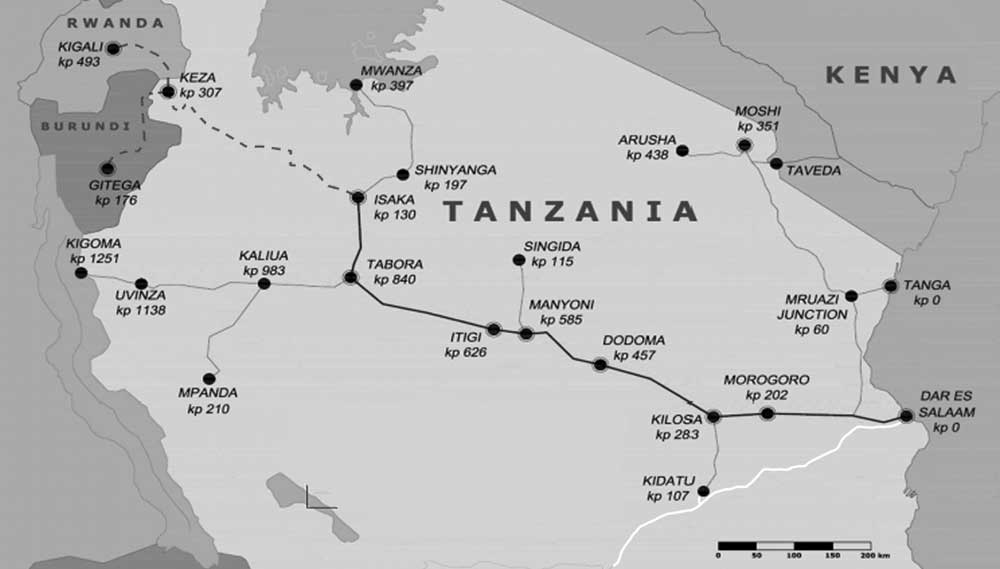
Map showing the Dar-Isaka line, with possible future links to Rwanda and Burundi.

Map showing the Dar-Isaka line, with possible future links to Rwanda and Burundi.

The World Bank has committed a USD $300m loan to support road and rail improvements in Central Tanzania. “We are excited to support the government’s efforts to rebuild its rail and intermodal transport system. The project will also indirectly help to boost agricultural trade, job creation and overall livelihoods for the country and neighbouring countries’ poorest people,” said Mr Philippe Dongier, the World Bank’s Country Director for Tanzania.

The work is focussed on the Dar es Salaam – Isaka line, and according to the managing director of Reli Assets Holding, Benhadard Tito, the money will be used for repairing and upgrading the track from Dar es Salaam to Munisagara (near Kilosa) and a short section from Igalula to Tabora, and to rehabilitate bridges and elevate axle load to 25 tons/axle. (The Citizen)

Dar-Chalinze Road Improvements
The government is encouraging investment proposals for a 100km six-lane highway connecting Dar es Salaam with Chalinze.
Prime Minister Mizengo Pinda said to overcome bottlenecks for traffic entering and leaving the city, the government is working on various intervention measures including construction of the Kigamboni Bridge, Ubungo and Tazara flyovers and on some sections of trunk roads which connect the city to the regions. He noted that congestion in Dar es Salaam is fuelled by rapid population growth and the increased number of motor vehicles. While Dar had only 70,000 inhabitants in 1967, the population had grown to 843,000 by 1978 and to 1,360,850 by 1988. Now the city has nearly 4.4 million people, and is expected to reach 10m by 2050.

Expansion of Dar es Salaam airport
Construction of Terminal III at Julius Nyerere International Airport in Dar es Salaam began in January 2014. The new terminal is designed for the anticipated growth of international air traffic, leaving Terminal II, which currently caters for international passengers, as a domestic flights terminal. The cost is estimated at Tsh518 billion ($322.4 million).

Tanzania Aviation Authority legal officer Ramadhani Maleta, said that the construction of the current building would be completed in 2017. Phase I is being funded by the Dutch Government, and a partner is currently being sought for Phase II. Completion of the new terminal will enable the airport to handle six million passengers annually. The airport, whose current capacity is 1.2 million passengers, now handles two million.

In 2012 Tanzania received one million visitors, earning the economy Tsh11.1 trillion ($7 billion), up from 867,000 visitors in 2011. (The East African)

TANZANIA IN THE INTERNATIONAL MEDIA

by Donovan McGrath

Microwave link with Zanzibar upgraded
‘Tanzania has upgraded the microwave link connecting Dar es Salaam and Zanzibar, a move expected to double the capacity of voice and improve data quality… The $1.6m project, agreed in 2012 between Japan and Tanzania, is in line with the government’s Vision 2025 to enhance use of communication as a tool for sustainable development.’

Mafikizolo live in Dar
‘In East Africa, among songs that have made Mafikizolo, the Afro-pop duo from South Africa, a household name, are Ndihamba Nawe and Emlanjeni. … In Dar es Salaam, Khona [from the duo’s latest album, Reunited] continues to top music charts. Not surprisingly, Mafikizolo’s recent concert at Mlimani City Hall was jam-packed… Unfortunately, the sound system was poor. The bass notes were so loud that the guy on trumpet didn’t get to perform… But judging from the reception Mafikizolo got, it seems the crowd chose to ignore the poor sound qual­ity…’ (East African 19-25 April)

Horror behind the smiles of Maasai girls

FGM campaigner Elizabeth Lesitey - photo from the Standard

FGM campaigner Elizabeth Lesitey – photo from the Standard

‘Almost all Maasai girls face the threat of female genital mutilation … Charity workers are trying to stamp out the procedure among the Maasai in Tanzania … They want to change the mistaken belief that it only happens to Muslim girls … 70% of Maasai girls are cut, having their clitoris and other external genitalia removed with a razor blade, compared with 18% in Tanzania as a whole – despite it being illegal in the country since 2007. The story of Ngaiseri Muteko shows change is happening. The elderly Maasai woman can’t remember when she began cutting girls… Until earlier this year, neighbours would bring their daughters and pay her 10,000 Tanzanian shillings (£3.50) for each child she cut… With someone helping to force the girls on to the ground, she would use a small razor blade then pour milk on the wound, followed by ash from the fire in her hut, which she said has healing properties. Girls spend three months in the hut recovering. But in February Ngaiseri threw away her razor blade and declared she would never use it again. The change came just nine months after meeting Elizabeth Lesitey, a 29-year-old worker for the charity World Vision. Elizabeth, herself a Maasai and a mother of three, has targeted 62 cutters and so far managed to persuade 33 to give up… Ngaiseri earned a good living from the practice, so Elizabeth gave her three goats and eight chickens, funded by World Vision, to provide an income. Many of the girls Ngaiseri cut were suffering from what the Maasai call “lawalawa”, a urinary tract infection caused by unhygienic conditions. For years Ngaiseri and oth­ers believed that the only cure for little girls was to cut off their external genitalia. But Elizabeth busted this myth by taking a girl suffering from “lawalawa” to hospital, where she was cured by doctors using medica­tion. This sent shockwaves through the community. On International Women’s Day in February, alongside 29 other cutters, Ngaiseri made a declaration in front of her community that she would never cut another girl…’ (London Evening Standard 18 July)

WHO: Aids now the number one killer of adolescents in Africa
‘According to the World Health Organisation report Health for the World’s Adolescents, East Africa is one of the regions where the disease kills more youths than road accidents, the number one global killer of 10-19 year-olds. On the global level, HIV is the second most com­mon cause of death among adolescents. Other leading causes of death are suicide, lower respiratory infections and interpersonal violence. According to the UN Programme on HIV/Aids (UNAids), in 2012, Tanzania had 230,000 children under 14 living with HIV, Uganda had 190,000, Kenya 200,000, Rwanda 27,000 and Burundi 17,000.’ (East African 31 May – 6 June)

Tanzanian artist’s journey through life
‘Robino Ntila has been painting since 1975. Born in 1954, he first went to Dar es Salaam in 1968. Ntila is a veteran of Nyumba ya Sanaa, an artist’s association founded in Tanzania by Sister Jean Pruitt from the USA. “Before I joined Nyumba ya Sanaa I was enthusiastic about art… In 1971, I used paints for the first time. I had just completed secondary school. I spend time with artists. There was a Congolese artist who was the first to commercially paint the savannah landscape with Mt Kilimanjaro in the background. I was also introduced to some batik techniques called ‘moderne’”… Ntila uses subtle techniques for his work, which range from realist to abstract, mixing cubism with aspects of African silhouettes… He worked at Nyumba ya Sanaa for 30 years.’ (East African 7-13 June)

New taxman appointed
‘Rished Bade has been appointed the new Commissioner General at the Tanzania Revenue Authority (TRA), replacing Harry Kitilya, who retired last December. Prior to his new appointment, Bade was deputy commissioner general. Top priority for the new taxman will be to cut down on revenue leakages and widen the tax net to support the government’s growing spending needs.’ (Citizen and others)

Witch doctors arrested over albino killing
‘Albinos in Tanzania have become targets for body-snatchers seeking to sell them to witch doctors. Two witch doctors have been arrested after a woman with albinism was hacked to death, police say. Albinos have suffered widespread persecution in Tanzania, where witch doctors say magic potions made with albino body parts can bring good luck. Such killings have declined in recent years, but this latest attack has prompted a human rights group to call for all witch doctors to be banned. …the group, Under the Same Sun said the current regulation of witch doctors was clearly not working. The attack occurred in a village in Simiyu region (formerly part of Shinyanga) – a remote rural area where there have been killings of albinos before … According to Under the Same Sun, the last killing of an albino in Tanzania was in February 2013. The government has been trying to address the problem, and an albino MP was appointed several years ago.’ (BBC News Africa 14 May)

Mo-Cola: Tanzania’s new soft drinks war targets poor consumers
‘Cash-conscious consumers in Tanzania will soon have a new product to spend their hard-earned money on: Mo Cola. The fizzy drink is the latest home-grown offering to go into battle with established market leader Coca-Cola, which has been bottling its secret recipe in Tanzania for more than 60 years. That the market for such cut-price drinks is growing in Tanzania is an illustration of the financial realities faced by the country’s consumer class. Despite impressive 7% a year GDP growth, the number of poor people in Tanzania has not fallen in the past 15 years.
‘Mo Cola is named after Mohammed Dewji, chief executive of MeTL [see TA 108], a family conglomerate he says turned over $1bn last year, serving the needs of Tanzania’s largely poor population with everything from sugar and spaghetti to fuel and pens. Although Dewji is keeping the launch price of Mo Cola under wraps, it is likely to undercut Coca-Cola… It follows another local family corporation, Bakhresa Group, which brought out the Azam Cola in 2011 following a $30m invest­ment. Bakhresa estimates it has 15% of Tanzania’s soft drinks market… Entrepreneurs have long understood that, however little a family has, food and clothes will always be a priority. Developing new drinks ranges is part of an effort to capture a little bit more from the country’s poorer consumers. “There is money to spend even though people have limited value in their pocket,” said Dewji, who has put $48m into developing his drinks line – enough for 36m crates a year…’ (Financial Times online 18 April)

Zanzibar bombing leaves one dead
‘One person was killed and several others were wounded in a bomb attack near a mosque on Tanzania’s Ocean Island of Zanzibar … Police said the bomb went off in the commercial district of Stone Town … The attack coincided with the opening of the Zanzibar International Film Festival, which draws international visitors … There was no immediate claim for responsibility. Zanzibar has been the scene of sectarian and political tensions in recent years, although the island has been generally quiet for several months… There have also been wider tensions surrounding this year’s 50th anniversary of Zanzibar’s union with mainland Tanzania, with some opposition parties wanting to break ties and return to independence. The unrest had sparked fears of a tourist exodus…’ (Telegraph online 14 June)