
OBITUARIES

A veteran of the independence struggle in Tanzania and one of its first cabinet ministers, Ambassador PAUL BOMANI (80) died on April 1. He had been Chancellor of the University of Dar es Salaam since 1993 and was also chairman of Tanzania Breweries Ltd and Tanzania Distilleries Ltd. He obtained a diploma at Loughborough College in Leicester in 1954 and later, a Masters Degree at John Hopkins University in the USA. His first post was as Minister of Natural Resources and Co-operative Development in 1960. He was subsequently Ambassador to the United States and Minister for Mineral Resources. But perhaps his greatest achievement was to mastermind the establishment of a huge and highly successful cooperative movement in the Lake Victoria Region in the 1950’s which became responsible for marketing the rapidly increasing cotton crop. President Mkapa led hundreds of mourners at the burial at Capri Point cemetery in Mwanza.

Good Governance Minister in the Zanzibar Government and former diplomat, AHMED HASSAN DIRIA (68) died on March 14 in a German hospital. He first joined the government as a Labour Officer in Zanzibar. After the Zanzibar Revolution in 1964, he was appointed Area Commissioner for Pemba. He became Tanzania’s ambassador to Zaire before he was transferred to West Germany and later to Egypt, Japan and India. He was appointed Minister for Information and Broadcasting in 1989, a position he held up to 1994. He was then moved to the Ministry of Foreign Affairs and International Co-operation. He was a staunch defender of the Union between the mainland and Zanzibar.

Sir JAMES FARQUHARSON KBE (101) who died on 17th February, dedicated virtually his whole working life to the development of railways in Africa. He came to Tanganyika in 1937 and remained there through the war years as District Engineer and then Chief Engineer of the Tanganyikan part of the then the East African Railways and Harbours (EAR&H). It was in Dar es Salaam that he began the work that pleased him most, the expansion of railway systems. Expansions completed during this period were the Mpanda line in western Tanzania (131 miles) the southern line (168 miles) built to serve the UK Government’s disastrous groundnut scheme and the Singida line (65 miles). In 1957 he became General Manager of the EAR&H and became involved in establishing a link line between the central and northern lines in Tanzania (425 miles). This was a difficult time for labour relations as the new trade unions flexed their muscles. Farquharson was a hardliner in such matters, believing that the railway staff enjoyed better pay and conditions than most other workers. He faced out several strikes, walking through the picket lines to his office; a newspaper report from the time quoted a union leader advising that there was to be a great party when the General Manager retired. The split of the railway system in East Africa into its three component parts saddened Farquharson but did not daunt his belief that the railways could still play a key role in the country’s development (Thank you Hugh Leslie for sending this from The Times – Editor).

GREVILLE FREEMAN-GRENVILLE (86) who died in February, was described in the Times obituary as ‘a gentleman-historian of the old school’ and a fearless campaigner to preserve the archaeological remains of Africa and the Middle East. He was in Tanganyika from 1951 to 1961. Amongst the 26 books he wrote were ‘The Medieval History of the Coast of Tanganyika’ (1962) and ‘The East African coast: select documents from the first to the earlier 19th century’. His interest in the copper coins that were minted at port cities offered the possibility that their dynastic history could be reconstructed from their surviving chronicles. For many years he was the only person able to identify the coins of the Sultans of Kilwa and Mogadishu. He frequently pointed to the importance of Kilwa as a site for research.

MARY PEAKE (104) served as a teacher and as a School Supervisor at the UMCA’s Diocese of Masasi for 32 years from 1937. When Trevor Huddleston became Bishop in 1960 he transferred Mary, by then aged 60, to the less physically arduous work as a teacher at the boys’ secondary school at Chidya. In 1969 she moved to Dar es Salaam to teach English at the new St. Mark’s Theological College. Her dining rooms served as a refectory for other expatriate church workers, not to mention a constant stream of visitors to what became known as ‘Mary’s Guest House’. During her final years from 1995 she was cared for by the Tanzanian sisters of the CMS next to the cathedral at Ilala – from Rev. Canon Paul R Hardy. (Thank you Mary Punt for sending this on – Editor).

BRUCE RONALDSON (87) who died on December 2 2004, was a District Commissioner in Tanganyika after the Second World War. He took a particularly close interest in sport and captained Tanzania at cricket. He also trained John Akhwari, who entered the marathon at the Mexico Olympics. Akhwari fell during the race and finished hours after the rest of the field but became an overnight celebrity and symbol of the Olympic spirit when he told reporters: “My country did not send me 7,000 miles to start this race. They sent me to finish it.” In 1961 Ronaldson moved to Britain and became Company Secretary of Oxfam – The Times.
REVIEWS

Edited by John Cooper-Poole (UK) and Marion Doro (USA)

LORDS OF THE FLY: SLEEPING SICKNESS CONTROL IN BRITISH EAST AFRICA 1900-1960. Kirk Arden Hoppe. Westpoort (Connecticut), Praeger, 2003. ISBN 03250 71233. h/b 216pp. £37.99

In his book Lords of the Fly Hoppe looks primarily, but not exclusively, at the relationship between disease control and the exercise of power at various levels in colonial Uganda and Tanganyika.
In Uganda from 1903 and Tanganyika from the 1920s, the imperial government introduced measures aimed at curtailing the spread of sleeping sickness, which the author contextualises as part of Britain’s ‘civilising mission’ for the colonies. Underlying the apparent benign paternalism, however, lay less benevolent practices. The colonial regime introduced a number of coercive measures to tackle disease and eradicate the tsetse fly. Continue reading

TANZANIA’S INCREASING INTERNATIONAL ROLE

TANZANIA ELECTED TO SECURITY COUNCIL

A TANZANIAN BECOMES CHAIRPERSON OF THE AFRICAN PARLIAMENT

ANOTHER TANZANIAN REPRESENTS 21 COUNTRIES AT THE IMF

A ‘DAR ES SALAAM DECLARATION’ IS PUBLISHED

Tanzania’s international status has taken a considerable step forward during recent weeks.
The country was elected as the member representing Africa on the 191-member Security Council at the UN’s fifty-ninth General Assembly meeting on October 15th. Other countries elected as non-permanent members for two years on the same day included Argentina, Denmark, Greece, and Japan. Continue reading

LOCAL ELECTIONS SHOW RULING PARTY’S STRENGTH

Local elections held at the end of November indicated clearly the continuing popularity of the ruling Chama cha Mapinduzi (CCM) Party. Although final results were not known when TA went to the printers it seems that perhaps more than 90% of the votes went to CCM. Many of the sixteen opposition parties, still not united in spite of the obvious advantages of putting up a common front, made strenuous efforts and did well in a few areas. The Civic United Front (CUF) appears to have now established itself as the main opposition party on the mainland as well as in its Zanzibar stronghold. CUF leaders were clearly pleased with the results in many areas. Voter turnout was very high in several places. Continue reading

ZANZIBAR – TROUBLE AT VOTER REGISTRATION

After several delays voter registration for what will be highly competitive general elections in Zanzibar in October began on November 29 and went well. However, a number of incidents of violence gave cause to fear what might happen when the elections themselves take place.
There was trouble at various registration centres in Pemba, the stronghold of the CUF party. Continue reading

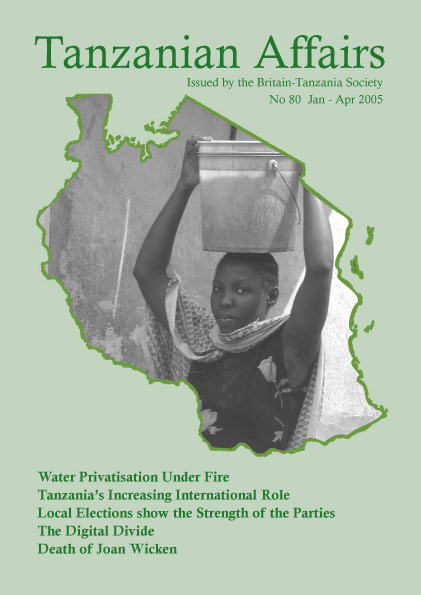
WATER PRIVATISATION SCHEME UNDER FIRE

Dar es Salaam has always had problems in ensuring its water supply and the vast growth in the population of the city in recent years has exacerbated these problems. November last year was a particularly difficult month – most of the city was without water for days at a time.

water carrierWater carrier in DSM – Photo courtesy Birgit La Cour Madsen/ActionAid UK

The Government’s reaction to the recurring problems was to privatise the industry, but this process has now come under heavy fire even though it is less than year since it happened. Continue reading

BUSINESS & THE ECONOMY

EXCHANGE RATES:
£1 = Shs 1,925
$1 = Shs 1,355
Continued improvement of the environment for investors saw foreign investments to Tanzania between January and June last year surge to an estimated Tsh.268.7 million. Investments included projects in paper manufacturing, textiles, cement, gas pipeline building, edible oil and soap manufacturing and tourism. Investment worth Tsh. 68.3 million was made in the Mufindi Paper Mills, which, after rehabilitation, should create 2,200 new jobs. The China-Tanzania Friendship Textile Mill, after rehabilitation, will have 1,269 vacancies, while Premier Cashew Industries Ltd expects to create 3,555 new jobs. Three local business firms have made deals with Dutch companies to develop new businesses in honey, beeswax and production of enriched flour meal – Guardian. Continue reading

THE DIGITAL DIVIDE

In summer 2003 I travelled out to Tanzania to train the staff of a secondary school on the slopes of Kilimanjaro in the use of computers. I had stayed there for a month in 1999 and had helped set up an IT lab with PCs donated by schools and small businesses in Cumbria. Although their intentions were good, the machines they donated were not. We did the best we could with seriously outdated machines but we knew at the time that they would probably not last long. We were, unfortunately, correct. Continue reading

NEWS FROM THE FAITHS

Following a spate of burning of churches in Zanzibar, the Zanzibar Diocese of the Catholic Church announced that it would punish a local clergyman following his statement that Catholics were praying for CCM to win the general elections as an opposition victory would spell the end of churches in Zanzibar… A spokesman said that the church was not aligned with any political party…. but since it was an institution that upheld good conduct, it had every right to speak out against evil deeds such as the burning of churches. Zanzibar Archbishop Shao said that Catholics had been harassed and church leaders accused of bringing into Zanzibar ‘mercenaries’ since the introduction of political pluralism in the isles. “I’m not bringing in voters from the Mainland nor am I being paid by the Zanzibar government” he said. CUF hailed the Church’s decision to reprimand the priest.
Libya’s leader Muammar Gaddafi has donated TSh 25m/- towards the development of the Islamic University which was established by the Islamic Development Institute of Tanzania in Morogoro last year. President Mkapa had earlier donated TSh 10m/- towards the establishment of the university – Guardian.
Last September bishops of seven dioceses of the Evangelical Lutheran Church in Tanzania called on the Church’s Secretary-General, Amani Mwenegoha, to resign, accusing him of usurping powers and causing divisions in the church. They were alleged to have involved the Church in a case he filed against former Prime Minister, Cleopa Msuya.