TANZANIA'S 'TITANIC' DISASTER – MV BUKOBA

In what many considered to be a disaster on a par with that of the ‘Titanic’ in 1912 (over 1,500 people perished) some 700 people died when the Lake Victoria passenger ship ‘M V Bukoba’ capsized on May 21 just 30 minutes before reaching Mwanza port. Only 53 people survived. President Mkapa declared three days of national mourning. Governments and individuals all over the world sent their condolences.

Eye witness survivors told how the ship was loaded with many more than its 433-passenger capacity should have allowed. At eight am, with Mwanza in sight the ship began to sway. Huge jikos, dishes and kitchen equipment in the restaurant crashed to one side; the loud bang created a panic and as people rushed to the deck the vessel turned over. Ironically, the vast quantity of Bukoba bananas the passengers had earlier asked the crew to throw overboard, later helped survivors by giving them something to cling on to in the water. There were not enough lifebelts. The vessel remained on the surface, partially buoyant. But then rescuers, who could hear trapped passengers screaming and banging, ignored the pleas of fishermen, and decided to drill a hole into the hull to rescue those trapped inside. The effect however was to release the air which had kept the hull afloat and shortly after 3 pm the boat sank.

Several hundred bodies were extracted with great difficulty by divers – people in the packed third class compartment of the ship had linked arms in solidarity before they died and it proved extremely difficult to break them free. Most of the bodies of the dead were buried in mass graves in Mwanza. An old lady in Kagera Region collapsed and died after learning that her daughter and three grandchildren had perished. One victim, a Ugandan businessman, was found to be carrying $27,000 in notes.

On May 29 the captain of the ship and eight senior officials of the Tanzania Railways Corporation Marine Department were charged in court with the murder of 615 people and were remanded in custody. They were later released. On the same day Prime Minister Frederick Sumaye announced the appointment of a Commission of Enquiry under Judge Robert Kisanga which included five other Tanzanians and six foreign experts.

On June 2 President Mkapa halted any further recovery of decomposed bodies from the wreck as this posed a health hazard to divers who had come from South Africa, Kenya and Zanzibar. 392 bodies had been recovered. At a joint service of remembrance on June 3 Chief Justice Nyalali spread a handful of soil on the lake as a burial symbol. The wreckage, which lies 27 metres below lake level, became a permanent tomb for those whose bodies could not be recovered.

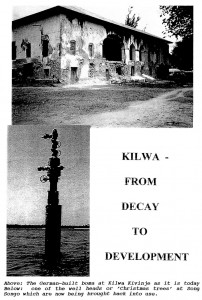
KILWA – FROM DECAY TO DEVELOPMENT

Kilwa 1996

Kilwa 1996

Above: The German-built boma at Kilwa Kivinje as it is today Below: one of the well heads or ‘Christmas trees’ at Songo Sonqo which are now being brought back into use.

Historic Kilwa Kisiwani, decaying Kilwa Kivinje, small town Kilwa Masoko with its unusual little market and the nearby Songo Songo island may never be the same again in the light of all that is now going on in this long neglected part of Tanzania:

– President Mkapa has made a promise that the main road from Dar es Salaam to Kilwa, which must be one of the worst in the world, will be fixed during his term in office;

– If it is, the present occasional visitor to the ancient ruins on the island could become more like a flood because the excavations of the ruins at Kilwa Kisiwani remain in good condition and full of interest;

– a rehabilitated and expanding fish freezing and packing plant at Kilwa Masoko could, if the local fishermen respond and if the government can gain control of the illegal fishing now taking place, benefit thousands of local fisherman all along the coast;

– a long planned fertiliser manufacturing plant – the Kilwa Ammonia Company (KILAMCO) appears to be back on the drawing board; Minister of Energy and Minerals William F Shija announced in August that discussions were continuing with M W Kellog of the USA and IFFCO of India on possible financing because the biggest development of all – the Songo Songo ‘Gas to Electricity project’ is now fully financed and being developed apace.

– new efforts are being made by an Irish company which has taken over exploration following the numerous efforts over the years of such companies as BP, AGIP, AMOCO Shell, Shell Company to find viable quantities of petroleum through two wells being drilled at Mandawa, 30 kms inland from Kilwa; drilling equipment has been flown in by helicopter.

But visitors to Kilwa Kivinje must be saddened by the sight of a town seemingly forgotten by the world. The main street comprises dirty and derelict buildings on both sides of the road but the saddest sight of all is the old German Boma. Heavy rain earlier this year caused further damage to the building which now looks forlorn indeed. The old mango tree just outside town where the Germans hanged leaders of the Maji Maji rebellion was burnt down last year but the government has replaced it with a small monument.

Following the collapse of a parastatal fishing company and the failure of the enterprise which succeeded it, a third attempt to establish a viable cleaning, processing and freezing plant is now under way at Kilwa Masoko and is showing considerable promise. Seithmar Ocean Products Ltd., the most important local industry, is employing 100 people and is shipping significant quantities of prawns, lobsters, crabs and sea fish to Spain and Portugal. It supplies local fishermen with outboard engines, nets, and ice and then collects the fish they are able to catch. The products then have to travel with difficulty in massive 20-ton refrigerated trucks at -20 degrees C along the appalling road to Dar es Salaam. The operation needs lots more fish; it is also greatly handicapped by the widespread dynamiting of fish stocks by people from outside the area and the government’s inability to stop it.

THE GAS TO ELECTRICITY PROJECT

If all goes well a bright orange smokeless flame at the top of a 100ft. flare stack will pierce the night skies of Songo Songo island later this year and signal the beginning of what must be one of the biggest, if not the biggest, development projects under way in East Africa at the present time. The gas field was discovered in 1974 and later relinquished by AGIP. It was further developed from 1986 to 1985 by the Tanzania Petroleum Development Corporation (TPDC) and 9 wells were dug of which 5 are producers.

The company now formed to develop the field is SONGAS. Its Assistant General Manager Gary Boucher told TA that all the funds needed ($300 million from the World Bank, TransCanada Pipelines, Ocelot Energy Inc., the government and several other donor agencies) were now available, subject to final contracts. Although there had been a six month delay caused by the need to complete a number of supplementary agreements, everything was now ready to start and the whole thing should be completed by the end of 1998.

This complex project will finally bring into use three offshore and two onshore wells. The well heads constructed at the time and known in the trade as ‘Christmas trees’ are likely to have become heavily corroded over the years and the first job, (being undertaken by the Canadian companies Ocelot Tanzania Ltd and TCPL Tanzania Inc. on behalf of TPDC will be to test, repair and increase the tubing size on two wells to increase the gas flow. Then the new company which has been formed to implement the project – SONGAS – will be able to start work on building two 35 million cubic ft. processing units on Songo Songo island; it will construct water and power supplies, roads, an airstrip and wharves on the island; build a 25 km 12″ diameter underwater pipeline to Somanga Funga (bypassing Kilwa to the north – see below); lay a 207 km underground pipeline from there to the Ubungo Power Plant and the Wazo Hill Cement Plant in Dar es Salaam; then will follow the purchase of an additional gas turbine generator to add to the four already owned by TANESCO at Ubungo and thus produce 150 megawatts of electricity to fuel Dar es Salaam’s growing industries. The gas supply is expected to last for at least 50 years.

‘SERIKALI YAONYWA’

‘The Government is Warned’. This was the front-page headline in ‘Taifa Letul on August 11 as indignation about the fact that the gas was to be sent to Dar es Salaam and not used directly for the benefit of the southern Region of Tanzania. Wananchi wa Kusini wasema kunyang’anywa gesi hiyo ni kufyekwa miguu na mikono….Wadai gesi hiyo ni zawadi toka kwa Mungu (Southern people say that to be deprived of this gas is like sweeping away their arms and their legs ….. they claim that this gas is a gift from God) the article went on. TA understands that the reason why the gas has to be piped first to Dar es Salaam and then converted into electricity is the availability in the capital of numerous industries able to use the gas directly – something which does not apply to Kilwa or other parts of the Southern region. But a Rural Village Electrification scheme is envisaged for some time in the future.

David Brewin

AFRICA’S URBAN PAST – CONFERENCE

ARUSHA – A TOWN OF STRANGERS
VUGHA – A HISTORICAL MISINTERBRETATATION
DAR ES SALAAM – THE PROBLEM OF THE ‘DETRIBALISED’ AFRICANS
ZANZIBAR – DYSFUNCTIONAL COLONIALISM

A conference (with almost 200 participants) entitled ‘Africa’s Urban Past’ at the London School of Oriental and African Studies (SOAS) from June 19 to 21 1966 was not without pungent expressions of opinion about various aspects of the Tanzanian (or Tanganyikan) experience of urban development.

Thomas Spear of the University of Wisconsin-Madison in his paper (TOWN AND COUNTRY: ARUSHA AND ITS HINTERLAND) described Arusha’s history in some detail: from its original establishment by the Maasai in the 1830’s’ through its function as the last stop for caravans in the 1860’s; the erection of the ‘boma’ by the Germans (‘it was meant to impress – it even had electricity’); and the British notion of Arusha as a ‘garden centre’ with its carefully segregated high, medium and low density residential areas; ‘the Europeans lived above and to windward of the Africans’; land was ‘seized from the African population for golf courses, tennis courts and other European social amenities’. Throughout it all the town remained resolutely divorced from its hinterland and was populated by ‘strangers’ – Colonial officers, European shop keepers, settlers, Indian merchants, Chagga, Pare, Somali and Swahili traders – relentlessly expanding at the Arusha farmers’ expense.

In what turned out to be a controversial paper (‘A HEAP OF HUTS? VUGHA AND THE NATURE OF THE KILINDI STATE) Justin Willis of the British Institute in Eastern Africa spoke about the ‘Shambaa Kingdom’, a pre-colonial polity in what is now north-eastern Tanzania. The residence of the hereditary rulers, from the Kilindi clan, was at Vugha, in the mountains of Western Usambaa; when first visited by European observers in the mid-nineteenth century, Vugha, with perhaps 3,000 inhabitants, represented an unusual concentration of population for the region. The object of Willis’ paper was to argue that the presence of such a settlement close to the normal residence of the ruler, led European observers to make certain assumptions about the Kilindi state which were mistaken. Burton had described it as a ‘heap of huts’. Kilindi had not been a centralised polity; Vugha was not the capital of the state; nor was it even a single settlement.

When Britain took over responsibility for Tanganyika from the Germans in 1919 they inherited in Dar es Salaam a situation of urban lawlessness amongst the 20,000 African population said Andrew Burton of SOAS in his paper CRIME AND COLONIAL ORDER IN DAR ES SALAAM, 1918-39. The behavioural constraints of the ‘tribal society’ no longer applied in the multi-ethnic urban environment and this lack of constraints resulted in the emergence of that bogeyman of colonial society, the ‘detribalised African’, he said. A prominent area in which colonial law clashed with African notions of legitimacy were the regulations controlling the production and consumption of alcohol. Liquor laws were rigidly enforced – they helped to reduce drunkenness and increased the reliability of the African worker. Prostitution was considered legitimate not only by the African population but also, effectively by the state; laws prohibiting it were not implemented.

The paper by William Bissell of the University of Chicago (CONSERVATION AND THE COLONIAL PAST: URBAN PLANNING, LAW AND POWER IN ZANZIBAR) consisted of a rather intemperate attack on the five urban planning documents produced there since 1919 which, the author said, had remained unimplemented. Whatever the political jurisdiction, officials had ‘repeatedly demonstrated an almost unshakable faith in the ability of a comprehensive town plan to solve all problems … the immense disparity between the bureaucratic resources, time and energy devoted to planning and its meagre results might seem astounding … but in the colonial milieu plan-making and inertia were not opposed activities, indeed they directly implied and depended upon each other.

The author went on to put the knife into colonialism – ‘parts of the plans which were actually built invariably related to the colonial economy – improvement of traffic networks and transport or port rehabilitation. At least until the revolution, pressing social needs like housing, which were often put forward as the raison d’etre of the plans, were continually postponed …… What Zanzibar reflects is the degree to-which legal contradiction, bureaucratic ineptness, official obfuscation. prolonged inaction and petty adherence to formality – all reinforced by a total lack of accountability – were powerful tools of colonial power…. The fact that this was unintentional makes it no less powerful’ – DRB.

TANZANIA REARS TSETSE FLIES

Tanzania has the largest tsetse mass-rearing facility in Africa and the largest tsetse colony of over 600,000 female flies – the largest in the world, according to Director General of the International Atomic Energy Agency, Dr. Hans Blix, quoted in the Daily News. Although tsetse flies were a menace to the health of people and livestock, he said, still there was a need to reproduce them en masse. The flies are reared at the Tanga-based Tsetse and Trypanosomiasis Research Institute and the male flies are made sterile using gamma radiation from cobalt 60 or caesium 137 sources before their release in tsetse affected areas. Tanzania was said to be in a leadership position and could soon begin exporting flies which would help to decimate tsetse populations in other countries. Dr. Blix inaugurated a third insect rearing facility at Tanga during his visit to Tanzania.

THE DEMOLITION OF DAR

Visitors to Dar es Salaam these days can hardly believe their eyes when they see the extent of the demolition now taking place in the commercial centre of Tanzania’s capital city. No one would claim that the city’s shopping streets were a beautiful sight. Most looked dilapidated and, according to the new Commissioners running the city, many were not fit for habitation and were condemned. But to decide to obliterate them completely seemed to many to be rather drastic treatment.

The demolition is the prelude to the launching of a Shs 90 billion ‘Dar es Salaam Modernisation Project’. The objective is claimed to be the creation of a healthier environment. No less than 176 plots including several on Samora Machel Avenue are being demolished and are to be replaced by 20 ‘ultramodern’ structures. The project is based on a city redevelopment plan approved by the Urban Planning Committee in 1982. This was followed by Government Notice Number 98 of July 1982 which recommended the demolition and redevelopment. All the cleared areas have been allocated to various developers for offices. Amongst these are the British High Commission, Swedish Embassy, the European Community, the ANC, the National Housing and Railways Corporations and TANESCO.

Needless to say, this sudden action caused considerable consternation, and several court actions were commenced by occupiers of the buildings. Cynthia Stacey writing in the ‘Family Mirror’ described it as ‘state-sanctioned vandalism’ and pointed out that in the last 14 years city planners around the world had reformulated urban planning policies to avoid cities comprising only multi-story office blocks and becoming dead and dangerous ghettos by night. ‘Trust Tanzania to get it so wrong’ she wrote.

‘Twenty-six storeys in a city prone to electricity cuts?’ trumpeted the Express in a front page headline. ‘This is a crazy idea’.

The Friends of the Museum of Tanzania convened a well supported seminar in early August. Architects, engineers, academics, health and environmental specialists and members of the public expressed alarm at the loss of the city’s architectural heritage and its unique character and its replacement by a concrete jungle. Criticism was directed at the lack of clear rules in the planning exercise, the environmental impact on people living in the city, probable traffic congestion, the lack of participation by the people in the planning process, particularly women (where were the day care centres, children’s playgrounds?), the effect on the tourist trade and so on. Why could not the example of Zanzibar’s Stonetown be followed where rehabilitation of old buildings had created a really nice place to live?

But it seems that the old Dar es Salaam is doomed. It will soon be rebuilt, like so many other cities, in the image of New York – DRB.

TANZANIA IN THE INTERNATIONAL MEDIA

WHAT A FANTASTIC PLACE!
In its regular feature ‘My Hols’ in the SUNDAY TIMES (July 7) the well-known Channel 4 newscaster Jon Snow wrote as follows: ‘… when I was with VS0 in Uganda I hitch-hiked on a wonderful holiday all round East Africa. Round Uganda, down Lake Victoria, round Tanzania, down to the coast and on to Zanzibar. What a fantastic place! Empty beaches, white Arab houses, graceful dhows, the smell of nutmeg …’

LAND LAW LEGISLATION AND RECORDS MANAGEMENT
The British Council’s ACTION IN AFRICA newsletter (June 1996) reported that two eminent land lawyers, Charles Harpum, a member of the Law Commission of England and Wales and Malcolm Grant, Professor of Land Economy at Cambridge University, were in Tanzania recently. They contributed to a workshop organised by the Ministry of Lands for lawyers scrutinising the draft land law legislation for consistency with the published National Land Policy before its presentation to Parliament later this year.

The same newsletter reported that the Council had hosted a presentation of the film ‘Towards Good Government: Records Management and Public Sector Reform in Tanzania’ to an invited audience of Principal Secretaries in the Civil Service and members of the Cabinet Secretariat. The film was made by the International Records Management Trust as one of the outputs of a workshop to restore order to the Tanzania National Archives which took place last year. The Ministry of Education has invited archives personnel to appraise records and reorganise its congested registry.

‘A VIBRANT REBIRTH’
This is how Mark Besire in the EAST AFRICAN (May 6-12) described a cultural renaissance now happening amongst the Sukuma. The centre of this rebirth was the Sukuma Museum, a ‘living museum’, at Kisesa 24 kms north of Mwanza which was being assisted by several donors including the Dartington Trust in Britain. New chiefs were being installed and others reinstalled. Many were collecting and researching shitogeljo – objects that played a significant role in traditional ceremonies. Some chiefdoms were returning to matrilineal succession as practised before the colonial period. The institution of chiefs was abolished at independence. But many chiefs were now taking active roles in their communities, more people were turning to traditional healers and there was great zest for traditional dance competitions.

THREAT OF EXTINCTION
A note of alarm was signalled in an article about a well-known Tanzanian tree in BBC MUSIC MAGAZINE in August 1996. It stated that, unless action is taken, harvestable stocks of the African Blackwood or ‘Mpingo’ tree which is used to make clarinets and oboes, the chinrests of violins and the wooden part of bagpipes – plus Makonde wood carvings, could run out within 30 years. An expedition from Cambridge University has gone to Tanzania this summer to get data to help the Flora preservation Society draw up a conservation plan for Mpingo. (Thank you Jane Carroll for finding this item. More on this subject in Readers Letters below – Editor).

PEMBA LIBRARY
The Bellagio Network Newsletter No 16 (Spring 1996) contained an article about the Pemba Public Library by Margaret Ling, Director of the Zimbabwe International Book Fair, Although the need for a library had been established 40 years earlier this one finally opened in 1994. Its initial stocking was helped by the British ODA and Council and there are now some 1,500 regular users of the 13,000 titles. Of these only 2% are from African publishers and Pemba, like 85 of the 104 districts in Tanzania, does not yet have a bookshop. (Thank you Pru Watts-Russel for this item – Editor).

TANZANIAN CD-ROM
GUARDIAN EDUCATION (March 12) revealed that the Leeds Development Education Centre (Tel: 0113 278 4030) has designed an interactive CD-Rom and accompanying teacher’s pack and video about a Tanzanian woman and her family for key stages 1 to 3 in schools. The cost is £49.

BIG ZOOLOGICAL FIND
According to the March/April issue of AFRICA – ENVIRONMENT AND WILDLIFE, a small chameleon spotted in the Mkomazi Game Reserve late in 1994 by entomologist Tony Russell-Smith has turned out to be a big zoological find. This was the first African pygmy chameleon seen by Dr. Malcolm Coe, leader of the Mkomazi Ecological Research Programme, in 40 years of studying savanna ecology. But Rhampholian kerstenti is a familiar sight in the coastal forests and in the Usambara and Pare mountains. The hills of Mkomazi are relatively undisturbed, offering what may in the future be a critical refuge for these eight centimetre-long reptiles.

PERHAPS THE GREATEST MUSICIAN TANZANIA HAS EVER PRODUCED
This is how the EAST AFRICAN described Mbaraka Mwinshehe Mwaruka on what would have been his 52nd birthday. He died in 1979 aged 35. ‘He was a singer, guitarist, performer and composer – East Africa’s most prolific all-round pop musician’, the article said. ‘Although he said that he only wanted to sing and dance he was an amalgamation of different things to different people – a poet to some; to his family a cutting satirist; to the country’s politicians a lavish praise singer; to the nation, a musical ambassador (he was with the famous Morogoro Jazz Band at the Expo ’70 Exhibition in Japan and later formed his own band, Orchestra Super Volcano); he was a witty social commentator in the East African oral tradition’. A commemoration was held at the newly opened FM Club in Kinondoni on January 12 this year.

ENGLISH VERSUS SWAHILI
Herald Tagama of Gemini News writing in the Uganda MONITOR (May 6-7) featured the revived debate in Tanzania about the language to be used in schools. The Chairman of the National Swahili Council, Prof. Herman Mwansoko, was quoted as having started the debate by leading a delegation to President Mkapa to press for a ban on English in all subjects in schools from primary level to university. President Mkapa deflected the proposal but said it was worth debating. And a debate began. Particularly vociferous were those parents who send their children to Kenya and Malawi to avoid declining standards in Tanzanian schools. Tony Ngaiza, the editor of Majira attacked this ‘fanciful’ proposal and accused the Kiswahili Council of frivolity when the quality of education was nose-diving. Mwansoko returned to the fray, calling the objectors ‘colonial minded’. Others noted that European countries had no difficulty in continuing to use their local languages in schools and also learning English. Eventually Mwalimu Nyerere, who had made Swahili the medium of instruction in primary schools so that he could put his message across to ALL the people, said that “What we have done for Swahili is enough. Now we have to give English its vim. It is the ‘Kiswahili’ of the world”.

“YOU SHOULD HAVE BEEN HERE LAST WEEK”
This, according to British TV personality Jeremy Paxman is what you always hear when you go on a fishing holiday. But, according to the WEEKEND GUARDIAN (January 27) when he went fishing at the Pemba Channel Fishing Club on the Kenya/Tanzania border he was greeted with the unprecedented words “You are going to catch fish. We’re having the best season for years”. Marlin fishing, Paxman wrote, is the macho end of angling – it is to fly fishing what arm wrestling is to chess. ‘The longer the search went on the more I began to dread what would happen if and when we found one. Then suddenly complete commotion… when the fight began it was every bit as exhausting as I’d feared. The fish tore off 400 yards of line and then leapt from the water… within five minutes I was soaked in perspiration and had lost most of the skin from my index finger. In 10 minutes my left arm was aching as if it couldn’t move any more. It took about 15 minutes. “Do you want to kill him?” the boatman asked. I couldn’t see the point and so we tagged him in the hope that the next time his aggression led him to attack a bait, the boatman might think it worth $5 to send back the tag and we’d learn a bit about how these beautiful fish migrate around the world’.

SUSPENSION OF REGISTRATION OF NGO’s
The EAST AFRICAN (June 17-23) reported that the government had suspended the registration of new NGO’s (non-government organisations) until September pending amendment of the 1953 Association Ordinance that governs the operations of such bodies. Each of the 850 NGO’s registered in Tanzania since 1953 would be examined amid rising suspicions that many were not following the law.

CLEANING UP LAKE VICTORIA
WORLD BANK NEWS (August 1) announced that $77.6 million $35 million from IDA is being invested in a project designed to conserve the lake’s biodiverity and genetic resources, control the water hyacinth, generate food and provide jobs and safe water in a disease-free environment.

NO SOCIAL SECURITY BENEFITS
VSO’s quarterly magazine ORBIT (No. 61) reported what it described as an unwelcome jolt. Volunteer Jennifer Semahimbo, who had married a Tanzanian while in the country, was refused social security benefits on her return to pending ‘reestablishment of her habitual residence’ even though she had kept her home in Birmingham and VS0 had paid her national insurance contributions. The Department of Social Security claimed that a Tanzanian tax clearance certificate in her passport indicated residence there.

TEA RESEARCH INSTITUTE OF TANZANIA
The EAST AFRICAN (August 19-25) reported that Tanzania has inaugurated its own Tea Research Institute in an effort to reverse the decline in the country’s tea production. Malawi was said to have the same acreage under tea as Tanzania but produced twice as much tea.

BUSINESS NEWS

Exchange rates (August 18): $1 = TShs 612 £1 = TShs 920

World Bank Resident Representative in Tanzania Ronald Brigish told a press conference in May that while the GDP GROWTH in Sub-Saharan Africa averaged 3%, Tanzania was now growing at a rate of 4% p.a. Tanzania had bright prospects and could register economic growth of even 10% like Uganda. The country’s POVERTY was exaggerated, he said. He thought that Tanzanians were probably consuming more than twice the official GDP per capita of $120 p.a. and that the difference was caused because figures for the informal sector, small scale mining and trade were not included in official statistics – Daily News.

Exchange controls by the Central Bank of Tanzania have been removed on the strong recommendation of the IMF. Restrictions on payments and transfers of money whether they be for imports, education, transport, travel or repatriation of investment income were officially removed on July 15 but many observers reacted with caution to the move wondering whether it was in the best interests of the country – East African. The National Assembly ratified on April 24 a 1994 agreement between Tanzania and Britain which gives FAVOURED STATUS to investors from the two countries. The agreement enables the aggrieved party in the case of nationalisation to refer the dispute to the International Centre for Settlement of Investment Disputes or to a special joint arbitration tribunal in the case of other disputes – Daily News.

A USAID STUDY has singled out antiquated socialist-era laws still on the statute book as major impediments to investment. Reference was made to the legal monopoly in grain marketing of the National Milling Corporation even though the government had liberalised marketing through executive directives; these could be contested in court. The stagnation in coffee production was partly due to the Nationalisation Act of 1973 which gave the government powers to seize commercial farms of over 50 acres. Such old laws should be repealed to encourage investors – Business Times.

The new TANZANIA REVENUE AUTHORITY started work on July first. Its Commissioner General is Mr Melickzedec Senare. It is the only body authorised to recommend tax exemptions to the Treasury and is empowered to attach property for auctioning without reference to the courts. It has received a grant of $2.5 million from the USA, $0.49 million from the World Bank and 2.7 million Kroners from Denmark to help with start up costs. The UK firm Coopers and Lybrand assisted it in drawing up its staff scheme of service and remuneration package. World Bank funds are being used for communication equipment to enable it to communicate with all customs posts in the country. At the inaugural ceremony President Mkapa instructed the authority to raise tax collection to an internationally comparable percentage of the GDP. He said that in Tanzania it was only 14.6% compared with 23% in Kenya, 32% in Zimbabwe and 45% in the European Union – Daily and Sunday News.

A 10,000-line computerised DIGITAL TELEPHONE SYSTEM which identifies both fake and genuine subscribers has been installed in Dar es Salaam – Business Times.

The leasing of the SA0 HILLS SAWMILL to a Norwegian company at $198,000 p.a. on May 15 is expected to boost the country’s dwindling wood industry. Nortan AS will pump in $3.4 million for rehabilitation. The parastatal Tanzania Wood Industries Corporation’s (TAWICO) output declined from 21,419 cu.m. in 1991 to 8,515 cu.m. in 1994 and profits turned into losses. The company’s nine other subsidiary companies are to be privatised – East African.

Tanzania has jumped from 16th to 7th position among 20 African countries with the highest income from TOURISM – from 1.3% in 1993 to 2.3% of African tourism revenue in 1994. South Africa, Tunisia and Morocco lead the list – Business Times.
Locally made WINE has virtually disappeared from the market because of the collapse of the Dodoma Wine Company (DOWICO)> The company, which produced a million litres in 1983, has stopped purchasing grapes because of liquidity problems – Business Times.

A Tanzanian company, Superdoll Trailer Manufacturers (STM), has won the International Africa Award which is awarded each year by ‘Editorial’ an international publishing company to companies which produce high quality products and provide good service. Almost 50 companies were represented at the award ceremony in Senegal – Business Times.

CASHEWNUT PRODUCTION has increased dramatically from 17,059 tons in 1990 to 81,000 tons in the 1995/96 season. Farmers are now using sulphur pesticide and improved seeds under the Cashewnut Improvement Programme (CIP) – Daily News.

At a meeting convened on June 18 for the 1,000 strong ‘Tanzania Shop Owners Association1 addressed by the Commissioner of Income Tax, which was designed to allay their FEARS OF THE NEW REVENUE AUTHORITY, less than 50 people turned up; none were from the large Tanzanian Asian membership – Business Times.

At a meeting of the ‘Tanzania-UK Business Group’ in London on July 22 Director General of the Investment Promotion Centre Samuel Sitta revealed that an INVESTORS FORUM was being planned for November 5 to 8 at the Sheraton Hotel, Dar es Salaam; he admitted that the ‘One Stop Investment Centre’ had not yet become a reality but hoped that improved and accelerated procedures for investors would be announced at the conference (Thank you Ron Fennel1 for this item – Ed).

The start of work on prospecting for what is expected to be one of the biggest GOLD MINES in the world in Shinyanga Region is being held up by the need to evict 7,000 illegal miners. They will be relocated to other areas. The company has already spent $3.8 million in initial work in the area – East African.

The Kuwait Fund has agreed to finance a $13.8 million TELECOMMUNICATIONS NETWORK in Zanzibar to be installed by the Tanzania Telecommunications Company and Ericsson AB (Sweden) within 16 months.

The COOPERATIVE AND RURAL DEVELOPMENT BANK (CRDB) was privatised in July. It is now owned by 10,000 individuals, cooperative unions and private companies, each limited to not more than 5% of the shares plus the Danish International Agency (DANIDA) which has 30%. They jointly raised $3.4 million to buy the bank – East African.

AMNESTY INTERNATIONAL 1995

Amnesty International’s report on Tanzania for 1995 occupies less than a page in the whole report. Extracts:
– ‘The authorities continued to use criminal charges to harass journalists. At least 12 were facing charges at the end of the year. Six were arrested and held for several days. Edna Ndejenbi in Moshi was held for twelve hours before being charged with using abusive language likely to cause a breach of the peace and released. She was later tried and acquitted. The editor of Majira and two publishers were arrested in March following publication of an article critical of the government. The editor and publisher of Shaba were held for five days in July before being released without charge. In November a Swahili weekly was banned for publicising information likely to cause unrest’.

OBITUARIES

The first conservator of the Ngorongoro Conservation Area and author of the famous wildlife book ‘Ngorongoro, The World’s Eighth Wonder’, HENRY ALBERT FOSBROOKE (90) died and was buried in front of his house, perched on a crater rim at Duluti, 15 kms from Arusha at the beginning of May after a long illness. He came to Tanzania in 1931 and had also worked in Biharamulo, Kondoa and Arusha.

A former Principal Secretary in the President’s Office, Central Establishments and in the Ministry of Agriculture, DAVID ALBERT MWAKOSYA (74) died of cancer in Dar es Salaam on June 18.

SIR GEORGE PATERSON, OBE (89) served first in Tanganyika in 1936 as Crown Counsel. He became an excellent big game hunter. He served again in Tanganyika, this time as Solicitor-General, after war service in Eritrea and Kenya.

The Chairman of the 14-member Committee which organised the 1964 Zanzibar Revolution, COL. SEIF BAKARI, who subsequently held a number of important posts in the Zanzibar and Union governments and was, just prior to his death, advisor to President Amour on defence matters, passed away on August 20.

NEVILLE FRENCH CMG who has died at the age of 75 spent 14 years in the administration in Tanganyika, completing his career there as Principal Assistant Secretary for External Affairs. He was later expelled from Rhodesia by Ian Smith for alleged spying and found himself Governor of the Falkland Islands from 1975 to 1977 just as Argentina was beginning to make her military intentions clear by pestering the islands with low-flying jets and circling warships.

MRS LUCY ELIZABETH CROLE-REES (1911-1996) first came to Tanzania in 1966. She was buried by her husband’s side at the Kinondoni War Memorial Cemetery on May 11. Mr Victor Kimesera, Chairman of the Board of the Music Conservatoire of Tanzania (Taasisi ya Muziki Tanzania) which was founded by Mrs Crole- Rees in 1966 and of which she was Principal Tutor as well as Manager, gave the eulogy.

A man described in The Times as one of the most eccentric and talented agricultural officers ever recruited by the Colonial Office in London has died in Mombasa at the age of 88. BRIAN HARTLEY, CMG MBE became an agricultural officer in Tanganyika in 1929. He was said to have been the first man to observe the change that came over gravid locusts when they have finished swarming before laying their eggs. On one occasion he shot two impala for the pot not realising that they were sacred to a local secret society. He believed that he had become bewitched and for 30 years afterwards was affected by sleepleaping – he would leap out of bed in the night and sometimes jump out of windows and even off a roof. Later he farmed in Arusha until his farm was confiscated in 1966 by the Nyerere government and later still, at the age of 80, he introduced camels to Tanzania by walking with a troop of them for some 300 miles from northern Kenya (Thank you Debbie Simmons for this information – Editor).

JOHN BOYD-CARPENTER (67) spent approximately 40 years in Tanganyika/Tanzania having joined Amboni Sisal as an Engineer and then later became Chief Engineer of NAFCO. He retired to Arusha in 1990 (Thank you Donald Wright for this information – Editor).

Professor ABDULRAHMAN MOHAMED BABU (72) who died at the London Chest Hospital London on August 5 was a celebrity. At one time a formidable political force who first struggled against colonialism, then introduced communism and finally became an advocate of multiparty democracy. He could be described as one of the founding fathers of Tanzania. His fiery rhetoric, incisive mind, analytical methodology and his prominence in international left wing circles made him a well-known figure on all continents. His friends included Che Guevara, Chou en Lai, Lord Brockway, Malcolm X and Pakistan’s Zulfikar Ali Butto.
He was born of mixed parents whose origin was in the Comoro’s and the Middle East. It was a distinguished religious family. He acquired a number of degrees in politics and economics and his first job was with the Zanzibar Clove Growers Association in the 1940’s. In 1957 he became Secretary General of the Zanzibar National Party (ZNP). After publishing an editorial alleging that the British had turned Zanzibar into a police state he was imprisoned for sedition. He came out a hero but in 1963 broke away from the ZNP and formed his own Marxist Umma Party which joined in seriously challenging the power of the then Sultan. After his party merged with the stronger Afro-Shirazi Party he became prominent as an organiser of the 1964 Zanzibar Revolution.
There followed several high positions in the Zanzibar and Tanzania Union governments until 1971. In April 1972 Zanzibar President Abeid Karume was assassinated. Although Babu was out fishing when the deed was done, he was tried in absentia and sentenced to death. By detaining him in a mainland prison away from Zanzibar Mwalimu Nyerere saved his life. After his release in 1978 he went to the USA to teach at university and then moved to Britain as a journalist. He entered the political arena in Tanzania again in 1995 when he was chosen as Vice-Presidential candidate for the NCCR party until he was banned because of his previous conviction. He had intended to spend his final days in Tanzania. But this was not to be. At his funeral in Zanzibar – his family obtained special permission for him to be buried at his home in Stonetown – political rivalries were forgotten as President Amour joined leaders of NCCR and other opposition parties and thousands of other mourners to bid him farewell. Babu was a man of great charm and he remained youthful in spirit. His death leaves a void in both Britain and Tanzania.

PARLIAMENTARY MATTERS

The budget session of parliament began on June 18. Some 600 questions had been tabled by MP’s. The following information comes from the Daily News reports on the session:

Because of increasing cases of BANDITRY AMONGST RWANDAN REFUGEES IN AND OUTSIDE REFUGEE CAMPS in Kasera, 400 policemen had been sent there equipped with 20 Landrover Defenders and a number of lorries. 628 refugees had been arrested in connection with crimes. 169 guns had been seized. Out of 52,640 BURUNDIAN REFUGEES in Kasulu, Kibondo and Kigoma, 257 had been granted citizenship.

There had been a delay in swearing in Zanzibar President Amour as a member of the Union cabinet due to problems in interpreting the constitution. He had now been sworn in.
Some 4,160 people, mostly businessmen, had been arrested under the March 1993 operation against ECONOMIC SABOTEURS. Many had been cleared subsequently and those who were keen to follow up their cases had been compensated.

The government had saved Shs 11.1 billion under the civil service RETRENCHMENT SCHEME. 56,727 workers had been laid off since the programme began in 1972. All workers had received retirement benefits.

Persons wishing to become CITIZENS of Tanzania had to be proved to be beneficial to the nation, be conversant with English or Swahili, have good conduct and have stayed in the country for five years.

165 patients had been TREATED ABROAD between 1993 and last year at a cost to the government of Shs 1.9 billion. The acquisition of a computerised scanner at the Muhimbili Medical Centre in Dar es Salaam would reduce the number of patients for that particular diagnosis facility.

Measures being taken to ease the problem of SHORTAGE OF MAGISTRATES included the recruitment of retired magistrates and the opening in October of the Judiciary Department’s new Lushoto Law School.

The government had increased SECONDARY SCHOOL FEES in boarding schools from Shs 15,000 to Shs 40,000 and in day schools from Shs 8,000 to Shs 20,000 per year. Primary school contributions had been increased from Shs 200 to Shs 1,000. Next year boarding school fees would go up to Shs 60,000 and in day schools fees would be Shs 30,000.

Tanzania had earned over Shs 1.8 billion from its diplomatic missions between 1990 and 1994 from VISA FEES. The receipts were used for economic development. Tanzania now had 25 embassies.

AND IN THE ZANZIBAR HOUSE OF REPRESENTATIVES it was stated
that 127 teachers including 3 headteachers had ordered their pupils to participate in the boycott of classes in March in Pemba. The Deputy Minister of Education said that the boycott, which had affected 52,000 pupils, had been politically motivated; the three headteachers had been removed and the cases of the other teachers were being examined.

HESELTINE IN TANZANIA
British Deputy Prime Minister Michael Heseltine chose Tanzania for his holidays this year. He arrived on August 2 and spent almost three weeks visiting a number of game parks and Bagamoyo.