REVIEWS

Edited by John Cooper-Poole (UK) and Marion Doro (USA)
Suggestions from readers about items for future review are always welcome.

ENDING AID DEPENDENCE. Yash Tandon, Fahamu Books, 2008
133 pages, ISBN978-1-906387-29-7. £7.99. paperback.

The global financial crisis and predictions of imminent capitalist collapse possibly brought a smile to the face of Yash Tandon, director of leftist think-tank, South Centre, and author of this book.

In ‘Ending Aid Dependence’ Dr. Tandon develops his well-rehearsed arguments from earlier works and continues his tirade against the West, IMF, World Bank and various UN agencies perceiving them as neo-colonialist and neo-imperialist bent on perpetuating economic dependence and perverting the political independence of the developing nations of ‘the South’.

In wishing to provoke a global dialogue whose laudable purpose would be to work towards an end to the unsatisfactory reliance on aid of so many impoverished nations of the South, it is a pity that for half the length of his book Dr. Tandon bites the (only) hand that feeds them.

He does make reasonable points – for example it is unconscionable that after nearly half a century of independence and despite billions of dollars of investment by the West and the institutions reviled by Dr. Tandon, many nations remain underdeveloped and penurious; true too that promises made by donors at high-profile international conferences are often diluted or put aside. He observes that much aid seems primarily to serve the ‘charity industry’ for its own benefit and continuing survival.

Unfortunately, he glosses over the endemic corruption and disreputable governance affecting nearly two-thirds of the South countries today, and unrealistically suggests as alternatives the immediate post-independence policies of Nkrumah’s Ghana or Nyerere’s Tanzania whose failed socio-economic experiments inflicted so much misery. Such naivety is apparent too in that despite past chronic misuse, Dr. Tandon feels that aid, unlike most lender/borrower relationships, should be donated without terms and conditions.

In this ultimately unsatisfactory book, Dr. Tandon offers few if any practical solutions, only discussion and the development of (yet more) strategy. The South nations can only become free of aid if and when they offer their peoples conditions for economic, social and financial progress backed by incorrupt institutions and the rule of law. Until then, with unconditional assistance unlikely to emanate from any other source, the West and its institutions, however imperfect or self-serving, remain the South’s only source of succour without which the situation would be even worse. The end to aid reliance unfortunately remains a distant dream and any smile can be only fleeting.

Roger Payne 2008.

The two following abstracts of papers likely to be of interest to readers were kindly sent by Professor Pat Caplan:

‘BETWEEN SOCIALISM AND NEO-LIBERALISM: MAFIA ISLAND, TANZANIA, 1965-2004’. Review of African Political Economy, special issue on ‘Class, Resistance and Social Transformation’, no. 114, 2007, pp. 679-694 By Pat Caplan, Goldsmiths College, London

This paper considers issues of equality and inequality in Tanzania with particular reference to Mafia Island over a period of forty years. It begins by examining an apparently paradoxical situation: in the recent period of neo-liberal economics, during which Tanzania has won plaudits from multilateral agencies for its economic policies, many ordinary people on Mafia consider that their well-being has actually decreased and that
social differentials have vastly increased: wengine wanapata, wengine hawapati (some get, others don’t).

The paper seeks to consider some reasons for this situation by considering the relation between state (and local state), political party(ies) and citizens, and the changes and continuities in these relations over four
decades. This also involves an examination of the role of donors (wafadhili) and NGOs, on the one hand, and developers (wawekezaji) on the other. It is shown that the discourse in which issues of development are
discussed contains both continuities with earlier periods, as well as changes.

The paper also examines people’s perceptions of equality, inequality and poverty, with particular emphasis on the comparisons made between their own lot and that of others, as well as their views of their entitlements.
It concludes with case studies of two villages on Mafia: Kanga in the north, which has remained relatively isolated and poor, and Chole in the south, where tourist development has taken place.

‘BUT THE COAST, OF COURSE, IS QUITE DIFFERENT’: ACADEMIC AND LOCAL: IDEAS ABOUT THE EAST AFRICA LITTORAL. Journal of Eastern African Studies vol.1 no. 2. 305-320. July. 2007 by Pat Caplan, Goldsmiths College London

This paper examines identity and history on the coast of East Africa, an area long thought to be different from its hinterland in many respects, including the absence of ‘tribes’. It discusses the apparent paradox of
recent calls by intellectuals of East Africa coastal origin for the Waswahili to be termed a ‘tribe’. In the first section, I consider the arguments of those who have maintained that the Waswahili are not a single people, and in the second discuss those who have argued the opposite. The third section considers some of the reasons for the differences, including historiography, identity politics, and the positionality of both authors and informants.

THE ECONOMIC IMPACT OF HIV/AIDS IN AFRICA: A COUNTRY STUDY. Mandy Siebold, Saarbrücken, VDM Verlag Dr Müller, 2008. pp.101. ISBN 978-3-8364-6308-9. Received as a pdf document.

This book explores the current and potential impact of HIV and AIDS on the economy in Tanzania. Based on a review of existing literature, it argues that the disease represents an economic crisis because it targets the economically-productive groups in society. The first section of the book provides a general survey of HIV and AIDS, and Tanzania. The second part takes a more detailed look at the impact on key areas of the economy: the workforce; the macro-economy; particular sectors such as the formal, education, agricultural and public sectors; and how the disease affects households, women and children.

Whilst the book does provide a wide-ranging survey, its main weakness is reliance on data that is already out of date. This reduces the usefulness of the book, as the data cannot be relied upon to reflect the current situation. For example, on page 19, the book asserts that there are 42 million people globally living with HIV and AIDS. However, the latest estimate from UNAIDS is that there are 32.5 million people living with HIV and AIDS. Similarly, estimates of the number of children orphaned are out of date (and the assertion that a large proportion live without family support of any kind is not supported by current research). Numbers currently receiving anti-retroviral treatment have expanded dramatically over the past two-three years with the implementation of programmes by the Global Fund, the Gates and Clinton Foundations and US funding. Ultimately, these weaknesses undermine the usefulness of the book as a key text in understanding how HIV and AIDS is affecting Tanzania’s economy, society and politics.

Michael Jennings

MIOMBO, Newsletters of the Wildlife Conservation Society of Tanzania, Numbers 31 and 32. The Society, Dar es Salaam, 2008. 20 pages each issue. Free to members of WCST.

Quite apart from the knowledge that one’s subscription is helping the WCST’s admirable cause, one splendid advantage of membership of the body is to receive two issues of the Society’s Newsletter each year. The issues for 2008 were, as usual, excellent.

Number 31, datelined April, contained, as major features, a summary of WCST’s conservation projects under implementation; a survey of the rare warbler, Karamoja Apalis, in the Serengeti ecosystem; an article querying whether the water flow from the Eastern Arc Mountains is declining; an excellent piece on Tanzania’s endangered marine turtles; the discovery of a new Shrew species in the south centre of the country; and pictures of a Parliamentary Committee visit to Lake Natron. Natron is the lake, north-west of Arusha that is the subject of heated debate: bird conservation vs soda ash extraction on an industrial scale.

Number 32, datelined November, continues the Lake Natron theme with a detailed update on that ongoing saga as well as offering a well-researched article on Peafowls in Dar; a fascinating piece on the threat to Tanzania’s biodiversity from invasive alien trees and plants; and features on the distribution of the wild dog, climate change and environmental education.

The WCST is a wonderful organisation and always needs new members. They can be contacted at wcst@africaonline.co.tz. The newsletters on a whole range of flora and fauna topics are worth the annual cost of membership alone!

David Kelly

WORLD LEAGUE GUIDE, covering the ICC World Cricket League Division 4 tournament, held in Tanzania 4-11 October, 2008. 4-page leaflet, published by ICC (International Cricket Council).

A small, but unusual, literary offering, essentially a souvenir programme for the matches held in Dar es Salaam, a significant landmark in the history of Tanzanian cricket. The tournament involved teams from Afghanistan (the eventual winners), Fiji, Hong Kong, Italy, Jersey and Tanzania. There are welcome messages from the President of the ICC and from Zully Rehemtulla, the Chairman of the Tanzania Cricket Association; some useful facts about all the contesting countries; the tournament programme itself; a summary of the global structure of the ICC World League (for countries outside the Test arena); and a picture of the Tanzania squad.

David Kelly

KEEPING SOMETHING ALIVE
. Glyn Roberts and Mark Smith. ISBN 978-1-906274-07-8. Brill Books 2008. paperback. 128 pages. £7.50 inc. p & p. Available from Tools for Self reliance, Netley Marsh, Southampton SO40 7GY. Tel: 023 8086 9697. Email: info@tfsr.org.

This is the story, written by two of its founding members, of Tools for Self Reliance from its start in 1978 up to 1995. The idea of collecting unwanted tools and refurbishing them for the use of craftsmen in Tanzania, was one which quickly caught on, with over sixty support groups in Britain, and tools being sent to a number of countries. As well as providing much needed tools, the organisation seems to have served as a conduit for the enthusiasm of many supporters of Mwalimu’s policy of African Socialism and radical movements generally.

In its early days the organisation worked as a cooperative, everything being decided democratically, but it soon became apparent that a more structured arrangement was needed to meet the needs of a rapidly growing organisation. Clearer lines of authority, formal links between support groups, headquarters, and distributors had to be devised, not without much soul searching. There is surely the basis here for several worthwhile business school dissertations on organisational development.

There is useful information about the number of tools supplied, but more about finance and personnel numbers would enable the reader better to compare inputs with outputs, which on the basis of the information given appear to have been rather poorly related.

The shortcomings of the organisation are fairly discussed, particularly the difficulty, shared by many (most?) donors, of assessing their effectiveness.

Small though it is, this book is thought provoking and likely to interest anyone who is, or has been, involved in aid projects of whatever size. Given the ethos of the organisation it is no surprise that profits from the book will go to the organisation, rather than the authors. Very good value, and much to interest, at the price, particularly as a DVD is included.

J. C-P.


RAISE YOUR VOICES AND KILL YOUR ANIMALS
. Islamic Discourses on the Idd el-Haj and sacrifices in Tanga, Tanzania. Authoritative Texts, Ritual Practices and Social Identities. Gerard Cornelius van de Bruinhorst, 2007. Doctoral thesis, Utrecht University.
The book text can be downloaded at http://igitur-archive.library.uu.nl/dissertations/2007-0907-200459/index.htm

The Islamic Sacrificial Feast, one of the two major Muslim annual festivals and coinciding with the pilgrimage to Mecca, has long been neglected as a static, canonical ritual determined by centuries old, Arabic texts. This study based on extensive fieldwork and many written documents illustrates how the ‘orthodox’ Idd el-Hajj (as the feast is called in Tanzania) shows many different faces. The basic elements of the ritual shared by all Muslims and corroborated by authoritative texts are a communal prayer, a sermon and an animal sacrifice. The ritual reflects the influence of these authoritative texts but the interpretations of these scriptures are continuously reworked in order to reconceptualise Muslim identity in a changing social and political context. Although all Muslim groups in Tanzania accept the idea that Islam is embodied in a set of basic texts, the legitimacy of these texts and their applicability to particular situations is continually challenged and contested.

The discussions on the correct ritual practice are influenced by new developments like the vernacularisation of Islamic key texts and an exceptionally high literacy in Swahili which enables a large part of urban Muslim population to participate in these discourses on Islam and Islamic ritual. This study especially illustrates the ideas on time and place of the Idd el-Hajj. Differences in the date of the festival are connected to the problems of moonsighting: the lunar month only starts with the first sighting of the crescent but the validity of a sighting is not accepted by all Tanzanian Muslims. The personal authority of a religious leader, the loyalty to a local madrasa (Qur’an school) or the desire to synchronise the Idd with the ritual performance of the whole nation or with the activities of the pilgrims at Mecca results in different holidays.

Secondly, the notion of place in the Idd el-Hajj performance is very important because of the link with the hajj: the annual pilgrimage to the sacred heart of Islam. Different conceptions of the religious and social importance of the hajj are reflected in the way Tanzanian Muslims perceive the role of Islam in their society. This is furthermore reflected in the place where each community performs its Idd prayers: inside the mosque or on public prayerfields. Also the significance of animal sacrifice changes according to the place where it is performed: in the private sphere of the house, on the public field in the centre of the town or in the state controlled abattoir.

The major point of this study is that in the particular forms of the Idd el-Hajj Muslim groups redefine their position within a field of different loyalties and identities and in this process continually reconstruct a Muslim moral community. These different identities are not necessarily contradictory or mutually exclusive. Sometimes the social significance of the ritual is primarily that of a family happening, sometimes the ritual is important to express the identity of a particular madrasa or mosque. But the two most important moral communities visible in the discourses and practices of the Idd el-Hajj are the Tanzanian nation state and the global Muslim community. Tensions between the daily reality of a Muslim minority living in a secular state and the ideal image of a unified Muslim community exemplified by the hajj are at the heart of these discourses.

REVIEWS

Edited by John Cooper-Poole (UK) and Marion Doro (USA)

WAR IN PRE-COLONIAL EASTERN AFRICA. Richard Reid, (London: British Institute in Eastern Africa/Oxford: James Currey, 2007). Pp. xvi+256, ISBN 978-1-84701-604-1. £55.00 cloth. £16.95 paper.

This is an illuminating study that seeks to put African warfare in a more objective context than that which has prevailed since the colonial period and, to a significant degree, persists to this day. According to these dated, yet hardy, models, African warfare was usually ‘barbarous’ and had little to do with ‘civilized’ motives but everything to do with cattle-rustling and slave-raiding. ‘This was combat that lacked the soul, the aims and the complexity of ‘civilized war’ as Richard Reid puts it; ‘these were parochial and decidedly low-calibre struggles’. Furthermore, the nineteenth century European-promulgated stereotype – still with us today, as those familiar with reportage on African violence will know – portrayed these struggles as ‘irrational’ and ‘interminable’, suggesting that all Africans did was fight each other and, of course, providing one of the bedrock justifications of European rule and pax colonia. ‘The aim of this book, put simply, is to contribute to the growing refutation of these notions. The history of African warfare is perhaps the last bastion of the kind of distorted Eurocentric scholarship that characterized African studies before the 1960’s. Continue reading

REVIEWS

Edited by John Cooper-Poole (UK) and Marion Doro (USA)

WHY PLANNING DOES NOT WORK: LAND USE PLANNING AND RESIDENTS’ RIGHTS IN TANZANIA. Tumsifu, Jonas and Nnkya. Mkuki na Nyota Dar es Salaam. 2007. ISBN 978 9987 449 682. pp360. p/b £29.95. Available through African Books Collective, P.O. Box 721 Oxford, OX1 9EN. www.africanbookscollective.com.

Town planning is struggling back into vogue after three decades of discredit. The World Planning Congress published a ten-point declaration ‘Reinventing Planning: a New Governance Paradigm for Managing Human Settlements’ in June 2006 that it took to the United Nations Third World Urban Forum in Vancouver for endorsement. The theme of UN Global Report on Human Settlements 2009 will be on ‘Revisiting Urban Planning‘. This return to planning is well overdue – but what sort of planning?

Physical planning in the rapidly growing urban areas of the developing countries of the South lost the plot in the 1970s when it became evident that the processes for determining and controlling land use by the public sector (local government) were being overtaken by the magnitude and speed of urban population growth and economic and social change. Private sector investors could not wait for, or be bothered with, the seemingly tortuous bureaucratic procedures entailed in obtaining planning permission. New migrants in search of urban opportunities could not wait for nor afford officially approved housing or licences to start enterprises. In short, planning and building standards could not be afforded, building permit procedures were too slow, town plans bore no relation to municipal budgets so they were rarely implemented, and there were not enough planning officers and building inspectors to ‘police’ new developments. As a result people, rich and poor alike, did their own thing and the authorities could not control them.

On the other hand, professional town planners saw themselves as the upholders of planning standards, procedures and legislation (that were largely inherited from former colonial administrations) that would ensure efficient, livable and beautiful towns to be proud of. They worked in ‘administrative black boxes’ that were secretive and exclusive and did not engage those who were ‘being planned’. Planning was seen as a technical process that ordinary people would not understand.

So, if there is to be a return to planning, what should the new planning be like? What should be its aims: control, promotion or both? Who should do it: planners, investors, citizens or all three? What is the interface between planning and plan implementation, or should there be no need for one? There are many glib and seemingly obvious answers to such questions, but in the real world of the cut-and-thrust politics of urban development they are far from easy to put into practice.

This is borne out by Tumsifu Jonas Nnkya’s new book ‘Why Planning Does Not Work? Land Use Planning and Residents’ Rights in Tanzania’, which is a fascinating and detailed analysis of planning, power and land rights in Moshi over the last thirty-years.

The story starts with a brief overview of Tanzania’s colonial planning inheritance, providing a lead up to the heady post-Arusha-Declaration times of “building a socialist and self-reliant egalitarian society” in Tanzania that characterised the late 1960s and early ‘70s. It saw the adoption of a national ‘growth-pole’ policy aimed at stimulating more “balanced development” away from the economic dominance of Dar-es-Salaam. Moshi was to be one of the nine regional growth-poles, for which it needed a new town plan that included significant extensions to the town boundaries, incorporating villages, previously under rural district administration. After two years of deliberation and dispute, the plan, which had been drawn up by “two non-resident planners and an engineer from the Ministry of Land, Housing and Urban Development in Dar-es-Salaam”, was approved in 1975, setting the scene for the rest of this often disturbing but at times encouraging account of “government versus the people”.

Dr Nnkya probes, recounts and analyses the interests and strategies of the wide range of different interest groups and actors engaged in the processes of planning in Moshi and its implementation through a series of captivating case studies, starting with the new town boundary. He digs deep into the political interests of the town council; describes the dismay of villagers at finding themselves liable to pay new urban licence fees; reports on how the Ministry of Works discovered that the airport, for which it was responsible, had been turned over to housing, requiring the construction of a new one; and tells how a group of villagers charged the Town Council with trespass in the High Court in a case that took ten years to resolve.

Building upon these and other examples of the lack of consultation and transparency by those in authority, the book examines a range of different issues such as how the planners and public sector developers faced civil disobedience that prevented the demarcation of new housing plots; the official appropriation of land that was deemed to be “inefficiently used” by a psychiatric hospital for therapeutic farming, which ended up as luxury housing for senior officers of the administration, despite widespread media coverage and public protest; and how even when the Planning Department was requested to plan a neighbourhood by its residents, who had themselves paid for its survey, they were not involved or consulted about the new layout, which bore little relationship to what was on the ground or what they needed and was therefore ignored.

Despite all of this, the book is not just a catalogue of horror stories or an account of conservative resistance to change. A picture of slowly evolving institutional change and effective public participation in Moshi’s planning and development is built up throughout the middle section of the book. This is largely achieved by the insightful and analytical introductions and closing summaries to each chapter and the reflective commentary that binds together the myriad of quotations from letters, minutes, judgements and the author’s his own discussions with those who had been involved. In the penultimate chapter Moshi rides gloriously into the sunset of the United Nations sponsored Sustainable Moshi Programme, hand-in-hand with citizen consultations and participatory decision-making in the planning and management of the town.

Throughout the book Dr Nnkya draws on the work of contemporary planning theorists and international experience to provide a coherent basis for his commentary and analysis, thus drawing out lessons for urban governance, management and planning of relevance to many African towns and cities, beyond the borders of Moshi and Tanzania.

The book is beautifully written in the fast-moving, easy-flowing traditions of the best of analytical investigative journalism, making it an exciting read for all those interested in the complexities of local politics and the creation of sustainable and just urban environments in Africa. We eagerly await Dr Nnkya’s next book, in which he promises to provide “an account of the changes that have taken … place in planning practice under political pluralism and a liberal economy”. This, we hope, will give a similarly exhaustive treatment to the first ten years of the Sustainable Moshi Programme – an example of the new urban planning.

Patrick Wakely

MEMOIRS OF AN INTERNATIONAL TANZANIAN. Al Noor Kassum. L B Tauris and Co. Ltd, London and New York 2007 Distributed by Macmillan Distribution Ltd, £24.50. p/p. 158 pages, including 12 of b/w photos and letter reproductions. ISBN 978 1 84511 583 8).

By current political memoir standards, this fascinating book is remarkably short considering that it covers a long and impressive career at the top of politics in pre- and post-independent Tanzania, with the (first) East African Community in Arusha and at the United Nations in Paris and New York – as well as doing much else besides.

Yet, this work by Al Noor Kassum – ‘Nick’, to those who know him – is a major contribution to 20th century East African history, the more so given the real scarcity of African political memoirs . There is something here for everyone. The book should be of special interest, though, to the modern generation of Tanzanians (who did not know Mwalimu Nyerere), and to all who have an interest in the decolonisation period in Tanzania and the country’s relationship with its East African neighbours.

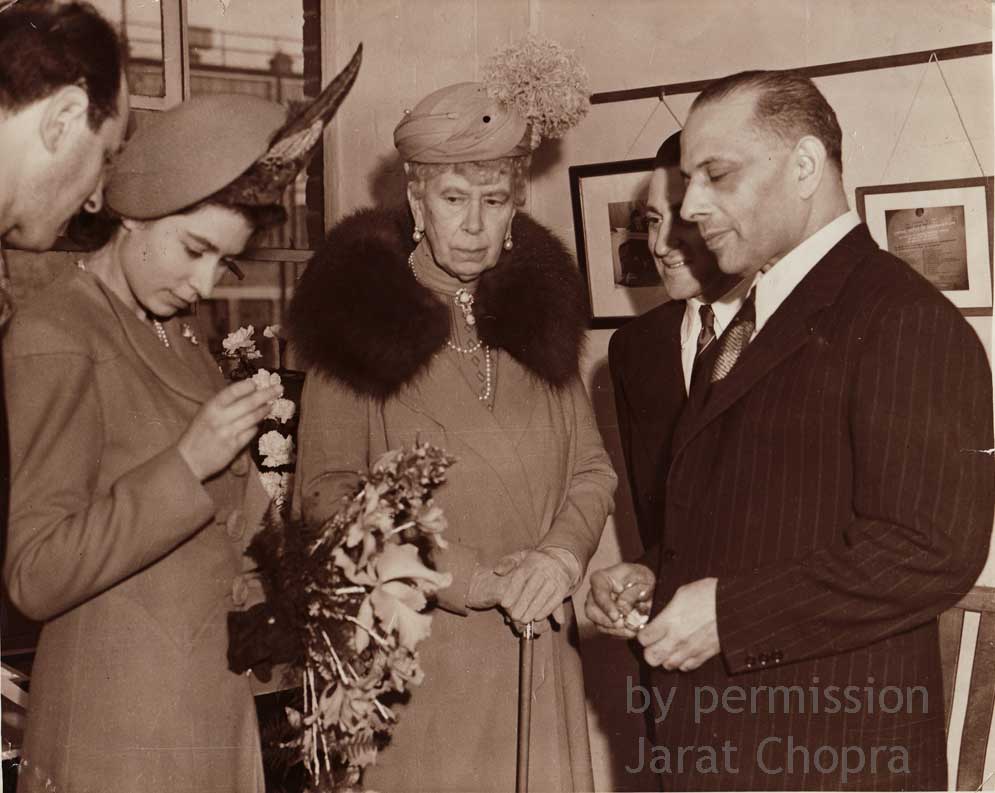
Nick starts with his father’s migration from India to Tanganyika in 1896, and describes the development of his family’s businesses in colonial Dar es Salaam – including the grocery store that served the British Governor and which first brought the author into contact in the early 1940s with Julius Nyerere who, as a teacher at Pugu, used to shop there. He then describes his schooling in England before the outbreak of WWII, and in India during the war, how he qualified as a lawyer in London and subsequently established a legal practice in Dar. Nick’s increasingly close relationship with the Aga Khan and the leading role he played in the Ismaili communities in London and Tanzania are evidenced. He then documents his growing interest in educational reform – in 1954 the Aga Khan appointed him Administrator of the Aga Khan schools in Tanganyika – and his involvement in pre-independence Tanganyikan politics (first as a Town Councillor, then a Member of the Legislative Assembly, and from 1959 MP for Dodoma and Chief Whip of the TANU parliamentary party).

Continuing the catalogue of impressive public service, Nick then sets out his time as: Parliamentary Secretary for Education and Information (1961); Parliamentary Secretary of Industries, Mineral Resources and Power (1964); posts with UNESCO (1965) in Paris and New York, and then Secretary of ECOSOC (1967) in New York; Deputy General Manager of Williamson Diamonds (1970); EAC Minister of Finance and Administration (1972); and, for thirteen years, Minister for Water, Energy and Minerals (1977).

After leaving formal Government service in 1990, Nick has continued to serve Tanzania – as Chairman of the Dar es Salaam University Council, Chairman of the National Development Corporation, Chancellor of the Sokoine University of Agriculture (succeeding Mwalimu in that role in 1993), Trustee and Interim Chairman of the Mwalimu Nyerere Foundation, and as the Personal Representative of the Aga Khan in Tanzania.

Much in this book is politically engaging. I was especially fascinated by Nick’s accounts of: Nyerere’s forthright defence of the 1967 Arusha Declaration (responding to the big unease it caused many leaders, who lost their privileges) and the Ujamaa villages programme; of the suspicions Tanzania generated regionally and internationally during the Cold War by its growing relationship with China (especially with the construction of TAZARA); of his analysis of the multiple reasons for the break-up of the first East African Community and how the lessons learnt have been applied in the construction of the new EAC; and of the way he helped develop Tanzania’s mineral and Songo Songo gas resources, kept the country supplied with essential oil imports at a time when Tanzania could not afford them, and spear-headed the most rapid expansion of the national electricity grid that the country has ever seen.

Nick’s description of more personal happenings are equally engrossing – such as: the attitude in pre-WWII England to an East African Asian schoolboy (a rare sight in those days); of his eight-day journey home on the last flying boat to Tanganyika after the declaration of war, meeting the founder of the Boy Scouts, Baden Powell, on the way; of how he nearly joined the British Royal Air Force in India; of the colourful Independence Day celebrations in Tanzania in 1961; of the Zanzibar revolution, the union of Tanganyika and Zanzibar, and other aspects of the Mainland’s relationship with Zanzibar; of how he rose to senior positions within the UN, and the ‘tussle’ between UN Secretary General U-Thant and Nyerere in 1970 over whom Nick should next serve; of his family’s reaction in 1971 to the nationalisation of their properties; of how he out-manoeuvred the secretive management of Williamson Diamonds (then dominated by De Beers) to get Tanzania a better long-term deal in the diamond industry; of his conversations with Mwalimu each time the President appointed him to the various senior public positions he held; of his meetings (as EAC Finance Minister) with Idi Amin, at the time the Ugandan dictator was expelling the Asians; of Mwalimu’s anger when Amin’s troops invaded Tanzania in November 1978 and of the President’s bitterness at Kenya’s stance; of the protracted saga over the Sunday driving ban (but no mention of the equally dubious fuel ration card system!); of how he performed an informal intermediation role in the 1980s between the Government and the World Bank/IMF when they were at logger-heads with each other; of the stressful months at the end of 1983 when a British newspaper alleged he was complicit in secret and corrupt oil deals with apartheid South Africa (wholly untrue allegations that were eventually fully retracted and compensated); and of his astonishment at not being re-appointed a minister in President Mwinyi’s drastic cabinet changes in 1990.

Nick documents his friendship over the years with Benjamin Mkapa – who wrote him a sympathetic letter in 1990 after he was dropped from the Cabinet and who, in the Foreword to the book, describes Nick as a ‘towering figure in the Asian community’ who ‘has made a contribution to the building of the nation of Tanzania that should speak volumes’.

In the moving and more personal final chapter, Nick reflects on the character and legacy of Mwalimu Nyerere (whom he admired greatly and quotes extensively throughout the book), and on Tanzania’s future. He concludes with paragraphs about his family and his association with current President Kikwete.

I happily declare an interest, and also make a suggestion. As he kindly acknowledges in the book, I worked closely with the author throughout the 1980s when he had ministerial responsibility for Water, Energy and Minerals. He was a dynamic, able and likeable minister, who performed well on both the domestic and international stages. It was a challenging and exciting period, bridging the Nyerere-Mwinyi Presidencies. Had space permitted, there is much more that he could have written.

My suggestion is that the author should consider having his book translated into Kiswahili, so that its contents can become more accessible to all Tanzanians.

My only disappointment with the book (apart from several unexpected typographical errors) is that it is too short! Nevertheless, I hope it will encourage others in similar leadership positions, in Tanzania and elsewhere in Africa, to record for posterity their own personal experiences of the Independence era.

Roger Nellist

INDEPENDENT? TANZANIA’S CHALLENGES SINCE UHURU: A SECOND-GENERATION NATION IN A GLOBALIZED WORLD. Knud Vilby, Uppsala, Nordiska Africainsitutet, 2007. Pp.213. ISBN 978-91-7106-590-2.

Based on a series of interviews with former and current political and party leaders, community leaders and ordinary citizens, this book seeks to re-assess the Nyerere legacy from the perspective of those who were there at the time. It also seeks to examine how Tanzania’s past interacts with current structures of globalisation in shaping the country’s current and future prospects.

The interviews highlight official (and especially Mwalimu Nyerere’s) thinking behind key policies, most notably: Ujamaa; nationalisation policies; universal primary education in the 1970s; the decision to abolish cooperatives; and the economic reforms began after Nyerere’s departure in 1985. In relying on key players in these decisions – figures such as former Vice-President Rashid Kawawa, Nyerere’s former private secretary Joseph Butiku – Vilby offers an interesting account of how policy was formulated, debated and contested within government and party. In listening to the voices of farmers, religious leaders, and former regional officers, the book explores the impact and contradictions in the implementation of those policies. There are also interesting chapters on corruption, HIV and AIDS, and agricultural development in Tanzanian policy.

The absence of Zanzibar from the story is a serious gap, ignoring some serious political fractures which are crucial to Tanzania’s story today. The narrative can at times feel disjointed, and too much emphasis is perhaps placed upon the issue of population growth. But ultimately this book is a satisfying first-person account of Tanzania’s post-colonial history.

Michael Jennings

EAST AFRICA ART BIENNALE EASTAFAB 2007:
Exhibition catalogue prepared by Yves Goscinny, 2007. Dar es Salaam. ISBN 9987–8975-5–X. p/b pp 216 with many colour images; cost: £20 plus postage (in EU: £10). In East Africa, available at La Petite Gallery and Novel Idea Bookshop, Dar es Salaam; Tulifanya Gallery, Kampala, Uganda and RaMoMA (Rahimtullah Museum of Modern Art), Nairobi. Overseas, available directly from the author or PO Box 23165, Oyster Bay, Dar es Salaam, Tanzania. Related publications: ‘Tinga Tinga, Popular paintings from Tanzania’ ‘2003 East African Art Biennale’ and ‘2005 East African Art Biennale’, each at £20 plus postage.

Back story. In 1998 Yves Goscinny initiated a project ‘Art in Tanzania’ whose primary purpose is to hold a bi-annual exhibition which showcases and documents contemporary art in Tanzania. For example, in 1999/2000 it featured the works of 36 local artists including established movements of Makonde sculpture and ‘Tinga Tinga’ painting. This marked a fresh start in strengthening the local infrastructure for development in and through the visual arts. ‘Fresh’ because public art in Tanzania has had little strength, nguvu since the golden years of Professor/Artist Sam Ntiro, Commissioner of Culture (1962-72) and the inclusive Society of East African Artists.

2007 East Africa Art Biennale: EASTAFAB. Since 1998, the platform for visual art has expanded considerably due to overall betterment in East Africa and, in Tanzania, and specifically, to the energy and focus of Mr Goscinny. Now, he is Executive Director of the Biennale Association which held its third international exhibition in November 2007, in Dar es Salaam. The organizers selected more than 100 artists from 26 countries, while concentrating on five: Uganda, Tanzania, Cuba, Kenya, Mauritius. The resulting, very interesting range of regional and international art works offers stimulating comparisons for art-making as well as for the conditions for art in the global South. The especial focus on art from Cuba is a fruitful product of cultural exchange.

The Catalogue. Like an album of snapshots and ephemera this attractive publication for the 2007 EASTAFAB conveys the sensibility of a purposive selection, herein, for modern art practices relevant to Tanzania. While the bulk of the catalogue is visual material, it is more than a book of pictures. Its contents generously reach out to the viewer-reader: visually and verbally.

Visually, there is a wonderful variety of images across the range of two-dimensional mediums, techniques and styles of representation by more than a hundred makers, most of whom live in the global South, while those from Europe tend to be ‘intimate outsiders’– who have long-term commitments to Tanzania. While some works employ ‘African’ clichés such as a market or hunting scene painted boldly in bright colours, the majority of entries are individualized, imaginative and well-composed works that have the capacity to engage the beholder’s gaze.

Verbally, there is a peppy introduction, basic information in alphabetical lists by artist and country, two large sections which present the individual artists and several short essays. Two sections, one for seasoned artists and the other for emerging artists, consist of information about each artist. Overall, the text inputs are uneven, which I appreciate is part of the story, but sometimes, they are not translated (which is more tantalizing due to use of penmanship, below). In a few cases there is no text, apart from an image of a work. Many artists (40) wrote their statements by hand. As an aesthetic device, handwriting links artists to each other with the effect of lessening differences in their backgrounds while it also creates warmth between the artist and the reader.

The short essays concern socially- and politically-implicated art: art for society’s well-being and share the specific innovations of three projects taking place in East Africa. EASTAFAB’s guest artist Bruce Clarke discusses the relationship between political commitment and art making, based upon wide concepts of art and his own reality of political violence in South Africa and Rwanda. He pursues his own practice of mixed media and collective endeavors like the Garden of Memory in Rwanda for which each victim of genocide is being symbolized by incised stone (query absence of an image of the Garden). The two other projects use painting and drawing therapeutically to assist people who have crises to handle: ‘Positive Bodies’ involves the painting of ‘body maps’ as part of a process to assist people in coming to terms with HIV-AIDS in Kenya and ‘Childsoldiers’ similarly uses drawing with teenagers who have experienced violence related to child soldiers in northern Uganda.

This cornucopia of evidence is vast and raw, being neither homogenized, nor perfectly edited, nor uniformly anglophonie. Its shortcomings and mild unruliness are part of its charm which, involve rather than annoy the viewer-reader. In fact, the criteria for good practice differ between catalogues and books. For art catalogues, the basic criteria are coherent and comprehensive coverage for the artists with clear reproduction of their work; on these terms, EAST AFRICA ART BIENNALE EASTAFAB 2007is close to exemplary.

The book itself is a pleasant object and has delighted colleagues (at SOAS and the BM) who have said “what a beautiful cover”, “how apt an image for a biennale in Dar”, “how well it is produced”, “a big book from Tanzania”, “is it for sale in London?”!! The front and back cover display a panorama landscape photograph of a tranquil beach scene with the title handwritten in the foreground sand EAST AFRICA ART 2007 BIENNALE. This image immediately conveys the character of EASTAFAB: (i) its locality in the tropics that in turn reinforces its perspective from the South; (ii) its topicality — sand letters are like a snapshot, indicating its ‘moment’ in time, (iii) its openness — an expansive view of art practices in the region and toward those which have resonance with Tanzania. Overall, this catalogue is of better quality than the art books produced by art organizations in Nairobi and Kampala.

May this review raise an issue for the Britain-Tanzania Society. If the membership would like to advance awareness of art in Tanzania, here is a small suggestion. Could we use the platform of the Society’s annual Christmas card to share an apt image by a local artist, possibly via the Biennale Association?

*Readers are welcome to the exhibition “Positive Bodies” 17 April – 21st June 2008 at the Brunei Gallery, SOAS, Russell Square. Also, nearby, the British Museum’s permanent display kanga includes works by veteran painters Mohamed Charinda and Robino Ntila, Sainsbury Africa Gallery (Rm 25).

UTENZI, WAR POEMS, AND THE GERMAN CONQUEST OF EAST
AFRICA Swahili Poetry as Historical Source. Jose Arturo Saavedra Casco.
2007. $29.95
This book examines Swahili narrative poetry that in spite of being available in published editions for many years, has not previously been studied from an historical perspective. The poems were written on the eve of the First World War by the authors who were all residents of the Swahili coastal towns of mainland Tanzaniaformerly Tanganyika Territory. This poetry narrates the stories of episodes in the wars of conquest, fought between the German colonial forces and indigenous Africans. Most of the poems belong to a literary genre known in Swahili as utenzi, whose oldest preserved samples date from the eighteenth century. This genre originally depicted epic themes linked with the prophet Mohammed and the heroes and martyrs of the Muslim faith. The poems were first preserved only by oral means, being subsequently recorded in manuscript form in the Arabic script. This poetry was recited in public during local religious festivities, or on other civic occasions. During the nineteenth century this poetic style was increasingly applied to philosophical and didactical subjects, and by the second half of the nineteenth century the first historical poem was written in Mombasa. The German conquest of East Africa is the event that has inspired more poetic works of this kind than any other event in the modern history of the region.
Among the poets were those who depicted the horrors of the war, but others were enthusiastic in their praise for the establishment of the German rule.

The book includes a study of the historical context in which the poems were produced, and the social origins of the poets who composed these works. This enables the reader to understand better the opinions and views expressed in the poems. The study proposes that this kind of historical poetry represented a unique, indigenous manner for the transmission of historical accounts of the conquest from the perspective of the Swahili, and not simply a repository of facts already registered and discussed by Western scholarship.

DOGODOGO – DAR STREET CHILDREN

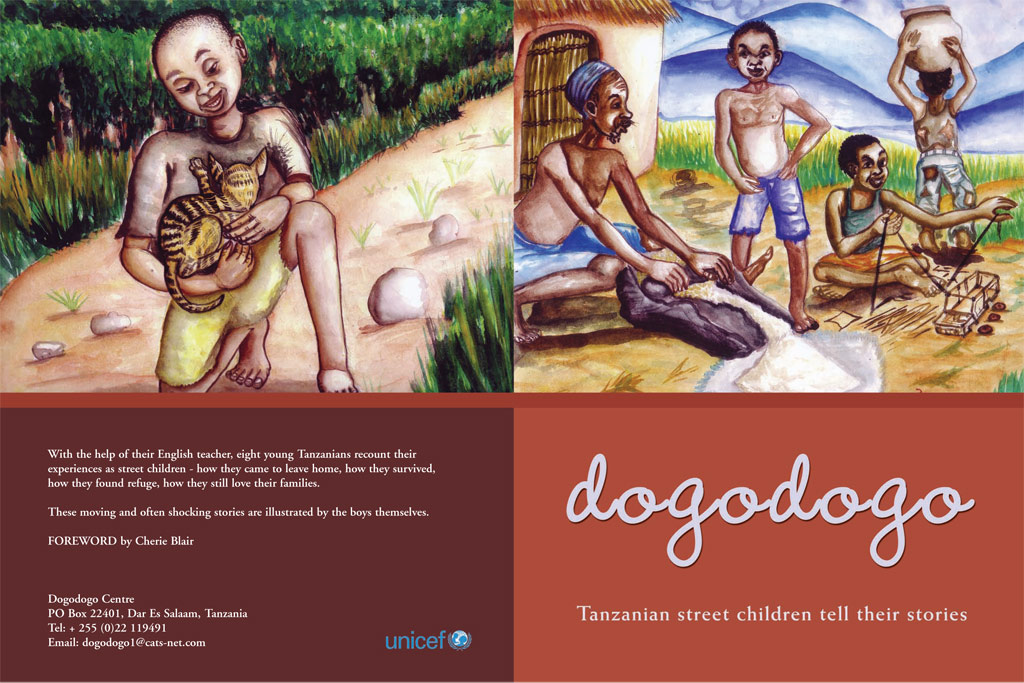
Dogodogo book coverIllustration from the cover of the “Dogodogo” book

“It left a deep impression on me” said Cherie Blair, the wife of the former British Prime Minister, in a Foreword she has written to a new 50-page book published by UNICEF, Macmillan Aidan and others entitled ‘Dogodogo – Tanzanian street children tell their stories’. “I was lucky when Kasia Parham, the wife of the British High Commissioner, took me along to see the remarkable care and support being provided to those who had nothing. I was struck by the dedication and warmth of the American Sister Jean Pruitt, who established the Dogodogo Centre in Dar es Salaam which provides a haven for boys rescued from the street” Cherie Blair said.

The book, which is edited by Kasia Parham, a volunteer teacher at the Centre, contains a large number of illustrations painted by some of the boys, and describes the experiences of eight of them – how and why they came to leave home, how they found refuge, how they survived in incredibly difficult circumstances, and how they still loved their families.

High Commissioner Philip Parham said that he hoped the book would be seen as a good teaching resource in schools in the UK, US and elsewhere to raise awareness.
Kasia Parham described how the boys told her their stories over a period of four months as part of their English language programme. As they learned to express themselves in English, they also learned to speak individually about their past. “Often they told me the factual events of their lives rather than their emotional responses to them. I believe their stories are more powerful for that” she said. “In subsequent more lighthearted group discussions they corroborated each others’ stories.”

The result of all this work is a highly readable book which explains in moving language the extraordinary and often very sad stories of their lives so far. During the past fifteen years some 1,500 children have benefited from the services of the Centre operated by the ‘Dogodogo Street Children Trust’ which also runs a programmes on HIV/AIDS and a successful anti-drugs programme.

With the encouragement of First Lady Mama Kikwete a USAID-financed edition is being produced in Swahili.

The book is being sold in TZ at Novel Idea and Art n Frame (Dar-es-Salaam). Schools in UK wanting copies should contact Ellie Wilson at Macmillan UK: e.wilson@macmillan.com.
See http://www.dogodogocentre.org for more information about the project. Those wishing to contribute to the Trust should contact Sister Jean at dogodogo@bol.co.tz.
David Miliband’s comments on the book can be seen at: http://blogs.fco.gov.uk/blogs/david_miliband

REVIEWS

Edited by John Cooper-Poole (UK) and Marion Doro (USA)

LAW AND JUSTICE IN TANZANIA: A QUARTER OF A CENTURY OF THE COURT OF APPEAL EDITED BY Chris Maina Peter and Helen Kijo-Bisimba. Dar-es-Salaam: Legal and Human Rights Centre and Mkuki na Nyota Publishers. 2007. xx plus 382 pages. ISBN 9987 449 43 3. £29.95.

The Court of Appeal of Tanzania was established in August 1979, after the demise of the respected Court of Appeal for East Africa. Approximately twenty-five years later the Court celebrated its Silver Jubilee in style, with speeches by leading figures (including the Presidents of Tanzania and Zanzibar), a procession, dancing, and a seminar on the Court’s performance. This substantial volume includes photographs of the celebration and of almost all of the judges in the history of the Court, but the bulk of it is devoted to sixteen thoughtful papers on the history, achievements, and challenges of this admirable institution. Continue reading

REVIEWS

Edited by John Cooper-Poole
Our reviews pages have often featured books distributed by African Books Collective [ABC]. This is an organisation of 114 independent and autonomous African publishers from 18 countries. It is non-profit making, commercially self-sufficient, and receives support from funding agencies for development of publishing capacity in Africa. ABC stocks largely English language titles in 56 subject disciplines. Some 150 new titles are added each year. There is an emphasis on scholarly and academic books, literature, and general culture titles. There are a small number of children’s titles in Swahili, and some titles in French. If you would like to receive monthly new title email announcements from ABC please send an email to Justin Cox – email address available from editor

BANAGI HILL, A GAME WARDENS’S AFRICA. John Blower. Librario Publishing Ltd. ISBN 1-904440-35-5. pp 303. Can be ordered at www.librario.com or from Brough House, Milton Brodie, Kinloss, Moray IV36 2UA. Tel. 01343 850617. £11.99.
This book is a good read. It is a saga of one man’s life and work in the “old” Africa of the 1950’s and 60’s. As well as bringing back many nostalgic memories to those who were John’s contemporaries, it will also appeal to others who prefer their adventures second-hand. I knew John and the Serengeti back in 1953-4 when I was District Officer Musoma in which district Banagi lay, and I remember many of the places and people he mentions. I find it interesting that though the book is entitled Banagi Hill, his experiences in this area occupy only seventy pages of the book and the author only spent four years there. But it was a wonderful area and I for one understand his evident love of the place. If he were to go back there today, he might be disappointed, for there is now a luxury tourist resort nearby at Seronera, and the area swarms with tourists. Continue reading

REVIEWS

Edited by John Cooper-Poole (UK) and Marion Doro (USA)

BETWEEN A ROCK AND A HARD PLACE, edited by Jim Igoe and Tim Kelsall. Durham NC: Carolina Academic Press, 2005 xvii + 309 pp. ISBN 1 59460 017 1

This book is a collection of essays on the changed political landscape in Africa, more specifically on the interactions between government, NGOs and the international aid community. NGOs have everywhere become significant political actors, albeit that they may deny political aspirations. There are two contributions on Tanzania, one being by Ben Rawlence who wrote a sensitive article on the Jamiani Development Committee (JDC). This was spawned from a Danida school maintenance/ rehabilitation program. Teachers had formed a School Extension Group that capitalised on using Danida’s services on a wider scale. When these teachers were transferred, it was renamed JDC. Rawlence shows well how novel this form of organization was and how it operated in the interstices of power. Continue reading

REVIEWS

Edited by John Cooper-Poole (UK) and Marion Doro (USA)

THE AFRICAN ARCHAEOLOGY NETWORK: REPORTS AND A REVIEW
edited by Felix Chami, Gilbert Pwiti and Chantal Radimilahy. Dar es Salaam University Press, 2004 (distributed in Britain by African Books Collective, Oxford); ix+187 pp. ISBN 9976-60-408(410)-4.

This is the fourth set of papers in the series, Studies in the African Past, produced in as many years by the University Press in Dar es Salaam. That in itself belies the common perception that effective scholarship, and serious publication too, are barely manageable locally. More than that, this series, reporting archaeological fieldwork in several countries of eastern and southern Africa – and in the present volume extending to West Africa – attests a range of recent endeavours directed from a number of universities, including Dar es Salaam, and should be setting an example to academics in certain other disciplines where the spirit of active research has become moribund. Continue reading

REVIEWS

Edited by John Cooper-Poole (UK) and Marion Doro (USA)

FILM: DARWIN’S NIGHTMARE by Hubert Sauper, (Paris: Mille et une productions, 2005).

The power of Hubert Sauper’s new documentary Darwin’s Nightmare is rooted unfortunately in the indefatigable ‘heart of darkness’ theory of Africa. The film is primarily about the Nile Perch fishing industry in Mwanza on the shores of Lake Victoria. The infanticidal behaviour of the Nile Perch, which has eaten all the smaller fish in the lake and has turned to feeding on its own young, is taken to be a metaphor for human society. Straining to replicate Conrad’s narrative, the film unconvincingly implies that weapons are being smuggled into Tanzania in exchange for fish. Barbaric European pilots and businessmen “feed” economically on a thoroughly savage Africa, where children bare their teeth at each other in an animalistic fight for spilled cornmeal. The veiled eugenic fantasy implied in the title, of Europeans devolving into savagery through an encounter with the erstwhile ‘Dark Continent’, remains fundamental to European/White identity. The dying Kurtz shuddering at ‘the horror’ of what he had become by associating too closely with Africans is the emotive force of Sauper’s Oscar-nominated film. Continue reading

REVIEWS

Edited by John Cooper-Poole (UK) and Marion Doro (USA)

BLUEPRINT 2050: SUSTAINING THE MARINE ENVIRONMENT IN MAINLAND TANZANIA AND ZANZIBAR
. Edited by Jack Ruitenbeck, Indumathie Hewasam and Magnus Ngoile. Published by the World Bank, 1818 H Street NW Washington, DC. ISBN 0-8213-6213-6.

The special nature of Tanzanian marine life has most recently been brought to the attention of newspaper readers in the UK through the re-discovery of the coelacanth, a fish that was thought to have been extinct for at least the last 70 million years. In January 2006, The Observer ran an article on the regular appearance of these strange fish – which have no backbone, and sport four limb-like appendages- in nets in shallow waters off the Tanzanian coast. The implication of the article was that these rare and endangered fish are being driven into shallow water by deep water trawling in the coelacanth’s offshore habitat.

Like elsewhere in the world, Tanzania’s marine ecosystem is coming under increasing, and unprecedented risks. Threats include over-exploitation (of, for example, deep sea habitats like that of the coelacanth, but also of resources closer to shore: mangroves, lobster and coral); destructive fishing methods (dynamiting, poisoning), industrial and domestic pollution; potential unregulated tourism development and global climate change. Continue reading