Uganda’s THE MONITOR published an article in June under the heading ‘The Grave of Kiswahili’. Extracts: ‘One of the jokes that Tanzanian army officers told after they overran Uganda and threw out dictator Idi Amin in 1979 was that they had also discovered the ‘grave of Kiswahili’…..After the beautiful language was born in Zanzibar and grew up in Tanzania, it had been killed in Kenya and buried in Uganda…. But the Kenyans are not the only guilty ones in practicing ‘lingocide’, and nor are Ugandans the only lingual undertakers in the region. The Tanzanians themselves are guilty of a similar offence. What Uganda and Kenya did to Kiswahili, the Tanzanians did to English. Suppose you met this smart young lady dressed in a business suit on Parliament Avenue in Kampala and, on asking her for directions, she smiles apologetically and says in her language that she does not know English! It would be odd, wouldn’t it? In Dar es Salaam it would not be. They killed English decades ago. It was the language of colonialists, exploiters and all those things. They reasoned that English is not the same as knowledge and went ahead to promote Kiswahili as the official language in which everything is transacted. Coupled with massive primary education, they soon achieved 100% literacy, probably the highest in the world ever. All citizens could read and write Kiswahili and everybody was happy, for a while. Continue reading
Category Archives: Tz in International Media
TANZANIA IN THE INTERNATIONAL MEDIA
A well-balanced five-page article in the July issue of PROSPECT added many more accolades to the ones President Mkapa is receiving as his final term of office approaches its end. The author, Jonathon Power, who writes for the International Herald Tribune, compared Tanzania as it was 20 years ago with what it is like today. ‘Since coming to power in 1995, Mkapa has left his reformist mark on everything from tax policy to privatisation, from the bureaucracy to human rights, from political freedom to the free press. Of Nyerere’s well-meaning but autocratic Christian socialism there is hardly a sign left. As Deputy Foreign Minister Abdulkader Shareef put it to me, as we sailed across to Zanzibar, “Nyerere was redistributing poverty….. we are not anti-socialism…… But before distributing wealth we must create it.” Continue reading
TANZANIA IN THE INTERNATIONAL MEDIA
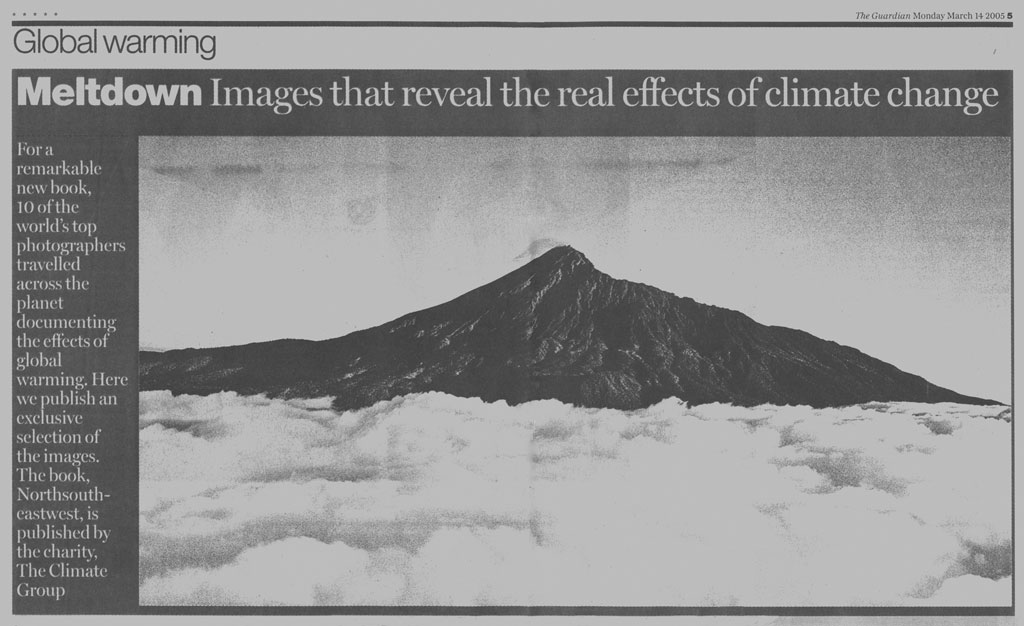
The London GUARDIAN, writing about global warming (March 14) published a photograph which it said showed that the snowy cap of Mt. Kilimanjaro, at 5,895 metres (19,340 ft) was now all but gone – 15 years before scientists predicted it would melt through global warming.
The paper reported that 34 ministers at a G8 energy and environment summit meeting in London were receiving a book – published by the Climate Group and entitled Northsoutheast-west: a 360-degree view of climate change – that included a picture depicting global-warming. The book’s text described the devastating speed of climate change documented by ten of the world’s top photographers. Continue reading
TANZANIA IN THE INTERNATIONAL MEDIA
NEW GAME RESERVE
A new 1,574 square kilometre Mpanga/Kipengere Game Reserve which aims to protect the water catchment of the Rufiji River Basin has been gazetted according to the EAST AFRICAN (October 28). The main river draining into the Basin is the Great Ruaha, which is fed by several rivers and streams originating from the new reserve’s catchment area, later joining the Rufiji further downstream. While the two rivers and their adjacent basins have been adequately protected downstream, their catchment within the new reserve and further upstream is unprotected. The Rufiji river basin is the largest of all nine drainage basins in Tanzania, with high and often controversial utilisation of water by multiple users, including irrigation farmers, livestock, wild animals in protected areas, hydroelectric power generation and towns and municipalities. The entire basin covers 177,420 square kilometres and is fed by four major rivers – Ruaha, Kilombero, Luwego and finally Rufiji itself. The Great Ruaha is central to the ecology and tourism in the Ruaha National Park and provides over half the water for Mtera and Kidatu hydroelectric power stations, which have a combined capacity to generate 284 Mw of electricity. In 1993, the Great Ruaha dried up completely in the Ruaha National Park and has since then been drying up every year. Continue reading
TANZANIAN TERROR SUSPECT CAPTURED IN PAKISTAN
Tanzanian Ahmed Khalfan Ghailani, a top al Qaeda terrorist suspect, one of the world’s most wanted men with a $25 million price on his head, was taken into custody in Pakistan on August 6th for his suspected role in the 1998 bombings of the U.S. embassies in Dar es Salaam and Nairobi. He was arrested along with 13 others after a 14 hour gun battle with security forces in Gujarat, 110 miles southeast of Islamabad.
Ghailani’s mother in Tanzania was quoted as saying that her son was a harmless, religious boy who had gone abroad to study six years earlier. “What I look forward to is my son getting a fair trial and that our (Tanzania) Government will ensure that my son is not tortured. The US Federal Bureau of Investigation had visited her house on several occasions over the last six years, ever since Ghailani left home, she said. Ghailani goes by the nicknames ‘Foopie’ or Fupi and ‘Ahmed the Tanzanian’– see also’ Tanzania in the International Press’ below – Editor
TANZANIA IN THE INTERNATIONAL MEDIA
Needless to say the arrest in Pakistan of Ahmed Ghailani (from Zanzibar), who is accused of having masterminded the bombing of the American embassies in Dar es Salaam and Nairobi attracted massive coverage in the media all over the world. The heaviest coverage, over several days, was in Pakistan’s newspapers. After the capture of Ghailani the Pakistan DAILY TIMES (July 31) quoted the Pakistan Interior Minister as saying: “We have now been quite successful in apprehending some of the most important figures of the Al-Qaeda including Khalid Sheikh Muhammad, Ramzi Al-Sheban and many others…. Pakistani security forces had been acting on a tip-off when they raided a suspected militant hideout. Ghailani, his Uzbek wife, and up to eight other foreigners, including two South Africans, were among those arrested according to Pakistan’s NATION newspaper (August 6). ‘They were strangers, and they acted as such, keeping mostly to themselves,’ the newspaper said. Investigators were scouring a computer and several disks seized from Ghailani and the others after a 14-hour gun battle with security forces in the city of Gujarat, 175 km southeast of Islamabad. Ghailani’s driver led police to his hideout. Among those found in the house were three women and five children. Ghailani had brought two other foreign comrades to his ‘safe house’ after the group became nervous that security forces were closing in on the hotel in Gujarat where they had been staying.
The security forces have also caught his local contact, Ejaz Warraich, a member of Millat-e-Islamia who rented the safe house for Ghailani. Ghailani, who reportedly could not drive a car at the time of the bombings in Nairobi and Dar es Salaam, was probably the most senior Al Qaeda operative caught in Pakistan since the arrest in March 2003 of Khalid Sheikh Mohammed, the suspected mastermind of the Sept 11, 2001 attacks on New York and Washington. “It is a big achievement for our security forces,” Interior Minister Faisal Saleh Hayat told the Pakistan National Assembly. It seems to have led on to the arrest of several other suspected terrorists.
The attack by pirates on a party of British students in Pemba in July received massive publicity in the British press. The DAILY EXPRESS filled its front page and two inside pages with articles under the headline ‘Shot by pirates – Terror ordeal of teenage British girl on gap-year trip to paradise island’. The article in THE TIMES on 5th July under the heading ‘Britons on gap year are shot by African pirates’ wrote: ‘The 25 students taking part in a gap year diving expedition were forced to bury their heads in the sand while the pirates stole money, jewellery and watches. “When the shot went off, everyone thought it was some sort of celebration,” one of them said. “Then, without any warning, the pirates just started shooting”. The headline in the INTERNATIONAL EXPRESS read: ‘Home at last: Survivor of the Pirate Raiders.’ (Thank you Douglas Gledhill for sending this from Australia – Editor) which described how ‘the brave gap year student, Grace Foster, escaped death by one mm when a bullet passed through her, narrowly missing her spine, before lodging in 20 year-old Robert Scott’s thigh.’ Grace said: “Once the bullet is removed we are planning to split it in half and each have a piece in memory of our Pemba Island ordeal.” Police later arrested five suspects in a massive manhunt and recovered the boat allegedly used. One of the suspects had been in police uniform and armed with a pistol; the raiders escaped with, among other things, £2,500, two outboard engines, two computers and two drums of petrol.
Pages and pages of illustrations supported an article in the July issue of the NATIONAL GEOGRAPHIC MAGAZINE under the heading: ‘Hunting for Glory – with the Barabaig of Tanzania.’ Extracts: ‘The Barabaig live on the margins of Tanzanian society, struggling to maintain their cultural traditions. The Government prosecutes anyone hunting elephants outside of licensed safaris so hunts are conducted in strict secrecy. The Geographic’s photographer spent six months with the Barabaig before he was allowed to join a hunt….. each man receives two to four spears…novices must prove themselves before earning more than two weapons… Rushing in for the kill the hunters face the danger of losing life or limb…. three hunter were killed during the writer’s time with them……They walk for 12 hours a day and eat nothing for the duration of the hunt, which can last a week or more. Only the first two men to kill will become ‘superheroes’. The article concluded: ‘No one knows exactly how many elephants the Barabaig kill each year but the number is relatively small. Conservationists agree that these traditional practices pose no threat to Tanzanian’s robust elephant herd estimated to exceed 100,000.’
A letter from a British reader in the July issue of NEW AFRICAN contrasted the generosity and tolerance to refugees and asylum seekers offered by African countries with the xenophobic attacks typical of Britain. ‘Tanzania shares what it has with millions of refugees…..the right-wing media and some British opposition politicians should take a leaf from Tanzania…..’ the letter said.
The EAST AFRICAN (May 10) revealed the contents of an unpublished mid-year donors’ (including the World Bank, the IMF, Canada, France, Germany, UK, the Netherlands and the Nordic countries) review of the ‘Poverty Reduction Budget Support and Poverty Reduction Support Credit.’ The development partners said they were seriously concerned by the continued delay in preparing a new Bill on corruption. The long delay appeared to indicate a lack of commitment by the Government they said. However, President Mkapa criticised the media and politicians for accusing his government of corruption, saying instead that such media owners should explain to the public where they got their capital and how they recouped their losses. Tanzanian Attorney General Andrew Chenge said: “It is unfair to generalise in evaluating our fight against corruption because efforts have been made to curb the vice; there is no pending new Bill on corruption. What’s in the pipeline is making amendments to the anti-corruption law; this is being dealt with by other stakeholders such as the Tanzania Law Reform Commission,” he said.
NEW AFRICAN (August) published the results of a poll of its readers to nominate the ‘greatest African of all time’. The late President Julius Nyerere came 4th in a list of 100. He was described as ‘a great leader who refused to allow the trappings of power to corrupt. He was respected by his country, Africa and the rest of the world.’ Needless to say number one on the list was Nelson Mandela – ‘a living legend’; number-two was Ghana’s Kwame Nkrumah; and, number three was Robert Mugabe. No other Tanzanians were on the list. Kofi Annan was 10th; Michael Jackson was 41st, F W de Clerk 50th, the William’s sisters 73rd, the Queen of Sheba 87th and Helen Suzman 100th.
The GUARDIAN WEEKLY (30th July) and the INDEPENDENT (3rd August) reported that the 354 – pupil Mvumi Secondary School is expected, if the share price of Marks and Spencer rises over 400p to receive from its Chief Executive, Stuart Rose, up to £500,000. Mr Rose’s connection with Mvumi began three years ago. He had spent eight years in Tanzania as a child and was looking to donate money to a project when he met the head teacher at Mvumi Mr Richard Morris. He has already paid for the building of a new school administration block. (Thank you Janet Bujra and Liz Fennell for sending these items – Editor).
Reporting on numerous violations of human rights of African students in Russia, NEW AFRICAN (April) described the growth of racism in the country. One case quoted was that of a Tanzanian student, Isaac Mwita, who was taking a pre-University Russian language course and had been viciously attacked by a group of five skinheads. One of them stabbed him in what seemed a ritual manner and left him writhing in agony, after they had stripped him of his jacket and forced him to lie on the ice-covered ground on a day when the temperature had fallen to minus 15 degrees. He was hospitalised in critical condition but was eventually released and returned home to Tanzania.
The American publication AFRICA NEWS REPORT (6th July) quoting from the NEW ENGLAND JOURNAL OF MEDICINE (July 1) reported that researchers from the Harvard School of Public Health and Tanzania’s Muhimbili University College of Health Services had found that women taking multivitamins (vitamins B-complex, C and E) significantly delayed the progression of HIV compared to those in the study who received a placebo instead. Researchers randomly assessed 1,078 HIV-infected pregnant women who were enrolled over a two-year period beginning in April 1995 and were followed until August 2003. ‘All women received standard doses of antenatal folic acid and iron, and all children received six-monthly doses of vitamin A, as per standard of care in Tanzania.’ It added that anti-retroviral therapy was unavailable at the time of the study to the majority of women in Tanzania, including those who were eligible for participation in the study. During the study, 299 of the 1,078 women either died from AIDS-related causes or progressed to WHO stage 4 (equivalent to AIDS). Among the 271 women who received multivitamins, 24.7% progressed to WHO stage 4 or died of AIDS-related causes; among women who received multivitamins with vitamin A, the total was 26.1%; for those who received vitamin A alone, it was 29%; and of those who received the placebo, it was 31.1%. Moreover, women in the study who took multivitamins had ‘higher CD4 immune cell counts, lower viral loads, and reduced complications of HIV infection, including oral thrush, oral ulcers, difficulty in swallowing, diarrhoea and fatigue. Our data suggest that multivitamins delay the onset of disease progression and thus extend the time until such therapy is necessary. Multivitamin supplementation is inexpensive: US $15 per person per year.
The Nairobi-based EAST AFRICAN STANDARD (July 26) reported that Microsoft Corporation is appealing to Kiswahili experts to help it create a standardised technical glossary for its Kiswahili program. The company has launched an interactive website where experts can contribute their suggestions. The website offers volunteer participants a platform to debate and help create Kiswahili translations of over 3,000 English computer terminology words. Patrick Opiyo, who is managing the Corporation’s Kiswahili programme, said that when the Kiswahili language program was complete, over 100 million people would have access. He put a closing date on the scheme of August 11, 2004 after which the project moderator would begin the review and selection. The final draft deadline was to be September 3, 2004 – Thank you Ron Fennell for sending this item – Editor.
The ASIA PACIFIC MISSION FOR MIGRANTS in Hong Kong reported on July 19 (following a Press Release from the LEGAL AND HUMAN RIGHTS CENTRE in Dar es Salaam on July 16) the case of the rape of a Tanzanian maid by an official of the Saudi Arabian Embassy in Dar es Salaam. The Centre strongly condemned this act and criticized the Tanzanian Government for even considering taking financial compensation from Saudi Arabia. This was offered as the diplomat enjoyed diplomatic immunity. The Centre demanded that the diplomat should be taken to court – Thank you Ken Mpopo for sending details of this case – Editor.
The ANTIQUES TRADE GAZETTE of 15th May described the sale of close to 100 items at Christie’s in London of books on the life and extraordinary times of Richard Burton. An 1872 first issue of the publication ‘Zanzibar’ that sold for £6,500 contained the sheet in which Isabel Burton, just a few days after publication, presented the book ‘With the hearty best wishes of Richard Burton for the success of the Livingstone expedition’ to a Lieutenant Llewellyn Dawson who was to lead a search expedition into the interior from Zanzibar – Thank you John Sankey for sending this item – Editor.
THE TIMES (5th May) quoted Bob Geldof of Live Aid as saying that there was ‘initiative fatigue over Africa’. The ‘Commission for Africa’ set up by Tony Blair had held its first meeting in London in May. Asked why there should be yet another commission, President Mkapa, who is a member said: “I would ask you why preachers preach every Sunday in spite of the fact that the Bible has been with us for 2000 years. It is as simple as that. Sometimes inculcation can energise people to do something……We hope to produce the energy that will generate action and implement recommendations that may well be a replication of what has been said before.” The BBC’s FOCUS ON AFRICA (July-September) under the heading ‘Africa’s champion – UK Prime Minister Tony Blair is taking up Africa’s cause on the international stage’ included an article by British Aid Minister Hilary Benn. He wrote that he was broadly in favour of the establishment of the Commission. But there was another article by William Mervyn-Gumede which took a very cynical view. It asked who were the ‘stooges’ in the Commission and decided that it was the African members. Mr Blair had been under fire over Iraq and this was a useful diversion. Mr Blair should have noted that many African countries were still waiting for the G 8 countries to fulfil previous promises to Africa. They could have pointed out that rich countries gave their farmers $320 billion in handouts, more than six times the amount they gave to poor countries in aid. ‘One of the commissioners, perhaps President Mkapa, might have insisted on fair global trade as a pillar of any effort to reduce African poverty’ the writer said.
The EASTERN AFRICA MAGAZINE in its July issue published a letter from Dr Frederick Kassulamemba describing the Britain-Tanzania Society as doing a superb job in bringing development to one of the poorest countries in the world. Even more satisfying was its success in helping to win the war on debt cancellation by the British Government.
An article in the April issue of the NEWSLETTER OF THE JUBILEE DEBT CAMPAIGN quoted President Mkapa as saying how much he wished the campaign success and commended it for its new initiative. Tanzania’s debt relief had been directed towards the social sectors and, as a result, the primary school population had increased by 50%; over 31,000 new classrooms had been built; hospitals were being refitted and the rate of immunisation had reached 83% – Thank you Sylvia Voisk for sending this – Editor.
The American publication AFRICA NEWS REPORT gave the results in August of the ‘diversity lottery’ for persons wishing to obtain permanent resident visas in the USA. 9.5 million persons applied during 2003 of whom 100,000 were successful, including 356 from Tanzania.
EXCELLENT FILMS AND BETTER AMBIENCE
Mary Wright writing in The Express in July described the 2004 Zanzibar Film Festival (ZIFF) in glowing terms. Extracts:
How to define or explain the charm of this island, in particular of Stone Town? On your left: ancient white-painted palaces whence the sultans used to rule, and mosques and old forts fringed with palm trees; on your right: speeding minibuses, bicycles, motorbikes and landcruisers; beyond them the quayside where fishermen are sitting or distributing their catch against the background of the blue ocean…… One feels the influence of an ancient civilisation, its calm and confidence’..….Over four and a half days I saw 21 films, including five short ones, two interrupted by mosquitoes and one cut off by power failure. All were of high quality in their production and all had something to say…The film which won the silver award; “Gardiens de la Memoire”, about the genocide of Tutsis in Rwanda, although it consisted mainly of interviews with survivors, was striking not only because of the subject but also because of the trauma of the individual speakers. Another excellent film containing many interviews was “Memories of Rain”. It concerns the lives of two people who had been underground members of the ANC in South Africa….The only other filmmaker I met over these festival days was a lady from Kenya, Sonal Tyagi, who’d made the film “The Ivory Orphans”. Such a beautiful subject and quite amazing, the process of persuading orphaned baby elephants to adapt and form a bond first with their human keepers, then, when it was time, with a group of elephants in Tsavo Game Reserve and get themselves accepted by these. Again, the short film about the lioness who adopted an oryx calf (inspiring local Christians to believe that God was about to return) was both beautiful and tragic (“Heart of a Lioness”, Kenya).
Across the road from the film screenings were the open-air musical events, making a joyful noise indeed. Hordes of folk, not just youngsters and certainly not just tourists, made their way to sit beside the sea and hear these rampaging, wild musicians… People drifted back late at night along the footpath by the quay; not least of the pleasures of Stone Town is that apparently one is perfectly safe walking about no matter what hour of day or night.
I just have to talk about two outstanding entries whose memory remains with me: the Iranian film “Women’s Prison” and the Senegalese one “Madame Brouette”. To take the latter, gayer one first, this was a riot of colour and action; all sorts of mayhem and corruption but also friendship, solidarity, love. It had already won many prizes and its sequences were superbly put together. As for the Iranian film, the projection room was packed for it and it’s difficult to explain the fascination of this story which took place over 17 years.
As a total experience this seventh ZIFF festival was marvellous, I just can’t wait to go again. The setting is primordial. An ideal home for the international flavour of the Ziff festival.
ASYLUM AND REFUGEES – BRITAIN AND TANZANIA TALK
Britain and Tanzania have been in discussions about Britain’s asylum and refugee problems. Liberal Democrat party leader Charles Kennedy brought the matter into the public domain on February 25 when he asked the Prime Minister what was going on and expressed the fear that the proposal could lead to ‘an international trade in displaced people’. Tony Blair then explained that the idea was for asylum claims to be processed nearer to the country of origin. It would be a pilot scheme to explore how Britain could help process asylum applications which arose in Tanzania. “We have been talking to the Tanzanian Government about various immigration issues, including East Africans falsely claiming to be Somalis in the hope of securing British residency” he said.
In Dar es Salaam, the Government immediately confirmed that consultations over Britain’s request to set up a camp in Tanzania for screening Somali asylum seekers were going on. Home Affairs Minister Ramadhani Mapuri quoted in the East African said: “The government wishes to acknowledge a request made by the Government of the United Kingdom to settle Somali refugees in Tanzania. Internal consultations among stakeholders within the Government of Tanzania are in progress but the Government is yet to give its response.” He added, “Any response must take full consideration of the magnitude, multitude and the entire range of socio-political implications for Tanzania including the fact that Tanzanians are already overwhelmed by the burden of refugees”.
According to the United Nations High Commission for Refugees (UNHCR), Tanzania is host to more than 600,000 refugees mainly from Burundi, Rwanda, the Democratic Republic of Congo (DRC) and Somalia. 470,000 of these are in camps, and another 170,000 are living independently in the Tabora and Rukwa regions.
Mr Mapuri added: “It was brought to the Tanzanian Government’s attention that there are some alleged Tanzanian nationals in the UK who pose and continue to live in the UK as Somali refugees….Tanzania believes that, should any Tanzanian nationals posing as Somali refugees in the UK be identified, they should not be expelled, but returned to Tanzania under normal procedures that respect human dignity.”
The ‘East African’ said that Tanzania was one of the major transit points for asylum seekers from the Great Lakes region trying to get into Europe due to its lax immigration scrutiny. Once they arrived in the UK, most of them identified themselves as Somalis seeking asylum due to the current turmoil in Somalia. People from the Democratic Republic of Congo, Burundi, Rwanda and Somalia itself were trying to enter Britain through Tanzania. Britain has said that it is prepared to help Tanzania with cash support for its growing refugee problem.
Somalis made up the largest number of refugee applicants to Britain last year but the numbers are still tiny (around 6,000 in 2003) compared with the number of refugees Tanzania has to host.
Peter Kallaghe, Director of Communications for Tanzanian President Mkapa, told the Guardian that there had been discussions between the two governments over the issue but that it was sensitive. Any decision would not be taken very easily,” he said. The Guardian report said that a camp in Tanzania could offer a processing point for Somalis seeking asylum as well as a home for failed asylum seekers.
Tanzanian Affairs has been told that the British Home Office is planning to send a ‘scoping’ visit to Tanzania in the near future to take the discussions further.
TANZANIA IN THE INTERNATIONAL MEDIA
US General Charles Wald, Deputy Commander of the US European Command based in Germany, (which also has responsibility for 93 countries, including all of the sub-Saharan region apart from the Horn), recently responded to a journalist’s question about a report that Tanzania was not co-operating fully with the US on terrorism. He was quoted in the WASHINGTON TIMES as saying that US military forces were working with the Tanzanian government to counter a terrorism threat. Unnamed Bush administration officials had apparently said that Tanzanian officials had only haltingly co-operated with American efforts to root out terrorists. The paper quoted an anonymous Western diplomat as saying: ‘The Tanzanians see terrorism as an international issue, not a domestic one, because most terrorists are imported. The problem with that argument is that Tanzania is a permissive environment.’ The newspaper article went on: ‘US Treasury Department officials charged in January that the Tanzanian branch of a Saudi Arabian charity had engaged in terrorist activities and plotted attacks last year against tourist hotels on Zanzibar…..The scheduled attacks did not take place due to increased security by local authorities, but planning for the attacks remained active.’ Some Tanzanians were said to view the high level of American concern as exaggerated. They pointed out that the Tanzanian mainland had not suffered an attack for five-and-a-half years.
In a detailed report published on February 2 THE EAST AFRICAN took to task what it called the ‘errent lawyers of Tanzania and the 23 cases pending against them. There was said to be growing concern over falling standards, pilferage of clients’ money and unethical conduct. The report was based on a paper obtained from the Tanganyika Law Association (TLS). A common complaint was the lack of an effective legal mechanism to crack down on errant lawyers. “Complaints against advocates have increased, although the society has taken steps against lawyers who abuse their profession”, TLS acting executive secretary Anitha Moshi said. Despite the growing list of complaints, not a single lawyer had lost his licence to practice in Tanzania. But Ms Moshi insisted that the TLS was taking action and had forced some advocates to return clients’ money. Asked about cases of magistrates dismissed by the Government and then readily admitted to the Bar, she said the practicing certificate is issued by the Chief Justice after he verifies an applicant’s records. Surprisingly, many former magistrates, who were sacked over corruption or other unprofessional conduct, have crossed over to the Bar as advocates. The regional ethics committees of TLS said they were satisfied with the conduct of advocates in Tanga, Arusha, Mbeya and Kilimanjaro regions, where no complaints had been filed. Mwanza had received one complaint but cases against lawyers in Dar es Salaam included receiving legal fees but failing to appear in court, withdrawing from arbitration proceedings after being paid and refusing to refund clients’ money.
The AFRICA RESEARCH BULLETIN (December 2) announced that Stella Artois beer, a brand popular during Tanzania’s beer shortages in the early 1990’s, had made a comeback and was to be brewed by a locally owned brewery under licence from Belgium’s ‘Interbrew’, the world’s third largest beer producer. This would represent competition for Tanzania Breweries which controlled 98% of Tanzania’s beer market. Minister for Trade and Industry Dr Juma Ngasongwa said that producing Stella Artois locally would ensure that more Tanzanians were employed and that government revenue would increase.
The World Bank’s publication FINDINGS (April) described, in four succinctly-written pages, recent development in Tanzania’s coffee industry by the Senior Economist John Baffes. The paper recorded that during the 1960s the cooperatives and the Coffee Board became involved in most aspects of marketing and trade in coffee. This involvement culminated in the nationalisation of most Arabic coffee estates in northern Tanzania in 1973. Since then the coffee sector had been subject to a shifting of power between the cooperatives and the Coffee Board with the needs of the sector itself never seriously addressed.
The performance of the sector deteriorated and reforms became necessary. The first steps were taken in 1990 when the Coffee Board began to make more timely payments to cooperatives. The Board became a marketing agent rather than a marketer. In March 1992 input markets were opened to private traders and a few months later exporters were allowed to retain 10% of their export earnings in foreign currency and, soon thereafter, 100%. More reforms came in 1993 allowing private sector participation in marketing and processing.
While these reforms brought about some improvement there were still many problems. Although the processing capacity for coffee had increased enormously – since 1988 twelve new factories had been built – many of these were operating at only a quarter of installed capacity.
Uncertainties in the coffee sector were exacerbated by the ‘one-licence regulation’ issued by the Coffee Board just three days before the official start of the 2002/03 coffee buying season in the Western coffee zone. The regulation limited applicants for private coffee buying, coffee processing or coffee export licences to just one of these licences so as to help the cooperatives increase their market share at the expense of private traders.
The paper made a number of recommendations: taxes should be substantially reduced; the Coffee Board’s licensing procedures should be re-examined; the coffee auction should be voluntary; the Board should take greater responsibility for statistics; and, its powers and those of the ministries should be substantially reduced. The regulatory framework should facilitate the transfer of nationalised estates to private individuals so that their full potential could be realised.
The paper also includes an account of the numerous significant changes made since 1920 in the coffee estate sector.
Why has the Tanzania shilling dropped so heavily against the US dollar in recent weeks? The latest AFRICA RESEARCH BULLETIN suggested that it was because of severe food shortages in late 2003 and the action of the Government in trying to ease the situation by waiving some taxes paid by food importers. The result had been massive food shipments in January paid for in dollars at the same time as a recent drop in exports of coffee and cashew nuts caused by low rainfall.
AFRICA ANALYSIS (March 5) expressed concern about the possible threat to tourism in Zanzibar following what it described as a brutal attack by machete-wielding robbers who boarded a yacht with 15 tourists on board off Pemba on 21st February. None of the holidaymakers were hurt but the robbers escaped with money, passports, jewellery and computers.
Schoolboys fidget and mess about in class, while girls sit still and concentrate – all because of biological sex differences that evolved millions of years ago. A team from the University of Minnesota, quoted in the DAILY TELEGRAPH (April 15) and based on an article in NATURE, had conducted a four-year study of young chimpanzees in the Gombe National Park in Tanzania. They noted how young chimps learnt to fish for termites using a stick. Although both sexes received the same attention, on average, the females picked up enough skill to extract their own termites by the age of 31 months while males took 58 months. Males spent more time playing and in physical activity. The fact that young chimps followed the same sex specific roles as humans was said to indicate that such behaviour had deep- rooted biological origins, probably dating back more than 6 million years.
AFRICA CONFIDENTIAL (19th December) revealed what it described as ‘a bad-tempered discussion on Zimbabwe’ at the Commonwealth Summit Meeting in Nigeria from 5th to 8th December. Commonwealth Secretary General Don McKinnon had applied for an extension of his term of office but this was opposed by some African countries because he was supporting continued sanctions against Zimbabwe. According to Africa Confidential, in September last year, Tanzania’s High Commissioner in London had approached his Sri Lankan counterpart with a plan to put up an Asian candidate against McKinnon. The person eventually selected to do this was former Sri Lankan Foreign Minister Lakshman Kardirgamar. Discussions continued some weeks later in Romania and Switzerland which involved, amongst others, former OAU Secretary General Salim Ahmed Salim from Tanzania. Efforts to mobilise a large African vote against Mc Kinnon did not succeed however and McKinnon was eventually re-elected by 41 votes to 11. Only South Africa, Namibia, Malawi, Mozambique, and Zambia amongst African countries allowed themselves to be publicly identified with support for the Sri Lankan candidate. (TA has been told that Tanzania voted for McKinnon as did Uganda and Kenya – Editor).
HABARI, the journal of the Sweden-Tanzania Society, is written in Swedish. However, in its first issue of 2004, it contained three articles in English on languages spoken in Tanzania and included a comprehensive language map of the country. The first article, by Malin Petzell was on a socio-linguistic study on the position of the Kagulu language which is spoken by 200,000 to 300,000 people in Kilosa district. It was said that it still held a strong position in society but was in the ‘endangered’ category particularly in urban areas. The second paper, written by Jennifer Palmgren, had the title ‘Kiswahili language, nation-building and identity’. There was also a half-page on basic English-Kisukuma greetings.
Under the heading ‘Drawing on ancient remedies’ the South African MAIL AND GUARDIAN (27th February) described how traditional and modern medicine is being fused in the fight against AIDS in Tanga by an ‘Aids Working Group’. It is estimated that the region has a ratio of one doctor to 33,000 people but there is one traditional healer to every 156 people. An elderly healer, Mohamed Kasomo, is actually working with doctors in a modern hospital and is using all kinds of herbs for a variety of AIDS-related complaints including loss of appetite, fever, skin infections, abdominal discomfort and oral and vaginal fungus. The herbs are packaged in powder form and every two weeks about 700 patients go to the hospital to collect their packages. They then take them home where they boil them into tea. Although the traditional healers are not curing AIDS they are making marked improvements in people’s standards of living, the article said. (Thank you David Leishman for sending this item – Editor).
‘It may look like dung and smell like dung, but it’s a life-saver for the deaf of Africa’. THE THIRD SECTOR quoted in THE TIMES (January 13) reported that Christmas cards made from elephant droppings have raised £1,000 for deaf children in Tanzania. Some cards were sold in game parks and one of these parks also requested 1,000 elephant dung folders to package its annual report. A hotel was said to have ordered ‘Dumbo-dung’ lampshades – (Thank you Liz Fennell for sending this item – Editor).
‘Juma Twaha had gone blind but his life in the atmosphere of torpor and decay in Temeke, Dar es Salaam, was causing him some torment. Not having the sureness of foot of those blind from birth, he would often stumble into the treacherous potholes. This would immediately prompt mirth and jeers from an entourage of small children who would collapse on the ground in a theatrical mimicry of Juma’s clumsiness. Last August his luck changed. A 35-person team from Orbis, the global sight-saving charity, came to Tanzania to train ophthalmologists in cataract surgery. Mr Twaha became the first person in a Tanzanian public hospital to receive small incision surgery on his cataracts. His sight was restored.’ Seeing himself in the mirror for the first time for years, he exclaimed “Actually I’m pretty good looking. I should now be able to find a wife!” (Thank you Donald Wright for sending this item from the SUNDAY TELEGRAPH (December 14) – Editor.
AFRICAN BUSINESS (March) presented its first annual review of Africa’s top companies listed on a sub-regional basis. In East Africa, it quoted ‘Market Capitalisation’ as placing Tanzania Breweries top of the list and Tanzania Cigarettes fifth. Out of the first ten companies all except two were Kenyan. Tanzania’s stock exchange, which generated a loss of 8% compared badly with that of Uganda which had a 140% return – one of the highest in the world. Zimbabwe (in US dollar terms) was said to be the worst performing market in the world. Tanzania’s exchange lists only six companies compared to Kenya’s fifty.
THE EAST AFRICAN has published a report on the mining industry in Tanzania which stated that an international mineral auditing firm, Alex Stewart of the US, had been engaged by the Government to verify the amount of gold mined and revenue earned. This happened after the Government had finally persuaded the large scale mining companies to provide it with details of their operations. Brief extracts from the report, by Faustine Rwambali and Joseph Mwamunyange: ‘Unlike in the past when the sector was dominated by artisanal miners, which made monitoring of production and actual sales figures difficult, the entrance of large-scale mining companies has made it easier to monitor mining activities. Tanzanians have for long debated whether the Government has been earning all the revenue due to it from the country’s precious metals…. There are five giant gold mining companies in Tanzania – Afrika Mashariki Gold Mines Ltd (North Mara Gold Project); Resolute (Tanzania) Ltd (Golden Pride Project); Kahama Mining Corporation Ltd (Bulyanhulu Mine); Meremeta Ltd (Buhemba Gold Mine); and Geita Gold Mining Ltd (Geita Gold Mine). Tulakawa Mine, owned by Pangea Mining Ltd., was opened recently. The five companies jointly produce an estimated 1.45 million troy ounces of gold annually. According to Tanzania’s investment law, mining firms pay only 3 per cent of their earnings in royalties. Amendments to the mining law that were effected in the late 1990s, created an enabling environment to attract large scale mining investors.
The ECONOMIST published yet another of its frequent highly critical articles about the early years of independent Tanzania in its January 3 issue. It began: ‘Julius Nyerere, the socialist who founded and nearly destroyed Tanzania, must be grumbling in his grave. His protégé, President Mkapa, who cannot seem to look at a state enterprise without trying to privatise it, is bringing market discipline even to the health sector. Compounding his betrayal, his government last month appointed a Briton, David Tregoning, to overhaul the state hospital in Dar Salaam……. The revered Nyerere was not fond of business – minded Westerners: in the early 1960s, he kicked them off their farms and nationalised multinationals’ Tanzanian subsidiaries….. Nowadays, though the Government hates to admit it, Tanzania does what foreign donors say. It was at their insistence that Dr Tregoning was hired….. donors will be paying for the hospital’s face-lift and demanded some control over how their money is spent…..
The article went on: ‘The hospital’s history mirrors Tanzania’s. The state-of-the-art facility, when it was built in 1960, just before independence, decayed under Mr Nyerere’s unaccountable socialist regime. Donated equipment festered in storerooms; underpaid medical staff pinched drugs; patients lay unattended and underfed in overcrowded, filthy wards…… This should soon change with $2 million a year from the African Development Bank and the Illinois -based Abbott Laboratories Fund .
Dr Tregoning will oversee the renovation of laboratories, the introduction of new training techniques, the establishment of an HIV Management Programme and the upgrading of technology across the hospital…..’
The article also included some praise for Tanzania: ‘Tanzania’s recent overall record has been good. There has been an impressive growth in agriculture under Mr Mkapa. He has imposed fiscal discipline; inflation has fallen, Tanzanians are less likely to find cockroaches in their beer now that the state brewery has been sold off; the national telecoms firm and airline are also largely in private hands and foreign companies now manage the water and electricity utilities. Some economists now predict that the economy might even become the biggest in East Africa in a few years time by overtaking Kenya’s (Thank you Jill Bowden for sending this item – Editor).
TANZANIA IN THE INTERNATIONAL MEDIA
Investment Success.
At the launching of the WORLD INVESTMENT REPORT 2003 at the UNDP offices in Dar es Salaam on September 12 it was revealed that Tanzania registered a record rise in new investors in the first half of 2003. Director of Investment Promotion at the Tanzania Investment Centre Emmanuel ole Naiko said that the centre had registered a total of 311 new investment projects in 2002 creating jobs for some 33,000 people. But in the first six months of2003 the centre had registered 323 projects creating employment for almost 190,000 people. The Director pointed out that since 1996 Tanzania had tried to create an attractive investment atmosphere by adopting a new investment code, enacting 13 laws to facilitate investments, reforming the financial sector and introducing political reforms. Plans were underway for reviews of the Land Act and labour laws and for new income tax legislation. There was also to be a review of business licensing. As a result of these policies Tanzania was now among the top recipients of foreign direct investment in Africa. It ranked 14th on the 2002 role but eight of these fourteen countries were oil economies.
East African Unity.
Neil Ford, writing in the 9th January, 2004 issue of NEWSAFRICA commented on efforts being made to bring about economic integration in East Africa. He said that attempts to promote trade within the region would only really take off once trade barriers within the three states had been removed. An agreement to set up the East African Customs Union was signed in November 2003 but it seemed likely that it would take at least seven years before all internal tariffs were finally removed. It was also hoped that the customs union would result in the imposition of common external tariffs on imports from the rest of the world. However, as the experience of the European Union had shown, the harmonisation of customs rates was never an easy process. There had already been disagreements over the loss of sovereignty and fear of Kenyan domination. Ford was optimistic however concerning possible future success. He said that there was now a smaller imbalance in the size of the three economies, former deep-seated differences had largely disappeared and all three states generally followed the same IMF-inspired line of privatisation, deregulation and a reduced economic role for the state.
Kilimanjaro and its melting ice.
The NEW YORK TIMES (November 17) contained an article by Oliver Morton (the author of ‘Mapping Mars: Science, Imagination and the Birth of a World. ‘) on the alarming situation on the top of Mount Kilimanjaro. Extracts: ‘Kilimanjaro is losing its ice so quickly that it could be barren dirt before the next decade is out. It will take with it an irreplaceable 10-millennium record of the African climate, a profitable tourist attraction and a source of beauty that is a joy to contemplate … .It is not clear that global warming is responsible for this precipitous retreat. … It may well be that a regional change of some sort -deforestation, in all likelihood -has dried out the moist, rising winds that used to replenish the ice….. The question of what is destroying the ice, though, is less pressing than the question of whether anything can be done to save it. And the surprising answer to the second question is yes. The two main ice fields on top of Kilimanjaro are big flat slabs with cliff-like faces. According to scientists studying the mountain, it is melting from these cliffs -rather than from the flat tops of the fields -that seems to be the key to the problem. Euan Nisbet, a Zimbabwean greenhouse gas specialist at The Royal Holloway College, University of London, has come up with a fairly simple solution: drape the cliffs in white polypropylene fabric. Sunlight bounces off, and the ice below stays cool. …. this would buy some decades during which ways could be found to develop reforestation plans …The task of protecting the ice, while monumental, would not be impossible ……. In principle it would be well within the grasp of the world’s grandmaster wrapper, Christo, who convinced German parliamentarians to let him wrap the Reichstag, and who might well persuade the Tanzanian Government to allow the same thing to be done to Kilimanjaro …. Getting hundreds of thousands of square yards of fabric to the mountain top would be fairly easy -pack it up tightly and throw it out of the back of a transport plane.’
But The Times was not persuaded. It wrote later: ‘(This would be) a mammoth undertaking yielding dubious benefits …. Although it is tempting to blame global warming, the most likely culprit is deforestation. Forests at the base of the mountain, which once exhaled moisture that replenished and protected the ice fields, have largely disappeared, leaving the glaciers to the mercy of hot, dry winds that erode and melt the high cliffs that form their edges …… at least one scientist has wondered if the proposed plan might backfire, allowing a little heat to penetrate the tarpaulins and get trapped inside, thus speeding up the melting. Science might be better served by pouring more resources into collecting and studying ice cores before the glaciers disappear and leave Africa with a new icon -a bare mountaintop underscoring the folly of reckless destruction of the forests.’ (Thank you Liz Fennell for bringing this to our attention and Professor Euan Nisbet for adding additional information-Editor).
White modernism.
‘Nothing has done more to give modernism a bad name in architecture than grey stained concrete. Yet originally the international style captured imaginations with gleaming white surfaces speaking of both sun and cool shade.’ So wrote Marcus Binney in THE TIMES (1st September). He went on: ‘Now White modernism is making a comeback. A first-class example is the new British High Commission in Dar Salaam designed by the Manser practice with a wave roof and wave canopies highly appropriate to its ravishing outlook over the Indian Ocean…… The wave canopy along the top of the building is not so much a roof as a sunshade, stopping the rays of the sun from cooking the rooms below and ensuring that the merest breeze drawn over the terrace beneath the canopy provides further cooling ….. The structure and the glass are designed to withstand bomb blasts and solid concrete was used rather than blocks….. as the water supply is erratic, the building (which is shared with diplomats from other countries), has been provided with ten-day underground water tanks …. (Thank you John Rollinson for this item -Editor).
Demarcation.
Agreement was finally reached in mid-September, after 24 years of negotiations, on the demarcation of the border between Tanzania and Uganda. The previous boundary lines were derived from the Anglo-Gerrnan agreement of May 14th, 1910. The late Ugandan dictator Iddi Amin’s forces removed most of the beacons marking the border during the 1978 war with Tanzania. As a result of the agreement some Tanzanians now find themselves in Ugandan territory and vice versa and some have immovable property in both territories. Some will need to be resettled and thought is being given to a transitional period during which the two countries could decide on the fate of people suddenly displaced from their country of origin -The EAST AFRICAN (September 8) .
Nungwe.
The wife of the new leader of the British Conservative Party, Sandra Howard took over two pages of the SUNDAY TELEGRAPH (2nd November) to recall the couple’s 25th anniversary trip to Zanzibar. They stayed at the Ras Nungwi Beach Hotel in Zanzibar’s remote and beautiful north-east corner. Mrs Howard wrote: ‘The local village -Nungwe -where dhows are still made, is the only nearby habitation. It is a glorious beach walk away; miles of pure white sand -we could walk for an hour in either direction seeing only one or two other couples…. The best bar for sunset gazing is the aptly-named Paradise Cafe. I thought it should perhaps be called Paradise West, like Key West of Hemingway fame, also famous for its sunsets, but Michael pointed out, with his usual steely logic, that we were on the eastern side of the island …… Zanzibar could not be more beautiful, and the warm, genuine welcome was one that invited return. ‘
Music.
John Kariuki, writing in the January – March 2004 BBC FOCUS ON AFRICA compared pop music, mostly influenced by American hip hop, in different parts of East Africa. Tanzanian artists had been the great success story, he wrote. A recent survey showed that in a breakdown of the 20 top hits, three Tanzanian groups were in the first seven. The probable reasons for this were Tanzanians’ greater proficiency in Swahili and in story telling. Taarab (traditional Kiswahili music), tinged in their song arrangements and in their voice intonation; this had the advantage of giving their music more character. More young people were appreciating the sweetness of Kiswahili and obviously Tanzania was the home of the language. Album sales were also higher in Tanzania because copyright laws were more stringently enforced. The region was undergoing a cultural renaissance that had broken old prejudices against home-grown arts.
Singing.
An article in the AFRICAN TIMES (August 25) reported that a new three-man band from Arusha had been asked why they were singing about prisons. One of them said that prisons were very rough in Tanzania. “We’ve been locked up for different reasons and we had to sleep on dirty, cold, cement floors, use filthy toilets, eat terrible food and so on. The group also sings about AIDS. They have now been joined by a traditional Maasai singer, Yamat Ole Meipuku, to ‘cream up the bands’ lyrical concoctions.’ “Hip hop is naturally embedded in Maasai music” he said. The band had been in London to promote their album ‘Maasai hip hop’ .
Comics.
WEST AFRICA (June 16) reported that a ‘World Comics Workshop’ had been held in Dar es Salaam which had brought together 25 leading artists and cartoonists. Tanzania’s Katty Ka-Batembo, described as the country’s leading artist, had said that Tanzanians were keen to read comics because of the difficulty in obtaining books and getting access to TV. Much of the workshop was taken up in making cartoons on corruption. The workshop was financed by Finland as part of its development aid budget. The Finnish spokesman said that comics were cheap for organisations with limited resources and could be made by amateur artists and published in small photocopied booklets. “Comics are cost-effective, no other development aid project can beat it ” he said.
African Eve.
A new genetic study has shown that the so called ‘African Eve’, the 150,000-year-old female ancestor of every human being on earth, may have lived in Tanzania or Ethiopia. AFRICA TODAY (June 2003) quoted researchers as saying that the oldest known DNA lineages found were those of East Africans, including the Sandawe, Burunge, Gorowa and Datog people who live in Tanzania. Several of the ethnic groups sampled in the study also lived in countries surrounding Tanzania.
Miss Bantu.
NEW AFRICAN (November) reported that an alternative beauty pageant based on African values -Miss Bantu -was taking Tanzania by storm and attracting both women and men in droves. Miss Bantu contestants are not barred by age, height or body size as is the case with westernised beauty contests and as a result there had been full houses and satisfied audiences. Many Tanzanian men were said to dispute beauty measured on western qualities such as tall and slim or petite, light skin, hair as straight as a ruler or, parading seminaked in bikinis. They thought that the Miss Bantu contest was respectable and imbued with African values and culture. The contest is under the wings of the National Arts Council and has attracted women from all sectors. First prize in this year’s contest was Shs 500,000. The westernised Miss Tanzania contest, however, which was resurrected in 1994, awarded the winner a Nissan car worth Shs 3 million.
Malarious territory.
‘The Rufiji District, a poor, rural area of coastal Tanzania, has at least three claims to fame’. So wrote Philip Kennicott in a recent issue of the WASHINGTON POST. He went on: ‘It is home to the Rufiji River, in whose labyrinthine delta a German warship sheltered during the First World War. … It is the home of the newly opened Mkapa Bridge; it is now possible to travel (if you have four-wheel drive, high clearance and nerves of steel) from the south of Tanzania directly to Dar es Salaam, without having to pay an erratic ferryman for passage … The new bridge glides gracefully enough over the source of a third, more malign, claim to fame. The Rufiji River delta is one of the most malarious territories in the world, and thus a logical site for studying the disease and the panoply of frustration and tragedy it brings to Southeast Africa…..
Up the Rufiji watershed is the town of Ifakara, ground zero of mosquito and malaria studies, and host to so many foreign scientists that even guidebooks have taken note of the mosquito invasion (though tourists rarely make it there). Down river, in Ikwiriri, on the north end of the Rufiji bridge, are the offices of IMPACT Tanzania. The public health world loves acronyms, but this one is a handy condensation of a real mouthful: Interdisciplinary Monitoring Project for Anti-malarial Combination Therapy (in Tanzania). It is interdisciplinary because it involves molecular scientists, economists, epidemiologists, policy analysts, health care professionals and social scientists. ‘Combination Therapy’ refers to the increasingly necessary use of a double punch (two complementary drugs) to fight a disease that has become largely resistant to many of the single drugs long used to treat it. The project, funded by the V.S. Agency for International Development, hums along in different towns in the study area …..
Yet, while there is activity on all fronts, it’s hard to say that there’s progress against the disease on all fronts. Patrick Kachur, Director of the Center for Disease Control and Prevention of Malaria, says there’s little doubt that the drug combination they’re studying works at least for now, though the parasite that causes malaria is rapidly evolving resistance, and as it trumps drug after drug, the cost of treating malaria skyrockets. More to the point is whether combination therapy can continue to be effective, is affordable on a mass scale, and whether it can be successfully introduced in areas where literacy and health care access are limited ….. ‘ (Thank you Peg Snyder for sending this item -Editor).
Human Skin.
In its October issue AFRICA TODAY revealed that the Government of Tanzania had to resort to a macabre but shocking tactic recently (to discourage the growing trade in human skin) at an international business fare in Dar es Salaam. Visitors were faced with an exhibit of human body parts (from the police forensic department) in an attempt to raise awareness about the underground trade in human skin, especially from southern Tanzania, in the last two years. The prices of the human parts range from $2,400 to $9,600 depending on the age of the victim, according to police. Human skin is used in witchcraft for rituals in West Africa to which it is exported.
Lake Tanganyika.
Under the heading “Global Warming Chokes the Life out of Lake Tanganyika’ the INDEPENDENT (August 14) quoted Canadian, American and Belgian scientists writing in the journal NATURE as saying that local temperature rises and climate change have dramatically altered the delicate nutrient balance of the lake -Africa’s second largest body of fresh water. Local fishing yields have plummeted by a third or more over the past 30 years and further decreases are predicted. The article explained that winds blow across the surface of the lake causing evaporation which cools the water. This cool water then sinks to the bottom allowing warm water carrying nutrients to be carried up with the current to the surface where aquatic plants and algae live. The problem has been caused by the less windy weather (now 30% weaker than in the 70’s) and warmer temperatures. The scientists claim that it is climate change rather than over fishing which is responsible for the collapse in the Lake’s fish stocks (Thank you Liz Fennell for sending this item -Editor).
Integrity.
Dr Harrison Mwakyembe, a member of the East African Legislative Assembly, was praised in the EAST AFRICAN (September 22) for what it described as ‘a rare show of integrity.’ He has recently resigned from his position as a member of the Board of Directors of the National Bank of Commerce. He said that he was resigning in defence of integrity, honour and patriotism. He was also quoted as saying that he could not swallow the rot at the Bank; some of his colleagues thought that being a member of the Board was probably an opportunity to get benefits. The leading article went on to say that reports of unfolding financial mismanagement at the Bank in the previous months had shocked many Tanzanians after Mwakyembe had apparently written to the Minister for Finance and the Governor of the Bank of Tanzania revealing alleged mismanagement practices.
Water.
An article in IRIN, the publication of the UN’s Office for the Coordination of Humanitarian Affairs (OCHA) Integrated Regional Information Network (not necessarily representing the views of the Office) in December, quoting from a Water Aid briefing paper, described the water supply situation in Dar es Salaam. Extracts: ‘On any given day, young men pushing wheelbarrows stacked high with 20-litre water jerrycans can be seen weaving their way through congested traffic. In 1997 customers were paying Shs 0.29 per litre while vendors were selling water at prices varying from one shilling per litre, when the supply was good, to 20 shillings when there were shortages. In addition, of the 268 million litres of water pumped from rivers for daily use by Dar es Salaam residents, more than 43% is lost before it even reaches the city, 18% leaks through a faulty system and a further 11 % is lost through illegal taps and non-payers. This, according to WaterAid, meant that the authority was being paid for just 8% ~ 16% of the water it produced. Therefore, there was clearly a need for reform of the water sector. A private company, has now signed a 10year lease contract to manage the billing, tariff collection, operation and routine maintenance; this work began in August. Alongside a 30% price increase, one of the first announcements that the new company made was the introduction of a two-tier billing system aimed at keeping the price of water low for the poor. Under this system consumers who use less than five cubic metres of water pay 30% less for their water than those who consume more.
‘Dam Harris.’
Cathy Harris recently reopened a dam the construction of which was organised by her father 50 years ago. In the early 1950’s the Harris family lived in Nzega and, of the more than 80 dams and boreholes Harris had made, (he earned the nickname ‘Dam Harris’) one in particular was completed in Mwanhala in 1963 and worked well until 1998 when El Nino winds made a 30 metre gap in the wall. Repair work was carried out with the help of the charity ‘Friends of Urambo and Mwanhala’ and was completed nine months ago. The dam now has fish in it, there is rice growing below it and the people have water. Those wishing to contribute to the charity should contact Cathy on 01884 xxx120 (Thank you John Budge for sending this item from the TIVERTON GAZETTE -Editor).
Underwear.
THE TIMES (18th October) featured a cartoon showing two men looking at a newspaper headline: ‘Tanzania bans used bra imports.’ One man says to the other: “It’s a storm in a D cup”. The accompanying article reported that Tanzania had banned imports of second-hand underwear saying that the used garments might spread skin diseases. Pants, bras, stockings and petticoats were to be removed by inspectors examining consignments of used clothes (Thank you Paul Hardy and John Ainley for this item -Editor).
A strange article apparently appeared in the NEW SUNDAY TIMES OF MALAYSIA which was then quoted by the LONDON TIMES on October 22. The article began: ‘So there is this guy in Tanzania. He’s hugely in debt. He borrowed money from friends and relatives to start a business project and everything went wrong. He became depressed, began spending the cash on alcohol and prostitutes. Now they want the money back. He’s only 24….. He begins hatching plans, logical at first, then increasingly irrational and desperate. What he must have, he decides, is their pity. He needs to suffer a misfortune so great that nobody with an ounce of human compassion would trouble him again over something as trifling as a bad loan …… he cut off his genitals….. he’s lying in a hospital bed, skint, castrated ….. as he opens his eyes his first visitor turns out to be his flint-hearted great aunt from Bagamoyo. “You dumb dick-less bastard. Where’s my 50 bucks?”……… He overplayed his hand didn’t he? He should have started with a toe, and worked his way up…….. (Thank you Randall Sadler for this item -Editor).