MAASAI MARATHON

maasai marathon
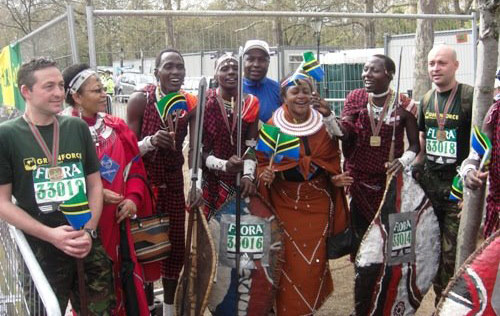
On Sunday 13 April six Maasai Warriors ran the Flora London Marathon to raise funds for a lean water supply for their community in Eluai Village, Monduli Juu. Nguru, Lengamai, Kesika and Ninna completed the race in 5 hours 24 minutes alongside Paul Martin of Greenforce. Isaya, their leader, became ill halfway through the race and was taken to hospital as a precaution accompanied by Taico. The next day, determined to complete the race, Isaya and Taico returned to where they had dropped out and ran the remaining 14 miles, crossing the finish line in a total running time of 4 hours 45 minutes. It was then announced that they had achieved the target of £60,000 and the figure is still growing. The Warriors were supported by various BTS members including Aseri Katanga, Abubakar Faraji and their children, John and Peter Leonhardt, Trevor Jaggar and Liz and Ron Fennell – see BTS Newsletter for more

TANZANIA IN THE INTERNATIONAL MEDIA

President Bush’s visit to Tanzania in February received widespread international coverage. For example, the SOUTH CHINA MORNING POST (February 18) reported that President Bush had signed a 5 year $698 million new aid package for Tanzania. In Arusha President Kikwete spoke about Barack Obama and the excitement of the American presidential election. “The US is going to get a new President. Whoever it is, for us, the most important thing is, let him be as good a friend of Africa as President Bush has been.”
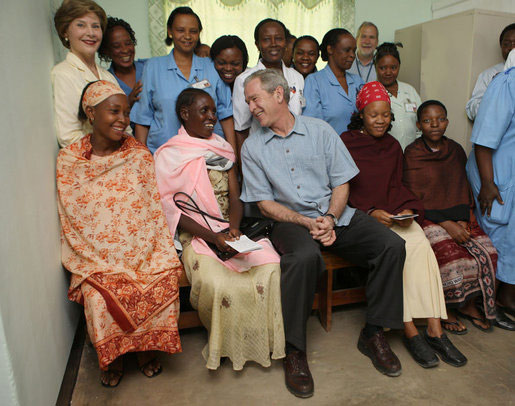
US president Bush at a health centre near Arusha
At a joint press conference in Dar es Salaam President Bush said “America doesn’t work with thieves” and added: “The decision to back Tanzania’s efforts to fight poverty has been prompted by President Kikwete’s stand against corruption.” President Bush described Mr Kikwete as a “smart and role model leader in Africa.”

Security was extremely tight during the visit. US security officials camped on the roof a one of the buildings in the State House complex and sniffer dogs were roaming the State House grounds. President Bush arrived in a massive bullet proof limousine which was equipped to fend off heat-seeking bombs from more than 100 metres. Some of the security guards took time off in Arusha in the evening to visit the Greek Club. On the way back to their hotel they were mugged!
President Bush summed up the visit by saying: “It was very moving for us racing through the streets of Dar es Salaam to see thousands of people there greeting us. I really do want to extend my thanks.” President Kikwete gave Mr Bush a stuffed leopard and lion and Mr Bush gave Mr Kikwete a pair of basketball star Shaquille O’Neil’s athletic shoes. In April the US said it would increase the President’s Emergency Plan for Aids Relief (PEPFAR) assistance to Tanzania by an additional $303m, bringing the total amount contributed to over $817m. Again in April they gave some $2.3 million to strengthen smallholder horticultural export market linkages for high value vegetables – Thank you Christine Lawrence and Elsbeth Court for sending parts of the above and Ron Blanche for sending another part from Singapore – Editor.

The London GUARDIAN WEEKLY REVIEW (February 29) wrote: ‘Never mind the bubonic plague, or T.B. or Aids, no disease in the history of the human species has caused more sickness or death and no disease has proved harder to defeat than malaria. It destroyed armies during the first and second world wars and counts among its illustrious victims Alexander the Great, Dante, the Holy Roman Emperor Charles V, Oliver Cromwell and Lord Byron. Meanwhile in Tanzania Shadrack Nuru, a nine months old baby in Bagamoyo, is one of 340 babies who are part of a newly energised global campaign to defeat this tenacious killer. They are participating in clinical trials which are under way to test the efficacy of the most promising malaria vaccine yet devised. Half of the babies have been injected with the prototype vaccine known as RTS.S and half with a control vaccine.

Shadrack, because he is at the centre of a major international research project, has a much higher chance of surviving than the average baby in the country where local doctors estimate that more than 100,000 chil- dren died from malaria in 2007. The cash for the project has come from the Bill and Melinda Gates Foundation. Salim Abdullah, who heads the Bagamoyo Research Centre, was quoted as saying: “I believe we are the first generation in human history with a serious chance of beating malaria. But I would not have dreamt of saying such a thing 10 years ago when we were alone, neglected and unfunded – Thank you Sister Lucia CSP for sending this – Editor.

BIRDS, the publication of the Royal Society for the Protection of Birds, indicated in its May/July issue the concern being expressed by people from Lake Natron regarding a proposed new soda ash plant. This is said to threaten the only breeding site of the African Rift Valley’s millions of lesser flamingos – among the world’s most sensational wildlife experiences. The Tanzanian Association of Tour Operators was quoted as saying: ‘Over and above tour operators’ losses, the country will lose in terms of employment, taxes and the economic trickle-down effect.’ The scheme is a joint venture between the government and Tata Chemicals of India. A spokesman for Tata was quoted as saying “It could well be that this project is impossible to carry out without significant risk to the survival of the lesser flamingo, but that point, in our opinion, has not yet been reached.” Representations about the issue have been made to the parliamentary Committee on the Environment in Dar. Thank you Robert Wise for this – Editor.

The NEW SCIENTIST (19th April) wrote: ‘Despite being one of the world’s poorest countries, Tanzania has become a role model in how to reach global targets for reducing death rates of children and mothers – putting most of its poor African neighbours to shame. So says the World Health Organisation which reported that, of the 68 nations that account for 97 per cent of the world’s childhood and maternal deaths, only 16 are on track to meet millennium development goals in children under five by two thirds and maternal deaths by three-quarters between 1990 and 2015. Between 1999 and 2004 Tanzania increased the annual amount spent on health care per citizen from $4.70 to $11.70. No other African government matched this. As a result child mortality fell by 11 per cent between 2000 and 2005 and Tanzania should be able to reach its target’ – Thank you Keith Lye for this and many other contributions – Editor.

An article in DEVELOPMENTS Issue 41 under the title ‘Net Benefit’ reported on an unprecedented joint venture to protect against malaria between the Japanese giant Sumitomo Chemical and A-Z Textiles based in Arusha. Sumitomo are the creators of the Olyset net which is guaranteed to last at least five years; it never needs re-treatment; its polythene technology makes it virtually tear-proof so it can be washed up to 20 times and still remain effective; its control – release technology enables the non-toxic insecticide to be contained within the fibre, not coated on the outside; it has a quadruple insecticide effect on mosquitoes – bite inhibition, repellency, knockdown and kill. Started in 2004, production has now reached 10 billion nets a year. Some 3,200 people, mostly women, have gained employment.

Kate Elsheby, writing in the April issue of NEW AFRICAN described a visit to ‘the mesmerising, yet little-known Katavi National Park in south-west Tanzania. There are more hippos than anywhere else in Africa. The park receives only 1,200 visitors each year in contrast to the Ngorongoro crater which recorded a record 375 cars on one day alone in August 2007. The animals at Katavi are completely wild and not like other parks where they are used to vehicles and sit watching like moody, camera-weary models. During the dry season Katavi’s crocodiles display behaviour unique to this area which resulted in the National Geographic Society coming out to film them in 2007. The crocodiles slither into caves along the riverbanks to hibernate: lying still, their heart beats slow to two beats per minute, and they remain like this for up to six weeks….’

The ANTIQUE TRADE GAZETTE (November ‘07) reported that the first European credited with successfully climbing Mount Kilimanjaro was Hans Horst Meyer. He eventually reached the summit on his third attempt; On his first he was defeated by deep snow and ice; on the second he was taken prisoner during the Abushiri revolt. In 1891 he published a book on his climbing and this book was recently put up for auction at Christie’s. Gallerie Minerva of Zurich bid £4,200 for it – Thank you John Sankey for sending this – Editor.

The EAST AFRICAN in its March 31 issue devoted two pages to the person it described as ‘Tanzania’s one-man backbench.’ It wrote: ‘Zitto Kabwe, the MP for Kigoma, is at the face of a new breed of young politicians who have lit up the public imagination by incessantly questioning authority and crusading against corruption.’ It went on: ‘Tanzanian society itself is in a state of ferment. For the first time, public pressure is mounting on leaders to account for their actions. And nowhere has this pressure for change been more evident than in Parliament where Kabwe and company have emerged as voices for reform and probity. He represents the new breed of radical nyerereist MP’s who have risen up to revive Nyerereism as an ideology of simplicity and the rejection of the empty worship of wealth…..the man has forced the government to start looking afresh at lopsided mining contracts that Tanzania has signed with multinational mining companies over the years. What CCM bigwigs did not realise was that Kabwe is riding the crest of a wave of popular resentment of mining companies because the people were perceived as not getting a fair share of the revenue from the expanding gold exports…. Kabwe is a trained Trade Economist…. At university he was suspended twice following a student strike…he joined the CHADEMA party in 1993 AND is now Deputy Secretary General. He say he will not contest the next election because he wants to undertake further studies but he is under strong party pressure to change his mind.

The NEW INTERNATIONALIST (October ’07) reported that a number of falconers in the United Arab Emirates have been in negotiations to lease land from the Hadzabe tribe, who dwell near Lake Eyasi and are one of the oldest indigenous groups on the planet. The Hadzabe apparently do not object provided they can continue to co-exist on the land. However, the article says, the Tanzanian government plans to take them off the land and relocate them in ‘shanty towns’ “Their right to their land and their way of life is under threat and protest is gathering worldwide” Sheikh Hamdan Bin Zayed Al Nahyan, Head of the UAE Falconers Club, is being petitioned to intervene in the case by falconers and also to help to see that the Hadzabe are treated with respect – Thank you Sister Lucia CSP for sending this – Editor.

MISCELLANY

In two years time 24 100m-plus-high power generators able to produce 50 MW of power (almost 10% of Tanzania’s current power needs) are due to have been erected in Nijapanda village in Singida region as part of the first commercial wind farm in sub-Saharan Africa. The company behind the $113m project is ‘Wind East Africa.’ “It’s important that Tanzania diversifies its power sources,” says project manager Mike Case. “The country is very reliant on hydro-electric power, which means that in times of drought, there is a power deficit. Oil-generated power is very expensive, so wind power offers a cheaper and more reliable alternative.”
The demand for power in Tanzania is growing by more than 50 MW a year, fuelled partly by an expansion of gold and nickel mining in the north of the country. At present, electricity is sourced from power plants more than 1000 kms away. This first wind farm will mean that power-hungry industries will soon be provided with electricity generated locally.
According to wind expert Dr Ladislaus Lwambuka, from the University of Dar es Salaam, Africa is now ready for wind power on a commercial scale. There are already plans, if the first phase of the project goes well, to double the number of wind turbines and increase Wind East Africa’s output to up to 100 MW – BBC News.
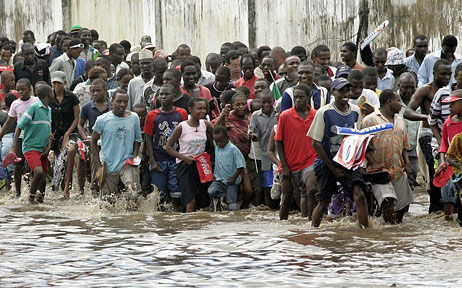
People braving torrential rain to see the Olympic Torch procession pass through Dar-es-SalaamPeople braving torrential rain to see the Olympic Torch procession pass through Dar-es-Salaam
The Olympic Torch for the Beijing Olympic Games passed through Dar-es-Salaam as the only African leg on its world tour to reach China. Thousands of people turned out to watch the procession despite torrential rain and flooding. There were no reports of protests which have affected the other legs of the torches journey.


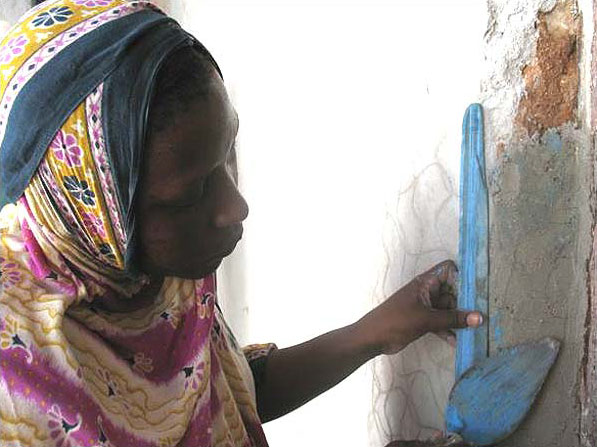
An article on the BBC NEWS website ( 10th April) describes how a small army of women are trying to restore the labyrinthine alleys and carved wooden doors of Zanzibar Stone Town. “Among them is 31-year-old Asma Juma, one of six Zanzibari women who have been trained to plaster. She is part of a team restoring a dilapidated old spice house which will be reborn as a tourist hotel. All the women have been taught by Vuai Mtumwa, who says that they all like the work because of their desire to renovate Stone Town. “They work hard, they come every day,” Mr Mtumwa says. “They are working like men. Some work they can’t do – they don’t climb the scaffold.” Mohammed Mughery, from the Zanzibar Stone Town Heritage Society, fears for the future of Stone Town. “Most buildings are made of coral stone and lime mortar. So they need to be attended often. Just a small crack if left will become wider and will lead to the collapse of the building.”
Although the heritage society is making its contribution by renovating the wall of an old trader’s house, there are still dozens of other buildings which need urgent attention. The women plasterers are ready to help out. They’re just hoping that the funds are provided before Stone Town disintegrates beyond repair.”

TANZANIA IN THE INTERNATIONAL MEDIA

The FINANCIAL TIMES published on 7th November an excellent six page supplement on Tanzania.
In a detailed analysis of President Kikwete’s performance since he took office two years ago it said that he had yet to prove that he can build significant new successes on the achievements of his predecessors. The article went on: ‘Some say that ministers imposed on him by CCM elders are dragging him down or that the money men behind the party are blocking reform…. A deeper explanation is that Tanzania lacks political accountability. People in power are isolated from the masses. One manifestation of the problem is corruption……’ In its criticism of the agriculture sector the paper wrote that the delicate matter of land reform remained a deterrent to big agricultural investors. ‘The sector has attracted only about five per cent of new investment since 1980…. In Parliament the opposition is increasingly vocal in its criticisms but, as 63% of MPs are from the CCM, parliament still functions as a rubber- stamp institution.’ Writing about the thriving gold mining sector it noted that the sector paid $28 million in taxes annually from 1997 to 2006 but this was only the equivalent of half the contributions by the country’s biggest beer company. Continue reading →

AMNESTY INTERNATIONAL REPORT

Extracts from the Tanzanian section of the 2007 Annual Report of Amnesty International:
Journalists writing articles criticizing the government were at times harassed, threatened or arrested. Three journalists of Rai newspaper were arrested and charged in July. In August a Citizen journalist was arrested and threatened with being stripped of his citizenship and expelled from the country on account of an interview he gave in a documentary film about arms trafficking. Three visiting mainland journalists were briefly arrested in Zanzibar in September.

Female genital mutilation continued to be illegally practised in many rural areas on the mainland, with rates of over 80 per cent among some ethnic groups. No prosecutions were reported. The World Health Organization reported a high rate of domestic violence in Tanzania, with 30 per cent of victims suffering serious injuries due to severe beatings.
The government accepted the need to reduce severe overcrowding in prisons but little action was taken. The National Commission for Human Rights and Good Governance inspected mainland prisons and criticized harsh conditions, particularly the holding of juvenile prisoners together with adults. The Commission was still barred by the Zanzibar government from working or opening an office in Zanzibar.

The government ordered the deportation of all illegal immigrants who had failed to register or apply for citizenship. Deportations began of several thousand people originating from neighbouring countries such as Rwanda, Burundi, Uganda and Democratic Republic of the Congo who had lived in Tanzania for up to 15 years or longer. There were a much larger number of such people, some of whom were former refugees integrated into rural communities who had never regularized their status.
In August President Kikwete commuted all death sentences on mainland Tanzania to life imprisonment. The total number of commutations was not officially disclosed, but was estimated to be about 400. At the end of 2006, no one was under sentence of death in Tanzania.

TANZANIA IN THE INTERNATIONAL MEDIA

NEW AFRICAN in its May issue included an interview under the heading ‘Jakaya Kikwete – SADC cannot abandon Zimbabwe.’ The first question was: “You have been to Europe twice in recent months. Did Zimbabwe come up in your discussions with European leaders?” Reply: “Oh yes. Everywhere. The US, Europe, the Nordic countries. Zimbabwe is a big story of huge interest. There is a lot of dissatisfaction in Europe and beyond on what is going on in Zimbabwe and they see President Mugabe as some kind of devil. They think that we in Africa should have done something to have him removed….. But we have been saying: fine, you can condemn when something is not going right but our approach has been to say let’s talk about the issues”. Continue reading →

TANZANIA IN THE INTERNATIONAL MEDIA

According to the Kenyan NATION a Tanzanian held in connection with the US embassy bombings in Nairobi and Dar es Salaam in 1998 has apologised to victims. Ahmed Khalfan Ghailani (33) told a US military tribunal at Guantanamo Bay in Cuba on March 17 that he did not know about the bombing and was sorry for assisting the bombers. But he denied charges that he bought a lorry used to deliver the Dar embassy bomb. Continue reading →

TANZANIA IN THE INTERNATIONAL MEDIA

The ECONOMIST wrote at length about Tanzania in its September 28 issue. Brief extracts: ‘For the moment, Tanzania is one of East Africa’s few good-news stories. That isn’t saying much. The country remains wretchedly poor, inefficient, with little medical care in its remote areas, few roads and with frequent power cuts, even in Dar es Salaam. But donors, disillusioned by the corruption and/or brutality that goes on elsewhere, are happy to pour money into somewhere that is, at least, both peaceful and stable. And in Jakaya Kikwete, Tanzania has found a president committed to doing his best to cut poverty. Continue reading →

TANZANIA IN THE INTERNATIONAL MEDIA

According to an EAST AFRICAN STANDARD report on 2nd July, not all was sweet and light in CCM before President Mkapa voluntarily opted out of the chairmanship of the party a year earlier than an election was due. Extracts: Mkapa was quoted as speaking about the poisoned political atmosphere in the party in 1995 when founding President Julius Nyerere had decided to back Mkapa for the presidency, despite Jakaya Kikwete having won the nomination. The grudge was said to have persisted to this day. Continue reading →

TANZANIA IN THE INTERNATIONAL MEDIA

In reviewing the probable future of the East African Community in the Kenyan THE NATION (March 26) Gitau Warigi concentrated on Tanzania’s new leader. Extracts: ‘Kikwete has started off doing some sensible things, like cracking down on crime and police corruption. He has also ruffled his country’s male establishment by appointing a host of women to powerful government positions. For me, Kikwete’s main problem is that he is a populist. The worry is whether he will allow this populism to play havoc with sensible governance. Most of the extravagant manna he promised during his presidential campaign is clearly not something poor Tanzania can afford right now. This populism could turn problematic in other ways. There is a powerful political and business lobby in Tanzania, which takes it as its calling to raise red flags about Kenya and its presumed designs to suffocate its neighbours economically. Continue reading →