TANZANIA IN THE INTERNATIONAL MEDIA

by Donovan McGrath

Five dead after helicopter crash on Mount Kilimanjaro
(Daily Mail online – UK) Extract: The Tanzania National Parks Authority said the victims were a Tanzanian guide Innocent Mbaga, a 32-yearold doctor Jimmy Daniel, a Zimbabwean pilot living in Tanzania Constantine Mazonde, 42 and two Czech tourists, David Plos and Anna Plosova, both 30, who were on board the Airbus helicopter when it crashed. The helicopter crashed near the mountain’s Barafu camp … Tanzania’s Civil Aviation Authority said in a statement. The Mwananchi newspaper and East Africa TV, citing Kilimanjaro region’s head of police, reported that the helicopter was on a medical rescue mission before it crashed. Musa Kuji, the commissioner for Tanzania National Parks, told reporters that the Czech tourists had been on a six-day trip … They were on their descent from the mountain when the helicopter crashed around the Barafu Camp area in Kilimanjaro National Park, Mr Kuji said. Meanwhile, the Aviation Authority announced … that an investigation had been launched, in accordance with international aviation safety standards, to determine the circumstances and probable cause of the crash. Although around 50,000 tourists climb Kilimanjaro annually, aircraft accidents are rare on Mount Kilimanjaro, with the last recorded incident in November 2008, when four people died. Mount Kilimanjaro, Africa’s highest peak, is nearly 6,000 metres (20,000 ft) above sea level. The crash happened between 4,670 and 4,700 metres, Mwananchi reported. The helicopter belonged to a company called Kilimedair, officials said. The company’s website says it offers a speedy descent service for climbers who have reached Kilimanjaro’s peak and find the ‘traditional two-day descent’ challenging, offering flights that allow them to ‘skip the long trek’. (25 December 2025)

Newly identified species of Tanzanian tree toad leapfrog the tadpole stage and give birth to toadlets
(CNN online -USA) Extract: Scientists have newly described three extraordinary species of tree toad that leapfrog over the egg-totadpole stage. The females give birth on land to dozens of toadlets, each measuring just a few millimetres long. Live birth, or skipping the egg-laying and larva stage, is extremely rare in amphibians. Among nearly 8,000 species of frogs and toads, fewer than 1% are viviparous, or bear live young. This strategy may have evolved as an adaptation in habitats lacking easy access to water where frogs and toads typically lay their eggs, the study authors reported. “Describing these new species that give birth to live young is fascinating and helps us understand the evolutionary flexibility of amphibians, one of the most diverse and ecologically sensitive groups of vertebrates,” said Dr. Diego José Santana, curator of amphibians and conservation ecologist at Chicago’s Field Museum of Natural History… The three varieties of tree toad from Tanzania were previously classified as one species: Nectophrynoides viviparus. However, when scientists analysed the physical traits and genetic data of hundreds of museum specimens, along with vocal recordings of toads in their habitats, they determined that the three types of toad were separate species in the Nectophrynoides genus. These newly described species provide researchers with a clearer picture of the diversity in tree toads that bear live young and could help to conserve them… Toads that reproduce in water lay an impressive number of eggs – in some cases about 20,000 in a single clutch. “They can do that every couple of weeks,” said Dr. Mark Scherz, senior author of the study published … in the journal Vertebrate Zoology. “They lay those eggs and they develop into teeny, tiny, tadpoles, of which only a fraction ever make it out of the pond,” … Live birth, in which the eggs are fertilized internally, by comparison, yields toad broods that are significantly smaller: around 40 to 60 toadlets. “The maximum we’ve ever recorded was, I believe, over 160 fully developed toadlets inside one individual,” he added… In 1905, German herpetologist Gustav Tornier found and described the first viviparous toad species,N. viviparus, in Tanzania. They measure no more than 1.5 inches (37 millimetres) long, have slender fingers with rounded discs at the tips, and glandular masses (sometimes referred to as “warts”) on their limbs. The toads come in a variety of hues, including white, pale grey, buttery yellow, caramel brown, earthy red or black. Scientists have since identified more than a dozen Nectophrynoides species that bear live young. N viviparus is the most widespread species in the genus and the only one found in Southern Highlands of Tanzania as well as the country’s Eastern Arc Mountains, where all other Nectophrynoides species live… (14 November 2025)

The TAZARA turns 50
(Al Jazeera online – Qatar) Riding the troubled railway line between Tanzania and Zambia as China moves to rebuild it. Extract continues: Dar-es-Salaam, Tanzania, to Kapiri Mposhi, Zambia – In Dar-es-Salaam’s train station, hundreds of passengers sat amid piles of luggage as a listless breeze blew through the open windows. Shortly before their scheduled 3:50pm departure on the Tanzania-Zambia Railway Authority’s (TAZARA) Mukuba Express train, an update crackled over the tannoy: the train would be leaving two hours late. A collective groan rippled through the crowd, and under the soaring roof of the station, pigeons darted back and forth, disappearing into holes left from rotted-out ceiling tiles. But nobody was really surprised. Given the train’s reputation for unreliable service, the passengers knew a two-hour delay for the TAZARA was practically on time. The railway runs from Tanzania’s largest city through the country’s southern highlands and across the border into Zambia’s copper provinces, finally pulling into the town of Kapiri Mposhi some 1,860 kilometres (1,156 miles) away. It’s a journey that, according to the official timetables, should take about 40 hours. For regular passengers, it’s a cheap way to reach parts of the country that are not located near main highways. For foreign tourists, it’s a unique way to see Tanzania’s landscapes far from the bustling cities and overcrowded safari parks, provided they are not in a hurry. A first-class sleeper car all the way to Mbeya, a travel hub and border town just to the east of Zambia, surrounded by lush mountains and coffee farms, is just over $20… [The] railroad celebrated its 50th anniversary, but it has struggled for most of its existence requiring foreign investment for basic upkeep and failing to haul the amount of freight it was built to carry. Inconsistent maintenance and limited investment have seen its infrastructure and cars deteriorate from decades of use. It’s hard to determine exactly where a trip on the TAZARA will be at any given time, due to the myriad delays and breakdowns that randomise each journey. Simple derailments from poorly loaded cars and deteriorating tracks are common, and then there’s the occasional unfortunate brush with nature … [the] service was cancelled after a passenger train struck an African buffalo while passing through Tanzania’s Mwalimu Julius Nyerere National Park. But since the beginning of 2025, the TAZARA has been plagued by more serious incidents – and fatalities that reveal the desperate need for an overhaul of both ageing infrastructure and poor safety management. In April, two locomotives being moved from Zambia to a workshop in Mbeya for repairs derailed at a bridge in southern Tanzania, killing both drivers. Two months later, in June, a train derailed in Zambia and was then struck by the “rescue train” dispatched to assist it. The collision killed one TAZARA employee and injured 10 staff and 19 passengers, according to a media release from the railway. Citing “unexpected operational challenges,” passenger service was briefly suspended … As it turned out, the few operational locomotives the TAZARA could field were stuck in Tanzania, after a fire damaged one of the hundreds of bridges along the track. But big improvements for TAZARA are on the horizon, thanks to a major investment by the China Civil Engineering Construction Corporation (CCECC), which has pledged $1.4bn to refurbish the ageing rail line over the next three years… Most of the money will be spent on rehabilitating the tracks, but $400m will go toward 32 new locomotives and 762 wagons, “significantly increasing freight and passenger transport capacity,” according to a TAZARA statement. In return, the Chinese state-owned corporation will receive a 30-year concession to run the TAZARA railway and recoup its investment before turning day-to-day management back over to Tanzanian and Zambian authorities… In the 1970s, the Chinese government invested in the TAZARA project – when Western nations wouldn’t – as a symbolic gesture towards former colonial and now-independent nations, hoping to spread goodwill and communist thought through cooperation and development. Now, infrastructure projects are more explicitly tied to financial outcomes. The scramble for copper in Zambia to fuel the development of green technology, electric cars, and more means repairing the TAZARA and increasing its reliability will facilitate the flow of copper ore to Chinese ports and factories. Throughout its life, the TAZARA has underperformed, moving a fraction of its design freight capacity of 5 million tonnes of cargo per year – currently, that number is about 500,000 instead. With the planned improvements, Chinese investors hope to quadruple that number to move two million tonnes of cargo annually along the railway. Many Tanzanians use the train for business as well, though on a much smaller scale. The passenger trains include room for cargo, and cheap goods from Dar-es-Salaam can be easily sent to towns and villages along the line. . . [What] is likely the real goal of China’s latest investment[?] While official statements from TAZARA and CCECC focus broadly on rehabilitation and efficient service, the railway’s core purpose – linking Zambia’s Copperbelt to Dar-es-Salaam’s port – makes copper exports the obvious driver… [Improved] timetables for passenger service, are likely secondary goals to those involved in the refurbishment project… [Representatives] from China, Tanzania and Zambia met in Lusaka to inaugurate the agreed-upon project, and promised a prosperous future for all involved. The revitalisation has started at Kapiri Mposhi, with an announcement of “boots on the ground” on TAZARA social media accounts, with pictures of a Zambian work crew lowering a new section of rail into place. Though the investment from China means ceding control of the TAZARA for three decades, Zambian President Hakainde Hichilema highlighted the potential upside of a new economic corridor, and focused on the people who have lived along the nearly 2,000km of railroad for generations. “This is your asset,” he told them. “Look after it from Kapiri Mposhi in Zambia all the way up to Dar-es-Salaam in Tanzania.” (28 December 2025)

Chronic water shortages dampen holiday mood in Tanzania’s biggest city
(BBC News online – UK) At first light in Tanzania’s main city Dar es Salaam, some of its six million residents begin their day with a frantic search for water. Extract continues: Christmas is approaching, but the festive mood is dampened by the dry pipes, as the city experiences serious water shortages. In some homes, plastic containers are stacked outside the door, ready to be carried at a moment’s notice whenever word spreads that a nearby tap is flowing again. City authorities ration water. Homes get it once a week, but the wait can stretch for weeks for some families. The crisis, caused by a drought and rising demand, has persisted for months. Many people are forced to turn to private vendors, who source their water from boreholes and tanks. They are a respite for thousands of families, but their high costs are a heavy burden to low-income households… Furaha Awadhi, a mother of two living in Tegeta on the outskirts of the city, says the price of water has risen from $4 (£3) for 1,000 litres to $10… Unlike many other major Tanzanian cities, Dar es Salaam has been particularly vulnerable to the failure of the October to December rainy season. Even Dodoma, which often receives little rainfall throughout the year, is less affected thanks to its man-made dams. In contrast, Dar es Salaam lacks a nearby freshwater source … Much of the city’s drinking water (about 70%) comes from the Ruvu River, whose flow is closely linked to seasonal rainfall inland… “When water is scarce, everything else stops. . . The government has acknowledged the severity of the problem. Water Minister Juma Aweso told the BBC that Dar es Salaam’s dependence on rainfall-fed rivers had left it particularly exposed. (24 December 2025)

Israel has confirmed Hamas handed over the remains of deceased Tanzanian hostage Joshua Mollel […] under the US-brokered Gaza ceasefire deal.
The Israel prime minister’s office said that, following the completion of forensic tests at the National Centre of Forensic Medicine, the foreign ministry had informed the 21-year-old student’s family. Mollel was undertaking an agricultural internship in southern Israel when Hamasled gunmen attacked on 7 October 2023. He was killed at Kibbutz Nahal Oz and his body was then taken by fighters. His return means six deceased hostages – five Israelis and one Thai – are still in Gaza. “The government of Israel shares in the deep sorrow of the Mollel family and all the families of the fallen hostages,” the Israeli prime minister’s office said … The Hostages and Missing Families Forum in Israel said: “Amid their grief and the knowledge that their hearts will never fully heal, Joshua’s return offers some comfort to a family that has endured unbearable uncertainty for over two years.” Before handing over Mollel’s remains to the Red Cross in Gaza … Hamas’s military wing said that it had recovered a hostage’s body in the eastern Shejaiya neighbourhood of Gaza City… (6 November 2025)

China, Tanzania reaffirm longstanding friendship, pledge deeper cooperation
(Xinhua News Agency – China) Extract: China and Tanzania are friends with a shared future, and the friendship forged and nurtured by leaders of the older generation remains the most valuable spiritual asset of the two countries, Chinese Foreign Minister Wang Yi said … Wang, also a member of the Political Bureau of the Communist Party of China Central Committee, made the remarks during a meeting with Tanzanian President Samia Suluhu Hassan in Dar es Salaam, Tanzania. Hassan asked Wang to convey her New Year greetings and best wishes to Chinese President Xi Jinping. She thanked China for its strong support for Tanzania’s development under the framework of the Forum on China Africa Cooperation. The Tanzanian side firmly adheres to the one-China principle, Hassan said, adding that Tanzania is ready to align its development plans with China’s, deepen practical cooperation, advance the revitalization of the Tanzania-Zambia Railway and the building of a regional prosperity belt, strengthen inter-party exchanges, expand people-to-people interactions, and promote economic growth so as to bring benefits to the two peoples. Hassan spoke highly of the four major global initiatives proposed by Xi, saying that Tanzania stands ready to enhance multilateral coordination with China and jointly promote a more just and equitable global governance system. The Chinese foreign minister conveyed Xi’s cordial greetings to Hassan, saying that China and Tanzania are friends with a shared future. The friendship between the two countries was forged and nurtured by leaders of the older generation, has withstood the test of changing international circumstances, and remains a most valuable spiritual asset, he said… (12 January 2026)
TANZANIA DEVELOPMENT TRUST

by Sheila Farrell

TDT’s priorities: clean water – The scale of the problem
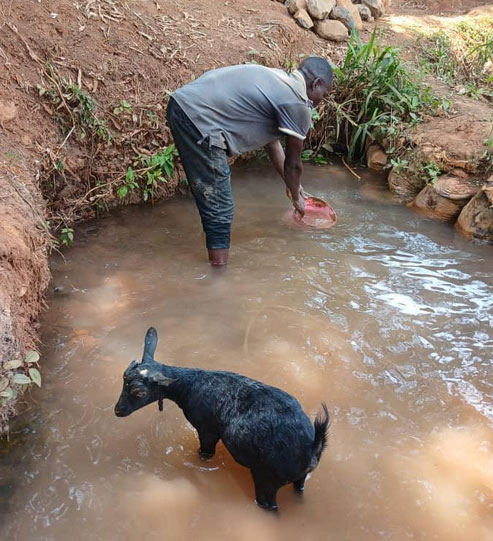
In rural Tanzania, fewer than half of all households have access to clean water within 30 minutes of their homes.

This leads to unnecessarily high rates of gastrointestinal illness, premature mortality especially amongst babies and young children, poor school attendance rates, lost working hours and a lot of time spent fetching water. In 2022 the World Bank estimated that inadequate water and sanitation were costing Tanzania a minimum of US$2.4 billion p.a. or 3.2% of GDP . Almost 70% of these costs were incurred in rural areas.Dirty water, poor sanitation and hygiene are the main causes of gastrointestinal infections like diarrhoea, cholera and hepatitis A & E which pose significant public health risks, especially amongst the under-fives. Although untreated water can be boiled, this does not eliminate all pathogens whilst increasing the already large demand for firewood.

In 2022, diarrhoea ranked fifth among diseases presented to outpatient departments, accounting for 3.7% of all cases. This increases to 8.5% for children under five, even though most cases are treated at home and therefore go unrecorded.

Studies suggest that access to clean water reduces the incidence of diarrhoea by 52%, compared with improved sanitation (24%) and more use of handwashing (30%) . This is why the provision of clean water to rural communities has become one of TDT’s top priorities.

Poor water and sanitation are responsible for an estimated 31,000 deaths in Tanzania each year, of which 18,500 are children. Pregnant women are particularly susceptible to waterborne infections, which contribute to Tanzania’s high rate of stillbirths – 19 per 1,000 births compared with only 3.2 per 1,000 births in the UK – and low birth weights. Children face cognitive deficits, stunting, and a reduction in lifetime earnings due to their shortened learning time at school, whether this is due to absenteeism caused by illness or school time spent carrying water. Even when physically present their ability to learn may be undermined by debilitating waterborne diseases that result in poor digestion of food.

For adults, the World Bank estimates for Tanzania as a whole that water and sanitation related diseases cause the loss of at least six million working days each year, with a further 1.1bn hours lost travelling to fetch water. During the dry season the distance that rural households have to travel to reach any water source – clean or dirty – is approximately doubled as rivers and ponds dry up. Climate change, by extending the length of the dry season, is already making this situation noticeably worse.

The role of the public sector
In 2006 Tanzania launched its Water Sector Development Program (WSDP). Across three phases, this had a total budget of around US$10bn, although the second half of the programme has been characterised by serious under-spending as support from international donors has become more difficult to secure.

Actual government spending on WASH projects has been around 2.53.0% of its budget before debt servicing. However, only 20-25% of the water budget has been spent on explicitly rural projects despite 60-65 % of Tanzania’s population living in rural areas.

This is because urban water systems are expensive, politically visible, and better equipped to absorb big capital budgets, which makes them more attractive to the international donors who have funded around half of the WSDP.

Originally most WSDP projects in rural areas were implemented by small local authorities, with patchy results. Common failings were:
•The high proportion of rural water points falling out of use due to lack of maintenance.
•Weak post-construction support.
•Limited technical knowledge of water engineering within local authorities.
•Affordability and revenue collection issues.

Partly to address these concerns, in 2019 the government created the Rural Water Supply and Sanitation Agency (RUWASA). Instead of the large piped-water and storage systems found in urban areas, RUWASA focuses on boreholes, gravity-fed sources and small piped-water networks, as well as the rehabilitation of neglected water points that have fallen into disuse.

It works closely with community-based organisations, providing technical assistance to ensure that schemes remain operational over time, whilst devolving management responsibility to local communities as far as is practical. RUWASA also provides hygiene training to ensure that the benefits of clean water are not wasted.

Because RUWASA is still building up its operational capacity, it is difficult to assess how much difference it has made. Community management of water resources has been strengthened in some towns and villages and there appears to have been an increase in the proportion of Tanzania’s water budget going to rural areas. This reflects not only RUWASA’s ability to attract funding from international donors such as the World Bank, GIZ (Germany) and Enabel (Belgium) but also its willingness to work alongside NGOs like Water Mission and WaterAid. TDT has also benefitted from RUWASA’s technical assistance when sponsoring water projects in rural areas.

Nevertheless, many households in rural Tanzania still have no access to clean water and government funding alone is insufficient to rectify this. This is why clean water projects have accounted for an increasing proportion of TDT’s own expenditure in recent years.

TDT’s water projects

Natural spring before protection works


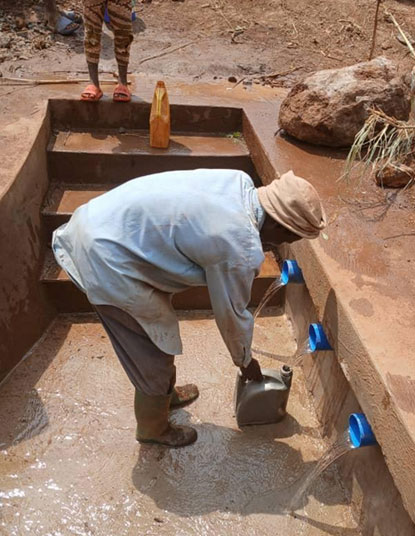
Natural spring after protection works to improve water quality and hygiene

On average just under half of TDT’s annual income over the last four years has been spent on clean water projects. These are of four main types: shallow boreholes, spring protection works, deep boreholes, and rainwater-harvesting/water storage facilities.

Shallow boreholes up to 30m deep are drilled manually and equipped with hand-worked rope pumps. They are simple structures with low maintenance costs, representing excellent value for money at around £1,500 each, and typically serve communities of 1,500-3,000 people. However, the underlying geology is not always favourable, so this type of project has been undertaken mainly in Kasulu District (Kigoma) where TDT’s local partner MvG has now drilled around 180 such bore-holes.

Spring protection schemes filter spring water through gravel beds and channel it into pipes, allowing villagers to fill their buckets from the pipes before the water hits the ground and becomes contaminated. The pipes lead into a concrete basin that takes the overflow (the pipes have no taps) and this is sometimes fenced to restrict animal access. These cost roughly the same as shallow boreholes and serve villages of a similar size, but whereas boreholes can be built close to people’s homes, reducing the amount of time spent carrying water, spring protection works are restricted to places where water reaches the surface naturally. For geological reasons most of TDT’s spring protection projects have been undertaken in Kagera Region to the west of Lake Victoria.

TDT has sponsored relatively few deep boreholes, which can go down to 200m before they reach water. These are more costly, at around £10,000-15,000 per borehole, and require the use of a contractor with expensive mechanical drilling equipment. Because pumping the water up to ground level requires electricity, this type of borehole may require a storage tank to protect villagers against power cuts or allow the use of solar power for pumping. TDT has recently been helping villages with no alternative means of accessing water to develop contracts that will transfer to the contractor more of the risk of not finding water.

Finally, TDT has funded several rainwater harvesting schemes, where water is collected from roofs when it is raining and channelled into storage tanks. These are suitable for small-scale users such as village schools and health centres.

Compared with the scale of the problem, TDT’s contribution is small. But it is providing clean water to villages that would otherwise have to wait many years for it, with low-cost projects that make a big difference to people’s lives. Since 2021-22 we have helped 295,000 people to access clean water. We are grateful to the BTS members who support this work.

References
https://www.worldbank.org/en/country/tanzania/publication/tanzania-economic-update-universal-access-to-water-and-sanitation-could-transform-social-and-economic-development
https://documents1.worldbank.org/curated/en/099141002082366224/pdf/P17961001428f80cf0a6700fadf5ecf43ef.pdf

SWAHILI MATTERS

by Donovan Lee McGrath

On the origin of Monopoly – the board game

Mtu yeyote ambaye amewahi kucheza mchezo wa ubao wa Monopoly anafahamu vizuri mienendo ya Mafanikio kwa Wenye Mafanikio: wachezaji wanaobahatika kutua kwenye mali ghali mapema katika mchezo wanaweza kuinunua, kujenga hoteli, na kupata kodi kubwa sana kutoka kwa wachezaji wenzao, hivyo kujikusanyia mali ya ushindi huku wakiwafilisi wengine. Kinachovutia, hata hivyo, ni kwamba mchezo huo hapo awali uliitwa ‘Mchezo wa Mmilikaji Ardhi’ na ulibuniwa mahususi kufichua dhuluma inayotokana na umilikaji wa mali uliozidi kwa mikono ya wachache, siyo kuuadhimisha.

Mvumbuzi wa mchezo huo, Elizabeth Magie, alikuwa mwungaji mkono mwenye msimamo wazi wa mawazo ya Henry George, na wakati alipoubuni mchezo wake kwa mara ya kwanza mwaka elfu moja mia tisa na tatu aliupa seti mbili tofauti kabisa za kanuni za kuchezwa kwa zamu. Chini ya seti ya kanuni za ‘Ustawi’, kila mchezaji alinufaika kila mara mtu aliponunua mali mpya (ikiakisi wito wa George wa kodi ya thamani ya ardhi), na mchezo huo ulishindwa (kwa pamoja) wakati mchezaji aliyeanza akiwa na kiasi kidogo sana cha pesa alipozizidisha mara mbili. Chini ya seti ya pili ya kanuni za ‘Mhodhi’, wachezaji walipata faida kwa kuwadai kodi waliokuwa na bahati mbaya ya kutua kwenye mali zao – na yeyote aliyewahi kuwafilisi wote wengine alikuwa mshindi wa pekee.

Kusudio la kuwa na seti hizo mbili za kanuni, alisema Magie, lilikuwa kwa wachezaji kupata uzoefu wa ‘mafafanuzi ya kiutendaji ya mfumo wa sasa wa kunyakua ardhi pamoja na matokeo na athari zake za kawaida,’ ili waweze kuelewa jinsi mitazamo mbalimbali ya umilikaji wa mali inavyoweza kusababisha matokeo ya kijamii yanayotofautiana kwa kiasi kikubwa. ‘Huenda ungeweza kuitwa “Mchezo wa Maisha”,’ Magie alinena, ‘kwa maana una vipengele vyote vya mafanikio na kushindwa katika dunia halisi.’ Hata hivyo kampuni ya kutengeneza michezo ya Parker Brothers iliponunua hataza ya Mchezo wa ‘Mmilikaji Ardhi’ kutoka kwa Magie wakati wa miaka ya elfu moja mia tisa na thelathini, waliuzindua upya kwa jina la Monopoly pekee, na kuwapatia umma wenye hamu seti moja tu ya kanuni: zile zilizosherehekea ushindi wa mtu mmoja juu ya wote.

Anyone who has played the board game Monopoly is well versed in the dynamics of Success to the Successful: players who are lucky enough to land on expensive properties early in the game can buy them up, build hotels, and reap vast rents from their fellow players, thus accumulating a winning fortune as they bankrupt the rest. Fascinatingly, however, the game was originally called ‘The Landlord’s Game’ and was designed precisely to reveal the injustice arising out of such concentrated property ownership, not to celebrate it.

The game’s inventor Elizabeth Magie was an outspoken supporter of Henry George’s ideas and when she first created her game in 1903 she gave it two very different sets of rules to be played in turn. Under the ‘Prosperity’ set of rules, every player gained each time someone acquired a new property (echoing George’s call for a land value tax), and the game was won (by all) when the player who had started out with the least money had doubled it. Under the second, ‘Monopolist’ set of rules, players gained by charging rent to those who were unfortunate enough to land on their properties – and whoever managed to bankrupt the rest was the sole winner.

The purpose of the dual sets of rules, said Magie, was for players to experience a ‘practical demonstration of the present system of land grabbing with all its usual outcomes and consequences’ and so understand how different approaches to property ownership can lead to vastly different social outcomes. ‘It might well have been called “The Game of Life”,’ remarked Magie, ‘as it contains all the elements of success and failure in the real world.’ But when the games manufacturer Parker Brothers bought the patent for the Landlord’s Game from Magie in the 1930s, they relaunched it simply as Monopoly, and provided the eager public with just one set of rules: those that celebrate the triumph of one over all.

(cf. Doughnut Economics: Seven Ways to Think Like a 21st-Century Economist by Kate Raworth (2017))

REVIEWS

by Martin Walsh

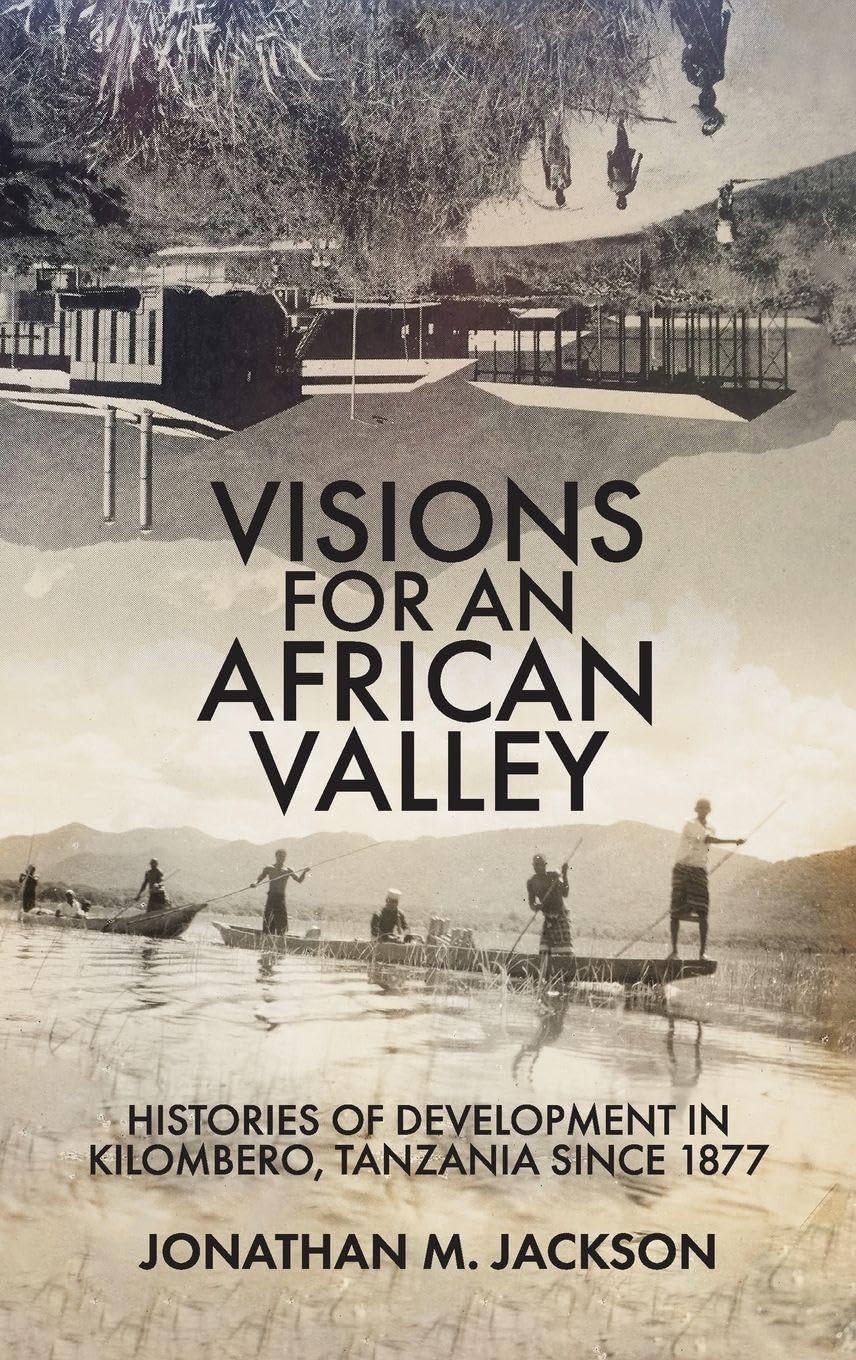
VISIONS FOR AN AFRICAN VALLEY: HISTORIES OF DEVELOPMENT IN KILOMBERO, TANZANIA SINCE 1877. Jonathan M. Jackson. James Currey, Woodbridge, Suffolk, and Rochester, NY, 2025. xvi + 253 pp. ISBN 9781847013941 (hardback) £95.00. ISBN 9781805435525 (eBook) £19.00.

Visions for an African Valley cover


Research on the history of colonial development and future-making in Tanzania has focused on the racial and class politics that influenced development visions and practices. Studies of postcolonial development history have demonstrated how state leaders and their ideologies shaped nation-building trajectories. Notwithstanding the temporal dynamics, scholars have analysed how the flow of finance and technical assistance reveals intertwined global forces such as nationalism and the Cold War, and how foreign development assistance shaped development in Tanzania. Visions for an African Valley moves beyond this conventional analysis. Instead of employing ideological lenses in analysis, it specifically examines how colonial and postcolonial development actors perceived and planned for the Kilombero Valley as a specific geographical area. The choice of Kilombero as a window in exploring Tanzania’s development history is apt given that both colonial and postcolonial governments regarded the valley as a ‘critical development zone.’

Visions for an African Valley employs analytical concepts of ‘future making’ and ‘imagined futures’ to explain the negotiated and contested nature of development plans in the Kilombero Valley. Building on the broad range of archival sources and government reports from Tanzania and the United Kingdom, it contends that colonial and postcolonial development plans in the valley were a ‘future-making’ process dominated by Western development discourses and practices. The author posits that the Kilombero Valley was a tantalising ‘potential’ site for socio-economic development for both colonial and post-independent governments. The multifaceted visions of colonial and post-independent actors regarding the valley led to convoluted development plans. Kilombero’s ecology proved cumbersome to Western experts who had limited knowledge of African tropical ecologies. Consequently, many development ideas and plans failed to materialise. One of the significant points the book makes is that of the colonial and post-independence continuities in dependence on Western finance and expatriates in the planning and implementation of the ‘imagined futures.’ As a consequence, the plans for socio-economic development in the valley assumed a top-down character as they were planned by Western experts without incorporating local populations.

As in Joseph M. Hodges’ Triumph of the Expert (2007), Western-based development consultants and agencies used Western donors’ funds, technologies and expertise to plan for Kilombero Valley development without involving Africans who resided in it. Jonathan Jackson expounds further that many plans and ideas to develop Kilombero ended on paper as great “technical knowledge, gained through reconnaissance and from surveys” (p. 58), but failed to resolve its problems. This observation corroborates recent studies on ‘delayed or failed futures’, which have highlighted how river basin development projects, especially Stiegler’s Gorge (now Julius Nyerere Hydropower Scheme), became ‘delayed futures’ despite both colonial and post-independent development planners envisioning it as indispensable for socio-economic development.

In chapters 1 to 7, the book interweaves the history of development with the history of waterways and transport infrastructure in the valley. It carefully analyses the way colonial imagining of the valley connected development with the plans to build reliable transport infrastructure, a subject which existing development studies have overlooked. To be precise, in chapters 1 to 5, Jackson accounts for how the German and British colonial governments unsuccessfully addressed the transport challenge. He points out that “[i]n many respects, the history of the development in Kilombero is the history of the development of a transport infrastructure, or ultimately its underdevelopment” (p. 57). As in Daniel R. Headrick’s The Tools of Empire (1981), colonial planners viewed railways, roads, and bridges in the colonies, not just in Kilombero Valley, as technical systems for exploiting natural resources for the benefit of colonial empires. Colonial governments planned to bridge the coast and the interior through a railway line, but their visions failed to materialise. The failure of colonial visions to provide reliable transport infrastructure is one of the areas where colonial theory failed to meet practice. Jackson offers valuable insights into transport infrastructure history, thus, extending analysis beyond electricity and irrigation infrastructures, which currently dominate analyses of the valley.

In the last two empirical chapters, 6 and 7, Jackson examines how confidence in using Kilombero to drive development continued in the post-independence era. In building the nation, government perceived the valley “as a spearhead for industrial and economic development” (p. 166). It planned to establish timber and sugar industries and to develop the valley as the country’s agricultural modernisation training centre. Consequently, it received greater financial and technical assistance from international agencies in the 1960s and 1970s, including the construction of TAZARA and a resettlement scheme under socialist Ujamaa policy. Jackson argues that, although these schemes glorified progress, statecraft and patriotic spirit in building the new nation, they were, in reality, a materialisation of past colonial visions, particularly the need for reliable transport infrastructure and stable population in the valley. Although TAZARA “was a railway through and not for Kilombero,” says Jackson, “in any case, it was the fulfilment of one of the earliest development visions for the region” (p. 171).

On villagisation, he writes that, though “[f]or many Tanzanians today, historical memory insists that villagisation began with the implementation of Ujamaa after the Arusha Declaration” (p. 208), Kilombero resettlement schemes of the 1960s and 1970s were a fulfilment of colonial visions to populate the Valley in efforts to address the labour challenge. For him, Ujamaa formalised and implemented earlier visions. TAZARA, villagisation and many other post-independent development projects in the Kilombero Valley were not new post-independence development visions but the realisation of colonial ‘past futures.’

However, this well-researched and impressive piece has some pitfalls. Reading the book’s subtitle, Histories of Development in Kilombero, Tanzania since 1877, one expects to encounter a detailed analysis of Tanzania development issues from 1877 to the present. However, the book’s focus is mainly on the colonial period. Five chapters (1-5) cover the colonial period, while only two chapters (6-7) focus on the post-independence era. Moreover, in chapters 6 and 7, one can only find Tanzanian socialist development visions and practices up to 1976. Despite the subtitle’s promise, Tanzania’s post-socialist development is missing in the analysis, except for a few recent developments, which Jackson mentions in passing in the concluding remarks.

As a matter of fact, the Kilombero Valley has continued to be viewed as a potential area for socio-economic development in Tanzania even today. In addition, the liberal era, which began in the mid-1980s, was ground-breaking in the history of Tanzanian post-independence development. The adoption of liberal policies might have saved the country from the economic crisis of the 1980s, and the Kilombero Valley in particular evidenced a rejuvenated development vision, including an increase in foreign investors. Therefore, to exclude detailed analysis of this period in a book on ‘past futures’ makes Tanzania’s development trajectory incomplete and not helpful to the book’s cause. Readers could have benefited more from the analysis of changes and continuities in development visions in the valley, especially as Tanzania entered its era of economic liberalisation.

Additionally, the analysis could have been extended to integrate development plans in Kilombero Valley with broader development discourses in the country and globally at large. Although Kilombero received special attention from colonial and post-independence planners, it was not the only place that attracted actors’ attention in Tanzania. How did plans and visions on Kilombero Valley uncover broader ideas of exploiting river basins for socio-economic development in colonial and post-independence Tanzania? This is an important question that the book did not address. This makes analysis of the visions on the valley appear as isolated case from other development practices in Tanzania and the world. Lastly, there are minor linguistic mistakes, particularly on the use of Swahili phrases. For instance, one Swahili phrase is written Maendeleo wa Jamhuri instead of the Maendeleo ya Jamhuri (Development of the Republic). Nonetheless, Visions for an African Valley is an essential publication for students and researchers in colonial and postcolonial development studies in Africa. Moreover, historians of technology and infrastructures can also benefit from the book especially on how and why development actors strove for the construction of much-desired transport infrastructure in the Kilombero Valley.

(This is an edited version of a review that first appeared in Zamani: A Journal of African Historical Studies (Vol. 2 (1), pp. 185-188) and was published online on 17 October 2025: https://www.scienceopen.com/hosted-document?doi=10.56279/ZJAHS.2.1.185 )
Emanuel Lukio Mchome

Emanuel Lukio Mchome is a lecturer in history of technology, environment and urbanisation at University of Dar es Salaam. He received his PhD in 2022 from Technische Universität Darmstadt in Germany for a thesis entitled ‘Blackout Blues’: A Socio-cultural History of Vulnerable Electricity Networks and Resilient Users in Dar es Salaam, 1920–2020.

Also noticed:

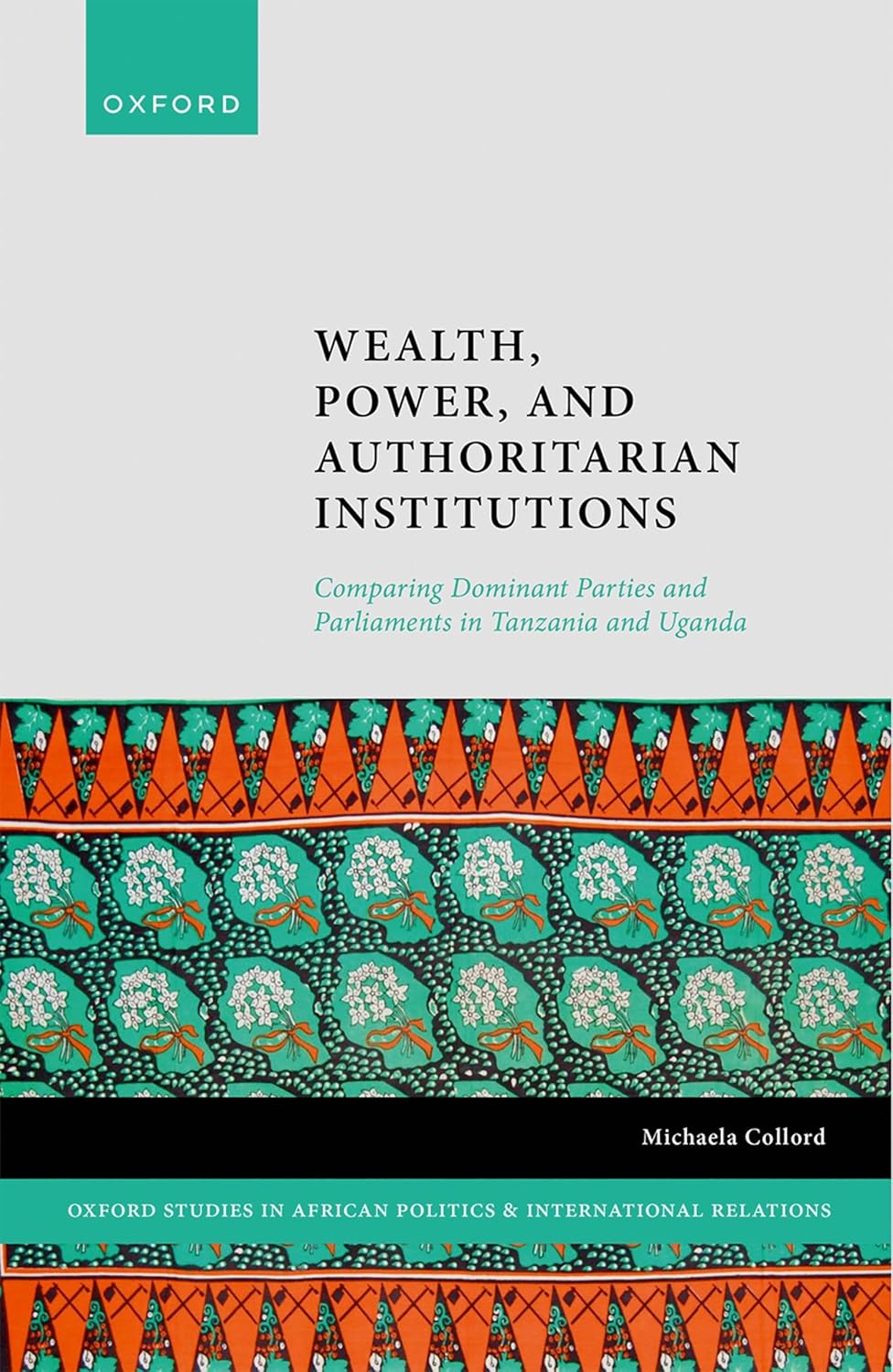
WEALTH, POWER, AND AUTHORITARIAN INSTITUTIONS: COMPARING DOMINANT PARTIES AND PARLIAMENTS IN TANZANIA AND UGANDA. Michaela Collord. Oxford University Press, Oxford, 2024. xiv + 292 pp. ISBN 9780192855183 (hardback) £102.99. ISBN 9780191945335 (Kindle) £90.00.

Wealth, Power and Authoritarian Institutions cover


The author of this comparative study is a Lecturer in Politics and Development at the Global Development Institute, University of Manchester. It’s based on her Oxford DPhil and published in the series Oxford Studies in African Politics and International Relations. The publisher’s abstract follows.

“Through an analysis of the recent political history of Tanzania and Uganda, Wealth, Power, and Authoritarian Institutions offers a novel explanation of why authoritarian parties and legislatures vary in strength, and why this variation matters. Authoritarian political institutions reflect—and to some extent, magnify—elite power dynamics. They are a ‘terrain of contest’, an arena where power is tested, negotiated, and re-ordered. While there are many sources of elite power, the book centres on wealth, exploring how the socio-economic foundations of a regime affect its institutional landscape. This analysis first considers how diverse trajectories of state-led capitalist development shape divergent patterns of wealth accumulation across regimes. Where accumulation is more closely controlled by state and party leaders, as was true in Tanzania until economic liberalization in the 1980s, rival factions remain subdued. Ruling parties can then build up relatively strong institutional structures and parliament remains marginal. Conversely, where a class of private wealth accumulators expands, as occurred in Tanzania after the 1980s and in Uganda after the National Resistance Movement took power in 1986, rival patron-client factions can more easily form. Factional rivalries then channel through the ruling party and into the legislature, simultaneously eroding party institutions and encouraging greater legislative strength. Finally, the book reflects on the significance of a stronger legislature, particularly for distributive politics. It details mechanisms through which legislatures, as ‘terrains of contest’, contribute to both regressive and progressive redistributive outcomes. To support its analysis, the book draws on extensive fieldwork in Tanzania and Uganda.”
Martin Walsh

Martin Walsh is the Book Reviews Editor of Tanzanian Affairs.

PRIMARY HEALTH CARE IN TANZANIA THROUGH A HEALTH SYSTEMS LENS: A HISTORY OF THE STRUGGLE FOR UNIVERAL HEALTH COVERAGE. Ntuli A. Kapologwe, James Tumaini Kengia, Eric van Praag, Japhet Killewo, Albino Kalolo. CABI, Wallingford, Oxfordshire, and Boston, MA, 2023. xv + 257 pp. ISBN 9781800623316 (hardback) £120.75. ISBN 9781800623323 (eBook) £120.75.

This edited collection, written primarily by Tanzanian health professionals, is described by the publisher as follows:“Robust health care systems are paramount for the health, security, and prosperity of people and countries as a whole. This book provides for the first time a chronicle of the struggle for, and eventual success of, universal health coverage (UHC) in Tanzania. Beginning with an introduction to primary health care in the country, from its historical foundations to the major milestones of implementation, this book then considers stewardship of this important aspect of health systems over time. Written in a way to allow the application of lessons learned to other countries’ contexts, this book covers:
—Policy and governance issues such as leadership, human resources, and financing of health systems;
—Practical aspects of health system delivery, including supply chains, community care, new technologies, and the integration of services for particular population groups;
—The impact and mitigation of global events on health systems, such as resilience and preparedness in the light of disease outbreaks or climate change, and social, commercial, and political influences.

Concluding with a look to the future, forecasting the changes and new solutions needed to adapt to a changing world, this book is a valuable reference for policy makers, global health practitioners, health system managers, researchers, students, and all those with an interest in primary health care and reforms – both in Tanzania and beyond.”

The book comprises chapters with the following headings: “Introduction to Primary Health Care”, “Leadership and Governance for Primary Health Care in Tanzania”, “Human Resources for Health”, “Primary Health-Care Financing and Resource Mobilization”, “Health Commodities Supply Chain”, “Health Management Information and Evidence in Primary Health Care in Tanzania”, “Health-Service Delivery”, “Community Health Within Primary Health Care”, “Achieving Health-Systems Resilience in Tanzania”, “Beyond Health-System Building Blocks: Context and Determinants of Health”, and “Looking to the Future of Primary Health Care in Tanzania”.
Martin Walsh

PROSPERITY GOSPEL REDEFINED: THE IMPACT OF CHARISMATISATION ON THE MAINLINE CHURCHES IN TANZANIA. Leita Ngoy. Brill Schöningh, Paderborn, Germany, 2025. xxi + 293 pp. ISBN 9783506796288 (hardback) EUR €92.52. ISBN 9783657796281 (eBook) free to download from https://brill.com/display/title/69943

This open access book, written by a Lutheran Pastor, is based on her doctoral dissertation at Ruhr University Bochum. It’s published by Brill Schöningh in their Global Religion series, and here is their summary:

“This book provides an in-depth discussion of the cultural and missional implications of the explosion of charismatic Christianity on mainline denominations in Africa. The book proposes that the charismatization of mainline churches is a contextual, missional, and transcultural phenomenon that enriches and invigorates African Christian communities. Focused on the experience of the Evangelical Lutheran Church in Tanzania and using Prosperity Gospel as an example, the book explores how some mainline churches are being enriched by adopting practices of charismatic Christianity. It proposes a holistic and contextual understanding of the Prosperity Gospel, understood as the mafanikio gospel in Tanzania, as a relevant theological resource for Lutherans in Dar-es-Salaam. In doing so, it intends to contribute to the needed paradigm shift in theological discourses around Prosperity Gospel to challenge stereotypical criticisms that label it false and misleading.”
Martin Walsh

OBITUARIES

by Ben Taylor

Former Minister Jenista Mhagama has died at the age of 58. She had served in various capacities in government and Parliament, and will be remembered by colleagues as a dedicated public servant whose contributions had shaped policy and influenced national debate.

Mhagama, born in June 1967, completed her schooling from Peramiho Girls’ Secondary School before achieving a Diploma in Education from the Korogwe Teachers Training College. She worked as a teacher for six years between 1991 and 1997.

She was first appointed to the Parliament from a special seat reserved for women in 2000. In 2005, she defeated former Finance Minister Simon Mbilinyi for the right to represent CCM in the upcoming elections for the Peramiho constituency in Ruvuma Region.

Mhagama’s first ministerial role was as Deputy Minister for Education and Vocational Training in President Jakaya Kikwete’s administration between January 2014 and January 2015. She went on to serve in several other roles, including Minister of State in the Prime Minister’s Office for Policy, coordination and parliamentary affairs, Minister of State in the President’s Office responsible for Public Service Management and Good Governance. Her last cabinet position was as the Minister for Health, a position she held until a few weeks before her death.

President Samia Suluhu Hassan expressed her sadness on social media, describing Ms Mhagama as a “distinguished” member of the ruling Chama Cha Mapinduzi (CCM) party for 38 years. The President acknowledged her contributions as a stalwart youth and women’s leader, a minister across multiple administrations, and a mentor in both public life and politics.

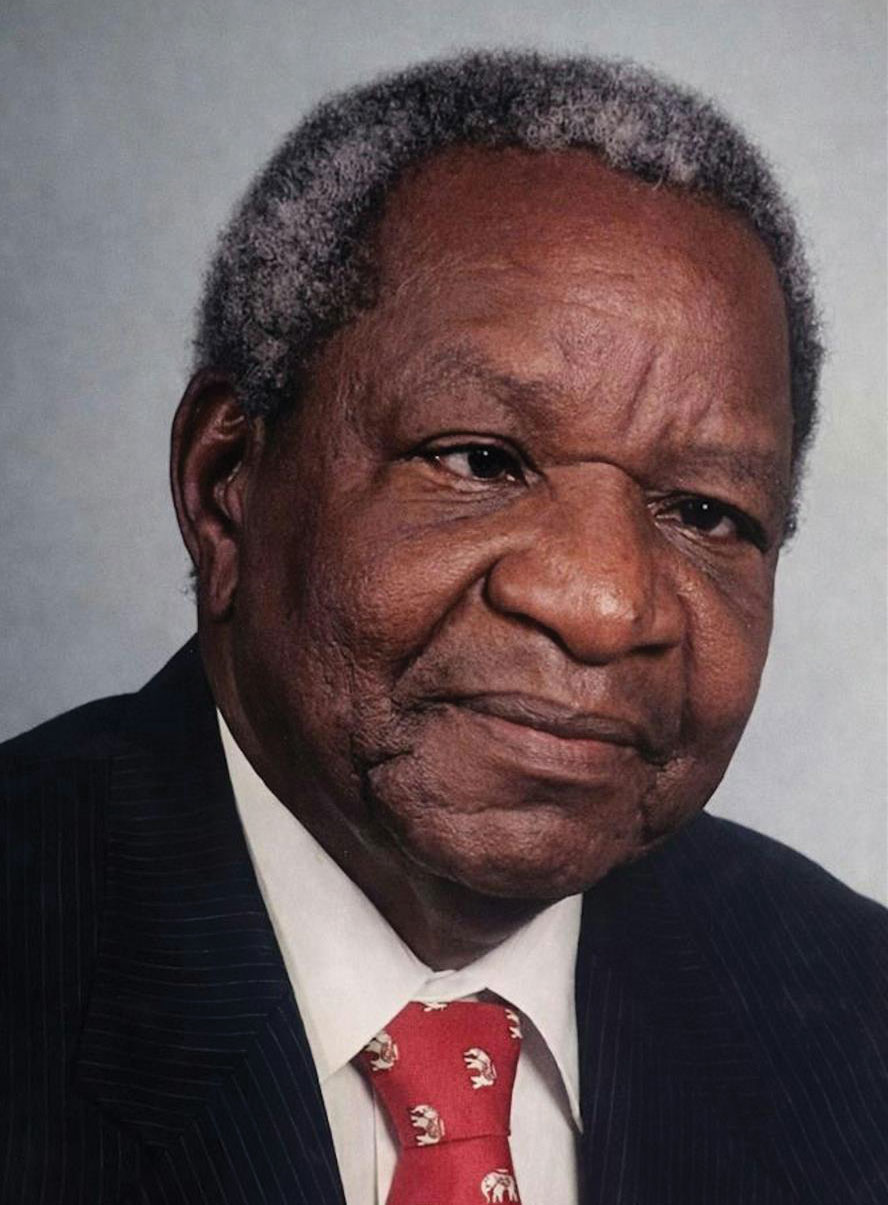
Edwin Mtei, Tanzania’s first Governor of the Bank of Tanzania (BoT) and a founding member of the opposition party Chadema, has died aged 94. He passed away in the early hours of Tuesday, January 20, 2026.

Edwin Mtei

Mr Mtei served as Bank of Tanzania governor from 1966 to 1974, before going on to become secretary general of the East Africa Community from 1974 to 1977 and Minister of Finance and Planning from 1977 to 1979.

When President Julius Nyerere appointed Edwin Mtei to this latter role, the decision placed two men of fundamentally different economic philosophies at the helm of Tanzania’s struggling economy. The collapse of the East African Community, the closure of the Kenya border, declining exports and mounting fiscal pressures had left the economy fragile and increasingly dependent on state intervention.

As detailed in his 2009 book titled From Goatherd to Governor, The Autobiography of Edwin Mtei,[Reviewed in TA 97] he clashed with the President, and the wider cabinet, on issues including export tariffs (which he opposed), parastatal reform (including part-privatisation, which he advocated for). His ideas were unpopular with his colleagues in an era when socialism defined economic legitimacy. Any proposal resembling private ownership was dismissed as ideological betrayal. President Nyerere in particular, while aware of the parastatals’ failures, was unwilling to accept reforms that touched ownership structures or diluted state control.

When Tanzania entered negotiations with the IMF on economic rehabilitation, Mtei sided with IMF on some key points, including parastatal privatisation and devaluation of the shilling. On both counts, Nyerere dismissed the advice, accusing the visitors of insolence and declaring that he would not allow Tanzania to be “run from Washington”. Shortly after this, Mtei resigned his position.

Within weeks, he turned to farming, exchanging his Dar es Salaam home for a coffee estate in Arusha. After initial struggles, a bumper coffee harvest in 198182 enabled him to clear debts and stabilise operations.

He also found his way back into public service. He was appointed executive director for African affairs at the International Monetary Fund in 1983 – a post for which President Nyerere recommended him, showing an impressive ability to refrain from holding grudges. Appointments to key commissions on banking, taxation and public finance put him once again at the heart of reform debates that would reshape Tanzania’s economy in the late 1980s and early 1990s, including seeing many of the reforms that he had previously advocated for being put into practice.

After Tanzania amended its constitution in 1992 to allow a multiparty system, Mtei founded an opposition party, Chadema, with a liberal ideology that reflected the economic views he had proposed as finance minister. Mtei himself quit frontline politics in 1998, but Chadema has survived to be the leading opposition party in the country to date.

Freeman Mbowe, the former national chairperson of Chadema, remembered his predecessor as a man who “was not one for quarrels” but for principled debate on policy.

The party’s current chair Tundu Lissu also paid tribute to Mtei, in a statement issued from prison, where he faces charges of treason. Lissu described Mtei as a principled patriot and a public servant who refused to compromise his convictions in the face of poor governance.

President Samia Suluhu Hassan issued a statement describing Mr Mtei as a “distinguished public servant and visionary” who played a key role in building the country’s economic institutions. She further acknowledged his “historic contribution to the introduction of multiparty democracy.”

FROM THE EDITOR

by Ben Taylor

Dear reader,

Welcome to the latest issue of Tanzanian Affairs.

As you may have noticed, we have taken a slightly different approach to this issue. With the sad news that the editor of the Britain-Tanzania Society newsletter, Jennifer Sharp, passed away earlier this year, the BTS committee has decided, going forward, to incorporate some of what would previously have been included in the newsletter into Tanzanian Affairs. This is starting small, with two pages of news from BTS’s charitable arm, Tanzania Development Trust (TDT). More will follow in future issues.

Of course, you will continue to find much the same type of news that Tanzanian Affairs has always covered. In this issue, this includes extensive coverage of the imminent general elections in Tanzania, as well as articles on Tanzania’s expanding rail and road networks, progress (or lack of) with natural gas processing investment negotiations, the rising importance of tourism to Tanzania’s economy, the challenges around regulation of ride-sharing services such as Uber, and some sporting success.

We also have reviews of some fascinating new books. In Salama binti Rubeya: Memories from the Swahili littoral, Dr Ida Hadjivayanis and Salha Hamdani share the true life-story of their mother / grandmother: casting light on the social history of the Swahili coast from an important but often-neglected perspective. And there are two significant photographic books on Tanzania’s history – the first on the life of Julius Nyerere and the second on the history of the Union.

We have also made a late change in response to the unfortunate news of the passing of Jane Goodall, including reflections from the BTS chair, Paul Harrison.

If you have ideas, stories, or resources you’d like to see featured in future issues, please don’t hesitate to reach out.
Warm regards,

Ben Taylor (Editor)

GENERAL ELECTIONS

by Ben Taylor

Presidential election – the three main party leaders: President Samia (CCM), Luhanga Mpina (ACT Wazelendo) and Tundu Lissu (Chadema)

General elections in Tanzania: October 29, 2025
Tanzania’s forthcoming general elections represent a significant moment in the nation’s democratic trajectory. These polls will determine the presidency, 393 seats in the National Assembly, and local government positions across the mainland and the semi-autonomous islands of Zanzibar, for the next five years.

With over 30 million registered voters, the elections occur against a backdrop of some political re-opening under President Samia Suluhu Hassan, who assumed office in 2021 following the untimely death of President John Magufuli. However, concerns remain over restrictions on critics, opposition participation and institutional disputes, raising questions about the credibility of the broader democratic rebuilding process.

In particular, it looks likely that President Hassan, seeking re-election as the candidate of the ruling party, CCM, will face no meaningful opposition candidate. Chadema’s leader, Tundu Lissu, will miss the election, as he is in prison on charges of treason, and his party has refused to legitimise the elections by putting forward candidates. In any case, the electoral commission has blocked them from participating. The Alliance for Change and Transparency (ACT Wazalendo), the only other party with significant support, has had its campaign interrupted by the electoral commission’s decision to block their proposed Presidential candidate, Luhaga Mpina, from standing – a move on which the High Court has (at the time of writing) not yet reached a final decision.

Voter turnout, which has historically fluctuated between 50%-70%, may be low, due to apathy or bans / boycotts. Meanwhile, a historic surge in female candidates – over 40% of parliamentary aspirants – highlights evolving gender dynamics.

The legacy of 2020
The 2020 general elections inevitably form part of the context for this year’s polls. These were marked by widespread allegations of fraud and violence that eroded trust in Tanzania’s electoral institutions. Incumbent President John Magufuli of CCM secured a landslide victory with 84.4% of the presidential vote, while his party claimed 365 of 393 parliamentary seats. Official turnout was reported at 50.7%.

Opposition parties, led by Chadema, rejected the results, alleging ballot irregularities, intimidation, and the disqualification of many candidates on questionable technical grounds. Chadema’s presidential candidate, Tundu Lissu, garnered just 13%, but rejected the outcome, fleeing to exile amid arrests of party officials.

The polls unfolded under Magufuli’s tightened political environment, including restrictions on independent media and political rallies, which stifled opposition campaigns. International observers, such as the European Union, were absent after being denied visas, leaving only limited Commonwealth and African Union missions that faced restrictions.

Critics argue these elections exemplified “electoral authoritarianism,” where formal democratic processes mask one-party rule. Hassan’s ascension promised reforms, but the 2020 legacy – including distrust in election authorities – persists, fuelling opposition demands for constitutional reforms and true independence for the electoral commission.

Authoritarian drift?
Tanzania heads to the polls amid what some analysts have described as a new narrowing of political space under President Hassan. Once hailed for tentative reforms post-John Magufuli’s death in 2021, this democratic re-opening been increasingly called into question. Freedom House downgraded Tanzania from “Partly Free” to “Not Free” in its 2025 report, citing manipulated voter registrations and broader erosion of electoral integrity. Similarly, the International Institute for Democracy and Electoral Assistance (IDEA), says the ruling party’s approach has transformed what could have been a competitive democratic exercise into one of unchallenged CCM dominance.

UN human rights experts in June 2025 expressed concern over a “pattern of enforced disappearance and torture” against political opponents, urging the government to halt such practices. Amnesty International reports that four government critics have been forcibly disappeared and one killed in 2024-2025, attributing these to efforts to curb opposition ahead of the elections.

More recently, the Tanzania Communications Regulatory Authority (TCRA) suspended the license of Jamii Forums, a major social media news platform on September 6, and has directed police to “patrol the internet” for election-related content since August. Human Rights Watch (HRW) reports broader clampdowns, including bans and/or measures to block access to online platforms like WhatsApp and Twitter / X.

In response to such criticisms, President Hassan on September 17, 2025, urged unity and highlighted the preparedness of security forces to maintain order during the elections: “Peace and stability in our country are more important than anything else. Elections are not a war but a democratic process. Our defence and security organs, both in Mainland Tanzania and Zanzibar, are fully prepared to protect this peace. Citizens must remain calm and united.” Earlier, in March, she said that “we have sworn to protect the rights and dignity of every Tanzanian, and we will not hesitate to act against anyone who exploits these freedoms to incite discord.”

The Tanzania Police Force, in an official statement released on June 18, in response to reports of abductions and disappearances, denied state involvement and attributed many cases to unrelated factors: “In the cases reported at police stations and thoroughly investigated – where the missing individuals were later found either alive or deceased – evidence in some instances has revealed causes such as self-staged abductions, jealousy in romantic relationships, superstitious beliefs, property disputes, acts of revenge, travel to foreign countries to learn extremist ideologies, and fleeing from justice after committing crimes.”

The statement further defended the police’s role: “The government, through the Police Force, has the responsibility to protect people’s lives and property and not otherwise. Furthermore, all reported incidents involving the disappearance of various individuals are still under investigation until the truth is established about what happened to our fellow Tanzanians.”

Beyond Tanzania, the SADC Electoral Commissions Forum (ECF­SADC), which deployed a pre-election assessment mission to Tanzania from August 12-16, reported “no major issues flagged” in preparations for the elections. They recommended enhancements like increased voter education, framing the process as stable rather than flawed. The AU has offered similarly measured endorsement through a June 2025 pre­election assessment that “praised logistical preparations” while urging civic education and rights safeguards, avoiding outright criticism and focusing on constructive engagement.

Chadema’s ban and boycott stance
Chadema, Tanzania’s largest opposition party, will watch this year’s election from the sidelines, facing a controversial ban and/or their own boycott. In April 2025, the (so-named) Independent National Electoral Commission (INEC) disqualified Chadema from presidential and parliamentary contests, after party officials refused to sign the 2025 Election Code of Ethics. Chadema had said it would not sign the code until the government undertook electoral reforms. This followed the arrest of Tundu Lissu, Chadema’s recently-returned leader, on charges that critics have described as politically motivated, and raids on party offices. Chadema, which polled strongly in 2020 in urban areas, also now faces exclusion from all by-elections until 2030.

Rather than a full boycott, Chadema has framed its response as a “No Reforms, No Election” campaign. They call for a truly independent electoral commission, revival of the stalled constitution writing process abandoned in 2013, and legal changes to allow independent presidential candidates and judicial review of presidential election results.

Party officials insist this is not disengagement but a fight for fairness. Nevertheless, the ban / boycott / protest effectively undermines the opposition challenge at the polls, handing CCM a much clearer path.

Zanzibar
Zanzibar’s elections are likely to be more competitive. As a semi-autonomous region, Zanzibar elects its own President, 85-member House of Representatives, and local councils under the Zanzibar Electoral Commission (ZEC), as well as casting votes for Tanzania’s president and MPs in Tanzania’s National Assembly. CCM’s Hussein Mwinyi seeks re-election as President of Zanzibar.

Debates over the relationship between Zanzibar and the Union simmer, with many islanders supporting calls for independence referendums, or at least for constitutional reforms to give Zanzibar increased autonomy.

The opposition landscape on the isles is also somewhat confused. The decline of CUF after 2015 paved the way for ACT Wazalendo as a rising force on the islands. This left-leaning party blends social justice with anti-corruption rhetoric. Nevertheless, lingering elements of CUF threaten to weaken ACT Wazalendo’s vote share and their potential post-election coalition role.

ACT on the national level
Nationwide, ACT Wazalendo faces some similar challenges to Chadema. Their presidential candidate for Tanzania, Luhaga Mpina, was initially banned by INEC from standing. The ban stems from an objection by Attorney General Hamza Said Johari, who argued that Mpina lacks the necessary qualifications based on a prior ruling by the Registrar of Political Parties, citing irregularities in ACT Wazalendo’s internal nomination processes.

Mpina was MP for Kisesa constituency, representing CCM, and served for three years as Minister of Livestock and Fisheries under President Magufuli. In August 2025 he left CCM and joined ACT Wazalendo.
The High Court overturned this decision on appeal, only for INEC to reinstate the ban. ACT Wazalendo immediately challenged the second ban through multiple legal avenues, culminating in a constitutional petition filed on September 19. At the time of writing, with less than one month remaining before the election, the court ruling is pending, thought to be imminent.

Election Monitoring Initiatives
The EU has deployed a 100-member Election Observation Mission (EOM), following Tanzania’s invitation. The African Union conducted a June pre-election assessment, praising logistics but urging civic education. SADC’s Electoral Commissions Forum visited in August.

Other Significant Developments
Beyond core issues, the 2025 elections spotlight women’s empowerment, with over 200 female parliamentary candidates – a 50% jump – driven in part by quotas as well as by Hassan’s trailblazing example.

MANIFESTOS

by Ben Taylor

What do the Manifestos say?
As Tanzania gears up for the elections, the ruling Chama Cha Mapinduzi (CCM) and opposition Alliance for Change and Transparency (ACT Wazalendo) have unveiled their manifestos outlining their goals for 2025–2030. CCM’s document, launched on May 31, 2025, emphasises continuity and alignment with the ambitious Tanzania Development Vision 2050, targeting a $1 trillion economy. ACT Wazalendo’s manifesto, released August 11, 2025, adopts a bolder, reformist tone, critiquing “elite capture” and pledging radical shifts toward equity and resource nationalism. Both prioritise economic transformation, job creation, and social welfare but differ in scope and ideology: CCM’s business-friendly growth-focused approach versus ACT’s interventionist, people-centered reforms.

CCM Manifesto: Building on Stability for Inclusive Growth
CCM’s manifesto for 2025–2030 emphasizes continuation and acceleration of economic transformation, infrastructure development, social services, and stronger institutions. Some of the highlights include:
• Economic growth & industrial transformation: A target to modernize the economy by adding value to local resources rather than exporting raw materials. Industry sector growth target of 9% annually by 2030.
• Agriculture, livestock & irrigation: Aim to improve agricultural production significantly: subsidies on inputs, better seeds, more modern farming, increased irrigation, increase grazing lands (livestock) and fishing sector improvements.
• Employment & revenue: Target to generate 8.5 million jobs in both formal and informal sectors. Strengthening revenue collection, aiming revenue-to-GDP ratio of 15.6%.
• Infrastructure, trade & local industrial zones: Greater investment in roads, ports, railways (including a new/revamped line connecting Tanga, Arusha and Musoma on Lake Victoria), and logistics to boost trade and connectivity. Establishing district-level industrial zones to support localised industrialisation.
• Social sectors & human development: Free education from primary through secondary; more vocational training.
• Housing: formalising housing, surveying, granting ownership, improving access to decent housing.
• Constitutional reform & governance: CCM pledges to revive the constitution review process. Increased attention to inclusivity, participation of civil society, youth, community leaders in consultations.
• Debt, macroeconomic stability: Ensuring national debt remains sustainable and that external and domestic borrowing is used for productive projects.

ACT Wazalendo
ACT Wazalendo positions itself more strongly on redistribution, governance reforms, social justice, and asserting community rights over land and natural resources. Key features include:
• Land, natural resources & resource nationalism: The party describes land as “life” and calls for bold reforms in how land is managed, reversing “arbitrary privatisations,” returning lands improperly converted (ie. to protected areas), allocating idle land to youth/vulnerable groups. They also propose greater transparency in extractive industries; ensuring citizens benefit from mining, oil, gas, forests.
• Social services, equality, human development: Universal health insurance; free education up to university level; improved access to clean water and electricity; stronger social protection, especially for informal sector and rural communities.
• Infrastructure & connectivity: Major infrastructure plans include a Southern Standard Gauge Railway (linking Lindi, Mtwara, Songea/ Ruvuma and mining projects in Njombe), rehabilitation of regional rail lines, strategic roads, and improving ports (Mtwara, Tanga, Bagamoyo, Kigoma). Rural electrification and last-mile access to water, transport and communications networks.
• Governance, justice & constitution: Police and judicial reforms, repealing repressive laws, restarting constitutional review within six months for power limits and an independent electoral body, and a three-tier Union structure for Mainland-Zanzibar equity.
• Inclusive economy & empowerment of ordinary citizens: Reducing elite dominance in national resources; putting citizens at centre of economic planning; formalisation of informal businesses and support for small traders; fair markets and prices for farmers, herders, fishermen; removal of unfair levies etc.
• Environment, climate, tourism: Balancing development with environmental protection; more community-based conservation, protecting coastal areas, mangroves, reefs; implementing green growth; reform in tourism to ensure more of the value stays in Tanzania.

What about Chadema?
Given that Chadema is boycotting the election / has been deemed ineligible, they have not published a manifesto. However, for completeness, their stated priorities include:
• “No Reforms, No Election” is Chadema’s central campaign slogan, calling for “fundamental” reforms in the electoral system. This includes a new constitution or significant constitutional reforms; reforms of electoral bodies and processes, to ensure elections are free, fair, and credible; equal opportunity for all political parties in elections; and fairness in how the rules are applied.

In conclusion
Many of the promises (from both manifestos) are ambitious in scale. Implementation will depend heavily on financing, institutional capacity, corruption control, legal frameworks, and external economic factors (e.g. global markets, climate change). Both align with Vision 2050’s $1 trillion goal but diverge on means: CCM via private partnerships, ACT through state assertiveness.

ACT’s proposals around land restitution and resource sharing may face pushback from existing stakeholders (private investors, communities that benefited under the old allocations, foreign investors). For CCM, sustaining high budget commitments (on infrastructure, jobs, agriculture subsidies) without increasing unsustainable debt or wasting resources will be a challenge.

ECONOMICS

by Dr Hildebrand Shayo

Tanzania’s standing in the context of evolving global geopolitics Recently, an article in an English-language newspaper circulated in Tanzania suggested that Tanzania has been sleepwalking into global irrelevance. The author stated, among other things, that the relocation of UN offices to Nairobi, Kenya, serves as a significant indicator of Tanzania’s declining prominence, given the previous experience from Arusha was a testimony that Tanzania was ready to accommodate such offices.

For Tanzanians, an explanation provided by Susan Ngongi Namondo, the UN Resident Representative in Tanzania, along with the reasons for choosing Nairobi, implied that the author should have reached a different conclusion about Tanzania’s position.

Between 2022 and 2024, Tanzania experienced a significant increase in foreign investment inflows, mainly due to improved policy stability, regulatory reforms, and strategic infrastructure development. Sectors such as mining, energy, agribusiness, and manufacturing, have attracted heightened attention from international investors, bolstered by governmental initiatives aimed at refining investment processes via entities such as the Tanzania Investment Centre (TIC). This positive trajectory has fostered job creation, facilitated technology transfer, and enhanced export diversification – essential components in fortifying Tanzania’s economic foundation.

Under the current leadership, these efforts have strengthened the nation’s economic resilience within the region. These investments align well with the nation’s primary goals outlined in Development Vision 2050 (DV2050), which aims to develop into an upper-middle­income and globally competitive economy by promoting sustainable industrialisation and inclusive growth.

Another area mentioned was human capital and how Tanzania has neglected education. Based on the assessment of the budget approved by the National Assembly from 2022 to 2024, Tanzania has made notable advancements in enhancing human capital by augmenting government investment in education, elevating productivity in both public and private sectors.

Prominent initiatives have encompassed the broadening of access to technical and vocational education, the elevation of teacher training standards, and the incorporation of information and communication technology within educational institutions. The initiatives in place are now yielding tangible results, as a growing workforce gains proficiency in relevant, job-ready skills.

Further, Tanzania made notable advancements in logistics efficiency between 2022 and 2024 by implementing strategic investments in its transport infrastructure. Recent advancements have positioned Tanzania as a key logistics hub in the region, enhancing its trade competitiveness and strengthening economic ties with neighbouring nations.

The procurement of a new fleet for Air Tanzania has significantly improved domestic and regional air connectivity. Implementation of the Standard Gauge Railway (SGR) has improved cargo transportation from Dar es Salaam Port to inland and landlocked nations, such as Rwanda, Uganda, and the DRC. At the same time, advances in port efficiency, such as digitized clearance systems and increased handling capacity, have reduced turnaround times and boosted throughput.

Those with insights and knowledge backed by data from government institutions such as BOT and NBS, and reviews conducted by the World Bank and IMF, can confirm how Tanzania is performing strongly on the regional and global stage, especially as Kiswahili continues to be a preferred UN language and enhances regional and international cooperation.