BUSINESS AND THE ECONOMY

93rd freest economy
Tanzania has been rated the 93rd freest economy in the world with an ‘Economic Freedom Index’ placing of 58.3 out of 100 – 1.8 points higher than in the previous year. The economy registered improved scores in six of the ten economic freedoms tracked in terms of the Index. Tanzania is ranked 11th out of 46 countries in sub-Saharan Africa, and the third out of the four East African Community members ranked. Globally, Hong Kong is leading with an index of 90.0. Zimbabwe and North Korea are the ‘at the bottom.

The report on the Index says: ‘Tanzania scores above the world average in fiscal freedom, investment freedom, and government size,’ reads the Report. Foreign and domestic investors receive equal treatment, although poor infrastructure, government control and corruption remain deterrents. Government spending is moderate, and tax administration has been centralized and modernized.” As in many other sub-Saharan nations, the Judiciary is underdeveloped and subject to the political whims of the Executive. Corruption is a pervasive problem throughout Government – despite feeble attempts at reform over the past decade. The overall freedom to conduct business is seriously limited by Tanzania’s regulatory environment. However, starting a business has improved somewhat, taking an average of 29 days, compared to the world average of 38 days.

Obtaining a business license takes more than the world average of 18 procedures and 225 days… costs are high. Bankruptcy proceedings are fairly straightforward – but still lengthy. Tanzania’s weighted average tariff rate was 7.2 per cent in 2006. Adding to the cost of doing business is motley of negatives that include import and export restrictions; taxes and fees; registration and licensing processes; prohibitive tariffs; inefficient/slow customs implementation, and weak enforcement of intellectual property rights. Ten points were deducted from Tanzania’s trade freedom score to account for non-tariff barriers.

Tanzania has moderate tax rates. Both the top income tax rate and the top corporate tax rate are 30 per cent. Other taxes include a value-added tax (VAT), a property tax, and an excise tax on petroleum products.
In recent years, overall tax revenues as a percentage of GDP have been 12.0 per cent. On the other hand, total government expenditures, including consumption and transfer payments, are low. After five years of growth, government spending in the most recent year equaled 23.5 per cent of GDP! Inflation is relatively high, averaging 6.8 per cent between 2005 and 2007 – and 11-13 per cent currently.’

“World Bank has disappointed us” – Mkulo
Finance and Economic Affairs Minister, Mustafa Mkulo has expressed dismay at the World Bank disclosure of classified information about Tanzania in a public statement. The government reaction was conveyed in a Bank statement which said Tanzania was not doing enough to stamp out grand-corruption, among other things. Mkulo told ‘The Guardian’ in an interview that traditionally, such comments “are not expected to be made in public” because that was not a proper way of disclosing information or making comments. The Minister was specifically referring to information furnished by the World Bank regarding a slight drop of 0.1 per cent by the government on Public Management and Institutions, being one of the specified four rating categories before a country qualified for a soft loan.

However, the World Bank insisted that the decision to make the report public was a shift in policy, aimed at eliminating unnecessary secrecy when dealing with financial communications with various beneficiaries. ‘A sound open policy on the disclosure of information was fundamental to the fulfillment of many roles. “Our intention is to strike the right balance between maximum disclosure and our legitimate concerns to protect certain types of confidential information,” the World Bank information spokesman said.

According to the World Bank Communication Officer in Dar es Salaam, Nicodemus Odhiambo, more ‘open-policy implementation’ would be experienced in future functioning of the Bank to sustain transparency. “Under the new arrangement the general public will have access to non confidential information such as the Quarterly Management Reports, Country Portfolios and Performance Reviews, Implementation Status and Results reports (excluding staff comments), Mission aide-memoirs and Minutes of Concept Review and Decision Meetings,” Odhiambo said. “
“This new approach is consistent with our business model, which recognizes that transparency is critical for enhancing governance, accountability, and development effectiveness,” he insisted.

Minister Mkulo said Tanzania was ranked 4th in the evaluation which covered 34 different countries in Sub Saharan Africa, after scoring above average, equivalent to 3.8 points in a scale of one to six points. Tanzania scored 4.3 points in Economic Management; 3.8 points in Structural Policies; and, 3.7 points on Policies for Social Inclusion/Equity and Public Management and Institutions.

The ranking places heavy emphasis on public finance management and reforms – the Guardian.

Africa`s Governor of the Year
Bank of Tanzania Governor Prof Benno Ndulu has won the 1909 award of the ‘Central Bank Governor of the Year for Africa’ award by the London-based ‘Emerging Markets’ daily newspaper – the newspaper of record for the World Bank, IMF and African Development Bank meetings for the past 18 years. The Governor won the award because of his ‘impeccable performance since he assumed the leadership of the Bank in January 2008.’


Improved Ibrahim Index Rating

The Ibrahim Index attempts to rate the quality of governance of African countries using statistics on 84 criteria arranged in four categories; Safety and Rule of Law; Participation and Human Rights; Sustainable Economic Opportunity; and Human Development.

In the latest ranking, Tanzania has improved by two points to 59.2, and continues to outrank its neighbours – Zambia (55.3), Kenya (53.7) and Uganda (53.6). It is well ahead of Zimbabwe (31.2) and Nigeria (46.5) but still some way behind South Africa (69.4) and Botswana (73.6).

The Mo Ibrahim Foundation held a celebration in Dar-es-Salaam in November to celebrate Africa and promote good governance, including performances from Angelique Kidjo and Youssou N’Dour.
INFLATION RISES AND FALLS

In his 2008/09 budget the Finance Minister projected that the inflation rate would be controlled at below 7% by the end of June 2009. As previously noted in this section of TA the Bank of Tanzania (BoT) is primarily charged by law with maintaining price stability. Hence, they have declared on their website that inflation is their enemy number one. Since they are yet to name their number one friend or rather the ideal inflation rate, it would probably be safe to consider the projected rate as their targeted rate.

However, in 2008, the average inflation rate was recorded at 10.3% with the highest rate being 13.6% in December. By the end of June 2009 it was 10.7%. With such a wide divergence from target one may wonder whether it would be safe to conclude that BoT is failing in its primary objective!

In the June 2009 biannual Monetary Policy Statement the BoT only promises to restore and maintain a low and stable inflation rate which begs the question “what is a low and stable inflation rate or is it a moving target? From previous experience on price stability, particularly the period of falling inflation from 1995 to 2005, a 5% rate would appear to be the ideal to ensure stable prices without jeopardizing economic growth.

The BoT tends to adopt a post mortem-rather than a pro-life approach to reporting, be it monthly or annually, their reports focusing only on what has happened and not what is likely to happen and how they intend to achieve their set targets. The future will be shaped rightly or wrongly by the choices we make today. These choices can sometimes be difficult and may be painful as we witnessed when the government chose to pay foreign debt in the early years of Mkapa’s presidency. In the end the rewards in debt relief, good creditworthiness, increased budgetary support, low inflation rate, sustained economic growth, etc did however justify those choices.

It is high time for the BoT to set out not only why the inflation target could not be met but what they intend to do to achieve it. This will also allow them the chance of bringing to government’s attention the direction of fiscal policy and its potential impact on inflation.

Tanesco (the national electricity company) is still malfunctioning and the government is still unable or unwilling to reform it. There is increasingly heavy reliance on thermal electricity generation to meet increasing demand which leads to high energy costs and provides an erratic supply.

To sustain a projected GDP growth rate of above 7% would require an increased demand for energy and, as western countries’ economies starts to grow, there would be an upward pressure on the oil price which, in turn, would have a further negative effect on the value of the shilling and hence energy and transportation costs and food prices.
With all this in mind the chance of containing inflation at the perceived ideal rate of 5% without transparent, pro-active and coherent policies, which clearly set out a medium to long-term inflation, this outlook is remote.
Joseph Sabas

‘AGRICULTURE FIRST’

In several recent statements President Kikwete and other government leaders have made it clear that agriculture, which employs about 80% of Tanzanians, brings in 30% of foreign currency, and contributes 27% to the national income, is to be Tanzania’s top priority in the drive to expedite development.

Launching the programme on August 4th in Dodoma, the President urged the private sector to participate effectively in the implementation of his new ‘Agriculture First’ (Kilimo Kwanza) declaration. He pledged that his government would “engage the private sector in large-scale farming” in a bid to realise the declaration’s objectives and bring about a green revolution in the country. He said that the private sector had been the only missing link in past agricultural initiatives but it was critical in meeting the ‘Agriculture First’ goals.

However, probably mindful of the controversies which have occurred in other African countries like the Sudan, and especially Madagascar, where Saudi Arabian investors were offered a large tract of land for the growing of food crops and the government was then overthrown in a coup d’etat, he added that this did not imply that the agricultural sector’s policy as a whole would be overhauled. The crusade was aimed at injecting fresh vigour into the implementation of various agricultural projects. The President stressed the need to revive the government’s own plantations – some of which formed part of the ill-fated groundnut scheme in the 1950’s as one of the ways of improving agricultural production. “After reviving these plantations, we would like to offer them to the private sector so that they could run them effectively” he said.

Tanzania had 29 million hectares of land suitable for irrigation agriculture but the current data showed that only 400,000 hectares were under irrigation. Commenting on the use of seeds, the President said: “I have already ordered all departments in Prisons and JKT to research and come up with better seed varieties.” He complained that most Tanzanians did not use fertilizers – one of the reasons for poor performance.
Minister for Food and Agriculture Steven Wasira said that his ministry had embarked on a number of initiatives to establish a ‘farmer’s bank’ in collaboration with the government of China to provide capital to small farmers.

Priority in the budget
The government’s 2009/2010 budget reflected the Kilimo Kwanza programme with a 30% increase in expenditure on agriculture including compensation for losses incurred by crop buyers in the cotton sector. There would be exemption from VAT on processed locally grown tea and coffee and on heat-insulated milk cooling equipment as also on farm services – land preparation, cultivation, planting and harvesting. There are also specific budget allocations for the identification and surveying of land for large scale food crop farming. The government has increased subsidies on fertilizer from Shs 7bn in 2005 to Shs 118bn in 2009.

BUSINESS AND THE ECONOMY

Economic stimulus package
President Kikwete announced on June 10 a Shs 1.7 trillion economic stimulus package designed to mitigate the effect of the global financial crisis. He said that the crisis had adversely affected many areas including exports, tourism, manufacturing and agriculture. He said that the world was facing the worst economic crisis since the 1930s, but the government would do everything possible to absorb the shocks. Among the measures included were the off-setting of the Shs 21.9 bn loss suffered by several firms and co-operative unions involved in crop buying. On firms which had borrowed over Shs 270 bn for construction of hotels and in other areas, the government would guarantee the debts and ask bankers to extend the repayment schedule by two years. Shs 80 bn would go to recapitalizing firms with inadequate working capital and Shs 20 bn to boost export and small and the medium entrepreneurs guarantee schemes plus Shs 20 bn to the Tanzania Investment Bank (TIB) to enhance its capacity to extend loans. To support gemstone dealers who could not sell diamonds, tanzanite and other precious stones abroad, they would be exempted from payment of royalty for two years. – Daily News

THE ECONOMY AND THE BUDGET

During the budget session in Parliament Finance Minister Mustafa Mkulu reviewed the state of the economy. He forecast a significant fall in revenue because of the global financial crisis and said that the Government would borrow funds from the domestic market, although he hoped that donors, would increase their support through loans and grants by 30% compared with the previous year.
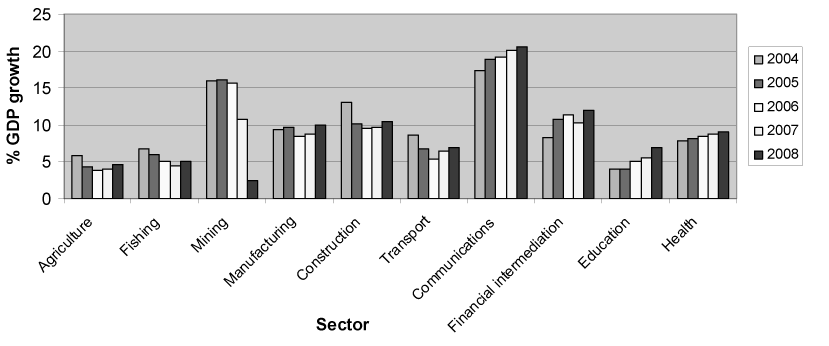
The economy of Tanzania is estimated to have attained GDP growth of 7.4% during the year 2008 (7.1% in 2007). The annual rate of inflation for 2008 was 10.3% (7% in 2007.) The rate of inflation reached 13% by the end of March 2009.

GDP growth in Tanzania 2008

GDP growth in Tanzania 2008

The 2009/10 budget sets out the following targets:
• GDP growth rate of 5% in 2009;
• inflation at below 10% by end of June 2010;
• increase in domestic revenue from 15.9% of GDP in 2008/09 to 16.4% in 2009/10;

Total budget revenues will be as follows (Shs mn):
• Domestic revenue 5,096
• grants and loans 3,181
• domestic loans 1,082
• local government collections 138
• privatisation proceeds 15
Total Revenue 9,513

Donor dependency is expected to grow due to the economic crisis reaching 45% of the 2009/10 budget.
The Government is proposing to spend Shs 9,513 billion in 2010/11: Recurrent 6,688, development 2,825. Total: 9,513 in the following areas: Education 18.3%; agriculture 7%; infrastructure 11.5%; health 10.1%; water 3.7%; energy and minerals 3%;
Tourism and gold receipts continued to dominate the export sector accounting for 27% and 18% respectively.
Foreign reserves increased by 3.9 % to US$ 2,869.7 million in 2008, enough to cover 5 months of imports.

As at 31 December 2008, the national debt had increased by 7% at $ 6,329 million – 32.6% of total GDP.

The budget included provision for:
– the immediate abolition of 405 government notices issued between 1964 and 2005;
– a reduction in local Government taxes to 3% from the previous 5%;
– a number of measures to ease widespread concerns that Tanzania isn’t getting a fair return on foreign investments in gold mining including the removal of VAT special relief and limiting it to cover only prospecting and exploration; abolition of exemption from taxes on fuel for mining companies, other than fuel levy exemptions in existing mining development agreements;
– a reduction in the VAT rate from 20% to 18% and a 7.5% increase in excise tariffs on alcohol, tobacco and carbonated drinks;
– in the tourism sector the removal of VAT exemption on air charters, balanced by a removal of import duty on 4-wheel drive vehicles specifically designed for tourist purposes, and some rationalisation of visa costs;
– removal of import duty on pharmaceuticals.
– to encourage companies to list on the Dar es Salaam Stock Exchange a reduction in the corporate tax rate for companies from 30% to 25%;
PricewaterhouseCoopers Newsletter.

Criticism
There was such strong criticism from religious leaders of the proposal to lift tax exemptions enjoyed by religious and other non-governmental institutions providing services like education, health and water that on June 17 the Prime Minister announced, at an emergency news conference, that this part of the budget would be cancelled – Guardian.

REMAKING TANZANIA PLC

By Joseph Sabas

The financial crisis has availed us of a golden opportunity to see the two major schools of political and economic thought being played out in an open arena and the divergence in approach to solutions.

The school on the right characterised by the Conservative Party in the UK, Republican Party in USA and the CDU in Germany offers a simple and clear approach of allowing the recession to take its course. (The left call this “the do nothing approach”). This school also believes in protecting individual liberty, private property, in fiscal conservatism and small government and fewer taxes. To them a country is a sum of individuals rather than societies.
The left school of thought characterised by the Democrats in USA, the Labour party in the UK and the Social Democrats in Germany believes in Government interventions in economic activities to safeguard economic prosperity and to act as a safety net for the people. The left believes a country is made up of societies hence unions and such overused phrases like “hard working families”.

While the left, led by President Obama and Prime Minister Brown favours increased government spending and bailing out failing key companies, the Right led by Mr Cameron in the UK and the seemingly leaderless Republicans in the USA are vehemently opposed preferring instead to encourage the opening of lines of credit to viable business while allowing bad businesses to fail, which is a good case of “constructive destruction”.

In most countries these two schools of thought tend to converge and form a more or less identical centre-right/centre-left position with the demise of socialism and the rejection of pure capitalism offering a more amenable form of governance.

In Tanzania, with the exception of the Mwalimu phase, the IMF engineered policies that bear no resemblance to either school. Interestingly, CCM’s core belief remains that of “Socialism and Self Reliance” which is centred far to the left. God knows what it means in today’s CCM world. The opposition parties fare even worse. The irony here is that the IMF prescribes economic and social medicine but bears no political or economic responsibility for the consequences.
Over the period of Mr Kikwete’s presidency we have witnessed a restrained approach in diversifying the remaining major companies and utilities still in government hands. The government has intervened directly: in Air Tanzania by breaking the partnership with South African Airways, appointing a new management, and loaning it over Shs 5 billion of taxpayers’ money; in the Port Authority, the Telecommunication company (TTCL), TANESCO and the postal service by issuing directives on the way forward; in the National Insurance Corporation (NIC) the government has underwritten a NIC reorganisation; and, in TRL employees’ benefits have been improved.

In most countries the conclusion from the convergence of the two schools of thought is that the state is a bad allocator of capital and therefore the best job for the government is to legislate and regulate business and not to run it. This is only possible if the government policy framework is credible and sets clear objectives and there is an understanding of the conflicting goals of government and private investors/shareholders. In the words of Adam Smith in ‘The Wealth of Nations’ “it is not from the benevolence of the butcher, the brewer, or the baker, that we expect our dinner but from their regard to their own interest”.

There is no doubt that most of TRL’s many problems emanate from these sorts of conflicts.
One cannot blame President Kikwete for trying to prop up the Mwalimu era of publicly-held companies and utilities. As he directs from the state house pulpit, summons CEO’s for a dressing-down and makes surprise visits to the port to highlight inefficiencies he also notes their critical importance to the country. But in this year of the 200th anniversary of Darwinism the nature of human beings in pursuit of self interest in the course of survival comes very much into play. This human behaviour has tested Mwalimu’s structure of governance at a huge cost to the country let alone the tax payer.

In this structure the taxpayer owns the companies, the President appoints the Chairman and Chief Executive with the respective Minister constituting the Board. The management bear no risk to the capital they are charged to employ and stand not to receive rewards for taking risks as they are serving at the pleasure of the appointing authority. So no matter what the President may promulgate, their goals are always short term. In the private world of owners and managers there is increasing professionalism (business competence, audit committees, independent non-executive directors). Rewards are linked with ownership through share option schemes. This is not perfect as seen in the case of the Royal Bank of Scotland but at least it addresses the key weaknesses. Now the government’s shares in public and partly privatised firms are vested with the Treasury Registrar and very few if any in government can claim to have either the knowledge or the professional experience to run major businesses.

The shenanigans emanating from the THA, NIC, TANESCO, the TTCL, the Postal Service, TRL, etc are almost guaranteed.

Vesting these shares in government-owned but independently and professionally run companies similar to the UK Financial Services Authority may go a long way in safeguarding taxpayers’ money, and creating value, while removing direct political interference.

ECONOMIC CRUNCH BEGINS TO HIT

Kikwete at IMF

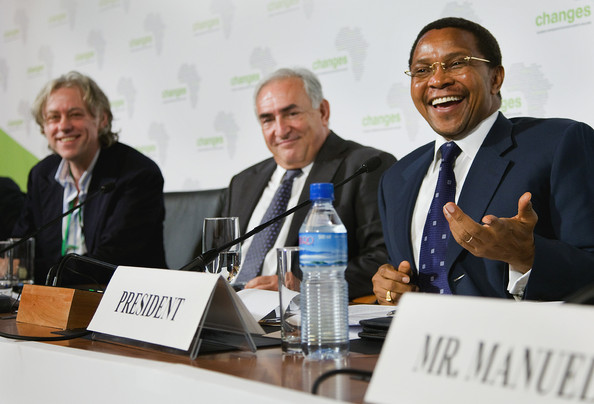
Bob Geldof, IMF Managing Director Dominique Strauss-Kahn and President Kikwete share a joke at the IMF conference (Photo Stephen Jaffe/IMF/Getty Images)

At a meeting organised by Tanzania and the International Monetary Fund (IMF) in Dar es Salaam from March 12 to 13 President Kikwete said that the consequences of the world economic crisis were not yet too pronounced in Tanzania but the country was being affected. Examples: the postponement of a $3.5 billion investment in aluminum smelting and a $165 million nickel mining project. A Swedish company, SEKAB, which had leased 40,000 hectors of land in Bagamoyo and had invested $250 million in an effort to produce ethanol (see TA No 91), had now decided to abandon the project.

Other negative consequences of the economic downturn were the falling world prices for Tanzanian commodities. The 2009 price of cotton, one of Tanzania’s major exports, had fallen from $0.82 in 2008 to $0.45 this year. Arabic coffee had fallen from $158 to $104 per 50 kilometre bag and Robusta coffee had dropped from $93 to $65. The prices of most minerals except for gold had also fallen and there was expected to be a decline of from 7% to 18% in tourist arrivals in 2009.

Also affected had been Tanzanite where the fall in price was some 80%. In Mererani, Arusha district, the owners of the nearly 200 Tanzanite mining pits had reportedly opted to suspend their operations between October 2008 and January 2009 rather than operate at a loss. The situation had been made worse by political unrest in Thailand, one of the leading markets for Tanzanite gems.

The price of Nile Perch, of which 80% are exported, was likely to fall by 50% in 2009. This situation was complicated by stiff competition from Vietnam – Sunday Observer.

However, on the brighter side, Finance and Economic Affairs Minister Mustafa Mkulo said he expected that Tanzania would be among first the beneficiaries of the $750 million aid package agreed by the G20 powers at their meeting in London. “We have already communicated our interest in the package” he said. “How much we get depends on decisions of the IMF board” – The Citizen.

PRAISE FOR WAR ON CORRUPTION

France is just one of many donor nations which have said it is encouraged by actions taken by the Tanzanian government in tackling corruption cases, and is now happy that the money it donates will not end up in the pockets of corrupt individuals.

European Union (EU) head of delegation Tim Clarke and Swedish Ambassador Stefan Herrstrom also hailed the actions being taken by the government. Clarke said that legal steps being taken against senior state officials implicated in corruption scandals were a true indication that there was maturity in the political leadership – Guardian.

The following is a summary of recent events:

The ‘Radar’ deal

After nearly three years of investigation, the UK`s Serious Fraud Office (SFO) has published remarkably detailed accounts of what it believed had happened during the negotiations leading up to the purchase in 2002 by Tanzania from Britain’s BAE Systems of an air traffic control (radar) system at an inflated price of $40m including an apparent figure of $12 million as ‘commission.’ (See many previous issues of TA– Editor). The report was summarized in several Tanzanian newspapers. It named former Infrastructure Minister and now Attorney General Andrew Chenge and several other persons, including Sailesh Vithlani (a Briton of Asian background, who is alleged to have played a major role) and Dr Idriss Rashidi a former Governor of the Central Bank plus six British people as having been involved in the deal. The SFO believe that Chenge was ‘a conduit’ through which the lost money was distributed to selected top government officials whose decisions were crucial to the deal. The SFO established that Chenge received money through a slush fund he set up in Jersey when he was serving as Attorney General. According to information provided by the authorities in Jersey, the $1.5m was transferred from a Frankfurt branch of Barclays Bank to Chenge’s account in Jersey. Chenge was said to have used the money to pay others involved in the radar deal.

The SFO established that on September 20, 1999 Chenge personally authorised the transfer of $1.2m to the Royal Bank of Scotland International in Jersey. The SFO report concluded that Rashidi and Chenge were key figures in the deal, but they were acting with the full support of top government officials. The SFO investigation established that, to avoid being caught, the facilitators of the deal gave Vithlani the codename ‘Mr Fat’, while any mention of bribing or corruption was replaced with the euphemism ‘commitments’. In what is believed to have been a tactic to obscure the deal’s corruption, Vithlani and his partners registered a front company in Panama which received $8m between 2000 and 2005. The payments came from ‘Red Diamond Trading Co Ltd’ registered in the British Virgin Islands, alleged to be a front company of BAE Systems – until December 2005 when it was terminated through a settlement of $3.36m.

Meanwhile, in Tanzania, the Guardian has reported that the Prevention and Combating of Corruption Bureau (PCCB) had been contacting various sources outside the country in order to build up convincing evidence to enable it to prosecute. The Bureau urged people to be patient while the investigations continued.
To add to his troubles Mr Chenge was recently involved in a car crash in which two women died – Mtanzania.

Andrew Chenge MP

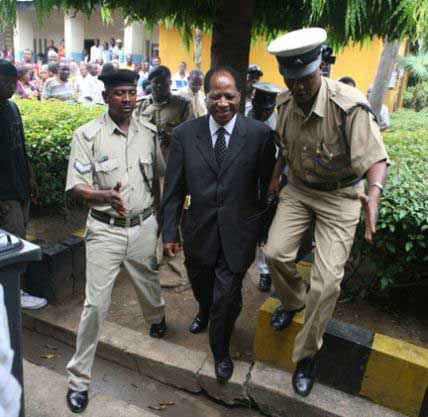
Andrew Chenge is escorted to Kinondoni court to hear the charges against him with regard to the recent traffic accident (photo Mroki Mroki/TSN)

Continue reading

THE CREDIT CRUNCH & TANZANIA

by Joseph Kilasara
It is stimulus time. Finance ministers in the developed world are reaching for their red boxes trying to tighten or loosen some economic bolts and nuts in order to stimulate their faltering economies.

Reacting to the fallout from the credit crunch, President Kikwete pleaded with them not to touch the aid nut or perhaps try to loosen it a bit further. He went on to point out how our economy could be affected by the fall in future aid pledges, tourism related revenues, fall in demand of exports, increased borrowing costs of foreign loans as well as fall in foreign direct investments as capital markets in the developed world keep turning south.

For his part Governor Ndulu of the Tanzania Central Bank (BoT) assured the nation that the financial stability of the banking system is sound as demonstrated by an increase in private credit lending of up to 48% by September 2008. The banks are also not exposed to the secondary debt market championed in the northern world which has all but dried up and are said to be well capitalised to meet their maturing obligations. With a foreign exchange reserve of about $2.7bn, which is equivalent to about 5 months worth of importation, $1.6bn foreign currency deposits of Tanzania residents and $600m in commercial bank net foreign assets the BoT forecasts that going forward the economy is well cushioned against the potential fallout from the crisis and its ensuing recession.

Despite the Governor’s bold assurance and his immediate follow-up warning to banks against currency speculation, one could sympathize with the banks for making a quantitative interpretation of some of his statements such as: “The robustness of the foreign reserves is important for the stability of the Tanzania Shilling and confidence in the economy” and cause the US dollar to rise against the Shilling from 1,160 to 1,310 in four weeks. Blaming this fall on speculation is much the same as when naked short-sellers were blamed for the falling share price of the UK bank HBOS when its capital was actually inadequate.

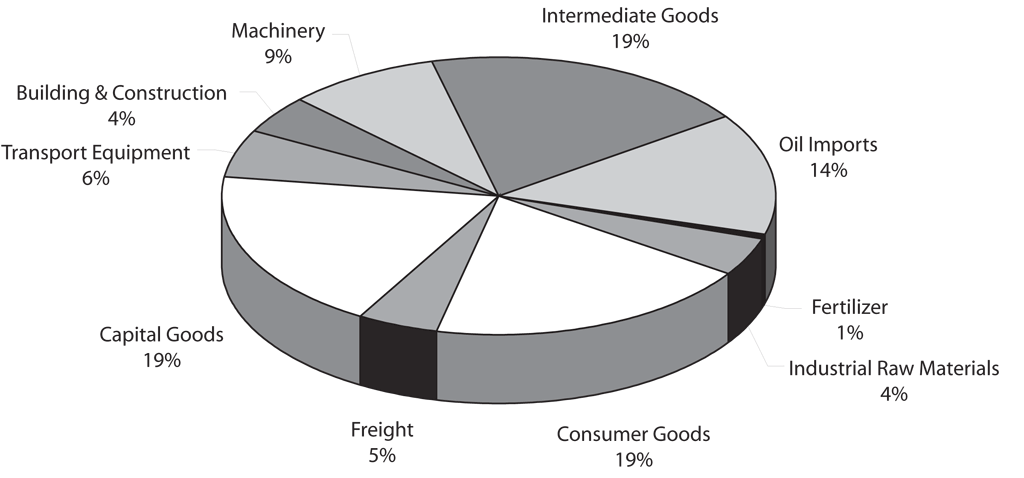
Financing of the current account deficit which jumped by 49.1% in 2007 to $2,056.2m equivalent to about 17% of GDP is also a major cause of concern. At this rate of increase the reserve cushion looks very flat. Looking at BoT figures for the year up to August 2008, the structure of imports, where 38% comprise consumer goods and intermediate goods excluding oil means despite being endowed with an abundant level of resources and generous donors we are still borrowing substantially to pay for our daily consumption (see chart).
chart3

Breakdown of Imports into Tanzania by value
Continue reading

BUSINESS & THE ECONOMY

Exchange rates £1 – TShs 1,994
$1 – TShs 1,259

While western banks are reeling under the financial crisis Tanzanian banks reported a good year in 2007/8. On average, profit before and after tax for each bank increased by about 60% according to the Tanzania Banking Sector 2007 Performance Review by Ernst & Young. All the other banks, the report said, showed significant improvements and of the five loss-making banks of 2006 all recorded profits in 2007.
Among the commercial banks, Citibank recorded the highest interest income while the Dar es Salaam Community Bank was the highest among the non-commercial banks.

As at 31st December 2007 the banking sector comprised 23 commercial banks, three non-bank financial institutions and seven regional unit banks/financial institutions. The industry averages for return on average assets and return on average equity were 3% and 27% respectively, as in 2006. Standard Chartered Bank was the best individual performer in both cases with 8% and 61% respectively. Only one bank recorded a loss before and after tax – Sunday Observer.

Frank Mwakumbe writing in the Guardian noted that almost all banks experiencing the financial crisis in the USA operated as publicly traded companies and were privately owned and managed. He felt that this was a cause for caution about the privatisation process in Tanzania. A study by the ‘African Forum and Network on Debt and Development’ (AFRODAD) on Tanzanian’s experience with privatisation policies published in 2001 had summarised the benefits of privatisation, tersely: ‘Well performing privatised enterprises can contribute meaningfully to government revenue and to the economy as a whole in the form of taxes, increased production of quality goods and services, creation of more employment opportunities and introduction of modern technology. Continue reading

BUSINESS & THE ECONOMY

By Joseph Kilasara
Exchange rate £1 = TShs 2,222

The Budget

The mood from the finance minister Hon. Mkullo about the economy’s performance was both upbeat and optimistic. Coming at a time when his counterparts, particularly in Western Europe and America, are reeling in the fallout from the credit crunch and skyrocketing commodity prices he must be a very optimistic man.

He estimates that the economy will grow at 7.8% this year (2007, 7.1%) and at over 8.1% next year with inflation being controlled at below 7% by June 2009 (9.7% April, 2008). His confidence is evidenced by the increasing availability of commercial bank credit which rose by 42% with lending rates declining to an average of 15.1% to March, 2008. The signing of the US sponsored Millennium Challenge Compact Agreement totalling around US$698m over 5yrs for infrastructure projects will also play a part.

While he identifies inflation as one of the major challenges to the economy, faltering economies of most donor countries could also prove to be another headache, as they are estimated to contribute about 34% of the budget. The falling price of oil may facilitate the achievement of the inflation target but it is likely to affect the level of revenue as oil related taxes contribute up to 20% total revenue projected. Continue reading