
DAR-ES-SALAAM CONSTRUCTION BOOM

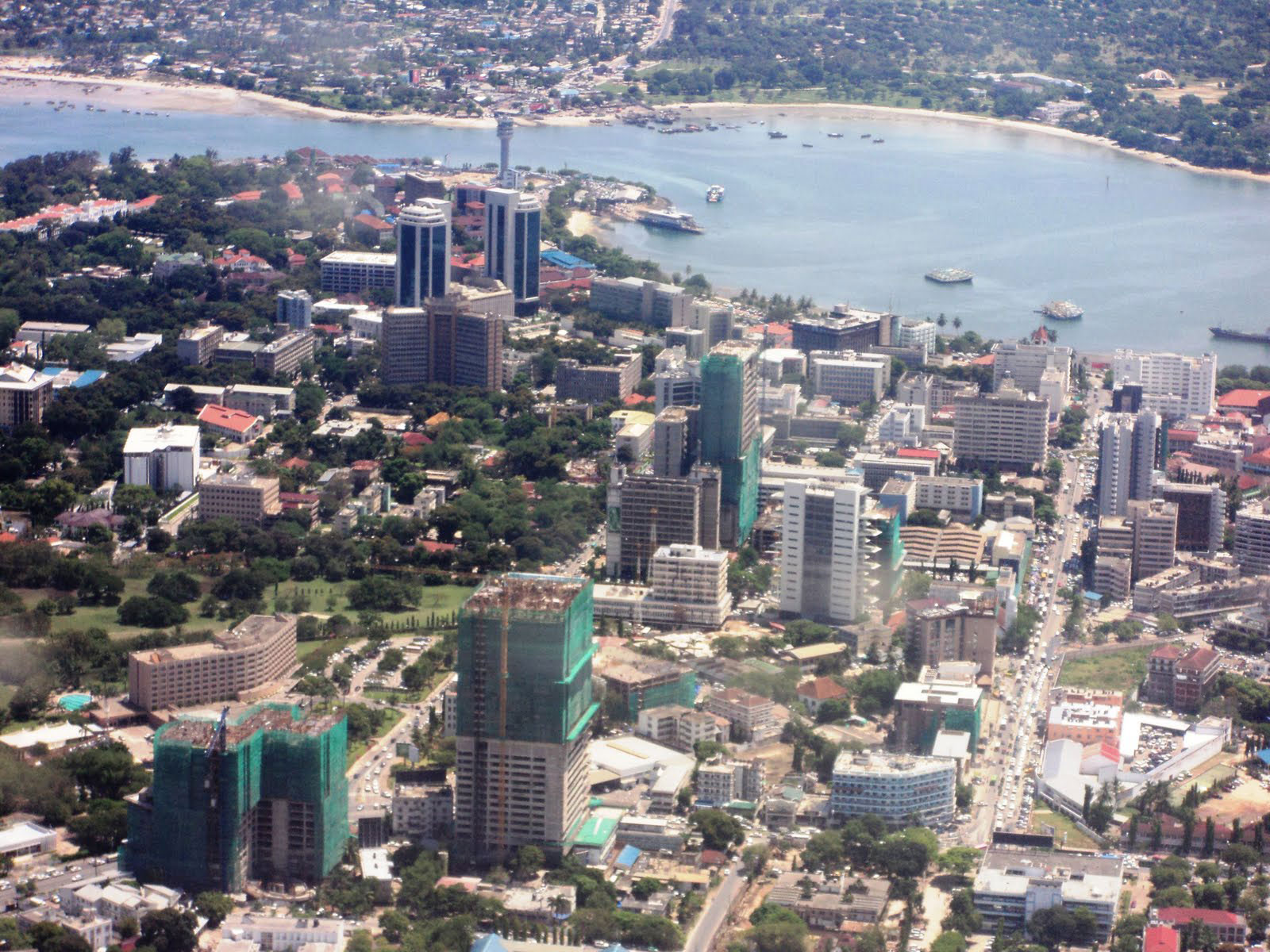
Kivukoni area of Dar-es-Salaam, with the Askari Monument to the right, and the Bank of Tanzania twin towers in the distance, near the ferry to Kigamboni. Photo Issah Michuzi http://issamichuzi.blogspot.com

Visitors to Dar-es-Salaam cannot fail to see evidence of the construction boom in the city. Perhaps most obvious is the number of skyscrapers being constructed in the central Kivukoni area (see photograph). One casualty is the Nyumba ya Sanaa (Nyerere Cultural Centre) which has been demolished to make way for a tower. The centre’s operations will be relocated to Msasani Village.
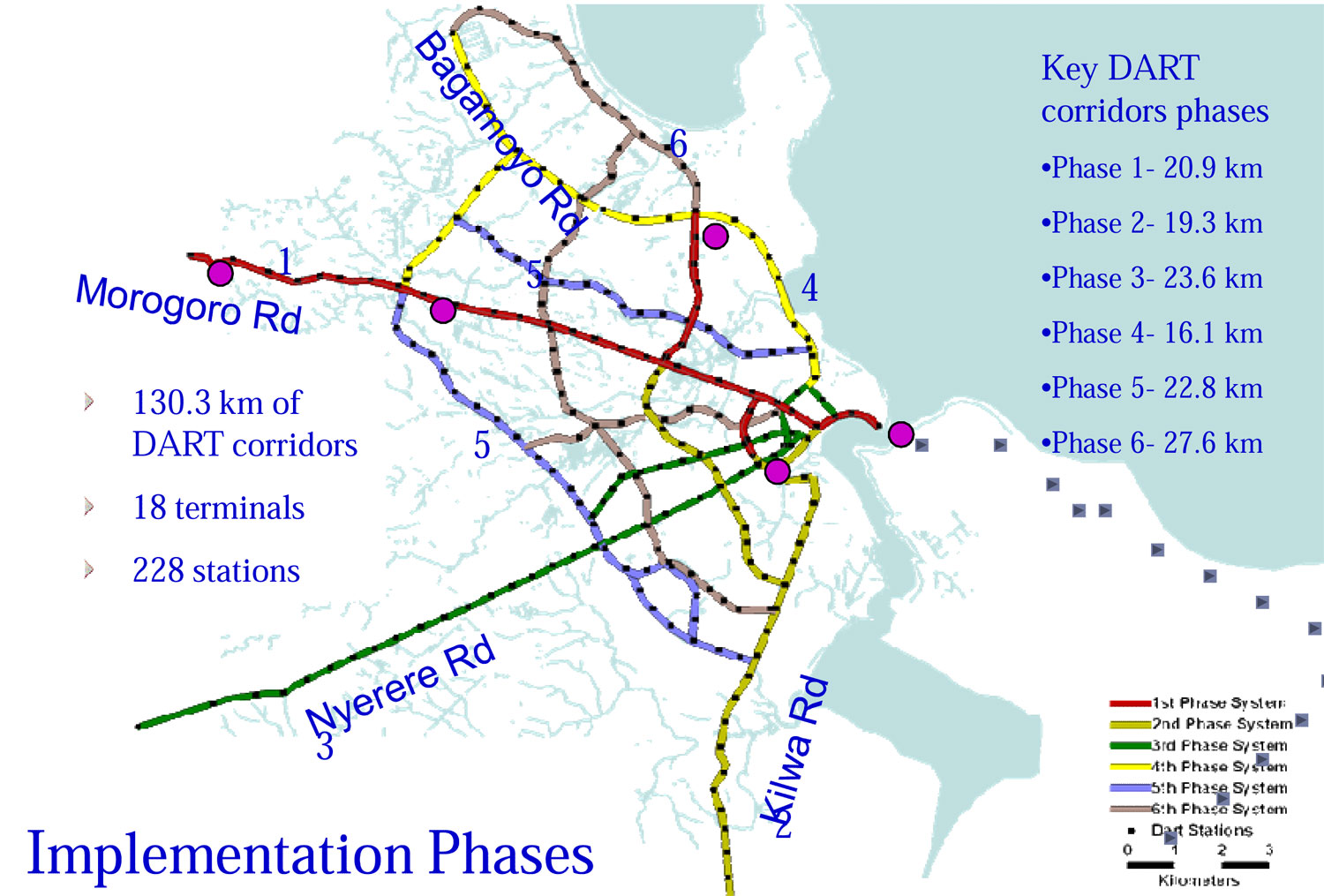
Map of the DART bus rapid transit project in Dar-es-Salaam, showing the six phases

An ambitious project to try and alleviate the chronic congenstion faced by commuters is the Dar es Salaam Rapid Transit (DART) project, which was launched by President Kikwete in September and is expected to start operating in 2012. The system will use guided buses (Bus Rapid Transit) on segregated bus lanes, and dala-dalas will no longer be allowed to operate on the routes, but will operate as feeder services to the DART arterial routes.

The project will comprise six phases and a total of 130km of road plus two workshops, five main stations and six feeder stations. The first phase has just been let to Chinese firm Beijing International Engineering Group (BCEG). The route follows Morogoro Road from Kimara – Ubungo – Kivukoni with branches to Kariakoo and Morocco. 145 articulated buses, each capable of carrying 140 passengers will operate on the route, with an expected 400,000 passengers using the system every day. Subsequent phases comprise Kilwa Road, Nyerere Road, Bagamoyo Road, and orbital routes. The scheme further includes cycle tracks alongside the routes with the aim of encouraging non-motorised transport in the city. Funding for the project comes from the World Bank and UNEP as well as the Tanzanian governemnt.

The government has also released a tender for construction of a road flyover at Tazara and a bridge at Bendera Tatu that will link the junction of Nyerere Road to Bibi Titi Road, also with the aim of reducing congestion.

Private development is gradually spreading outwards from the central areas of the city, for example a large mixed use project planned for Mchikichini, Illala district, with over 1,600 multi storey flats, office accommodation and hotels, jointly funded with a Malaysian company.

Construction work is also underway at Julius Nyerere International Airport (JNIA). Speaking at the official launch of the project, Tanzania Airports Authority (TAA) Director General, Mr Prosper Tesha said that the project would involve rehabilitation of taxiways, runways and sewage system, and is set to be finished by May 2011.
RAILWAYS

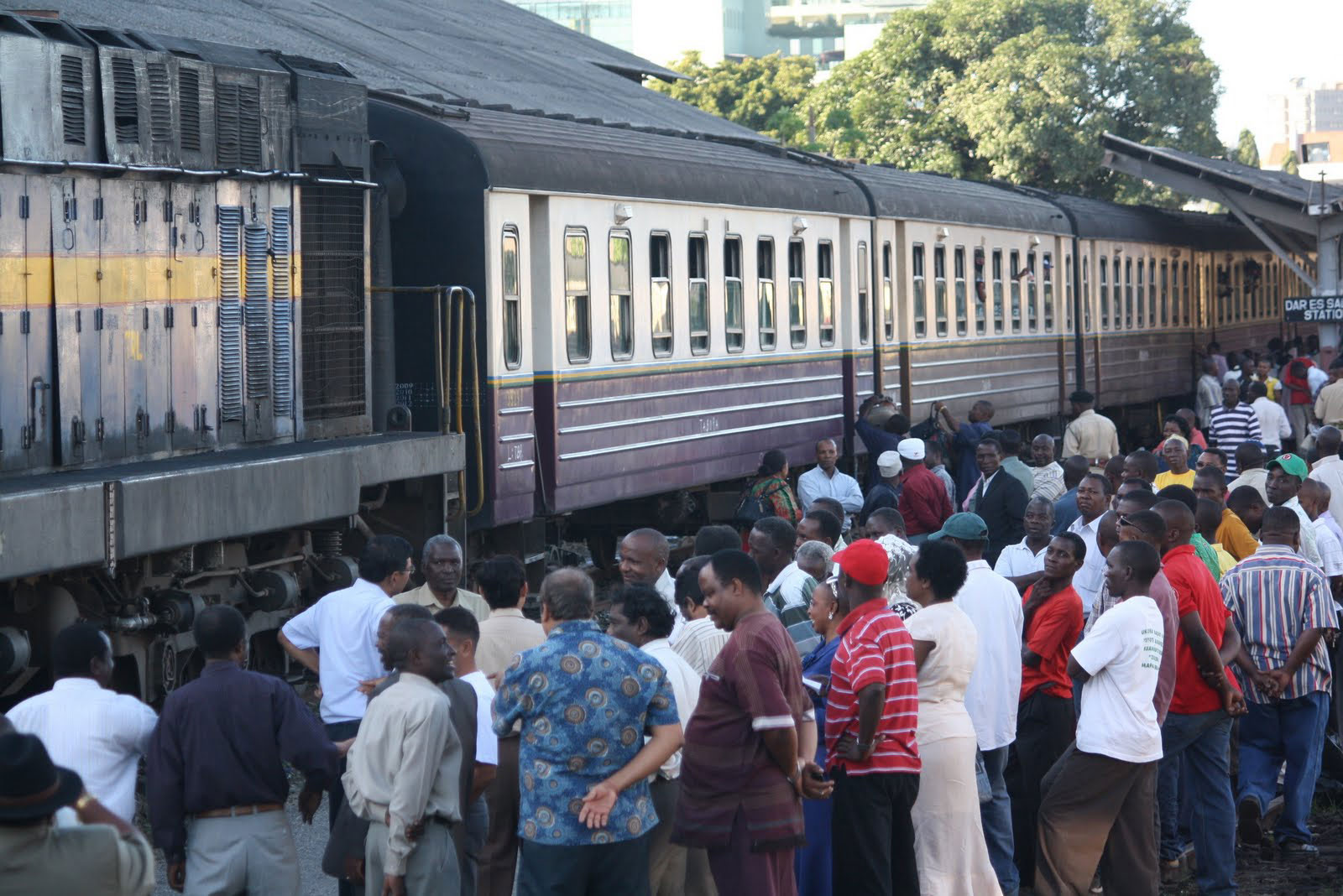
The Tanzania Zambia Railway Authority (Tazara) has signed a contract with a Chinese manufacturer for the manufacture and supply of 90 container wagons worth approximately US$5 million. The Chinese company was given eight months in which to manufacture and deliver the wagons which will be used in the transportation of containerised cargo and metals such as copper and manganese. Other components of the agreement are expected to follow including the supply of six new mainline locomotives, rehabilitation of three shunting locomotives and training of staff. Chinese ambassador to Zambia Li Qiangmin was quoted as saying that Tazara was a symbol of friendship between Zambia and China and his country was saddened by problems the company was facing. “We are sending a technical team to Tazara to investigate the problems and help them improve efficiency,” the envoy said. Tanzania’s Infrastructure Development Minister Shukuru Kawambwa was quoted as saying that the Chinese financing was intended to save Tazara from total collapse as the company had been experiencing major operational and financial problems with a debt burden of over US$100 million – Guardian.

BUSINESS & THE ECONOMY

Addressing a conference of leading financiers in Dar es Salaam Prime Minister Mizengo Pinda stated that strong supervisory enforcement of financial regulations had enabled Tanzania to weather the storm during the recent world economic crisis without too much impact compared to other countries. Limited links with the global financial markets had also helped to keep the country’s financial sector strong and sound, as the world went through its most severe financial crisis in recent times. All major financial indicators of the local banking sector had remained strong he said. The banking system had remained adequately capitalised against any potential financial risk and the ratio of non-performing loans to total loans had remained within prudential limits. “Furthermore, the banking system has managed to keep enough liquidity to operate smoothly and cover its liabilities without recourse to the central bank.”

“Our banking system has maintained reasonable profitability”, he pointed out. He also announced that the Bank of Tanzania recently took steps to review the minimum capital requirements for commercial banks, raising it from Sh5 billion to Sh15 billion. This would consolidate the strength of the banking industry and enhance its ability to self-bailout in case of a crisis. On the proposed East African Monetary Union (EAMU), the PM said that recent reforms in Tanzania’s financial sector had placed the country in a better position for financial integration. Since these had been undertaken in various phases dating back to the early 1990s, the number of banks that operate in the country had increased to 42, up from only three public-owned banks in 1992. Insurance companies had increased from two in 1990s to 26 at present. The total assets of banks had risen significantly from an average of 6% of GDP in the early 1990s, to above 40% of GDP currently.

Warning to foreign traders
The government has issued a warning to foreign traders doing small business in Tanzania without following procedures. One of the requirements for a foreigner to do business in the country is that he should have a minimal capital of $300,000. Some foreigners are said to be entering the country for work on the mines or on major projects but later moving into petty trading in Kariakoo market in Dar es Salaam. The Guardian has reported that there has been an increase of shopkeepers of Chinese origin at several business centres in the city which were adversely affecting local businesses. However former Industry, Trade and Marketing Minister Dr Mary Nagu she said this was due to globalisation. “It is not only Tanzanians who conduct their businesses in the area, but also Congolese, Zambians, and Malawians” she said.

Big Korean investment
100,000 hectares of land in Tanzania’s Rufiji valley are to be developed by South Korean corporation KRC as part of Tanzania’s Kilimo Kwanza programme. In an interview with the BBC, Lee Ki-Churl, of the state-run Korean Rural Community Corporation, said the move would see Tanzanian farmers benefit from an education centre as well as from South Korean expertise on the ground. Plans envisaged half the land given over to local farmers with the rest being used to set up a food processing complex for exports to Korea. The initiative was said to be partly the product of Prime Minister Mizengo Pinda’s visit to South Korea to help develop economic ties between the two nations.

UK gives £103.5 billion
While some donors have decided to cut down on their donations towards General Budget Support, Britain is giving Shs 230 billion in the financial year 2010/11. This was said by the UK Parliamentary Under-secretary of State for International Development, Stephen O’Brien, during a visit to Tanzania. Earlier on, the British minister had a meeting with Finance Minister Mustafa Mkullo during which they had a profound discussion on the utilisation of the funding. “This will help in the priority areas as stipulated in the Mkukuta development strategy,” said the statement. Tanzania ranks third among the recipients of British aid – Mwananchi.

TANZANIA RAILWAYS

Train services from Dar-es-Salaam to Kigoma resumed in June, although limited to only one serice per week. Photo Jackson Odoyo

The problems facing Tanzania Railways Ltd (TRL) have not been resolved (they have been described in several issues of TA) but a number of new developments have been reported during recent months.

In May it was revealed that the India-based firm RITES was demanding $86 million (about Shs 125billion) as the cost of ending the 25-year deal it had signed with Tanzania three years earlier. However, the Guardian on Sunday claimed that the company hadn’t invested any money in the railways during all this time. The paper alleged that RITES had expected to use the TRL’s shares and assets it acquired in order to borrow $400 million from the International Finance Corporation/World Bank. As the quality of service on the main lines declined, the paper said, the government eventually agreed to buy back the 51% of shares RITES owns. Then, alarmed by the financial report presented by RITES, the government’s negotiation team was said to have asked for an independent auditor to verify the books of accounts, before any compensation deal could be reached. RITES apparently did not agree to this.

On June 8 the Daily News reported that the government had formed an interim management team to run Tanzania Railways Limited (TRL) while the government looked for a reliable and serious investor. RITES management had agreed to hand over the assets and operations of TRL as a decision to this end had been made by shareholders on both sides of the partnership.

TAZARA

The Tanzania Zambia Railway Authority (TAZARA), a company built with $500 million Chinese aid in the 1971’s and jointly owned by Zambia and Tanzania, is also in serious operational and financial trouble due to a fall in traffic and the old age of its locomotives, which have not been well maintained. The railway line runs some 1, 870 kilometers from Dar-es-Salaam to Zambia’s Kapiri Mposhi.

New Managing Director Akashambatwa Mbikusita-Lewanika, who was appointed in 2010 has said that the management is determined on turning around the company. It had developed a 2010 action plan which indicated what should be done to bring efficiency to the company. The company was expected to spend about $520, 000 on repairing 500 defective commercial wagons this year. The company currently had 1, 853 commercial wagons, of which only 988 were running. This rehabilitation exercise would see the company increasing its volume of cargo from the current 15, 000 to at least 72, 000 tons per month. The company’s liquidity problems had resulted in it accruing a huge debt which it was currently trying to off-set.

In 2008 the two governments had signed an agreement with the Chinese which would cover the provision of equipment, materials and other technical services valued at $40million and, in 2010, the Chinese gave the company a $39 million interest-free loan to revive its operations.

The Daily News (August 8) published a highly critical article saying that TAZARA’s low cargo load represented nothing but death itself. This view was in contrast to a TV documentary shown on British TV which was surprisingly up-beat. The programme showed a very open management struggling with great determination and remarkable resourcefulness. Among the suggestions made in the Daily News was that TAZARA should open its CEO position to international competition. ‘They should just borrow a leaf from the success of Kenya Airways (KQ) which employs the service of foreign experts in some of its important departments.’ It quoted a number of companies wanting to use the line including Tanzania Breweries, Mbeya Cement, Mufindi Paper Mills, plus the Chinese company mining coal in Chunya.

AIR TANZANIA CORPORATION LTD

Minister for Infrastructure Dr Shukuru Kawambwa, has revealed some of the problems facing Air Tanzania (ATCL).

He said for several years government has been trying to bail it out by pumping in more and more capital, but it continued limping. As a result it was decided that as from June this year the airline would be restructured. “It is not enough to do minor jobs. We intend to transform ATCL into a new airline with the cooperation of the private sector,” the Minister said – Nipashe.

He said efforts by the government to find a reliable investor for the cash-strapped airline were continuing. The Chinese firm China Sanangol International Limited (CSIL), which had earlier shown interest, appeared to be withdrawing.
The Minister said that ATCL was spending more than it earns. The firm’s revenue between July 2009 and March 2010 was Shs 7.8 billion while its expenditure stood at Shs 26 billion. During this period ATCL had carried a total of 63,362 passengers and 253 tonnes of cargo.

The Communication and Transport Workers’ Union (COTWU) has also registered its concern over the plight of ATCL, which they said they saw collapsing unless concerted efforts were made to resuscitate it.

Air Tanzania Corporation Limited (ACTL) management stated in April that it could not repair the B737-200 aircraft that crash landed at Mwanza airport in February since the cost of doing so would be too high. The Corporation would be referring the matter to its insurance company – Guardian on Sunday.

KILIMO KWANZA

One of the main features of the new government policy of Kilimo Kwanza (Agriculture First) is that certain unused government-owned land and other land not being adequately farmed might be leased out to local and foreign firms to use for large scale farming. But this idea is coming under increased criticism in Tanzania and amongst NGO’s and other activists abroad. They point out that China has secured land in the Democratic Republic of Congo roughly the size of Belgium to set up the world’s largest palm tree plantation and that Rwanda has signed a $250 million investment deal to produce 20 million litres of biodiesel per year from jatropha, a hardy ‘wonder plant’ that can grow in low-quality soil. They claim that all over Africa what they describe as ‘land grabbing’ is speeding up. They warn of possible water shortages, evictions of farmers and corruption.

Tanzania is being criticised for its lack of policy to guide biofuel investment. According to the Tanzania Investment Centre, the country has over 33 million hectares of uncultivated, arable land. But ‘uncultivated’ doesn’t mean ‘unused.’ For many villagers such land is a source of firewood, medicinal herbs and building materials. When foreign investors come, locals get displaced. Moreover, loss of economic opportunities is rarely included in compensation for land legally belonging to a village. In Kilwa District villagers were paid less than $10 per hectare by a biofuel company for giving up their right to their farms. The International Institute for Environment and Development, a London-based think-tank, calculated that in some cases the value of timber harvested from such land each year is higher than the compensation the villagers receive.

NEW MINING BILL PASSED

Parliament passed the new Mining Bill following heated debate in the National Assembly in April. Prime Minister Mizengo Pinda, Attorney General, Frederick Werema, and Minister for Energy and Minerals William Ngeleja, had to hear hours of critical contributions by MP’s. The Citizen reported that CHADEMA MP Zitto Kabwe, Speaker Samuel Sitta, newly nominated Zanzibar CUF MP Ismail Jussa, and Bumbuli CCM MP William Shelukindo were among those who kept the front bench on its toes, constantly seeking clarification on issues.

The MPs took issue with the inadequate compensation paid to villagers whose land is acquired for mining and also called for more transparency in operations in the industry. Some 84 MPs contributed to the Bill which became the most debated Bill during the 19th parliamentary session.

The Bill provides for:
– the setting up of a new Mining Authority
– the government to effectively manage and supervise the sector
– five year reviews of mining contracts
– setting aside specific areas for small-scale miners to avert conflicts between artisanal miners and big mining companies.
– gemstones to be processed locally; foreigners wishing to mine gemstones will be required to enter into joint ventures with locals.

The Africa Report (No 23 of 23.06.10) commented that this Bill marked an attempt to increase government revenue and ease fierce public hostility towards foreign mining companies. New investors in Tanzania’s mining sector will now be charged 4% rather than 3% royalties for precious and base metals (gross rather than net); they will have to list on the Dar es Salaam Stock Exchange; and, the government will have a stake in any new mining project. Gemstone companies will have to be at least 50% Tanzanian.

The proposed changes are expected to raise mining revenue from $57m in 2009 to $110m in 2010.

LEAST CORRUPT

Tanzania is the least corrupt state in East Africa, according to Transparency Internationals East African Bribery Index published on July 22 and quoted in the Guardian. In Rwanda however, corruption was insignificant.

The agency declared Burundi the most corrupt nation in the region. The survey was conducted among 10,505 respondents selected through random household sampling across all the administrative provinces in the five countries between January and March 2010. Burundi had a ‘corruption prevalence’ of 36% with Kenya at third position (45% in 2009 to 32% in 2010). Uganda came second at 33% while Tanzania was fourth at 28%. Key governance and enforcement institutions such as the police, judiciary and defence featured prominently in the index, as did institutions offering key services like health, education, housing and finance.

In the Aggregate Index for Tanzania there were some new entries including the Tanzania Ports Authority, the Registrar of Births and Deaths, the Prisons Service and the Department of Defence.

TANZANIA AND CHINA

There are more than 100 Chinese companies doing business in Tanzania with an accumulated direct investment of more than 200 million U.S. dollars in construction, textiles, agriculture, medicine and infrastructure, according to the Chinese news agency Xinhua quoted in the Guardian. Reports in 2008 showed business between China and Tanzania had reached $102 million in 1997, a jump of 22% over the previous year. The growth rate of trade between the two countries has developed steadily since 1994, surpassing the 15 percent mark for three years in a row. The rise of the trade is attributed to the political stability and economic reforms in Tanzania, which have increased the confidence of Chinese businessmen.

In August 2009 Minister for Agriculture, Food Security and Cooperatives, Stephen Wasira, had announced that “Tanzania welcomes Chinese investment and is expecting more investment in the agriculture sector to boost bilateral cooperation and enhance food production.”

Four more agreements

Tanzania and China signed four more grant and concessional loan agreements on 15 January 2010 amounting to over Shs 239 billion for various projects including the Information, Communication and Technology (ICT) Infrastructure Network Project and the International Airport Terminal II Project in Zanzibar and, very significantly, the transformation of the Tanzania Zambia Railway Authority (TAZARA).

Increasing concern for Chinese nationals

However, in March, the Chinese embassy expressed concern for the safety of its nationals doing business in Tanzania. It asked for security measures to be strengthened to protect the safety of Chinese investors in Tanzania following the murder of two businessmen in 2008 and another in Dar in 2009. In a statement, the Chinese Business Chamber of Tanzania demanded that the police speed up the investigation into the latest killing – Guardian.

KILIMO KWANZA – INITIAL STEPS

The first steps have been taken in President Kikwete’s ‘Kilimo Kwanza’ (Agriculture First) policy designed to inject fresh vigour into the agricultural industry.

Repossession of idle land
The government has initiated a countrywide move to revoke title deeds of idle land neglected by proprietors for more than twenty years. Some 115 plots totalling 177,000 hectares in Morogoro Region alone are to be repossessed.

According to the Daily News, 115 plots totalling 177,000 hectares have been identified in Morogoro Region alone and will soon be repossessed by the government. Funds are being allocated to facilitate surveys of other identified idle land ready for development in Manyara and Tanga Regions.

More engineers to be trained

Prime Minister Pinda test drives a tractor


The government has given the Arusha Technical College the job of training irrigation, agro mechanical and civil engineers to support the ‘Agriculture First’ drive.

Prime Minister, Mizengo Pinda said shortage of qualified irrigation engineers is holding back government efforts to boost agriculture. “We are facing a significant shortage of irrigation and related field engineers to serve in agriculture and irrigation schemes,” Pinda said.

The Guardian reported that the population of approaching 40 million people, 80 per cent of them farmers, was facing a shortage of over 250 irrigation engineers and 1,300 technicians in the irrigation field. Tanzania, with more than 44 million hectares of agricultural land, three of the largest 10 lakes in the world and a large network of rivers, uses less than one per cent of its arable land for Irrigation.

High quality cassava flour

Furthering the objectives of Kilimo Kwanza, a $4.5 million project funded by the Common Fund for Commodities, which will be implemented by the International Institute of Tropical Agriculture, is being launched. The aim is to raise the profile of cassava, in the form of high quality cassava flour, so as to make the crop a profitable and stainable source of income – The East African