DRUG SEIZURES

by Ben Taylor

Two seizures of heroin were made in Tanzanian coastal waters within the space of a few days in late January and early February. Firstly, the Canadian military vessel, HMCS Toronto, found 265 bags containing over 280kg of heroin on an Iranian dhow. A few days later, an Australian ship, HMAS Melbourne, found 201kg aboard another Iranian dhow said to be travelling between Dar es Salaam and Zanzibar. The combined street value of the drugs found was estimated as a little over £500m.

These seizures follow smaller amounts of heroin and cocaine pellets confiscated at Tanzania’s international airports. Last year the government sacked four officials suspected of aiding drug traffickers to smuggle 150kg of drugs through the Julius Nyerere International Airport (JNIA) in Dar es Salaam.

In December, Police at the Kilimanjaro International Airport (KIA) arrested two foreign nationals alleged to be carrying 12.7kg of drugs. Two west Africans were arrested before boarding flights to Accra, Ghana and Cape Town, South Africa respectively.

A Dar es Salaam resident was arrested in January at JNIA when attempting to board an Ethiopian Airlines flight to Macao, China. The woman was about to board her flight when she aroused the suspicion of anti-drugs personnel.

Later that same month, a man holding a Kenyan passport was caught by the special drugs task force carrying 131 pellets of cocaine. The head of the Anti-Drugs Unit said the man had tried to enter the country through JNIA from Brazil. He has yet to appear in court.

The UN Office of Drugs and Crime (UNODC) World Drug Report 2013 reported that Kenya and Tanzania are becoming major transit points for drugs as the number of drug users is also increasing. The report said that drug trafficking in East Africa has increased five-fold since 2009, indicating traffickers preference for the region as a transit route for drugs from Afghanistan, Pakistan and India to the US and Europe.
(Guardian, Citizen, East African, Australian Associated Press).

TOURISM & ENVIRONMENTAL CONSERVATION

by Mark Gillies

In April President Kikwete addressed a meeting at Chatham House, London, on Tanzania’s Transformation and Vision 2025. Despite the recent coverage of poaching, the threat to Lake Natron and explosions on Zanzibar, the President made no mention of tourism; he did, however, stress the need to improve infrastructure, develop industry and increase the local processing of natural resources.

Widespread poaching continues to drain the life from Tanzania’s national parks and game reserves. According to Martin Fletcher (Mail on Sunday 22 March), the Ministry of Natural Resources warehouse in Dar now holds 34,000 tusks – 17,000 dead elephants. That is still just a fraction of the animals lost, as confirmed by the recent Frankfurt Zoological Society aerial survey of the Selous Game Reserve and Kilombero Valley [see article on Operation Tokomeza]. On 25 March the new Minister for Natural Resources and Tourism, Lazaro Nyalandu, sacked the Chief Executive of the Tanzania Tourist Board Dr. Aloyce Nzuki, accusing him of poor performance and saying his position had become ‘untenable’. The sacking may have been due in part to Tanzania not making the top three at the prestigious ITB Travel Fair. However, it may also have to do with the fact that the Mail on Sunday article came from a fact-finding trip paid for by the Tanzanian government.

Controversy continues over the proposed road through the Serengeti and the plans for a soda ash extraction plant at Lake Natron, both of which will, it is alleged, cause permanent damage to the charismatic wildlife that attracts so many visitors and the landscapes in which they live (see the website savetheserengti.org). The East African Court of Justice in Arusha has heard final submissions from both the Tanzanian government and the plaintiffs, headed by the Africa Network for Animal Welfare, who are seeking a permanent injunction against the road in its present proposed form.

Sadly, violent attacks have occurred on Zanzibar once more. On 24 February, home-made explosive devices were detonated at the Anglican Cathedral and the popular Mercury’s Restaurant in Stone Town. Police recorded no casualties, although Reuters mentioned local reports of injuries. Although the event was picked up quickly by the Foreign & Commonwealth Office and published on its travel advisory, it did not generate much media coverage.

FLOODING IN DAR REGION

by Ben Taylor

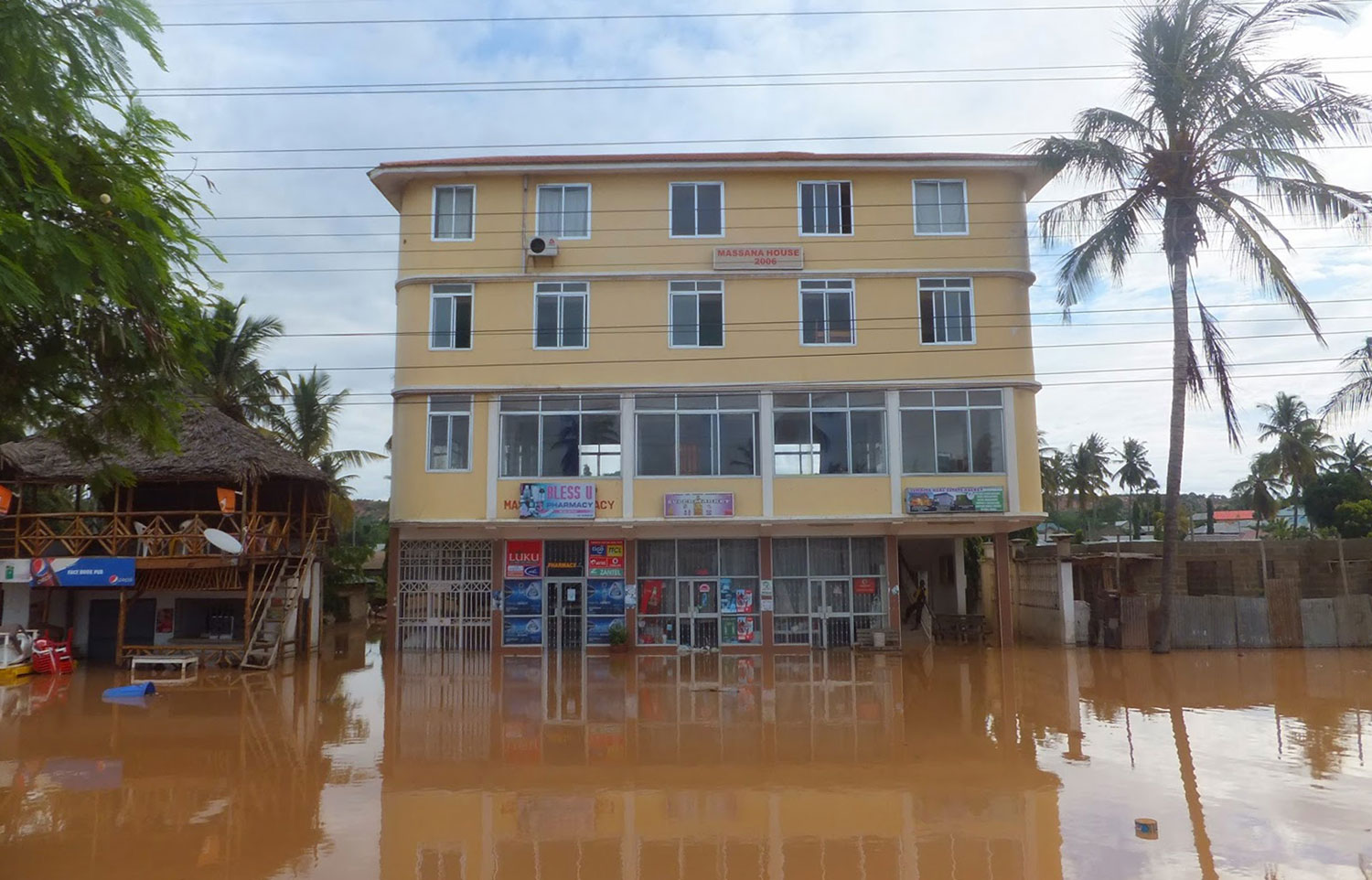
Over forty people died in Dar es Salaam, Coast, Tanga and Morogoro regions in March and April when prolonged heavy rain caused extensive flooding. Hundreds of homes in the Tandale, Kigogo, Tabata Kisiwani, Mwananyamala, Msasani Bonde la Mpunga areas of Dar es Salaam were swamped by the water.

In many parts of Dar es Salaam, transport came to a complete standstill as storm water flooded road networks, leaving commuters stranded as services temporarily ground to a halt [See also transport section below].

In Morogoro there were reports that heavy rains that continued for three days wreaked havoc in many homes and destroyed roads and crops.

The Director of Environmental Compliance and Enforcement at the National Environment Management Council, Dr Robert Ntakamulenga, said the flood problem in Dar is a man-made disaster caused mainly by gross violation of urban planning rules and failure by local govern­ment authorities to enforce the rules. “We need to ask ourselves who is issuing permits for people to build in river beds and our wetlands,” he added.

In Dodoma, Members of the Constituent Assembly agreed to devote their TSh 70,000 sitting allowances for a single day to the ongoing government initiative to help victims of the floods that destroyed properties and damaged infrastructure.

“If we all agree to sacrifice our sitting allowances for a day, we will have contributed Tsh 44 million to the victims of the downpour that affected Dar es Salaam and Morogoro residents,” said Ms Suluhu, the deputy chair of the Assembly.

TRANSPORT

by Ben Taylor

Flooded buildings on Bagamoyo Road, Dar es Salaam

Flooded buildings on Bagamoyo Road, Dar es Salaam

Dar floods cause traffic chaos
Heavy rains in early April caused traffic chaos in Dar es Salaam, as major roads became impassable. At one point the city was entirely cut off from the rest of the country as Morogoro Road became submerged at Ruvu, Mapinga bridge on Bagamoyo Road was washed away, and Mzinga bridge linking Mbagala and Kongowe on Kilwa Road was dangerously damaged. The cost of emergency road and bridge repairs was estimated at TSh21bn.

Vice President Mohamed Bilal, Minister of Works John Magufuli, Dar Regional Police Commander Suleiman Kova, and Dar Regional Commissioner Saidi Meck Sadiki, had a lucky escape when they walked away unhurt from a helicopter crash at Dar International Airport. Their military helicopter crashed as it tried to take off on a flight intended to inspect the flood damage. The pilot and three journalists on board were also unhurt. An investigation into the accident was launched by the Tanzania People’s Defence Force. (Daily News, The Citizen)

Runway drama in Arusha
Ethiopian Airline flight ET815 from Addis Ababa to Kilimanjaro, a Boeing 767-300 with 223 people on board, made an unscheduled landing at Arusha Municipal Airport on 18 December 2013. The Arusha airfield is only 1,620m long, less than half the length of the runway at Kilimanjaro International Airport, and well below minimum length for a plane of this size.

The plane landed successfully, but became embedded in soft ground when attempting to turn around on the narrow runway. Passengers were stuck on the plane for several hours while steps were brought from Kilimanjaro to Arusha, as the smaller airport did not have facilities for a plane of this size.

The reasons for the error were the subject of dispute between Ethiopian Airways and Tanzanian air traffic control. It seems a miscommunication between the pilot and air traffic control led to the pilot mistakenly assuming that Arusha airport was in fact Kilimanjaro.

Ferry to link Dar and Bagamoyo
A new ferryboat has been purchased for TSh7.9bn to ply between Dar es Salaam city centre and Bagamoyo. It will start operation on delivery later this year. The new ferry, purchased from Denmark, will have the capacity to carry 600 persons. (Daily News)

EDUCATION

by Ben Taylor

Criticisms of form 4 exam results
The National Examinations Council of Tanzania (NECTA) released exam results for last year’s form 4 exams (O-levels), showing a 15% increase in the pass rate (58% of students who took their exams in November 2013 achieved a pass, up from 43% of those who took their exams in 2012).

However, education sector analysts described the new results as misleading. Elizabeth Missokia pointed out that the exams were graded under a new system that lowered the marks required in order to achieve a pass. “The government is fooling the public by claiming that results have improved,” she said.

The new grading system includes an A which previously ranged from 81-100 but can now be obtained if a student scores 75-100, the government also introduced a B+ which ranges from 64-74, B:50-59, and C:40­49. “If we could put these results into the previous year’s grading, I can say that no improvement has been attained,” noted Dr Mkumbo of the University of Dar es Salaam.

The government-owned Daily News called for “heads to roll” at the Ministry of Education and Vocational Training. “A critical self examination is needed at the Ministry, especially the department responsible for secondary schools,” they said in an Editorial. “It borders on the criminal to keep poor children at school for four years just to have them get poor results.”

Rakesh Rajani, an activist who heads the Twaweza organisation, faulted the Continuous Assessment (CA) process, which contributes 30% of the candidate’s final marks. He argued that evidence shows that CA is most of the time not objective and usually highly inflated. “In two out of seven subjects you could be given 80% in your CA and get only 10% in your exams; and get absolutely zero in your other 5 subjects, and still pass,” he said.

The secretary general of Tanzania Association of Managers and Owners of Non-government Schools and Colleges (TAMONGSCO) Mr Benjamin Nkonya said that there is no way the country can take pride from the results.
“Truth is, the learning environment in most of the public schools is bad. There are no libraries, no books, no laboratories, teachers are demotivated, many of them incompetent. There is no way we can have good results in such a situation,” he said. (Daily News, The Citizen)

Teacher retention challenges
The government has admitted that despite considerable costs incurred in educating primary and secondary school teachers in the country, a good number of them are not practising their profession.
“Teachers have been a favoured group in various education aspects such as admission in universities and in securing loans from the Higher Education Students’ Loans Board (HESLB),” said Prof Eustella Bhalalusesa, Commissioner of Education in the Ministry of Education and Vocational Training.

Prof Bhalalusesa said a good number of the employed teachers do not stay at their stations for long. “They just report and go for other jobs,” she said, adding that the ministry has taken it as a challenge and was working on it.

The President of the Tanzania Teachers Union (TTU), Gratian Mkoba, argued that poor housing, low salaries, lack of social services and infrastructure are among the factors forcing many teachers to leave their job for greener pastures. He said trainee teachers get TSh 10,000 as a daily allowance, but when they graduate they receive less than TSh 10,000 per day or less than TSh 300,000 per month. “This frustrates them, making them quit their jobs in search of other activities or jobs”, he said. (The Guardian)

BAE radar “change” begins to reach schools
The majority of the text books purchased using the refund from the bungled radar purchase have been distributed to primary schools across the country.

British defence company, BAE Systems, paid Tanzania £29.5 million (TSh72.3 billion) after it sold an obsolete and overpriced military radar to the country, as part of a settlement reached with the UK Courts and Serious Fraud Office.

It was agreed that TSh59.7 billion would be used to purchase books, TSh12.2 billion to buy desks while TSh367.2 million was set to be used for monitoring and auditing. Over 85% of the text books have now been distributed, according to officials from the Prime Minister’s Office for Regional Administration and Local Government.

Cambridge charity supporting vulnerable children in Gairo district
Villagers from Gairo district in Morogoro region have a reason to smile after the Cambridge-based Campaign for Female Education (Camfed) introduced a new programme to support vulnerable children from poor families to access best education from primary to tertiary level.

The Director of Operations and Finance for Camfed Tanzania, Msaada Balula, said educating girls is the best way to help a community to alleviate poverty, noting that educating them is the most effective strategy to ensure the well-being of children and in the long run economic development.

Camfed’s ‘Comprehensive Bursary Support’ will cover all costs related to their secondary education from school fees to textbooks and other costs. According to Balula, the value of the support will depend on the need and poverty level of the supported children.

He said that since Camfed began operations in the country in 2005, a total of 21,592 students have been supported to access education and remain in school from primary to university level.

ECONOMICS

by Paul Gooday

China biggest foreign investor in Tanzania
China’s total direct investment in Tanzania increased from US $700 million in 2011 to US $2.1 billion last year, becoming the biggest foreign investor in the country. Bilateral trade has soared in the same period, reaching over US $2.5 billion by the end of 2012.

According to Imara Equity Research, this investment is focused on railways, ports, road construction, gas pipelines and wind power farms. It has not only boosted economic growth but also created more than 150,000 direct jobs. Up to 19 projects worth billions of dollars include construction of the new port at Bagamoyo, set to be the largest and most modern in Africa. The harbour is expected to be in operation by 2017 and will handle 20 times more cargo than the Dar es Salaam, which is Tanzania’s current major import and export gateway in East Africa. Additionally, a Chinese US $1.2 billion soft loan for a 523km pipeline connecting Dar es Salaam and the Mtwara gas field was endorsed in September 2012 between the Tanzanian government and the Exim Bank.
(The Citizen)

Single Currency and Monetary Union
The East African Community (EAC) Monetary Union Protocol was signed in December 2013 by the five heads of state in Kampala, kicking off ambitious plans to have a common currency within 10 years. The single currency is aimed at enhancing trade in the region.

A few weeks later, however, the Managing Director of the International Monetary Fund (IMF), Christine Lagarde, cautioned EAC member states against rushing the Monetary Union. Addressing the Kenya private sector she said the EAC was not yet ready for the move and needed to address key issues before uniting their currencies. The challenges include increasing non-tariff barriers, varying economies and different tax regimes. She added: “As a member of the European Monetary Union, I have to tell you that it is a very exciting and ambitious project. … make sure you learn from our mistakes, so that the East African Monetary Union can even teach the Europeans how to do it right.” (The Citizen)

Mobile Payment Transactions
Mobile money platforms offer instant money transfer using phones, which helps cut costs and saves time as compared to physically transporting money. The value of mobile payment transactions jumped more than three times in the twelve month period ended December 2013. This was due to increased use of mobile phones in payment of services such as utility bills. Further, several banking institutions have formed partnerships with mobile network operators to facilitate customer transactions, according to the regulator in its latest Banking Supervision report.
(The East African)

Debt dilemma
Tanzania faces a new debt crisis unless government moves fast to contain its current borrowing, which has seen national liabilities more than double in less than 10 years. Until around 2006, the public debt as a percentage of GDP was almost 70%. Debt forgiveness brought that ratio down to about 21% the following year, but since then it has been growing at an alarming rate.

“The national debt as a percentage of GDP is now about 38%. That is a manageable debt ratio,” said Prof Richard Mshomba, a Tanzanian economist based in the US. “However, what is alarming is that hat ratio has been steadily growing and Tanzania could find itself in a debt crisis.”

Some see that happening as early as next year, when the debt may hit TSh30 trillion, about three times what it was when the current government assumed power in December 2005. They warn that the crisis would derail economic prospects in the wake of huge gas discoveries and undermine efforts to alleviate poverty. (The Citizen)

LOW CONFIDENCE IN ECONOMY

by Ben Taylor

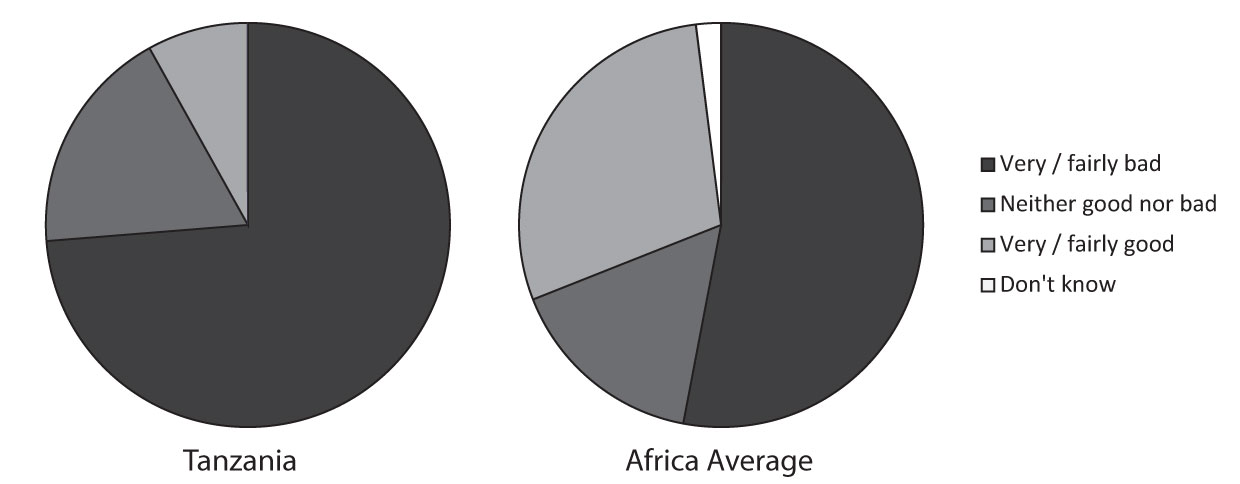
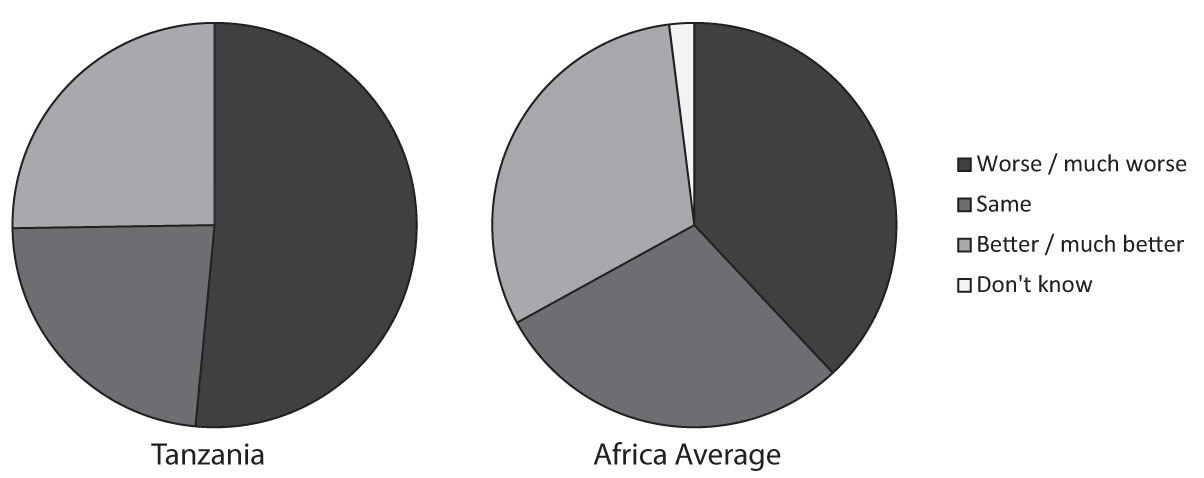
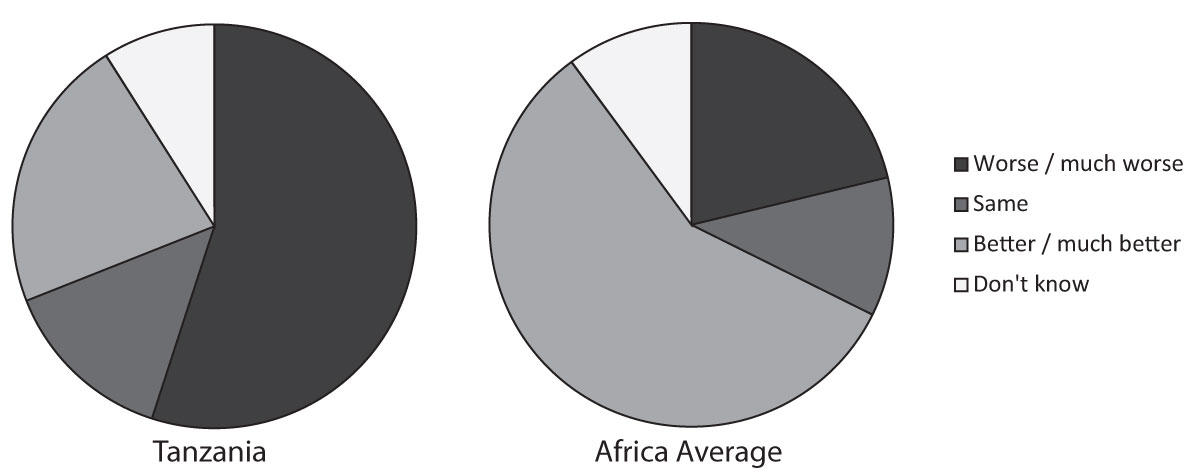
Though Tanzania has posted some enviable rates of economic growth in recent years – averaging around 7% in recent years – a new Africa-wide survey shows that Tanzanians are unconvinced by the state of the economy. The report, from Afrobarometer, found that Tanzanians were consistently much less positive about their country’s economic situation than people elsewhere on the continent.

Fewer Tanzanians (8%) were positive about the current state of the economy than in any other country. Twice as many Tanzanians said that they thought the economy had got worse in the past twelve months (51%) as said it had got better (25%). Fewer Tanzanians (22%) said that they expected the economy to improve in the coming twelve months than in any other country.

1) How would you describe the present economic condition of this country?

1) How would you describe the present economic condition of this country?

2) Looking back, how do you rate economic conditions in this country compared to one year ago?

2) Looking back, how do you rate economic conditions in this country compared to one year ago?

3) Looking ahead, do you expect the economic conditions in this country in 12 months time to be better or worse?

3) Looking ahead, do you expect the economic conditions in this country in 12 months time to be better or worse?

ENERGY & MINERALS

by Roger Nellist

New jobs in Tanzania’s gas industry
An early indication of the type of career opportunities that the emerging gas industry can offer professional Tanzanians was evident from major recruitment drives in February. The Tanzania Petroleum Development Corporation (TPDC) placed an 11 page advert in The Guardian on Sunday inviting applications for 226 new posts across 39 technical, managerial and administrative disciplines. Reflecting the offshore gas field locations and the expected onshore facilities, nearly three-quarters of these jobs (161) will be in Mtwara, with a handful shared with Songo Songo), and the remainder in Dar.

Mindful of regional interests and concerns, the BG Group (working with Ophir, Statoil and ExxonMobil in the south) also advertised for a Community Liaison Officer (CLO) in Tanzania. With progress on a potential large LNG project imminent, the CLO will build relationships with local stakeholders so that local concerns can be addressed before work is initiated.

Other recent petroleum developments
In January President Kikwete confirmed that the government will establish a special fund to receive a portion of revenues collected from natural gas production. The fund will be used to support national projects in other sectors, so that all Tanzanians can benefit directly from exploitation of the country’s gas. Similar sovereign wealth funds have been established by other resource-rich countries. Kikwete said Parliament will oversee the process, adding that the government is examining ways to sell TPDC shares to Tanzanians to ensure broader ownership and benefits.

The Australian company Swala Energy, which is prospecting for oil and gas in the Pangani basin and in the Kilosa-Kilombero area, has been in discussion with Tanzania’s financial authorities about floating shares on the Dar Stock Exchange. Swala is seeking to raise US $2 – 3 million from Tanzanian and other East African Community investors to fund further exploration work in its licence areas, where early results were encouraging.

In March, London-based Solo Oil confirmed the start of seismic surveys in its onshore south-eastern Tanzania licence area to determine future drilling locations. In 2012 its Ntorya-1 Well discovered “significant” reserves of gas-condensate. Solo has been seeking potential partners and expects to transport the gas through the pipeline now being built by the Chinese from Mtwara to Dar.

TANESCO troubles
Faced with large debts and increased demand for its services, TANESCO has threatened to disconnect defaulting customers. At end 2013 it was owed TSh233bn (about £90 million), of which more than half (TSh129bn) was owed by government institutions. In January 2014 TANESCO raised its tariff by 67% for domestic consumers, who will pay TSh100 per unit of electricity instead of TSh60. TANESCO has introduced a more effective procurement system to speed up customer power connections, for which applications have risen from 30,000 in 2006 to 143,000 now. It is also planning management changes to improve its service to the public and has also warned people to stop tarnishing its image through social media sites (there is much criticism of TANESCO providing almost TSh 1bn p.a. of electricity free to its staff).

In February the Parliamentary Committee on Energy and Minerals told TANESCO to inform people on the actual cost of installing electricity in rural areas under the Rural Energy Agency (REA) scheme. In some villages the uptake of the scheme has been low, partly because REA has been charging villagers for electricity poles, contrary to a government directive. During 2013/14 Parliament voted TSh 881bn for rural electrification projects. REA said that in the first phase 22,000 rural dwellers in 16 districts were connected and villages in a further 24 districts will be connected in a second phase starting this year.

Mineral mapping
In January, Energy and Minerals Minister Muhongo published the results of the latest high resolution airborne geophysical survey, indicating that 31 districts on the mainland have “plenty” of mineral reserves – specifically gold, diamonds, iron, nickel and copper. These surveys are an effective mineral prospecting tool and help the government meet its target of increasing mineral revenues to 10% of GDP by 2025. The surveys also assist land-use planning, environmental management, groundwater detection and animal conservation. A second phase survey will cover other districts.

KIKWETE IN THE UK

by Jacob Knight

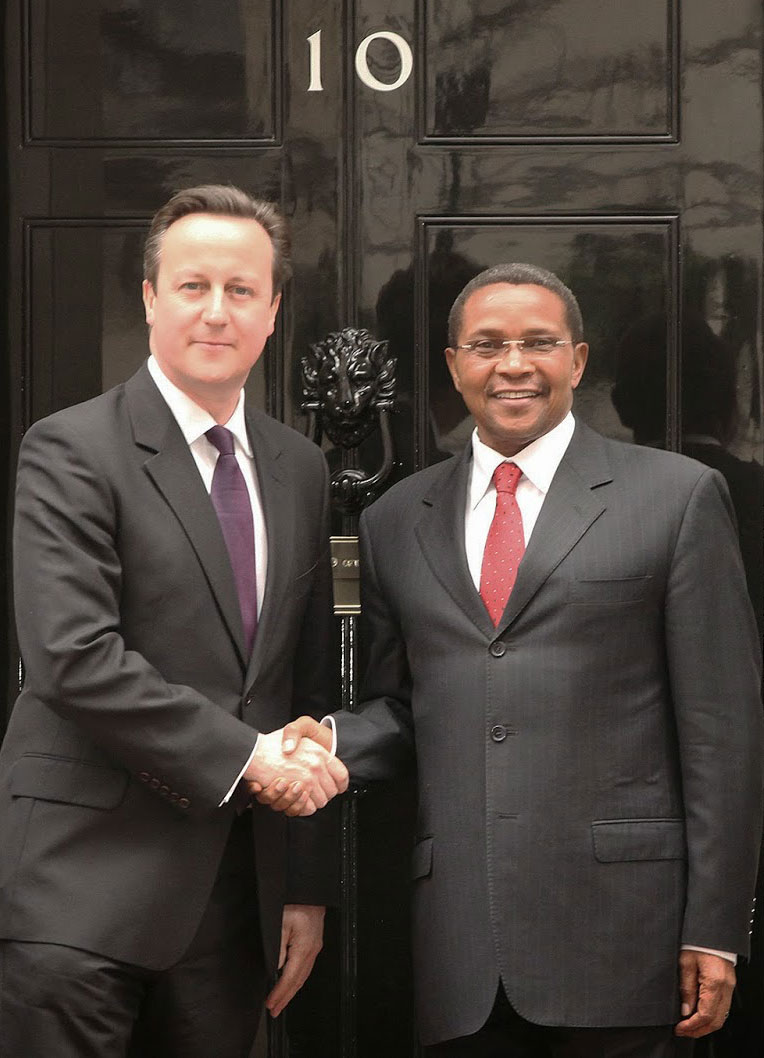
Kikwete and Cameron outside No 10 Downing Street

Kikwete and Cameron outside No 10 Downing Street

President Kikwete visited London from 31 March-1 April on a three day official visit. He met with the Prime Minister David Cameron and Foreign Secretary William Hague and held talks at Buckingham Palace with the Duke of York, Britain’s Trade Ambassador. The President opened the UK/Tanzania Trade and Investment Forum and visited Aberdeen to see UK expertise in the oil and gas sector. William Hague noted during the visit: “I am delighted at the growing partnership between the UK and Tanzania on a number of fronts. Tanzania offers significant opportunities for British businesses in the energy sector and beyond and has the potential to become a major new global gas supplier.”

The President also met with over 500 diaspora in North Wembley, urging them to play a meaningful role in the country’s affairs and noting that the issue of dual citizenship was being considered.

UK MP DELEGATION ON NUTRITION & EDUCATION

by Steve Lewis

“You can’t study if you’re hungry” is a new report by RESULTS UK, looking at how the Government of Tanzania is addressing challenges related to early childhood development. The report focuses on the impact of undernutrition on the education and learning of children.

Two UK MPs, Mark Williams and Cathy Jamieson, accompanied by RESULTS UK staff, took part in a fact finding delegation to assess how undernutrition and limited access to education were impacting the abilities to achieve their potential. The visit also looked closely at how UK aid is supporting Tanzania to make progress on these issues.

The report states that in Tanzania, 42% of children under five are chronically malnourished (stunted) whilst 5% are severely malnourished (wasted). Undernutrition can lead to permanent physical and cognitive damage that can impact a child’s performance in school. While Tanzania has experienced steady economic growth over the last few years, economic growth on its own is not sufficient to reduce undernutrition. The report recommends that the Tanzanian government, supported by donors like the UK, should invest directly in nutrition programmes to effectively achieve nutritional outcomes.

From meetings with Tanzanian MPs and Government officials there appears to be strong political leadership for addressing Tanzania’s nutrition challenges, although coordination among multiple ministries is a concern. The report urges that this high level political commitment is matched by better collaboration among agencies and an increase in resources to allow nutrition to become a priority throughout all ministries and districts. This is essential for ensuring that nutrition outcomes improve. In the long term, the governments of both the UK and Tanzania should advocate nutrition becoming a distinct priority in the post-2015 development framework.

In Tanzania, a lack of essential nutrients in the average child’s diet is one of the key determinants of undernutrition – it is not necessarily a lack of food, but a lack of nutritious and varied food. Lack of nutrients and vitamins can be mitigated through the fortification of staple foods such as flour and salt. The Tanzanian government has recognized the cost effectiveness of this method and has, with the help of the UK government, invested in fortifying flour. The report recommends Tanzania expands on this by fortifying other key staple foods, such as maize.

Tanzania has made very strong progress in getting children into primary school, and the net enrolment of children is now at 95%. However, many children are marginalised by ‘under the counter’ school fees and classes are often overcrowded because of the lack of trained teachers. The delegation visited a teacher-training college, which is supported by UK aid, and saw how important this was.

It is important that the UK government continues its support to teacher-training in Tanzania, supports teacher recruitment and works closely with the Government of Tanzania ensure that the teaching profession is valued, with salary and conditions to reflect this.