FAITH NEWS

Violence in Mto wa Mbu
The was a violent incident in Mto wa Mbu, Monduli, at the end of March during which ten people were injured. It was said to have been sparked from preaching by Pastor Richard Chenge from Dar es Salaam, who is alleged to have incited Muslims in the area. Before the chaos started, some Muslims called in the police complaining about the preaching and the district authority intervened calling on the two parties to sit together and resolve the matter. But before this could happen, Muslims stormed the Pentecostal congregation and fighting erupted.

The Dar es Salaam Guardian wrote a strong editorial. Extracts:

‘We strongly condemn any violence linked to religion because it does not bode well for the attributes of peace, unity and tolerance our nation has been promoting and protecting since birth. We believe that violence is never a means to correct a wrong or achieve religious harmony, where other remedies haven’t been exhausted. We say this bearing in mind the adverse consequences it has caused to millions of innocent people across the world….

Religious communities are meant to live and teach forgiveness, love, peace and tolerance as their holy books command them. Where misunderstandings arise they should engage in interfaith dialogue…. We are witnessing some newspapers and religious radios and tabloids that prompt religious conflicts in the country. The latter, instead of teaching their listeners and readers religious or moral values, have been busy instigating hatred and discontent under the pretext of freedom of expression and opinion.

But what surprises us most is to see that the responsible authorities are just silent even where they should have acted.

We suggest the following:

Religious communities should refrain from insulting believers of other faiths or using their scriptures inappropriately. Doing this does not add any value to their belief system or salvation. It only shows the ignorance or prejudices they have against their counterparts. Responsible authorities should warn politicians and clerics, who manifestly instigate religious hatred or discontent. It should also warn or deregister radios or religious tabloids that spread religious hatred.’

Catholic bishop warns CCM government on divisive propaganda
The Catholic Arch-Bishop of Mwanza, Jude Thaddeus Ruwa’iich has accused the CCM government of conducting a smear campaign by associating the Catholic Church with the opposition party Chadema. The Bishop, who is also the President of the Tanzania Episcopal Conference (TEC), was speaking ahead of an Episcopal consecration service for the new Dodoma Archbishop. He said some CCM cadres had been openly associating the Church with former Chadema presidential candidate, Dr. Wilbroad Slaa. “We don’t promote religious divisions; and we have never done so before,” said Ruwaich. “Our goal has always been the pursuit for truth. We challenge bad decisions and ask questions whenever things aren’t being run well – Mwananchi.

Cardinal Pengo says Chadema poses no threat
Following claims by some CCM leaders that big political rallies being organised around the country by Chadema are a threat to peace, Catholic leader Cardinal Polycarp Pengo said that he sees no such threat. Instead, he advised the government to look into the root cause of people’s complaints over the high cost of living. “The government should not act on comments from individuals who interpreted Chadema’s public rallies as instigating violence. It should carefully examine the situation and come up with amicable solutions,” he said – Mwananchi.

Mufti accuses Chadema of breach of the peace
The Chief Sheikh of Tanzania, Mufti Shaaban bin-Simba, has expressed concern over an emergence of what he referred to as religiously motivated politicians who incite breaches of the peace. The Mufti pointed out that the Chadema rallies are calculated at weakening President Jakaya Kikwete. “We have been quiet for sometime, but we should openly fight against allegations that the current government is illegitimate simply because the president is a Muslim. If some people want to bring about demonstrations that are characterised by violence – like what is happening in some other African countries where there are gunshots everywhere – then such people are very dangerous,” he said.

MISCELLANY

Lake Natron
President Kikwete has sanctioned plans to mine soda ash at Lake Natron in the Arusha region. He said that environmental concerns would be taken care of. NGO’s and activists opposed to the plans have expressed concern that soda ash mining would alter the area’s ecosystem and disrupt the habitat and breeding grounds for the flamingos which have given Lake Natron worldwide fame – Citizen.

Student Fees
Tanzania is facing the same problem over student tuition costs as Britain but with far fewer financial resources.

Rogers Luhwago, writing in the Sunday Guardian, under the heading ‘Education costs must be shared’, quoted a government official as saying that chaos and class boycotts at institutions of higher learning would not end unless the government reviewed its cost sharing policy. Tanzania was the only country in the world that provided finance for students in all private and public universities; it was unbearable for the government. The burden of financing undergraduate studies in universities would keep growing every year. He noted that Tanzanians were keen to contribute to wedding ceremonies and kitchen parties but when it came to education every one thinks it is the duty of the government.

One MP suggested that the government should think of financing a single student in each family where there are many children. “It’s impossible for the government to finance all of them. Parents should share the costs,” she said.

In the previous week the government had suspended indefinitely all undergraduate students from the University of Dar es Salaam for boycotting studies in protest against what they described as the “low rate” of meal allowance of TSh5000 (£2) per day’ The government later promised to double the amount in the next budget.

DEVELOPMENT RESEARCH IN 2010

Compiled by Hugh Wenban-Smith

That Tanzania might provide a rich field for development research will come as no surprise to readers of Tanzanian Affairs. However, the fruits of this research do not often make the headlines; rather, they tend to appear in academic journals not readily accessible outside university libraries.

This article is the first in what will hopefully become a regular report on development research in Tanzania, culled from journals in the library of the London School of Economics. Reflecting this (and the author’s own interests), the journals covered are mainly economic ones, such as World Development, Journal of Development Studies, Urban Studies, etc but I have included some more general ones, such as African Studies Review and Journal of Modern African Studies (both incidentally prolific reviewers of books about Africa).

In this report, articles published in 2010 are listed. The format is: Journal title; Volume and issue number; Author(s); Article title; Short abstract.

African Studies Review,Vol. 52(2) – Dill, B “Community-based organisations and norms of participation in Tanzania”. [Discusses the contradictions involved with inducing popular participation in the development process.]

African Studies Review,Vol. 52(3) – Sanga, I “Post-colonial cosmopolitan music in Dar es Salaam”. [This article concerns the late Dr Remmy Ongala, a Tanzanian-Congolese musician.]

Development and Change, Vol 46(6) – Beckmann, N & Bujra, J “The politics of the queue”. [This article analyses the political significance of HIV-positive people’s collective action in Tanzania.]

Journal of Development Economics, Vol 92(1) – Bengtsson, N “How responsive is body weight to transitory income changes?”. [We use time-series of rainfall to estimate the response of body weight to transitory changes in household income in rural Tanzania.]

Journal of Development Studies, Vol 46(1) – De Weerdt, J “Moving out of poverty in Tanzania”. [This paper uses qualitative and quantitative data to explore the growth trajectories of matched households in the Kagera region of Tanzania, finding that agriculture and trade provide the main routes out of poverty.]

Journal of International Development, Vol 22(5) – Dill, B “Public-public partnerships in urban water provision: The case of Dar es Salaam”. [This paper draws on original research and secondary data to analyse the strengths and limitations of public-public partnerships (i.e. government-community organisations) with respect to water provision in contemporary Dar es Salaam.]

Journal of Modern African Studies, Vol 48(3) – Bryceson, DF, Jonsson, JB & Sherrington, R “Miners’ magic: Artisanal mining, the albino fetish and murder in Tanzania”. [The murders are connected to gold and diamond miners’ efforts to secure lucky charms for finding minerals and protection against danger while mining.]

Urban Studies, Vol 47(5) – Lyons, M & Msoka, CT “The World Bank and the street”. [The well-documented weaknesses of structural adjustment policies have led to a reconceptualisation of the World Bank’s approach to neo-liberal reforms … It is argued (based on research in Dar es Salaam) that the exclusion of micro-traders from the reforms contributes to their marginalisation in political and policy arenas, increasing their vulnerability.]

World Development, Vol 38(3) – Bryceson, DF & Jonsson, JB “Gold digging careers in rural East Africa”. [Based on a recent survey of small scale mining in Tanzania, this article documents the higher risks, greater potential earnings, more elaborate division of labour and career trajectories of miners.]

Dr Hugh Wenban-Smith was born in Chunya and went to Mbeya School. His career
was as a government economist (mainly in Britain, but with periods in Zambia and
India). He is now an independent researcher, with particular interests in infrastructure,
urbanisation and transport.

MANYARA STARS

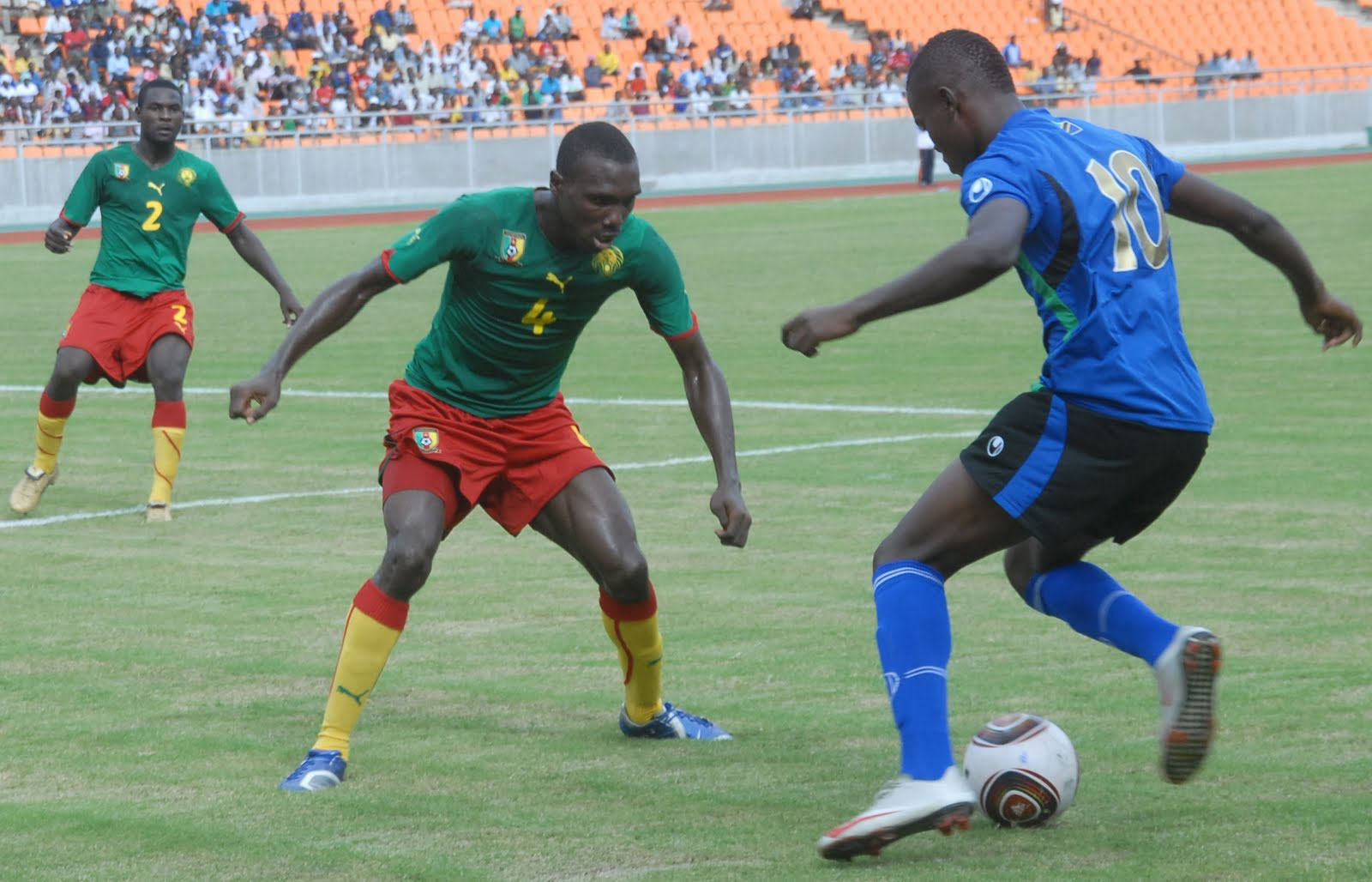
The Tanzanian under-23 team in action against Cameroon - Issah Michuzi

The Tanzanian Under-23 football team surprised many when they beat Cameroon on penalties after a thrilling return leg match of the 2012 Olympic Games qualifiers. The “Manyara Stars” now face another difficult task having been drawn against the powerful Nigerian team in the next round.

In the domestic league, Young Africans (Yanga) won the league title by the closest of margins. Yanga and arch rivals Simba started the final day with the same number of points, and both managed to win their final games (against Mwanza and Majimaji), but Yanga emerged victorious due to their overall goal difference of 25 compared to Simba’s 24. Yanga were awarded US$25,000 for winning the title and will represent Tanzania in next year’s Champions League.

KILIMANJARO MARATHON

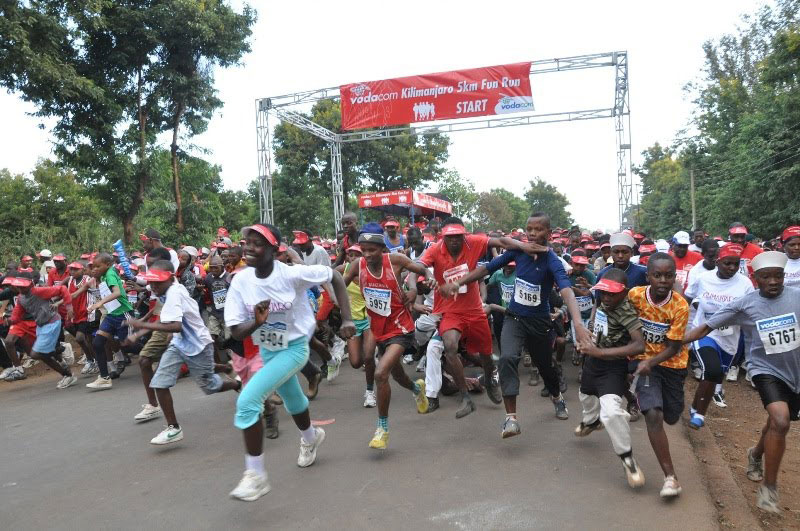
The start of the Kili fun-run - photo Issah Michuzi

The 9th Kilimanjaro Marathon was held in Moshi on 27th February and included a marathon (with over 300 entrants), a half marathon and a 5km fun-run (with over 2,000 entrants). Kenyan runners dominated the top spots, with Kipkemboi Kipsand and Anna Kamau winning the mens and womens marathon respectively, though Tanzanians Julius Kilimo and Banuelia Brighton came in second place. The medals were presented by Information, Youth, Culture and Sports Minister Emmanuel Nchimbi, who advised Tanzanian runners to use next year’s Kili Marathon as preparation for the London Marathon and Olympics, saying “We want medals from the London Marathon next so please prepare yourself well and don’t let us down.” The minister also noted that he was aware of complaints from sports fans that football was being given top priority, but insisted that was not the case and that the government appreciated all disciplines.

Crowds were entertained by the African Stars band ‘Twanga Pepeta’ and Bongo Flava artists ‘TMK Wanaume Family’ together with Joseph Payne known as ‘Mzungu wa BSS’ after having finished in 2nd place in the TV programme “Bongo Star Search 2010”.

Tanzania was not represented at April’s London Marathon, but Kenyans again dominated with a 1,2,3 in the men’s race and winning first and third places in the women’s race.

OBITUARIES

Christine Lawrence - thank you to Mrs Hilary Herbert for this - Editor

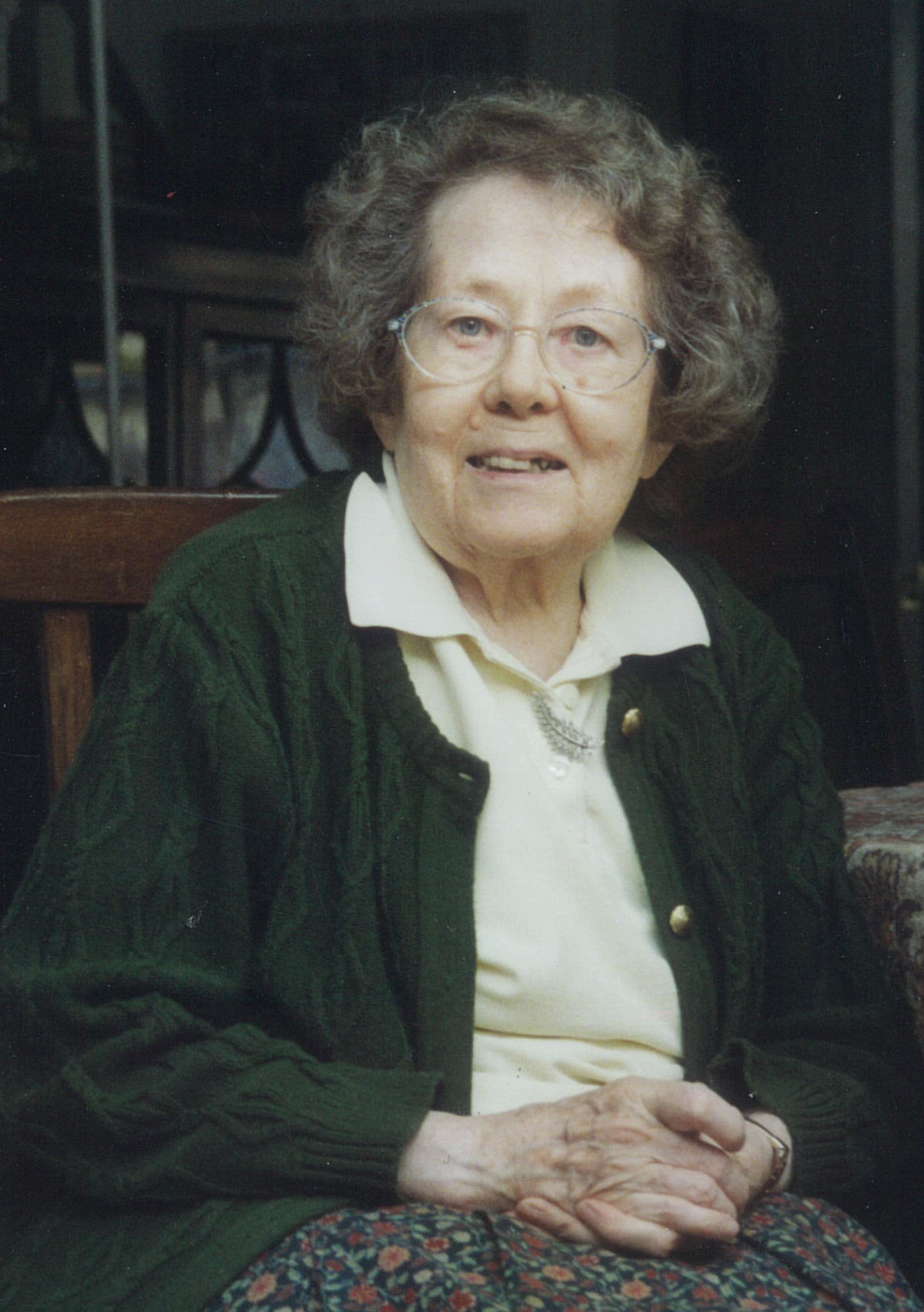
CHRISTINE LAWRENCE died on January 7 aged 80.
She played a pivotal role in the early days of the Britain- Tanzania Society when she did an immense amount of work on the administrative and financial side working with Bishop Trevor Huddleston and Roger Carter. She kept closely in touch with very many BTS members and with others connected to Tanzania and proved invaluable in locating and recruiting people to contribute to Tanzanian Affairs. She herself wrote numerous book, film and TV documentary reviews about Tanzania on a wide variety of subjects. She was present at virtually every meeting of the Society and was an active member of the committee. She played a leading role in organising society meetings and plying participants with refreshments.

At her funeral, Society member Keith Lye read out a tribute he had written:

‘Christine Lawrence made a massive contribution to many disadvantaged and impoverished people, particularly in Africa and Britain.

After completing a two-year course to become a child welfare officer, she went to run the Mahiwa Young Farmer’s Training Centre, in southern Tanzania, which had been set up by Bishop Trevor Huddleston, then the Bishop of Masasi. One of Christine’s most remarkable achievements, long before Women’s Lib, was to introduce courses at the centre for girls, the college having previously been exclusively for boys.

On her return to Britain in 1970, she worked for 20 years at Friends House, where she made many friends among the Quaker community. They shared the same ideals, especially in supporting projects to help people in what we then called the ‘Third World’. She made a return visit to Tanzania in 1972 and worked at a farm school on the slopes of Mount Kilimanjaro.

When we were working together, she was a stickler for detail. Like others, I got my knuckles rapped whenever I generalised or was imprecise. Christine was a most able and efficient person. Inspired by her deep Christian faith, she touched the lives of many people and she will be very much missed.

The funeral was held at the small and very attractive Gospel Oak Methodist Church in London. The BTS was represented by the Fennells and David Brewin.

The popular satirist ADAM LUSEKELO, whose columns in various newspapers over the years amused and sometimes shocked readers has died aged 56. The Citizen on Sunday said that he had a way with words and the use of simple and entertaining language. ‘Look at the names of his columns – Light touch (Sunday News), Punch Line (Daily Mail), Eyespy (This Day) – they all smacked of naughtiness. He rebuked the men in power and got away with it… he had no qualms about describing some of the politicians as ‘Bull crap,’ ‘trash comedy’, ‘baloney’, ‘empty talk’. Lusekelo was the BBC correspondent in Dar in the 80s and 90s and he had in recent years established himself as a Radio 4 presenter (for programmes including Africa’s Fourth Estate, 2005; the Living With Aids series, 2006; A Voyage On Livingstone’s Lake, the story of the MV Ilala boat on Lake Malawi, 2009; and Africa at 50: Wind of Change, 2010). He was buried with a chief’s honours, next to his father’s grave in Rungwe.

Emeritus Professor MICHAEL LATHAM OBE was born in Tanzania in 1928 and studied medicine at Trinity College in Dublin. One of his books, Kilimanjaro Tales: The Saga of a Medical Family in Africa, combined his and his mother’s accounts of their early life in Tanzania. From 1955 to 1964 he was a district medical officer and director of the nutrition unit of the Ministry of Health in Tanzania, and was awarded the OBE in 1965 for distinguished service. He joined Cornell University in 1968 after four years at Harvard, and remained there for over 40 years as a highly respected nutrionist. He was a cofounder and co-chair of the advisory group of the World Alliance for Breastfeeding Action and one of the first people to recognise the risks and campaign against the widespread marketing of powdered baby formula milk in developing countries. In 2007, the African Nutrition Graduate Students Network presented its first lifetime achievement award to Dr. Latham for his work to improve nutrition in Africa, and in 2008 he was awarded an order of merit from the United Nations System Standing Committee on Nutrition.

The EARL OF OXFORD AND ASQUITH (94), the grandson of Prime Minister HH Asquith, died on January 16 , 2011. After serving in Libya he was moved to Zanzibar in 1963. He said later that it had been a mistake to grant independence to the country in 1963 as it was clear that it had been suffering from underlying instability due to racial antipathies. He found the Arab politicians unreliable in both judgement and in action – The Times.

The Anglophile German historian and diplomat FRITZ CASPARI (96) died on December 1. After a distinguished career in Germany, Britain, Portugal and America, one of his final jobs was responsibility for German diplomatic relations with the Third World and the UN. In the Obituary in the Times (Thank you John Sankey for this – Editor) reference was made to the death in a plane crash in Tanzania of his eldest son Hans Michael who was serving in the UN. Thank you John also for the note you sent following the death on December 12 2010 of FATHER KIT CUNNINGHAM who spent 10 years at a Rosminion School in Tanzania.

Jonathan Hill, son of the Permanent Secretary for Home Affairs immediately before and after the independence of Tanganyika, has written to us to record the death of his father, DENYS CHALLMERS HILL OBE. He was in the Colonial Service in Tanganyika from 1940 to 1962 and, while holding various positions in the administration, he was involved in the Groundnut Scheme, a road to the (then) new Serengeti National Park, the distribution of famine relief during the war period and surveying the Ruaha Game Reserve.

REVIEWS

Edited by John Cooper-Poole

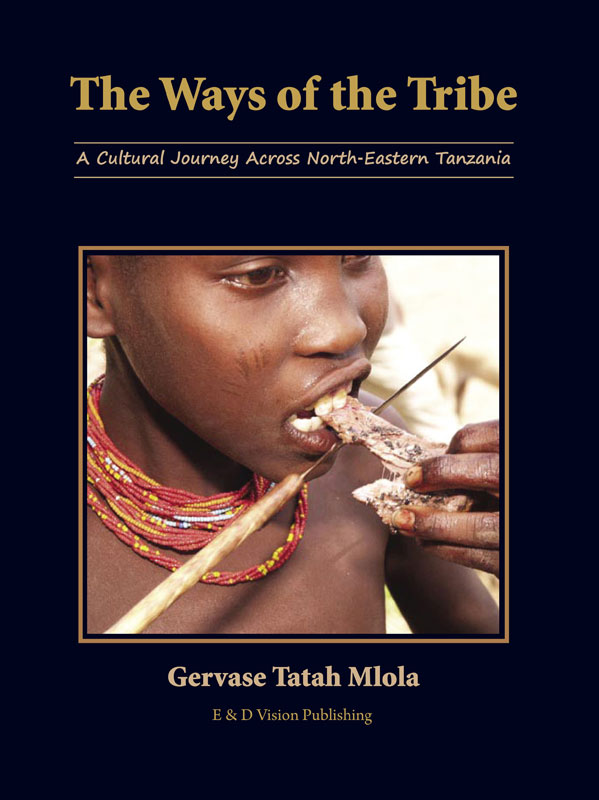
THE WAYS OF THE TRIBE – A CULTURAL JOURNEY ACROSS NORTH-EASTERN TANZANIA, by Gervase Tatah Mlola, published by E & D Vision Publishing, Tanzania, October 2010. www.edvisionpublishing. co.tz. ISBN 978 9987 521 42 5. The book is available at all outlets of Novel Idea Bookshop in Tanzania, Kase Book Stores in Arusha, and the offices of Park East Africa Ltd., and the Tanzania Cultural Tourism Programme. In the UK, the book will shortly be available from www.africanbookscollective.com for £20.95 See www.waysofthetribe.com for more information on the book and some sample pages.
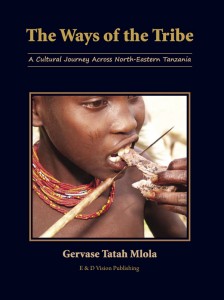
The Ways of the Tribe cover

Tanzania has a rich and diverse cultural landscape. The Ways of the Tribe is a compelling and authoritative reference work that makes a valuable contribution towards documenting the ancient heritage of the various tribes that populate this vast and beautiful land. Mlola’s first book offers readers a fabulous survey of fourteen tribes from the north-east of Tanzania.

Whilst the Maasai may be familiar to readers worldwide, the book also chronicles less familiar peoples like the Barabaig of Hanang District and the Mbugu of the Usambara mountains. This account is the result of a decade of research arising from visits to the present-day tribal communities by the author – a respected travel writer and cultural expert.

The content of this book is arranged by tribe and within each chapter there are sections on origins, history, community life, and customs. The contribution of each tribe to the national life and development of the nation is also included with a range of fascinating stories, such as the heroic story of the Olympic runner John Stephen Akhwari of the Iraqw.

The Ways of the Tribe is a lively and engaging chronicle packed with legends, humour, and colourful insights into everything from the naming of babies to the brewing of sugar cane beer. Each chapter also contains a very useful bibliographical section; the work would benefit further from the inclusion of an index. In addition to many striking images contributed by Colin Hastings (now a director at Majority World Photo Library) and photographer Briony Campbell, there are also illustrations by artists Abdul Gugu and Bosco Mpitivyako. Their work (together with a selection of maps) contributes to the bright and attractive appearance of this publication.

Mlola’s scholarship has resulted in a very accurate historical account, but his work also provides another level of understanding beyond the factual. The author’s first-hand experiences, passion, and dedicated research also offer readers a valuable understanding of the interplay between the beauty of the land and the beauty of the people. In doing so he offers a unique insight into the essence of the identity and vibrancy of these peoples.

In addition, the author provides a description of the present-day circumstances and lifeways of these peoples. In doing so, we are reminded these tribes are real communities whose rich heritage is sadly threatened by a host of issues often faced by indigenous peoples around the globe who strive to retain their identities in a rapidly changing world. The final chapter on the “lost tribe” of Engaruka is a reminder of the fate of indigenous groups who are unable to withstand the social, economic and environmental pressures that may come to threaten their future.

The Ways of the Tribe is a well-presented and important reference work that will have widespread appeal. For students and scholars it is a valuable historical chronicle and present-day commentary on the tribes under discussion. The book should give Tanzanians a greater appreciation of their diverse and lively heritage. Tourists planning a visit to the region that is home to many worldfamous destinations will greatly benefit from understanding the peoples they may encounter on their holidays. And finally for the general reader, this lively reference work is a wonderful way to begin exploring the people, places and cultures of this fascinating part of Africa.
Antony Shaw.

This review first appeared in Tantravel, the official travel magazine of Tanzania Tourist Board, and we are grateful for permission to re-publish it here.

MAJI MAJI. LIFTING THE FOG OF WAR James Giblin and Jamie Monson, eds., Brill, Leiden, pp.xii and 325, 2010, ISBN 978 90 04 18342 1. US$107, Eur 75.

The greatest achievement of the first ‘Dar es Salaam school’ of history in the 1960s was the Maji Maji research project. Over forty years ago there was money available for student research in the vacations and very many were deployed to collect oral testimony in the areas which had been affected by Maji Maji. This research produced what Giblin and Monson call ‘the foundational accounts’ of the rebellion, mainly by John Iliffe and the late Gilbert Gwassa, in collections of ‘records’, articles, and books. These now classic works were very popular and influential both inside and outside Tanzania. For decades it did not seem necessary, or perhaps even possible, to review and revise them.

Forty years later, though, so much new work has been done on central and southern Tanzania that a second Maji Maji research project has become possible and perhaps essential. A ‘multi-year collaborative project … began in 2001’ and has taken longer and cost much more than the original research. This book is the result. Though its contributors present a variety of interpretations of Maji Maji it is in essence a revisionist work. The 1960s account of the rebellion, the editors hold, was unduly ‘statist’. It overestimated the reach and the presence of the colonial state and it overestimated the proto-nationalist intentions of resistance to it. It was also too tidy, making the violence seem more co-ordinated than it really was. It laid too much stress on the spread and effect of the maji medicine but at the same time accepted too uncritically the existence of ‘tribes’. The real situation was much messier and more shaped by local and fragmented realities.

Reading this book reminded me of the famous story of the blind men and the elephant – one feeling its tail and deducing it must be a snake, another embracing a leg and deducing it must be a tree and so forth. The contributors find in Maji Maji what they most hope to find. Thaddeus Sunseri, who has done so much good work on environmental history, says that ‘Maji Maji was a symbolic clash of hunting cultures’ – it was ‘the war of the hunters’. (119) Lorne Larson, who has been working on the Ngindo for decades and who has written on witchcraft eradication movements, finds Maji Maji to be the climax of the politics of medicine. Heike Schmidt, who has an active interest in black female political power, lays stress on the role of Nkomanile, an Ngoni ‘royal woman’. (197) James Giblin, who has ‘domesticated’ rural Tanzanian politics, emphasises an oral tradition that ‘the war occurred here [in Ubena] because of a woman. Mpangire wanted to marry Mwangasama, for the very reason that Mpangire had a great desire for brown women’. (284) Giblin finds this story ‘as plausible and as faithful to our admitedly incomplete knowledge of the events of September 1905 as any account yet devised by historians’. (286) In fact, Maji Maji was all these things and more, just as an elephant has ears and a tusk as well as a tail and legs.

Maji Maji was about the contest over elephants and it was about how to resolve the problem of evil. It was about desire, gender and slavery. It was about the failures of chiefs and elders as well as about the presumptions of German colonial officers. It was a revolt against colonialism but it was something much more profound than that. It was an attempt to resolve the desperate problems of society, economy, belief and enviroment. The brutality of its repression foreclosed any possibility of reaching solutions. As Heike Schmidt writes: ‘Death, starvation, displacement, enslavement, forced labour and humiliation dominated life into the years following the fighting … The deadly silence observed in 1907 still resonates in Ungoni today.’ (218-219).

This collection makes many innovations. There is a terrifying chapter by Michell Moyde on the Askari, which makes great play with John Iliffe’s work on honour. Heike Schmidt’s historian’s chapter on Ungoni is balanced by a chapter on the archaeology of Maji Maji in the district by Bertram Mapunda. Very effective use is made of German missionary records, both Catholic and Protestant – though there is little on the role of African Christians. The book is beautifully produced and illustrated. It is a pity that it is too expensive to be bought by the average reader. It is possible that even if many Tanzanians read it they would not be as excited as a preceding generation was by the ‘statist’ accounts of forty years ago. Complexity is hard to digest or to teach. But anyone interested in Tanzanian history should obtain and read this book.
Terence Ranger

CHECHE: REMINISCENCES OF A RADICAL MAGAZINE edited by Karim Hirji, Mkuki na Nyota 2010. ISBN 978 9987 08 098 4.

THE COURAGE FOR CHANGE: RE-ENGINEERING THE UNIVERSITY OF DAR ES SALAAM by Matthew Luhanga, Dar es Salaam University Press 2009. ISBN 978 9976 60 479 5. £22.95. Both books available from African Books Collective, P.O. Box 721, Oxford OX1 9EN www. africanbookscollective.com

Two recent books, one edited by Karim Hirji, the other by former Vice Chancellor Matthew Luhanga, contribute to the historiography of the University of Dar es Salaam (UDSM), an institution which has seen significant and rapid changes in its relatively short history.

Karim Hirji opens his chapter, entitled “The Spark is Kindled,” with a vivid description of a Friday evening at UDSM in 1969. “Only a handful of staff offices are lit. Walter Rodney types out page after page of How Europe Underdeveloped Africa…” (p. 18). He goes on to describe an animated meeting of the University Students African Revolutionary Front (USARF), the radical socialist student group that founded Cheche, a short-lived but fiery student magazine published from 1969 to 1970. At this meeting a young radical named Yoweri Musevani speaks to the crowd; Issa Shivji and others who will become prominent Tanzanian intellectuals are there. In his description Hirji captures the spirit and enthusiasm of these activist students and provides a rich picture of UDSM’s vibrant intellectual atmosphere in the late 1960s and early 1970s. Likewise, Matthew Luhanga’s recounting of his time as UDSM’s Vice-Chancellor in The Courage for Change includes vivid, and often humorous, descriptions of significant events that took place during his tenure from 1991-2006. Indeed, the core contribution of both of these works is the detailed personal narratives and recollections of two significant, yet very different time periods in the history of UDSM.

Cheche recounts an intellectually vibrant period of UDSM’s history, the late 1960s and early 1970s, just after the Arusha Declaration, when students and scholars were engaged in building a university relevant to the socialist development of Tanzania. The volume, edited by Hirji, one of the founders of USARF and Cheche, can be divided into two parts. First, the core of the book gives Hirji’s account of the rapid rise and fall of the radical socialist student group and it’s associated publication. It includes reminiscences of other USARF members, such as Henry Mapolu, Zakia Meghji, George Hajivayanis, and Christopher Liunda about their work with Cheche and its successor publication, Maji Maji. Hirji has even included an article by a young Yoweri Musevani that appeared in a 1970 issue of the magazine. This section ends with a selection of poems, some republished from Cheche, that express the socialist ideals of USARF and its members. The second section bookends this core narrative of personal recollections. In the first and last three chapters, Hirji provides his socio-historic analysis of the wider national and global context in which the authors of the book were steeped. Utilizing personal observations and drawing on the work of a wide range of scholars, Hirji offers an analysis of why socialism failed in Tanzania (or was never truly enacted) and his critique of the capitalist imperialist system. The final chapter contains his reflections on the contributions and the deficiencies of USARF and Cheche. He ends the book with a call to the next generation to take up the cause of African liberation. While Hirji’s call to arms is inspiring and his socialist historical analysis is detailed, albeit unapologetically agenda-driven, it is the rich and detailed story that he and others tell of their personal experiences with USARF, Cheche, and the socialist era at UDSM that make a solid contribution to the historiography of the University of Dar es Salaam and Tanzanian intellectuals.

Luhanga’s Courage for Change focuses on another key time in the history of the university. In 1991, when Luhanga began his tenure as Vice Chancellor, the university was reeling from extreme economic hardship of the 1980s. Luhanga tells the story of his implementation of the Institutional Transformation Programme and UDSM’s subsequent slow emergence from a period of significant decline. Throughout the text Luhanga provides numerous facts and figures, supporting his contribution to UDSM’s recovery. These are also available in his previous publications (Strategic Planning and Higher Education Management in Africa, 2003 and Higher Education Reforms in Africa, 2003). While these tables, bullet points and statistics give some context, they are repeated from other sources and give a rather flat picture of UDSM’s recent history. It is the stories that Luhanga weaves amongst these facts of his hasty appointment, student protests, a “kidnapping”, economic hardships, and conflicts between the Hill (UDSM) and the Tanzanian government that are of interest. Of course, Luhanga’s account comes from the political perspective of the highest level of university administration, contrasting sharply with Hirji et al.’s narrative from radical students’ perspectives. Both are necessary, however, to gain a fuller picture of the rich history of the University of Dar es Salaam.
Amy Jamison

FROM BONGOLAND TO DAR ES SALAAM; URBAN MUTATIONS IN TANZANIA, co-ordinated by Bernard Calas, originally published in French by Karthala of Paris around 2006, now translated by Naomi Morgan, and published in English by Mkuki wa Nyoka Publishers Ltd in association with the French Institute for Research in Africa, pp 417, ISBN 978-9987-08-094-6. Available from African Books Collective, P.O. Box 721, Oxford OX1 9EN. www.africanbookscollective.com. £34.95.

This book brings together in English a dozen papers by a group of French academics in the fields of geography, economics, political science, sociology and history, Their research, done between 1996 and 2002, covers Dar es Salaam’s foundation and exponential growth, the harbour, trade and commerce, local government (and its shameful neglect in the 1970s), land and planning controls, slum life, public and private transport, primary education, and water supply. There are also chapters on the impact of various ethnic groups and the colonisers on the metropolis’ culture and society; and finally a dissertation on the city’s relations with Zanzibar.

On all these matters, this volume offers useful data and informed judgements (on, for example, the problems of Ujamaa and the subsequent Structural adjustment Programme). It also provides numerous insights into the life of the city’s inhabitants over the years. As such, it will be a useful quarry for future students of urban development in sub-Saharan Africa, as well as of the story of Dar es Salaam.

The book has severe limitations however. There is no index; and because few of the writers knew Swahili, their work lacks the immediacy of oral testimony, while the bibliography is inevitably mostly of works in French. Moreover, the chapters vary in quality; some are clear and direct, others are prolix and complex. Some are a pleasure to read; others very heavy. The translator tackled her job gallantly but appears to have had fearful difficulty at times in turning academic French into straightforward English. My review copy had not been proof-read, and contained frequent irritating howlers – like “Babamoyo” on page 12 – as well as the omission of illustrations and repetition of sentences in several places.

Unless a clean and much tidier edition is published, this is a poor example of the work of the publishers, Mkuki wa Nyoka. Despite all these drawbacks however, we may be grateful to the authors, coordinator and translator for contributing another useful building block in Tanzania’s recent history.
Dick Eberlie

SPEAK SWAHILI, DAMMIT! by James Penhaligon. Authorhouse U.K. Ltd. 500 Avebury Boulevard, Central Milton Keynes, MK9 2BE. www.authorhouse. co.uk. ISBN 978 1 4490 2373 7. Speak swahili Dammit, is available via the author’s book website, www.SpeakSwahiliDammit.com at “just over £10”.

For those Wazungu who lived in East Africa from the Fifties onwards, this book will bring back many fond memories. It was good to hear a tale from someone who was brought up in what was then Tanganyika later to become Tanzania, as to my knowledge there are few other similar accounts.

James Penhaligon was raised in the bush in a remote area near Mwanza next to Lake Victoria at the Geita gold mine and after the premature death of his father, his mother and sister carried on living in the area with his mother working to make ends meet. The young “Jimu” soon comes under the spell of Africa and one can see the enthusiasm he has for the country, people and especially the language.

Apart from Jimu’s adventures, the book also gives the reader a little history about Tanzania when he meets an old soldier from Von Lettow Vorbeck’s Deutsch Ost Africa Corps and about the campaigns of the First World War which I remembered being spoken about when a pupil at Lushoto in the Sixties. Jimu’s story continues with his education at Arusha and Nairobi, and I can identify with the black and blue bruises that he describes! The Swahili interspersed throughout the book was interesting to a Swahili speaker although there was quite a lot of repetition of phrases that sometimes detracted from what is a really a cracking tale that has tragedy, adventure and humour in jembefuls (spadefuls).The book was also a little long but overall an enjoyable read and brought back wonderful memories of Tanzania.
David Holton

Dick Eberlie was District Officer in Dar es Salaam, Kisarawe and Morogoro and subsequently worked for the Tanzania Tea Grower’s Association. He was Secretary of the Tanzania Society for the Blind and a member of the Editorial Board of the Tanzania Notes and Records. Author of “The German Achievement in East Africa”, he is now an adviser on industrial organisation and business representation with the British Executive Service Overseas (BESO).

Contributors
David Holton was educated at Lushoto Prep School before returning to school in England. He has been manager of Bookland in Chester and a regular book reviewer for BBC local radio.

Amy Jamison holds a PhD in Educational Policy from Michigan State University, and conducted her doctoral research on the history of the University of Dar es Salaam. She is currently the Assistant Director of the Center for Gender in Global Context and continues to pursue research focused on African higher education.

Terence Ranger was the first Professor of History at University College, DSM, 1963-1969. He is currently Emeritus Professor at the University of Oxford and has been a member of the Britain-Tanzania Society for thirty years.

Anthony Shaw is Managing Director of Creo Communications, a Tanzania-based company offering communication consultancy and English language support services to individuals, organisations and businesses.

TA ISSUE 98

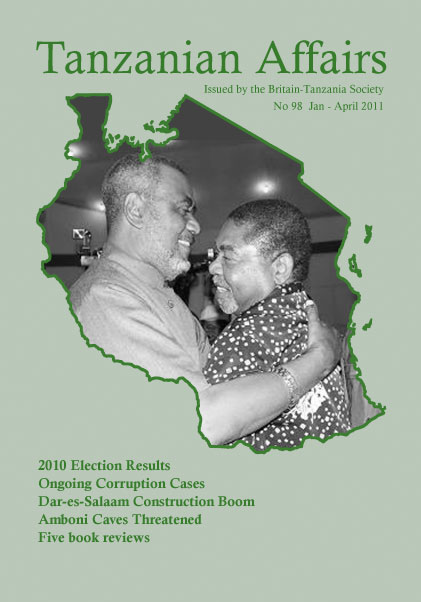
TA 98 cover showed New President of Zanzibar Dr Ali Mohamed Shein (CCM) (right) and First Vice President, Maalim Seif Shariff Hamad (CUF), embracing at the start of the Government of National Unity

A pdf file of the issue can be downloaded here

ELECTION 2010 RESULTS

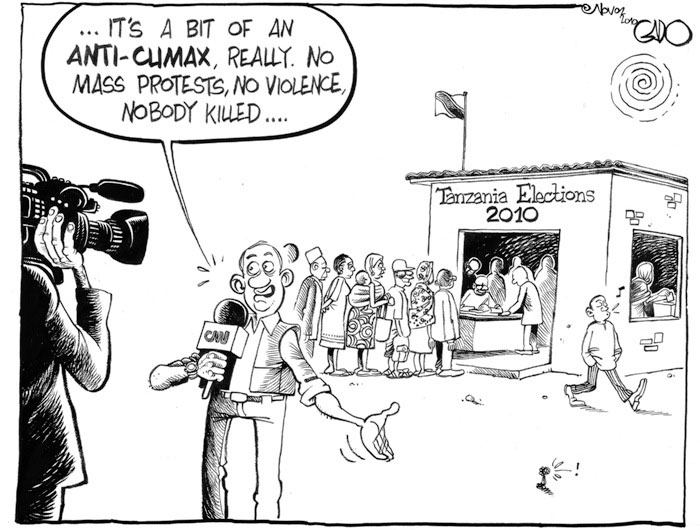
Cartoon by Gado (Godfrey Mwampembwa) which appeared in the local press

THE EMERGENCE OF A REAL OPPOSITION
In Tanzania’s elections on 31 October 2010, for the first time since independence, an opposition party made significant gains in votes and seats in Tanzania’s National Assembly. The ruling CCM party’s presidential candidate Jakaya Kikwete saw his vote drop to 61% compared with 80% in 2005. Leading opposition CHADEMA presidential candidate Dr Wilbroad Slaa got 26% and the presidential candidate for the Civic United Front (CUF) (whose main strength is in Zanzibar) Professor Ibrahim Lipumba was in the third position with 8% of the vote.

The ruling CCM party lost 55 seats in parliament while the CHADEMA party increased its seats from 5 to 24. Thus, Tanzania now has a viable opposition party in parliament and observers are anticipating lively debates.

TANZANIA SHOWERED WITH PRAISE

Tanzania was showered with praise on its conduct of the elections from the large contingent of foreign observers in the country and by heads of state and leaders of international organisations.

The elections passed largely peacefully although there were many minor incidents in individual constituencies before the elections when CCM was involved in often passionate debates on the selection of its parliamentary candidates and during the counting of the votes when there were complaints about the delay in publishing some results.

BUT THE OPPOSTITION PROTESTS
CHADEMA, while accepting the validity of the parliamentary elections, and after an apparently heated internal debate on what to do, refused to recognise the re-elected President Kikwete because it believed that the published results of the presidential election had not been correct. The Party’s MP’s then walked out when the President began his inaugural speech to the new parliament.

CHADEMA leader Freeman Mbowe said that their aim was to pressurise the government into changing the constitution so that future elections would be free and fair. He said that his party was not satisfied with the way the presidential votes had been counted and the results announced.

He pointed out that the law and did not allow anyone to question the presidential election results yet it was possible to question the outcome of parliamentary and civic polls. The law had been drawn up during the period of the one-party state and was now obsolete. CHADEMA would press for the formation of an independent commission to examine the presidential poll results and to make proposals on the preparation of a new constitution.

Asked if CHADEMA’s readiness to meet the government was not against their stand not to recognise President Kikwete, Mbowe explained that they acknowledged the presence of the head of state though they were not in agreement with the way he was elected.

CCM REACTIONS
CCM Publicity Secretary John Chiligati said that what CHADEMA MPs had done was an ‘act of treason against democracy.’ He said the elections were endorsed by local and foreign observers who said it was free and fair. What CHADEMA was doing was ‘incitement to violence.’

The Citizen quoted Prime Minister Pindo as saying that CHADEMA MP’s had shown weaknesses in handling issues and its MPs had proved to be still very young democratically. Mr Pinda said he had been ready to meet with CHADEMA and discuss their problems but they had decided to take another measure which was not helpful in building the country’s democracy and bringing development.

President Kikwete told parliament that there was no way for any person to avoid CCM’s government. “People will come and go but this is the CCM government and it will remain in power whether they like it or not. I am the President and they will end up bringing their problems to me,” he said.

In the following weeks the demands for a new constitution grew amongst wide sections of the population.

THE RESULTS IN DETAIL

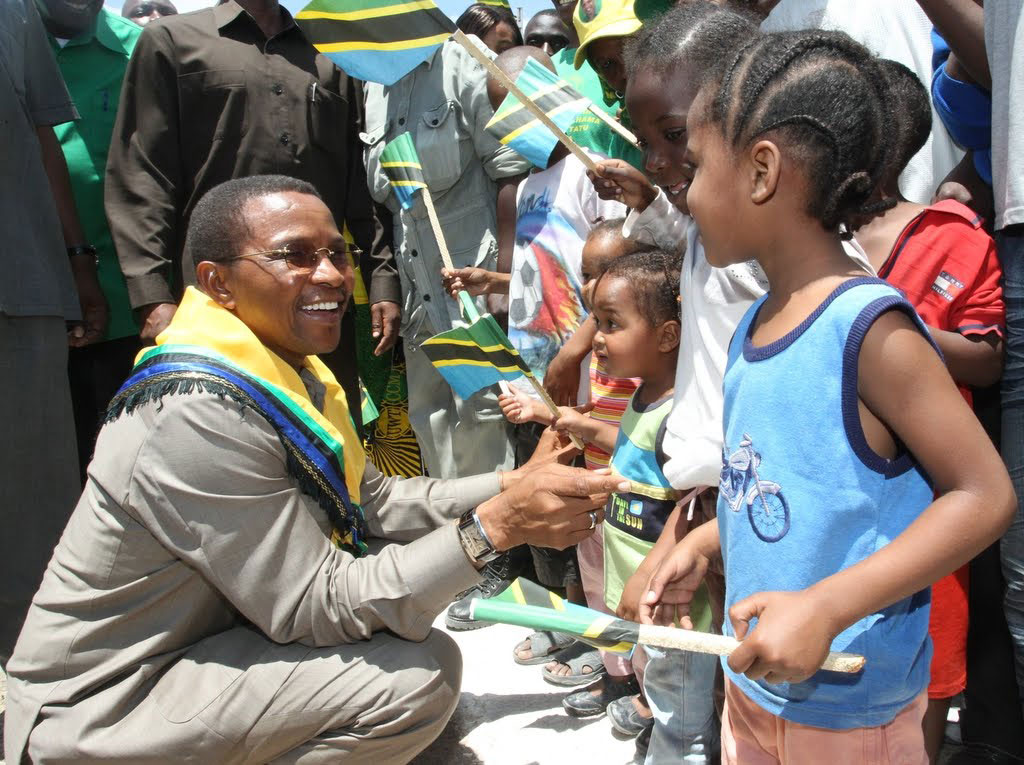
President Kikwete on the campaign trail in Dodoma (photo Issah Michuzi)

President Kikwete garnered 5.2 million votes or 61% of the 8,626,283 ballots cast, followed by CHADEMA’s Dr Willbroad Slaa, with 2.2 million votes or 26%. The new Vice President is the prominent Zanzibar leader Dr Gharib Billal, who was not voted for being part of President Kikwete’s ticket.

After seven by-elections were held in seats where there had not been enough ballot papers, the final result of the parliamentary elections for the 239 elected seats in the Union National Assembly (when special nominated seats for groups such as women and youth are added the total is 358 MP’s) was as follows: CCM 188. CHADEMA 24, CUF 21, NCCR-Mageuzi 4, United Democratic Party (UPDP) 1 and Tanzania Labour Party (TLP) 1.

By comparison the 2005 results were as follows: Kikwete 80% and out of 232 elected seats: CCM 206, CUF 22, CHADEMA 5, TLP 5, UDP 2 . Five seats were vacant at the time.

The number of MPs increases to more than 350 compared with 323 following the demarcation of new constituencies. The President also appointed additional MP’s representing special interests such as women and youth. After these appointments the number of opposition MP’s in the National Assembly was as follows: CHADEMA 45, CUF 34, NCCR 4, TLP 1 and UPDP 1 – Guardian.

In Zanzibar President Shein appointed a number of Special Seat MP’s making the composition of the House of Representatives CCM 28 and CUF 22.

REGIONAL DIFFERENCES AND PERSONALITIES
There were differences in regional voting patterns. CCM remained very strong in all the coastal regions and strong in most other areas. CHADEMA gained votes and seats in urban centres and, in particular in the Kilimanjaro, Arusha, Mbeya and Kigoma regions. Opposition parties in Klimanjaro Region won four seats – three CHADEMA and one TLP.

In Lindi the CCM candidate made some derogatory remarks about the CUF candidate. He advised voters that his opponent ‘suffered from albinism’ and should be avoided by voters who should … keep their distance from him because albinism was a curse. But the Albino is the new MP for Lindi.

The result in the constituency of former Prime Minister Edward Lowassa, who had been alleged to be involved in corruption, caused surprise in some circles. His electorate showed that they had not lost confidence in him by giving him an overwhelming majority.

Former prominent minister and MP Augustine Mrema is back in the forefront of Tanzanian politics after his success in the elections in Moshi. He himself became MP for Vunjo and his TLP party did well in the civic elections.

Former Speaker of the National Assembly Samwel Sitta said that in his new position as Minister for East African Cooperation, he would continue advocating ethical and transparent leadership as he had done when he was Speaker. During his heyday he had given government leaders a tough time by allowing fiery debates that led to the resignation of the then Prime Minister Edward Lowassa – Mwananchi.

The new Speaker is Anne Makinda, Njombe South MP (CCM), the first woman in the country’s history to be elected to this post. She brings a wealth of experience having been an MP for 35 years, and having been the deputy Speaker for five years.

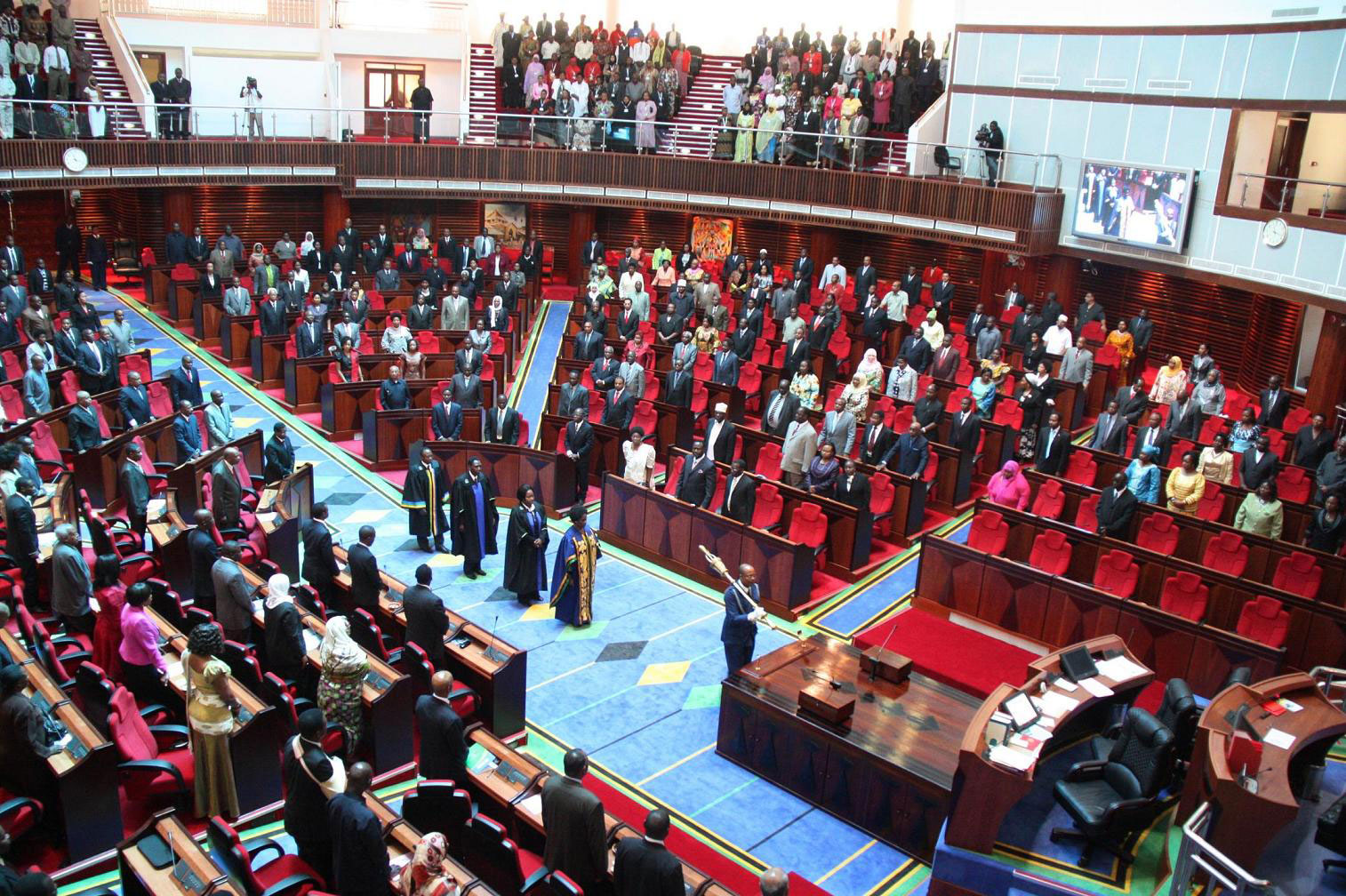
Speaker Anne Makinda at the opening of parliament - photo Aron Msigwa and Anna Itenda

CHADEMA won its first seat in Manyara region when its candidate Mustapha Akunaay, the outspoken executive secretary of the Tanzania Association of Tour Operators, defeated veteran CCM Minister Phillip Marmo by a margin of over 20,000 votes.

In the Arusha council elections a CHADEMA Rastafarian was elected: The Citizen wrote: ‘Donning his characteristic curled hair and a green-and- yellow cap associated with the culture, astounded some of his political rivals. During the campaign he was perceived by his rivals as a marijuana smoker unfit for leadership because of his behaviour which ‘resembled that of some famous Rastafarians in the Caribbean.’ However he insisted that he had ‘never ever’ smoked bhang or any other narcotic drug and did not plan to do so. CHADEMA had advised him to remove his Rastafarian attire “But I told them that I had better leave politics than remove my Rasta fashion. Since then nobody has ever discussed this matter with me again “ he said.

Another of the new MPs is rapper and Bongo Flava artist Sugu (Joseph Mbilinyi) who won the Mbeya Mjini seat for CHADEMA. He defeated the incumbent CCM candidate Benson Mpesya by 46,411 votes as against 24,236. Sugu’s campaign had the theme “Tumaini Jipya kwa Maendeleo ya Wote” “New Hope for Development for All”. In an interview Sugu said “It pains seeing many musicians in the country failing to pay for a bus fare, while someone somewhere is eating the sweat of musicians.” Fellow musician Afande Sele says that he hopes Sugu will be able to reduce the problems Tanzanian musicians face due to widespread piracy of their work.

OPPOSITION CAMPAIGN

Dr Slaa addresses a crowd in Zanzibar - photo Emmanuel Herman

The CHADEMA presidential candidate Dr Wilbroad Slaa attracted massive crowds during the election campaign wherever he appeared. As an example, on September 19, the Guardian reported that business in Arusha came to a standstill for four hours as thousands of its residents rushed to welcome him. His decision to vie for the presidency ‘had changed the political wind in the country.’ A convoy of hundreds of vehicles accompanied the candidate to the rally grounds. Security officers were almost overwhelmed….Finally came the moment when Dr Slaa stood to address the crowd. “We have not ferried you from your homes to this place with lorries or buses…Neither did we give you free T-shirts nor khangas plus money to solicit you to come here….Your massive attendance is a demonstration that you are fully committed to change” he said.

Slaa said it was a shame that people from a nation endowed with abundant natural resources such as minerals and wildlife led a miserable life while countries with minimal or no resources such as Kenya were now offering education for free. He said Tanzanians, for a long time, had been victims of poor government policies, corruption and embezzlement of public funds. He added that CHADEMA would raise money to finance education and heath care services by cutting down public spending through reducing the size of the cabinet to not more than 20 seats, slashing MPs’ emoluments, abolishing some government posts, such as the post of district commissioner, and reducing procurement of government vehicles. He said other money would be generated after overhauling mining contracts. Slaa maintained that a CHADEMA government would waive all taxes on construction materials to enable people to construct decent houses.

CHADEMA’s founder, former Finance Minister Edwin Mtei, who also attended the rally, questioned the new culture in which those accused of corruption were being protected by the ruling party. This, according to Mtei, was the beginning of the downfall of Africa’s oldest ruling party – the CCM – Guardian

During the election campaign at a big rally in Lindi, CUF leader Professor Ibrahim Lipumba was quoted in Majira as saying that his party would like to see the country being run as it used to be under colonial authority which had been better than the present CCM government. He said despite the problems of colonialism, the suffering people now underwent was worse. In those days the current spiralling cost of living was unknown, while the poor people were now burdened with education fees he said. Lipumba claimed. “If it were not for the free education I got I would be in my village corralling cattle.”

Needless to say, with its vast financial resources the CCM also put on a well organised campaign and President Kikwete’s numerous rallies attracted huge audiences many draped in the party colours.

THE PRESIDENT’S INAUGURAL ADDRESS
Undeterred by the unprecedented walk out by CHADEMA MPs, the President continued with his inaugural speech to Parliament and emphasised the need to build a middle-class economy and empower small-scale and medium entrepreneurs, farmers, pastoralists and fishermen.

He outlined 13 priority areas, which his administration would concentrate on in the next five years.
He called for speedy healing of rifts created in the run-up to and during the elections to forge national unity.
He said the government would continue to equip the Tanzania People’s Defence Forces (TPDF) and the Police Force to safeguard the country’s borders, and protect the people and their properties.

He said he had noted religious incitement during the campaigns, which had fuelled rifts that could jeopardise national unity. “The elections are over. We must now concentrate on building our country,” he said, stressing his willingness to work with fellow politicians and religious leaders to end the rifts.

The government would also attract investment in new industries and revive the defunct ones. Efforts would also be made to ensure reliable power supply and infrastructure for factories. “We will establish and strengthen the Tanzania Investment Bank to lend to entrepreneurs. We will also strengthen SIDO to serve more Tanzanians,” he said.

In the past five years, he said, the country had reviewed contracts with major mining firms, some of which had started to pay taxes. A new mining policy as well as legislation had been enacted to boost local participation in the sector. More than $4.7 billion was earned from minerals. The government would now acquire shares in major mining firms. He said there were plans to establish and attract agro-processing industries as well as local processing of minerals such as gold and tanzanite.

On railways, President Kikwete conceded that the government did not handle the area well in the past five years, but said that had been a good lesson to the government. “Our efforts to improve railways failed. But we are determined that in the next five years, we will take the correct steps because we have learnt our lessons,” Tazara and the Central Line would be rehabilitated to standard gauge level from Dar es Salaam to Mwanza and Kigoma and a new railway from Isaka to Kigali, Rwanda and Bujumbura, Burundi built.

The construction of Dodoma University would be completed to pave the way for work on the Mwalimu Nyerere University in Butiama and the Muhimbili University of Health and Allied Sciences. The Mbeya Institute of Technology would be upgraded to a full university.

The government, he added, would continue to reduce dependence on hydropower generation. He said emphasis would be put on power production from natural gas, coal, wind and solar power.
“We plan to add 640MW to the national grid. We will increase the number or Tanzanians who get power from the current 14 per cent of the population to 30 per cent,” he said – Citizen

THE SURPRISINGLY LOW TURNOUT
Many observers were surprised when it was revealed that, of the 20,137,303 registered voters, only 8,626,283 or 42% voted, making it the lowest turnout since the restoration of multi-party democracy in 1992. In 2005, when Mr Kikwete was first elected President, the turnout was 72% of the 9.1 million voters. In the 1995 and 2000 General Elections, 76% and 84% of the registered voters cast their ballots, respectively. In the 2010 election 2.64% of votes were spoilt.

Following a Royal African Society/BTS meeting on the elections on November 9 in London, Ron Fennell summarised the views expressed on this rather disturbing aspect of the results. He listed the factors:
• ‘Voter indifference about the outcome – it would not change the existing system in which a privileged group received the benefits of economic growth;
• A defective electoral registration process – many people disenfranchised, some because they had no ID cards;
• Fear that the ballot papers were not anonymous and that there could be victimisation of anti government voters;
• Fear of intimidation by the security forces;
• A significant number of CCM incumbents failed to be re-nominated for the election – 83 out of 232. John Malecela and other old timers and power brokers lost their seats;
• The absence of realistic manifestos – for example CHADEMA proposed a national non-contributory pension system. The perception is that the President campaigned more on promises than on policies;
• Regionalist tendencies which could undermine the unity of the nation seemed to be on the increase. Warning signals of future discord from personal allegations of cultural divides; for e.g CHADEMA Christian and Chagga; CUF Islamic;
• CCM candidates boycotted the TV debates. Opposition candidates had found it difficult to get air time in previous elections;
• Public funding was biased in favour of the ruling party which also had access to government transport, security, buildings, and helicopters. According to the East African, government financial support for the election campaigns of the different parties (based on the results of the previous election) was as follows: CCM $1.5 million, CHADEMA $500,000, CUF $100,000.

THE NEW UNION CABINET
President Kikwete’s previous government had 60 ministers who were reduced to 47 in February 2008 following the Richmond scandal, which led to resignation of the then prime minister Edward Lowassa and two cabinet ministers. The President’s new government comprises 50 ministers – 29 in the cabinet and 21 deputies. There are three new ministerial positions and 24 new faces. 15 full ministers from the previous cabinet have been retained and the number of women remains at seven. The previous cabinet had 26 full ministers and 21 deputies adding up to 47:

Finance – Mustafa Mkulo (no change).
Foreign Affairs & International Cooperation – Bernard Membe (no change)
Home Affairs – Shamsi Vuai Nahodha (former Chief Minister of Zanzibar)
Energy and Minerals – William Ngeleja (no change)
Constitutional Affairs & Justice – Ms Celina Kombani (formerly Minister for Regional Administration and Local Government)
Regional Administration & Local Govt – George Huruma Mkuchika
Infrastructure Development has been split into two ministries:
Works – Dr John Pombe Magufuli; and, Transportation – Omari Nundu
Natural Resources & Tourism – Ezekiel Maige
Health & Social Welfare – Dr Haji Hussein Mponda
Lands, Housing and Human Settlements – Prof Anna Tibaijuka
Livestock Development & Fisheries – Dr David Mathayo
Communications, Science & Technology – Prof Makame Mnyaa Mbarawa;
Education & Vocational Training – Dr Shukuru Kawambwa
Labour & Employment – Philipo Mulugo
Community Development, Gender & Children – Ms Sophia Simba
East African Co-operation – Samwel John Sitta
Agriculture, Food Security & Cooperatives – Prof Jumanne Maghembe
Water – Prof Mark Mwandosya (Irrigation has been moved to the Ministry of Agriculture).

Among other changes:
Youth Affairs has been moved from Labour to the Information & Sports ministry. This led to an increase of the three positions. The President said the additional positions were needed to have ministers of state overseeing Coordination as well as Planning.

Under the Prime Minister’s Office, a new position focusing on investment promotion and economic empowerment has been created. The President appointed two ministers of state under his office – Mathias Chikawe for Good Governance and Stephen Wassira for Relationships & Co-ordination. Ms Hawa Ghasia retained her previous position as Minister of State, Public Service Management.

There are ministers of state for Union Affairs and the Environment in the Vice President’s Office.