PREGNANT SCHOOLGIRLS – MORE CHALLENGES

When President Magufuli announced early in 2017 that schoolgirls who get pregnant would no longer be allowed to return to school after giving birth, there was an outcry among gender activists and others (see TA 118).

These protests did not succeed in changing the President’s mind, however, and the new policy remains unchanged. Moreover, two other recent developments threaten to create more challenges for schoolgirls.

First, in his Independence Day speech the President announced he was going to pardon two convicted child rapists, the singers Nguza Viking, known as Babu Seya, and his son Johnson Nguza, known as Papii Kocha. Their conviction dated back to 2003, when they were found guilty of raping ten girls aged 6-8 years. After the pardon, the pair were released almost immediately, having served 13 years and have since paid a visit to the President at State House.

It has long been believed by many in Tanzania, particularly young people, that Babu Seya and his son were framed in retribution for actions that caused the then Minister of Foreign Affairs (and later President) Jakaya Kikwete to take great personal offence. During the election campaign in 2015, the leading opposition presidential candidate, Edward Lowassa of Chadema, called for their release. The president’s move is seen as a nod to this strand of public opinion. It also has the effect of suggesting, without ever saying so explicitly, that the current President believes the rumours, and differentiates his “firm hand” style of leadership from the perceived “bend-the-rules” approach of his predecessors.

However, there is little or no evidence to support this conspiracy claim, and the court that convicted the two singers in 2003 heard from a large number of witnesses including children and medical experts. The conviction was later upheld by the Court of Appeal.

The pardon drew praise from some quarters and criticism from others. The President received cheers from the crowd as he announced the decision in Dodoma, and much of the reaction on social media has been in support of his decision.

However, opposition MP, Zitto Kabwe, posted a series of tweets on twitter: “So we must believe street rumours instead of competent authorities? Then we will be a banana republic. … Same President ordered pregnant girls not to go back to school after delivery. … This is the message the president sends to girl child of Tanzania. … I am appalled by his decision to pardon convicted rapists.”

Petrider Paul, of Youth for Change, in Tanzania, said the pardons sent a “terrible” message to perpetrators of sexual violence and devalued their victims. “It is unfair to the victims of these crimes and it sends a bad message to perpetrators that they can get away with it,” she said.

Around the same time, the Regional Commissioner of Mwanza, John Mongella, called for pregnant schoolgirls to be arrested, “so that they will be forced to reveal the names of those who impregnated them”. At the opposite end of the country, in Tandahimba District, Mtwara Region, several pregnant girls were later arrested together with their parents and pressed to reveal names. The fathers are said to have gone into hiding.

ENERGY & MINERALS

by Roger Nellist

Tanzanian mining – some progress
2017 was a particularly dramatic year for Tanzania’s mining sector. The mineral sands export scandal resulted in the sackings of senior government personnel and far-reaching changes in the governing legislation and administrative machinery for management of the country’s mineral resources. In our feature article, TA118 presented the background to the saga and highlighted the radical responses initiated personally by President Magufuli.

Whilst things now seem to be settling down on the gold mining front, in recent months the President’s crusade against proven and presumed malpractise in the mining sector has turned to the country’s tanzanite and diamond operations.

Important agreement reached with Barrick Gold (Acacia)
On 19 October at a ceremony presided over by President Magufulu in State House, and after three months of intensive high-level negotiations between the government and Barrick Gold Corporation, the two parties signed a framework agreement which in the words of Barrick’s chairman (John Thornton) signals “… a modern, 21st century partnership that should ensure Acacia’s operations generate sustainable benefits and mutual prosperity for the people of Tanzania, as well as for the owners of Barrick and Acacia”. (Barrick – a Canadian multinational based in Toronto – is the world’s largest gold producer and is the parent company of Acacia Mining plc whose Tanzanian gold mining operations triggered the crisis last year. Tanzania is the African continent’s fourth-largest gold producer and Acacia is its largest miner).

Although there are still important details to be negotiated between the two sides, it is expected that the agreement will put an end to the acrimonious state of affairs that has existed between Tanzania and Acacia over the last year. It is understood that the main principles agreed are: (a) the net profits (‘economic benefits’) generated by Acacia’s operations will be shared with Tanzania on a 50/50 basis from now on; (b) additionally, the government will take a 16% stake in the venture (with a new company being established in Mwanza to reflect the new shareholding arrangement, under which Tanzanians will also be appointed to the Board); (c) all income of the company will be banked in Tanzania, no longer abroad, and any disputes will be settled in Tanzania, not internationally; and (d) significantly it has also been agreed that a smelting plant will be built in Tanzania so that the gold, copper and silver produced by Acacia can be processed in the country, obviating the need to export the raw materials. These terms are a big departure for Tanzania and are expected to create more jobs and revenues and generally boost the domestic value-addition from the country’s substantial gold mining operations.

Two other important matters have also been agreed in principle, with the details yet to be worked out. First, arrangements will be established to ensure that the local communities surrounding the gold mines benefit more from the mining operations, and that the mine workers will be much better treated (in terms of contracts, housing, health and social services and the like). Second, Acacia will make a “good faith” payment of US$300 million to the government whilst experts from the two sides continue to haggle over the enormous amount (US$190 billion) that Tanzania has demanded by way of unpaid taxes, fines and interest.

This deal (which was to be approved by the Acacia Board and shareholders) has been acclaimed as especially good news for Tanzania. At the televised signing event the Minister for Constitutional and Legal Affairs, Professor Palamagamba Kabudi (who led the government negotiating team with Barrick), clarified that – with the 50/50 profit split, 16% government shareholding and the other payments to be made by the company – Tanzania’s overall share should amount to about 70%. President Magufuli said “Now that we are all shareholders, we can sit down over a cup of coffee and amicably resolve any outstanding issues”. The deal means that, as a shareholder, the Tanzanian government will be involved in key decisions governing the gold operations (such as investment, employment and training of Tanzanians, procurement of goods and services, and marketing). There appeared to be investor relief too, as Acacia’s London-listed share values rose 16 percent on news of the agreement.

Nevertheless, there continues to be fall-out from the 2017 saga. In the autumn, because of the original ban imposed on the export of gold and copper concentrates, Acacia scaled back production at one of its three gold mines (Bulyanhulu) and retrenched about 2,000 workers. This led to fears of serious impacts on their families and the local economy and worries from banks that many of the mineworkers would default on the personal loans that had been extended to them.

Then, a day after signature of the framework agreement, a senior representative of Acacia said his company did not have $300 million with which to pay the upfront “good faith” sum. That prompted Barrick to announce that it would meet part of the bill. Finally, in the first week of November Acacia’s top two executives – Chief Executive Officer (Brad Gordon) and Chief Finance Officer (Andrew Wray) – resigned and the Board announced their replacements. It was unclear whether their departures were directly related to the October framework agreement with government, but commentators hinted that the two had been excluded from the negotiations that Barrick had conducted effectively on Acacia’s behalf.

More widely, a few experts were predicting in September that no Tanzanian mining venture would be economic after the recent changes in the mining tax laws, and in early October, two weeks before the Barrick agreement, a government spokesman denied that Tanzania was moving to nationalise mining operations. He said: “The laws are not intended to lay the ground for nationalisation but seek to ensure sovereign ownership of natural resources … in conformity with international principles. … The government will continue attracting and protecting investors in the mining and other sectors so long as they adhere to the law and regulations”.

Diamonds and Tanzanite
In July 2017 the Bunge Speaker appointed two parliamentary teams to probe alleged malpractice in Tanzania’s diamond and tanzanite mining operations. Reporting to the Prime Minister and President in early September both teams were very critical of the country’s mineral sector regulatory bodies (especially the Ministry of Energy & Minerals, where the last three Ministers were singled out for having supervised the gemstone industry poorly); they pointed to the likelihood of substantial tax losses whilst also questioning missing revenues in that Ministry’s accounts.

The diamond probe identified huge differences in diamond production statistics kept by different organs of government and, startlingly, asserted that “…. one high-level government leader was given a gift of diamonds with a current value of $200 million”. Amid public and parliamentary controversy, that leader was not named.

Decrying the secrecy surrounding tanzanite mining, the other probe team suggested that only 20% of Tanzania’s tanzanite production passes through official channels (the remainder disappears through smuggling) and that government gets only about 5% from the likely global sales and other disposals of that gemstone, which is uniquely produced in Tanzania.

As with gold earlier, government responded robustly. In early September London-listed Petra Diamonds (which owns 75% of Williamson Diamond Ltd) temporarily suspended diamond mining at its Shinyanga Williamson mine after a parcel of diamonds destined for export to Antwerp had been seized by government on 31 August at Dar’s international airport and some of the company’s key staff had been detained for questioning by the authorities. It was alleged that the diamonds had been deliberately under-valued by half (with a declared preliminary value of some $15 million instead of nearly $30 million established through a government re-valuation of the stones) as a result of possible collusion between mine workers and dishonest officials. Petra’s share price fell by 28% on news of the seizure but the company maintained that it had sought and been granted all relevant export documentation, and even published copies of the government’s certificates on its web-site.

On tanzanite, in mid-September whilst on a visit to the north, President Magufuli ordered the military to build a wall around the tanzanite mining areas at Mirerani (close to Mt Kilimanjaro), allowing only one way in and out of the mine, and to install enhanced electronic security equipment, so that smuggling of the precious stones can be stopped and the government can secure its proper share of their worth. Mirerani is the only known tanzanite mine in the world. Magufuli also instructed the Bank of Tanzania to start buying stocks of tanzanite to boost its reserves.

It is understood that following the conclusion of the gold framework agreement with Barrick, the President ordered government officials to commence talks with diamond and tanzanite miners with a view to reaching similar agreements.

BUSINESS & THE ECONOMY

by Ben Taylor

Government claims ownership of Airtel Tanzania
President John Magufuli has instructed Finance and Planning Minister Philip Mpango to institute measures that would enable the government to acquire full ownership of Airtel. The government currently owns 40% of the company’s shares.

TTCL board chairman Omar Nundu and CEO Waziri Kindamba said the company had officially embarked on a “war to recover the firm’s lost shares”. “Airtel … is an asset of Tanzania Telecommunications Co.,” said President John Magufuli. “A terrible game was played. I don’t want to say more than that.”

Airtel Tanzania is now jointly owned by the government of Tanzania through TTCL (40%) and Celtel Tanzania BV, an affiliate of Zain Africa BV which was acquired by Bharti Airtel International in November 2010.

TTCL’s case is being built using records traced back to 1998, when the Cellnet Company was launched under TTCL’s full ownership. Cellnet operated until 2001 when it was rebranded to Celtel Tanzania, again under the ownership of TTCL which owned the entire operating infrastructure installed at a cost of $5 million.

The company was later sold and rebranded as Zain and thereafter as Airtel Tanzania. Subsequent decisions by the then TTCL management and board of directors, as well as, the Treasury Registrar reportedly handed control of the mobile firm to private investors in what TTCL is now arguing is free-ride ownership at its expense. The corporation claims it invested $82 million in the early stages of establishing the company.

A TTCL board meeting in 2005 is in the spotlight for approving the transfer of TTCL’s 10.25 million shares to an investor Mobile Systems International (MSI), which boosted its share to 60% against 40% of the government. Bharti Airtel acquired the 60% shareholding in 2010.

“We would like to highlight that our acquisition of the said 60% share-holding in June 2010 was in full compliance with and following all approvals from the Government of Tanzania,” said Bharti Airtel in a Business & the Economy 17 statement. (The Citizen, Bloomberg)

Reduced dependence on foreign finance
A report by the National Bureau of Statistics (NBS) and the Ministry of Finance and Planning shows that government revenue from foreign sources has been cut from 46% in 2003/04 to 13% in 2015/16. Foreign sources include official development assistance (ODA / aid) and other grants and loans.

The report indicates that the fall in dependency on foreign sources is largely a result of increased domestic revenue, mainly resulting from ongoing expansion of economic activities and improved efficiency in revenue collection by the Tanzania Revenue Authority (TRA).

Total revenue collection reached TShs 15.8 trillion in the 2015/16 financial year, up from TShs 3.39 trillion in 2003/04.

Possible land ownership by foreigners
The Ministry of Lands, Housing and Human Settlements Development has raised the possibility of allowing land ownership by foreign nationals in Tanzania. Under the current arrangement, foreigners are not allowed to own land in Tanzania but are granted ‘durative rights’ to have access to land for investment through the Tanzania Investment Centre (TIC).

A new National Land Policy is proposed, which will put in place new mechanism for land administration and management in the country. This includes enabling foreign land estate developers to have title deeds to the land after which they can sell their houses on the open market.

The Minister, Mr William Lukuvi, said it was time the policy was changed to accommodate changes in the land sector. “The government finds it appropriate to amend the policy to improve land administration and management in the country,” he explained.

The Minister explained that with the new policy the government seeks to survey and plan the entire 948,000 square kilometres in Tanzania and allocate land for industry, agriculture and residential areas. The envisaged new policy will also introduce a requirement to have land officials at village level in order to curb land conflicts and rampant selling of land.

The new policy has been developed in consultation with key stakeholders, and now awaits official endorsement from the meeting of permanent secretaries and finally the cabinet.

Disputed economic data
A disagreement flared between opposition MP, Zitto Kabwe, and the Bank of Tanzania (BoT) over official economic data. Kabwe conducted his own analysis of BoT data on inflation and the money supply, concluding that the rate of GDP growth was around 0.1%, much lower than the official estimate of 5.7%.

In making this claim, Kabwe tapped into widespread public unease at the state of the country’s economy. This view says that clampdowns on tax evasion and corruption have over-reached, leading to a shortage of cash in the economy and a slowdown in growth. Indeed, even official BoT data shows sharp declines in lending to the private sector and in the broad money supply, and smaller declines in both imports and exports, lending some credibility to Kabwe’s argument.

However, economists such as Justin Sandefur of the US-based Center for Global Development (CGD) have argued that elements of Kabwe’s analysis are flawed, though agreeing that there are grounds for concern. “Even if the official growth figures aren’t wrong, the opposition’s main critique still applies,” he wrote.

Following the publication of his analysis, Kabwe was arrested and charged both with sedition and under the Statistics Act. This latter charge represents a test case for the controversial law, which criminalises the publication of false or misleading statistics.

Meanwhile, the World Bank has cautioned against growing public debt in Tanzania. Speaking at the launch of a Tanzania Economic Update (TEU), World Bank Africa Chief Economist, Albert Zeufack, said that across Sub-Saharan African, “debt is rising very fast such that it’s almost crossing the HIPC levels which is not sustainable.”

According to the new TEU, the level of public debt in Tanzania has increased by more than 30% over the past 5 years, although this debt remains sustainable at around 40% of GDP by June 2017. The report states that increased level of public debt in recent years has been driven by increased non-concessional borrowing from both the domestic and foreign markets.

“In 2016/17, the cost of public debt service increased significantly, consuming about 14% of domestic revenues,” reads the report. The report argues that Tanzania’s public debt “appears to remain sustainable”, but adds that “additional short-term borrowing could increase liquidity vulnerabilities, especially if a significant portion of new loans is contracted on the domestic market. Thus, the debt portfolio needs to be monitored closely, as the growth of domestic debt could exacerbate tight liquidity conditions, while increased debt service costs could reduce the fiscal space for development spending.”

Observer newspaper reports contentious links between Vodacom and Tanzanian elites
An investigation by the (UK) newspaper, the Observer, into the African interests of British mobile phone company, Vodafone, has raised significant questions about the selection of local partners when the company established Vodacom in Tanzania.

The paper reported that in 1999, a company owned by Rostam Aziz acquired a 10% stake in Vodacom Tanzania and that by 2007, he had increased his shareholding to 35%. Local investors were required to lend money to Vodacom to enable the firm to expand its network, but the Observer found that Vodacom lent the money to Mr Aziz’s company so that he could meet this obligation. His share purchases were not funded by these loans.

Vodafone says that by 2012 Aziz’s company owed Vodacom and Vodacom Tanzania a total of $52.5m, though this is disputed by Mr Aziz. In 2014, he sold half his stake, netting $240m, and Vodacom is now looking to buy out the remainder of his stake. The deals have led to him appearing in Forbes as Tanzania’s first dollar billionaire.

Aziz became an MP in 1994 and later the national treasurer for the ruling party. He helped to fund and managed President Jakaya Kikwete’s campaign for the 2005 elections. In 2007, a US embassy cable noted his “extraordinary influence”, quoting a fellow politician who said: “I don’t know what magic that guy has, but he is the power behind the throne.” In 2011 he resigned as an MP amid corruption allegations that he strenuously denies.

The former chair of the UK parliament’s Public Accounts Committee, Dame Margaret Hodge, questioned whether Vodafone could have done more to ensure that ordinary Africans benefited from the transactions. “Vodafone should not just hold its nose while the wealthiest in Africa get even wealthier,” she said. “They could have used their power to ensure that, where there were local ownership rules, the ordinary people of the country benefited, rather than the wealthy elite.”

FOREIGN RELATIONS

by David Brewin

Israel
Relations between Tanzania and Israel have become much warmer during the last two years following a surge of tourists from Israel and the visit of Israeli Prime Minister, Benjamin Netanyahu to Uganda. Planes full of Israeli tourists now arrive regularly at Kilimanjaro and Zanzibar airports. However, as this edition of TA goes to press the surprising decision of President Trump that the USA will move its embassy from Tel Aviv to Jerusalem could have serious consequences for relations between the two countries.

Trade and diplomatic relations between Tanzania and Israel were first established in 1963 but were severed in 1973 following the Arab-Israeli war, while diplomatic relations were re-established in 1995. Israel has been operating until recently from its embassy in Kenya in its dealings with Tanzania. The number of tourists visiting Tanzania has risen from 3,007 five years ago to 14,754 in 2015. The Israeli Ambassador said Tanzania was now among African countries that Israel has been looking to for business and diplomatic cooperation.

Relations were strengthened further when President Magufuli expressed his intention to open an embassy in Tel Aviv in a letter addressed to Israeli Prime Minister Benjamin Netanyahu, and hoped that the establishment of an embassy in Dar would make it easier to process visas and help to boost trade between the two countries.

Turkey and Portugal: rail contract
A joint venture between one Turkish and four Portuguese firms has won a tender for construction of 205 km of Tanzania’s new standard gauge railway, part of the 1,216 km stretch that will eventually link Dar es Salaam with the rest of the country as well as with Rwanda and Burundi. The two firms beat 39 other bidders to win the tender after meeting both technical and financial criteria for implementation of the project, which will take 2½ years. The line will run parallel to the existing central railway line built by the Germans 120 years ago. This consortium will be responsible for the stretch linking Dar es Salaam with Morogoro.

Oil exploration
Tanzania has entered into an agreement with Uganda to help in the search for oil in Uganda’s Eyasi Wembere Basin and Lake Tanganyika. This puts in doubt Tanzania’s previous agreement with Democratic Republic of Congo signed a year ago to work on joint oil exploration in Lake Tanganyika.

Charm offensive
President Abdel Al Sisi of Egypt recently visited Tanzania as part of a four-state tour of Africa. His objective was to drum up support for Egypt’s position on the use of water in the Nile Basin prior to a meeting of the countries through which the Nile flows. Tanzania recently ratified a Nile basin common framework agreement that Egypt opposes as it lobbies for its own renegotiated and updated Common Framework agreement.

President Al Sisi pledged support for the Nile Basin countries in return for favourable sharing terms of the Nile waters which he said were a matter of life and death for his people. The Nile Basin countries dispute Egypt’s historic share of the Nile’s waters.

Fears over Kenya dam proposals
A 10-year plan to build several dams on the river Mara and its tributaries could pose a threat to the rich animal and plant life of the Serengeti ecosystem. The river Mara flows from Kenya into Tanzania and is the only permanent source of water for Masaai Mara and Serengeti reserves and the herds of wildebeest and other wildlife that migrate between the two countries. Conservationists are concerned that the dams will reduce or even eliminate flows in the river at some times of year and lead to environmental problems, and could spark a diplomatic row between the two countries unless the East African community agreement is invoked in support of sections of the proposed project. Experts say that international efforts are needed soon to save the Serengeti as Kenya stands to reap all the economic benefits from the dams while Tanzania could remain saddled with environmental problems.

AGRICULTURE

by David Brewin

Charcoal and wood
Moves are underway to ban trade in wood and especially in charcoal in Tanzania in a government program to curb deforestation. Statistics from the Tanzania Forest Service Agency show that the country converts more than 370,000 hectares of forest to charcoal every year. But charcoal traders are opposed and saying that thousands of people who use charcoal or earn a living from producing or selling it will suffer. Poor households across Tanzania’s main cities and towns regard forests as a source of income, harvesting trees to supply growing markets for charcoal and timber. About 2 million tonnes of charcoal is consumed in Tanzania ever year, half of it in Dar es Salaam.

Sea cucumbers
The growing demand for sea cucumbers has prompted traders in Zanzibar to call for regulation of exports of this marine species. According to the East African they say that trade in the sea cucumber is unregulated on the island with poachers smuggling it to Asian markets. In China a kilogram of processed sea cucumbers can go for as much as $300 depending on the species.

Sea cucumbers are processed and exported either by sea or air to China, Hong Kong and Dubai, where the demand is high. Exporting to Asia via Ethiopian airlines costs $1.20 per kilo. To process the sea cucumbers, farmers boil them in hot water sprinkled with salt, then dry them on the shore. 1 kg of sea cucumbers shrinks to about 200 grams. The dried product is considered a luxury food item in many Asian seafood markets. The delicacy not only generates revenue but also contributes to food security among fishing communities. It is believed to have high nutritional and medicinal value and is used in China to treat health problems such as fatigue, impotence and joint pains. The harvest period lasts about seven months. There are about 1,000 species worldwide according the National Geographic Magazine.

Coffee levies
The Tanzanian government is scrapping 17 taxes and levies imposed on coffee as part of measures to boost production. The levies include coffee buying, processing and selling fees as well as marketing. Examples of fees include $1,000 for a licence to sell coffee, $20 for a permit to purchase parchment dry cherry coffee and $250 for a coffee processing licence. The country has put in place a 10-year development plan to raise the annual production of coffee. It is hoped that production will increase from about 50,000 tonnes 100,000 tonnes over the next four years

Coffee accounts for about 5% of Tanzania’s total exports and generates about $100 million per year. Tanzania is the fourth largest coffee producing country in Africa after Ethiopia, Ivory Coast and Uganda.

Fertiliser pricing
Tanzania has set regulations for the importation and supply of cheaper fertilisers and appointed two firms to supply 55,000 tonnes of urea and diammonium phosphate. 50kg bags will sell between for $26 and $50.

The fertiliser deal was agreed upon between King Mohammed of Morocco and President Magufuli during the King’s tour of Tanzania in October. Tanzania plans to build a $3bn fertiliser factory in partnership with German, Danish and Pakistan industrialists.

Sweet potato laws
New efforts are underway to harmonise standards for sweet potato seed production, which is considered crucial in improving the quality, quantity and market access of the crop. New standards for production of the crop include ensuring that potato seed multipliers sell quality vine seedlings that are disease-free and that they are of the right variety and quantity. Margaret McEwan, a senior project manager for the International Potato Centre has been quoted as saying that the production of sweet potatoes had been hampered by virus diseases that affect the quality of vines. She said: “with the improved disease – resistant sweet potatoes farmers can produce between 12 and 15 tonnes per hectare compared with 4 tonnes using the existing varieties.” Sweet potatoes are the most important food crop in East and Central Africa after cassava and maize.

Tsetse fly eradication
The Tanzanian islands of Zanzibar are among pioneers to successfully use radiation against the tsetse fly, according to a report released by the Russian State Atomic Energy Corporation (ROSATOM). This has been achieved through the nuclear-based sterile insect technique (SIT), a form of insect pest control that involves the mass-breeding and sterilisation of male tsetse flies using ionising radiation in special rearing facilities. The sterile males are released systematically in tsetse infested areas, where they mate with wild females, which do not subsequently produce offspring.

TRANSPORT

by Ben Taylor

Arguments flare over Air Tanzania plane seized in Canada A new commercial aircraft, purchased by the government as part of President Magufuli’s efforts to boost the previously-ailing Air Tanzania (ATCL), has been seized in Canada by a construction firm in dispute with the Tanzanian government over a long-standing debt. The aircraft – a Bombardier Q400 – had been expected to arrive in Tanzania in July 2017, but remains in Canada at the time of writing. The Canadian firm, Stirling Civil Engineering Ltd, seized the plane in Canada over a $38 million lawsuit before it could be delivered by Bombardier Inc to the Tanzanian government. The claim stems from a 2010 compensation ruling by the International Court of Arbitration over a terminated contract to construct a road between Bagamoyo and Wazo Hill / Kunduchi.

The government plans to revive ATCL involve the purchase of at least six new aircraft, including one Boeing 787 Dreamliner. The new planes are reported to have been placed under the ownership of the Tanzania Government Flight Agency – a state-owned firm – to avoid possible confiscation of the planes from lawsuits related to Air Tanzania’s multi million-dollar debts from previous suppliers.

The seizure of the aircraft came to light after two opposition MPs, Zitto Kabwe (ACT Wazalendo) and Tundu Lissu (Chadema), asked questions about the late arrival of the new plane. Kabwe raised the matter on social media and then Lissu held a press conference. In response, the then acting director of Information Department

Services, Ms Zamaradi Kawawa, described the “Bombardier fiasco” as “dirty games” by some members of the opposition. “The government is aware that some of the opposition leaders are behind this. They hold malicious intentions towards efforts done by President Magufuli on bringing development in the country, but their days are numbered, their betrayal is intolerable,” she said, accusing them of being unpatriotic.

Lissu asked “who is patriotic between me and the government that didn’t want to tell its people about the court case and subsequent seizure of the plane? Who is sullying the image of the country internationally between me and the government which is failing to adhere to international standards and clear the debt since 2010?”

A few days later, Lissu was arrested and his residence in Dar es Salaam was searched by the police. Two weeks later, in early September, he was shot multiple times by unknown assailants outside his home in Dodoma. He narrowly survived the attack. (See politics section, this issue).

The government of Tanzania has appealed through diplomatic channels to the government of Canada to intervene to ensure the plane’s release and delivery to Tanzania. Further, the government has promised to challenge Stirling Civil Engineering’s claims in court. (The Citizen, Reuters)

Former ATCL chiefs found guilty
Two former senior officials of the same national airline (ATCL) have been found guilty of conspiracy, abuse of office and occasioning loss. Former Managing Director David Mattaka and his Chief Finance Officer Elisaph Ikombe were each sentenced to 21 years imprisonment or fines of TShs 35m each. They are expected to pay the fines. The trial magistrate, Victoria Nongwa, also gave the two convicts a one-month ultimatum to compensate ATCL with 143,442 US dollars (over TShs 320m), representing the loss they had caused.

The court found that while discharging their duties in 2007, the two intentionally abused their positions by inviting tenders to supply ATCL with 26 motor vehicles without approval of tender board, by procuring the motor vehicles from a Dubai-based firm without conducting competitive tendering, and by authorising payments for purchase of the motor vehicles without a formal procurement contract.

Tanzania purchases new radar equipment
The Tanzania Civil Aviation Authority (TCAA), has signed a TShs 61 billion contract with the French firm Thales Air Systems to install a new surveillance radar system. The system will involve installation of new equipment at four airports: Julius Nyerere International Airport (Dar es Salaam), Kilimanjaro International Airport, Songwe Airport in Mbeya and Mwanza Airport.

The Minister of Works, Transport and Communication, Prof Makame Mbarawa, spoke at the signing ceremony, explaining that a shortage of the relevant equipment in Tanzania has meant the eastern triangle portion of the country’s airspace is currently being monitored by Kenya. He noted that this has been denying TCAA up to $1m in fees annually from airlines using that portion of the airspace.

TCAA director general Hamza Johari said the project was part of wider efforts to secure the country’s air space. He added that TCAA would purchase the radars with internally sourced funds, of which 45% would be from the authority’s various sources and the government will provide the remaining 55%. He explained that the French firm won the tender through competitive bidding which involved five bidders.

New railway law
The Tanzanian Parliament has passed a new law – the Railways Act, 2017 – which will, among other things, enable the establishment of a new railway company, the Tanzania Railway Cooperation (TRC). The new company will be responsible for handling all rail matters including transportation services, developing, promoting and managing infrastructure assets in the country. The new law also facilitates the disbandment of Tanzania Railways Limited (TRL) and the Rail Assets Holding Company (RAHCO). “All the contracts and agreements entered by TRL and RAHCO will be accommodated into the new company that means even the debts that the two entities had,” said Minister of Works, Transport and Communication, Prof Mbarawa. He added that the new law will replace the 2002 Railways Act.

Bulldozer goes to work around Ubungo

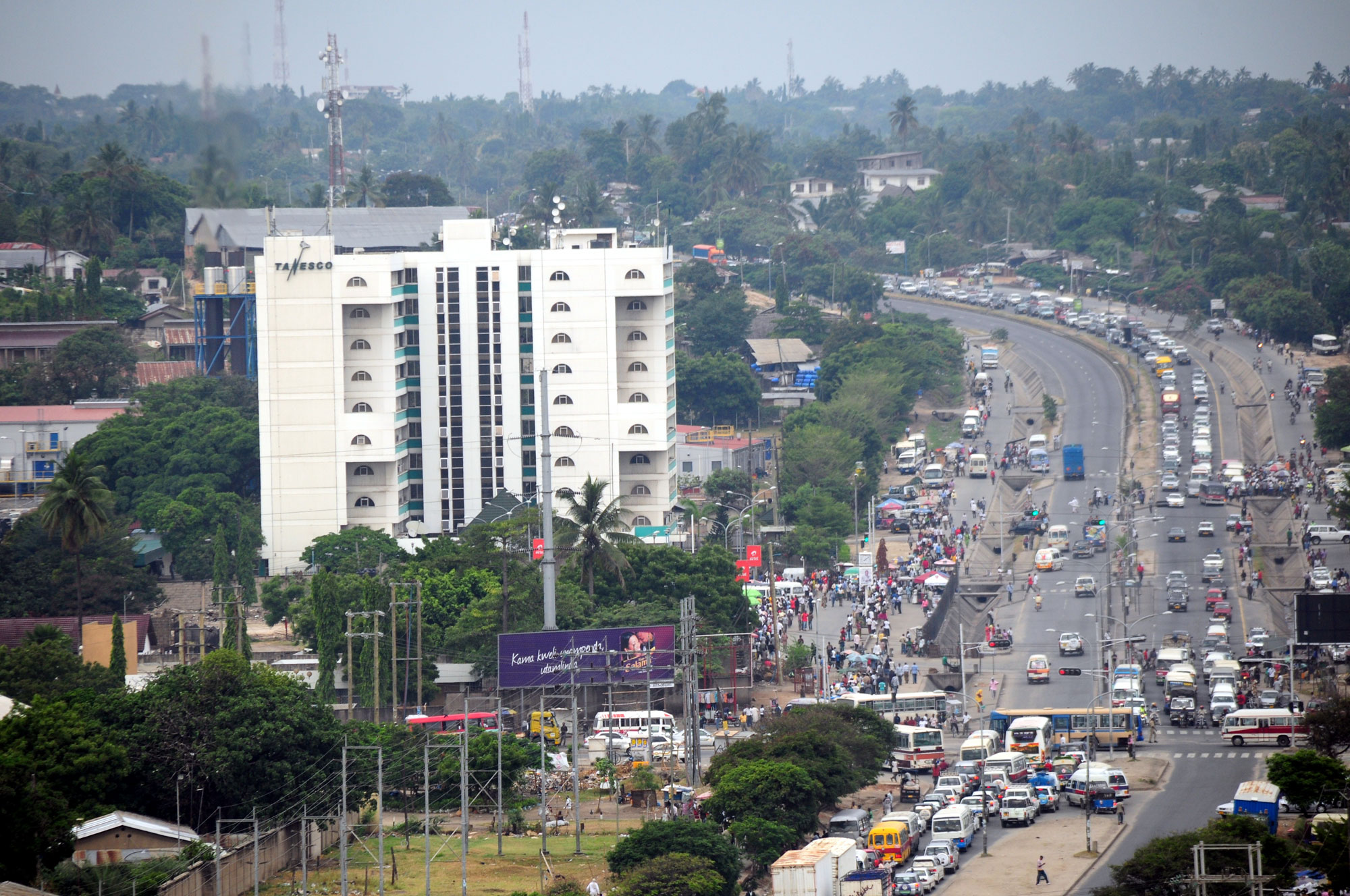
Tanesco building and Morogoro Road, Ubungo (Paul Scott. wikipedia)

President Magufuli has directed that the Tanesco headquarters building on Morogoro Road in Ubungo, Dar es Salaam must be demolished as it encroaches on the road reserve. The 10-story building is located within 90m of the centre of the road, in contravention of the Road Reserve Act. On the other side of the road, a boundary wall for the offices of the Ministry of Water also encroaches, and has already been demolished following the President’s instruction.

Potential demolition of the Tanesco building was raised in 2011 while President Magufuli was Ministry of Works. He had then instructed the National Roads Agency (Tanroads) and Tanesco to demolish the building, only to find himself overruled by the then Prime Minister, Mizengo Pinda.

Demolition of the building has become more urgent as the space is required for construction of a new $88m flyover interchange at Ubungo, similar to the interchange already under construction at TAZARA. Around 1,300 houses, public buildings and houses of prayers have been demolished this year by Tanroads to pave the way for the expansion of the Kimara-Kiluvya section of Morogoro Road.

HEALTH

by Ben Taylor

Prize for Dr Malecela
Tanzania’s Dr Mwele Malecela has been awarded the 2017 Kyelem Prize in recognition of her work in combating neglected tropical diseases (NTDs). Dr Malecela, now serving as a Director in the World Health Organisation (WHO) African regional office, was previously director general of the National Institute for Medical Research (NIMR) in Tanzania. She was fired from that position by President Magufuli in December 2016, the day after she told the media there were signs that the Zika virus was present in Tanzania.

Dr Malecela’s prize was received on her behalf by Dr Upendo Mwingira, the NTD programme manager in the Ministry of Health, Community Development, Gender, Elderly and Children. “It’s a real honour to have Dr Upendo receive the award on my behalf! Thanks Tanzania NTD Programme, it’s our collective success!” said Dr Malecela.

The Kyelem Prize is awarded by the NTDs research coalition (CORNTD), a group of researchers, programme implementers and their supporters with a shared goal of optimising elimination of NTDs. The prize is named after the late Dr Dominique Kyelem, a medical doctor from Burkina Faso who worked tirelessly in combating NTDs. (The Citizen)

Innovation in malaria prevention
The London Times recently published an article by Kate Wright about what it described as ‘Trojan cows’ and the worldwide campaign to defeat malaria. A biotech company is going further than the use of nets or insecticides to thwart the mosquitoes that carry malaria from person to person. They have now begun using livestock doused in human scent to lure mosquitoes to their deaths.

In much of East Africa livestock such as cows and goats often live alongside people. These animals get malaria. Mosquitoes tend to prefer sucking blood from humans. A potent cocktail of four or five human odour compounds has now been developed that can be sprayed on to animals so that they can develop their own alluring ‘eau de human’ rather than ‘eau de cologne’.

The concept has been tested on a small scale where researchers conducted experiments in which they go into a greenhouse, and then, together with the goats, face the mosquitos, noting where each one landed. The researchers found that mosquitos were attracted to the goats sprayed with a common worming medicine that also kills mosquitos. The mosquitos can thus be persuaded to bite cows or goats that will kill them and prevent them from spreading malaria. (The Times)

Malaria past and present
A new study has found that the prevalence of malaria in sub-Saharan Africa is at the lowest point since 1900. A team of researchers led by Professor Bob Snow of the Centre for Tropical Medicine & Global Health at Oxford University, spent 21 years finding and analysing data from over 50,000 surveys of malaria prevalence from across Africa.

The study found an overall decline of 24% in the number of children infected with malaria between 2010 and 2015, and a 40% drop between 1900 and 1929.

“Investment in malaria control in Africa has been sporadic in the past,” said Professor Snow. “The world has seen a reduction in malaria over the last 15 years, based largely on the use of treated bed nets and antimalarial drugs. If we take our eye off the ball, then rising drug resistance and falling control will lead to the sorts of increases we saw in the 90s.”

The financial boost provided by the Global Fund has, since 2005, led to one of the largest drops in malaria infection prevalence witnessed. However, gains made after 2005 have stalled since 2010. A decline in funding, coupled with increased insecticide and drug resistance, are the main obstacles to the elimination of malaria in Africa. (The Conversation)

EDUCATION

by Naomi Rouse

PM invites proposals on education policy
The government has invited ideas to reshape education to better contribute to national development goals. “Tanzania Towards Industrialisation” under the theme: ‘Rethinking Education for Self-Reliance Policy.’ At a national symposium, Prime Minister Kassim Majaliwa said “The government is ready to receive suggestions from experts, stakeholders and members of the general public on restructuring of our education system to match our current development goals to transform Tanzania into an industrial economy.” The symposium comes amid increasing demand for serious reflection on the state of education, and public discontent with performance of formal education at all levels. (Daily News)

Free education sees sharp rise in exam candidates
There was a significant rise in the number of Form 2 and Form 4 exam candidates this year, attributed to the increased retention of students after the Free Education Policy. The number of Form 2 candidates increased by 86,780 to 521,855, of which nearly 52% were girls. The number of Form 4 candidates increased by 141,779 to 1,195,970. (The Citizen)

Girls shine in Standard 7 exam as overall pass rate increases
Overall passes increased by 2 percentage points this year, to 72.76%. A total of 662,035 registered candidates out of 909,950 pupils, who sat for the Primary School Leaving Examination this year passed. 70% of girls taking the exam passed and 75% of boys. 10 candidates were disqualified for cheating. (The Citizen)

Sanitary pads fund will help girls realise their dreams
Tanzania Gender Networking Programme (TGNP) is leading the call for the government to establish a fund for providing sanitary products to girls. Research by TGNP shows that girls are missing between three and seven days of school every month due to inadequate sanitary provision. “It is a huge concern,” said Ms Grace Kisetu, Activism and Movement Building Manager at TGNP. “There are no sanitary towels, even locally made ones, to help these children, most of whom come from poor households, and some of whom experience their menstrual period for the first time,” she noted. Besides lacking adequate funds, she says public schools across the country also lacked pain killers for delivery to needy pupils. A resident of Kipunguni, Mr Suleiman Bishangazi, suggested that the government should allocate 5 cents from the sale of a litre of fuel to a special fund for schoolgirls’ sanitary pads across the country. Mr Bishangazi expressed optimism that the arrangement would have positive outcomes similar to the ones related to rural electrification, water supply and road constructions. The net result, he said, would be assuring thousands of children of learning opportunities. (Daily News)

UDSM gets new Vice Chancellor as Prof Mukandala retires
President John Magufuli has appointed Professor William Anangisye to succeed Professor Mukandala as Vice Chancellor of the University of Dar es Salaam. Prof Anangisye was previously Principal of Dar es Salaam University College of Education. (The Citizen)

TOURISM & ENVIRONMENTAL CONSERVATION

by Mark Gillies

Action in Maasai land dispute
Newly appointed Minister of Natural Resources and Tourism, Hamis Kigwangalla, has terminated a 25-year-old hunting concession with a company owned by the United Arab Emirates royal family and launched investigations into the dealings of the company and former tourism ministers.

The Minister ordered the Prevention and Combating of Corruption Bureau (PCCB) to arrest and investigate Isaac Mollel, executive director of the Ortelo Business Corporation (OBC), for trying to bribe him and his predecessors. Dr Kigwangalla also called for the investigation of former ministers. This includes Lazaro Nyalandu, who was recently lambasted by the Minister after having defected from CCM to Chadema citing concerns at the government’s direction under President Magufuli.

Dr Kigwangalla said OBC will never be awarded another hunting licence, and suspended director of wildlife Alexander Songorwa for allegedly creating a syndicate of government officials in the ministry who have been compromised.

Prior to Kigwangalla’s appointed, long-running tensions between the Maasai community and government authorities in Loliondo and the Serengeti flared up in August 2017. An estimated 185 homes were burned in an act of forced eviction, according to a Danish NGO, the International Work Group for Indigenous Affairs (IWGIA).

“We must speak out about the land issue,” said Lilian Looloitai of Cords Limited, an Arusha-based rights group. “The government has not taken the proper measures to educate and communicate what their intentions are for the land. They are told, ‘You can’t cross this land, it belongs to the government, you can’t cross this land it belongs to investors’. We are not certain, we are not stable – as a community, as a society – and it is affecting our future.”

In 2012, there were claims that the government wanted to force Maasai pastoralists off their land to allow hunting activities on land bordering the Serengeti National Park. In response, the government shelved plans to create a “wildlife corridor” of 579 square miles. President Kikwete promised in 2014 that evictions would not take place.

Shortly after his appointment, the new Minister gave an interview to The Citizen newspaper that offered rights and conservation activists hope. “I heard about the violation of human rights that occurred in that area including houses of residents being torched and women being raped,” he said. “So, I have said as the minister I will not promote the dispute further as it only serves to entrench hatred of the people we seek to serve against their government.”

“Some livestock were seized on the villages’ land during an operation of establishing the buffer zone,” he added. “I said you seized these livestock in the game controlled area of Loliondo and you have not seized them according to the law. So, get them (livestock) back to the residents and I suspended that operation. The animals seized within the Serengeti National Park would be fined according to the law.”

Just days later, the OBC concession was terminated, Songorwa suspended and PCCB called in.

Bids invited for Stiegler’s Gorge hydropower dam project
The Ministry of Energy and Minerals has invited bids for the construction of a hydropower project at Stiegler’s Gorge in the Selous Game Reserve, despite opposition from conservationists.

The government considers the project on the Rufiji river in the UNESCO-designated reserve as vital in its bid to diversify its energy mix and end chronic electricity shortages.

The project would more than double the country’s power generation capacity. With an installed capacity of at least 2,100MW, the new dam will dwarf other hydropower dams in Tanzania, including Kidatu (204MW), Kihansi (180MW), Mtera (80MW) and Pangani (68MW).

The conservation group, WWF, called on potential investors, banks and construction companies not to participate in the project, at least until a full Strategic Environmental Assessment has been carried out. “WWF wants the true impacts of the dam to first be assessed and the World Heritage Committee to give its approval. The proposed dam would endanger the livelihoods of 200,000 local people and the reserve’s rare wildlife, such as elephants and black rhinos, would be placed under even greater threat.” “Companies who become involved in the project run the risk of significant reputational damage,” said WWF campaign manager. “We are asking investors, banks and those in the construction industry that work on dams to add Stiegler’s Gorge to their risk register.”

President Magufuli’s office said in July that the long-delayed hydroelectric plant would be built “to speed up the development of the country”.

CONSTITUTION

by Enos Bukuku

Government resists mounting pressure to kickstart Katiba process The appointment in April 2017 of Prof Palamagamba Kabudi as Constitution and Legal Affairs Minister was seen by many to be a catalyst to restart the process of making a new constitution. This expectation was enhanced further when he indicated soon after his appointment that a resumption would take place soon.

At the time of writing, however, there has been no progress at all. There remains a growing concern of human rights abuses in Tanzania which has led to criticism that a new constitution should be high on the priority list. CCM MP Lazaro Nyalandu resigned both as an MP and a member of the party on 30th October, citing these alleged human rights abuses and a lack of separation of powers amongst the three pillars of the state: the legislature, the executive, and the judiciary. It is understood that he plans to join Chadema.

The Tanzania Human Rights Defenders Coalition (THRDC) has demanded that preparations for a new constitution should start now. Similar appeals to the government have been made by the Tanzania Constitution Forum (TCF) and representatives of over 80 civil society organisations.

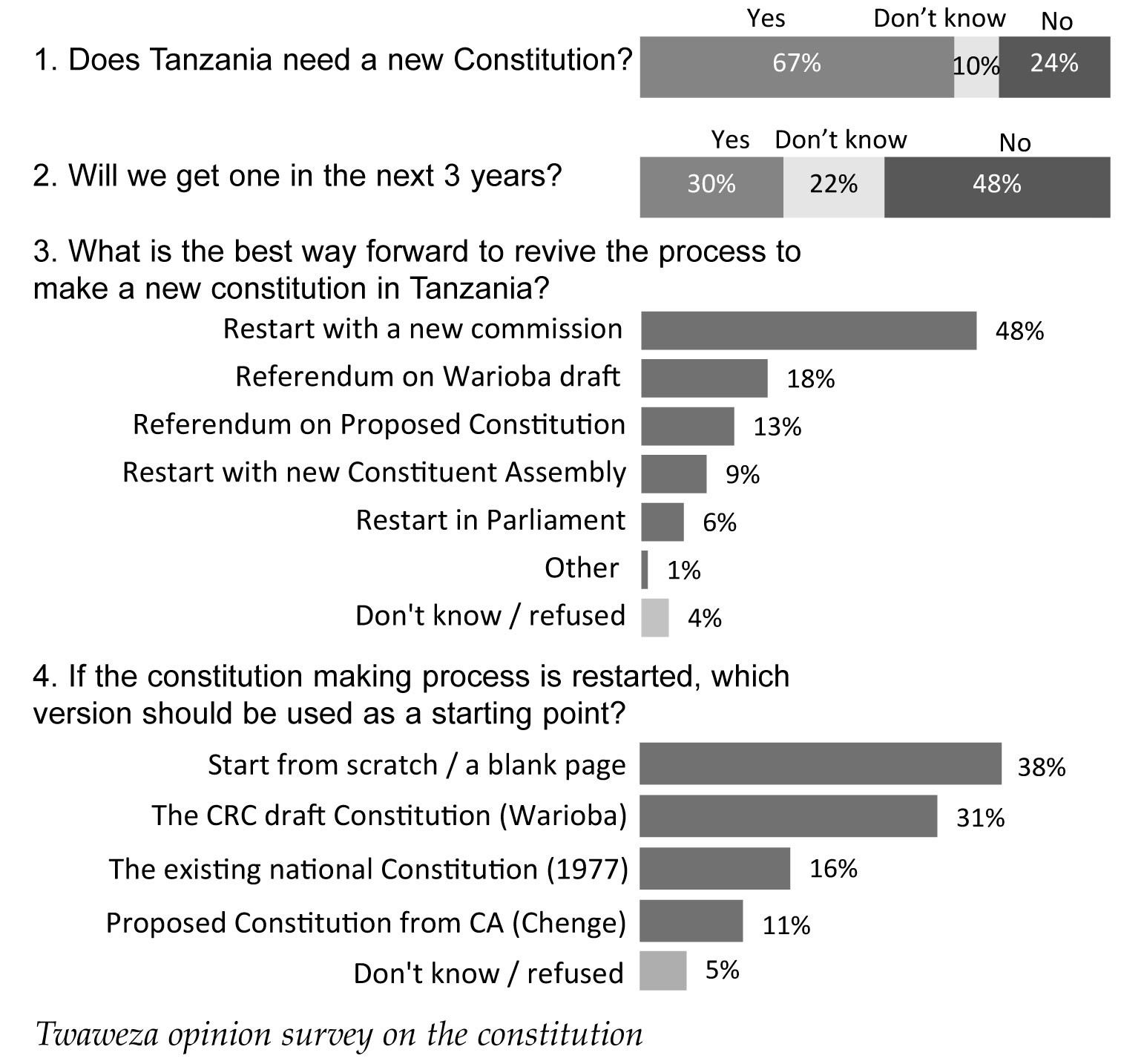
Opinion survey on constitution by Twaweza

Meanwhile, a recent survey by Twaweza suggests that two thirds of Tanzanians want a new constitution.

Despite these appeals, on 9th November Prime Minister Kassim Majaliwa reaffirmed the government’s previous stance on this issue, in that it is not high on their list of priorities. In response to questions put to him in Parliament he replied that “after satisfying ourselves that the provision of social services has reached the ideal standards, especially in the rural areas, that is when we will resume the exercise of completing the new constitution-making process”.

One factor is cost. It would cost several billion shillings to continue with the constitution review process, whereas the government would rather allocate those funds for what they consider to be more important projects.

How long it will take to bring social services to “ideal standards” is anyone’s guess and open to very wide interpretation. Some of the more cynical political commentators would say that it is merely a way to avoid the issue. Once again, it looks as though we will have to wait a very long time for any change to the status quo.