
REVIEWS

EDUCATION AND CULTURE OF TANZANIAN TEACHERS: RE-DEFINING EDUCATIONAL AND CULTURAL MILIEU. B. Lindsay. Comparative Education. Vol 25. No. 1. 1989.

This article is an outline review of the attempts by American educators to influence the Tanzanian system of education since independence. It pretends, in its introduction, to be a deep and searching investigation into all sorts of socio-cultural questions affecting education in Africa, but when the writer drops most of the sociological jargon (which really gets us nowhere very fast) her case is essentially fairly basic.

In 1968 Julius maintained that ‘the purpose of education is to transmit wisdom and knowledge of the society from one generation to the next, and to prepare young people for their future membership in the society by active participation in its maintenance and development’. From the early seventies therefore, the Americans were denied access to Tanzanian education. The national language, Kiswahili, was used within schools and tertiary education mainly to foster cultural and national identity and unification. In addition, Kiswahili became the only language of instruction for all primary schools. American Peace Corps teachers and various Agency for International Development programmes were dropped, because they did not seem to foster indigenous educational and cultural development.

In the nineteen-eighties, however, things changed fairly dramatically. Tanzanians recognised that secondary school students no longer had enough grasp of English to make sense of the various subjects (including technical subjects) they had to handle. One would not have thought this very surprising in view of the fact that they had received virtually no English at primary level. But the Americans, at the direct invitation of their Tanzanian hosts, set up courses for the training of staff from the Dar es Salaam College by educationalists from the Universit y of Massachussets, and indeed, some of the Dar staff took Masters degrees in Massachussets. Workshops followed, great success was encountered, and, the writer concludes, in very verbose and highsounding paragraphs (and at considerable length) that this proves that ‘if a sense of identity with specific policies is maintained, then external influences need not threaten the original cultural ideology’.

In fact the writer ducks the two absolutely basic educational points which stand out from the Tanzanian experience in the last twenty five years. The first is that the so-called Mutual Educational and Cultural Exchange which the Americans set up in the sixties (the Fulbright-Hayes Act) quite unashamedly saw education and culture as directly related and looked upon American help for education as enhancing U. S. foreign policy. In such circumstances, it is hardly surprising that the Tanzanians turned i down and wanted none of it. Nor would any self-respecting nation.

But the second point of enormous importance is surely this. The whole concept of education at depth is that it is a sharing of ideas, a mingling of cultures, a constant borrowing from traditions in one’s own country and many other countries. The finest education systems in the world have never been afraid or ashamed to borrow from other countries.
The recent American programme in Tanzania has doubtless given much practical help to Tanzanians, but it is only the beginning of a road which Tanzanians should be encouraged to walk – with many other systems and nations, not just one, and as free as possible from all political dogma and dictation.
Noel K. Thomas

APARTHEID TERRORISM. The Destabilisation Report. A Report on the Devastation of the Front Line States prepared by Phyllis Johnson and David Martin for the Commonwealth Committee of Foreign Ministers on Southern Africa. James Currey Publishers. November 1989. Hardback £19.95. Paperback £5.95

This book of 163 pages contains only nine pages on the way in which Tanzania has been affected in recent years by what it describes as the ‘consistent and continuous economic and military pressure to which the Frontline States have been subjected’ by South Africa (and its regional surrogates) during the long anti-apartheid struggle.

But this limited coverage is of considerable historical interest. The authors recall that Mozambique’s liberation movement, Frelimo, was first established in Dar es Salaam on 25th June 1962 and that the actual liberation struggle began on 25th September 1964, So Tanzania became the first of the Frontline States to be subjected to destabilisation, albeit on a much lesser scale than the other Frontline Stales. For example, the Portuguese authorities set up in the 1960’s an intelligence network in Tanzania in which Major Vitor Alves, subsequently a key figure in the Portuguese coup d’etat, was involved together with a Portuguese lieutenant-colonel whose cover was assistant manager on a tea estate in southern Tanzania, not far from Frelimo’s main training base at Nachingwea.

The book also reports that Tanzania’s former Foreign Minister, Oscar Kambona, was at one time in Lisbon at the side of Jorge Jardim, a godson of the then Poduguese dictator, Antonio Salazar. In December 1971 and July 1972 pamphlets were dropped from a Portuguese aircraft over Dar es Salaam in support of Kambona, The Portuguese apparently also set up a military training base for Kambona in north-western Mozambique. On February 3rd 1969 Frelimo’s first President, Eduardo Mondlane was killed by a Portuguese book bomb at a beach house where he was working just outside Dar es Salaam.

Rhodesia’s Unilateral Declaration of Independence (UDI) is described in the book as ‘of massive consequence for Tanzania’. Zambia became reliant on it for desperately needed lifelines to the sea. Most of the emerging liberation movements and the OAU’s Liberation Committee were based in Dar es Salaam, The cost of all this to Tanzania has never been quantified but has amounted to several million dollars a year for over 25 years – ‘a remarkable sum for a nation of such modest means’.

The authors go on to describe the effect on Tanzania of the more recent activities in Mozambique of the dissident movement MNR. Tanzania had sent 4,000 troops to help the Mozambican authorities to combat the MNR in 1986. They stayed until November 1988, The cost of this has been estimated at some US$120 million, but, more importantly, 60 of the 4,000 Tanzanian soldiers are now buried in Mozambique. Between late 1987 and April 1989 there have been five cross border MNR incursions into Tanzania in which one Tanzanian was killed, 68 were abducted and large amounts of property, food and money were stolen from poor border area villages.

The book finally quotes Mwalimu Nyerere – described as the chair and driving force of the informal grouping Frontline States – as having congratulated the people and governments of the victim states ‘who have kept the beacon of freedom alight by their endurance, their courage and their absolute commitment to Africa’s liberation’- DRB.


BARABAIG LAND TENURE; RISKS, RIGHTS AND WRITS
, Review of talk given by Dr Charles Lane to the Royal African Society at the School of Oriental and African Studies on November 20th 1989,

Dr Lane has been a volunteer in VSO and also Director of OXFAM in Tanzania, He has lived with the Barabaig people for some eighteen months in total, Some 30,000 – 50,000 Barabaig people now live in Hanang district south of Arusha. They are a Nilotic race and a pastoral people living, for the most part, as nomads. They have some thirty herds of cattle in which the mortality rate is as much as 40% largely from tick-borne diseases. Local dips have not operated for ten years.

The Barabaig are a marginal group leading a tough life where cattle theft and ritual murder have been common. Infant mortality is as high as one in five – twice that pertaining in other communities. The rate of literacy is less than 2%,

Development has largely passed them by and Tanzanian agricultural policy has tended to emphasise crop production rather than pastoralism and dairy production for which the cattle are most suited. It is unfortunate that there has been a gradual invasion of Barabaig territory from the north resulting in there being driven out of some of the best grazing land. Crops such as wheat are now being grown in the area.

In 1970 the Canadian aid agency CIDA, encouraged by the Government, took over an area for wheat production which has now grown to 100,000 acres. This is a highly mechanised scheme involving much sophisticated machinery such as combine harvesters. It has gone a long way to satisfy the aim of the Tanzanian Government self-sufficiency in wheat production.

But the development of this programme has had very serious implications for the Barabaig people since the area under wheat cultivation probably represents as much as half of the total grazing land in the district. Tanzanian policy is not to provide compensation for non-cultivated land; payment has been made only for the house areas and no allowance has been made for the private land around the house, cattle compounds, wells, burial mounds etc. Sacred trees such as Acacia and Ficus species have been cut down to make way for further cultivation. Cattle have been confiscated and the Barabaig denied rights of way on areas which were previously theirs. Land has become increasingly eroded, fertility has declined and more productive grass species have been replaced by less productive types and weeds.

CIDA and the Government have now been challenged on the basis that the total of one hundred thousand acres is thirty thousand more than the originally agreed 70,000, However, the Prime Minister’s Office, has recently decreed that these areas are not held by customary rights. It has stated that it is now recognised that all customary rights to land should be extinguished.

The present situation is that this is being contested with the help of the Legal Aid Committee of the University of es Salaam.
Basil Hoare

URBAN PRIMACY IN TANZANIA. Larry Sawyers. Economic Development and Cultural Change. Vol 37. No 4. July 1989. Pages 841-859.

This article explains how Tanzania has been one of the few countries to take steps to resist the dominance (primacy) of its largest city. The article evaluates urban and regional planning aimed at reducing the dominance of Dar es Salaam. It begins with a historical survey of the extent and causes of primacy; next is a review of the components of Tanzania’s spatial programme. Various measures of urban primacy are used to judge the effectiveness of anti-primacy policies. The conclusion is that Tanzania has been largely unsuccessful in preventing or even slowing the growth of the city this for reasons not ostensibly spatial in nature but which have overwhelmed the Government’s efforts.

SMALL TOWNS AND DEVELOPMENT: A TALE FROM TWO COUNTRIES. Charles Choguill. Urban Studies. Vol 26. 1989. Pages 267-274.

This paper is summarised as follows: Urban centralisation within the developing world has created problems such as congestion, migration, poor housing, unemployment and environmental deterioration. Urban analysts have therefore directed attention to the development of small and intermediate cities as one means of providing the necessary counterbalance. This paper analyses the economic potential of small town development through a study of the regional development programmes in Malaysia and the Ujamaa village development programme in Tanzania. The study concludes that necessary ingredients for a small town development programme include an appropriate agricultural policy, adequate consideration of the economic base of the small town and some element of self-reliance in the provision of local urban services. Without these components such programmes are unlikely to have any significant effect on rural to urban migration flows.

POLICY REFORM AND RURAL DEVELOPMENT ASSISTANCE. L. Kleemeir. Public Administration and Development. Vol 9. No. 4. September-October 1989.

In this ten-page article the author explains that for a long time Tanzania refused to reform its economic policies along the lines recommended by the World Bank and the IMF. Eventually the foreign exchange crisis forced the Government to make changes. The reforms were necessary but not a panacea for all the problems which had plagued rural development programmes over the past decade ie: the limited capacity of the Government administration to manage or back-up programmes; shortage of funds; and, the failure of rural residents to compensate for these deficiencies through their own participation and contributions. The article looks at two basic-needs programmes in the rural water supply sector to illustrate how these long-standing problems continue to affect implementation. Both programmes are funded and implemented by donors. The conclusion is that donors have not been self-conscious and innovative in grappling with the more intractable problems facing rural programme assistance in Tanzania.

THE CRUNCH – A FABLE ABOUT THE DEBT CRISIS
The Tanzania ‘Theatre In Education’ Project (first referred to in Bulletin No. 34) is based on a play (“The Crunch”) specially devised by a cast of Tanzanian and British actors brought together by the Commonwealth Institute in London. It links strongly with GCSE and ‘ A’ level Drama and Humanities syllabuses. The play, which uses both fable and metaphor to get its message across, focuses on the situation facing developing countries today and the role of ‘developed’ countries, banks and international companies in the independence and governing of ex-colonies. Through the lives and experiences of four bridge builders and the people they encounter in their work, “The Crunch” explores the factors affecting development past present and future. The play subsequently toured nationally and for performances in schools and colleges there was an accompanying workshop.

The play’s script was formed during rehearsal and at the time of the first performance was unavailable in print.

The central character is Monya, a bridge builder who has been killed while making repairs to the all important bridge which links countries to the North across a wide river with his own poor country in the South. Monya’s three colleagues, also from the South, are desperate to keep the bridge open for trade in order that their country does not suffer substantial hardship. Monya’s ghost keeps interrupting proceedings and making comments about his own feelings – mostly feelings of joy at having been liberated from the arduous repair work which appears to him to be fruitless. The bridge really needs to be pulled down as, according to Monya’s work-mates, it is totally unsafe. The trouble is that the link with the North will be broken for some considerable time until a replacement is built. There have previously been plans for a replacement (the Uhuru Bridge) but this is only a quarter complete and now there is no money to sort out the mess. The three workers decide to continue repairing the unsafe bridge as best they can and hope for the best. Unfortunately the state of the bridge suddenly deteriorates when its foundations shift and the workers are faced yet again with an insuperable problem.

After much argument they agree to go to Mr Boyle, the banker in the North, to ask for a massive loan to start again and build a completely new bridge. Other than suggesting that they rely on the setting up of a disaster fund to get them out of their difficulties, Boyle does not offer any help, the workers having previously rejected his idea that they start from scratch with a few boats to maintain the lifeline.

Unknown to the bridge workers, Boyle himself has financial problems and needs a substantial loan to keep his own head above water. When Boyle is refused this loan, he is so eager to clinch a deal with the Southerners that he sets off for the bridge and the South with his vehicle laden with steel bottomed boats – but the bridge cannot support him and as he crosses it, encouraged by the mischievous, laughing ghost of Monya, bridge, boats, vehicle, Boyle and original old bridge take a tumble into the waters below – and everybody loses.

Credit has been seen to turn into debt, hope into despair and partial success into total failure. Monya is well out of it all.

The performance was imaginative and required little in the way of scenery and props. The change from narrative to reflection and the commentary by Monya was most effective with the characters of the narrative freezing while Monya made his comments. Perhaps the play could have produced more laughs (important for secondary schools) if the actors had been more confident in their roles but overall this was an enjoyable performance with much to recommend it to schools. Hugh Jones

As the play had been designed for schools we asked a school student to let us have an additional review from her point of view. Aldyth Thompson and her mother attended a ‘Focus on Tanzania’ day session designed for teachers (with others welcome to join them) at which the play was per formed and then discussed together with the actors. Aldyth Thompson wrote as follows – Editor

On October 27th my Mum and I went to see ‘The Crunch’ at the Commonwealth Institute in London. The play was introduced to us by the director who said that normally a workshop would take place before watching the play. This would be to see how much people already knew about Tanzania, its problems as well as its geography.

The actors put over a lot of points through the play that I hadn’t actually thought of before, such as the fact that everybody is in debt to someone higher up the scale.

We were given a handbook for teachers which gave a lot of very interesting background information both about the play and about Tanzania. In our discussion we covered a lot of points we had wanted to ask. We discussed how the play related to the real life situation in Tanzania today. The way in which the white people depend on the black, as well as the black people on the white is portrayed in the play as both South and North depending on each other. This discussion also brought out people’s views, such as “Well, people aren’t going to give up their profit are they?” – meaning that we all look after Number One. I was sorry that the role of non-government aid agencies was not brought out. I found the discussion very interesting and it made me think about the different views people have of all subjects. As a student I would like to get my school to see this play in the near future.
REVIEWS

THE LIGHTNING BIRD
On March 17th 1989 Channel 4 produced an extraordinary film in its ‘ Survival’ series about lions in the Serengeti (Bulletin No 33). In the same series and shown on June 24th was another film about Tanzanian wild-life. This was made with the cooperation of the National Parks and the Ngorongoro Conservation Authority. It is the work of Joan and Ann Root and its title is ‘The Legend of the Lightning Bird’. As Andrew Sachs started his commentary we saw what we have learnt to expect from wild-life films of Africa South of the Sahara Kilimanjaro, elephants in the forest, lions on the savannah, herds of wildebeest and fantastic, glorious birds.

Who is the King of the Birds? Is it the huge ostrich, the powerful eagle, the handsome superb starling or the regal crested crane?

Legend says it is none of these. It is the hammerhead or hammerkopf. He is related to herons and storks, stands a foot high, is uniform brown with a tuft of feathers at the back of his head and looks like a kindly dunpy pteradactyl. The hammerheads spend most of their lives fishing. This they do effectively but without display. When they are excited they jump on each others backs, flap their wings and squawk.
According to legend these dowdy avian monarchs receive homage from subjects who bring contributions to the palatial nest, help build it and even guard it. The hammerheads are also credited with magical power over rain and floods. None of this is true. They cannot swim and have no special weather sense.

Visitors to the big nest come for their own purposes. A silver bird takes what she needs to build her own nest; an Egyptian goose tries to take over the penthouse until thrown out by the owners; she then finds a disused nest downstream. A grey kestrel is small enough to use the old nursery but finds her way barred by a family of acacia rats and a large African owl nest on the summit, ostensibly on guard.
The hammerheads, far from being feudal lords, act more like the local housing aid centre because they re-use an old nest. At the beginning of the rainy season they start to build in the fork of a tree overlooking a river. For nearly three months they each make journeys totalling about three hundred miles to build a nest four feet high and weighing two hundred pounds. It is so strongly woven that it can bear the weight of a man jumping on it. The entrance is sensibly kept away from the tree trunk and the roof is decorated with feathers, shed snake skins, little bones and porcupine quills. This nest even had a wildebeest tail.

Most of the film was concerned with the building of this nest and the mating of the hammerhead, kestrel and goose families. I particularly enjoyed the emergence from the nest of the two-day-old goslings who plopped in the water below one after the other like children going down a chute. One gosling had unfortunately fallen out a day earlier and had had a Disneyesque adventure with hippos and a crocodile. He found a diminutive island for the night and miraculously met up with his family again the next day.

There seems to be no scientific explanation for the hammmerhead’s extravagant use of energy. We are told the species is the only member of its family. I wonder if there were others now extinct who decided to build Hiltons and died in the attempt.

Anyway, Good Luck to the eccentric loveable bird. Long may he reign! Congratulations too to all concerned with the production of this delightful, tantalising film. Shirin Spencer

TANZANIA: COUNTRY STUDY AND NORWEGIAN AID REVIEW. Kjell J. Havnevik and
Others. Centre for Development Studies. University of Bergen. 1988.

There was a time when it seemed as though almost everyone wanted to write a book about Tanzania. The early years after independence are well documented in several comprehensive studies. Nowadays, this is no longer true. As far as the Bulletin has been able to determine there are no recent comprehensive studies covering all sectors of Tanzania’s economy other than those provided from time to time by the World Bank. It is for this reason that this Norwegian book is so useful. It is useful primarily for those wishing to up-date their knowledge (references and statistics go up to 1988) and those who do not know Tanzania and do not have the time or the opportunity to study the innumerable short papers available in the better libraries. It is concise (the whole country is covered in 193 pages), clear and, as they say nowadays, ‘reader friendly’; it does not appear to be over afflicted, as so many papers on Tanzania are, by ideological bias. It contains a useful up to date bibliography but, surprisingly, no index. It has particularly strong sections on women (for example, the effect of villagisation on them) and reveals much cause for alarm in its section on AIDS.

The second part of the book critically analyses Norwegian aid programmes. Although the authors state that Norwegian aid does not differ from that of other countries (Norway comes second only to Sweden in the ‘league table’) those interested in sea fisheries, coastal transport (in both cases associated companies went bankrupt!) sawmilling, hydropower and the maintenance of rural roads can learn much from this book.

One interesting item (Page 13) states that after the First World War the idea was considered of giving Norway the task of ruling Tanganyika Territory – DRB.

(We are indebted to Mr. Karl Aartun for sending us a copy of this book – Editor).

BOOK REVIEWS

TANZANIA AND THE WORLD BANK’S URBAN SHELTER PROJECT: IDEOLOGY AND INTERNATIONAL FINANCE by Horace Campbell. The Review of African Political Economy. No. 42, 1988, pp 5-18.

John (not Horace) Campbell sets out to examine a major World Bank funded urban project in the context of Tanzania’s relationship with the Bank and its attempts to influence domestic policy as a condition of further lending. Bank ideology has determined its actions, he argues, not the realities of Tanzania’s situation or the priorities of its government.

In the 1960’s urban areas grew rapidly and programmes of slum clearance and public housing failed to meet housing needs. Much development was unplanned, with half or more of the population living in squatter areas and dependent on incomes below the poverty line. The Second Plan (1969-74) included a commitment (although few funds) to provide infrastructure and housing suitable for the needs of the urban poor. In 1971 rental housing was nationalised, with the effect that the (primarily Asian) landlord class was pushed temporarily out of the housing market and no new housing was built for more than a decade.

Although the intention of providing serviced plots on a large scale to accommodate poorer families had been stated in 1969, it was not until 1972 that a decision was taken to proceed (partly, Campbell speculates, in response to worker unrest) and 1974 that World Bank funding was secured.

Phase I (1974-78) was intended to benefit c. 160,000 low income people by providing 10,600 serviced plots in Dar, Mwanza and Mbeya and upgrading squatter areas in Dar and Mbeya. In Phase II (1978-83) an additional 315,000 residents were to benefit from similar schemes in five urban areas. Campbell suggests that the Bank insistence on tendering contracts to the private sector was contrary to national policies which aimed at expanding the role of the public sector, although it is questionable whether the latter would have had the capacity to take on large contracts. The serviced plots provided were in relatively low density suburban areas and the Bank insisted on full cost recovery. Although construction for subletting was allowed, the provision of loans by the newly established Tanzania Housing Bank (THB) and its insistence on the use of ‘modern’ building materials, made the plots too costly for most poor families. The World Bank’s pressure to reduce standards of construction was not heeded until 1981.

By that time, Phase II was under way, despite the cost overruns of Phase I, the failure of the THB to account for funds and corruption in the allocation of plots. Shortages of housing for middle income families, due partly to policy neglect, encouraged them to obtain serviced plots, pushing out the poor to unauthorised and unserviced areas. Failure to consult residents gave rise to initial suspicion of upgrading, but this later proceeded with fewer problems. Following mounting cost overruns, project components were cut and the standard of services reduced. Responsibility for project management was devolved to local government, despite its lack of expertise and finance. As a result, services and infrastructure deteriorated rapidly and residents’ understandable reluctance to pay for them increased.

Campbell is correct in emphasising the dominance of project planning and implementation by the World Bank; pointing out that the serviced plots met the needs of the middle income rather than poor households; stressing the burden of infrastructure in need of maintenance; and accusing the World Bank of attributing Tanzania’s problems solely to economic mismanagement rather than external shocks. He may well be right that the Bank, despite its involvement with the country’s economic problems, was taken by surprise by the huge cost overruns that its attempt to devolve responsibility for project administration on to ill-prepared local government structures was an attempt to wash its hands of responsibility; and that its concern for the poor was jettisoned when cost recovery was threatened by rising costs. However, by succumbing to the temptation to treat the Bank as a scapegoat, he has oversimplified the explanations for what occurred in Tanzania between the mid-1970’s and mid-80’s. To apportion blame solely to the Bank is to ignore both the mismanagement which undoubtedly occurred, in, for example, the abolition of urban local government between 1973 and 1978; and the class interests within the indigenous (and not just Asian) Tanzanian population which have sought to utilise power and the spoils of public sector activities to advance their own interests.
Carole Rakodi

VILLAGES, VILLAGERS AND THE STATE IN MODERN TANZANIA. Edited by R. G. Abrahams. Cambridge African Monograph 4. Cambridge University Press.

These five papers which are based mainly on field work carried out in Tanzania in the seventies and early eighties, were first published in 1985. They give an insight into the situation pertaining in a number of rural communities at that time and the changes which came about during the post-independence era.

Developments in five disparate areas of the country during and after the villagisation programme known as Ujamaa are detailed. The impact of state intervention in village life has been considerable, and sadly, as is well known, much of the programme has been marred by failure. Poor management, mishandled funds and corruption were features highlighted in this paper.

The field work carried out by Thiele in villages close to Dodoma illustrates, as do other papers, the reluctance of villagers to engage in communal farming activities on collective plots. Priority was always given to their own areas and labour allocation to other work was given a distinctly low priority. The fact that communal farms have been frequently sited on the poorest and most inaccessible land does not also contribute to good production as is evidenced by the poor yields achieved in a number of villages which were listed.

The paper by Lwoga, the only contribution by a Tanzanian, based on work in the vicinity of Morogoro, shows how the State imposed its will and disregarded the views of villagers until the Prime Minister’s Office was able to make a second intervention.

In his paper Walsh outlines the problems associated with traditional leadership, both before and after independence, and how the influence of traditional authority lingered to the detriment of the community as a whole, in spite of the fact that the role of chieftancy had been abolished at the time of independence. The complicated and interweaving relationships within a community were further illustrated by Thompson who related the unsuccessful efforts of a well educated young leader from the town when pitted against the traditional beliefs of the villagers.

These various papers show that the aim of Julius Nyerere, widespread socialism has not been achieved in Tanzania. Reluctance on the part of rural communities to take part in communal activities has been clearly shown and the original aspirations of the State that each village would have a collective farm of a significant area have not been met. Merchant enterprises, such as the village lorry and shop, have often been more successful, but the examples shown indicate that such success was generally limited. Lack of spare parts for vehicles and the frequent absence of basic supplies, poor accounting and corruption, have all contributed to poor results. However, examples in two papers show what can be achieved by good leadership. The resilience and organisation of the local schoolmaster in one instance and the village chairman in the other, were largely responsible for the success achieved. The value of education was also evident in some cases and, more particularly, when this applied to a Village Manager. Thompson also illustrates the extent to which education and urban background undoubtedly contributed to the failure of one politician.

These papers are valuable contributions to the story of rural development in Tanzania during a particular post-independence period. It is to be hoped that later field work by the authors will give a further insight into more recent programmes and achievements.
Basil Hoare

ZANZIBAR TO TIMBUKTUU by Anthony Daniels. J. Murray. 1988.

The first two chapters of this book are devoted to Tanzania, and it is important in the sense that, as there is not a vast library of literature (either non-fiction or intelligent fiction) which deals with contemporary Tanzania, anything in print is liable to be seized upon as some sort of guide to the country, past as well as present.

Despite the fact that it has already had some good reviews, it is not an impressive offering. The trouble is that Daniels really wants sensation at every turn, and in Tanzania he reckons that the best way to obtain this effect is to highlight the misery and wretchedness and the way society has deteriorated in the past quarter century. So we are given a seemingly endless list of iniquities. In Dar es Salaam, for example, we are told that Africans neglect their gardens, the telephones don’t work, the potholes on the road are so bad that you need a four-wheel drive vehicle and the thieving is such a problem that you have to have locked doors, barred windows and even ‘steel gates constructed across windows.

To be fair to the writer he does try occasionally to even up the picture. He admits that ‘this violence is un-characteristic of Tanzanians’ and that ‘I knew them as gentle and forgiving people’. The problem is that he is keen to rush through Africa, from one country to another, hardly pausing to take breath, that he never stops long enough to analyse either people or social situations. Daniels is plainly aware of the ambivalence in many of the scenes he describes. The Tanzanians, though gentle, he declares, can behave extremely badly, even dishonestly to one another ‘no real trust existed between them’. ‘This is Tanzania, this is Tanzania.’

But with full respect to his lively and often amusing style and picturesque phrase, this simply will not do. If there are contradictions in people’s characters then the good writer explores them and helps us to understand the ambivalence. If he had ever done this, or even attempted it, this book would be ten times more worthwhile. The sad truth is that there is nothing in this hasty tour of Africa that is really substantial. Daniels has clutched at straws, many of them brightly coloured and diverting, but straws just the same, and blown away by the wind as they should be.

There is undoubtedly a fashion for travel books which titillate the palate with the slightly grotesque, and invite us to look with our comfortable western eyes at various morsels of Third World decay. But in these pictures there is scant truth to life. It is a pity that Daniels’ undoubted descriptive talents have not been used to produce a book of greater balance and some real depth.
Noel K. Thomas

AGRICULTURE AND DEVELOPMENT IN AFRICA: THE CASE OF TANZANIA by Goram Hyden, Universities Field Staff Report 1988/89 No. 5. pp 10. $4. 00
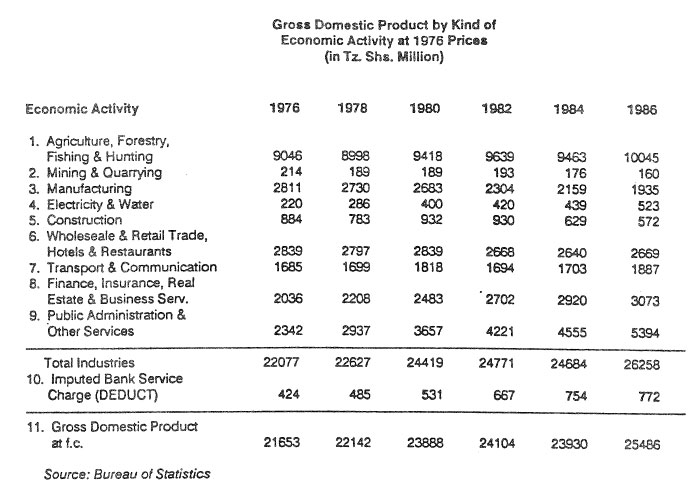
This report was written following a short visit to Tanzania in June 1988 funded by USAID. It is in two parts. The first is an analysis of Tanzania’s predicament. It can be summarised by a table and two quotations.


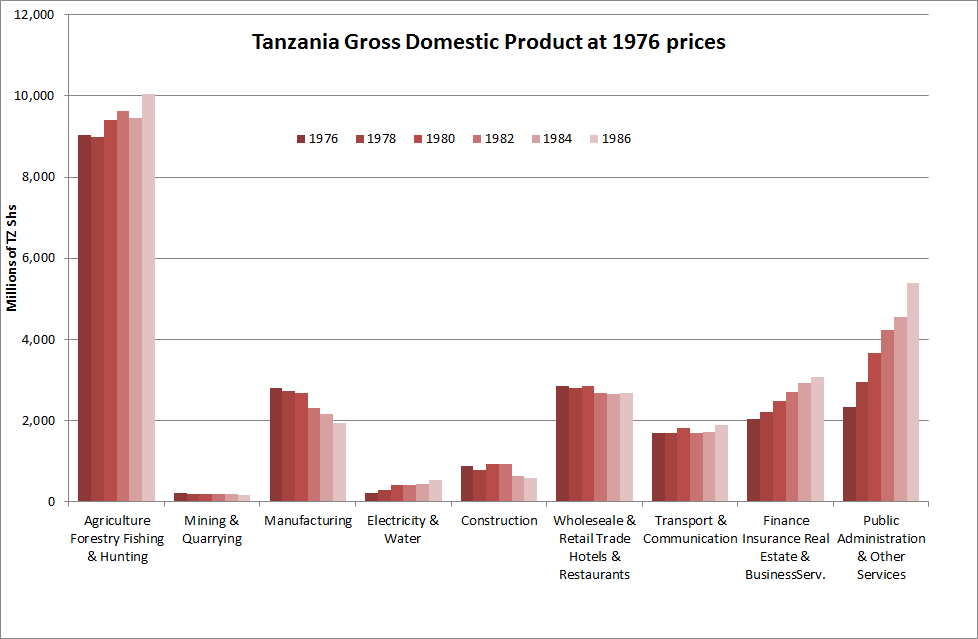
Graph of table data (not in original publication)

Gross Domestic Product by Kind of Economic Activity at 1976 Prices (in Tz. Sha. Million)

Economic Activity 1976 1978 1980 1982 1984 1986

1. Agriculture, Forestry,Fishing & Hunting 9,046 8,998 9,418 9,639 9,453 10,045
2. Mining & Quarrying 214 189 189 193 176 160
3. Manufacturing 2,811 2,730 2,683 2,304 2,159 1,935
4. Electricity & Water 220 286 400 420 439 523
5. Construction 884 783 932 930 629 572
6. Wholeseale & Retail Trade, Hotels & Restaurants 2,839 2,797 2,839 2,668 2,640 2,669
7. Transport & Communication 1,685 1,699 1,818 1,694 1,703 1,887
8. Finance, Insurance, Real Estate & Business Serv. 2,036 2,208 2,483 2,702 2,920 3,073
9. Public Administration & Other Services 2,342 2,937 3,657 4,221 4,555 5,394

Total Industries 22,077 22,627 24,419 24,771 24,664 26,258

10. Imputed Bank Service Charge (DEDUCT) 424 485 531 667 754 772

11. Gross Domestic Product at f.c. 21,653 22,142 23,888 24,104 23,930 25,486

Source: Bureau of Statistics

The table shows GDP growing less than 20% in 10 years – but three quarters of that growth comes from ‘public administration and other services’. Agriculture has apparently grown (but can we believe the statistics?), as has ‘finance, insurance, real estate and business services ‘; manufacturing has clearly declined.

The two quotes are the following:

In brief, the decline of the Tanzanian economy between 1973 and 1985 must be ascribed to a widespread decline in production beginning in the agricultural sector; it spread to manufacturing because imports to keep the industries going became more and more difficult to purchase with falling agricultural revenues. This situation was aggravated by the adherence to the Basic Industry Strategy which encouraged capital investments in new, often expensive and ill-conceived plants. This limited the scope for allocating scarce foreign exchange in existing industries which were often forced to operate at very low levels of available operational capacity.

It is paradoxical that Tanzania, a large country with low population densities, poor initial infrastructure, and population concentrations mostly in the areas bordering on other countries, should have devoted a smaller share (averaging about 7% between 1970 and 1985) of its resources to transport and communications compared to Kenya (12%).

The second part of the report, under the heading ‘Tanzanian Agriculture since Liberalisation’, consists of thinly disguised prescription. Priority No. 1 is maintenance of the road and rail networks. The second priority is to cope with ‘institutional shortcomings’, notably the failures of the marketing authorities and the National milling Corporation. However, ‘this must be accompanied by a strengthening of other institutions, including the co-operatives’ (how?), and Hyden also advocates ‘district based development trusts’ such as the Njombe District Development Trust. The third priority is more investment in agricultural research, but also more effort to ensure that the results of this research are used. This leads him to conclude that ‘agricultural production in the years ahead will increasingly be led by large-scale farmers’ who will be mainly ‘retired party and government officials …. cultivating 10-50 acres … in the vicinity of large urban centres’! In this way Hyden repeats his distrust of ordinary Tanzanian farmers. A similar mistake characterised his 1980 book, when, using unhelpfully aggressive language, he wrote of the ‘uncaptured’ peasantry and the need to ‘capture’ them. Somehow Hyden’s belief in market forces deserts him when it comes to small farmers. Yet his own analysis provides the clues to an alternative. If the district and trunk roads are maintained and the railways do the work they were built for and if basic consumer goods are available up-country, then Tanzanian farmers, just like those everywhere else in the world, will produce and sell.
Andrew Coulson

QUEEN OF THE BEASTS. An ITV ‘Survival Special’ broadcast on March 17th 1989.

The lion has always been a potent symbol. The European hunter who came to the area in 1913 is shown in photos with his foot on a lion’s mane. He seems to think of himself as a ‘Super lion’. By 1921 most of the lions had been shot and the scarcity of lions was the stimulus for making Serengeti, the size of Northern Ireland, a National Park. Since then fortunate visitors have seen the magnificent scenery and the vast herds of grazing animals and have got close to prides of resting lions.

I remember seeing such a pride. There were so many friendly exchanges, lickings and head rubbings that I was tempted to get out of the car and join in, especially as one lioness was lying on her back asking to be stroked!

Visitors accept lion society without questioning, but scientists, comparing it with the life style of more solitary cats have been puzzled. This ‘Survival Special’ film is the result of a recent two year project by Richard Mathews and Samantha Purdy. This involved them in danger, considerable discomfort and a great deal of drudgery but it was well worthwhile.

We saw the Serengeti at all times and all seasons; the migration of the huge herds of wildebeest and the animals left behind, especially the lions driven to tackling ostrich eggs, unsuccessfully and robbing cheetah of their prey, successfully.
One of the most exciting sequences was taken during a four day and night trek. With the aid of binoculars, cameras and film adapted for night viewing they showed us a pride at its most active. For their study the scientists kept records of individual lions. They noted and drew the nicks in their ears and the spots on their muzzles; and they listened to bleeps from electronic collars fitted to some of the lions. All this was shown with an enthralling sound track and traditional African music in the background.

The picture emerged of two groups of lion society; one being the small group of unrelated males who live together temporarily and the larger matriarchal group with only one or two adult males. By hunting strategically, large prey can be brought down, but there are other reasons for grouping. The females of the matriarchal pride are all related; they will feed one another’s cubs, and we even saw one wounded lioness who could not share the hunt share the kill.

While he is in residence the adult male is a protector, an amiable consort and a tolerant father, but about two years later he is ousted by a mature younger male or males. We saw two, who had been members of a ‘bachelor’ group, drive away the resident male. Although he put up a token fight at the edge of his territory little harm was done, The newcomers entered the new pride and drove out all the nearly mature males, again without bloodshed.

After that a vague menace became a horrifying reality. The newcomers, finding the resident lionesses unwilling to accept them, killed all the cubs they could find. Two days later the bereft lionesses came into season and after a while accepted the newcomers.

This apparent descent from nobility to savagery is disturbing but all lion behaviour has a purpose. Their usual corporate care of the cubs and even a wounded lioness is not as consciously generous, nor is the slaughter of the innocents as casually cruel as we might imagine from an anthropomorphic viewpoint.

As for us?
It is only thanks to some far seeing and caring members of our species who made the area a national park, to the scientists and film makers of today, and to the people of Tanzania who are responsible for the region that we can enjoy watching ‘The Queen of Beasts’ in her natural setting and reflect on how the ‘super lions’ can be reconciled among themselves and with nature. I am now going to ask ITV for a repeat!
Shirin Spencer

MAKONDE: WOODEN SCULPTURE FROM EAST AFRICA. From the Malde Collection. An Exhibition (April 2 – May 21. 1989) and Seminar (April 15, 1989) at the Museum of Modern Art, Oxford.

The exhibits are separate pieces about 18 inches or more high, mostly columnar, worked to a smooth finish in black hardwood, mainly bearing individual artists’ names, and dated between around 1940-1970.

At first I was somewhat baffled, attracted and repelled. The often twisting, intertwining elongated figures variously distorted and even abstract yet disturbingly realistic fell into no category I was familiar with. But I was fascinated. Gradually I began to see meaning in the strangeness. The postures and activities portrayed found an echo in my own experience. There was common ground.

Then I was lucky enough to talk to Mott Malde, the collector of the pieces (We hope to publish an article on the way in which the collection was made in our next issue – Editor), and I began, after he had helped me with some stylistic puzzles, a little to enter the world of the Makonde and to identify with the themes which preoccupied them. The ‘big-headed teacher’ talks animatedly to the eager and respectful ‘little’ students who cluster round him; (size expressing importance is a familiar concept in art); a woman gives birth; a mischievous ‘spirit’ taunts and upsets two human figures; the ‘spirit’ meant to be protecting the fruit crop yields to the temptation of the succulent fruit and opens his (huge) mouth, greedily eating whilst a large turd falls from his anus (he is punished by diarrhoea ?!); ‘He who would not listen’ portrays a young man mournfully surveying his limp, ineffective penis, and ‘She who would not listen’ shows a woman whose flat, hollowed stomach suggests infertility. For the moment I am leaving out the few masks which are displayed. They come into rather a different category, I think , and require a more strictly anthropological approach than the one I am taking in these few notes.

During the last century the impact of Europeans (missionaries, traders, etc.) stimulated the Makonde to develop further their traditional wood carving. In response to direct requests they made small pieces, usually port raying ordinary everyday domestic activities. But from the 1940’s onwards they developed a more liberated, independent and individual style, using their own imagination and corporate myths to express their own unique from of life. They felt free to express fun and ribaldry, the seriousness of teaching the young the pain and joy of sexuality and reproduction, and the vulnerability of humans to the caprice of the ‘Spirits’. Different styles emerged, but most seem to be based on the tree trunk, a column of wood with the figures either carved in relief leaving the solid wood intact, or – quite breathtakingly – hollowing out the wood leaving sinuous intertwining figures of immense delicacy and inventiveness, resulting in a most satisfying filigree design. Sometimes the abstraction is so extreme one responds entirely to the aesthetic pleasure of the flowing lines weaving wonderfully balanced shapes, using both external and internal surfaces. But (almost) always, on close inspection, one realises that limbs, faces, hands and feet are intricately carved and the whole is alive with the active human or animal form.

Not surprisingly this work became popular with visitors who wanted to buy it. Various outlets were used, including of course, airports, and this has given rise to what seems to be a misconception. Because the pieces are readily saleable at airports, which therefore stimulates further production, the derogatory term ‘airport art’ has been in this case misapplied. Mr. Malde was very insistent that all his pieces are carved by genuine artists, who decide the subject themselves and who, like most practising artists, are pleased to have their work bought.

The SEMINAR was held to discuss ‘Issues of Colonialism, Primitivism, Exoticism and Western Attitudes Towards Indigenous Art’. The well-qualified speakers talked learnedly and fairly about primitive art (is it art ?) but, I felt, from a purely detached Western perspective. As I listened I became increasingly uncomfortable. These were people of meticulous scholarship, who clearly respected indigenous art and judged it worthy of study on its own terms, but whose emotional distancing, their retreat almost into academic concepts gave the implicit message that of course a direct and instinctive response to the sculptures themselves was for a European impossible. I profoundly disagree. Undoubtedly the more one knows of the background and life of the Makonde the more one’s understanding and appreciation of the sculptures increases. And certainly we delude ourselves if we claim, arrogantly, completely to understand what we are seeing. But having said that, I feel if we lay aside (as far as we ever can) our own cultural conditioning, and humbly allow ourselves to respond naturally and simply to the carvings, a great deal of their fundamental meaning is communicated to us. I am sure that our common humanity, our shared hopes, fears, joys and longings provides a common ground from which we can enter into the spirit of the work of art. If it is passionately and honestly made, we can have a passionate and honest response to it. Then it becomes both ‘other’ and ‘familiar’.

This is an excellent exhibition, and large and varied enough to give one a rich experience of a modern art form of culture different from our own, engrossing in its own unfolding into a new form of an old society. We must thank the Oxford Museum for mounting it.

(The exhibition will be in Preston in July and August, Southampton in September and October, Bristol in December and January, Glasgow in January and February and Leicester from February to April 1990 – Editor)
Kathleen Marriott

BOOK REVIEWS

THE SNAKEMAN by Margaret Lane. Hamish Hamilton. 1988. £ 6.95 This is a paperback edition of a book which was originally published in 1963 under the title ‘Life With Ionides’.

C.J.P. Ionides was undoubtedly one of the great characters of East Africa; one of those singularly original people who escaped from the restrictions of a more ordinary life to find fulfilment in his own way. After a rebellious childhood, Rugby, Sandhurst, the army in India, he landed in Dar es Salaam in 1925 in pursuit of the love of his life, wild animals. He did two years with the Kings African Rifles before taking up ‘professional’ ivory poaching and finally managed to join the Tanganyika Game Department in 1933 where he made a name for himself as a disciplinarian and a great naturalist. His autobiography was published under the title “A Hunter’s Story” by W.H. Allen in 1965.

The author of this book is Margaret Lane whose most well-known book is an outstanding biography, “The Tale of Beatrix Potter” (F. Warne 1946 and 1985 ) – not at all the same subject as Ionides, one would think, but I am not so sure.

Miss Lane was intrigued by the character of Ionides when she first met him in London after he had retired and went there for medical treatment. He was ‘shocked’ by London and persuaded her to visit him in idyllic Newala where he lived in ‘a tin-roofed bungalow plastered like a swallow’s nest on the edge of an escarpment, looking towards Mozambique.’ Here there was an abundance of snakes and he was able to carry on his retirement trade with the zoos of the world without a lot of trouble.

It is not necessary to be a snake lover to read this book and possibly one can learn to appreciate snakes from reading it. Miss Lane even learned to handle them. Incidents with other animals and insects are also described attractively.

The book is primarily a character study of Ionides during the few months that Miss Lane spent with him in 1962. She found him something of an ascetic but not averse to enjoying himself in the right company. One was able to ‘sit with him in his uninhabited-looking room and at a glance to see nearly everything that he would call his own’. He had, as he said, escaped from ‘the tyranny of possessions’. He spent much time apparently meditating in a cloud of tobacco smoke with his feet on the tablecloth while he waited for news of snakes to be relayed to him through an elaborate system of messengers.

He employed eight servants ‘for the comfortable running of his household’ which of course included the snake-catching business. The servants, however, were certainly not overworked: all they had to do was to obey orders when summoned in a fearsome voice. (“Excuse me I am going to ring my bell!”). His diet was frugal and identical every day – a sausage for breakfast, rubber-like goat for lunch, melted cheese on bread for supper – and the minimum of housework was done. Miss Lane had to introduce her own diet in order to survive and to suggest a few household jobs for the sake of hygiene. Once this was done, the two of them appear to have got along together very well.

Ionides had charm, was always courteous to Miss Lane, and ready for any amount of deep, original conversation. He was widely read, though somewhat behind the times. His heroes all had ‘a streak of violence in their nature’ as he had himself. Chaka, King of the Zulus; Tippu Tib; Hannibal; Genghis Khan. “Jezebel now, I always liked her; a great woman who died so bravely, with much dignity”. “It is the same feeling that he has for all wild animals” says Miss lane. In Shakespeare, which he read often, he would always quote the references to animals.

The book contains interesting descriptions of life in and around Newala at the time together with Ionides’ comments on it. Since he had ‘an instinctive disapproval of anything called progress’ there was much he did not like. Nevertheless he was very tolerant of people because he saw them as part of the animal kingdom and accepted them as they were.

Finally there is an enjoyable visit to Mafia, followed by a few days in Dar es Salaam where Ionides was greeted ‘on every hand as a rare and auspicious migrant’ his nickname being revealed as ‘Iodine’!

I am glad that this charming classic has brought the Snake Man to our notice once more.
Christine Lawrence

BOOK REVIEWS

AFRICA – MY SURGERY. Leader Stirling (former Minister of Health in the Tanzanian Government). Churchman Publishing Ltd. Worthing and Folkestone. £4.95.

Leader Stirling’s story spans a period from his pre-first-world war childhood until 25 years after Tanzanian independence. His autobiography makes compulsive reading.

After sewing up the burst abdomen of his teddy bear while still in the nursery, we proceed through student days to his qualification as a doctor in 1929. The rigours of giving birth ‘on the district’ i.e. in the homes of the East End of London, are graphically described. The early chapters are slightly tedious, but once Dr Stirling reaches his training in clinical work and qualification the narrative has the quality of a novel by A.J. Cronin, both in content and writing. The reader is not spared clinical detail. Technical terms are used freely – eg .. the child “who developed sceptic thrombosis of his lateral sinus, and so pyaemia … ” This may prepare us for the more gory details of the animal injuries he later encountered in Tanzanian rural hospitals.

Descriptions of his early days in Africa in the Southern Province of Tanganyika are hair-raising. The operating theatre “was an open-work bamboo building with a grass roof and every gust of wind filled it with dust and dead leaves. A hen had also found its way in between the bamboos and was nesting quietly in the corner. There was no running water and no lighting except for oil lamps”. Many of the conditions he had to treat were horrific due to the distances patients had to travel to get medical help. The accounts of his journeys on foot or bicycle; sometimes at night, in response to emergency calls bear witness to his incredible stamina.

“The Dirty Game” heads the first chapter about Dr. Stirling’s entry into politics and here I have to part with him. Whatever one thinks about colonialism, in fact, most Africans accepted it without rancour at least until the middle fifties. It is true that it was due to the “…political dedication and consummate skill of our leader Julius Nyerere … that independence was secured peacefully” but an important part was played by the last Governor Sir Richard Turnbull, who is not mentioned, but who was chosen by the British Government with the purpose of working with Julius Nyerere to being about independence.

Two matters regarding registration of nurses and doctors require comment. On page 37 we read of Indians with “unregistrable qualifications”. These were, in fact, Asian doctors, of whom there were many in Tanganyika, qualified in India but whose degrees were not recognised in Britain or her colonies. Soon after Tanzania became independent they were fully registered as doctors. They were experienced men from whom more than one green young fully registered English doctor learnt much.

The Grade B nurses are described on page 153 as “..second class nurses simply because they were trained in their own country …” Any difference in the syllabus apart, no mention is made of the fact that their basic education was to middle school level only whereas the English nurses had GCE or its equivalent. Maybe it is not important but lack of basic education applies, of course, also to the “upgrading scheme” described on pages 130-131.

The later chapters are perhaps the most important in the book. Dr. Stirling presses for proper care for some of the cinderellas of the African medical services; patients with mental illnesses, leprosy etc. Then there is a chapter on primary health care, the “in thing” for the past 15 or 20 years, which Dr. Stirling rightly points out “we had been giving in Tanzania for the last 50 years or more”.

Altogether this is an excellent book. If parts read to those of us who were in Tanzania at the time like the writings of a politician, well, that is what the author acknowledges them to be.
Ursula Hay

TREVOR HUDDLESTDN. Essays on His Life and work. Edited by Deborah Duncan Honore. Oxford University Press. £14.95.

The Oxford University Press have produced this book of personal reminiscences and essays covering the main spheres of Trevor Huddleston’s life and work on the occasion of his 75th birthday in June 1938. Of course it cannot be a full biography of his life, for he is as strenuously active as ever in the leadership of the Anti-Apartheid Movement and the Defence and Aid Fund, not to speak of his active chairmanship of the Britain-Tanzania Society and much more. But the man shines through these essays encompassing the areas and materials of his major concerns – in South Africa as priest in Sophiatown, so movingly pictured by Desmond Tutu, in Tanzania as Bishop of Masasi, in Stepney, in Mauritius, and now in the continuing struggle for justice in South Africa.

Those in the Britain-Tanzania Society will of course be drawn by the chapters on Tanzania by Julius Nyerere, Roger Carter (on Anglo: Tanzanian Relations Since Independence) and Terence Ranger (on Trevor Huddleston in Masasi). But the book should draw us as a whole if we are to grasp his courage and his integrity and his power to discern the heart of the matter in each of these situations and understand their background so vividly described and the problems so well discussed in these essays.

Here is Trevor carrying his Christian faith into the thick of the struggle for human dignity and respect against the powers of racialism, poverty, class, even of competing churches and faiths which so disastrously divide and may lead to violence. And unlike many prophets and campaigners he carries a power of friendship for us all, of every race, creed and age, and the abounding sense of fun (most of it at his own expense), which we have all joyfully experienced at our meetings and beyond.

At the centre is Trevor’s urge to break through the barriers that divide (see the delightful pictures of him enjoying the company of children in Masasi and Stepney). And if we need a bit of stretching of our horizons try the chapter by Pauline Webb on ‘The New Ecumenism’ in which through experience beginning with tribal beliefs in Tanzania and coming to flower in Mauritius he turns from the traditional exclusiveness of the Church to find in other faiths, tribal, Hindu, Muslim and Buddhist not only a respect but a bond in the search for spiritual and human values and a new light on his own Christian belief. Bernard de Bunsen

SOLOMAN AND THE BIG CAT. A play presented at the Young Vic. June 8-25,1988.

Soloman and the Big Cat is about a schoolboy called Soloman in Tanzania. People thought that there were no leopards there but Soloman found two leopards, a mother and a baby while he was running his usual five miles to school. The rest of the story tells how Soloman and the Game Ranger try to protect the African poachers.

I thought the acting was very good especially as there were only six actors to take the parts of the many animals and characters that were in it. The costumes were also very good and the masks for the leopards were brilliant.

I thought the play was very exciting and worth watching. Harriet Benton (aged 9)

This play was given such an outstanding review in the Independent (“It is, quite simply, the best children’s play I have seen” – Alex Renton) that we asked Christine Lawrence, who also saw it, to give us a second opinion. Here are her comments – Editor.

It was exciting to find this very Tanzanian children’s play in the middle of London. Before the performance the cast were able to sit on the edge of the stage and chat informally with the children so that a link between performer and audience was established from the start.
There was practicaly no scenery but clever use was made of lighting and a large screen at the back of the stage. At one point the Serengeti migration of thousands of animals moved across the scene and while Soloman had a nightmare about poachers a kaleidoscope of coloured patterns swirled dizzily around.

The play was made topical and true to Tanzanian tradition by the inclusion of a refugee schoolgirl from Mozambique and by giving Soloman a ‘big brother’ who is an Olympic marathon runner. (Two Tanzanian marathon runners, Juma Ikangaa and John Bura have recently qualified for the Olympic Games in Seoul). Big brother does not actually take part in the play but is a constant inspiration to Soloman as he runs to school and elsewhere.

The simplicity of the production, something like a superior game of charades, made it easy for children to follow but in no way did it detract from the creation of atmosphere. Our emotions were constantly stirred. We worried about the two leopards, (first caught in snares and later pursued by poachers); we loved Soloman and agonised or rejoiced with him and prayed that he would resist the bribery and threats of the poacher’s boss, a slick, sun bespectacled city-type. At various points we laughed, especially during the first school scene with Soloman repeatedly trying to tell about the leopards and being repeatedly ‘squashed’ by the school mistress; when various animals appeared (played by people); and, at the sight of a remote-controlled toy Landrover journeying across the stage (recalling to my mind those home made toys made by African children).

The climax was superb. Soloman discovers that the poachers know the whereabouts of ‘little Africa’ (the smaller leopard) who has become pregnant. He does a marathon run to fetch Ranger Filbert from the Serengeti but they arrive back too late to save both leopards from being shot dead. There is a terrible moment of despair but this is turned to joy when two tiny living cubs are taken from little Africa’s dead body, The poachers, of course, are caught. Soloman is a hero.

BOOK REVIEWS

NYERERE OF TANZANIA: THE LEGEND AND THE LEDGER. UFSI Reports 1987/No 3. pp13. US$ 3.50

In the mid-Sixties Gus Liebenow found Dar es Salaam one of the cleanest cities in Africa, its port charming, and its citizens honest and industrious. He expands on this romantic view by describing the University at that time as a modern Camelot where Tanzanian scholars met with a host of radical expatriate academics. At the Round Table they set about constructing a new development strategy based on the concept of African Socialism in what is described as one of the most intellectually stimulating campuses in Africa.

Gus Liebenow was shocked when he returned to Tanzania in 1986. He observed dilapidated taxis; decaying streets, pavements and buildings; uncleared garbage; sanitation and water supply inadequacies. He noted reports in the Daily News of cholera outbreaks, neglect of duties by Government employees; increasing incidence of AIDS; food and cash crop smuggling; striking sugar cane workers killed by Field Force Unit police; public sector inefficiency, laxity and dishonesty.

What went wrong? According to this highly readable and concise survey, pretty much everything. The problems are judged to have begun with pre-Colonial Arab influence on the mainland followed by 70 years of German and British rule. Adverse economic factors beyond the control of the Government such as climate, falling commodity prices and higher oil bills in the 1970’s are cited. Then there were costly political events such as the break-up of the East African Community and the war with Uganda. Much of the blame is placed on the Socialist development strategy, which is considered ill – judged and disastrously implemented. While the Left seeks to explain the failure by claiming that the strategy has not really been socialism at all, Gus Liebenow observes that in June 1986 the remarkably open, self-critical and pragmatic Tanzanians moved to begin winding up the great experiment in African Socialism.

It’s tempting to continue Gus Liebenow’s imaginative Morte D’Julius analogy. Much of the time in Camelot was spent in organising a fruitless search for the Holy Grail. The downfall of the fellowship and high i deals of the Round Table came about when the trusted Sir Lancelot betrayed King Arthur by kissing Queen Guinevere. Who should be cast in these roles – is Lancelot the state bureaucracy and Queen Guinevere inefficiency and petty corruption – or is Lancelot Ali Hassan Mwinyi and Queen Guinevere the IMF?
Michael Hodd

LABOUR AND POVERTY IN RURAL TANZANIA. Ujamaa and Rural Development in the United Republic of Tanzania. Clarenden Press: Oxford, 1986. pp 143.

This is a small book with great pretensions. Aiming to provide an up-to-date assessment of Tanzania’s experience in rural development (a big subject) it claims to provide “a basis on which many of the current controversies can at last be solved empirically”. This it certainly does not do, even if it provides some interesting statistical results worthy of further investigation. Its claim to superiority is its application of econometrics, based on a sample here of 600 households drawn from over 8 regions in a range of different ecological situations . One might say that the results demonstrate both the advantages and the limitations of the approach. As far as the sample is concerned, it is nevertheless concentrated in a curve along the East and Centre of the country from Tanga through Dar es Salaam to Dodomaa : Sukumaland and most of the West and the South East are omitted. At the same time there are problems associated with bringing together households taken from villages within agro-ecological zones which vary greatly and considering them as a group.

The core chapter is on peasant differentiation which is found to be substantial – not in itself an original finding . The interesting result here is that, despite the range of conditions from which the sample is drawn, only 15% of inequality is accounted for by inter-village variation, 85% being due to variation within villages irrespective of location. Looking at the cause of this variation in income per adult equivalent, this turns out to be differences in non-labour endowments. Of the total variation 44% is due to crops, 21% to livestock and 30% to non-farm income. To illustrate the criticism made earlier, there are difficulties here in analysing the livestock factor since livestock play very different roles in different areas of Tanzania, being virtually absent, for instance, in the South East. Access to crops such as coffee is important in respect of cash crop income and here the results may disguise differences in the quality of land owned, coffee land being a very different kind of asset from that in the lowlands. There is no discussion in the book of correction for land quality. The variation in crop income is ascribed to differences in the use of inputs , associated itself with greater income, which also is thought to generate a greater willingness to assume risks, rather than any difference in land or labour availability.

There is some useful hard data on the economics of the communal plot, which is the focus of Ujamaa. As much as 20% of total labour time is spent on the communal shamba, although output yielded per household is only some 28 shillings from individual plots, implying a substantial opportunity cost.

The authors summarise with a strongly negative view of the Tanzanian economy in which “Rural isolation is compounded by a poor transport system and limited availability of even the most basic goads. In this way, Tanzania’s economy is in sharp contrast with many other peasant economies which are characterised by a dense network of market transactions and a wide variety of economic activities”. The implication is that this is largely the consequence of rural and development policies adopted, including Ujamaa. It is probably an exaggerated picture which fails to take adequate account of regional variations within Tanzania and the handicaps of infrastructure and climate with which it has to contend.

Nevertheless the statistical vigour of the approach followed, the hypotheses put forward for testing, and the variety of individual findings derived present a challenge first to establish a broader statistical base to the data, along the lines of Kenya’s Integrated Rural Surveys, and secondly, to explore them in more detail at the level of each agro-economic zone.
Ian Livingston

TANZANIA AFTER NYERERE: ed. Michael Hodd, Pinter Publishers, London and New York. 1988.

This book presents in abbreviated form some of the papers submitted at a conference under the same title held at the School of Oriental and African Studies in June 1986. At the time of the conference it was fully expected that the chapter of Tanzanian history coinciding with the influence and leadership of Julius Nyerere would come to a close in the following October on his final retirement from the Chairmanship of the Party. But his unexpected re-election to office for a further five years means that this collection of essays must now be regarded as an interim report rather than an epilogue. From the title one would have also expected a tinge of prophesy, but mercifully nearly all the contributors have wisely avoided any such endeavour. Only one, taking his life in his hands, has concluded that ‘an authoritarian state, gravedigger of democracy, is appearing’. Well, we will see.

As an account of various facets of the Tanzanian experience during the years of Nyerere’s presidency the book has much to commend it. All the essays are short and most of them reproduce in summary form the gist of accumulated knowledge without too much partisan treatment. There are, however, two aspects of the history of the period that, though not entirely absent, might profitably have received greater emphasis.

One is the issue in which the evolution of policy reflected a learning process. An example is to be found in the changing attitude towards legislation. In the sixties there was certainly a naive belief that Government had only to issue an order and the desired result would ensue. Today there is a clearer perception of the limits of Government power and of the importance of a longer perspective. The relaxation of price controls was not simply obedience to the IMF, but a recognition of their futility in times of dire scarcity, when the alternative market takes over. It would be unfair to attribute these changing perceptions solely to a learning process in a young democracy. Some aspects of policy, such as the belief in capital intensive agriculture, at the time was conventional wisdom, shared by so-called experts everywhere. We must not overlook the fact that we, too, are learning.

The other feature of the period under examination was the personality of Nyerere himself. This is touched upon by one or two writers, but deserves wider recognition. Nyerere is after all a giant of a man, not only in his own country, but also the world over. His utter incorruptibility, his frugality amidst poverty and above all his readiness to admit mistakes, failures and shortcomings were certainly part of the secret of his great moral influence. As a factor in the history of the period it is characteristically difficult to assess, but it is nevertheless undeniably an important component.

It is a pity that the book retains quite a number of printing errors, a few of them significant, such as a statistic that accidentally loses the word ‘million’. The use of initials and acronyms without explanation is also unfortunate. But there is good stuff in this book and I commend it to your readers.
J. Roger Carter

BOOK REVIEWS

TANZANIA CRISIS – NORDIC VIEWS

Tanzania: Crisis and Struggle for Survival. Edited by Jannik Boesen, Kjell J. Juhani, Koponen and Rie Odgaard, Scandinavian Institute of African Studies, Uppsala, Sweden. 1986. (distributed by Almqvist and Wiksell Ihternational. Stockholm) 325pp. Sw Crowns 185 (approx. £18.50)

This is an important book. It provides key insights to the underlying causes of the crisis, especially how different policies could have shielded the country from the worst effects of the world economic recession which has affected all countries – the less developed countries more than most.

The book consists of 16 papers written by Nordic scholars with many years of experience working in Tanzania, covering population growth, macro-economic policy, various aspects of agriculture (including agro-pastoralism and pastoralism), manufacturing industry (both. large and small scale), rural water supply and health services. They criticise the aid policies of Nordic governments (and other external advisers and aid agencies) as much as Tanzanian policies, wrong decisions of the one often supporting those of the other. However, they explicitly distance themselves from ‘much of the latterday criticisms of Tanzanian policies’ and their claim to share ‘a basic sympathy with Tanzanian aims and ideals’ was clearly demonstrated in their approach. Thus, their criticisms are of the practical and constructive kind that can provide the basis for developing new policies to solve current problems and avoid similar crises in the future.

In fact, the overriding cause of the crisis (or the degree of its Intensity) brought out in virtually all the papers was the extent to which the Tanzanian Government, during the years following the Arusha Declaration, went in almost the diametrically opposite direction to the declared policy of socialism and self-reliance. Thus, the industrialisation programme was almost totally dependent on outside support and imported inputs . To keep industries running, even the bulk of the small industries established during this period, required ever more foreign exchange. Unfortunately, the world recession, with the declining prices of primary commodities upon which Tanzania was dependent for its foreign exchange earnings, together with the dramatic rise in interest rates, coincided with the time the accumulated debts from this exercise had to start being repaid. Meanwhile, the administrative apparatus, and other parts of the managerial and service sectors had expanded vastly, which increased the demand for financial resources at state level. At the very time the Government needed the peasants to produce more, every incentive had been taken away, through low producer prices to pay for the tasks the state had taken on. The increasingly overvalued exchange rate also went against self-reliant solutions, making imports of goods (technology, industrial and agricultural inputs and consumer goads) cheaper than they otherwise would be , which undermined local supplies of these or substitutes.

Similarly, the approach to solving problems peasants faced was to make them more dependent on the state rather than more self-reliant. The excellent paper on rural water supply by Ole Therkildsen, For instance, showed how the Government committed itself to provide water supplies – a commitment in the end it could not fulfil – rather than supporting villagers to do it themselves. The technocratic approaches of Nordic and other agencies assisting the Government further undermined any steps towards self-reliant solutions. Recipients were the last people to be consulted, which itself is the antithesis of socialism.

Many of the papers showed that when the country had to be more self-reliant because there was no foreign exchange and a dearth of goods, it was the peasants and ordinary people rather than the policy makers who had the greater capacity to improvise and innovate in order to survive, developing their own local network of trade and barter to substitute for the unreliable and unrewarding state system. If socialism and self-reliance is to be put back on the agenda, the Government has to trust ordinary people to develop local solutions to local problems, and to create a stimulating macro-economic environment to enable them to do this. A start has already been made in the form of better producer prices. It is the organisation of production that has now to be tackled. The key to this is the newly created village structure. Unfortunately, most of the authors were rather negative about villagisation, blaming the policy for such things as environmental degradation, fuel shortages and long distances from fields. However, one may criticise the means used in some places, it is only by bringing people close together that true advantage can be taken of cooperation in production. Through cooperation, all those problems, and many others besides, such as financial support for village health workers, a crucial factor noted by Harald Heggenhougen, can be solved. But, above all, given the right sort of support to those who lack political and economic power, cooperation forms the basis for gradually increasing productivity and diversifying production, thus creating new financial resources in the hundreds of rural communities, Neither the authors of this book, nor the Government seem to have a very clear idea of the forms cooperation should take. Perhaps it should be left to the peasants and workers to work it out for themselves for a change – with a little help from their friends.
Jerry Jones

WILD FLOWERS
Collins Guide to the ‘Wild Flowers of East Africa. Michael Blundell. 1987. £12.95

Faced by a book describing 1,200 wild flowers, an amateur scarcely knows where to begin a review. However, when the three volumes of the Flora of Tropical East Africa are completed, this will probably cover about 11,000 species so one cannot but congratulate the producer of this present book on making a selection of plants which can be contained in a large pocket sized book. No doubt it will become essential to plant loving travellers and residents in East Africa.

Identification of plants is intended to be mainly from the beautiful colour photographs of which there are 864. Descriptions are given in reasonable botanical terms (there 1s a glossary and a guide to leaf and flower forms at the back of the book) and grouped together in families. Grasses and sedges are not included but flowering trees are. I was at first surprised to open the book and find the Baobab tree included but it does have a lovely white flower worthy of notice and quite unlike the tree’s massive form.

We must not expect to find in this book the ornamental flowering bushes which we are so familiar with, such as frangipani, Chinese hibiscus or jacaranda, as these are not classed as ‘wild’. Nevertheless, there are very many beautiful flowers to be found; some spectacular ones lie the Flame Lilly (Gloriosa superba) and others with fascinating form and colour.

Incidentally, the African Violet (Streptocarpus), I discover, actually does look like a violet when growing wild in East Africa (mostly in Tanzania)
Christine Lawrence

BOOK REVIEWS

RAILWAY ENGINEER – GEOGRAPHER
Gillman of Tanganyika 1882 – 1946. The life and work of a pioneer geographer. B.S. Hoyle., Gower Publishing Company, Aldershot, 1987. 448 pp

This book has the unmistakeable feeling of a labour of love about it. The life and work of Gillman clearly has a consuming interest for the author, and, although it is Gillman’s contributions as a pioneer geographer which was perhaps uppermost in the author’s mind as he wrote the book, there is no doubt that he has succeeded in writing a book of wider appeal. Gillman was, after all, an engineer by training and spent much of his professional life working in railway construction and administration in Tanganyika. In addition, Brian Boyle is keen to place Gillman’s life and work in the social context of the time, and does this successfully at a number of places by quoting from Gillman’s diaries on his thoughts and Observations on colonial Tanganyika.

Like most of the pioneer geographers in the early part of this century, Gillman received no formal training in the subject, but like many, he had a good eye for landscape observation and an enquiring mind, especially on the question of man-land relationships. Hoyle attributes the start of Gillman as a geographer to his ascent of Kilimanjaro in 1921, which provided the basis for a paper which he presented to the Royal Geographical Society in London in 1922. From this eventually developed his three main geographical interests, which went on to dominate his writing in the future, namely the problem of soil erosion; the provision of reliable water-supplies; and population issues, especially interrelationships with the first two. Indeed, probably his best known contribution to geography was the population map of Tanganyika published in 1935, although Boyle maintains that the vegetation map published in 1949, years after his death, was probably the finest of his achievements. But Gillman’s geographic interests were wider than man-land relationships however: for example, Gillman, the railway engineer, recognised the importance of the railway in promoting regional economic development, and not just simply as an exploitative mechanism.

As his reputation as a geographer grew internationally. Gillman did not, however, forget his Tanganyika roots. He was heavily involved in the establishment of Tanganyika Notes and Records in 1936, and in the establishment of what was then the King George V Memorial Museum, opened in 1940, the fore-runner of the National Museum of Tanzania. However, more significantly, Gillman was of the view that knowledge should be of practical value; in Tanganyika’s case, it should therefore contribute to what we would today call the development process. Indeed, it is this and especially his consuming interest in man-land interrelationships which make Gillman a geographer ahead of his time. Perhaps where his weakness lay was in not developing new methods for geographic enquiry which might have given even greater insight into some of the issues he raised.

This reviewer enjoyed the book, and not just as a geographer. Some of the old photographs and re-drawings of old maps were fascinating; the book is well-referenced and well-indexed for those wishing to go further; and the text is generally interestingly written, although the density of type-set on some pages seems daunting. A weakness was perhaps the feeling that the picture of Gillman the man was still a little hazy. For instance, how did a complex set of personal circumstances (born of a British father and German mother, educated in Germany, but English by nationality (sic)) influence his attitudes towards life in a country which was first German and subsequently British. At the very least, it would seem that there must be some confused loyalties. Perhaps Gillman was too private a man to put any such thoughts into his diaries.

Overall, this is a worthwhile read, and this reviewer is sure that many of the Society’s members will enjoy it.
John Briggs.

RURAL MEDICAL AIDS
The Effects of Finnish Development Cooperation on Tanzanian Women. Report 2 – 1985 B. Finnish Aid to the Tanzanian Health Sector. Paivi Kokkonen. University of Helsinki, Institute of Development Studies. 1986.

In the early 1970’s Finland made a major contribution to the health sector in Tanzania by constructing eleven training schools for Rural Medical Aids (R.M.A.’s), which have been responsible for training three quarters of this grade of health worker in the country. Each R.M.A. is based at a dispensary, which provides primary health care for an average population of 6-7,000. The R.M.A. is assisted by a Mother and Child Health Aide (M.C.H.A.), a Health Assistant, and in come villages by unpaid Village Health workers. The R.M.A. is supported by the District Medical Officer, who is based at the District Hospital and is responsible for up to four Health Centres (each with a few beds, and a Medical Assistant in charge), and up to 20 Dispensaries. The work of the dispensary health team is directed mainly towards preventive measures, which include adequate water supplies, sewage disposal, and nutrition. In addition to home visits, maternity and child health clinics, the R.M.A’ s provide simple treatment for the diarrhoeal diseases, for common conditions such as malaria, and for the relief of pain. More serious clinical problems are referred to health centres or hospitals.

This report attempts to evaluate the effect which this provision of R.M.A.’s has had on the health of a few selected communities; and particularly on the health of the women. Whilst conclusions are necessarily subjective, the report does focus on some of the reasons why, in spite of the provision of buildings and training schools, the level of health care remains less than satisfactory. The reasons include lack of resources and problems connected with the social and cultural environment.

Lack of money has limited supplies of books, and fuel for reading Lamps, refrigerators and transport. Consequently, vaccines and drugs are often in short supply. Since this report was written, the introduction of the Extended Programme of Immunisation (E.P.I.), and of the Essential Drugs Programme (E.D.P.) both of which are funded externally. has improved this situation in some areas. Shortage of cash in the family means inadequate clothing to protect children in the wet windy weather of the Southern Highlands where the temperature sometimes reaches zero and where open fires all too often result in horrifying burns in babies and in epileptics. Lack of money has also contributed to the difficulty of implementing the practical period of training which is spent in a village community. Whilst the proportion of funds allocated to the primary health care sector in Tanzania is said to have increased in 10 years from 20% to 40%, more than half of the recurrent health expenditure in 1980 was devoted to the maintenance of hospitals. The author states that the cost of building one 200 bed hospital is the equivalent of building 15 health centres, and that the cost of training one doctor (physician) is the equivalent of training 24 R.M.A.’s.

The author believes that the R.M.A. school curriculum has instilled a suitable emphasis on preventive as compared with curative activities. Most R.M.A.’s who were questioned appeared to be well motivated to participate in the Maternity and Child Clinics, and to supervise public health and health educational activities in the villages. However, she suggests that the curriculum should include an introduction to the social and behavioural sciences. Oddly, there is hardly any reference in the report to the influence of the traditional healers and birth attendants in the community; nor to the large volume of psychological and psychosomatic illnesses, of which the R.M.A. should be made aware, and whose treatment the R.M.A. may with advantage share with traditional healers.

The report suggests that the relatively poor health of women (as indicated by out patient attendances) is a consequence of the status of women in the village community. In addition to the burden of raising a large family, women are said to be responsible for 70% of food production, 100% of food processing. and 80-90% of fetching fuel (wood) and water. Except where women earn money for themselves by brewing beer, the man handles money earned from the sale of cash crops. He may, (and often does) spend it on himself (in the form of alcohol) rather than on food and clothing for his children. The author describes the disturbing paradox that, in such families, malnutrition is more apparent than in those families that grow subsistence crops. It is suggested that the health team should play their part in promoting family spacing, projects which would save women’s labour and ways in which women could earn money for themselves – other than brewing beer.

The status of women in society is also partly responsible for the small proportion of women R.M.A.’s (4-25% in different training schools).

Many of the villagers who were questioned about their perceptions of the health workers’ functions, stated that they looked to the M.C.H.A. for preventive services (clinics, immunisation, etc.), but to the R.M.A’s for curative services. However, I was delighted to read that “overall R.M.A.’s hold a positive perception of women”!

On the whole therefore, the project found that Finnida’s contribution to the health of women through the development of R.M.A. training schools, has produced the necessary infrastructure in the form of buildings and suitably motivated personnel, but that implementation of the objectives has been hampered by lack of funds and by the prevailing negative status of women in the community as a whole. P.M. Weston, FRCS.

“ENERGY FOR ALL”. Researched, written, designed and produced by Martin Bibby and colleagues. Published by the Development Education Centre, 38 Klrkgate, Cockermouth CA13 9PJ

The Britain-Tanzania Society has recently received a series of booklets from the Development Centre in Cockermouth, Cumbria. The booklets are basically intended for use in secondary schools in Britain but because the intention is to take a global view of energy requirements there are many comparative references to the developing countries, including several references to Tanzania, which will be of interest to readers of the Bulletin.

The various types of fuel in common use in Tanzania are described and their advantages and disadvantages are analysed. An interesting comparison between charcoal making in Cumbria (which continued until 1945) and in the developing world is made, together with descriptions of three stone cooking and a wood burning stove constructed by students of Whitehaven School during a visit to Tanzania in 1986. Many members will remember the accounts of the students’ activities during that visit. Apparently the stones in the three stone cookers are heated to 400 degrees centigrade. Of interest, too, is a table of “Wood as % of total energy consumption” by countries in Africa, Asia, and Latin America. Tanzania at 94% is easily the heaviest consumer of wood which means that electricity, coal, kerosene and petrol only account for 6% of the total energy consumed. However, various new developments are discussed including a biogas plant at Moshi.

AI though the Tanzania references occur in several different booklets, the general impression is of a very well organised global survey of the various types of energy and its associated problems of food production, diet and conservation which involves equally the industrial as well as the non-industrial countries.

Copies of the booklets can be obtained from: Cumbria Schools World Development Project,
Development Education Centre,
38 Kirkgate, Cockermouth,
Cumbria CA13 9PJ
R.C. Honeybone

SLAVES, SPICES AND IVORY IN ZANZIBAR. Abdul Sheriff. James Currey, London; Heinemann, Kenya; Tanzania Publishing House; Ohio University Press, Athens. Cased copies £25; Paper £9.95

When I was asked to review this book I pointed out that I was a very slow reader and that the time I was being given for the task was, by my standards, very short indeed. The answer was that not only did it read very easily but that the subject matter was so fascinating that I would not want to put it down. Both suppositions have proved true and I must say that everything about the appearance and format of this welcome book whets one’s appetite for what one hopes is to come: the clarity of the print, the ease and grace of the language, the range and quality of the tables and illustrations. By the time one has finished the Preface and Introduction one feels totally at home and very anxious to proceed, as the author has put his cards on the table to such an extent that one feels one can trust him. One knows that a Marxist view is being taken and can therefore make whatever allowances one needs to accommodate it in one’s own mental processes and historical background.

The cover of the book states that it provides a wealth of detail and meticulous analysis to assist in an understanding of the rise of Omani Zanzibar and its changing place in the world economy. This it certainly does.

There is an occasional overuse of jargon cliches, words and phrases: “ruthless” Portugese, “valiant” defenders, “liberated” country, “corrupt” monopolistic system, not to mention endless “social formations”. The “anti-slavery sentiments” of the Foreign Office which one would have presumed to be laudable, are, surprisingly stigmatised as “rabidly anti-slavery”; and when the author likes his source it is “stated” or “confirmed”; when he doesn’t (as on p42) it is “alleged”.

He is sometimes tautological, as on p.128 (“the commercial empire was economically vibrant but structurally fragile. Its economy was essentially commercial”); sometimes repetitive (same page: “Both the productive sector ……. and the transit trade sector were primarily dependent on international trade” ….. “Both sectors, however, were almost entirely dependent on international trade.”)

A fairly considerable amount of background knowledge is a great help. “Kimweri” appears out of the blue on p.173 and vanishes immediately, without trace; there will be not a few readers who have to pause and ask themselves who this can be. The Sangu appear for the first and last time in one reference on p.177; one wonders who they might have been. And even with a word like “Kazembe” it is not always easy to adjust promptly to the use it is being put to, whether person, position, place or people.

The organisation of the material and the marshalling of the arguments occasionally drop from the high standard of the work as a whole, as in the latter part of Chapter 2, where one is all too frequently told of the “hurricane of 1872” and the overproduction of cloves.

One would like a deeper analysis of some of the scorned slavery figures, like the 20,000 Capt. Moresby reports waiting in Zanzibar in the 1820’s.

While being willing to accept, for arguments sake , that it is movements rather than men which provide the groundswell of history, one cannot help but notice that by Chapter 5 it is individual men who make the running all the way.

In spite of appearances to the contrary, these are all comparatively small criticisms of a book which has been a real pleasure to read (and review), where the argument develops easily and is built up with a wealth and breadth of detail which adds to the general conviction. The index, notes and bibliography are excellent.
P.J.C. Marchant

BOOK REVIEWS

William Ostberg, THE KONDOA TRANSFORMATION: COMING TO GRIPS WITH SOIL
EROSION IN CENTRAL TANZANIA
. Research Report no. 76, Scandinavian Institute of Agricultural Studies, Uppsala, Sweden. 99p.

The problems of land degradation and conservation have been brought into the international limelight by the recent famines in the semi-arid regions of Africa. It is a matter of concern that there appears to be so little to show for the amount of effort that has gone into soil conservation. This is often because ‘the ideas and the techniques involved have not been taken up, or have even been actively opposed by the local farming population. It is thus very encouraging to read of a programme that has been successful because it has won the support of the farmers.

Kondoa became notorious in Tanzania for its extreme examples of soil erosion. Spectacular gullies scarred the hillsides, while broad sand rivers spilled over the agricultural land of the plains. The present soil conservation project, known as HADO (Hifadhi ya Ardhi Dodoma) began in 1973, but the transformation of the landscape dates from 1979 when cattle were excluded from the most severely eroded land; since then the vegetation has recovered rapidly, soil erosion has been greatly reduced, and formerly devastated land is being turned into productive farmland.

The author undertook a socio-economic study of the Kondoa eroded area during February and March 1955, and this report relates his findings to the history of the area and of the project. His analysis of the historical background takes us back to the 19th Century, and the demands placed on the countryside by the caravan trade. Since then the cultivated land area has increased with the growing population, and in particular, the “expansionist” agriculture of the dominant Rangi people. But perhaps the most serious problem has been the livestock that traditionally have been allowed to graze freely over all the land. Attempts at soil conservation during Colonial times led to the adoption of improved cultivation methods and rotational grazing schemes, but attempts at reducing the livestock population failed.

The HADO Project started on conventional lines. Land which was to be rehabilitated was closed to grazing. Then contour banks and check dams were built, and trees and grass were planted. Machines were used initially, but these were soon replaced by hand labour. By 1979 the project management realised that this job would take a hundred years, and it was expensive. The major benefit of all the work had been in fact the increased vegetation cover once the livestock was excluded. Therefore, why not exclude livestock from the whole eroded area for a limited period?

This was done. It succeeded despite the reluctance of the local people to part with their livestock, and there were confrontations; in one incident a HADO worker was killed. Other operations were also opposed. Plantations were sited on eroded land that had been cultivated previously; resentful farmers have burnt some of them. Gradually, however, people have come to see the advantages of the measures. Cultivators find that they can plant more land, some of which was formerly reserved for grazing, and with the improved vegetation cover and reduced runoff the lowlands have been restored to productivity. The plantations are becoming more popular as poles can be bought cheaply and firewood is free.

Now the project is considering how livestock can be re-introduced to the area without undoing all the progress that has been achieved, If this can be done there will be lessons in the HADO Project for soil conservation in many parts of Africa.

The report is well structured and easy to read. Sadly, it lacks a summary, though one can be obtained separately. As so much literature on development problems is not published by commercial publishers, it is important that work such as this is presented in a form which can be entered into the specialist databases that now cover the subject – a summary would therefore be invaluable.
A.J.E. Mitchell

REVIEWS

WITCHCRAFT AND PSYCHOTHERAPY
When I was in Sri Lanka in November, I was very interested to learn the extent to which traditional medicine has been recognised for its contribution to society. There is a Minister of Indigenous Medicine in the Government and there are hospitals and clinics devoted to it. During the Parliamentary debate on the Minister’s budget in an otherwise deeply divided land, there seemed to be unanimity about the great value of indigenous medicine. Meanwhile in Tanzania, the Minister for Health and Social Welfare bas been underscoring the need to integrate traditional medicine into the national health care service. He was speaking at a seminar on traditional medicine in Arusha in October.
On my return to the UK my attention was drawn by my doctor brother to the following note in the British Medical Journal’s issue of 18th December 1986:
A patient brought up in a society in which medical care is provided by witchdoctors is likely to have a poor opinion of a Western physician who takes a long history. The witchdoctor “understands” and has no need to inquire – so to maintain plausibility his Western trained competitor must be intuitive and use his clinical experience to guess more than he bas been told. This and other insights come from a fascinating review from Tanzania (British Journal of Psychiatry), which emphasises that the psychiatrist must strive for empathy not just with the patient but also with his culture.
I asked Dr Marion Way if she could locate the article and review it for us. This is her review – Editor

J.S.Neki, B.Joinet, N.Ndosi, G.Kilonzo, G.J.Hauli, and G.Duvinage, “Witchcraft and Psychotherapy”, BRITISH JOURNAL OF PSYCHIATRY, August 1986 vol 149, pp 145-155.

This excellent review article describes the way in which witchcraft ideation serves a variety of social functions and is used in personal defence mechanisms. It is written by a multinational team of three Tanzanians and three expatriates (Indian, German, and French).

Witchcraft (ulozi) is defined as “mystical and innate power which is used by its possessor to harm people” and distinguished from sorcery (uchawi), defined as “evil magic against others employing herbs, medicines, charms etc.” (p. 145), although the two terms are frequently interchanged. The widely held belief in witchcraft by people of all educational backgrounds is explained as follows: ‘Witchcraft is a theory of causation: it does not deny natural or empirical causes, but seeks supernatural ones behind them. Two questions can be asked in the context of every misfortune: “how” did it happen?, and “why” did it occur at all? The ‘how’ is answered by empirical observation; the ‘why’, inter alia, by witchcraft. Even if our scientific understanding of the ‘how’ increases, it will still not be able to dispose of the ‘why’ of a misfortune. Hence the two beliefs may easily co-exist.”

Witchcraft thrives in a closed system of relationships and group values. It explains evil as coming through the malign influence of deviant or alien persons who my or my not be exercising their power voluntarily and who may not even be aware of it, as for instance if it is exercised in sleep. Witchdoctors are considered to be those with similar powers who use them to divine the source of evil and suggest remedies. Divination is used at times of disaster. Witchcraft has many sociodynamic uses: it prevents members of its community from transgressing the moral code; feigned or imputed witchcraft is used as a means of distancing unwanted social contacts: the witch is used as a scapegoat, and an outlet for repressed aggression; the witch acts as a buffer against social sanction.

Psychodynamic “uses” of witchcraft are mentioned: for example, as an explanation of weakness or failure, taking away responsibility so that feelings of guilt are unnecessary. Distrust and jealousy may be institutionalised through witchcraft, particularly where there is malice within the family. Probably the most controversial statement of the paper is that the super-ego or conscience is externalised into witchcraft so that guilt and sin are not inherently African concepts; shame occurs only after discovery, and witchcraft explains happenings, excusing all.

As witchcraft is a universally accepted idea in Africa, it inevitably becomes a significant factor in psychotherapy, and the therapist is liable to be categorised as a witchdoctor. All misfortunes may be attributed to witchcraft, but it is particularly likely in emotional problems with a sexual or sensory component. If witchcraft is presumed, there will be intense anxiety and foreboding. This fear may become so malignant as to lead to death.

In Psychiatry, witchcraft as part of a delusional system in psychotic illness has to be distinguished from the beliefs inherent in the prevailing culture. Delusions are less frightening, not shared by the family, not altered by traditional divination or corrective measures. They are accompanied by withdrawal and loss of contact with reality. In psychosis, witchcraft can be likened to a delusional belief in the power of electricity or radio waves.

Much of the advice given in the paper is common to all psychotherapy, e.g. a special strategy so as not to impose too close a proximity too quickly, advice on how to avoid confrontation with different traditions and belief; exercises to build up the patient’s confidence that he has some control over his own destiny; mirroring back thoughts and making a patient feel needed and useful; family therapy, relaxation therapy, role playing, modelling and dream interpretation: loss of face must be avoided at all costs and the patient’s autonomy has to be balanced with the group’s solidarity.

A short review cannot do justice to such an interesting paper which is relevant to all those in a counselling role. It stresses the need for understanding without which a therapist’s skills would be useless. Cultural empathy can only be gained by sharing life experiences on informal as well as formal occasions. It has been well researched and has 38 references from a wide range of disciplines, including Anthropology, Psychology and Psychiatry.
Dr. Marion Way

THE MAASAI
Saitoti , Tepilit Ole. THE WORLDS OF A MAASAI WARRIOR: AN AUTOBIOGRAPHY. 1986. London: Andre Deutsch.

This work is a moving account of a Maasai whose life has been shaped by three chance events: his father’s decision to select him from among his large family to attend school; his appointment as park guide in Serengeti, giving him the opportunity of making friends among a variety of tourists; and his selection for the title role in the television film “Man of the Serengeti”, leading him to America and further education, which had eluded him in Tanzania. The narrative is shaped, however, by the author’s determination to pursue his opportunities at each stage. It is his ability to adapt himself to western culture that marks him out from most other Maasai who have attended school. They tend to be drawn back to their families and herds, whereas he utilised the responsibility and discipline instilled as a herdboy to apply himself towards an American degree in creative writing, having leapfrogged secondary schooling. His experiences have enabled him to translate an endearing aspect of Maasai culture for non- Maasai audiences. This is their panache for portraying encounters with the world and their inner feelings in evocative terms.

It is a brief but powerful story. The author has the facility of projecting his close identification with his family and culture by constant comparison and simile. He conveys his spontaneous wonder at the world as it opens up to him, in his childhood during the first stage of the book, and then on the path to success. His impressions of western society as a Maasai voyeur constantly recreates childhood images of the herds, the game, and the colour of Serengeti that seems to accompany him wherever he goes.

The author parades his growing worldliness and his catalogue of sexual conquests as might any Maasai. It is as though writing this work is for him what creating songs are for those who remain as warriors among the Maasai, and to this extent the title of the work is a pt. Yet the emotional highlights – the warm hugs and embraces – are not with any of his girlfriends, but with his brothers and sister sat each homecoming. The Maasai idiom keeps reflecting a homesickness that wells to the surface from time to time. The theme that threads through this narrative is not an account of warriorhood or age systems so often described for the Maasai, or even of the predicamnt faced by the Maasai in modern times. The compelling narrative is not really an account of the two worlds of a Maasai warrior, but of a developing relationship between a close family of brothers and sisters dominated by their father, who becomes increasingly difficult as he ages and yet retains a striking degree of affection among his children mixed with their fear. He is the central character who looms over the work, raining blows on his younger sons for any lapse in herding, and suspected of cursing an adult son to death for his attempt to assert some independence.

It is in this setting that the death of the author’s mother early in the work and of the older brother towards the end draw the family together and draw the author back from America and from his doubts concerning his identity as a cultural half breed. At intervals throughout the book one sees the development of the family as it grows and as rivalries develop between huts, and between generations. Apart from the father, it is the character sketch of the family as a whole rather than of individuals that provides the thread of continuity. Their slender mortality as individuals is offset by their loyalty to the persistence of the family itself. It is a family familiar to those who have seen “Man of the Serengeti” or Carol Beckwith’s collection of photographs in “Maasai” (1980) with which the author collaborated, and some of these photographs are reproduced here.

The author returns home and the narrative ends where perhaps the world of new experience ends. He has encountered six years among the most powerful nation on Earth, riven with racial disharmony. What else is there to wonder at? Has he exhausted his repertoire for further works? or how will he develop this facility Re has for bridging his own culture?

Maasai warriorhood is impelled with ideals that are corrupted in middle age as family responsibilities and possessions grow. The final scene is of a quarrel with a surviving brother over the management of their branch of the family. It suggests the onset of life after warriorhood. The telling portrait will be one of the author in middle age (perhaps by one of his sons). It is such a work that will demonstrate finally whether he has remained a man of Serengeti and become a patriarch in his turn, or has fallen between two cultures after all.
Paul Spencer

COMMERCIALISATION OF MAASAI CATTLE
The Dally News recently published an item on the commercialisation of Maasai cattle. It wrote that at the 13th Scientific Conference of the Tanzania Society of Animal Production held in Arusha in November 1986 Mr George G. Hadjivayanis, an agricultural extension expert, had revealed fhe results of a study he had done in Morogoro region. “Commercialisation of cattle raised by the Maasai herdsmen is a serious threat to the tribe’s livestock economy and stability” he said. “The growth of the beef market in Tanzania is rapidly expanding and has the capacity to consume the whole Maasai flock in a brief period.” He said he found the problem of the Maasai livestock economy to be its lack of integration with the beef market and its simple herding “which has become obsolete”. Nowadays be said the Maasai herdsmen preferred to live in illusion and not to accept the reality of the fate converging on their nomadism. “Liquor has become the opium that gives the Maasai herdsmen the false confidence of their miseries” he added. Explaining the consumption patterns of the Maasai, he said the cultural aloofness of the Maasai nomads was a thing of the past and that they had developed a taste for western consumer items. “The Maasai consume the most fashionable items (such as) sunglasses, electronic watches, radios, bicycles, American caps, latest fashion shoes and all the paraphernalia of western decadence”, he added. – Editor


AFRICAN INDUSTRIALISATION

C. E. Barker, M. R. Bhagavan, P. V. Mitschke-Collende and B. V. Wield, AFRICAN INDUSTRIALISATIOB: TECHNOLOGY AND CHANGE IN TABZANIA. Gower, 1986,

Very little high quality analytical work has been published in recent years on sub-Saharan economic development in general and industrialisation in particular. Sub-Saharan Africa is the least industrialised of the less developed regions of the world and only a handful of countries have the beginnings of a modern manufacturing sector – Nigeria, Zimbabwe, Ivory Coast, Kenya and Cameroon. The authors of this study of Tanzanian industrialisation have differing disciplinary backgrounds and attempt jointly to develop a marxist political economy of the industrialisation process, arguing that “the particular form which industrial development takes in any country – and its dynamic role within the political economy of that country – is determined by a complex set of variables. These variables and their interrelationship, can only be understood within a historical framework of class formation in the country in question and the relationship of class to the means of production at any point in time. (p.xi)

The authors reject the once fashionable underdevelopment/ dependency perspectives and present a fair and balanced critique of the work of the late Bill Warren. They nevertheless reject Warren’s notion of the widespread development of independent domestic capitalisms in the Third World (the only exception in their opinion being India) and instead argue, although on the basis of very limited evidence, that industrial growth and diversification are occurring within the framework of capitalist relations and forces of production which “are being consolidated under the overall control of foreign capital” (p. 23). Domestic bourgeoises, backed by massive state support, are however emerging and consolidating their position in a number of countries.
In Tanzania, the authors identify a ruling class still in the making which is weak both in terms of its economic base and its management and technical capabilities in production, but stronger in its administrative abilities and control over the state apparatus. The future of this class is uncertain, however, and the authors do not speculate as to its longer-term development.

Individual chapters discuss the historical evolution of Tanzanian industrialisation, the structure of industry, the process of capital accumulation and surplus appropriation and the transfer of technology and industrial skills. There is an excellent discussion of the “class character” of consumption and much evidence is presented on the indirect transfer abroad of surplus by foreign capital in the post 1967 period. The authors accuse the Tanzanian Government of implementing an industrialisation strategy that has concentrated on export-orientated industries, and intermediate goods production with a high import content supplying mainly luxury and export production. No attempt has been made to establish a capital goods sector and few inter-industry linkages have been developed The choice of technology since 1967 has been left to the multilateral corporations with a consequent neglect of indigenous technological development The state has deliberately counteracted the practice of workers’ control of industry.

This is an excellent study that will hopefully provoke much discussion. Inevitably there are criticisms that can be made of it – it would have been useful to locate the analysis of industrialisation within a wider discussion of the overall development record of the Tanzanian economy; the bibliography is perhaps too selective; there are a number of infelicities of style – but it repays careful reading and it is to be hoped that it marks the beginnings of a new era in the study of Third World Industrialisation in general and Sub-Saharan African industrialisation in particular.
Dr Frederick Nixson