PRIVATISATION GUIDELINES

The World Bank Mission in Tanzania has issued proposed guidelines for what was described in the BUSINESS TIMES (December 4) as a programme for Government withdrawal from the running of economic enterprises.

The Bank was said to consider that the programme would be a formidable challenge but could bring Tanzania to the forefront of the process of ‘divestiture’ in Sub Saharan Africa.

According to the guidelines, more than half of the regional cooperative unions would be liquidated, most regional trading companies would be auctioned and many regional transport companies would be sold by tender.

Only the Tanzania Cigarette Company and the Mtibwa Sugar Estates would remain relatively unchanged by the privatisation exercise because they are scheduled to make part of their shares available to private investors. Air Tanzania Corporation and Tanzania Breweries would undergo partial trade sale.

Several other good performing companies would be subject to full trade sale including MECCO, the Friendship Textile Mills, National Pharmaceuticals, Williamson Diamonds, Tanzania Distilleries, Minjingu Phosphate Company, Sabuni Industries, Mwanza Textiles, Tanzania Sheet Glass and Nyanza Glass Works.

Enterprises scheduled for sale by tender include Darbrew, Tanzania Hides and Skins, National Steel Corporation, and the National Engineering Company.

Several other enterprises would enter into a lease of assets – Musoma Textiles, Morogoro Polyester Textiles and Southern Paper Mills.

Enterprises scheduled for liquidation include the Tanzania Shoe Company, Tanita, Rubber Industries and Tanzania Instant Coffee.

Joint venture arrangements are already under way in the case of the New Africa Hotel, Tanzania Railways Hotels, Tangold Products Ltd and Landrover Tanzania Ltd.

TANZANIA IN THE INTERNATIONAL MEDIA

SMUGGLING
TIME MAGAZINE published a lengthy cover story under the title ‘The Agony of Africa’ in its September 7th issue. On East Africa it wrote ‘Trade between Kenya and Tanzania is supposed to be closely regulated. At Namanga on the border, there are police, customs and immigration posts on either side …. but the boundary does not physically exist. Tanzanian instant coffee is smuggled into Kenya. Tanzania produces fresh milk that is sold in sachets but it has a short shelf life so Kenyan ultra-heat-treated milk is smuggled into Tanzania. Tanzanian gold, diamonds and emeralds come across the line; state controls on mining in Tanzania have made smuggling the export route of choice ……’

WITH HINDSIGHT
Would he, now that he was in retirement, and with hindsight, have done things differently, Mwalimu Nyerere was asked in a lengthy interview published in Volume Number 1 of AFRICA FORUM. “In the basic things, I would not change anything” he replied. “I do not think I would change the Arusha declaration. With hindsight, I would have tried to implement it differently. On nationalisation, either I would have nationalised more carefully or taken joint ventures with the owners, rather than nationalise outright”. On rural policies Mwalimu would have toned down ‘Siasa ni Kilimo” (Agriculture is Politics), the rallying cry of the Iringa Declaration that led to villagisation. “I would have tried to develop agriculture differently. Agriculture is very difficult to communalise. I would have emphasised the family but encouraged the people to work together. We wasted too much energy trying to develop community farming. We could have been more relaxed about it… but the object would have been exactly the same….”.

In his retirement Mwalimu was said to go every day to his farm, to inspect his cattle (most of them retirement presents from grateful citizens), work with a hand hoe, keep fit by walking ten miles some days – he dislikes an unfit appearance and has often told off officials who developed beer guts ….

ZAMBIA PULLS OUT
After failing to take off as scheduled on April 1st this year as scheduled, African Joint Services which was being planned as the forerunner of a regional airline of the Preferential Trade Area (PTA) for Eastern and Southern African States, has received a jolt according to the October issue of AFRICAN BUSINESS. Zambia, which had been one of the founder members with Tanzania and Uganda, has withdraw because of economic constraints. New partners are now being sought.

TANZANIA COMING INTO ITS OWN
In a lengthy and well illustrated article in the November 1992 issue of its publication HIGH LIFE, British Airways gave an update on safaris in Africa. ‘Tanzania’ the author wrote, ‘for so long overshadowed by Kenya’s booming safari trade, is at last coming into its own. Certainly, there is nothing to beat the spectacle of the wildebeest migration in the vast Serengeti plains. The greatest wildlife show on earth. I was there in February at the start of the rains when the plains are green and the wildebeest – all 1.2 million of them – were massed in the south of the park. It is an extraordinary sight. Most of the calves are born in the space of a couple of weeks. The day I arrived I saw only a handful. By the end of the week the plains were alive with gangling new-born babies ….

TANZANIA PLANS AN ENVIRONMENT HOUSE

Tanzania’s Minister for Tourism, Natural Resources and the Environment was quoted in the January 1993 issue of AFRICAN BUSINESS as having announced that the government is planning to establish an Environment House to accommodate all non-governmental organisations (NGO’s) involved in conservation.
The aim was to ensure more efficient coordination and use of common facilities. He made the announcement when welcoming Prince Bernhard of the Netherlands, founder President of the World Wide Fund for Nature, who was in the country to inaugurate Tanzania’s first forest park – the Udzungwa Mountains National Park in Morogoro Region.

TAARAB MUSIC
‘As the Kiswahili language links Uganda, Kenya and
Tanzania, the Taarab music of Zanzibar links ancient customs and modern behaviour’ wrote Graeme Ewens in a book quoted in the December issue of AFRICA LIFE. ‘The music grew from women’s wedding music (first recorded by Siti Binti Saad in 1928) to today’s large orchestras. The classic Swahili top song is ‘Malaika’ recorded by the singer Miriam Makeba. This aside, however, East African music has not spread like other styles. Instead, it has been dominated by waves of Zairean influence…..

SEED FROM THE LIVINGSTONE TREE GERMINATES
110-year old seeds from the tree under which the heart of the explorer David Livingstone was buried have been germinated at a school in Kent, according to the DAILY TELEGRAPH (October 5). The seeds were from among several brought to Britain as souvenirs by one of the parents in 1882 and stored in a cardboard box in the school’s archive room. The Scottish explorer had been found dead by his servants in May 1893 at Ghitambo in what is now Zambia. They removed his heart and viscera in order to embalm his body and buried them in a tin box under a mapundu tree. His body was later brought to England for burial in Westminster Abbey. Livingstone’s niece was a pupil at the school. The seeds have been planted in the school greenhouse and the ones which germinated were growing during the summer by six inches a month but the Headmistress fears that they will soon outgrow the greenhouse and she is looking for someone to adopt the trees.

NOT OVERLY PLEASED
According to an article by Hans Bakker in a recent issue of the JOHANNESBURG STAR the Tanzanian leadership is not overly pleased with the end of the cold war and the beginning of what is referred to as the ‘New World Order’. It quoted President Mwinyi as saying that Africa had become the loser. “To us it remains a new order. Order in the real sense of order. We have to obey orders. In the past, when we were given orders by one side we could always find refuge in the other. But now … we have to obey orders whether we like it or not. At present, with commodity prices continuing to fall, we have no alternative but to go with our caps in hand and ask for aid….”

Similar sentiments were expressed by Mwalimu Nyerere in an article he wrote in the GUARDIAN (November 16) ‘The market has become religion’ he wrote, ‘and the money speculators have become the leaders of the world. So we have a ‘New World Order’….. there are no signs of a (real) New World Order. What we have is a world dominated and ruled by the wealthy and the strong…. basically international affairs are conducted in accordance with the law of the jungle, where might is right….’.

FOOTBALL VIOLENCE WITH A DIFFERENCE
According to the DAILY TELEGRAPH (September 7) football violence took a new turn in Tanzania recently. Not fans v fans, not police v fans, but police v players. When Milambo players disputed a referee’s decision in the game against Simba, 50 policemen intervened, giving some of the footballers a severe pasting. The goalkeeper fractured his knee and a defender suffered a serious rib injury. An MP told Parliament that the players should be paid compensation for the ‘cruel’ actions of the police.

THE BIGGEST STEEL PILING JOB IN EAST AFRICA
The COURIER, in its September-October issue gave considerable prominence to an account of the many European Community projects in Zanzibar. These include a US$ 31 million project for rehabilitation of the ports of Malindi in Zanzibar town and at Mkoani, Pemba. The government hopes that the completed port works at Malindi, which include demolition of the old wharf, the construction of new west and north wharves and the construction of a new container storage area of 5,500 square metres, will facilitate plans to make it into a free port. The depth of water at Malindi after dredging is now from 7.5 to 11.5 metres compared with only 4 metres before the rehabilitation. For the first time, ocean-going vessels will be able to sail direct to the two islands thereby reducing transit times, eliminating lighterage charges and saving the expense of transhipment in the port of Dar es Salaam. A total of 543 steel piles were driven 60 metres deep through the ocean floor at Malindi. Each pile was filled with reinforced concrete and had to accept a theoretical load of 200 tons. This had to be done after a soil investigation revealed that it would be impossible to construct the deck by drilling boreholes into the ocean floor since the coral limestone would not be able to sustain the pressure. British contracts engineer, John Appleby, said that the works at Malindi represented the biggest piling job ever carried out in East Africa.

The EC has also financed the rehabilitation of the Mnazi Mmoja Hospital in Zanzibar (built in 1927) and Chake Chake Hospital in Pemba (built in 1914).

The EC has provided US$ 336,000 for urgent repairs to the House of Wonders (built in 1870) in Stone Town and the restoration of the Old Fort.

The EC has also financed (US$ 11.5 million) the rehabilitation of the north feeder road in Pemba which runs for 38 kilometres from Maili Tano to Konde.

COOPERATIVE ACCOUNTING
The journal of the Chartered Association of Certified Accountants, CERTIFIED ACCOUNTANT, in its October issue featured Tanzania in text and illustration in recounting the experience of VS0 volunteer Aileen Lyon who worked for three years at ‘one of the largest cooperative colleges in East and Central Africa – the Cooperative College at Moshi’. Here she taught a tertiary course leading to an advanced diploma.

‘MIRACLE TREES’
The Editor of the TROPICAL AGRICULTURE ASSBCIATION NEWSLETTER (December 1992) has described a ‘treasure hunt’ under way at Mbeya for ‘miracle (coffee) trees’ that do not appear to suffer from two major diseases affecting coffee in the region – Leaf Rust and Coffee Berry Disease. One clue to the source of the disease resistance found in the miracle trees (some of which have been found on Kilimanjaro) is the elongated shape of the berries.

DAR ES SALAAM THE BASE?

Dar es Salaam was mentioned on the front pages of several South African newspapers almost every day during December 1992. This followed attacks resulting in the deaths of white people by what was described as the ‘Dar es Salaam based African People’s Liberation Army (APLA) – the military wing of the Pan Africanist Congress (PAC) which was believed to have associated itself with the attacks. The Johannesburg CITIZEN quoted the PAC as stating that APLA was controlled from Dar es Salaam. However, in spite of several attempts, South African journalists were unable to obtain a response from the PAC’s office in Dar es Salaam. The Johannesburg STAR subsequently reported that strong statements had been issued by the OAU, ANC, and SA Communist Party condemning statements reportedly made by APLA cadres, declaring war on whites.

WORLD CUP
The December issue of NEW AFRICAN gave the latest results in the preliminary rounds of the 1994 World Cup. There were some surprises. Burundi beat Ghana 1-0. Niger held the African champions Cote d’Ivoire to a goalless draw and, in group H, ‘Tanzania and Madagascar slugged out a dour 0-0 draw’.

‘MISSIONARIES WILL ALWAYS BE NEEDED’

When I asked Archbishop John Ramadhani if missionaries were still needed in Tanzania he replied that they will always be needed because Christians need to be constantly reminded that they are a worldwide Church and, as partners, have much to learn from one another”. So wrote Andrew Ashton in the GUILDFORD DIOCESAN HERALD (November) after a visit he paid to St Raphael’s Hospital in Korogwe.

REVIEWS

THE BUSINESS GUIDE TO TANZANIA, 1992-1993. 120 pages. Available from IMI Ltd, 56 Upper Berkeley St., London W1H 7PP, f12.00

IMI, Initiative Marketing International, and members of the Tanzania-UK Business Group have prepared this Guide with the Tanzania Trade Centre in London, the Board of External Trade and other government ministries and departments. It is aimed at easing the path for British businessmen into Tanzania in rapidly changing circumstances. Basic economic facts are given to show the scale of Tanzanian trading opportunities, including free market exchange rates to May 1992. The population charts show projected increase according to Regions (although the column giving the percentage increase is not clearly described).

The core of the Guide is an account of the Government’s reform of the national economy, starting in 1985 and leading to the work of the 1992 Commission for Parastatal Reform. The extent of privatisation proposals, from Air Tanzania, Arusha and Kilimanjaro coffee cooperatives to the great Tanzania Tourist Corporation hotels, must shake those who knew Tanzania and its pattern of institutions in the sixties and the seventies. Is nothing sacred? The Guide further lists some hundred investment opportunities, from construction of a brewery in Mwanza, to a mini cement plant in Shinyanga or a language teaching institute.

Agents in the UK offering to supply goods from Tanzania are listed, The variety of wares they specialise in ranges from beeswax, cashewnuts and cloves to sapphires and sisal. Among them are a number who specialise in ‘handicrafts’, ‘giftware’ and ‘tourist curios’. This is an area of trade yet to be fully realised. ‘Airport art’, the outcome of a commercial debasement of Tanzanian traditions and expertise, is the usual stock in trade of these agencies. It may be in the future that Tanzania will, following the current examples of Zimbabwe and Kenya, treat these products as a significant element in overseas trade and how they will become an object of serious promotion by the Board of External Trade.

The visiting businessmen may wish to enjoy Tanzania beyond the industrial estate and the Ministry anterooms, and the Guide devotes pages to the major and the lesser national parks, although there is little detail on the costs that the visitor who is not on package tour might meet. From its nature, the Guide does not warn of all pitfalls, but it does provide an outline of visa and immigration rules and some of the hurdles of registration that are required jumps for the visiting businessman or anyone hoping to carry on work under the 1972 Business Licensing Act.

Advertisers in the Guide are not only well-known multinationals but also leading Tanzanian companies, manufacturing, banking, including the British High Commission in Dar es Salaam reminding us that ‘British is still best’ and a substantial notice encouraging membership of the Britain- Tanzania Society. The Guide presents an encouraging picture of the nation in change.
Warren Shaw

THE TRADITIONAL MUSICAL INSTRUMENTS OF TANZANIA. Compiled by G W Lewis and E G Makala. Edited by J C Bangsund. Published by The Music Conservatoire of Tanzania. 1990.

The main section of this book comprises 68 pages, and lists the various musical instruments found in Tanzania, giving brief descriptions of them and their mode of manufacture, the manner in which they are played, and their uses in the context of the social life of the people. The introduction is excellent, and has much to say about the all important aspect of the place of music in society and the part that the instruments play in social occasions. Mention is also made of the various different cultures involved, including Arabic, “Modern African”, and Western, although the influences of these are not discussed in great detail, the purpose of the book being to concentrate on the ‘traditional’ music and its instruments. In Tanzania, music and dance is still very much a part of people’s lives, in spite of outside influences.

The instruments are classified according to the Hornbostel- Sachs system, which places them in four main groups;
1. Idiophones (“self-sounding” instruments), sounds being produced by, for instance, shaking, as with maracas, or striking, as with xylophones,
2. Membranophones, such as drums using a stretched skin.
3. Aerophones, which comprise (a) horns and trumpets, (b) flutes, and (c) reed instruments.
4. Chordophones: stringed instruments, whether plucked or bowed, with or without resonators.

The book covers an extremely wide range of instruments from most of Tanzania’s ethnic groups. In view of this, I wish that the authors/compilers had envisaged a much larger volume than that produced; there would then have been scope for more detailed descriptions of the instruments and the ways in which they are played. It is difficult to describe accurately the intricacies of playing some of the more complex stringed instruments; for example in the case of the ndono, a musical bow, there is little hope of giving an adequate account of how it is played in the short space allotted.

Another criticism I have concerns the layout; it is not at first obvious exactly where an account of a particular instrument actually begins. It might have been better if each new instrument (or group of instruments) had begun on a fresh page, or had been headed by the name of the instrument in bold type, rather than (in most cases) by the illustration.

The drawings, by J Masanja, are most beautifully done. There are one or two instances where an extra drawing of somebody playing the instrument would be useful, especially in the section on Chordophones, but the instruments themselves are very clearly drawn.

The book also contains two very useful appendices, the first of which lists the various ethnic groups, their locations, and the instruments used, The second acts as an alphabetical index, containing over 100 names of instruments referred to in the text.

I strongly recommend this hook as an introduction to those interested in pursuing the subject further, and hope that the Music Conservatoire will, in due course, publish a much more detailed survey of traditional music and instruments in Tanzania,
John Brearley

ORTHINOLOGICAL WINTER SURVEYS ON THE COAST OF TANZANIA 1988-89, T . Bregnballe et al. International Council for Bird Preservation Study Report No. 43. 1990.

The Tanzanian and Danish Sections of the International Council for Bird Preservation jointly carried out this bird survey covering approximately 10% of the Tanzanian coastline, which lies on the major migration routes for waders. Birds were counted from the end of January to the beginning of March 1988189 along a 200 km stretch of coast centering on the Rufiji Delta and in Zanzibar and the Lindi Region with the aims of :
1. describing the occurrence and distribution of birds, especially waders, along the coast during the northern winter;
2. evaluating the importance of possible threats to the coastal ecosystem;
3 , including Tanzanian students and Game Officers in practical field ornithology.

The report is clearly laid out with maps showing migration routes, counting sites and types of coastal morphology (e.g. barren sandflats, mangrove, flats of fossil coral), followed by tables giving exact locations of counting sites each with a brief description of the habitat, state of the tide and time spent and method adopted for counting. Then follow the tables of actual counts including density per kilometre in chosen areas.

There is a physical description of the regions visited and a discussion on the accuracy and interpretation of counts, the importance of sites, threats and impacts and recommendations for future research.

The most numerous groups of birds counted were waders, terns and egrets, but the coast of Tanzania constitutes an important cover for populations of several species. Ornithologically speaking, it has not been comprehensively described – the team discovered a previously unknown wintering area for the Lesser Black-beaked Gull, Herring Gull and Caspian Tern. As the report makes clear, only if counts are made regularly and widely will the importance of areas for wintering, breeding and stopovers become apparent, so telling us more about which areas have priority for conservation and how they contribute to the annual world migration pattern.

At the time of the report, the team say ‘…the present extent of exploitation of resources as well as the extent of disturbance had few and only small-scale negative effects on waterbirds nesting and foraging’. They describe the effects of mangrove reduction on habitats and disturbance to birds by humans and rats; the effect of fishing on bird food supply is unknown, but presumably minimal in these parts.
However, the effect of illegal dynamite fishing is inimical to the marine ecosystem and inevitably can be effectively controlled only by the Tanzanian authorities: the report points to the lack of resources and destruction of local fisheries.

The birdwatcher in Tanzania can use the report (with allowances for shifting sandbars etc.) to visit the sites covered by the report. Note that the team fulfilled their aims without problems – visas causing lost time in 1988 and a sunk yacht in 1989, but birdwatchers do not lack perseverance and time waiting is usually put to watching,..
Cherridah Coppard


TANZANIA AND THE IMF: THE DYNAMICS OF LIBERALIZATION.
Morace Campbell and Howard Stein, eds. Westview Press. Colorado. 1992. 211pp.

Since the late 1970s the economic crisis has thrown Tanzania into turmoil. Severe balance of payments problem, rising inflation, falling production and living standards meant that the country could not continue on this path and something had to be done. Adjustment of the economy was inevitable, but what kind of adjustment and with what consequences, and at what cost to the population? This book 4s one of the first comprehensive attempts to address these questions.

The most important contribution of the book is that the authors take a historical approach to the economic and social problems of Tanzania and try to locate the debate on adjustment po1icj.e~ in the dynamics of social change in Tanzania. With regard to the latter point the book goes beyond the usual analysis that puts all the blame for the adoption and impact of the adjustment on the IMF and the World Bank, The book is divided into nine chapters dealing with the political and social implications of economic liberalization in Tanzania.

Kiondo (ch. 2) argues that the nature of economic reforms in Tanzania is shaped by external as well as internal forces in the private sector – commercial interests and the ‘nouveau riches’ of the smuggling cum export/impost business – who support the full reform programme and those – mainly in the productive sectors of agriculture and industry – who want a limited and controlled reform. The latter group has some measure of support from those within the sector whose interests are threatened by the reform project, While the battle is fought between these groups over the shape and timing of the restructuring programme the masses of the Tanzanian people are kept out of the discussions. The ‘demobilizing’ character of the political structure in Tanzania (Campbell, ch. 5) which had brought all forms of political and trade union activities under the umbrella of the one party rule with its one class populist ideology had meant that the opposition to the restructuring of the Tanzanian economy remained fragmented.

The theme of struggle between different fractions of the ruling class and the changing political alliances is repeated throughout the book. In the final chapter Samoff argues that over time the governing class (as opposed to the ruling class) has tilted towards its external allies. As the “free market’ ideology takes root in the wake of the structural adjustment programmes, creation and nurturing of a ‘modernizing middle class’ (which in my view is already there) will lead to the formation of the other alliances between the governing class and the emerging class interests.

The ending of the populist nationalist ideology also means the restructuring of its social and economic policies that for three decades emphasized the meeting of the basic needs of the people, The commitment to this objective came out of the struggle for independence and had remarkable results. But these gains are in jeopardy now because of the cuts in social expenditure.

As far as education is concerned, Roy-Campbell (ch. 8) points out that the return of school fees is undermining the universal primary education (primary school enrolment dropped by 10 percent between 1984 and 1988). This has come on top of poor working conditions and very low salaries, over-crowded classes and limited access to secondary schools that has in turn led to the mushrooming of private tuition classes and schools. Roy-Campbell also draws our attention to the broader issue of the relationship between knowledge, language and state legitimation. In her view the 1987-91 project (funded by British aid of £1.46 million) to improve the teaching of English in secondary schools was yet another manifestation of a fundamental shift in an educational policy that for three decades promoted Africanisation of the curricula and the use of Kiswahili as the medium of instruction.

The crisis in the social services is not confined to education. The inevitable outcome of the free market approach to the provision of social services is the emergence of a two tier system with all its inequitable consequences. It is easy to blame the economic crisis on the egalitarian policies of the past. But it is important to note that, as this book successfully demonstrates, the ideological shift followed the gradual shift of power away from peasants, workers, students and radical sections of the ruling party, and towards the business interests.

As for the impact of adjustment on women Vourela (ch. 6) argues that economic crisis has led to a crisis of reproduction (of human labour within the family and in the society at large). Reduction of funds for the health sector, and cutting of food subsidies has increased the pressure on women who have to spend more effort on their traditional caring activities, and, at the same time, engage in petty trade and other cash earning activities to supplement family
income.

H.Stein (ch. 4) provides a good summary of the economic conditions under the IMP supported adjustment package. He shows that a number of policy measures (credit restrictions and increased prices of agricultural inputs) have in fact reduced production despite the stated objectives of adjustment. Devaluation has also reduced the final prices (producer prices adjusted for the cost of processing agricultural products for export) paid to farmers. He goes on to argue that liberalization has not led to a socio-economic shift, and ‘it has simply been a device for perpetuating state hegemony in the crisis at the expense of most of the population. (80) In his view the bureaucratic class has been able to strengthen its position, whatever the outcome of the adjustment programme.

I find the concept of a bureaucratic class problematic, as it presumes a degree of common interest which is hard to find within the bureaucracy as a whole, especially in single-party political structures in which the party has an eclectic and populist ideology. Moreover, I cannot see how we can talk of a strengthening state when the state functions cannot be performed because of lack of finance and facilities and because of the low morale of civil servants, who have to divide their time between state duties and other income earning activities.

The book is quite up-to-date with regard to statistics and issues that are currently of concern to Tanzanians. There is also much in the book that is of relevance to other countries. We need more such books if we are going to have a better understanding of the process and dynamics of the social impact of orthodox adjustment policies in developing countries.
Mahmood Messkoub

TIMING AND SEQUENCING IN AGRICULTURAL POLICY REFORM: TANZANIA. David Booth. Development Policy Review. Vol.9 no.4. Dec, 1991.

David Booth uses a field study of the Iringa area to examine the effects of timing and sequencing on the success of reforms. He looks not just at the effects of reforms, but also at unachieved potential, in a clearly explained and well integrated article.

The case study is set against a background of more general work on sequencing, particularly the usual requirement that IMF reforms of pricing structures precede World Bank measures to increase supply. Thus the much vaunted reactions to higher prices for agricultural goods are impossible or severely muted, increasing hardship for those having to pay such prices.

Booth’s study of Iringa is fascinating both to those familiar with Tanzania and as a case study. Me traces the history of liberalization from 1984, and shows that its partial nature produced disappointing results, The arguments for reform are based on the importance of pricing signals, particularly in supply, where years of inadequate returns have depressed output, especially in the agricultural sector, But if prices rise without the infrastructure necessary to produce reaction (increased output, switched demand) the price rises will merely cause hardship to consumers, including producers who must pay more for agricultural inputs. Booth argues that while reforms have brought some benefits these are less than they might have been and are still heavily dependent on overseas aid.

One encouraging result emerges from the analysis of ethnic distribution of benefits from reforms. These have been distributed across racial groups, and have accrued to new African enterprises, as well as Arab and Asian owned businesses. Booth notes the greater discretion surrounding the African businesses, but it is clear that they have benefited none the less. The Africanisation is particularly significant in a region that he describes as ‘largely European’ at independence, and the centre of a number of earlier European agricultural experiments.

On a number of fronts Booth finds that the partial nature of reforms has frustrated the full realisation of their advantages. He pinpoints remaining bureaucracies and transport as two areas which still block the full response to exchange rates and price changes. In the context of earlier aid debates (particularly given the U.K. involvement in road construction in Tanzania) it is interesting to see these needs highlighted in the wake of fiscal and market reforms. It demonstrates, as does the entire article, the interdependence of the economic system and the very importance of sequencing suggested in the article.
Most of the analysis is economic but David Booth is a sociologist, and ends by examining the social strains that this patchy reform engenders, As noted above this is not primarily ethnic in Iringa, but resentment is generated against a mixed race class of beneficiaries, including Africans. However Booth is concerned that these tensions might take on an ethnic dimension in the country as a whole, and is concerned about this. It is not entirely clear that better sequencing would necessarily imply more even benefits, since unfortunately efficiency and equity do not necessarily go together. But David Booth’s article provides a clear analysis and vivid picture of the present reforms – their success, missed potential and possible dangers.
Catherine Price

PUBLIC SECTOR PERSONNEL MANAGEMENT IN THREE AFRICAN COUNTRIES: CURRENT PROBLEMS AND POSSIBILITIES. Harry Taylor. University of Manchester. Public Administration and Development. Vo1.12 pp 193-207. Oct. 1992.

Following a brief visit to three developing countries in sub Saharan Africa (Tanzania, Kenya and Zimbabwe) to study public sector personnel systems, the author reviews personnel practices in civil service and parastatal organisations. Harry Taylor argues that Personnel Management in LDC.s (as exemplified by his study) tends to be reactive and concentrates on house-keeping functions including maintaining of records, administering conditions of service, monitoring manpower levels etc. This is in contrast to the situation obtaining in developed countries where, he argues, the personnel management function transcends basic house-keeping activities and includes making a contribution to organisational strategic planning.

I have a number of difficulties with: (a) the author’s findings on the state of public personnel management in the countries studied and the generalisations emanating from those findings; (b) his assumptions on the state of public personnel management in developed countries; and (c) the agenda for reform proposed by the author.

The author ought to be informed that in the three countries, and one could generalise for most English speaking Africa, strategic tasks in relation to the personnel function in government/parastataIs would not be taking place at the individual ministry/firm level. In the civil service these are performed centrally by the Directorate of Personnel Management in the case of Kenya, the Civil Service Department of the President’s office in Tanzania, and by the Ministry of Public Service in Zimbabwe. Moreover, the Civil/Public Service Commissions of the three countries perform some essential strategic arrangement functions for their civil services. Since strategic direction tasks are performed centrally, the personnel function at a level of the ministry tends, of necessity, to concentrate on house-keeping functions. These central personnel agencies have been especially involved in strategic type of functions since structural adjustment reforms in the three countries began three years ago. As part of that reform process for example, the Tanzania Civil Service has undertaken a review of the size and cost of the civil service; is reviewing measures for strengthening management of personnel records as well as the upgrading of skill levels of senior and middle level civil service personnel.

With regard to the parastatals, most parastatal firms operate under the direction of holding companies and, in these circumstances, organisational strategic planning including for the personnel function, would tend to performed at the parent/holding company level. At the individual firm level, therefore, personnel managers concentrate on house-keeping tasks.

A more valid criticism of the state of personnel management in these countries would have focused on the extent to which the house-keeping functions including recruitment, administering the conditions of service, staff welfare administration etc. are not performed properly. The factors which the author cites to explain why personnel management has not bothered to address strategic issues including political interference, absence of a critical mass of personnel management experts, and the historical legacy – personnel management is a residual activity in public administration, do explain even better why house-keeping personnel management functions are performed badly.

There is evidence to demonstrate that political interference has on many occasions made it difficult to recruit public service personnel on merit; and evidence to show how political interference has made it difficult for personnel management departments to focus on strategic issues. We do not want to go into an argument with the author with regard to his important point, ie: his claim that in developed countries the personnel management function tends to focus more on strategic than on house-keeping issues. As he himself admits, even in these countries the focus on strategic issues is a recent phenomenon in public service organisations. Within the British Civil Service, for example, it can only have come to the fore since the setting up of Executive Agencies. Until recently, strategic personnel management functions were performed, if at all, in the Treasury and the Civil Service Department, for the entire civil service. At the Department level, personnel management concentrated on house-keeping functions. Some improvements have been made and there is now greater involvement by personnel managers in organisational strategic activities.

There have also been, improvements, however, in the way house-keeping personnel management functions are carried out in these countries and the positive developments have been due, in part, to reduced incidence of political interference, and the presence of a critical mass of personnel management experts which, in turn, made it possible for the development of personnel management as a profession. In the light of the foregoing observations concerning the state of personnel management, our prescription on improving the personnel function in Sub-Saharan Africa’s public sector would be somewhat different from the author’s and would include the following:

1. Upgrade the status of personnel management in government departments and at firm level in parastatals. This will involve making the function a more discrete activity than is presently the case.

2. Noting that the size of the civil services and personnel parastatal sectors are such that they may not always call for the establishment of capacity for strategic personnel management at the department or single firm level, there is need to strengthen the working of the personnel agencies in government and parent parastatal levels which are already in existence.

3. There is need to reform the entire machinery of public administration in these countries. It is only in that way that many of the problems which afflict personnel management in these countries can be addressed. If there is no overall strategic planning in the governmental machinery, why should one expect to have strategic planning for the personnel function?

4. The need for enhanced professionalism in personnel management is an imperative in these countries and leadership in this direction can come from the private sector.
Gelase Mutahaba

CRATER OF THE RAIN GOD (Channel 4 Wildlife Programme).
December 21 1992.

On 21st December Channel 4 showed an outstanding film based on the wildlife of the Ngorongoro Crater. It was indeed, as the narrator said, a ‘story without parallel’. The narrative was brilliant; the pictures of the animals and the scenery of the crater, and even more, the musical background, all contributed to a film deserving of much credit. A clear vision of what the Ngorongoro crater is all about was given. Basically, the crater (stretching for ten miles across) is a vast home that displays nearly all the species of wildlife found in the dark continent. There are over twenty thousand animals. But Ngorongoro is not just renowned for its animals; the place is full of forests, lakes, and even volcanoes can be seen.

Something worth knowing is why in that tiny land can the glory and majesty of Africa be magnified. It is said that the main secret is the fresh water which spurts from the mountains and the walls of the crater, enabling the existence of the animals all year round – they don’t even need to hibernate, The Ngorongoro is called ‘the milk and honey for the animals’. In November each year the East winds of the Indian Ocean known to be accompanied by the ‘Black God’, bring even more water to the crater.

The history of Ngorongoro goes back more than two million years. It is said to have been a home for many nomadic tribes in years past, and more recently the Maasai, who have now settled on the highlands surrounding and overlooking the crater, The ashes that gush from the volcano are later distributed on the Ngorongoro soils where they deposit abundant amounts of nutrients that fertilise the soil, thus encouraging the growth of the savannah grasses.

The animal life at Ngorongoro comprises the hunters and the hunted. Lions and spotted hyenas are believed to be the most invincible predators. It was also noted that more lions and hyenas exist in this place than in any other comparable place in Africa, Among the herbivores the dominant group are the wildebeests which account for over a third of the whole animal population found in the crater.
Perhaps the Ngorongoro is one of the greatest marvels left in Africa. What can be missed? Elephants, black rhino, buffalos, baboons, zebras, vultures and many other birds and animals can be seen.
Philip Fakudze


SURGERY IN TANZANIA
. J . K . Shija. Dar es Salaam University
Press, 1991. 56 pages.

This is a historical survey from 1877 when Tanzania was first introduced to western type scientific medicine by the Church Missionary Society Hospital at Mamboya near Mpwapwa; the arrival of five German military ‘surgeons’ in 1838 at medical headquarters in Bagamoyo; the opening of the Sewa Hadji Hospital in Dar es Salaam in 1883 (following donation of 12 400 rupees by a wealthy Indian merchant of the same name); the first qualified Tanzanian medical practitioner (Joseph R. Mutahangarwa in 1940); and, Tanzania’s own Medical School in 1963.

But the most useful part of the book is the 27 tables arising from a 1982 questionnaire sent to the six main institutions undertaking major surgery including an analysis of surgical admissions, surgical beds, staff problems etc. Among current problems mentioned are the Pcinderella9ubjects anaesthesiology and pathology in medical education. Several recommendations are made for improvements so as to ensure ‘surgery for all by the year 2000′.


OTHER PUBLICATIONS

FOREIGN AID NEGOTIATIONS – THE SWEDISH TANZANIA AID DIALOGUE.

Ole Elgstrom. Avebury, Ashgate Publishing Ltd. 1992. 179
pages.

This book or case study endeavours to treat foreign aid negotiations in a scientific way through four approaches, contextual, organisational, cybernetic – cognitive and power approaches. The author refers to what he describes as the schizophrenic nature of Swedish Aid bargaining behaviour – from basically persuasive strategies to very tough demands.

CONSERVATION AND BIODIVERSITY OF LAKE TANGANYIKA, F. C. Roest . Bulletin of the Technical Centre for Agricultural and Rural Cooperation. Wageningen, The Netherlands, 1990. A 3-page summary of an international symposium.

NUTRITION STATUS AND THE RISK OF MORTALITY IN CHILDREN 6-36 MONTHS OLD IN TANZANIA, Olivia Yambi et.al of Cornell University. Food and Nutrition Bulletin, vo1.13, no.4. 1991.

HANGING BY A THREAD. AN ACTIVE LEARNING PACK. Leeds Development Education Centre. 1992. This learning pack is designed for use in schools by 13-19 year olds. It focuses on issues of international trade and debt using cotton production in Tanzania as a case study.

URBAN ENVIRONMENTAL DEGRADATION IN TANZANIA. Michael Yhdego of the Technical University of Denmark. Environment and Urbanization, Vol. 3,No. 1. 1991. 6 pages. This fact and figure filled paper is a litany of environmental problems in Dar es Salaam – especially in the Msimbazi river – which makes depressing reading.

FISHING OUT THE GENE POOL. Brian O’Riordan. Appropriate Technology Vol.18 No.4. 1992. 4 pages. This paper mentions the damage caused in Lake Victoria by the disappearance of the small nutritious fish species belonging to the genus Haplochromis of which 200 species used to be found in the Lake.

MANUFACUTRING MANAGEMENT IN DEVELOPING COUNTRIES WITH PARTICULAR REFERENCE TO THE TANZANIAN TEXTILE INDUSTRY. N.A.J. Hastings and K.A.B. Msimangira of the Monash University, Australia. International Journal of Public Sector Management, Vo1.5 No.2. 1992. 8 pages.

TNE PAYOFF OF DEVELOPING A SMALL-SCALE PHOSPHATE MIME AND BENEFICIATING OPERATION IN THE MBEYA REGION OF TANZANIA. W. van Vuuren and J . G . Hamilton of the University of Guelph, Canada. World Development, Vol.20, No.6. 1992. 12 pages.

EXPERIENCES IN HOLISTIC HEALTH DEVELOPMENT AMONG THE MASAAI OF THE ARUSHA REGION, TANZANIA. Rev. Gabriel Kimirei et.al. Contact Vo1.18, No. 124. 1992, 12 pages.

CHILD MALNUTRITION AND DEVELOPMENT PROCESSES IN TWO TANZANIAN VILLAGES. Margaret A. Wandel and Gerd Holmboe-Ottesen of the
University of Oslo. Health Policy and Planning; 7 ( 2 ) . 1992.

NEW PATHWAYS TO INDUSTIALISATION IN TANZANIA: THEORETICAL AND STRATEGIC CONSIDERATIONS. I D S Bulletin, Vol. 23, No. 3. 1992. 6 pages.

A FRAMEWORK FOR ANALYZING FINANCIAL PERFORMANCE OF THE TRANSPORT SECTOR (World Bank Working Paper WPS 356). Ian G. Heggie and Michael Quick. World Bank. 1990. 32 pages.

NEW TECHNOLOGIES AND ENTERPRISE DEVELOPMENT IN AFRICA. Scott Tiffin &.al. Organisation for Economic Co-operation and Development. 1992. 212 pages including examples (from the extractive industries) from Angola, Zimbabwe and Tanzania.

MATERNAL WORK, CHILD FEEDING AND NUTRITION IN RURAL TANZANIA. Margereta Wandel and Gerd Holmboe-Ottesen. Food and Nutrition Bulletin. Vol-14, No-1. Pages 49-54. 1992.

NON-PRIMARY EXPORTS OF AFRICAN LDC’S: HAVE TRADE PREFERENCES HELPED? D B and L J Truett. Journal of Developing Areas. July 1992. Pages 457-474. Examines the impact of the United States’ generalised system of preferences on four African economies including Tanzania.

ENVIRONMENTAL IMPACT ASSESSMENT FOR DEVELOPING COUNTRIES. Biswas and S B C Agarwala. Butterworth-Heinemann. 1992. 249 pages. This has examples from four countries including Tanzania

DEVELOPING INSTITUTIONAL CAPACITY TO MEET THE NEEDS OF THE URBAN POOR: EXPERIENCE IN KENYA, TANZANIA AND ZAMBIA. Carole Rakodi. Cities. August 1991. Pages 228-243.

IMPACT OF THE STRUCTURAL ADJUSTMENT PROGRAMS ON AFRICAN WOMEN FARMERS AND FEMALE-HEADED HOUSEHOLDS. Jean M Due and G N Gladwin. American Journal of Agricultural Economics. 1991, 30 pages. Covers Malawi, Zambia and Tanzania.

LETTERS

RUBONDO ISLAND
I was particularly pleased to hear news of Rubondo Island National Park in the last issue of the Bulletin because this was the last major initiative of Peter Achard, then Senior Game Warden in the Game Department, before serious illness forced his retirement.

Peter can no longer read, but I am hoping his family will be able to convey to him that work he started still continues.
Roger Searle

THE AUTHOR WAS A SHE NOT A HE
I would like to give two comments on the review of my paper ‘The Challenge faced by the Building Materials Industries in Developing Countries in the 1990’s: with special reference to Tanzania’ in the September Bulletin. We seem to share the same views on the future of this sector in the 90s. The point which I disagree with is the suggestion that I tend to confuse “the large scale modern construction sector and the small scale traditional domestic sector’. The classification which is suggested was first introduced in this sector by O’Brien and Turin in the 1960s. They argued that in developing countries there are four separate sectors of construction, viz, ‘International Modern’, ‘National Modern’, ‘National Conversional’ and ‘Traditional’; each of which make different demands upon the building materials industries and is supplied by correspondingly separate building materials sectors. I find this approach quite misleading and untrue. I also wish to let the reviewer know that the author was a ‘she’ not a ‘he’.
Dr. Aida U. Kisanga

‘JUMA’S GOAT’
The September issue of the Bulletin, included an advertisement by Janus Publishing Co. As a result, my wife got in touch with them regarding a manuscript entitled ‘Juma’s Goat and other stories’. It was accepted and has just been published in time for Christmas. It is a book written for 11- 13 year olds about a fictional Tanzanian school boy who wanted a bicycle more than anything else. His rich uncle could have given him a bicycle, but gave him a goat in order to teach him patience and to learn to start from what is at hand. Ultimately Juma does get a bicycle. The stories have a development moral in them and are also concerned with ecology. It should prove interesting reading to children with African interests.
S.v.Sicard

LUSHOTONIANS
The meeting for those at Lushoto School from 1942-6, announced in the January Bulletin, duly took place over the weekend of August 22nd in Lugano, Switzerland. It was attended by twenty-six people from England, Kenya and Switzerland, including husbands and wives. Gazing down from a mountain restaurant at the Swiss Alps, Lushotonians fondly remembered mostly happy school days in very different surroundings fifty years ago.

The friendships formed then between very small children far from home and well educated in difficult circumstances, were very strong and have been helped by the reunion of 1989 and the hard work of the Englers of Lugano. We are now all looking forward to the next reunion in Kent in 1993.
Jane Gibbs

12 NEW POLITICAL PARTIES REGISTERED

Within four days of the passage into law of the legislation governing Tanzania’s new Multi-party system on July 1 1992, some 36 sets of application forms to be registered as political parties had been applied for.

On July 28th the first six parties were registered:

NATIONAL LEAGUE FOR DEMOCRACY (NLD) Interim leader – Emmanuel Makaidi

CHAMA CHA DEMOKRASIA NA MAENDELEO (CHADEMA) former Finance Minister Edwin Mtei and former Junior Minister Edward Barongo.

UNION FOR MULTI-PARTY DEMOCRACY (UMD) Chief Abdullah Fundikira and Christopher Kasanga Tumbo

PRAGMATIC DEMOCRATIC ALLIANCE (PDA) Nicholas Munuo Ng’uni

NATIONAL CONVENTION FOR CONSTRUCTION AND REFORM (NCCR-Mageuzi) Dar es Salaam lawyer Mabere Marando and Prince Bagenda.

LIBERAL DEMOCRATIC PARTY (LDP) Hillary Mapunda

Radio Tanzania announced the names of six more registered parties as we were going to press; details are not available:

SEPT – Leader said to be Mahenda
TDP – Magesa
CHAMATA – Semiono
CCD – Kaoneka
TPP – Dr Chemponda
UPDP – Dadi (Headquarters in Zanzibar)

In introducing before Parliament the Bill for the Eighth Constitutional Amendment in Dodoma on April 30 1992, Prime Minister and First Vice-President John Malecela, stated that the Government would be presenting a series of Bills in the future to implement several of the recommendations of the Nyalali Presidential Commission (Bulletin No 42) but it did not accept all of them. The Commission had proposed, for example, a new form of federation with separate governments for the Federation, the mainland and Zanzibar. The Government did not accept this proposal because, although there were problems between the present Union Government and Zanzibar (in the areas of citizenship, exchange control, division of customs revenue, and the financing of the Union) the solution did not lie in setting up a Federation which would weaken the solidarity of the nation. The present constitutional set up would continue for the time being.

POLITICAL GATHERINGS – LEGAL AND ILLEGAL
Addressing thousands of people who turned up at the Mnazi Mmoja grounds on August 7th the Chairman of CHADEMA, Mr Edwin Mtei promised to promote local industry and cut down the importation of raw materials which should be obtained from within the country.

The Interim Chairman on UMB, Chief Fundikira, speaking at his party’s first rally, called for multi-party elections within the next twelve months. The Government has announced that the elections will be in 1995.

PDA Interim Chairman Nicholas Munuo blamed Socialism and Self Reliance for Tanzania’s present woes at his first rally.

Meanwhile, the Chairman of the Dodoma branch of the unregistered Democratic Party, Rev Christopher Mtikila and nine others, have been arrested for holding an illegal meeting.

The constitutional debate has already brought to the fore a number of
other significant issues (in addition to the perennial debate about the
position of Zanzibar in the Union):

INDIGENISATION OR ‘ECONOMIC MAGEUZI’
“Who is handling the Bureau de Change” asked Member of Parliament for Makete during an interview in the Dar es Salaam Express. “The black people of Tanzania are not handling them because they don’t have the money to establish such activities.” But, as an Asian businessman, quoted in the same paper said “I may be of Asian origin, but as far as I’m concerned I am a Tanzanian.” So has begun what is being called the debate on Indigenisation or ‘Economic Mageuzi’. Some political parties are beginning to raise the issue.

THE RELIGIOUS TIMEBOMB
The Business Times, in an article under this heading, quoted Professor Jamanne Wagao, the Economic Advisor to Mwalimu Nyerere, as stating that the fall of the Ujamaa ideology was the man cause of the recent growth of religious militancy in Tanzania. People were searching for alternative ideologies. Sheikh Kassim bin Jima bin Khamis was quoted as called upon the government to create special seats in the legislature for representatives of religious communities as the checks and balances under a one-party state might not be there within a multi-party system. Christian militants were said to be accusing President Mwinyi of failing to take stern measures against fellow Muslims who were preaching against and insulting the Bible.

THE NEW CO-OPERATIVE SOCIETIES ACT

In each of the last four decades, a new Law has been passed to govern Co-operatives in Tanzania. In 1968, in response to problems caused primarily by too rapid growth, the 1932 legislation was replaced by an Act which greatly strengthened the power of the government to intervene in Cooperative affairs. In 1975, the mould-breaking Villages and Ujamaa Villages Act made each village into a single corporation responsible both for the administrative functions of local government and the commercial functions hitherto carried out by Co-operatives. Everybody in the village was automatically a member. The Rural Primary Co-operatives ceased to exist and, shortly afterwards, the District and Regional Co-operative Unions were also abolished. The 1982 Act, which was discussed in the January 1986 Bullet of Tanzanian Affairs, brought Tanzania more than half-way back to Co-operative orthodoxy. Now the 1991 Co-operative Societies Act has completed the process.

Whether the 1991 Act represents final recantation of valuable Socialist principles or the welcome return of the Prodigal Son to the Cooperative father it is an outstandingly well-written piece of legislation. In its’ way, it is as radical as the 1975 Act. Many third world countries talk about the need for legislation which gives proper autonomy to Co-operatives. Tanzania. has led the way by producing such a Law. Many of the good features of the 1982 Act are retained in the 1991 Act. However, it is the changes which are of great interest.

At the root of it all is one word in the 1991 definition, “A Cooperative Society is an association of persons who have VOLUNTARILY joined together…”. The omission of the underlined word in the 1982 definition was meant to preserve the 1975 idea that everyone in the Village was automatically a member. The 1991 Act not only restates the time-honoured Co-operative Principle of voluntary membership. Its’ details are also consistent with all the Six Principles supported by the International Co-operative Alliance.

The 1982 statement that Co-operatives act in accordance with a ‘Socialist outlook” is gone. So is the rule that all Co-operative activity in a village should be under the umbrella of one multi-purpose Co-operative and of a Co-operative Development Committee. There is practical support for small group enterprise since groups with specialized skills are allowed to register with as few as four members.

Whereas the 1982 Act required the Registrar to “exercise control” over Co-operative Societies, the new requirement is to “promote, inspect and advise”, and there is a new emphasis on the duty of providing educational support. Although the Audit Commission is preserved, Societies now have the option of choosing “any competent and registered auditor appointed by the general meeting and approved by the Registrar”.

No longer can the Registrar order Societies to amalgamate or to divide or to join a federal body. In all such matters, the Registrar has a duty to advise and, in one case, there is the sanction that members can become personally liable for debts caused by not following the Registrar’s advice,

Only Societies which are receiving financial assistance from the Government can be forced to accept government nominees on their board and the power to direct Co-operatives to sack an incompetent or dishonest manager is shifted from the Registrar to an Apex Co-operative,

The word “Apex Co-operative” has e different meaning from before, No longer does the Act DICTATE a three-tier federal structure with one Appex. Now a four-tier structure is suggested subject to the consent of members. The proposal is for a single national federation with sectoral apexes in membership. All reflections of the National Apex as a party organ parallel with youth wing and the women’s organisation (UWT) are gone.

The 1982 Act ALLOWED the Registrar gradually to delegate certain duties to the APEX ORGANISATION as soon as the Apex was judged to be competent. The 1991 Act DIRECTS the Registrar to delegate to “THE COOPERATIVES ON MUTUAL AGREEMENT”, The direction would have more force if it was accompanied by a time limit but the dropping of the judgement of competence seems important. It may represent the abandonment of a recipe for perpetual paternalism. Few paternalists abandon power if they have been directed to wait till their proteges are competent.

It is a pity that all pronouns in the new Act are still masculine. A change, especially in references to qualifications of membership, would have given a small push in right direction. Too many Co-operatives are hampered by the fact that the women who do most of the farming are not members unless they are “heads of households”,

Finally, let us hope that the full potential of this liberating legislation will be realised. The “Registered Villages and Ujamaa Villages” failed so far as they did not bring prosperity to the people. Meanwhile in the African countries, Co-operatives closer to the orthodox Western pattern were failing equally badly. The poorest third of the population need other structures if they are ever to pull themselves out of poverty. The problems have not gone away and the search for solutions as radical as those associated with Ujamaa should still be on.

The new Act permits members to shape their own Co-operatives and is also calls for additional Co-operative education. Let us hope that the educators put before the members ideas associated with Socialism and Ujamaa as well as those associated with Free Market and Competition, Unless people are encouraged to look at ideas from both sources, the chances that they will create Co-operatives that meet their needs will be unnecessarily reduced

A pessimistic interpreter can see the new Act as a jump backwards from Socialistic modes of Co-operation which did not help the poorest to older styles which did not help them either. Alternatively, it can be seen as a commitment to trust the people to choose their own modes of Co-operation, anywhere on the spectrum between Marx and Adam Smith. Let us hope the second will prove closer to the truth.
Peter Yeo

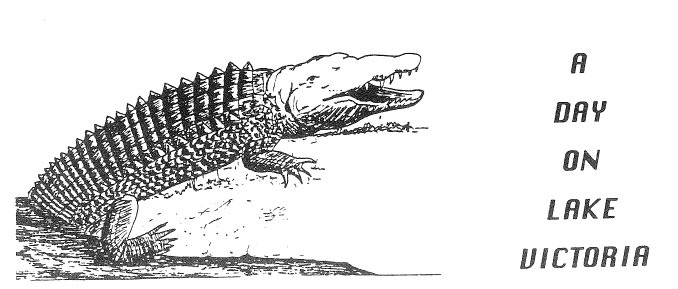
A DAY ON LAKE VICTORIA

Rubondo Island National Park is a unique place, situated in the South-West waters of Lake Victoria; it is exceptionally beautiful, far flung from the madding crowd and last, but definitely not least, cheap, since this is a park where hiring a four-wheel drive vehicle is not an obligation. Therefore, between the 19th and 24th September 1991, five of us (all volunteers with VSO) took a break here on this island. I am quite certain none of us will ever forget this trip end that none of the five will ever deny that much of the memorabilia we have stored in our minds are the events of one single day,

We begin in the early morning at the Rangers Headquarters camp where we were staying. We hired a park boat and bought fifty litres of petrol because today we were going to the southern end of the island to look for Rhino and Elephant. We set off slightly late, and headed south, past the Island of Birds, the Island of Crocodiles, over the deepest blackest waters of Lake Victoria, and skirted a series of formidable rock cliffs that fell straight into the deep water. We reached our first port of call, a smaller Rangers outpost that we were already familiar with, having spent our first night on the island there. This is where things really began to happen. To begin with, we foolishly let the Rangers take our boat (and our petrol) to the opposite side of the island to buy some cigarettes. Meantime, we brewed up some tea and had a simple breakfast. Eventually, the boat came back and we were prepared to leave.

Into the campfire I threw a pinch of the magic powder that I had bought from my local medicine man (he sold ‘dawa’ in the market place) for drawing the animals to us, imploring whoever was listening, in my best Kiswahili, to “Bring us Elephant and Rhino”. We had not quite gone when I was called over to the side for an urgent discussion with one of the Rangers. Reluctantly I disappeared behind a big tree with the man in order to listen to his problem, when, without further and to my immense consternation, he began to silently unbuckle his trousers and undo his fly. My mind began to reel with the possibilities. He silently carried on until his lower midriff was totally naked, and then, wedding tackle in hand, he began to beg me for help. His genitalia had been beseiged by insects of a variety I had no inclination to study more closely, and he, having seen me with the magic powder and having heard my Kiswahll, had obviously decided that I was an Mzungu to whom all could be bared. As it was, I was in no position to help and somewhat befuddled by his unique situation, All I could do was to worm my way out from behind the tree by claiming that two of the other VSO’S (who lived at the nearest mainland town) were the ones to see and that he could feel free to drop in on them any time he saw fit. We pushed off, and thus it was that we came across the poachers in the lake.

The day’s plan was that we were to be left at the southern end of a long sweeping bay, and that we would walk north following the line of the shore until we’d reached the end of the bay, where we would be met. We’d just rounded the northern tip of the bay formed by a headland crowned with a large steep hill, when we spotted another boat. Obviously they were poachers and so we set off to arrest them. As we drew nearer it became clear that their vessel was waterlogged; there were two men sitting up to their chests in the lake astride their stricken and totally useless boat.

At first I had thought they were using a cunning trick to hide from us – The lower they were in the water, the less we could see of them. In fact they were drowning and had been so since nine pm the previous night when their boat had begun to sink.

Ridiculously, we offered them our greetings and condolecences, and finally we rescued them. The thing was that the two fishermen-cum-poacher s were so dispassionate about the whole affair. Since nine pm they’d been slowly drowning, not four hundred metres from the shore, yet they’d not attempted to attract our attention nor flung themselves into the sanctity of our boat, nor attempted to reach the shore, nor displayed any emotion whatsoever. This was very disconcerting and occupied our minds for a good part of the rest of the day. Though they could talk end breathe, it was as if we had just pulled two very dead men from the lake. Anyway, we the tourists and the Rangers, were left at our start point while the ‘dead men’ were taken back to the Secondary Rangers post that we had just left.

We began to rapidly move northwards. Our Ranger, an ex-soldier, must have been in the throes of some sort of Uganda War flashback, because what we were engaged in was not a gentle tourist stroll through the woods, but a tough physical speed march. The woods were magnificent and, as on the previous days, the magic powder seemed to be working for we were surrounded by wildlife: Bushbuck, Sitatunga, fresh spoor of Elephant, and a diversity of birdlife to make an ornithologist weep. Much marching later and we were approaching that part of the bay opposite to where we had made our rescue. Our Ranger stopped and casually informed us that there was a crocodile on the beach in front of us. At first I saw nothing, but then the ubiquitous tree trunk that was protruding from the forest edge suddenly become the neck and head of a crocodile.

In that instant of recognition, I knew why those fishermen had ‘died’. Had I been mad enough to wish to run forward and embrace the crocodile in a warm hug about its neck , its tremendous girth was such that my hands would have failed to meet on the far side of the beast. The crocodile was now looking at us with its rear eye (deep orange-yellow in colour and infinite in depth): it rose and began to emerge from the forest’s edge to cross the beach not fifteen metres to our front. The beast was extraordinarily large, elemental and awesome, as tall on its feet as a very, very large dog. Needless to say we, the tourists, were rooted to the spot. The crocodile’s length (perhaps five metres or so), passed us and entered the water. Its tail waved once and it was gone. So that was it. Can you imagine sitting up to your chest in that creature’s dark kingdom from nine pm last night till this morning? “But that was only a small one” announced our Ranger, “the bigger ones are in the Island of Crocodiles that we passed this morning”. Suckers for punishment that we were, we decided to have a closer look on our return journey. We carried on, but by now some of our party were suffering from the effects of the marching and the heat. It was necessary therefore for three of us to remain behind while the others went to bring the boat back. This we did. We all climbed aboard and began the return to the headquarters via the other Rangers post.

The two men from the lake were still in shock, though slightly more lively; we didn’t have anything to say to them. What could we say? We had just arrested them for poaching, after all.

The day was not over yet. The unforeseen activities of the day, the cigarette sortie, the rescue, and returning to pick up the retired tourists, had sorely depleted our petrol. In short, we didn’t have enough to get back. We were faced with two poor choices: stay here the night (with our insect laden friend), or go on and then row the rest of the way.

We chose the latter. At this point, let me tell you that I am terrified of deep water – but deep black water inhibited by large monsters? Well, as it was , we ran out of petrol as we were circling the Isle of Crocodiles. We were going to run out of petrol anyway, and as I said, we were suckers for punishment. The crocodiles put on a great display for us. On sighting us they rushed from their basking points, down their mud-slides, to crash with horrible momentum into the water. We screamed and, for an instant, I nearly began to run, when fortunately I remembered where I was.

Every one of them was a large beast, though, to the great disappointment of our Rangers, none were larger than the one we had seen on the beach. From here, it took us six hours of constant rowing through the inky night to reach our camp. Though I was frightened, I shall never forget how beautiful that night was. The moon was bright and we could clearly see the island to our left, the cliffs falling into the waters. The other four VSO’s were singing as they rowed, but I was silent, numb with fear and awe.

When we got back we found that the only other campers there had left us another gift from the lake, Tilapia – good fish for eating. We fried them up and it was delicious, and let me tell you, it was not just the taste I was enjoying.
Michael Ball

BUSINESS & THE ECONOMY

CHANGES AT AIR TANZANIA
The Government has retired seven top executives (including the General Manager and the Director of Finance) and has demoted the Di rector of Operations and the Technical Director of Air Tanzania Corporation. This action followed within a few days of the appointment at the beginning of June of a new Chairman of the Board of Directors – Principal Secretary in the Ministry of Communications and Transport, Mr Richard Mariki.

The Government has also taken over Shs 12.4 billion accumulated debt. It is believed that a substantial percentage of the work force will be laid off and private investors will be invited to buy shares in the company.

The Corporation has announced increases in domestic tariffs of between 50 and 100% effective August 10, 1992 – Dally News.

THE 1992-93 BUDGET
The budget speech of the Minister for Finance was delivered in the National Assembly on June 18 1992 by Professor K A Malima who had recently exchanged jobs with Mr Steven Kibona as Minister of Planning. Thus, as Professor Malima generously acknowledged in his speech, a large part of the preparatory work had been supervised by his predecessor.

The underlying purpose was stated to be to continue the reforms towards greater market orientation and institutional financial responsibility set in motion in successive economic recovery programmes. Inevitably, therefore. a considerable part of the speech was devoted to a survey of reforms already begun or accomplished. The object of these changes was to open up the economy to private enterprise, to reorganise parastatal organisations on self-sustaining commercial lines, to expose the banking system to competition, to remove from the banks the severe handicap of non-performing assets and to institute various measures aimed at trade liberalisation and a wider access to foreign exchange. The full effect of these changes was likely to become visible only in the medium term. but already some encouraging results were emerging. In comparison with the previous year. the dollar value of exports was expected to show an increase of 7.4% Agricultural production was showing encouraging signs of expansion.

At the centre of the reforms needed was a progressive reduction of the Government’s dependence on external financing to balance not only the domestic budget , but also the country’s foreign trading and payment s account. Revenue in 1991-92 only financed two thirds of recurrent expenditure. the balance being made up out of foreign loans and grants, while export earnings only paid for about a third of minimal import requirements. The bulk of these deficiencies will eventually be made good as a result of economic growth, but a significant contribution was expected as a result of the institutional reforms now in train, or in prospect, and a generally enhanced regard for efficiency and productivity.

The continuing expansion of Government activities in recent years, beyond the limits of available revenue has led to a deterioration in the quality of Government services. an increase in the number of incomplete projects and neglect of preventive maintenance. It was therefore intended that the role of Government should be redefined with the aim of reducing its scope to a size capable of being financed out of revenue based on a small and highly efficient civ11 service. Government would withdraw from activities that could effectively be carried out by the private sector. Central to the remaining functions of Government will be law and order and the provision of economic and social services. In the case of the social services an element of consumer contribution is envisaged.

An element in the reform of Government business is the search for simpler procedures. In future the customs tariff will only contain four rates instead of five and excise duty only two in place of eight. But a notable change announced in the speech is a substantial reduction of customs duty, sales tax, income tax and company tax. The objectives here are to reduce costs of production, to alleviate the burden on consumers and bring about a reduction in tax avoidance . The effect on consumers is of special significance in view of the adverse effect of inflation on personal incomes. The abolition of customs duty and sales tax on all industrial raw materials will not only reduce costs, but also help industries to compete effectively in home and overseas markets. Other taxes have been abolished either because they are obsolete or because they are at odds with present policies. Examples are the 20% levy on the value of air tickets for foreign travel and a 1% tax on share capital.

A number of reasons were given in the budget speech for the decision to reduce taxes. It has been observed that, in view of the narrow tax base and the constant increase in Government services, it had become necessary to raise taxes by substantial amounts in order to balance the books. The result had been a marked reduction of the take-home income of the workers and a decline in revenue collection through tax avoidance. The tax burden was also adversely affecting industrial productivity.

The widespread reduction of customs duties and sales taxes and their abolition on certain items has prompted the Government to discontinue all exemptions hitherto enjoyed by Central Government, Local Government, political parties, religious institutions (except for items used in worship), Non-Governmental Organisations and charities. Local NGO’s and charities will not, however, have to pay tax on materials and commodities given them as donations to be passed on as free gifts to the needy and the poor.

The budget included the customary civil service salary increases to compensate for inflation. It was admitted that salaries were inadequate in view of the high cost of living and that efficiency had been impaired by a lack of appropriate working tools and poor remuneration. While little specific provision appears to have been made in this budget to ameliorate these underlying problems, it may be assumed that planned reduction in the scope of Government services will provide the necessary opportunity.

The budget is a courageous sequel to previous budgets and, in its fiscal provisions , a daring attempt to grapple with deep underlying problems. As a forecast of budgetary performance much reliance is placed on expected psychological reactions, which may or may not eventuate in whole or in part, but the attempt was certainly worth making. Will the new tax structure enhance production , increase efficiency, reduce absenteeism and raise expectations as a result of improvement in morale? Will the more moderate level of taxes reduce tax avoidance? Will simplification of Government procedures result in greater efficiency? All of these outcomes are justifiable hopes and it will be profoundly interesting to read in next year’s budget speech how far hope has been transformed into fact.
J Roger Carter

SOME OTHER BUDGET HIGHLIGHTS
– Minimum wage for civil servants raised from Shs 3,500 to Shs 5,000 (approximately £9 or US $17!) per month; – Abolishing excise duty on locally produced sugar, textiles, garments and cement ; Reducing corporate tax for local firms from 45% to 35%; foreign firms from 50% to 40%;
– Increasing licence fees for birth, death and marriage
– 10% income tax (15% for foreigners) on bank deposit interest ; 20% (once and for all) income tax on dividends;

TANZANIA IN THE INTERNATIONAL MEDIA

STAYING TRUE TO PRINCIPLES THAT INSPIRED A CONTINENT
Writing in a ‘Tanzanian Special Report’ in THE GUARDIAN (May 21 1992) Brian Cooksey pointed out that Tanzania is one of the last four counties in the world to retain socialism as its official creed. Although the National Assembly had recently passed legislation for multi-party government, proposals to remove all reference to socialism from the constitution had been roundly defeated. A decade of pressure from the World Bank and Western donor nations had so far failed to persuade Tanzania to ditch former President Nyerere’s collectivist ideology. For years his distinctive brand of African socialism had inspired millions of the continent’s poor and oppressed. One of the ironies had been that, until the early 1980’s, Western donor policy advice – the World Bank included – had been almost entirely supportive of the statist policies of the Nyerere years. With capitulation to the Bank and the IMF, Tanzania’s radical international reputation had declined and interest in Tanzania’s development model had waned.

AN OVERSEAS BRANCH OF THE CCM?
AFRICA EVENTS (July 1992) quoted CCM Party Secretary General Horace Kolimba during a speech given on June 11th at the Tanzanian High Commission in London as saying: “The work place must remain a place of work , Including this mission”. In the past, he said, the High Commission had been considered as an overseas branch of the (CCM) Party. “Not any more, from July 1st” he went on. “No party will be allowed to have any branches in any place of work” .

TWO FREE PORTS
Zanzibar President Dr Salmin Amour was reported in the August issue of AFRICAN BUSINESS to have announced that the islands are to establish two free ports – one on the West coast of the main island and the other at Micheweni in Pemba, two sites where virtually no economic activity is going on at present .

IN THE BEST SENSE UNIQUE
‘This novel (whose Swahili title is ‘Bwana Myombekere na Bibi Bugonoka na Ntulanalwo na Bulihwali’) is in the best sense unique, Never before was a novel of its kind been written in Africa and never again can such a book be written.’ With these words the WESTDEUTSCHER RUNDFUNK (West German Radio) revealed that a novel about early life in Ukerewe written by the late Aniceti Kitereza and already published in Swahili and English (the latter by the Tanzania Publishing House) has now been published in part (the first of two volumes) in German. (The remarkable story of how the book came to be written and the large number of persons and agencies involved was given in Bulletin No 14 in 1982 – Editor).

THE ONES THEY LEFT BEHIND
In introducing to its readers a new African-Russian Society designed to help the children of African fathers and Soviet mothers who are still in Russia (the oldest are 26 because the Soviet Union began a large scale scholarship programme in the early 60’s) the BBC magazine FOCUS ON AFRICA recently featured 13 year-old Maria Ferdinadova Balige. Her Tanzanian father had eventually been deported from the Soviet Union to Tanzania for having overstayed on a vacation in Sweden. He had spent a clandestine year in Leningrad with his Soviet wife and baby. Maria, a promising athlete, had had to be withdrawn from her gymnastics school complaining that her fellow Russian pupils had begun to hate her when she started coming top in most of the exercises. “They called me names” she said. “Obeziana (monkey), black paint, chocolate, black sea …..”

TANZANIA AND SOUTH SOUTH COOPERATION

Pointing to recent visits to Tanzania by Indonesian President Soeharto and Malaysian Prime Minister Mahathir Mohamed, AFRICA ANALYSIS in its June 12 issue reported on Tanzania’s ‘dynamic policy to reactivate Afro-Asian solidarity … The new South South focus is expected to result in joint ventures . . .. already Malaysia is helping with a palm tree project in Kigoma and discuss ions are under way with Indonesia on gas exploration’. President Mwinyi was said to be taking a keen interest also in regional conflict resolution. Because of its relative political stability and geography” Mwinyi had been able to successfully mediate between Burundi and Ruanda and between Kenya and Uganda and had played a pivotal role in efforts to revive East African economic cooperation.

NOT GEARED TO TOURISM

“I travelled around Pemba in the local covered, but open sided ‘buses’• wrote Frank Nowikowski in a full page art1cle on Zanzibar in the BUENOS AIRES HERALD (March 1 1992). “I asked for directions to a nice sandy beech … but such a concept did not seem to be understood …. In the main town Chake Chake there is one small hotel with five rooms . In the other two settlements on the island there are identical hotels, even down to identical wall clocks in identical positions, behind identical reception desks ….. Pemba is not geared to tourism” .

BELIEF SYSTEMS OF THE TANZANIAN PEASANTRY
As part of a supplement on Human Development in the June 1992 issue of AFRICA EVENTS Prof Sulaymen Nyang, Director of the African Studies Centre of Howard University, Washington DC, gave his views on what he described as the’total failure’ of Julius Nyerere’s Ujamaa policy. ‘I am inclined to make a tentative conclusion’ he wrote ‘that a significant part of the failure was the coerced villagisation .. Unwilling to pay adequate attention to the belief systems of the diverse ethnic groups of Tanzania … President Nyerere’s ilks wittingly or unwittingly committed a serious blunder … the separation from their (the peasant’s) ancestral lands could not be compensated by creature comforts identified with this illusive stage called development … perhaps the fate of Ujamaa could have been very different .. . if a programme of effective social psychological mobilisation (had been) mounted by the government ‘.

COFFEE TO JAPAN
Reporting on a recent visit to Japan by members of the Tanzania Coffee Marketing Board the JAPAN TIMES recently explained that Japan is ranked second to Germany as far as the trade value of coffee imports from Tanzania is concerned. Demand for Kilimanjaro coffee was stable in spite of increasing imports from other countries such as Kenya.

IS KAMBONA TANZANIAN?
‘It is ludicrous for anyone inside the Tanzanian ruling elite to suggest that (former Tanzanian cabinet minister) Oscar Kambona should be any other than a Tanzanian by birth’ wrote a reader in the June issue of NEW AFRICAN replying to an ellrl1er article 1n which a Tanzanian had been quoted as saying that he was originally from Malawi. ‘Mr Kambona, who was once the number two in the Tanzanian leadership hierarchy and a crown prince to Dr Nyerere, had dedicated his early political life to the fight for Tanzania’s independence. How can anyone doubt such a man’s patriotism? .. The Government should rehabilitate Mr Kambona and incorporate his party into the new political life of the country’ the reader concluded.

The LONDON EVENING STANDARD (August 14) published a letter from Mr Kambona in which he stated that he wished to join those paying tribute to the former Prime Minister of New Zealand, Sir Robert Muldoon, who has just died. Kambona wrote that it was Sir Robert, in a humanitarian act, who had used his influence to bring about the release from detention in Tanzania in 1978 of his two brothers, Otini and Mattiya.

MONEY RELATIVELY WELL SPENT
Writing in a recent issue of the IRISH TIMES Peadar Kirby criticised in some detail Ireland’s aid programme in Tanzania – a programme which takes a quarter of Ireland’s total aid budget. During recent years the Kilosa District Vocational Training Centre at Mikumi had taken 40% of this annual budget which, last year amounted to £2. 4 million. ‘It is an impressive campus of which any Irish town would be proud’ he wrote. 73% of the first output of trainees have been placed in employment which is good by Irish standards …. Compared to larger aid programmes Irish taxpayers’ money seems relatively well spent … but what isn’t disputed is that the Irish Aid Programme is now left with a Centre too costly for Tanzanians to maintain themselves. A plan to get the Tanzanians to cover 60% of the costs by 1993 has been shelved in favour of 1996 . … the haphazard nature of the Irish Aid Programme and the mistakes made with Mikumi point to a major weakness – it is administered by diplomats who are rarely left long enough to build up expertise in development issues …’

DEBTORS TO THE FORMER SOVIET UNION
An article in MOSCOW NEWS quoted in the July issue of ‘ New African’ described how the Russian Federation, groaning under a huge external debt, is demanding payment of some 14 billion convertible roubles (£804 million) owed to the former Soviet Union by various African countries. A table listing 32 African debtor countries had Tanzania in the sixth position (after Angola, Algeria. Zambia, Libya. and Mozambique) with debts of 295 million roubles for military assistance and 34 million roubles for economic assistance.

THE VICIOUS CIRCLE IN SHINYANGA
In one of a number articles on the Rio Earth Summit in the May issue of AFRICA EVENTS Belinda Coote quoted a Shinyanga social worker as explaining the role of cotton in degrading the soil. ‘When people first started growing cotton it was relatively well paid. They were able to buy cattle with the proceeds but this led to overgrazing. Then they began to use tractors to prepare the land for cotton. This meant that larger areas were cleared and trees uprooted. Now there is less rainfall 1n the area. Farmers can no longer grow maize so have switched to sorghum. Because there is little wood left for fuel they have to use cow dung and cotton stalks which would otherwise be left to fertilise the land. The result is severe soil erosion and declining soil fertility’. Thus, the author wrote, Shinyanga’s farmers were caught in a vicious circle. ‘Cotton production is one of the very few ways they have of earning money, yet by growing it they further degrade the area’s fragile soils . As a result, yields decline . . . Shinyanga’s cotton industry illustrates the complex link between trade, poverty and environmental degradation.’

THE LAST GREAT UNTESTED NICKEL BELT IN THE WORLD?
In what was described in the July issue of AFRICAN BUSINESS as a milestone in Tanzania’s drive to secure foreign investment the magazine revealed that the government had signed an agreement with Kagera Mining Company, a subsidiary of Sutton Resources of Canada which would provide mining exploration and development options to the company for an area of 25,400 sq kms in the Kagera Region . The agreement represents a follow-up to exploration in a corner of the region, Kabanga, where the nickel deposit is estimated to contain 40 million tonnes, grading 1.05% nickel, and also cobalt and copper.

MAANDISHI YA KIAFRIKA (AFRICAN WRITING)
This is what its inventor, Shiyana Saleh Mandevu, a 58-year old peasant, poet and former truck driver, calls his new Swahili script according to an article in NEW AFRICAN (July). His writing was said to be rather like Pitman’s Shorthand with Arabic influences. It was his collection of ancient objects bows, arrows, clay pots and other handicrafts – which inspired him to devise the new script. Two horizontal bows with their strings facing upwards mean ‘baba’ (father), two traditional stools read ‘mama’ and so on.

NYERERE ATTACKED
Anthony Daniels (the author of the book ‘Filosofa’s Republic’ based on his experiences as a doctor in Tanzania and reviewed in Bulletin no 36) launched an unusually vitriolic attack on Mwalimu Nyerere in the DAILY TELEGRAPH on July 3, 1992. He wrote: ‘Present-day reality has an autosatirical quality about it. How else is one to account for UNESCO’s recent award to ex-President Nyerere of Tanzania of the Simon Bolivar Prize for services to freedom, independence and the dignity of peoples. (The award of US$25,000 was shared with Burmese Opposition leader Aung San Suu Kyi; the jury said in its citation that Nyerere had worked tirelessly in the struggle against poverty, disease and ignorance; it took note of ‘the ethical ideal of honesty that personifies Julius Nyerere’ – Editor).

Daniel’s article went on: ‘Nyerere strutted and fretted his hour (or quarter of a century to be precise) upon his own small stage (Tanzania) and forced millions of people from where they were living, herding them into collectivised villages so that they could come under the control of his Chama Cha Mapinduzi .. . . not only did the Swahili Stalin get away with it but he received the bien pensant of Europe even as the huts of the recalcitrant peasants were burnt down …. Nyerere was not entirely original in his ideas … he received a Fabian training at Edinburgh University but his road to Damascus was actually the road from Peking airport to Peking. Mao arranged for a couple of million helots of welcome to wave flags at him … it turned his head and all that was needed to complete the catastrophe were a few economic advisers from the Institute of Development Studies at Sussex University ….

…. AND PRAISED
AFRICA EVENTS Zambian reader Jimmy Mdluli in the July issue compared President’s Kaunda and Nyerere. President Kaunda had eliminated all opposition and the only people he had genuinely attempted to groom as his successors had been his own sons. By comparison, when Tanzania’s first President (Nyerere) stepped down, he had left a couple of obvious successors whom he had thoroughly schooled in politics and statesmanship.

ACHINGLY BEAUTIFUL
Writer Jim Berry used these words to describe the Selous Game Reserve in the DAILY TELEGRAPH ON July 25th. ‘ Much about the Selous is unexpected ‘ he wrote. ‘Despite being Africa’s largest wildlife sanctuary it is also one of the least known and least visited. Its 2000 sq miles make it almost the size of Ireland … within its perimeter there are three separate ecological entities whereas the – admittedly smaller – Serengeti National Park cannot accurately boast one …. this vast area was named after the celebrated Frederick Courtney Selous, a towering figure among early white hunters … he was killed by a German sniper near Beho Beho. One afternoon we walked the few miles to where he fell. Old cartridge cases and other rusted military paraphernalia still litter the overgrown trenches. Selous’ grave, marked by a marble plaque set in a simple concrete slab, stands nearby ….

LADY CHALKER FIRES BACK
Lady Chalker of Wallasey, Britain’s Minister for Overseas Development, replied robustly in the SPECTATOR (May 9 ) to an earlier article attacking foreign aid which had been sceptical about the reality of the southern African drought. The article had spoken about Tanzania earning twice as much through foreign aid as it did through exports and of the lack of incentive for Tanzanians to grow exportable crops in a hot climate – only to be paid a fraction of their worth’ when you can go to Dar es Salaam, sit in an air conditioned office and lay your hands on untold dollars by bureaucratic intrigue’. Lady Chalker wrote to the editor that she really could not decide whether it was his arrogance or ignorance which appalled her the more. She pointed out that the article was out of date and listed the numerous changes that had occurred during recent years in aid policy.

THE ASSASSINATION OF PRESIDENT KARUME
In 8 cover story on Political Assassinations in Africa AFRICA EVENTS (August 1992) went into some detail about the assassination (while he was playing dominos) of the late President Karume of Zanzibar on April 7, 1972 . ‘By no means’ said the article ‘was the assassin, Lt Humud Muhammed Humud , a lone player. He had accomplices at the scene who were subsequently either gunned down by the security forces or committed suicide. Humud died on the spot in circumstances that are still not clear … the Government (had) insisted that the assassination was part of a plot to overthrow it. But Humud had had a personal motive … his father had been arrested a few months after the Zanzibar Revolution of 1964 and, while Humud was training later in the Soviet Union he had been told that his father had been executed … he had vowed revenge ‘. But there had been political factors also. By 1972 the revolution hed degenerated into a tragic farce – gross abuses of human rights, political killings, a curious system of people’s courts, forced inter-marriages , a declaration by Karume that there would be no elections for fifty years …. Karume had become an embarrassment to Nyerere and a danger to the future of the Union .. . ‘ . The blood of Humud and his colleagues had not been shed in vain, the article concluded, as it had enabled Nyerere to subsequently consolidate the Union through the joining together of the TANU and CCM parties, the neutralisetion of those who considered themselves to be Karume’s legitimate heirs and the subsequent far-reaching constitutional changes and liberalisation which had followed under Zanzibar Presidents Jumbe and Mwinyi.