REVIEWS

Edited by John Cooper-Poole

John Cooper-Poole, who has run the TA reviews section since 2002, covering 38 issues, has decided it is time to hand over the role to someone new. The TA editorial team wishes to express its gratitude to John, who – as we’re sure you will agree – has done a wonderful job.

This means we are now in need of a volunteer to take on the role of reviews editor. Please contact David Brewin or Ben Taylor if you are interested.

UJAMAA – The hidden story of Tanzania’s economic development from the grassroots Ralph Ibbott, Crossroads Books £15.99 In the 1960s the Ruvuma Development Association (RDA) was formed by new villages that were being run as genuine cooperatives. The villagers grew their crops by collective work and the villages were run democratically through open meetings and elected officials who had no payment.

Development in the RDA villages was slow but real, with improvements in food supply, health and education and most significantly in the confidence of the villagers as they learned to manage their affairs. The villages exemplified the policies that Julius Nyerere was expounding in his ‘Socialism and Rural Development’ and he gave the RDA his personal support.

RDA villages were probably the most successful of the various forms of collective farming being attempted across the country and the RDA attracted support from international aid agencies.

Although collective villages and cooperative farming were party and government policies, in 1969 the TANU National Executive decreed that RDA be dissolved. Why? Andrew Coulson gives an explanation in his ‘Tanzania, A Political Economy’: TANU regional and national politicians became fearful that their position and power would be undermined if independent, politicised villages became the norm. Ibbott provides detailed experience to support this conclusion. In addition he has evidence that at least one minister and member of TANU National Executive was not just opposed to the RDA but also to Ujamaa, which was supposedly party and government policy.

Ibbott was an advisor to RDA and lived in Litowa, the first RDA village. He was closely involved with the work and life of the villages until the dissolution of RDA and on his return to Britain was invited by the Commonwealth Secretariat to write a report of his experience with RDA which they intended to publish. However, his report was never published, perhaps because the Commonwealth Secretariat did not want to offend the government of a member state or possibly it was the victim of a change in personnel. The report has been available to academic researchers, and now becomes accessible to a wider readership.

Ujamaa is Ibbott’s record of events, reports by visitors to RDA villages, sections on specific topics and Ibbott’s letter to Nyerere after the dissolution decision (to which there was no reply). He has added a recently written Epilogue which brings together later research on the subsequent history of the ex-RDA villages.

The original report “The Origin, Growth & Disbanding of the RDA” has severe criticism of successive Ruvuma Regional Commissioners. They did not understand the philosophy on which the villages were based and became opposed to something that they could not control.

The last of the sections on specific themes is a profound critique of Nyerere’s failure to turn his political ideas into practical policies. He passed implementation over to party and government officials who had no understanding or experience of promoting voluntary small- scale collective villages. They wanted quick results from large state-organised schemes and were all too ready to fall back on compulsion. Nyerere must have known this.

This is a report prepared to inform and guide those involved with rural development and is probably a unique source for researchers and historians. The general reader who is not familiar with the background might struggle with, for example, the references to Peramiho, the Catholic mission complex near Songea.

Ujamaa makes uncomfortable reading for those of us who uncritically and enthusiastically championed Tanzania through the 70s and 80s. It also has a harsh message for those who are “not interested in politics, I just want to help” – effective development is always political.
John Arnold

(John Arnold, was Regional Secretary, Ruvuma Region, 1963-4.)

NYERERE – The Early Years, Thomas Molony, James Currey 2014. ISBN 9781847010902 £25.00

This book from the pen of the Lecturer in African Studies at the University of Edinburgh aims to present “the first truly rounded portrait of Nyerere’s early life”. There has been little opportunity to learn accurately about the development of Mwalimu’s early thinking and this is a valiant effort to fill the gap.

Even here descriptions of the background to his early upbringing rely on much anecdotal evidence. The need to include even the smallest detail, in an effort to lend more substance to the narration, can give the early pages the air of a doctoral thesis.

This improves in value as the narrative progresses, so that the inferences which are dependent on other studies of the social mores are increasingly replaced by facts more relevant to Nyerere’s particular circumstances. Nevertheless there are many statements asserting that much more evidence about incidents cited must exist somewhere.

The key question that is always asked about great men from humble and at first sight unpromising origins is “Who first realised that this exceedingly bright, above-average young person was not after all destined to blush unseen?” With hindsight we might say that Nyerere would probably have fought his way out anyway, but this book reveals how he caught the eyes of the White Fathers, with their paramount influence and encouragement, and followed this when in relatively privileged positions in Kampala and in London.

The final chapter of this book, titled “Legacy and Reappraisal” is lucid and authoritative. After several pages which may appear “sparsely informed and predominantly uncritical”, the author can rightly claim that this is a valuable piece of research which clearly amplifies the little that was previously published about Nyerere’s early progress. Ending as Nyerere moved away from teaching to active politics, it lays the basis of our understanding of what he came to regard as significant for his country: education, agriculture – and independence.
Geoffrey Stokell

(Geoffrey Stokell first went out to the Gold Coast (now Ghana) in 1953, serving there for thirteen years as an “old-style” merchant trader. After qualifying as an accountant and building an internationally-successful career, in 1983 he went to Tanzania as a missionary with the Moravian Church and was later head of finance for the Tanganyika Christian Refugee Service. He became Treasurer of the Tanzania B-T S Chapter and on his return to the UK in 1996 and was TDT Treasurer.)

HADZABE: By the Light of a Million Fires, Daudi Peterson, with Richard Baalow and Jon Cox. Mkuki na Nyota, Dar es Salaam, 2013. ISBN 978-9987­08-212-4, 230 pp paperback (with music CD). Tsh50,000

It is difficult not to be fascinated by the Hadza, speakers of a unique click language and one of the last remaining groups of hunter-gatherers in Tanzania. It is easy to sympathise with their struggle to retain control over their customary lands in the Lake Eyasi basin, near Ngorongoro. By the same token, it is not hard to like this handsome volume, which is much more than a coffee table book with excellent photos; it strives to give the Hadza a voice and support their right to choose their own future. The window it opens onto the world of the Hadza is enough to make you envy the ethno-tourists and researchers who visit Hadzaland , if not the hapless folk who have to entertain them.

Hadzabe: By the Light of a Million Fires was compiled by Daudi Peterson with the help of a number of Hadza and Hadzaphiles, including the venerable anthropologist James Woodburn. A limited hardback edition has been sold to raise money for the Dorobo Fund and Ujamaa Community Resource Trust, established by the Peterson family’s eco-tourist enterprise. The paperback and accompanying CD of Hadza music that have now gone on sale are very good value. They are not without their flaws: a tendency to romanticise the Hadza and to demonise their neighbours and an uneven mixture of topics and styles, including a Swahili paean to Nyerere and villagisation on the CD. But I would much rather possess this engaging book and its vibrant music than not.
Martin Walsh

(Martin Walsh is Oxfam GB’s Global Research Adviser. His seminar presentation to the Britain-Tanzania Society on ‘Tanzania’s (agro)pastoral headache’ is available online at http://www.btsociety.org/app/images/events2013/agropastoralist_headache.pdf)

VIOLENT INTERMEDIARIES – African Soldiers Conquest and Everyday Colonialism in German East Africa, by Michelle R Moyd, Ohio University Press, 2014; ISBN 978 08214 2089 8, 328 pp, softback.

The author of this exhaustive and authoritative account of the German colonial years in East Africa was indeed an acknowledged expert on the period even before this book was published. Now the reader has the full story of those years from 1891 to 1918, with the emphasis on the locally-recruited askari, who fought for the Germans almost as if they were of them.

The askari take centre stage throughout the book, indeed from the cover onwards, with an askari, rifle on shoulder, about to take his leave from his family to return to the Schutztruppe, the German colonial army. Chapters show how and where the askari were recruited; the military training and “socialization”; the wars fought by the askari (such as the Maji Maji conflicts of 1905-7); life on the stations within the country; and the inadvertent role of the askari in German colonialism. We learn, among myriads of facts, how many Sudanese initially became askari but how eventually all tribes became merged within the askari hierarchy; how the “legal” wives of askari detained for transgressions were given an allowance for their “household stability”; and how the scorched-earth policy adopted by the Schutztruppe during Maji Maji rebellion disrupted crop cycles and led to labour movement away from the Southern Highlands.
The author takes us through the 1914/18 War from the first campaign to the final 1,200 askari who surrendered to the British in November 1918, effectively closing a definitive chapter in the history of German East Africa and signaling the end of the Schutztruppe.

Although the book is, relatively speaking, hot on the heels of Anderson (2004), Paice (2007) and Samson (2013), it provides not only a great read but a quite different slant on the history of the period. The three maps – produced by Brian E Balsley, an American cartographer – are very illustrative and useful. An extremely full bibliography is of considerable fascination in itself. The index runs to a mere six pages, this being more an observation than a criticism. This work is a marvelous example of how long-term research can come to fruition in a superlative way.
David Kelly

(David Kelly has been involved with East Africa since he wrote the first history of cricket in the region in the 1960s. He is now a book dealer, with Africa a speciality subject; still researches cricket; and is a director of a Dar-based company in the beverage sector.)

TRANSITIONS OF A LIFE, printed and published for private circulation by J K Chande KBE

I first met Sir Andy Chande in the late 1980s, since when, though we now meet less frequently than before, he has become a close personal friend. Transitions is his own collection of speeches on an immense range of topics, all reflecting the dedication he continues to bring, even in retirement, to the management, in its widest sense, of enterprises and organisations with which he has been connected.

The volume is self-published, and to that extent it could probably be classified as a vanity publication; but it deserves none of the sneers which that title often evokes. It naturally lacks the fascination and raciness of his autobiography A Knight in Africa, but it underlines the way the author has been able during his lifetime, modestly but effectively, to participate in and influence some significant social decision-making. Sir Andy has been appointed to at least 100 public positions; his support for the Britain-Tanzania Society has been exemplary; and it comes as no surprise that the most significant chapters reflect his summons to all to dedicate themselves to community service. This is a celebratory volume exemplifying the practical application of two battle-cries of great public principle: Rotary’s “Service above Self” and Freemasonry’s “Love, Charity and Truth”.

TANZANIA; Strength in Unity, Strength in Diversity, published to mark the 50th Anniversary of the United Republic of Tanzania by FIRST Magazine 2014. www.firstmagazine.com, 56 pages.

This is a glossy publication which the publisher tells me “was promoted by the Tanzanian Government and High Commission in London but financed by FIRST via advertising sponsorship. It is being distributed by the High Commission/Foreign Ministry and agencies such as the Tanzania Tourist Board. It is intended for presentation to VIP guests, distribution at investment fora/conferences etc. It will also be printed in FIRST magazine which is made available, on a complimentary basis, to first class passengers on British Airways and other airlines”. I quote this at length to explain why, unless you fall into one of these rarefied categories, you are unlikely to see a copy. Which is a pity.

There are articles by many different people, ranging from President Kikwete to the manager of the Kilimanjaro Hotel in Dar es Salaam – who incidentally is still an expatriate 40 odd years after the hotel was built. (Not the same person!). Some contributors rely heavily on unexplained TLA’s*. None the less, a proud story can be extracted, which is perhaps best summed up by John Malecela when he says “During the 50 years of existence, Tanzania has been a centre for peace and liberation in Africa. All in all, the role played by Tanzania in international and African affairs has been commendable beyond imagination”. Malecela’s piece is perhaps the best of the lot, as one might expect from someone who was at or near the centre of affairs for most of the relevant period.

Professor Mwesiga Baregu writes a thought-provoking piece about the challenges to be faced in working out a new constitution. Another is the last in the booklet, by Walter Bgoya and appropriately titled “The Last Word”. He warns of the dangers currently facing publishing in Tanzania, particularly of school text books; he fears a possible return to the state monopoly arrangements of the 1960s to 1980s, when in rural areas there could be one text book for every 15-20 pupils, and even in urban areas there might be one book for three pupils.

Our own David Brewin has a useful feature about the army mutiny and the Zanzibar revolution of 1964, the “two shocking events which triggered unity”. Incidentally it is a pity that throughout the publication the Britain-Tanzania Society does not get a mention.
*three lettered acronyms, in case you wondered.
J.C-P
TA ISSUE 109

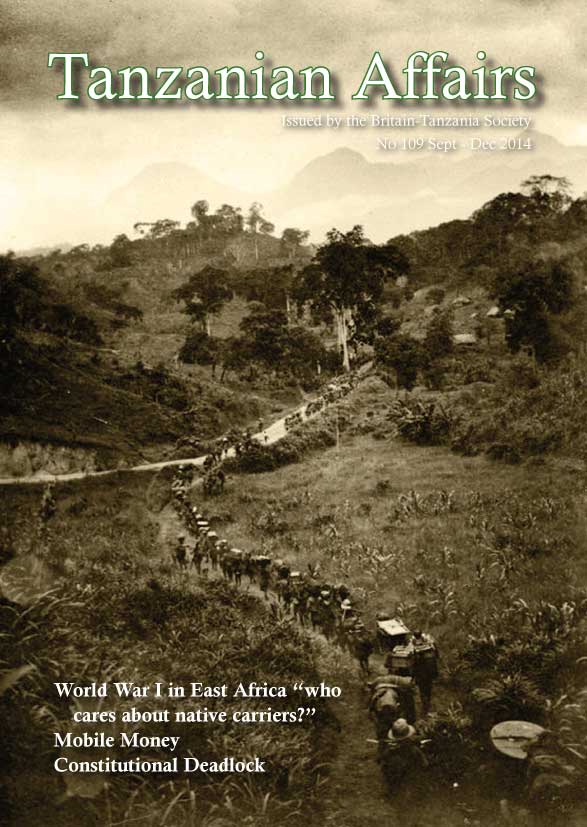
TA 109 cover features photo of Water Camp on Mikesse (near Morogoro) -Ruwu (near Kahe)road, December 1916. Imperial War Museum photo Q15412

TA 109 cover features photo of Water Camp on Mikesse (near Morogoro) -Ruwu (near Kahe)road, December 1916. Imperial War Museum photo Q15412

World War I in East Africa “who cares about native carriers?”
Mobile Money
Constitutional Deadlock

A pdf of the issue can be downloaded here

WORLD WAR I IN EAST AFRICA “WHO CARES ABOUT NATIVE CARRIERS?”

by Ben Taylor

On 8 August 1914, the Royal Navy bombarded the German wireless relay station in Dar es Salaam. War had broken out in Europe just days earlier, and already it had come to East Africa.

In the shadow of the horrors of western Europe, space in the popular memory for the East African theatre of the First World War is limited. Such room as there is tends to be dominated by Boys’ Own tales of derring-do, successes against the odds and heroic failures.

The madcap British scheme to gain naval supremacy on Lake Tanganyika is Exhibit A. Two 40 foot motorboats, HMS Mimi and HMS Toutou, were shipped out to South Africa and transported 3,000 miles by land (including being dragged for 146 miles through the jungle of the Belgian Congo) to reach the lake. It should never have succeeded, and yet it did, capturing one German vessel and sinking another before forc­ing the Germans to scuttle their 220-foot flagship Graf von Götzen (now the MV Liemba).

This inspired C.S. Forrester’s novel, The African Queen, a film of the same name starring Humphrey Bogart and Katherine Hepburn, and, more recently, Giles Foden’s book Mimi and Toutou Go Forth. Partly as a result, though the military significance of the Battle of Lake Tanganyika was negligible, the story became arguably the most well-known episode of the Great War in East Africa.

Or perhaps that accolade should go to the sinking of the German battle-cruiser SMS Konigsberg. Just before outbreak of war, the ship had given the British navy the slip from Dar es Salaam harbour. She frustrated the British in the Indian Ocean for well over a year, sinking ships including City of Winchester and HMS Pegasus, before eventually being cornered and sunk in the Rufiji Delta.

The Germans began the war with a well-trained force of some 5,000 men under the leadership of Lieutenant Colonel Paul von Lettow-Vorbeck. They launched an early attack over the border into British East Africa (now Kenya) to disrupt the Mombasa-Nairobi railway, capturing an area around Taveta and Tsavo. This was the only British territory anywhere worldwide to be occupied during the entire First World War. During one skirmish, a German sniper is said to have hidden inside a hollow baobab tree; locals still claim the tree to be “the most shot at tree during World War I.”

In November 1914, a British/ Indian Expeditionary Force launched a disastrous attack on the port of Tanga, the terminus of the strategically important Usambara railway to Moshi. There was an agreement that guaranteed the neutrality of Tanga, so the British gave the Germans 24-hours’ notice that the agreement was cancelled. Lettow-Vorbeck thus had time to bring reinforcements down the line from Moshi. When allied troops were landed, they struggled against a swarm of bees. The Germans faced similar problems, but they prevailed in what inevitably became known as the “Battle of the Bees”.

Guerrilla tactics and impossible logistics
These episodes have a place in the history of the Great War in East Africa. But they do not tell the full story – far from it – for this was a brutal war.

Schutztruppe in German East Africa - German Federal Archive Bild 134-C0265

Schutztruppe in German East Africa – German Federal Archive Bild 134-C0265

In contrast to the immobile trench warfare in western Europe, the war in East Africa was one of mobility and guerrilla tactics: brief battles and long marches. The allied troops launched an offensive in early 1916, after which Lettow-Vorbeck conducted a guerrilla war for two and a half years around the south of German East Africa (Tanzania), the northern part of Portuguese East Africa (Mozambique) and finally in Northern Rhodesia (Zambia).

Lettow-Vorbeck by 1916 had around 20,000 troops – mostly Africans with German officers – while the allied combatants numbered around 150,000, under the command of South African General Jan Smuts. Smuts’ troops were drawn from Britain, the British colonies in East, West and Central Africa, South Africa, India and the Belgian Congo. By the end of the war, the allied force was almost entirely African.

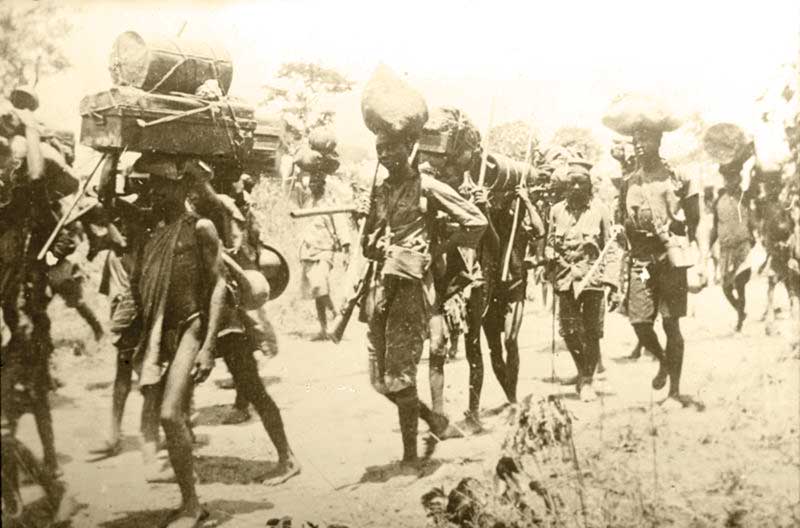
Troops and carriers would often walk twenty miles a day, every day for a month, exposed to tropical weather of intense heat and drenching rain. Two King’s African Rifles battalions marched 1,600 miles in seven months, in the process fording 29 large rivers and fighting 32 engagements. Much of this was done with virtually no rations, subsisting on what could be found locally. Disease killed more British troops than combat. On returning from the field, soldiers were described as “resembling the victims of famine.”

In the words of one South African quartermaster, the war “involved having to fight nature in a mood that very few have experienced and will scarcely believe.” Another stated that “there is no form of warfare that requires so much inherent pluck in the individual as bush fighting.” And an officer who had fought on the Western Front wrote: “what wouldn’t one give for the food alone in France, for the clothing and equipment, and for the climate, wet or fine”.

A Malawian veteran described the experience: “Think of lying on the ground where the hot sun is beating directly on your back; think of yourself buried in a hole with only your head and hands outside, holding a gun. Imagine yourself facing this situation for seven days, no food, no water, yet you don’t feel hungry; only death smelling all over the place. Listen to the sound from exploding bombs and machine guns, smoke all over and the vegetation burnt and of course deforested. Look at your relatives getting killed, crying and finally dead. These things we did, experienced and saw.” (Page, cited by Samson).

Supply chains for food, medicines and munitions were impossible to maintain. Historian Edward Paice describes the logistical challenge: “As the availability of livestock for transport proved incapable by mid­1916 of matching the depredations of disease, the onus fell on the only alternative – human porterage. The mathematics are sobering. … 16,500 carriers were required to transport a single ton of supplies – enough to feed 1,000 askaris and their camp-followers for one day – for the simple reason that 14,000 of them were needed to carry food for the column while 2,500 carried the food for the troops. … The troops required more than a million carriers to keep them in the field.”

The German troops largely abandoned efforts to maintain a supply chain, and instead appropriated crops and livestock without payment. They recruited some 300,000 carriers, again largely without payment.

The effect of all this on the civilian population was devastating. Agriculture became more and more difficult, leading, by 1917-18 to famine in much of East Africa.

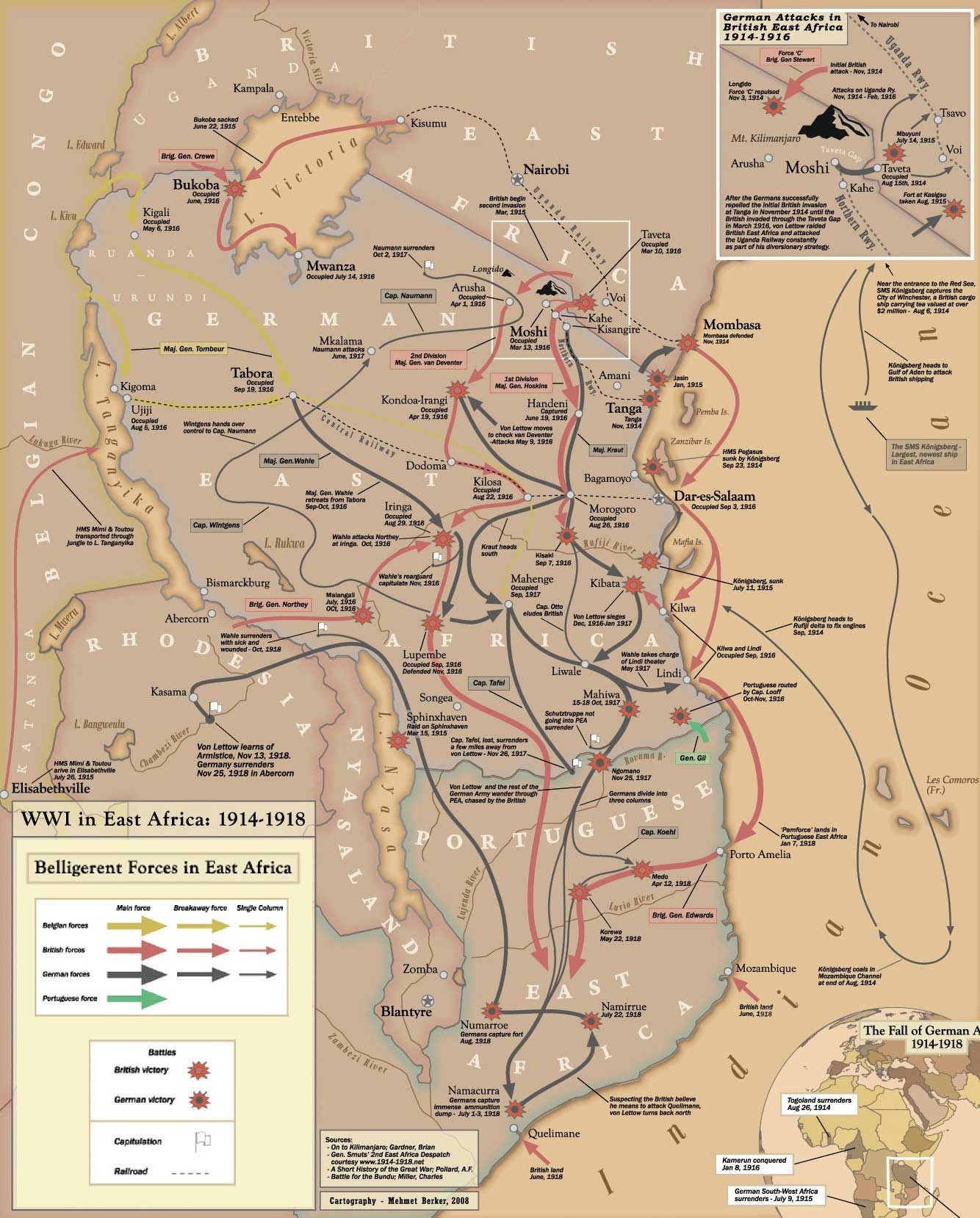
Map of the Great War in East Africa based on that by Mehmet Berker, wikipedia

Map of the Great War in East Africa based on that by Mehmet Berker, wikipedia

And for what?
M’Inoti wa Tirikamu, a carrier from Meru, “wondered why white men hate each other so much. They looked so much like brothers. We asked ourselves: Do they fight for land, or for the power to rule, or is it because they are all white, or why?”

Odandayo Mukhenye Agweli, an askari of the King’s African Rifles had similar thoughts: “To this day, I still do not know why we fought the Germans and how the war began. Though we admired the European ways of fighting, we were still left wondering why so many people had to die. In our tribal wars, the number of the dead was never very big.”

There is no answer to these questions that can possibly justify the war. Lettow-Vorbeck saw the role of his army as a drain on allied resources – drawing men and weaponry away from more important battles in Europe. Though he evaded capture until the war had ended, at which point he surrendered in Northern Rhodesia, he never really drew significant manpower away from Europe. The allies fought the war mostly with African soldiers.

Historian Edward Paice sees the war in East Africa as “the final phase of the Scramble for Africa”, which “epitomised the vainglorious imperial ambitions which helped to trigger – and certainly prolonged – World War I”. The British gained a League of Nations Mandate over Tanganyika and the Belgians gained one for Rwanda and Burundi. But the war laid bare the human vulnerability of the white man as never before, and sowed seeds of a demand for independence. The First Pan-African Congress was held in Paris in 1919, to coincide with the Versailles Peace Conference. It called for Africa to be granted home rule, and for Africans to take part in governing their countries as fast as their development permits.

The real cost
In contrast to the (relative) glamour of a small British navy expeditionary force on Lake Tanganyika, the real story of the war in East Africa is far more brutal. The vast majority of war deaths were among carrier units – an estimated 95,000 on the allied side, probably well over 50,000 among the German carriers. Around one in eight of the adult male population of British East Africa – today’s Kenya – lost their lives either as askaris or carriers. And an estimated 300,000 civilians in German East Africa died as a direct result of the war and the 1917-18 famine. The official death toll among British combatant and support units was over 105,000 men. This equalled the number of American war deaths, and was almost double the numbers of Australian, Canadian or Indian troops who lost their lives during the war.

Disgracefully, however, the official death toll does not include carriers. According to Paice: “There were many British combatants in East Africa who paid tribute to the carriers on whom they were utterly dependent for survival … But when the mortality rate became common knowledge in Whitehall it was deemed a “bloody tale” best ignored, or even suppressed, as Britain sought colonial prizes in Africa at the Paris Peace Conference. As one colonial official put it, in particularly arresting terms: the conduct of the campaign “only stopped short of a scandal because the people who suffered the most were the carriers – and after all, who cares about native carriers?””

And yet, somehow, the worst was still to come. In September 1918, as the war was coming to an end, Spanish Flu reached sub-Saharan Africa. In British East Africa, probably as many as 200,000 died, nearly 10% of the total population of the country. In German East Africa, the death toll from Spanish Flu may have been as high as 20% of the population. “There came a darkness” is a much-repeated phrase in oral histories of the time. This was a war with an immense human cost: on the troops and on the carriers, and most of all, on the civilians.

Sources
Great War in Africa Association http://gweaa.com/

Edward Paice – How the Great War razed East Africa, Africa Research Institute http://www.africaresearchinstitute.org/publications/counterpoints/how-the-great-war-razed-east-africa/

Edward Paice – The Great War and the size of the butcher’s bill, The Africa Report
http://www.theafricareport.com/Columns/the-great-war-and-the-size-of-the-butchers-bill.html

Anne Samson – When two bulls fight
http://thesamsonsedhistorian.files.wordpress.com/2014/07/when-two-bulls-fight.pdf

Anne Samson – The numbers game: how many men fought in Africa?
http://thesamsonsedhistorian.wordpress.com/2014/06/13/the-numbers-game-how-many-men-fought-in-africa/

Wolfgang H Thome – Battlefield East Africa, 98 years and counting http://wolfganghthome.wordpress.com/2012/06/24/battlefield-east-africa/

World War I in Africa: What happened in Africa should not stay in Africa http://wwiafrica.tumblr.com/
Wikipedia – East African Campaign (World War I) https://en.wikipedia.org/ wiki/East_African_Campaign_(World_War_I)
Wikipedia – Battle for Lake Tanganyika https://en.wikipedia.org/wiki/Battle_ for_Lake_Tanganyika
Wikipedia – Battle of Tanga https://en.wikipedia.org/wiki/Battle_of_Tanga
Wikipedia – Schutztruppe https://en.wikipedia.org/wiki/Schutztruppe

WWI EAST AFRICA – THE RETURN OF THE COHORT

We’re a very tiny army, as armies go to-day,
Just an army of the Tropics and beginning to decay.
We thought you had forgotten us-so long we’ve been away.

We’ve most of us had fever or a tropical inside,
And we’ve foot-slogged half a continent; we’re not supposed to ride;
And lots of us have lost the trail and crossed the Great Divide.

Perhaps the blokes in Flanders our little bit will scorn,
‘Cos we’ve never had an order that gas masks must be worn,
And have never heard a “nine point five“ or a Hymn of Hate at morn.

But how’d you like to tramp it for a solid month on end,
And then go on another month till your knees begin to bend,
Or when you’re out on picquet hear a lion answer “Friend”?

And what about a scrapping up a mountain three miles high,
A-swearing and a-panting till you thought your end was nigh,
And then to bump a Maxim gun that’s dug in on the sky?

And would you like anopheles and jigger-fleas and snakes
To “chivvy” you from dusk till dawn, and fill you up with aches,
And then go on fatigue all day in a heat that fairly bakes?

There wasn’t any Blighty, no, nor mails in twice a week:
We had no concerts ‘hind the lines; we got too bored to speak,
And there was no change of rations; and our water bottles leak.

So don’t despise our efforts, for we’ve done our level best,
For it wasn’t beer and skittles, those two years without a rest,
And though the world forgot us we think we stood the test.

We’re a cohort from the tropics, and we’ve come from far away,
Just an unremembered legion, fret with fever and decay.
And all of us are weary, and lots have lost the way.

We’re a tiny little cohort, and we’re glad to have a spell
From fever and from marching and a sun that burns like hell,
And now we’re back amongst you, we’ll very soon get well.

Just a tiny army, as armies go to-day,
Just a handful from the tropics, and beginning to decay,
Just a Legion of the Lost Ones-who have wandered far away.

Just a remnant who’ve been fighting for you and for your race;
Just a cohort from the northward, where we’d worse than Huns to face.

We thank you for your welcome, and we think you’re very kind,
But we’d ask you to remember – all our mates we left behind!

Written by Owen Letcher in 1918 and first published in the Johannesburg “Star”. Letcher fought with the King’s African Rifles out of Nyasaland into German East Africa. He wrote an autobiographical novel about his experiences: “Cohort of the Tropics”.

MOBILE MONEY

by Ben Taylor

Mobile money has revolutionised financial services in East Africa, starting with M-Pesa in Kenya and spreading from there. All Tanzania’s major mobile phone networks offer similar services, through which users can send money at very low cost to anyone in the country using a standard mobile phone.

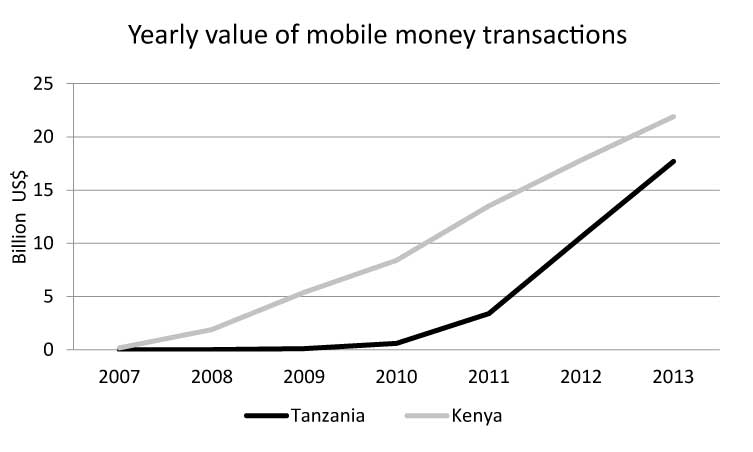
The global association of mobile phone network operators, GSMA, has recently published a report on mobile money in Tanzania, with a chart showing the total value of mobile money transactions since 2007:

Graph showing yearly value of mobile money transactions. Source: GSMA, data from Bank of Tanzania & Central Bank of Kenya

Two points are worth highlighting here. First, though Kenya was undoubtedly the trendsetter, Tanzania is fast catching up, and looks set to overtake Kenya during 2014.

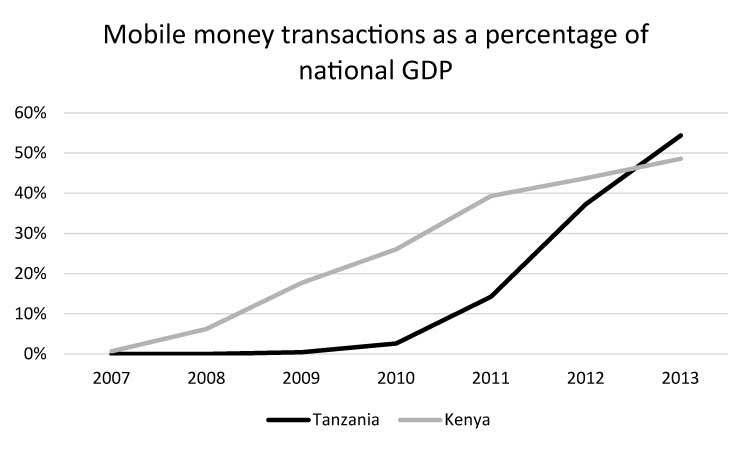
Second, take a look at the Y-axis label on the left. These figures are in billion US$. In other words, the total value of mobile money transactions in Tanzania in 2013 was US$17.7 billion. This is a huge amount – equivalent to over half (54%) of Tanzania’s GDP*. Which means in one sense Tanzania has already overtaken Kenya, where the value of mobile money transactions in 2013 was “only” 49% of GDP*:

graph_mobile

This raises the question: is Tanzania the first country in the world where mobile money transactions are worth more than half the country’s GDP? Quite possibly it is.

* GDP Estimates are from IMF (2013): Tanzania US$32.5bn, Kenya US$45bn

POLITICS

by David Brewin

Yet another political party
As if Tanzania did not have enough political parties – there are twenty – there is now another one! This party, now going through the processes of official registration, bears the name; ‘The Alliance for Change and Transparency’ (ACT). It is believed that it has been set up by former members of the leading opposition party Chadema, which is the only party to have a chance of defeating the ruling CCM party in the 2015 elections. CCM has been in power for more than 50 years. ACT’s interim chairman said that the party would be guided by five principles – patriotism, equality, accountability, transparency and true democracy.

‘Traitors’ in Chadema
The main opposition party Chadema, which did well in the 2010 elections, is now being torn apart by internal dissension. According to The Citizen, a group of its members have written to the Registrar of Political Parties on alleged illegal amendments to the party’s constitution, and to the Controller and Auditor General requesting an audit of the party’s accounts. Others have apparently accused the party of removing illegally a section on term limits for presidential candidates in Chadema’s constitution which could have made the party’s two main leaders ineligible for leadership posts’.

Some observers think that these events are simply ‘business as usual’ in Tanzanian politics ahead of elections. Many of these members have defected before – mainly from CCM to Chadema or other smaller parties.

Potentially more damaging is the revolt of perhaps Chadema’s most ambitious and charismatic former Deputy Secretary General, Zitto Kabwe, MP for Kigoma. Kabwe has been virtually expelled, together with other party members in the Kigoma and Tabora regions. He played an important role (see TA 108) in establishing the party’s growth, especially among the younger generation.

CCM in trouble too
In the case of CCM, too many people want to put themselves forward as candidates for the presidency. But the party has severely frowned on this premature campaigning and is threatening severe penalties for those engaged in it.

All this is disheartening for those wanting Tanzania to develop into a democracy on the British model where governments change from time to time to reflect the changing views of the electorate. But most Tanzanians regard security and peace as their highest priorities. People continue to vote for CCM in large numbers because, unlike the situation in all its neighbours, Tanzania and CCM have given the country peace and a relatively good state of law and order.

Calm before the storm
The present political scene, and especially the highly contentious debate on the constitution, could lead to stormy times in the next few months. With most politicians installed in Dodoma for the deliberations of the Constituent Assembly, the ruling party and the opposition parties have begun to worry seriously about the forthcoming 2015 elections. For the first time, three main opposition parties have come together in a ‘Coalition of the Peoples Constitution’ (UKAWA). Unless the CCM drops its determination to continue with two governments, Chadema has threatened to boycott further meetings of the Constituent Assembly (see separate article).

Chadema goes much further in threatening not to take part in the 2015 elections under the current constitution because they claim (perhaps with some justification) that the present law favours the CCM. Chadema is concerned to ensure that the nearly six million new young voters will be correctly registered before the 2015 elections. It fears that the country could go to the polls before a new and fairer constitution comes into effect. It wants to see the setting up of a new; independent (of government) Electoral Commission which will not receive orders from any government authority and will have only members not belonging to any political party. It also points out that, although over 20 million people registered to vote in the last election in 2010, only 8.6 million actually voted.

Municipal elections are due in October this year but the present National Electoral Commission says that it cannot afford to update the register twice between the two elections and is seeking funds to buy a biometric system with which to update the permanent voter register for both the constitutional referendum and the 2015 general election (but not for the local elections this year).

Salim retires from the ring
Respected Tanzanian ‘elder statesman’ Salim Ahmed Salim, who is highly qualified for the presidency and reached the last stage of the presidential primary contest in 2005, has indicated that he no longer plans to stand for the presidency in 2015. He is believed to have been disillusioned by ‘political machinations’ at that time. He said that a good track record in leadership had not been enough to guarantee him victory. He is now 72 and says that younger blood should get the chance.

What next for President Kikwete?
President Kikwete has received much praise following his recent recognition by the African Leadership Magazine as Africa’s ‘Most impactful Leader of the year 2013’. In a rare interview with the press, the President told The East African that when he returned to private life he would look after his cattle and expand his pineapple farm.

The costs of democracy
The Tanzanian government has released the amount of subsidy it paid, during a recent four-year period, to the political parties. The figures correspond to the strength of the party representation in the National Assembly and the Zanzibar House of Representatives.
The amounts received were as follows:
CCM – $31.8 million
CHADEMA – $5.75 million
Civic United Front – $3.93 million
NCCR Mageuzi – $423,125
Tanzania Labour Party – $135,025
United Democratic Party – $20,625
APT Maendeleo – $ 6,875
Democratic Party – $2,062

The quality of financial control exercised by the parties left much to be desired and the Parliamentary Public Accounts Committee revealed that none of the political parties had kept proper financial records. Some parties did not even have bank accounts! Presumably, in these cases, the money went in to private accounts. The then chairman of the committee, Zitto Kabwe, was quoted in the East African as saying that political financing was the largest single driver of large-scale corruption. “It has taken four years for this audit to be implemented but it has been done and we have shown that fighting corruption must start with political institutions. A foundation has been built for cleaner politics.”

The immigration problem
As in Britain, immigration is becoming a major political issue in Tanzania. Legislation is being considered for possible action on foreign workers. President Kikwete has said that the number of foreign workers has reached an “alarmingly high figure” and that a bill will be introduced in Parliament in October to limit the number of work permits issued to foreigners, even if they come from other parts of East Africa. The other members of the East African Community seem likely to oppose this.

WHO SUPPORTS CCM/CHADEMA?

by Ben Taylor

As the Tanzanian political scene gears up for the 2015 presidential and parliamentary elections, CCM remain in a strong position, despite a growing challenge from Chadema.

But who exactly supports Chadema, and who backs CCM? It has often been assumed that Chadema draws most of its support from a young, urban demographic, while CCM retains strong support in rural areas, though there has been little information available to back this up.

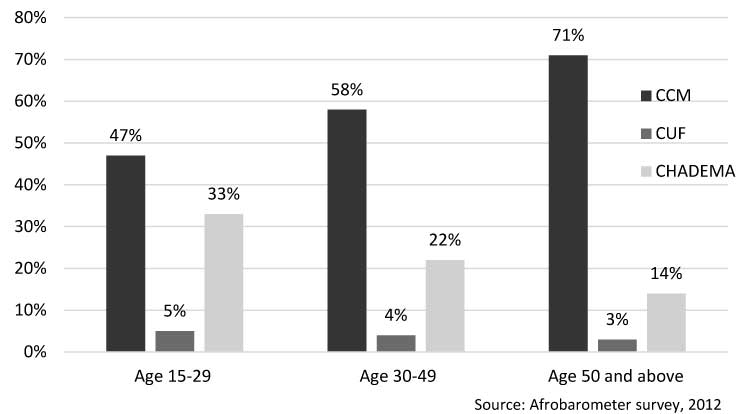
Recently released data from the Afrobarometer initiative, a continent-wide public opinion survey, allows us to examine this question in more detail. The survey asked the standard opinion poll question: If an election were held tomorrow, which party’s candidate would you vote for?

Support for CCM Chadema with age range

Support for CCM Chadema with age range

First, the survey found that support for Chadema was indeed substan­tially stronger among 15-29 year olds (at 33%) than the over 50s (14%). Conversely, support for CCM rises with age, from just under half the 15-29 year olds (47%), and nearly three in four of those over 50 (71%). Support for CUF and other parties was negligible.

(This survey was conducted in 2012, so those who were 15 at the time will be of voting age by the time of the 2015 election.)

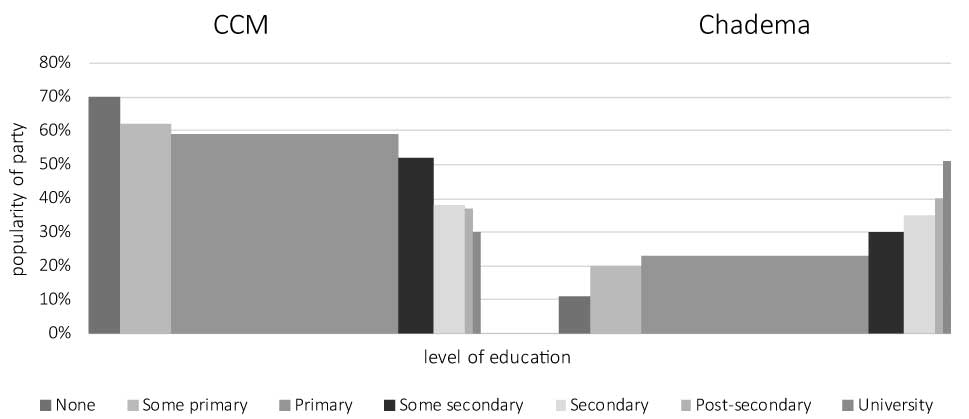
Support for CCM and Chadema versus education level

Support for CCM and Chadema versus education level

There is also a strong link between a voter’s level of education and their party affiliation. At each successive level of education, support for CCM dropped, and support for Chadema rose. Among those with post-secondary or university-level education, support for Chadema was higher than for CCM – 51% v 30% among university graduates. Support for CCM among less well-educated groups remains well ahead of Chadema. Among those with primary education, CCM has the support of a strong majority: 59% to Chadema’s 23%.

Since those with primary education or below represent three quarters of all potential voters (8% have no formal education, 13% have some primary education and 58% have completed primary education), this suggests Chadema have a lot of work to do to bring less-well-educated voters to their side.

Opinion poll data – a staple of political journalism across much of the world – have only very occasionally been available in Tanzania. The fast turn-around times of UK-style polls is simply not possible in Tanzania, where there is no easy way of quickly producing a random sample and few organisations have both the capacity and the credibility to carry out polls.

However, two separate initiatives have begun to fill this gap. Twaweza [‘we can make it happen’] have set up a nationally representative sur­vey panel, reachable by mobile phone, and are now conducting twice-monthly public opinion surveys. This initiative is known as Sauti za Wananchi – Voices of the People.

And the Afrobarometer initiative, a periodic Africa-wide survey of public opinion, has recently published data from its 2012 survey round, including Tanzania. This article draws exclusively on Afrobarometer
data.

TOURISM & ENVIRONMENTAL CONSERVATION

by Mark Gillies

Poaching
This dry season, tourist tales are of long day drives spent looking for elephant. Some find large groups clustered tightly; others are unlucky and return home without seeing one. It never used to be this way. Tanzania’s poaching epidemic is now much more than statistics: it is arguably a national disaster.

At the end of April, Tanzania was named in the Born Free USA/C4ADS ‘List of Shame’ as one of the top countries in Africa with the worst poaching records and the least effective government action to control the worst threat to natural resources in living memory.

Perhaps partly in response the growing international criticism of perceived governmental inaction to combat international poaching syndicates, the Tanzanian government hosted a Summit Conference to Stop Wildlife Crime and Advance Wildlife Conservation in May and signed a joint initiative with the United Nations Development Programme (UNDP) to establish a new body for wildlife conservation. On 10 May, The Daily News reported the creation of the Tanzania Wildlife Authority (TAWA), to increase the revenue derived from Tanzania’s natural resource and to intensify conservation. Let us hope the two are not mutually exclusive.

The creation of TAWA was announced by the Minister for Natural Resources and Tourism, Lazaro Nyalandu, who assured delegates to the conference that there would be zero tolerance towards the corrupt and inefficient elements involved in the protection of the country’s wildlife. In particular, 500 extra game rangers are to be hired and three helicopters await pilots currently training in South Africa.

Operation Tokomeza, the Tanzanian government’s attempt to combat poaching (see an article in TA108), continues to create headlines. In May, President Kikwete established an investigation into the Operation. Retired Justice Hamisi Msumi will head efforts to address the complaints of all those negatively affected by the Operation whilst also investigating claims that the Operation was sabotaged. Meanwhile, Tokomeza II continues, but without the early successes, or alleged excesses, of the original Operation.

Putting to one side where the individual culpability lies for the dramatic loss of natural resources through poaching, The Citizen on 7 July draws on the international media to provide a clear explanation for the driving force behind the trade. It outlined how the price of African ivory in China has tripled over the past three years, so that the cost of ivory in China is now ten times the cost in Africa, a profit margin that is driving corruption, crime and conflict across Africa.

The poaching epidemic in Tanzania must be confronted and stopped for the sake of the species targeted. Once they are gone, they will be extremely difficult to reintroduce. The continued existence of elephant and rhino has an existential value, but it also has an immense economic value – a fact should also be remembered by the Tanzanian government when considering other areas of legislation that affects the tourism industry.

Tax and Tourism
In June, in the run up to the release of the national budgets in East Africa, intense lobbying was carried out by the Tanzanian tourism industry with government officials to prevent, or adjust the timeline for, the repeal of certain VAT exemptions covering tourism goods and services that would have resulted in an increase to the average Tanzanian holiday package of about 10%.

Whilst the impact of such a rise on the numbers of tourists visiting Tanzania in the medium to long term is debatable, the issue was that the change was due to come into effect on 1 July 2014, days after the deci­sion and at the start of the peak travel season. The potential increased costs would have to be passed on to clients, risking widespread cancellations and Tanzania’s good reputation in the African tourism market.

The Tanzanian government of course has the right to determine its monetary policy as it wishes, but tourism operators were left pleading for some forewarning and an understanding of the realities of the ultra- competitive market that is African tourism.

In the event, the decision was delayed until October, leaving the operators waiting.

Serengeti Road
On 23 June eTN Global Travel Industry News reported that the East African Court of Justice had ruled against the Tanzanian government’s plans to construct a bitumen road across the Serengeti National Park, declaring it to be ‘unlawful’. Although celebrations broke out in court and across the internet, it should be noted that the ruling only specified a ‘bitumen road’, leaving open the prospect of a gravel road following the same route. So the battle goes on for the future of the Great Migration, the integrity of the Serengeti National Park and the reputation of Tanzania as a leader in the field of African conservation.

CONSTITUTIONAL DEADLOCK

by Enos Bukuku

Throughout March and April the Constitutional Assembly (CA), the body tasked to come up with a final draft Constitution, was marred by divisions between two informal coalition groups within the Assembly.

“Tanzania Kwanza” is largely made up of CCM members; whilst “UKAWA” (Muungano wa Umoja wa kutetea Katiba ya Wananchi – Coalition of Defenders of the People’s Constitution) is formed mainly from members of the opposition parties.

The arguing and political mud-slinging is focussed almost exclusively on one issue: the nature of the relationship between Zanzibar and main­land Tanzania – “the union question”. Should Tanzania continue with a two-government system (i.e. Tanzania and Zanzibar), or adopt a three-government structure (Tanzania, Zanzibar, Tanganyika), also referred to as a “federal” government?

As the Constitutional Assembly’s first session broke up in April – to allow MPs to return to parliament for the annual budget session – UKAWA’s frustrations with CCM intransigence on the union question led them to walk out on the Assembly. UKAWA is thought to have considerable support among the Tanzanian public.

In 2010, as part of their election manifestos, both Chadema and the Civic United Front (CUF) pushed for a three-tier government, which had previously been proposed by various groups and commissions over the past 30 years or so. The Constitutional Review Committee (CRC) took the initiative and incorporated this into both the first and second drafts of the proposed constitution, which according to Joseph Warioba, Chairman of the CRC, “was aimed at safeguarding the 1964 merger between Tanganyika and Zanzibar”.

It has been argued by supporters of the three-government system that it streamlines the governmental structure and gives Zanzibar more autonomy, thus maintaining stability between mainland Tanzania and Zanzibar. Judge Warioba has gone on record several times to state that most Zanzibaris are in favour of the three-government idea, though this has been challenged by some Zanzibari politicians.

President Kikwete has been vocal in his objection to the proposal; in his opening speech to the Constitutional Assembly, he stated that a three-government system will not add value and will create problems. CCM, which had previously housed a wide range of opinions on the matter, fell quickly into line behind the president.

The delay in debating the draft constitution has had a knock on effect on new laws being drafted. Proposed energy legislation, for example, which could make Tanzania the first exporter of liquefied natural gas in East Africa, may now have to wait until next year.

Changes to the law to ensure better rights for women, children, the disabled, the press, and many other vulnerable groups are likely to be enshrined in the new constitution if it goes ahead. The issue of dual citizenship has received attention from a few high ranking politicians who suggest that its inclusion will be debated in the Constitutional Assembly. However, it is believed that dual nationality is more likely to be incorporated within a separate Act of Parliament rather than within any new constitution. Bernard Membe, the Foreign Minister, told the National Assembly in May: ”We believe that the time is ripe for our country to have an Act that allows dual citizenship, in the interest of our nation’s development”.

All these issues hang in the balance until the Assembly deadlock is broken.

The United Nations Development Programme (UNDP) has also been closely monitoring the situation. In May UNDP Administrator Helen Clark criticised UKAWA for its walk out earlier in the year and urged that they voice their concerns and discontent through the forum of the Assembly, rather than refusing to participate. This has been echoed by Judge Warioba, warning that failure to reach an agreement may plunge the country into a political crisis.

Kenyan politician and legal scholar Patrick Loch Otiendo Lumumba has been asked to mediate in the CA and ease the tensions between UKAWA and Tanzania Kwanza.

The CA Chairman, Samuel Sitta, also sought to broker peace between the rival groups with a reconciliation meeting scheduled for 24 July. The UKAWA members did not show up, arguing that it was pointless as CCM continue to hold a firm line on the union question. Deus Kibamba, chairman of the influential civil society group, Tanzania Constitution Forum (TCF), has called for the debate over the new constitution to be delayed until after next year’s elections. There are many who believe that Tanzania will not get a new constitution because both groups will never reach a consensus.

The debate on the Constitution is due to resume in August. The president has authorised a further extension of the time, allowing 60 days from 5 August for the CA to finalise the draft constitution before it can be presented to the public for a vote. At the time of writing, UKAWA continues to boycott the Assembly, though Sitta insists it will carry on regardless.

This raises two questions: Will the CA have sufficient members present to vote on the articles of the new constitution – will it be quorate? Without UKAWA members, it looks to be very close. And if votes are possible, will a new constitution written by a CCM-dominated Assembly have sufficient popular legitimacy and support to pass a national referendum, and stand the test of time?

It would be a bitter shame if it all collapses at this stage, wasting billions of shillings, years of preparation and most importantly, a golden oppor­tunity to address many of the fundamental problems that the country faces. An independent observer may be forgiven for reaching the con­clusion that Tanzanian politicians excel at forming coalition groups, but underperform in implementing objectives. The next few months will show whether such an observation is unfair.

FOREIGN RELATIONS

by David Brewin

Tanzania and the EAC
Three East African Community (EAC) member countries (Kenya, Rwanda and Uganda) continue to forge ahead in signing agreements and strengthening their relations, while Tanzania and Burundi, the other members, remain either absent from discussions or self-excluded because so many of the new development programmes do not directly concern their countries for geographical reasons.

Examples include the dramatic fall in the clearance time for goods going from Mombasa to Kampala – down to 4 days compared with 12 days previously, and from 21 days to 6 for goods going from Mombasa to Kigali (Rwanda). There has been a substantial lowering of costs. This is the result of the East African Single Customs Territory (EASCT), which ministers from the three countries have recently signed.
Under a new special visa deal, foreign residents can get a single six-month multiple entry visa for US $100 valid in all three countries (i.e. not including Tanzania). This compares with the earlier cost of $150. The three countries are also participating together in various international tourist fairs.

From August 2014 the tax on mobile phone calls between the three countries is being reduced by 20%. Plans were being prepared for Tanzania to join in this.

Rwanda
After the rough period in relations between Tanzania and Rwanda last year, relations seem to be slowly getting better again. Rwandan President Paul Kagame said he would readily honour an official invitation to visit Tanzania if he received one because Tanzania meant a lot to him, as did the survival of Rwanda and the stability of the region. Tanzania’s State House responded by saying that the idea was not only welcome but was also a critical step in normalising relations between the two countries.

North Korean arms
A recent UN report has claimed that that 18 military technicians from North Korea had been involved in the refurbishment and repair of Tanzanian F-7 fighter jets and other military aircraft at the its Air Force base in Mwanza. The journal Africa Confidential has reported that although N. Korea has no diplomatic representation in Tanzania, two senior officers had been seconded to the Tanzanian Peoples Defence Forces. The report said that Uganda, Ethiopia and Eritrea were also engaged in providing military assistance.

Tanzania has strongly denied the allegations. “Tanzania has no trade relations with N Korea. UN sanctions are specific. They are about trade and we don’t have any trade deals with North Korea,” said a Foreign Affairs spokesman. He added however that maybe the TPDF may know more.

North Korea is believed to have developed sophisticated ways to circumvent UN sanctions, including the suspected use of its embassies to facilitate an illegal trade in weapons, and making use of complicated financial techniques “pioneered by drug-trafficking organizations” , so that tracking the isolated state’s purchase of prohibited goods is more difficult.

The 127 page report was compiled by a panel of eight UN experts and is part of an annual audit of North Korea’s compliance with UN sanctions imposed in response to Pyongyang’s banned nuclear weapons and missile programs. The panel reports to the UN Security Council.

“From the incidents analyzed in the period under review, the panel has found that (North Korea) makes increasing use of multiple and tiered circumvention techniques,” a summary of the report said.

Chinese ambassador speaks frankly
In a wide ranging interview given by Chinese Ambassador Lu Youqing to the Hong Kong newspaper South China Post (quoted by the Citizen) he touched on some delicate parts of Chinese relations with Tanzania and Tanzanians.

On corruption he said that in 2011 his country had made amendments to its criminal law so that it was now a criminal offence for Chinese nationals to bribe nationals in foreign countries.

The Ambassador voiced his concern about “shoddy” work being carried out by some Chinese contractors in neighbouring countries and said that some infrastructure projects had been undertaken by Chinese companies at unrealistic prices. They had been building roads for between $300,000 and $400,000 per km but the real cost was much higher and he wondered what would happen to these roads in five years’ time.

The Ambassador expressed his disappointment over “bad habits” that tarnished China’s image in Tanzania. For example he mentioned corruption and illegal ivory trading. “Our people just cannot shake off their bad habits. When they come to Africa, they are not united and engage in infighting as usual” he said. He referred to competition among Chinese companies over contracts and bribes offered to Tanzanian officials to lobby on their behalf.

On violent crime targeting Chinese nationals in Tanzania he said: “Tanzania has ambassadors from about seventy countries but none of them needs to constantly worry like us about consular protection issues, police harassment and robberies targeting Chinese citizens.”