SPORT

by Philip Richards

Football
The national team “Taifa Stars” ended their World Cup 2014 qualifying campaign with a disappointing 0-2 defeat away in The Gambia, although they had already failed to qualify for the Brazil finals.

At the time of going to press, the “Kilimanjaro Stars” and the “Zanzibar Heroes” are competing in the Council for East and Central Africa Football Association (CECAFA) regional tournament in Nairobi. Interestingly, this is one event where two separate teams can represent the United Republic; normally it is one, because Zanzibar is not a member of FIFA.

With a nod to longer term aspirations, a three-way partnership between the Ministry of Information, Youth, Culture and Sports, the English Premier League side Sunderland FC and the local electricity generator Symbion Power, will see a state of the art football academy set up in Dar es Salaam for elite youngsters. Stewart Hall, who has been coaching top flight local clubs such as Azam FC, has been appointed manager of the complex. The project has the backing of President Kikwete.

The President also welcomed the authentic FIFA World Cup trophy to Tanzania as part of its nine month tour of 88 countries. Speaking at the CCM Kirumba Stadium in Mwanza, where the trophy was on public view, he said that “we owe the world…a big debt….which we and the coming generation should pay at least once in a lifetime, by playing in the World Cup finals and winning the trophy.” (Daily News)

Hockey
The Tanzanian women’s hockey team made their inaugural appearance in the Africa Hockey Cup of Nations held in Nairobi in November. It was fortuitous that they were there at all, given that they replaced the men’s squad who pulled out due to financial constraints. Although they were soundly beaten by South Africa, who went on to win the compe­tition, the Tanzanian coaching staff were happy with the experience gained during the tournament. (Daily News)

Volleyball
In a similar vein, the Tanzanian women’s volleyball team took part in their first World Cup qualifying tournament in Uganda in October. Despite losing their three games, there were positive benefits from their participation and development plans are in place to improve skills and awareness of the sport.

OBITUARIES

by Ben Taylor

Respected lawyer, human rights activist and politician, Dr Sengondo Mvungi died in Milipark Hospital, Johannesburg, on November 12th. He had been attacked in his home by bandits nine days earlier, in an apparent robbery. Though he was rushed first to Muhimbili National Hospital, and later to South Africa, Dr Mvungi never recovered from the attack. He died from his injuries a few days later.

Having begun his career as a journalist on the ruling party’s newspaper, Uhuru, Dr Mvungi later switched to the law. After studies in Dar es Salaam and abroad, he taught in the Law Faculty at the University of Dar es Salaam for over two decades. He had recently been appointed Deputy Vice Chancellor of the newly established University of Bagamoyo.
A staunch defender of media freedoms and human rights, his legal expertise and media background made him an obvious appointment to the founding board of the Media Council of Tanzania, where he was very active. He was among the founders of the Legal and Human Rights Centre, and practiced as an advocate of the High Court.

With the advent of multi-party politics, Dr Mvungi joined the opposition, running as the NCCR-Mageuzi Presidential Candidate in 1995. He knew he could never win, but saw value in making a contribution to the slow task of building a new political reality in Tanzania. It was a cause he continued to struggle for throughout his life.

Most recently, Dr Mvungi had been a prominent member of the Constitution Review Commission, bringing his sharp legal mind and unstinting defence of human rights once more to the service of his country.

“His untimely departure leaves us with a serious gap in a situation where we already had too many gaps,” wrote Jenerali Ulimwengu. “Our cumulative and collective actions have created around us an intellectual wasteland in which rather than blooms of flowering thought, angry shrubs produce only prickly and poisonous thorns, testimony to our degeneracy.”

“It may not explain the whole episode but Mvungi was killed by representatives of these shrubs, who may not even fully comprehend the enormity of their actions in terms of the loss inflicted on the nation. How could they ever understand, when all they were looking for was a little cash and some trinkets they could sell to get money to drink and to buy chicken and chips. The cheapness of life implied in their actions speaks to the cheapness of life generally, engendered by a nonchalant system that has manufactured disposable people who dispose of other people.”

Seasoned Tanzanian politician and diplomat, Ambassador Isaac Sepetu, died on October 27th, aged 70. Ambassador Sepetu’s career encompassed a spell as Deputy Minister of Foreign Affairs during the presidency of Julius Nyerere, Minister of Information in the Zanzibar Revolutionary Government in the 1970s and Minister of Economy and Planning in Zanzibar in the 1990s. He also served as Tanzanian Ambassador to the former USSR and the Democratic Republic of Congo.

To many younger Tanzanians, however, Ambassador Sepetu is perhaps best known as the father of Wema Sepetu, actress, model and former Miss Tanzania. Wema has become a staple of the celebrity-obsessed tabloid media, not least for her relationship with bongo flava star Diamond Platinumz.

Lionel Cliffe: An Africanist scholar and global citizen
By establishing the Department of Development Studies in 1969, the University of Dar es Salaam was stepping into an uncharted territory. The main task of the new unit was to teach an interdisciplinary course on socio-economic development to all entering students. The course would challenge the conservative spirit of the traditional social science disciplines and reflect the goal of building socialism in Tanzania. The first head of this bold academic venture was Lionel Cliffe, a British scholar who had come to Tanzania in 1961.

After teaching at Kivukoni College and a spell in the civil service, Lionel had joined the Department of Political Science of UDSM in 1964. Lionel was a socialist, sympathetic to Mwalimu Nyerere’s policies, and a firm supporter of the liberation of Africa from external domination. Right from the start, he undertook pioneering socio-political research and became involved in the effort to make the university curricula more relevant to national needs. The book One Party Democracy: A Study of the 1965 Tanzania General Elections (East Africa Publishing House, Nairobi, 1967) that he edited and co-authored and which contains several detailed investigations and political analyses is regarded as a pioneering work in the field that also provides a bright insight into the political dynamics of Tanzania of that time.

Lionel was not just an armchair academic. As a leftist student activist at the UDSM at that time, I vividly recall him providing much needed support to progressive student groups in ways more than one. Our student magazine, Cheche, had no external funder and was perpetually short of resources needed for bringing an issue into print. Though we did the printing ourselves, paper was expensive. Lionel helped out by selling printing paper from the departmental stock to us at the wholesale price.

By the time Lionel left the university in 1972, Development Studies had become an integral part of the local academic scene, and universities the world over began to imitate the department. Lionel edited (with John Saul) Socialism in Tanzania: A Interdisciplinary Reader, which remains a standard reference work for anyone interested in the post-Independence history of Tanzania and a relevant text for present day students of development studies, economics, education and political science that focus on Africa.

I pen these words with a heavy heart because Lionel Cliffe passed away after a brief illness on October 23, 2013. Until his death, he was engaged in African issues. Among his many achievements, he was a founder editor of the Review of African Political Economy and the first Director of the Centre for Development Studies at the University of Leeds. Over the years, he had established a distinguished academic reputation, and published on a range of issues spanning from land tenure and reform to political affairs and external barriers to development. He remained a champion of social and economic self-determination for the people of Africa and took a sharply critical stand on the Western strategies that promoted continued domination over the continent.

I last met this fine, ever smiling, soft-speaking human being in April this year. He was in Dar es Salaam to attend the annual Mwalimu Nyerere Intellectual Festival at the UDSM. He had regularly visited many countries in Africa over the years, maintaining strong links with progressive African scholars striving for social and economic justice.

Lionel engaged with us on an equal footing; at times we critiqued him, and at times, he critiqued us; but in the spirit of comrades undertaking a joint long term journey. He had the outlook of and functioned like a global citizen. At his passing, Africa has lost a good comrade; an upright champion our people’s rights. Let us pay homage to this stellar specimen of humanity by drawing sound lessons from the work of activists scholars like him and begin to recreate an African academia that will challenge the neo-liberal establishment and truly champion the rights and needs of the people of Africa.

One thing I am certain of: Wherever in the heavens he has landed, Professor Lionel Cliffe is already busy establishing an inter-galactic Institute of Development Studies, and boldly challenging the status quo. Most likely, he has us within his sights too. Let us then once more elicit his usual broad grin by retaking similar steps on this planet.
Karim F. Hirji
(Abridged, with permission, from a longer obituary in Pambazuka News)

REVIEWS

Edited by John Cooper-Poole

THE THREAT OF LIBERATION: IMPERIALISM AND REVOLUTION IN ZANZIBAR. Amrit Wilson: Pluto Press: London, 2013. ISBN 13 978 0745334073. £18.99

Zanzibar is a small-scale society, with a population, even today, of less than a million people, dispersed between three islands, Unguja, Pemba and Mafia. For hundreds of years its strategic significance rather than its intrinsic value has driven its history. Occupied by a succession of overlords, from Portugal and Oman to Britain, it has been the hub of trade routes for slaves and ivory from Africa’s hinterland, a centre from which to exert political power over semi-autonomous city states along the East African coast, and later a plantation economy focussed on cloves. Each set of rulers has left its divisive mark in a complex, racialised social order and shifting class formations.

Making sense of the political trajectory of Zanzibar has exercised many intellectuals as well as politicians and diplomats. Amrit Wilson draws on her own first-hand knowledge, interviews with participants and existing literature (especially Lofchie, Chase, Babu and her own publications), bringing the story up to date, the Wikileaks revelations. Her interpretation of events and their significance is based on one of the key actors in this political maelstrom, Abdulrahman Mohamed Babu, a lifelong Communist and revolutionary.

In December 1963 Zanzibar gained independence from Britain as a constitutional monarchy under a Sultan. Liberation from colonial rule promised progressive social transformation, but Zanzibar tore itself apart and remained the subject of imperialist concern. Within a few months, a series of political battles had put ‘liberation’ in question. In January 1964 a bloody revolution overthrew the Sultan; Wilson does not estimate the numbers killed, but they were primarily of Zanzibar’s ‘ruling class’ – Omani Arabs and Asians – who had prospered from the plantations or from trade, and their political allies. She claims that the uprising was fomented by disaffected youth and ‘lumpen’ elements, people who saw no change in their abject circumstances by virtue of ‘liberation’.

Although the revolution was not initiated by Babu, he had formed a Marxist left wing party (called Umma or ‘Community’) just before independence. This drew on the support of union workers in the docks and in transport, as well as intellectuals. Umma played a strategic role in the revolution and became part of the Revolutionary Council, with Abeid Karume of the Afro-Shirazi Party as President. Zanzibar’s numerous political parties cannot be neatly subsumed into class or racial conflict. Most represent opportunistic alliances of different class groupings. So-called ‘right-wing parties’ have left wing factions and the language of race/ethnicity permeates all political discussion. Wilson’s account does not make this much clearer – and maybe the chaotic reality is not susceptible to easy analysis.

The question now raised is a challenging one. As a Communist and leader of a party dedicated to achieving socialism, what scope did Babu have, as Minister of Foreign Affairs and Trade in a ‘Revolutionary’ government dominated by increasingly reactionary elements? Wilson makes a brave case for Babu’s initiation of policies to restructure the economy with an integral link between agriculture and industry, and to learn from China. But she describes it as a ‘Zanzibar that might have been’. In April 1964 (only four months after the revolution) whilst Babu was absent on a mission to link Indonesia and East Germany into his plans, a merger between Tanganyika and Zanzibar was engineered by Karume and Nyerere without any vote in the Revolutionary Council. Thereafter, Zanzibar descended into despotism with political scores being brutally settled and many activists murdered. Babu was removed to Dar es Salaam and sidelined as a minister of state without any real power, his only achievement (at Nyerere’s behest) the Chinese involvement in building the Tazara railway.

Nearly a decade of violence and arbitrary rule in Zanzibar led to the assassina­tion of Karume in April 1972 by two ex-Umma members. They were killed in the ensuing melee but mass arrests led to a lengthy Treason Trial. Umma activists in Zanzibar, together with Zanzibari politicians on the mainland (including Babu), were accused on flimsy grounds of being involved in the killing of Karume and the trial was marked throughout by anti-Communist rhetoric. Torture was used to extort confessions, and most of the accused were sentenced to death or life imprisonment. Babu received a death sentence after a trial in absentia. He was detained on the mainland when Nyerere refused to extradite him to Zanzibar and he was eventually released in 1978.

Wilson’s book will be notable to some for its critique of Nyerere. Basically he is presented as a stooge of the West, particularly in respect of Zanzibar, with both Britain and the US bringing pressure to bear to neutralise what they saw as a potential ‘African Cuba, from which sedition would spread to the continent’ (quoting Frank Carlucci, Reagan’s Defense Secretary 1987-9). The revolution and the Revolutionary Council were seen as evidence of a Communist takeover. Wilson notes that some have seen the merger between Tanganyika and Zanzibar as evidence of Nyerere’s ‘pan-Africanism’, but she rejects this. Nyerere was beholden to the British for rescuing him after the army mutiny in Dar es Salaam and the Zanzibar revolution was shortened by the appearance of a US destroyer.

Wilson compares Nyerere’s claim to ‘African socialism’ with Babu’s more Marxist-oriented projections for development. She derides the Ujamaa policy as failing to confront colonial economic structures and being more marked by ‘austerity and control’ than ‘self-reliance’. Self-sufficiency in food production led to food shortages and growing imports, and there was no serious policy of industrial development. Babu’s recipe was to develop agriculture, not for export but for people’s basic needs, and to establish industries based of modernising agriculture and exploiting Tanzania’s reserves of coal and iron.

In the last section of the book, Wilson traces Zanzibar’s history to the present, with emphasis on the implications of the merger. A shift to neo-liberal policies and the rise of tourism and other services superseded the clove industry as the major determinant of Zanzibar’s economy, though still on a foundation of subsistence and export agriculture. A major shakeup of the kaleidoscope of political parties reflected the fading political autonomy of Zanzibar. All this against the backdrop of western imperialist intervention – now directed at the growing politico-economic might of China and the representation of Zanzibar as a source not of communism, but of Islamo-terrorism.

Whilst these final chapters lose their keen focus on Zanzibar, the bigger picture is that the merger with Tanzania is still a contested political issue, about to be voted on in a national referendum. Wilson has usefully reminded us of the promise of liberation for Zanzibar, as well as its betrayal.

Janet Bujra

Dr Janet Bujra is an Honorary Reader and Senior Research Associate in Peace Studies at the University of Bradford. She is the author of books and articles on gender, domestic service and HIV/Aids in Tanzania.

TANZANIA: A POLITICAL ECONOMY (2nd EDITION) Andrew Coulson: Oxford University Press. 2013. ISBN 10 0199679967. p/b 432pp.

The appearance of a new edition of Andrew Coulson’s classic study will be welcomed by admirers of the first edition, which came out more than 30 years ago. Apart from corrections and minor revisions to the main text, there is a new Preface in which the reader is reminded how well-qualified Coulson was to write the original book – being acquainted with many of the players and having a ringside seat at the University of Dar es Salaam (UDSM) when he was not himself right in the fray. And there is a substantial new Introduction in which the author reflects on what he said previously in the light of subsequent developments.

The scope of the book is wide, aiming to cover the whole history of Tanzania from earliest times up to c.1980. Thus, after a couple of short introductory chapters, we have three chapters on the period up to 1900, covering particularly Zanzibar, the slave trade and the early German period. Six more chapters cover the colonial period, starting with German colonisation (and the resistance to it), the disruption caused by the First World War, the award of Tanganyika to Britain under a League of Nations mandate and the virtual freezing of development during the 1930s depression, followed by further disruption during the Second World War.

More than a third of the book is taken up before we reach the post-War period, the nationalist take-over and developments post-Independence. It is clear that Coulson wants to rub in Tanzania’s difficult inheritance, particularly during the 19th and early 20th century. Inter alia, this serves as a corrective to the rosier picture, post-WWII, of a peaceful but backward country taking slow but positive steps towards a brighter future under the guidance of a well-meaning but cash-strapped administration – as attested in the memoirs of some of those involved. It also underlines that this is as much a political history as an eco­nomic one.

Inevitably, these early sections of the book are highly condensed, but Coulson provides good summaries of the main episodes, together with judicious obser­vations on their consequences – for example, balancing accounts of the brutal­ity of the German conquest with their more positive contributions, so that “the economic structure laid down by 1914 was in all but detail that handed over in 1961”.

Having set the scene in this way – and those unsure of Tanzania’s early history, and looking for a short pithy introduction, could do far worse than take Coulson as their guide – the real meat of the book is contained in two hefty sections covering ‘The Early Years’ (1961-67) and ‘Harsh Realities’ (1968­80).In retrospect, the Early Years appear rather benign, the economy making reasonable progress of a conventional kind, propelled by post-independence enthusiasm and by the remarkable growth of export crops produced by progressive smallholder farmers. ‘Kulaks’ Coulson dubs them, imparting a whiff of the radical thinking prevalent at UDSM at the time – a colourful but somewhat chilling term when one recalls the treatment meted out to this class of producers elsewhere by the likes of Stalin and Mao. But tensions were building up, notably frustration at the slow progress of Africanisation, reflected in clashes with the unions.

The turning point was of course the Arusha Declaration in 1967. Coulson documents well the set of radical transformations towards a socialist future set in motion by this and the related policy statements. It was certainly widely welcomed, acting as a lightning rod for the frustrations of ordinary Tanzanians and checking the more materialistic ambitions of some of Nyerere’s colleagues. However, execution of the new policies quickly exposed a disconnect between aspiration and outcome – the ‘Harsh Realities’ that make up the final section of the book. The disastrous effect on agricultural production of villagisation, the inefficiency of the parastatals set up to replace the cooperatives and to take over nationalised enterprises, and the over-expansion of budgets relative to resources (as relations with external donors soured) are all discussed.

Coulson tries hard to be even-handed, drawing attention also to the parallel extension of education and (to a lesser extent) health services to rural areas.

Even so, the kindest verdict might be “Good intentions, bad effects”. The sad truth is that in Tanzania, as in pretty much every other country in the world, whether developed or developing, capitalist or socialist, human nature is much the same: put someone in a position where opportunities can be exploited to feather one’s own nest and most will probably do just that. The task of policy then should be to provide an institutional framework which minimises such opportunities. This means competition rather than monopoly, active democracy and good laws applied impartially. Not easy, particularly with limited manpower and other resources; but, after 1967, under the influence of Nyerere’s somewhat puritanical anxiety about inequality and his distaste for capitalism, Tanzania headed in more or less the opposite direction – and has paid a high price.

Against this background, it is not surprising that Coulson ended his first edition on a pessimistic note: “Talk of ‘Tanzanian socialism’ … does not provide a clear economic strategy … The result was a failure ruthlessly to pursue any single class interest (apart from the bureaucracy’s interest in expanding the functions of the state). The worst results were in rural policy, a series of despairing dashes for freedom, with what seemed like short cuts actually leading further and further into the mud.” “Can the future offer something better?” Coulson asks, sadly concluding: “On the basis of the performance of the 1970s, the answer is no.”

But that was 1980. Since then, there has been the long confrontation with the International Monetary Fund and the World Bank, the structural adjustment programmes and the new problems and opportunities arising post-2000. We turn to the new Introduction to learn how Coulson sees things now.

Retrenchment in the early 1980s set back progress in education and health, but also reined in government and parastatal excesses. When growth resumed, Coulson notes that it was accompanied by more corruption, with the benefits “mostly going to the salaried elite – with little impact on poverty in most parts of the country”. At the same time, opportunities for political competition were opened up, civil society activity grew stronger, particularly NGOs. Tanzania became more attractive to foreign investment, and more urbanised. In the light of these developments, Coulson appears less confident that dependency theory and Shivji’s concept of a ‘bureaucratic bourgeoisie’ provide a sufficient framework for understanding the political economy of post-colonial countries such as Tanzania, indicating room for fresh thinking here. Insights from the new economic geography school and Collier’s The Bottom Billion might help.

Looking to the future, Coulson notes that the 1999 Development Vision and the 2012 Five Year Plan point to a more capitalist development path, as does the ambition to become a middle income country by 2025. While new opportunities have indeed been opened up by the remarkable growth of the mining sector, and the prospect of major oil and gas development, the challenges, as Coulson notes, remain formidable. These include: getting mineral taxation right; how to foster manufacturing with only a small domestic market; the enormous backlog in urban infrastructure investment (electricity, water supply and sewerage); and improving transport (notably ports and railways). As if that were not enough, he adds “Agriculture is even more challenging”, with long-standing questions – large scale vs small scale, transformation vs improvement – still unresolved. He concludes with an appeal to the Tanzanian elite to show the leadership and vision needed.

One measure of Coulson’s achievement is that no comparable work has appeared since 1980. There have been books and articles on particular aspects of Tanzania’s development and bits of the story could be pieced together from these (many appear in the expanded bibliography), and from reports by the Tanzania Government and agencies such as the World Bank, but no-one has attempted a comprehensive overview of Tanzania’s post-Independence economic development to bring the story up to date.

In case someone is contemplating taking on this daunting task, it may be worth drawing attention to some aspects which appear (to this reviewer at least) not to have been given their due weight, either in Coulson’s book or elsewhere. First, there is the regional dimension. There are enormous differences in climate, topography, natural resources and ways of life between the different parts of Tanzania: attention to these differences and their effects would make for a more rounded account. Secondly, population growth at around 3% p.a. right up to the present time has made the development challenge immensely more difficult but receives very little attention in the literature. Only about a third of the increase in the rural population has been absorbed into towns, so that the pressure of population on land and other resources in the rural ares has approximately trebled, compounding the problems attributable to poor policies.

Thirdly, the urban development that has occurred has been rather unproductive, raising questions both about the quality of local administration and about strategies for non-agricultural employment. Finally, on a more positive note, an up-to- date economic history of Tanzania will be able to document the unexpected surge in mineral exploitation, starting with artisanal mining of gemstones in the 1980s, moving to larger scale mining in the 1990s, and (prospectively) oil and gas production in the near future. Hopefully, our future historian will record that these new opportunities have been put to good use, resulting in a better future for all Tanzanians.

Hugh Wenban-Smith

Dr Hugh Wenban-Smith was born in Chunya and went to Mbeya School. His career was as a government economist – mainly in Britain but with periods in Zambia and India. He is now an independent researcher, with particular interest in infrastructure, urbanisation and transport.

THE RACE FOR STATE HOUSE

by David Brewin

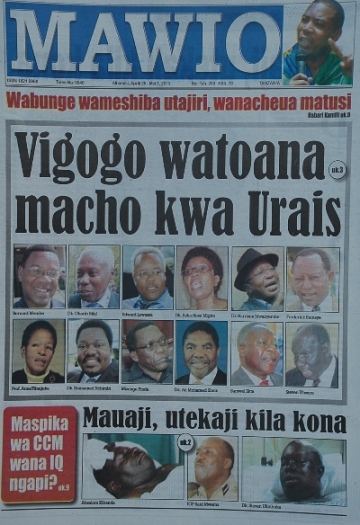
Newspaper cover featuring twelve people said to be eyeing the Presidency.

Newspaper cover featuring twelve people said to be eyeing the Presidency.

Americans usually start campaigning for the next election contest almost immediately after the completion of the previous one. Tanzania seems to be moving in the same direction. Although the elections are not due until late 2015, those aspirants who are considering standing for the top job are beginning to quietly mobilise their support. Speculation is now rife in political circles on the issue of who will succeed President Kikwete. Unlike some of his opposite numbers in other states, notably Zimbabwe, he is expected to comply with the law and retire at the end of his second term as all his predecessors have done.

A number of prominent figures are expected to compete in the elections. One factor which could become crucial is a long established ‘under­standing’ that, if the president is a Muslim, as is President Kikwete, his successor should be a Christian. President Nyerere was a Catholic, former President Mwinyi is a Muslim and President Mkapa is also a Catholic. As both the Christian presidents have been Catholics the large Protestant community might be wondering when its time will come.

Among possible candidates are the following:

Former Prime Minister Edward Lowassa is considered by many as the front runner. He is popular in many areas of the country because of his diligence and active implementation of development projects, especially the ward secondary education project. He is a Protestant and a member of the Tanzania Evangelical Lutheran Church but he was alleged to have been corrupt in the Richmond electricity scandal (see many earlier issues of TA) and has had some recent health problems.

The Chairman of the Parliamentary Select Committee which inves­tigated the Richmond scandal, Dr Harrison Mwakyembe, pointed out alleged corrupt practices and gained some popularity as a result. However, most Tanzanians seem less influenced by allegations of cor­ruption and more interested in overall competence in their leaders. Dr Mwakyembe has now taken on the post of Minister of Transport – one of the most demanding positions in government as it includes the rail­ways, roads, airlines and ports with their numerous problems. When he addressed members of the BTS in London he impressed them by his command of every part of his portfolio and his innovative proposals for reform. It was clear that he is intolerant of corruption and inefficiency, although his candid and explicit approach might not be the best way to make friends and influence people if he has higher ambitions.

Another possible candidate who is high in the popularity stakes is the former Prime Minister under President Mkapa, Frederick Sumaye. He has the advantage of being a Protestant and is generally considered to be honest. Having been largely absent from front-line politics under President Kikwete, he has recently sought more of a public profile.

Samuel Sitta, the Minister for East African Cooperation and former Speaker of the House of Assembly, is outspoken, commands popular support, and is widely regarded as fair and incorruptible. He is a Catholic but his advancing age may harm his prospects. In addition, he does not have the same level of support as his key rivals among the party’s power-brokers and key donors.

Former Prime Minister Salim Salim who has held many senior posi­tions outside and inside Tanzania is a Zanzibar Muslim, but he seems to be keeping a relatively low profile. His ambiguous relations with the Isles might be a handicap so far as the presidency is concerned.

Current Foreign Minister Bernard Membe seems to be growing in stature and his honesty while leading an observer mission to the recent controversial Zimbabwe election plus his serious criticism of their con­duct, was brave in view of the great esteem in which Mugabe is held in many parts of Africa. Membe is a Catholic. It is to be noted that both Presidents Mkapa and Kikwete were Foreign Ministers before becoming presidents.

Dr John Magufuli, Minister of Works, is organising an ambitious road building programme and might be a candidate.

For the first time, the charismatic leader of an opposition party, Chadema’s Dr Wilbrod Slaa, is considered by some as having an outside chance of winning the presidency. He won many votes in urban areas at the last election and his party is using the time before 2015 to strengthen its support in rural areas where the government CCM has always been very popular. Dr Slaa is a Catholic.

The dynamic campaigner against corruption and Chairman of Parliament’s Finance Committee, Chadema’s Zitto Kabwe is a man with a future but because of an unusual clause in the current constitu­tion is too young to run for the presidency in 2015.

Alternatively, this may be the time for a female candidate. Two names are regularly mentioned as among the contenders for the CCM nomi­nation. Anna Tibaijuka is Minister of Lands, Housing and Human Developments, and the former Executive Director of UN-HABITAT, while Asha-Rose Migiro is a former Minister of Foreign Affairs and served as Deputy Secretary General of the UN between 2007 and 2012. She is not currently a Minister but retains influence within the party.

By David Brewin (with considerable help from Dr Juma Ngasongwa, the former Minister of Natural Resources and Tourism, later Industry and Trade and then Planning, the Economy and Empowerment. He is not standing for the presidency or for parliament. He says that he is enjoying his retirement).

OBAMA IN TANZANIA

by David Brewin

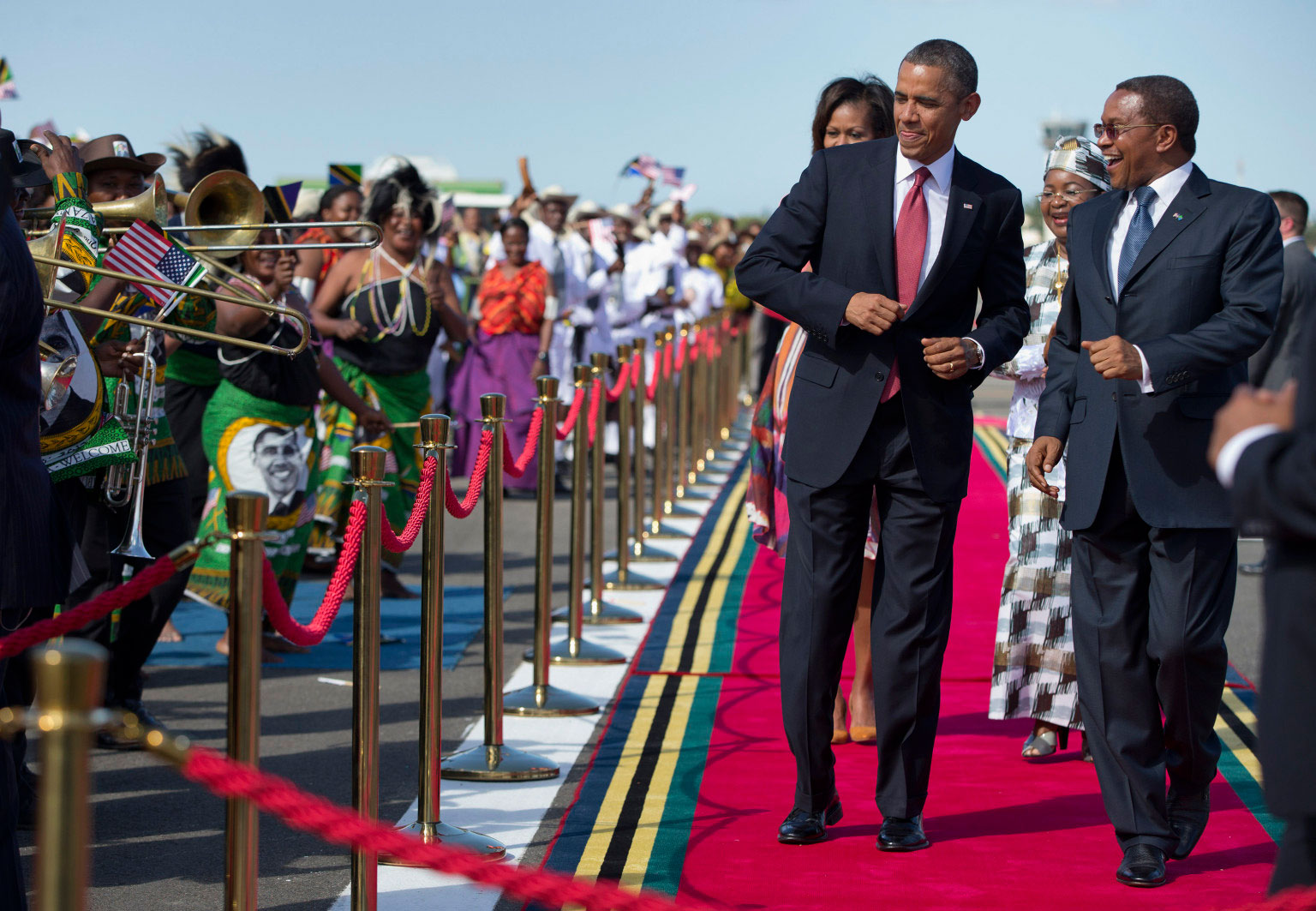
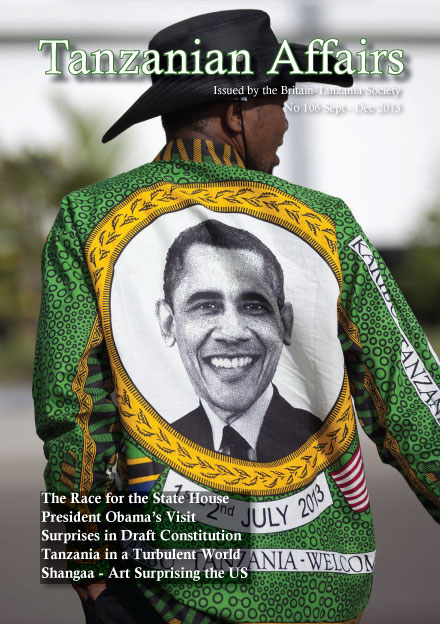
Huge crowds lined the streets, often twelve deep, with warm welcom­ing smiles on their faces. There were also a few articles in the media from some of the professional classes questioning President Obama’s motives in coming to Tanzania. This probably sums up the historic visit by President Obama to Dar es Salaam from June 29 to July 1 accompa­nied by a large contingent of business leaders.

Presidents Obama and Kikwete on the red carpet

Presidents Obama and Kikwete on the red carpet


And then, by coincidence, another American President was found to be there too. Former President Bush, who had made himself popular in the country by arranging substantial support for a big US-supported AIDS relief programme which had saved many lives. He was attending a conference on empowering African women, organised by an institute he had founded after leaving office. Mrs Bush was holding a summit meeting for African first ladies.

And then there was somebody else reported to be on the way from her home near Kisumo in Kenya. It was Mama Sara, President Obama’s grandmother and the second wife of his maternal grandfather.

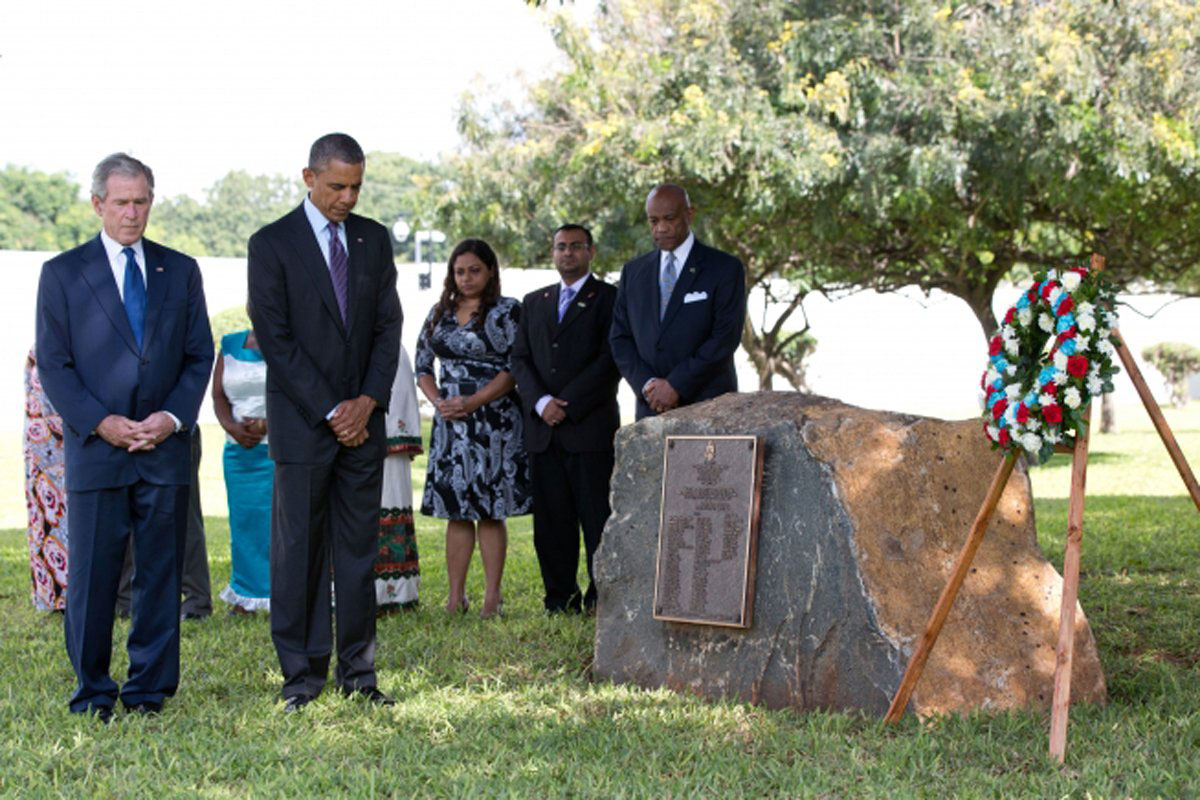
President Obama in his speeches stressed America’s commitment to improving electricity supplies as well as other aid and investment. At the end of the visit, as the Global edition of the New York Times put it (Thank you Elsbeth Court for sending this) the two presidents stood solemnly together as a US marine placed a wreath to mark the memory of the Tanzanians who were killed in the US embassy grounds by Al Qaeda terrorists fifteen years ago.

Presidents Obama and Bush pay their respects for the 1998 US Embassy bomb victims

Presidents Obama and Bush pay their respects for the 1998 US Embassy bomb victims

SHANGAA – SURPRISING THE US

by Ben Taylor

A new exhibition of traditional Tanzanian art in New York, titled Shangaa is receiving positive reviews from art lovers and critics. It is “sensational” according to the New York Times reviewer, Holland Cotter.
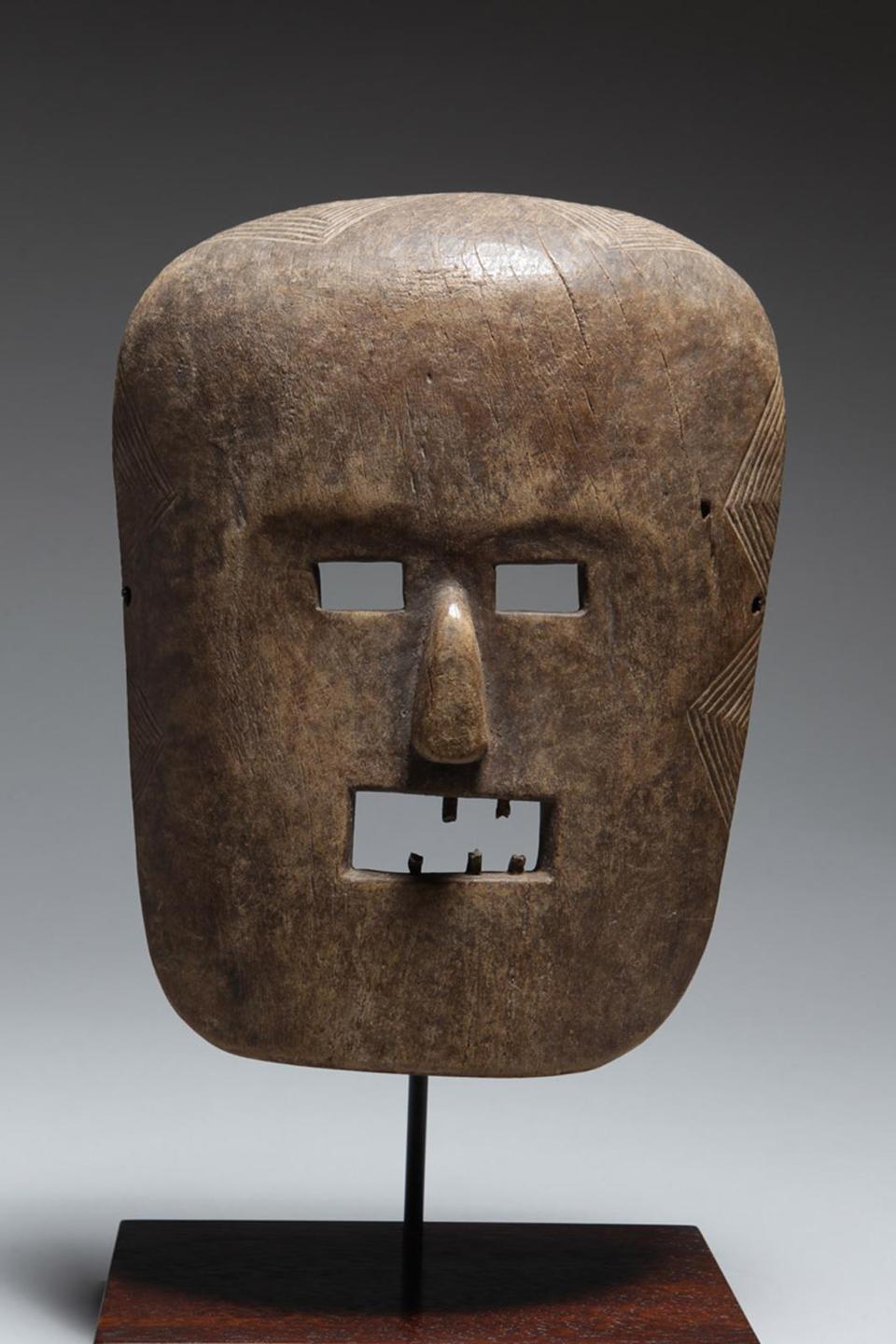
“As was true of most East African art, Tanzanian mate­rial was overlooked by 19th and 20th century collectors, who had their sights on other parts of the continent,” wrote Cotter. “And because so lit­tle art from Tanzania was in museums, the assumption grew that there was none worth having. One look at the tiny, disc-shaped Makonde mask that opens the show tells you otherwise.”

Shangaa- Mask, Hehe

Many of the pieces are on loan from German museums, where Tanzanian art has been relatively well-known. Yet the show makes it clear that the colonial history that pro­duced the German familiarity with Tanzanian art was not a happy one. Depictions of slavery, and of the indiffer­ence of slave masters, are among the exhibition’s most striking sculptures.

Traditional medicine and witchcraft are another recurring theme. Many of the objects were originally intended for use in healing and divination practices.

Shangaa: Art of Tanzania, was on show for three months at the QCC Art Gallery of the City University of New York, under the curation of Gary Van Wyk, and for three months at the Portland Museum of Art. (Daily News)

TOURISM & ENVIRONMENTAL CONSERVATION

by Mark Gillies

The Loliondo Land Issue
In April the ongoing issue of land use in the Loliondo Division on the borders of the Serengeti National Park came to the fore once more as headlines declared ‘The End of the Maasai’ (Survival International 28 March 2013). This is an emotive issue that combines the themes of the rights of indigenous people, environmental conservation, histori­cal grievances, a perceived uncaring central government (with worse implied), and foreign hunters [see also TA 95,97,105].

The current issue dates back to 1992, when an Emirati hunting com­pany, the Ortello Business Corporation (OBC), owned by the business­man and member of the Dubai royal family Mohammed Abdulrahim Al-Ali, secured the rights to a hunting concession in Loliondo Division of Ngorongoro. However the problem can only be understood in the general context of land use and the displacement of peoples.

According to the house blog of Just Conservation, an online forum for academics and activists interested in equitable conservation, the 1992 allocation was done with a lack of procedural clarity and without consulting the relevant community representatives. As the 1990s pro­gressed, there were accusations of dubious hunting practices, including the export of live animals, although these have not been verified or recently investigated. (http://www.justconservation.org/grabbing-land-for­conservation-in-loliondo,-tanzania)

In 2009, the severe drought experienced in northern Tanzania led to conflict between OBC and the local Maasai communities as the herd­ers endeavoured to water their livestock in an area where access was prohibited by OBC. In the ensuing conflict, a Police Field Force unit restored order with a level of force that resulted in the burning of sev­eral homesteads and accusations of physical and sexual abuse. OBC defended their position by stating that herders are only denied access to the water sources during the hunting season. This runs from July to September, which unfortunately coincides with the dry season.
So, when in March this year it was announced by the government that a 1,500 square kilometre ‘wildlife corridor’ would be created in the Loliondo that would displace an estimated 30,000 people and affect
Tourism & Environmental Conservation thousands more who use the grasslands for seasonal grazing, the local communities engaged in vociferous protest.

The story has interesting local – and national – political implications. In addition to the 2012 threat to blockade the Ngorongoro Crater (The East African 8 December 2012), one protest took the form of a mass burning of CCM membership cards by Maasai women. This move caught the atten­tion of local CCM officials who, according a BBC report, made the long drive to Loliondo from Arusha to denounce the proposed corridor.

The affected communities plan to lodge a legal challenge, but as a previ­ous action from 2009 remains unheard, they are not hopeful. However, on 29 June, Prime Minister Pinda told the National Assembly that the Government had “received complaints from various stakeholders and the people of Loliondo” and would therefore review its most recent decisions regarding the Loliondo land concessions and OBC. (Daily News and http://allafrica.com/stories/201307010357.html).

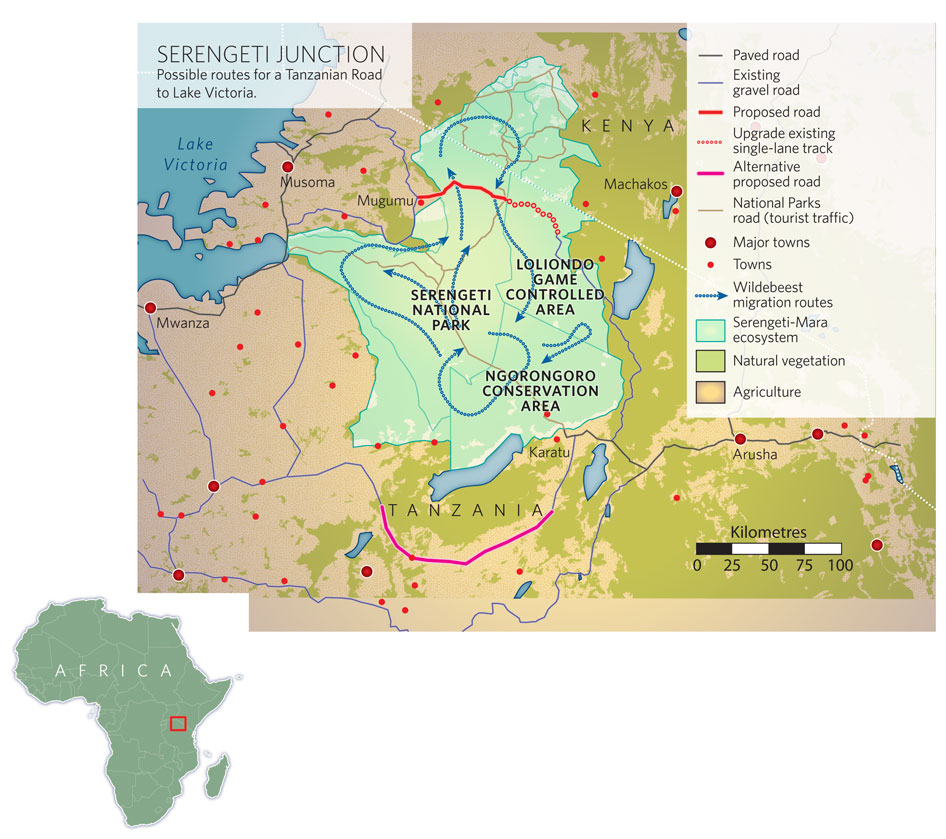
Serengeti Highway proposal remains live

Map of the possible Serengeti Highway routes (courtesy Nature)

Map of the possible Serengeti Highway routes (courtesy Nature)


On 27 June word emerged that the proposed Serengeti Highway, which has provoked international condemnation [see TA 97/99], may nevertheless still be a viable project in the eyes of the Tanzanian government. The proposed budget for the financial year 2013/14 appears to contain an allocation of funds to advance the planning and design of the high­way. This is despite the reported offer by the German government and the World Bank to finance the construction of an alternate southern route that will protect the Serengeti ecosystem and arguably reach more people than the original proposed northern route. The southern route would, however, not suit the interests of mining and soda ash extraction interests operating in the northern areas. (27 June Wolfganghthome’s Blog)

Tourism taxation
On 1 July the new Tourism Development Levy came into force. The levy imposes a 2% bed night charge on all tourist accommodation. Of even more concern was the proposal to make tourism products and services liable to VAT at 18%. This move had been adopted by Uganda but rejected by Kenya. Fortunately, on 28 June the Tanzanian Assembly also rejected the imposition of the tax, which in one move would have made Tanzania a far more expensive destination (in general) than Kenya – a dangerous move.

Edward VIII: The Lion King
And finally, on 28 May in the UK, a documentary aired on Channel Four entitled ‘Edward VIII: The Lion King’. The programme was a fas­cinating account of the transition of Edward VIII, in his time as Prince of Wales, from hunter to one of the earliest advocates of African conserva­tion. Working with the famous Denys Finch Hatton, after developing an understanding of the bloody reality of the growing hunting trend, the Prince used his celebrity to draw attention to the increasing threat to the wildlife and integrity of what we now call the Serengeti ecosystem. Which just goes to show that some issues have an enduring importance beyond their local significance.

SURPRISES IN DRAFT CONSTITUTION

by David Brewin

Historical background
Tanganyika at independence in 1961 had its own government and three years later Zanzibar at its independence also had its own. It was a time of great local and international tension. Tanganyika had had an army mutiny and Zanzibar had had a violent revolution. The East-West cold war was in full swing and both sides were worried about what might happen in Zanzibar, as its frequently unpredictable new President Abeid Karume had invited the Soviet satellite East Germany (not rec­ognised as a state by most of the West) to send experts and establish a presence in the Isles. America and the Western countries were alarmed at the potentially destabilising effect in East Africa of a communist state like Cuba (which still makes trouble for the US all these years later) on the doorstep of East Africa. Both sides were impressed however by the new leader of Tanganyika Julius Nyerere and relied upon him to come up with a solution.

Few know precisely what happened during the Tanganyika – Zanzibar negotiations which were conducted personally by the two presidents, but the result was a new Constitution (two, in fact, because Zanzibar had its own) which were ingenious and innovative and have stood the test of time, in spite of years of friction between the two sides. It cre­ated a new nation with two governments called the United Republic of Tanzania. The Union government had wide powers in both countries, and the Zanzibar government, which was not granted sovereign status, had certain powers in Zanzibar. There were two presidents, two gov­ernments and two parliaments (not three, which many thought would be more logical). Nyerere, a man of great sagacity, realised that the new Union was a delicate flower likely to die unless there was a strong central government and the Zanzibaris were given influence and power far beyond what their respective populations (now 45 million and 1.5 million) would justify.

Many people on both sides have complained over the years about this unusual set up. But Nyerere insisted over and over again that the Union must remain constitutionally as it was. He said that if three govern­ments were set up this would lead to the end of the Union. All subse­quent presidents and parliaments have followed the same line.

The new draft constitution
Following many expressions of opposition to a continuation of the status quo, as explained in recent editions of TA, the Constitutional Review Commission (CRC), under its Chairman Judge Joseph Warioba, travelled all over the country to ask people what they wanted in the new constitution. Finally, on 3 June 2013, they surprised many by publish­ing a very detailed draft, called the “Mother Plan,” which would totally change many aspects of the existing constitution.

The most contentious issue was the future structure of government. The Commission rejected the present two-part government because of “the sensitivities and opposition from both sides of the Union.” It proposed instead a federal union with three governments – a Tanzanian government, a new government described as Bara Tanzania (Mainland Tanzania) and a Zanzibar government.

Some other surprises
The draft constitution provides other detailed proposals which have already stimulated debate, a debate which will continue until the final document is agreed. Examples:
– the Government of the United Republic of Tanzania, which was cre­ated in April 1964, would be substantially reduced in size with about 15 cabinet ministers and a parliament of about 75 members (20 from Zanzibar). There would be five members from the mainland appointed by the President and allocated to the disabled; the provision of special seats for women would not be continued;
-the number of Union matters would be drastically reduced from the current 22 to seven: foreign affairs, immigration, citizenship, defence and security, the central bank, currency, registration of political parties and constitutional issues;
-there would be proportional representation with the details worked out later;
-cabinet ministers and the Speaker of the National Assembly would be selected from outside parliament;
-details of any gifts made to public officials would have to be submitted to the Chief Secretary for approval and public officials would be barred from holding more than one office in government;
-the rights of minority groups such as hunter gatherers (the Hadzabe and Akiye ethnic groups comprising less than 2,000 people) would be recognised and they would be given representation in governance structures where appropriate.

Omissions
Some concern has been expressed about the omission of many key matters from the draft document. These include land ownership, protection of property rights, health, education, exploitation of natural resources, dual citizenship, participation by people in the affairs of the state, free­dom of the press, religious differences, and the right to information. It is understood however that provision might be made for some of these in the new Mainland and Zanzibar constitutions.

There is also the problem that, although Zanzibar has its own constitu­tion which will merely require amendment, a new constitution will have to be drafted for Tanzania Bara, then debated, passed and inaugu­rated, which could be a lengthy process.

Needless to say, discussions are going on around the country and the draft might be substantially changed, but space constraints prevent TA from reporting on most of the comments made so far.
However, the magnitude of the task facing the government in finalis­ing the constitution(s) is illustrated by two statements made at recent public meetings. The former East African Community (EAC) Secretary General, Ambassador Juma Mwapachu, described the move to have an “autonomous Zanzibar” as a drawback to the East African regional inte­gration process. He said that Vice President of Zanzibar Seif Sharriff Hamad’s statement to the effect that Zanzibaris should regain their citizenship and have full autonomy on international issues amounted to a breaking of the Union. “With such comments I wonder what East African people are going to think or say about the nature of the pro­posed East African citizenship,” he added.

AGRICULTURE

by Paul Gooday

New Agricultural Development Bank
The Tanzania Investment Bank (TIB) is restructuring, in a change that will see its agricultural lending function transferred to the newly formed Agricultural Development Bank, while its remaining operations will be run by two distinct subsidiaries.

The Finance Minister told Parliament in July that the setting up of TIB Corporate, one of the bank’s new subsidiaries, is in its final stages, and that the lending function of TIB would now be the responsibility of the Agricultural Development Bank. This restructuring has been going on since last November, and is aimed at making the government-owned facility more efficient.

The establishment of the new bank is intended to provide short, medium and long term credit to the agricultural sector, which includes lending facilities to fisheries and livestock projects. The corporate structures of the bank have been put in place and government has already disbursed Tsh90 billion ($55.4 million) to enable the bank to start operating.

Development banks in the East African region, particularly government-owned ones, provide credit for specific functions or to under-served sectors as well as to consumers not served by mainstream lenders. (The East African)

Tanzania and Clinton Foundation sign agriculture pact
The government and the Bill Clinton Foundation have signed an agree­ment under which the organisation led by the former US president will support farmers and the agriculture sector in the country. The initiative will improve access to better seeds and fertilizers by small-scale farmers.

The foundation intends to work closely with the Ministry of Agriculture, Food Security and Cooperatives to ensure that Tanzanian farmers are able to feed the nation and furthermore export their produce to the rest of the world. The memorandum of understanding was signed by rep­resentatives on behalf of government and the foundation with the event being witnessed by Mr Clinton and President Jakaya Kikwete.

Speaking after the ceremony, President Kikwete said the support was targeted appropriately as 75 to 85 percent of Tanzanians live in rural areas and depend on agriculture. Most of this is subsistence and still depends heavily on the use of the hand hoe. “The focus should now be on transforming our agriculture by reducing the use of the hand hoe and dropping dependence on God’s rain,” he said. “With this pro­gramme we shall increase the use of fertilizers and pesticides.”

Mr Clinton revealed that he came from a farming background and said he will dedicate his remaining life to improving the lives of farmers in Tanzania and elsewhere in the world. “We will also establish big farms that can produce better seeds and increase yields,” he said, adding “but we should do everything in our power to make sure that this pro­gramme is sustainable.” Earlier in the day, Mr Clinton visited a village savings and loans assistance society at Vingunguti (Ilala Distict), which is also supported by his foundation. (The Citizen)

Approval for Tobacco Farming in Serengeti
Serengeti farmers have earned billions of Tsh after selling 2,520 tonnes of tobacco, making the villagers of Kebanchabancha and Nyamakendo the leading tobacco producer in Mara region. Production will increase significantly as hundreds of farmers in the region have started cultivating tobaccos.

The Ministry of Agriculture, Food Security and Cooperatives has allowed farmers in three districts to pursue large scale production of the crop. Tobacco farming has been carried out on a trial basis for about three years, and farmers have now been approved by the ministry.

While Tanzania acknowledges that tobacco is one of the most profitable crops, the country is also pursuing sustainable and responsible farming practices in the Serengeti District that consists of 70% game protected areas and the Serengeti National Park. (Tanzania Invest)