Edited by John Cooper-Poole (UK) and Marion Doro (USA)
THE GREAT DIAMOND HUNT by James Platt, Creighton Books, 2007. ISBN 978 9080780842
Fifty years ago, James Platt, armed with a degree in Mining Geology from the Royal School of Mines in London and, remarkably, a knowledge of Shelley’s poetry, was employed to traverse MMBA (Miles and Miles of Bloody Africa) collecting soil samples in the search for diamonds. At the time, following the world-class discovery by Dr John Williamson, diamonds were being mined at Mwadui, which is situated roughly midway between Mwanza and Tabora. Mr Platt’s employer was Williamson Diamonds Limited (WDL), a subsidiary of de Beers, which had its headquarters at Mwadui. De Beers was engaged in the search for other deposits of diamonds in north-west Tanzania.
The young geologist was required to follow instructions as set-out in the WDL’s Geologists Field Manual. It is the detail of life in the field, as directed by the GFM, which is so fascinating. Most of us have memories of our first overseas assignment, but few of us manage to write about our experiences. Names are forgotten and incidents only vaguely recalled, often in an alcoholic daze. Not so for James Platt. Each employee, his name, tribe and personality is remembered. Incidents are vividly described: an early experience of the effects of dehydration; his first kill (of an impala for the pot); an ‘investigation’ by the Tanzania Transport and General Workers Union; inevitably, the theft of a cash box.
One forgets how different things were in the early 1960’s. The journey from London to Nairobi was by Vickers Viscount turbo-prop aircraft that took two days to make it from London to Nairobi via Malta, Benghazi, Khartoum and Entebbe. He flew the final leg of the journey by Dakota aircraft from Nairobi to the airstrip at Mwadui. Life in the bush was spartan: no generator; paraffin-fuelled Tilley lamps for lighting; a battery operated radio, and a bath rigged up out of a tin tank. Samples were sent to Johannesburg for analysis, and it took months for the results to be sent back.
Only Land Rovers and tsetse fly and the vagaries of black-cotton soil don’t seem to have changed much. Then, as now, the quality of a town was defined by its bars. At the Diamond Fields Hotel in Shinyanga he bought beers for the local head of police. Despite his taste for cold beer (IPA), Mr Platt never tried pombe, a strange lapse, indicative of the social isolation of Wazungu (Europeans) in the early 1960’s.
The period of Mr Platt’s diamond hunt was immediately before Uhuru. He captures well the spirit of the times in his descriptions of the characters that shaped his experience: WDL’s diverse work-force; the lady from South Africa in the adjacent seat on the way out; the police chief in Shinyanga, who cadged beers and failed to return Mr Platt’s rifles. In common with all young geologists, he shows scant respect for the management skills of his bosses, or the style of the local District Commissioners.
In places, Mr Platt’s language is arcane and the syntax garbled although, after he gets going, the narrative reads fluently. ‘The Great Diamond Hunt’ is an authentic memory of what it felt like to be a young man from Cornwall, living in Africa for the first time. It is an authentic and valuable historical record, and an entertaining memoir.
Tony Marsh
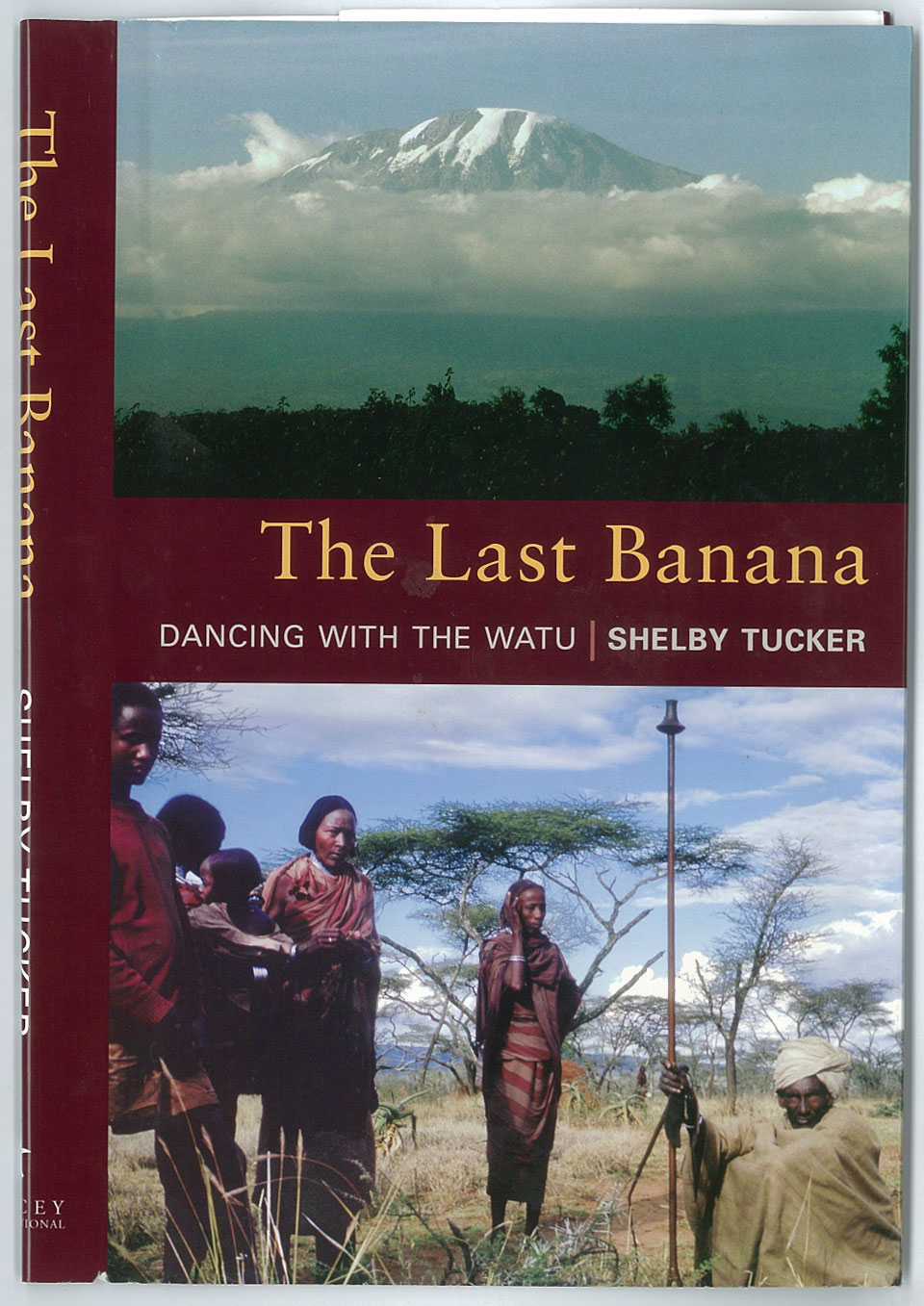
THE LAST BANANA: DANCING WITH THE WATU Shelby Tucker. Stacey International, 2010. ISBN 978 1906768 21 8. H/B, pp373 RRP £17.99
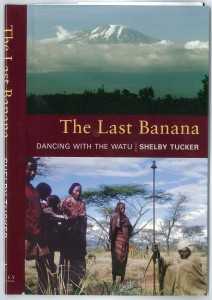
The Last Banana - Dancing with the Watu
Twenty years ago, when I first went to Tanzania, the community of permanent white residents of Arusha was tiny – a handful of farmers, safari operators and long-term missionaries, with a subpopulation of researchers and aid workers. It was literally possible to know them all, and to recognise them by their vehicles. Conspicuous among them was a Greek, known only as Ghikas, who could be seen around town in a battered Landrover, or occasionally a tractor if he was short of fuel – one of the few old-time ‘characters’ around.
On being asked to review this book it was therefore quite a surprise to find that ostensibly its main protagonist was none other than Marios Ghikas, who had been at Oxford with Tucker and who, shortly before his farms were nationalised, had invited Tucker to come to share the ‘last banana’ of the title. The scion of a wealthy Greek family who owned major coffee plantations on the slopes of Kilimanjaro, and the Livingstone Hotel in Moshi, Ghikas was one of very few Greeks to remain in Tanzania following independence and nationalisation of almost all of their assets. His background and experiences, as documented here, are a valuable record of the important Greek influence on the development of the country (dating back to the German occupation), and the trauma of the nationalisation process on those it affected. As well as the Ghikas family and other Greeks, Tucker also covers the stories of other white settlers similarly affected, including that group of remarkable men who farmed at Ol Molog on the north-western shoulder of Kilimanjaro. The story continues to the present day, revealing that Marios Ghikas is back on some of his ancestral coffee estates, struggling to make them profitable once more.
The sections of the book devoted to Ghikas, his fellow Greeks and other colonists in northern Tanzania will be the most appreciated part of the book for those interested in Tanzanian history. Much of it, however, concentrates on Shelby Tucker himself, and his travels through Africa, more or less en route to Moshi to see Ghikas, but with lengthy diversions through Sudan and Ethiopia, and his marriage in Zanzibar, form a large part of the story. The whole is intermingled with excerpts from the adventures of David Livingstone and Wachagga history. It is well written, however, and its scholarly references and notes are, for once, usefully in their proper place as footnotes.
John Grimshaw
A MEDICAL SAFARI. Richard Evans. Athena Press, 2006. ISBN 1 84401 748 6. About £6 on Amazon.
We missed this is one when it was published. It tells of a “safari” which started at a mission hospital in Uganda in 1969. Then in 1971 Richard joined the medical staff of the newly opened Bugando Hospital as an obstetrician/gynaecologist. Both he and his wife were particularly interested in the development of maternal and child health services in the rural areas. After five years he and his family moved to the New Hebrides before returning to Tanzania as the medical coordinator in the planning stages of ODA’s Southern Regions Health Project, which included the enlargement of the government hospital at Mbeya to become a regional referral hospital, with an extensive outreach programme.
Richard is remembered as a good raconteur whose tales seldom lost anything in the telling, and this is all good vintage stuff. It is necessarily a personal and selective account, but is a good read.
J. C-P.
AFRICA’S LIBERATION; THE LEGACY OF NYERERE. 2010. Pambazuka Press. ISBN 979 906387 71 6. P/B pp195
This new collection of essays is an introduction to the philosophy and politics of Julius K. Nyerere, a tribute to his legacy, and a rumination on the trajectory of Tanzanian politics since his death in 1999. The essays themselves are mostly written by Tanzanian scholars and activists, and all share a desire to cast the legacy of Mwalimu in a positive and developmental light.
The collection is certainly rose-tinted, opening with a poem that asks ‘where do we go from here?’, and reflecting on Mwalimu’s undoubtedly positive achievements in nation-building and education. Later on, it falls to Chris Maina Peter and Marjorie Mbilinyi to sound a note of caution on Tanzania’s human rights and gender equality record. What comes across most consistently – and is also most fun to read – is the spirit of Nyerere: that rare combination of intellectual ferocity and human instinct. During his tangles with the IMF in particular, he combines a robust (although partly flawed) defence of ujamaa socialism, whilst simultaneously admonishing the arrogance and myopia of the Washington development bureaucracy. It is stirring stuff, and fascinating to read post-credit crunch.
Mwalimu Nyerere is central to the narrative and identity of post-colonial Tanzania. And whilst this collection will teach relatively little to those who already know this, it does illustrate just how multi-faceted this narrative and identity is. He would be happy with this. His legacy is not just as a portrait on a government office wall, but as a living, breathing part of everyday life and politics in the country.
Henry Kippin
THE HADZA HUNTER-GATHERERS OF TANZANIA. Prof Frank Marlowe. University of California Press, 1910. ISBN 978 0 520 25342 1. P/B. £19.95.
How cool are the Hadza? Having done a bit of work (i.e. hunting and gathering) you spend time with your family, community, mates, discussing the environment, children, food, decisions – men and women together. You enjoy leisure time with a game, a chat, a snooze or preparing your arrows for the next expedition. Maybe you even contemplate the meaning of life and your world view without dogmatic monotheism or existentialist crisis or fear of eternal damnation. You share stories, ideas, food, laughs, politics, a bit of the local weed and some local history – having hung out in the same place for over 60,000 years you really get to know your community and history. Maybe you worry a little about the rain or your neighbourhood: “the place has gone down hill since those agriculturalists moved in!”
I am not a romantic when it comes to Africa, but the Hadza? I admire them, their values, their minimal ecological footprint, their spirit of equality and egalitarianism, the way they don’t take themselves too seriously.
So Prof Frank Marlowe is one lucky guy to be able to write an ethnography of the Hadza – not least because there are only 1,000 living in a fairly small area. But clearly he is sensitive to the privilege of being able to move with and research the Hadza. The author’s rigorous approach ensures this is not simply an ode to a noble people; while the affection and respect he has for his ‘subject’ shine’s through it, but doesn’t taint the evidence.
Particularly interesting was the equitable role and clear responsibilities women have, compared to most societies, including our own “over developed” countries. Women choose their partner freely, are not cast out or into homes if they are widowed and organised communal childcare gives freedom to participate economically and politically. Sexual relations are negotiated around menstrual cycles, women lactating and a certain amount of choice ensuring good reproductive health and child spacing.
The Hadza, and this ethnography, are a robust example of evolutionary theory and why it is essential to understand humans; how evolution occurs through natural selection which in turn leads to adaptation to changing environments – or extinction. What is remarkable is how little the Hadza have changed, especially given the often negative and increasingly hostile forces that surround them.
And this is my only criticism – apart from the language being a little academic and at times inaccessible. What is lacking is an analysis of the Hadza’s political economy and participatory action-research that could lead to an analysis of the major threats and opportunities the Hadza face at the beginning of the 21st Century. An example would be the opportunity, maybe necessity, of political alliances on land issues with, for example, pastoralists, building on the work of the local social justice organisation, the Ujamaa Community Resource Trust. This would ensure that this extraordinarily rigorous and valuable ethnography is more than a study of what may be the extinction of one of the first of the first peoples.
While Marlowe’s book may not be a clear rallying cry in defence of the Hadza and hunter-gathering as a legitimate and sustainable livelihood, “The Hadza hunter-gatherers of Tanzania” does have the passion, evidence and humility to contribute towards it.
Mike Sansom
PLANTS VISITED BY BEES AND OTHER USEFUL PLANTS OF UMALILA, SOUTHERN TANZANIA. By Paul Latham. ISBN 978 0 9554208 3 2. Availabale from the author at Croft Cottage, Forneth, Blairgowrie, Perthshire PH10 6SW. paul@latham9.fsnet.co.uk price £21.
This most interesting book came out of a project to encourage the conservation and planting of useful plants, including “bee” plants. Other objectives of the author’s initial visits were to assist the local secondary school to set up an agricultural programme and to help school leavers find self-employment especially bee-keeping.
Bees not only provide honey and wax for cash, but are vital for the pollination of food and economic crops as well as indigenous plants. The realisation of this encourages forest conservation.
Beginning with a short introduction to beekeeping in Umalila, the text continues with one page per species illustrated by excellent colour photos These are mainly of the plants mentioned, but also include views of Umalila, pictures of people at work, tools and household objects.
For each of the 188 species discussed, the text is clearly set out with headings such as common names, description, ecology, propagation, management, uses and references to the plant in other African countries.
Most of the plants mentioned are indigenous to the area covered and have traditionally been used for food, medicines, construction or making household utensils. Introduced species, including food crops, are also included. This means that although the book relates to a small part of Tanzania it could be interesting and useful in other countries over sub-Saharan Africa.
The author acknowledges the help of his hosts, botanists who helped with plant identification, and photographers.
Rachel Nicholson
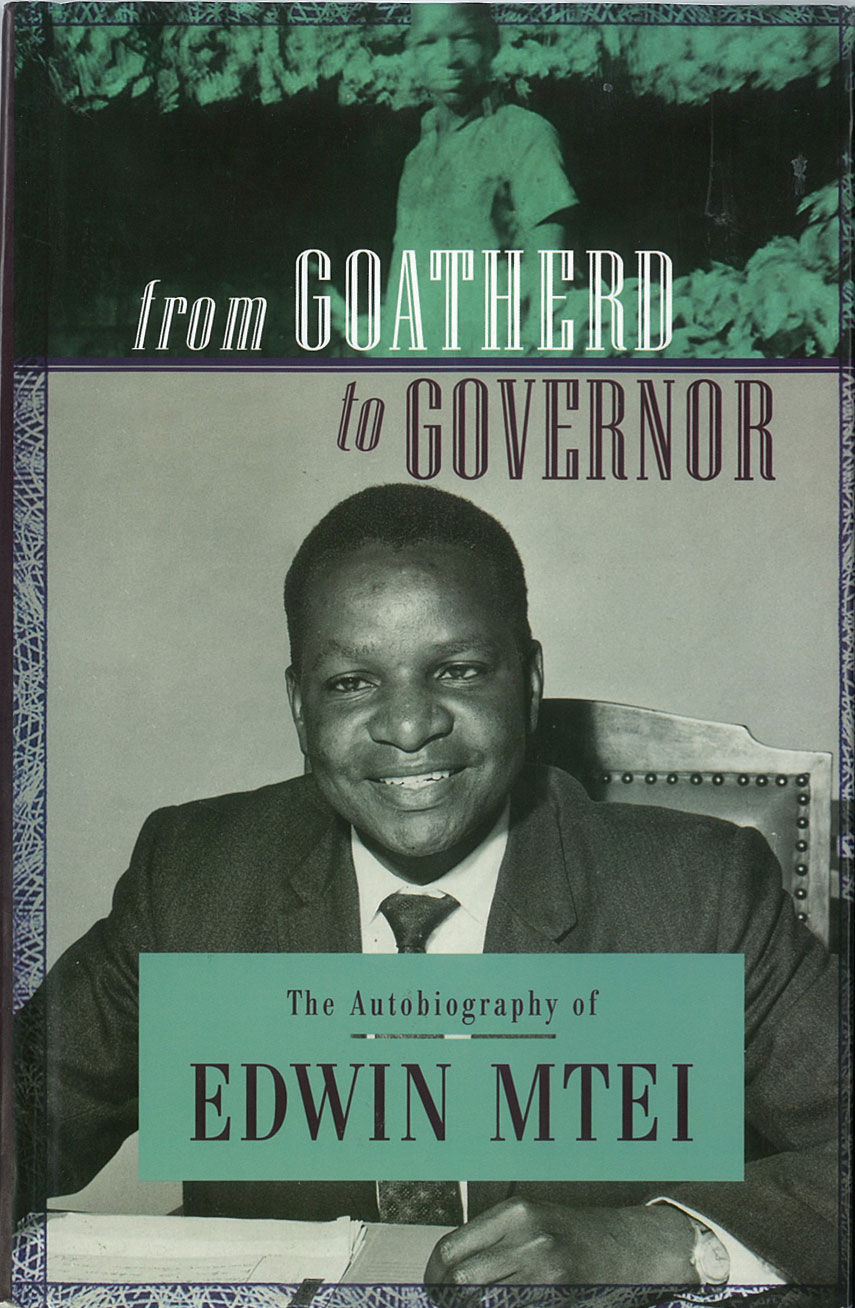
FROM GOATHERD TO GOVERNOR. Edwin Mtei. Mkuki wa Nyota Publishers. Dar es Salaam. 2009. ISBN 978-9987-08 030-4 £19.95 (obtainable from Africa Book Centre Tel: 01273 – 560 – 474)
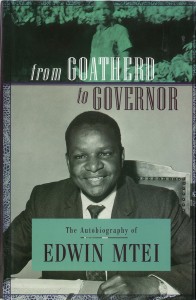
From Goatherd to Governor
Tanzania is not blessed with many autobiographies written by Tanzanians of the calibre of this author. The book is also not just an autobiography – it is a contribution to the history of some of the most dramatic years in Tanzania’s post-independence period.
Yes, as the title indicates, Edwin Mtei started life as a goatherd but, in some ways, he was a rather privileged one. He was a Chagga, regarded, at the time when he was boy, as the best educated and most advanced segment of Tanganyikan society, which benefited from an economy supported by good soils, a good climate and a well organised agricultural industry based on coffee. His parents were determined to give him a good education and they did.
He was fortunate also to have been born in 1932 which meant that he became a man just as Tanganyika became a nation. Some of his best descriptive writing reflect his feelings during Independence Day – ‘It was excitement beyond measure.’
Although the civil service was being rapidly Africanised, Mtei’s first objective was to get some money so that he could prepare marriage plans. He became a District Tobacco Sales Representative in Kenya but this job did not satisfy him for long and he soon began his meteoric rise up the promotion ladder in Tanganyika/Tanzania.
He became an Establishment Officer in the Tanganyika Civil Service in Dar. He was soon promoted to Chief Establishment Officer in the Africanisation Department and began to meet many of the people who would soon be running every department of government. His salary jumped from £792 per annum to £1,660 – a respectable salary for someone who was only 29 years old.
His rapid climb continued when he became Deputy to the Secretary General of the East African Common Services Organisation in Nairobi. And then, not long after this, President Nyerere suddenly made him Permanent Secretary in the Treasury in Dar but he was not in this job for long either.
The break-up of the East African Community is covered in fascinating detail in this book and Mtei soon became Governor of the newly established Bank of Tanzania. He recalls in the book how, when the first consignment of new Tanzanian coins arrived in Dar by sea in March 1966 there was nowhere suitable to put them. He writes: ‘The Army agreed to guard them…. We strengthened the doors of the Army’s office building and the army guarded them until we had built our own strong room, three and a half years later!’ He and his new wife were also building a house in Mzinga Way in Dar at the same time.
This was the time of Ujamaa. He and a group of senior personnel were sent to Kondoa to do some physical work with the villagers. His first project was digging trenches for water pipes and there were the first indications of Mtei’s disillusionment with the way the economy was being run. He comments: ‘The pipes never worked because there had been no proper initial survey….it was such unplanned projects that contributed to the eventual near collapse of the economy and the unmanageable foreign debt’.
Next, he learnt that he had suddenly been appointed Secretary General of the East African Community at a time when President Nyerere was refusing to speak to Ugandan President Iddi Amin! He found a little time to produce hastily some handing-over notes for the new Governor of the Bank in Dar before beginning what he described as the ‘hectic and strenuous’ final days of the East African Community.
But he was on the move again before this death finally took place. As he entered the last three months of his contract he received an urgent call from State House. He was to catch the next plane to Dar. But Kenya had just grounded most East African planes in Nairobi and he had to use a plane on loan from the national airline of Mozambique.
In Dar, Mwalimu Nyerere told him that he was to be nominated as an MP and then be appointed Minister for Planning and Finance. ‘I was stunned’ he writes. When was he to start? The next day! This seemed to be the way in which Mwalimu liked to conduct cabinet reshuffles.
Then began the saga (which finished in 1979) in which Mtei’s relations with the President gradually deteriorated. This, the most revealing part of the book, describes in considerable detail (in Chapters 17 and 18) the other war – between Mwalimu and the International Monetary Fund (IMF). To complicate matters, Mtei had been chosen as Chairman of the Boards of Governors of the IMF and World Bank for part of the same period. As the differences on policy with the IMF worsened it became apparent to Mtei that he would have to resign from his ministerial position. He did so in a short but brief confrontation with the President. Mtei’s analysis of Mwalimu’s economic policies is in Chapter 18.
Within a week he had swapped his house in Dar for a coffee farm in his own region and became a farmer. But this wasn’t enough and he soon took other positions in the private sector. He is clearly a ‘workaholic.’
Then, yet another new phase of his remarkable career began. In July 1992 Tanzania got a new constitution and new political parties were allowed. Mtei then founded the Chama cha Demokrasia na Maendeleo (CHADEMA) which is now the main opposition party on the mainland. Those interested in how multi-party politics developed in Tanzania should read chapters 22 to 24.
The author writes well, in a readable style. He shows a prodigious memory for people and events. Unfortunately he said that he found writing the book an ‘arduous task’ which must explain why it seems, at 227 pages, so very short.
Sadly, Mr Mtei’s boss, the late Mwalimu, who met so many distinguished leaders worldwide, and participated prominently in the making of world history, left no written record of his life and work.
This book is not perfect. It is rather expensive in the UK for such a small book and is almost bereft of critical comment on people and places. A few more amusing anecdotes might have added to the attractiveness of the book. Perhaps Mr Mtei does not like to upset people but, as the founding father of what might become the leading party in the country at some future date, he is likely to have to do so.
However, Mzee Mtei is to be congratulated for not leaving a vacuum behind him and for describing these eventful years in such a clear way. Let us hope that some of the other Tanzanian leaders during this period will put pen to paper before it is too late. There must be a fear that they won’t. Mwalimu told Mtei on one occasion, that he was the only one of his ministers who sent him long reports in writing!
David Brewin.
SIR GEORGE. A THEMATIC HISTORY OF TANZANIA THROUGH HIS FIFTY YEARS OF PUBLIC SERVICE. Joseph Kulwa Kahama. Foreign Languages Press, Beijing, China. 182 pages. www.flp.com.cn ISBN 978 7 119 06219 8
This is a very unusual book: a stimulating and interesting account of the life of a key player in his country’s development written by a son whilst his father and subject is still alive. ‘Sir George’ is no less than George Kahama, former General Manager of the Bukoba Co-operative Union, Minister of Commerce and Industry in Nyerere’s first Cabinet, CEO of the National Development Corporation, Director General of the Capital Development Authority, Ambassador at different times to West Germany, China and Zimbabwe, MP for Karagwe and currently Chairman of Seacom (T) Ltd – the undersea fibre optic company which delivers internet services to Tanzania. This is an extraordinary life which has spanned almost every aspect of Tanzania’s development over the last sixty years.
Joseph Kahama writes clearly about all these and related phases of George Kahama’s work. He paints a picture of an extraordinarily energetic individual, able to master very divergent briefs, but to collect many friends and supporters along the way. The book indicates that Kahama Senr regards the work of building the new capital at Dodoma as both his greatest challenge and perhaps greatest failure, in the sense that his vision was never fully realised. His strategy at the NDC, in line with much international thinking at the time, was the promotion of joint venture companies with equity capital supplied both by the overseas investor, local investors and government itself. In principle this was sound, and it is not so different to the new paradigm which has emerged after the global crisis of the last two years, or to the strategy adopted by the east Asian economies since the 1970s. However, his work at the National Development Corporation was to some extent undone as the NDC was first broken into smaller entities and ultimately saw most of its subsidiary companies fully privatised in the 1980s and 90s.
However Kahama never lost his faith in the ability of the co-operative movement to deliver real services and benefits to farmers and was very glad to return to his first Cabinet brief as Minister of Co-operatives under President Mwinyi, investing his energies in seeking to re-invigorate a movement which had lost so much strength during the late and post ujamaa period.
The book succeeds in throwing some light on Kahama’s real social and political beliefs during the various phases of Tanzania’s political development in which he has been so closely involved. Whilst on the one hand he has been consistent in trying to ensure that small farmers and households received a better deal through co-operatives and through the educational system in general, he has also had a vision of a successful middle class of investors who would be the backbone of the country’s economic development. It seems that, at least until the last few years, this has been at odds with the CCM vision and that Kahama has to be regarded as an odd man out, pushing his own vision against the odds but never taking it so far as to be fully alienated from the mainstream of the party.
The author makes it clear that the Catholic faith has been central to Kahama’s personal strength which was formally bolstered by the award to him of a papal knighthood (Knight Commander of the Order of St Gregory the Great) as early as 1962. His own family, and particularly his wife Janet (currently an MP), have also been critical to his ability to work in so many different spheres. Kahama must be the only senior figure in Africa today to have both presided over a late colonial (and very successful) farmers’ co-operative and the principal internet distribution service for his country towards the end of the first decade of the twenty first century.
His son has done an excellent job in capturing this rich life and much of the modern history of Tanzania in the process.
Lawrence Cockcroft
TINGA TINGA – UNIQUE, KITSCH OR QUALITY ?
This summer the Tinga Tinga art movement was the focus of several unrelated cultural events, bringing an opportunity to see and consider the continuity and new directions of this popular genre of Tanzanian art. The brightly-coloured and uncomplicated style of narrative painting on square board was invented by Tinga Tinga aka Edward Saidi in 1968. Most accounts relate how he, then a labourer in Dar es Salaam, was inspired by colourful Congolese paintings on paper which were sold in the open air by vendors in the capital.
The events included two exhibitions: ‘TINGATINGA – Unique Paintings from
Tanzania’ (Croydon Clocktower Gallery with some 25 works), and ‘TINGA TINGA KITSCH or QUALITY – Bicycle enamel on board and canvas’ (Round Tower Gallery, Copenhagen, with some 100 works) and also an animated Childrens BBC television series ‘TINGA TINGA TALES’.
The latter, a totally new departure if remarkable appropriation generated in Nairobi, indicates the continuing and general appeal of the Tanzanian style, though the initiative is beyond the scope of this account.
The two exhibitions were the results of enthusiasts wanting to share their personal involvements with the Tanzanian artists and their own painting collections. While the Croydon show was organised solely by amateurs Stef and Maggie Van der Heuvel, the Danish effort of ThorupART (a family art consultancy) had considerable professional input, including some photographs by anthropologist Jesper Kerknaes who has been involved with the Tinga Tinga movement since its beginning. The Copenhagen exhibition included loans (13 by Tinga Tinga himself and many sculptures by Lilanga) and published an attractive and comprehensive catalogue, the best to date.
Comparison may seem unfair, but van der Heuvel’s modest collection stood up well, offering an overview of the movement’s history through selected paintings and a good range of contemporary practice including a painting by Lilanga and several by Charinda. His work is interesting because he tackles different subject matter, whether shetani, slave trade or daily life (one on display in the British Museum) in the same graphic style.
Other current artists use different graphic styles but keep the characteristic colour palette. To its credit, the movement has been able to accommodate differing approaches while some artists maintain the classic repertoire, especially those related to the first generation (one of whom is a woman: Agnes Mpata). Van der Heuvel also displayed contextual material, for example two Chagga bowls decorated in Tinga Tinga style, greeting cards and other ephemera as well as relevant books.

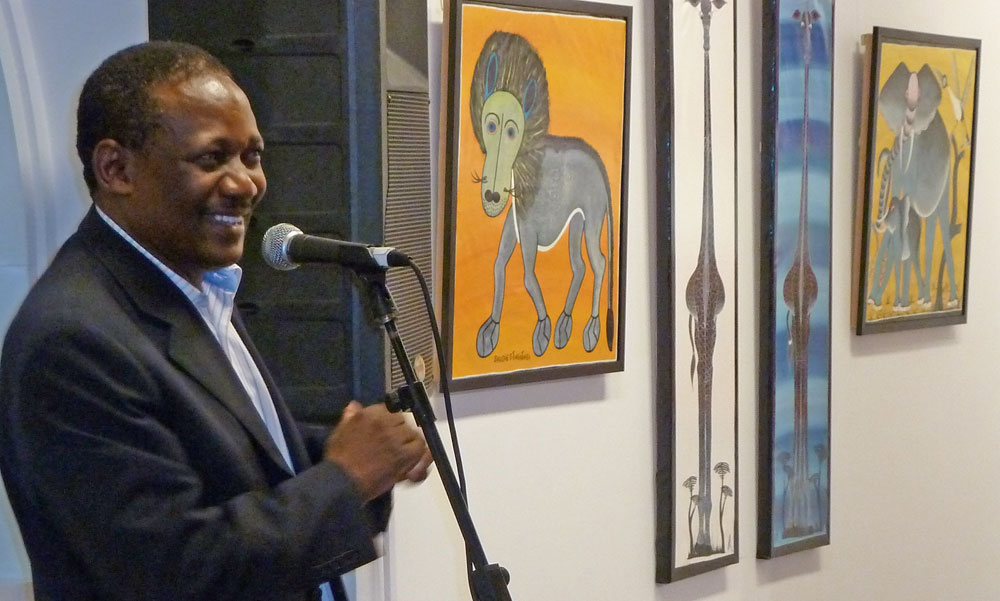
Deputy High Commissioner Kilumanga at the exhibition (Elsbeth Court)
Overall, ‘TINGATINGA – UNIQUE PAINTINGS’ provided an excellent introduction, even if some of us query the organizer’s use of descriptors like ‘unique’ and ‘exotic’ for what is a national style. I found a bit of a mismatch between the works and the rhetoric (and wanted documentation) but these matters seemed not to bother the Tanzanians at the Preview. Indeed, in his opening speech Deputy High Commissioner Chabaka Kilumanga reiterated that he had bestowed Stef Van der Heuvel with the honorary title ‘Tinga Tinga Ambassador to the UK’ and congratulated him warmly for rekindling interest in Tinga Tinga including his own.
Catalogue: Thorup, Tine & Sam, Cuong (2010) TINGA TINGA 2010 KITSCH or QUALITY – Bicycle enamel on board & canvas. Copenhagen: torupARt.
http://www.bbc.co.uk/cbeebies/tingatingatales/watch/tingatingatalesclips
Examples of two relevant books: Yves Gosginny’s Tinga Tinga Popular Painting from Tanzania and Chris Spring’s Angaza Afrika. African Art Now.
Elsbeth Joyce Court