AND VERY FREE SPEECH IN TANZANIA’S OWN MEDIA

The Dar es Salaam ‘FAMILY MIRROR’ has continued to illustrate the remarkable extent of the freedom of the press now evident in Tanzania. In a single issue (May 1992) it headlined:

On page 1 ‘Dodoma: A Capital Nobody Wants’ in which it wrote that the Government had backtracked on its decision to move Tanzania’s capital from Dar es sal aam to Dodoma because of a lack of political will and the ‘hopelessly collapsing national economy …. .. although no official announcement is expected from State House’.

On page 3 under the heading ‘Malecela Must Show Political Maturity’ it accused Prime Minister and First Vice-President John Malecela of suffering from ‘leadership fatigue’ after what it described as the ‘big flop’ of Mr Malecela’s visit to Namibia. What irked the Family Mirror was what it described as the ‘old-fashioned … tired politics’ he had been preaching as exemplified by his warning to Africa that it was about to be ‘recolonised’. Quoting the example of foreign involvement in Kuwait, the Kurdish country and the Liberian Civil War it wondered why Mr Malecela didn’t realise that the old (OAU) concept of non-interference (in the affairs of other countries) had ‘ almost become irrelevant in the African political context. Mr Malecela still ’embraces mesozoic notions that western nations are exploiters and colonialists trying to impress their models on Africa’…. ‘Politicians without originality are finding it tough … as they try to concoct new situations and create new scapegoats to divert the attention of the world from their own internal problems. If Mr Malecela did not have any new agenda to sell to Namibians he could have discusssed common problems such as population explosion, foreign debt, drought, food shortages, civil wars, human rights etc .

Page 4, ‘Dourado Speaks Out His Hind’, contained an interview conducted six years ago (shortly after he had been released from detention) but never published, with the ‘fiery, defiant but principled politician’, former Zanzibar Attorney General Wolfgang Dourado. “It was Mwalimu who detained me … not the Zanzibar Government” he said. “I was never given any grounds … but I believe that it was because I had been invited to present a paper to the Tanzania Law Society on the Consolidation of the Union. . . I was interviewed about it in the foreign media including the BBC . . . but in Africa one does not tread on the toes of venerable and infallible Founding Fathers’.

A COVERT CAMPAIGN
Reacting to increasing criticism in the private press Prime Minister and First Vice-President John Malecela was quoted in the SUNDAY NEWS (July 5) as speaking in Zanzibar of a ‘covert campaign’ to discredit the CCM and the Government. He said that the country’s leadership welcomed criticism intended to rectify mistakes and lapses but strongly rejected reports aimed at arousing people’s resentment so as to isolate the Party and the Government from the population. He urged Tanzanians to be vigilant against ill motives and advised them to resist attempts to erode national unity, peace and solidarity.

THE NEW BUREAUX DE CHANGE

Until the middle eighties, importers and others requiring foreign exchange had to apply to the Bank of Tanzania and to make out a case for an allocation in competition with other applicants. In practice this procedure had two main disadvantages in conditions of extreme foreign exchange shortage delays were inevitable and widespread and foreign trade was severely hampered; and, centralised allocation was not always found to be an appropriate mechanism for adjudicating between rival claims. With minor exceptions, all foreign exchange holdings had to be surrendered to the Central Bank, or to the National Bank of Commerce, in exchange for local currency.

In 1985 the central control of foreign exchange allocation was breached by removing the legal bar on the possession of foreign exchange in certain circumstances (‘own funds scheme’) and allowing exporters to retain a proportion of their foreign exchange earnings (‘retention scheme’) to meet the cost of importing machinery and raw materials and to import certain consumer items within a specified list deemed to raise public morale and offer an incentive for greater production (‘ incentive goods’) . The combined effect of these measures was to fill the shelves of the shops with goods, albeit generally at a higher retail price in shilling terms, and to raise spirits and expectations.

While these measures bypassed the bureaucratic process for the procurement of some of the imports needed to sustain industrial production, they were not sufficiently wide-ranging to deal with all urgent requirements of foreign exchange. Furthermore, black market dealings , though they provided an informal means of access to foreign exchange, were nevertheless illegal and were depriving the established channels of scarce foreign exchange.

Early in 1992 a new Foreign Exchange Act vested responsibility for management of the country’s foreign exchange in the Bank of Tanzania , including the power to make regulations. It became legal for any person to hold any amount of foreign exchange and to buy and sell it in the open market. In March 1992 the Foreign Exchange Regulations and the Foreign Exchange Bureau de Change Regulations were published in the Official Gazette. Bureaux de Change were set up in Dar es Salaam thus providing a legal basis for most of the transactions hitherto performed illegally. The device was not new, having been tried in a number of countries including Ghana and Uganda to good effect. It was hoped that this mechanism would go far towards undermining the black market and would draw into the public domain resources hitherto sidetracked into black market obscurity.

The rate of exchange is determined solely on a market basis at weekly auctions. As foreign exchange remains a scarce commodity, it is expensive and figures in excess of Shs 700 to the £1 have been quoted. Such figures reflect not only the scarcity of foreign currencies, but also provide holders of foreign currency with a strong motive for selling it to the Bureaux. At the same time, the official rate of exchange fixed from time to time by the Bank of Tanzania continues to govern applications for normal trade purposes through the banking system. This rate is in the region of Shs 500 to £1, revealing a substantial gap between the two rates. The official rate, which, under present policy, is moving slowly upwards in accordance with the rate of inflation, will tend towards stability as inflation is reduced to a figure comparable with that of Tanzania’s main trading partners. The Bureau rate, however, will continue to be the value at which supply is in equilibrium with demand in the Bureau market and in the immediate future is likely to remain well above the official rate.

It would be a mistake to designate either rate as the ‘right’ one as they are the result of different mechanisms and serve differing purposes. The Bureau rate reflects the extreme scarcity of foreign exchange and depends solely on the interplay of supply and demand. Under the present policy, on the other hand, the official rate is much nearer to the value at which the purchasing power of the shilling is in approximate equilibrium with the purchasing power of the dollar. It is the official rate that governs most commercial transactions, while the Bureau rote provides a useful safety valve in cases that cannot command commercial priority, such as international travel costs and overseas purchases for non-commercial purposes, It is, however, the Bureau rate that has less claim to underlying validity , as it is inflated by the present scarcity of foreign exchange.

With the expansion of Tanzanian exports and the progressive narrowing of the unfavourable balance of overseas payments, the difference between the official and the Bureau rates will diminish. Ultimately, when Tanzania’s foreign payments account reaches equilibrium, the exchange rate gap will disappear and present arrangements for the publication of an official rate will be discontinued. As scarcity of foreign exchange will no longer influence dealings, the market rate, as determined by auction, will fall to meet the official rate and thenceforth all dealings, apart from minor adjustments to different transaction costs for different sizes of transaction , will be based on the interaction of supply and demand .
J Roger Carter

(Eight Bureaux de Change now advertise their services in the Dar es Salaam press – Editor)

LONDON INVESTMENT PROMOTION SEMINAR

BIG ATTENDANCE AT LONDON INVESTMENT PROMOTION SEMINAR
A two-page spread in The Guardian called ‘Special Report: Tanzania’, greeted me on Thursday 21st May 1992. A handful of articles and several advertisements extolling the virtues of doing business in Tanzania, were a real surprise to me since I had never seen anything similar before; Nigeria, Kenya or Uganda perhaps, but never Tanzania. I soon realized that this was part of Tanzania’s investment campaign taking place in London with a Confederation of British Industry (CBI)/East African Association Seminar arranged for the following day.

‘The Changing Face of Tanzania: Business Prospects’ stimulated a huge interest. From Tanzania, the Prime Minister John Malecela, brought four ministers, the Governor of the Bank of Tanzania, George Kahama, Director of the Investment Promotion Centre (IPC) , plus numerous other officials. All the senior diplomats were assembled from the Tanzanian embassies in Europe. More than double the usual number of participants at CBI seminars were enrolled. The Conference Administrator reported that the phone had never stopped ringing with enquiries. When asked to explain the popularity of th s conference, she suggested it was due to the friendliness of the Tanzanians.

So, the following morning I joined the 230 men and 5 women to attend the conference at Centre Point. I had discovered a special entry rate of £30 plus VAT was available for members of the Britain-Tanzania Society (BTS) as the regular fee of £282 is certainly beyond my means. Also present from the BTS were Roger Carter and Trevor Jagger. The format of the day was speeches and questions, very ably and smoothly chaired by Tom Brazier, Chairman of the East African Association. Sir David Gilmore started proceedings with a very informative and welcoming speech. This was followed by presentations by the Tanzanian team.

Quite clearly, everything is changing. Tanzania is very keen to welcome business to its shores . Time and again we were reminded of the glorious scenic beauties of Tanzania from Kilimanjaro to the Indian Ocean, from historic Zanzibar to the Serenget1. We were also told of the vast potential for agriculture, fisheries, minerals and natural resources. The businessmen were told several times about the fiscal changes, no tax for five years, freedom to remit profits and dividends, and the assistance available to establish new work in Tanzania.

During the afternoon I attended a Workshop on Industry and Agro-Industry. There was a question posed which for me illustrates in cameo the issues ahead; “I am in the fisheries business based for many years in Mombasa, Kenya. Two years ago, I moved down to Tanzania and am now based in Dar es Salaam. I have orders for ten tons of octopus a month but my current fishing fleet capacity can deliver only one ton a month. I have discovered three fishing vessels in Dar es Salaam that were part of an aid package from Italy some years ago. They are operating at only one tenth of their capability. I need ships, they need more work; how do we create a successful partnership?”

This also illustrates dramatically, the ecological and social issues which were conspicuously absent from the day’s deliberations. Only Alistair Boyd from the Commonwealth Development Corporation spoke of the need to take into account the social and ecological consequences of economic development. This example leaves me asking many questions:

-Will Tanzanians benefit from this change of economic policy?
-Do Tanzanians want all their octopus taken?
-Do Tanzanians want any of their other natural resources exploited?
-Does Tanzania have safeguards in place to protect it from over development ? (which means money and people to monitor activity).
-Who benefits and who loses out?
Judith Holland

POINTS MADE BY PARTICIPANTS:
– Tanzania produces 1% of the total world output of coffee, cotton and tea . Coffee estates are up for sale. Investment is required for cashew nut and pyrethrum processing. Sisal is Tanzania’ s number four foreign exchange earner; Tanzania is soliciting the private sector to purchase or enter into joint ventures with sisal estates – Investment Promotion Centre
– The UK is still Tanzania’s leading trading partner with a 22% share of the market . Our closest competitors are Italy (16%), Japan (13.3%) and Germany (11.7%). In 1991 we exported goods to the value of some £73 million and imported £21 million – mostly tea and coffee. Britain’s Area Advisory Group for the Department of Trade and Industry has designated Tanzania as one of its ‘markets to watch’ and it is possible that it will consider an investigative mission in 1993. Tanzania’s remarkable stability gives it advantages over many of the neighbouring states. It is to be congratulated on its marketing and cooperative reforms, political pluralism, independent press, the record in human rights . . .. But it is a competitive world. There have been changes in banking but no foreign banks are yet operating in Tanzania; none of the parstatals have been sold or liquidated yet; there is need for progress on a double taxation agreement and there is the problem of outstanding commercial debts dating back to 1979 – Sir David Gilmore, Permanent Under-Secretary of State at the Foreign and Commonwealth Office.

– Many people neighbouring Tanzania have found the country to be a safe haven whenever they felt severely threatened in their own countries .. . even the wild game have the same feelings . It is no wonder that Tanzania has 25% of her territory reserved for game parks … ,. It is our intention to make the Investment Promotion Centre a ‘One-Stop-Centre’ to speed up the process of approving investment projects .. . . Between 1990 and April 1992 some 35 projects which are wholly owned by British firms or in partnership with Tanzanian counterparts have been set up …. I really hope that you will be able to look into new possibilities – John Malecela.

– The factors which were most influential in our deciding to increase our investment in Tanzania were the stability and remittability of funds but …. we have encountered some resistance from minor offici also to the implementation of IPC investment approvals and there is continuing uncertainty on who in Government is responsible for privatisation and who we should negotiate with – Tom Brazier, Chairman, Brooke Bond Ltd.

MISCELLANY

TANZANIA TO GET US$ 990 MILLION
Aid donors and international organisations meeting in Paris on June 29 th and 30th 1992 pledged about US$ 990 million to help finance Tanzania’s development programmes next year. Almost two thirds of the funds will be provided in the form of grants – World Bank News.

PRIVATISATION OF CROP SALES
The Tanzanian Government bowed on July 16th to pressure from Members of Parliament and delayed implementing a decision it had earlier announced to privatise the sale of cash crops. “The Government has, with immediate effect, suspended the new crop purchasing procedure until next year” Prime Minister John Malecela told the National Assembly.

The decision was a setback to economic reforms being pressed by the International Monetary Fund (IMF). The Government had originally decided also to abolish further interest-free loans for cooperatives to help them to buy crops after the State-run National Bank of Commerce had accumulated US$’5 million in bad debts from cooperatives; the reversal of policy meant that this decision was also reversed.

Mr Malecela explained that the Government’s earlier decision to end a monopoly enjoyed by the cooperative movement had been designed to encourage competition. But angry legislators said that farmers would turn to smuggling if private businesses were allowed to buy crops. “We cannot let cooperatives compete with the wolves” said the Member of Parliament for a northern wheat growing constituency.

ELECTRICTY MONOPOLY ENDED
Tanzania Electricity Supply Company’s (TESCO) 30-year monopoly on the production and supply of electricity has been ended. Minister for Water, Energy and Minerals Jakaya Kikwete told Parliament that it would take years for the whole country to be energised unless private organisations and individuals were free to enter the power market.

TELEVISION COMING
The new Minister for Information and Broadcasting, Dr Shija has told the National Assembly that plans have been finalised for a three-phase programme (estimated to cost Shs 13 billion) for the introduction of television. Some 18 TV stations would need to be built and the Government had agreed to cooperate with local and foreign investors who had shown interest.

BOOK REVIEWS

INNOVATION AND CHANGE IN HIGHER EDUCATION IN DEVELOPING COUNTRIES. EXPERIENCES FROM TANZANIA. I. M. Omari . Comparative Education. Vol 27. No 2. 1991

Professor Omari has written a lucid and interesting account of developments at the University of Dar es Salaam from which he draws some broadly-based conclusions.

He begins by exploring the background to the 1974 CCM decision to change university admission procedures: after 1974 only those with considerable work experience qualified for admission. One result was an older student population, less equipped in some ways to cope with traditional undergraduate courses Fairly quickly, modifications had to be made to science admissions. The issue of equity of access – especially of women – also had to be addressed Professor Oman remarks that the early cracks In sciences and for women students provided a hostile staff with ammunition to point out the flaws In the innovations, and that the exemptions again gave critics an opening to point out Inconsistencies He is pessimistic about the multiplier effect for decades to come of admitting poor students Into the Faculty. of Education.

Professor Oman comments on the powers of heads of state as chancellors of universities. This underlines the importance of getting right the relationship between the state and the university. This is a sensitive issue, as current events in the University of Zimbabwe demonstrate. There, new legislation on tertiary education has run into strongly expressed opposition from the university community and relations between the Ministry and the University are not good. Tanzania early realised that the university as a sovereignty symbol is both an asset and a liability. Professor Omari quotes President Nyerere (1985) “the effects of ambition clashing with the limitation of resources” and Nahdi (1987) on the University of Dar es Salaam as “a seething cauldron of militancy and radicalism and new ideas. Academics streamed from all over, looking for the revolutionary Mecca of their dream” He draws attention to the Incompatibility of ‘the Wish of the political elite for a subservient university, closely following and obeying party and government policies Without overt contradictions’ and ‘the culture of a university which had accumulated an international reputation for being at the centre of the developmental debate.’

Professor Omari quotes Cote, who wrote in 1973 that, of the three primary functions of a university (teaching, research and training), it is research which is the essence of scholarship and a necessary condition for the existence of a university. However, since then increasing stress has been placed on the vocational aspects as a fundamental part of university education. Perhaps, therefore, Professor Omari might have acknowledged that it is not only in developing countries that ‘the pressures on universities to redefine themselves so as to be more responsive, practical. … and the locus of change have been particularly severe.’ Professor Omari charts the course of the ‘University as a Workers’ Institution’. He criticises the lack of consultation with the university when the Party introduced changes in 1974. He makes the point that it is easier to innovate in a multi-university system. Tanzania – like most of Africa – has lacked the capacity of countries in the North.

The lessons of the Tanzanian experience do not all take the form of cautionary tales. There has been a growth of interest in university-sponsored work experience. Although Professor Omari finds no evidence that such experience if leading to a long delay between secondary and tertiary education, produces persons better equipped to play their role in national social and economic development, he concludes that the policy debate regarding the relationship between work experience and university education should not cease.
I do not wholly go along with professor Omari in his view that ‘university first-degree programmes take the form of liberal education designed to give broad analytical skills different from vocation-specific skills’ or that’ it is a misconception to conceive the role and objectives of universities in developing countries primarily from the perspective of specific skill training while they have multiple roles and functions to deserve the claim’. He suggests that other post-secondary institutions whilst being flexible enough to filter a few for university should prepare people for specific occupations. He shares with others the view that this would allow universities to concentrate on producing high-level personnel with broad, flexible, imaginative conceptual frameworks and attitudes consistent with management capabilities and tasks that would cut across sectoral confines. However, there are countries in Africa where the demand for people with such skills is beginning to be satisfied There are limits to the expansion of the public sector, and some of the future emphasis in African universities must be on producing people for self-employment.

For those who wish to follow the debate started by Professor Omari a stage further I recommend a study of the recent work on cost effectiveness and efficiency of universities by the Association of African Universities. Next year should see the production of a report by the Higher Education Working Group of the Donors to African Education that will cover in depth issues raised by Professor Omari as well as some of the more recent developments in African higher education than those brought out by the Tanzania case study.
John Theakstone

THE FACADE OF PRECISION IN EDUCATION DATA AND STATISTICS – A TROUBLING EXAMPLE FROM TANZANIA. Joel Samoff. Journal of modern African Studies. 29, 4 (1991). pp 669 – 689.

To the educational planner, the first essential on which to base any development or projects, is to have a firm and reliable base from which to start Two of these, namely a) the number of students in the system by grades; and b) the expenditures Involved, are examined by the writer of this article. Dealing first with educational statistics, the writer found some years back, that in one region in Tanzania (Kilimanjaro), “there were nearly twice as many children in primary schools as the official reports indicated”. An error of this magnitude when totalled by all regions, gives a completely false picture and could produce major distortions and misjudged development as a consequence.

Unfortunately, the writer does not develop these possibilities but concentrates the bulk of his theme on governmental expenditures on education. He then proceeds to demonstrate how widely differing conclusions can be drawn from identical pieces of data. His arguments and reasons are important and are worth summarising. To evaluate accurately how much is actually spent on education, the planner or developer must check whether :-

i) official financial figures deal with budgeted or actual expenditure;
ii) all expenditures by government are covered; some may be covered by local councils in addition;
iii) other voluntary bodies contribute, eg: churches or community groups;
iv) local currency values have changed over the periods being compared ;
v) the periods being compared are really comparable; and,
vi) the periods being used for comparative purposes are long enough to yield valid conclusions.

Having made these points, the second half of the article concentrates on showing exactly what has been happening to recurrent expenditures on education over the two decades in Tanzania as a whole. The overall conclusions reached are that a) official statistics must be treated with great caution; b) apparent changes must be watched over a longish (several year) period before public policy is changed and, c) pinpoint accuracy IS impossible (though often claimed) and only general trends are worth’ considering.

These are all valid points and are supplemented by the writer stressing that generalisation must be checked by on-the-spot sampling, because officialdom in the country’s capital may be ignorant of what is actually happening in the localities.

This last point was all too clearly discovered by your reviewer when he spent some days in the Mtwara region and found serious lack of co-ordination in more than one respect between locality and headquarters.
The article performs a valuable function in drawing attention to basic discrepancies and the need for careful qualification before generalisations are made. It concentrates over-heavily on recurrent expenditures to the neglect of other areas such as teacher qualification and supply, which are not mentioned. Greater emphasis could have been placed on the error liable to arise if the numbers and grades of pupils are inaccurate. However, overall, the article makes its points firmly, and alas, With validity
Bernard Braithwaite

THE CHALLENGE FACED BY THE BUILDING MATERIALS INDUSTRIES IN DEVELOPING COUNTRIES IN THE 1990’s WITH SPECIAL REFERENCE TO TANZANIA. A.U Kisanga. Habitat International. Vo1.14. No.4. (1990). pp 119 – 132.

This is a technical and academic article. You have to dig for them but the author has the right ideas. Much of what he says applies also to other industries, but the building materials industry is of special interest since we all use its products. The reporter’s themes are that:

a) In Tanzania there is excessive dependence on imports, and even locally produced building materials have a high import content.
b) local building materials industries are inefficient and high cost, so leading to low utilisation which makes matters worse; and,
c) import substitution alone is not the answer. Throughout the article the author tends to confuse two separate sectors. They both use building materials but there the resemblance ends. One is the large scale modern construction sector, and the other is the small scale traditional domestic sector.

To use the term “modern” defines the problem. The construction industry is truly traditional. Technology and design for large buildings are now world-wide. City centres everywhere are locked into this technology. Who can tell apart a skyline in America, Africa or Asia? Some of this building upwards is a necessity but some is merely fashion . Not all cities have space problems, yet many choose to build high mainly for reason of prestige. The other sector is domestic and local – essentially low rise as opposed to high, what we describe a ‘traditional’ People pay lip service to this but rarely build.

The essence of traditional styles the world over is to use local materials. But architects trained in high technology do not accept these limitations and involve their clients in expensive imports. And local people, building for themselves, copy what they see and also use imported products.

It was not always so. The author refers to colonial days and implies that Tanzanians were taught expensive habits. Yet in the 1920’s the Tanganyika PWD Issued a technical guide which became famous as “Longland’s Field Handbook”. As late as the 1950’s it was issued to all British Colonial Service Cadets, and It was recently reprinted by the Intermediate Technology Development Group (ITOG) It had all the right ideas, advocating the use of local materials (because there were no others) and described how to improve their quality. It even encouraged Technological Co-operation among Developing Countries (TCDC), as now advocated by the United Nations, by quoting from Indian and West African equivalents.

As the author argues there is a need for education, training and guidance, and here the government should give a lead But it may be that government officials Will need to be re-educated first to understand that local is best. And the government must show support in its own building work. People copy what they see
It was unfortunate that the decade of African independence was the 1950’s and 60’s, when Soviet central planning appeared to be highly successful, and Western countries too had faith in the ability of governments to plan prosperity. Hence the series of problems experienced not only by Tanzania but familiar to Eastern and Western countries alike. Here they are described as:-

a) Excessive protection which has fostered uncompetitive behaviour;
b) Inefficient public sector industries;
c) State controlled monopolies;
d) Development determined by political rather than economic criteria; and,
e) Wage regulations raising the cost of unskilled labour, coupled with a lack of training creating skill shortages.

The author’s solutions are to:
– Remove barriers to growth and encourage local and small scale enterprise;
– Develop a building materials industry protected from eX1ernal suppliers but with effective internal competition to encourage productivity and innovation;
– Encourage the selection of appropriate technology; .
-Support small companies with technical services, including spare parts and repairs, and training for skills and management;
– Protect the environment
He becomes a little over-optimistic when he ends by writing about a regional export trade, but if his ideas were applied, the improvement within Tanzania would be reward enough.
Mel Crofton

“THE MPINGO – TREE THAT MAKES MUSIC”
Programme on BBC 2 at 8 p.m. on Sunday 3rd May 1992. Presented by David Attenborough.

Mpingo wood is the only possible material from which you can make clarinets The instrument makers at Buffet Crampon in Paris insist that this is so. Professional clarinettists, jazz and classical, agree.

Mpingo is African .Blackwood, Dalbergla melanoxylon, a small Leguminous tree of savannah woodland. It is now the traditional tree of Tanzania which is at the centre of its natural range To a reader familiar With trees In Britain I would describe its stature as resembling a hawthorn, inclined to be shrubby and crooked, and its leaves and flowers somewhat like the introduced Robinia or False Acacia. Its heartwood is at first sight black, though really grained in shades of very dark brown, contrasting with the light fawn outer sapwood.

The timber is described as the finest of all woods for carving fine detail. It can be machined almost like metal on a lathe, and the precise bore and fine screw threads that are worked in it are amazingly stable in the extremes of moisture and temperature to which a Wind Instrument is exposed. It is so dense that it sinks in water and so hard that the tools and the sculptor’s chisel – need constant re-sharpening Selected seasoned billets of the right size for woodwind instruments and keys and fingerboards of other Instruments are exported from Tanzania at 10,000 dollars per cubic metre.

You might expect a full forestry system to have developed around this tree – planting, weeding, thinning, pruning and harvesting in rotating compartments – but this is not so. It is more like hunting than forestry. The skill lies in finding the best trees in their native habitat. Poor specimens are quite common, good ones increasingly rare, and the journey to the sawmills can now be as much as 200 kilometres to keep up the rate of felling of 600 per week. The best trees are at least 60 years old and still only as thick as the waist of the woodcutter we saw felling One. Being so small a tree, awkwardly shaped, often cracked internally it is not surprising that the waste from the sawmills greatly exceeds the product in spite of the skill of the operators. “Ninety per cent of the tree” is not good enough for export.

To many in Tanzania the mpingo is known better for the “ebony” carvings which are the speciality of the Makonde people. A good tree would provide enough wood for a family to work with for six months, and make a living. A particularly intricate sculpture, perhaps fetching one hundred dollars in Dar es Salaam, could take one man the whole of six months to complete.

The message of the programme was that mpingo will soon be unobtainable if nothing is done about its proper management, and that the importers should invest money in the necessary research and development.

One man, at least, is trying to do something about it: Sebastian Chuwa, a Tanzanian botanist. He now has 2,000 seedlings growing in pots in various locations by courtesy of his friends around Dar es Salaam. Starting from scratch, he must have a formidable task ahead. It takes a long time to experiment with trees, and the final proof that you have been doing the right thing only comes when they reach commercial dimensions. Sebastian Chuwa’s plan is to grow the trees in their natural habitat complete with their usual associated plant communities. The experimental areas would need protection against the increasing encroachment into savannah woodland by the ‘slash-and-burn’ agriculture of the increasing human population, in fact it would have to be recognised as a resource by and for the local communities. The loss of mpingo at present is being hastened by excessive burning that destroys the seedlings before they develop the protective bark that makes older savannah trees fireproof against moderate grass fires.

The success of Chuwa’s work will depend on many other people. The ultimate production of sound timber with less waste starts right now with seed selection and control of growing conditions. Perhaps biotechnology can help in genetics and vegetative multiplication. It all costs money, but it is a resource that Tanzania must not lose.
John Leonhardt


FLIGHT TO FREEDOM. A TRUE HIJACKERS’ STORY
. Yassin Membar. Publisher Tanzania Youth Democratic Movement. 16, Maddock Way, London, SE 17. £4.50.

‘A questionable new type of book has appeared: the skyjacker autobiography’. So began an item in the July 23 issue of the DAILY TELEGRAPH which was describing how, ten years after the author had been arrested at Stanstead airport, having hijacked (with four other young men) an internal flight from his native Tanzania, he had now burst into print with an account of the adventure. And adventure it seems to have been. They were armed with two wooden grenades and half a dozen waxed candles wrapped in wire and brown paper. As the author says: ‘It was one of the great ironies of the whole affair that, once in control of the plane, our search of passengers turned up a real handgun brought on board by one of the passengers for his own protection !” This gun subsequently went off, accidentally it was claimed, and slightly injured the co-pilot.
The plane landed at Nairobi, Jeddah, Athens and Rome before the crew were eventually arrested and, after receiving much help from former Tanzanian Foreign Minister, Oscar Kambona, were sentenced to relatively light terms of imprisonment in Britain.

The book or booklet – there are only 28 pages of text about the actual hijacking and subsequent time in prison – is disappointing. It tells us little beyond what is in the newspaper cuttings of the time which are included in the book. Nothing about the character and personalities of the hijackers; how their political activities in Tanzania drove them to take such drastic action; little about the precise nature of the Kambona intervention and the Government’s reaction to it; even less about an apparent coup d’etat which was being planned; and who was the ‘spy’ in the British prison? The mystery about the Captain of the plane and his part in the hijacking remains a mystery.

The author does write about his emotions on leaving Wormwood Scrubs: “This was a hateful place. A squalid Victorian hovel. Yet there I was, lump in the throat and tears in my eyes as I read the ‘Best Wishes’ cards …. and shook the hands of fellow inmates who I would never see again”- D R B.

WILDE TALES FROM AFRICA Jack K. H. Wilde. Castle Cary Press, Somerset. £5.95 plus £100 postage and packing.

Jack Wilde, described in Professor Brockleby’s introduction to this highly entertaining book of reminiscences as an ‘extrovert personality with a sense of humour’, spent several years In Mpwapwa working as a veterinary officer. Despite the remoteness of his station and the absence of the many comforts and facilities we now take for granted, Jack Wilde does, indeed, emerge from the pages of the book as a likeable, amusing and very life-loving individual

Thrust, like so many young men of the time, into considerable responsibility – the running of a veterinary laboratory and the overseeing of large numbers of men and their huge cattle herds – he soon seems to have taken to the work and, despite the undoubted difficulties and occasional poor health, he writes of the pleasures and sheer fun of the place and the job, barely mentioning the frustrations and the disappointments

He was Joined for his second tour by his Wife. She, poor woman, suspected that her husband was responsible for the vile odours in his bedroom when in fact it was the remarkably flatulent dog under the bed.
Inevitably, wild life features in the book There are also the usual scary snake stories – a ‘dead’ cobra suddenly coming to life in the living room – and once Wilde was tossed by a bull His African staff used to sing of him as ‘Bwana Waildi who was banged up the arse by a bull’.

At the end he describes his painful ascent of Kilimanjaro and even more painful meeting with an American religious crank who believed that Hitler had been sent by God. Fortunately, by a strange coincidence, the two men met years later in the Ngorongoro Crater and the American had modified his views. Perhaps Wilde’s arguments and sheer warmth had had a part in the conversion. Certainly one would have liked to work with a man whose enthusiasm and sense of the ridiculous side of life never seemed to flag.
Peter Barratt

OTHER PUBLICATIONS

ISSUES IN AFRICAN RURAL DEVELOPMENT 1991. Editors C R Doss and C Olson. Winrock International I nstitute for Agricultural Development 1991. Four of the 24 articles in this book concern Tanzania and cover such specialised topics as the economics of tractor use,mobile saw milling and village forestry

DEVELOPING INSTITUTIONAL CAPACITY TO MEET THE HOUSING NEEDS OF THE URBAN POOR. Carole Rakodi. Cities. August 1991 . pp 228-243. Sites and services and upgrading projects have been implemented in Kenya, Tanzania and Zambia mostly with World Bank assistance. The paper analyses the extent to which the components and institutional mechanisms developed during these projects have been sustainable.

BRITISH OVERSEAS AI D. 1991 Annual Review. Overseas Development Administration.
This lavishly illustrated book includes comparative figures of aid provided to 140 countries in 1991 . In Africa, Kenya was the largest recipient (£44 million) and Malawi came second (£37 million). Tanzania was sixth (£23 million) but it was by far the largest recipient of debt relief (totalling £7 million) amongst African countries.

RETHINKING THE ARUSHA DECLARATION. Edited by Jeanette Hartmann. Centre for Development Research . Copenhagen. 1991.
This book is a collection of articles which were first presented at a conference in Oar es Salaam in December 1986 but also contains eight articles commissioned later. (It is understood that the editor of these papers died in Norway on May 2nd 1992 during leave of absence from her post as Senior Lecturer in the University of Dar es Salaam – Editor)

FIFTY YEARS OF AGRICULTURAL TRAINING AT MATI, UKIRIGURU. 1939 -1989. AS Mosha, E 0 M Mlay. A K K Ibrahim, J R K M Mayanja and T B Mnyema Ministry of Agriculture, Livestock Development and Cooperatives. 1990.
This book is a half-century account of Tanzania’s first agricultural training Institution – the Ministry of Agriculture Training Institute (MATI) . Ukiriguru, whose origins go back to 1931 when a Mr. WC Clarke. Agricultural Assistant, pitched his tent on the site and established a seed farm there.

POST ABOLISHED. Laetlcia Mukurasi. The Women’s Press. 1991 . £15. 00 This is an autobiographical account of the author’s two-year struggle to protect her employment rights after she was the only woman and the only manager to lose her job during a redundancy exercise at Fibreboards Africa Ltd. She was eventually reinstated after being replaced by an expatriate on eight times her salary.

AGRICULTURAL DEVELOPMENT IN SADCC COUNTRIES. A BIBLIOGRAPHY. VOL 7. TANZANIA 1990. C T A Netherlands/Sayce Publishing UK.
This vast 700- page book contains 6,159 items, each with a summary of the key words. Items vary from a Brazilian paper on Tanzanian coffee dated 1927 to a paper on plant nematode pests of bananas dated 1986.

BALANCE OF PAYMENTS, OUTPUT AND PRICES IN TANZANIA. A Sepheri. World Development. Vol. 20. No. 2. 1992.
This paper examines the relationship between changes in international reserves and in output, prices and monetary balances from 1962 to 1986.

TACKLlNG OBSTACLES TO HEALTH CARE DELIVER Y AT DISTRICT LEVEL. A M Ahmed, E Mung’ong’o and E Massawe. World Health Forum . Vol. 12. 1991 . . pp 483-488.
Low staff motivation is the main problem limiting the quality of health care according to this survey undertaken in the urban district of Dodoma and the main problems in the rural areas are poor transport and poor supervision. The survey covered six urban dispensaries and two health centres and three health centres and three dispensaries in the rural areas.

MUST DIABETES BE A FATAL DISEASE IN AFRICA? STUDY OF COSTS OF TREATMENT. S S Chale, A B M Swai, P Myinga, 0 G Mc Larty. British Medical Journal. VoL 304. 1992. pp 1215-1218.
This concisely written study of over 900 patients at Muhimbili Medical Centre, Dar es Salaam determined that the average annual cost of diabetes care in 1989-90 was $287 per patient requiring insulin and $1 03 for a patient not requiring insulin. Thus around 0.2% of the population aged 15 years and over used the equivalent of 8% of the total government health expenditure, which was $47,408,382. The paper concludes ‘Diabetes places a heavy strain on the limited resources of developing countries If African patients with diabetes have to pay for their treatment, most Will be unable to do so and Will die .’

CHOICE OF TECHNOLOGY IN SMALL AND LARGE FIRMS GRAIN MILLING IN TANZANIA MS D Bagachwa. World Development. Vol 20 No 1 pp 97-107.
This paper evaluates the performance of small and large grain milling techniques based on data from 49 maize and 16 rice milling units. The author demonstrates the economic Viability of the small-scale custom milling sector and is encouraged by the restoration of cooperatives which could operate such machinery and thus reduce the monopoly power of the National Milling Corporation In terms of access to raw grain. He is critical of the marked differences in milling machine characteristics which have evolved In Tanzania over the years.

CONSERVATION AND BIODIVERSITY OF LAKE TANGANYIKA F C Roest Bulletin of the Technical Centre for Agricultural and Rural Cooperation. Netherlands.
This report is a follow-up to a seminar held in Burundi in March 1991 which listed the dangers – excessive suspended sediment following clearing of 40 – 100% of the surrounding forest land, overfishing and pollution – and makes recommendations on possible improvements.

CONTRIBUTORS TO THIS ISSUE

Mr MICHAEL BALL, an ecologist, recently spent 26 months as an Agricultural Extension Officer in Nzega, Tabora Region.

Mr PETER BARRATT has been a Lecturer in English in three countries of Africa – Malawi, Rhodesia (as it then was) and Swaziland.

Mr BERNARD BRAITHWAITE has served as Chief Education Officer (East Sussex), Director of Education (Bahamas) and as an Education Planner in the World Bank. In 1979 he advised on improving basic education in Tanzania.

Mr ROGER CARTER is Vice President of the Britain-Tanzania Society.

Mr MEL CROFTON was, until recently, Industrial Training Advisor in the British Council. He has visited Tanzania several times in connection with transportation projects.

Ms JUDITH HOLLAND was a VSO teacher in mathematics in Tabora 23 years ago. For many years she organised the Britain-Tanzania Society seminars; she plans to re-visit Tanzania in November.

Mr JOHN LEONHARDT who works at a field studies centre in Hertfordshire was in Tanzania as a biology teacher from 1965 to 1969.

Mr JOHN THEAKSTONE is Head of the Africa Section of the Higher Education Department of the British Council.

Mr PETER YEO who works at the International Cooperative College, Loughborough, was a District Officer and Regional Local Courts Officer in Tanzania until 1964. His book ‘Cooperative Law in Practice’ was published in 1989 by Holyoake Press.

LETTERS

‘I WAS ASTONISHED’ (So was I – Editor)
In the last number of the Tanzanian Bulletin, I was astonished to see on the ’50 Years Ago’ page, a parody of the ‘Ode to Autumn’, describing the Monsoon Season of the Tanzanian Coast. Yes! I remembered that I had written it all those years ago.

As I read it again, I had a vivid picture of a very solid, double-storied German Lutheran Mission building. With the outbreak of war and the internment of the Germens, this building had been taken over by the Government, and used as offices for the administration of Kiserawe District. The offices were on the ground floor, and steep wooden steps led from the wide verandah to the floor above, and this was our home for two years. We looked out on a level with the tops of many coconut palms, shining in the moonlight, and rustling eerily in the evening breeze. All water had to be fetched by porters from the wells in the valley below, and then carried up these steep steps.

The sanitation consisted of a large pit latrine, built a little way from the house. This ‘convenience’ was spacious with a long wooden seat with accommodation for three people simultaneously!

Of the local people, I remember the daily queues sitting on the ground outside the office, bringing their shauris to the ‘Boma’. But I also remember, when, once, during the wet season, my husband was confined upstairs for some weeks with sciatica, the many dignified visitors in their long robes , Arab and African, who came to see him, offering compassion and concern with great courtesy.

We did not often go to Dar es Salaam, 20 miles away, petrol rationing being then in force; but we frequently visited the U.M.C.A. mission at Minaki, 2 or 3 miles away, where in school and hospital Canon Gibbons and Dr. Mary Gibbon must have had a lasting influence for good.

They are good memories of a friendly people – 50 years ago!
Helen Griffiths.

MAGEUZI
I feel sure that some readers of the Bulletin who possess an Oxford Standard Swahil1-English Dictionary, as I do, will have written to you in connection with the first paragraph on page 2 of the May Bulletin (No. 42) , headed, ‘What is Mageuzi’ , and the translation you gave from the “Teach Yourself” dictionary. I agree that the word ‘fluctuations’ hardly fills the bill and I feel sure that the Inter-Territorial Language Committee, East African Dependencies would also agree on the inadequency of this word. In the event of your not having been informed of the Standard Swahili-English Dictionary translation, I quote it as given:
‘Geuzi’ – noun, plural ‘mageuzi’ – usually in the plural, that which causes change, alteration, shifting turn, transformation.

This to me would appear to be a more suitable translation for what is happening in Tanzania today.
Ronald W. Munns. Adelaide.

In your May issue you were looking for a suitable English translation for’ Mageuzi’; but surely it is itself a Swahili translation of the wellknown English ‘U-Turn?’ There is no mistaking what that means.
Alan Hall


PUBLICATIONS BY POLITICAL PARTIES

One of the specialist activities of this Library is the collection of publications issued by political parties in Commonwealth countries. I note with some interest the contents of page 8 of the latest Bullet1n of Tanzanian Affairs where you list new political parties in Tanzania. Obtaining documents from such bodies is not easy, particularly as the parties often do not have postal addresses. Our TANU and CCM holdings are exceedingly modest and I am always seeking to improve them and extend the collection.
If any of you readers can help us in obtaining such documents or letting us know where they could be obtained I would be most grateful.

Patricia Lar by (Mrs), Librarian,
Institute of Commonwealth Studies
University of London
28 Russell Square , London WCIB 5DS

DEVALUING SWAHILI
Like Don Barton (Bulletin No 41) I too was intrigued by Dr Thomas saying Kiswahili was ‘still’ being devalued at the end of British rule. I shall not enter the Welsh part of the debate but agree with all Mr Barton says about Swahili.

I would add one further comment. I found myself on safari from time to time with one of the Maryknoll Fathers. His Swahili was perhaps adequate but he had one great advantage over me in that he spoke the local tribal languages (of which there were a dozen or so in Musoma District) and he told me it was his mission’s policy to use the tribal languages (in the 50’s) rather than Swahili as that gave them immediate access to the woman and the home
Paul Marchant

THE TANZAM RAILWAY, THE WORLD BANK AND THE AFRICAN DEVELOPMENT BANK The abbreviated version of my letter which you published in your May issue did not reflect one of the main points I wished to make. In the penultimate paragraph you used the word “we” without indicating who was represented by the word. (Indeed I was fully aware of the potential of the Port). The point I was trying to demonstrate was that, after consideration in Abidjan and Washington the two banks were sufficiently interested in the TANZAM project for the ADB to send the No 2 of the Bank for discussions in Nairobi (then headquarters of the railway services in East Africa), Dar es Salaam and Zambia. I was asked to accompany him and help him on the mission.
Sir James Farquharson

MAGEUZI

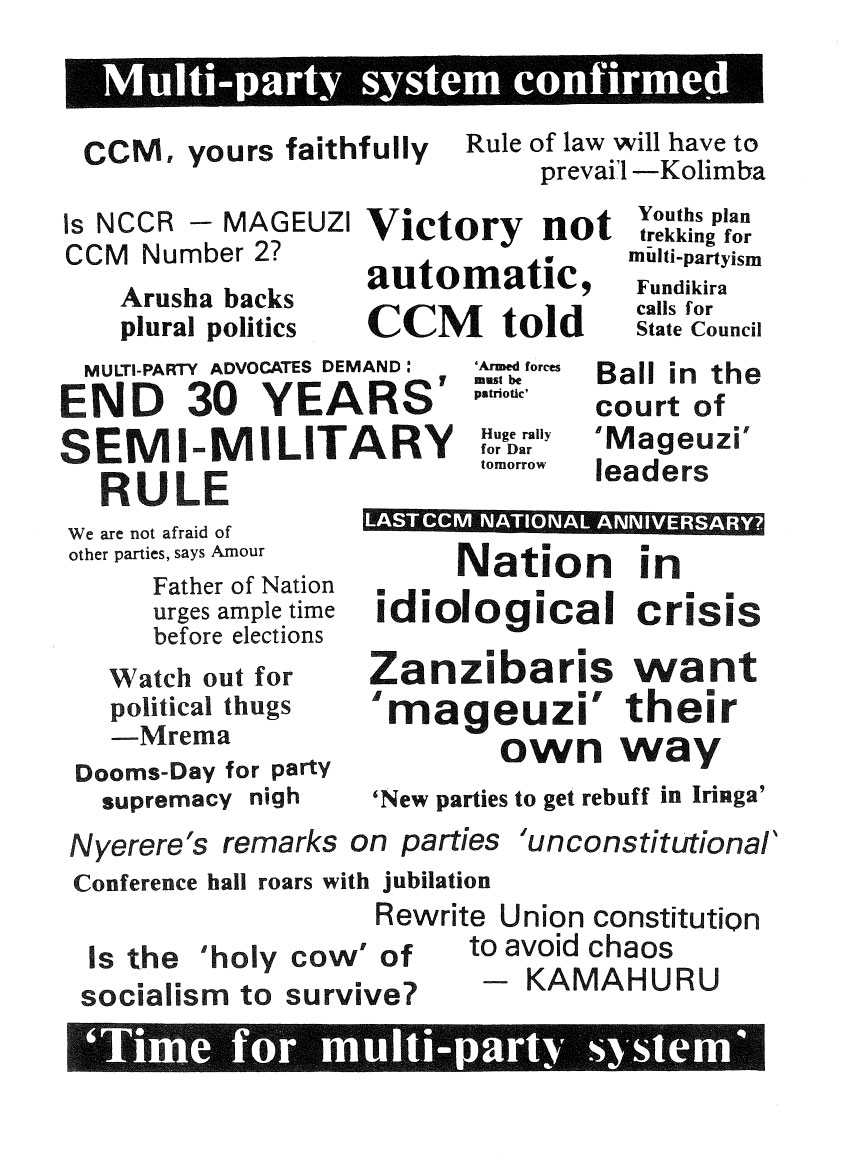
Various local newspaper headlines

WHAT IS MAGEUZI?
The word’ mageuzi’ seems to be on every lip and is also being widely used in English language publications in Tanzania at present. If you look into the ‘Teach Yourself Swahili Dictionary’ the translation of the word is ‘fluctuations’. But ‘mageuzi’ means much more than ‘fluctuations’. The word ‘change’ does not quite fit the bill. ‘Volte-face’ is better, but is it English? It seems that there is, in fact, no precise English translation of the word. But those interested in Tanzania need to understand what it means. Hopefully, the headlines from recent Tanzanian newspapers featured opposite and the explanations given on the following pages will help readers to clarify the matter – Editor.

THE HISTORIC DECLARATION
(From the National Executive Committee of the Chama Cha Mapinduzi (CCM) – the Ruling Party of Tanzania)

CONSIDERING that at this Ordinary Meeting held in February, 1990, the National Executive Committee (NEC) examined in detail the question of changes taking place in Africa and the world as a whole, and later decided to initiate a national debate on either to continue with a one-party political system or embark on a multi-party system in Tanzania;

AND CONSIDERING that the President of the United Republic of Tanzania had set up a Presidential Commission to co-ordinate the debate and advise on the need, wisdom, and consequences of continuing with the one-party system or changing this system;

AND CONSIDERING that at the end of the debate the Presidential Commission has presented to the President its Preliminary Report recommending that a Multi-Party Political System should now be introduced in Tanzania;

AND CONSIDERING that after deep examination of the recommendation of the Presidential Commission which was presented to us by the President of the United Republic, which we agree to unanimously;

THEREFORE we the Members of the NEC who met in Dodoma on 17 – 21 January, 1992, in accordance with Article 74(3) of the Constitution of Chama cha Mapinduzi (CCM):

1. Agree with one voice to present to an Extra-Ordinary National Party Conference the Presidential Commission recommendation that a Multi-Party Political System should be introduced in Tanzania.

2. In order to ensure that the transition from the present system to a multi-party state takes place in a peaceful, politically stable environment and in the spirit of national unity, the NEC recommends that the Extraordinary Party Conference should direct that:
(a) The Government of the United Republic of Tanzania, in co-operation with the Revolutionary Government of Zanzibar, should amend the Constitution of the United Republic of Tanzania so that the question of registration of political parties and other related issues, should be a Union matter.
(b) The new political parties should be guided by the principles that they are national in character, taking into account the two parts of the Union; and should not tend to divide the country or the people on the basis of one part of the Union, or seek to divide the country or its people along tribal, religious, regional or racial lines or on the basis of sex …

DRASTIC CHANGES PROPOSED IN PRESIDENTIAL COMMISSION REPORT
The Bulletin has not yet been able to obtain a copy of the full three volumes of what is becoming known as the ‘Nyalali Report’ (after the Chief Justice who headed it).

The Commission heard opinions from 36,000 people and groups. It studied other political systems. It concluded that it was now possible to have a genuine multi-party democracy in Tanzania without endangering its unity, its security and its peace. From the extracts being published at intervals in the press, it is clear that it is filled with revelation and contains innumerable recommendations, which, if approved at a National Assembly meeting planned for April 28th 1992 will change Tanzania in fundamental ways.

The Presidential Commission made the following recommendations:
The country should have THREE PARLIAMENTS for a Federation (50 members), for Tanganyika mainland (160 members) and for Zanzibar (60 members): this recommendation is being much criticised because of the disparity in size of the proposed governments vis a vis the Federation; the recommendation also divided the Commission; 12 members voted in favour of three governments, seven voted for two governments and one decided not to vote at all;

Both sides of the Federation should be led by PRIME MINISTERS:

POWER OF THE PRESIDENT: The Federal Parliament should ensure that the President is made accountable; the Parliament should be able to pass a vote of no confidence or impeach the President; under no circumstances should the President be allowed to dissolve Parliament; Parliament should be declared dissolved, either after its expiry date, or, following the downfall of the ruling party;

For thirty years Tanzania’s DEPARTMENT OF NATIONAL SECURITY has been working without legal status; a law should be passed making it legal and defining its work, limit of operations and accountability;

The appointment of the Chief Justice and other judges should be done by the two Prime Ministers in consultation with the two Judiciary Appointments Commissions;

The recently established Organisation of Tanzania Trade Unions (OTTU) is not independent as the President has powers to cancel its registration; it has been established from the top (the Government) and not from the masses; the Trade Unions Ordinance should be looked into;

The Commission has proposed the scrapping or amendment of a large number of LAWS including Acts dealing with the Acquisition of Buildings, National Security, Economic and Organised Crime, Criminal Procedures, Peoples’ Militia, Powers of Arrest, Registration and Identification of Persons, Stock Theft, Collective Punishment, Resettlement of Offenders and Removal of Undesirable Persons.

NYERERE SPEAKS TO THE CCM
Father of the Nation Julius Nyerere addressed a Special National Conference of the CCM on February 18th 1992. The following are quotations from his lengthy speech.

‘The one-party has served our country well … it has built up and strengthened national unity while still providing the citizens with an effective means of choosing their leaders … there is no ‘safe seat’ for any M.P! … but times have changed. Tanzanians are better educated … they have greater expectations than we had in the past. We are struggling with severe economic problems. ‘Njoo Kesho’ was always a problem but is now a disease. The poison of corruption remains a problem. In the light of these conditions some changes in our policies are necessary …

I am pleased that the majority of Tanzanians (80% according to the Commission) would like to continue with a single party CCM system. But we cannot wait until the majority of people have lost their faith in CCM before the Party itself seizes and uses its responsibility to usher in change …. True democracy requires that minority views be respected. It also requires that citizens accept that they disagree and then go on arguing with one another in a spirit of respect and toleration.

The change must be made under the leadership of a united and strong CCM. I ask you to believe me in this. I am saying it from deep conviction. But I ask you to believe me also when I say …. that (under multi-partyism) if some people decide to leave the CCM … we would be making a big mistake if we treat them as traitors … to lead is to show the way.

Mr Chairman, I am urging this conference to agree to political change … I hope you will welcome future opposing political parties as a good soccer team welcomes a worthy competitor …. ‘

WHAT OTHER PEOPLE ARE SAYING
‘Everybody, even the dimmest political observers, could see that it was no longer possible to rule any country in Africa on the basis of a one party system; but it has taken massive pressure at home and a threat of aid withdrawal from abroad to force Tanzanian authorities to begin to have a glimpse of the obvious … above all, it was the humiliating defeat of our good old friend Kenneth Kaunda of Zambia that has alerted the reluctant power holders to the impending showdown …. this is sad because Tanzania has always been innovative and constantly taking the initiative on major issues concerning Africa… ‘ former Cabinet Minister Abdul Rahman Babu in ‘Africe Events’:

‘We have adopted political pluralism to strengthen democracy in our country – not for the destruction of our nation …. had we refused it we would have given the opposition the opportunity to seek more riches from outside and perpetuate their agitation underground’ – Zanzibar Chief Minister Dr Omar Ali Juma;

‘New political parties will not be harassed or intimidated …. CCM is for a fair contest and peace, love, tranquillity end solidarity are in the blood of Tanzanians’ – President Mwinyi.

‘After 30 years of groping in the dark, of trial and error, of experimentation, Tanzanians will now stand up and say, like Karl Marx said 144 years ago, ‘we have nothing to lose but our chains … but we have the whole world to gain’. Indeed, monumental changes are in the offing’ – Robert Rweyemamu writing in the ‘Business Times’;

‘It is a grave mistake to underestimate your opponents’ – President Mwinyi;

‘We will not invite foreign nations to monitor and supervise the general elections because Tanzania is mature enough for the task’ CCM Secretary General Horace Kolimba;

‘Democracy may mean independent newspapers but it also means radically raised school fees’ – 79-year old Barbro Johansson, former Headmistress and distinguished Member of Parliament interviewed in Bukoba:

‘My region expects to recruit 60,000 new CCM members. If you, my subordinates, let me down so that we get less, I will weep’ – Dar es Salaam Regional Commissioner, Mary Chipungahelo quoted in ‘New African’;

‘The CCM will never forsake its Ujamaa and Self-Reliance Policy even though it has embraced the multi-party system’ – CCM Secretary General Horace Kolimba;

‘Former President Nyerere’s demand that political parties …. must draw members from both the mainland and the Isles is unconstitutional. … political parties are not stipulated in either the Union or the Zanzibar constitutions as being Union affairs …. Zanzibar is for Zanzibaris and it is a nation’ – Shabaan Mloo of KAMAHURU;

‘I do not care what is happening in CCM as long as get my bread peacefully and I can sell my shirts and sunglasses; Achia wazee wafanye vitu vyao’ – a street vendor in Dar es Salaam (Daily News);

‘As CCM celebrates its 15 years of existence it can boast of one thing. It has forced the majority of Tanzanians into a brainwashing ideology of socialism. Look at any corner of the population …. people who have been grilled through CCM colleges …. getting favours after becoming members of the Party …. scholarships for Party cadres …. ‘ Givic Kuandika in the ‘Business Times’.

‘Things are only just beginning. The changes …. have given our cause A higher profile and a greater sense of urgency; there couldn’t have been a better moment for pushing our case’ – recently released from detention former Zanzibar Chief Minister Seif Shariff Hamad, interviewed in ‘Africa Events’.

‘Whether a country has one party or two parties or three parties, the present economic trends will not dramatically change …. (but) …. the democratisation of our societies will harness the energies of our people and so will ensure (their) more meaningful participation in the development process – Organisation of African Unity Secretary General Salim Salim speaking on the BBC.

THE PROCEDURES
Outlining the procedures for the introduction of multipartyism at a huge rally in support of Mageuzi in Dodoma on March 10th, President Mwinyi said that persons intending to form political parties would have to submit to the Registrar of Societies the proposed constitution of the party and list of leaders. The registrar would determine whether the party had a tribal or religious inclination. The party would not be recognised if it did and would only be registered if it had 200 trustees in each of 10 regions of Tanzania which must include Pemba and Unguja (Zanzibar main island). Parties would be given six months in which to fulfil this latter condition. “If they fail in six months to get the necessary trustees, then we will know that they are not serious and they will be disqualified.”

PLETHORA OF NEW PARTIES
A wide variety of groups want to form political parties but until the appropriate legislation is approved such parties remain illegal.

Amongst the aspiring groups are the following:

UNITED DEMOCRATIC MOVMEMENT (UDM) formed by former Government Minister Chief Abdallah Fundikira.

NATIONAL CONVENTION FOR CONSTRUCTION AND REFORM (NCCR); as this is not easy to translate into Swahili, the party proposes to add to this title the word ‘Mageuzi’ so that the party would become NCCR-Mageuz1.

James Mapalala’s CIVIL AND LEGAL RIGHTS MOVEMENT (CLRM).

The Reverend Kamara Kusapa’s DEMOCRATIC PARTY.

Mabira Marando’s NATIONAL COMMITTEE FOR CONSTITUTIONAL REFORM (NCCR) which is said to be actively recruiting members at the University of Dar es Salaam.

Emmanuel Makaidi’s NATIONAL LEAGUE FOR DEMOCRACY (NDL).

Munua Mughuni’s PRAGMATIC DEMOCRATIC ALLIANCE.

Sheaban Mloo’s ZANZIBAR SPECIAL COMMITTEE TOWARDS FULL MULTI-PARTY DEMOCRACY – or KAMA HURU which has the support of former Zanzibar Chief Minister Seif Sheriff Hamad:

Former Foreign Minister Oscar Kambona’s TANZANIA DEMOCRATIC ALLIANCE.

Exile (in London) Yassin Member’s YOUTH DEMOCRATIC MOVEMENT which took a four-page advertisement in the ‘Family Mirror’ in Dar es Salaam to publicise its manifesto.

The TANZANIA AFRICAN NATIONAL UNION (TANU) following an announcement by Joseph Nyerere, Mwalimu’s younger brother. But, according to ‘Africa Events’ (March 1992) ‘the mind behind the project is the veteran philosopher King Julius himself … ‘.

THE IMPLICATIONS FOR THE CCM
The Bulletin understands, but this has not been confirmed, that members of the CCM party were far from enthusiastic about supporting multiparty politics until they were addressed by Father of the Nation Julius Nyerere. They did not have long to wait, however, to see how democracy in the Party would affect them and the sacrifices they would have to make to compete in a multiparty system.

On March 19th the Party’s National Executive Committee (NEC) announced sweeping changes in the Party’s constitution and structure. The changes included:

– the introduction of two Vice-Chairmen – one for Zanzibar and one for the mainland;
– closure of all CCM branches at work places, factories etc; Party branches would be set up only in villages, residential areas in towns and in institutions directly controlled by the Party;
– Branch, rather than district, executive committees would have the power to decide on applications for membership: branch secretaries would be elected by branch executive committees and not nominated by the central committee;
– salaried officials at all levels would be reduced in number to save funds; the number of delegates to the National Conference would be reduced to 5 instead of 10 from each district; elected NEC members would be cut from 90 to 70; nominated members from 15 to 10: the number of sittings would be reduced; the Defence and Security and Disciplinary Commissions would be abolished; ‘CCM to lose thousands’ headlined the ‘Business Times’;

The next day the NEC announced that members of the Defence and Security forces would cease to be members of the Party. Soldiers wishing to continue to serve would have to surrender their party membership.

Property given to the Party at branch level, including buildings would have to be returned to the former owners. District and Regional Commissioners would no longer also have CCM Party functions; they would be appointed by the President of the party in power.

The following day CCM members were told that the Kivukoni CCM Ideological College would be turned into an academy of social sciences and the seven zonal ideological colleges in the regions would be closed to bring about a saving of Shs 200,000 per year.

TANZANIA IN THE INTERNATIONAL MEDIA

SOMETHING GOOD HAS HAPPENED
AFRICA EVENTS had a six-page special feature on Tanzania in its March 1992 issue. In the introduction it wrote that ‘Informed Tanzania watchers … point to fresh sprigs sprouting off the economy, distinctly hinting that a new spring of surging prosperity is finally approaching. Economic growth, for example, has regained its lead over population growth. Standards of living, long frozen, are stirring towards modest improvement. Record export crops are reaching outlets on upgraded roads. Donor confidence and foreign investor interest are both on a cheery upturn. Monopoly politics is giving way to reforms which should stiffen up the benefits of this economic change. In broad measure, the sense that something good has happened is fair enough. Equally fair must be the sense of optimism that tinges the future. However, Zanzibar might turn out to be a gadfly ….

TANZANIA LIFTS CURBS
The Johannesburg WEEKLY STAR (April 1, 1992) announced on its front page that Tanzania’s Foreign Minister, Ahmed Diria, had stated that Tanzania was to lift sanctions on air travel and sports relations in recognition of the changes brought about by President de Klerk. Economic sanctions would continue for the present he said.

LIVINGSTONE’S LAST RESTING PLACE
BRITISH OVERSEAS DEVELOPMENT had an article on Bagamoyo in its January 1992 issue. It recalled how David Livingstone had died in 1873 in what is now Zaire. His heed had been buried in Africa end his embalmed body had been carried to Bagamoyo on a journey which took nine months. The last resting place of the body on the African mainland (before burial in Westminster Abbey) had been the Bagamoyo Catholic Mission. Britain is now paying for the restoration of the tower of the mission.

BASKING ON THE BEACH
The Johannesburg STAR gave publicity to a recent statement quoting Tanzanian Prime Minister John Malecela to the effect that South African tourists might soon be basking in the sun on Tanzania’s Indian Ocean beaches. “Don’t be surprised to see Boers coming here or Tanzanians going to South Africa” he had said in Parliament. Air Tanzania subsequently announced agreement on the start of a regular service to South Africa.

IMPORTANT DRUG SEIZURE
Tanzanian Customs authorities have seized 5.5 tons of illicit drugs according to AFRICA EVENTS (April 1992). The authorities in Dar es Salaam were said to be worried that Tanzanian drug traffickers might begin to play a role similar to that of their Nigerian counterparts in West Africa by acting as a conduit for drug transfers to Europe and North America. Police records showed that in the past six years more than 10,000 people had been arrested for alleged involvement in drugs.

A MEMORY OF LUSHOTO
In its series ‘A Memorable Wine’ the WINE SOCIETY’S BULLETIN for February 1992 contained a story by a Dr C. Granger in which he exercised some poetic licence in recounting a tale of many years ago. He had carried a quarter bottle of champagne in his rucksack – first by air (with the bottle in the decompressed hold), then across two frontiers by train, then by bumpy road for 18 hours to join his wife, who was working in Tanganyika, to celebrate their first anniversary of wedded bliss. The destination was Lushoto ‘a small verdant valley which the British Governor of the then Tanganyika had tried to buy (!) as a summer refuge from the heat’. ‘Our hotel’ he wrote’ overlooked the town, which, with its German missionaries and Bavarian churches, might have been in the foothills of the Alps. On the day of our thirteenth (month) anniversary we walked along the mountain crest to a spot known as ‘The View’ and sat on a rock overhanging a plunging cliff. Far below, the plains of Africa stretched away under the great sky …… I pulled the bottle from my rucksack triumphantly. My wife whooped with delight, I ceremoniously unwound the wire cage. Jill dug out our plastic mugs. I popped the cork. Only there was no pop, no bubbles. Just a hollow plop, and an evil smell. The champagne, like the anniversary, was overdue. It had probably undrinkable for a decade. (Thanks to reader Patrick Duff – Editor).

‘A PEARL OF MANY BRILLIANT COLOURS’
In a colour illustrated article in the April issue of NEW AFRICAN, the origins of Tanzania’s famous ‘Tinga Tinga’ paintings was told. Former fisherman Edward Said Tinga Tinge (who died in 1972) had started painting in his distinctive style using household gloss paint, rescued from abandoned tins, end commonplace surfaces such as hardboard, plywood or tin instead of costly canvas. The result? ‘A riot of multi-coloured images of African life; animals, birds, butterflies, flowers and tropical vegetation’. Now, one of the persons he taught, Rashid Bushiri, is teaching others in Swaziland under a project supported by the European Community; later this year, he has been commissioned to do murals on the wall of a hotel in Denmark.

POP FLOP
Many newspapers around the world catalogued the ill-fated visit to Africa of the American mega star Michael Jackson. For example, the BOTSWANA DAILY NEWS reported on its front page that Jackson had arrived in Tanzania on February 17th after visiting Gabon and Cote d’Ivoire where he had been greeted by tens of thousands but had upset Many of them. ‘On arrival in Dar es Salaam, the paper wrote, the singer ran to a waiting car, clutching his nose and hiding his face with a handbag, ignoring Tanzanian Foreign Minister Ahmed Diria who was waiting to welcome him’.

The DAILY NEWS in Tanzania gave many more details of the visit. Michael Jackson had visited the Sinza Centre for Mentally Retarded Children where he had left fond memories and had, later, met President Mwinyi who had asked him, after his proposed visit to the Serengeti, to become Tanzania’s envoy abroad and explain about the country’s tourist potential. However, the Singer suddenly cut short his visit and left for London, leaving thousands of admirers in Arusha and Kenya disappointed. The apparent reason was that he could not fly in any plane other than his own (which was too large for the Serengeti airstrip) and could also not drive in a car for more than one and a half hours. He was said to be allergic to dust.

The general response in Dar es Salaam was said to have been ‘good riddance’. Others agreed with earlier comments from Abidjan which had described Jackson as ‘a recreated being, bleached, neither white nor black, so delicate, so frail …’

A COUNCIL OF ELDERS
The London TIMES in its March 24th issue reported that former African Presidents had decided at a meeting in Tanzania to form a Council of Elders to tackle the continent’s perennial conflicts. The meeting was attended by former presidents Pereira of Cape Verde, Kaunda of Zambia, Obassnjo of Nigeria and Nyerere of Tanzania.

SATELLITE PHOTOGRAPHY TO MONITOR DEFORESTATION
WORLD BANK NEWS in its February 13 issue stated that Tanzania is to obtain an IDA Credit of US$ 18.3 million in support of a project to stop rapid deforestation through preparation of maps showing forests, agricultural areas and grazing lands and establishing a National Resource Information Centre to coordinate the collection of information on resources, land use and environmental conditions. The project would also support measures to improve land tenure systems, and, in the Mwanza and Tabora regions, help improve the management of 45,000 hectares of forest.

AIR TANZANIA SUSPENDED FROM MEMBERSHIP
Air Tanzania has been suspended from membership of the International Air Transport Association because of its financial problems according to the March 16 issue of the INTERNATIONAL HERALD TRIBUNE. The paper said that the IATA members would not now honour Air Tanzania tickets. The Tanzania DAILY NEWS reported on February 22nd that the Government had ordered the Air Tanzania Corporation (ATC) to cancel flights to Europe and India following serious losses on these routes using a plane leased from Ethiopian Airlines. The newspaper reported that ATC had had to ground its planes on April 1st because it apparently could not renew its insurance cover. It is also understood that the Government has decided to privatise the airline.

DAR THE MOST SATISFACTORY
In an article on shipping services between East Africa and Europe the AFRICAN ECONOMIC DIGEST (February 24) quoted Steve Barlow, Commercial Director of the ZAMCARGO organisation, as saying that, of the East African Ports, Dar es Salaam generally gave the most satisfactory performance. “The port itself functions quite efficiently following recent heavy Investment” he said. Similar comments in AFRICA EVENTS (April 1992) which reported that Mombasa’s efficiency had somewhat slumped and That it was meeting robust competition from Dar es Salaam which was fast modernising.

CHEESE MANIA IN TANZANIA
In its February 15th issue the DAILY TELEGRAPH gave considerable prominence to an apparently insatiable appetite for cheese which had suddenly developed amongst Tanzanians and others. So great was this demand for cheese, in fact, that Dutch customs officers had become suspicious. Thousands of tons of Dutch dairy products had apparently been shipped outside the European Community but had later found their way back to traditional market such as Germany thus allowing certain persons, now being investigated, to obtain attractive export subsidies from the Community.

TANZANIA TO GET A REDUCED ALLOCATION
The first issue in 1992 of HABARI, the Journal of the Svensk-Tanzeniska Foreningen in Stockholm, revealed that Swedish aid policy is in the process of change. Tanzania, Mozambique and Vietnam have had their allocations reduced. A change in ideological course in Sweden was said to be plainly evident. In the case of Mozambique, the reduction was attributed to poor uptake capacity. The same was said to be true of Tanzania, which was considered to have had too large a programme. The reduction would be of the order of £5.5 million. The State Secretary responsible had said that in his opinion the whole Tanzanian aid programme had been too greatly dramatised. He dwelt long on the question of democracy. ‘The Government unmistakably equated democracy with a multi-party system irrespective of the considerable differences in historical, political, social and economic circumstances of the different countries’ the Journal wrote.

JUST A HANDFUL OF NUTS
NEW AFRICAN (March 1992) reported that drinkers in Dodoma are up in arms about a blanket ban on locally brewed liquors. The ban had been imposed following a cholera outbreak which had caused 200 deaths between November and January. Local producers of ‘Wanzuki’ – a fermented honey liquor – had got around the ban, however, by putting the liquor into commercial wine and beer bottles end pretending it was something else. This had confused the health inspectors (and presumably also the customers) for a time, but then the Police found out and began to seize illicit stocks. But the brewers showed considerable ingenuity. They started hiding the liquor in other ways. In one case alcohol was stored in a coffin. Customers were told to join the ‘funeral procession’. Others soaked nuts for a long time in illicit grain (gongo). It was said that people could get drunk on just a handful of nuts.

HYGIENE AT THE KIGMANBONI FERRY FISH MARKET

The SOUTHERN AFRICAN ECONOMIST in its December/January issue featured Dar es Salaam’s well known Kigamboni fish market. ‘The fish and food vendors have been supplying meals at the affordable price of Shs 70 for some time. But they noticed that their clients often had to go away to answer the call of nature, usually not to return. They therefore raised Shs 50,000 to build a latrine. At Shs 2/- per shot the clients were happy but the project lost money for lack of management’. Now the Tanzania youth Development and Employment Foundation has undertaken a feasibility study designed to improve overall hygiene at the Ferry Fish Market.

HOW TANZANIA LINES UP
NEW AFRICAN THE WORLDS’S MOST FAMOUS BEEKEEPER
In a lengthy article on the man it described as the ‘Einstein of bee breeding’ the SUNDAY TIMES

THE BBC AND TANZANIA

Tanzania figured prominently recently in two significant and totally contrasting broadcasts.

The first was a four-part weekly series of talks on BBC Radio 4 under the title ‘AFRICA: DEADLINE FOR THE DARK CONTINENT’ by the well-known presenter Michael Buerk in which one whole programme was devoted to Tanzan1a. Such was the interest in the series that the BBC received over 1,000 letters about it from listeners.

The second was a television programme broadcast on Channel 1 at the peak hour of 9.30 pm on April 17th 1992 which must have had an audience of millions. This was called ‘THE COMIC RELIEF SNAPPILY TITLED AND UTTERLY SPONDITIOU5 STAB OF EXPLAINING WHY SO MANY PEOPLE IN AFRICA ARE S0 DAMN POOR’. It turned out to be powerful advocacy of continued foreign aid and it was filmed in Tanzania. Christine Lawrence has reviewed it as follows for the Bulletin:

This BBC programme is a novel way of raising funds for needy causes. People who contribute wear absurd red plastic noses. The presenters of the programme play on our sense of the ridiculous and attempt to let nothing be boring. Their success last year raised £20 million, every penny of which has gone to deserving causes in the UK and in Africa.

The recent programme was a look ‘Behind the Nose’ and included a documentary on poverty in Tanzania. We followed Tony Robinson as he travelled from the slopes of Mt. Meru, through Arusha to the Maasai highlands, Ngorongoro, and then to a hot, dry village miles from anywhere”. In Meru there was the coffee market problem; in Arusha dreadful shanty town poverty; in Maasai-land permanently sick children and a school without books or pens; Arusha hospital lacking drugs and equipment; in the Ngorongoro Conservation Area, the Maasai, suffering from hunger and their cattle dying but forbidden to grow crops on their traditional land; and, in the hot dry Village, a young man explained in beautiful English that all they could do was to sit and wait for the rain.

In between these scenes from Tanzania, we were returned to the UK first to witness farcical interviews by Peter Sissons (Newscaster) of a so-called British Government Minister (Kenneth Winelake), then to hear comments from a comfortably well-off family lounging in their sitting room guzzling chocolates. It certainly made one think. And ask why? Statistics of disasters in the Third World compared with those in the West had the same effect. How much is the West responsible for? Imposed terms of trade; misplaced loans and interminable interest payments; Western politics and the arms trade and big business all come into it and the’ trickle-down’ effect is felt by the poor who are not helped by corrupt and bad government.

In Tanzania, will multi-party elections give the poor more of a voice? Will they result in more justice for the oppressed? And how much more can we in the West do to influence our governments? Will the coming UN Earth Summmit help at all? I fear it 1s very much an up-hill struggle but I think that Comic Relief’s documentary must have had a more positive impact on viewers than the usual straightforward programme and so there should be more reaction.

The radio broadcast perhaps redressed the balance, as many felt that the TV programme had been biased in not paying enough attention to faults on the Tanzanian side. Both programmes had a point to make, however, and both tended to exaggerate in order to do so.

Michael Buerk’s contribution was much more serious, more specifically critical and more sophisticated. It was designed to ‘see how the First World’s solutions for the Third World’s problems are working out’.
The third paragraph of the transcript set the tone: Inside my African taxi the music’s jaunty, reassuring; outside it’s different. This is Dar es Salaam, the ramshackle capital of a bankrupt country, where Tanzania’s dream of African Socialism turned into a nightmare of economic collapse. In colonial times this city, with its wide harbour and palm-fringed beaches was one of the most beautiful in Africa, Now, my taxi picks its way through the potholes, down unlit streets, past dirty and decaying buildings; I sometimes think the most obvious difference between the First World and the Third is fresh paint. I remember, when I used to travel this region in the eighties, Tanzania, though not quite the poorest, was the most depressing place on the continent. No colour, no life, nothing in the shops, an epidemic of apathy. Two decades of defining profit as economic sabotage had destroyed all incentive. The slogan was self-reliance; the reality, the highest per capita dependence on foreign aid in the world.

Next we turned to the IMF and the World Bank. Tanzania had had to start running its economy on lines prescribed by these organisations. A quiet, undemonstrative Englishman was ‘now one of the most powerful men in Tanzania’ – Ian Porter, World Bank Representative. Not so, said Tanzanian Finance Minister Stephen Kibona – “There is no question about it – their (the Bank’s) approach is quite acceptable. We are not “going along” with the World Bank. Much of what we are doing is our own thinking. We want to liberalise the economy. We want to create new initiative. We want people to have ownership ……”

There followed a discussion with coffee farmers in which the pros and cons of foreign intervention were well explored. Populist Home Affairs Minister Augustine Mrema (‘a disconcerting figure, in his black suit and flat dog-toothed hat’) expressed his views as forthrightly as ever – “We are trying to implement the policies of the IMF and the World Bank ….. but the prices (of coffee) are determined by you. So things will never change. So long as you’re benefitting from our economy, so long as you’re getting what you want from us, we’ll remain your labourers really forever”.

Michael Buerk’s conclusions? “After six years of determined Western intervention the formal economy is only a little less hopeless than it was …. Down on Kongwa Street the black market is booming. It’s a neat irony that the World Bank’s most obvious success has been to promote an underground economy which can’t be recorded in its statistics. Tanzania is a good place to go, to realise how resilient Africans are, how what we see as the continent’s slow march to doom isn’t the whole picture, and how the West has never been able to remodel Africa into its own image – DRB.